Author: Lisa-Anne Bauch

  • Beloved Textiles and Family Stories in “Domestic to Decorative”

    Beloved Textiles and Family Stories in “Domestic to Decorative”

    The Scandinavian Weavers’ “Domestic to Decorative” exhibit included several heirloom textiles, which came with wonderful family stories. The heirlooms inspired members of our group to weave new versions of the same technique—in one case, to combine old and new in a single weaving—or to use their imaginations to create something new inspired by the past.
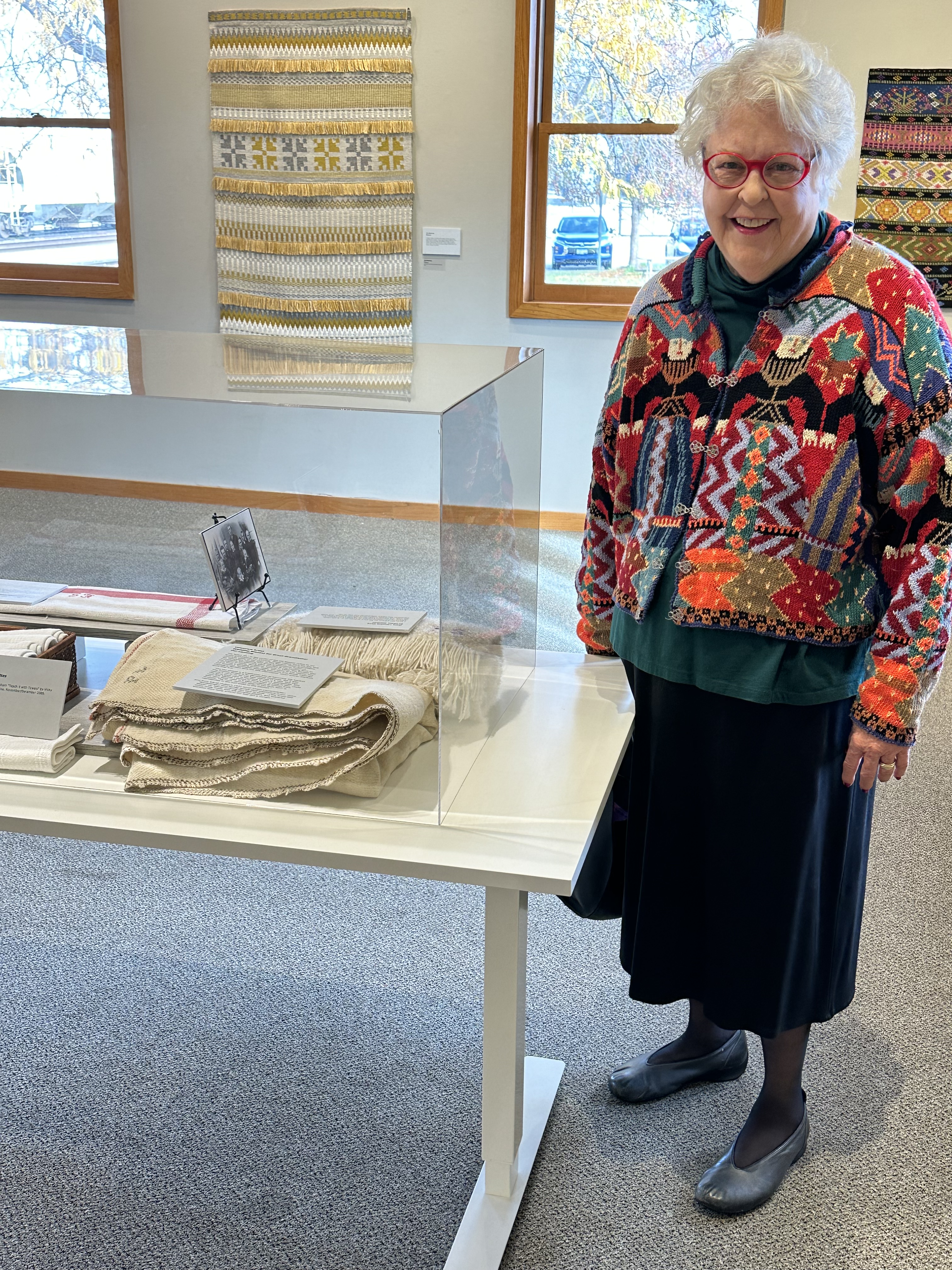
    Weaver Mary Skoy next to the woolen blanket given at her great-grandparents’ wedding.

    One of Mary Skoy’s most treasured family heirlooms is a simple woolen blanket. The blanket was a gift to Mary’s great-grandfather Per Mikkjelson Lønning and great-grandmother Synneva Fransdatter Kanelønning, who were married at the Lønning farm on the island of Stord, Hordaland, Norway in 1880. “The blanket was a gift from a wedding guest,” Mary explains. “The faded PL in the corner of the old blanket refers to Per Lønning. Sadly, the name of the weaver was not recorded.” Note: Mary always encourages those of us in the Scandinavian Weavers group to include our initials on everything we weave!

    Per Lønning and Family

    Mary researched the history of blankets from this era, consulting Norwegian weaving instructor and textile historian Ingebjørg Monsen. Ingebjørg sent the following information about similar blankets from that era: “The red thread is a traditional way of hemming the blanket. The colored thread is for decoration purposes, but it also makes a cover up for the hem stitches in a very nice way. The hand spun yarn in the piece is from a dropspindel. This very fine blanket I expect to have been in used in bed. Could also have been used as a tjeld (curtain) to protect from draught. The more common width of the farm loom is represented in the half width of the blanket.”

    Inspired by the heirloom blanket, Mary wove a new blanket for the birthday of her great-niece. “The elements from the old blanket I incorporated are the color, two narrow lengths hand-stitched together, and most importantly the initials embroidered into one corner,” Mary says. The new blanket is also much softer, incorporating alpaca, mohair, silk, and wool—luxury fibers that would not have been available to her ancestors in 1880.
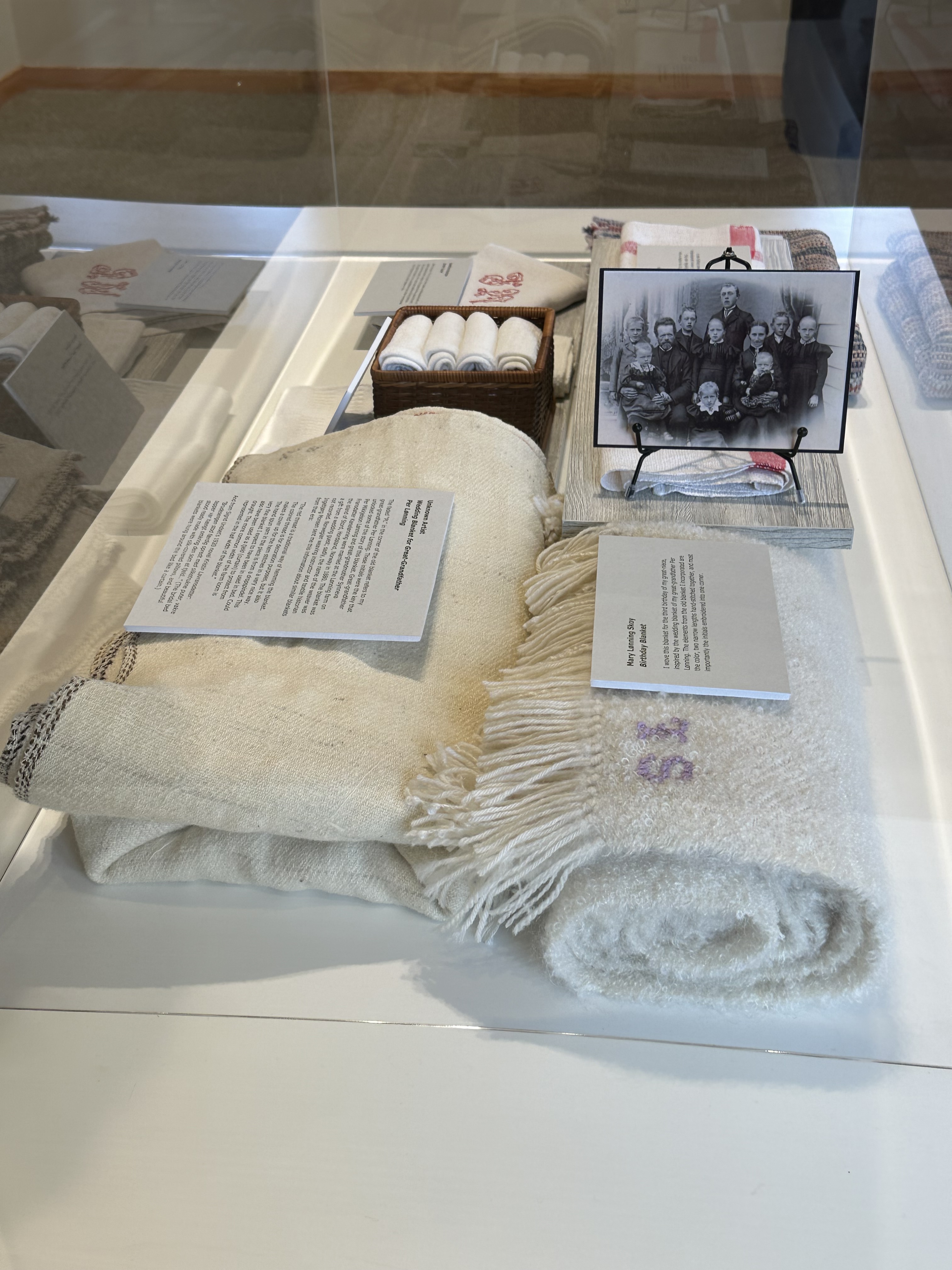
    Original blanket on the left; Mary’s blanket on the right.
    Close-up showing theembroidered initials.Note the difference between the simple wool fibers in the original and the fluffier fibers on the new blanket.

    Beth Detlie was also inspired by Norwegian textiles: “Vegteppe was a wedding gift from my husband’s aunt to us in 1978. She told us that the weaving was done by a distant relative of mine. (My mother’s ancestors immigrated to the United States from the Telemark region in Norway during the 1850s.)” Beth’s Telemark Reflection is an echo of this beloved weaving.

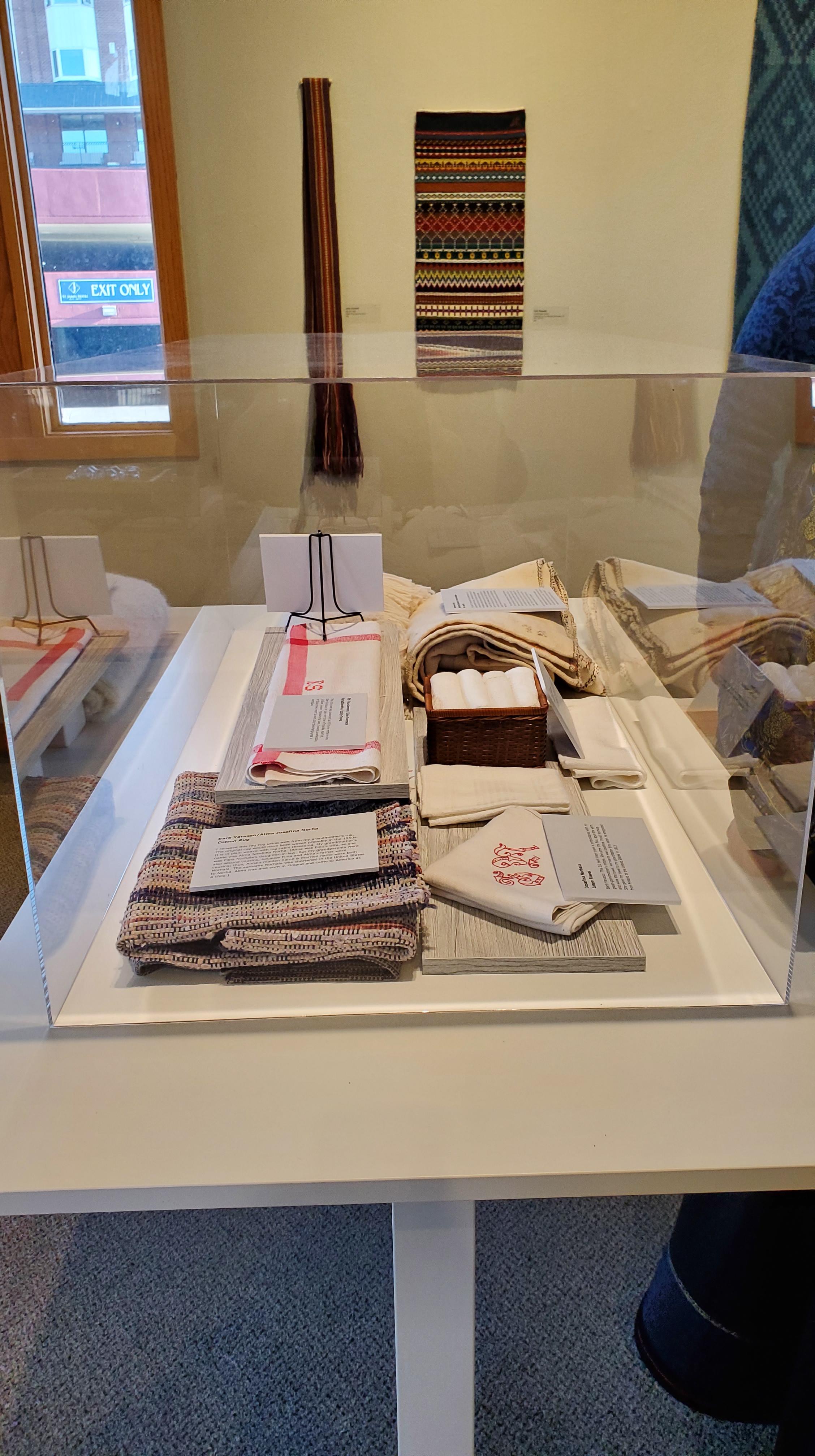
    Original vegteppe on the far wall with Beth’s smaller version on the right. In the foreground is the special case holding other heirloom textiles.

    Edi Thortensson donated a simple but treasured handtowel. “The towel was handwoven around 1950 by my mother-in-law, Ellen Svensson, for use in her home in Tröjemåla, near Ryd, Småland, Sweden,” Edi writes. Inspired by Ellen’s towel, Edi wove a paradhandduk, or display towel, meant to cover utility towels hanging near a washstand.

    Edi Thorstensson and her parahandduk.

    Barb Yarusso shared two Finnish heirloom textiles for the exhibit, including a 2/2 twill linen towel embroidered with her great-grandmother’s initials. Her great-grandmother’s name was Josefiina (Fiina) Norhala. “Josefiina grew the flax, spun the yarn, and wove the towel,” Barb writes. “She gave the towel to my grandfather Eino when he emigrated from Finland to the United States in 1913.”
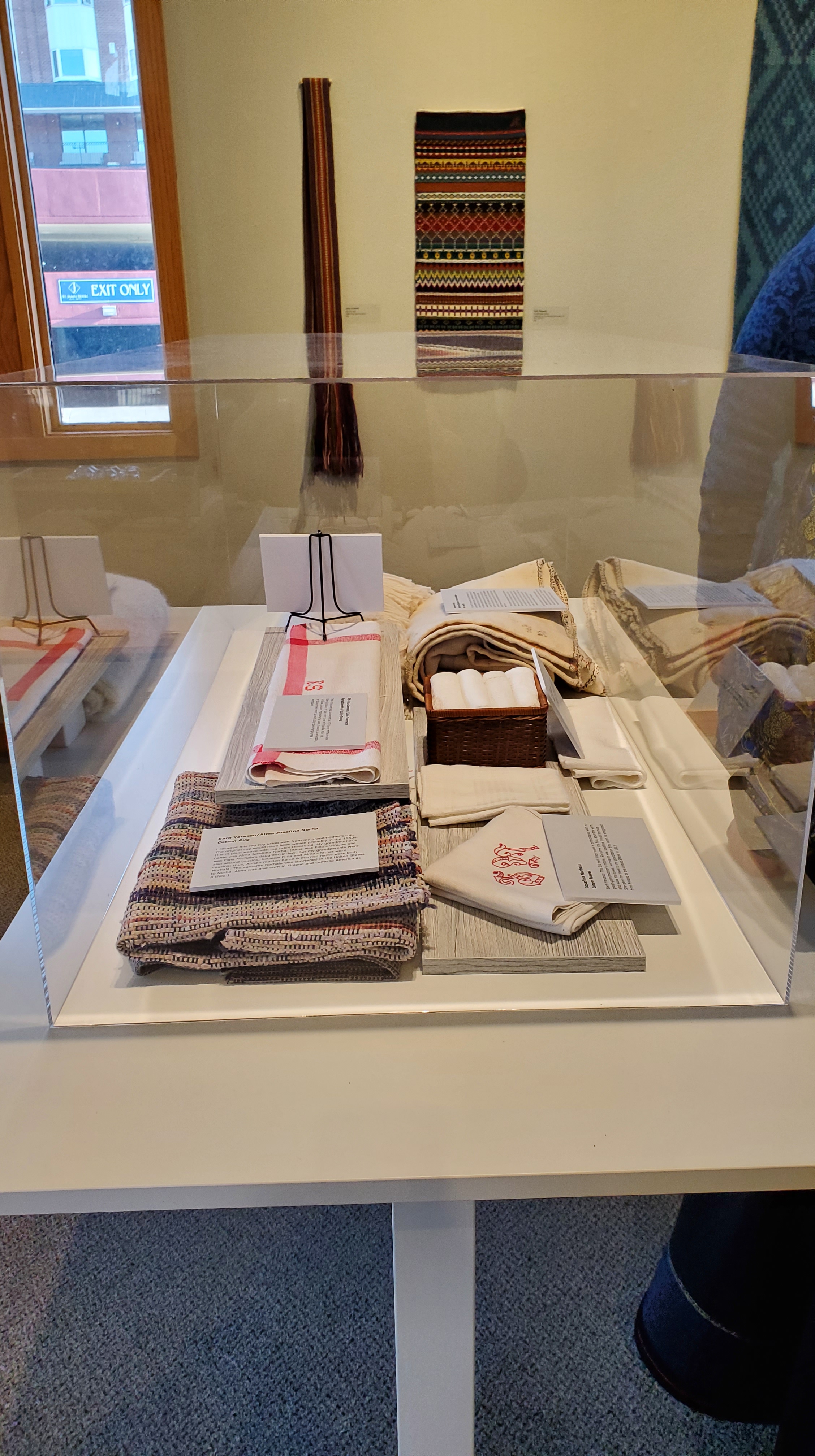
    On the far left is the red and white towel woven by Edi’s mother-in-law Ellen Swenson and embroidered with the initials ES. On the right is the white towel with initials embroidered in red by Barb’s great-grandmother Josefiina Norhala.

    Barb also has a rug woven by Alma Norhala, Eino’s wife. Alma was also born in Finland and came to America as a child. The original rug was woven in the 1950s, in plain weave with log cabin threading. Barb carefully salvaged the cotton weft material and re-wove it into a new rug as her way of honoring Alma’s work.

    Barb Yarusso proudly holds the rug she rewove using weft material from her grandmother Alma Norhala.

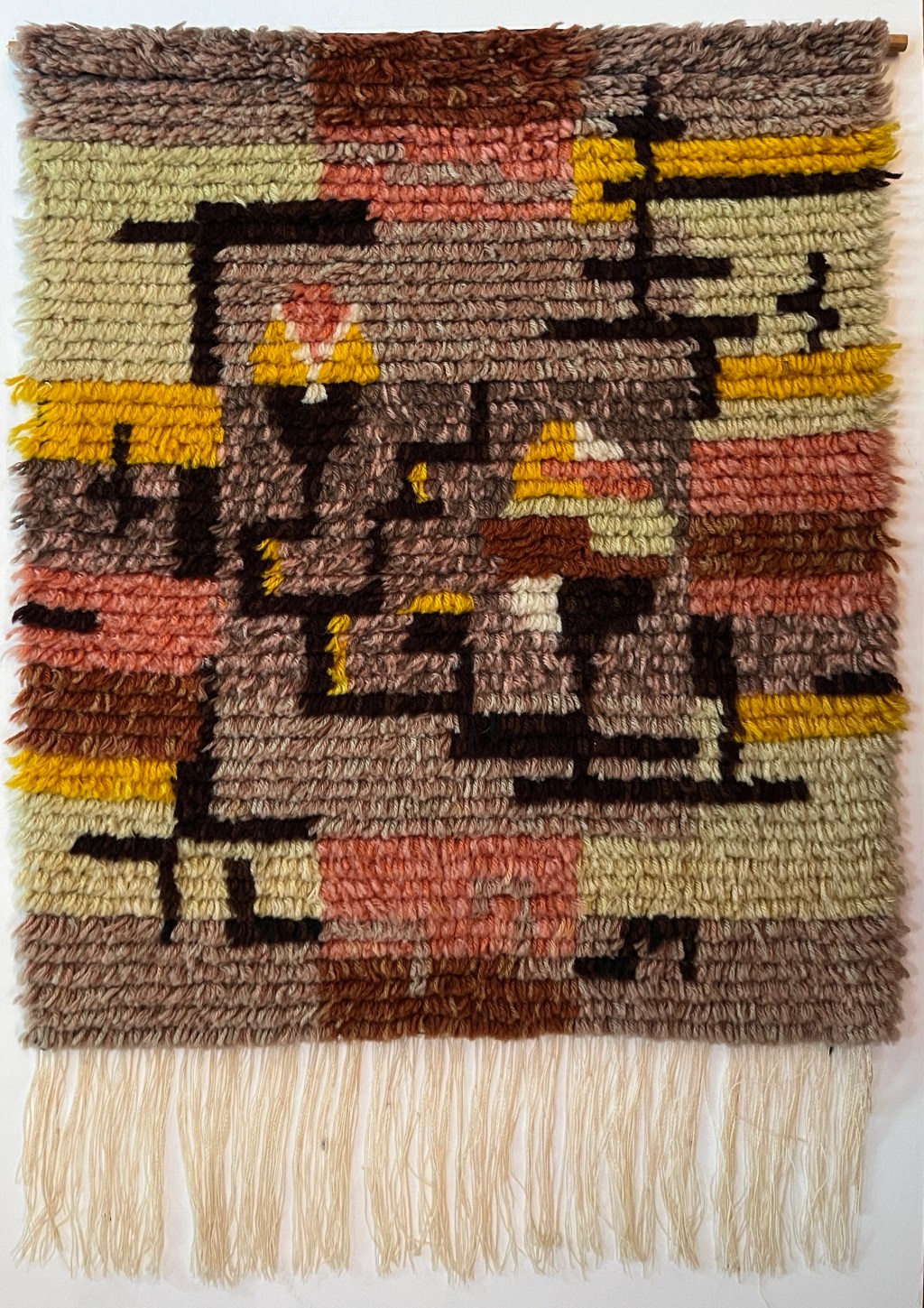
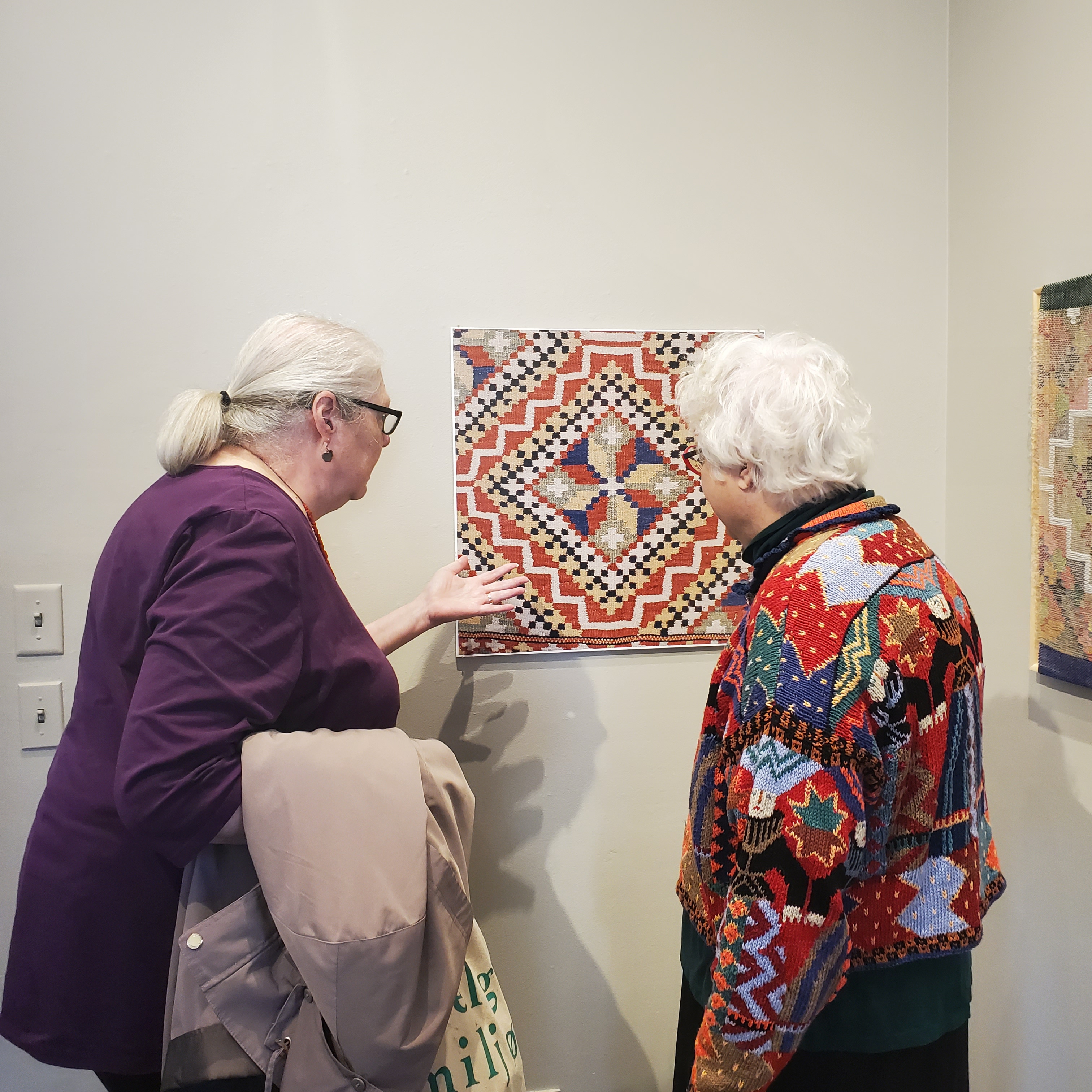
    Peg Hansen was also inspired by Finnish weaving. Löytyi Karannut Lemmikki (A Runaway Pet Was Found) is a vintage (over 100 years old) Finnish Rya/Ryu wall hanging from the collection of Peg’s friend Susan Sutherlund. It belonged to Susan’s grandmother Lydia Ivonen. Unfortunately, the weaver is not known.
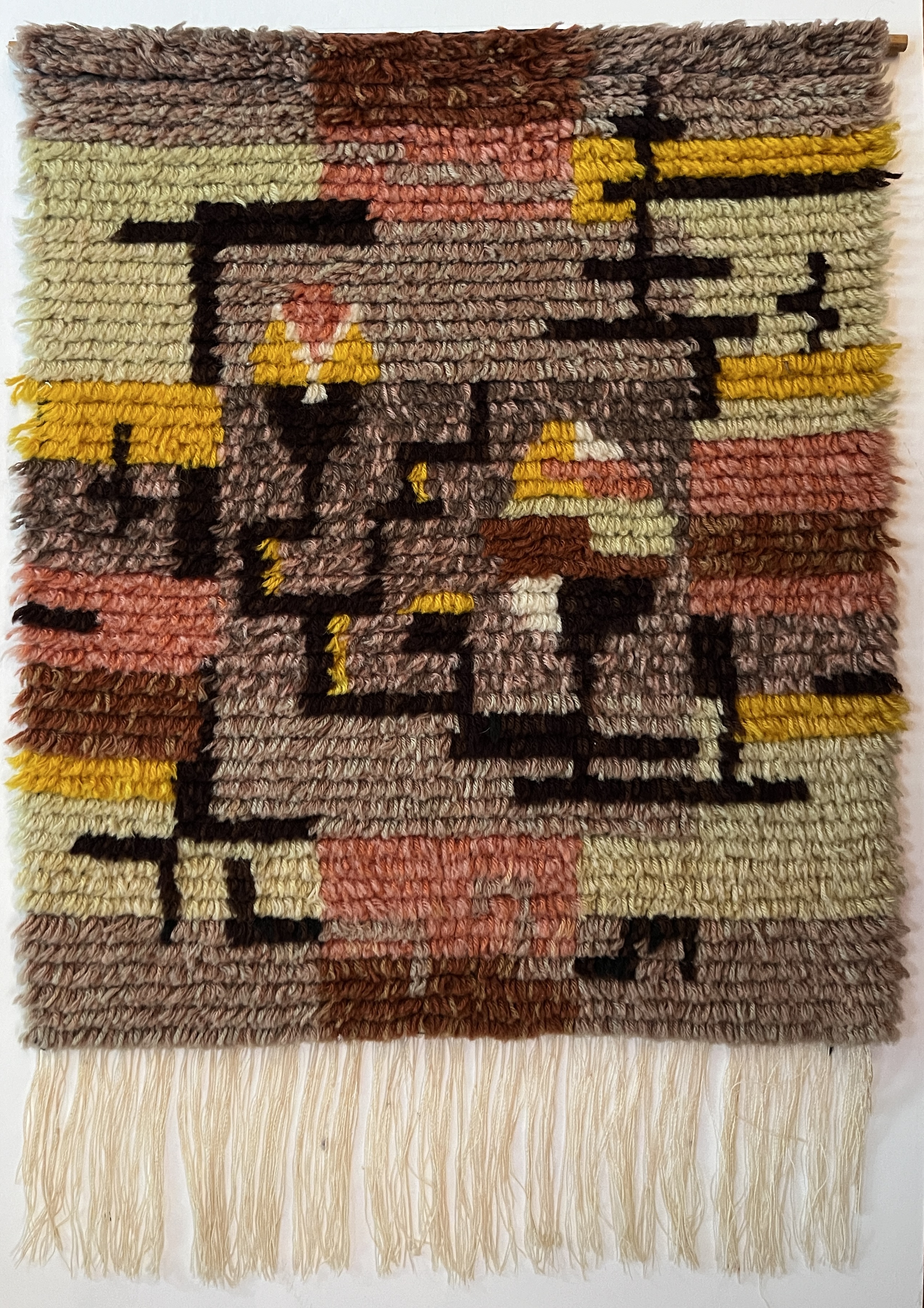
    Löytyi Karannut Lemmikki (A Runaway Pet Was Found)

    This piece served as Peg’s inspiration to learn more about the Rya/Ryu weaving technique used in Scandinavia.
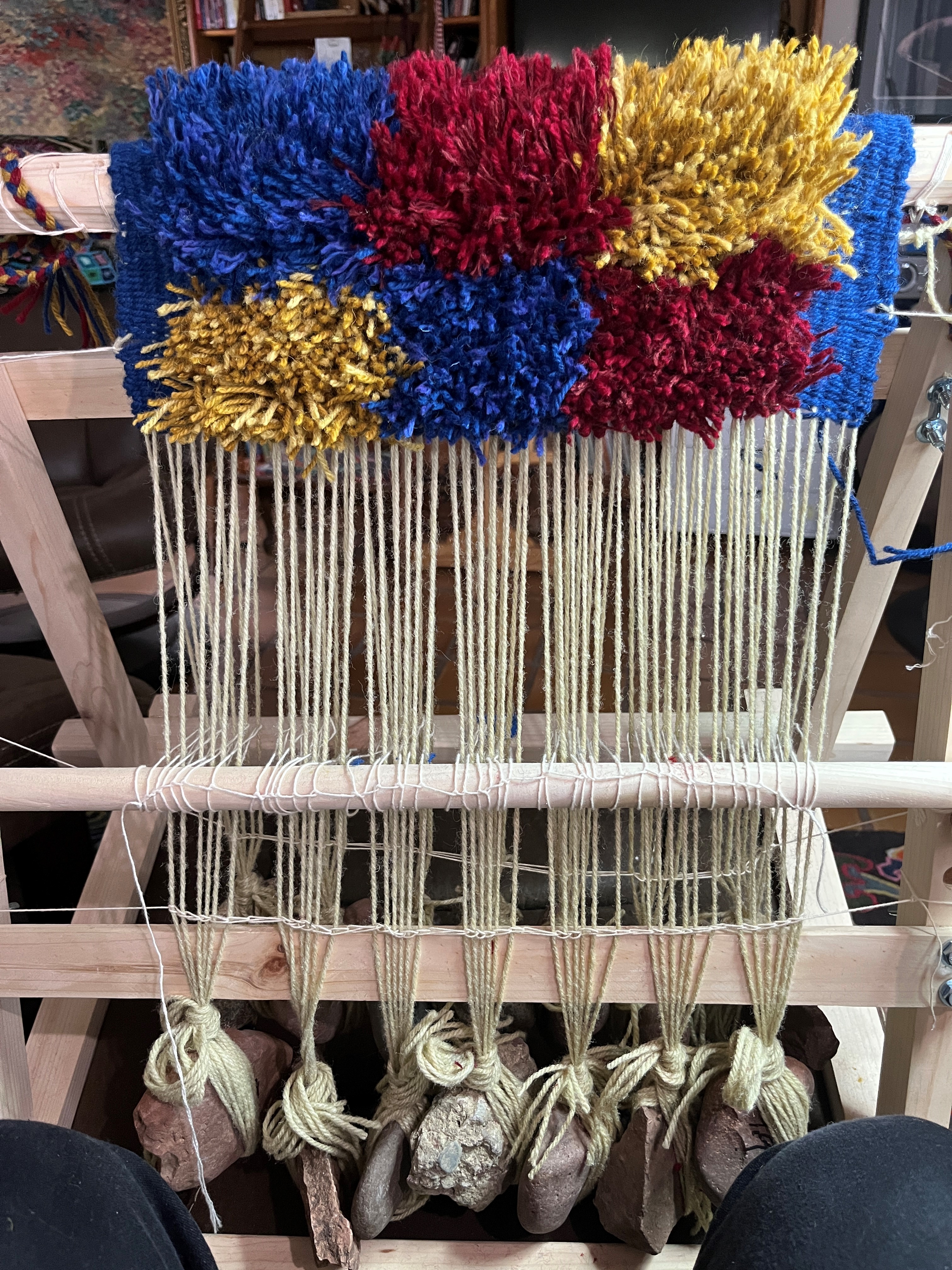
    Peg’s rya weaving on her hand-built warp-weighted loom.

    Kala Exworthy’s source of inspiration was a beloved quilt. “My maternal Grandmother loved making things,” she writes. “From her I learned to knit, rosmal and paint those cute plaster gnomes, which we painted red hats on and called “Nisse.” The photo below is of a quilt given to Kala by her grandmother. “I was the oldest granddaughter and was given first choice of the pile of quilts,” Kala explains. “The fabrics are from worn garments and I have always been a fan of bright colors. As a practical quilt, it has been used from day one. It’s worn and faded now but no less precious.”
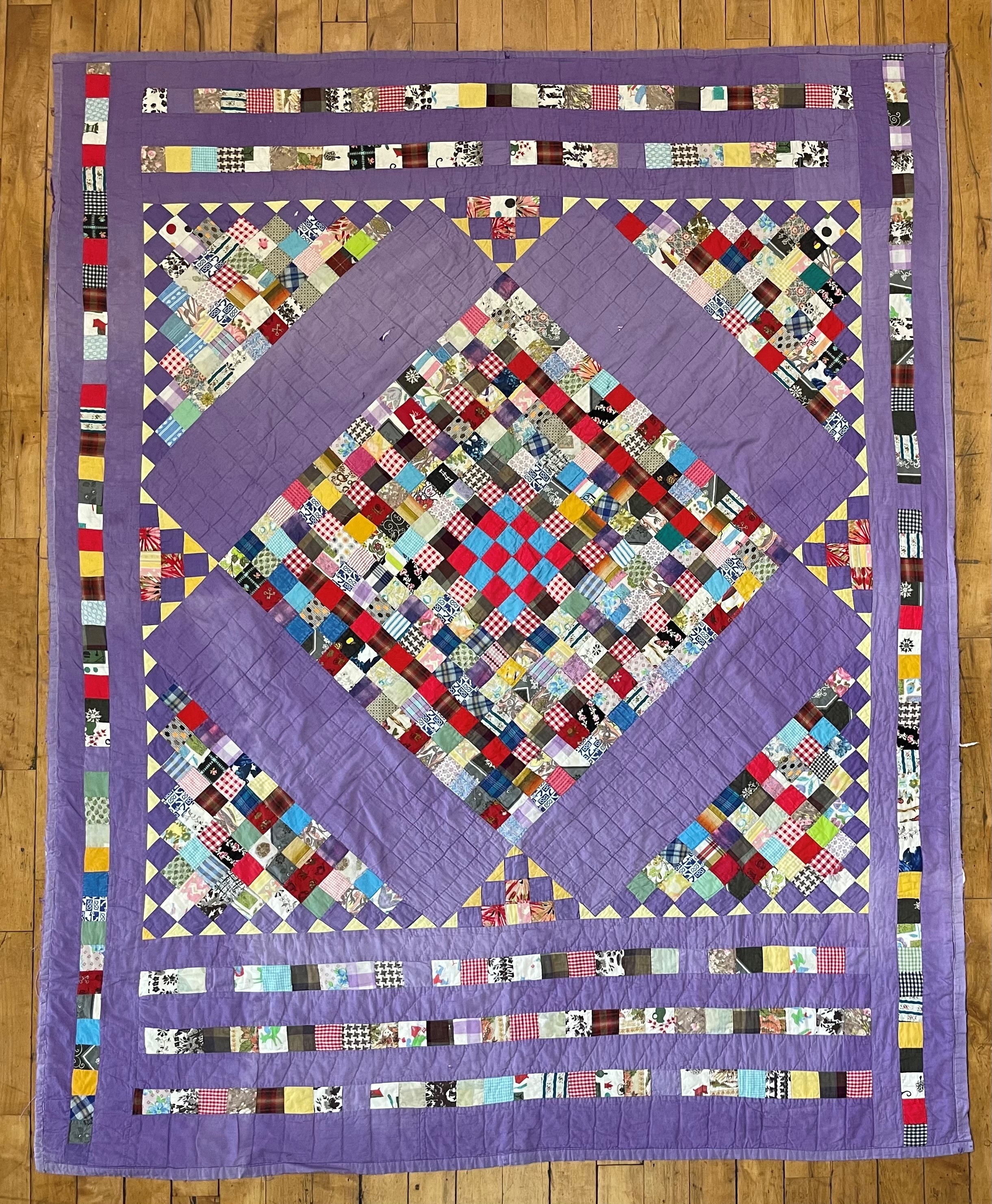
    The quilt given to Kala by her grandmother.

     Inspired by the quilt, Kala wove a wall hanging she calls Memory Fragments. “The wall hanging represents not only the colors in the quilt but also the random memories that I have when I look at the quilt,” she writes. “Pictures in my head of Gram at different times in our lives, red paint on the paintbrush for the Nisse hats, the smell of turpentine and linseed oil used to clean our brushes, yarn and needles and of course, lefse with mashed potatoes, chicken and crispy sugar cookies. I loved going to Gramma Egstad’s house because there was always time to make something.”

    Kala’s Memory Fragments inspired by her grandmother’s quilt.

    For Nancy Ellison, her heirlooms come in the form of sheep. Nancy raises Icelandic sheep and other heritage breeds on her farm near Zumbrota, Minnesota. “Historically in Iceland shepherds wore a mantel or cloak woven with locks of wool to protect the wearer from the weather,” Nancy explains. “The shaggy surface is like the wool growing on a sheep.” Nancy wove a pillow and chair cushion in this technique, using gray, black, brown, and white wool from her flock.

    Nancy shaggy sheep contributed to her weaving!

    Some weavers were inspired by vintage objects, even though they didn’t have a family connection. Sharon Marquart’s From Garment to Garnish was inspired by an antique embroidered bodice, possibly Scandinavian, and an antique beaded belt, which may have been part of a Norwegian bunad (ceremonial dress).
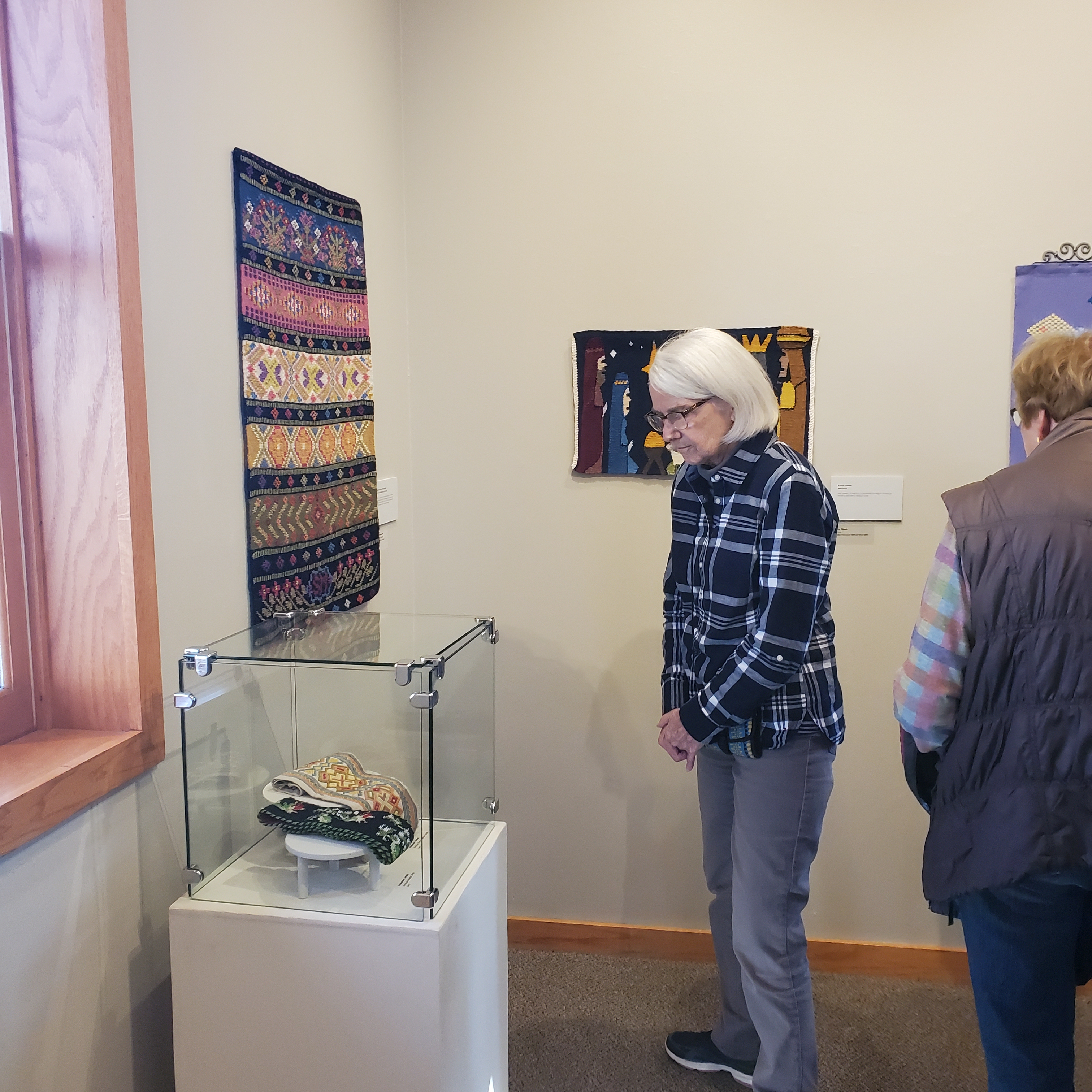
    A visitor examines the vintage clothing items that inspired the woven motifs in Sharon’s From Garment to Garnish, seen on the wall.

    Melba Granlund wove a telemarksteppe she called Reflections. “My color inspiration for Reflections came from a stained-glass window salvaged from an old farmhouse,” she states. “It was purchased at a farm auction in central Minnesota and currently hangs in the dining room window of our “new” farmhouse a few miles away. “

    Melba’s Reflections and a photo of the stained glass that inspired the color palette.

    Although humble, these beloved textiles are still treasures, even a hundred years later. As shown in this exhibit, even the simplest textile can inspire later generations to weave on. We are all part of the fabric of history, and our own small threads can have a positive impact far beyond our lifetimes. Just remember to put your initials on everything you weave!

  • New Year, New Project!

    A cold January is the perfect time to start a new weaving project! The Scandinavian Weavers’ latest group warp is a pattern called Kukkoladräll.

    The Kukkoladräll pattern was composed by Elsa Kerttu in 1926 when she was a student at Jämtslöjds Kvinnliga Slöjdskola (Women’s Craft School) in Östersund as an assignment to create a pattern in Jämtlandsdräll. It was named after Elsa’s hometown of Kukkola, a small fishing village in northern Sweden, just across the border from Finland. A lovely version of this pattern was woven by Ulrika Bos Kerttu, Elsa’s niece, in a palette she named Cloudberry. The draft for the pattern is copyrighted by Sveriges Länshemslöjdskonsulenter and provided bytextilhemslojd.se

    Image of cloudberries from Pinterest.

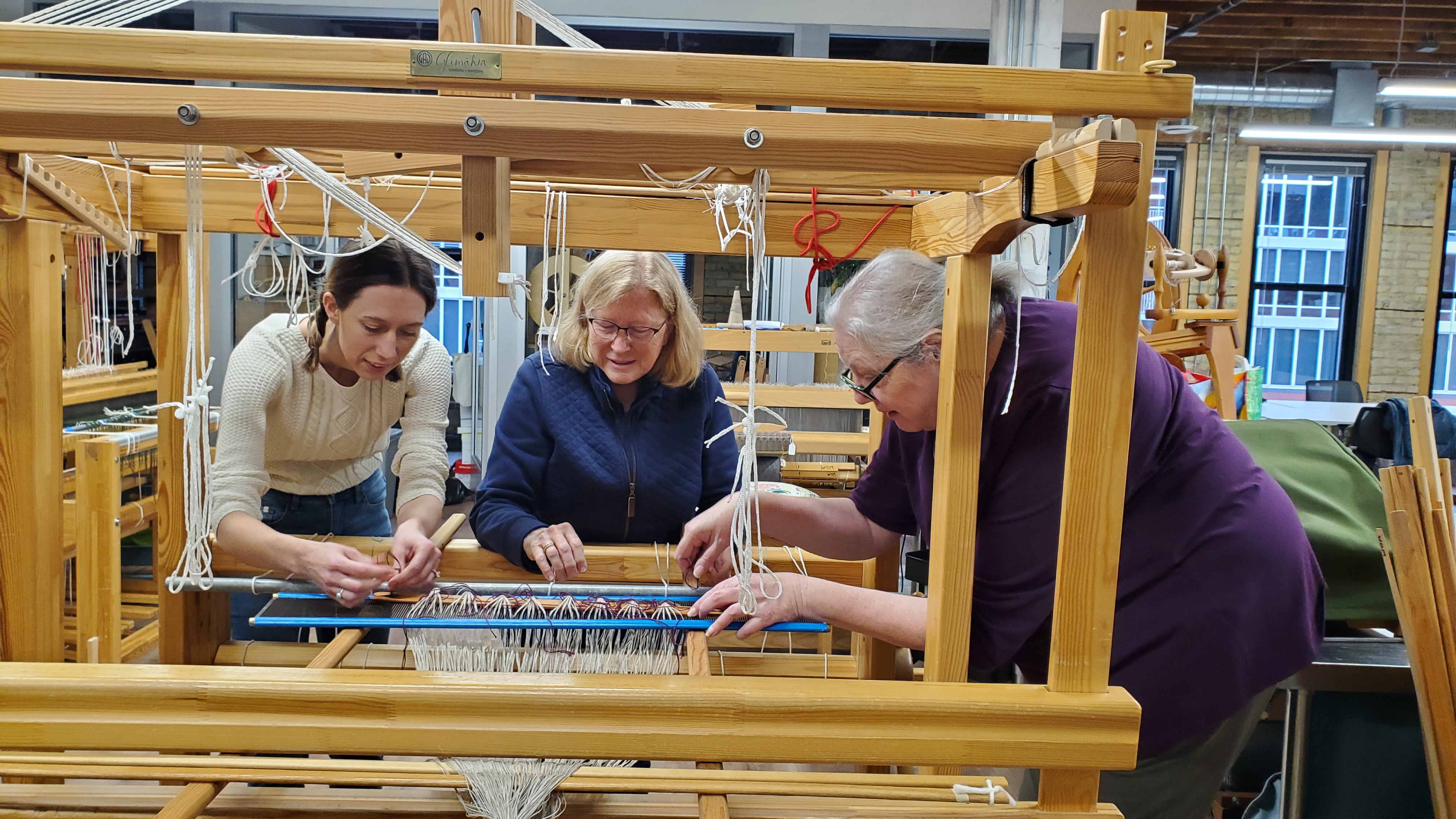
    The Weavers Guild of Minnesota is equipped with two Glimakra looms for classes and group projects. The Scan Weavers generously dug into their stashes for the linen warp. At least 14 of us will weave on this warp, so it is quite long.

    There’s nothing more beautiful than a plain linen warp. Note the slightly different colors that result from blending.

    Warping is always more fun with a group! (Especially with coffee breaks.) Below, Lisa Torvik explains the benefits of pre-sleying the reed to newer weavers Holly and Beth.

    Patty Johnson demonstrates how she used to warp her Glimakra all by herself – controlling the warp tension while winding on the back beam. Fortunately, Lisa is there to help.

    Lisa reminds everyone to spritz the linen warp with water to prevent breakage. (Lisa does this every time she advances the warp, which she does every three to four inches.)

    Lisa adapted the draft for towels and included four motifs across the width instead of three.

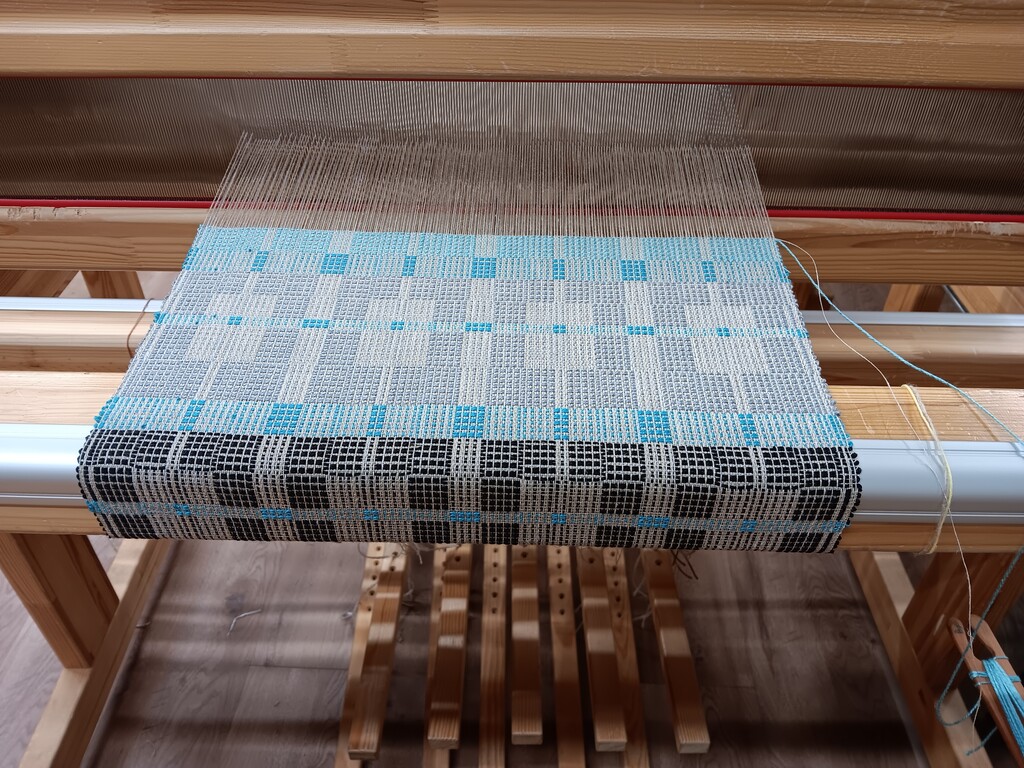
    Lisa wove two towels in different colorways. For the first, she used 16/1 linen doubled on stick shuttles for the pattern weft and 12/1 linen for the ground shots.

    For the second towel, Lisa chose to work with perle cotton for the pattern weft.

    Stay tuned for more updates on this project. I like to think that Elsa Kerttu’s original design of multiple squares was inspired by the many small fishing huts in Kukkola.

    Image of Kukkola from Pinterest
    Stock image

    If you now want to visit Kukkola as much as I do, search online for the Kukkola Tourist and Conference Board. They say the area provides natural beauty, peace, and creative inspiration. What could be better for weavers?

  • Handing on Tradition

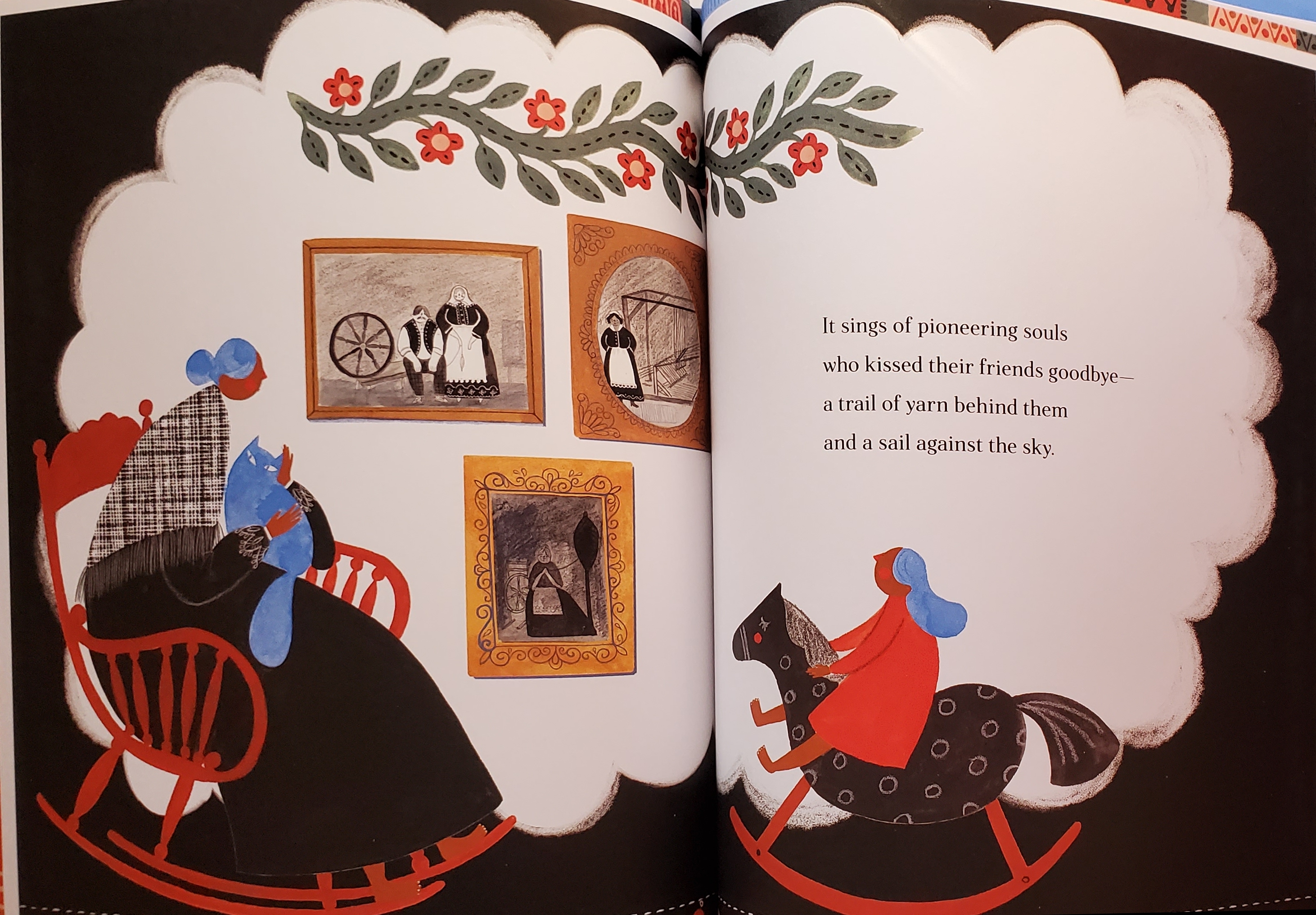
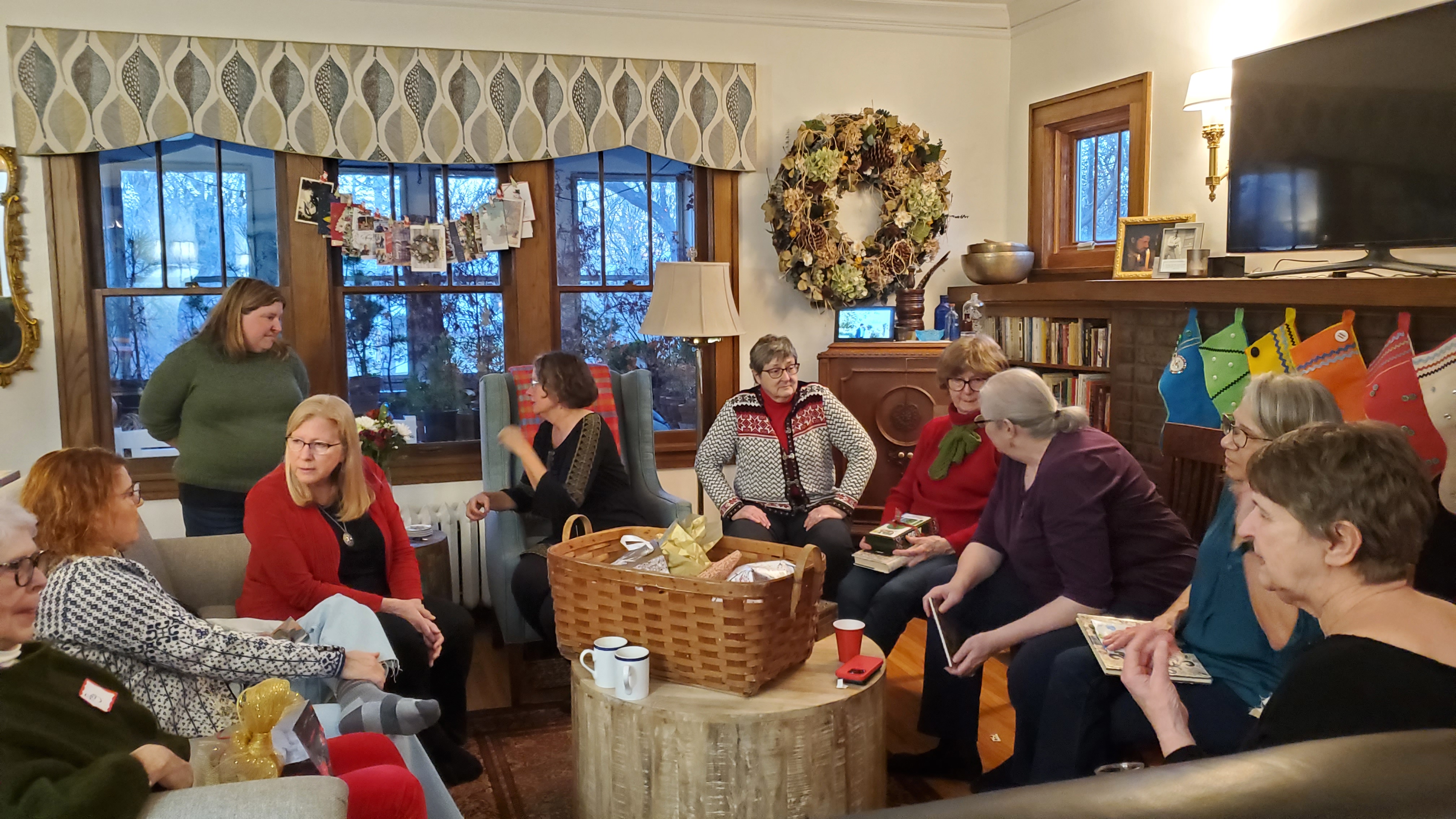
    At the Scandinavian Weavers recent holiday gathering, our host Nancy Ebner shared a wonderful children’s book called Woven of the World, written by Katey Howes and illustrated by Dinara Mirtalipova. The author and artist spent years researching the technical, cultural, and relational aspects of weaving in order to portray them with accuracy and sensitivity. In the book, a young weaver learns from her elder as the loom sings of fabric, friendship, and families.

    One page in particular made some of us stoic Midwesterners a little misty-eyed…

    All of us are drawn to the artistry of Scandinavian weaving, both in its home countries and wherever it has traveled around the globe. Some fell in love with weaving on first sight while others inherited weaving as a family legacy.

    Veronna Capone is one such lucky weaver. Her Swedish maternal grandmother brought her weaving skills to South Dakota, where her brother built her a rug loom with hand-cut mortise and tenon joints and metal rockers for the beater. She wove rag rugs to help support her family and was such a prolific weaver that she wore those metal rockers down to slivers. (The loom is now in the permanent collection of a university museum but is rarely put on display because it is so large and heavy it requires four strong people to carry it.) Veronna’s family on her Norwegian father’s side also wove rag rugs but twined them on a frame loom instead of using a floor loom. Veronna says that these rugs, woven from literal rags, were “hard-use back-door rugs!”

    For her part, Veronna loves the challenge of learning weaving techniques: “I have gone to many classes, workshops near and distant, textile tours, [conferences], and was amazed at the technical skills, and problem solving shown by weavers. I’ve been lucky to have classes with great instructors back east and out here [in South Dakota]. Learning different structures that can be used for other designs has been helpful. Scandinavian weaves are fascinating. As with all simple things it can become very complicated. This has been going on for 40+ years and I still have lots to learn.”

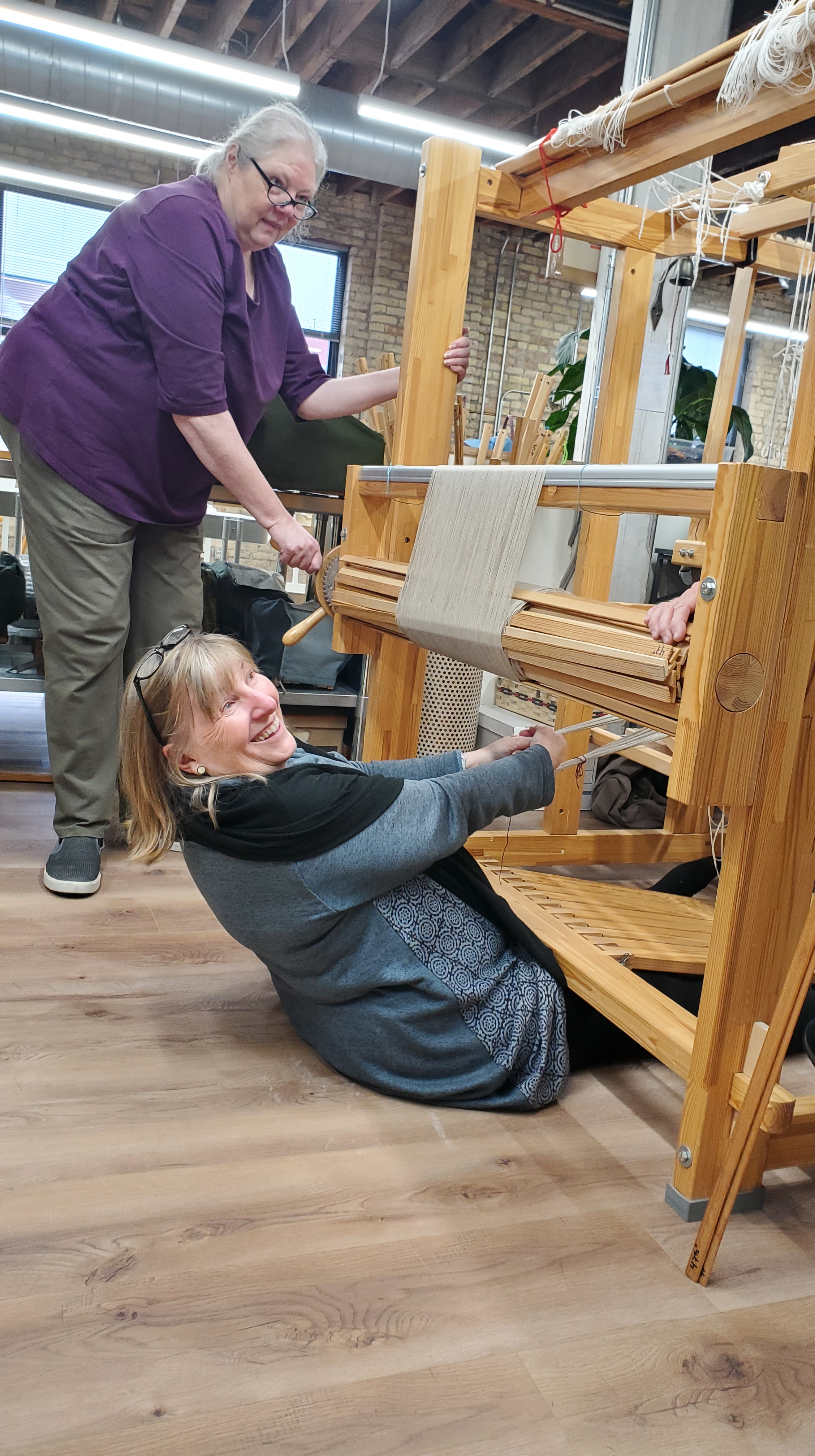
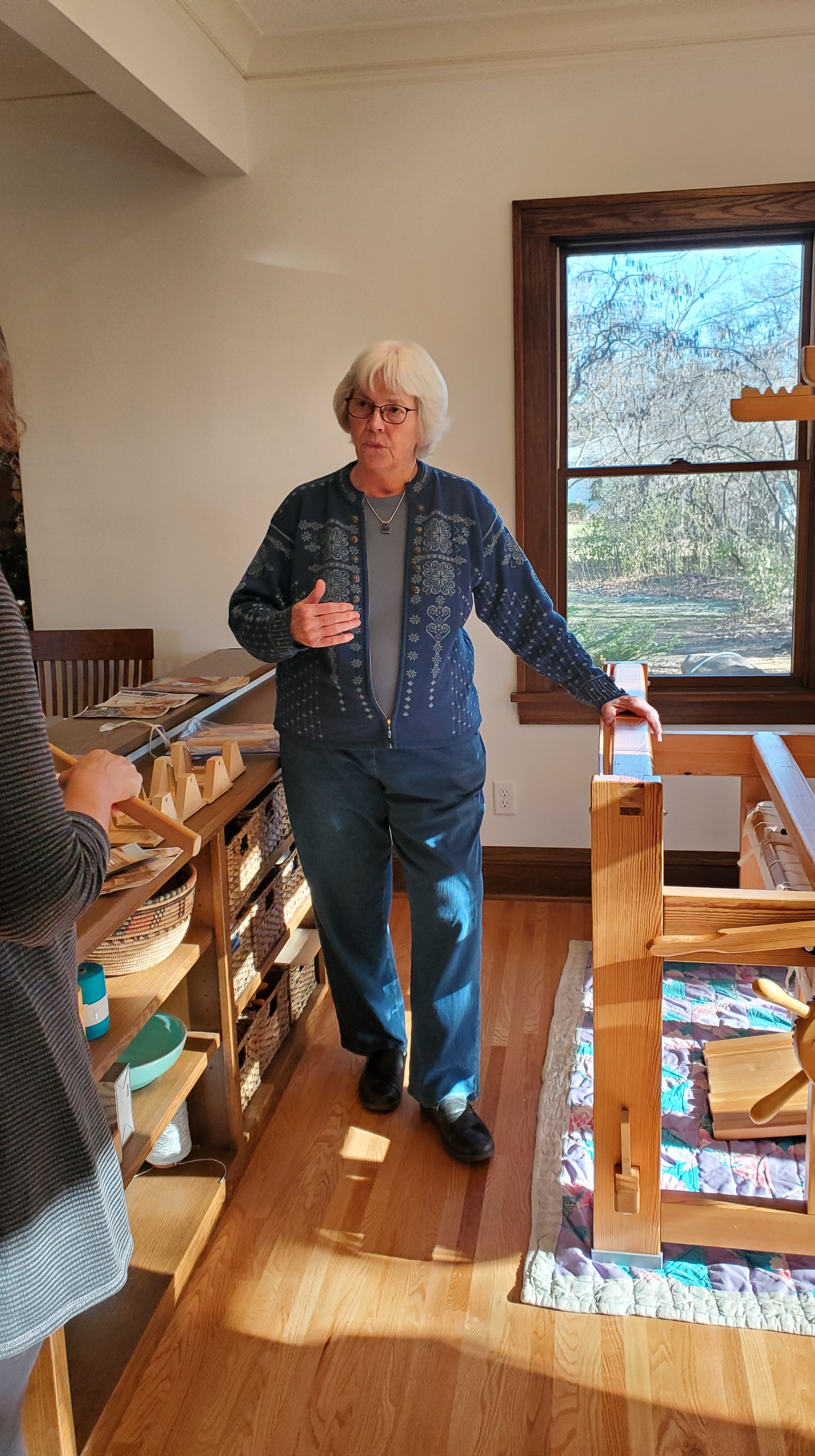
    “Early last spring I started to feel it was time to part with my Glimakra loom,” Veronna writes. “And within a week or two I saw the note from Nancy Ebner that she was looking for one to buy.” Several Scan Weavers gathered to install the loom in its new home.

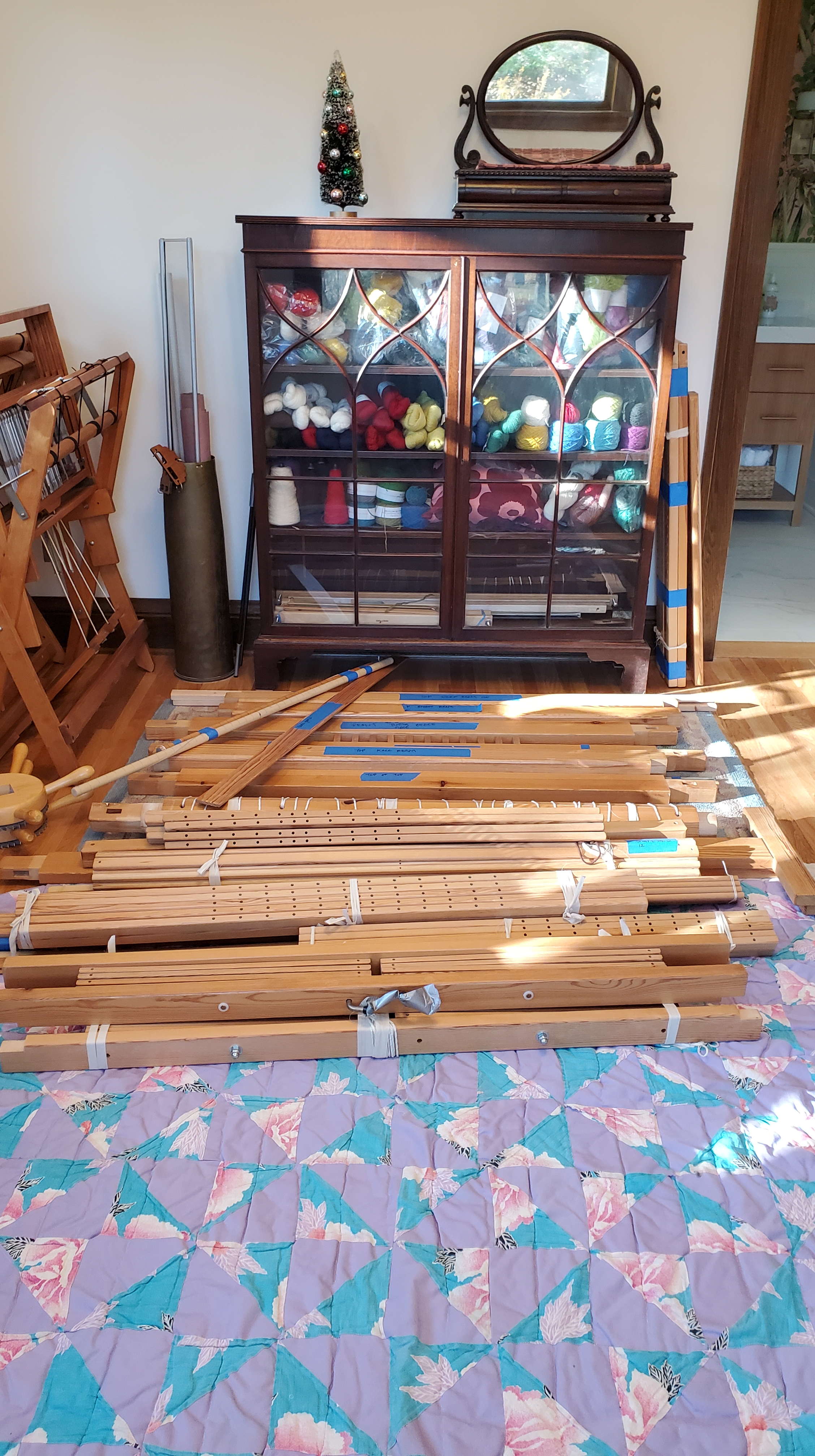
    Like a giant Tinker Toy set, Veronna’s Glimakra arrives in its new home, carefully wrapped in an old quilt.

    Nancy and Judy consult the diagram.

    Veronna approves of the sunny space!
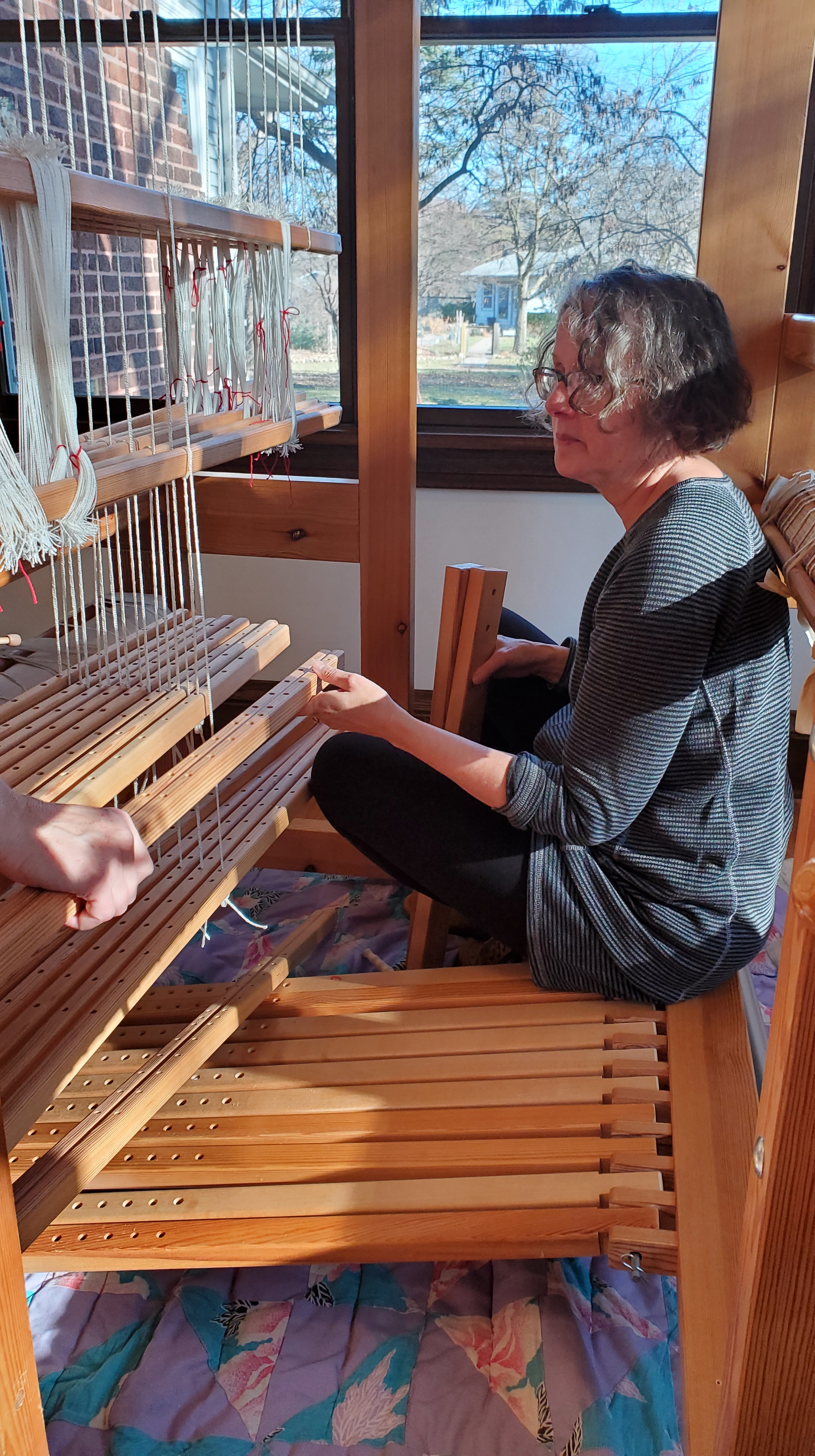
    A handy frameworks holds the lamms in place for tie-up.

    Tying up the lamms.

    Handing on the hammer!
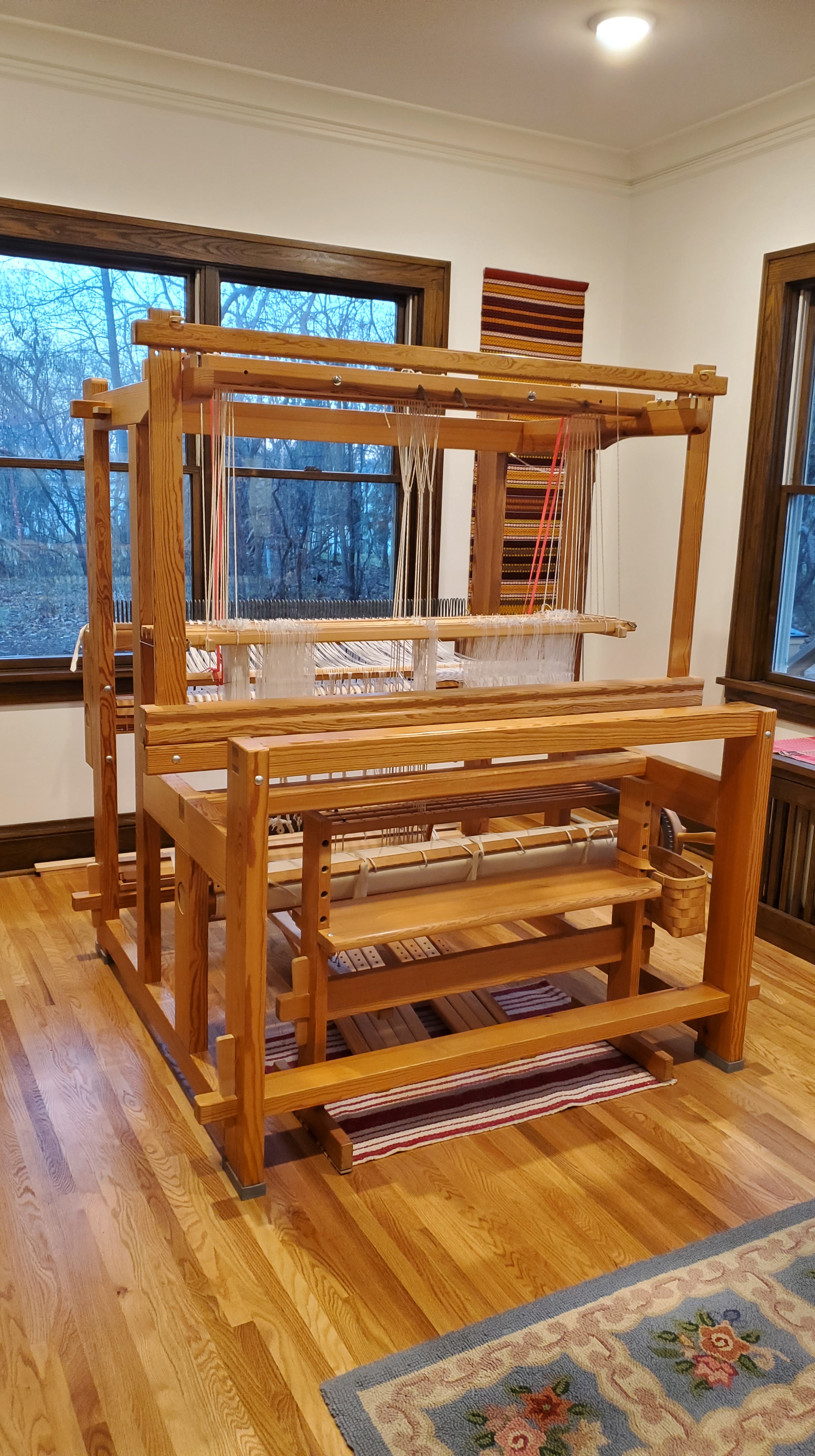
    The loom in its new home!

    By sharing our love and knowledge of weaving, Scandinaivan Weavers are part of a global community that spans generations, In the coming weeks, look for updates on our latest group projects, exhibits, collaborations, and resources. Happy New Year and Happy Weaving!

    When we’re not weaving, we’re talking about weaving.

  • “Domestic to Decorative”: Krokbragd Demonstration

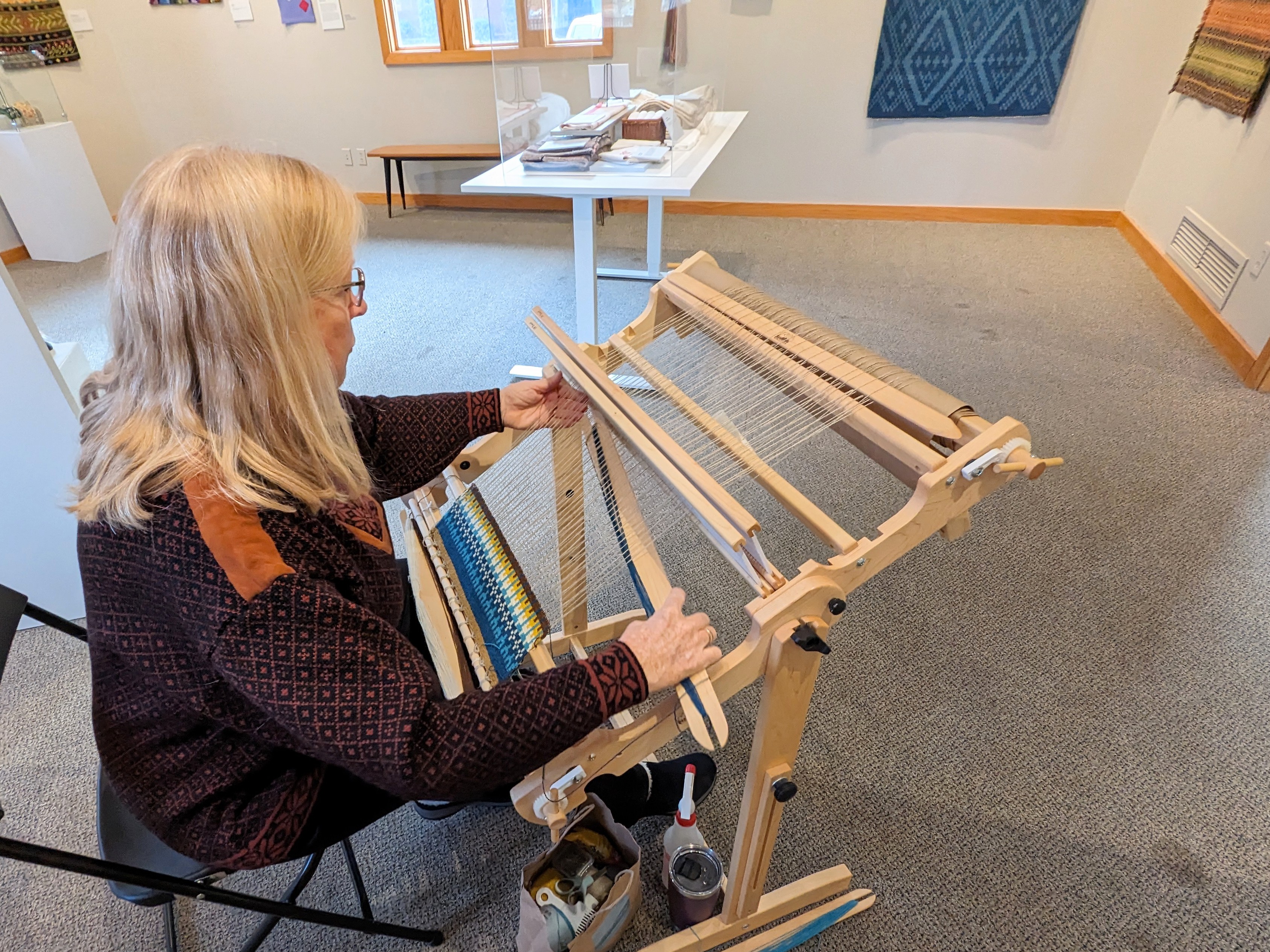
    Thanks to Beth Detlie, who demonstrated at Red Wing Arts as part of the Scandinavian Weavers exhibit “Domestic to Decorative: The Evolution of Nordic Weaving.” The exhibit is open through December 24 at the historic train depot gallery in beautiful Red Wing, Minnesota.

    Photo by Heather Laurenz

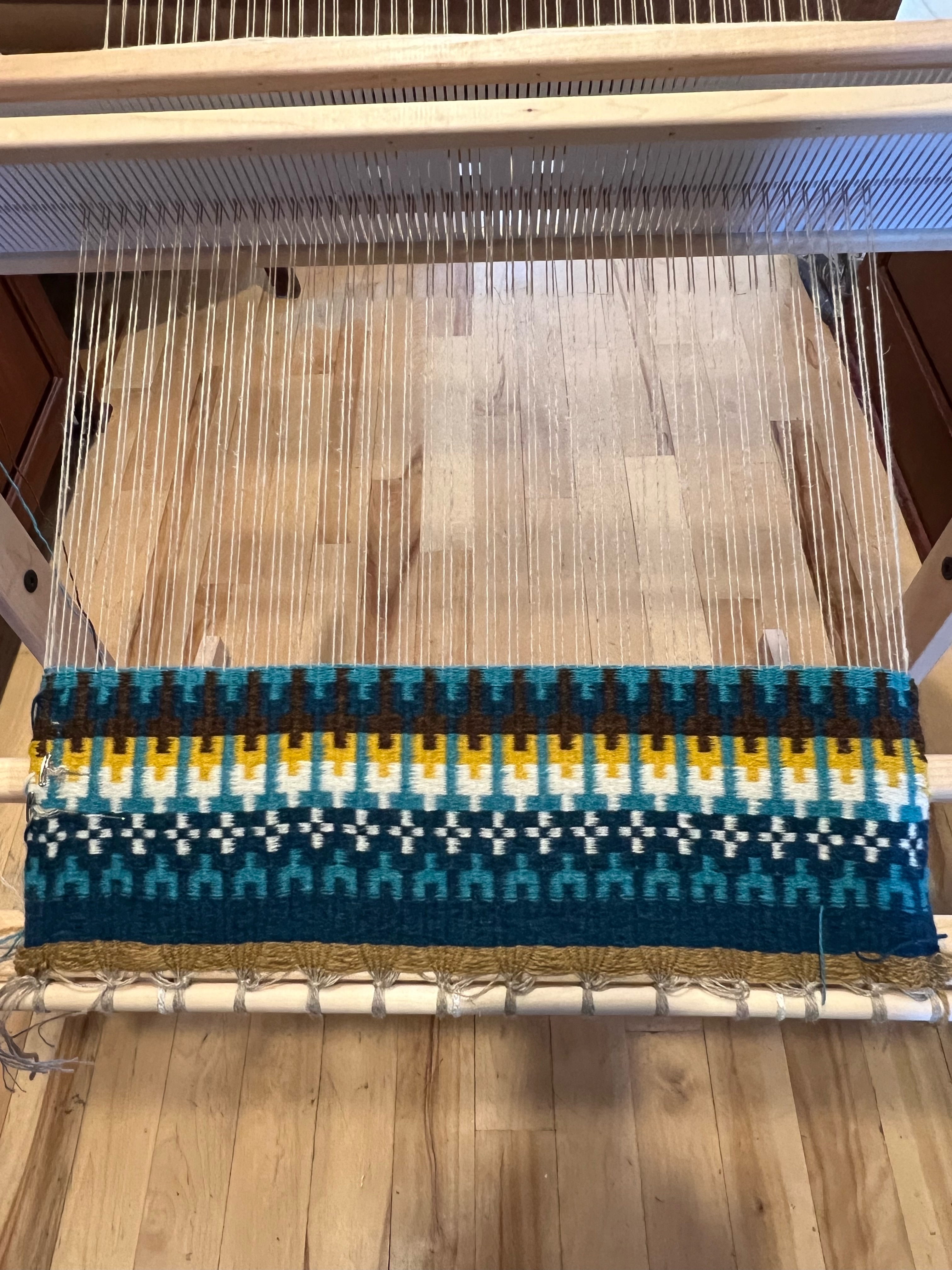
    Beth wove a classic three-shed krokbragd technique using a rigid heddle loom.

    Photo by Beth Detlie

    A close-up of Beth’s beautiful weaving. She is working with Holst Garn fingering-weight wool from Denmark, which she purchased at The Yarnery in St. Paul, Minnesota.

    Photo by Heather Laurenz

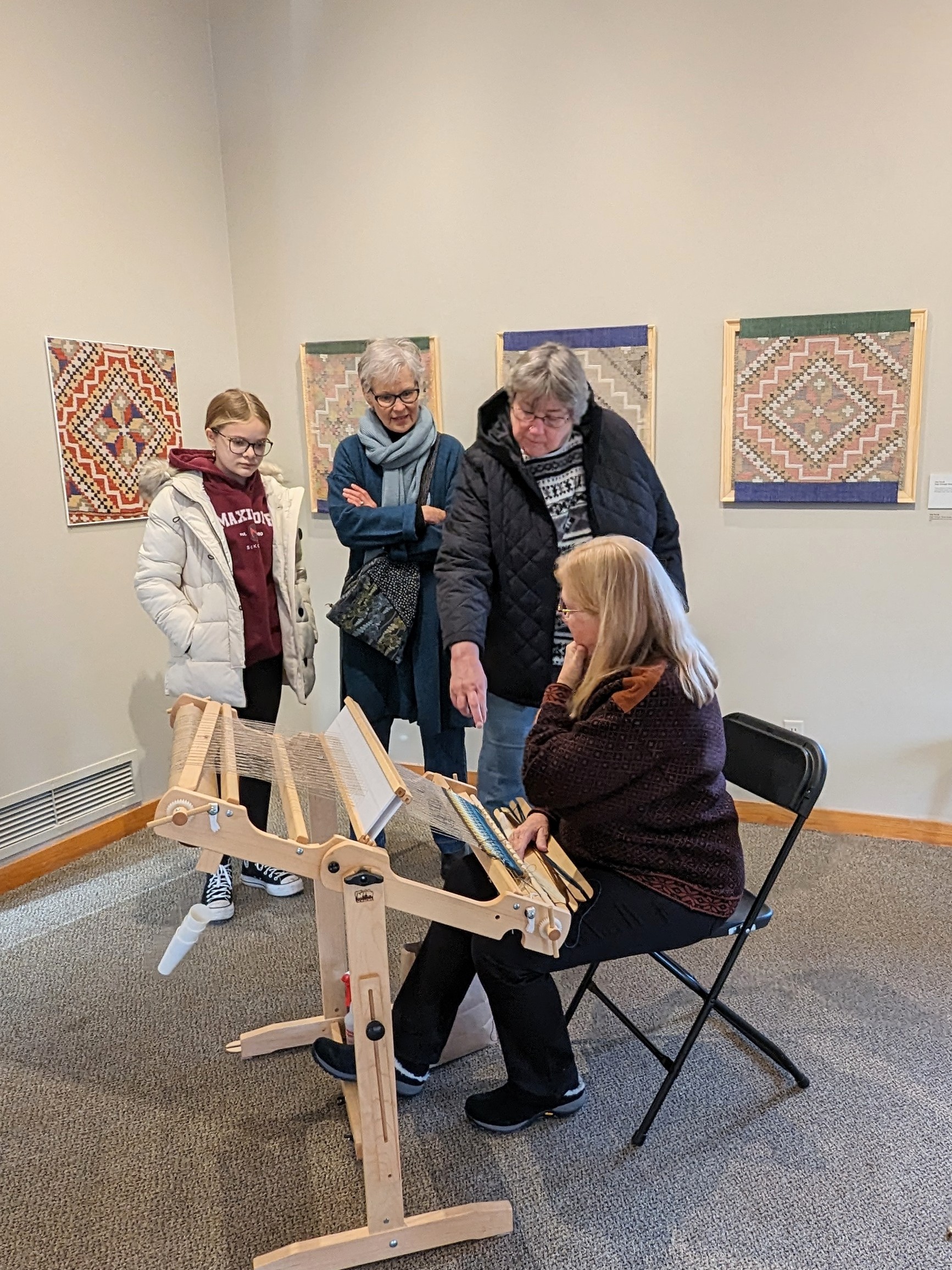
    Beth explains the finer points of her weaving to guests in the Red Wing Arts gallery. In the background are Lisa Torvik’s transparency weavings, based on a motif in a woven coverlet from the Sogn region of Norway. Lisa will demonstrate transparency weaving on Saturday, December 9 from 1:00 to 3:00 PM. Please join us!

  • “Domestic to Decorative”: Warp-Weighted Loom Demo

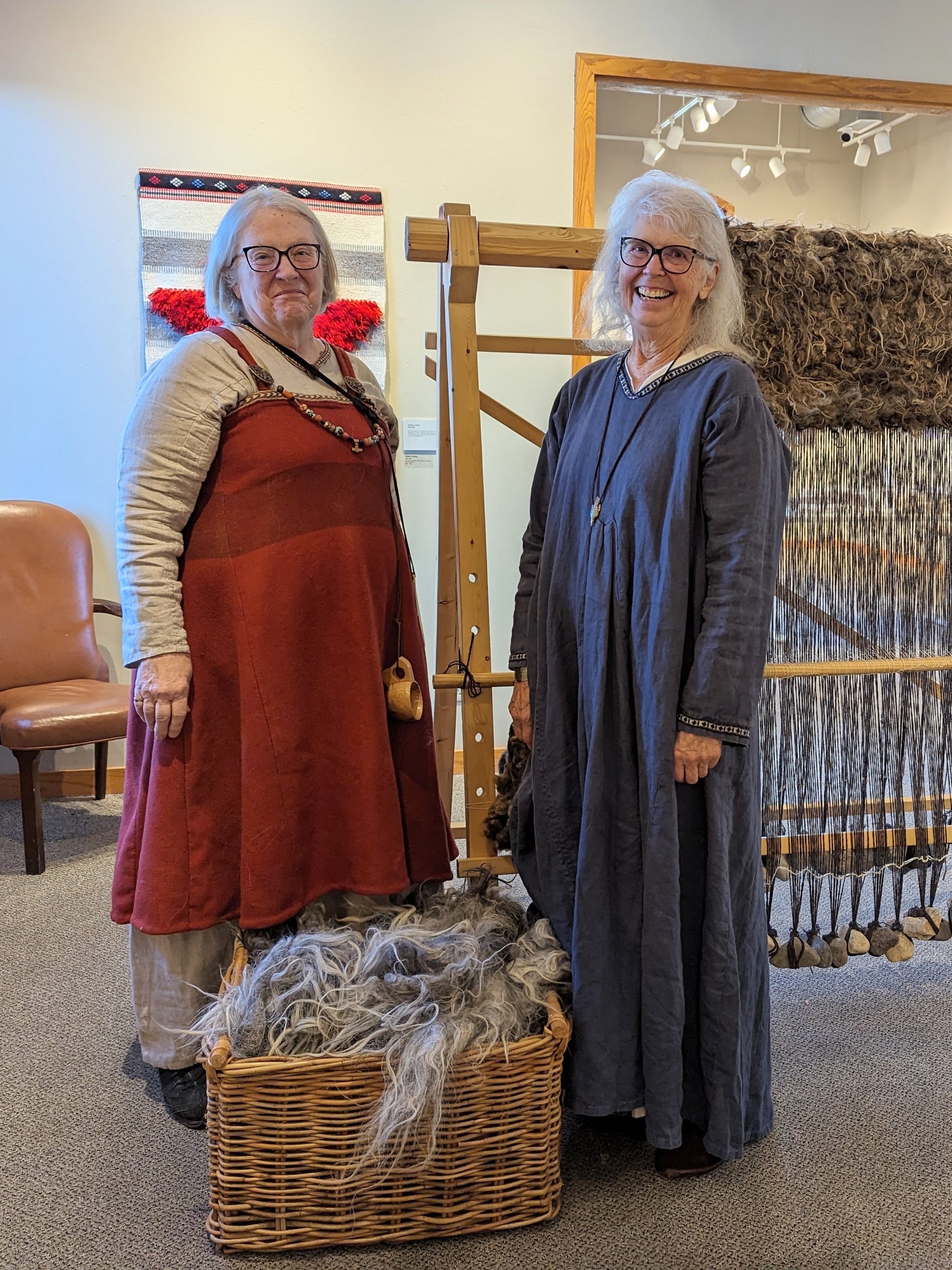
    Thanks to Melba Granlund and Peg Hansen who demonstrated weaving on a traditional Scandinavian warp-weighted loom at Red Wing Arts on November 18, as part of the Scandinavian Weavers exhibit “Domestic to Decorative: The Evolution of Nordic Weaving.” Visitors were fascinated by this ancient weaving technique, and Melba and Peg looked their finest in their Viking garb!

    Melba Granlund explains the history of the warp-weighted loom to visitors (dogs included). Melba teaches classes in warp-weighted weaving at the Weavers Guild of Minnesota, North House Folk School, Shepherds Harvest, and other venues.

    Red Wing Arts is the perfect space for weaving on a warp-weighted loom: Plenty of room and lots of sunlight!

    The big loom always draws a crowd!

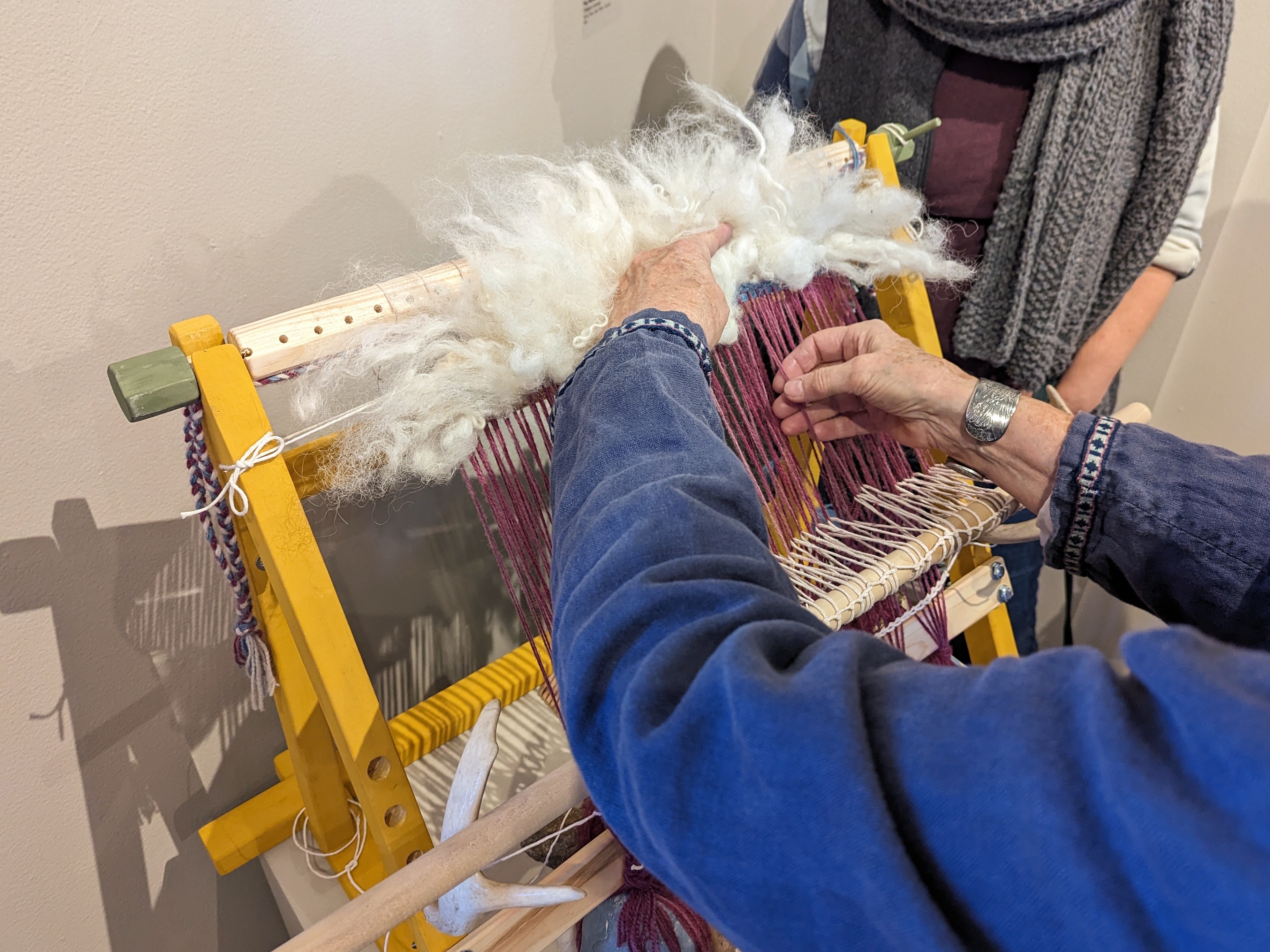
    Peg Hansen demonstrates rya weaving on the small warp-weighted loom she built in Melba’s class at North House Folk School. (Notice the deer antlers.)

    Any weaver who has used a warp-weighted loom will tell you the slowest part of the process is tying on the loom weights.

    Yes, still tying on rocks!

    Our beautiful Viking maidens!

    For close-up photos of Peg’s handmade loom and the saga that inspired it, visit Robbie LaFleur’s blog post here

  • Gala Reception for “Domestic to Decorative”

    Thanks to everyone who joined us at the opening reception for Scandinavian Weavers’ new exhibit “Domestic to Decorative: The Evolution of Nordic Weaving.” The exhibit is on view at the Red Wing Arts gallery through December 24. (Please see the Red Wing Arts website for hours.)

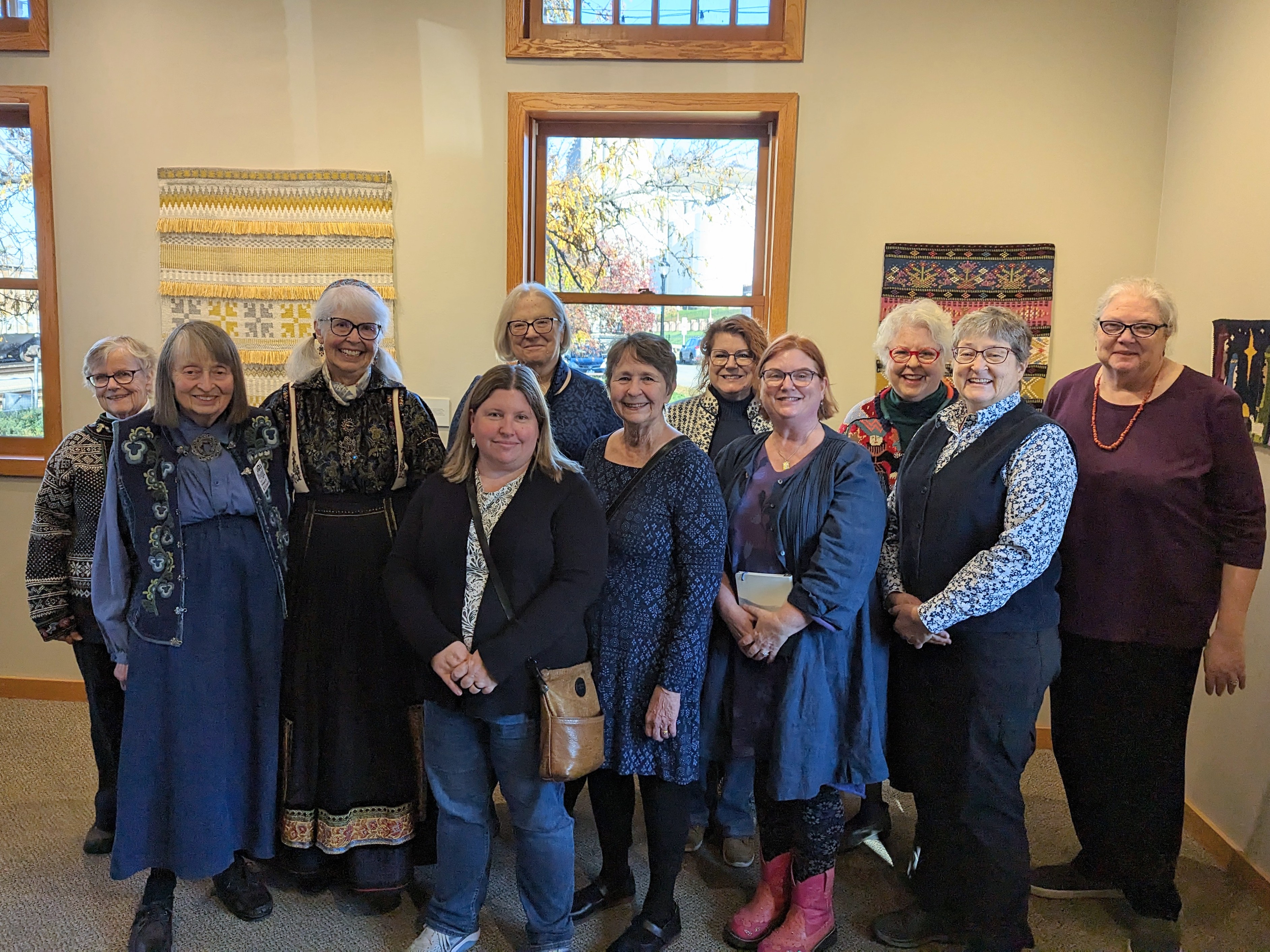
    Scan Weavers present at the reception. Back row: Edi Thorstensson, Peg Hanssen, Melba Granlund, Kala Exworthy, Mary Skoy, Lisa Torvik. Front row: Nancy Ellison, Nancy Pedigo, Jan Mostrom, Lisa-Anne Bauch, Barb Yarusso.

    Scan Weaver Kevin Olsen and his Norwegian tapestry Nativity.

    Special thanks to Edi Thorstensson and Nancy Ellison, who demonstrated weaving techniques.

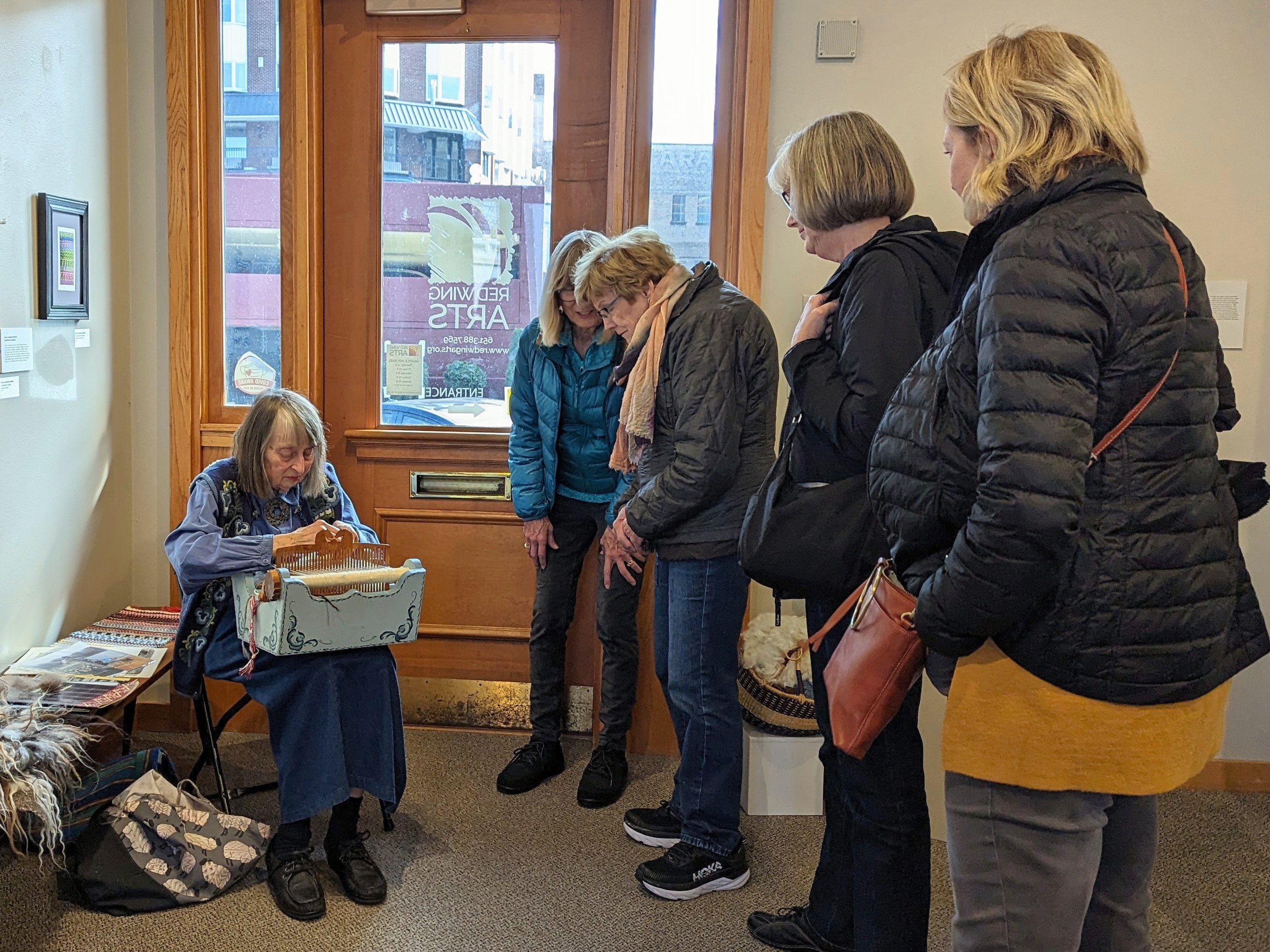
    Edi and Nancy compare weaving techniques. Edi wove a band using a hand-carved heddle, while Nancy wove rya on a Norwegian cradle loom.

    Tremendous thanks to Red Wing Arts Program Director Heather Lorenz and Gallery Manager Shawn Niebeling, who championed this exhibit and made the entire experience a joy.

    Scan Weavers member Peg Hansen, who regularly volunteers at Red Wing Arts, provided hospitality in her Norwegian bunad.

    Members of the Zumbro River fiber arts guild watch closely while Nancy demonstrates rya weaving on her hand-painted cradle loom.

    Lisa Torvik shows Mary Skoy the antique coverlet from the Sogn region that inspired her transparencies.

    Scan Weavers Barb Yarusso, Mary Skoy, and Edi Thorstensson generously lent the heirloom textiles that inspired their weaving. Jane Connett’s colorful weavings are in the background.

    Peg Hansen and her daughters Bitsy Joy and Rachel Hansen Morris collaborated on Tidligere Kvinner.

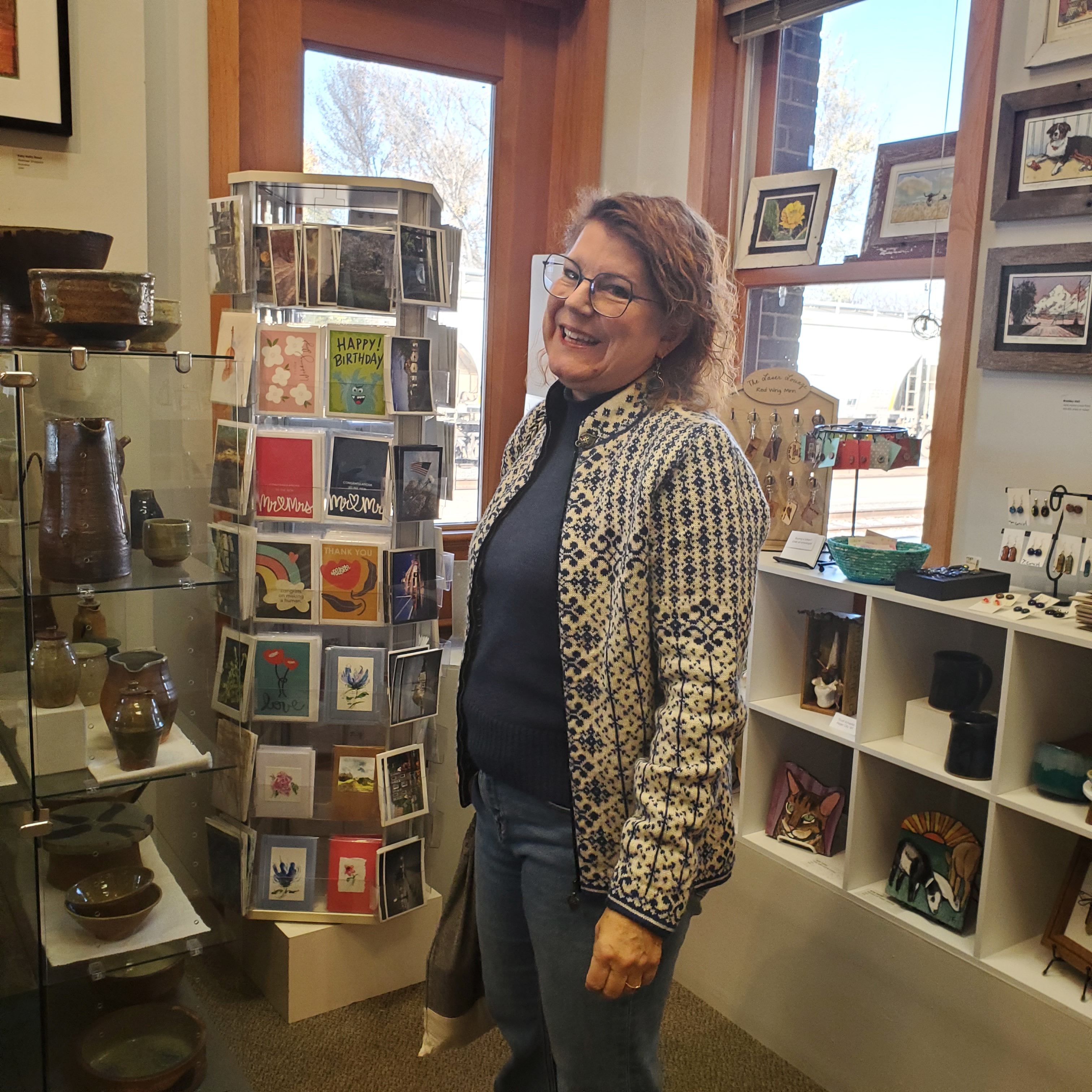
    Kala Exworthy takes a moment to enjoy the Red Wing Arts shop. (Highly recommended!)

  • Now Open: “Domestic to Decorative”

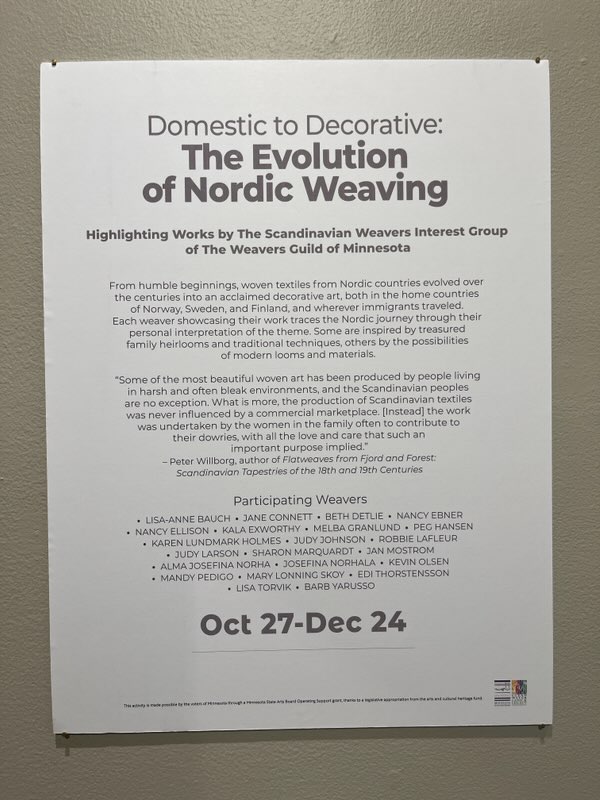
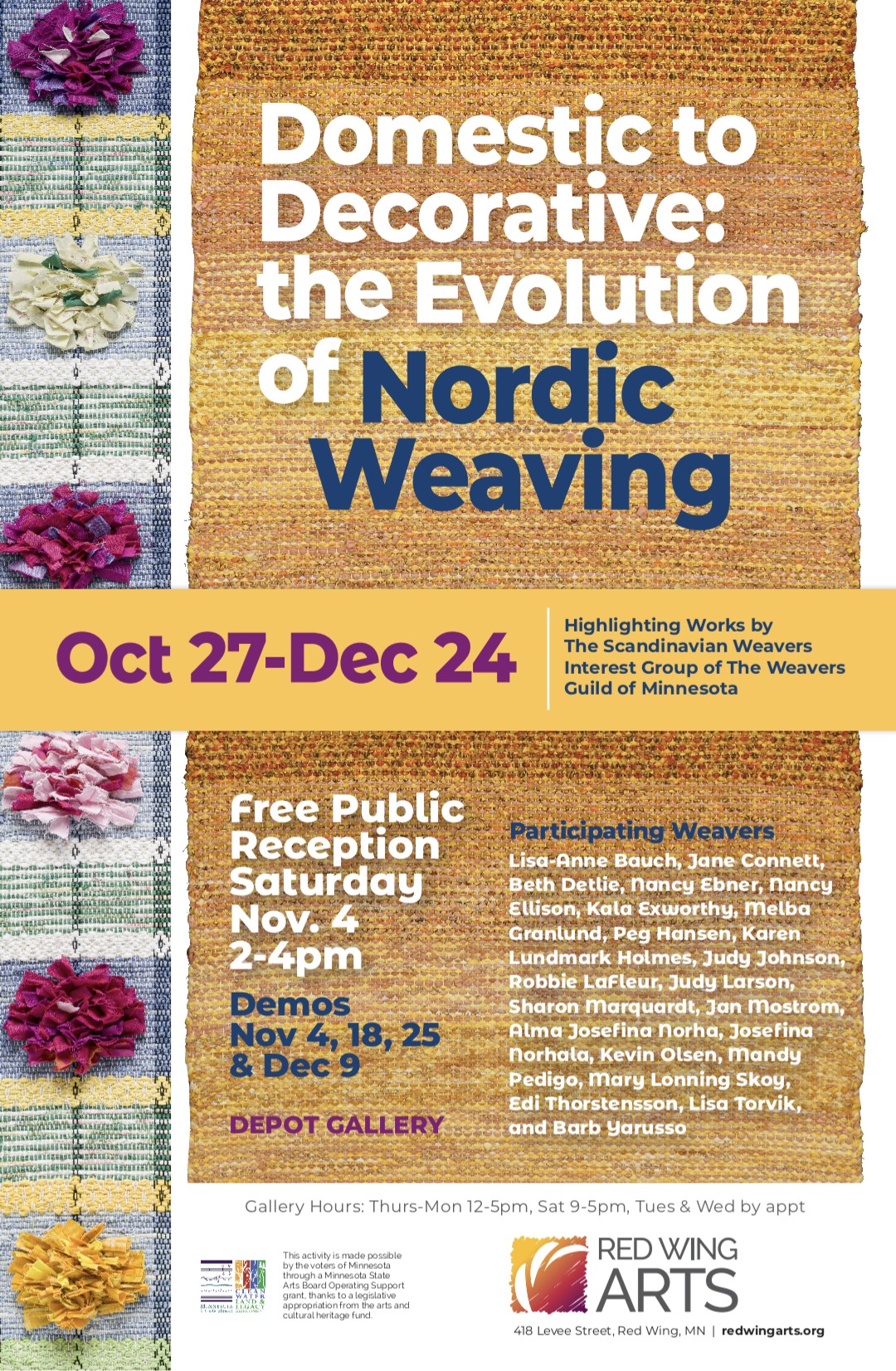
    The Scandinavian Weavers’ new exhibit “Domestic to Decorative: The Evolution of Nordic Weaving” is now open at Red Wing Arts in Red Wing, Minnesota. The exhibit is free and open to the public during regular hours at Red Wing Arts. (Thursday through Monday 12:00 to 5:00 PM / Saturday 9:00 AM to 5:00 PM/ Tuesday and Wednesday by appointment)

    Please join us for a free Opening Reception on Saturday, November 4 from 2:00 to 4:00 PM. In keeping with tradition, Scan Weavers are baking seven different kinds of cookies for the event.

    Also on November 4, Edi Thorstensson will demonstrate band-weaving on a hand-carved Swedish heddle from 10:00 to 11:30 AM. Nancy Ellison will demonstrate rigid heddle weaving from 1:00 to 3:00 PM. Additional demonstrations will be held November 18 (warp-weighted loom), November 25 (krokbragd on a rigid heddle), and December 9 (transparency weaving). Watch this space for further details.

    Special thanks to Shawn Niebling at Red Wing Arts for shepherding this exhibit from concept to installation!

    Visit Red Wing Arts in the historic train depot at 418 Levee Street in Red Wing, near the riverfront. (Yes, you can travel by Amtrak train to the depot.)

    During the installation process, Peg Hansen carefully combs the fringe on Jan Mostrom’s beautiful weaving.
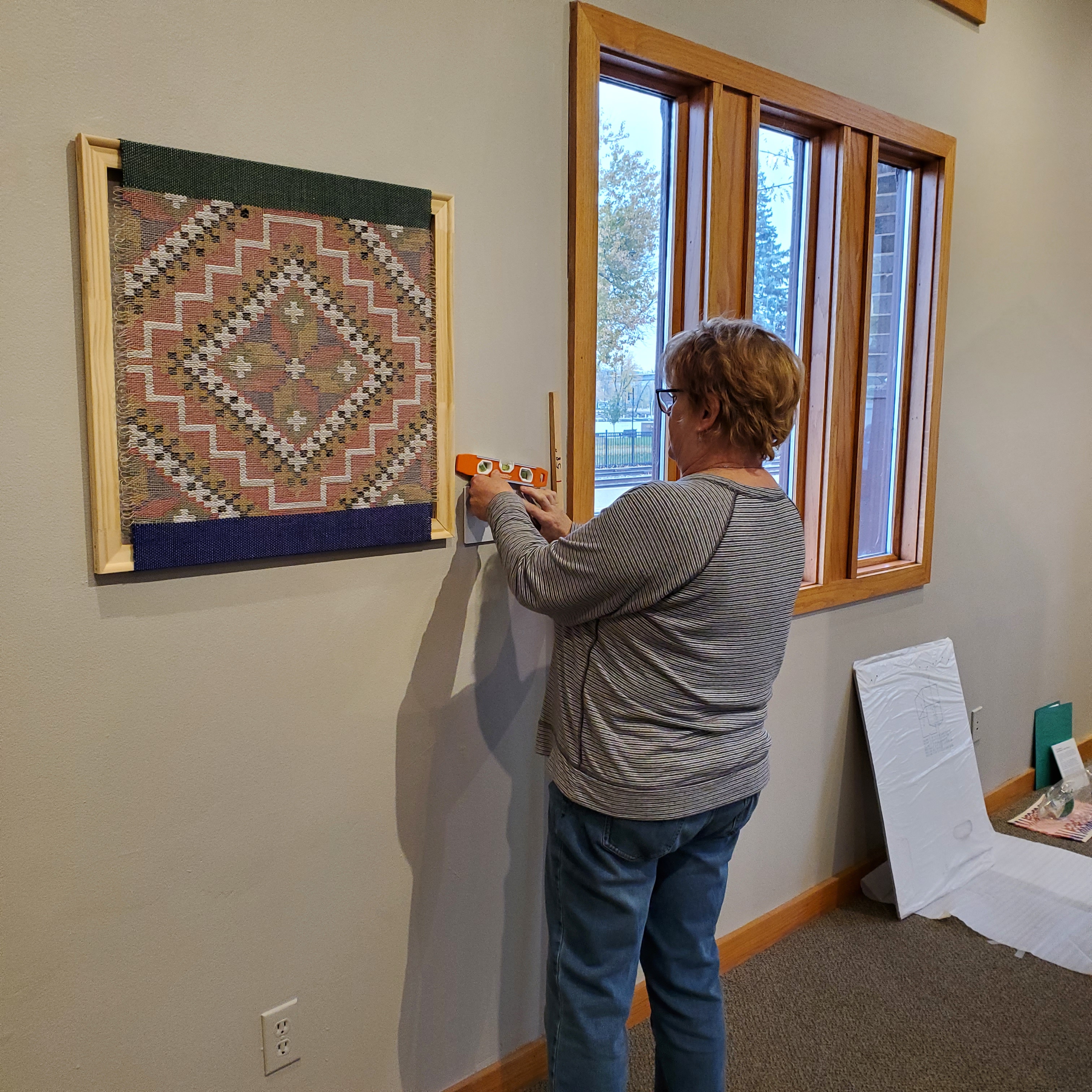
    Shawn Niebling expertly checking levels on Lisa Torvik’s transparency.
    Nancy Ellison’s rya weavings feature fleece from her flock of Icelandic sheep. (Photo by Peg Hansen)
  • Save the Date!

    Scandinavian Weavers NEW exhibit “Domestic to Decorative: The Evolution of Nordic Weaving” opens October 27 in the historic Depot Gallery in beautiful Red Wing, Minnesota! Many thanks to the wonderful staff at Red Wing Arts!

  • Swedish Loom Restoration at Gammelgarden

    Välkommen Hus at Gammelgarden (Photo by Brian Voss)

    Scandia, Minnesota is the site of the first Swedish settlement in Minnesota. Gammelgarden Museum in Scandia helps preserve this history through its programs, exhibits, and five historic buildings while celebrating the stories of all immigrants and their communities.

    On the second floor of the Välkommen Hus (shown above), there is an old floor loom. The loom was made in Sweden by a father with the intention that it would go to America with his daughter and her husband who would leave shortly after their wedding. The year 1879 is painted on the loom.

    The daughter and her family used the loom in northern Minnesota until 1962 when it was sold at auction to Myrabelle Lange Sommerfeld. Myrabelle used the loom for rug weaving until early 1999. Everyone she knew had one of her rugs! In 2003, the loom was generously donated to Gammelgarden by Myrabelle’s daughter, April Sommerfeld Corgärd.

    While the loom has been admired by countless visitors, it needed some minor repairs to be functional again. The Gammelgarden staff put an ad in the classified section of the Weavers Guild of Minnesota website, asking for assistance.

    Ad on Weavers Guild website showing loom before restoration

    Judy Larson, a member of the Scandinavian Weavers, happily volunteered. “It was an opportunity to see an old Swedish loom and visit Gammelgarden,” she explains. “The counterbalance loom is dated 1879 and was carved by a father for his daughter who was leaving for America. The side supports have some lovely wood carvings. As the loom was used by generations of weavers, there were changes made. A worm gear was added in place of the back brake. The string heddles were changed to metal heddles, and the shafts and treadles were held with nylon cords secured by wires, instead of knots. The front brake was still original and is exactly like the one on my great grandmother’s Swedish loom.”

    Judy got to work restoring the loom: “I reset the worm gear rotation wheel to engage correctly, and then got the treadle cords and heddle cords to pull evenly and adjusted the reed height to get a better shed. The loom was now functional, and weaving could happen.”

    Old Swedish loom at Gammelgarden after restoration

    Judy returned two weeks later with fabric weft prepared and started weaving a blue gingham placemat: “I showed three volunteers how to weave on the loom, and even got some visitors to try throwing the shuttle across. The video was made, and a short description of weaving terms is posted by the loom. There is a QR code for visitors to access the video and see the 144-year-old loom in action.” Judy donated more weft fabric so weaving can continue.

    Judy Larson demonstrating weaving on the old Swedish loom at Gammelgarden.
    A volunteer weaves while Judy and visitors look on

    Judy also restored an old tape loom at Gammelgarden so it is now functional. Thanks to her generosity and expertise, visitors to Gammelgarden can try their hand at weaving, which played such an important role in the daily lives of Swedish immigrants.

    Tape loom before restoration
    Restored tape loom in action. The band is about the width of a shoelace.

    Less than an hour from the Twin Cities, Gammelgarden is well worth a visit! Be sure to try out the loom while you are there. To learn more, visit their website at gammelgarden.org (link below)

  • Telemarksteppe Project

    Weaving by Robbie LaFleur

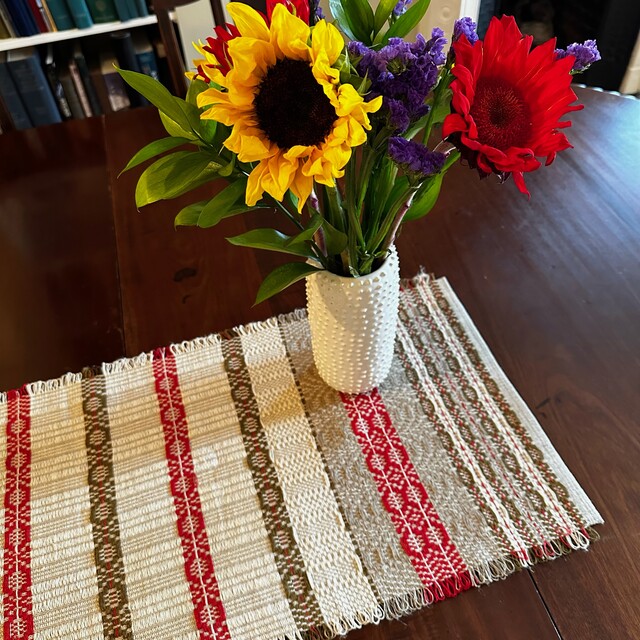
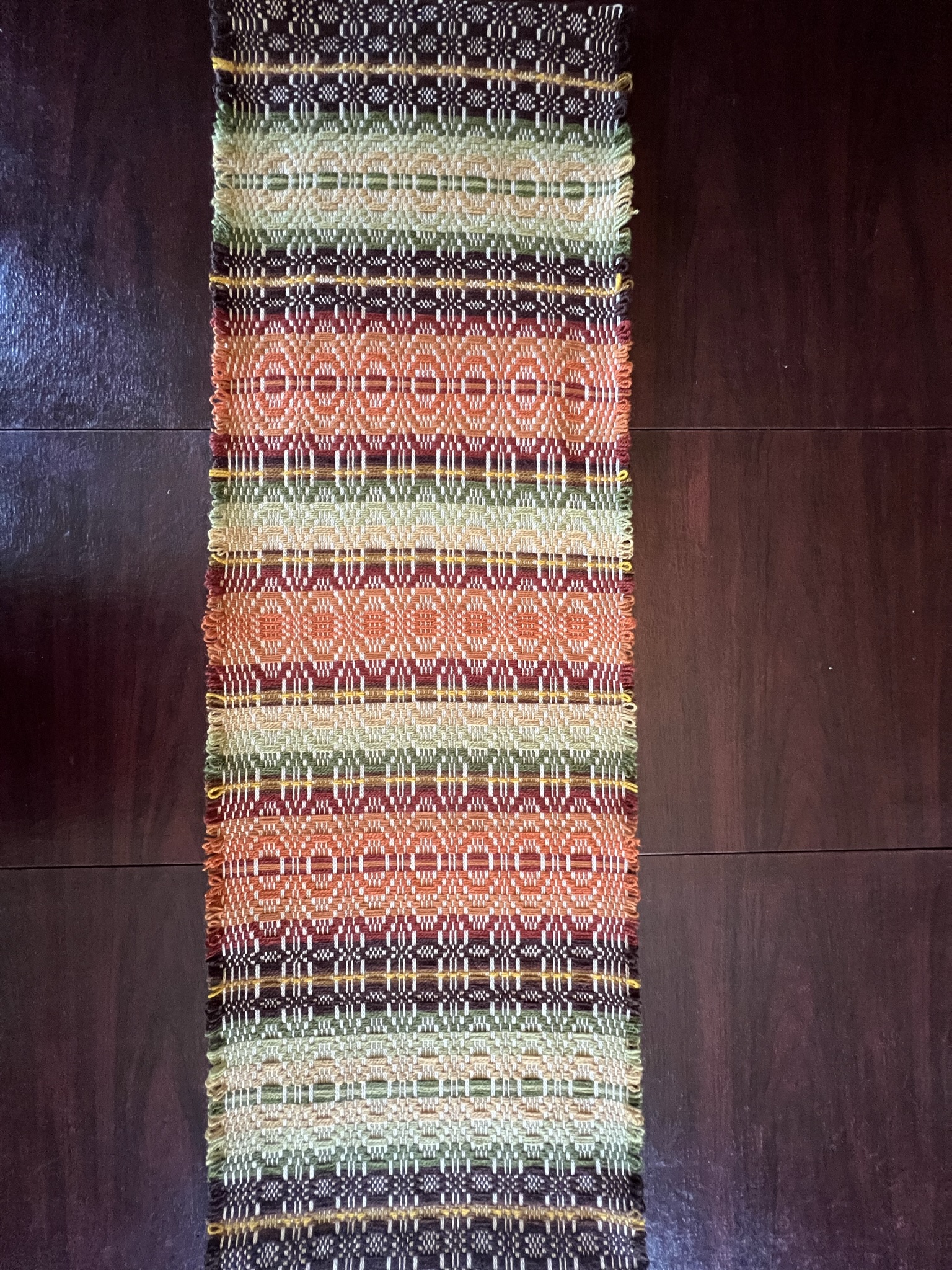
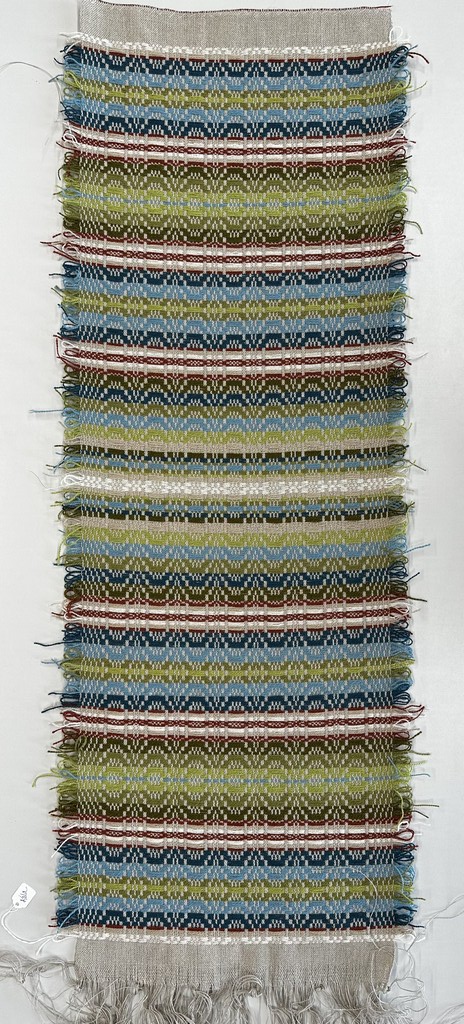
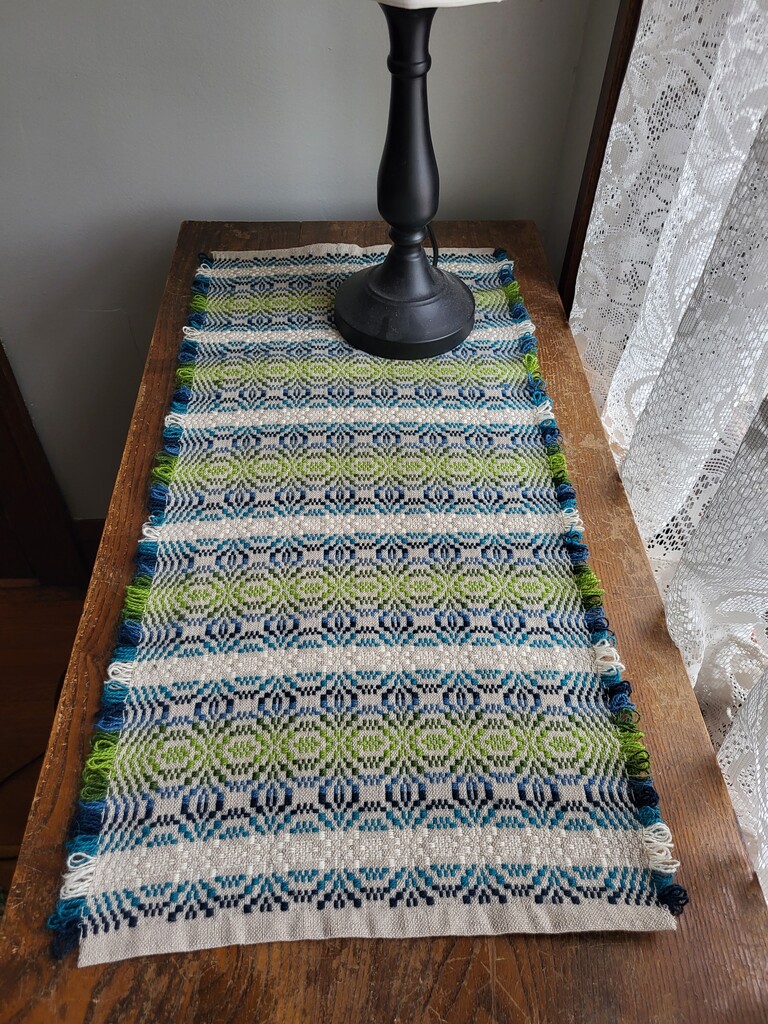
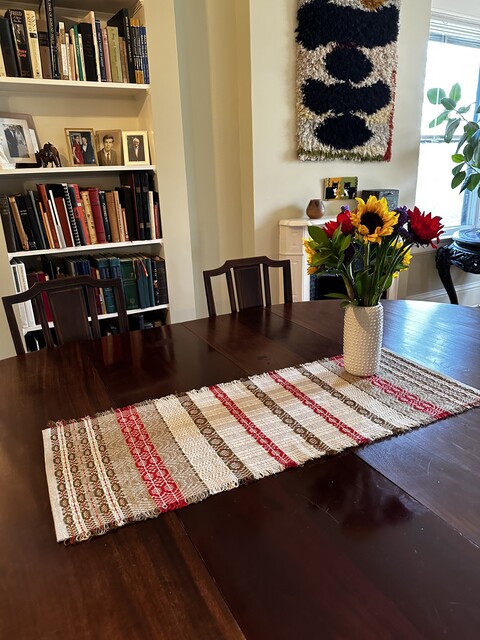
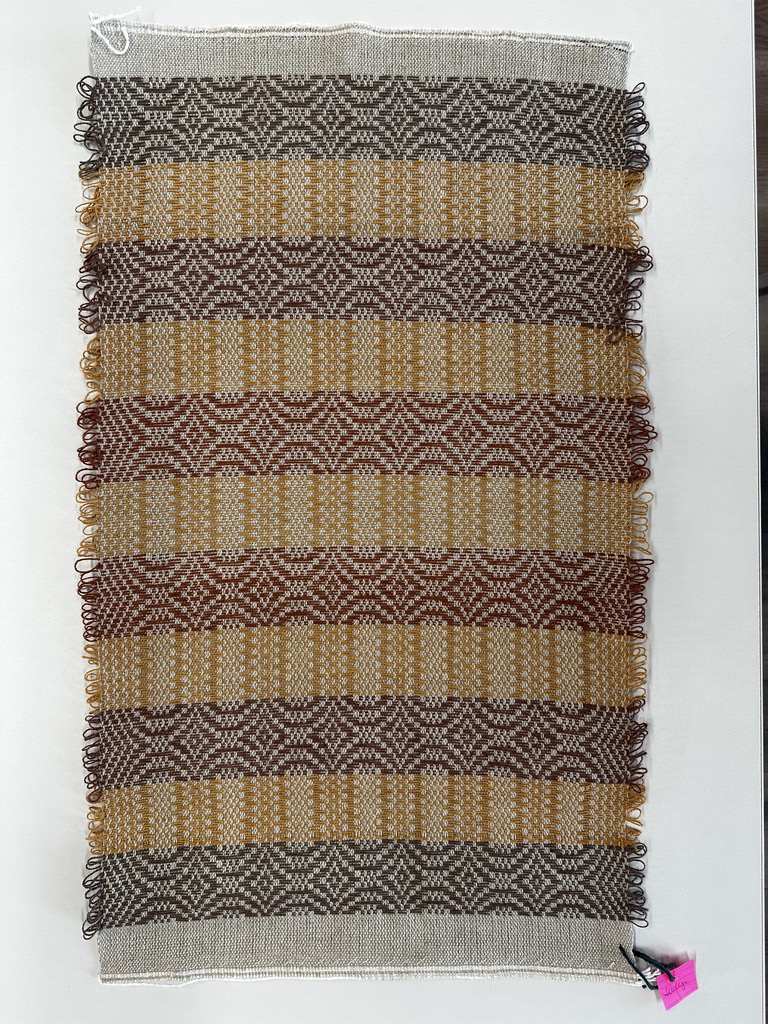
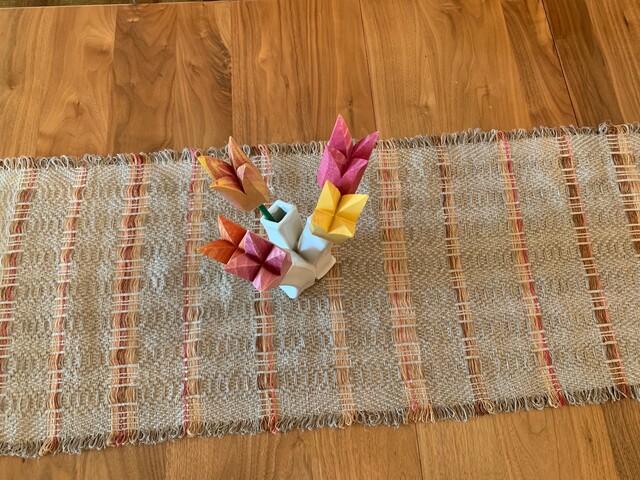
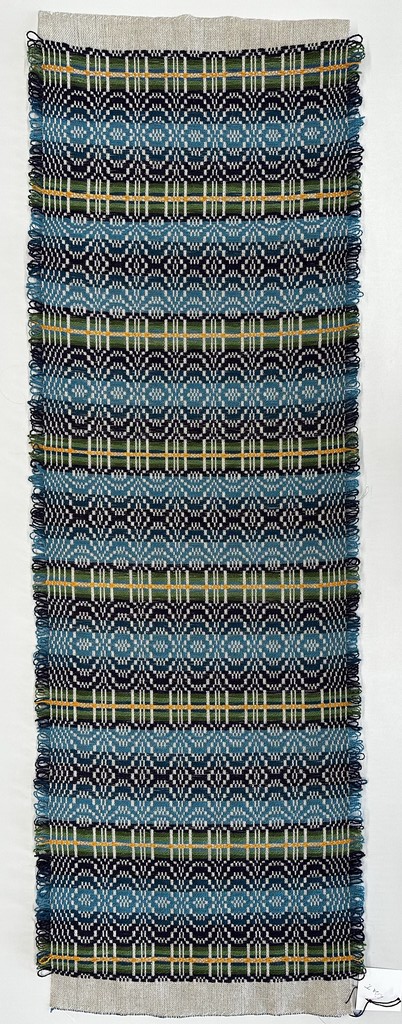
    The Scandinavian Weavers’ latest group project was weaving in Telemarksteppe, organized by Lisa Torvik. Lisa was inspired by Laura Demuth’s table runner in a 2013 issue of Handwoven magazine. Laura wrote:

    Telemarksteppe is a technique that originates from Telemark, a county located along the southeastern coast of Norway. Using six shafts and five treadles, Telemarksteppe is a three-block weave woven on a tabby ground. This three-block structure allows for more design elements than the two blocks found in monk’s belt. Another aspect of Telemarksteppe that I find especially charming is the inclusion of weft loops along the selvedges. The loops also make frequent pattern-weft color changes easy. A color that is not used for several picks does not have to be cut because its end may be woven into the selvedge and reintroduced by making a loop at the selvedge that blends in with the other weft loops.”

    This was our first group project in the new home of the Weavers Guild of Minnesota, the Open Book building in Minneapolis. It was a joy to work in this bright space and also have the opportunity to demonstrate weaving Telemarksteppe to visiting students, guests, and Guild members.

    Scan Weavers members used a variety of weft threads in wool, linen, or cotton. The first group of weavers had so much fun that we put a second warp on the loom. Stay tuned for more pictures as their projects are finished!

    Telemarksteppe runners fresh off the loom!
    Lisa-Anne Bauch
    Beth Detlie
    Nancy Ebner
    Kala Exworthy
    Brenda Gauvin-Chadwick
    Melba Granlund
    Jan Johnson
    Robbie LaFleur
    Judy Larson
    Cathie Mayr
    Shari Nelson
    Mary Skoy
    Paige Tighe
    Lisa Torvik
    Lisa Torvik