Both Scandinavian Weavers and Rag Rug Weavers have been busy this summer volunteering at the American Swedish Institute during the run of “Karin Larsson: Let the Hand Be Seen.” (See previous blog posts for details.) It’s been an amazing opportunity to demonstrate weaving to museum guests, who have been an enthusiastic and curious audience.
Many older guests have shared fond memories of cutting up old clothing and textiles into strips, then sorting them into piles by color, winding them into balls, and delivering them to the local “Rug Lady,” who wove the strips into rugs. Some guests are lucky enough to own rag rugs passed down from family members. so sturdy and well-woven they are still in use today.
Nancy Gossell weaves on the Glimakra loom as ASI guests look on.
This past Monday, Nancy Gossell, Judy Larson, and yours truly arrived at the ASI mansion in the wee hours of the morning to appear on a local news channel’s live broadcast. We were helping promote ASI’s “Cocktails in the Castle,” a night of celebration and craft (both the weaving and cocktail kind). Our interview appears about halfway through the video clip.
The exhibit will be on view at ASI through October 27. Scan Weavers will be on hand to weave on the following Thursday evenings: September 26, October 10, and October 24. Admission is free on Thursdays after 3:00 PM, so stop by if you can.
For a lovely recap of the Karin Larsson exhibit, check out this article on the Modern Daily Knitting blog:
If you’re not able to make it to Minneapolis to see this marvelous exhibit, you’ll have another opportunity in 2025 when it moves to the Swedish American in the historic Andersonville neighborhood in Chicago.
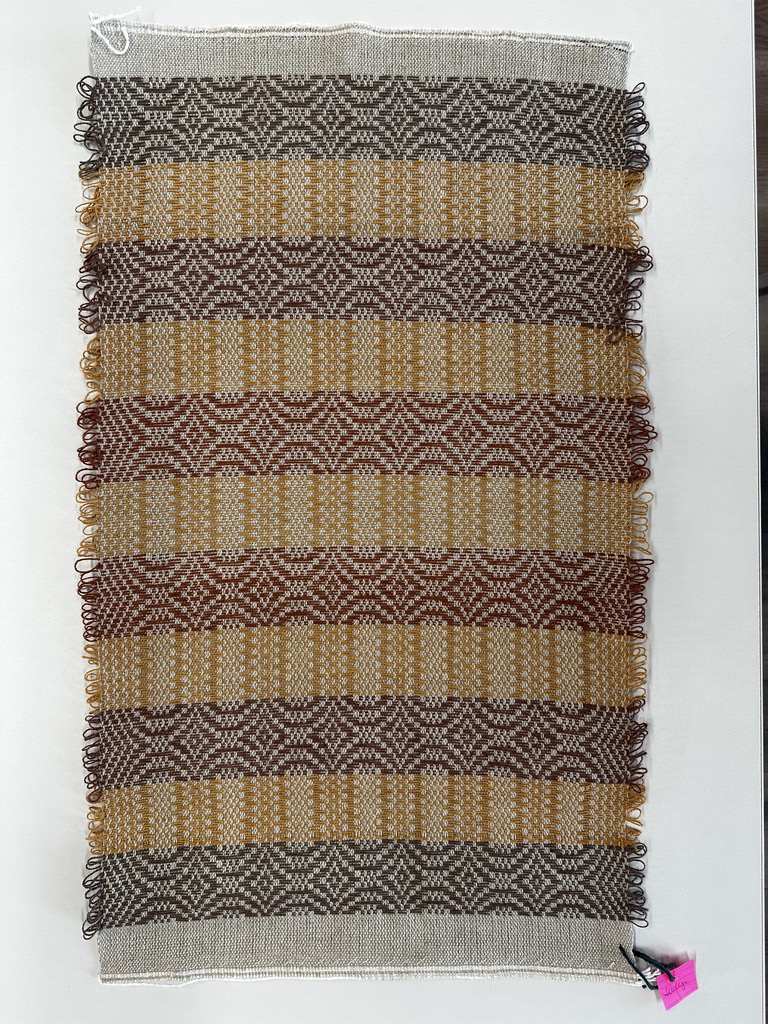
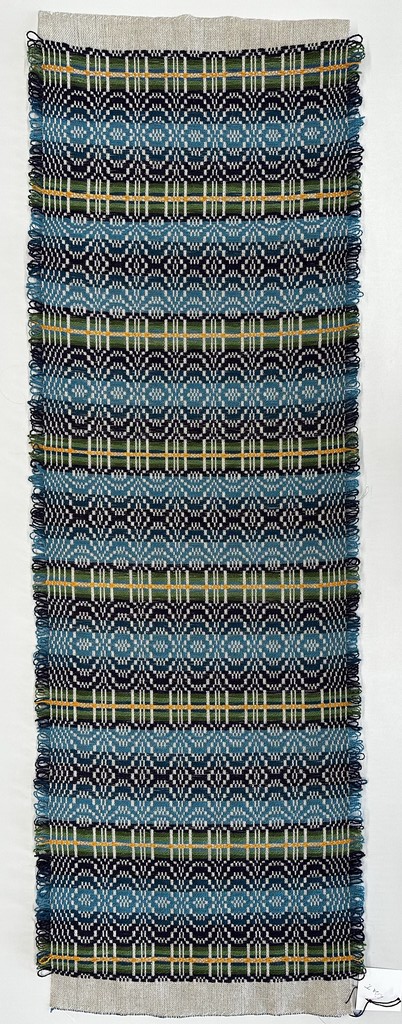
Follow the Scan Weavers Blog! (And see more beautiful blue rugs by Judy Larson!)
It’s been a busy summer for our Scandinavian Weavers Group and promises to be a busy fall, as well. Stay tuned for a summer wrap-up and fall preview, including the following:
Scan Weavers win ribbons the Minnesota State Fair!
A cold January is the perfect time to start a new weaving project! The Scandinavian Weavers’ latest group warp is a pattern called Kukkoladräll.
The Kukkoladräll pattern was composed by Elsa Kerttu in 1926 when she was a student at Jämtslöjds Kvinnliga Slöjdskola (Women’s Craft School) in Östersund as an assignment to create a pattern in Jämtlandsdräll. It was named after Elsa’s hometown of Kukkola, a small fishing village in northern Sweden, just across the border from Finland. A lovely version of this pattern was woven by Ulrika Bos Kerttu, Elsa’s niece, in a palette she named Cloudberry. The draft for the pattern is copyrighted by Sveriges Länshemslöjdskonsulenter and provided bytextilhemslojd.se
Image of cloudberries from Pinterest.
The Weavers Guild of Minnesota is equipped with two Glimakra looms for classes and group projects. The Scan Weavers generously dug into their stashes for the linen warp. At least 14 of us will weave on this warp, so it is quite long.
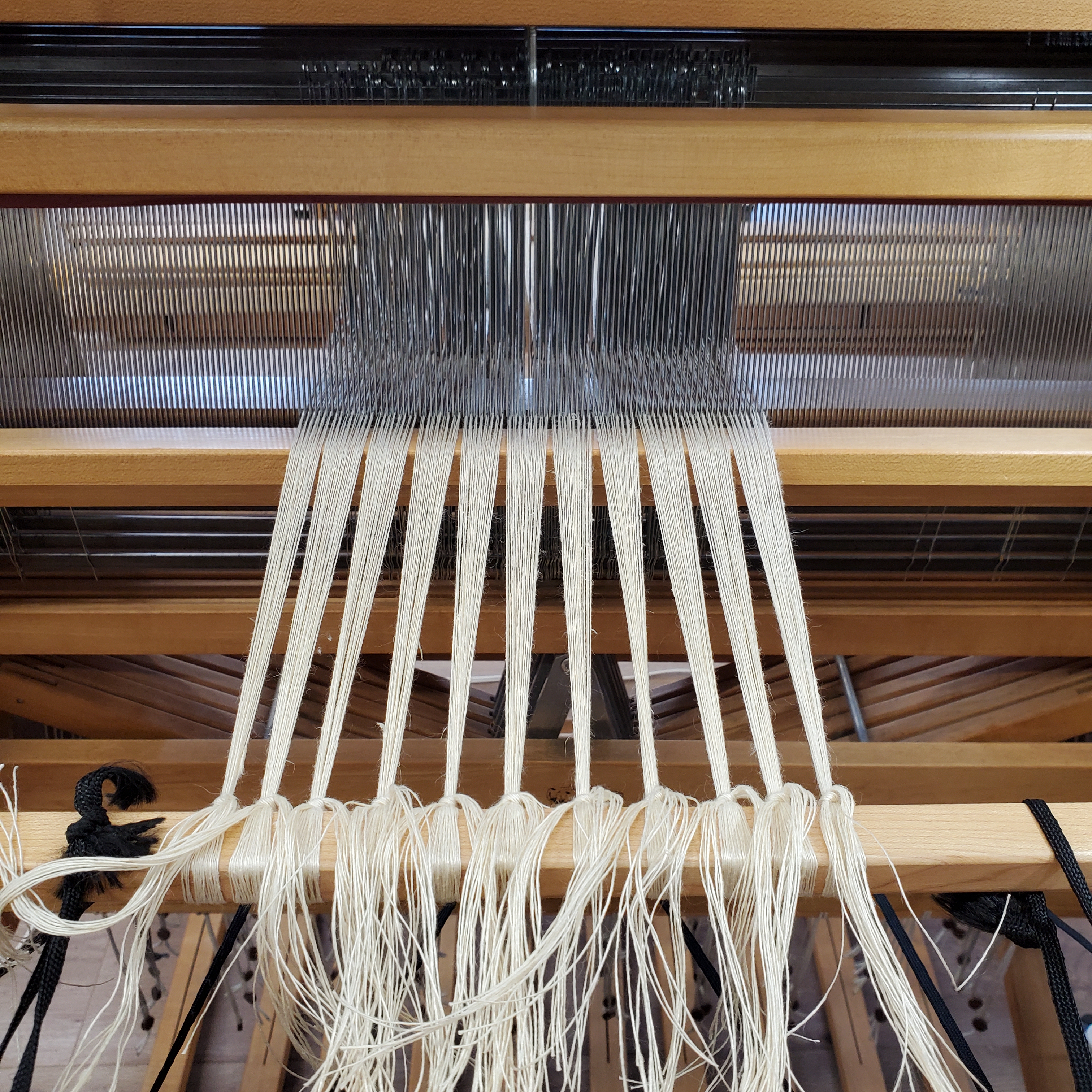
There’s nothing more beautiful than a plain linen warp. Note the slightly different colors that result from blending.
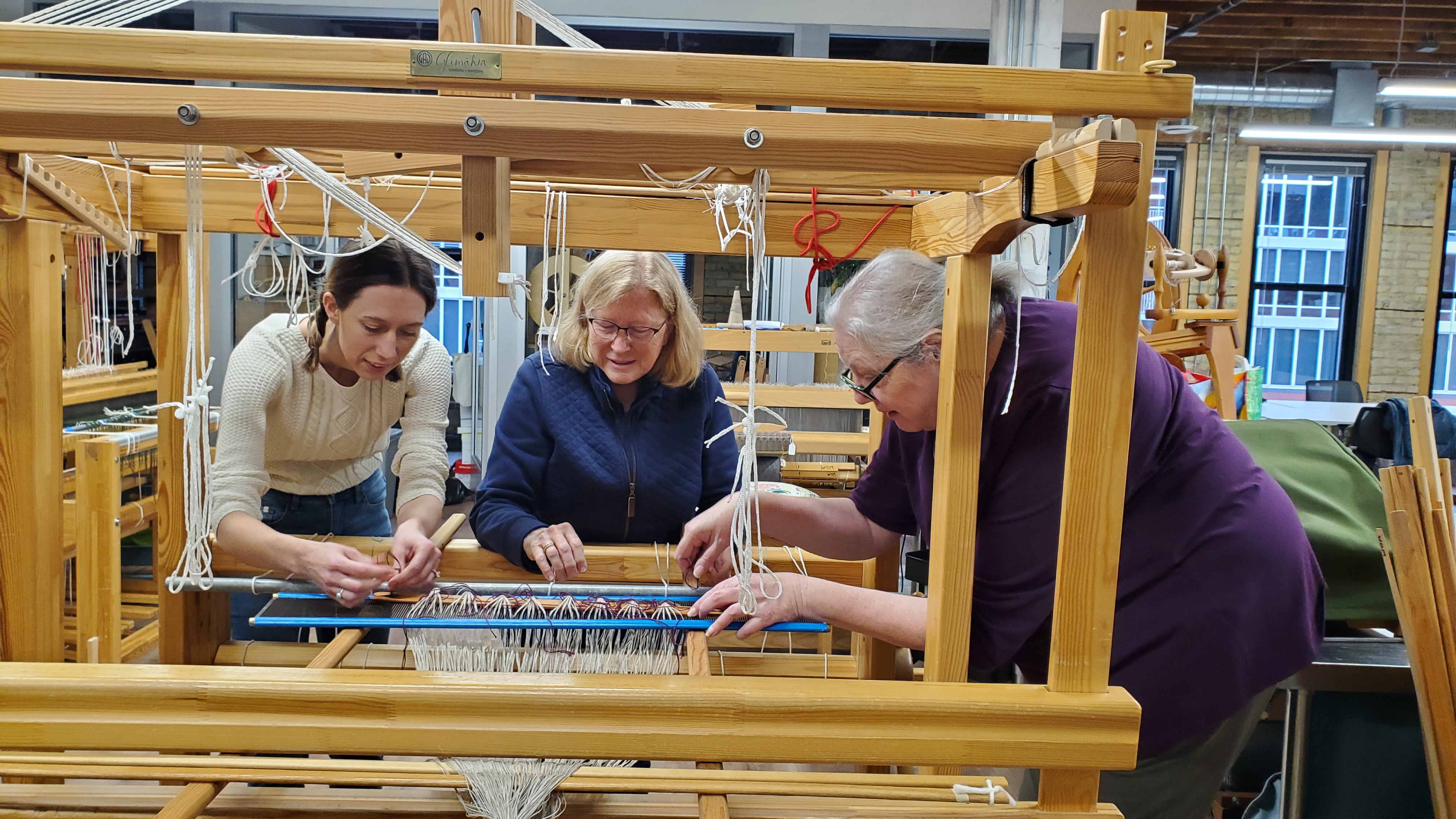
Warping is always more fun with a group! (Especially with coffee breaks.) Below, Lisa Torvik explains the benefits of pre-sleying the reed to newer weavers Holly and Beth.
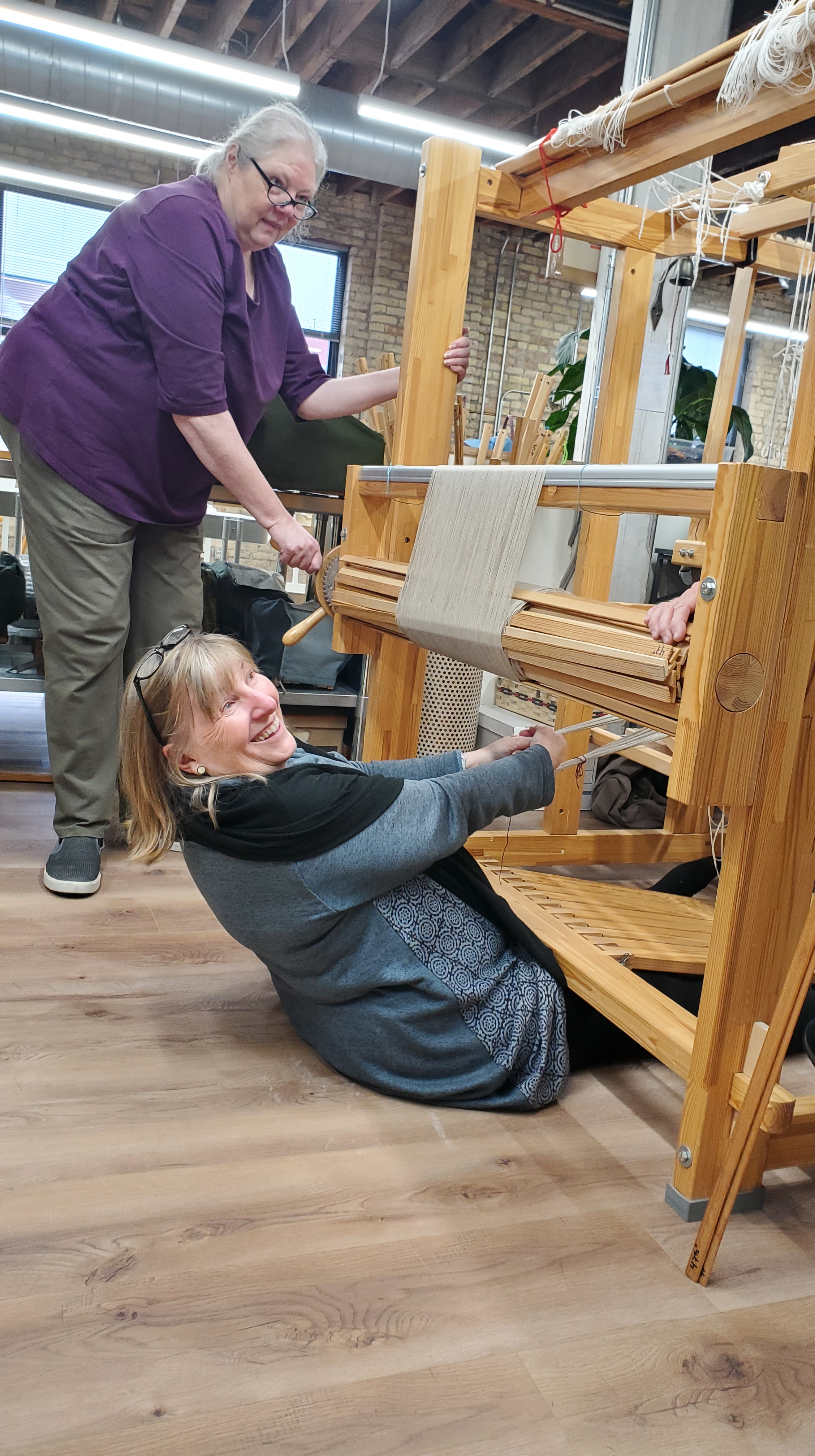
Patty Johnson demonstrates how she used to warp her Glimakra all by herself – controlling the warp tension while winding on the back beam. Fortunately, Lisa is there to help.
Lisa reminds everyone to spritz the linen warp with water to prevent breakage. (Lisa does this every time she advances the warp, which she does every three to four inches.)
Lisa adapted the draft for towels and included four motifs across the width instead of three.
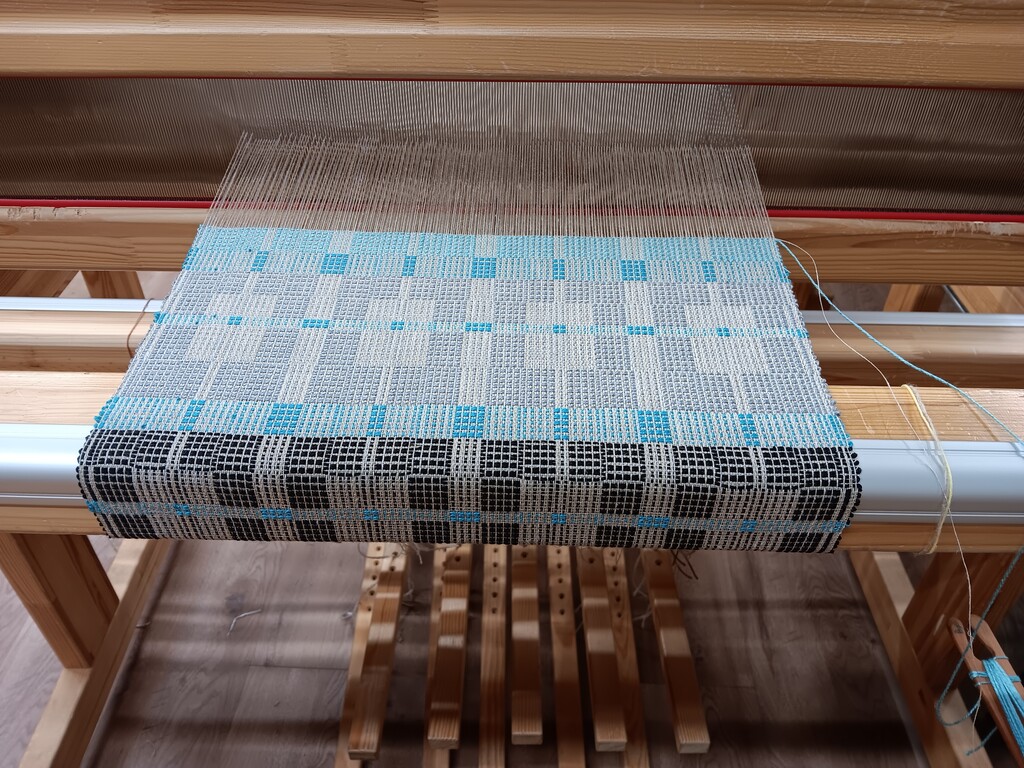
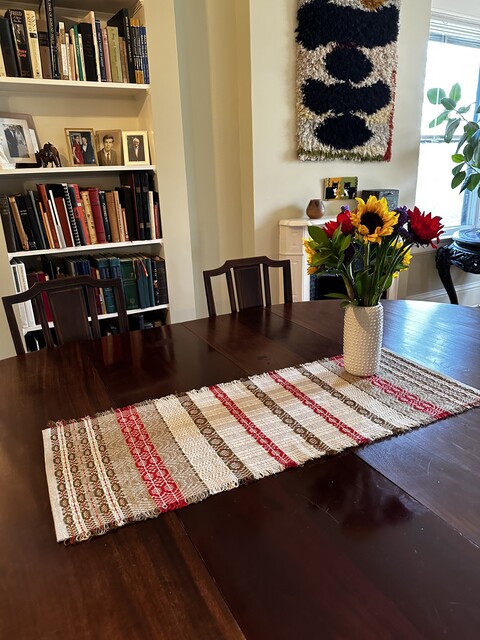
Lisa wove two towels in different colorways. For the first, she used 16/1 linen doubled on stick shuttles for the pattern weft and 12/1 linen for the ground shots.
For the second towel, Lisa chose to work with perle cotton for the pattern weft.
Stay tuned for more updates on this project. I like to think that Elsa Kerttu’s original design of multiple squares was inspired by the many small fishing huts in Kukkola.
Image of Kukkola from PinterestStock image
If you now want to visit Kukkola as much as I do, search online for the Kukkola Tourist and Conference Board. They say the area provides natural beauty, peace, and creative inspiration. What could be better for weavers?
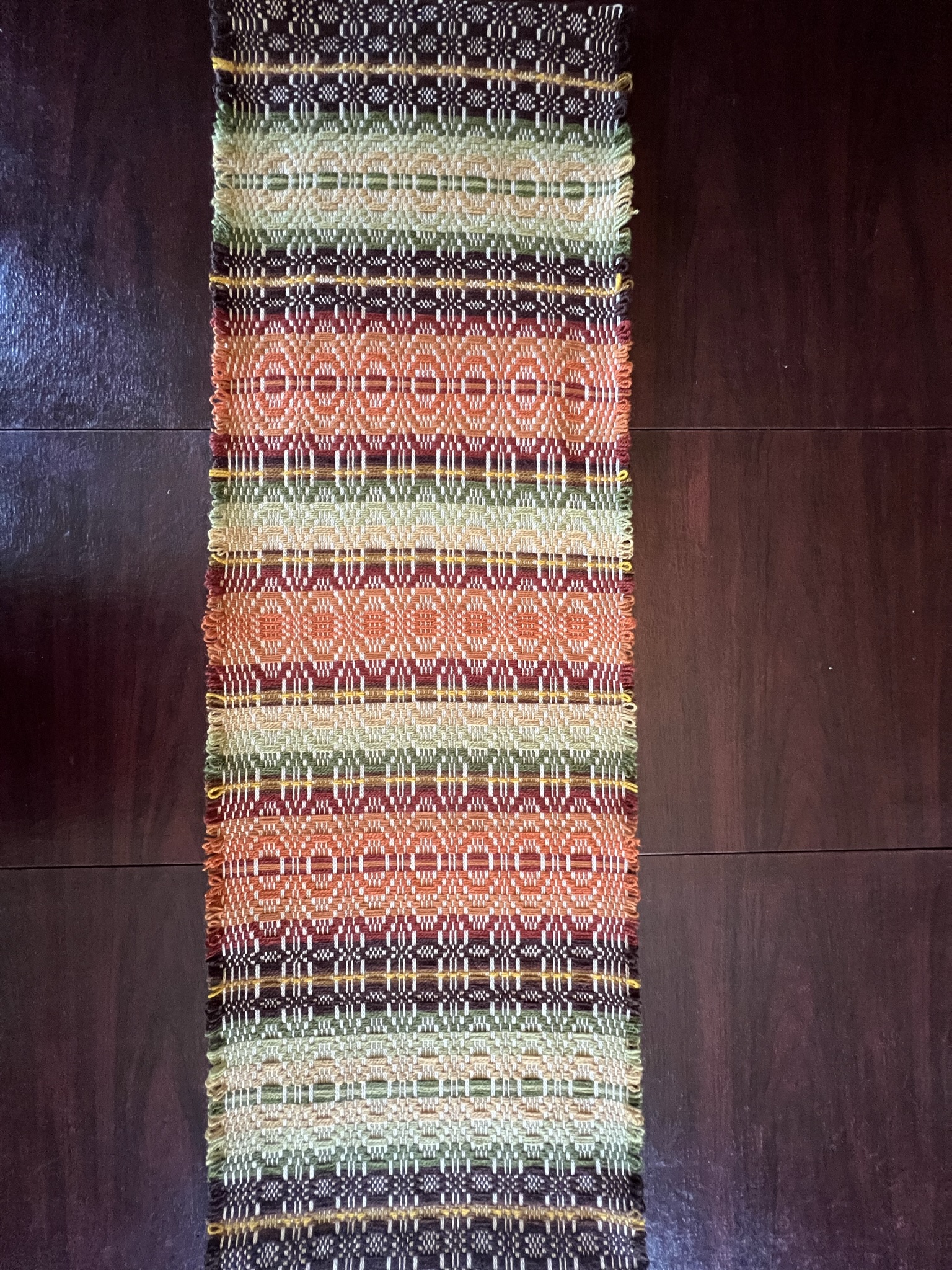
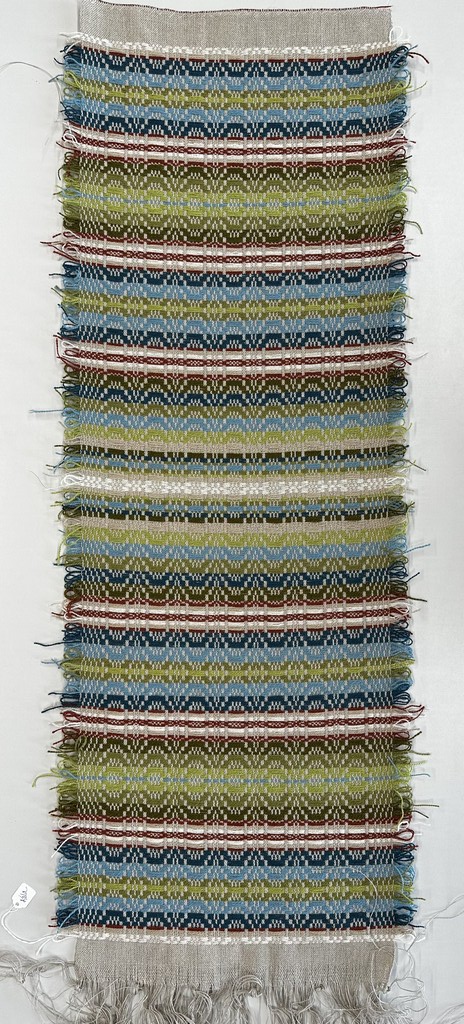
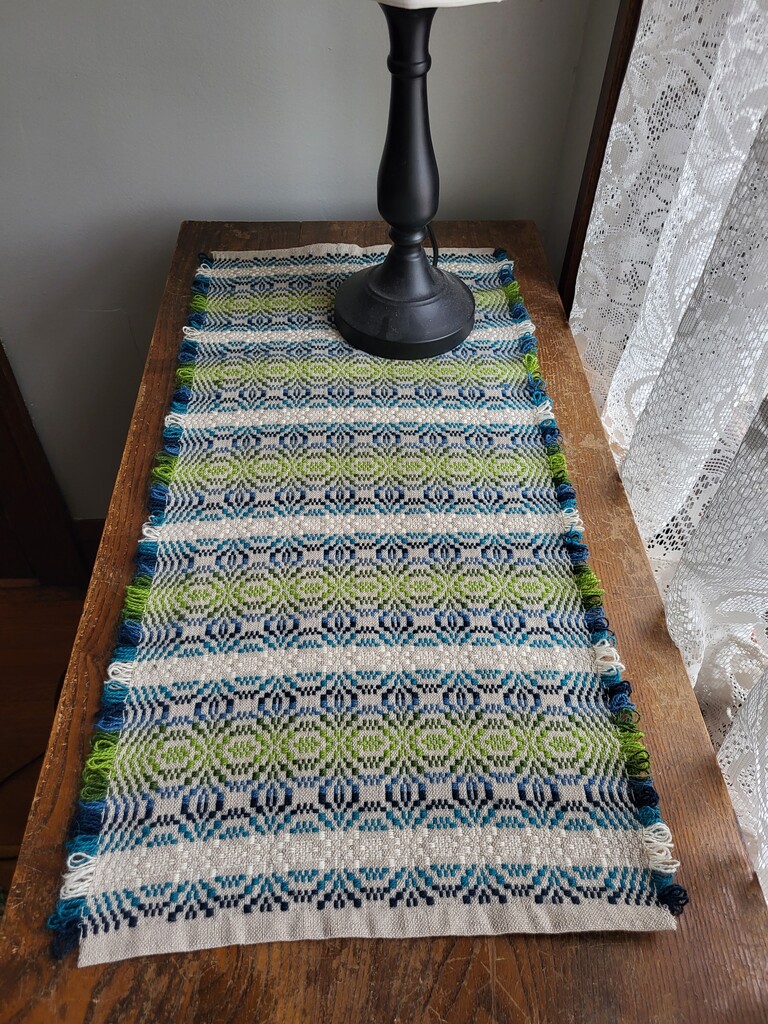
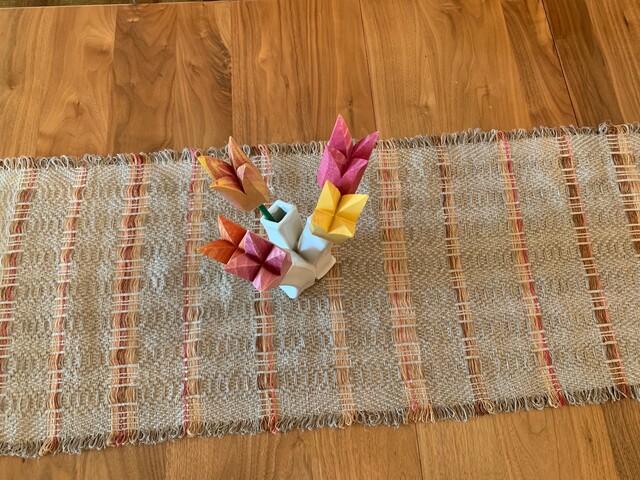
The Scandinavian Weavers’ latest group project was weaving in Telemarksteppe, organized by Lisa Torvik. Lisa was inspired by Laura Demuth’s table runner in a 2013 issue of Handwoven magazine. Laura wrote:
“Telemarksteppe is a technique that originates from Telemark, a county located along the southeastern coast of Norway. Using six shafts and five treadles, Telemarksteppe is a three-block weave woven on a tabby ground. This three-block structure allows for more design elements than the two blocks found in monk’s belt. Another aspect of Telemarksteppe that I find especially charming is the inclusion of weft loops along the selvedges. The loops also make frequent pattern-weft color changes easy. A color that is not used for several picks does not have to be cut because its end may be woven into the selvedge and reintroduced by making a loop at the selvedge that blends in with the other weft loops.”
This was our first group project in the new home of the Weavers Guild of Minnesota, the Open Book building in Minneapolis. It was a joy to work in this bright space and also have the opportunity to demonstrate weaving Telemarksteppe to visiting students, guests, and Guild members.
Scan Weavers members used a variety of weft threads in wool, linen, or cotton. The first group of weavers had so much fun that we put a second warp on the loom. Stay tuned for more pictures as their projects are finished!
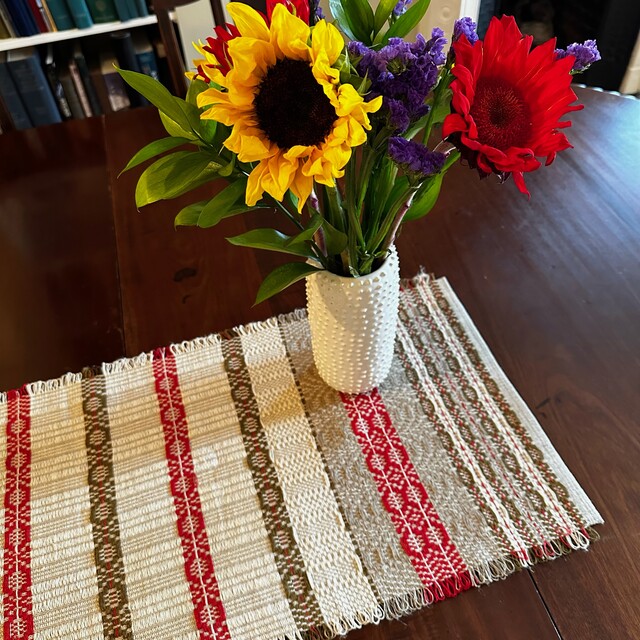
Telemarksteppe runners fresh off the loom!Lisa-Anne Bauch
Editor’s Note: Today’s blog entry was written by Judy Larson.
“Nordic Handcraft Workshop: Weaving with History – Using Historical Textiles” was a class co-hosted by American Swedish Institute (ASI) and Weavers Guild of Minnesota (WGM) and planned to be taught by Susanna Ayton of Sätergläntan Institute for Craft and Handwork in Insjön, Dalarna, Sweden. Enrollment filled quickly, and five members of the Scandinavian Weavers Interest Group offered to wind warps and prepare the twelve looms. Betsy Konop, the WGM Education Coordinator, ordered the materials and assigned the warps for winding.
On Tuesday, June 20, the warps were delivered, and five of the looms got the warps wound on. Each loom had to be carefully warped using 6/1 linen, 6/3 linen, 6/1 wool, and 16/2 cottons. The next day, more warps were wound on, sleying started, and the process continued. That night, we were informed that the instructor had been called back to Sweden for a family emergency, and we could choose to continue with the class as a group study or get a full refund. Betsy said she was sure we could “make lemonade out of these lemons!” Besides, the looms were almost ready!
Loom warped in beautiful Swedish linen
Ten of the twelve students chose to still do the class as a group study, and so the warping continued. It looked like everything was ready! Just before leaving on Thursday night, I noticed that one of the 6/1 linen warps had “churros” between the reed and the back beam, so it had to be completely wound to the the front beam, all the way to the end, and the twists removed. Betsy’s dog, Hopsy, was patiently waiting to go home, and he sat toward the end of the warp as the twist was slowly worked back. The decision was made to make it to Hopsy’s ears, and then cut the warp! It was then tied to the back beam and re-beamed the next day.
Hops hard at work!(Note his magnificent ears)
Friday morning, the group met at ASI and had a quick introduction to Sätergläntan’s programs in weaving, woodworking, blacksmithing, and hand sewing.
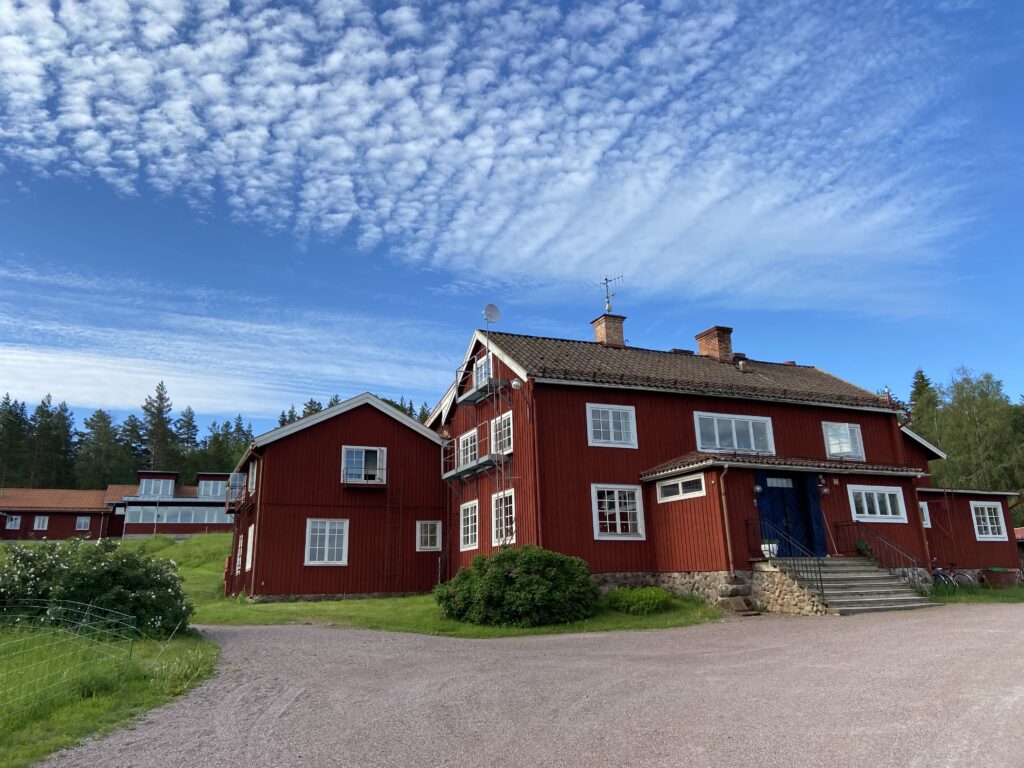
American Swedish Institute in Minneapolis
Then Phyllis Waggoner shared information and showed textiles from ASI’s collection in each of the weave structures we’d be sampling. Phyllis has been working with the ASI textiles for many years and is our local expert!
Phyllis explaining Blådrättar, a style of Dukagång
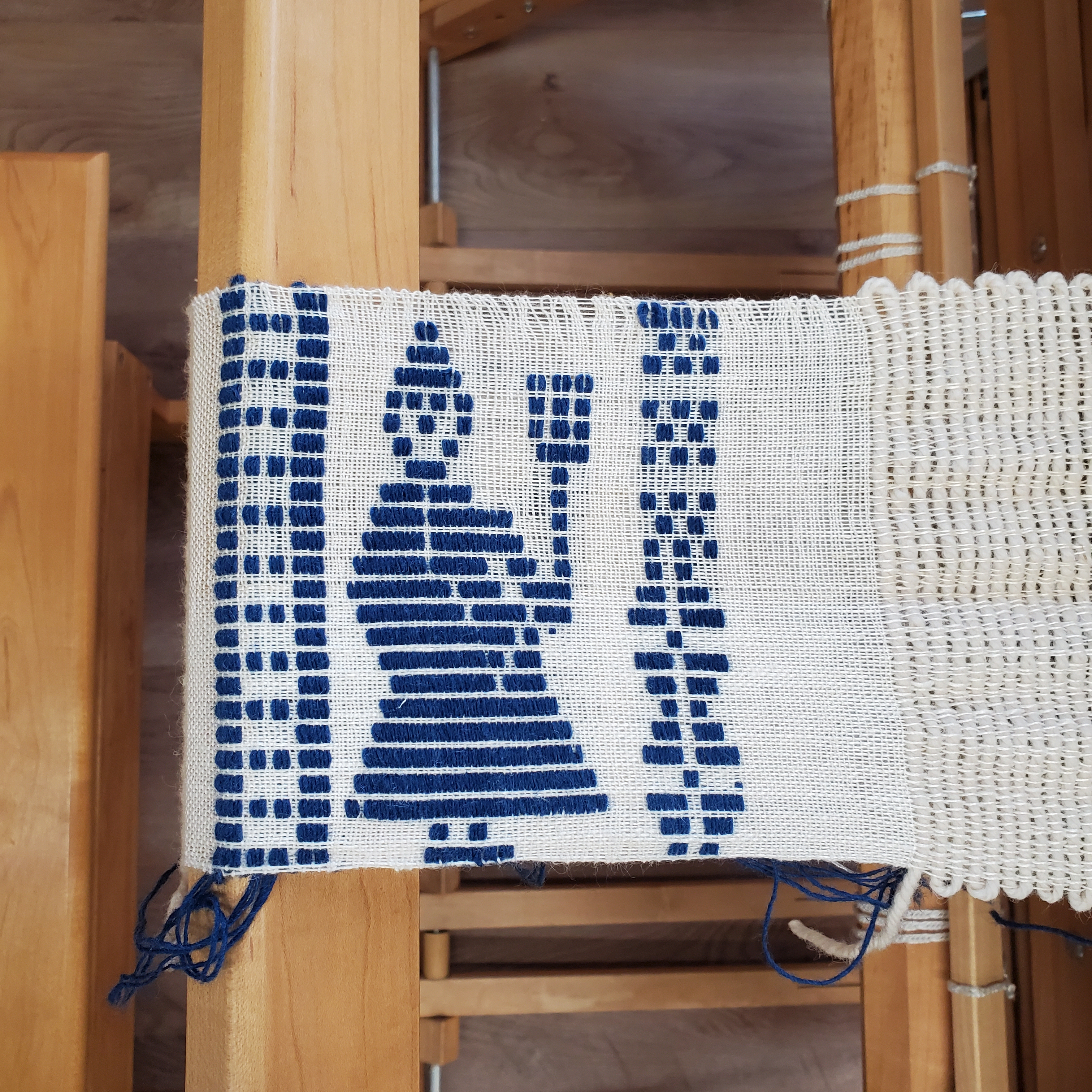
We first saw the Dukagång and Blådrättar. Blådrättar means “blue dish” in Swedish and refers to the fact that this type of Dukagång was traditionally done in blue and white/cream, similar to the colors on porcelain dishes. In Dukagång, the wool pattern weft is laid in fine rows separated by thin lines of tabby wefts.
Close-up of Blådrättar from ASI collection
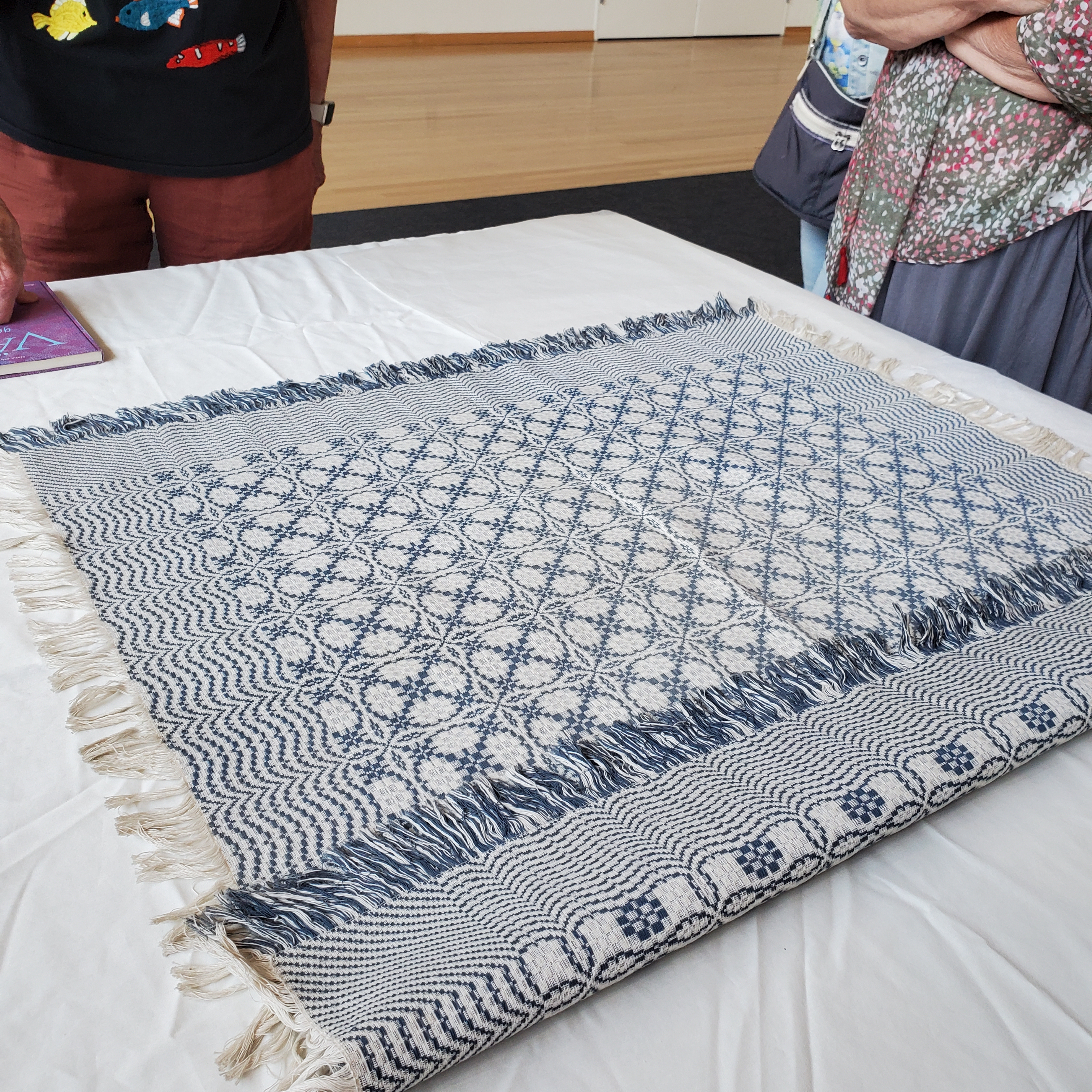
Rölakan and munkabälte (Monksbelt) pieces were shown next, along with Daldräll (Overshot) and Rosengång (Rosepath).
Close-up of Rölakan showing distinctive interlock technique
Close-up of mythical creature on Rölakan weaving
Another Rölakan from ASI’s textile collection
Daldräll from ASI’s textile collection
Munkabälte (Monksbelt) from ASI collection
After lunch, the group went to the Guild and started our group study. Those with any experience in any of the structures gave their mini-demonstration, and then the weavers began making their samples.
Swedish wool yarn with WGM looms in the background
Lovely Swedish linen in a rainbow of colors!
Munkabälte and Daldräll were both pattern/tabby weaves and were more familiar. The Rosengång on opposites was a little trickier to do, but remembering the treadle partners of 1/4 with 2/3 and 1/2 with 3/4 helped. The Rölakan differences with single or double interlocks, plus the dovetail and over two without interlocked were discussed. The most challenging weave was the Dukagång.
Marianne weaving Rosengång (Rosepath)
Ever working on Rölakan interlocks
The weavers wove 6-inch samples of three different Munkabälte patterns, two Rosengångs (one with twills 4321234, and one with 123414321 threadings), two Daldräll patterns, two Rölakan, and three Dukagångs. As the weaving started, the patterns were coming out underneath. The tie-ups were all for counterbalance looms, so the tie ups needed to be reversed! More learning was happening!
Daldräll by Judy
Second Daldräll threading
Two of the Dukagångs were on 6/1 Farö wool warps, which kept breaking. Finally, the decision was made to re-warp one of them with 6/1 linen, which worked much better.
Sharon’s beautiful Blådrättar!
Sharon experimented with color blending in munkabälte
Close-up of Sharon’s munkabälte
More munkabälte
Munkabälte
Analyzing weave structure’s in Nancy’s show-and-tell
After weaving on Saturday and Sunday, there was a reception at ASI for all the participants in any of the four areas for Sätergläntan classes. The blacksmithing teacher commented that it was impressive that the weaving class went forward, even without a teacher. But it just shows that when weavers get a chance, they make the best of it! We truly did make “lemonade out of the lemons!”
After the warps are taken off the looms, Betsy will take pictures of each sample, and send them out to their respective weavers. The weekend was a great opportunity to meet more weavers, learn more about Swedish structures, and support the Guild/ASI partnership with Sätergläntan. Thank you to everyone who made this possible!
Editor’s Note: Special thanks to Betsy and Judy (and Hopsy!) as well as Erin Swenson-Klatt at ASI, who all went above and beyond to make sure this week was a wonderful experience for all!























 Scandinavian Weavers Study Group