Category: Norwegian weaving

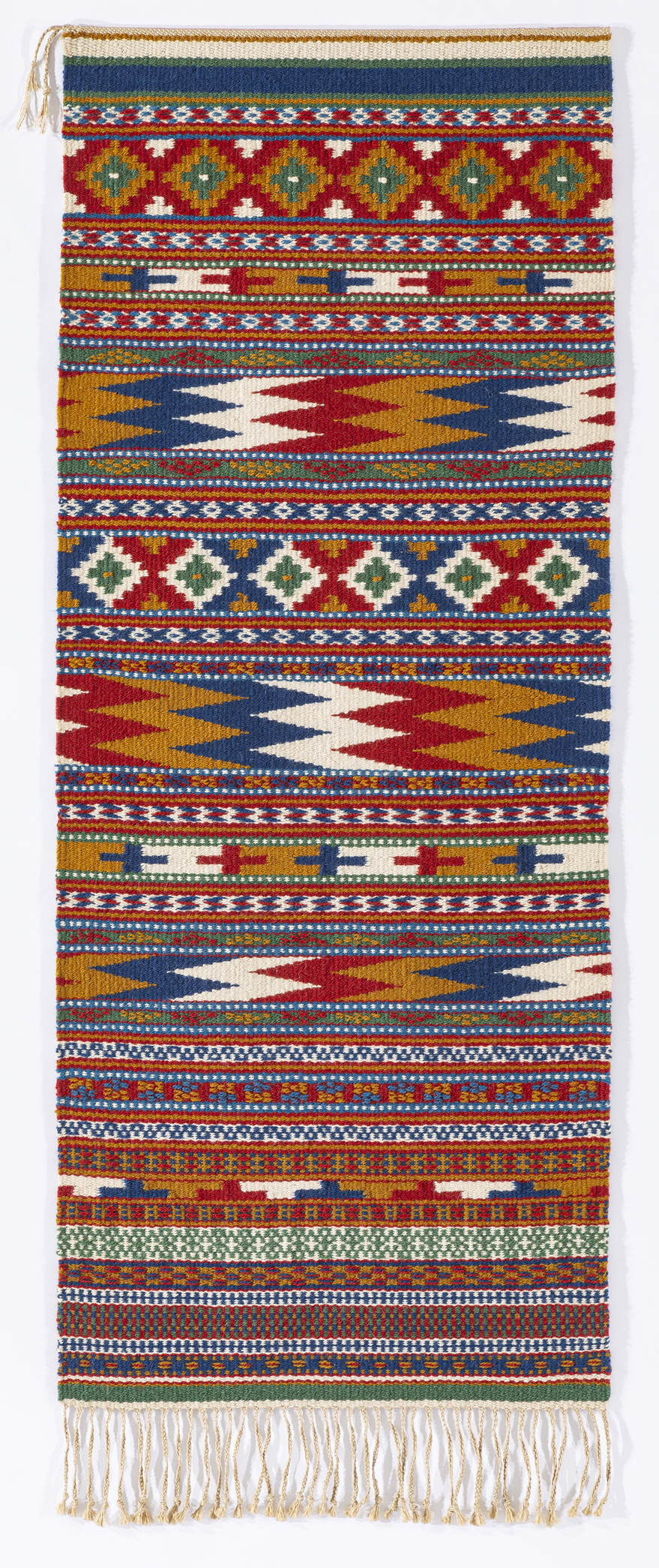
  • Nancy Ebner: Divine Connection

    Nancy Ebner

    Divine Connection

    24″ x 22.5″

    Cotton Seine Twine warp and Prydvevgarn wool weft

    NFS

    Bio: Nancy started weaving in earnest at the Minnetonka Center for the Arts in 2017 by taking classes offered by Traudi Bestler. She wanted to learn to weave independently prior to her retirement and has tried her hand at a multitude of 4-shaft weave structures. She continues to explore techniques for the opportunity to learn and to connect with other makers. Nancy is drawn to bright, vibrant colors and especially to the color PINK! She enjoys both the design and the technical aspects of completing a woven piece. As a bonus, textile-related travel has taken her to New Mexico, Massachusetts, Sweden, Norway, Ireland, and most recently to the Peruvian Andes. She hopes to explore the rich textile heritage of Morocco in 2025.

    Description: An online photo and the discussion of the similarity between Turkish Kilim and Scandinavian weaving patterns led me to the book Flatweaves from Fjord and Forest: Scandinavian tapestries of the 19th and 20th centuries. I ordered the book to learn more about the piece in the photo and chose to weave a smaller, modified version of the original weaving. The original design was thought to be from a carriage cushion woven around 1800 in southern Sweden. In 2019, I traveled to Sweden with a subset of our Scandinavian Weavers Group to learn various art weaves. I returned with a “sampler” that included a tiny portion of this geometric tapestry technique called rutevev (Norwegian) or rölakan (Swedish). In 2022, I received further instruction from Jan Mostrom during her class featuring square weaves at the Vesterheim Norwegian-American Museum in Decorah, Iowa. This weaving method is VERY slow going as each square in worked by hand using yarn butterflies and a single-interlock process. Some rows required up to 29 color changes per row! This particular piece has 1320 passes of the weft across the warp and finishing required 1775 ends to be woven by needle into the back of the work. (My super power is persistence!) Many of the designs in heirloom weavings have spiritual significance. This particular piece contains symbols of the sacred: a rose, birds and numerous crosses.

    naebner@msn.com

  • Sharon Moe Marquardt: Norwegian West-Coast Style Coverlet

    Sharon Moe Marquardt

    Norwegian West-Coast Style Coverlet

    13-½” x 30″
    Linen warp, wool weft
    NFS

    Bio: Sharon Moe Marquardt has been weaving since the mid-1980s. Inspired by her sister’s summer/winter cow runner, she studied rigid heddle one and two-heddle loom techniques from the Prairie Wool Companion, edited and authored by David and Alexis Xenakis. She used her notes to teach rigid heddle classes at the Weaving Works and Experimental College in Seattle. Moving to her home state of Minnesota, she taught these classes at several weaving conferences. At one conference, she discovered Syvilla Tweed Bolson’s vendor table and later signed up for her boundweave class in Decorah, Iowa. These lessons led to a life-long pursuit of learning Scandinavian techniques. She has studied at Vesterheim Norwegian-American Museum, in Norway, and at the Hemslöjden in Landskrona, Skåne, Sweden.

    Description: At Vesterheim I learned the decorative West Coast weaves from Marta Kløve Juuhl, who has explored almost-forgotten weaves from Norway, Iceland and the Shetlands. She is the main curator at the husflid in Osterøy, west of Bergen. I wove the smaller colorful hanging based on her lessons. Heidi Goldberg, art professor at Concordia College, Moorhead, Minnesota, asked me to assist with the weaving section in her traditional Nordic Arts classes. I taught the West Coast weaves first on backstrap looms and then on small warp-weighted looms that my husband had made based on the loom I had purchased at the Sami Husflid (handcraft store).

    Read more about the loom that Sharon developed in this Norwegian Textile Letter article: “Developing a Loom to Teach Scandinavian Weaving,” and about her creative use of rya for creating an image in Sharon Marquardt: Using Traditional Voss Rye Technique–to Depict Show Shoveling?, August 2020.

    Regarding the Scandinavian Weavers Group: The Scandinavian study group has been my main support for decades. I live in a small rural area where hardly anybody weaves. I’ve traveled to meetings, but with Zoom now available I can attend most of them. Mange takk to this group!

    shmarquardt@gmail.com


  • Cathie Eggan Mayr: Norwegian Spring

    Cathie Eggan Mayr

    Norwegian Spring

    31” x 16-½”
    10/2 Perle Cotton – Warp & weft tie-down; 5/2 Perle Cotton – Pattern Weft

    twotabby.com

    Bio: Inspired by a weaving exhibit at the American Swedish Institute in 1999, Cathie Mayr learned to weave at Sievers School of Fiber Arts on Washington Island, Wisconsin. It was the beginning of a life-long passion for the fine craft. She learned that her mother had done some weaving in college, but also was surprised when she discovered several ancestors on both her maternal and paternal sides were accomplished weavers. Throughout her 25-year weaving journey, Mayr learned from numerous experts and mentors across the country and in Norway. She began teaching in Central Minnesota in 2023. Mayr’s “home” Guild has always been the Weavers Guild of MN.

    Description: Norwegian Spring was inspired by a springtime visit to meet relatives in Meldal, Norway (near Trondheim) for Syttende Mai. As it turns out, most of the town of Meldal are my third cousins – and many are weavers! Spring is such a joyous time in Norway – the sun is warming and flowers are blooming in every color imaginable. I knew I’d have to capture the beauty and joy in a woven piece. Color has always defined much of my long weaving career. I’m endlessly fascinated with the interplay of color as threads intersect in various ways in woven pieces. I’ve woven scarves, blankets, rugs, towels, table runners, and much more, in nearly every type of fiber. But in the end, it’s the color that drives my design process. This piece was no different. It was pure joy to play with the color gradients to represent the four flowers in this piece. The background warp (vertical) threads are a gradient of 6 blues ranging from dark to light. This represents the still chilly / frosty skies to warming days of deepening blue skies. From the top, the four flowers represented are:
    1. Bergfrue (Pyramidal Saxifrage) known as “White Mountain Queen.” This beauty has five long white petals with increasingly dense splotches of deep magenta at the center (pistal). It was selected as Norway’s National Flower at the 1935 Botanical Congress in Amsterdam. Heather is now the National Flower since it is found across a wider range of the country.
    2. Yellow Coltsfoot (Tussilago Farfara – Daisy family) is a perennial wildflower. I love that it comes in the very early spring fairly shouting in bright yellow! It is often referred to as “Son Before Father” because the flowers come before the leaves.
    3. Red Clover (Trifolium Pratense) is seen across many of Norway’s fields and pastures. This versatile green manure crop not only adds organic nitrogen to the soil but also provides flowers that can be harvested for tea. It is often used for menopause symptoms and osteoporosis.
    4. Lupine (Lupinus) comes from lupus, Latin for “wolf”, and its related adjective lupinus, “wolfish.” Lupine fields have a highly organized social structure, with clearly distinguished leaders and followers. Although dangerous to livestock, lupines improve soil by adding nitrogen and loosening compacted earth with their strong root systems.

    catmayr@yahoo.com

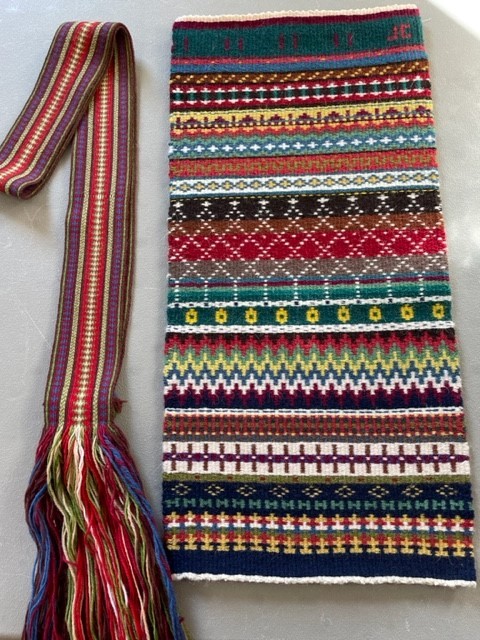
  • Jane Connett: Bunad Belt

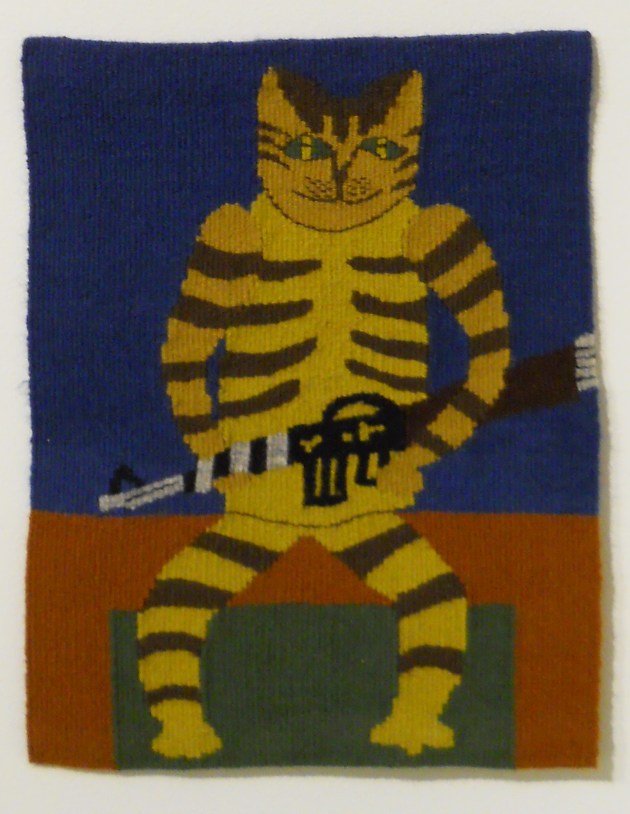
  • Lila Nelson: Terrorist Cat

    Lila Nelson (Date uncertain, 2008?)

    Terrorist Cat

    Cotton warp; wool weft
    NFS

    Bio: Lila Nelson, who died in 2015 at age 93, was the Registrar and Curator of Textiles at the Vesterheim Norwegian American Museum for 27 years, and the beloved leader of the Scandinavian Weavers Group for many years. She was a mentor to many of the weavers whose works are in the Vibrant Traditions show. No retrospective of American weaving in the Norwegian tradition would be complete without her work.

    Description (by Robbie LaFleur): Lila wove many tapestries that displayed her progressive politics, including more than one terrorist cat. Lila said her terrorist cats, children and a bear were her attempt to treat terrorist threats with the satire that they deserved. Lila said that when she wove the Terrorist Cat tapestry in the exhibition, she wanted to depict an Uzi, but she had never seen one. I think that we have all seen so many images of guns, that we know what they look like without even realizing it.

    You can read many articles about and by Lila Nelson in the Norwegian Textile Letter:
    Lila Nelson Celebration: Robbie LaFleur
    Lila Nelson and her Tapestry Barter System
    Lila Nelson’s Celebration: Laurann Gilbertson
    Lila Nelson’s Celebration: Carol Colburn and Norwegian Friends
    Lila Nelson’s Celebration: Lisa Torvik and Neil Mikesell
    Lila Nelson Celebration: Claire Selkurt
    Lila Nelson Celebration: Wendy Stevens
    Lila Nelson Celebration: Mary Skoy
    From the Norwegian Breakfast Club to the Norwegian Textile Guild – a Brief History
    On the Occasion of Lila Nelson’s 90th Birthday
    RETRO REPRINT: The Ruteaklaer Tradition in Norway
    A Forgotten Artist Remembered: The Tapestry Weaving of Pauline Fjelde

    In searching my own blog, Lila comes up about two dozen times. She is my most important weaving mentor, so that is only appropriate! These are the posts that focus on her work exclusively.
    Lila Nelson: Guessing at her Design Process (September 2020)
    Oh Lila, You Wove So Many Cat Tapestries (September 2020)
    Are These Tapestry Eaglets? (September 2020)
    The Tapestries of Lila Nelson: Poetry, Myth, and Protest (December 2015)
    In Case You Ever Thought Lila Nelson Was Repressed (October 2010)

    Obituary: Lila Nelson, educator and artist of Norwegian textiles, dies at 93. Star Tribune, June 1-2015
    Webinar: How Lila Nelson’s Tapestries Embraced the World and Its Politics. 2020

  • Vibrant Traditions: Scandinavian Weaving in the Midwest

    Norway House and the Scandinavian Weavers Study Group of the Weavers Guild of Minnesota present an exhibit of 49 contemporary and traditional weavings in the Scandinavian tradition

    Vibrant Traditions:
    Scandinavian Weaving
    in the Midwest 

    Norway House
    913 E Franklin Ave, Minneapolis, MN 55404
    January 31 – April 6, 2025 

    Free for members of the Weavers Guild of Minnesota and Norway House; all others $5.
    See the Norway House website for the building hours of operation.

    This exhibit of traditional and contemporary weavings in Scandinavian techniques will take place in the Mondale Galleri at Norway House. The Scandinavian Weavers Study Group is celebrating almost three decades of collaboration and friendship that has included exhibitions, study group topics, and sharing of expertise. This resulted in a strong community with a shared interest in traditional Scandinavian weaving techniques and commitment to keeping our craft alive — and vibrant. The exhibit will be accompanied by weaving demonstrations and special events. Check this blog in the coming months for details. 


    Exhibit Celebration: Friday, February 7, 2025 , 5-8pm. ($5 for members of the Weavers Guild of Minnesota and Norway House; all others, $10.

    Images: Top: “Wedding Tapestry,” Kevin Olsen. Botom: “Hordaland Teppe,” Lisa Torvik.

  • Magical Weaving on the Shores of the Big Lake

    Magical Weaving on the Shores of the Big Lake

    Today’s blog entry is written and photographed by Scandinavian Weavers member Holly Hildebrandt.

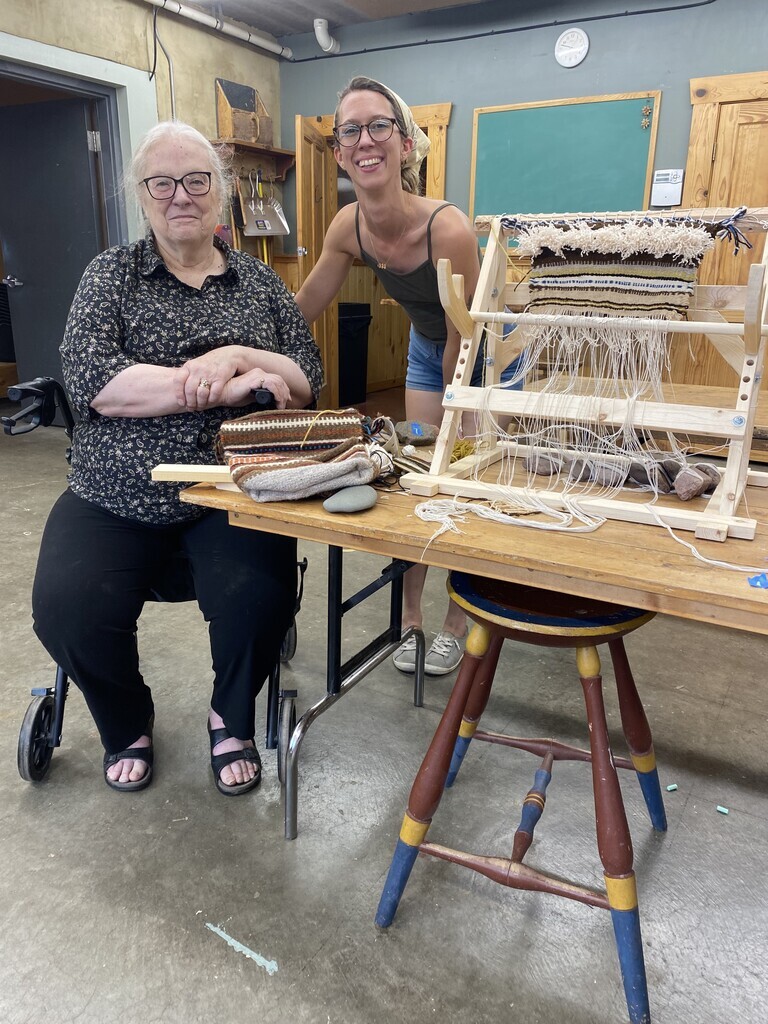
    I got home late last night after the most incredible five days in Grand Marais, taking Melba Granlund’s class at North House Folk School! We built our own warp weighted loom the first two days, then wove on it the next three. It’s the most fun I’ve had in a long time and it was wonderful spending time with Melba.

    Melba and Holly

    David Susag was our woodworking instructor. He also has a major affinity for Scandinavian tradition and is most known for springpole woodwork.

    Students with woodworking instructor David Susag

    Between the lake, smoked fish, mountain of wool yarn, and smell of pine as we chiseled, it was so magical. I am sad that it’s over but so grateful for the memories we created. Big thanks to Melba for sharing her wealth of knowledge with our little group! 

    Warp strings weighted with rocks
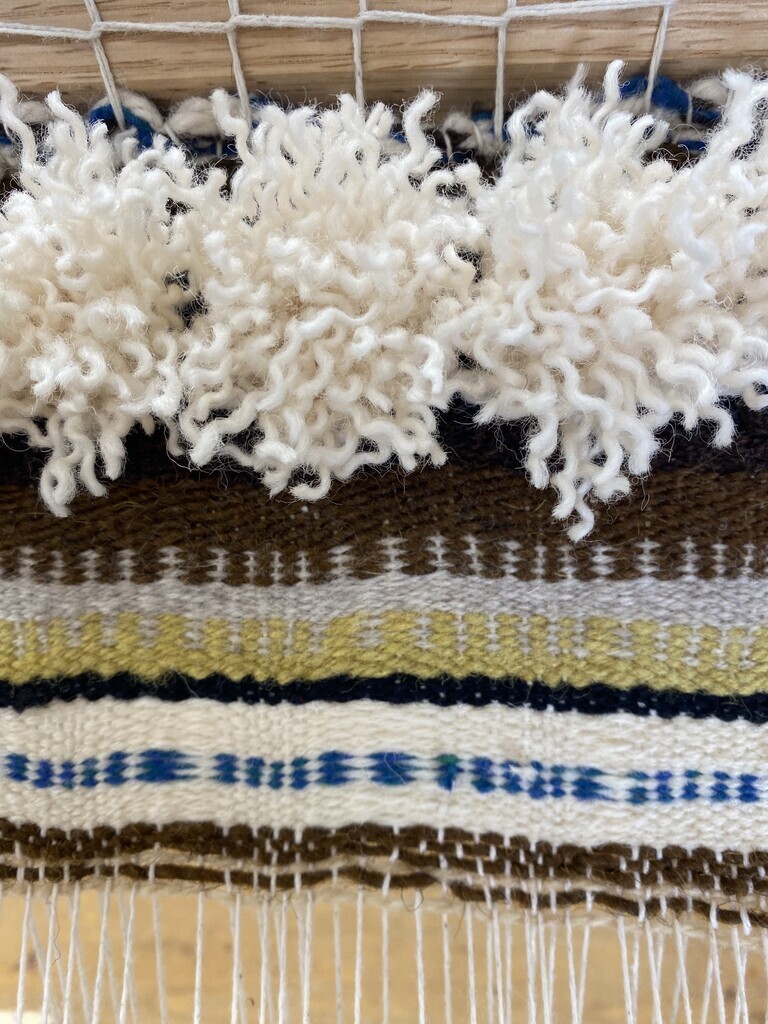
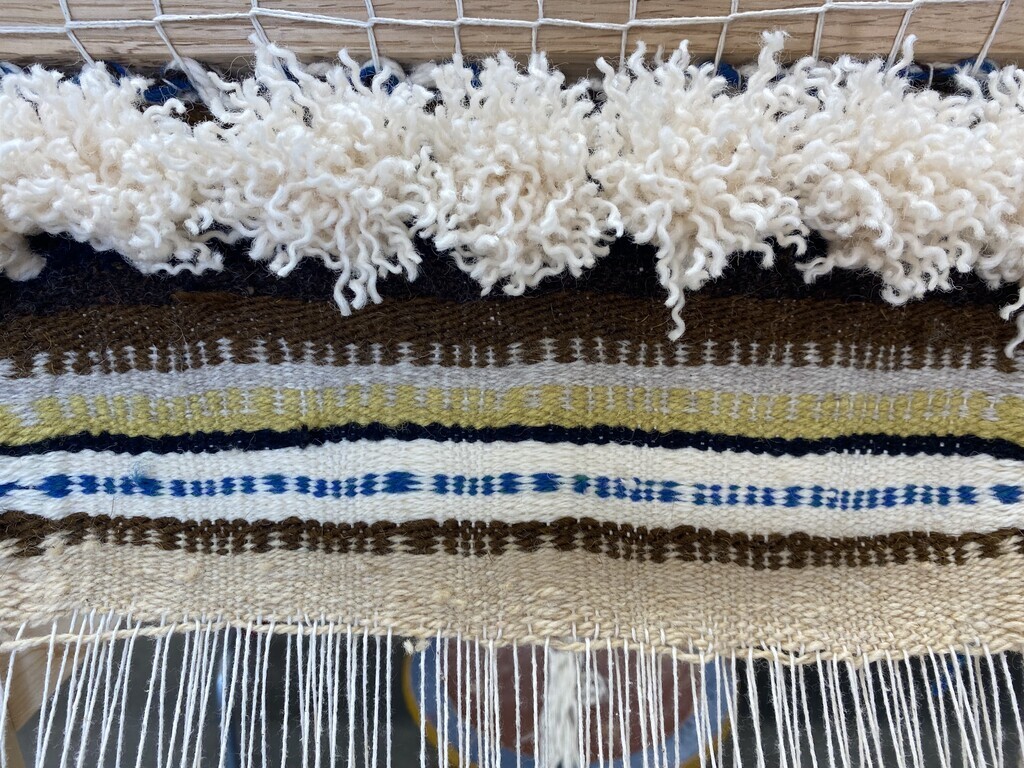
    Close-up of Holly’s weaving
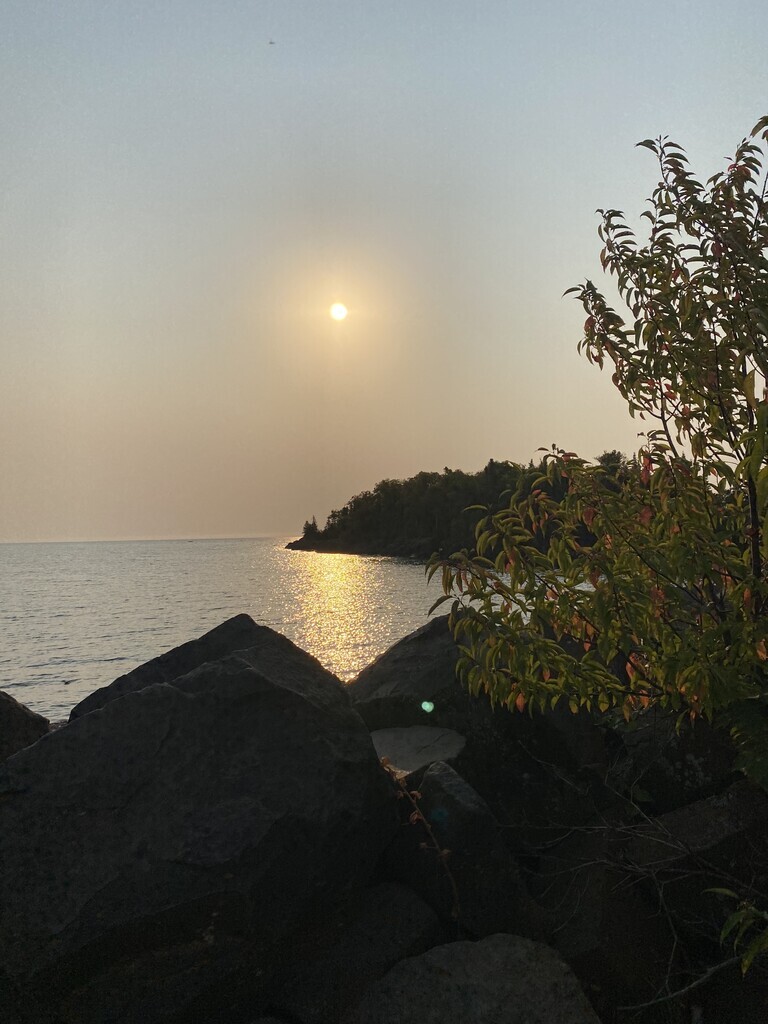
    Lake Superior shore in Grand Marais, Minnesota
    Sunset over the Big Lake

  • Latest News from Scandinavian Weavers!

    Latest News from Scandinavian Weavers!

    Follow the Scan Weavers Blog! (And see more beautiful blue rugs by Judy Larson!)

    It’s been a busy summer for our Scandinavian Weavers Group and promises to be a busy fall, as well. Stay tuned for a summer wrap-up and fall preview, including the following:

    Scan Weavers win ribbons the Minnesota State Fair!

    Scan Weavers in the news!

    Recent and Upcoming travels to Scandinavia!

    Group Projects: Rosepath Rugs and Viking Twill!

    Major Exhibit Coming in 2025!

    And more! (Including waffles.)

  • Nancy Ellison in the News!

    Nancy Ellison, longtime member of the Scandinavian Weavers Group, has been having a busy summer. Nancy raises Scandinavian heritage breed sheep on her farm near Zumbrota, Minnesota, and spins and weaves with their fleece. She is a recognized expert in traditional Norwegian folk arts.

    Nancy Ellison demonstrating cradle loom weaving at the Scandinavian Weavers Group exhibit “Domestic to Decorative” at Red Wing Arts.

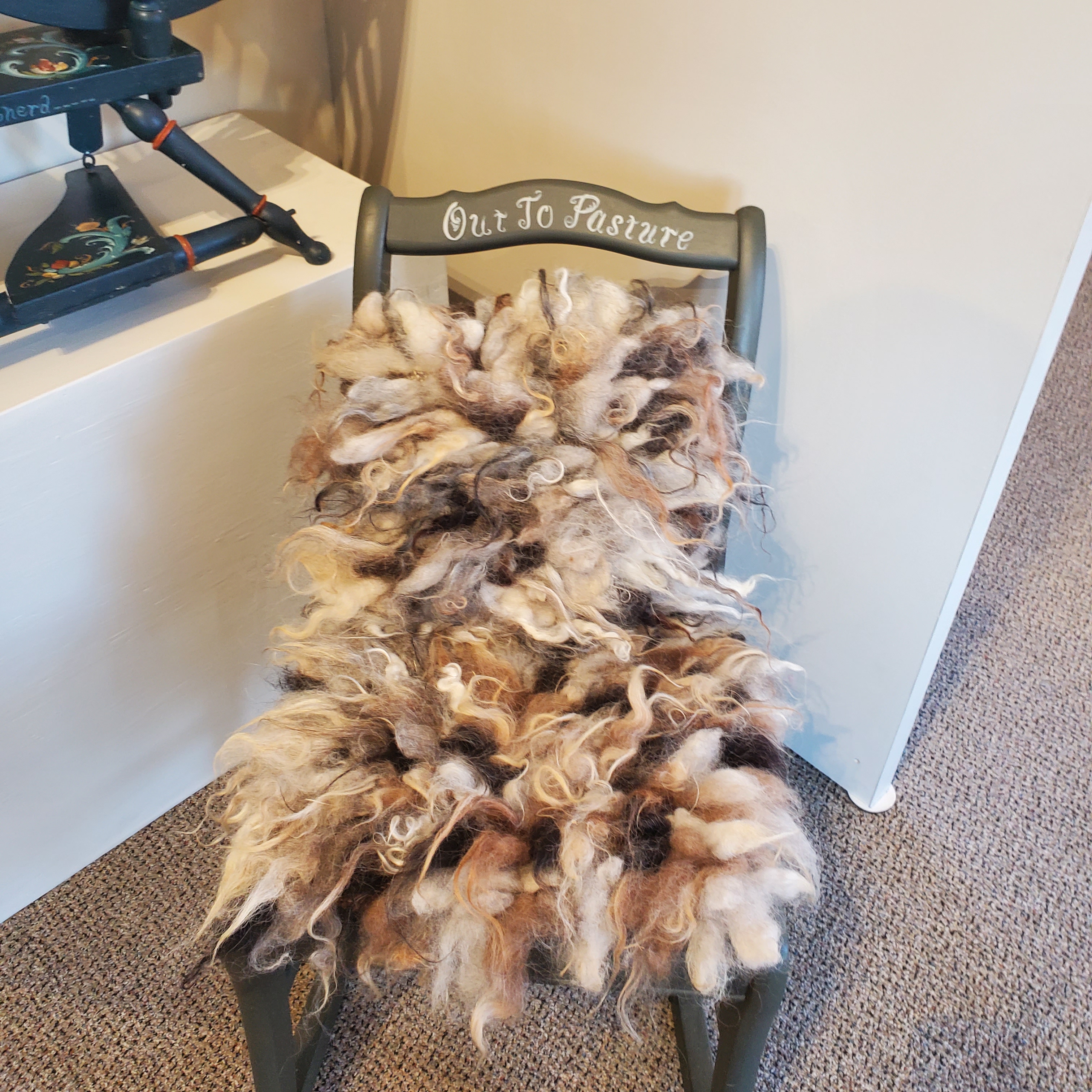
    Her flock’s colorful fleeces are featured in her weaving, as in this rya. (Nancy also painted the rocking chair and spinning wheel.) Her flock features Shetland, Gotland, and Icelandic sheep.

    A poster featuring Nancy was recently spotted at this year’s FinnFest in Duluth by alert Scandinavian Weavers member Barb Yarusso.

    Photo by Barb Yarusso

    The poster is from a traveling exhibit called “Traveling Traditions: Nordic Folk Arts in the Upper Midwest,” created by the University of Wisconsin-Madison’s Center for the Study of Upper Midwestern Cultures. The exhibit features photos and interviews with seven folk artists throughout the region. The interviews were conducted by graduate students at the University of Wisconsin–Madison, trained in folklore fieldwork, working in cooperation with the Minnesota State Arts Board and the Wisconsin Arts Board.

    Nancy recalls the interview with her customary modesty: “I don’t know how they decided to ask me for an interview.  I hadn’t applied for anything.  I’ve been blessed by unasked for publicity that has come my way through the years.  It has been fun!”

    Nancy’s full interview can be found here:

    Nancy was also in the news recently when a sheep got loose in Zumbrota. (Some might say the sheep was on the lam.) The sheep evaded police but was eventually apprehended by some experienced wranglers. An enterprising reporter from the Minneapolis Star Tribune contacted Nancy for a quote. “He had an interest in sheep and said he saw lots of sheep when he was on a trip to Scotland,” Nancy explains, “and he saw the news about the Zumbrota police capturing an escaped sheep. I am always happy to help educate the public when anyone asks me about sheep, wool, spinning, weaving, etc.”  

    Fortunately, Nancy has never lost one of her rare heritage sheep. “One time a lonesome stray sheep got in with my flock,” she says. “I was surprised to see a sheep I didn’t recognize.   [With a] pan of grain, my sheep follow me wherever I want them to go, and the stray followed them in the shed where I could corner him, put a halter on him, and put him in a separate pen.  I phoned neighbors with sheep and nobody was missing any. Some people had seen a sheep in the area by itself.  I phoned the sales barn, two miles from here on the other side of Zumbrota, and they had one escape a month previous and sent someone to get it from here.  The sheep had enjoyed a month of freedom and hadn’t been eaten by a coyote.  Sorry to see him go back behind baaaaars! “

    Be sure to check out Nancy’s website at Ellison Sheep Farm. She teaches classes and gives presentations on traditional Scandinavian spinning and weaving and is a great person to consult regarding old spinning wheels and looms.

    More links to enjoy!

  • A Mention from the Crown Princess!

    On Friday, April 12, a very special weaving symposium was held under the auspices of Her Royal Majesty Crown Princess Mette-Marit, Samlede Tråder [Unifying Threads]. I knew several Norwegian weavers who were thrilled to get invitations, and witnessed a lot of other excitement through social media posts. Although I meant to do it earlier, two articles about the event were just published in the Norwegian Textile Letter.

    Crown Princess Mette Marit’s Remarks at the “Unifying Threads” Weaving Symposium

    LONG LIVE WEAVING — Thoughts on Crown Princess Mette Marit’s Weaving Symposium. Jon Fredrik Skauge wrote an heartfelt essay about his experience at the symposium. I suggest following Jon Fredrik Skauge on Facebook to learn about his amazing linen projects, all the way from planting seeds through spinning and weaving. He wove a long linen tablecloth and added sprang at one end, in a pattern from a tablecloth made by his great-great grandmother.

    I was looking through coverage of Crown Princess Mette-Marit’s symposium and found a long article that appeared in the Norwegian handcraft magazine, Husflid. The article is posted on their website, “Kronprinsesse Mette-Marit: – Jeg gjorde selvfølgelig alt feil” [Crown Princess Mette-Marit – Of Course I did Everything Wrong.”

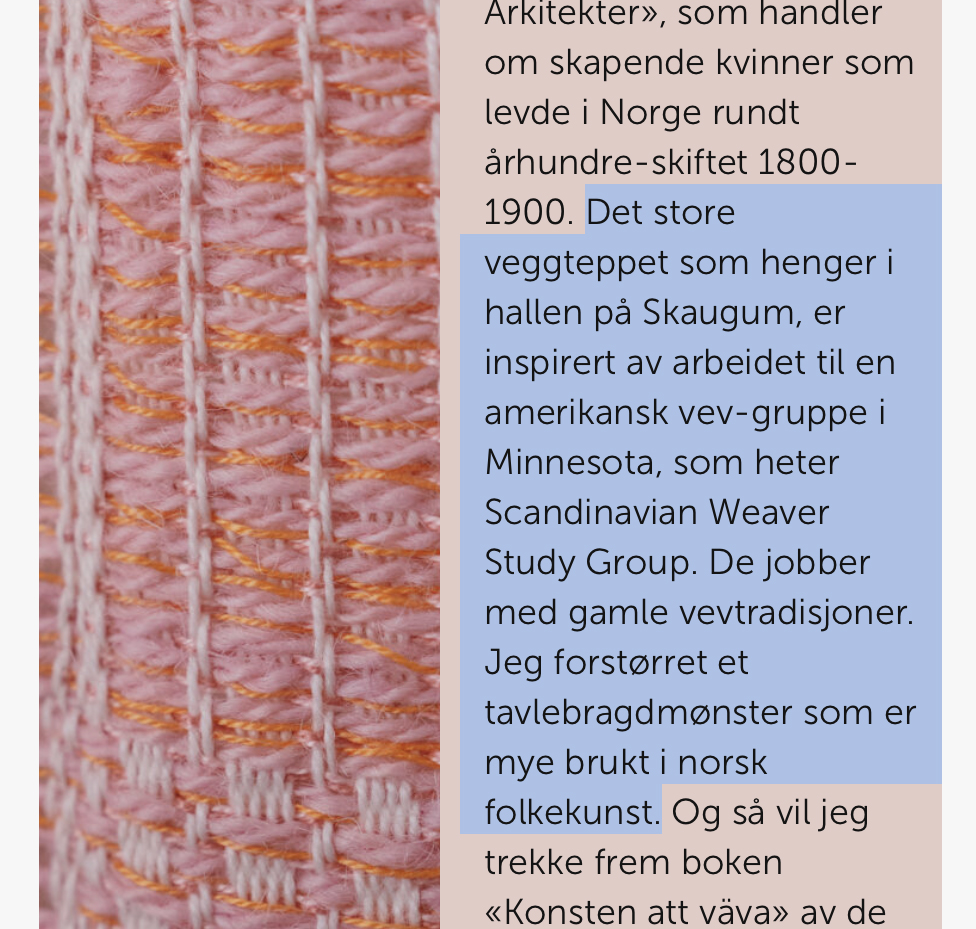
    The weaving hangs at the entrance to Skaugum. It is inspired by the traditional weaving technique tavlebragd [monk’s belt]. Photo: Tom Gustavsen

    Near the bottom of the article was a section called “Mette-Marit on Inspiration.” And surprisingly, there was a shout-out to our Scandinavian Weavers Study Group!

    What an honor it is to know that the work we do with traditional Norwegian weaving techniques spreads back across the ocean.