Category: Scandinavian weaving

  • Grene Demonstration on a Warp-Weighted Loom

    Grene Demonstration on a Warp-Weighted Loom

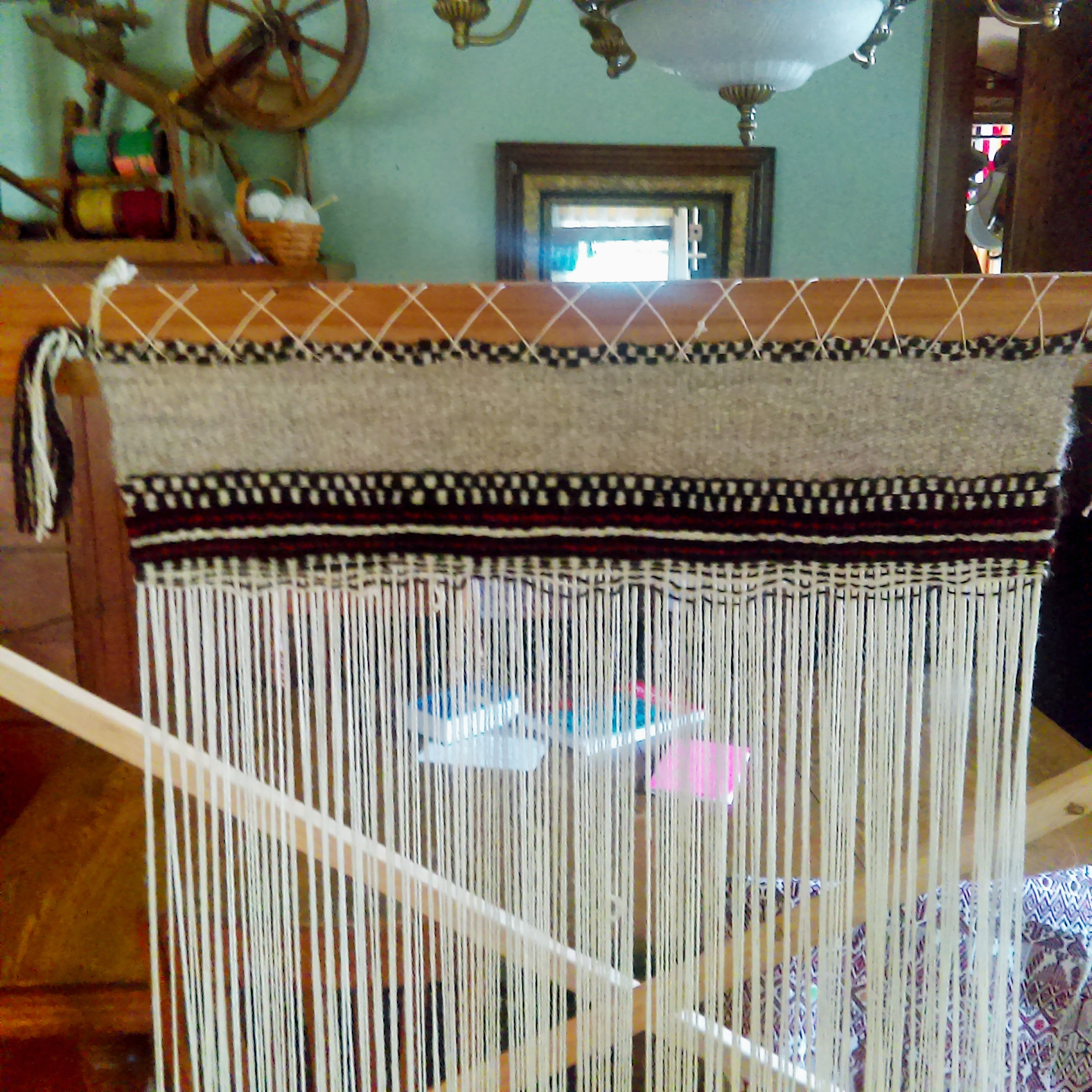
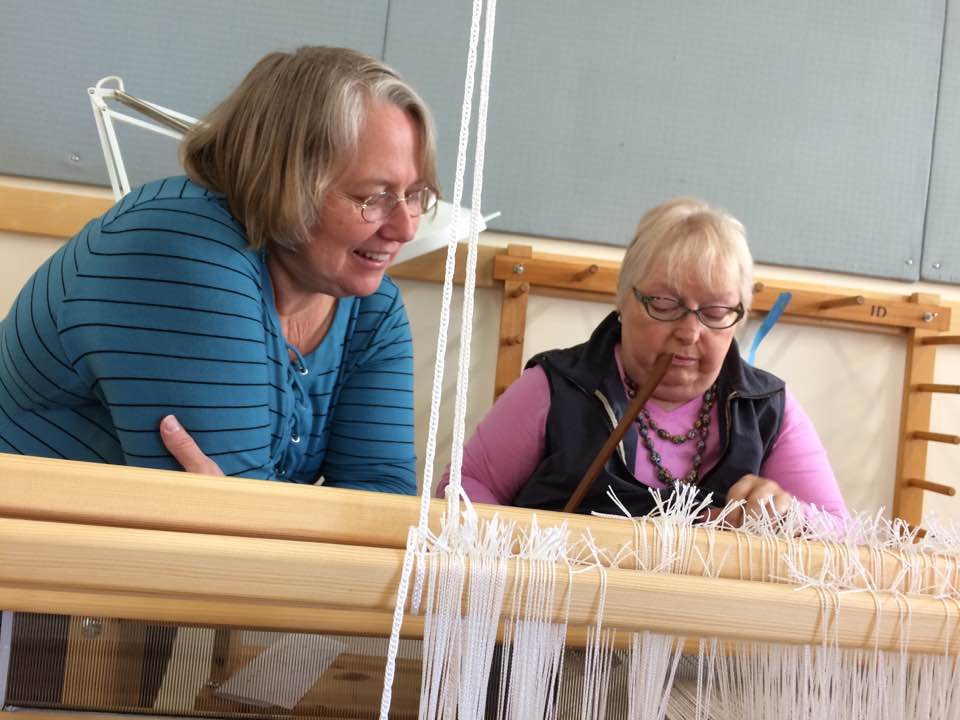
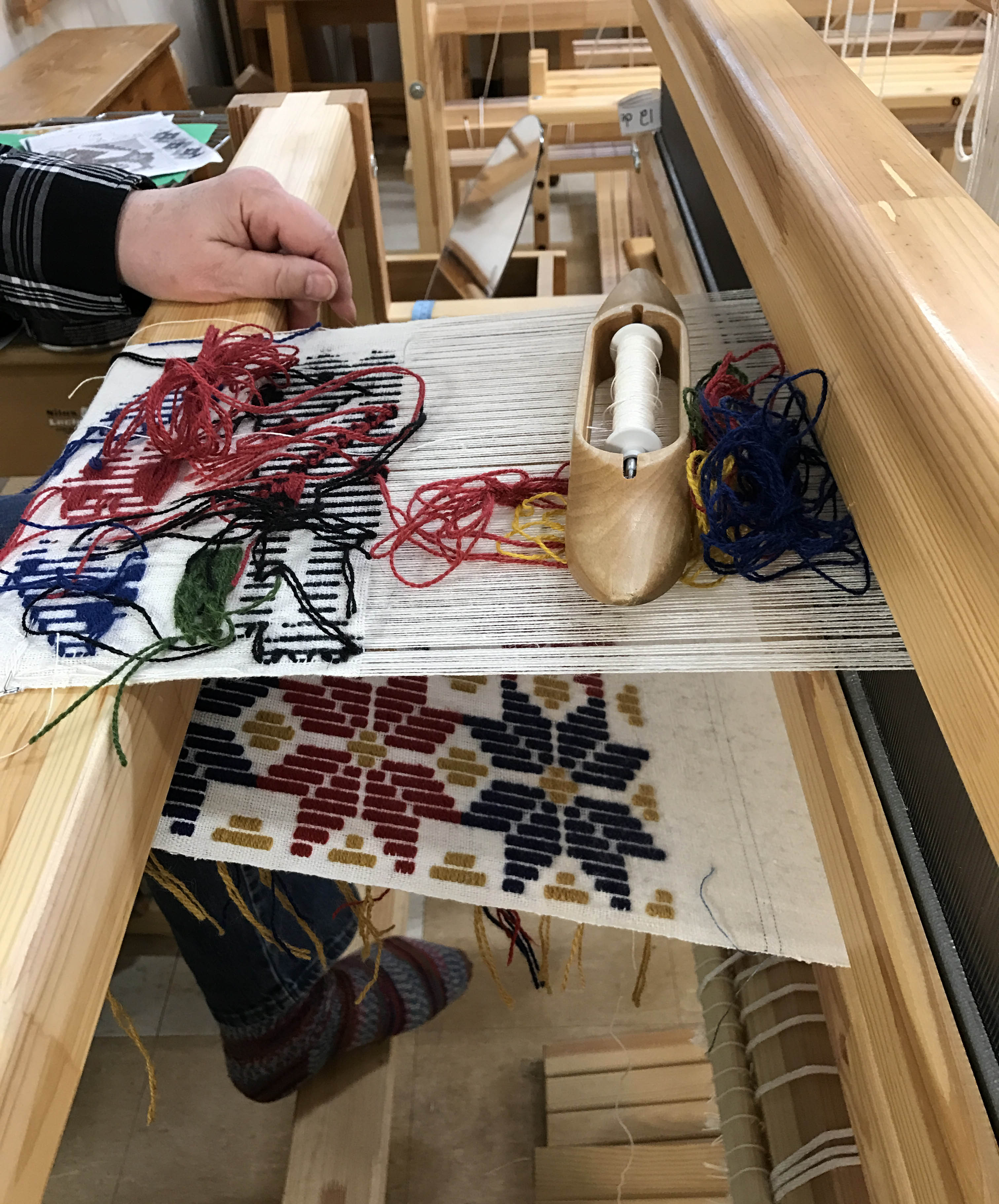
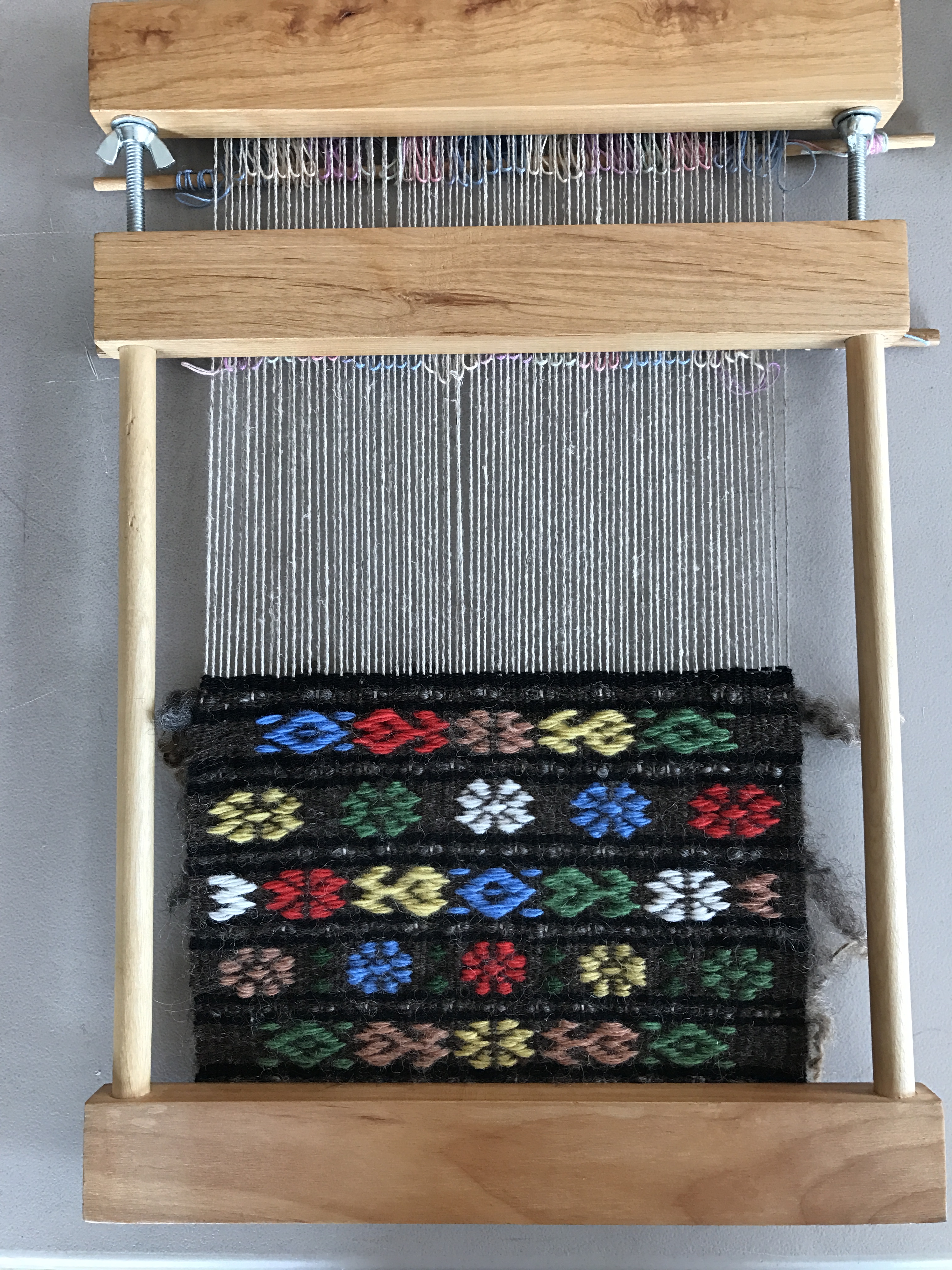
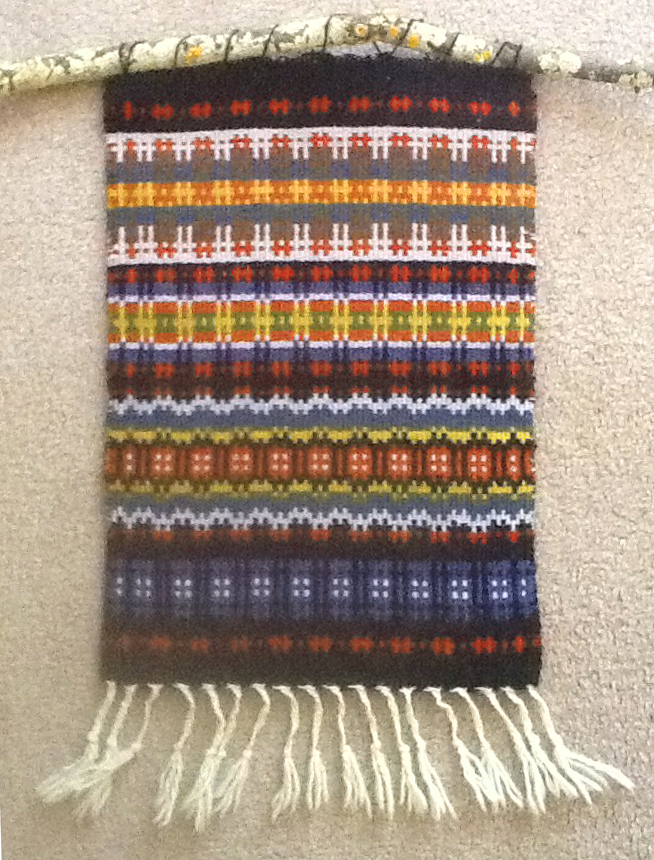
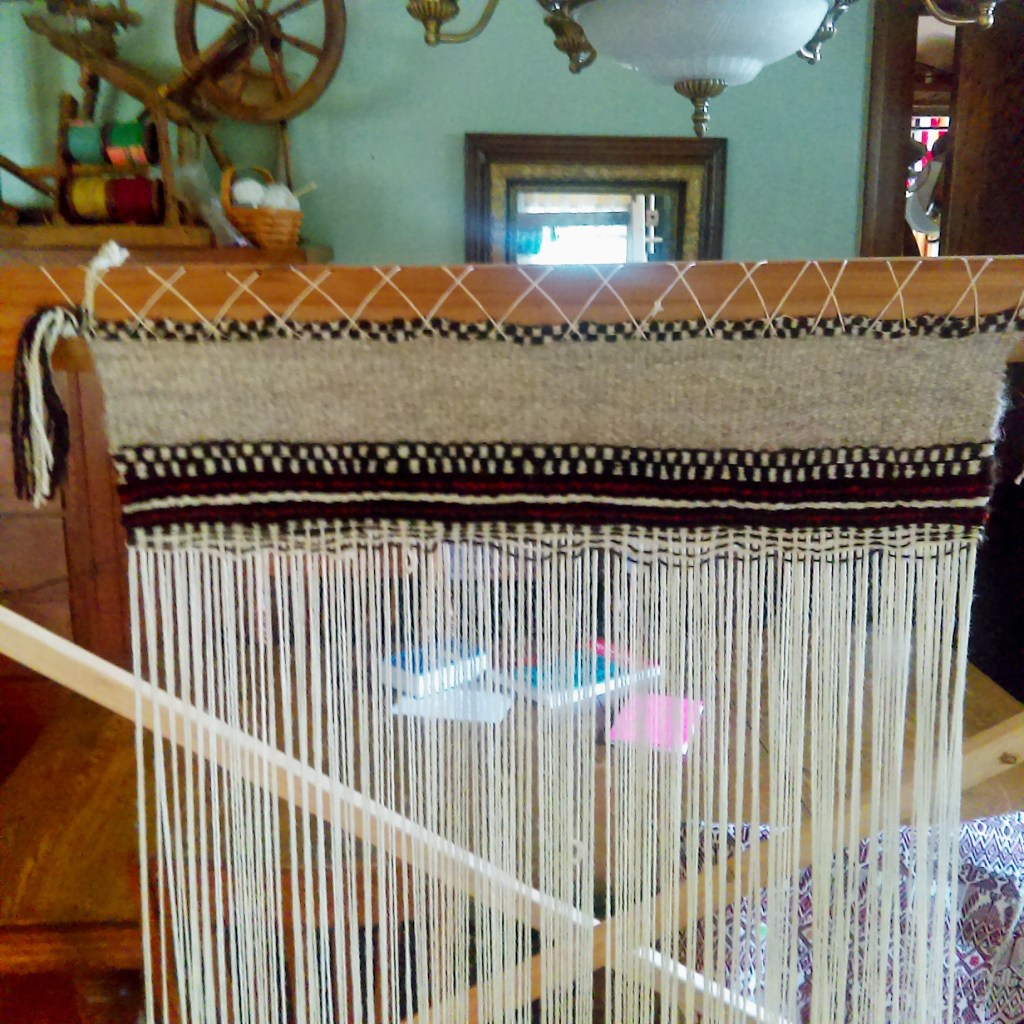
    Melba Granlund set up a warp-weighted loom (courtesy of the Vesterheim Norwegian-American Museum) at the 2017 Shepherd’s Harvest Festival, as part of the Weavers Guild of Minnesota booth.  She started work on a traditional Sami-style grene, a banded coverlet technique woven with thick, lofty wool.  It was a smashing success!  Though she planned to give a formal presentation at one point, that never happened.  Instead, she was inundated with questions from curious visitors from beginning to end.  And all that didn’t leave time for much actual weaving progress, only about 4-1/2 inches.

    melba-grene

    With the festival over, and the loom moved back to her home, Melba is continuing the project.  Watch the blog for updates on the grene, and a description of the wonderful yarn she is using.

    melba-grene-2

    Did you miss this cool loom at the Shepherd’s Harvest Festival this year?  There’s always 2018.  Melba said that there was so much interest that a warp-weighted loom demo would be great for next year, too.

  • Favorite Pattern Motif so Far? Stars.

    Favorite Pattern Motif so Far? Stars.

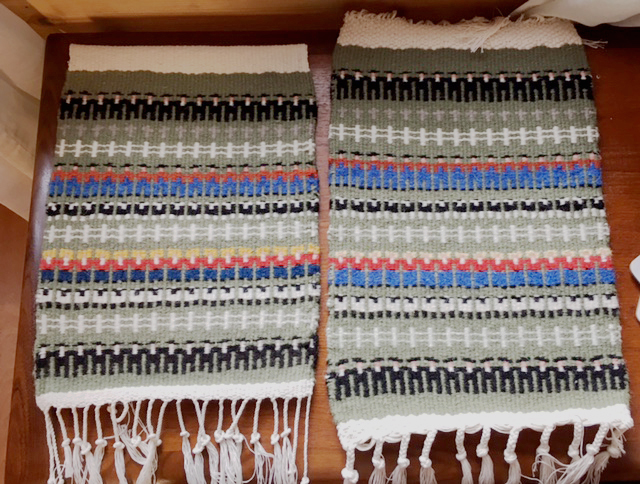
    On our Scandinavian Weavers group warp, three people have chosen to weave stars.  Recently, Lisa Torvik’s star peeps out as Sara Okern weaves a blue star.

    IMG_2579
    Lisa Torvik’s bright and festive star pattern
    IMG_2576
    Sara Okern said this was the first time she has woven anything but a rag rug.  Success! 
    IMG_2578
    Sara wove a blue star.
  • Norwegian Yarn in the Swedish Dukagång

    Norwegian Yarn in the Swedish Dukagång

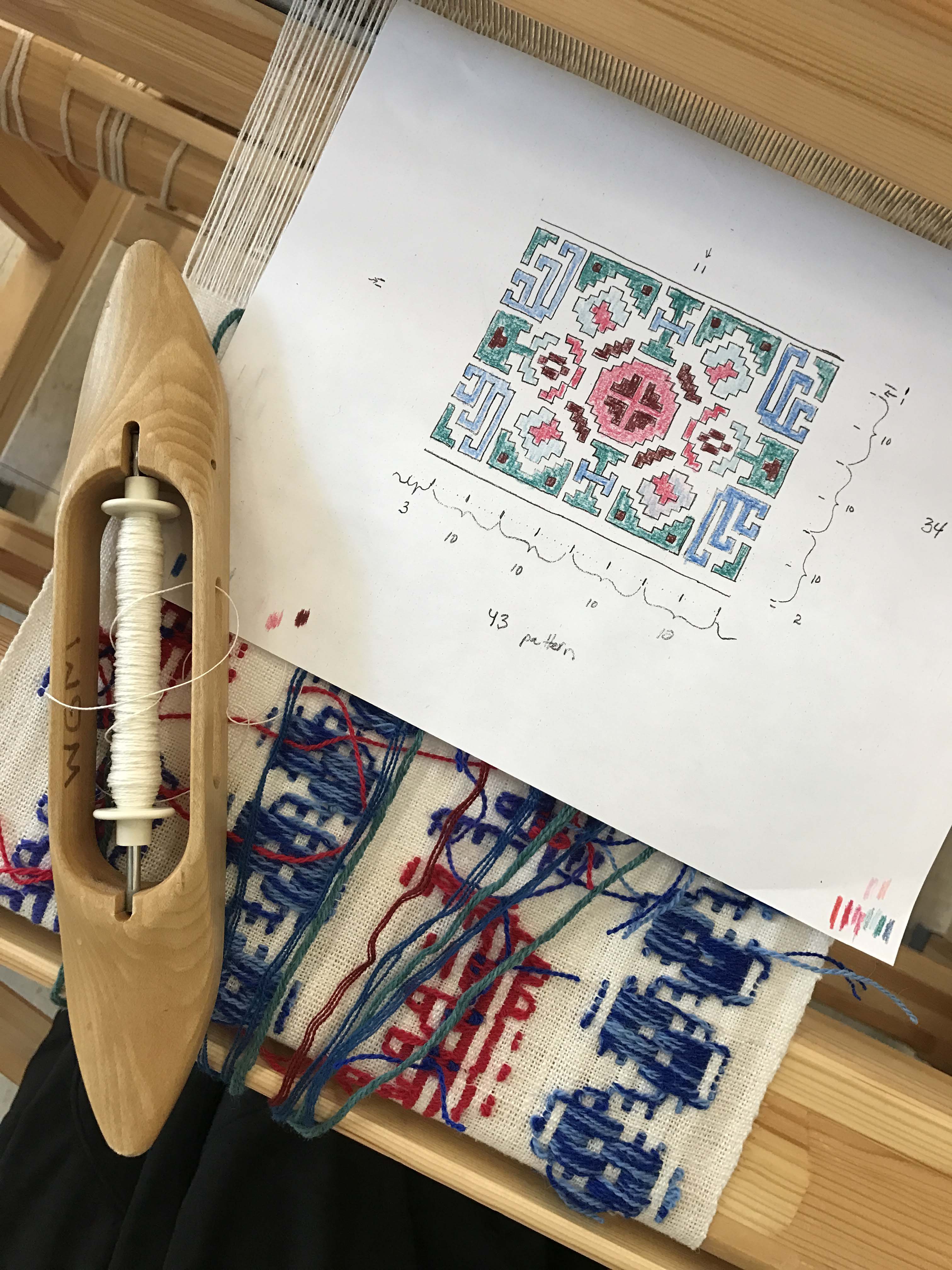
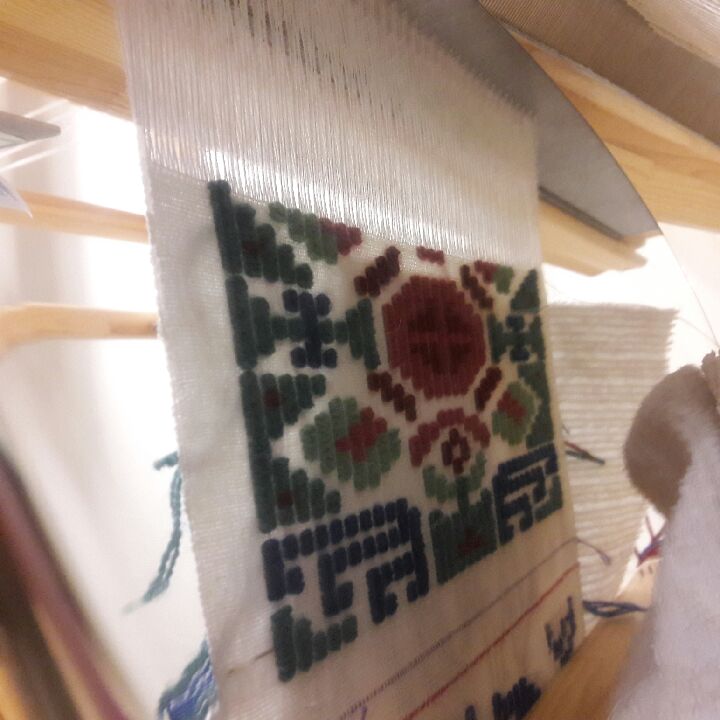
    Karin Maahs finished her piece, and her pattern weft was sentimental. She used thin Norwegian yarn her grandmother used to embroider bunads (Norwegian costumes).

    One day her pattern was sitting on the loom. “Oh nice, that’s what was just finished,” I thought as I snapped this photo.  Clearly I had not looked carefully, as that was the just completed piece, and Karin’s pattern ready to start.  Weaving from the back makes this process hard to document!

    karin2

    Here’s Karin’s piece, underway.  It will be nice to photograph all the pieces once they are off the loom.  For now, it still looks great at this weird angle.

    karin


  • A Dukagång among Friends

    A Dukagång among Friends

    Patty Johnson, Jane Connett and Judy Larson whipped out their dukagång in record time.

    17426249_10208969849945003_5122056684819950562_n
    Judy and Jane figure out the pattern.
    17553457_10208973372313060_4273208060765423849_n
    Patty helping out under the loom
    17554511_10208969917626695_3559845606546420303_n
    Their pattern revealed from below
  • Skinny Woman, Fatter Man?

    Skinny Woman, Fatter Man?

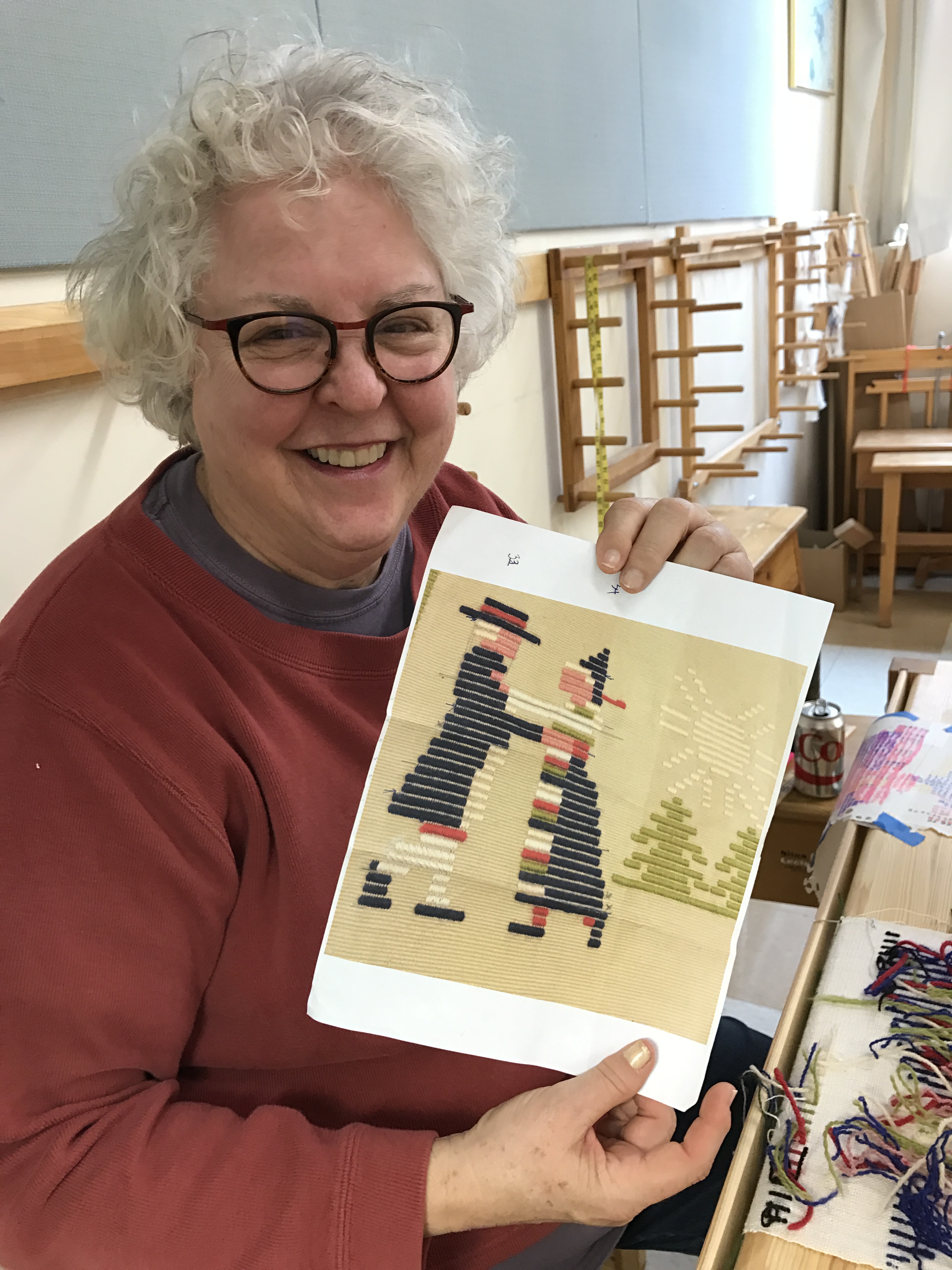
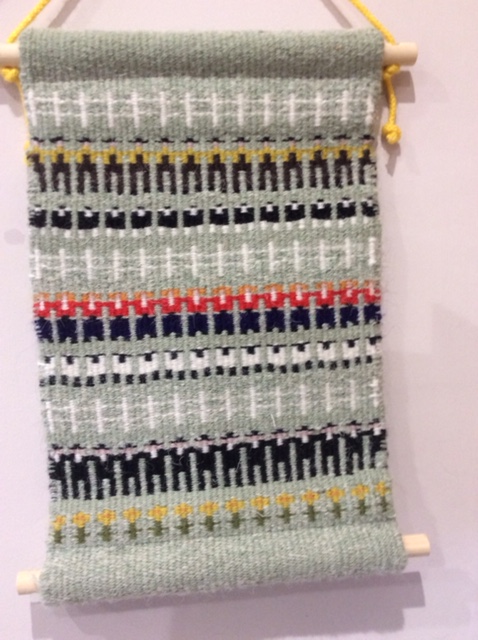
    Mary Skoy is working on her dukagang piece this weekend, weaving a dancing couple from a piece at the American Swedish Institute.

    IMG_2296

    She was using four shots of pattern yarn to make a square, with only one shot of background weft between each pattern shot.  This resulted in a skinny woman! For the man, she is switching to five pattern shots per square; it will be interesting to see how that changes the pattern.

    IMG_2300

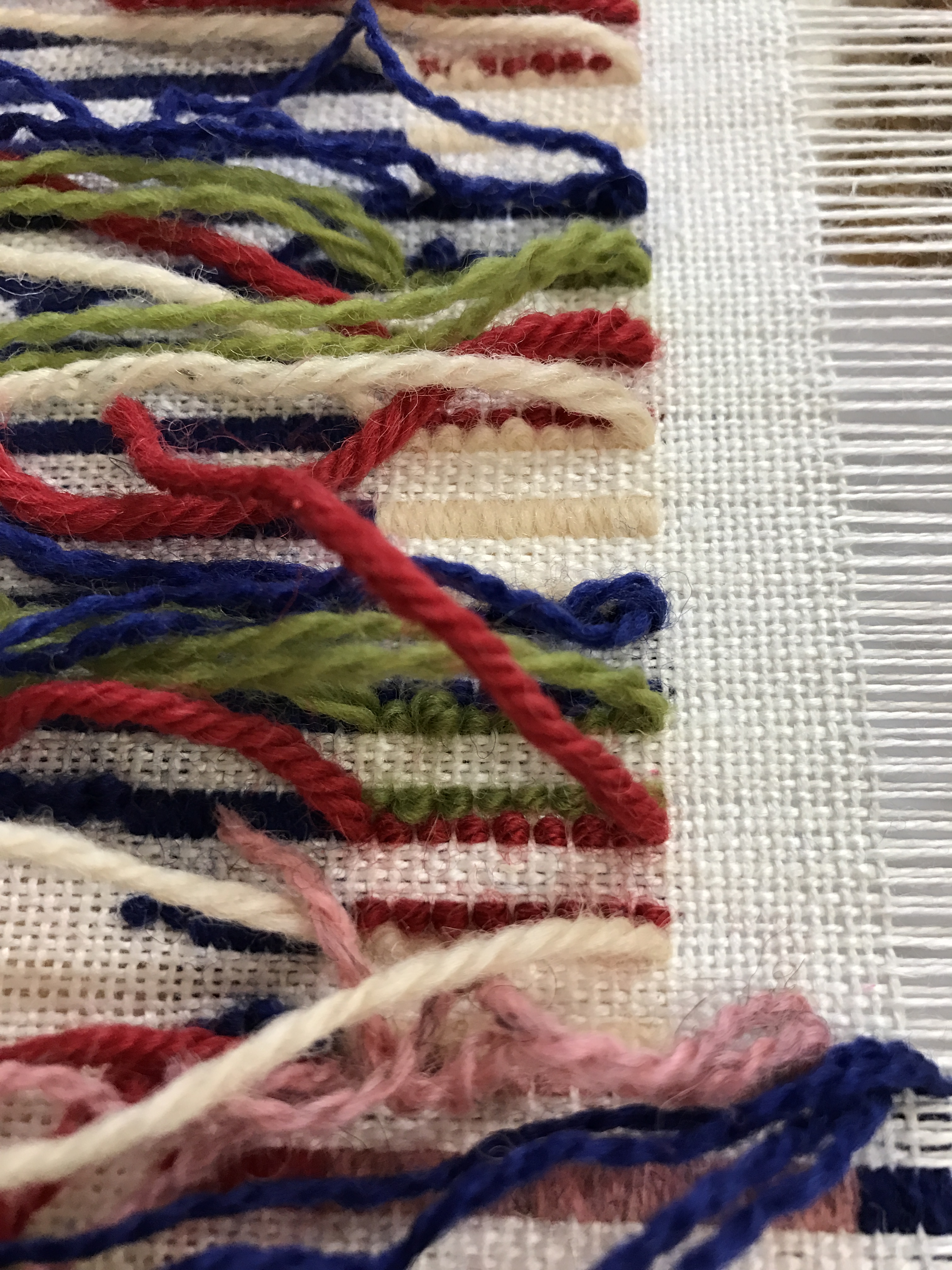
    She’s using a variety of wools from her stash for the pattern; sometimes two strands of Harrisville Highland (blue) or a single strand of a fatter knitting yarn (red and white).

    IMG_2302

    Mary placed a white piece of fabric on the piece below the loom, when she discovered that the lint from the linen was falling on the piece below.

    IMG_2298

    Mary’s weaving experience was great, although once she congratulated herself for weaving with no broken threads– snap went a selvedge thread.

  • Dukagång Group Project Underway

    Dukagång Group Project Underway

    By Robbie LaFleur

    Last year and this year our Scandinavian Weavers study Group is focusing on Swedish weaving, with a particular interest in linen.  We’ve begun a group project on one of the two Glimakra looms at the Weavers Guild of Minnesota.  We put on a 12″ wide warp of 20/2 half-bleached linen, set at 24 epi, to experiment with dukagång. Jan Mostrom deserves special thanks for ordering the yarn and winding the warp.

    jan-wind-warp

    Jan and Phyllis Waggoner warped; Melba Granlund helped, too.

    jan-phyllis-warping

    Their efforts resulted in a even-tensioned warp with a beautifully wide shed. Each of 12 weavers will weave 12-18″. I was the first to test the warp, and I chose an image I frequently weave — can you tell from the back? Dukagång is woven from the back.

    scream-back

    Jan Mostrom was the second one to weave, and the right side of my piece peeked at her as it wound through the loom. Now you’ll get it.

    scream-under

    Jan Mostrom was next on the loom; look at her beautiful stars–or as much as you can see, at this point. Melba Granlund was the third person to weave; you can see the back of her piece here.  A little hard to decipher…

    jans-stars

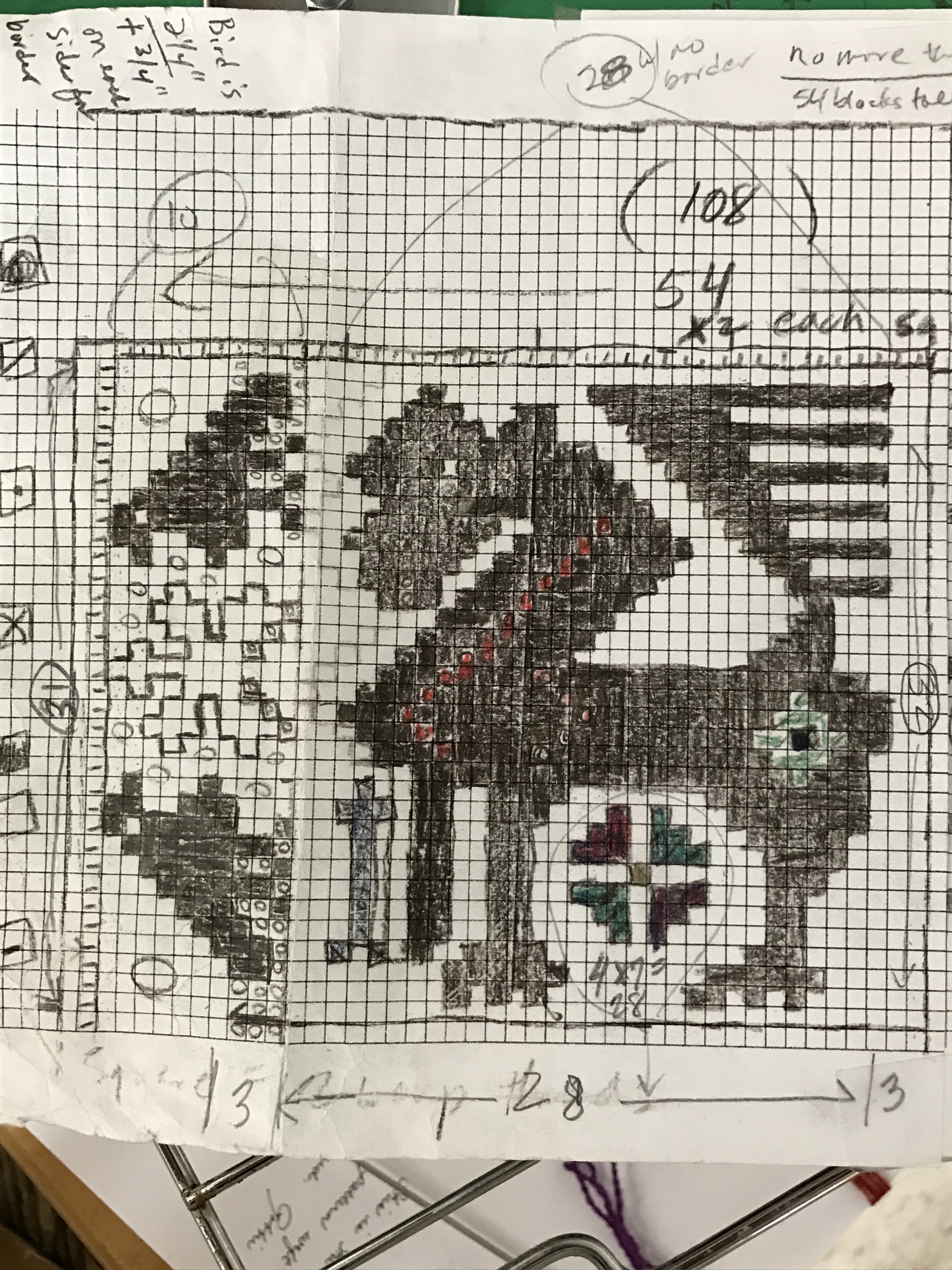
    Here’s Melba’s pattern: birds, a fabulous griffin, and a stylized floral border.

    IMG_2245

    A problem with weaving grid-based patterns is remembering where you left off.  I solved it by highlighting each new row before I wove it.

    scream-grid

    Melba’s system was more ingenious.  She asked her husband, “Don’t you have a magnetized clipboard?”  Shortly after, he came from the basement with a tool, a discarded metal refrigerator rack with a strong magnet. Melba moved the pattern as she finished each row.

    IMG_2246

    I’ll share more photos as this magical warp progresses, and the cut-off day will be super fun.


  • Swedish Art Weave – with Fleece

    Swedish Art Weave – with Fleece

    Our Scandinavian Weavers group met yesterday. There wasn’t so much show and tell, but lots of discussion about an upcoming exhibit of traditional and contemporary weaving in Norwegian techniques, to be held at Norway House in Minneapolis from July 20-September 17.  Expect more information in the coming month about the exhibit and accompanying classes, demonstrations, and lectures.

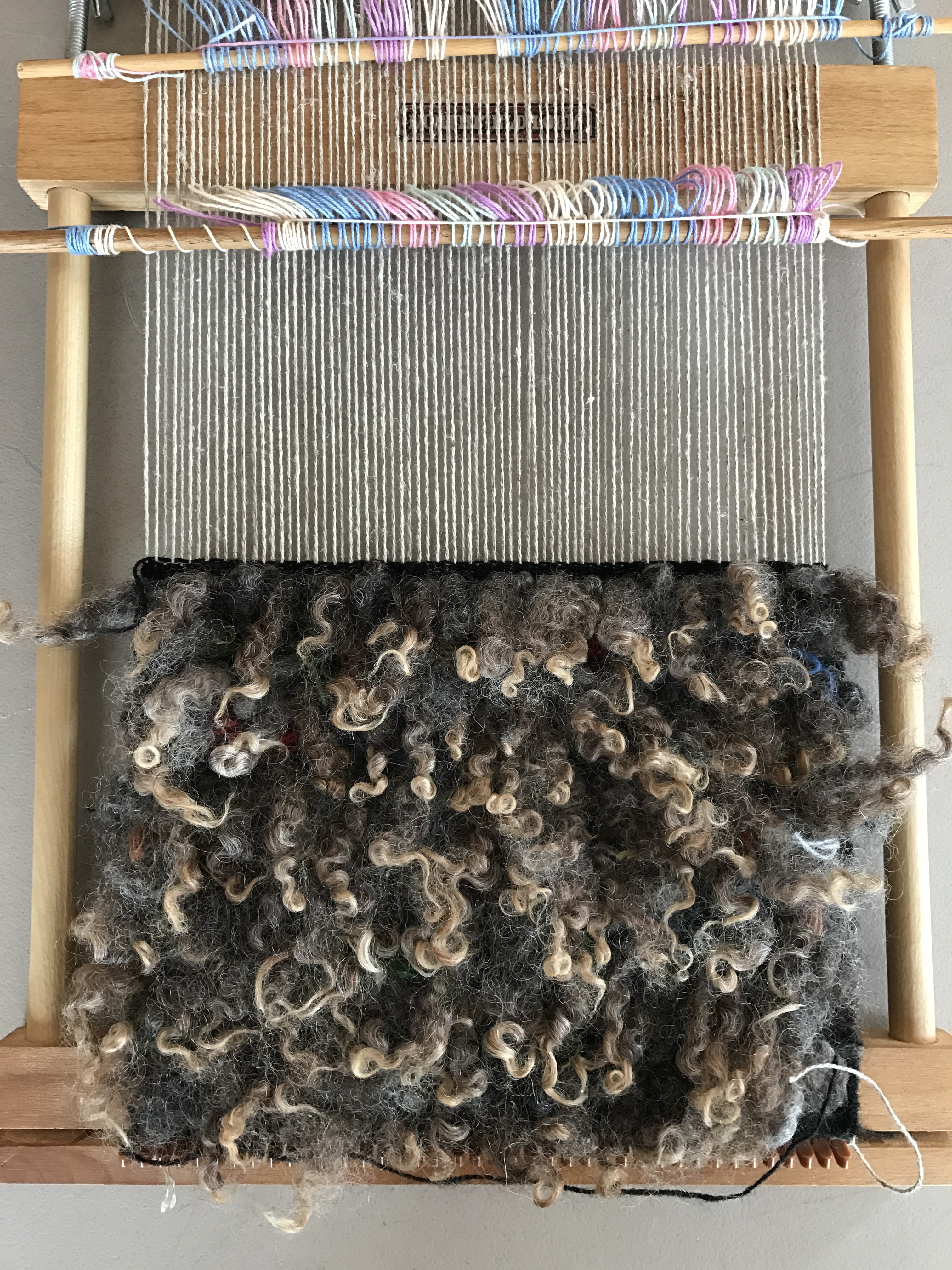
    Jan Josifek brought a wonderful small sample of Swedish krabbasnår that she is weaving on a simple tapestry loom.  Last fall one of our members brought a skinnfell – a sheepskin coverlet with printing on it to our meeting.  Jan was so taken by the fleeciness of it that she decided to add fleece to the back of her krabbasnår. One benefit of weaving the piece on her tapestry loom is that the piece can be easily turned from one side to another to check for mistakes! We look forward to the big version of this sweet piece.

    img_1919

    img_1920

    img_1921

    fullsizerender-5


  • Krokbragd, Big and Small

    Krokbragd, Big and Small

    img_2192By Robbie LaFleur

    This month Melba Granlund, a member of our Scandinavian Weavers Study Group, gave a talk at another of our Weavers Guild interest groups, the New and Occasional Weavers, about krokbragd.  She asked me to bring along a piece I made, a krokbragd backed by a skinnfell.


    The weaving incorporates traditional pattern elements from Lom and Skjåk in Norway.  For the Norwegian Textile Letter, I had translated an article from a 1985 issue of the Norwegian magazine, Husflid, and wove five pieces, experimenting with the traditional pattern bands.

    You can read the article and see photos of some of the “old pattern” pieces, here.

    At the New and Occasional Weavers meeting, one person expressed interest in trying out krokbragd at a fine sett. That seemed like a fine experiment, though no one had any particular guidance to give.

    A few days later, for a completely different reason, I was looking through previous issues of the Norwegian Textile Letter, and ran across a photo of a small-scale krokbragd woven by Catherine Forgit, in the same pattern as my larger one.  She wove it from the pattern I had published.

    cathy-old-pattern

    Cathy’s version is 11″ x 16.” Shrinking down a coverlet technique traditionally used for bed coverings in the cold climate of Norway makes a piece that could even be called darling. She used a wool warp (but doesn’t remember exactly what brand of yarn), set 16 ends per inch.  The weft was Rauma billdevev yarn (tapestry yarn). She wove it on her four-shaft floor loom, and doesn’t remember having any particular difficulties. “It was fun to weave.”

    Cathy lives outside of Fertile, Minnesota – way up north.  She reports, “It’s been a good winter for weaving and other fiber things – too cold to go outside!”  I hope her sheep are warm, too.

  • Woven Pastors in a Row – American and British

    by Robbie LaFleur

    In my book, weaving connections via the Web are wonderful.  A while back, a weaving instructor from the north of England, Jane Flanagan, asked for permission for her student to weave a pattern similar to one made by Nancy Ellison.  Avril Sweeting had seen Nancy’s piece featured on this blog, posted back in 2010.

    IMG_2546

    Of course Nancy was pleased that others would like to interpret her pattern.  Jane spent time with Avril working out how the motifs had been created. Avril wanted to reproduce the pattern accurately, so much so that she did it twice!

    twopastors

    Another of Jane’s students, Jean Roberts, saw Avril’s piece and tried her hand at boundweave too.

    english-pastors

    A further two students asked for help with similar boundweave pieces, so now Jane is  developing more learning materials, creating many samples, and plans to weave a larger boundweave rosepath rug early in 2017.

    Thank you for sharing, Jane, Jean, and Avril. It’s fun to think about a pasture in Minnesota, with people and sheep, and some matching sheep on the English countryside.

  • A Discussion of Hems and Edges

    By Robbie LaFleur

    Note: I recently discovered this post, one that had not been posted after a meeting in 2012.  It’s a bit late!

    At our March Scandinavian Weavers Study Group meeting, an interesting conversation began with a comment by Veronna Capone, whose craftsmanship is impeccable.  She’d struggled with a monksbelt runner; the edges had the slightest waviness, no matter how careful she was.

    veronna

    So she solved that by taking a step that many weavers consider a sacrilege.  She sewed a straight stitch down the selvedge edges, about three threads in from the edge, and then cut the edge, perfectly evenly, next to the stitching.  (I don’t have a photo of that one.) She said that she owns a lovely Irish handwoven scarf with the same edge finish, and that gave her the permission to mimic it on her runner.  My photo of the edge of Veronna’s monksbelt doesn’t show the really successful and interesting total effect of the piece, woven with pearl cotton. One really nice effect was the contrast in sheen between the background plain weave and the monksbelt blocks done in the same color, very textural.

    Veronna is not afraid to break rules.  Her additional ‘confession’ was that sometime when making a runner that was quite thick, she sewed a straight stitch across the end of it, turned it down once, and stitched it.  Uh-oh.  But really, how many people with real textile knowledge would turn over a lovely runner on Veronna’s table and note that a raw edge was visible?  This led to further discussion of hems and right sides/wrong sides and rules.

    It felt like a discussion that could have been held by my husband’s psychoanalytic colleagues.  What do people keep hidden in order to show their best faces to the world?  What everyday parts of life –  the messy parts, the parts you might not be proud of – are best put away when  you worry about being judged?   What do people choose to reveal?  What do they keep secret?  But here we are talking about textiles.

    Patty Kuebker-Johnson talked of her late Swedish mother-in-law, a wonderful weaving mentor.  Hems were important to fine Swedish weavers.  When planning a woven piece with hems, you should have a hem that is turned over twice and sewn by hand.  Ideally, the pattern should be taken into account when planning the blocks of the pattern blocks of the turned-over hem.  Once hemmed, the piece should appear the same on the front and the back.

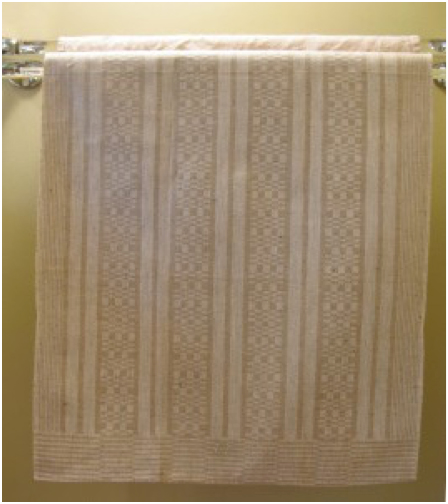
    Displaying pristine textiles for guests was a mark of skill and prestige.  Sometimes a runner was used on a table, or a towel was hung on a rack, hemmed-side-up, for everyday family use.  It could be quickly changed to the best side.

    A double towel rack could be used.  When guests arrived, the lovely towel was put in front.
    towel

    When you are not trying to show a perfect face, then perhaps this stained towel displays the messy craziness of life.

    stained