Category: Scandinavian weaving

  • Rutevev Exhibit in Norway

    Rutevev Exhibit in Norway

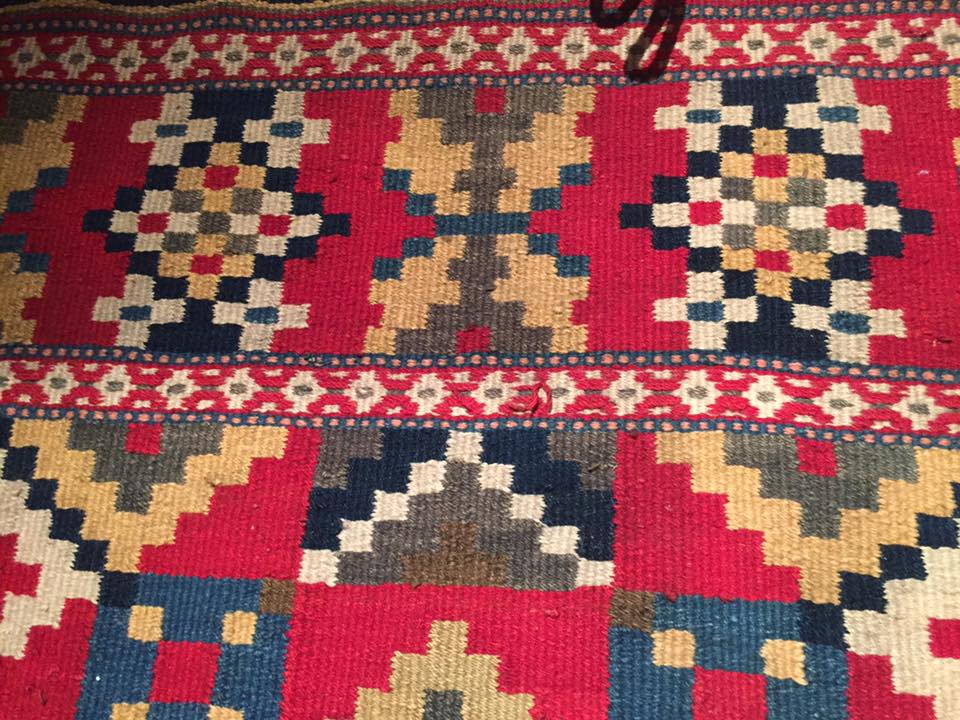
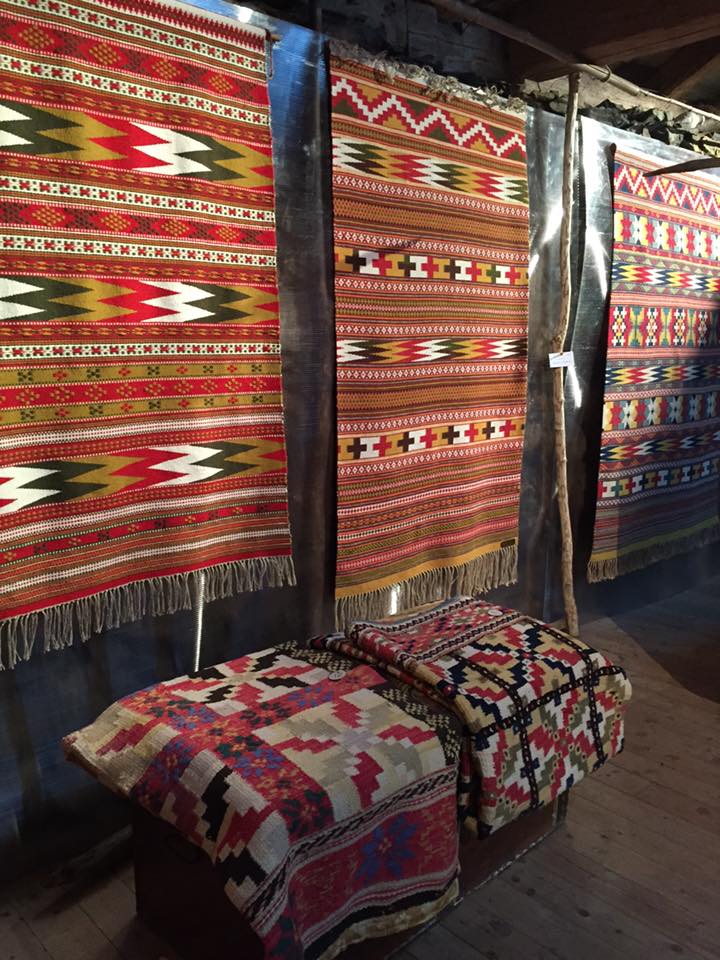
    Recently, Karin Randi Flatøy shared a set of photos on her Facebook site, from an exhibition of Nordhordaland-style coverlets at Galleri RusticaHolmeknappen, a cultural site  outside of Meland, a town situated on an island about 25 minutes north of Bergen.  The exhibit was part of  Ullveka på Vestlandet, or Wool Week in Western Norway, this year. 

    Her post prompted many people to comment about the beauty of the pieces, the too-short duration of the exhibit, and pleas to have it mounted in other venues, too.  Annemor Sundbø visited the exhibit and heard an accompanying talk.  When she shared the photos on her site, someone commented that it was difficult to tell (given the quality of the photos) whether they were woven on warp-weighted looms.  Annemor responded that at least three of them were woven on a warp-weighted loom.

    I wish I could have been there!  Because I know that many of my friends who are interested in Norwegian weaving are not Facebook regulars, I asked Karin Randi Flatøy if I could post her photos on this blog.  She kindly granted permission, saying that it was a fabulous exhibit for people of Norwegian heritage to see!

    14732162_10209829329105812_7197650471664251616_n14721620_10209829329305817_2286697051390148087_n14721596_10209829330105837_1298956356003087678_n14718681_10209829330265841_9162980288254269773_n14572816_10209829330825855_3991794544481925763_n14717131_10209829331185864_2301060457817935255_n

  • Scandinavian Heirloom Textiles

    Over the years, my friends have told me about their fabulous old Scandinavian textiles — inherited from family or friends in “the Old Country;” found in out-of-the-way antique stores, thrift shops, garage sales, or flea markets; or even rescued from barns.  Let’s tell their stories!

    Later this fall we will be mounting a display of historical textiles from the Nordic countries, along with their stories, on the walls of the Weavers Guild.  The items will also be featured in the upcoming (November) issue of the Norwegian Textile Letter.  Pieces will be submitted not only by the members of the Scandinavian Weavers Study Group, but also by other Weavers Guild of Minnesota members.

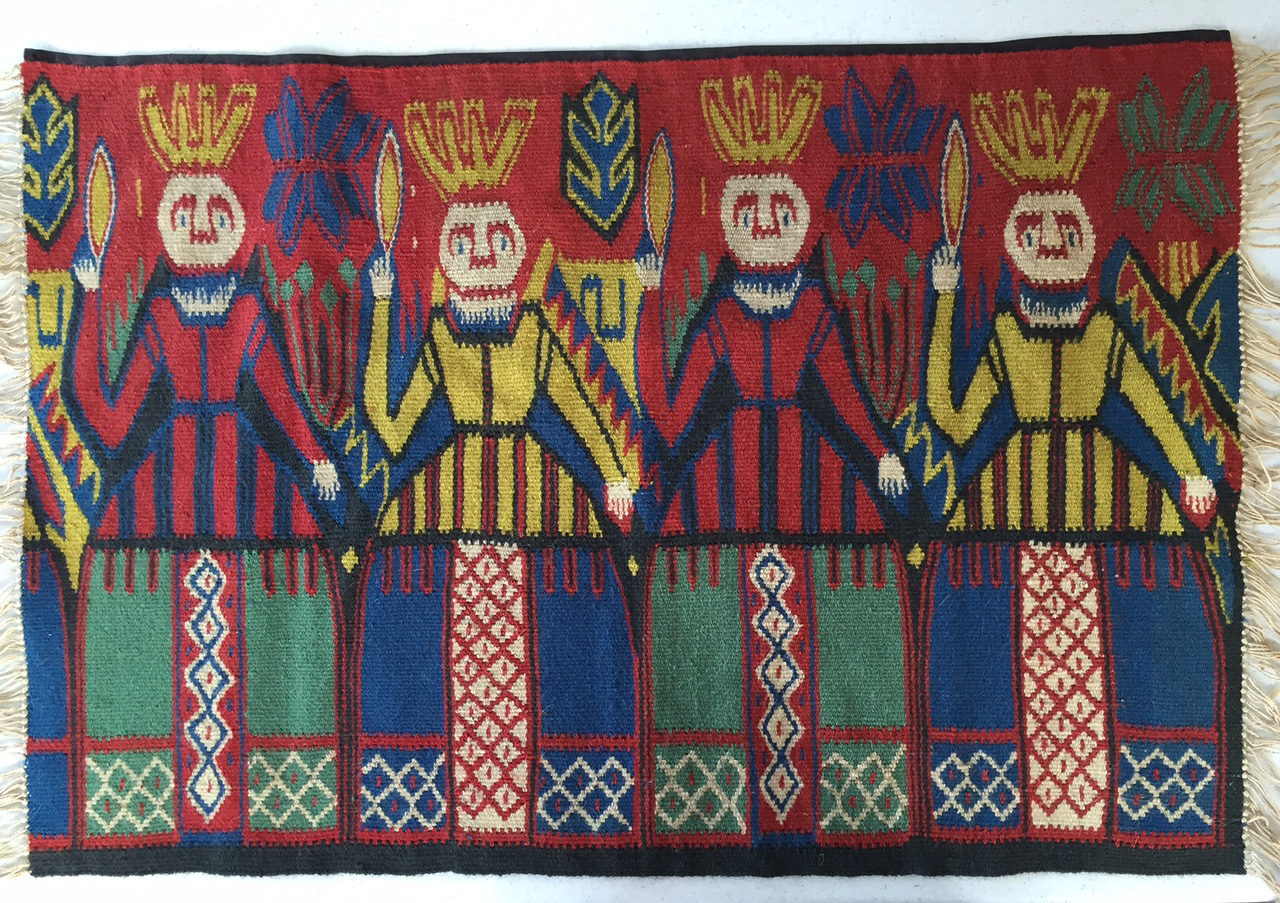
    At yesterday’s meeting of the Scandinavian Weavers, we saw great examples of old textile finds.  Jane Connett said that she had been a bit laid up recently, so she spent a lot of time on Ebay. Look at this beautiful Norwegian tapestry find.  It was advertised as an “Albanian kelim,” but fans of Norwegian tapestry know perfectly well that it is a replica of a portion of a Norwegian Wise and Foolish Virgins tapestry.  It was faded on one side, but the colors were clear and strong on the other.  And since the weaving followed Norwegian tradition, all the ends were sewn in so that either side is equally beautiful.

    virgin1virgin2

    Jane said she didn’t remember how much she paid, but probably only around $25.

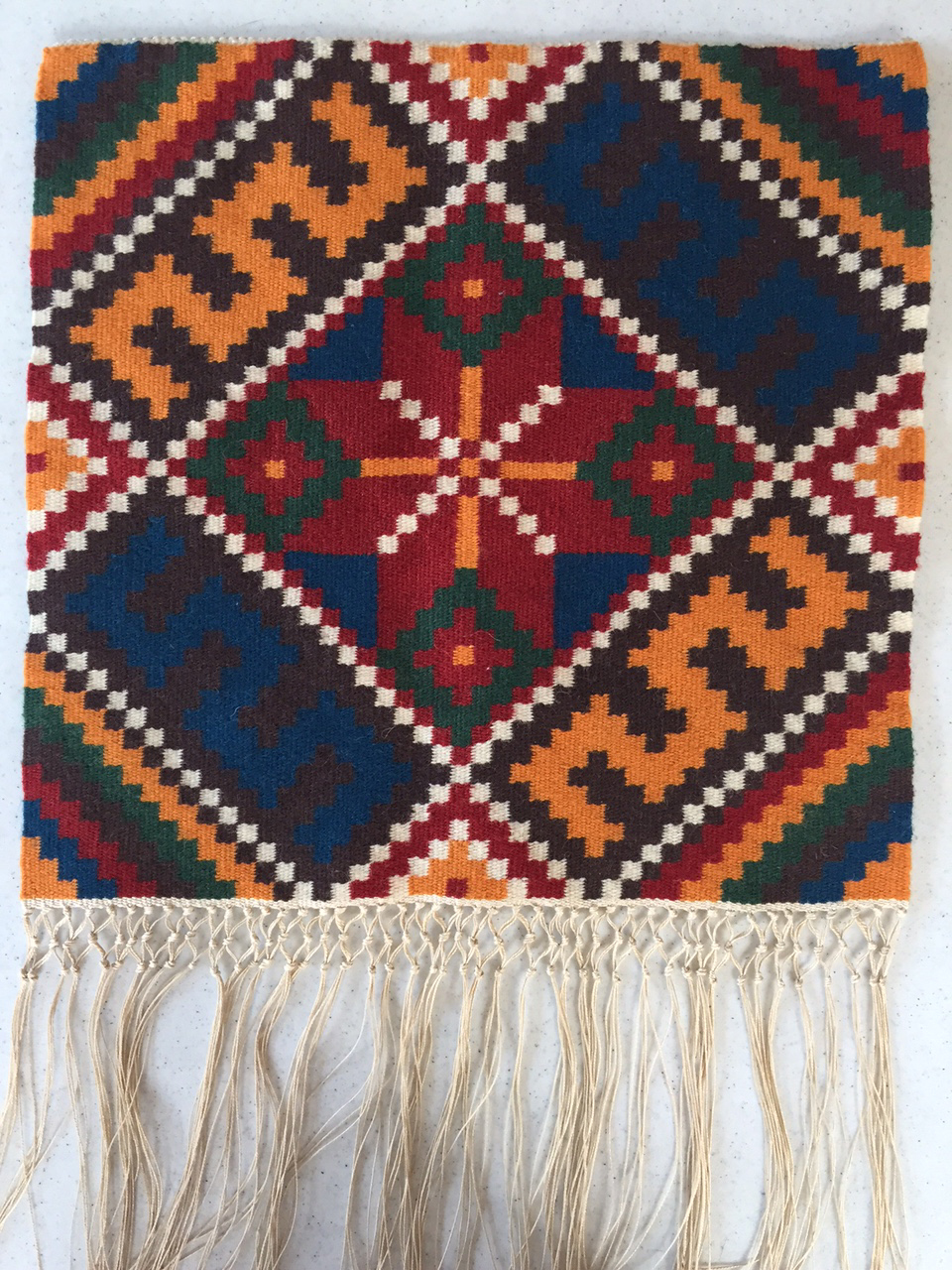
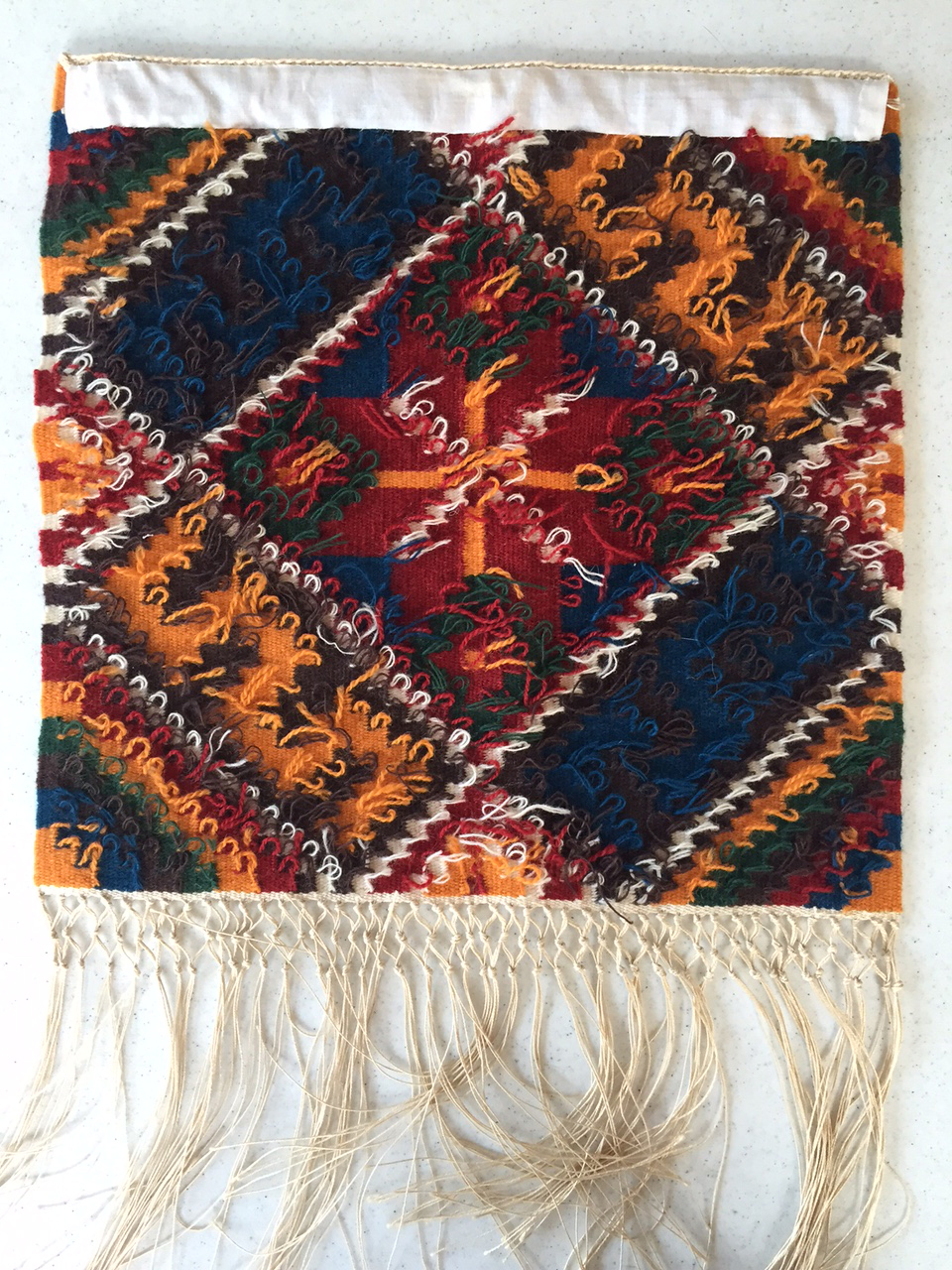
    She also bought a beautiful small rolakan weaving.  Judy Larson noted that the loops on the back side, where the colors jump over a few threads, are typical of Swedish rolakans.

    rite-uprite-back

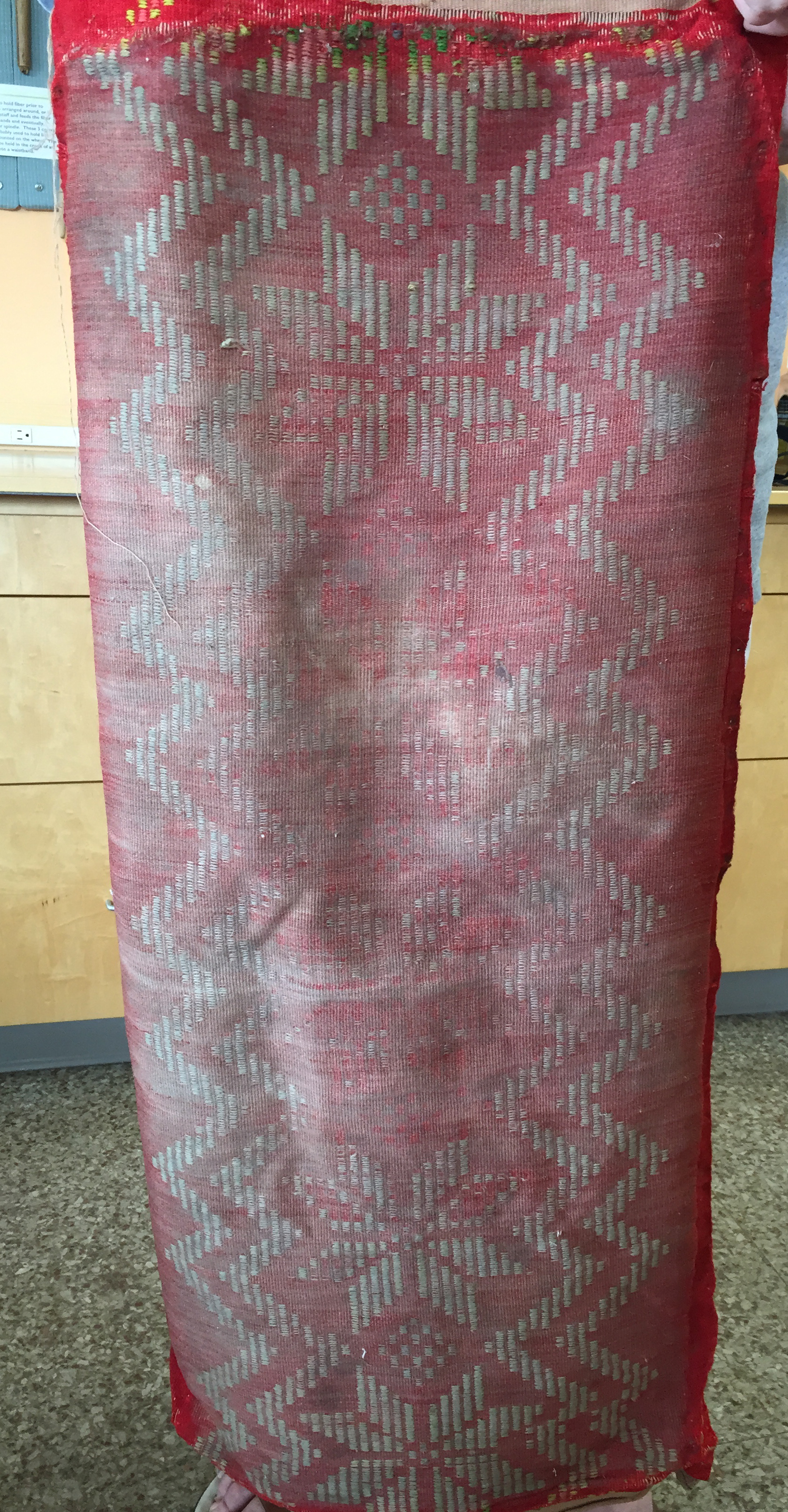
    Lisa Torvik showed a treasure-in-progress.  She rescued it from a friend’s barn, where it had supported feed sacks and whatever else needed a resting place. The bench was badly damaged, but still retained one crudely-carved dragon foot.  The top of the bench cover was so dirty that no color peeked through.  Was it even woven, or just embroidered, Lisa wondered.

    barn-front

    Once it was off the bench, however, you could see that it was a nicely-woven dukagang.

    The mystery remains – will Lisa ever be able to retrieve color on the dirty front side?  She had just taken it off the bench hours earlier.  Perhaps we won’t know for a while, as several members of our group thought that waiting until winter for a thorough snow-washing might be the best route.


  • RED – Phyllis Waggoner

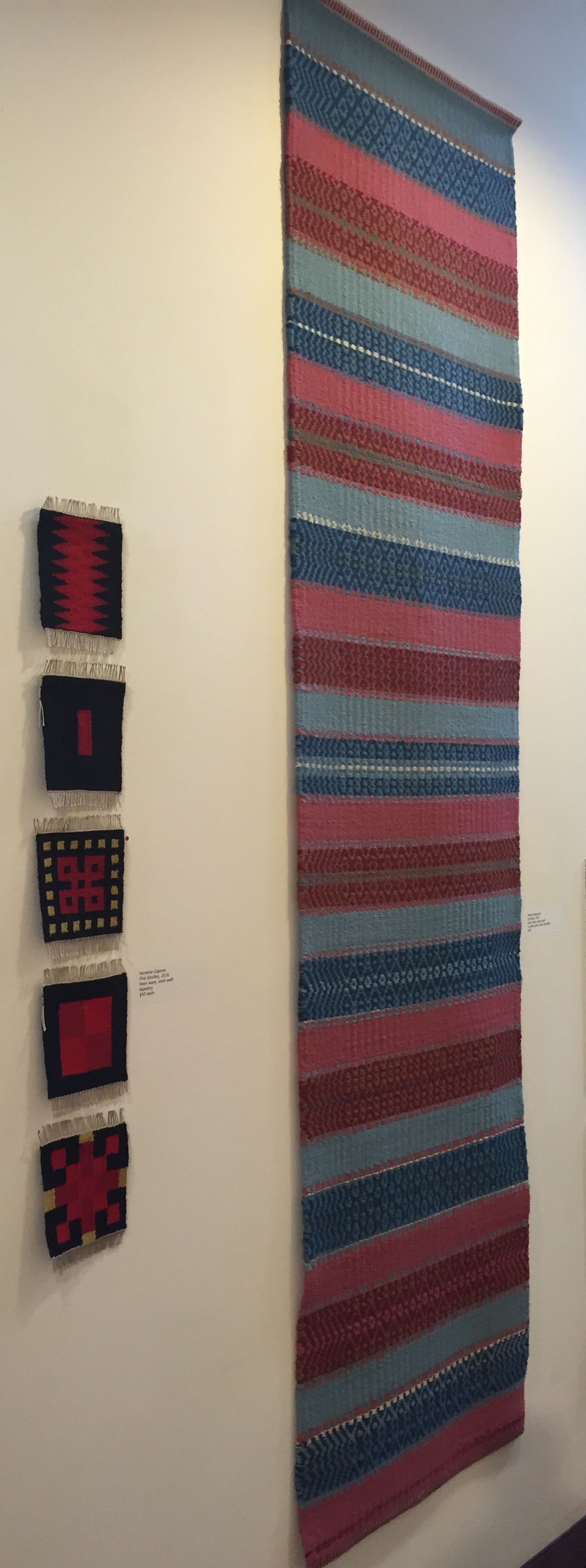
    “Untitled”  8’6” x 27”  Technique: 4 shaft point twill variation, treadles tied for 2/2 twill, “woven on opposites”  Materials:  5/8 linen warp, sett 6 epi, 3 ply rugwool weft.

    In the case of Phyllis’ long, beautiful rug, red was part of a color challenge — could she make the red work with the other colors? She had a great deal of yarn left after completing a commission. Rather than weave a shorter red rug, she chose to use all the colors to weave a long rug.  “Necessity is the mother of invention,” and Phyllis invented a design to make use of her red, and more.

    Unfortunately, the gallery configuration made it impossible to get a great head-on shot of Phyllis’s beautiful rug.  You’ll have to visit it in person, or look at it obliquely here.

    FullSizeRender


  • RED – Veronna Capone

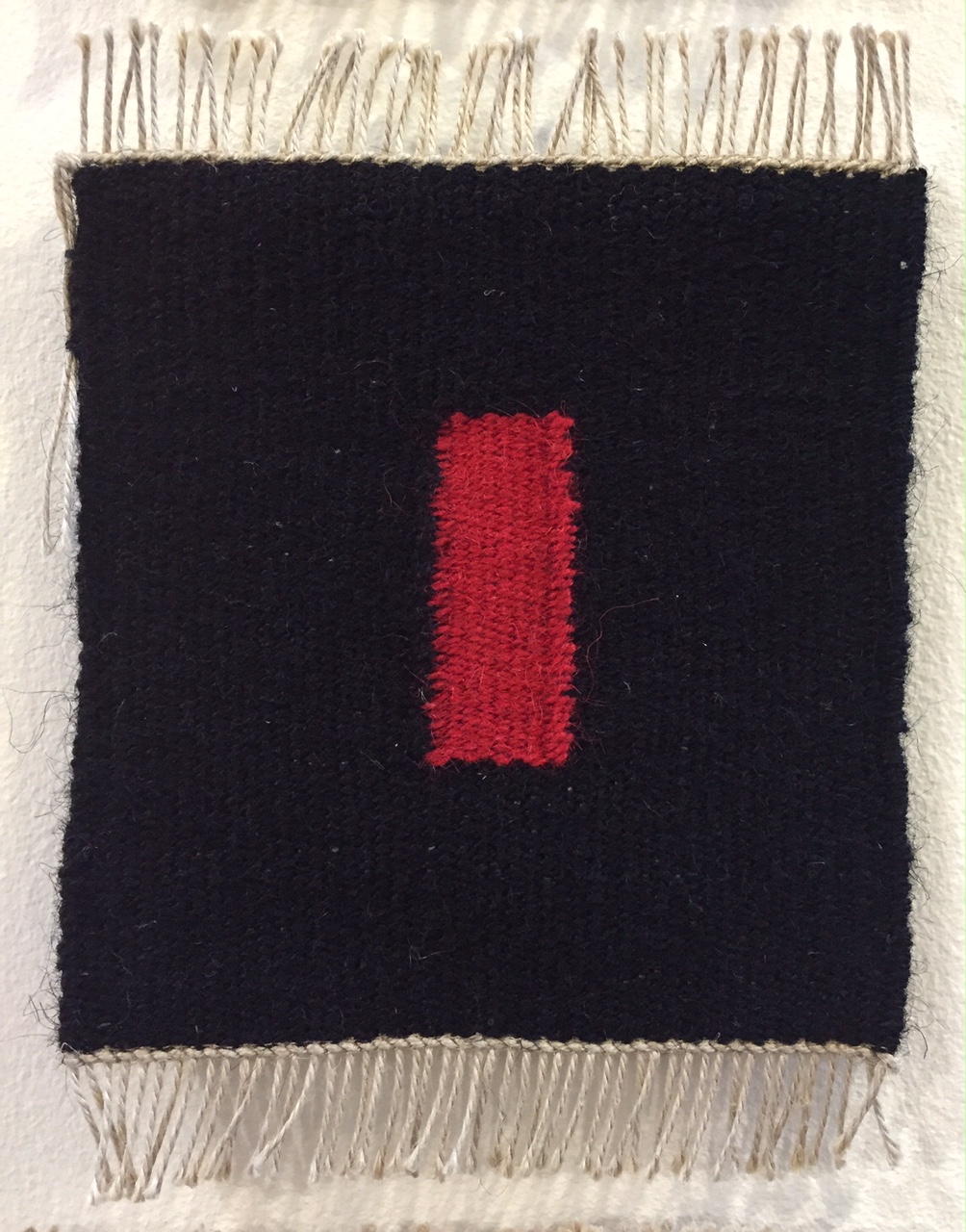
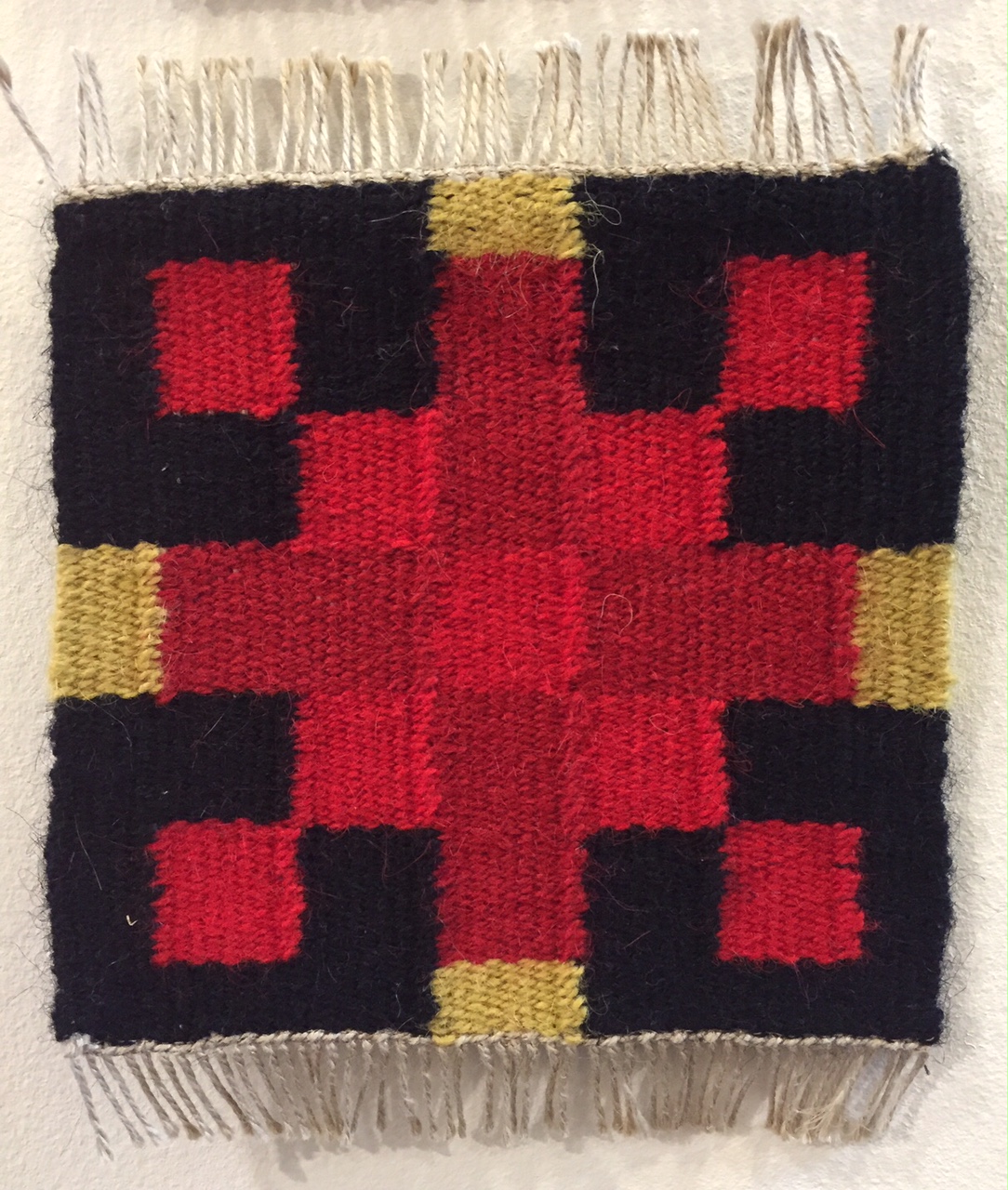
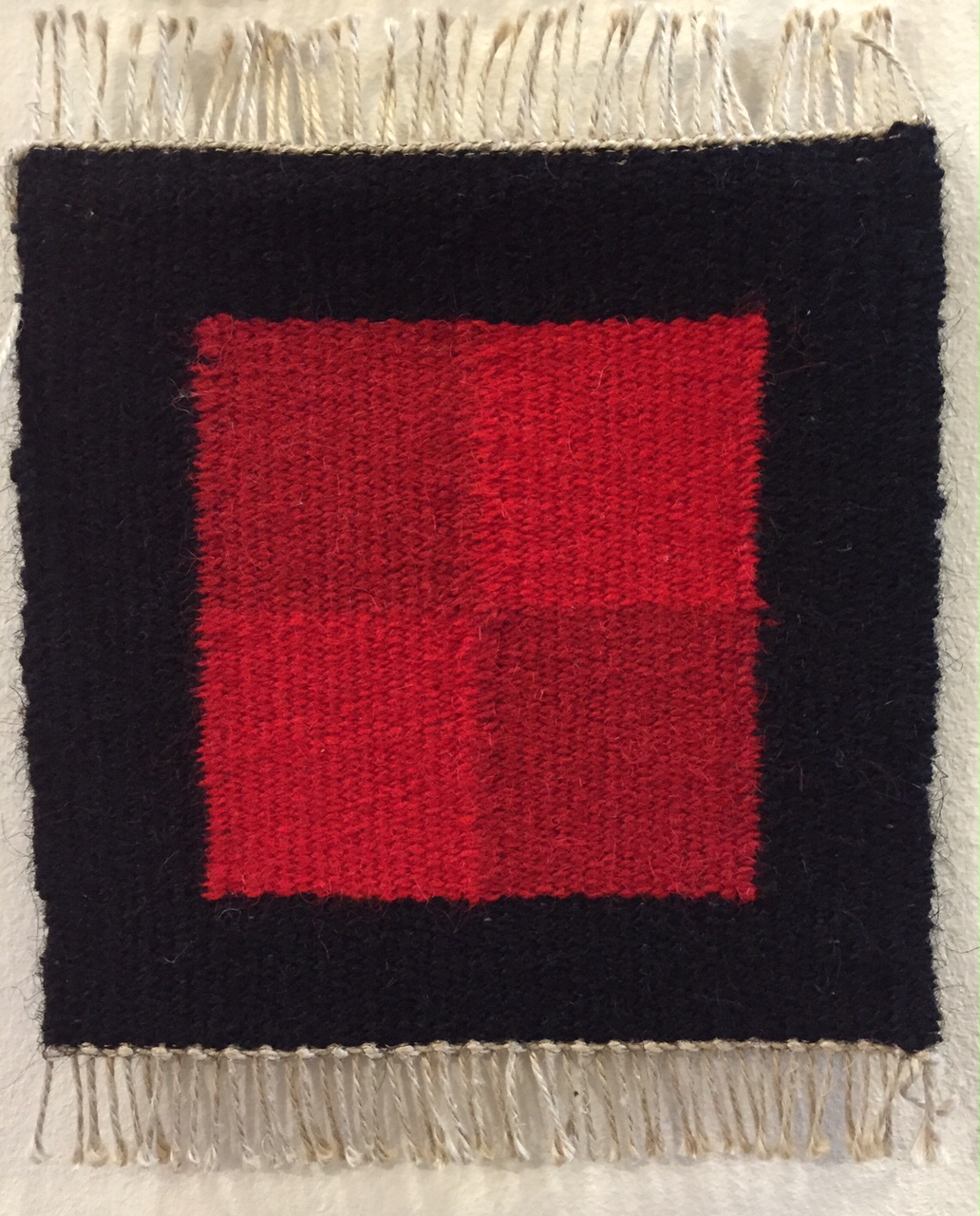
    Five Studies. Each 6″ x 6.”  Linen weft, wool warp.

    Five small tapestries.  The first of these five small tapestries uses traditional Norwegian ‘lynild,’ or lightning weave’; the others are in rutevev, or square weave.

    veronnaFullSizeRender-4FullSizeRender-3FullSizeRender-2FullSizeRender-1

  • RED – Judy Larson

    “Rolokan Reds.” 30″ x 29″ Cotton warp, cotton weft.  Rolokan.

    Judy used a variety of red quilting cotton prints in a rolokan (Swedish tapestry) technique, spacing out the “flames” with tabby stripes.  At a distance, the sharp edges of the flame-like image is graphic and bold.  It’s worth a close look, too, where the patterns in the fabric strips look unusually dizzying.

    IMG_5540

    judy-details

  • RED – Lisa Torvik

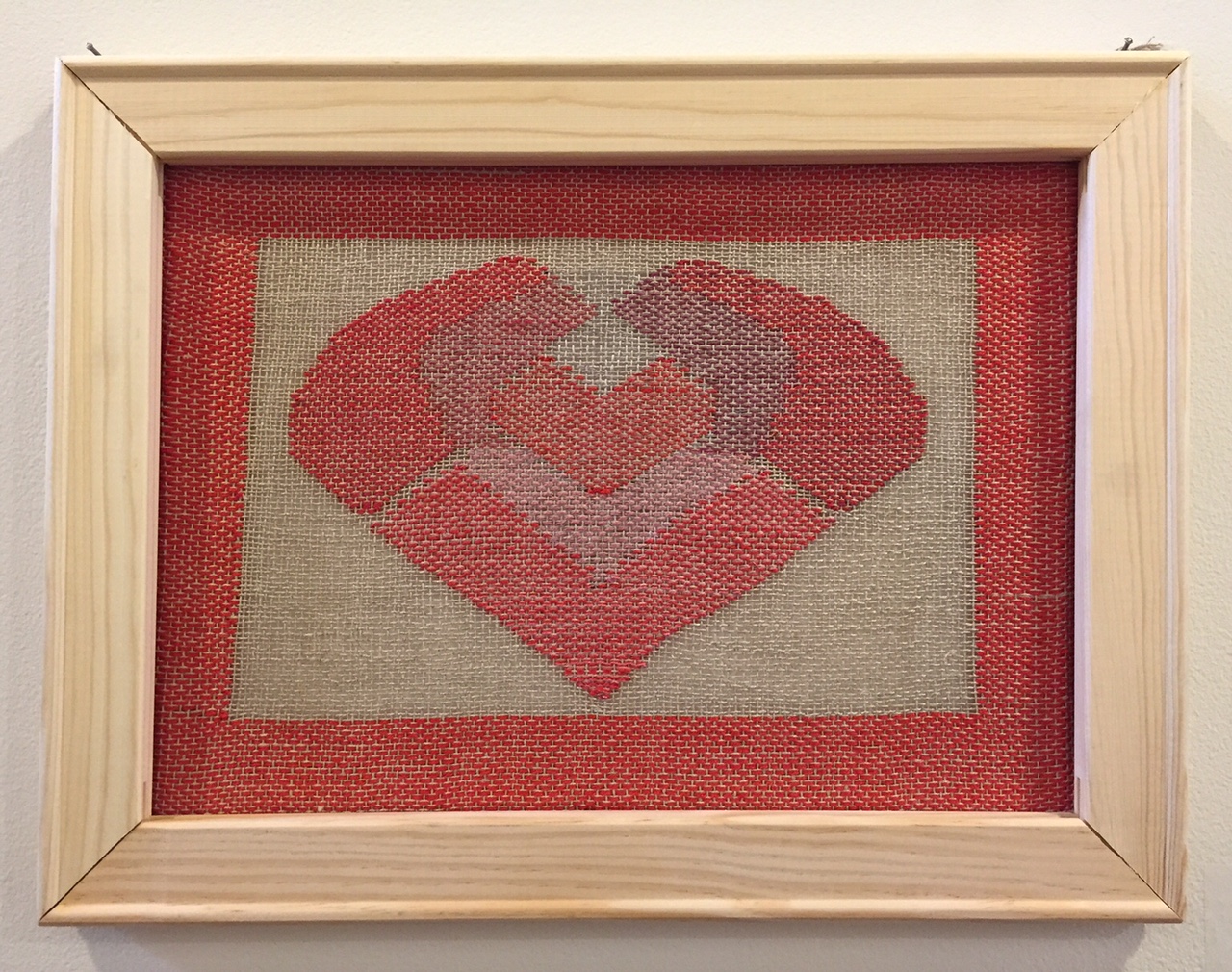
    “Transparent Tapestry #2 – Friends” 17″ x 13″ Linen and refleksgarn (reflective yarn).  Transparency Technique

    This is part of a planned series of four transparent tapestries featuring a Scandinavian reflective yarn.

    heart


  • RED – Lisa-Anne Bauch

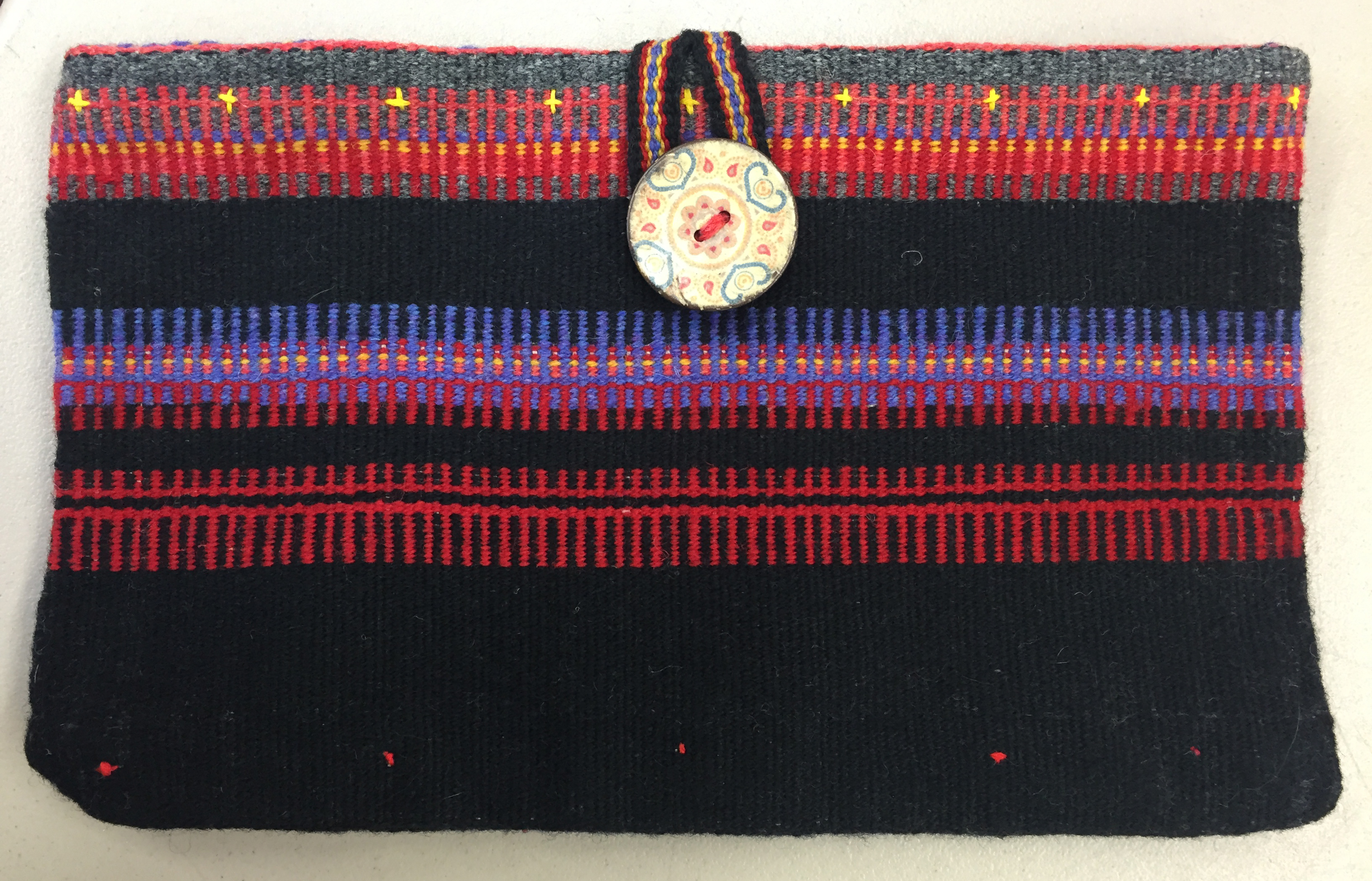
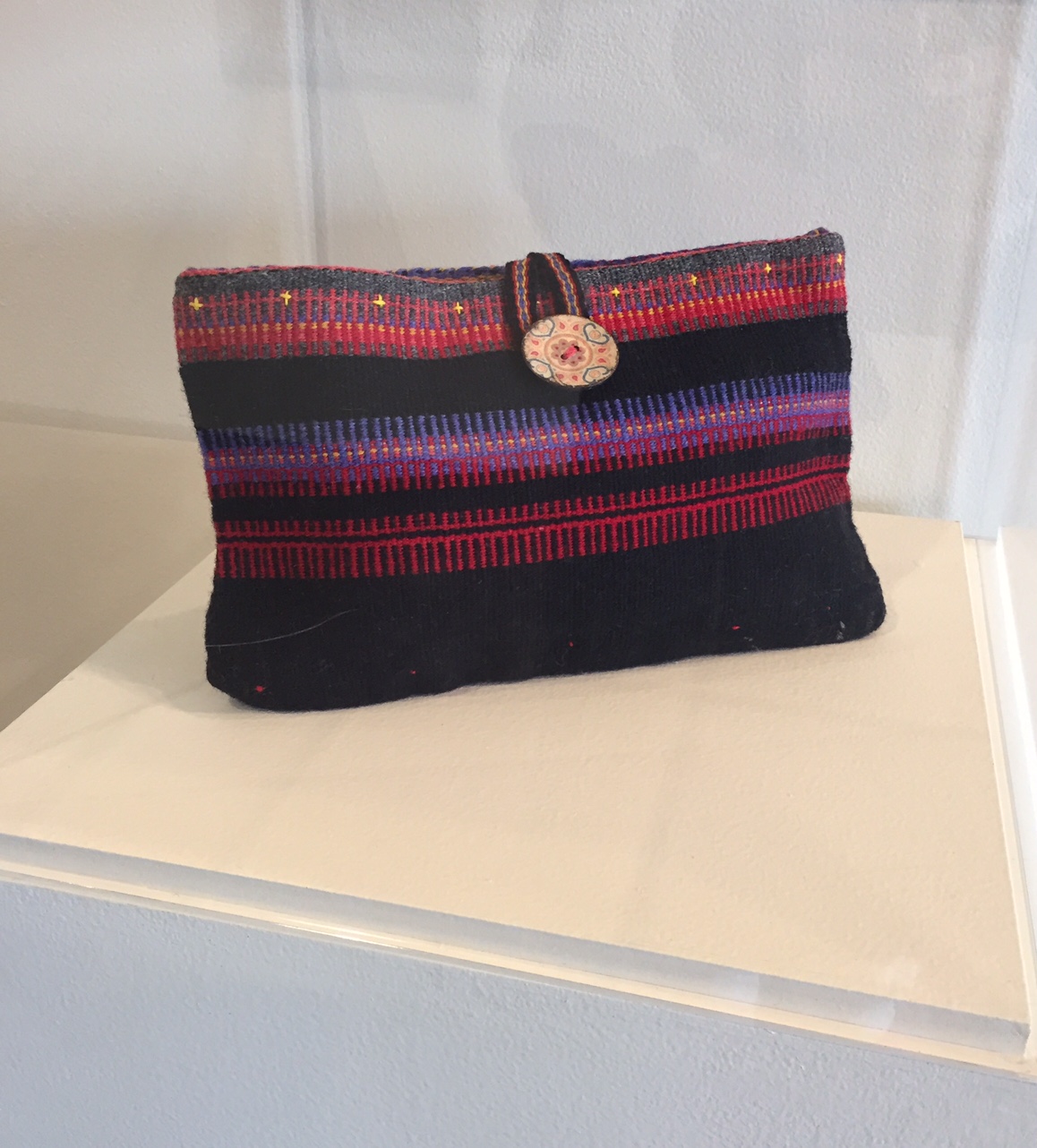
    Hraun. (Lava) 11.5″ x 7″  Technique: Boundweave. Materials: Cotton warp, wool weft, wood button.

    lisa-bag

    Inspired by lava!

    Lava

    lisa

  • RED – Claire Most

    Theme and Variation. 27″ x 45″ Double-binding technique. Cotton warp and cotton fabric weft.

    IMG_5276


  • RED – Marilyn Moore

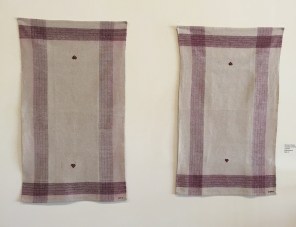
    Swedish Dishtowels.  Cottolin.  Plain weave with embroidery.  17″ x 26″

    FullSizeRenderMarilyn used red and natural cottolin for a set of six dishtowels. She wove them in plain weave, with a log cabin effect created by the two colors intersecting in the corners.  The Swedish heart was an appropriate addition, as they were given as gifts to friends on Valentines Day.

    IMG_5273


  • RED – Melba Granlund

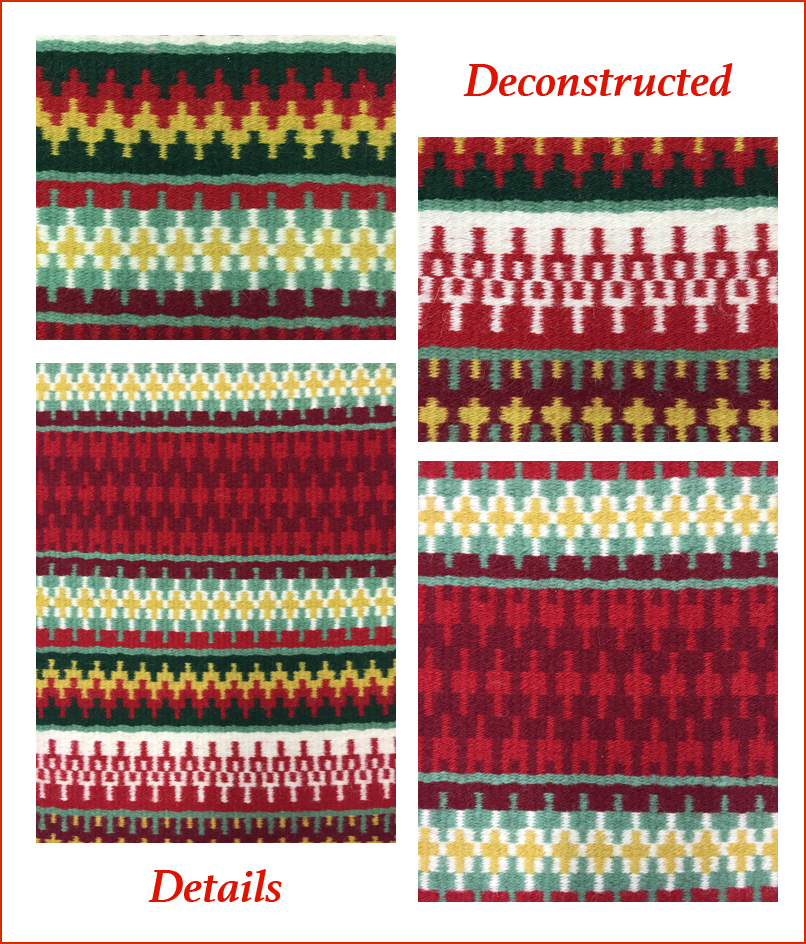
    Julefest.  11.25″ x 25″  Krokbragd.  Cotton warp, Rauma wool weft

    Melba chose to weave her red krokbragd for a couple of reasons.  The colors seemed appropriate to the holiday season when she began.  It represents all the colors and joyfulness of the Christmas season — the greens of Christmas trees, the reds and golds of Christmas decorations on the trees, and the pure white snow represented by snow angels against a red background in one of the motifs.  In the krokbragd technique, the threads are also treadled repeatedly as 1-2-3, which could represent the Trinity coming to life in the birth of baby Jesus.

    But the other reason, “the real reason,” was that she wanted to see if she remember what Jan Mostrom taught her in a krokbragd class five years earlier.  (Clearly, it all came back!)

    IMG_5037

    details-melba