Bio: Beth started to weave in 2020 after retiring. She has taken classes through the Weavers Guild of Minnesota and currently weaves on a Rigid Heddle loom and a floor loom at home. Her interest is in exploring Norwegian weaving. This has led to taking a course at Vävstuga in Massachusetts and weaving at a studio in Norway.
Description: I wove this piece as part of the Scandinavian Weavers’ Telemarksteppe group warp at the Weavers Guild of Minnesota. The design inspiration came from a veggteppe my husband and I received as a wedding gift from a relative in Norway in 1978. The wool was purchased in Norway and is similar to the material used in the original weaving.
Dimensions TBD Seine twine for warp, Norwegian Ryegarn for weft, NFS
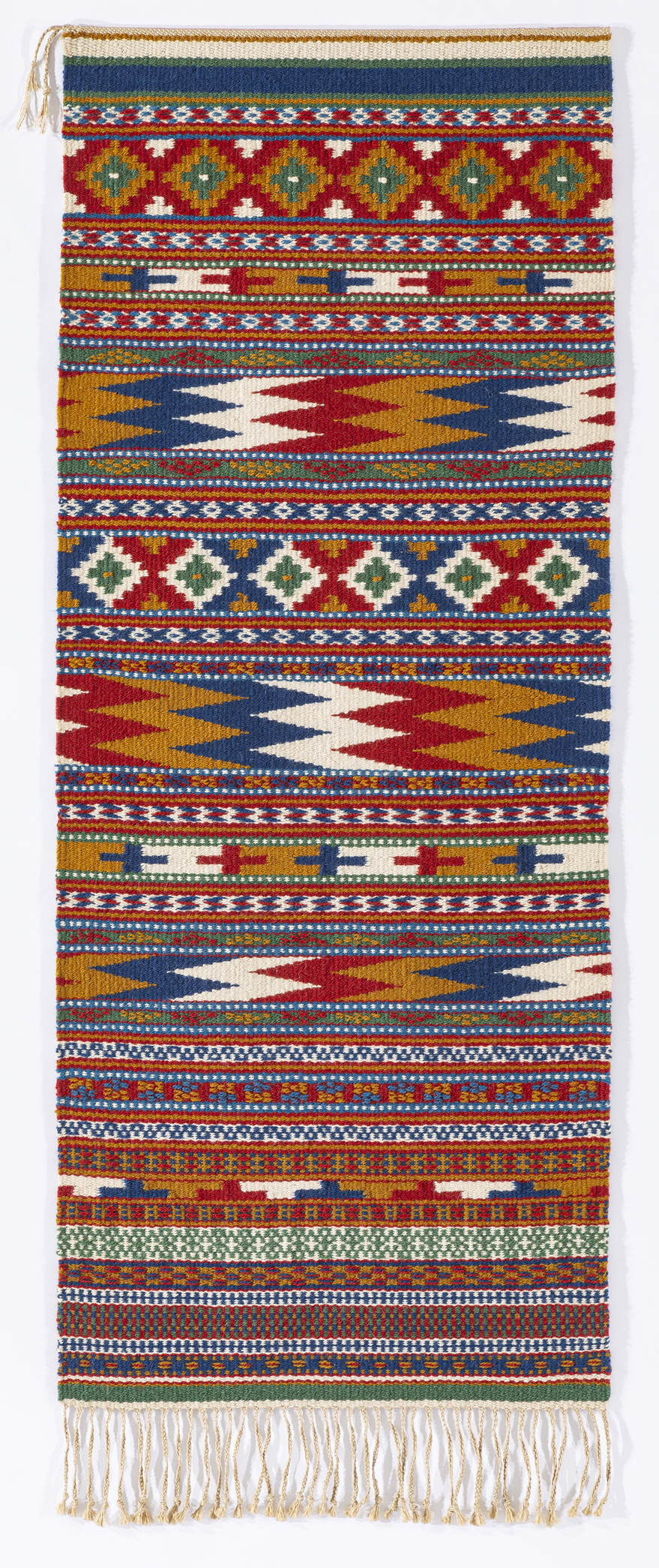
Bio: Melba Granlund is a weaver and handcraft instructor dedicated to preserving historical Scandinavian folk art traditions. In her classes, Melba’s philosophy is to not only teach the techniques but also the historical and cultural context in which they evolved over the millennia. She demonstrates textile-related handcrafts such as nålbinding, tablet weaving and weaving on a warp-weighted loom in Viking reenacting group encampments. Melba’s primary education in textiles and folk handcraft was received through the Weavers Guild of Minnesota and the Vesterheim Norwegian-American Museum Folk Art School in Decorah, Iowa. Melba deepened her skills through further studies with instructors from Sätergläntan Institute for Craft and Handwork and the Landskrona Hemslöjden in Sweden, and the Seljord Folkehøgskole, Manndalen Husfliden, and the Osterøy Museum in Norway.
Description: This piece is inspired by those woven by Berta Liarbø of Fitjar, Hordaland County, Norway. During her lifetime she wove around 160 coverlets, all on a warp weighted loom. It is said none of the coverlets were the same. Wow! I am drawn to the vibrant colors and variety of designs these pieces have. When I first started to weave about 20 years ago, I thought I would be a rug weaver. But when I was introduced to the variety of techniques in pieces like this one, I never looked back. They captured my soul.
Regarding the Scandinavian Weavers Group: I have learned so much being a member of this group thanks to the generosity of spirit of its members. I can’t say enough good things about them.
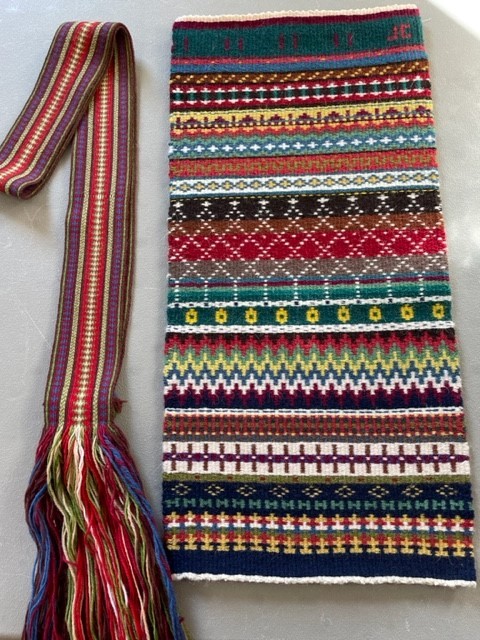
Bio: Nancy started weaving in earnest at the Minnetonka Center for the Arts in 2017 by taking classes offered by Traudi Bestler. She wanted to learn to weave independently prior to her retirement and has tried her hand at a multitude of four- to six-shaft weave structures. She continues to explore techniques via classes for the opportunity to learn and to connect with other makers. She is drawn to bright, vibrant colors and especially the color PINK! Nancy enjoys both the design and the technical aspects of completing a woven piece. As a bonus, textile-related travel has taken her to: New Mexico, Massachusetts, Sweden, Norway, Ireland, and most recently to the Peruvian Andes.
Description: In 2021, I had the chance to take a week-long class at Vävstuga weaving school in Shelburne Falls, Massachusetts. I chose to weave a Smålandsväv table runner designed by Becky Ashenden. While she taught a beginning-level class, I wove in an opposite corner of the barn on a loom (Glimåkra) that could accommodate the structure. It was an amazing setting and retreat. Take a look at the back of the piece to see a different, lovely color combination. This is the most complex piece I have woven in which the treadling pattern was not outlined in detail. It required that I continually observe the piece and noodle the next treadling sequence. I would like weave additional Smålandsväv designs and my next step is to modify my home loom to do so.
Bio: Sharon Moe Marquardt has been weaving since the mid-1980s. Inspired by her sister’s summer/winter cow runner, she studied rigid heddle one and two-heddle loom techniques from the Prairie Wool Companion, edited and authored by David and Alexis Xenakis. She used her notes to teach rigid heddle classes at the Weaving Works and Experimental College in Seattle. Moving to her home state of Minnesota, she taught these classes at several weaving conferences. At one conference, she discovered Syvilla Tweed Bolson’s vendor table and later signed up for her boundweave class in Decorah, Iowa. These lessons led to a life-long pursuit of learning Scandinavian techniques. She has studied at Vesterheim Norwegian-American Museum, in Norway, and at the Hemslöjden in Landskrona, Skåne, Sweden.
Description: At Vesterheim I learned the decorative West Coast weaves from Marta Kløve Juuhl, who has explored almost-forgotten weaves from Norway, Iceland and the Shetlands. She is the main curator at the husflid in Osterøy, west of Bergen. I wove the smaller colorful hanging based on her lessons. Heidi Goldberg, art professor at Concordia College, Moorhead, Minnesota, asked me to assist with the weaving section in her traditional Nordic Arts classes. I taught the West Coast weaves first on backstrap looms and then on small warp-weighted looms that my husband had made based on the loom I had purchased at the Sami Husflid (handcraft store).
Regarding the Scandinavian Weavers Group: The Scandinavian study group has been my main support for decades. I live in a small rural area where hardly anybody weaves. I’ve traveled to meetings, but with Zoom now available I can attend most of them. Mange takk to this group!
Bio: Inspired by a weaving exhibit at the American Swedish Institute in 1999, Cathie Mayr learned to weave at Sievers School of Fiber Arts on Washington Island, Wisconsin. It was the beginning of a life-long passion for the fine craft. She learned that her mother had done some weaving in college, but also was surprised when she discovered several ancestors on both her maternal and paternal sides were accomplished weavers. Throughout her 25-year weaving journey, Mayr learned from numerous experts and mentors across the country and in Norway. She began teaching in Central Minnesota in 2023. Mayr’s “home” Guild has always been the Weavers Guild of MN.
Description: Norwegian Spring was inspired by a springtime visit to meet relatives in Meldal, Norway (near Trondheim) for Syttende Mai. As it turns out, most of the town of Meldal are my third cousins – and many are weavers! Spring is such a joyous time in Norway – the sun is warming and flowers are blooming in every color imaginable. I knew I’d have to capture the beauty and joy in a woven piece. Color has always defined much of my long weaving career. I’m endlessly fascinated with the interplay of color as threads intersect in various ways in woven pieces. I’ve woven scarves, blankets, rugs, towels, table runners, and much more, in nearly every type of fiber. But in the end, it’s the color that drives my design process. This piece was no different. It was pure joy to play with the color gradients to represent the four flowers in this piece. The background warp (vertical) threads are a gradient of 6 blues ranging from dark to light. This represents the still chilly / frosty skies to warming days of deepening blue skies. From the top, the four flowers represented are: 1. Bergfrue (Pyramidal Saxifrage) known as “White Mountain Queen.” This beauty has five long white petals with increasingly dense splotches of deep magenta at the center (pistal). It was selected as Norway’s National Flower at the 1935 Botanical Congress in Amsterdam. Heather is now the National Flower since it is found across a wider range of the country. 2. Yellow Coltsfoot (Tussilago Farfara – Daisy family) is a perennial wildflower. I love that it comes in the very early spring fairly shouting in bright yellow! It is often referred to as “Son Before Father” because the flowers come before the leaves. 3. Red Clover (Trifolium Pratense) is seen across many of Norway’s fields and pastures. This versatile green manure crop not only adds organic nitrogen to the soil but also provides flowers that can be harvested for tea. It is often used for menopause symptoms and osteoporosis. 4. Lupine (Lupinus) comes from lupus, Latin for “wolf”, and its related adjective lupinus, “wolfish.” Lupine fields have a highly organized social structure, with clearly distinguished leaders and followers. Although dangerous to livestock, lupines improve soil by adding nitrogen and loosening compacted earth with their strong root systems.
Bio: Jane Connett has been weaving for 30 years, since Convergence in 1994. She loves to weave krokbragd and wall hangings, and specializes in small loom weavings that are labor-intensive and intricate. The feel and texture of the yarns inspire her to keep learning the processes that create these patterns.
Description: Inspired by a piece by Lila Nelson, I took up the challenge. Using cards with 4 holes individually threaded, I turned the cards to create the patterns. I attached it to a board and reset the tension as I rotated cards forward and backward. The challenge came with using regular American knitting yarns instead of the tighter Norwegian yarns.
Regarding the Scandinavian Weavers Group: I have been truly impressed by some of the experimental weavings that have been done by the group members.
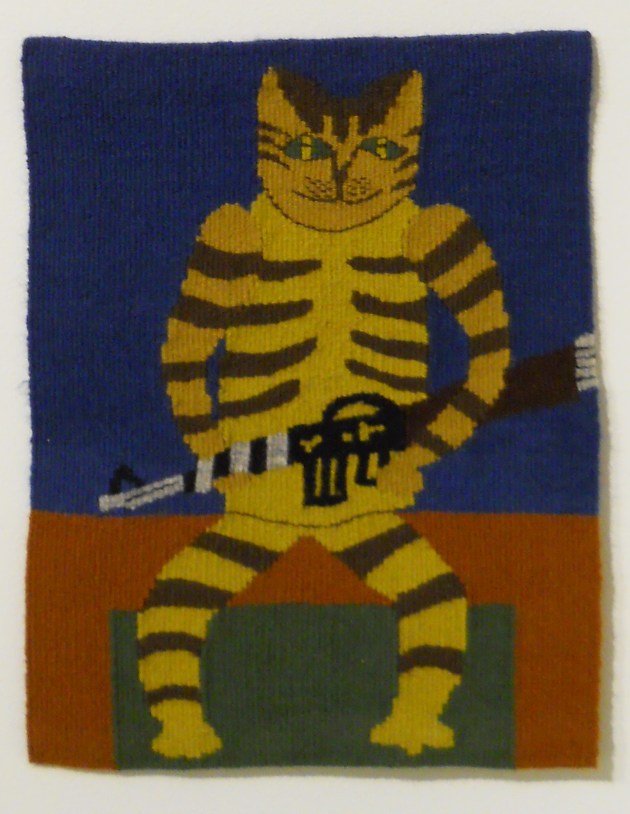
Bio: Lila Nelson, who died in 2015 at age 93, was the Registrar and Curator of Textiles at the Vesterheim Norwegian American Museum for 27 years, and the beloved leader of the Scandinavian Weavers Group for many years. She was a mentor to many of the weavers whose works are in the Vibrant Traditions show. No retrospective of American weaving in the Norwegian tradition would be complete without her work.
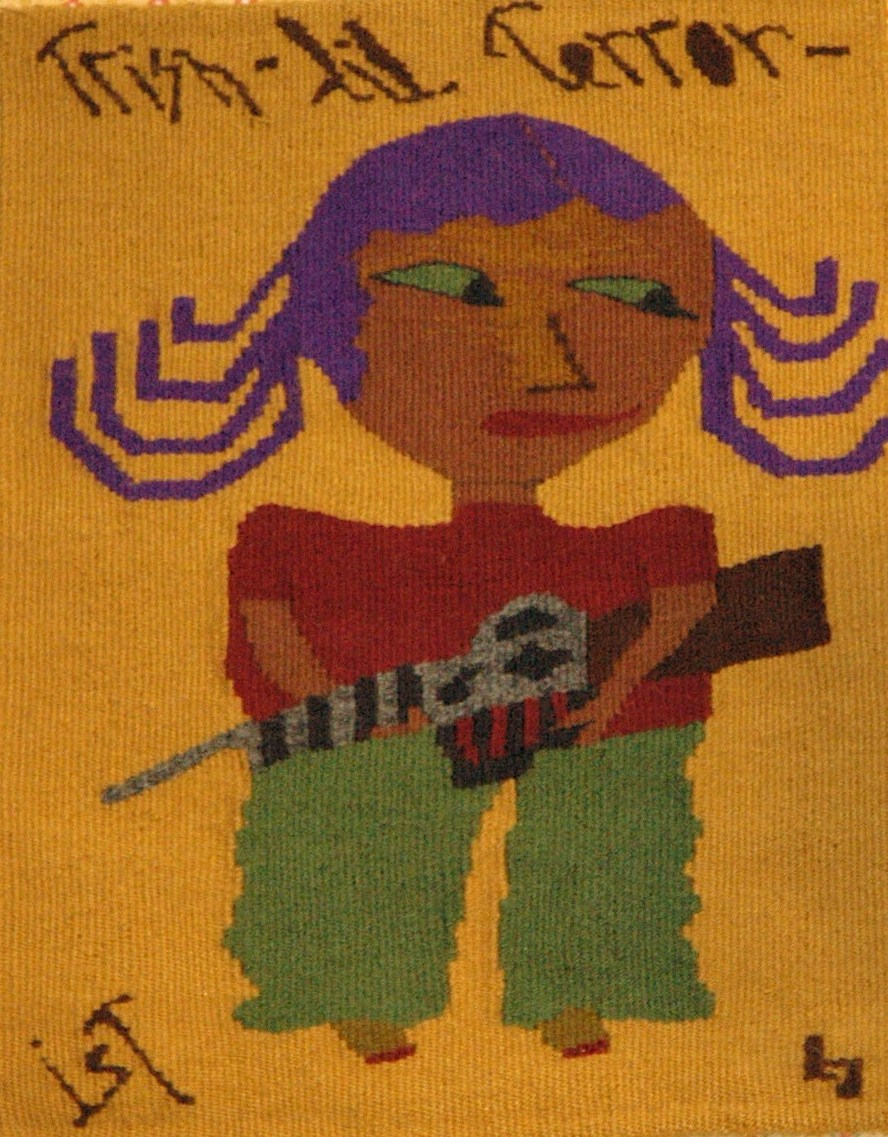
Description (by Robbie LaFleur): Lila wove many tapestries that displayed her progressive politics, including more than one terrorist cat. Lila said her terrorist cats, children and a bear were her attempt to treat terrorist threats with the satire that they deserved. Lila said that when she wove the Terrorist Cat tapestry in the exhibition, she wanted to depict an Uzi, but she had never seen one. I think that we have all seen so many images of guns, that we know what they look like without even realizing it.
Norway House and the Scandinavian Weavers Study Group of the Weavers Guild of Minnesota present an exhibit of 49 contemporary and traditional weavings in the Scandinavian tradition
Vibrant Traditions: Scandinavian Weaving in the Midwest
Norway House 913 E Franklin Ave, Minneapolis, MN 55404 January 31 – April 6, 2025
Free for members of the Weavers Guild of Minnesota and Norway House; all others $5. See the Norway House website for the building hours of operation.
This exhibit of traditional and contemporary weavings in Scandinavian techniques will take place in the Mondale Galleri at Norway House. The Scandinavian Weavers Study Group is celebrating almost three decades of collaboration and friendship that has included exhibitions, study group topics, and sharing of expertise. This resulted in a strong community with a shared interest in traditional Scandinavian weaving techniques and commitment to keeping our craft alive — and vibrant. The exhibit will be accompanied by weaving demonstrations and special events. Check this blog in the coming months for details.
Exhibit Celebration: Friday, February 7, 2025 , 5-8pm. ($5 for members of the Weavers Guild of Minnesota and Norway House; all others, $10.
Images: Top: “Wedding Tapestry,” Kevin Olsen. Botom: “Hordaland Teppe,” Lisa Torvik.
Weavers from left: Lisa Torvik, Nancy Ebner, Lisa-Anne Bauch, Brenda Gauvin-Chadwick, Beth Detlie, and Robbie LaFleur
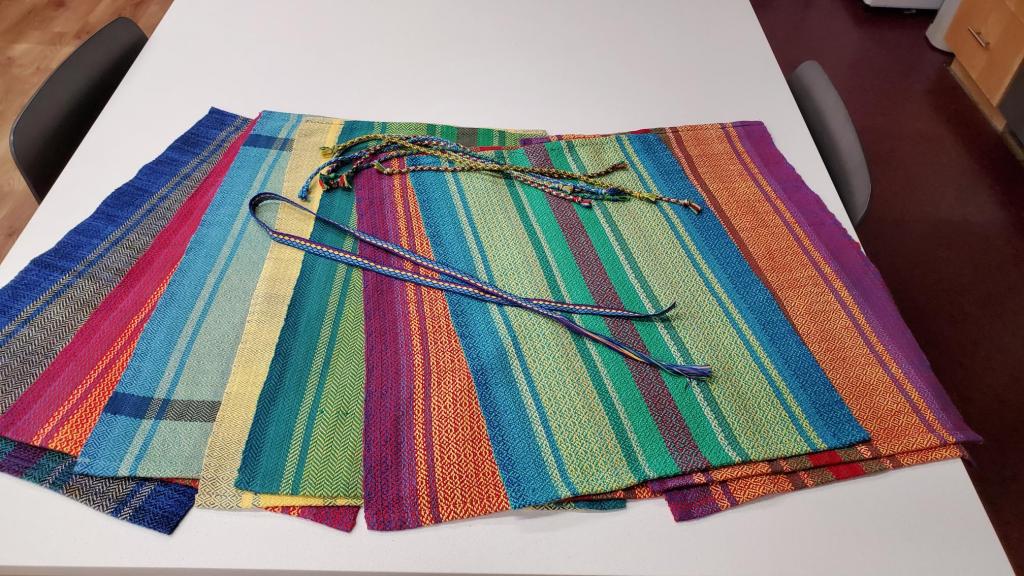
Last summer, the Weavers Guild of Minnesota and the American Swedish Institute collaborated on a weaving workshop with faculty from the acclaimed Sätergläntan Institute for Craft and Handwork in Sweden. (See previous blog posts for details. ) The Guild’s Education Manager Betsy Konop asked the Scandinavian Weavers Group if we would be interested in weaving towels with leftover yarn from the workshop to sell in the Guild shop to support our educational programs.
We chose the “Viking Twill” draft by Gunnel Oresjo, first published in the 2009 September/October issue of Handwoven. The editorial team at Handwoven gave us their kind permission to use the draft for fundraising purposes. (Search the Handwovenwebsite for the draft.)
The warp was wound with bright primary colors, similar to what would have been available from natural dyes in Scandinavia in Viking times. The original draft is for a simple 2/2 broken twill, but Weavers Guild instructor Donna Hanson generously created many more variations in PixeLoom for us to try. (Donna’s towel-weaving classes are perennial favorites at the Guild.)
Viking Twill warp on the loom
The warp uses Bockens 16/2 cotton, and each weaver brought in weft yarn from their stash, including cotton, linen, and blends. It was inspiring to see how many variations were created using the different colors, patterns, and textures.
Close-up of twill towels
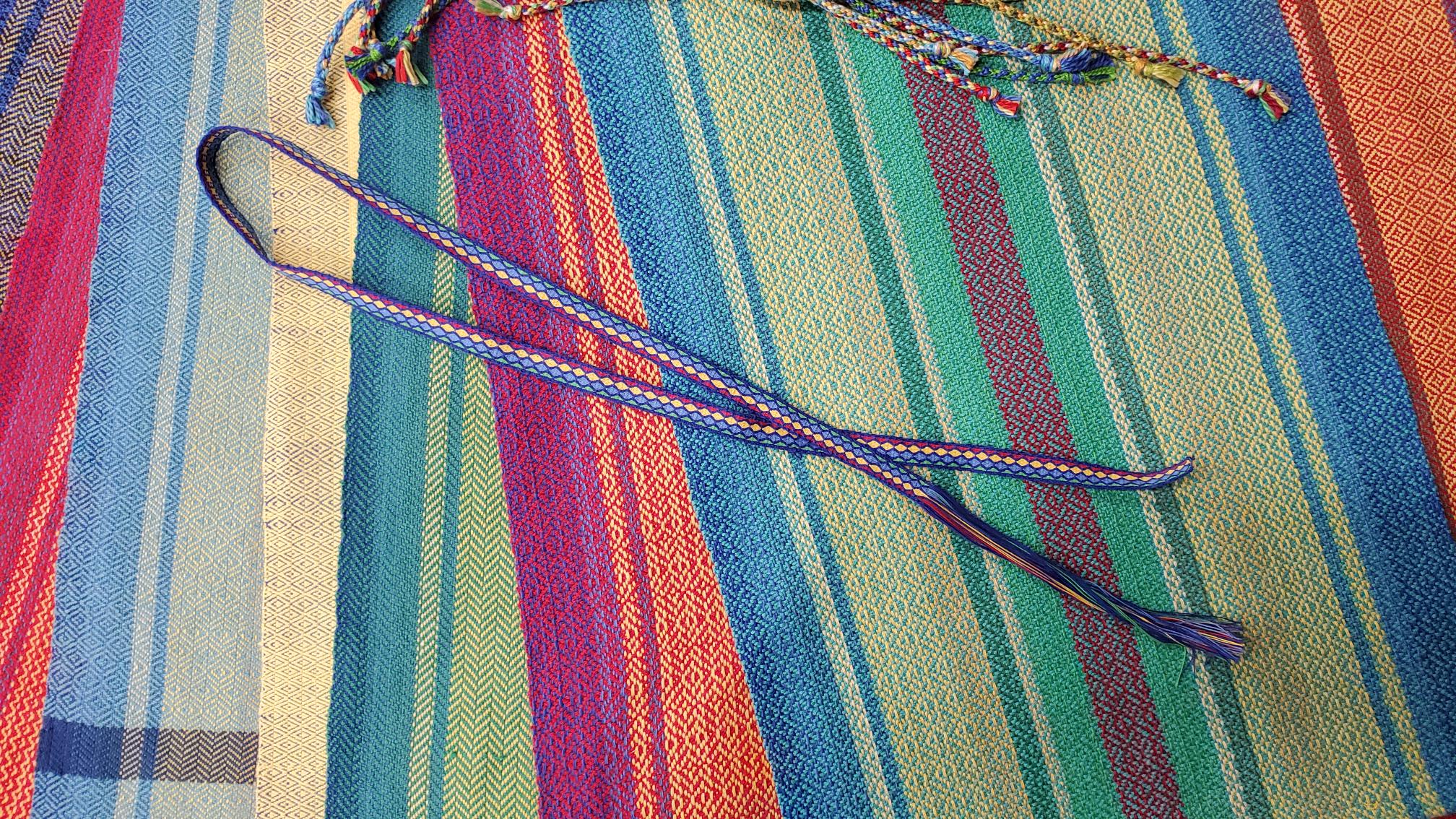
Some of the towels have a crowning touch—Swedish-style handing bands using the same Bockens yarn. These were woven by the Weavers Guild band-weaving interest group, affectionately known as the Banditos.
Close-up of tablet-woven and Kumihimo bands.
Fifteen weavers wove towels, and Beth Detlie heroically kept all of us scheduled and organized. Mary Skoy generously washed and hemmed all the towels.
Weavers Guild Education Director Betsy Konop and Scan Weaver (and heroic hemmer) Mary Skoy
The towels are currently available for sale in the Weavers Guild shop. Meanwhile, a second warp has already been wound and will soon be on the loom.
The second Viking Twill warp
Many thanks to our first batch of weavers! Judy Larson, Nancy Ebner, Robbie LaFleur, Auden O’Connell, Jan Johnson, Mary Skoy, Beth Detlie, Lisa Torvik, Brenda Gavin Chadwick, Karen Holmes, Lisa-Anne Bauch, Peg Hanson, along with guild staff Betsy Konop (Education Manager) and Jasmyn Hinton (Retail & Administrative Associate.) Special thanks to Hopsy for helping to warp the loom!
Today’s blog entry is written and photographed by Scandinavian Weavers member Holly Hildebrandt.
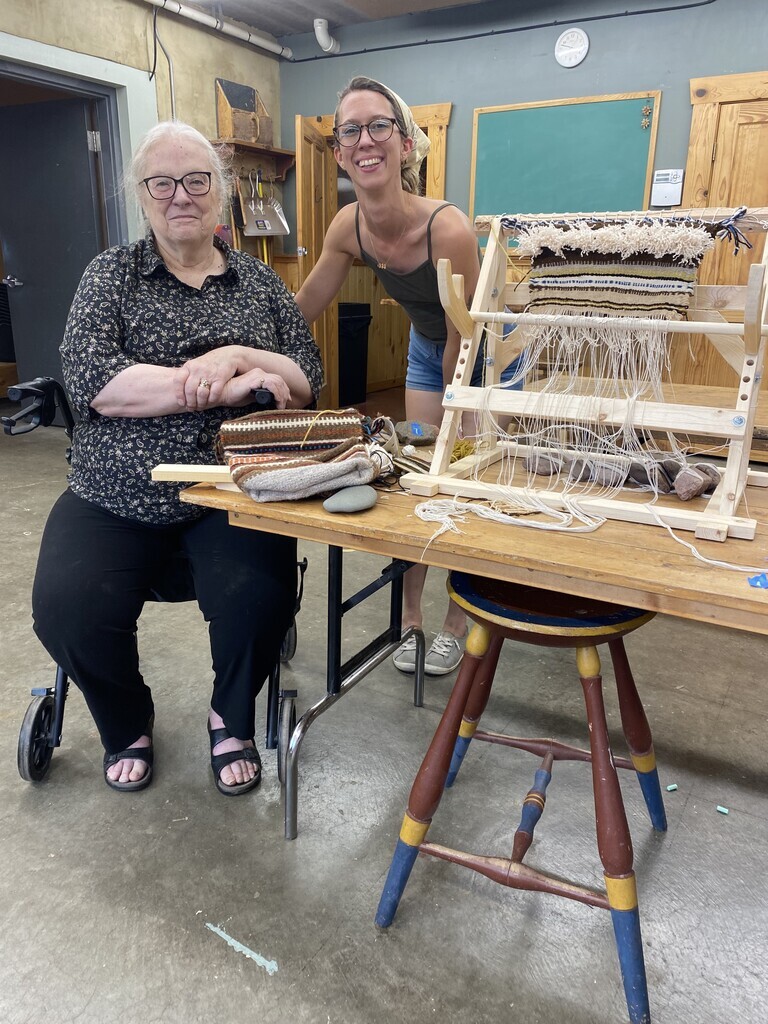
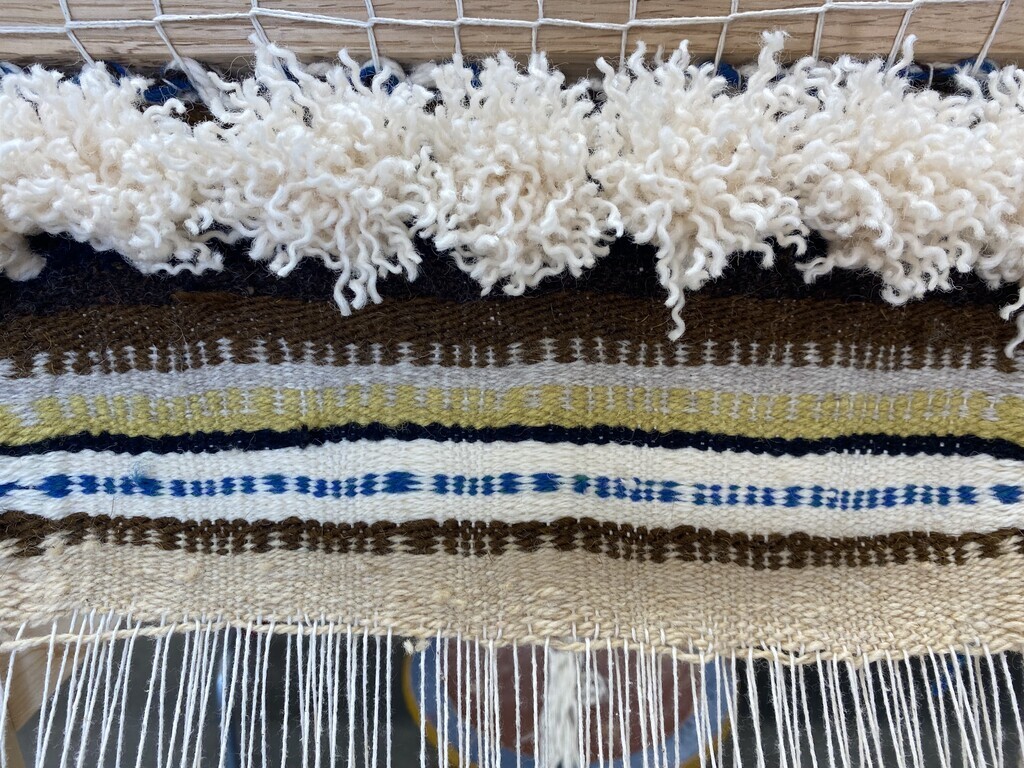
I got home late last night after the most incredible five days in Grand Marais, taking Melba Granlund’s class at North House Folk School! We built our own warp weighted loom the first two days, then wove on it the next three. It’s the most fun I’ve had in a long time and it was wonderful spending time with Melba.
Melba and Holly
David Susag was our woodworking instructor. He also has a major affinity for Scandinavian tradition and is most known for springpole woodwork.
Students with woodworking instructor David Susag
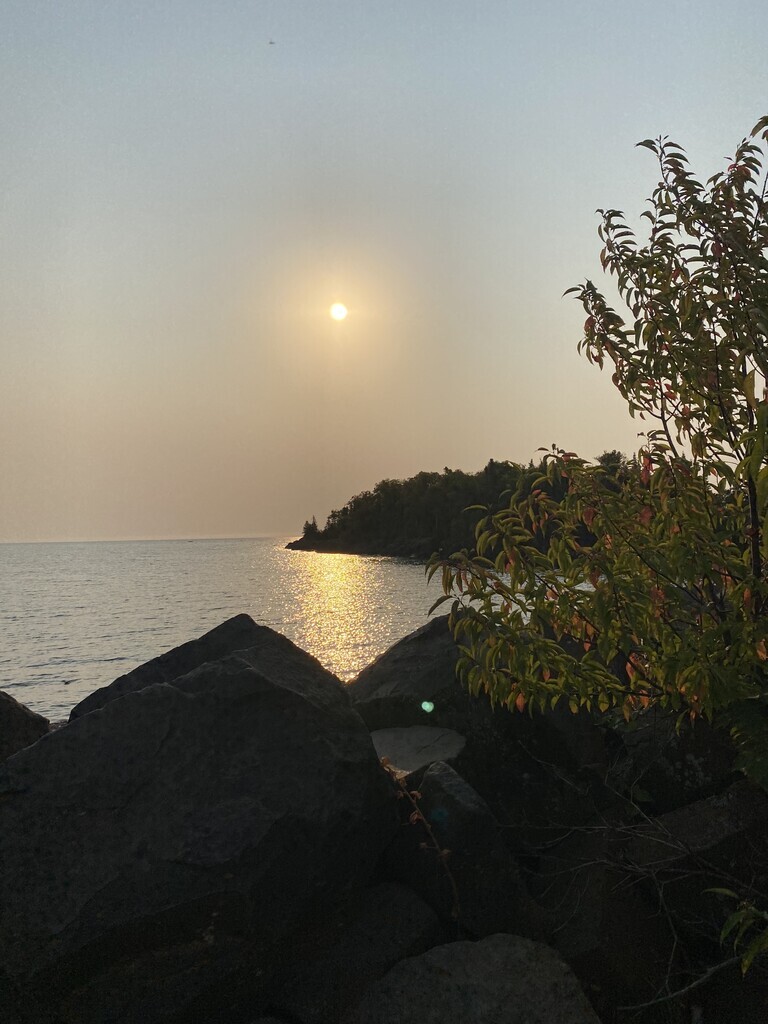
Between the lake, smoked fish, mountain of wool yarn, and smell of pine as we chiseled, it was so magical. I am sad that it’s over but so grateful for the memories we created. Big thanks to Melba for sharing her wealth of knowledge with our little group!
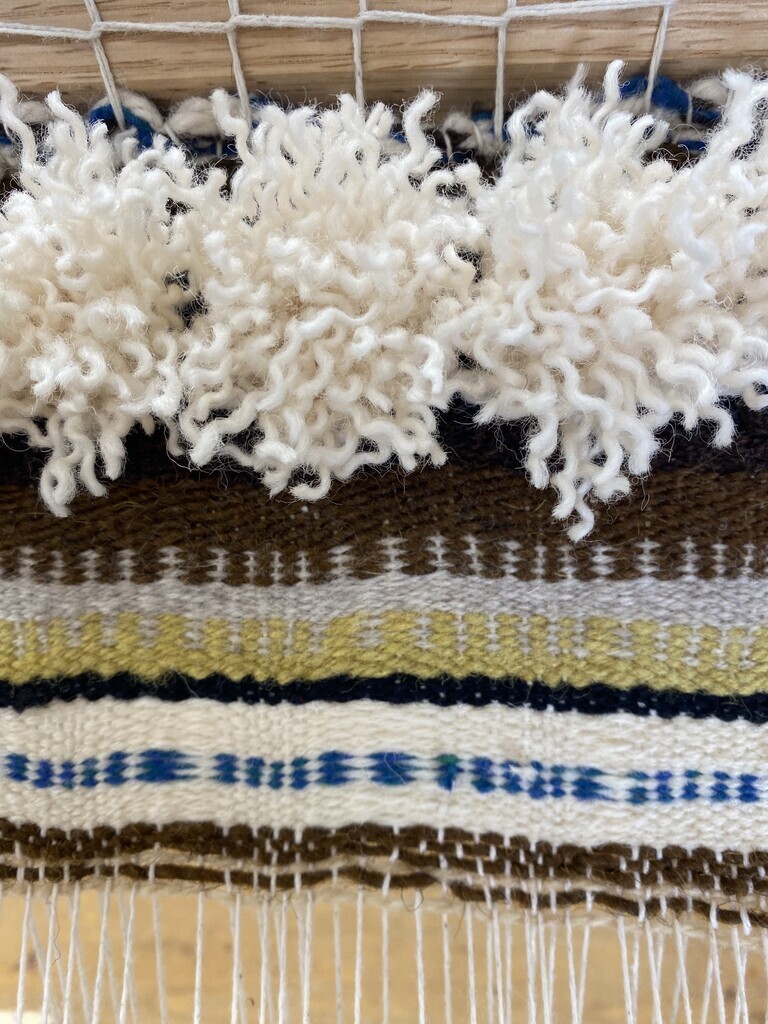
Warp strings weighted with rocksClose-up of Holly’s weavingLake Superior shore in Grand Marais, MinnesotaSunset over the Big Lake













 Scandinavian Weavers Study Group