Our Scandinavian Weavers group met on April , delayed one week because of the ridiculous weekend snowstorm of the previous week. Members have been busy weaving! I abandoned my fabulous weekend workshop with Catharine Ellis for a couple of hours to meet with our group, and showed some samples I had woven and dyed. “I have to take a photo of your beautiful blue hands,” Mary Skoy insisted.
Sara Okern just finished a gorgeous abstract rug. Of course this photo, holding it up in the air, makes it look a bit skewed. Part of its beauty is the sharp geometry of the center shape, coupled with the randomness of the inner lines of color.
Judy Larson brought three wall pieces, rag rug hangings woven in monks belt. Given the extreme longing for spring among the attendees, we all were attracted to the one in the brightest pink and green. She tried out and liked the fringe tying method taught by Tom Knisely, in which each bundle drops one thread on the edge and pulls in a thread from the adjoining bundle. It gives a sharper line to the edge.
She also brought a rug woven from the new Swedish book, I trasmattas värld från a-ö. I heard about this book and Judy’s daughter in Sweden found it and sent over copies for Judy and me. Judy is doing a great job of testing the patterns, even before I get to them!
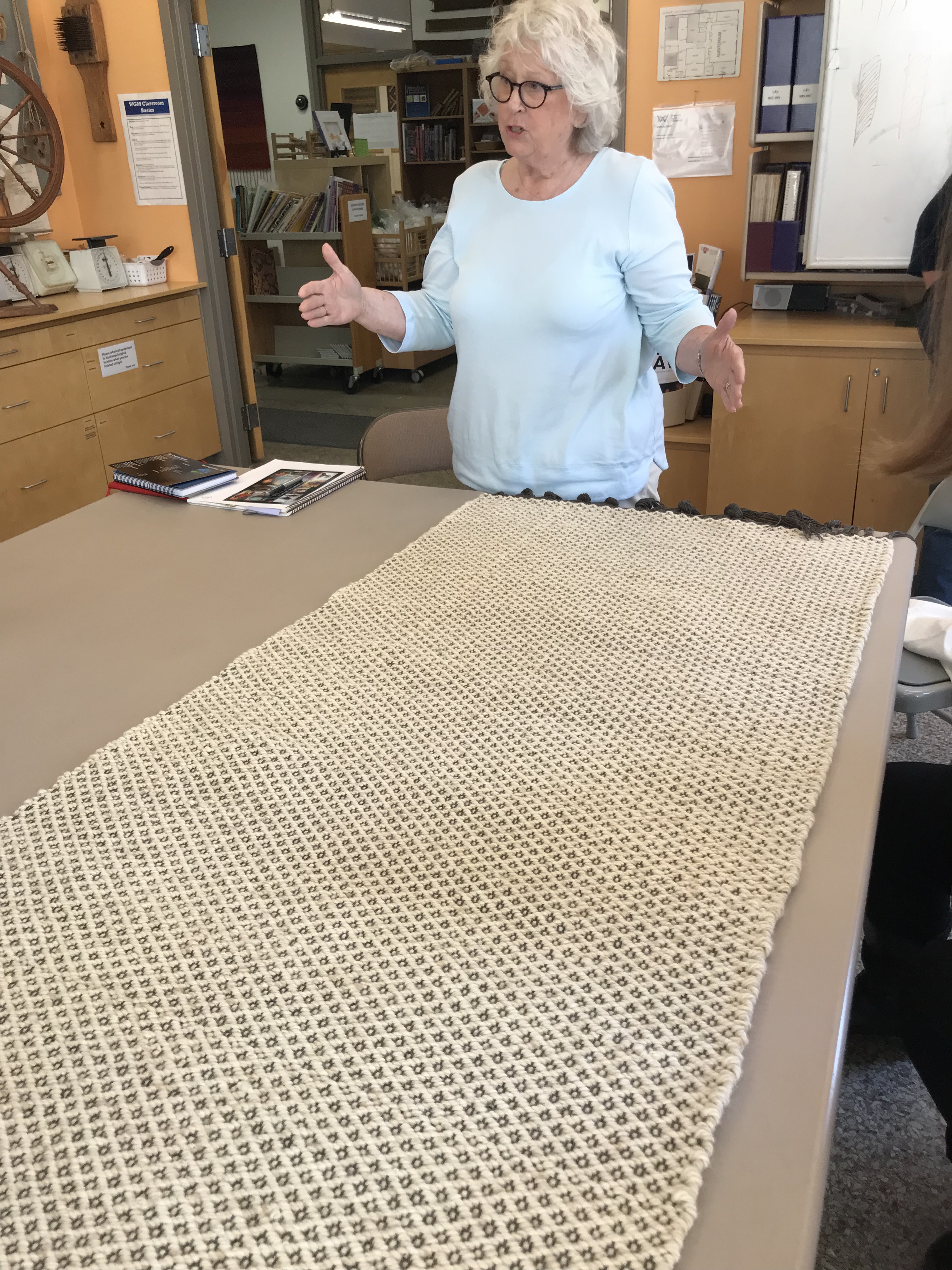
Marilyn Moore brought a beautiful wool rug and started a lively discussion of which side should be the “right” side. She solicited opinions about how the edges should be finished. Fringes? Straight edge? I think fringes won, though either would be lovely.
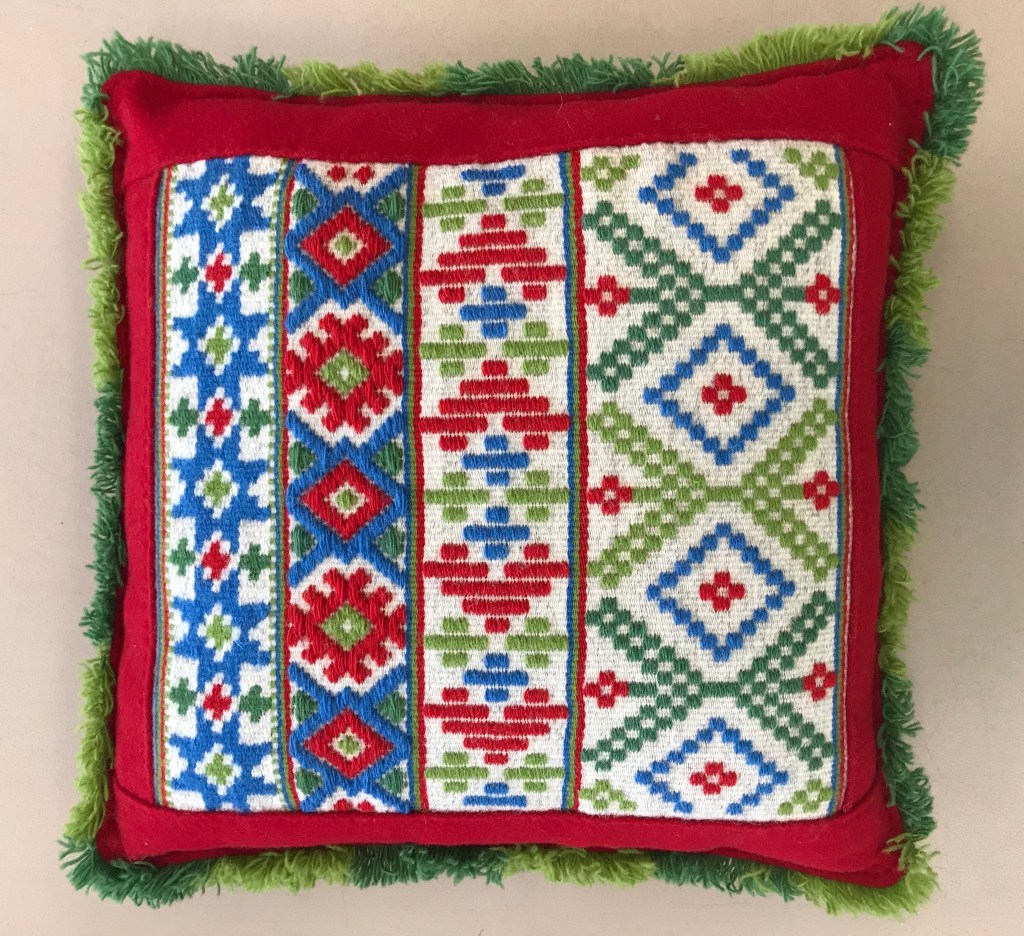
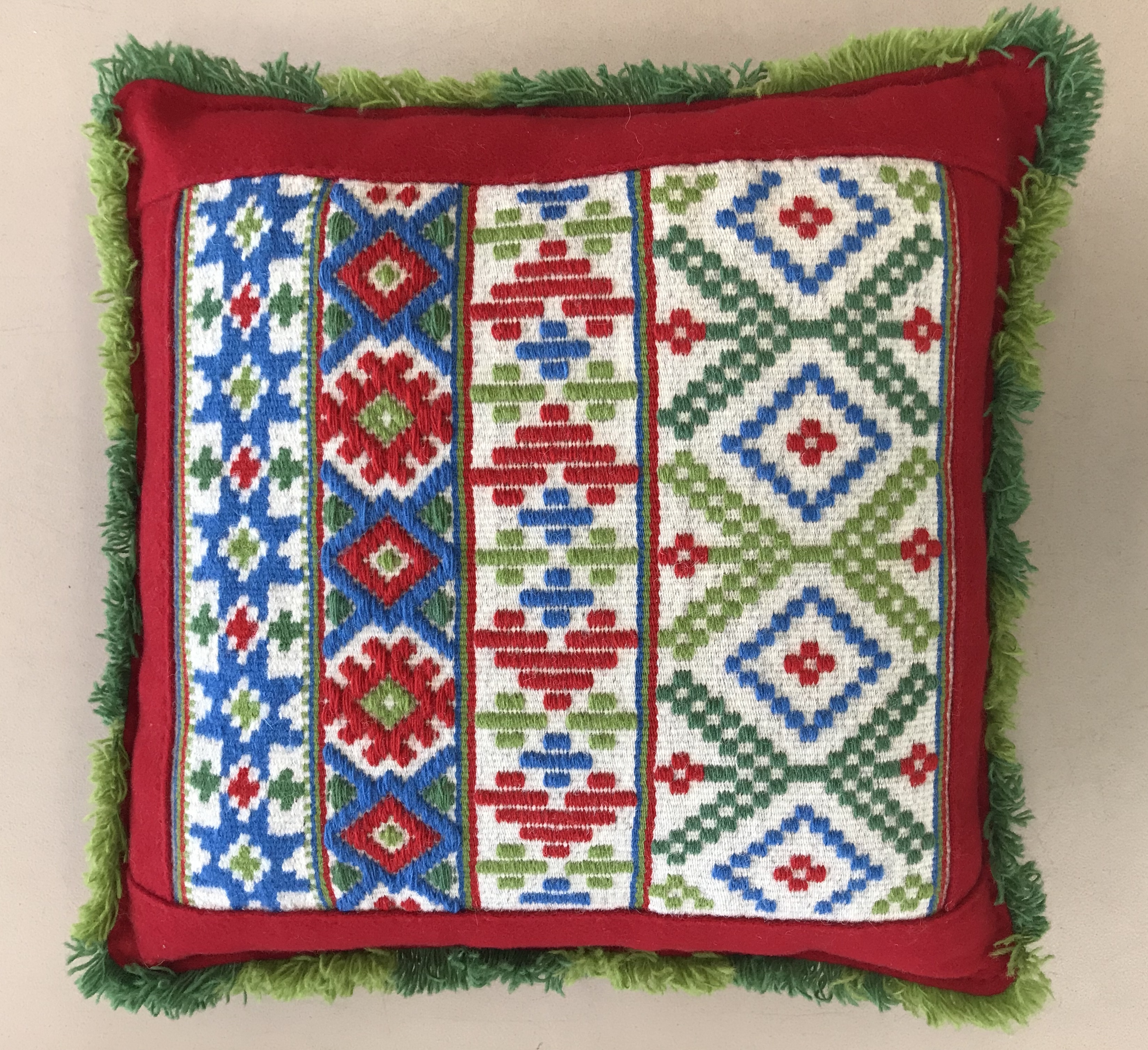
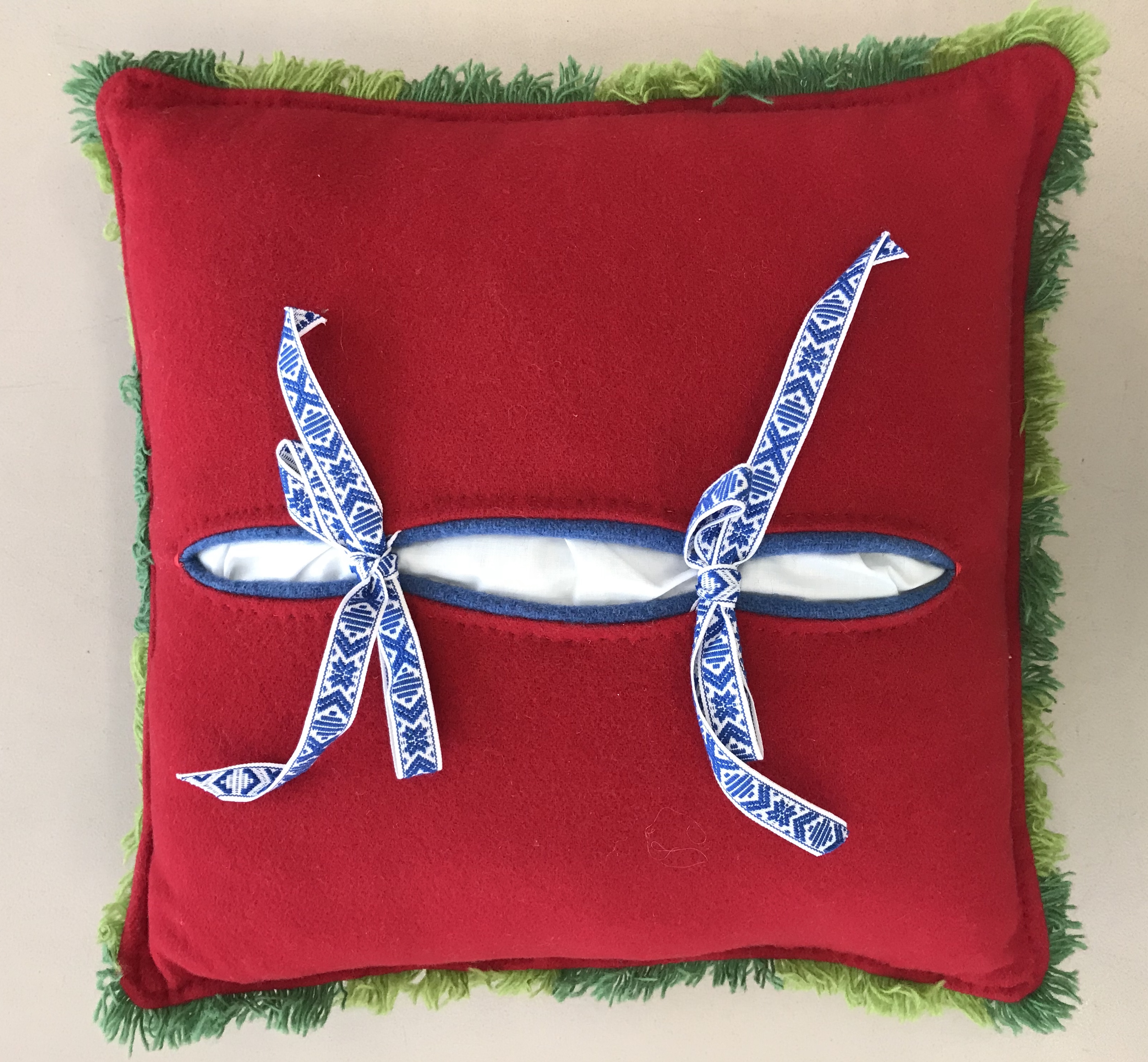
Jan Mostrom brought a sample pillow she made for her upcoming class in Swedish Art Weaves at the Weavers Guild in May. !!!
She finished the back in the method she learned in Sweden last year. The opening is often closed with large hooks and eyes, but braid is also used. She made the fringe using the traditional two-person Swedish fringe-making technique. The second person was her loving husband Mike, who spent two hours on that project. What a guy.
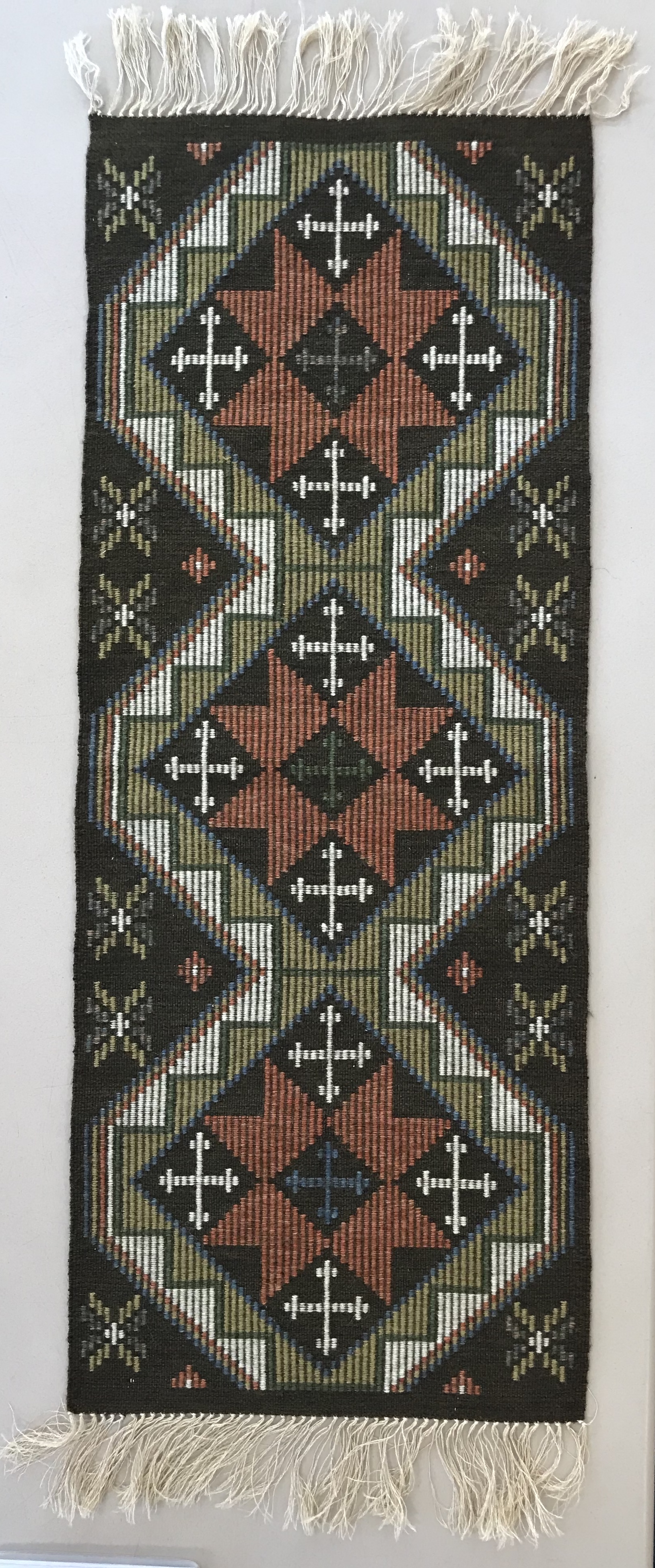
Jan also brought in a fortuitous eBay find, a lovely Swedish dukagång piece. One beautiful aspect was the slight variegation of color in the pattern yarns.
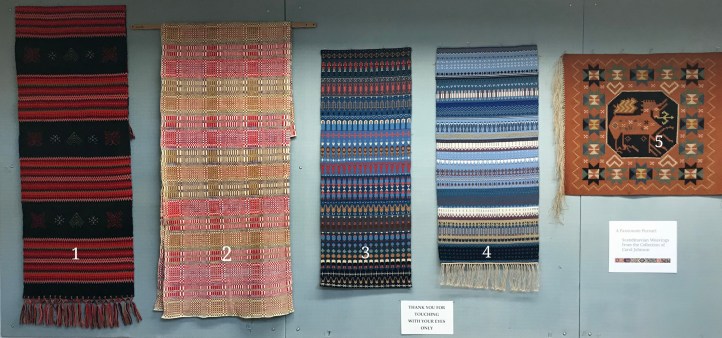
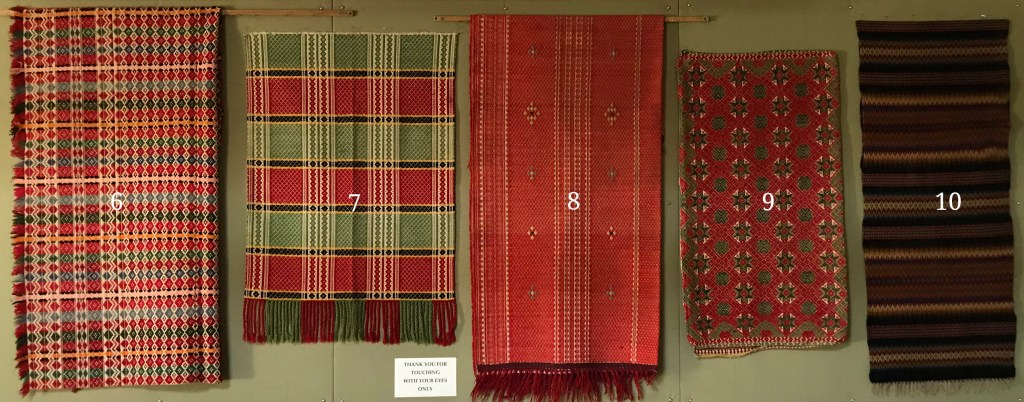
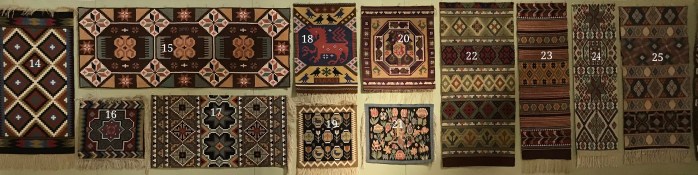
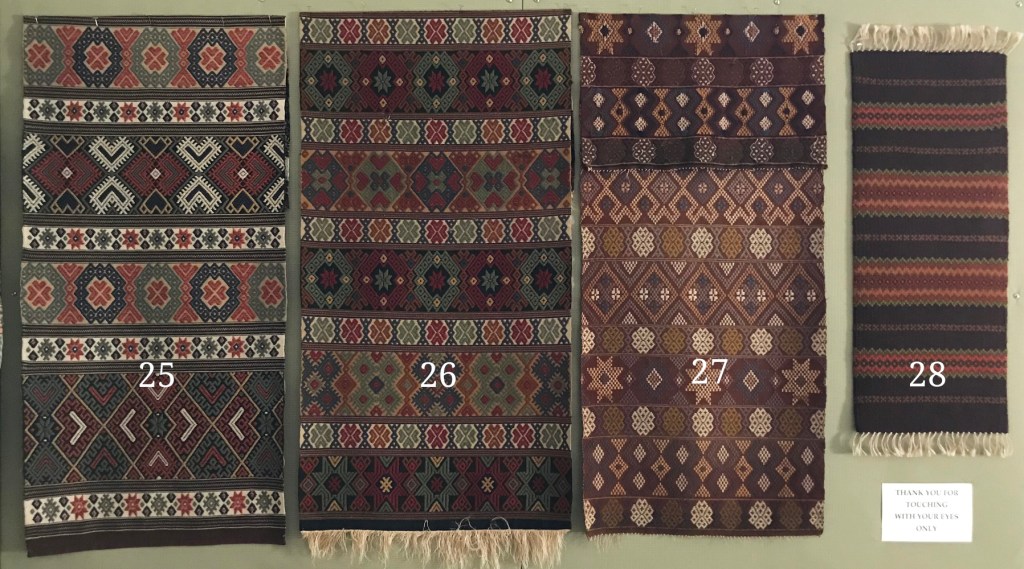
A pop-up exhibit of wonderful Scandinavian weavings is up on the gallery walls of the Weavers Guild of Minnesota, through June (exact date TBD), due to the generosity of a Minneapolis collector.
Carol Johnson is friend of many members of our Scandinavian Weavers Study Group, a fellow traveler on the Vesterheim Textile Tours. She has been collecting Scandinavian textiles for the last 40 years. Earlier she purchased her treasures at auctions and from antique dealers, especially Suzanne Kramer in Wisconsin, who specializes in Scandinavian antiques. In more recent years she has tracked eBay and scored many treasures.
A while back, Carol offered to show her textiles to the Scandinavian Weavers Study Group, and on April 2 we took her up on her offer. The week before, Mary Skoy and I visited her home to choose a selection for viewing. We were truly stunned at the extent of her collection as we looked around at weavings stacked on tables, over railings, on display racks, and in archival boxes. We didn’t even see any of her pieces in her tablecloth and woven curtains collections. She has many tapestries, generally smaller in size; those will be described and displayed at a future Weavers Guild event.
Carol shared with our group at a small gathering on April 2. Because we wanted to give other members of the Weavers Guild the opportunity to relish these weavings, we were happy that Carol was willing to lend us many pieces to put up on display.
Over the next month, I will be examining the 28 pieces and make either separate labels or a listing. There will be additional posts on this blog. I will write a substantial article about Carol and her collection for the issue of the Norwegian Textile Letter, coming out in early May, when you can learn about the stories behind some of the weavings.
Even without labels, the collection is a visual delight and an inspiration for weavers. Be sure to check it out at the Weavers Guild in the next couple of months. However, always check ahead before visiting, as the gallery walls are in a classroom and may not be available to visitors during a weaving class.
As a teaser, here are photos of the walls with the weavings.
The weather gods were with us this month, as the 12 inches of snow held off until the day after our Scandinavian Weavers meeting.
Jan Mostrom brought two books on Swedish weaving. She purchased the beautiful and huge Swedish Textile Art: The Khalili Collection, by Viveka Hansen, online. What’s the best thing about the book, I asked. The pictures. When she took the Swedish art weaves class in Sweden last summer, that book was in the classroom, and the students used it to pick out design elements for their samplers. If you look for this book online, note that there are English and Swedish editions.
In talking about buying weaving and textile books, Patty Johnson advised, “When a weaving book comes out, buy it, because when it goes out of print, it will cost way too much. They do all short runs with them.” These days, out-of-print weaving books are ridiculously expensive when trying to buy them online.
Jan also brought this small book that she bought in Sweden.
We had a round of introductions, because we have so many interested members of the group that can come only occasionally. Every month there is bound to be a few people who have not met one another. We asked each person to mention the weaving technique they like the most, or if that’s too hard, maybe mention the one they like the least.
Jan Mostrom said, “The technique I like the most is the one I am currently using. But if I’m having problems, that’s the one I like least.” Jan is a fan of krokbragd and danskbrogd, and she is teaching a class at the Weavers Guild on the techniques starting on January 29, the week that traffic in the whole city might be a giant Super Bowl snarl. Janis Aune and I also said that krokbragd and danskbrogd are favorite techniques.
Jan Josifek said her favorite technique these days is baltic pickup. She said, “I like doing it so much I have to hide my loom.” She brought two beautiful pieces. The pattern for this band was from the book Patterned Sashes: The Common Cultural Layer by Anete Karlsone. The Latvian language title is: “Rakstainas Jostas: Kopigais Kulturslanis.” She got her copy from The Baltic Smith on Easy, here. Jan thought that Vavstuga may be selling an English edition when it is available.
Patty Johnson, who favors her draw loom, said techniques with fine threads are her favorites. Jane Connett said, “I like to do small stuff; I like small designs and lots of color.” As you might guess, Jane does a lot of band weaving. She’s also taken up tatting, which she likes because it is portable.
Claire Most said, “I need to have two things going.” She likes to balance the slow work of tapestry with ikat dyeing. She added about working on tapestry, “I find it difficult to be that quiet.” Claire’s latest tapestry, “Lily,” is included in the “Common Thread” member show at the Textile Center of Minnesota now.
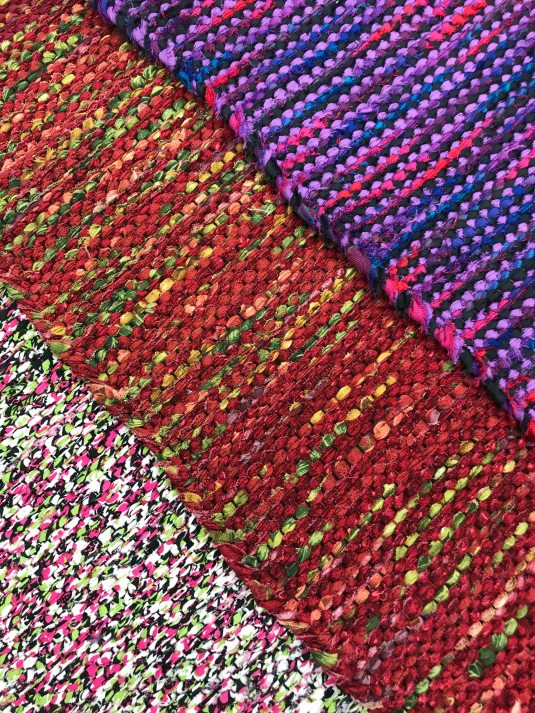
Judy Larson likes to work in a larger scale, and particularly likes the Finnish three-shuttle technique used with fabric strips. She brought a set of three rugs from her last warp–all WILDLY different.
One of the rugs was woven with fabric from the stash of Chuck Benson, a Weavers Guild member and fabulous rug weaver who passed away last year. Judy said they were fabrics she never would have chosen, especially the addition of black, but they worked well.
Kevin Olson shared a tapestry he took off the loom recently, not quite in time for his wedding anniversary. It’s adapted from a Swedish pattern. The peonies and irises are from his wedding, and the six roses stand for the six years he has been with his husband. The figures hold a wedding certificate, which is a meaningful addition to the composition, but it was also an adaptation because weaving hands was tricky! He still has quite a bit of finishing work to do, both working in the mass of threads on the back, and figuring out how to mount it. He wove it on his recently purchased upright Glimakra tapestry loom.
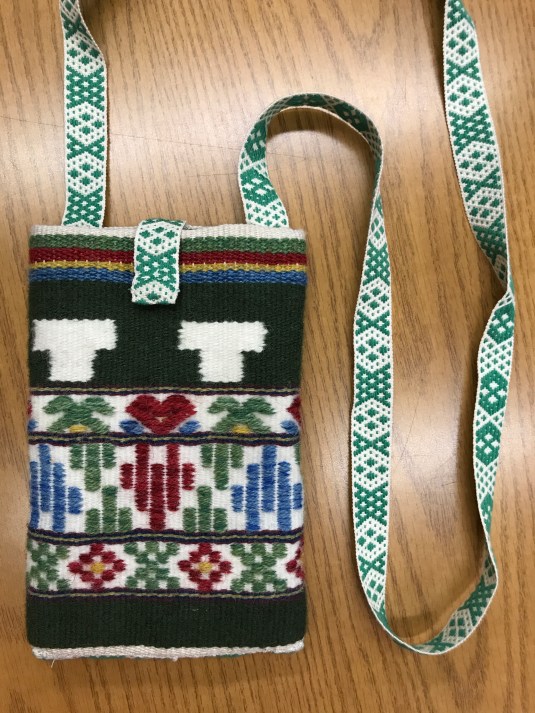
Janis Aune brought the small bag made from the sampler she wove at the Swedish art weaves course she took in Sweden last summer. (Read more about the class in the recent issue of the Norwegian Textile Letter.)
The study topic this year is a continuation of Swedish weaving, and we are interested in setting up another group warp on a Weavers Guild loom. (The last group warp was dukagang last year.) We planned to brainstorm at the next meeting, but by the end of our discussion there was enthusiasm for planning a half-heddle pick-up piece (Norwegian skilbragd, Swedish opphämta). Patty Johnson has all of the half-heddle sticks already.
Our next two meetings will be one week later than the usual third Sunday; they will be on February 25 and March 25. April and May 20 are the final spring meetings.
For the new issue of The Norwegian Textile Letter, Edi Thorstensson did a wonderful job of gathering the thoughts and images of several lucky Americans who took a Swedish Art Weaves course last summer in Landskrona, Sweden. Like me, you will be sad you were not there too!
In the same issue, don’t miss the article about the enduring image of The Wise and Foolish Virgins in Norwegian billedvev (tapestry) and about Annemor Sundbø’s adventures in processing nettles for fiber. The Norwegian Textile Letter
Several curious Scandinavian Weavers Group members gathered to cut the dukagång group warp off the Glimakra last night. It was so fun to see the completed pieces, right side up, and not just peeking from the back of the loom as they rolled around the beam. Jan Mostrom, who should be duly thanked for her work setting up the project and getting the yarn, clipped it off. (There was a section of unwoven warp at the very end, which Lisa Torvik is going to use for firfletting.)
Mary Skoy brought her sewing machine and sewed fine, straight seams between the pieces so they could be cut apart without raveling.
Melba Granlund was the designated snipper.
Oh, you wanted to see the individual pieces? Coming soon. They will be displayed on a wall of the Weavers Guild, and published here, on Friday.
On our Scandinavian Weavers group warp, three people have chosen to weave stars. Recently, Lisa Torvik’s star peeps out as Sara Okern weaves a blue star.
Lisa Torvik’s bright and festive star patternSara Okern said this was the first time she has woven anything but a rag rug. Success! Sara wove a blue star.
Karin Maahs finished her piece, and her pattern weft was sentimental. She used thin Norwegian yarn her grandmother used to embroider bunads (Norwegian costumes).
One day her pattern was sitting on the loom. “Oh nice, that’s what was just finished,” I thought as I snapped this photo. Clearly I had not looked carefully, as that was the just completed piece, and Karin’s pattern ready to start. Weaving from the back makes this process hard to document!
Here’s Karin’s piece, underway. It will be nice to photograph all the pieces once they are off the loom. For now, it still looks great at this weird angle.
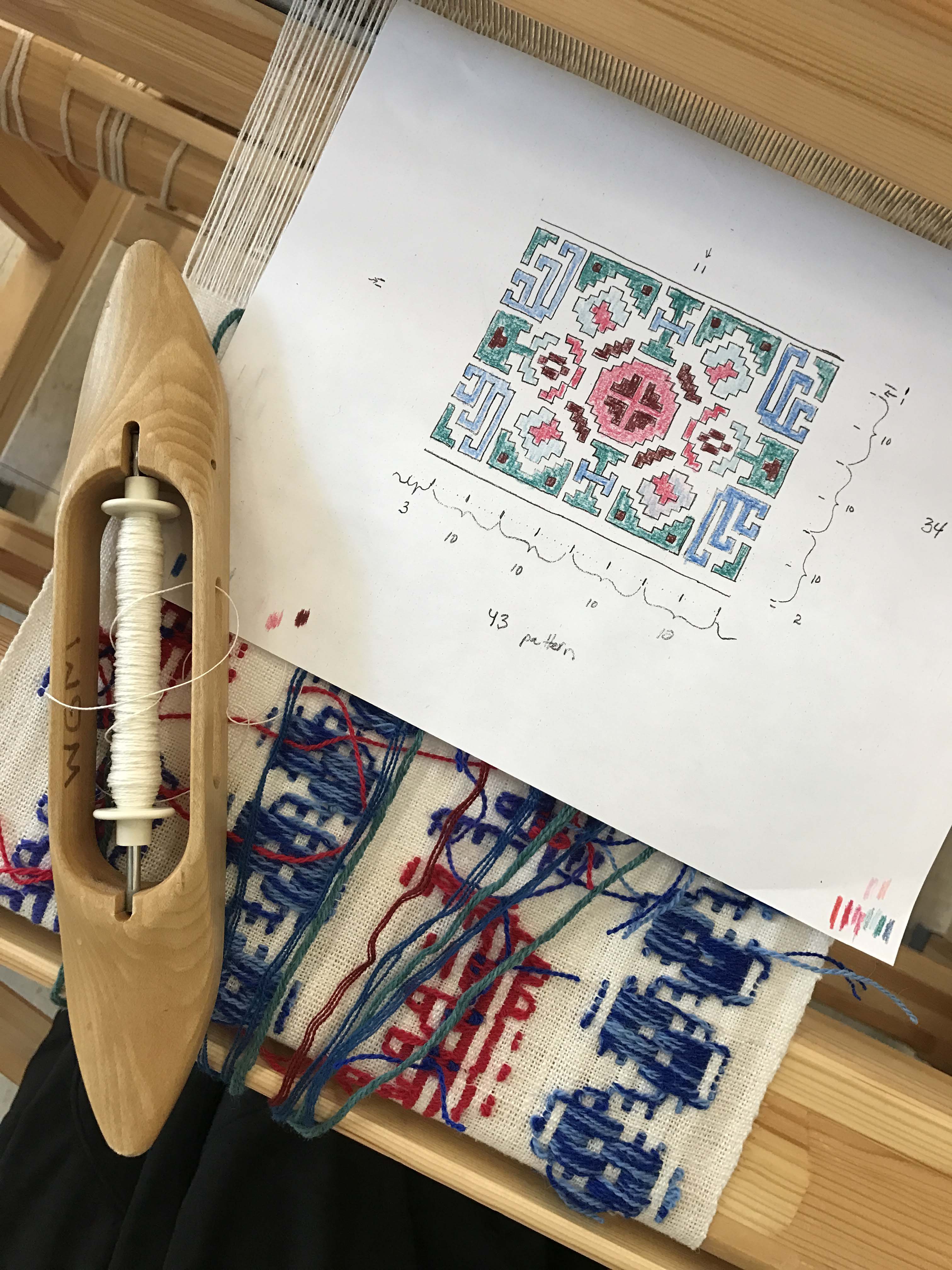
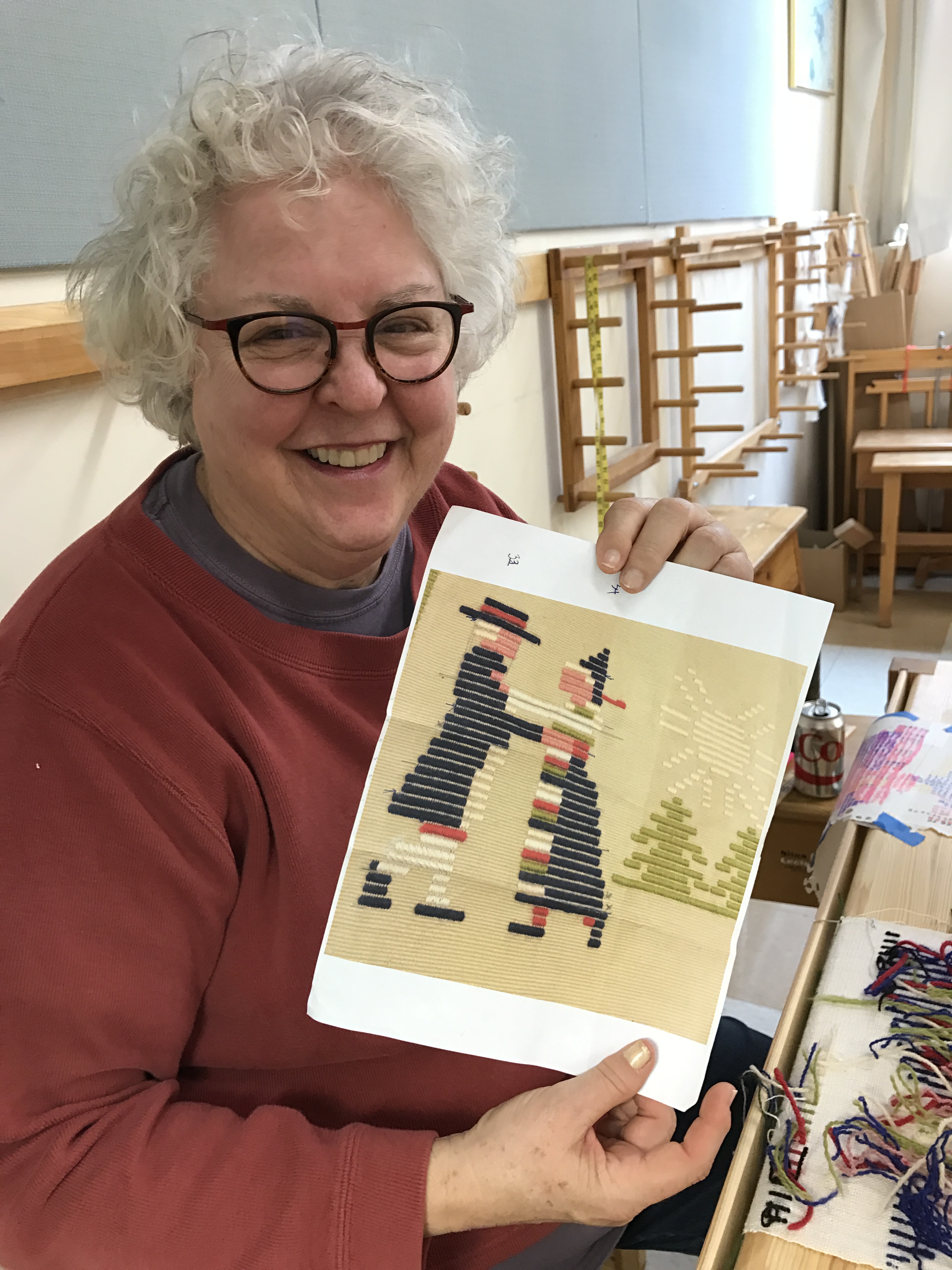
Mary Skoy is working on her dukagang piece this weekend, weaving a dancing couple from a piece at the American Swedish Institute.
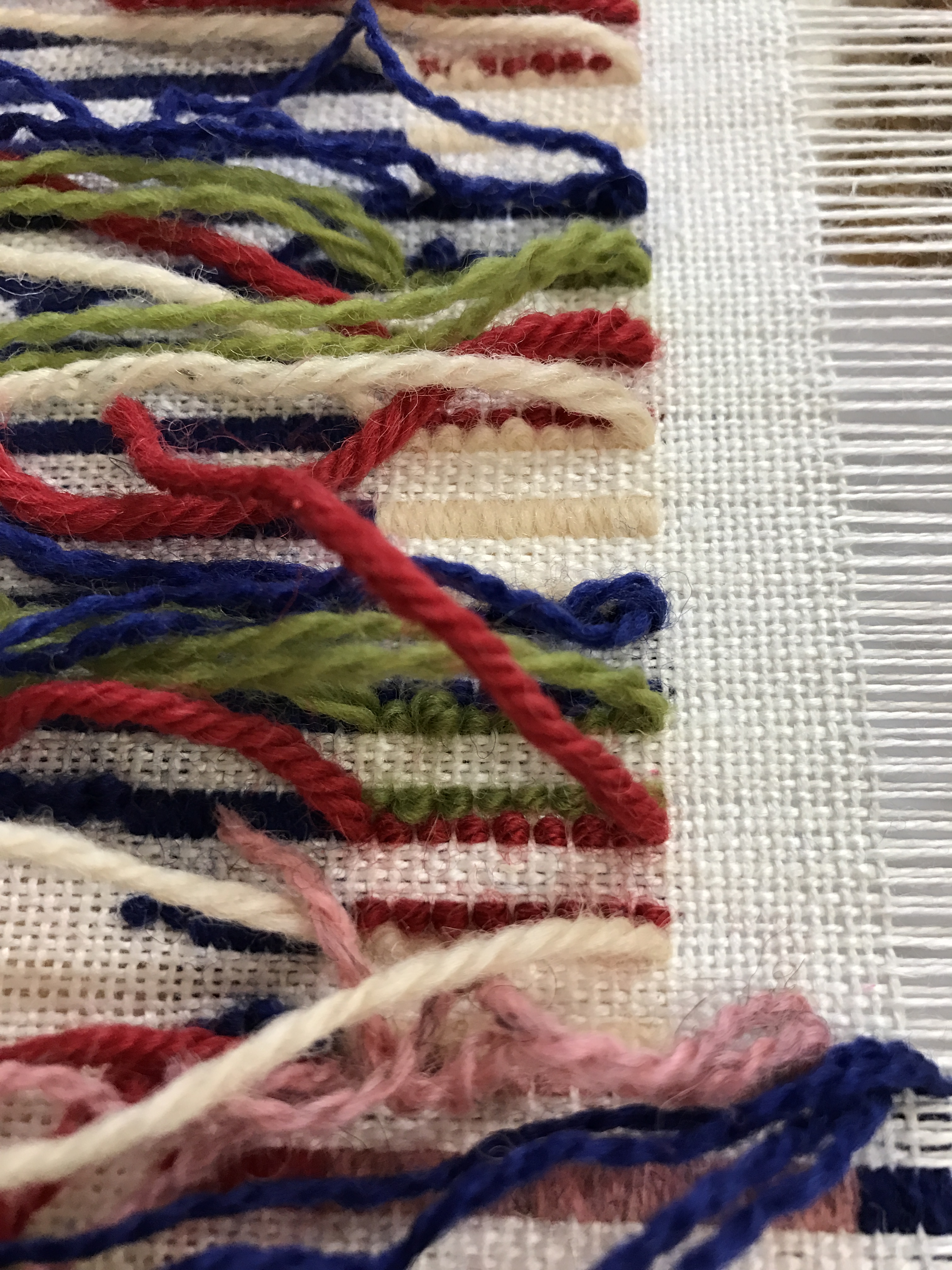
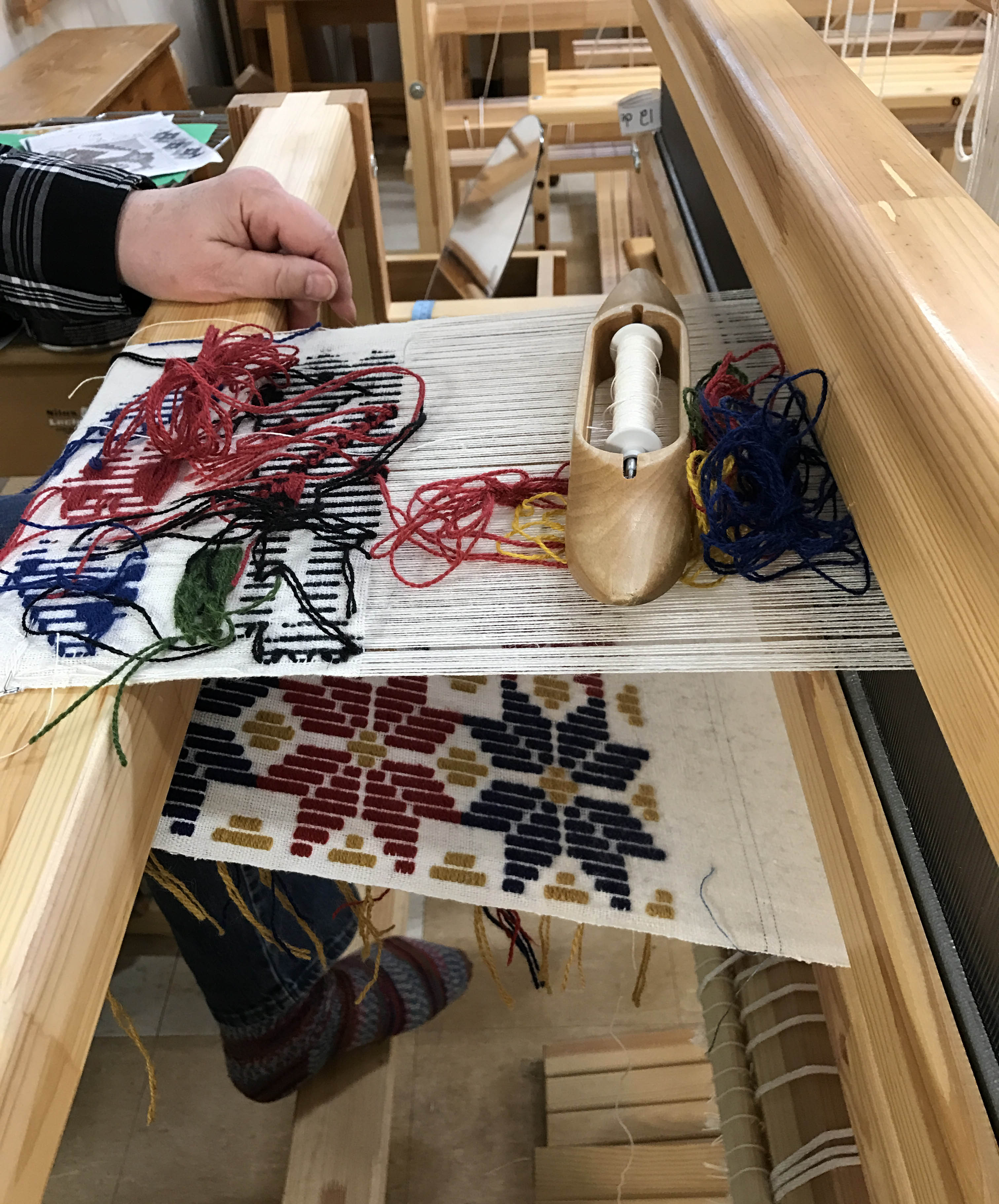
She was using four shots of pattern yarn to make a square, with only one shot of background weft between each pattern shot. This resulted in a skinny woman! For the man, she is switching to five pattern shots per square; it will be interesting to see how that changes the pattern.
She’s using a variety of wools from her stash for the pattern; sometimes two strands of Harrisville Highland (blue) or a single strand of a fatter knitting yarn (red and white).
Mary placed a white piece of fabric on the piece below the loom, when she discovered that the lint from the linen was falling on the piece below.
Mary’s weaving experience was great, although once she congratulated herself for weaving with no broken threads– snap went a selvedge thread.
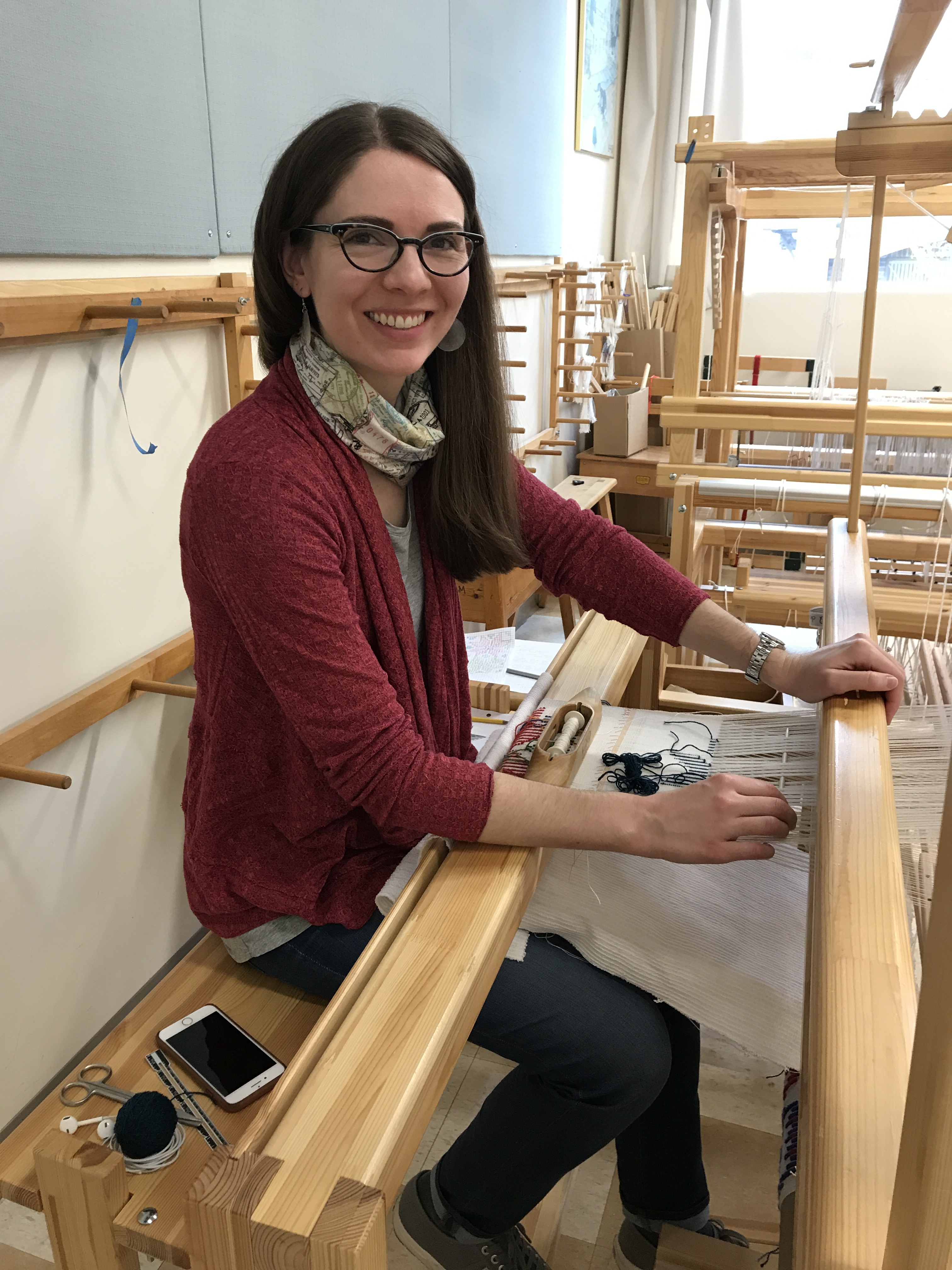
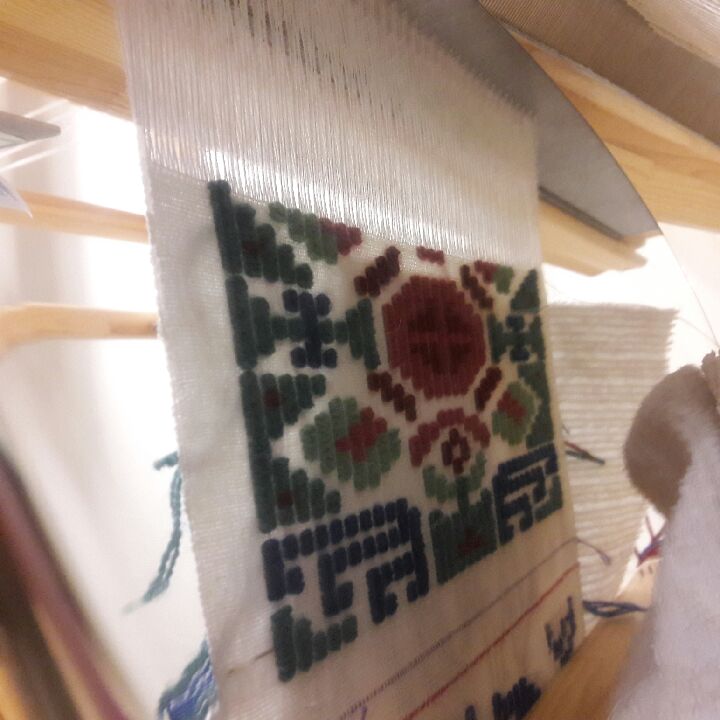
Last year and this year our Scandinavian Weavers study Group is focusing on Swedish weaving, with a particular interest in linen. We’ve begun a group project on one of the two Glimakra looms at the Weavers Guild of Minnesota. We put on a 12″ wide warp of 20/2 half-bleached linen, set at 24 epi, to experiment with dukagång. Jan Mostrom deserves special thanks for ordering the yarn and winding the warp.
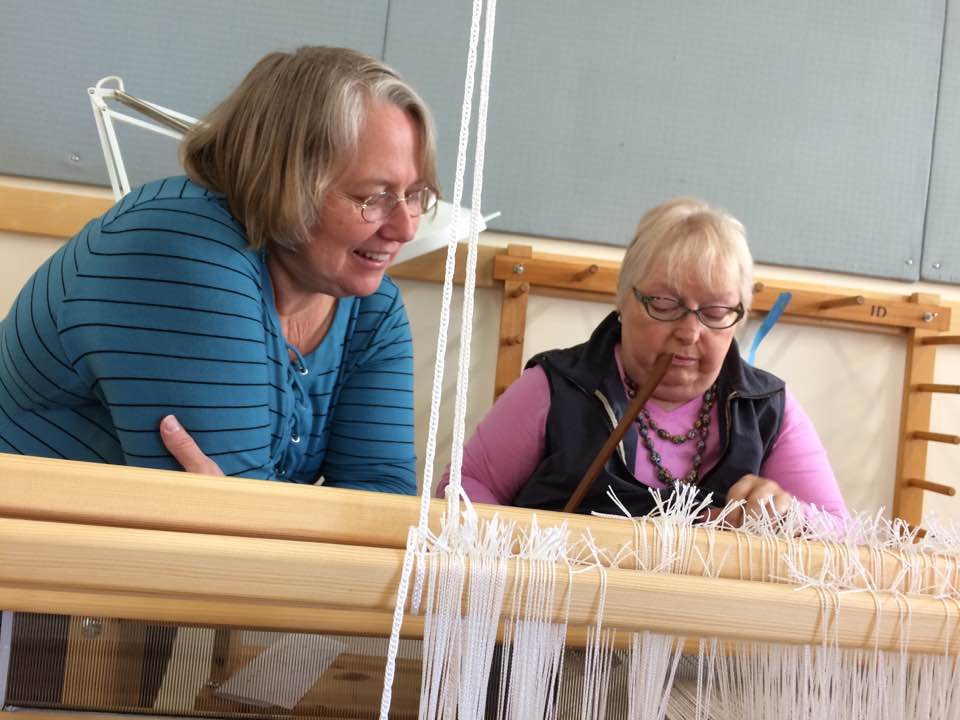
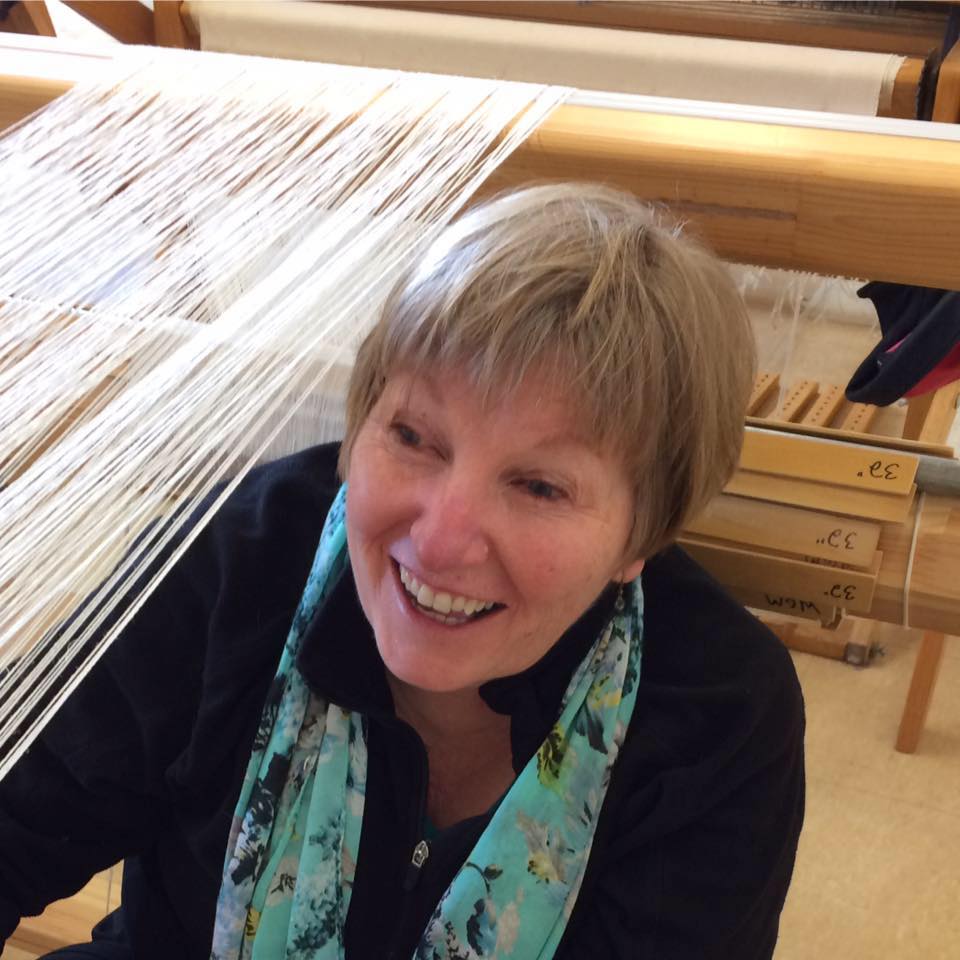
Jan and Phyllis Waggoner warped; Melba Granlund helped, too.
Their efforts resulted in a even-tensioned warp with a beautifully wide shed. Each of 12 weavers will weave 12-18″. I was the first to test the warp, and I chose an image I frequently weave — can you tell from the back? Dukagång is woven from the back.
Jan Mostrom was the second one to weave, and the right side of my piece peeked at her as it wound through the loom. Now you’ll get it.
Jan Mostrom was next on the loom; look at her beautiful stars–or as much as you can see, at this point. Melba Granlund was the third person to weave; you can see the back of her piece here. A little hard to decipher…
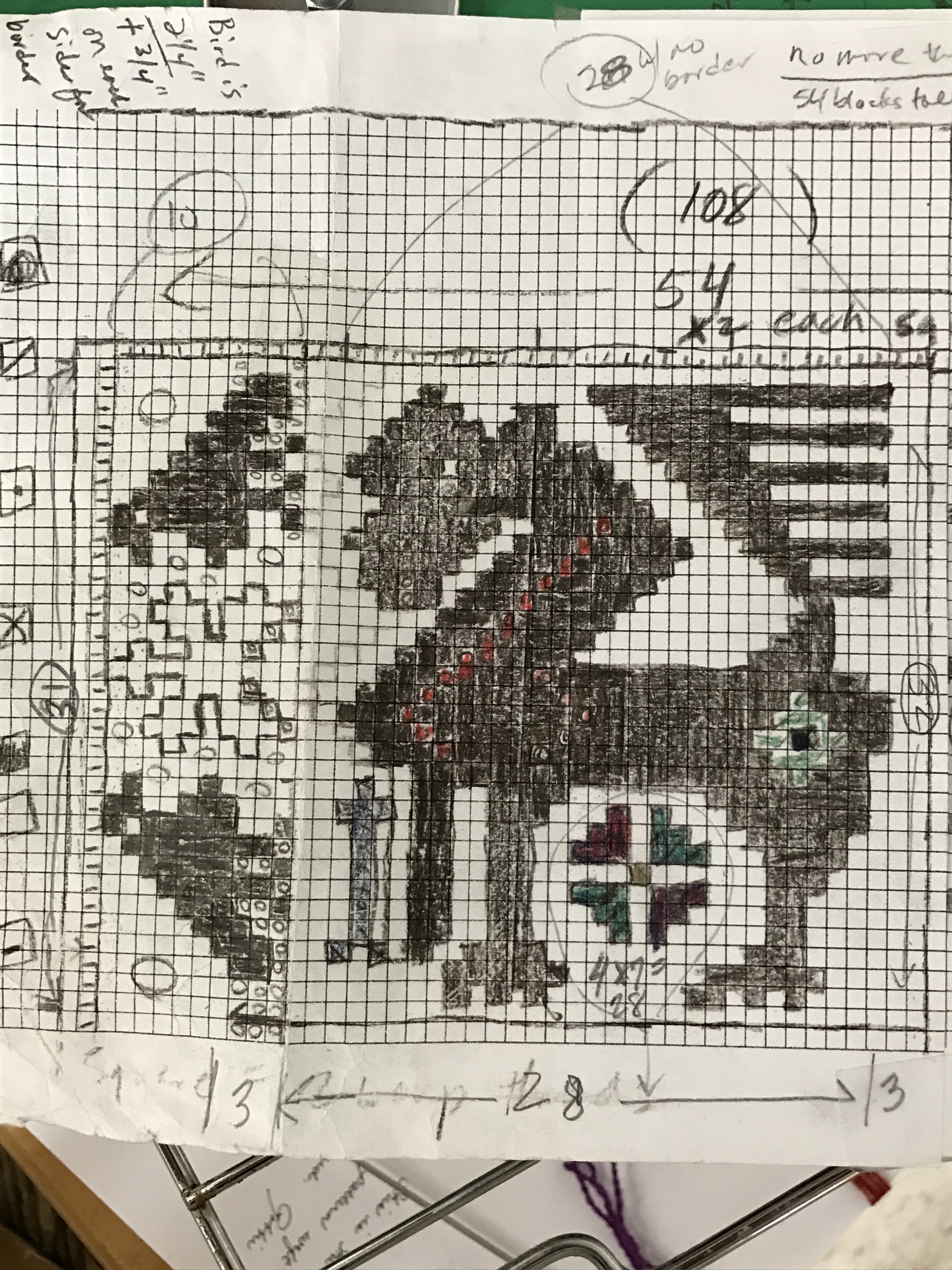
Here’s Melba’s pattern: birds, a fabulous griffin, and a stylized floral border.
A problem with weaving grid-based patterns is remembering where you left off. I solved it by highlighting each new row before I wove it.
Melba’s system was more ingenious. She asked her husband, “Don’t you have a magnetized clipboard?” Shortly after, he came from the basement with a tool, a discarded metal refrigerator rack with a strong magnet. Melba moved the pattern as she finished each row.
I’ll share more photos as this magical warp progresses, and the cut-off day will be super fun.
 Our Scandinavian Weavers group met on April , delayed one week because of the ridiculous weekend snowstorm of the previous week. Members have been busy weaving! I abandoned my fabulous weekend workshop with Catharine Ellis for a couple of hours to meet with our group, and showed some samples I had woven and dyed. “I have to take a photo of your beautiful blue hands,” Mary Skoy insisted.

 She also brought a rug woven from the new Swedish book, I trasmattas värld från a-ö. I heard about this book and Judy’s daughter in Sweden found it and sent over copies for Judy and me. Judy is doing a great job of testing the patterns, even before I get to them!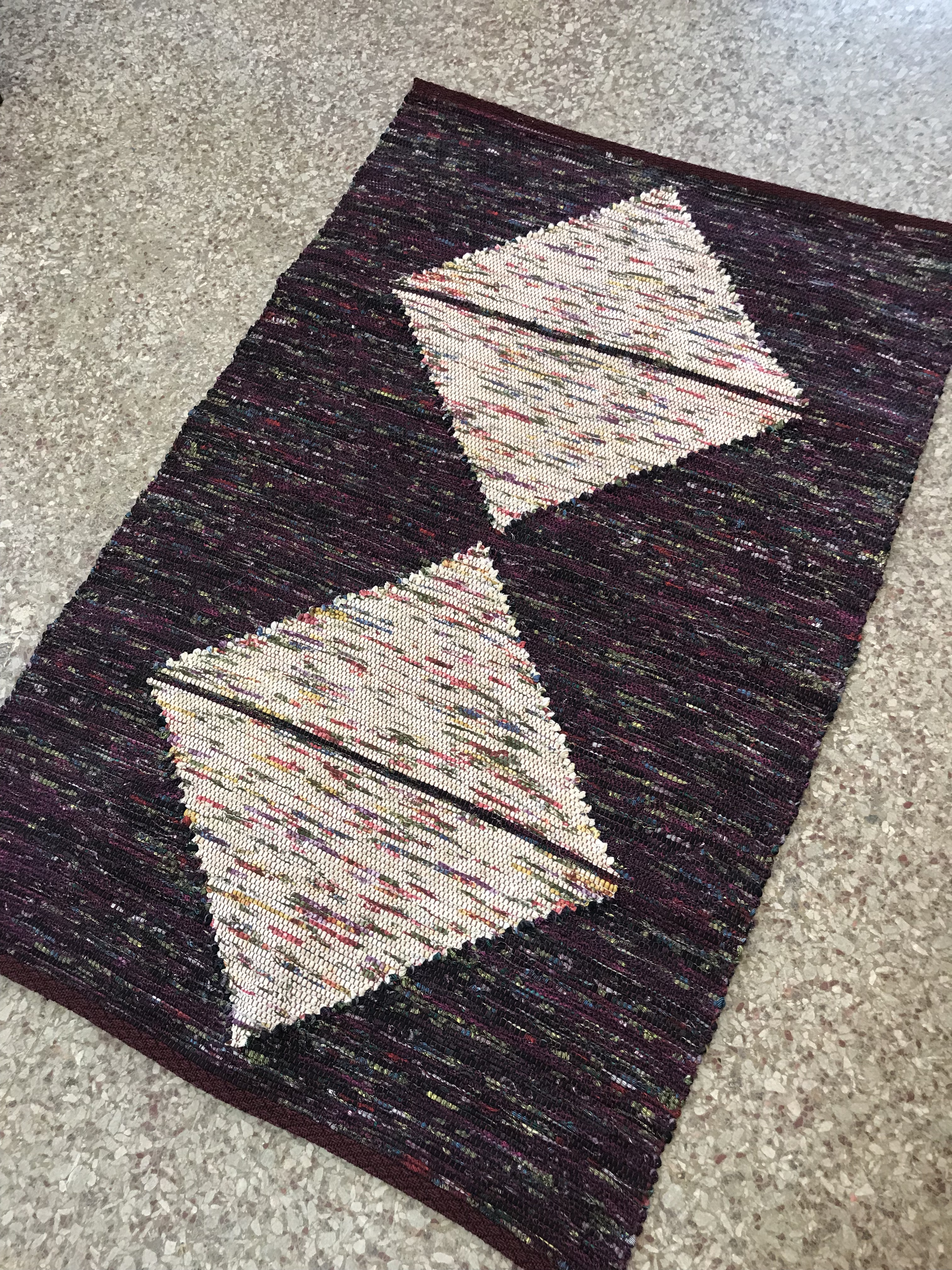




 Jan Mostrom brought two books on Swedish weaving. She purchased the beautiful and huge Swedish Textile Art: The Khalili Collection, by Viveka Hansen, online. What’s the best thing about the book, I asked. The pictures. When she took the Swedish art weaves class in Sweden last summer, that book was in the classroom, and the students used it to pick out design elements for their samplers. If you look for this book online, note that there are English and Swedish editions.
















 Scandinavian Weavers Study Group