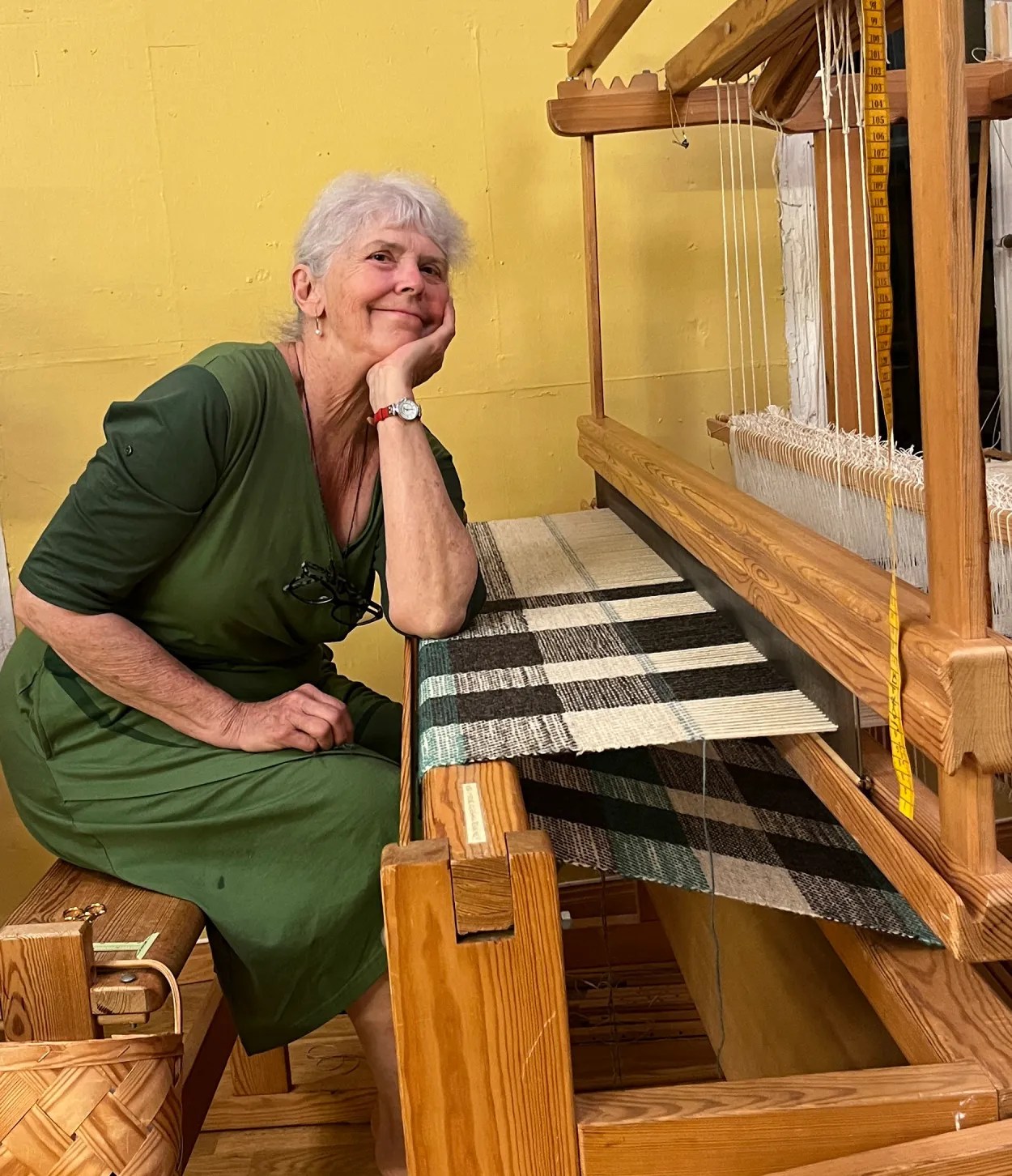
Bio: Peg Hansen attended the University of Wisconsin River Falls in the late 1980s for the purpose of learning to weave fabric for sewing garments. As it turned out, she instead pursued a career in teaching Visual Art to Red Wing High School students for 20 years. After that she got back to her fiber roots and started weaving in earnest. Being in the Scandinavian Weavers Group has provided the opportunity to learn about many weaving techniques from group warps and the sharing of knowledge by amazing group members. Weaving trips to Norway and most recently, Peru have proven to be highly educational and motivating. In addition to the classes at the Weavers Guild of Minnesota, Peg has taken classes at North House Folk School in Grand Marais, Minnesota and Vesterheim Norwegian-American Museum in Decorah, Iowa. Peg is also a member of the Zumbro River Fiber Arts Guild
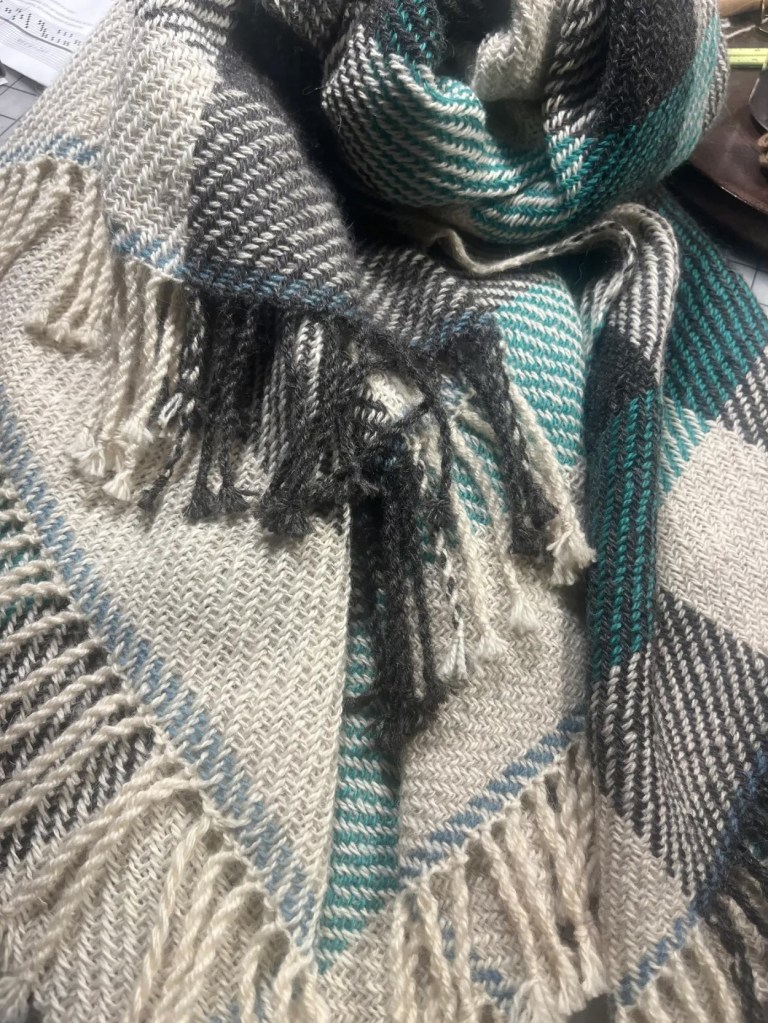
Description: Weaving a blanket is a rite of passage for weavers. I finally had the opportunity when I went to Bergen, Norway with friends from the Weavers Guild in May 2023. The goal of the workshop with Ingebjørg Monson was to weave samples of various Norwegian techniques. After sampling halvdräll, I took a turn on the blanket warp. What I thought would be a sample, or at at the most, a lap blanket, turned out to be a three day adventure. I kept going at the urging of Ingebjørg until 2:00 AM the night before my flight back to Minnesota. I was given parting instructions on finished my memorable wool twill blanket. It was so much fun I promptly enrolled in a double weave blanket class at the guild with Kayla Exworthy. I heartily recommend blanket weaving!
Regarding the Scandinavian Weavers Group: After a long hiatus from weaving, I joined the Scandinavian Weavers Group as a way to kickstart my life-long love of all things fiber. Having regular meetings to discuss and try many techniques is a great way to learn and maybe most importantly, get to know other fiber fanatics!
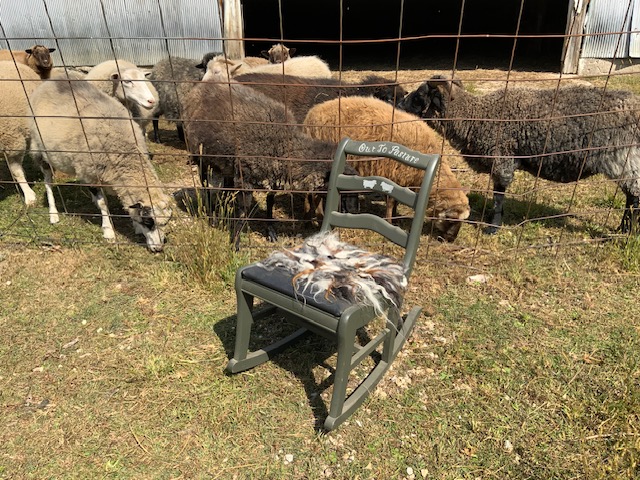
Weft of hand spun wool yarn and locks of unspun fleece from gray, black, brown, and white sheep.
$125
Bio: While a home economics teacher Nancy Ellison took her first weaving class while spending a summer in Norway in 1968. She returned to Norway in 2005 with a textile tour from Vesterheim Norwegian-American Museum. She has also taken classes at Vesterheim taught by weavers from Norway. She has been at Ellison Sheep Farm near Zumbrota, Minnesota since 1996 and has taught spinning, weaving, and felting and sells new, used, and antique spinning wheels and looms.
Description: In 1989 I did my first shaggy weaving incorporating locks of wool from Lincoln and Karakul long wooled sheep I had in my flock at that time. In 1999 I added Icelandic sheep to my flock when they became available. In 2018 I took a class at Vesterheim taught by Marta Klove Juuhl from Norway in weaving the Icelandic varafell technique which has been done in Iceland for hundreds of years to make capes with locks of wool to shed rain and snow for shepherds to wear in all kinds of weather. I had previously taken a coverlet class from her. I made my own warp weighted loom from small trees out in my pasture which I used in both classes. I enjoy selecting wool from sheep in my flock. The shaggy weave has the look and feel of a sheep skin, except the sheep gets to live to grow more wool to be sheared year after year.
Bio: While a home economics teacher, Nancy Ellison took her first weaving class while spending a summer in Norway in 1968. She returned to Norway in 2005 with a textile tour from Vesterheim Norwegian-American Museum. She has also taken classes at Vesterheim taught by weavers from Norway. She has been at Ellison Sheep Farm near Zumbrota, Minnesota since 1996 and has taught spinning, weaving, and felting and sells new, used, and antique spinning wheels and looms.
Description: Through the years I had admired weaving I saw in old Swedish Väv magazines that included figures of people, animals, trees, etc. woven in bound rosepath. Three harness krokbragd had been a favorite weave I enjoyed doing and I thought perhaps I could design some krokbragd patterns with figures and came up with this weaving. The figures start with gray tombstones which you have to look for as they don’t show up well on the green background. Then there are pastors in black suits and white collars, fences, sheep, blond girls in skirts, farmers in overalls and hats, etc. Titled “The Sheep Pasture,” it was first entered in the folk art exhibit at Vesterheim in Decorah in 2012 where it was awarded an honorable mention ribbon. Later it was shown at other events such as with shows of the Scandinavian Weavers Group. Sometimes the title was tweaked to “Pasture by the Cemetary”, “Pastors by the Pasture”, etc. In recent years other people have published patterns of krokbragd figures, especially sheep and fences, but I did it independently years earlier.
Regarding the Scandinavian Weavers Group: I joined the Weavers Guild of Minnesota and the Scandinavian Weavers Group over 30 years ago while my Aunt Marie Nodland was still living, as she had been a long time member who had joined in the early years of the guild. I feel like a link in the chain carrying on the tradition of Scandinavian weaving and am always happy to share information with others and enjoy the exchange of ideas at meetings. I haven’t driven to meetings since before the pandemic but appreciate being able to attend the meetings virtually on Zoom.
En Moderne Danskbrogd Vevprove: A Modern Danskebrogd Sampler
26″ x 84″
Warp 12/9 cotton seine twine, weft Rauma Aklegarn
NFS
Bio: Mary Lønning Skoy has been involved in the fiber community in Minnesota since the early 1970s. Taking weaving classes in Norway and at Vesterheim Norwegian-American Museum in Decorah, Iowa, as well as her membership in the Scandinavian Weavers group at the Weavers Guild of Minnesota, have contributed to her special interest in Scandinavian knitting and weaving. She has contributed projects and articles to Handwoven Design Collection #4, Handwoven, SpinOff, and The Weavers Journal magazines, and A Thread Through Time, the Weavers Guild of Minnesota’s 75th Anniversary book. Her booklet, “Weaving on a Frame Loom: a First Project,” has helped countless weavers experience the joys of rigid heddle weaving. She is the recipient of Textile Center of Minnesota’s 2020 Spun Gold award “honoring fiber artists and advocates for a lifetime dedication to Textile Center and fiber arts.” Her interest in Scandinavian textiles may be in her DNA. Her Norwegian great aunt Sunniva Lønning was a fiber artist, teacher of weaving and spinning, and an activist in mid-twentieth century Norway working to preserve ancient sheep breeds, particularly the iconic spelsau sheep. Visiting the Lønning farm on the island of Stord off the western coast of Norway, she saw firsthand the decorative and functional textiles that were such an important part of her Norwegian family’s homes and daily life. Several generations of Lønnings in Norway are both makers and collectors of textiles. Mary Skoy continues this family tradition today creating textiles for wearable, decorative, and household use.
Description: My cousin Linda and I have long shared an affection for our Norwegian family roots. Our grandfather Audun Lønning emigrated to a farm in Iowa in 1919 from the Lønning family farm on the island of Stord, Norway, and we have both visited with our extended family there and in other parts of Norway. In 2019, Linda asked if I could weave a Norwegian-inspired wall hanging for a specific space in her newly remodeled house. I was honored to be asked and said “Of course, what size would you like?” When she said “24 inches by 84 inches to go down a stairwell,” I tried to look nonplussed and again said “Of course!”
Here’s a very short story of En Moderne Danskbrogd Vevprove in the Vibrant Tradition exhibition. The story of this weaving is also the story of the extraordinary generosity of the community of weavers near and far who share my interest in Scandinavian weaving and who so willingly offered their expertise (and yarn). Linda and I settled on a danksbrogd design inspired by a beautiful weaving by Ann Haushild, woven after she took a class taught by Jan Mostrom in 2003 at the Weavers Guild of Minnesota. Ann had been a member of the original Scandinavian Study Group organized in 1996 to study danskbrogd. Ann invited me to her home to photograph her original weaving which I then used as a guide, expanding her 11½” x 31” wall hanging to 24” x 84” to fit Linda’s space. The members of that 1996 study group had figured out how to avoid the pick-up required to weave danskbrogd on a krokbragd threading, using five shafts instead of three. Thanks to the efforts of Robbie Lafleur, editor of The Norwegian Textile Letter, many of the notes from that group were digitized, appearing in articles in The Norwegian Textile Letter over the years. This archive became a great source of inspiration and information for me.
I had to learn how to weave danskbrogd on my loom—a sixteen shaft AVL Compu-Dobby. Jan Mostrom, an amazing weaver of all things Scandinavian, a recipient of Vesterheim’s Gold Medal in Weaving, a gifted weaving teacher, and a dear friend, patiently explained (with handouts) how to translate the 3 shaft pick-up krokbragd to a 5 shaft no pick-up treadled danskbrogd technique. Sue Fairchild, developer of the weaving software Pixeloom, explained her software’s boundweave feature to help me plan out some of the 3 shaft krokbragd motifs, and then I created a spreadsheet to design a drawdown for the 5 shaft motifs. Rauma aklegarn was my yarn of choice and Blue Heron Knitters in Decorah, Iowa, still had many colors for sale, but Rauma had stopped producing this yarn so I asked friends to “check their stash” for aklegarn. Once again, Jan Mostrom came to my rescue, offering me several colors I needed. Wendy Sundquist on Whidbey Island, Washington, sent me aklegarn from her stash, some of which she had dyed the perfect red. I knit Robbie LaFleur golf club covers in exchange for some of the blue I needed. Veronna Capone from Brookings, South Dakota, had some gold she could send me. Kay Larson from Bainbridge Island, Washington, contributed more colors, and I was ready to weave. As I wove, I learned how to manage selvedges with two and three colors, how to cover the warp completely in this weft-faced technique, how to advance the temple, and to keep track inch by woven inch on an 84” ribbon pinned to the weaving. And finally, how to finish the warp ends with a Damascus edge, steam press the hanging on thick felt to gently flatten the piece, and how to hand sew velcro onto fabric sleeves attached to the top and bottom so the piece could be hung. The story has a happy ending. Linda liked the hanging, and the Lønning family tradition of making and collecting Norwegian-inspired textiles will live on.
14″ x 33″ Warp and Tabby Ground Cloth – 10/2 mercerized cotton In color number UKI #117– Stone. Weft – 5/2 Perle mercerized cotton in color number UKI #000 – Bleach White
NFS
Bio: Karen Holmes learned to weave 10 years ago. She enjoys weaving useful items, such as table linens, towels, shawls, and scarves, both for herself and to give as gifts. Her Swedish and Finnish heritage beckons the exploration of Scandinavian styles of weaving. Daldräll is a Swedish weaving style that Karen just learned a year ago. Karen also makes time for watercolor painting, gardening, and enjoys classical music.
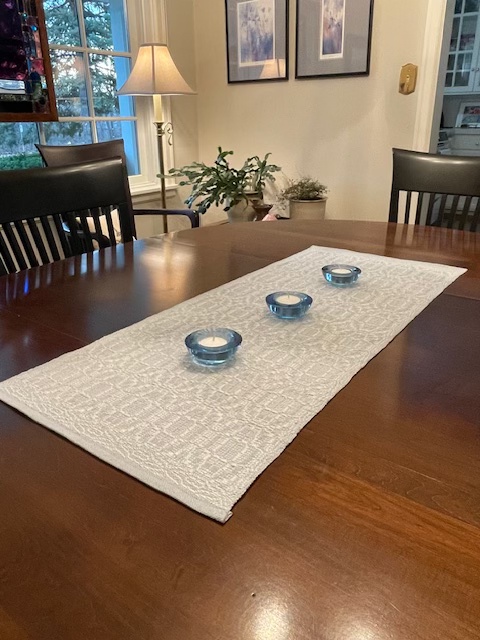
Description:I discovered the pattern for this table runner in a Handwoven magazine from 1997, which was in a stash of old magazines I bought at the Weaver’s Guild. This pattern caught my attention, as the author of the article mentioned she needed to weave a gift for three weddings that year. I was planning to weave something special for two upcoming weddings, a year apart. This pattern is called a “Name Draft” – thus the title “Happy Wedding Day.” In a name draft, each letter of the alphabet is assigned to one of the four shafts on the loom. This can be done either systematically or randomly. This seemed rather magical and I was intrigued how this could work to create something so lovely. I was also thrilled that someone else had worked it out for me. It seemed serendipitous to find this pattern named “Happy Wedding Day” with two upcoming weddings in the family! I have now completed three of these table runners in various lengths, all in neutral colors, like stone and silver grey with white. This one I might keep for myself, but if there is another wedding soon, I am ready!
Regarding the Scandinavian Weavers Group: The Scandinavian Weavers Group provides opportunities to gain experience and learn together. Members offer advice and helpful suggestions, whether it’s an individual or group project.
Bio: Mary Erickson is a fiber artist living on the Mesabi Iron Range with an interest in how landscape and culture influence our lives. Scandinavian weaving has long been an interest and she has traveled to several Nordic countries to study traditional methods of weaving. Her weavings are on public display at the Essentia Health Virginia Building, the Minnesota North College at the Mesabi Range Virginia Campus and also at the Eveleth Campus. Solo exhibits of her work have been held at the First Stage Gallery, Lyric Center for the Arts in Virginia, MN and her work has been included in many group exhibits. Mary holds a Bachelor of Science Degree in Art Education from Bemidji State University and a Master of Art Degree from the University of Wisconsin, Superior.
Description: This weaving was woven several years ago in a class taught by the Norwegian weaver Åse Froysadal at the Vesterheim Norwegian-American Museum in Decorah, Iowa. On the first day of class I envisioned using pattern drafts to learn how to weave Boundweave Rosepath. But to my surprise, Åse stressed designing at the loom. What this means is that instead of weaving from a pre-designed pattern on paper, I was looking at how the warp threads moved to determine what shape and color to use for the design. I still remember Ase saying, “Think about it,” as we wove–which is why I call the piece, Think About It. She opened up a new way of weaving.
Regarding the Scandinavian Weavers Group: Living in Northern Minnesota, the Zoom link to the Scandinavian Weavers Study Group enables me to connect with a wonderful organization of weavers who are always looking forward to new learning, projects and goals. I feel very lucky to be a part of this group of talented weavers and also the opportunity to display my work in this exhibit.
Bio: Brenda Gauvin-Chadwick has loved textiles since she was a young child, sewing her own clothes, knitting, embroidering, and of course making pot holders on a pot holder loom. She learned to weave in her late 20s from a very talented Swedish weaver in upstate New York, and with the exception of taking a hiatus when her children were young has continued to weave. She belongs to the Minnesota Weavers Guild and studies Scandinavian techniques with Scandinavian Weavers Group.
Description: This piece in bound rosepath technique was woven as part of a group project by the Scandinavian Weavers. I was inspired by the beauty of Scandinavia in the winter. The pillow was woven with Fåro yarn that I purchased in Sweden many years ago. I carried it all over Scandinavia for weeks in my suitcase. I bought it after skiing the Swedish Vasaloppet. Two weeks later in Norway I skied the Birkebeiner race. The colors represent the forests, the beautiful sunshine and my heart exploding with joy as I skied along! The colors represent the forests, the beautiful sunshine and my heart exploding with joy as I skied along the breathtaking terrain.
Bio: Jan Mostrom grew up on a dairy farm in Wisconsin. Before Jan started school, her grandmother taught her how to embroider. While she may have harassed her grandmother to teach her and preschool stitches are unique, this was the beginning of a lifelong love of textiles. While attending Luther College in Decorah Iowa, Jan took a January term class in weaving from Lila Nelson. After graduation, Jan used her savings to buy a used car and a loom. She has been weaving on that loom ever since. The car is long gone. Graduation was also followed by a wedding to her high school and college sweetheart Mike, and their two children and two grandchildren remain the center of her life and heart. Jan has taught Scandinavian weaving classes at Vesterheim Norwegian-American Museum for over 20 years and also has taught at the Weavers Guild of Minnesota, Minnetonka Center for the Arts and others including the first Norwegian Textile Conference. She has contributed articles to the Norwegian Textile Letter and organized an international weaving study group. She received her gold medal in weaving from Vesterheim Folk Art School in 1999. She has traveled to Scandinavia many times with Vesterheim textile tours and independently and has studied with Scandinavian weaving instructors in the United States, Norway and Sweden. Jan, along with weaving friend Janis Aune, has taught a small group of impoverished women in Tanzania how to weave rag rugs allowing them to support themselves and their children to attend school.
Description: Indigo Nights was woven as part of an earlier exhibition of textiles inspired by the Baldishol tapestry, one of the oldest surviving tapestry from Norway, dating from about 1100. I have always been attracted to the graphic style of the Baldishol with its interesting background designs and vibrant colors. The Baldishol represents April and May of what must have been a much larger tapestry. Taking my inspiration from the spotted sky of the May section, I wove a bold wool rug with wide stripes in various shades of indigo and circles of red, gold and white. The black and white triangle borders are another element found in the Baldishol. I dyed the wool with natural dyes that may have been used in the original weaving; indigo for blue, madder root for red and birch leaves for gold. The white and black wools are natural sheep colors.
Warp: 16/2 line linen, unbleached; tabby weft: 16/1 line linen, unbleached; Pattern Weft – Rauma Pridvevgarn, 2-ply wool
NFS
Bio: Shari Nelson learned to weave in the early 2000s but has done most of her weaving after retirement in 2020. She learned on a 4 shaft Norwood workshop loom during a class taught by Cathie Mayr at Nordic Living in Nisswa, MN. Shari has tried other techniques such as rigid heddle, tablet, card and tapestry weaving but her passion is for the more complicated floor loom projects. She continues to learn and develop drafts/color plans including those inspired by Scandinavian weaves past and present. Her looms are also used to produce utilitarian items and small wearables. Recently, she acquired a Glimakra 10 shaft countermarch loom that will open up a world of possibilities.
Description: I learned to weave this Telemarksteppe draft as part of the Scandinavian Weavers Group joint project on a pre-warped loom in April of 2023. As a relatively new weaver, this was the perfect opportunity for me to experiment with a countermarch loom and linen warp and ground weft with wool pattern yarn. The color inspiration is from a rug in my Scandinavian-decorated home in Baxter, MN. To use authentic Scandinavian materials, I chose Rauma Prydvevgarn yarn for the pattern yarn. Three colors of blue were used along with red, olive and gold as accents. I learned how to plan the color sequences and treadling by using a weaving software for the first time. The first couple of days were used understanding how the draft transferred to the woven cloth and adjustments were made as I wove. The “finger loop” edge trim was fun to do and easier than I imagined. It hangs in my dining room and is a constant reminder to me that anything can be accomplished if you have the desire to learn. Why name this piece Journey? This piece is a culmination of several exploration journeys to Norway, weaving software exploration to devise color, draft and treadling plans, collaboration with weaving friends and the desire to step out and just try it.
Regarding the Scandinavian Weavers Group: This Telemarksteppe project would not have happened for me if it wasn’t for the help and advice from members of the Scandinavian Weavers Group of the Weavers Guild of Minnesota. The linen being pre-warped and threaded was of utmost importance. Members answered so many questions for me about the draft and materials needed so I could be prepared. Lisa Torvik voluntarily came down on my first assigned weaving day to show me how to operate the Glimakra Loom since I had never used one before. Every night I went away tired but more confident. I live in Baxter, MN so it required me to stay at my son’s house to be able to do this project over four days. The staff was patient and encouraging and the space was a joy to weave in with ample space and light.
Bio: Jan Mostrom grew up on a dairy farm in Wisconsin. Before Jan started school, her grandmother taught her how to embroider. While she may have harassed her grandmother to teach her and her preschool stitches are unique, this was the beginning of a lifelong love of textiles. While attending Luther College in Decorah Iowa, Jan took a January term class in weaving from Lila Nelson. After graduation, Jan used her savings to buy a used car and a loom. She has been weaving on that loom ever since. The car is long gone. Graduation was also followed by a wedding to her high school and college sweetheart Mike, and their two children and two grandchildren remain the center of her life and heart. Jan has taught Scandinavian weaving classes at Vesterheim Norwegian-American Museum for over 20 years and also has taught at the Weavers Guild of Minnesota, Minnetonka Center for the Arts and others including the first Norwegian Textile Conference. She has contributed articles to the Norwegian Textile Letter and organized an international weaving study group. She received her gold medal in weaving from Vesterheim Folk Art School in 1999. She has traveled to Scandinavia many times with Vesterheim textile tours and independently and has studied with Scandinavian weaving instructors in the United States, Norway and Sweden. Jan, along with weaving friend Janis Aune, has taught a small group of impoverished women in Tanzania how to weave rag rugs allowing them to support themselves and their children to attend school.
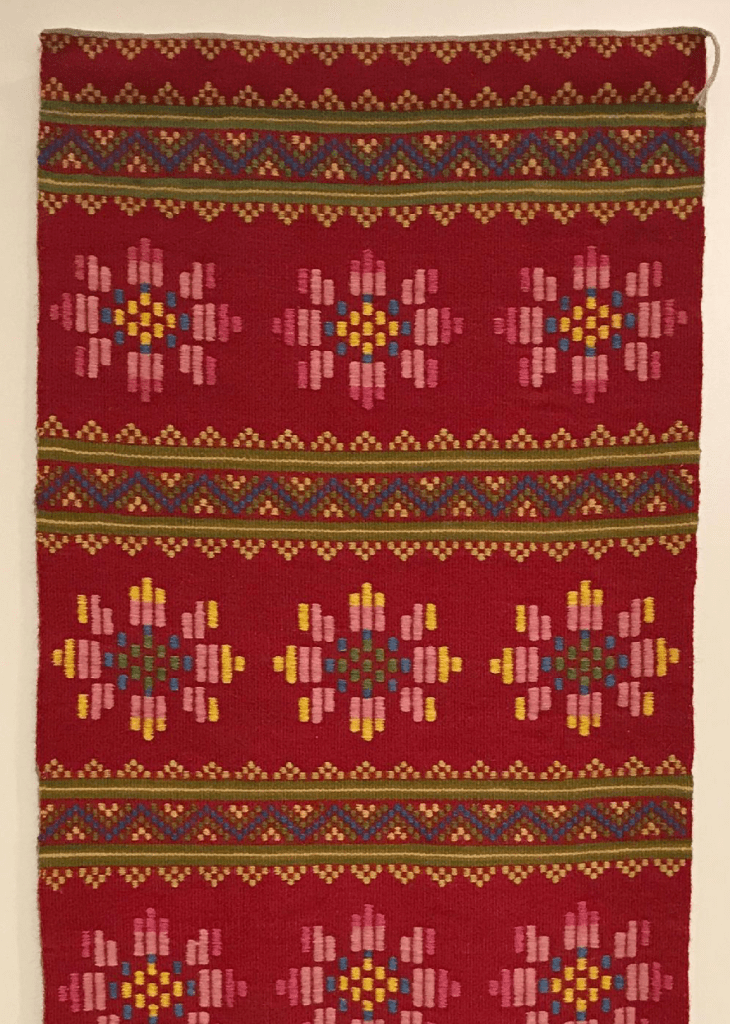
Description: Summer is inspired by the bright dance of light in summer gardens and by the basket of natural dyed yarns I had amassed over the years. I love the science and seeming magic of natural dyes. The red background was dyed with madder root and the rest of the yarns came from the basket of previous dyed yarns from flowers, leaves, cochineal, goldenrod and indigo. I wove the flowers in dukagång technique which creates columns and the rest of the patterns are woven in inlay technique similar to Vestfoldsmett creating a checked effect.
Regarding the Scandinavian Weavers Group: I have been a part of Scan Weavers for about 25 years. It has provided a wealth of inspiration, support and friendship. It is a safe place to ask questions and share. The depth of interest, research, knowledge is amazing as is the support and generousness of its members.




 Scandinavian Weavers Study Group