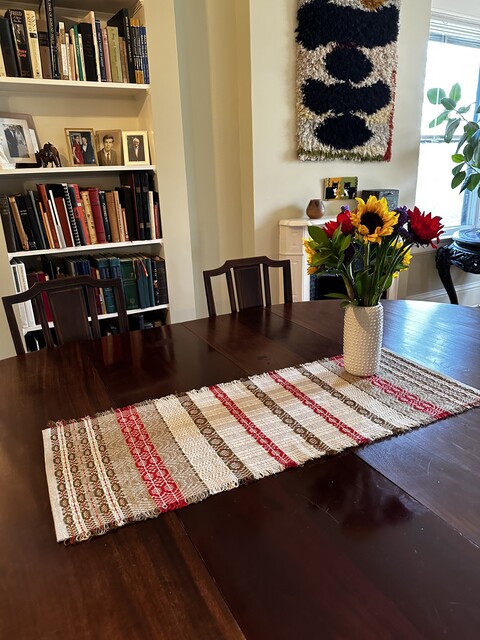
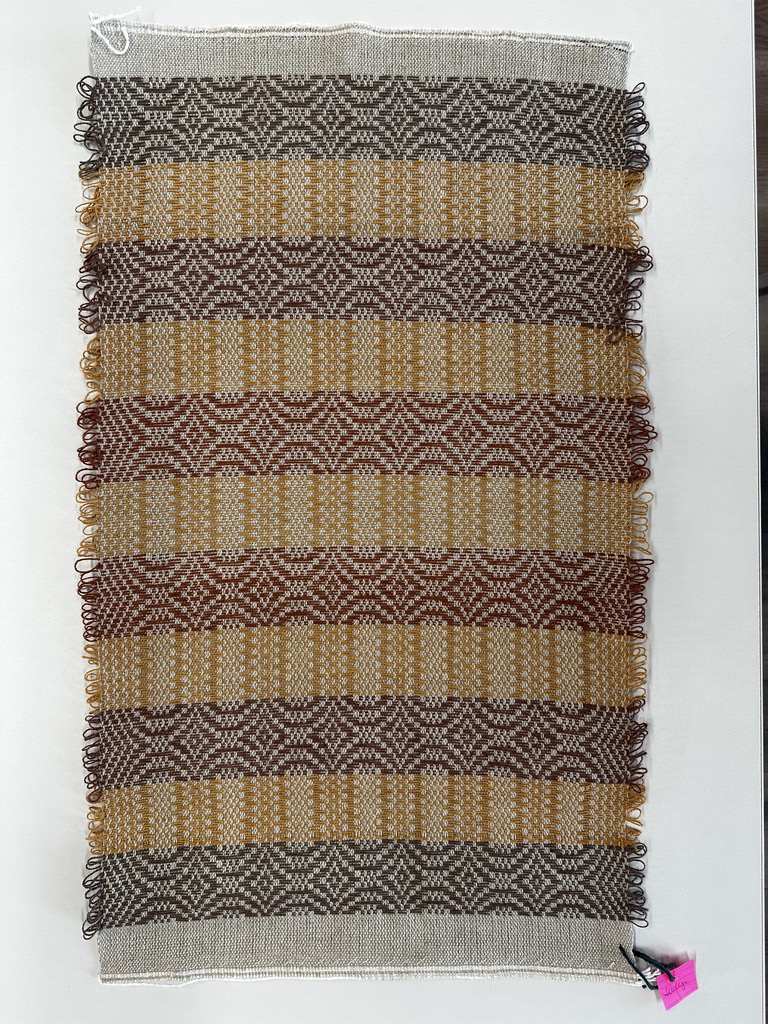
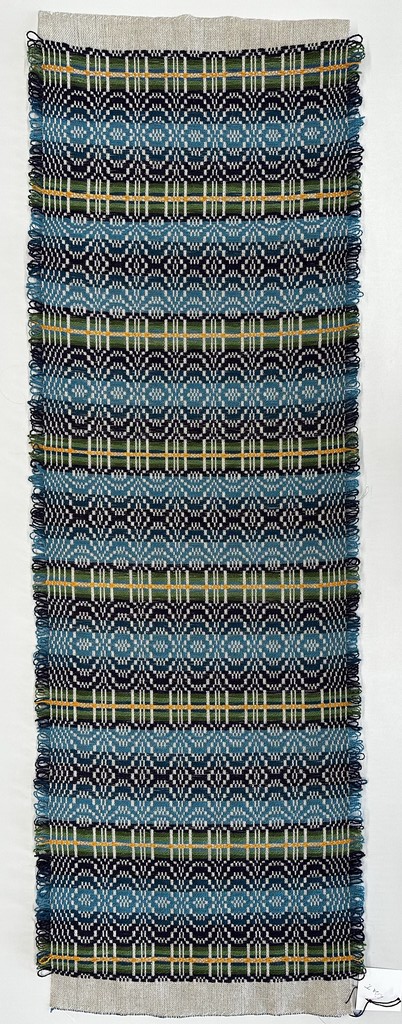
Follow the Scan Weavers Blog! (And see more beautiful blue rugs by Judy Larson!)
It’s been a busy summer for our Scandinavian Weavers Group and promises to be a busy fall, as well. Stay tuned for a summer wrap-up and fall preview, including the following:
Scan Weavers win ribbons the Minnesota State Fair!
On Friday, April 12, a very special weaving symposium was held under the auspices of Her Royal Majesty Crown Princess Mette-Marit, Samlede Tråder [Unifying Threads]. I knew several Norwegian weavers who were thrilled to get invitations, and witnessed a lot of other excitement through social media posts. Although I meant to do it earlier, two articles about the event were just published in the Norwegian Textile Letter.
LONG LIVE WEAVING — Thoughts on Crown Princess Mette Marit’s Weaving Symposium. Jon Fredrik Skauge wrote an heartfelt essay about his experience at the symposium. I suggest following Jon Fredrik Skauge on Facebook to learn about his amazing linen projects, all the way from planting seeds through spinning and weaving. He wove a long linen tablecloth and added sprang at one end, in a pattern from a tablecloth made by his great-great grandmother.
I was looking through coverage of Crown Princess Mette-Marit’s symposium and found a long article that appeared in the Norwegian handcraft magazine, Husflid. The article is posted on their website, “Kronprinsesse Mette-Marit: – Jeg gjorde selvfølgelig alt feil” [Crown Princess Mette-Marit – Of Course I did Everything Wrong.”
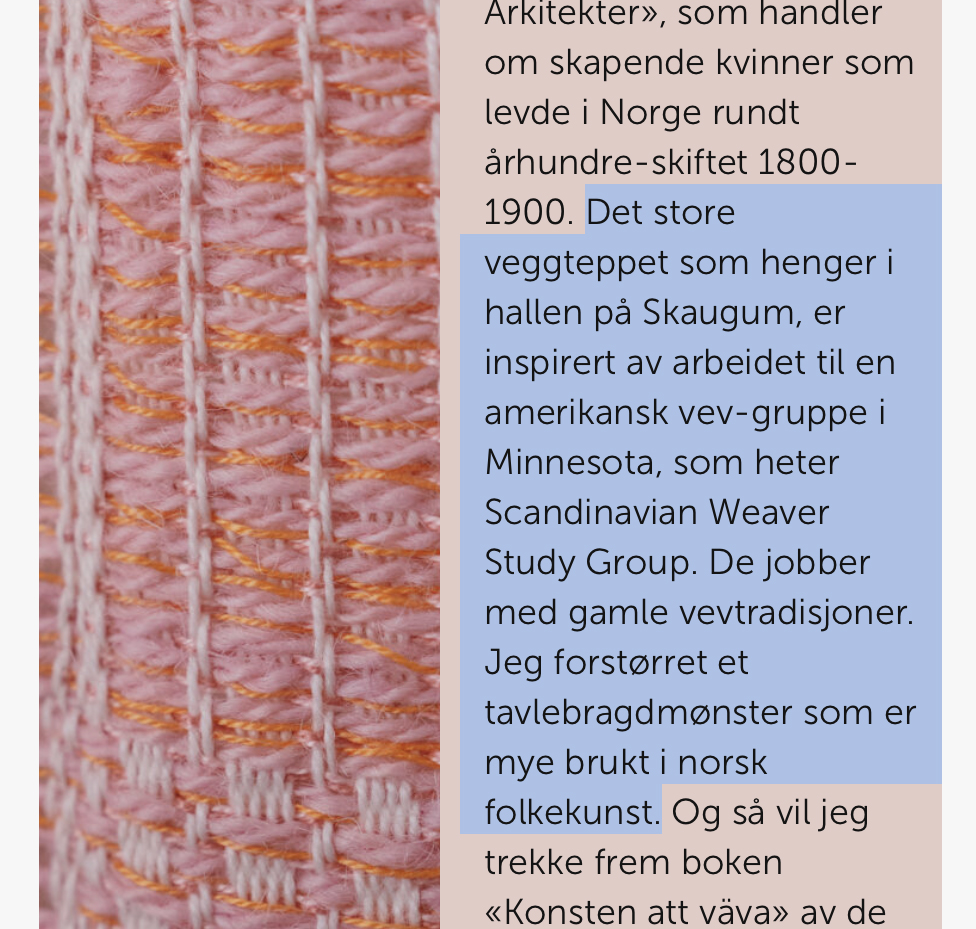
The weaving hangs at the entrance to Skaugum. It is inspired by the traditional weaving technique tavlebragd [monk’s belt]. Photo: Tom Gustavsen
Near the bottom of the article was a section called “Mette-Marit on Inspiration.” And surprisingly, there was a shout-out to our Scandinavian Weavers Study Group!
What an honor it is to know that the work we do with traditional Norwegian weaving techniques spreads back across the ocean.
“Karin Larsson: Let the Hand be Seen,” American Swedish Institute, June 8 through October 27, 2024
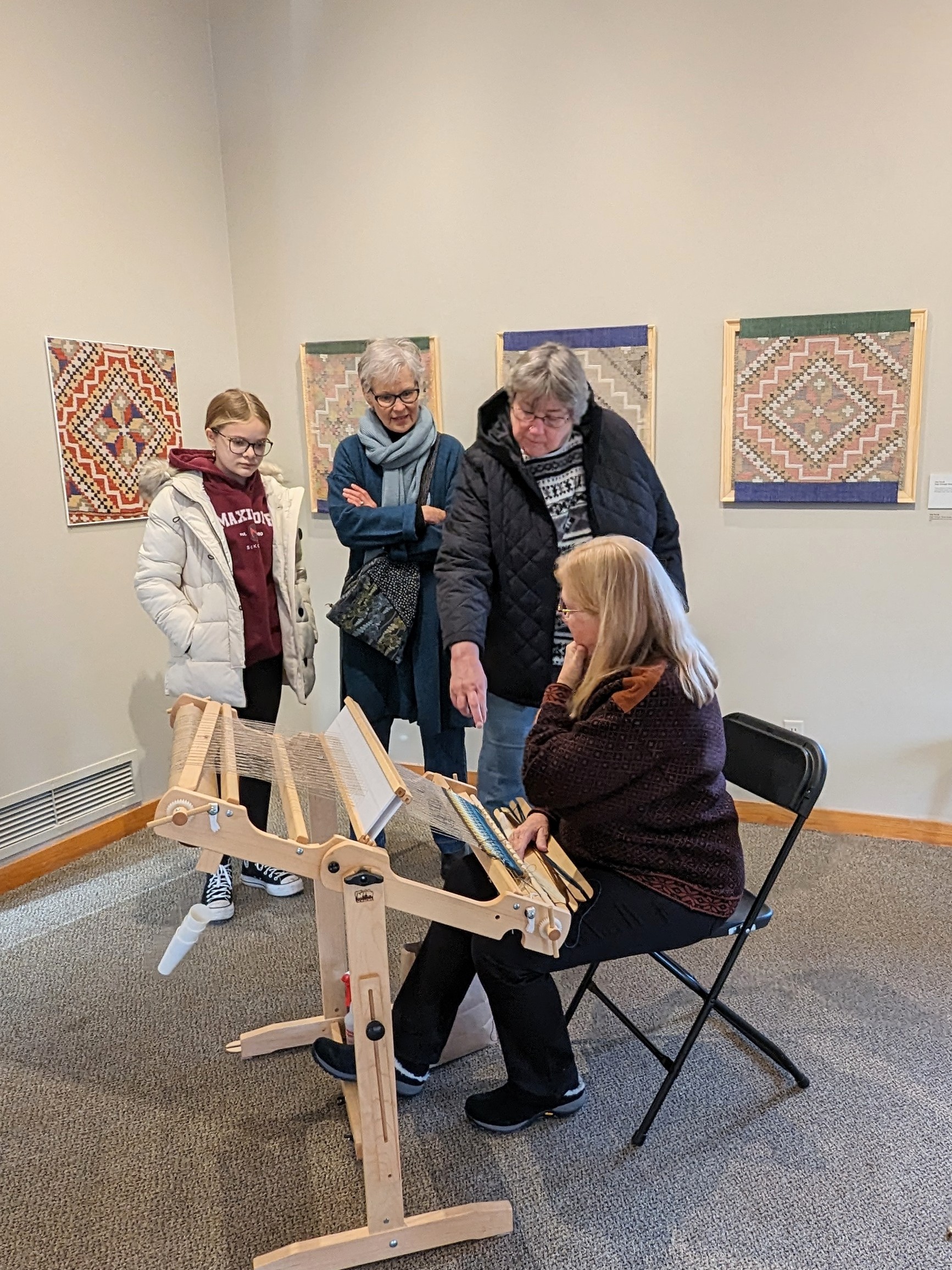
The highly-anticipated exhibit “Karin Larsson: Let the Hand be Seen” opened yesterday with great festivity at the American Swedish Institute (ASI), where it will be on display through October. Members of the Scandinavian Weavers and Rag Rug Weavers of the Weavers Guild of Minnesota were on hand to demonstrate the art of Swedish-style rag rug weaving and will continue on key dates through the run of the exhibit.
Swedish loom in the ballroom at the American Swedish Institute
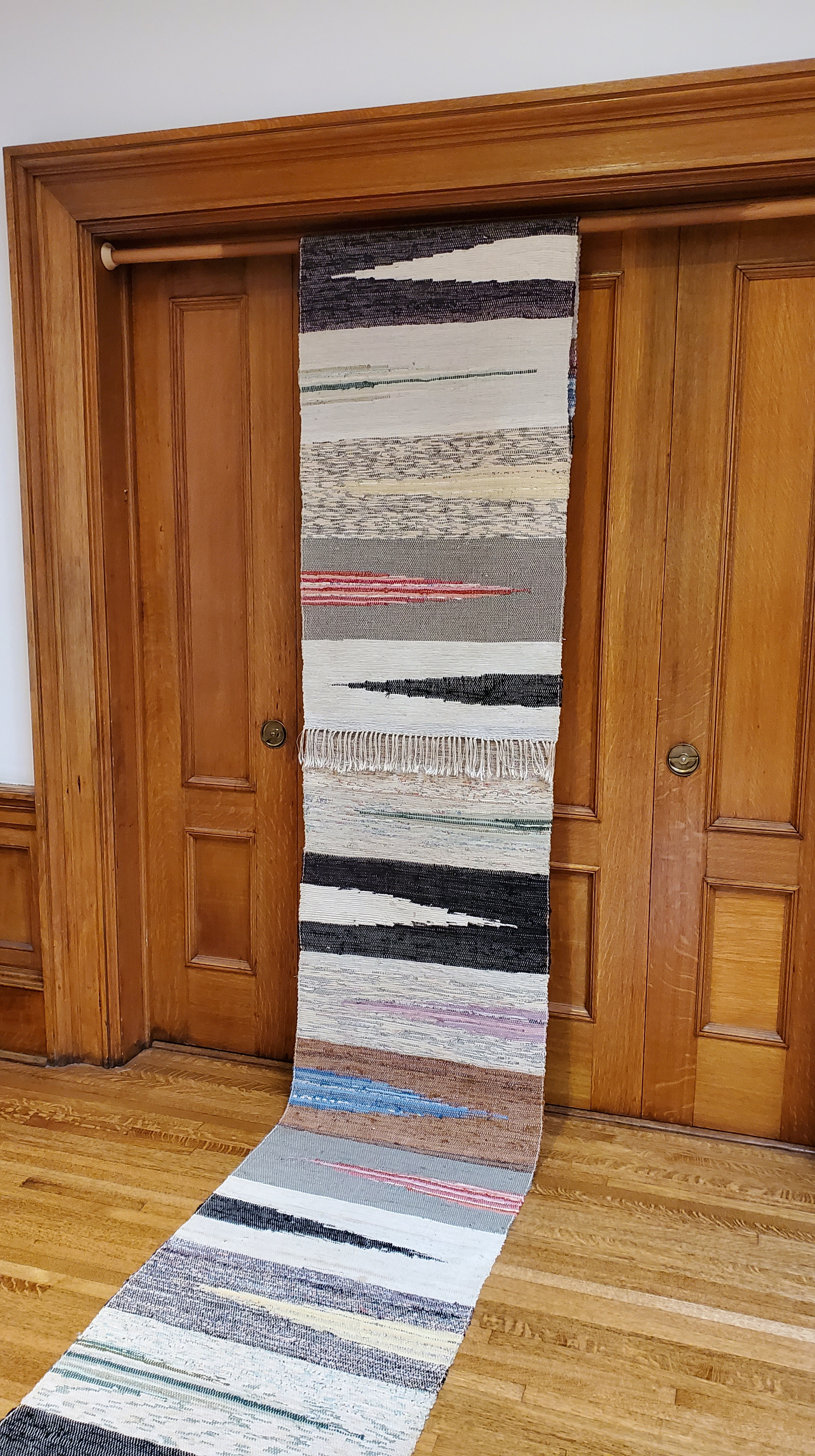
In addition to Karin Larsson, we took inspiration from a 14-meter rag rug in ASI’s permanent collection. It was woven by Maria Jonsson in the province of Värmland, Sweden and donated to ASI in the 1950s.
Maria Jonsson’s masterful rug
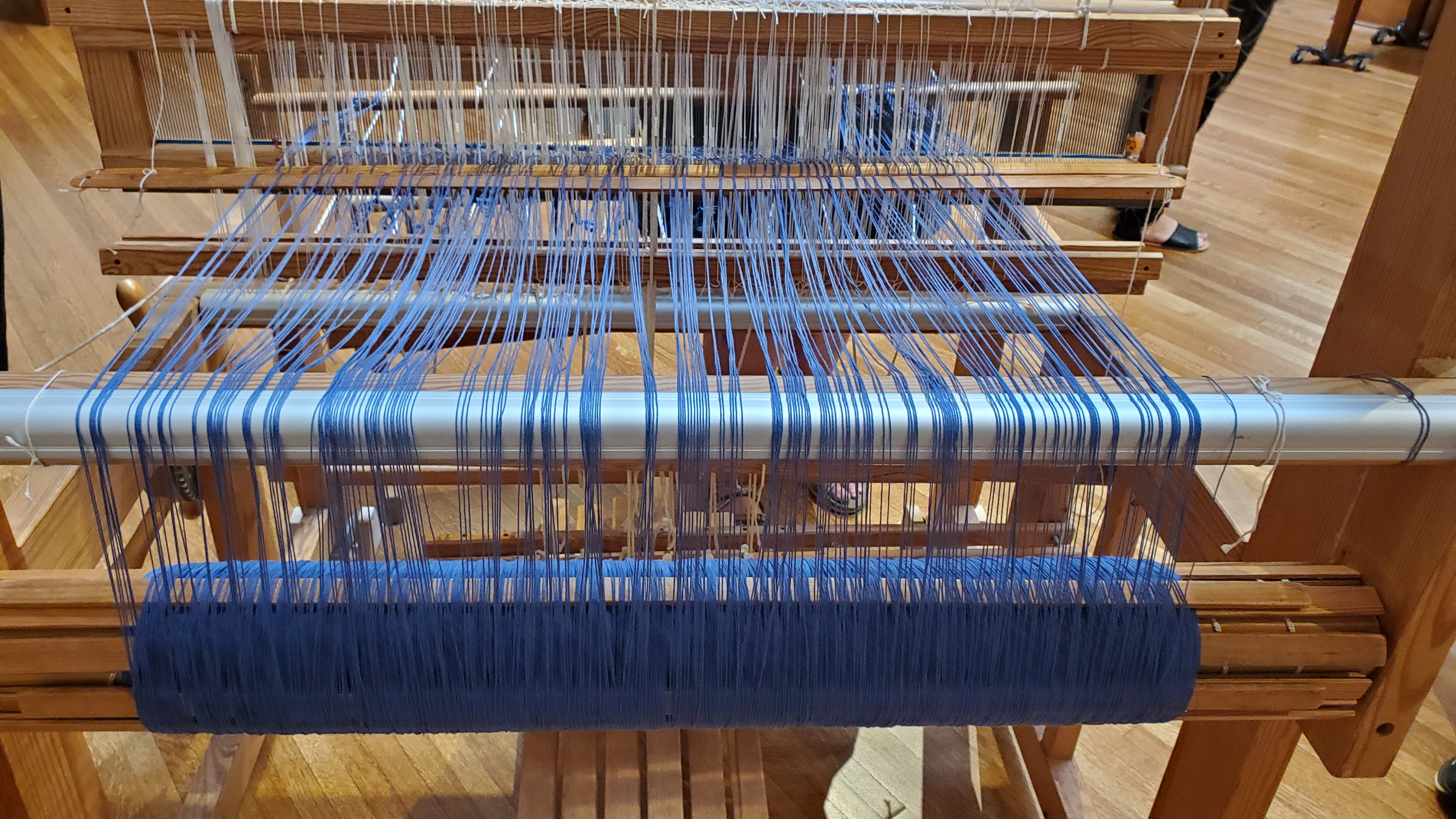
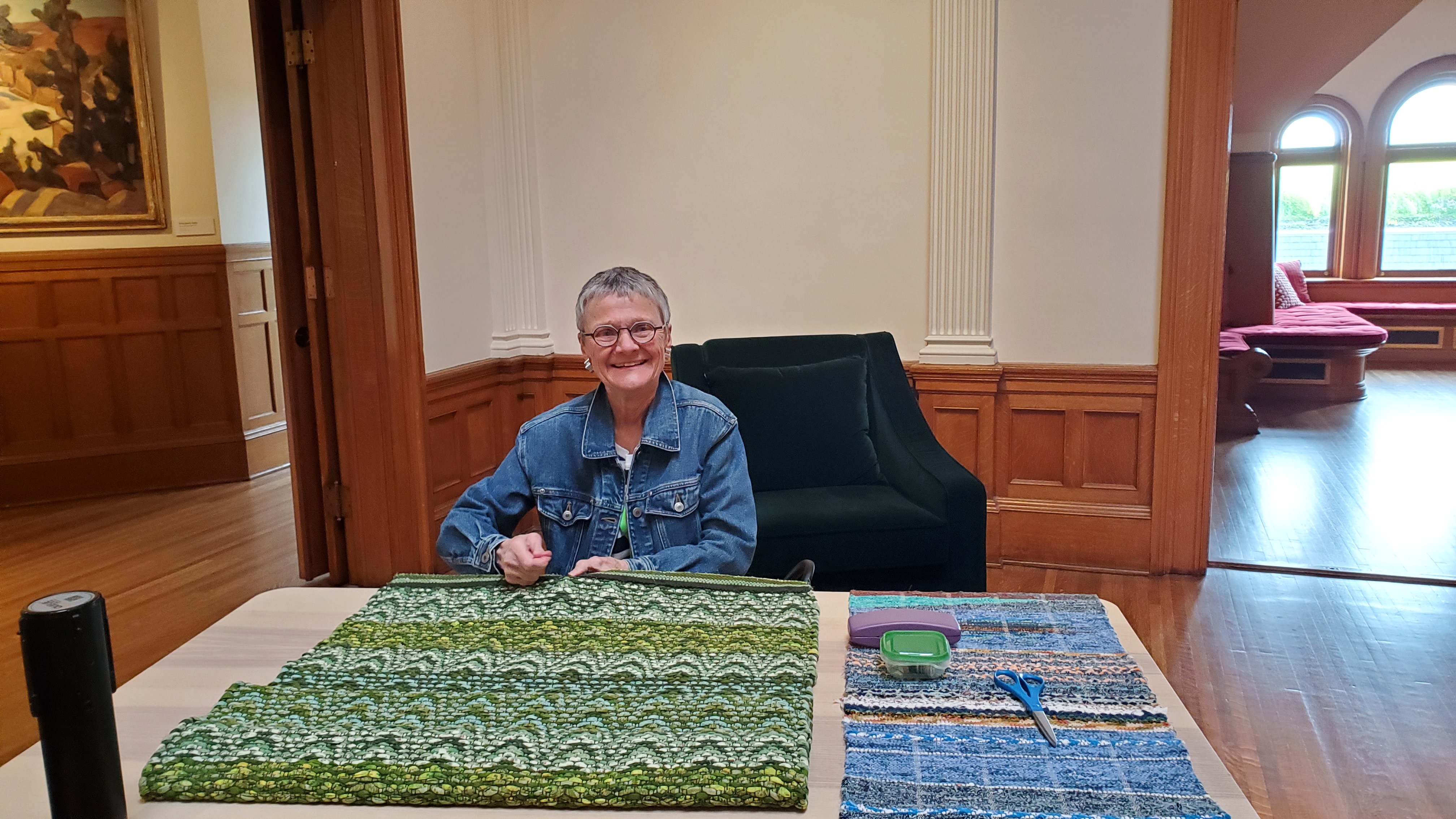
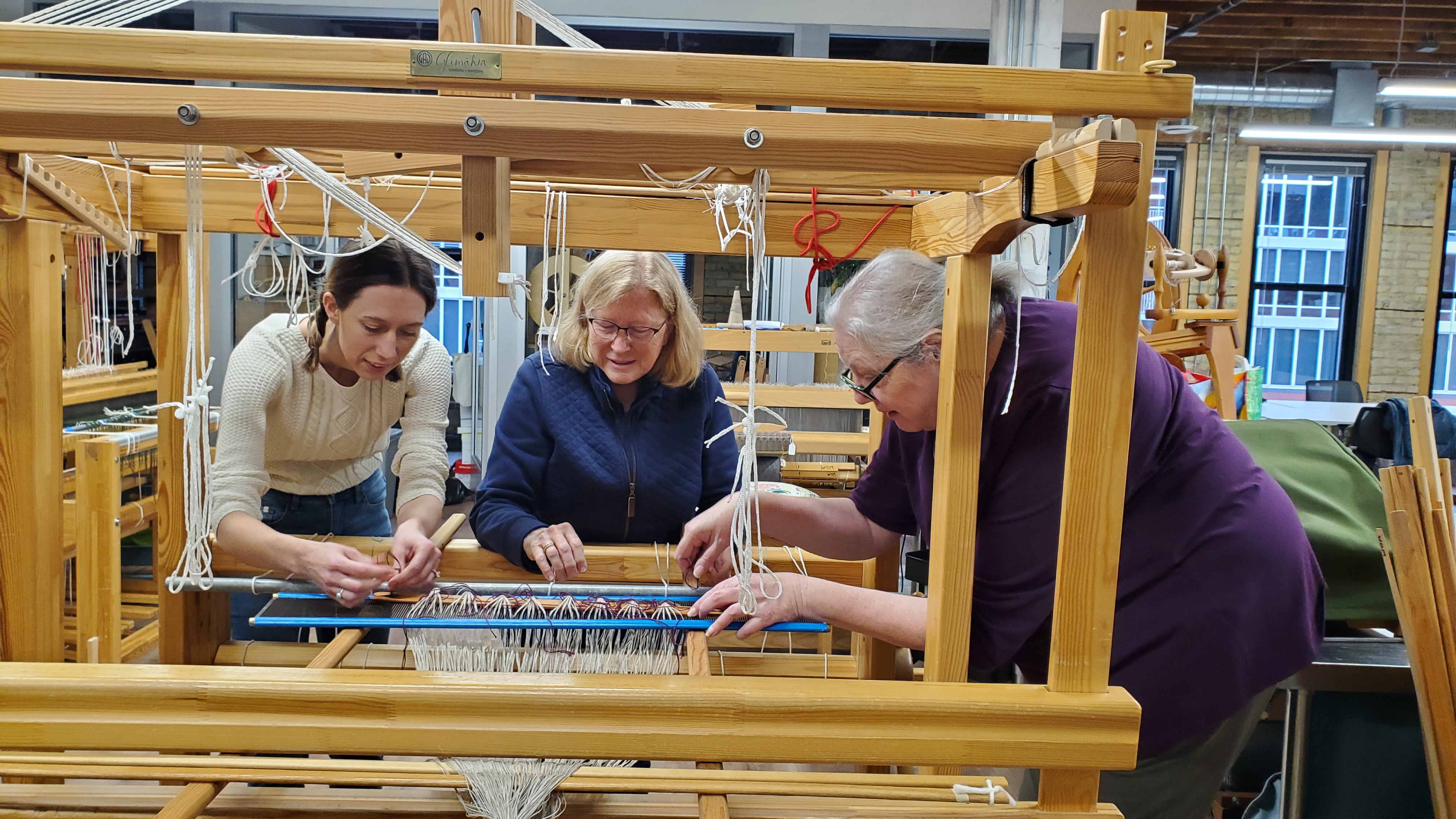
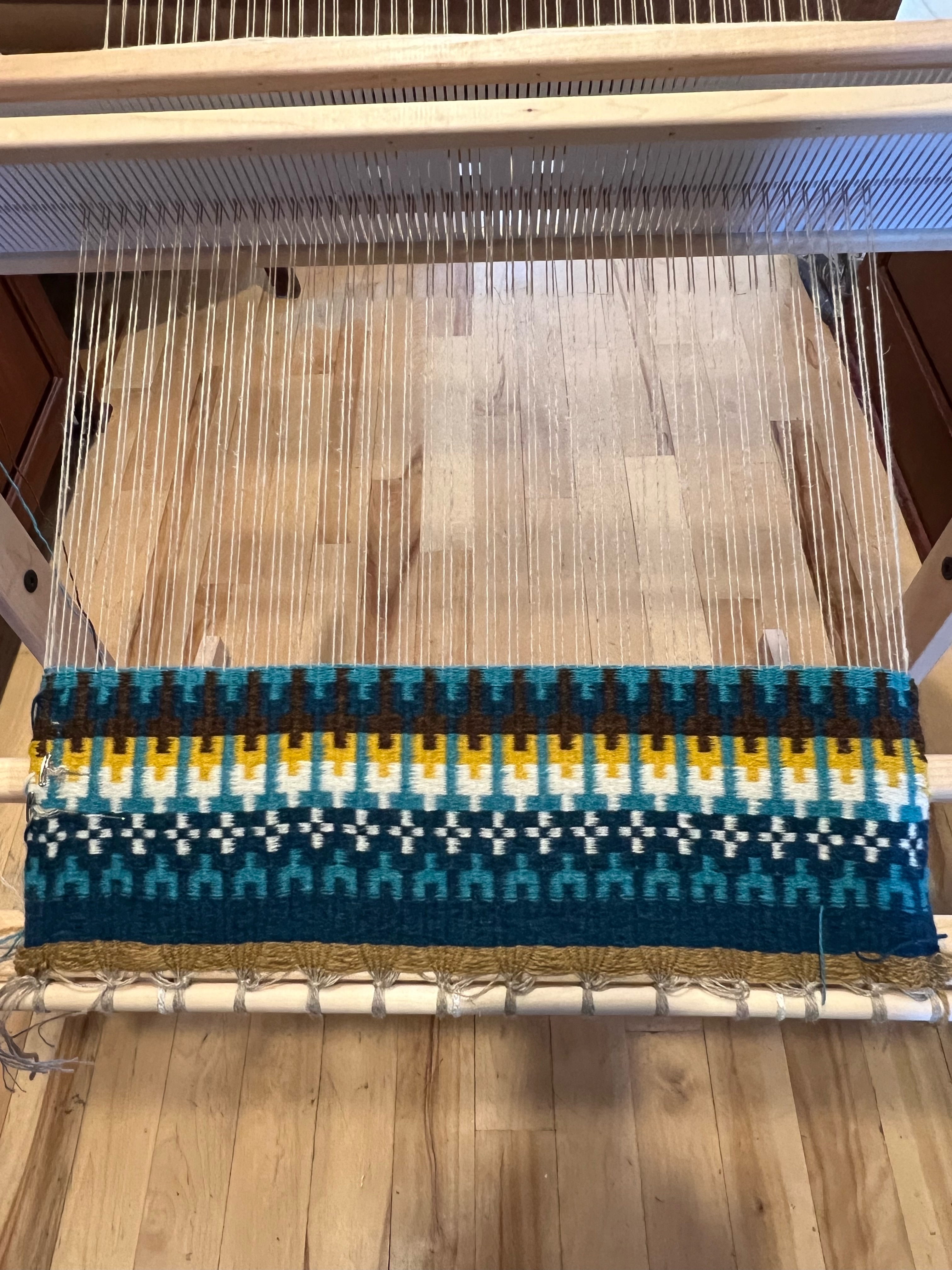
Judy Larson, coordinator of the Rag Rug Group, warped a vintage Glimakra loom in “Swedish blue” and designed our first rug to feature a wedge pattern like the ones in Jonsson’s rug. (Thanks to Patty Johnson of Color Crossing for lending her loom.)
Loom warped in cotton seine twineWedge weave in blue fabric strips
Besides weaving at the loom, volunteers demonstrated the entire process of rag-rug weaving, from preparing fabric to finishing techniques. Finished rugs are also on display.
Cotton fabric strips prepped for weavingNancy hand-finishing one of her beautiful rugs
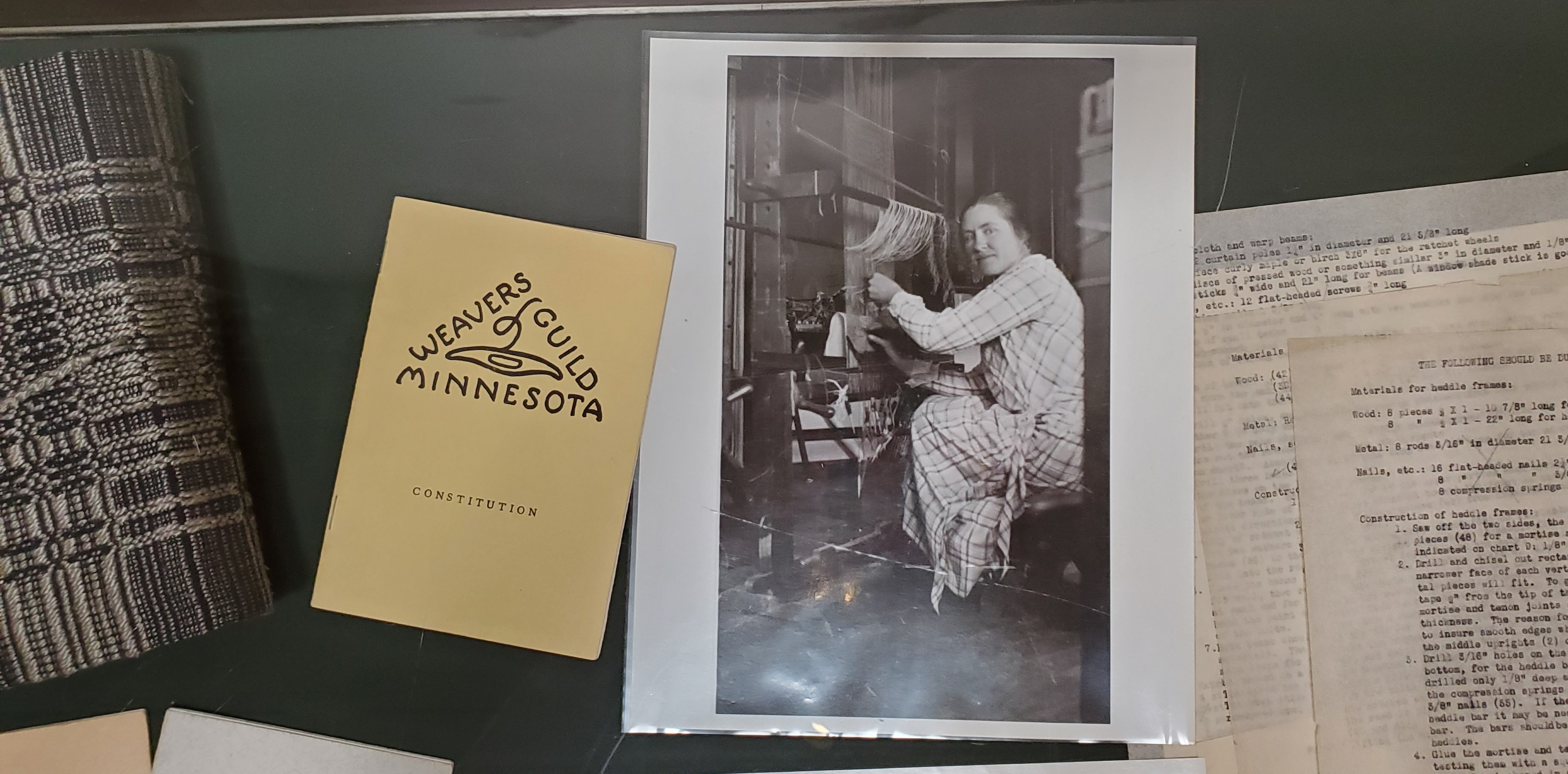
The collections staff at ASI has also put together a display about Hilma Berglund, one of the founders of the Weavers Guild of Minnesota.
Display features photos, examples of Hilma’s weaving, and documents, including the constitution of the Weavers Guild
Weaving demonstrations will be held on the following Thursday evenings from 5:00 to 8:00 PM: June 13, and 27, July 11 and 25, August 8 and 22, September 5 and 26, October 10 and 24. Note: Admission to the museum will be free after 3:00 PM.
In addition, demonstrations will be held at ASI’s Midsommar Celebration, Saturday, June 15 from 10:00 AM to 4:00 PM and Cocktails at the Castle, Saturday, September 14, from 6:00 PM to 9:00 PM. Note: These are ticketed events, so admission is required.
A special thank-you to the staff of the Weavers Guild of Minnesota and the American Swedish Institute for coordinating this volunteer program. Stay tuned to the blog for more articles on this ground-breaking exhibit!
For more information, please visit the ASI website:
Becketwood is a senior housing cooperative in Minneapolis, located in the Longfellow neighborhood on a beautiful bluff overlooking the Mississippi River. Becketwood has an active fine arts committee, including several weavers. The committee invited the Scandinavian Weavers to present an exhibit in their gallery space.
Scandinavian weavings at Becketwood
Our goal was to present a wide variety of traditional Scandinavian techniques. Since we were expecting our usual harsh Minnesota winter, we named the exhibit “Deep Winter Needs the Colors of Scandinavia.” Alas, it has been unseasonably warm with almost no snow. Nevertheless, the bright colors of the weavings are a welcome sight.
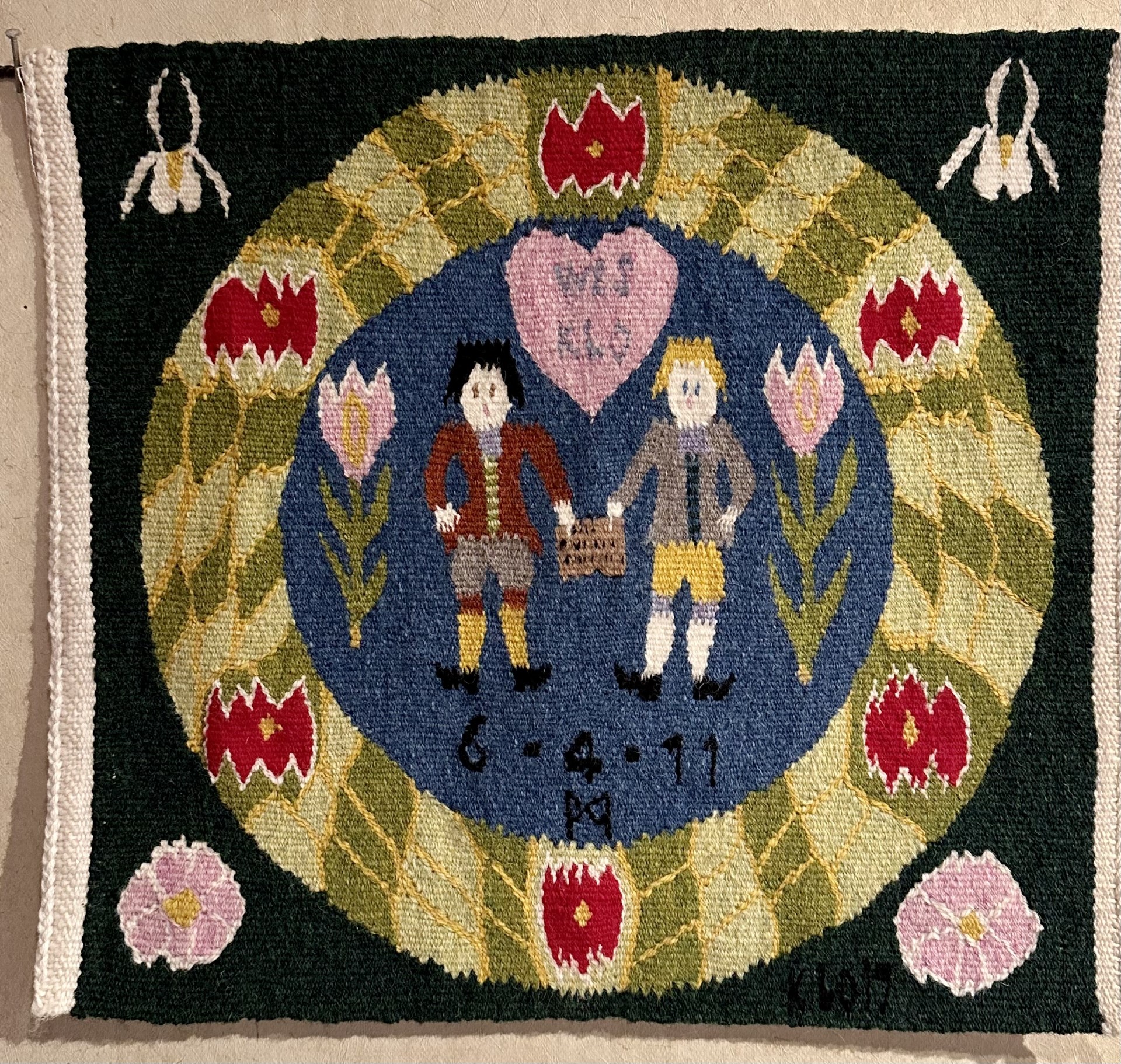
Kevin Olsen, who specializes in Scandinavian tapestry techniques, wove a wreath pattern called Betrothal, traditionally woven to celebrate an engagement. “Since my husband and I had already been married for six years when I wove the tapestry,” Kevin explains, “I called mine Anniversary instead. I included irises and peonies, which were our wedding flowers, while the tulips are a traditional motif.” The six red roses stand for the six years Kevin and his husband had been married. In the spirit of betrothal tapestries, Kevin included the date and an image of the marriage certificate.
Kevin Olsen’s Anniversary tapestry
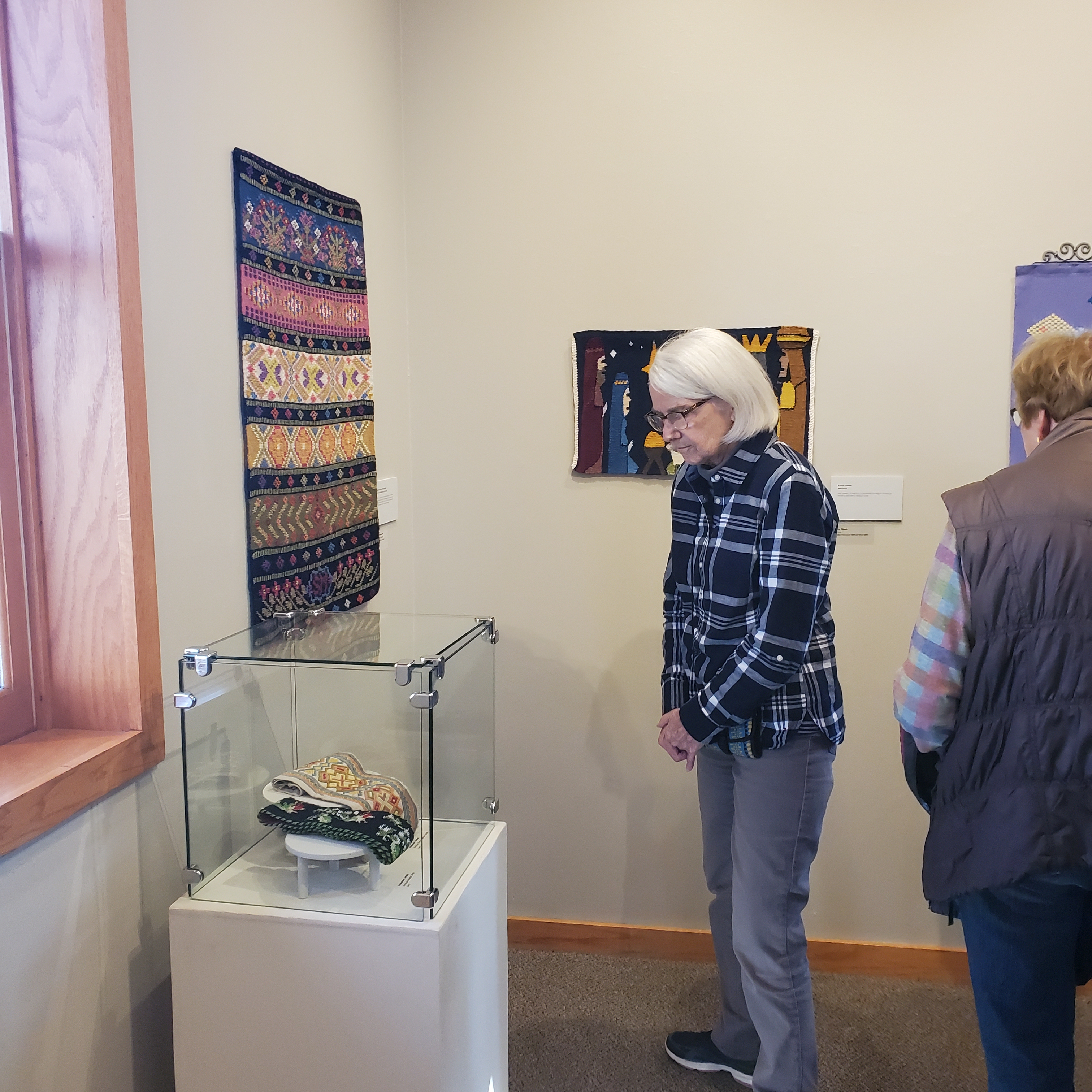
A vitrine showcases woven bands, a common element of Scandinavian folk costumes. As seen below right, Jane Connett used card-weaving to create a wide belt for a bunad (traditional costume). In this ancient technique, warp yarns run through holes in square cards. Each single card has four holes, one in each corner, and dozens of cards may be combined to create intricate patterns. After each weft shot, the cards are turned forward or backward to create the next element of the pattern.
Below center, Judy Larson wove a smaller band using a heddle or bandgrind. In this portable technique, the weaver raises and lowers the heddle to create the open sheds through which the weft passes. To weave designs, the warp strings can be picked up individually and a curved knife is used to beat in the weft yarn.
The charming tea cozy in the background was woven by Marie Nordland (1909-2000), the aunt of current Scandinavian Weavers member Nancy Ellison. Marie was a member of De Norske Vevere (the Norwegian Weavers), a group in the Weavers Guild of Minnesota that was a forerunner of the Scandinavian Weavers Study Group. She used a variety of techniques in her tea cozy, including krokbragd, danskbrogd, and rya.
Back row, left to right: Tea Cozy by Marie Nordland, Heddle Band by Judy Larson, and Bunad Belt by Janet Connett. Foreground: Sami-Influenced Band by Sharon Moe Marquardt.
Sharon Moe Marquardt wove the Sami-style band in the foreground using a simple tube loom. She added miniature Sami boots that she purchased at the husflidlag (handcraft association) in Manndalen, a Sami community on Kåfjord, east of Trømso in Norway, where she learned the technique.
Close-up of Sharon Moe Marquardt’s Sami-style band, including miniature boots of reindeer leather.
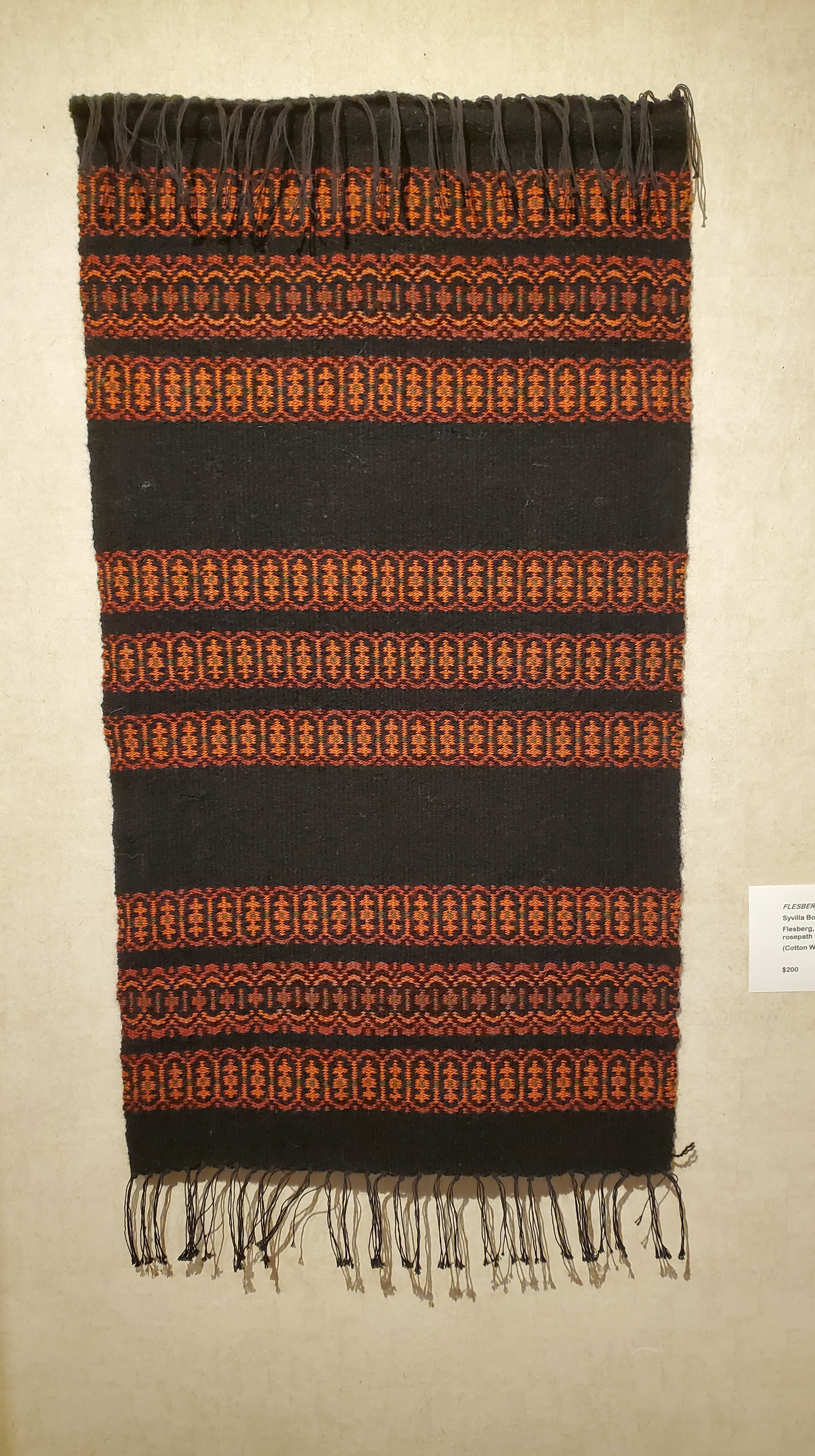
Syvilla Bolson (1928-2011) wove the wall hanging below in Flesberg technique, a style of three-shaft bound rosepath from the Flesberg region in Norway. Syvilla was a beloved member of the Scandinavian Weavers for many years. (Learn more about the flesberg technique in the November, 2020, issue of the NorwegianTextileLetter.)
Flesberg technique woven by Syvilla Bolson
Jan Mostrom wove the rutevev wall hanging below, evocatively named “Old Soul.” Rutevev, or square-weave, is a geometric weaving technique using single or double interlock joins.
Ann Haushild, a Becketwood resident and long-time study group member, wove this colorful hanging in Vestfold technique, named after the Vestfold region in Norway. It is an inlay technique, in which weft yarn is laid in to create the designs. (There is more on this technique in the February, 2020, issue of the Norwegian Textile Letter.)
Vestfold wall hanging by Ann Haushild
Last year, the Scandinavian Weavers set up a group warp to weave in telemarksteppe technique. (See previous blog posts for more photos of this technique.) Kala Exworthy wove the beautiful version below in colors inspired by the natural world.
Telemarksteppe wall hanging by Kala Exworthy
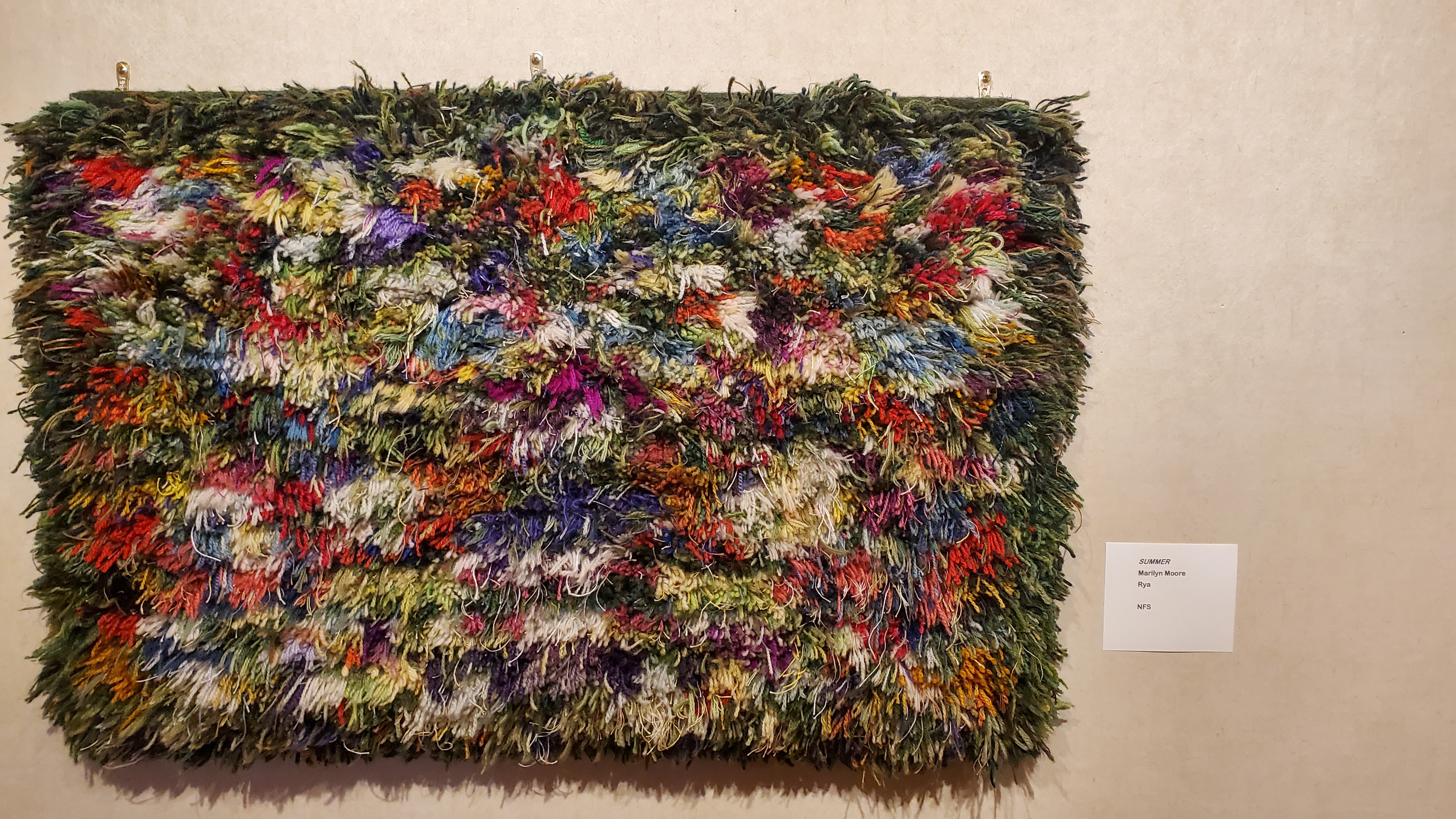
Rya is a traditional pile technique. Marilyn Moore’s lush version below was inspired by the colors in her expansive flower garden.
Rya wall hanging by Marilyn Moore
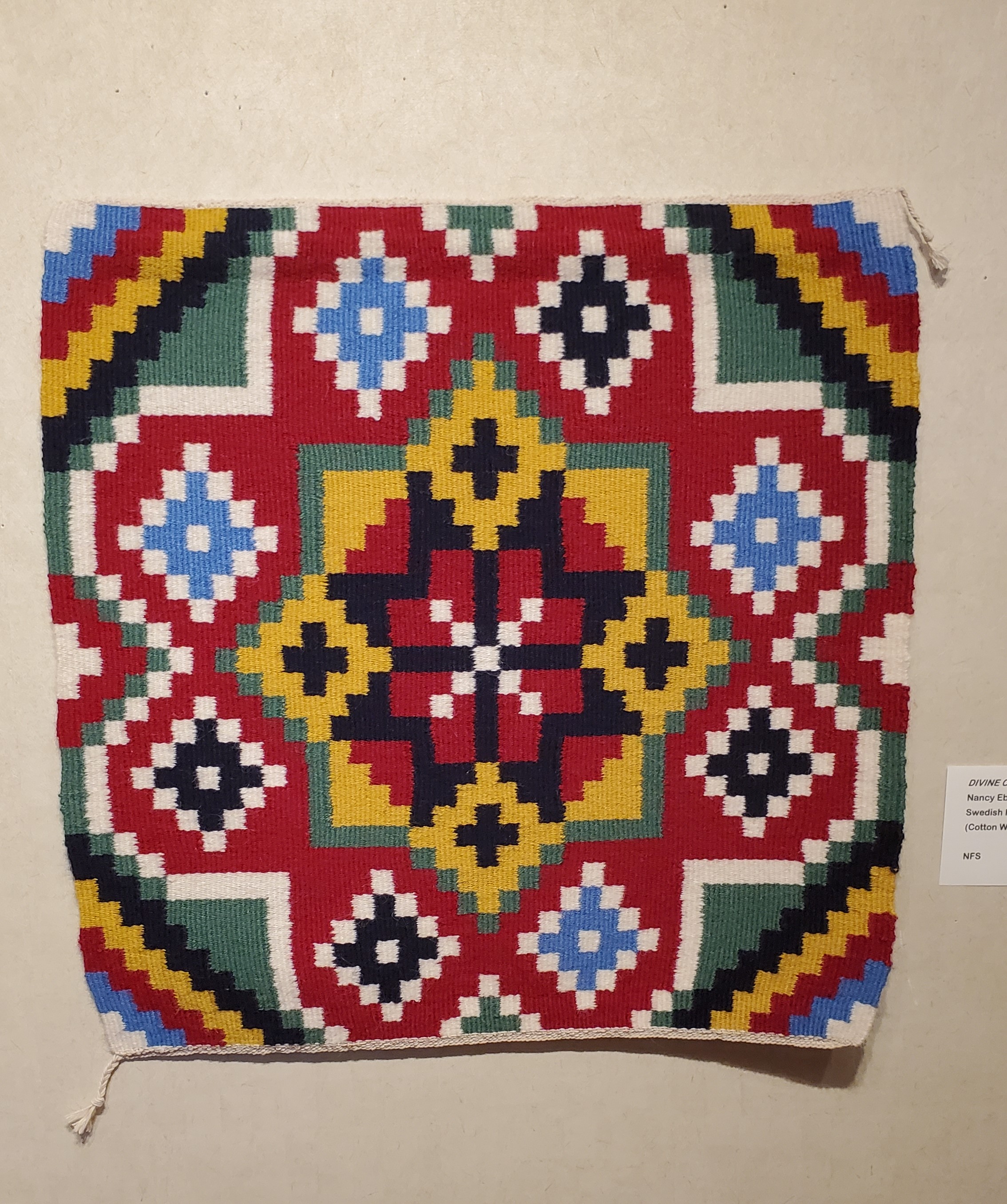
Nancy Ebner wove a rutevev wall hanging called “Divine Order.” The original pattern drawing was produced in the 1930s by Linnea Kullman (Johansson), a student at Johanna Brunsson’s Weaving School in Stockholm, Sweden. Nancy discovered the pattern in the historical collections at the Nordisk Museum (via digitalmuseum.se).
“Divine Order” by Nancy Ebner
Brenda Gauvin-Chadwick wove the pillow below, called “Joy Exploding,” in rosepath technique. “The pillow was woven with Fåro yarn that I purchased in Sweden many years ago,” she writes. “I carried it all over Scandinavia for weeks in my suitcase. I bought it after skiing the Swedish Vasaloppet. Two weeks later in Norway I skied the Birkebeiner race. The colors represent the forests, the beautiful sunshine and my heart exploding with joy as I skied along!”
Brenda Gauvin-Chadwick’s “Joy Exploding”Detail of “Joy Exploding”
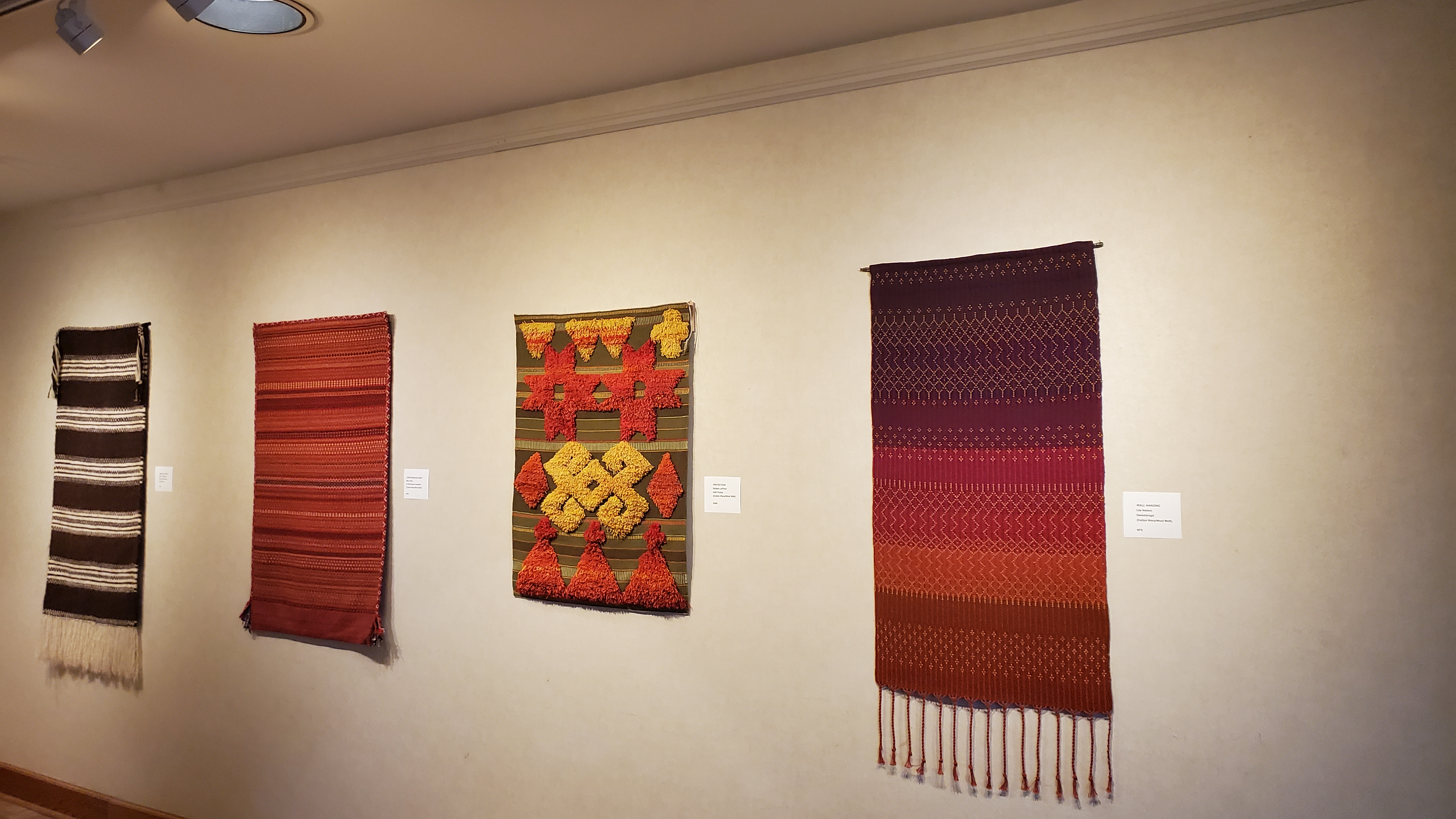
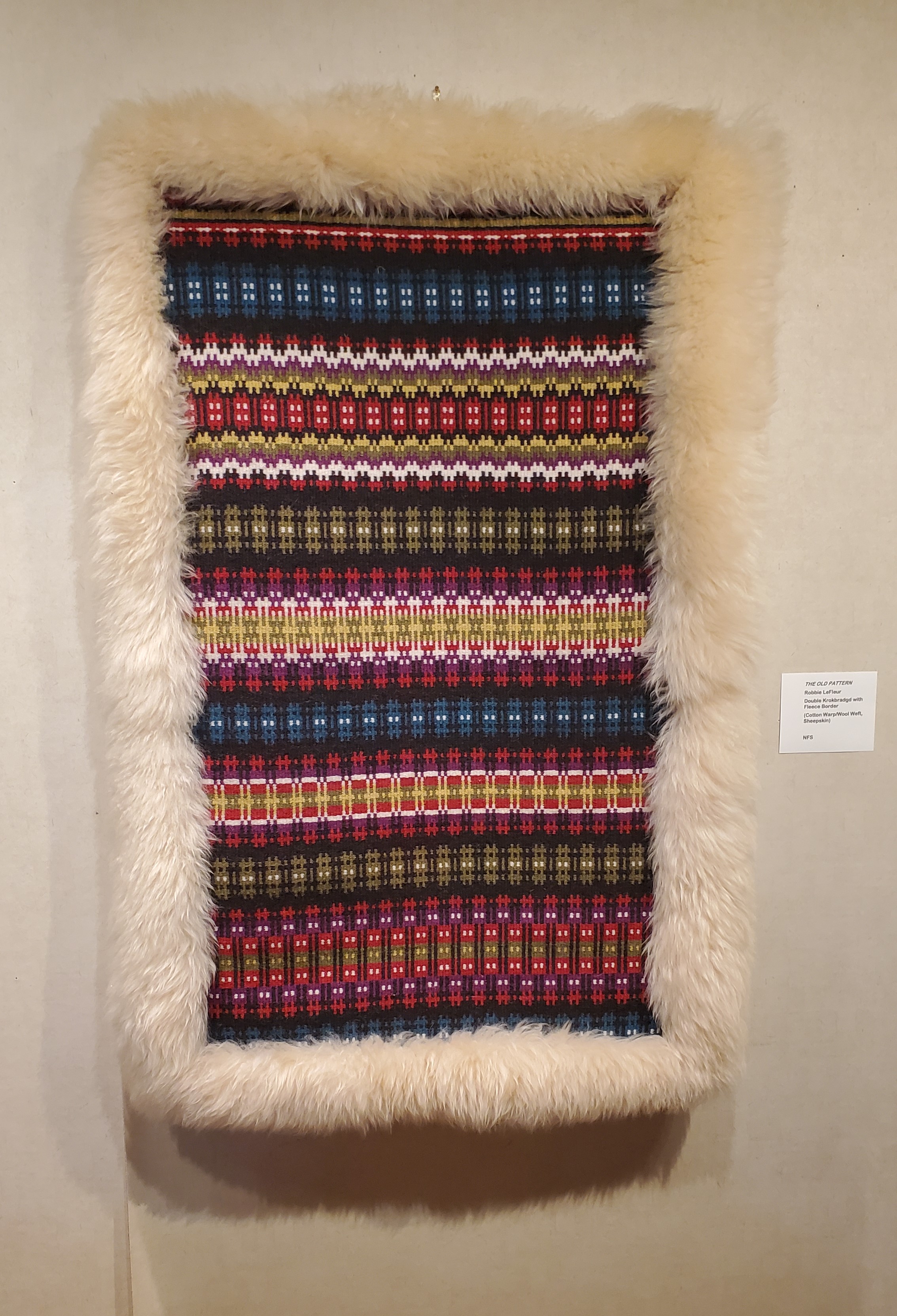
Robbie LaFleur’s weaving below is in double krokbragd technique. Called “The Old Pattern” it includes a sheepskin backing and fringe. (Read the full article from the Norwegian Textile Letter on the old pattern.)
“The Old Pattern” by Robbie LaFleurDetail of “The Old Pattern”
Stay tuned for more blog posts featuring photos from the exhibit, which will be on view through April 4.
If you would like to visit the exhibit, please call the Becketwood front desk at (612) 722- 4077 prior to your visit to make sure the galleries are open for viewing.
The Scandinavian Weavers’ “Domestic to Decorative” exhibit included several heirloom textiles, which came with wonderful family stories. The heirlooms inspired members of our group to weave new versions of the same technique—in one case, to combine old and new in a single weaving—or to use their imaginations to create something new inspired by the past.
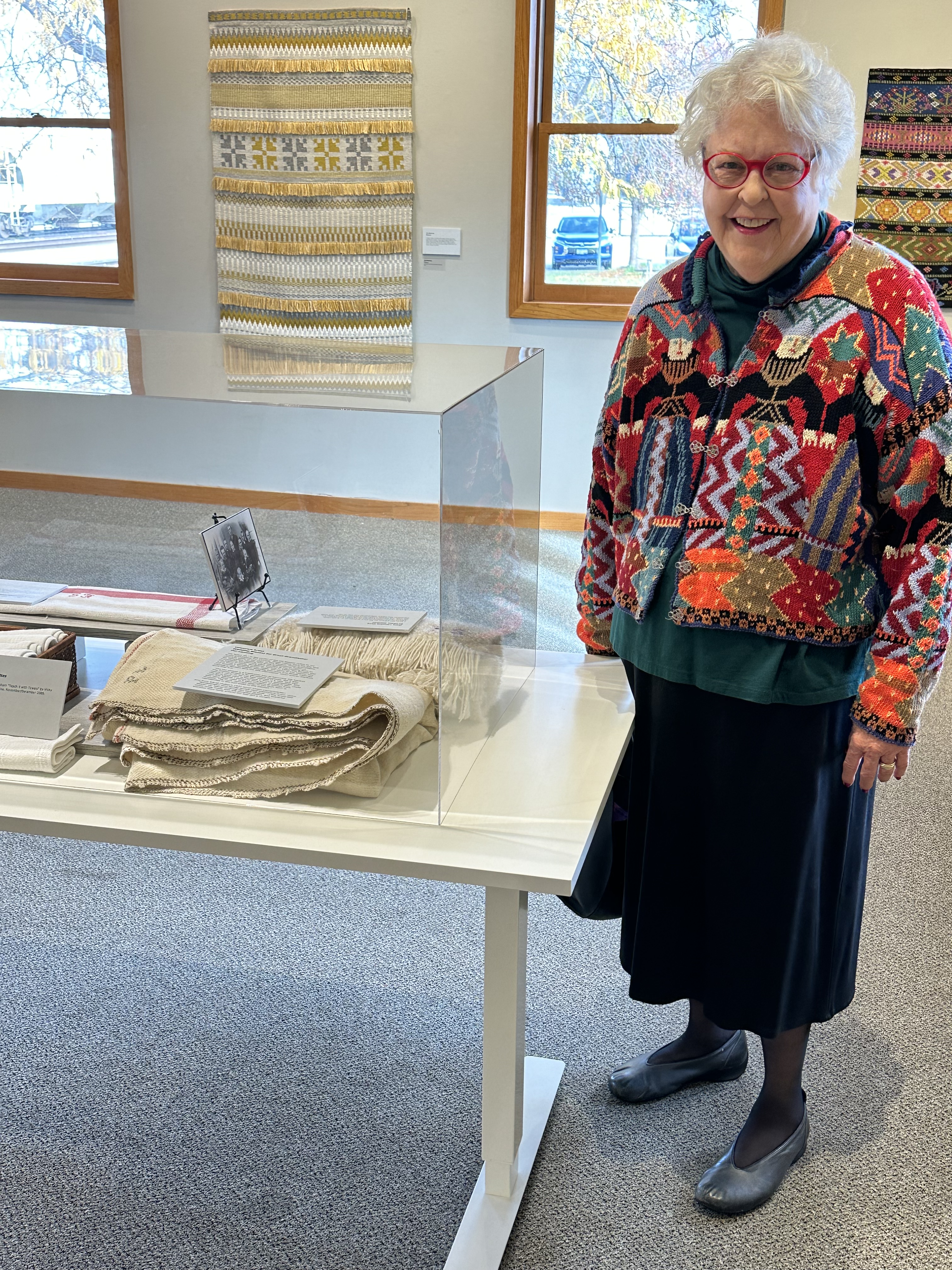
Weaver Mary Skoy next to the woolen blanket given at her great-grandparents’ wedding.
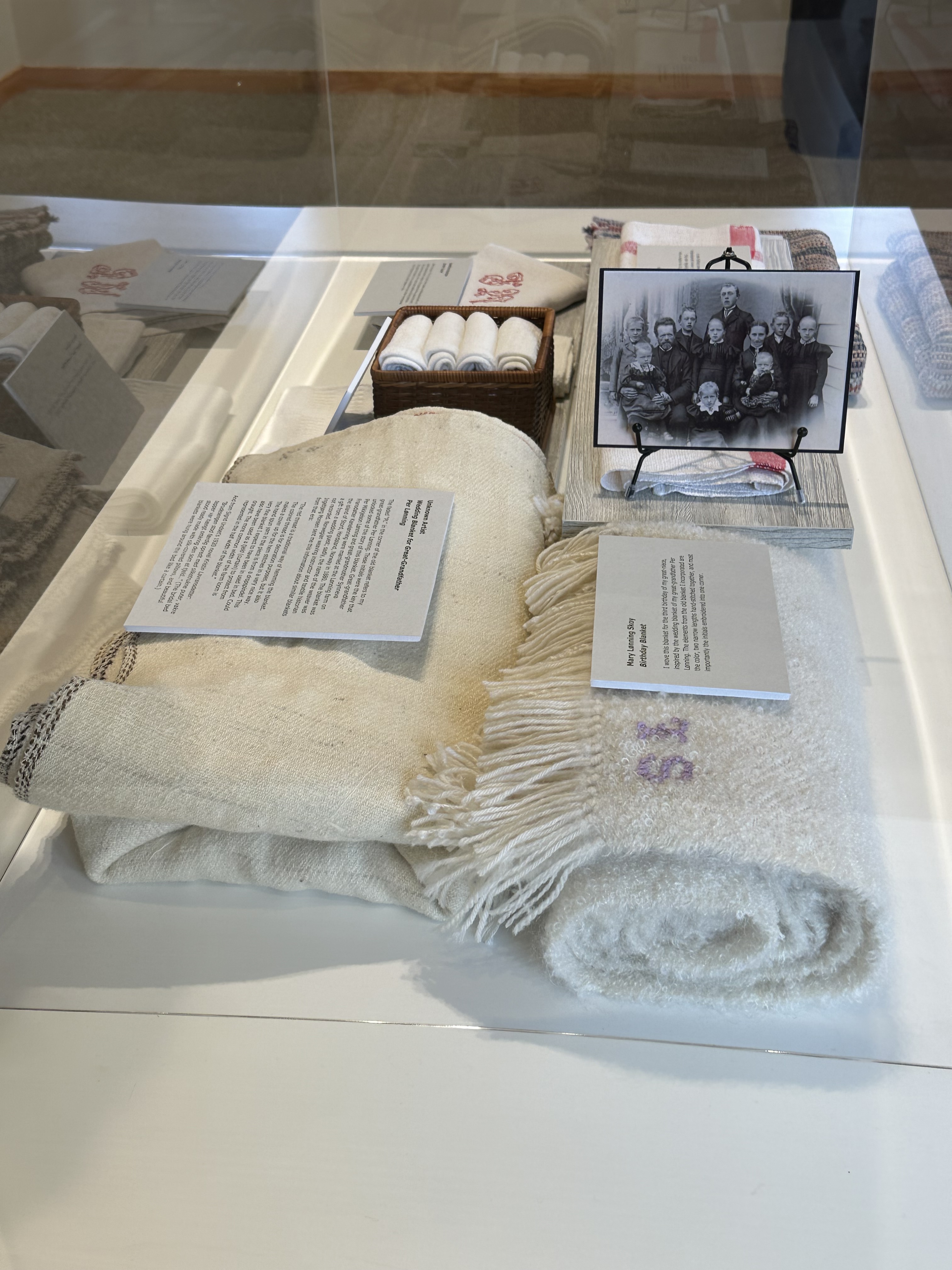
One of Mary Skoy’s most treasured family heirlooms is a simple woolen blanket. The blanket was a gift to Mary’s great-grandfather Per Mikkjelson Lønning and great-grandmother Synneva Fransdatter Kanelønning, who were married at the Lønning farm on the island of Stord, Hordaland, Norway in 1880. “The blanket was a gift from a wedding guest,” Mary explains. “The faded PL in the corner of the old blanket refers to Per Lønning. Sadly, the name of the weaver was not recorded.” Note: Mary always encourages those of us in the Scandinavian Weavers group to include our initials on everything we weave!
Per Lønning and Family
Mary researched the history of blankets from this era, consulting Norwegian weaving instructor and textile historian Ingebjørg Monsen. Ingebjørg sent the following information about similar blankets from that era: “The red thread is a traditional way of hemming the blanket. The colored thread is for decoration purposes, but it also makes a cover up for the hem stitches in a very nice way. The hand spun yarn in the piece is from a dropspindel. This very fine blanket I expect to have been in used in bed. Could also have been used as a tjeld (curtain) to protect from draught. The more common width of the farm loom is represented in the half width of the blanket.”
Inspired by the heirloom blanket, Mary wove a new blanket for the birthday of her great-niece. “The elements from the old blanket I incorporated are the color, two narrow lengths hand-stitched together, and most importantly the initials embroidered into one corner,” Mary says. The new blanket is also much softer, incorporating alpaca, mohair, silk, and wool—luxury fibers that would not have been available to her ancestors in 1880.
Original blanket on the left; Mary’s blanket on the right.Close-up showing theembroidered initials.Note the difference between the simple wool fibers in the original and the fluffier fibers on the new blanket.
Beth Detlie was also inspired by Norwegian textiles: “Vegteppe was a wedding gift from my husband’s aunt to us in 1978. She told us that the weaving was done by a distant relative of mine. (My mother’s ancestors immigrated to the United States from the Telemark region in Norway during the 1850s.)” Beth’s Telemark Reflection is an echo of this beloved weaving.
Original vegteppe on the far wall with Beth’s smaller version on the right. In the foreground is the special case holding other heirloom textiles.
Edi Thortensson donated a simple but treasured handtowel. “The towel was handwoven around 1950 by my mother-in-law, Ellen Svensson, for use in her home in Tröjemåla, near Ryd, Småland, Sweden,” Edi writes. Inspired by Ellen’s towel, Edi wove a paradhandduk, or display towel, meant to cover utility towels hanging near a washstand.
Edi Thorstensson and her parahandduk.
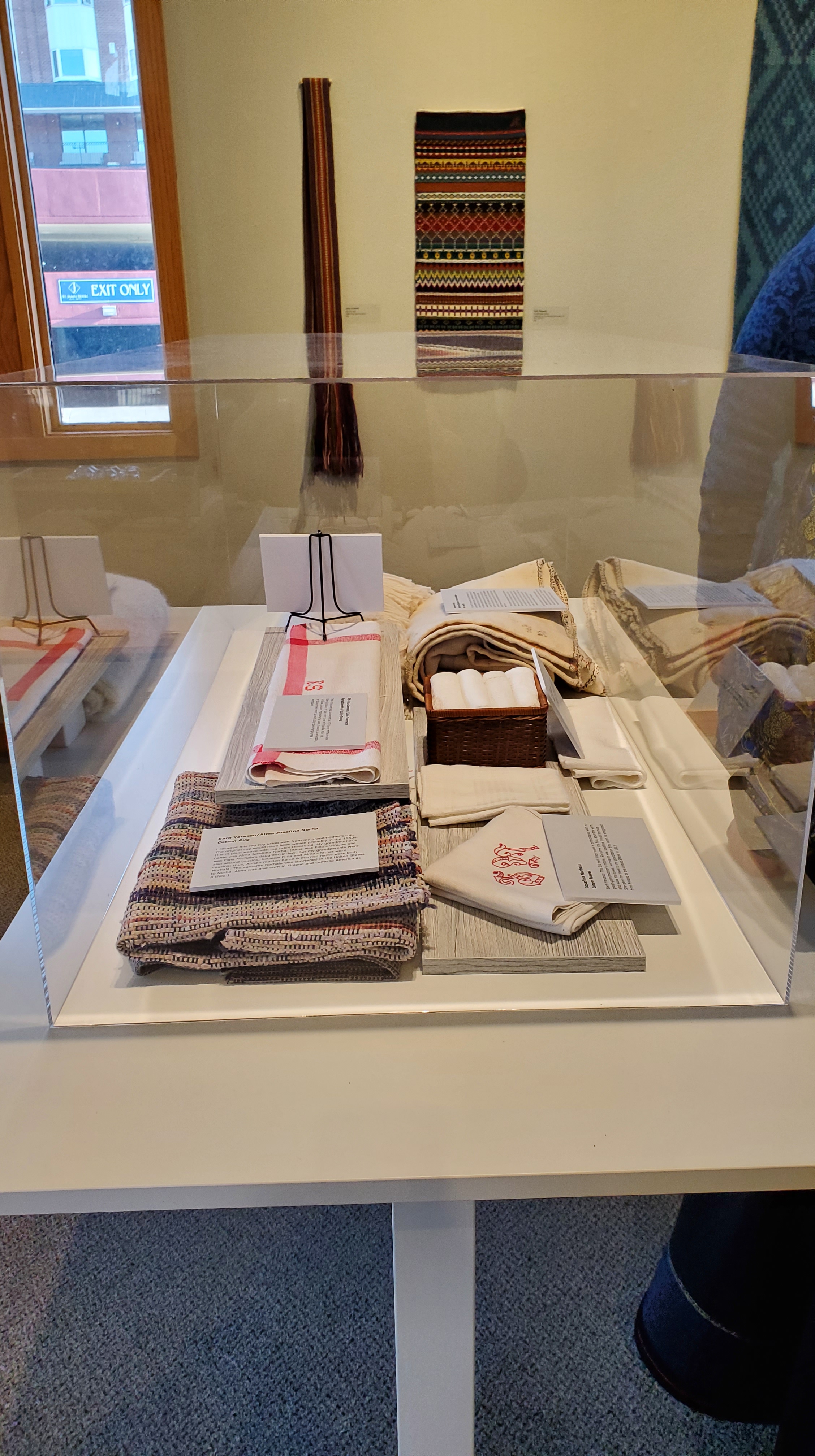
Barb Yarusso shared two Finnish heirloom textiles for the exhibit, including a 2/2 twill linen towel embroidered with her great-grandmother’s initials. Her great-grandmother’s name was Josefiina (Fiina) Norhala. “Josefiina grew the flax, spun the yarn, and wove the towel,” Barb writes. “She gave the towel to my grandfather Eino when he emigrated from Finland to the United States in 1913.”
On the far left is the red and white towel woven by Edi’s mother-in-law Ellen Swenson and embroidered with the initials ES. On the right is the white towel with initials embroidered in red by Barb’s great-grandmother Josefiina Norhala.
Barb also has a rug woven by Alma Norhala, Eino’s wife. Alma was also born in Finland and came to America as a child. The original rug was woven in the 1950s, in plain weave with log cabin threading. Barb carefully salvaged the cotton weft material and re-wove it into a new rug as her way of honoring Alma’s work.
Barb Yarusso proudly holds the rug she rewove using weft material from her grandmother Alma Norhala.
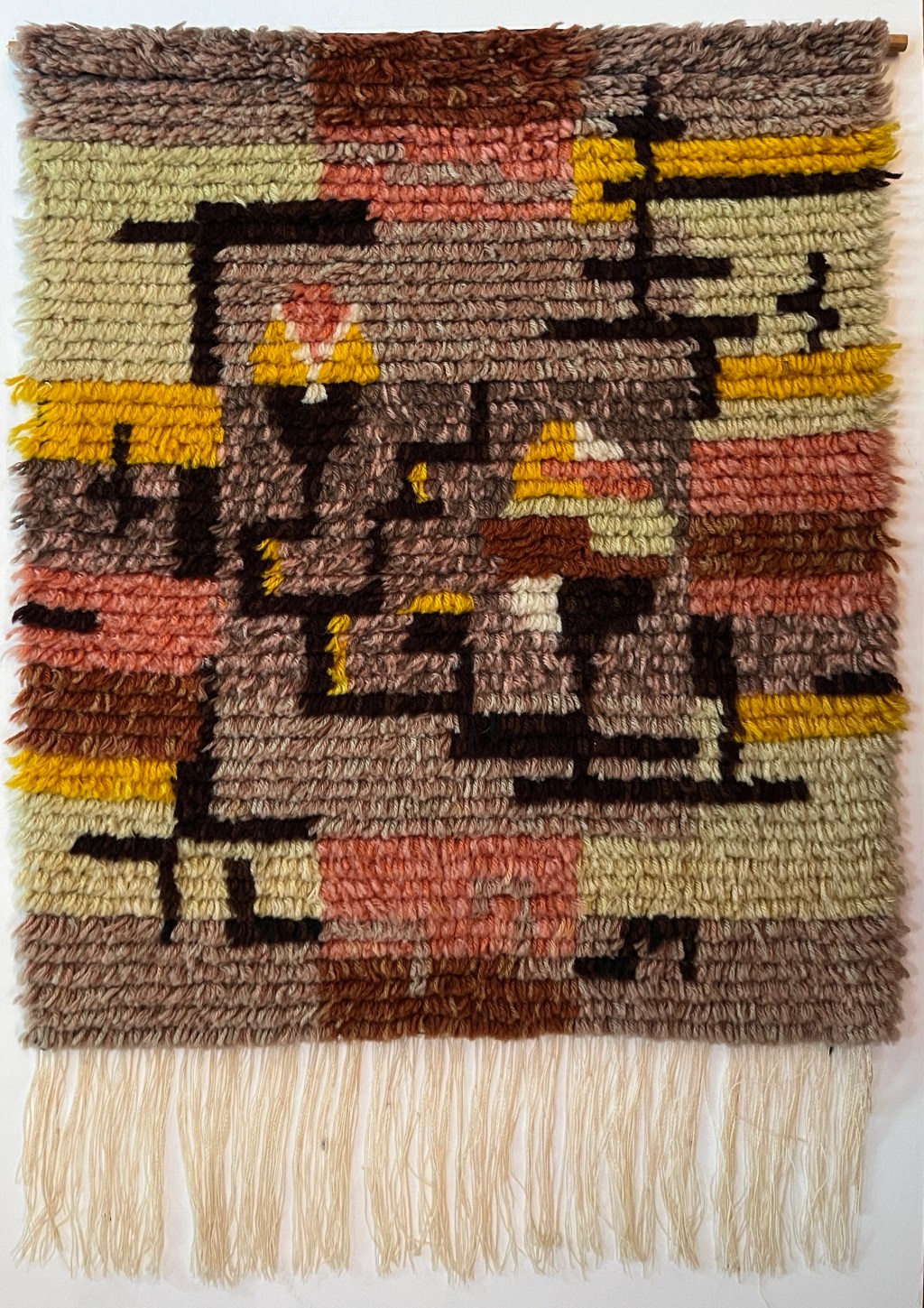
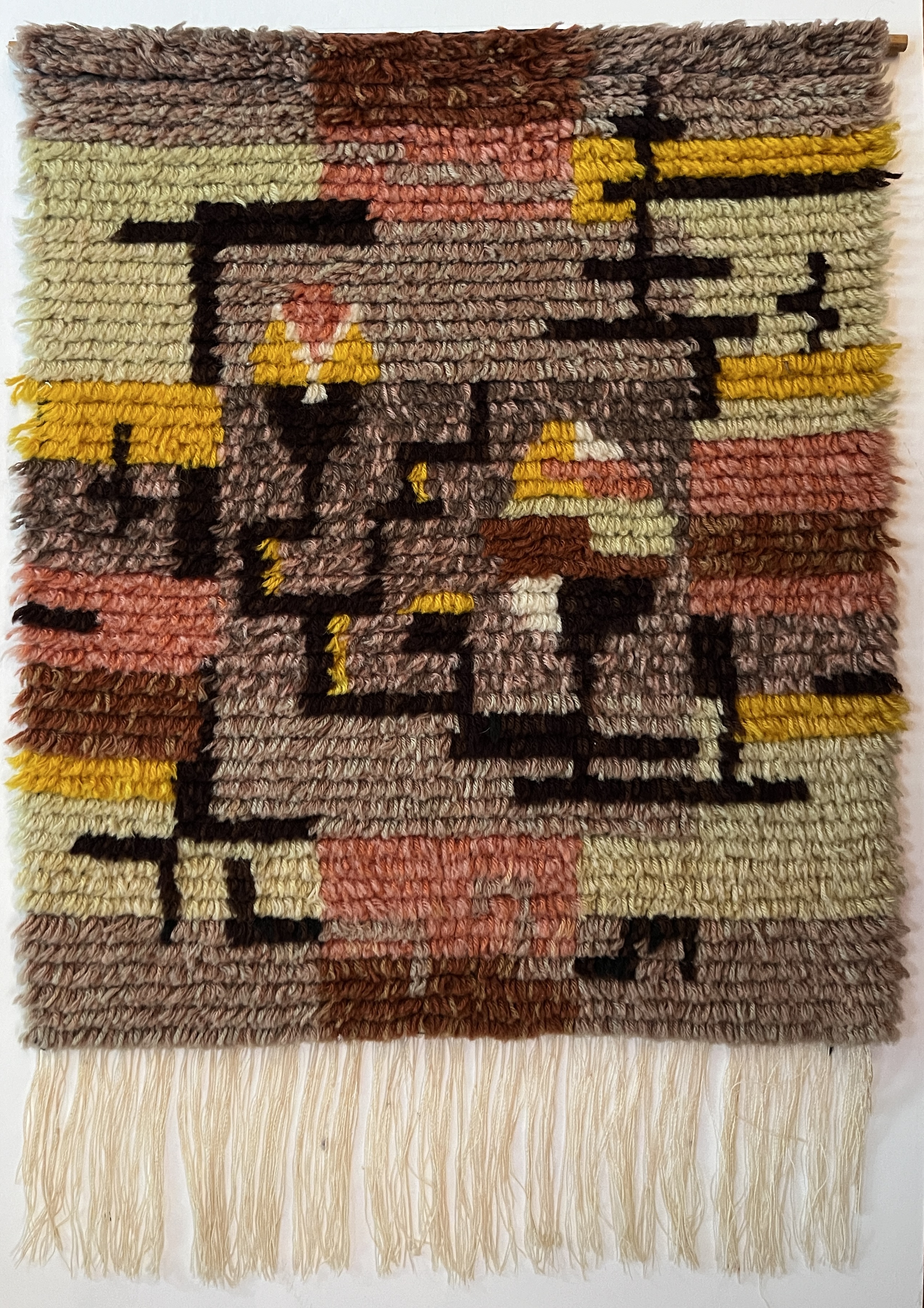
Peg Hansen was also inspired by Finnish weaving. Löytyi Karannut Lemmikki (A Runaway Pet Was Found) is a vintage (over 100 years old) Finnish Rya/Ryu wall hanging from the collection of Peg’s friend Susan Sutherlund. It belonged to Susan’s grandmother Lydia Ivonen. Unfortunately, the weaver is not known.
Löytyi Karannut Lemmikki (A Runaway Pet Was Found)
This piece served as Peg’s inspiration to learn more about the Rya/Ryu weaving technique used in Scandinavia.
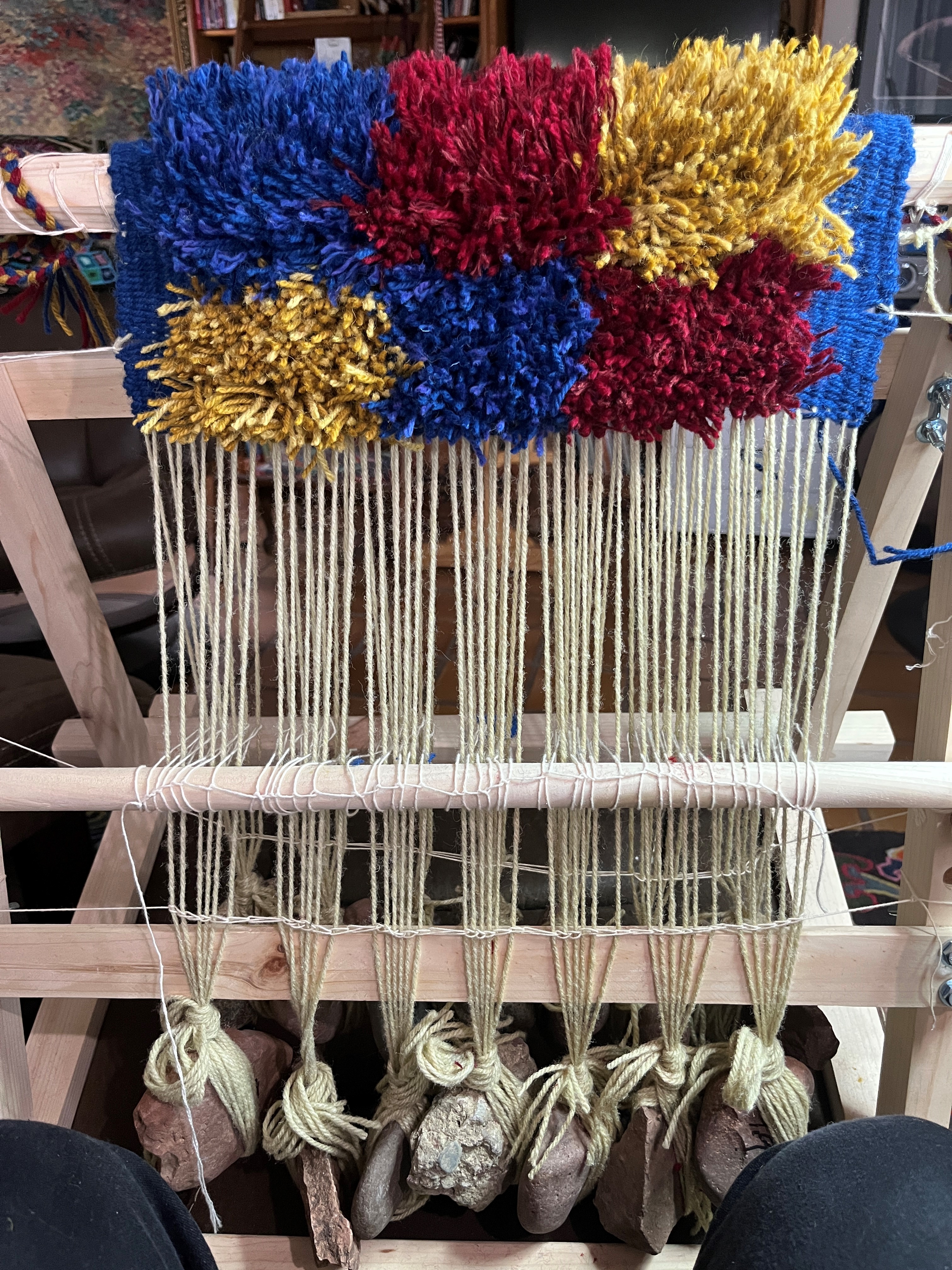
Peg’s rya weaving on her hand-builtwarp-weighted loom.
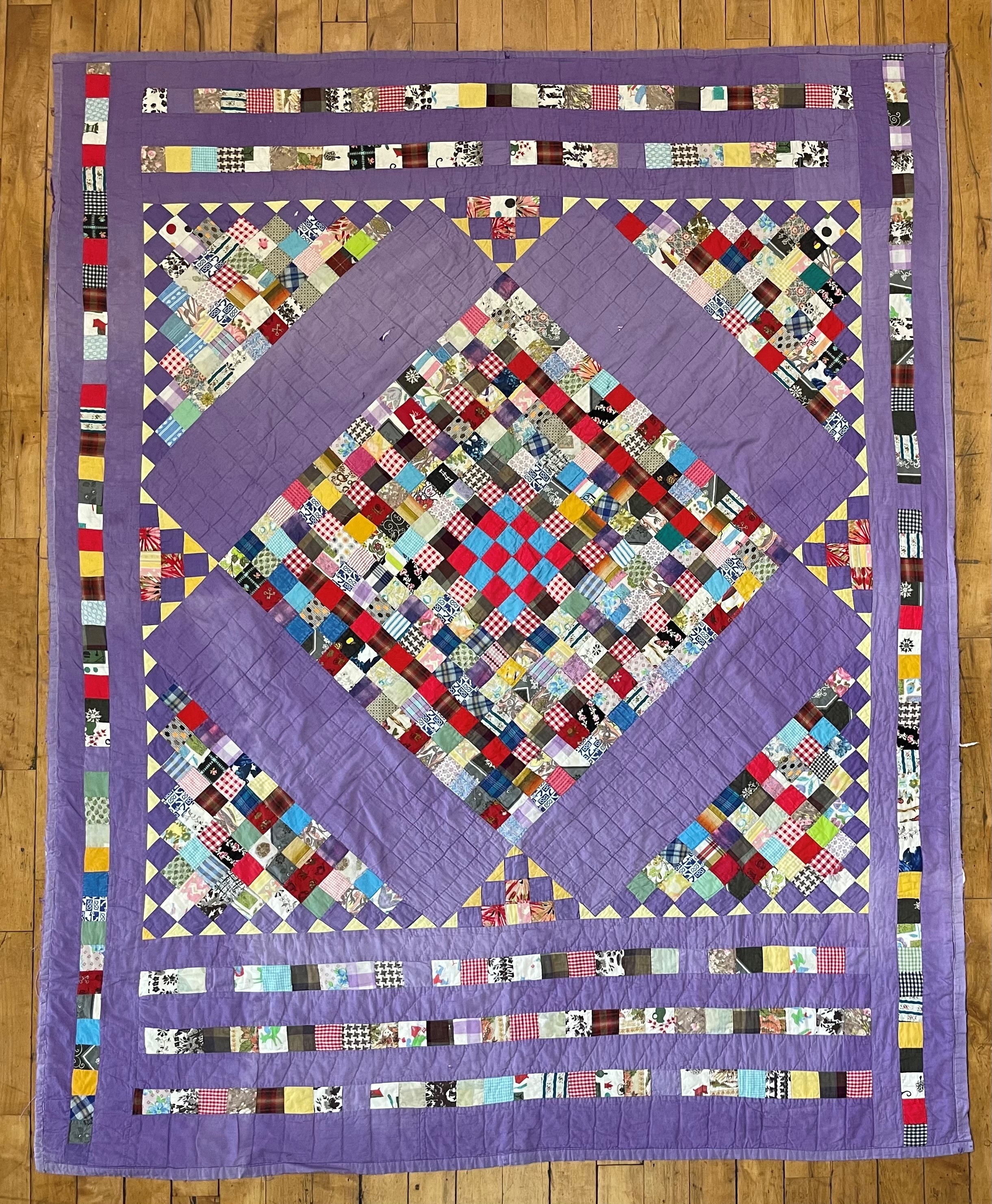
Kala Exworthy’s source of inspiration was a beloved quilt. “My maternal Grandmother loved making things,” she writes. “From her I learned to knit, rosmal and paint those cute plaster gnomes, which we painted red hats on and called “Nisse.” The photo below is of a quilt given to Kala by her grandmother. “I was the oldest granddaughter and was given first choice of the pile of quilts,” Kala explains. “The fabrics are from worn garments and I have always been a fan of bright colors. As a practical quilt, it has been used from day one. It’s worn and faded now but no less precious.”
The quilt given to Kala by her grandmother.
Inspired by the quilt, Kala wove a wall hanging she calls Memory Fragments. “The wall hanging represents not only the colors in the quilt but also the random memories that I have when I look at the quilt,” she writes. “Pictures in my head of Gram at different times in our lives, red paint on the paintbrush for the Nisse hats, the smell of turpentine and linseed oil used to clean our brushes, yarn and needles and of course, lefse with mashed potatoes, chicken and crispy sugar cookies. I loved going to Gramma Egstad’s house because there was always time to make something.”
Kala’sMemory Fragments inspired by her grandmother’s quilt.
For Nancy Ellison, her heirlooms come in the form of sheep. Nancy raises Icelandic sheep and other heritage breeds on her farm near Zumbrota, Minnesota. “Historically in Iceland shepherds wore a mantel or cloak woven with locks of wool to protect the wearer from the weather,” Nancy explains. “The shaggy surface is like the wool growing on a sheep.” Nancy wove a pillow and chair cushion in this technique, using gray, black, brown, and white wool from her flock.
Nancy shaggy sheep contributed to her weaving!
Some weavers were inspired by vintage objects, even though they didn’t have a family connection. Sharon Marquart’s From Garment to Garnish was inspired by an antique embroidered bodice, possibly Scandinavian, and an antique beaded belt, which may have been part of a Norwegian bunad (ceremonial dress).
A visitor examines the vintage clothing items that inspired the woven motifs inSharon’s From Garment to Garnish, seen on the wall.
Melba Granlund wove a telemarksteppe she called Reflections. “My color inspiration for Reflections came from a stained-glass window salvaged from an old farmhouse,” she states. “It was purchased at a farm auction in central Minnesota and currently hangs in the dining room window of our “new” farmhouse a few miles away. “
Melba’s Reflections and a photo of the stained glass that inspired the color palette.
Although humble, these beloved textiles are still treasures, even a hundred years later. As shown in this exhibit, even the simplest textile can inspire later generations to weave on. We are all part of the fabric of history, and our own small threads can have a positive impact far beyond our lifetimes. Just remember to put your initials on everything you weave!
A cold January is the perfect time to start a new weaving project! The Scandinavian Weavers’ latest group warp is a pattern called Kukkoladräll.
The Kukkoladräll pattern was composed by Elsa Kerttu in 1926 when she was a student at Jämtslöjds Kvinnliga Slöjdskola (Women’s Craft School) in Östersund as an assignment to create a pattern in Jämtlandsdräll. It was named after Elsa’s hometown of Kukkola, a small fishing village in northern Sweden, just across the border from Finland. A lovely version of this pattern was woven by Ulrika Bos Kerttu, Elsa’s niece, in a palette she named Cloudberry. The draft for the pattern is copyrighted by Sveriges Länshemslöjdskonsulenter and provided bytextilhemslojd.se
Image of cloudberries from Pinterest.
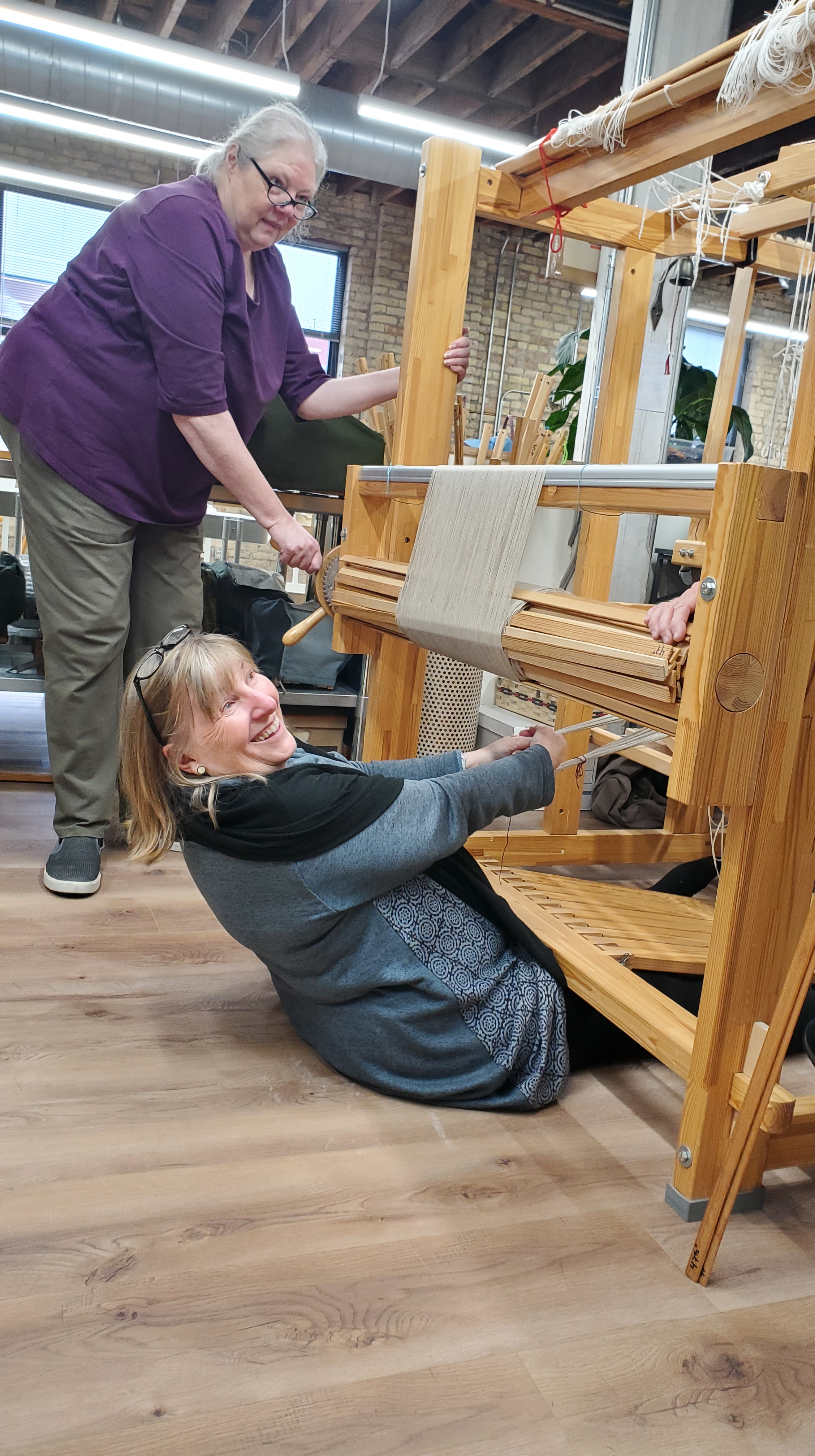
The Weavers Guild of Minnesota is equipped with two Glimakra looms for classes and group projects. The Scan Weavers generously dug into their stashes for the linen warp. At least 14 of us will weave on this warp, so it is quite long.
There’s nothing more beautiful than a plain linen warp. Note the slightly different colors that result from blending.
Warping is always more fun with a group! (Especially with coffee breaks.) Below, Lisa Torvik explains the benefits of pre-sleying the reed to newer weavers Holly and Beth.
Patty Johnson demonstrates how she used to warp her Glimakra all by herself – controlling the warp tension while winding on the back beam. Fortunately, Lisa is there to help.
Lisa reminds everyone to spritz the linen warp with water to prevent breakage. (Lisa does this every time she advances the warp, which she does every three to four inches.)
Lisa adapted the draft for towels and included four motifs across the width instead of three.
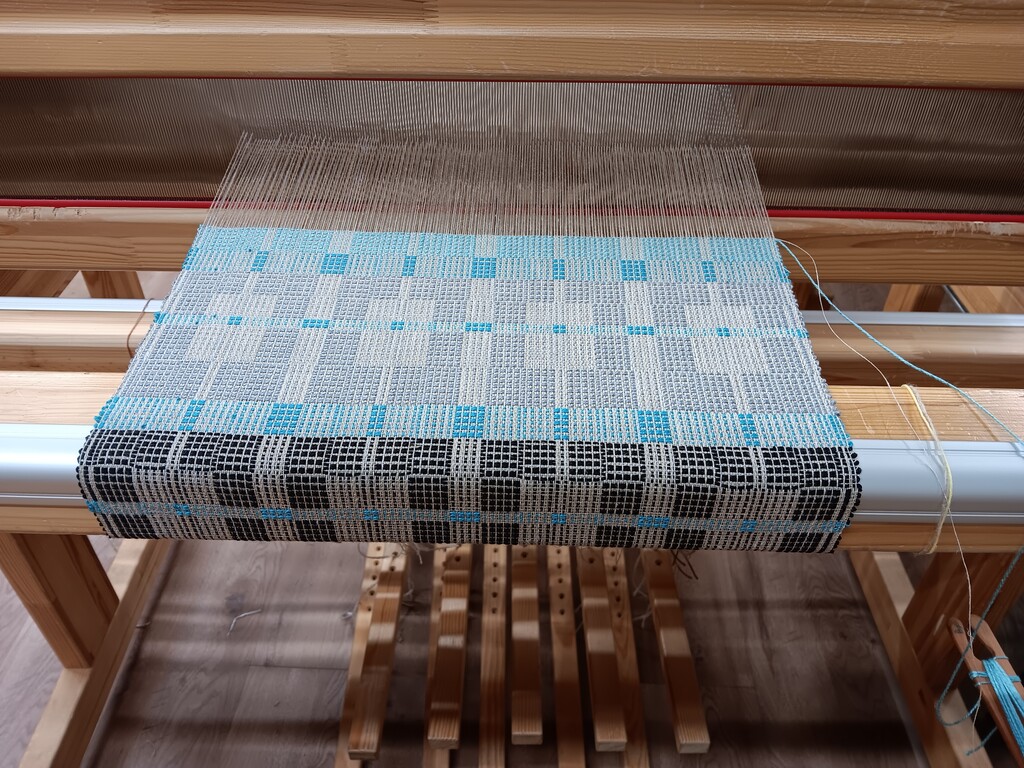
Lisa wove two towels in different colorways. For the first, she used 16/1 linen doubled on stick shuttles for the pattern weft and 12/1 linen for the ground shots.
For the second towel, Lisa chose to work with perle cotton for the pattern weft.
Stay tuned for more updates on this project. I like to think that Elsa Kerttu’s original design of multiple squares was inspired by the many small fishing huts in Kukkola.
Image of Kukkola from PinterestStock image
If you now want to visit Kukkola as much as I do, search online for the Kukkola Tourist and Conference Board. They say the area provides natural beauty, peace, and creative inspiration. What could be better for weavers?
Thanks to Beth Detlie, who demonstrated at Red Wing Arts as part of the Scandinavian Weavers exhibit “Domestic to Decorative: The Evolution of Nordic Weaving.” The exhibit is open through December 24 at the historic train depot gallery in beautiful Red Wing, Minnesota.
Photo by Heather Laurenz
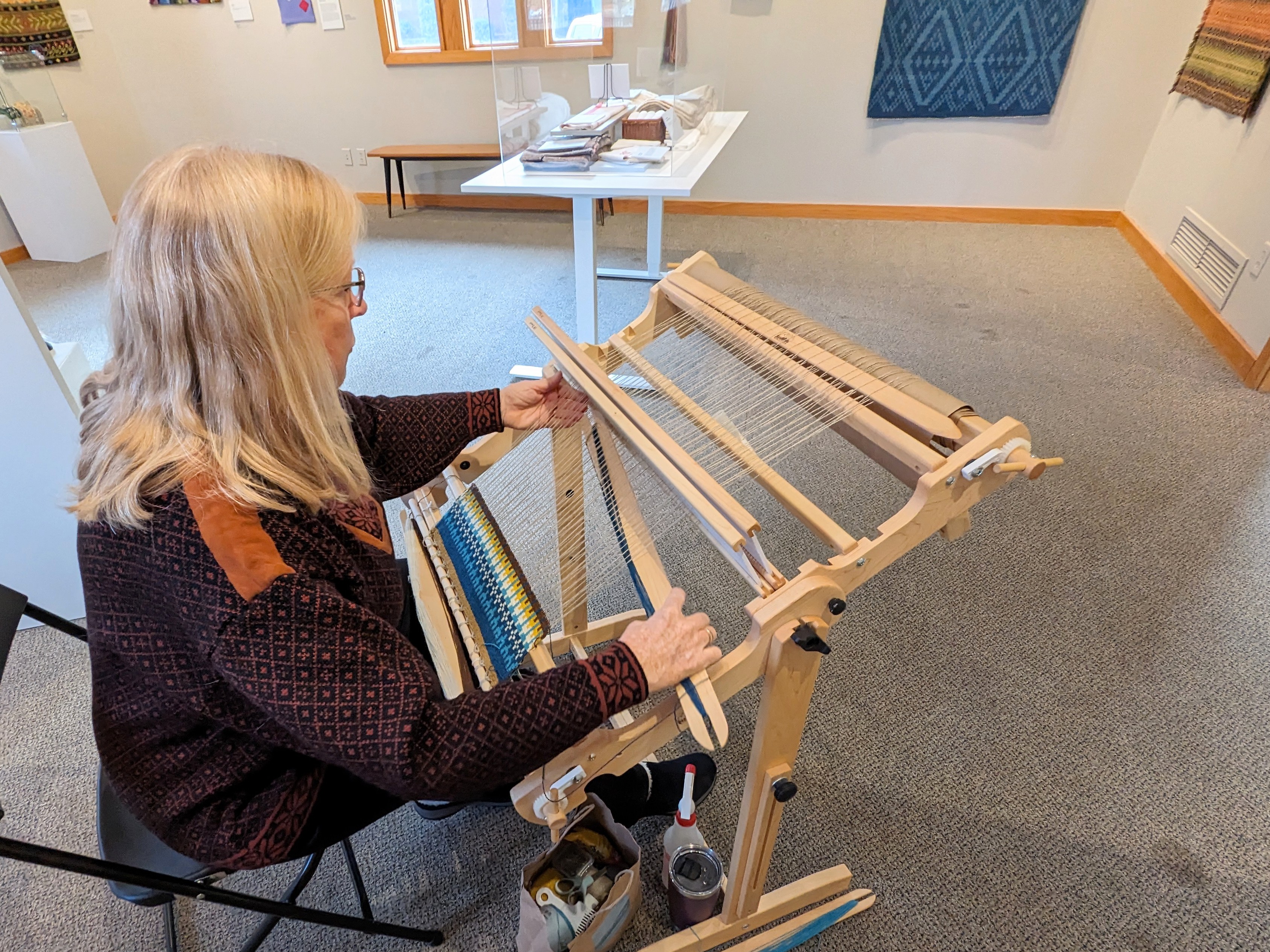
Beth wove a classic three-shed krokbragd technique using a rigid heddle loom.
Photo by Beth Detlie
A close-up of Beth’s beautiful weaving. She is working with Holst Garn fingering-weight wool from Denmark, which she purchased at The Yarnery in St. Paul, Minnesota.
Photo by Heather Laurenz
Beth explains the finer points of her weaving to guests in the Red Wing Arts gallery. In the background are Lisa Torvik’s transparency weavings, based on a motif in a woven coverlet from the Sogn region of Norway. Lisa will demonstrate transparency weaving on Saturday, December 9 from 1:00 to 3:00 PM. Please join us!
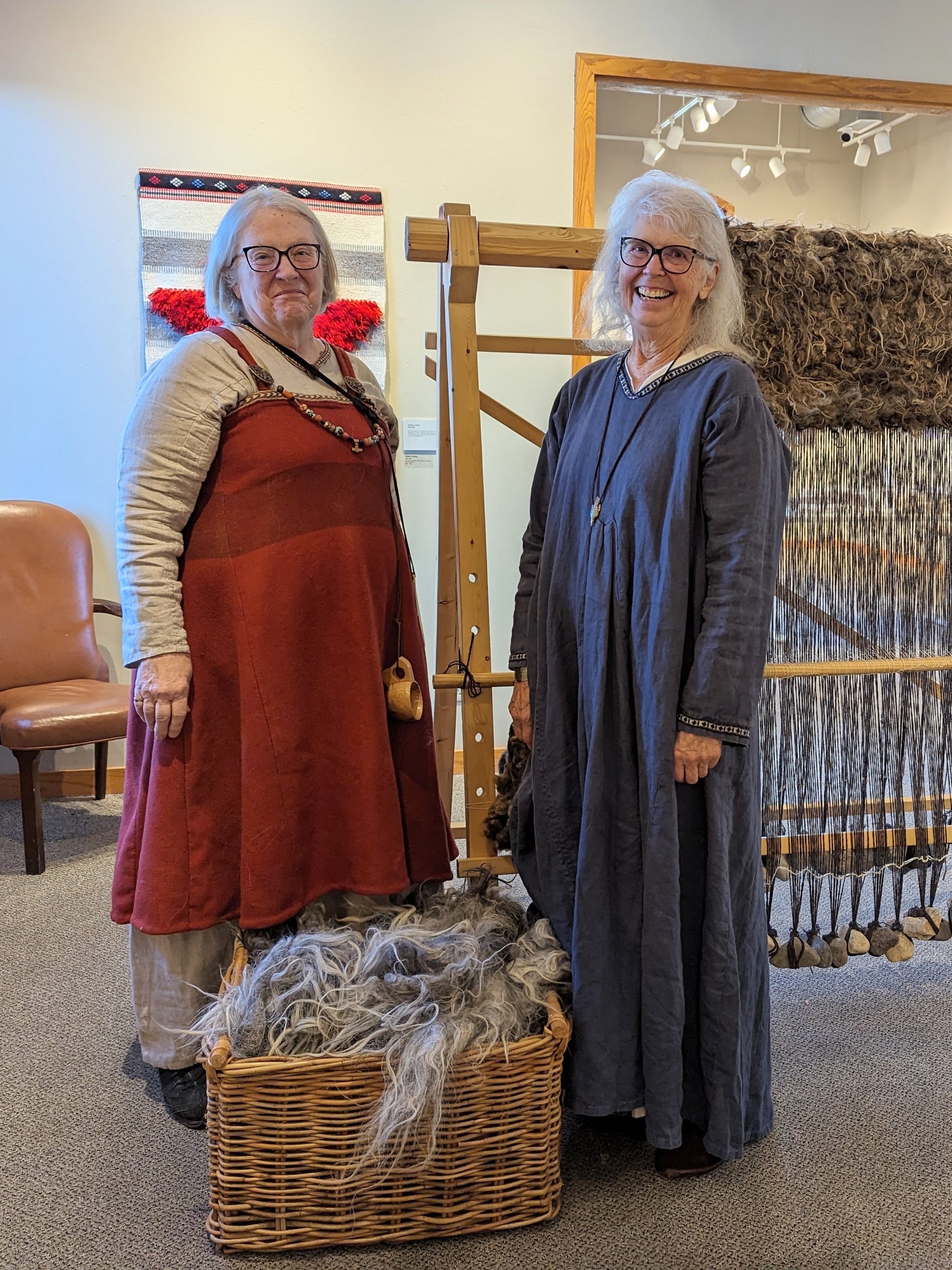
Thanks to Melba Granlund and Peg Hansen who demonstrated weaving on a traditional Scandinavian warp-weighted loom at Red Wing Arts on November 18, as part of the Scandinavian Weavers exhibit “Domestic to Decorative: The Evolution of Nordic Weaving.” Visitors were fascinated by this ancient weaving technique, and Melba and Peg looked their finest in their Viking garb!
Melba Granlund explains the history of the warp-weighted loom to visitors (dogs included). Melba teaches classes in warp-weighted weaving at the Weavers Guild of Minnesota, North House Folk School, Shepherds Harvest, and other venues.
Red Wing Arts is the perfect space for weaving on a warp-weighted loom: Plenty of room and lots of sunlight!
The big loom always draws a crowd!
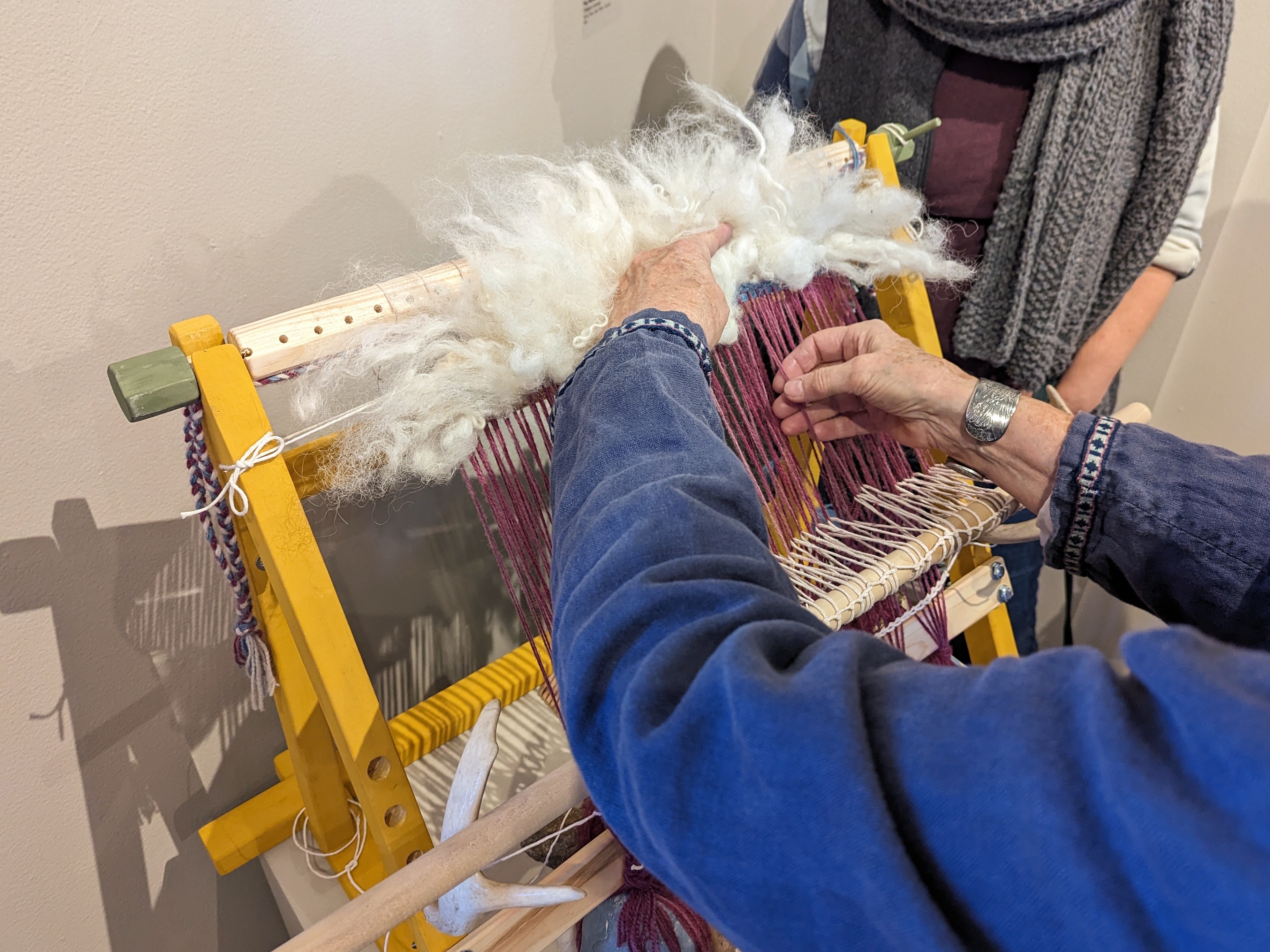
Peg Hansen demonstrates rya weaving on the small warp-weighted loom she built in Melba’s class at North House Folk School. (Notice the deer antlers.)
Any weaver who has used a warp-weighted loom will tell you the slowest part of the process is tying on the loom weights.
Yes, still tying on rocks!
Our beautiful Viking maidens!
For close-up photos of Peg’s handmade loom and the saga that inspired it, visit Robbie LaFleur’s blog post here
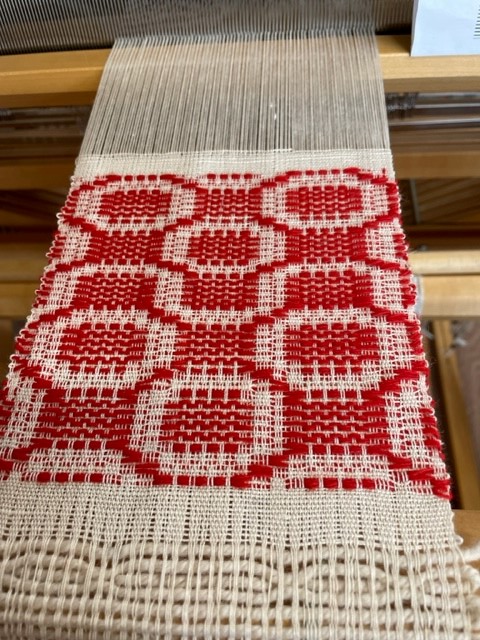
The Scandinavian Weavers’ latest group project was weaving in Telemarksteppe, organized by Lisa Torvik. Lisa was inspired by Laura Demuth’s table runner in a 2013 issue of Handwoven magazine. Laura wrote:
“Telemarksteppe is a technique that originates from Telemark, a county located along the southeastern coast of Norway. Using six shafts and five treadles, Telemarksteppe is a three-block weave woven on a tabby ground. This three-block structure allows for more design elements than the two blocks found in monk’s belt. Another aspect of Telemarksteppe that I find especially charming is the inclusion of weft loops along the selvedges. The loops also make frequent pattern-weft color changes easy. A color that is not used for several picks does not have to be cut because its end may be woven into the selvedge and reintroduced by making a loop at the selvedge that blends in with the other weft loops.”
This was our first group project in the new home of the Weavers Guild of Minnesota, the Open Book building in Minneapolis. It was a joy to work in this bright space and also have the opportunity to demonstrate weaving Telemarksteppe to visiting students, guests, and Guild members.
Scan Weavers members used a variety of weft threads in wool, linen, or cotton. The first group of weavers had so much fun that we put a second warp on the loom. Stay tuned for more pictures as their projects are finished!
Telemarksteppe runners fresh off the loom!Lisa-Anne Bauch
Editor’s Note: Today’s blog entry was written by Judy Larson.
“Nordic Handcraft Workshop: Weaving with History – Using Historical Textiles” was a class co-hosted by American Swedish Institute (ASI) and Weavers Guild of Minnesota (WGM) and planned to be taught by Susanna Ayton of Sätergläntan Institute for Craft and Handwork in Insjön, Dalarna, Sweden. Enrollment filled quickly, and five members of the Scandinavian Weavers Interest Group offered to wind warps and prepare the twelve looms. Betsy Konop, the WGM Education Coordinator, ordered the materials and assigned the warps for winding.
On Tuesday, June 20, the warps were delivered, and five of the looms got the warps wound on. Each loom had to be carefully warped using 6/1 linen, 6/3 linen, 6/1 wool, and 16/2 cottons. The next day, more warps were wound on, sleying started, and the process continued. That night, we were informed that the instructor had been called back to Sweden for a family emergency, and we could choose to continue with the class as a group study or get a full refund. Betsy said she was sure we could “make lemonade out of these lemons!” Besides, the looms were almost ready!
Loom warped in beautiful Swedish linen
Ten of the twelve students chose to still do the class as a group study, and so the warping continued. It looked like everything was ready! Just before leaving on Thursday night, I noticed that one of the 6/1 linen warps had “churros” between the reed and the back beam, so it had to be completely wound to the the front beam, all the way to the end, and the twists removed. Betsy’s dog, Hopsy, was patiently waiting to go home, and he sat toward the end of the warp as the twist was slowly worked back. The decision was made to make it to Hopsy’s ears, and then cut the warp! It was then tied to the back beam and re-beamed the next day.
Hops hard at work!(Note his magnificent ears)
Friday morning, the group met at ASI and had a quick introduction to Sätergläntan’s programs in weaving, woodworking, blacksmithing, and hand sewing.
American Swedish Institute in Minneapolis
Then Phyllis Waggoner shared information and showed textiles from ASI’s collection in each of the weave structures we’d be sampling. Phyllis has been working with the ASI textiles for many years and is our local expert!
Phyllis explaining Blådrättar, a style of Dukagång
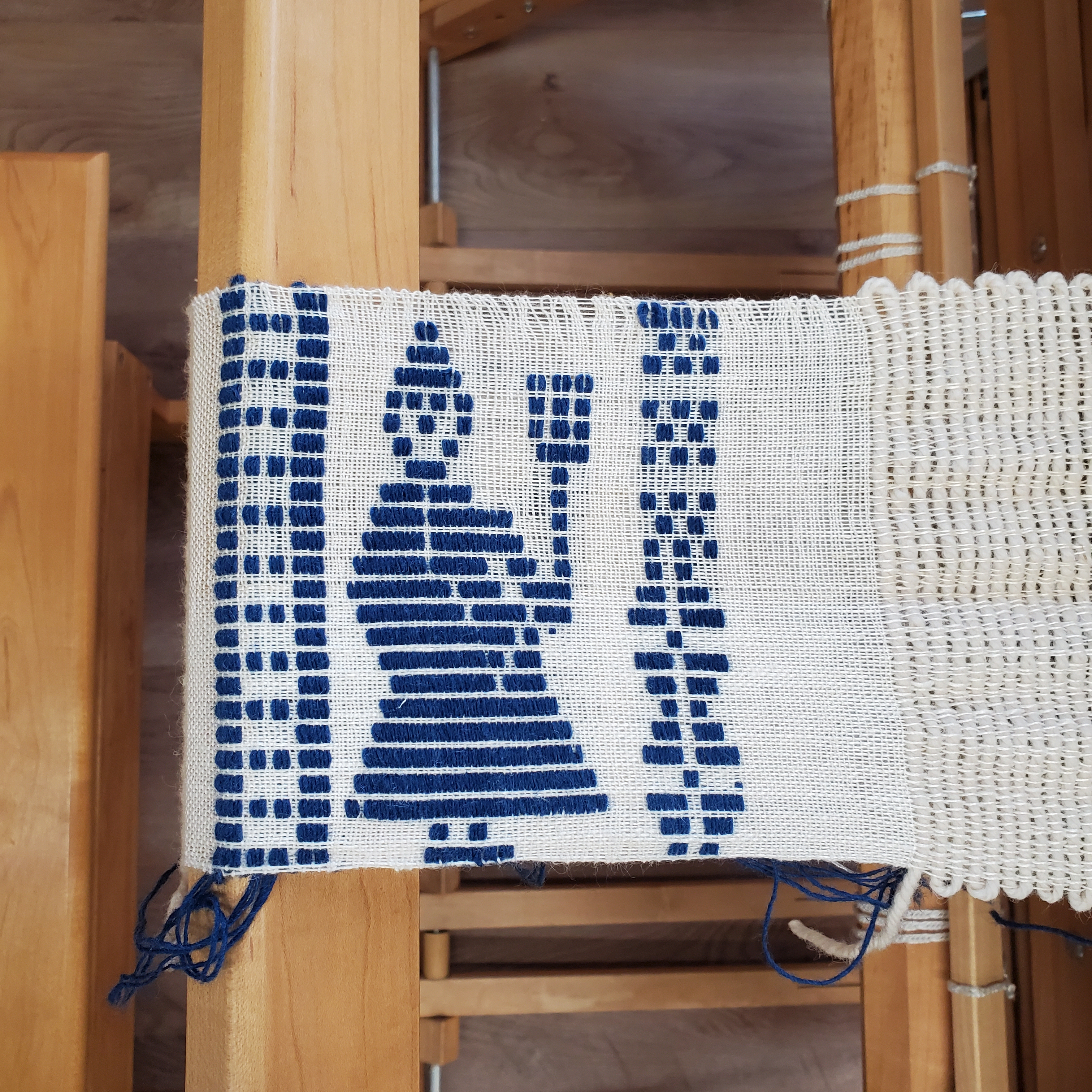
We first saw the Dukagång and Blådrättar. Blådrättar means “blue dish” in Swedish and refers to the fact that this type of Dukagång was traditionally done in blue and white/cream, similar to the colors on porcelain dishes. In Dukagång, the wool pattern weft is laid in fine rows separated by thin lines of tabby wefts.
Close-up of Blådrättar from ASI collection
Rölakan and munkabälte (Monksbelt) pieces were shown next, along with Daldräll (Overshot) and Rosengång (Rosepath).
Close-up of Rölakan showing distinctive interlock technique
Close-up of mythical creature on Rölakan weaving
Another Rölakan from ASI’s textile collection
Daldräll from ASI’s textile collection
Munkabälte (Monksbelt) from ASI collection
After lunch, the group went to the Guild and started our group study. Those with any experience in any of the structures gave their mini-demonstration, and then the weavers began making their samples.
Swedish wool yarn with WGM looms in the background
Lovely Swedish linen in a rainbow of colors!
Munkabälte and Daldräll were both pattern/tabby weaves and were more familiar. The Rosengång on opposites was a little trickier to do, but remembering the treadle partners of 1/4 with 2/3 and 1/2 with 3/4 helped. The Rölakan differences with single or double interlocks, plus the dovetail and over two without interlocked were discussed. The most challenging weave was the Dukagång.
Marianne weaving Rosengång (Rosepath)
Ever working on Rölakan interlocks
The weavers wove 6-inch samples of three different Munkabälte patterns, two Rosengångs (one with twills 4321234, and one with 123414321 threadings), two Daldräll patterns, two Rölakan, and three Dukagångs. As the weaving started, the patterns were coming out underneath. The tie-ups were all for counterbalance looms, so the tie ups needed to be reversed! More learning was happening!
Daldräll by Judy
Second Daldräll threading
Two of the Dukagångs were on 6/1 Farö wool warps, which kept breaking. Finally, the decision was made to re-warp one of them with 6/1 linen, which worked much better.
Sharon’s beautiful Blådrättar!
Sharon experimented with color blending in munkabälte
Close-up of Sharon’s munkabälte
More munkabälte
Munkabälte
Analyzing weave structure’s in Nancy’s show-and-tell
After weaving on Saturday and Sunday, there was a reception at ASI for all the participants in any of the four areas for Sätergläntan classes. The blacksmithing teacher commented that it was impressive that the weaving class went forward, even without a teacher. But it just shows that when weavers get a chance, they make the best of it! We truly did make “lemonade out of the lemons!”
After the warps are taken off the looms, Betsy will take pictures of each sample, and send them out to their respective weavers. The weekend was a great opportunity to meet more weavers, learn more about Swedish structures, and support the Guild/ASI partnership with Sätergläntan. Thank you to everyone who made this possible!
Editor’s Note: Special thanks to Betsy and Judy (and Hopsy!) as well as Erin Swenson-Klatt at ASI, who all went above and beyond to make sure this week was a wonderful experience for all!















































 Scandinavian Weavers Study Group