How did the contemporary weavers in the “Traditional Norwegian Weaving: American Reboot” exhibit learn to weave in traditional techniques? Sometimes it was a class, other times by studying an old textile. But books are key.
If you could create a state-by-state map showing ownership of weaving books in Norwegian, Minnesota would win, hands-down. Many weavers around the state have collections of books bought on trips to Norway or many times, from the Vesterheim Norwegian-American Museum. It doesn’t even matter if the owners don’t read Norwegian, weavers find inspiration from the photos and can read the drafts for the loom.
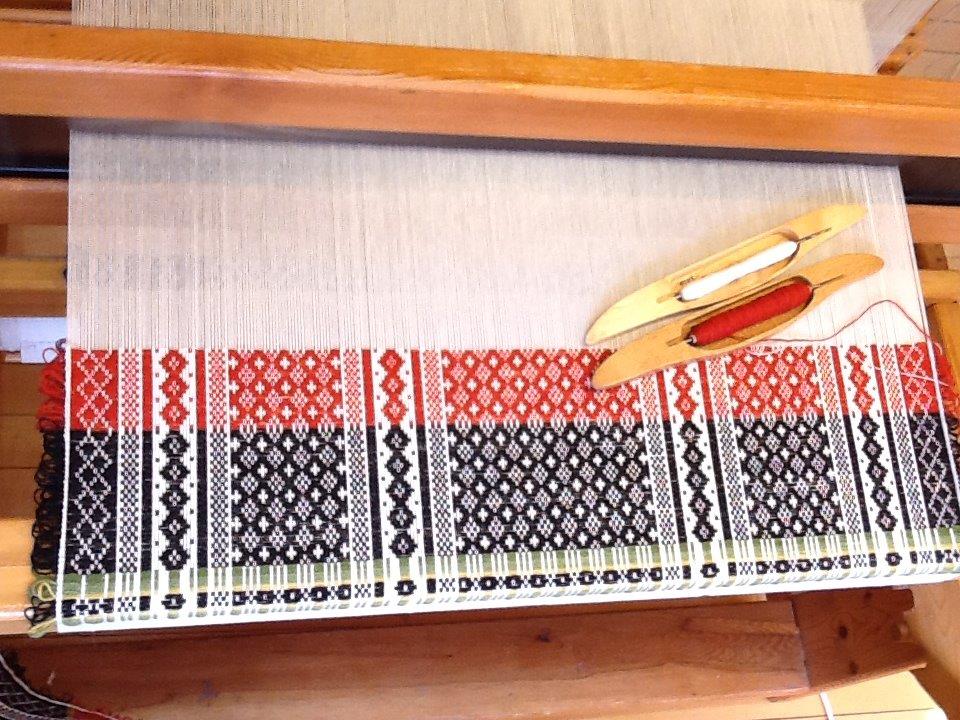
Jeanine Swanson Ehnert‘s beautiful and traditional weaving in skilbragd technique was inspired by the draft for a “Skilbragd from Fosnes” found in a book published in 2001 by the Nord-Trøndelag Husflidslag, Om Fellen Kunne Fortelle: Åkletradisjon til Inspirasjon by Randi Breistet (loosely translated as If the Blanket Could Talk: Coverlet Traditions for Inspiration). She used a draft similar to this one from the book.
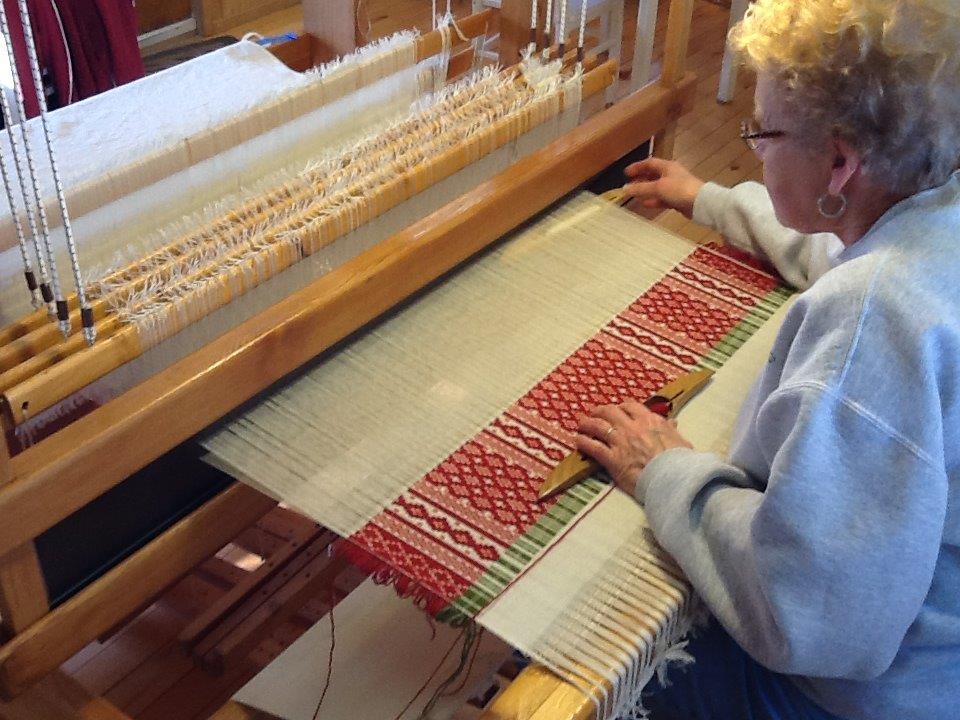
Jeanine weaves in Frazee, Minnesota, with a concentration on traditional Norwegian weaving techniques. She also conducts weaving workshops and classes at the Vevstuen Nordic Weaving Studio, located in her home, which includes two floor looms and several table looms. Some workshops are for beginning weavers, and others focus more on Scandinavian design aspects.
Here is Jeanine weaving the first section of her “Skilbragd fra Fosnes.”
The piece progresses.
Come to the wide-ranging exhibit at Norway House, July 20-September 10, “Traditional Norwegian Weaving: American Reboot” to see the full piece. Don’t miss it! During the run of the show, there will be classes, demonstration days, gallery talks, and a lecture. Full details here.
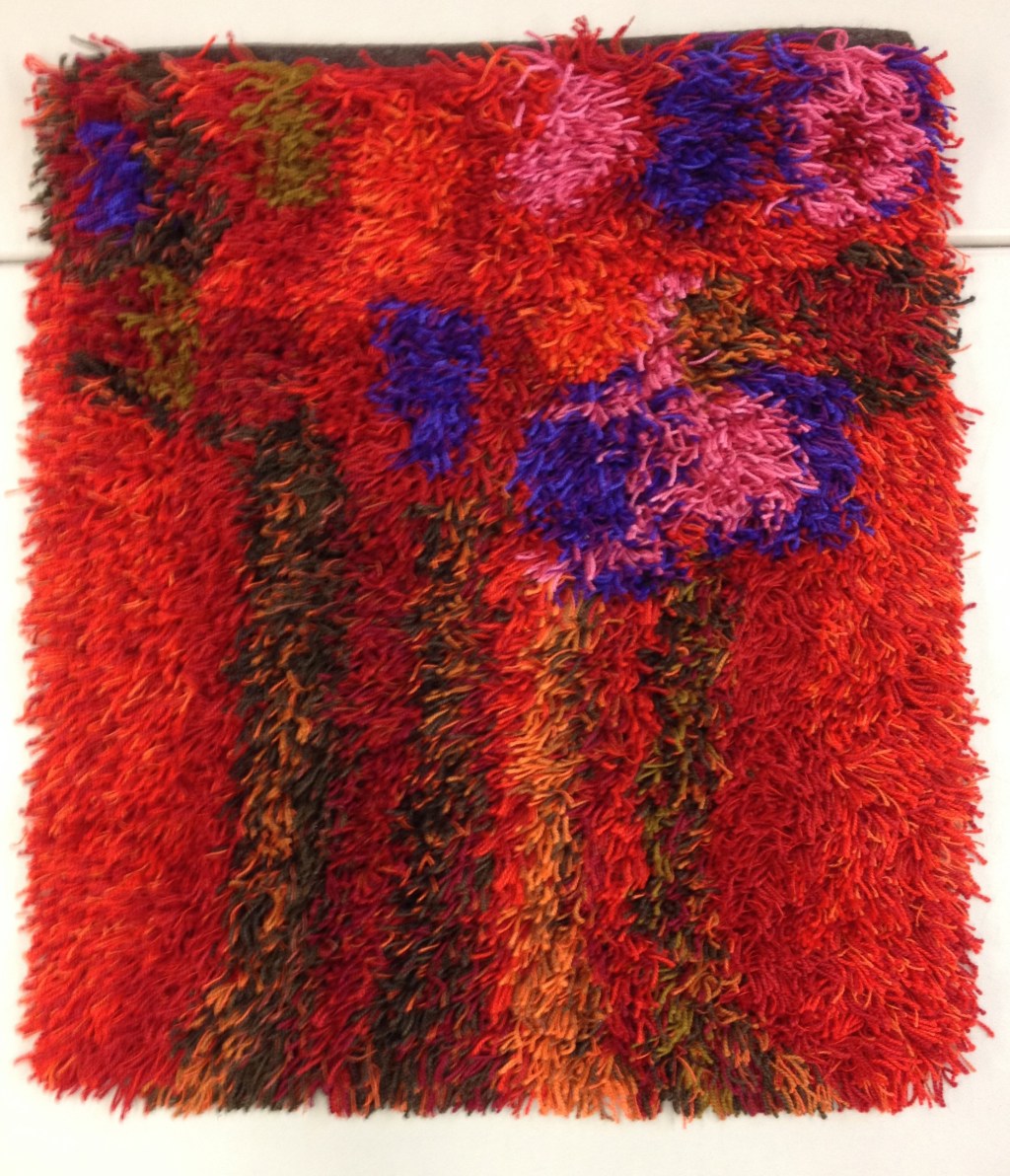
Corwyn Knutson, from St. Paul, wove “Hardanger Cherry Blossoms,” inspired by flowers he saw on a memorable driving trip through Norway. The trees with red, pink, and purple form a beautiful abstract image. It is so deftly balanced, in fact, that it was once hung in an exhibit upside-down and it was just as beautiful! Corwyn’s rya was a double winner at the Minnesota State Fair; it received a blue ribbon and the Doris Tufte award for Creative Loom Weaving in Scandinavian Tradition.
Marilyn Moore
Marilyn Moore, from Cedar, Minnesota, learned to weave rya from Jan Mostrom, co-curator of the “American Reboot” exhibit, at the Weavers Guild of Minnesota. Excited about the possibilities of color blending, Marilyn quickly moved to an interpretation of her perennial garden, which includes 25 varieties of day lilies and gives her color all summer long. Marilyn wrote, “It introduced me to a freedom that I had not experienced before working with color and fiber, and I loved every minute of it.”
This summer, enjoy flowers outdoors and the indoors at the Norway House Galleri, from July 20-September 10. Come to the opening! July 20, 5-8 pm.
A traditional krokbragd coverlet from the collection of the Vesterheim Norwegian American Museum
Sometimes textiles in the museum have detailed provenances and specific dates; this one does not. Curator Laurann Gilbertson guesses that it was not woven before the late 1800s, as the addition of bright pink means that chemical dyes were used. Also, it has hemmed ends, rather than fringe. At least in the coverlets at Vesterheim, fringed ends became more common in the first decades of the 20th century.
Claire Caughey Most. Photo by Jenny Rediske
Krokbragd bed coverlets were commonly found in most regions of Norway. It remains a popular weave structure for contemporary weavers in Norway and the U.S.; nearly all of the members of the Scandinavian Weavers Study Group have woven at least one.
Claire Caughy Most, from Stillwater, Minnesota, has explored luminosity in a series of krokbragd weavings, and the American Reboot show includes “Beyond Midnight #2.” Claire uses the same technique as the 19th century piece, but in a graphic and contemporary interpretation with narrow interlocking stripes. The shades of turquoise and green almost glow.
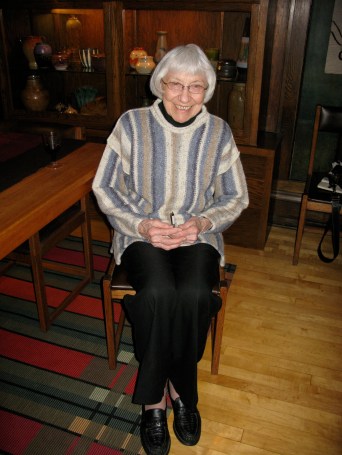
Lila Nelson, who died in 2015 at age 93, was the Registrar and Curator of Textiles at the Vesterheim Norwegian American Museum for 27 years, and a mentor to many of the weavers whose works are in the “Traditional Norwegian Textiles: American Reboot” show. No retrospective of American weaving in the Norwegian tradition would be complete without her work.
Two of Lila’s tapestries, both owned by the Vesterheim Norwegian-American Museum, are included in the American Reboot exhibit. One is a “virgin” with a puffy skirt. Many people who are fans of Norwegian tapestry, or billedvev (literally, picture-weaving), weave one of the virgins from the most popular medieval weaving motif, the Wise and Foolish Virgins. Lila wove one with attitude, and with a distinctive skirt. She wove the tapestry on a floor loom and used a clever combination of loom-controlled weave structure along with billedvev technique. When she wove the image of the woman, the threads in the “H” technique of the background floated behind, and she wove the figure in tapestry (billedvev). Perhaps it was unintentional, but that technique made the skirt pouf out.
Most of the virgins in the old tapestries held stylized small squares to their faces. (See the detail here, from a Wise and Foolish Virgins tapestry owned by MIA, the Minneapolis Institute of Art.) On Lila’s virgin, there is no doubt that the foolish virgin is crying into a substantial and functional handkerchief. This piece shows Lila’s lifetime love of experimentation in her weaving. It was also chosen because the exhibit will include many other virgin interpretations, showing the influence of that design in traditional Norwegian weaving.
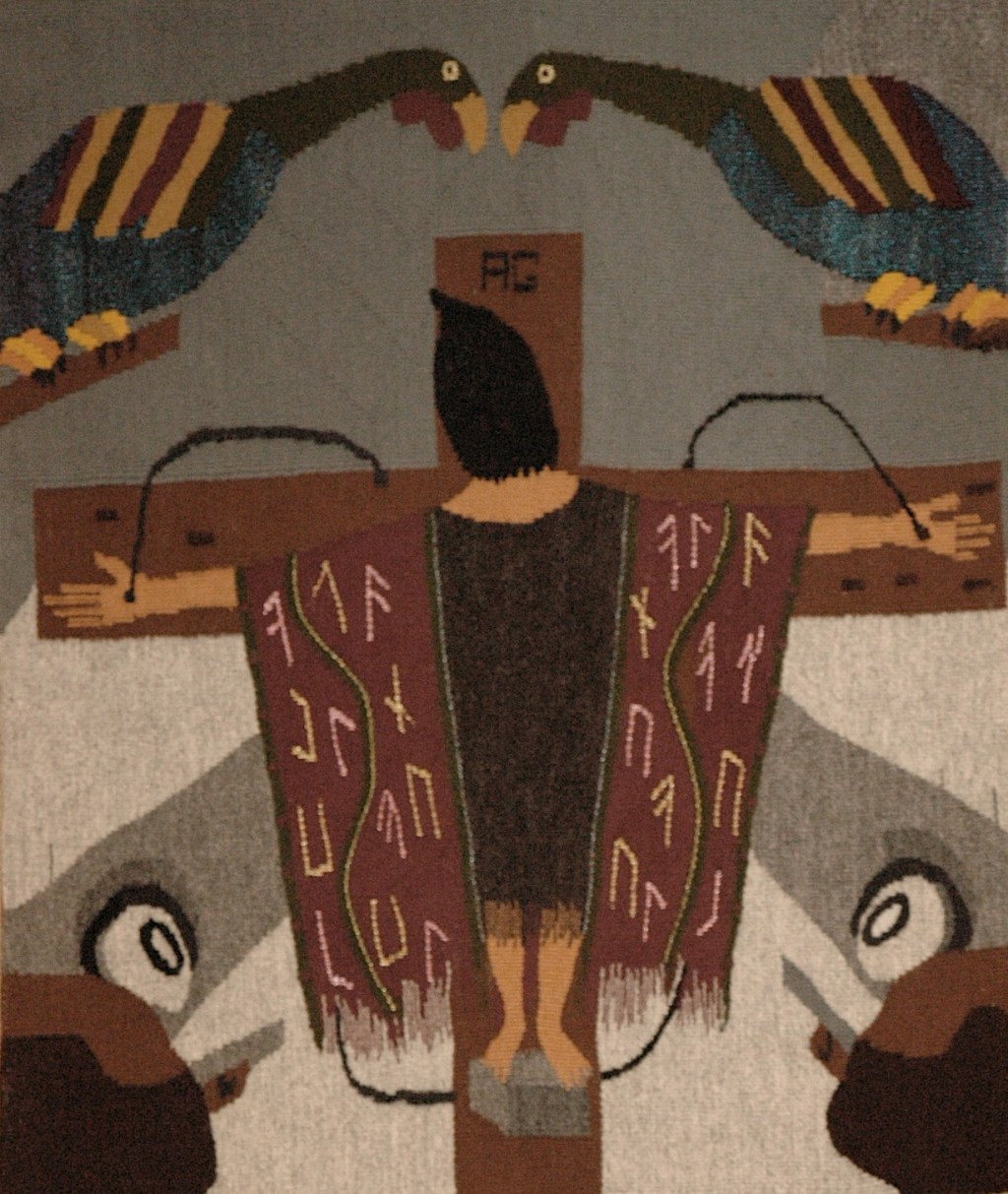
Lila’s other tapestry in the show illustrates another characteristic of Lila’s work–her frequent commentary on politics and world events.
Tree of Death. Lila Nelson, 2004
It was inspired by the photo, “Torture at Abu Ghraib,” by Seymour Hersh in the New Yorker on May 10, 2004. Here are Lila’s comments, as related in an interview with Sam Iverson.
“I saw an image of how they were treating some of the prisoners to get them to talk at Abu Ghraib and I thought this was quite horrifying. I think you can see that I turned this [image] into a cross-like thing and the AG stands for Abu Ghraib. At the bottom are impersonal guards or soldiers. The characters at the top are “vultures” that are in charge of all this. The designs on the garment are being ironic. They are from one of the Finnish runic alphabets and they are sort of the letters for love.”
Only two pieces from Lila’s loom are in the American Reboot exhibit, but her influence, whether through acquiring textiles for Vesterheim, or mentoring aspiring weavers, can be directly tied to many other weavings on view.
Explore more about Lila’s work in these online articles.
The Tapestries of Lila Nelson: Poetry, Myth, and Protest. This article was published at the time of an exhibit of her work at the Textile Center of Minnesota, November 2 – December 16, 2015. Also, this document includes images and commentary from the show. (Warning: it is a large file and will load very slowly.)
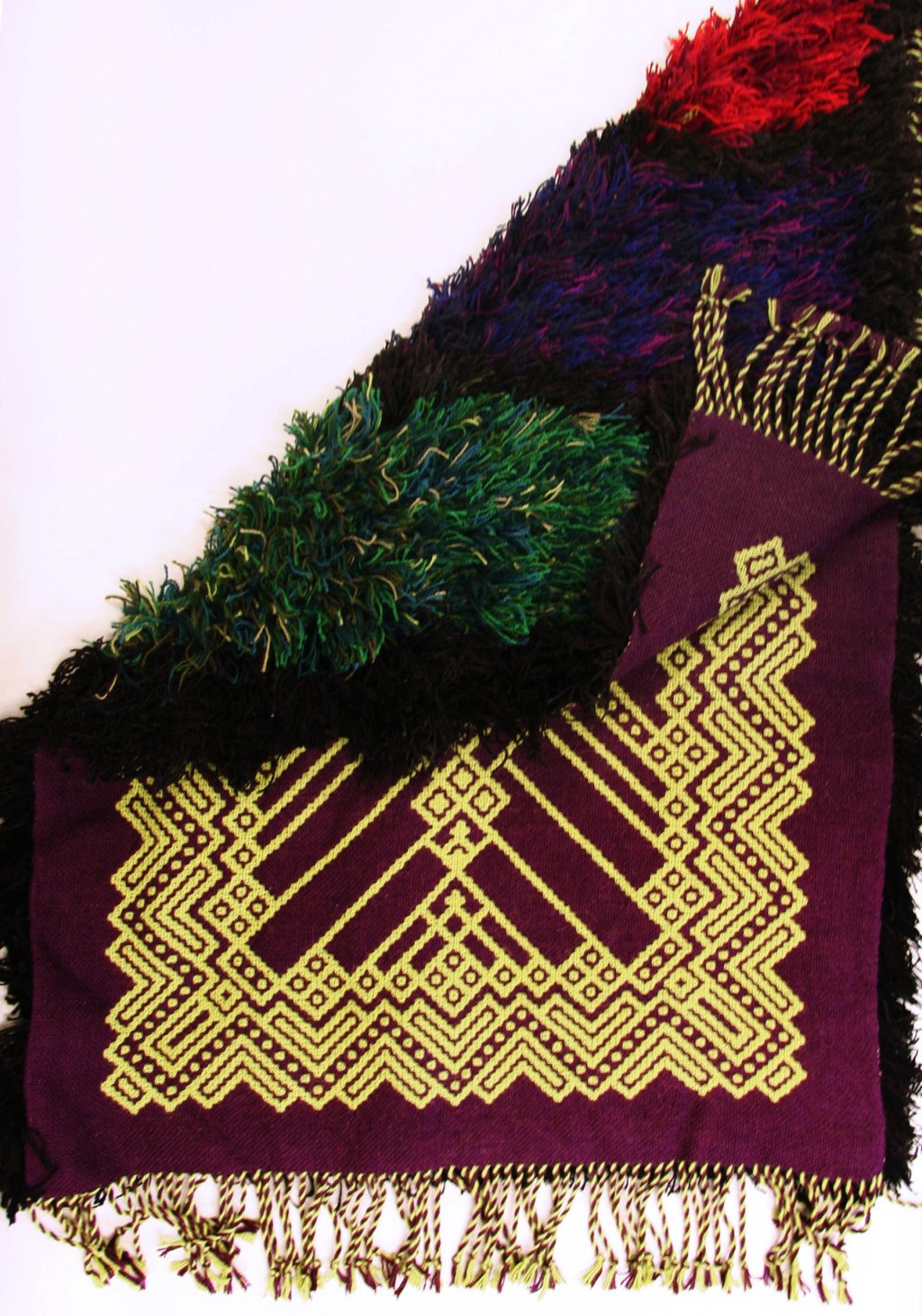
Iowa artist Laura Demuth sets up amazing weaving challenges for herself. Often, not content with just buying and weaving with beautiful wool, she spins and dyes yarn from her own sheep. In a number of weavings she has gone beyond weaving for beauty on one side, and combined techniques to make unique two-sided textiles. One of those will be included in the upcoming “Traditional Norwegian Weaving: American Reboot” exhibit at Norway House from July 20-September 10, 2017.
On one side of the hanging, Laura wove an intricate pattern in a complex doubleweave technique. She hid the knots of the rya pile between the two layers of the doubleweave. Because the doubleweave pick-up surface needs to be the upper side during weaving, she tied the knots upside-down on the lower surface. (Rya weavers would understand: this is tricky.)
On the other side, colorful stripes of beautifully-blended yarns are dense and enticing. This piece perfectly fulfills its purpose as a warm throw.
Biography:
Laura Demuth has been weaving for over 30 years and enjoys all aspects of textile production, from raising the sheep to taking a finished piece off the loom. Living on a small acreage just seven miles northeast of Decorah, Iowa, Laura has a small flock of registered Blue Faced Leicester sheep that keep her hands busy spinning wool all winter. She often dyes the handspun yarn with natural dyes from the garden before putting it to use in a woven or knitted textile.
Because Laura lives so close to Decorah, Vesterheim Norwegian American Museum has been a continual source of education and inspiration throughout her weaving career. Laura has focused on traditional weaving structures and techniques, especially bound weave and doubleweave.
Traditional Norwegian Weaving: American Reboot An Exhibit at Norway House: July 20-September 10, 2017
Sponsored by Norway House and the Weavers Guild of Minnesota
A traditional krokbragd coverlet from the collection of the Vesterheim Norwegian American Museum
Make Minneapolis your destination thus summer for an exhibit joining Norwegian weaving past and present. Inspired by historical textiles, American weavers have used Norwegian weaving techniques to create a new body of work, contemporary in design or materials. Enjoy traditional pieces from the collection of the Vesterheim Norwegian American Museum and outstanding weavings from recent decades that honor the past and break through with modern expression.
The exhibit of invited pieces (40 in all) is based around several techniques, including rya; tapestry; krokbragd and other boundweave variants; band weaving; and overshot weaves such as monks belt and skilbragd. Other pieces are chosen to illustrate where American weavers learned their skills in Norwegian techniques, and where weaving in the Norwegian tradition has been exhibited over the years.
Related events include lectures and classes and weaving demonstrations. A loom will be set up in the gallery where members of the Scandinavian Weavers Study Group will weave a rutevev (square weave) runner.
Opening celebration: Thursday, July 20, 2017, 5-8 pm.
Gallery talks: Sundays, July 23 and August 13, 2 pm.
Weaving demonstrations: Wednesdays and Sundays from July 23-September 10, 12 pm-3 pm
Afternoon with an Expert, featuring Laurann Gilbertson, Curator, Vesterheim Norwegian-American Museum: Saturday, September 9, 1-3:30 pm. Following the lecture, “Warmth and Color: Traditional Norwegian Coverlets,” Gilbertson will conduct an Antique ID clinic. Members of the public are encouraged to bring Nordic textiles to learn more about their age, origin, and function (but no appraisals).
Information on the exhibit is also found on the Norway House website. Be sure to sign up for Sami-style Band Weaving with Keith Pierce, or Make a Viking Knit Bracelet with Melba Granlund. Maybe you know a kid to sign up for the fun introduction to weaving. This is a special opportunity to see the weaving exhibit in depth, as these Weavers Guild classes will be held at Norway House, right in the main gallery.

 How did the contemporary weavers in the “Traditional Norwegian Weaving: American Reboot” exhibit learn to weave in traditional techniques? Sometimes it was a class, other times by studying an old textile. But books are key.




 Lila Nelson, who died in 2015 at age 93, was the Registrar and Curator of Textiles at the Vesterheim Norwegian American Museum for 27 years, and a mentor to many of the weavers whose works are in the “
 Most of the virgins in the old tapestries held stylized small squares to their faces. (See the detail here, from a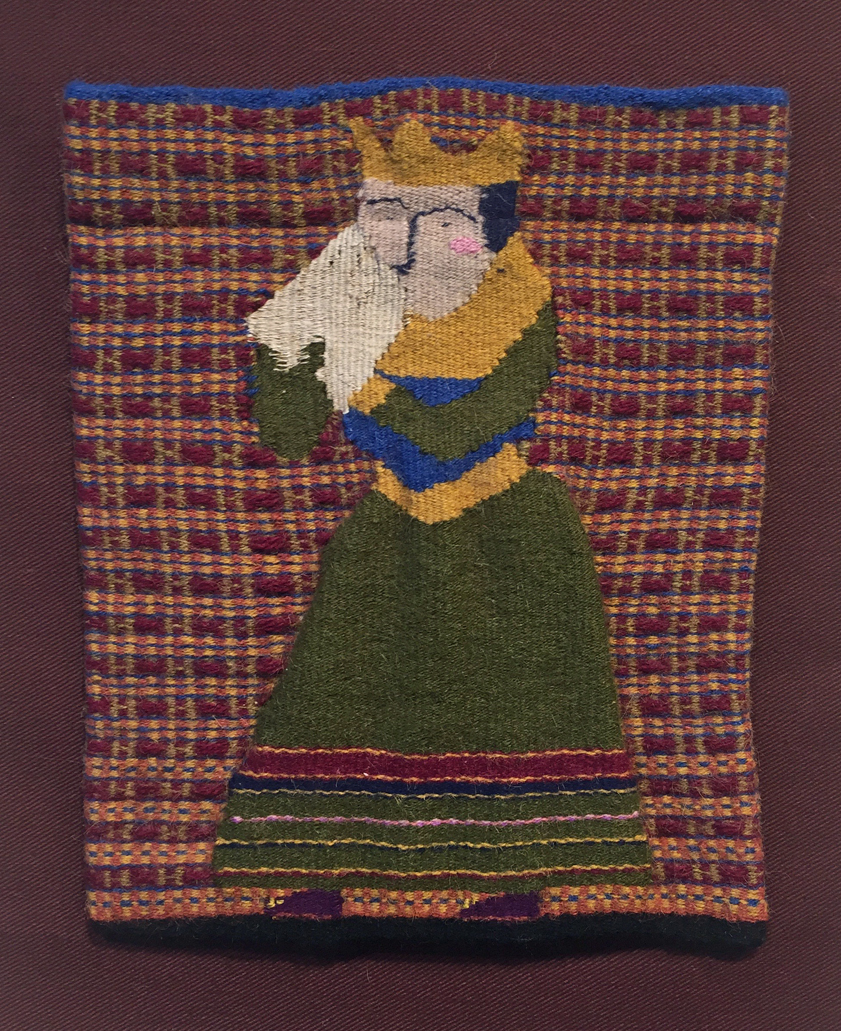



 Information on the exhibit is also found on the
  Scandinavian Weavers Study Group