Fortunately, creativity is flourishing among the Scandinavian Weavers!
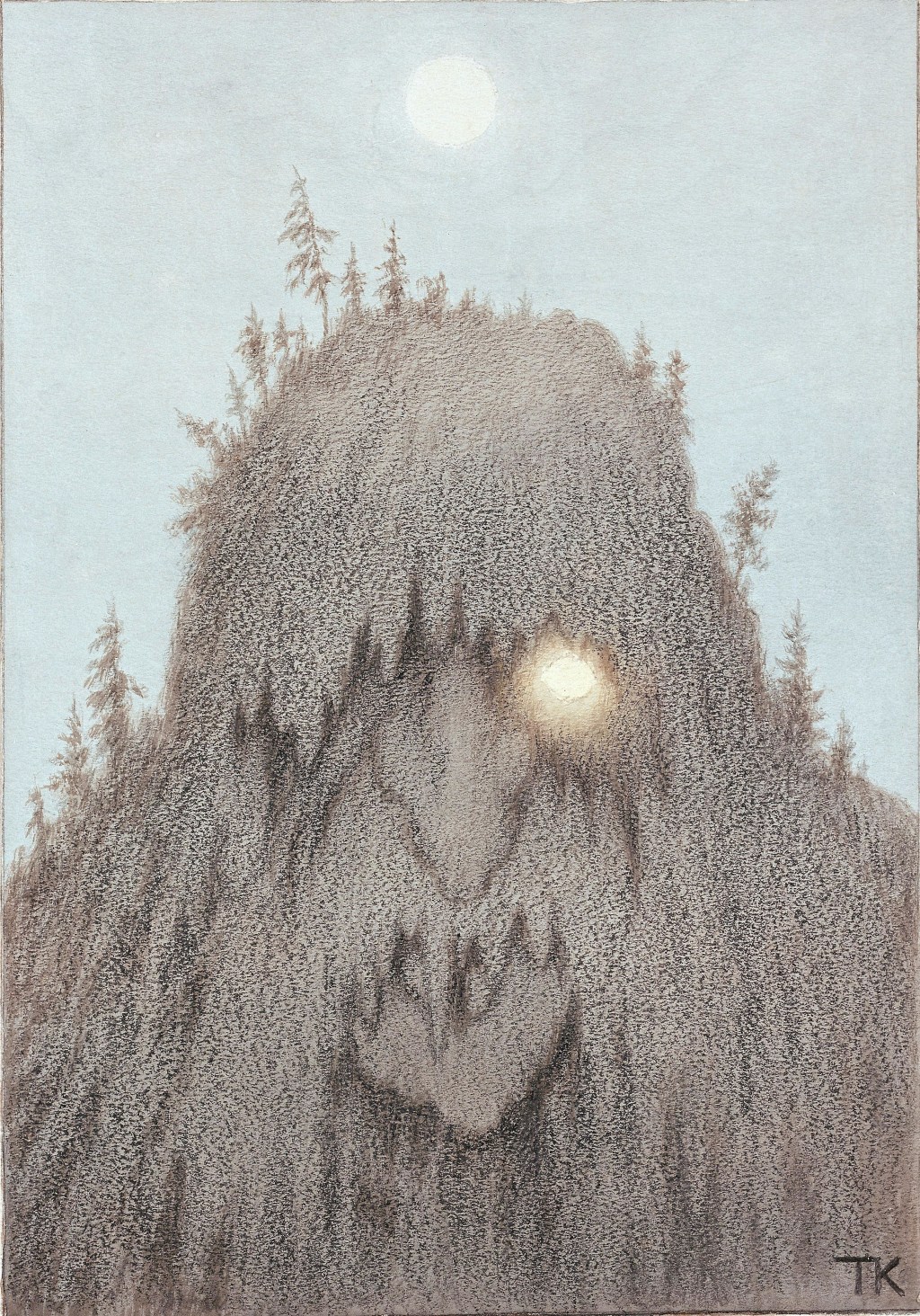
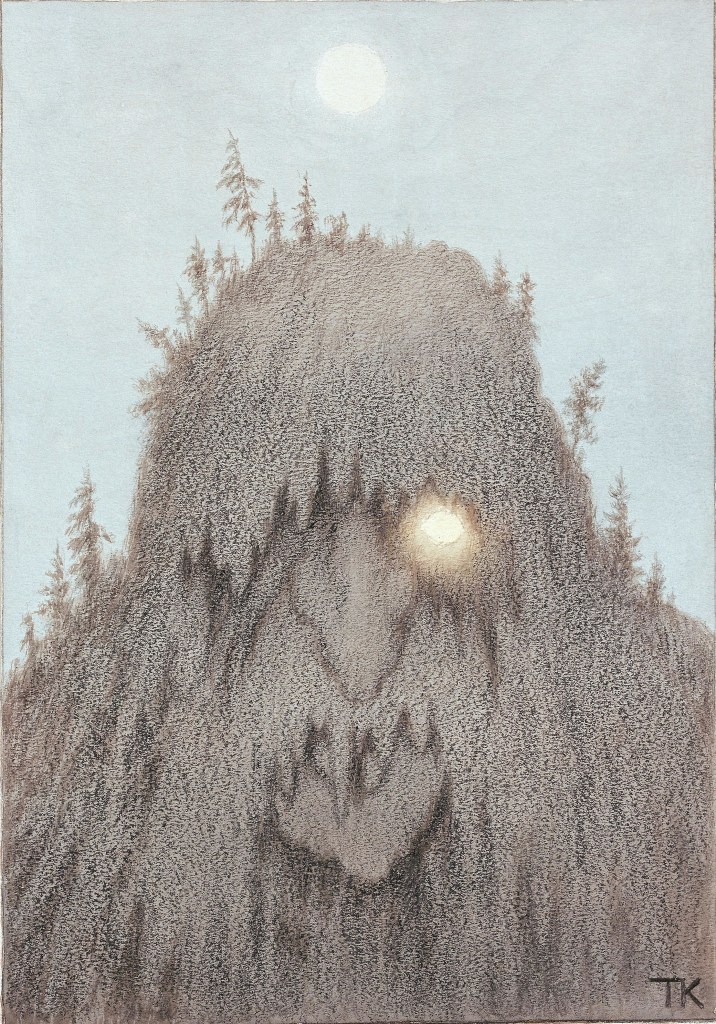
Alla Hale was inspired by Theodor Kittelsen’s image of the “Skog Troll” or Forest Troll. Kittelssen (1857–1914) is one of Norway’s most famous artists, known for his paintings of nature as well his illustrations of Norwegian folklore. We are grateful to Norway’s Nasjonalmuseet for the free use of the above image. (See link below.)
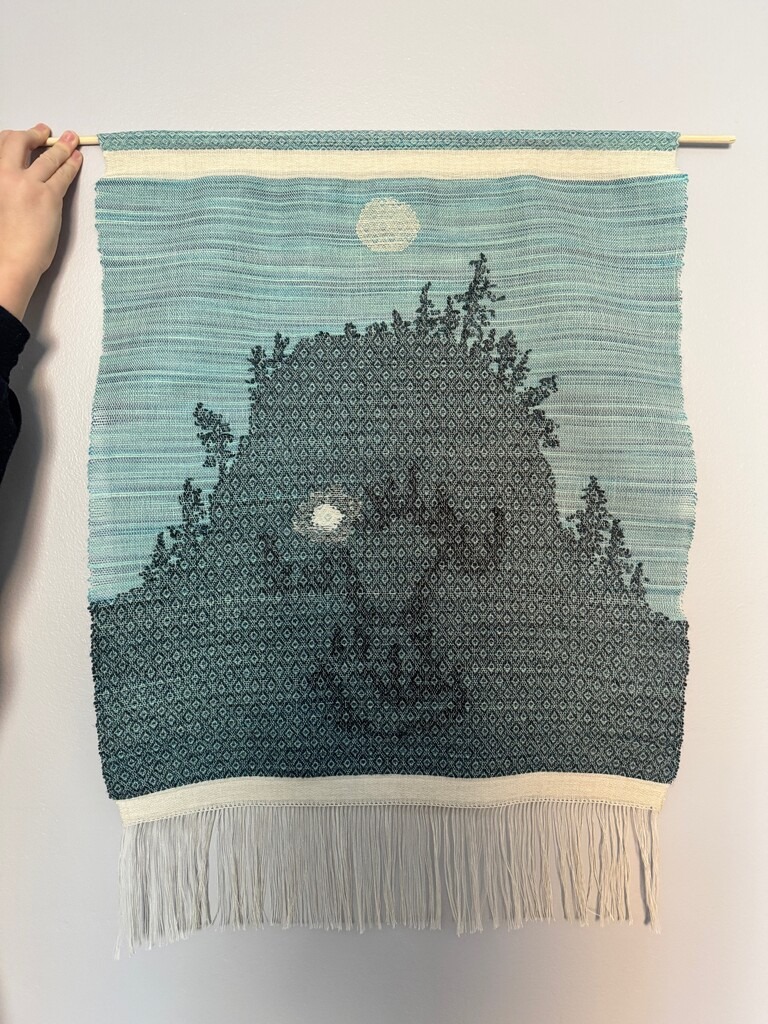
Weaving and photo by Alla Hale
Alla wove this piece as part of a series of eight, starting with six silhouettes of family members. Her warp is a very fine cotton threaded at 24 EPI. (She notes that the photo above is of the unfinished weaving fresh off the loom, rather than a “glamour shot.”)
Alla writes, “You’ll notice [my weaving] is a mirror image- I pin the reference cartoon to the work, but printed on an inkjet printer, and it was rubbing off on the work, so all my pieces became mirror images.”
“Background weft is a laceweight hand dyed merino wool. The troll is a Briggs & Little sport weight Canadian wool. The moon, eye, and shading is accomplished with an inlay of various remnant wool and alpaca, mostly fingering and lace weight.”
Weaving and photo by Alla Hale
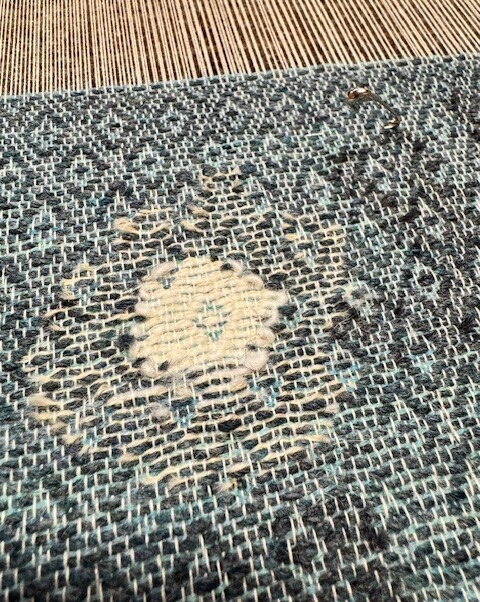
“I will share that I felt very unsure about weaving this,” Alla writes, “worried that I wasn’t doing the painting justice, until I got to his eye and saw how the overshot pattern lined up just so in the eyeball. This made me cackle with delight.” (Somewhere, the Trolls are cackling, too.)
Weaving and photo by Alla Hale
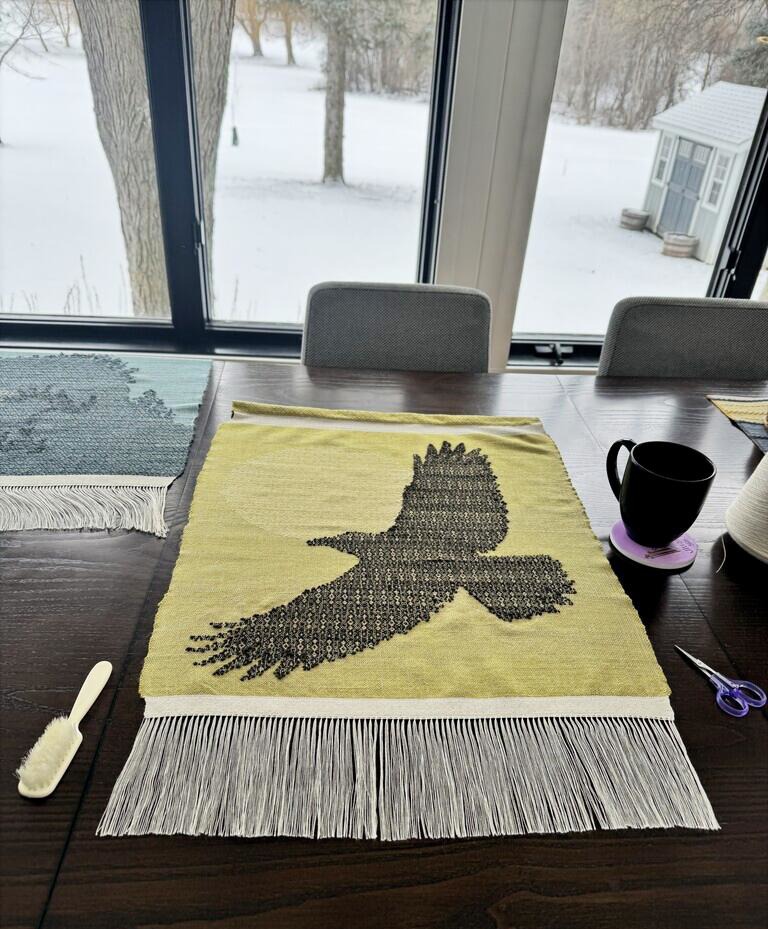
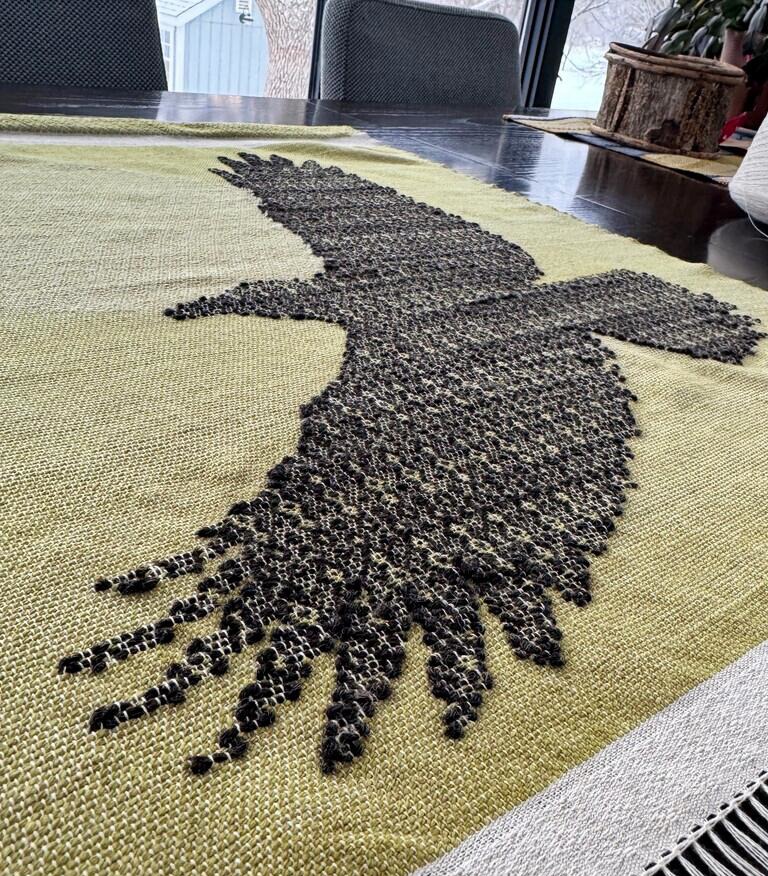
Alla’s eighth weaving in her series was a raven. “The raven was a request by a friend building a cabin up in Northern California,” she writes. “The raven is a cheviot spun at Badgerface Fiber, Minnesota’s first solar powered yarn mill.” (See link below)
Weaving and photo by Alla Hale.
“The moon is woven in a laceweight alpaca. The background is woven with a fingering weight merino wool that I dyed with red onion skins. Weaving this one was very challenging since I had to keep track of the moon [and] raven treadlings separately. What a brain workout for this baby weaver.”
Needless to say, all the weavers in our group were impressed!
Weaving and photo by Lori Labs
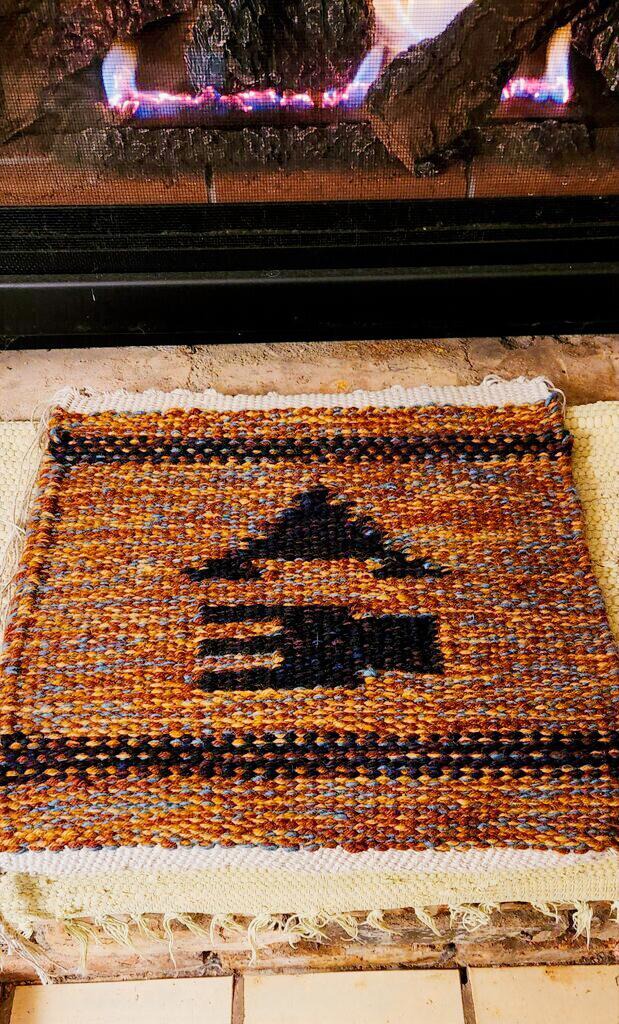
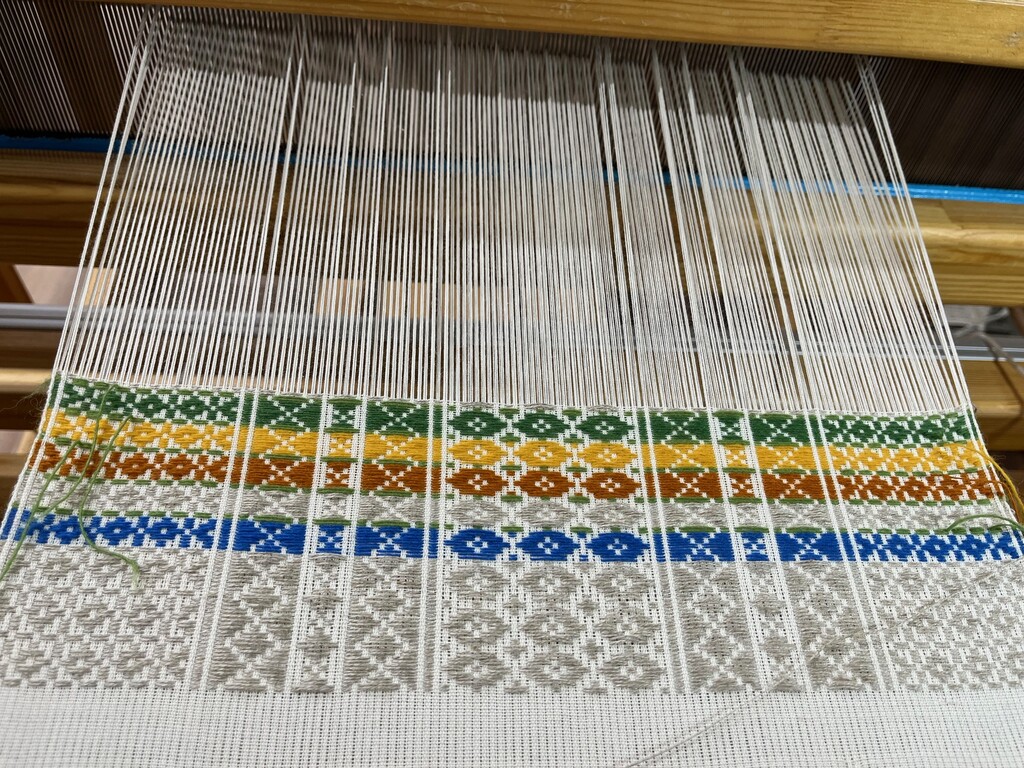
Above is Lori Lab’s Rölakan weaving, which she is in the process of finishing. Lori wove the piece in a class by Christine Novotny at North House Folk School. The weft yarn is Swedish Mattgarn. Five strands per pick allows for for color blending. The woven motifs were inspired by Lori’s travels in Morocco. With the colors echoing the flames above, Lori’s weaving seems to have found an appropriately cozy home by the fireplace.
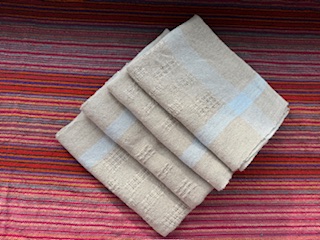
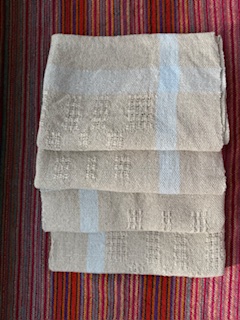
Equally cozy are Nancy Ebner’s lovely hand towels, woven in 16/2 linen that echoes the colors of the winter landscape. Nancy chose her favorite treadlings in a Bronson lace pattern from Halcyon Yarn in Maine, a state that is enduring an equally icy winter.
Look for more winter weavings in Part Two, including Norwegian pick-up bandweaving, the very last of the skillbragd warp, and the beginning our next group warp in Flesberg technique. Plus, a surprise gift lends hints of spring in Swedish linen!
Members of the Scandinavian Weavers group traveled far and wide in 2025. Lisa Torvik ventured to Rauland in Telemark, Norway, eleven hours north of Oslo. There, she studied weaving at Raulandsakademiet, which offers classes in traditional craft. (See link below.)
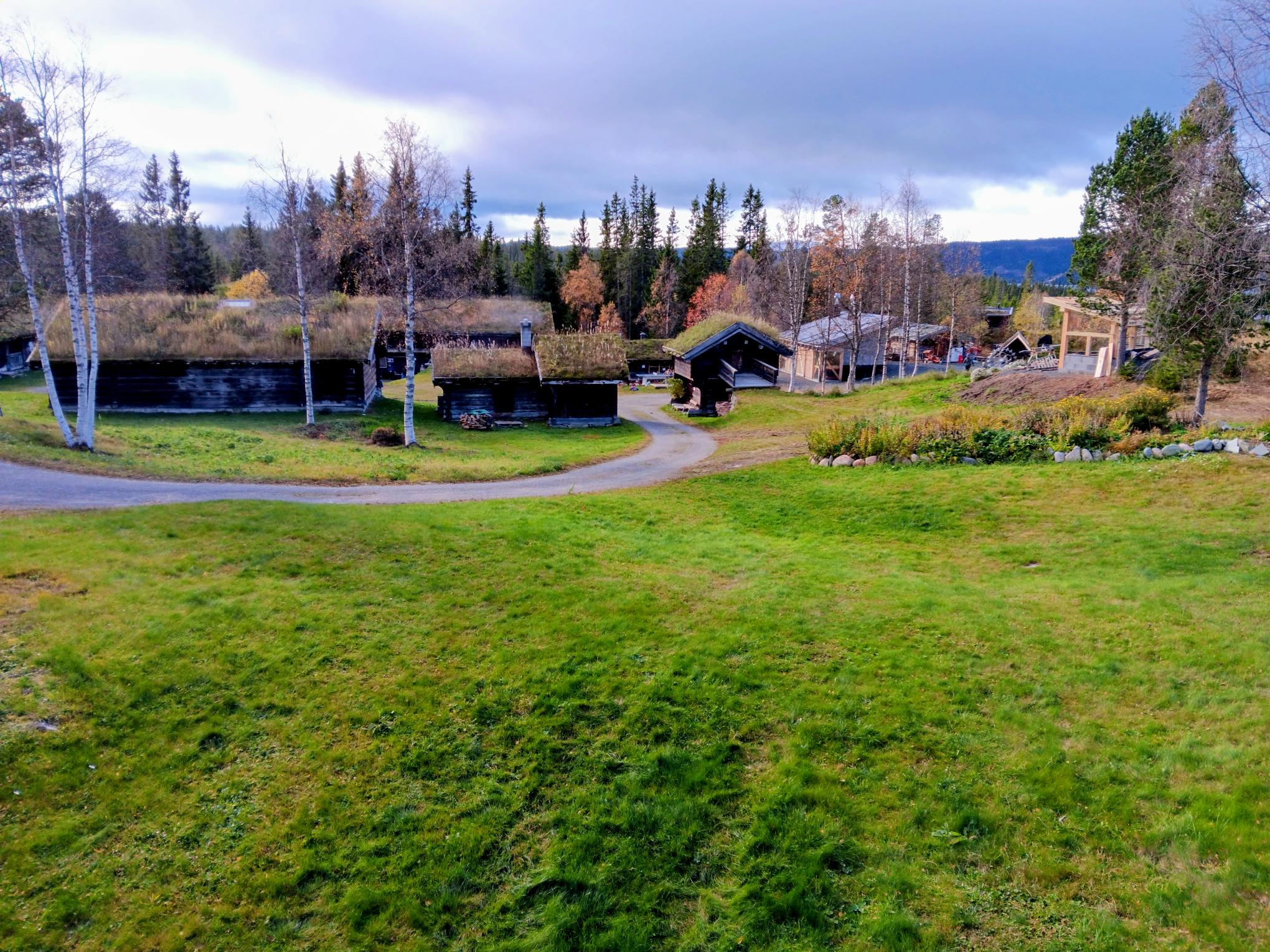
View from Raulandsakademiet in beautiful Telemark. Photo by Lisa Torvik.
Note from Lisa: “This is the view out the back windows of the fireplace lounge (peisestogo) and the upper floor cafeteria and large meeting room [at Raulandsakademiet]. The building is the “Telemark Tun”, a small museum of traditional farm buildings that house a shop of handmade items in the hay barn and a bakery specializing in traditional breads. In Norwegian, a “tun” is what we call a farmstead and since farmsteads were often built close together, with maybe two manor houses or more, it might be the origin of the English word town. ”
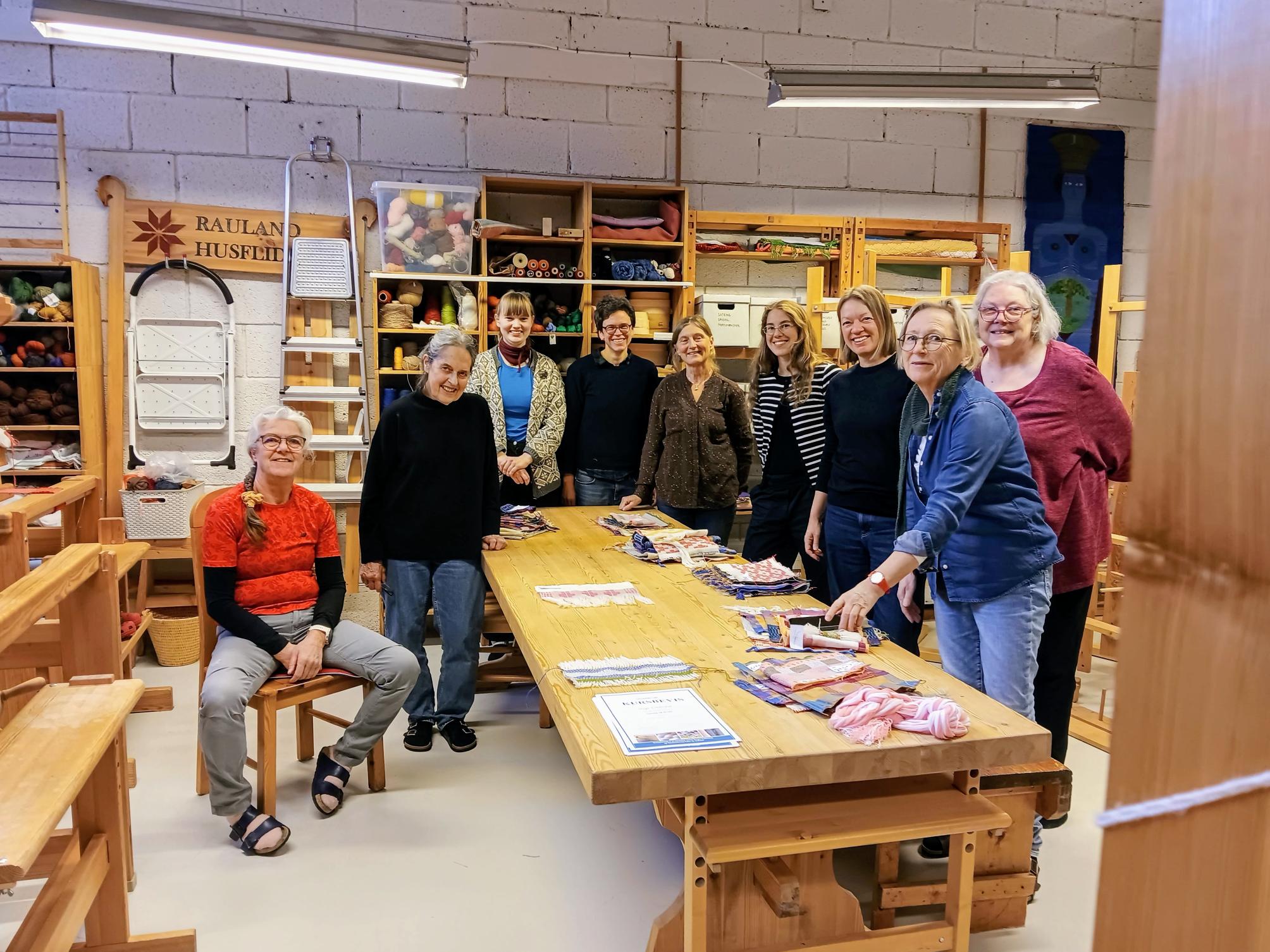
The weaving course was taught in Norwegian. Fortunately, Lisa is fluent in both language and traditional weaving, having studied at at Valdres Husflidskule (handcraft school) in Fagernes in 1974. She is currently a member of the Øystre Slidre Husflidslag (handcraft guild).
Lisa (in the red shirt) with her classmates in Rauland.
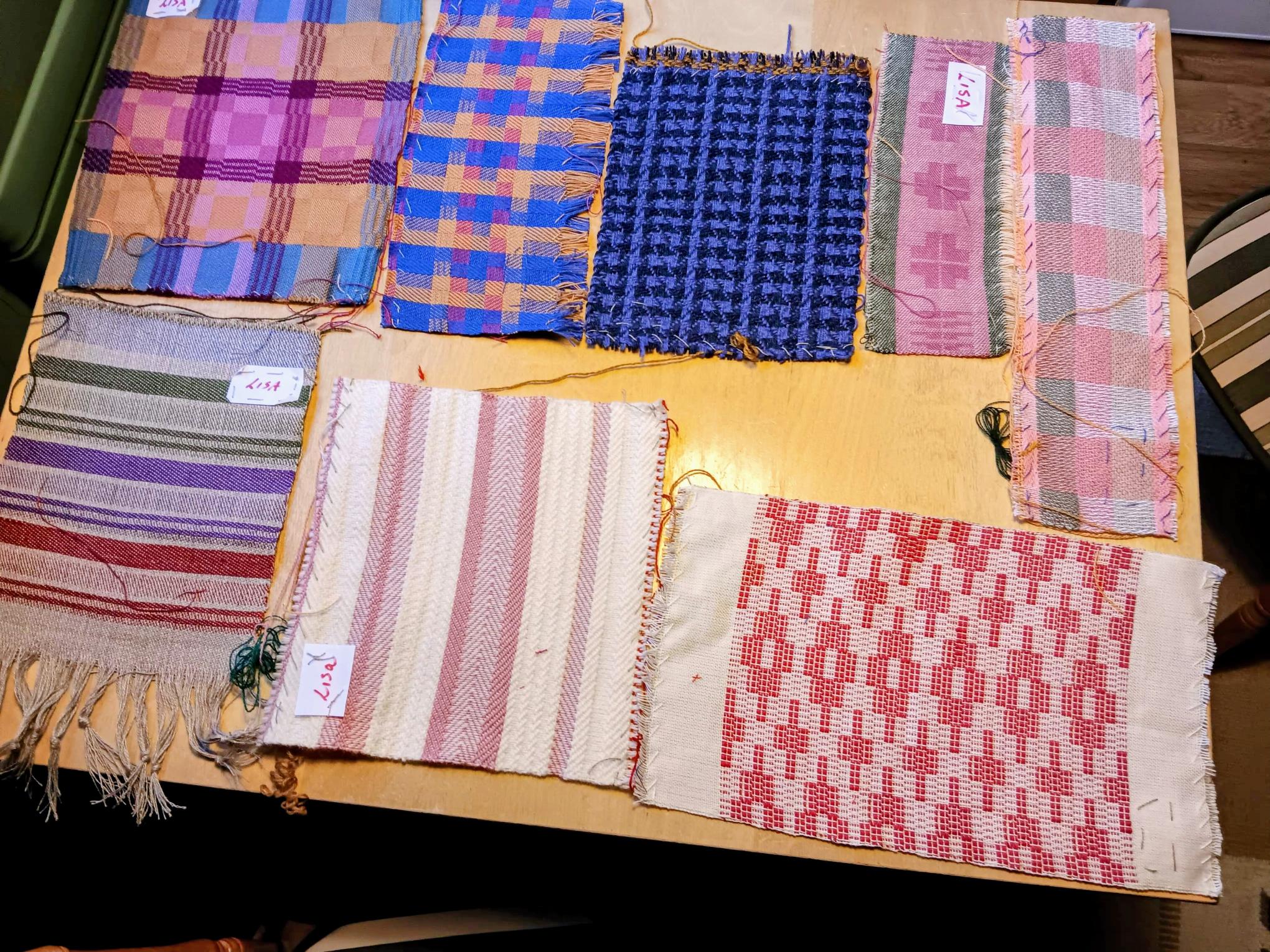
“The course I attended this fall in Rauland was called “Dreiel og sateng”, and focused on “drill” patterns of both satin and broken twill (korskypert) weaves,” Lisa explains. The course instructor was Rita Vistad
Lisa’s weaving samples. She wove all this in two and a half days! Photo by Lisa Torvik.
While in Norway, Lisa visited many friends and family members, bringing gifts of her woven items. Here is Lisa’s friend Gunvor Hegge in her artist’s studio. Lisa wove the black-and-white skillbragd table runner on the table.
Photo by Lisa Torvik.
Holly Hildebrandt made her very first trip to Norway, where she studied with Ingebjørg Monsen in Bergen. Ingebjørg is president of Bjørgvin Husflidslag (handcraft guild), where she teaches classes in weaving and sewing, and specializes in constructing men’s bunader (national costumes).
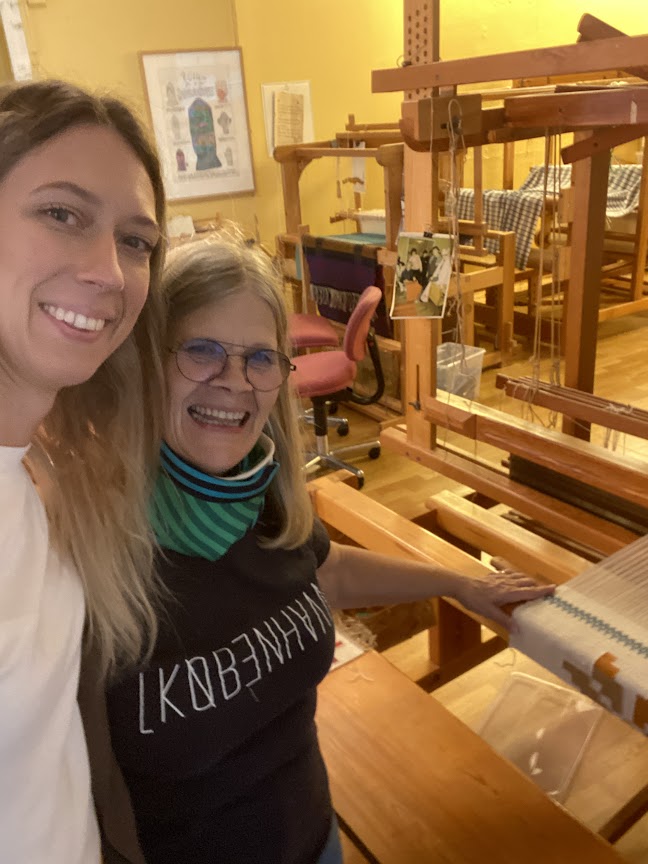
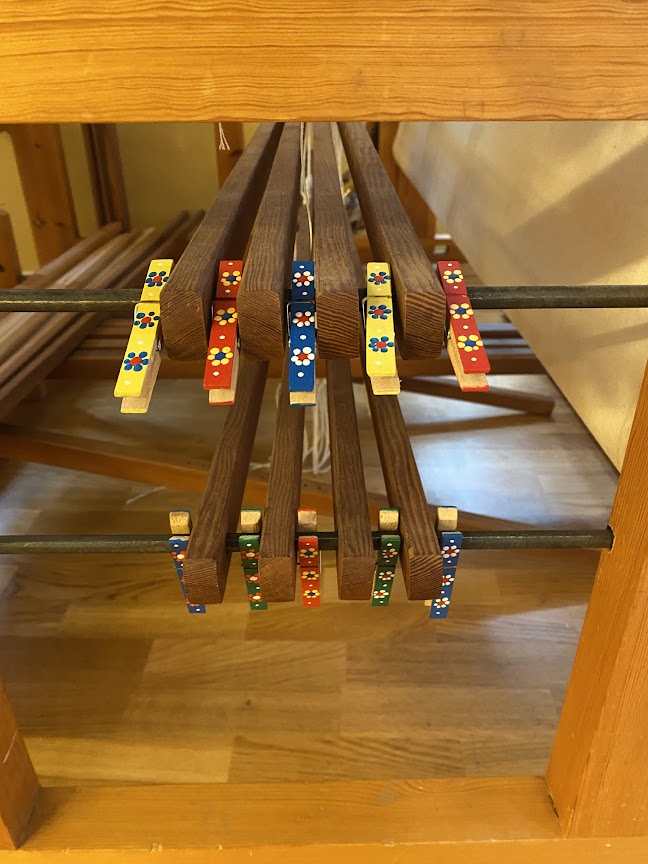
Holly and Ingebjørg at the loom. Photo by Holly Hildebrandt.A clever weaving hack to keep treadles spaced properly. Photo by Holly Hildebrandt.
Holly spent the week learning to weave krokbragd and rutevev techniques in beautiful Norwegian wool.
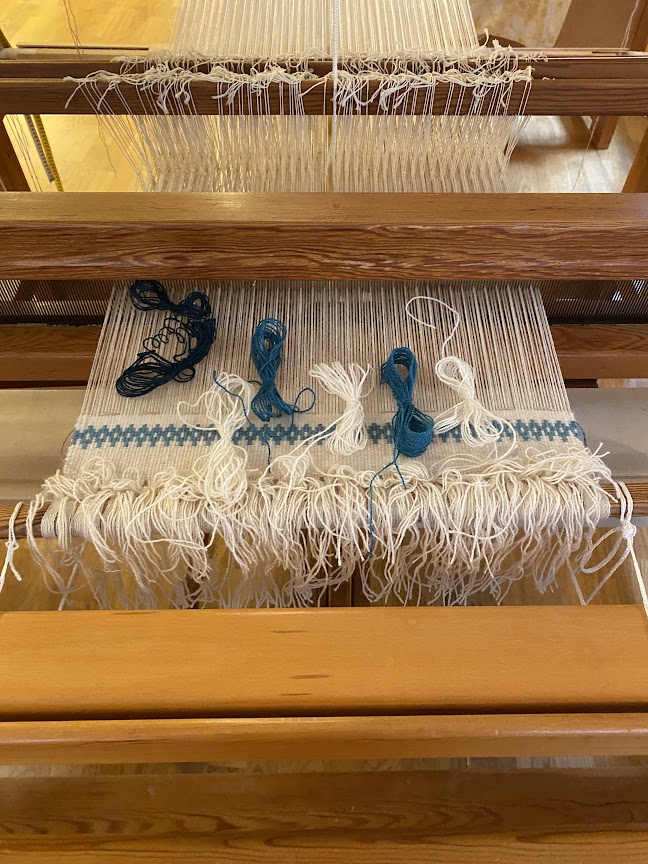
Krokbragd designs on the loom. Photo by Holly Hildebrandt.Yarn spin from Norwegian spelsau sheet. Notice the sheen! Photo by Holly Hildebrandt.
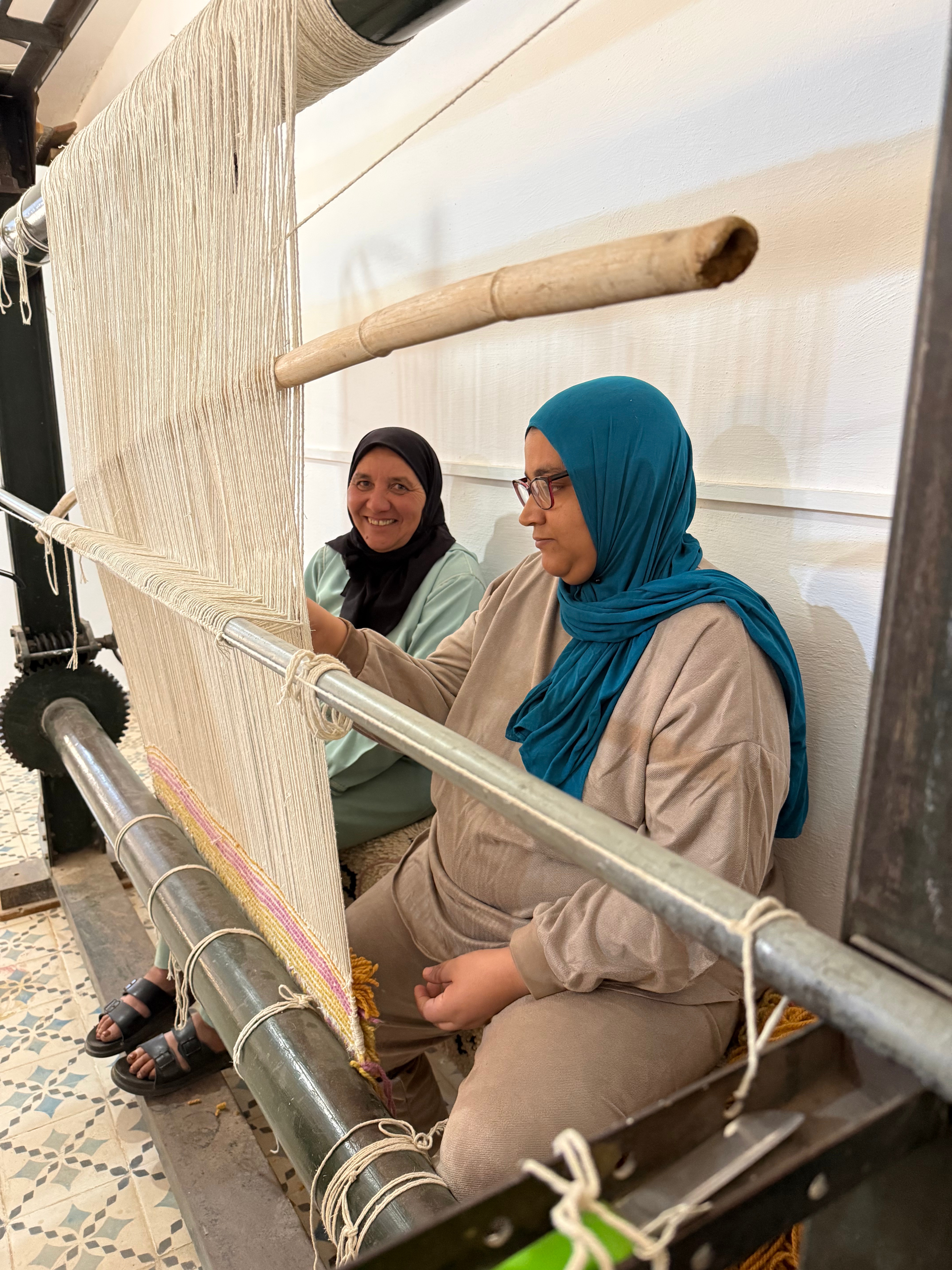
Nancy Ebner finished her 2025 travels with a trip to Morocco through Loom Dancer Odysseys. Nancy and other tour members participated in four textile workshops, and Nancy took more than 1000 photos! Below, women weave rugs in a pile technique similar to Scandinavian rya.
Photo by Nancy Ebner, taken at the Cherry Buttons Women’s Cooperative.
Weaving is a universal language with a thousand different dialects. Many of the Scandinavian Weavers group are ardent travelers, roaming far and wide to learn more about global textile traditions. These are some of their stories.
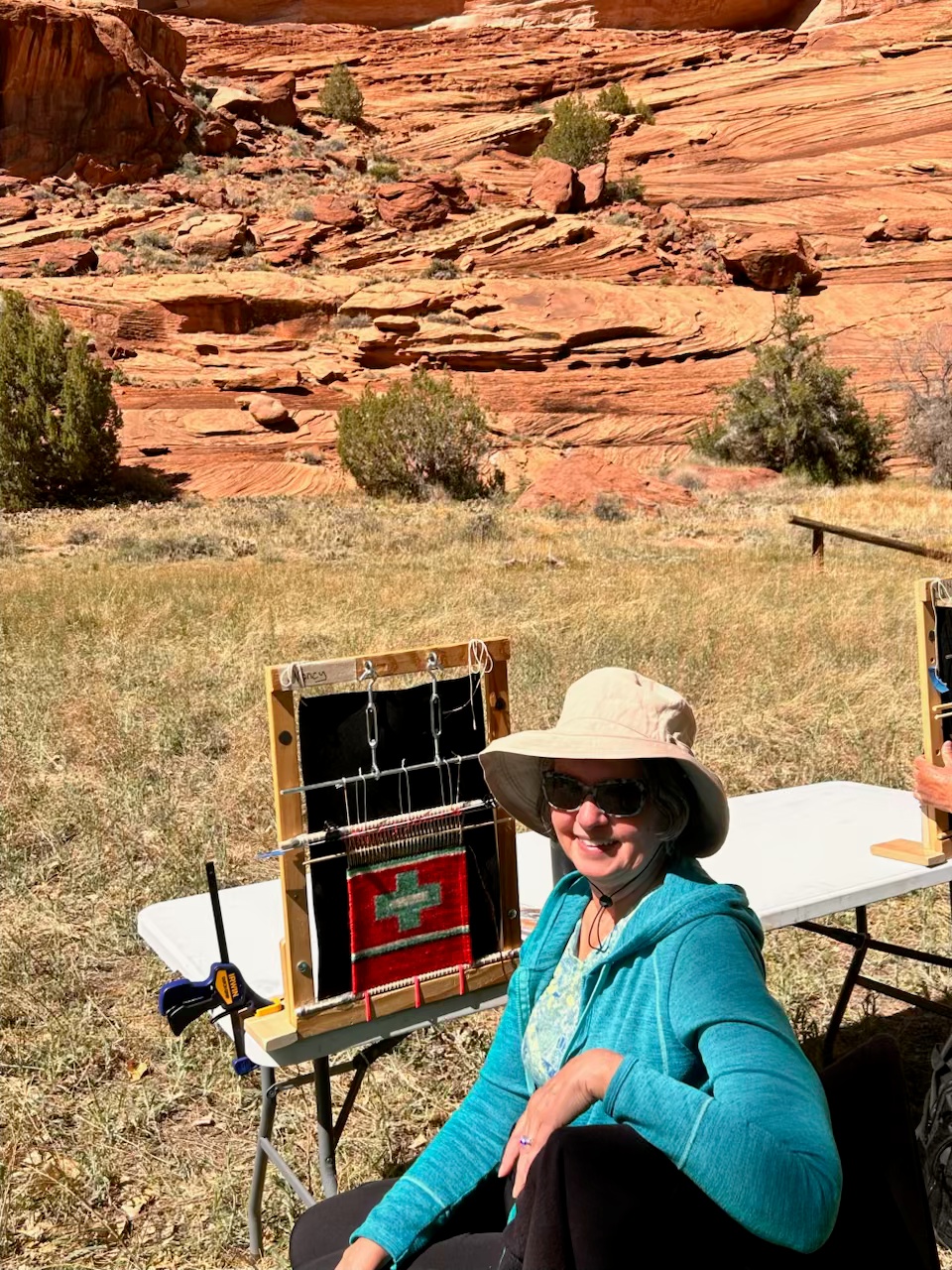
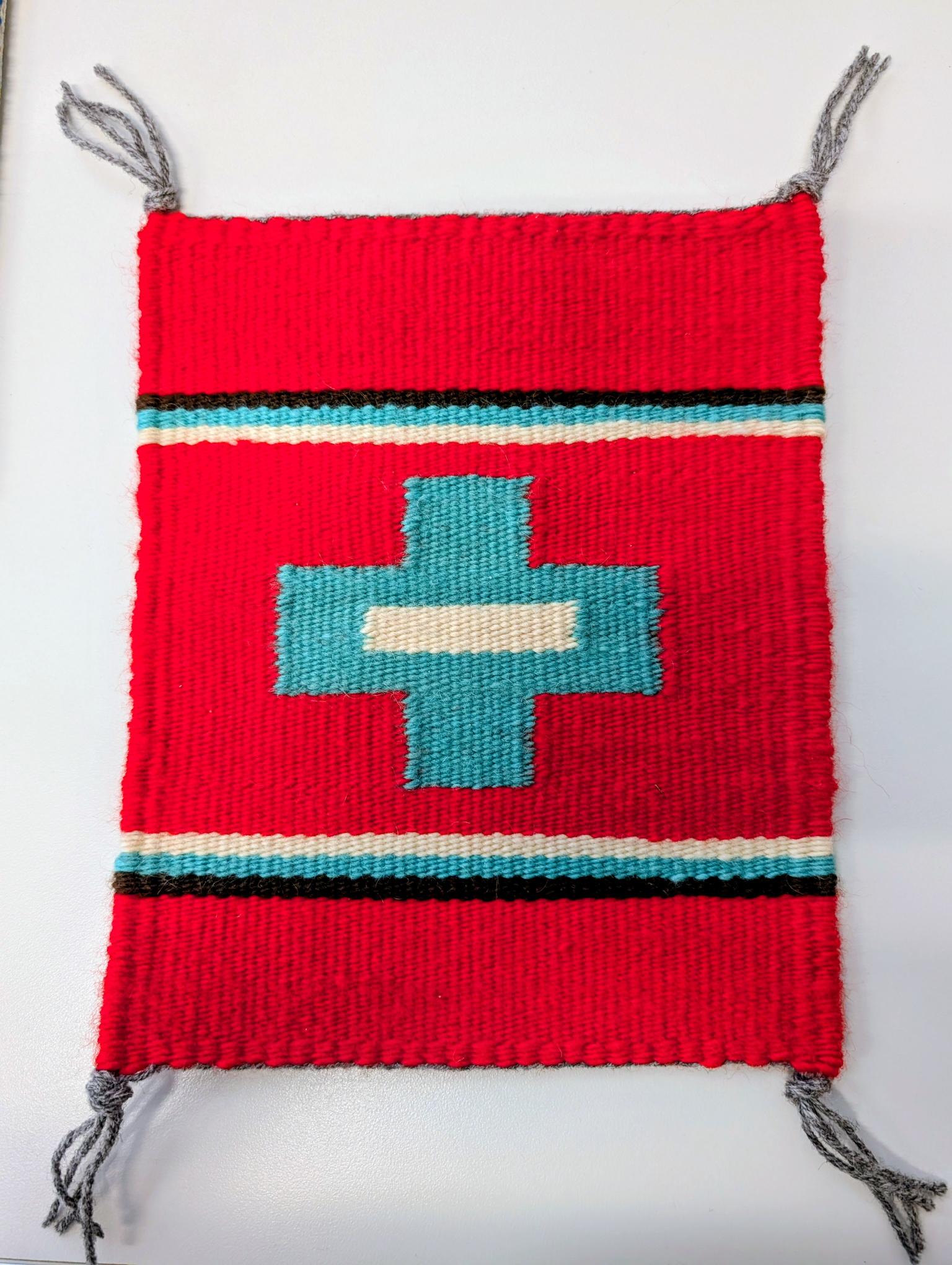
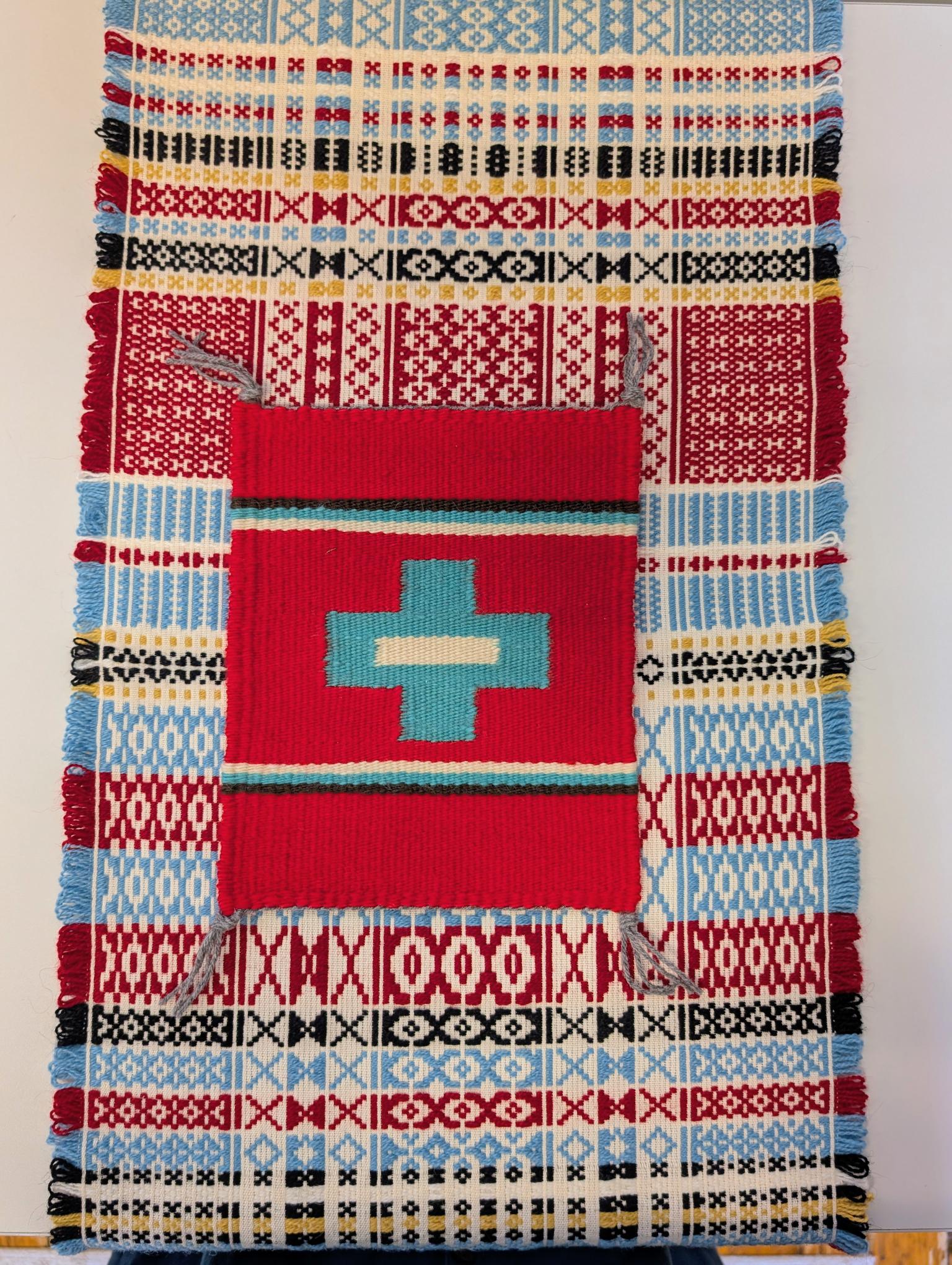
Nancy Ebner is a true globe-trotter—and wherever she travels, she always takes time to take classes in local weaving traditions. Here, she learns Diné-inspired tapestry on a portable loom in Canyon de Chelly, Arizona.
Nancy’s finished tapestry. Photo by Nancy Ebner.
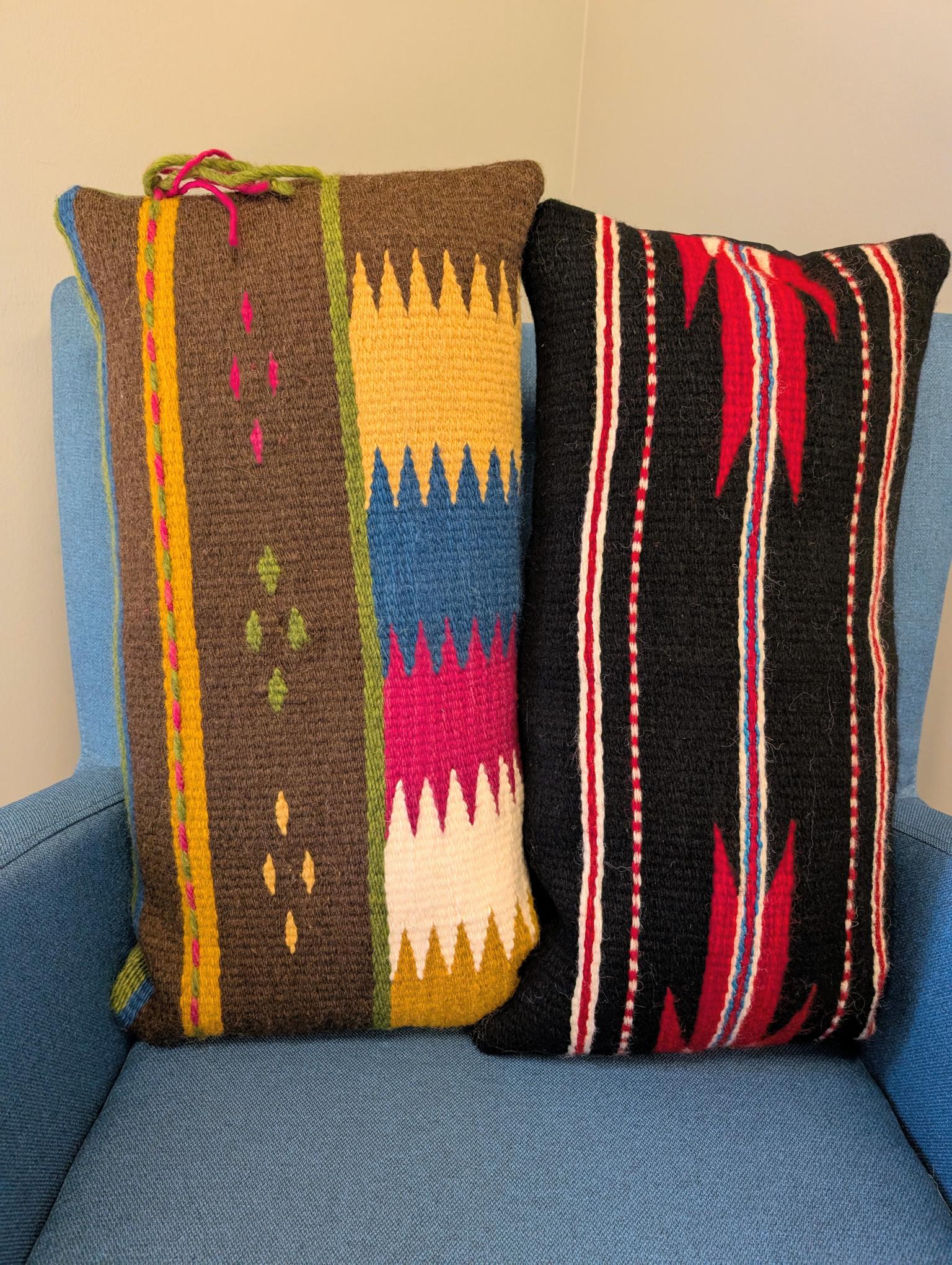
In a previous trip to Santa Fe, New Mexico, Nancy wove on a 2-harness, Rio Grande loom. “Rio Grande looms are also called “Walking Looms” because you stand at the loom, instead of sitting at the loom and step on the treadles to work the harnesses,” Nancy explained in a blog post. “They are counterbalance in nature, so they generate an excellent weaving shed.”
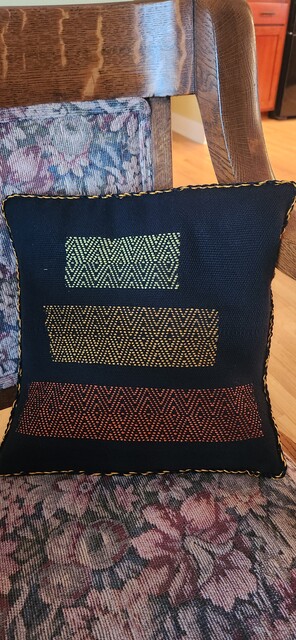
Nancy turned her Rio Grande weavings into pillows. Photo by Lisa-Anne Bauch.
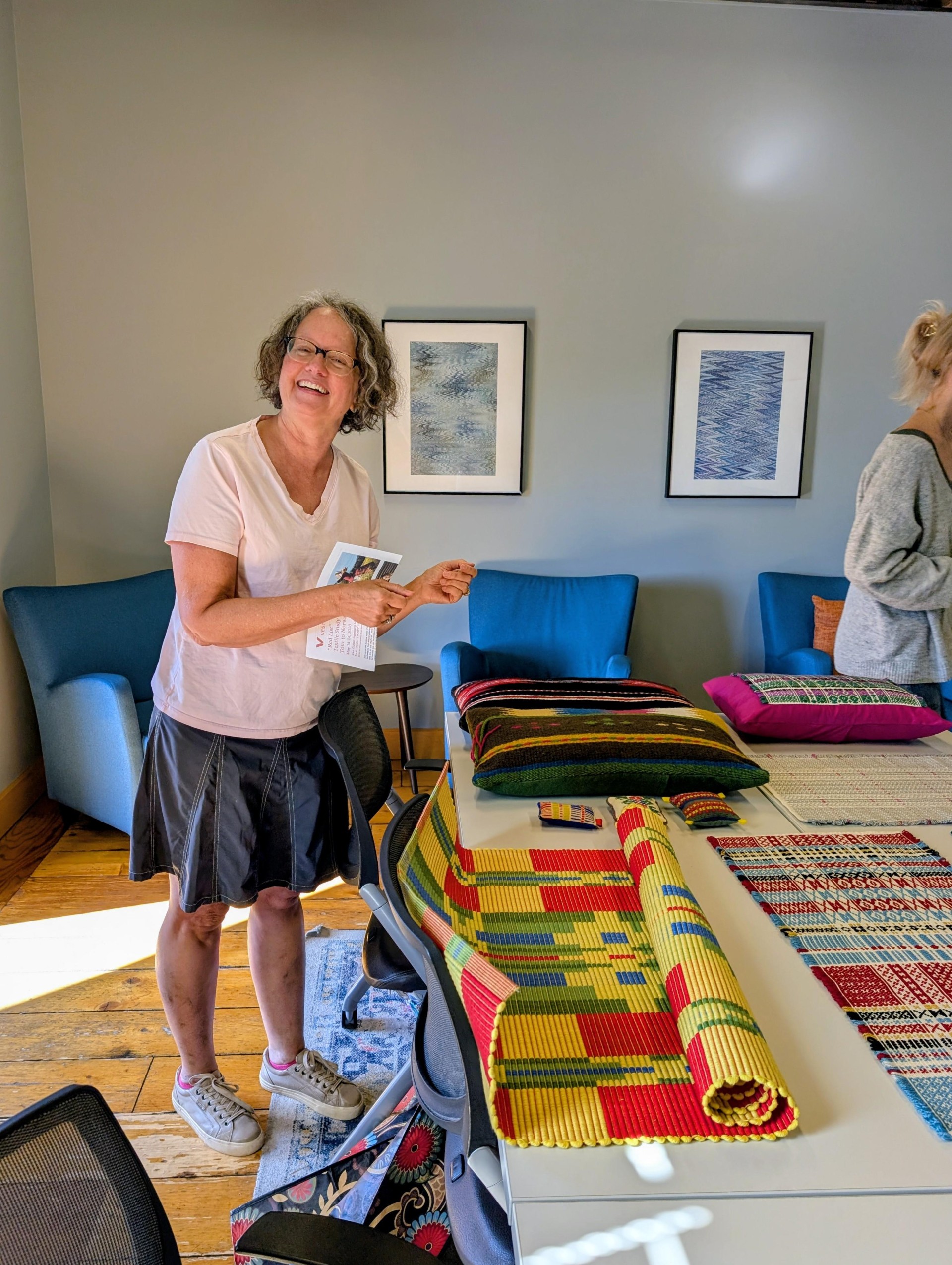
These were just a few of the SIXTEEN pieces Nancy wove and/or finished between April and August of this year. (We’re pretty sure this is a group record!) She shared them at a fall Scandinavian Weavers meeting.
Nancy surrounded by her sixteen weavings! Photo by Lisa Bauch.
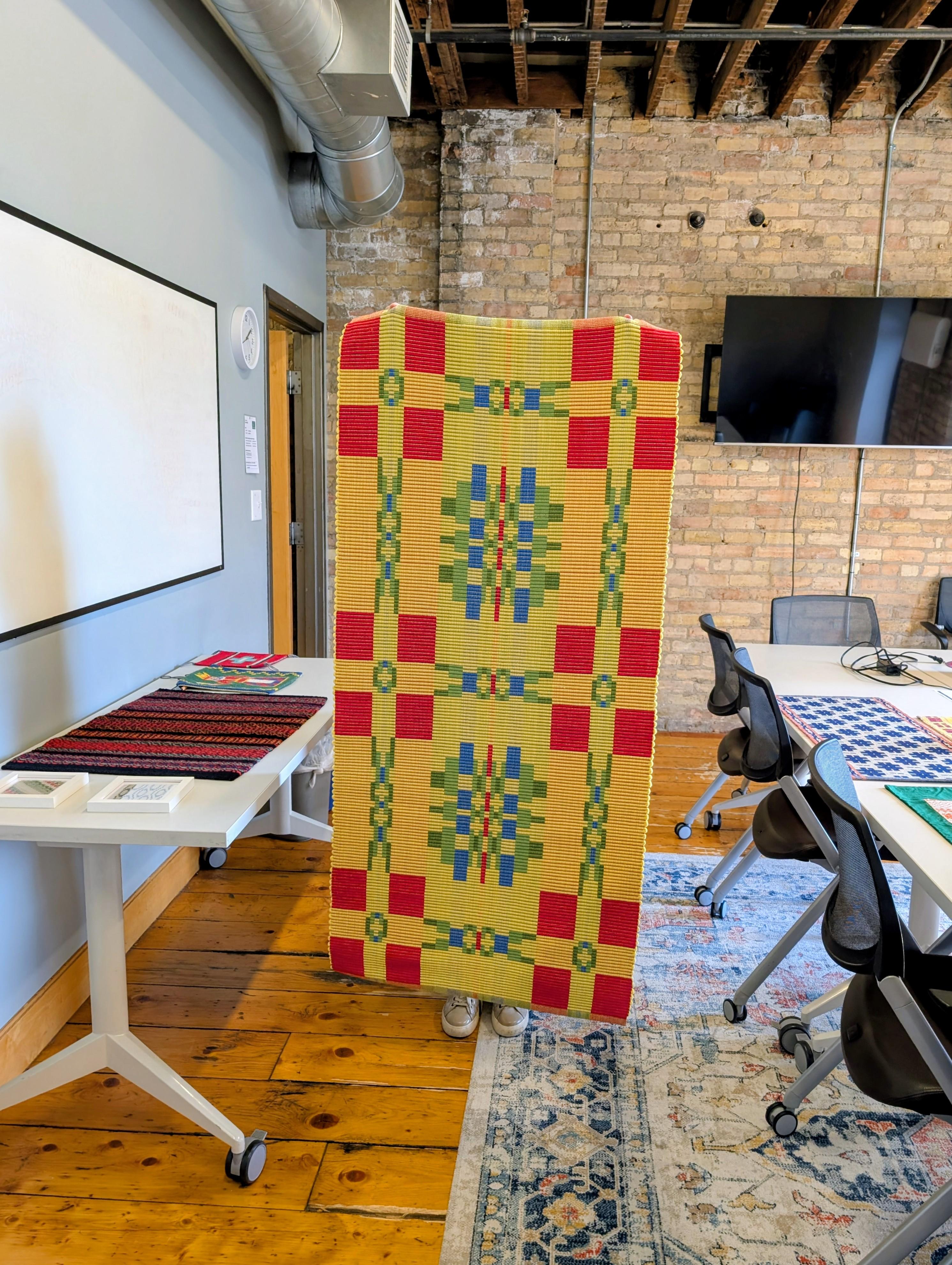
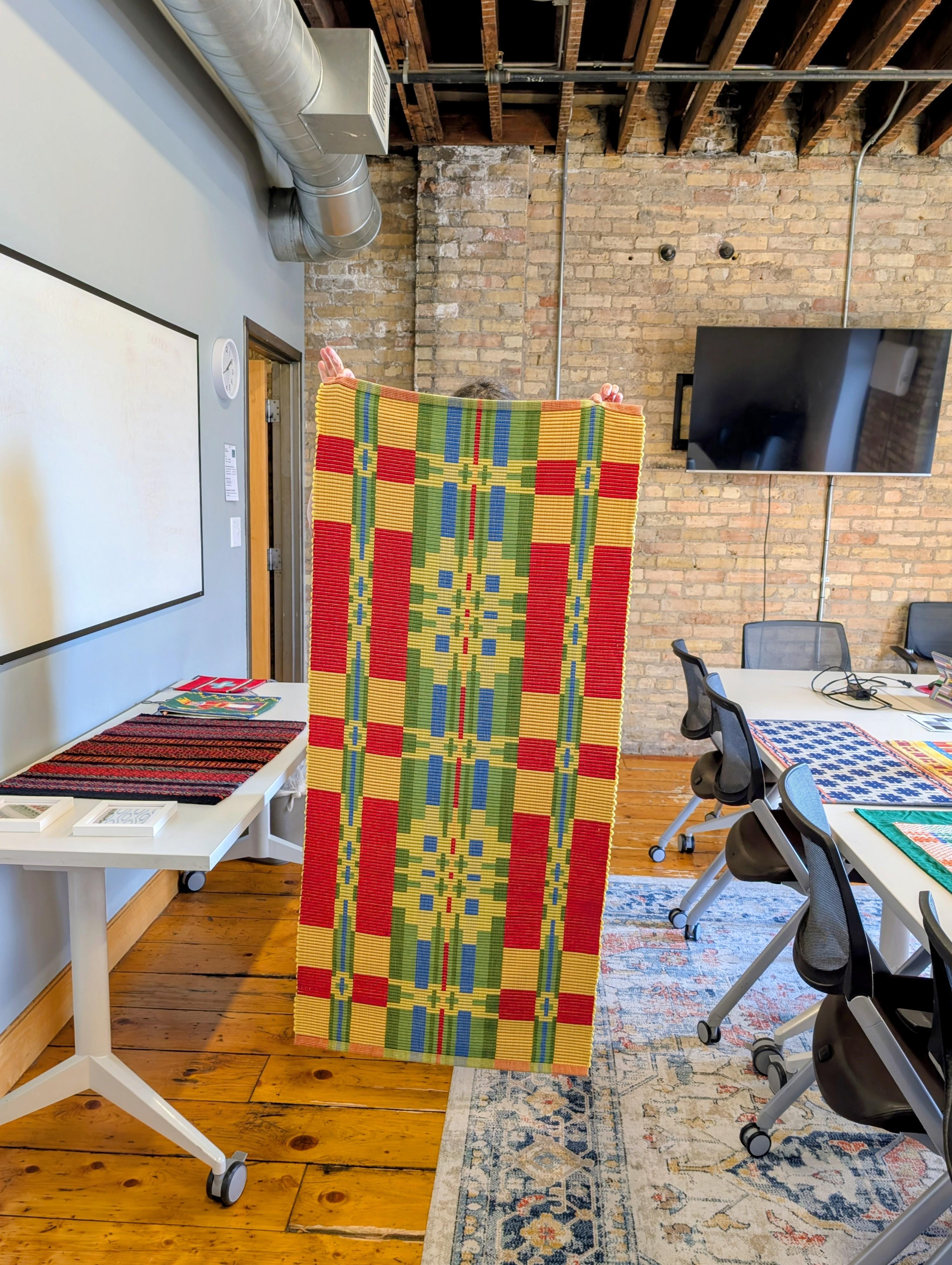
Nancy’s recent travels include a class in rep weave at Vävstuga Weaving School in Massachusetts, where she wove the rug below. (See link below) Which side do you prefer?
Photo by Lisa BauchPhoto by Lisa Bauch
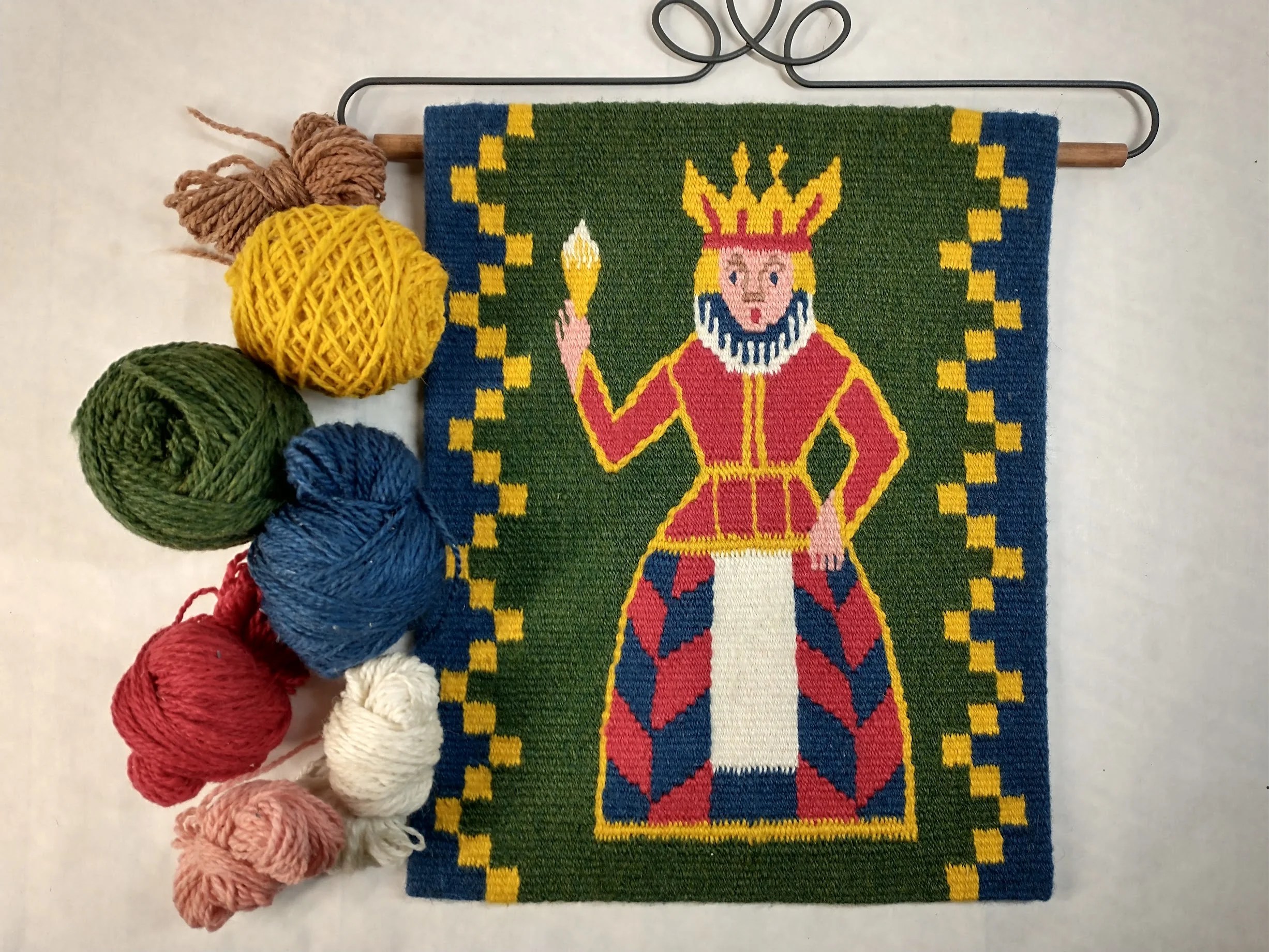
Nancy also studied Norwegian billedvev (tapestry) with Laura Berlage. Below is her rendition of the traditional Wise Virgin motif.
Photo by Nancy Ebner
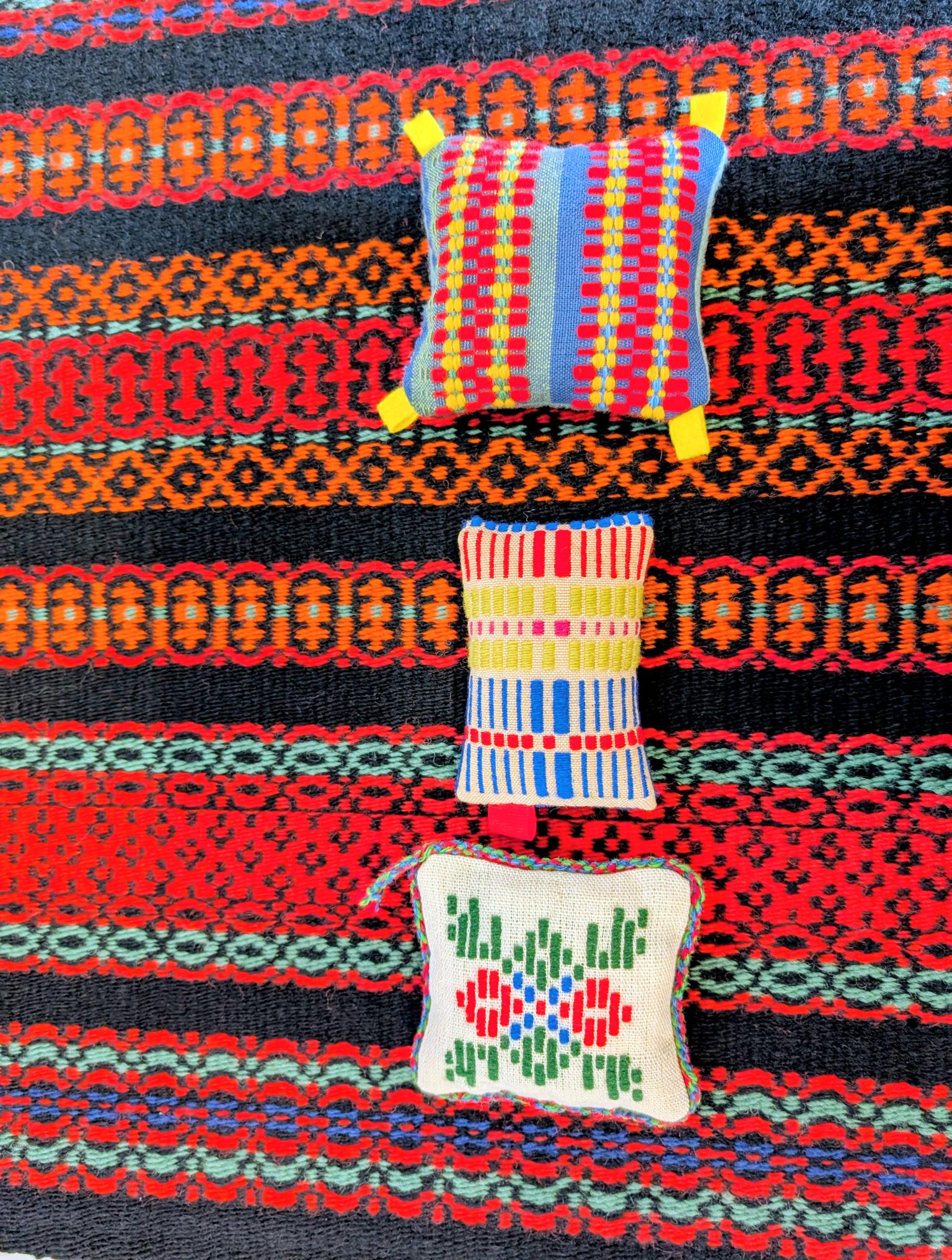
Nancy cleverly used her samples from a Swedish weaving workshop to make pin cushions. They are displayed here on a weaving she did in Norwegian flesberg technique.
Photo by Nancy Ebner.
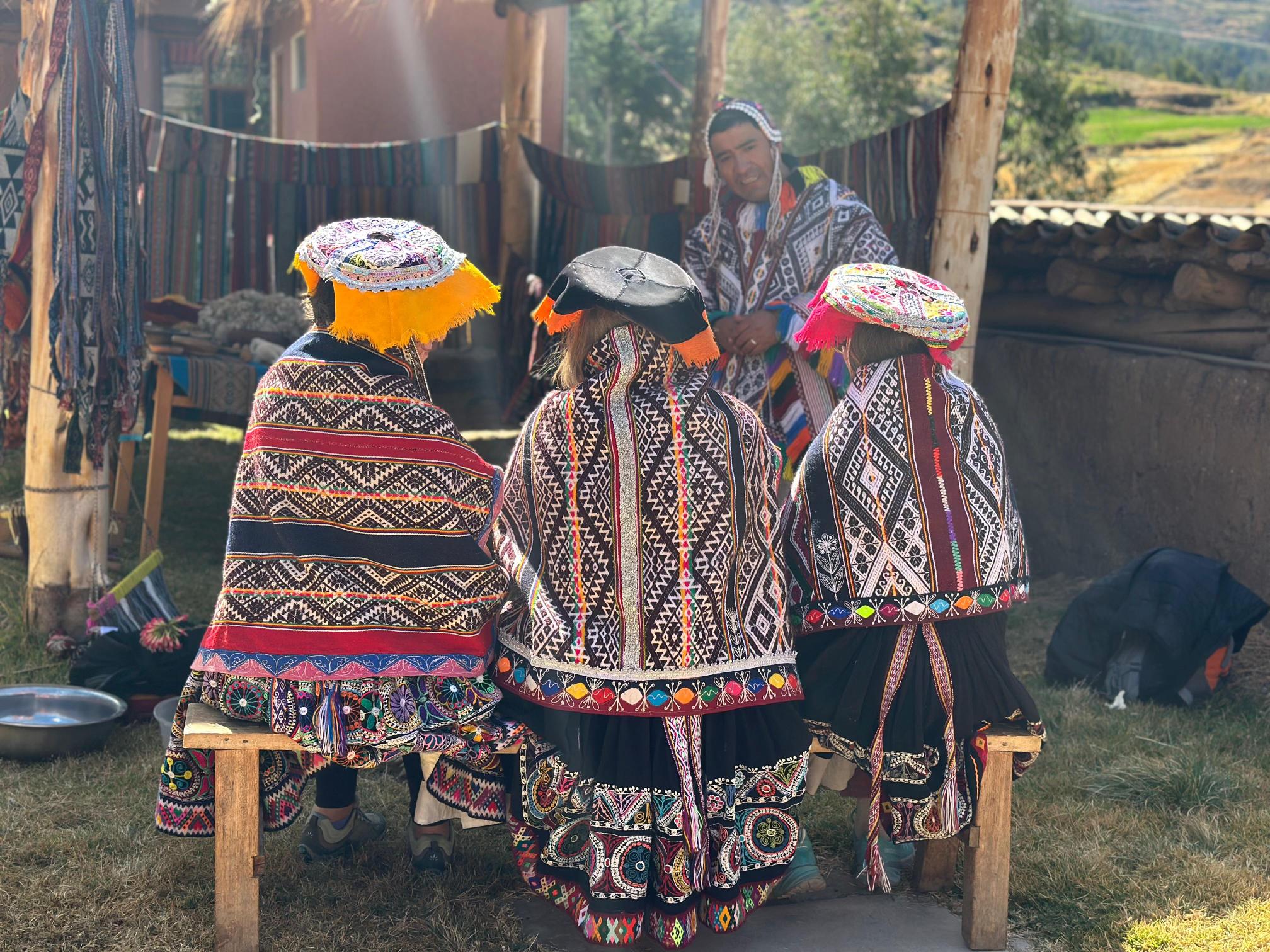
Finally, a photo from a trip Nancy led to Peru, through The Andean Alliance for Sustainable Development.
Quechua weavers. Photo by Nancy Ebner.
“I enjoy the weaving itself,” Nancy says of her travels, “and the connection it creates to people of other countries, backgrounds and cultures.”
Below, a cultural exchange. Nancy’s tapestry atop a Norwegian skillbragd she wove during a Scandinavian Weavers group warp. (See Skillbragd post.)
Photo by Lisa-Anne Bauch.
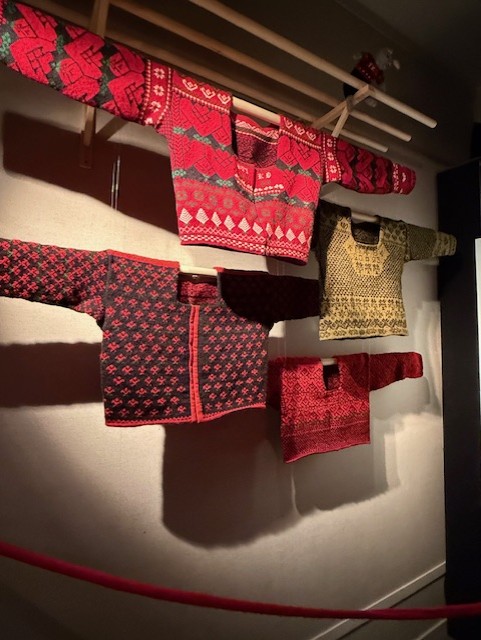
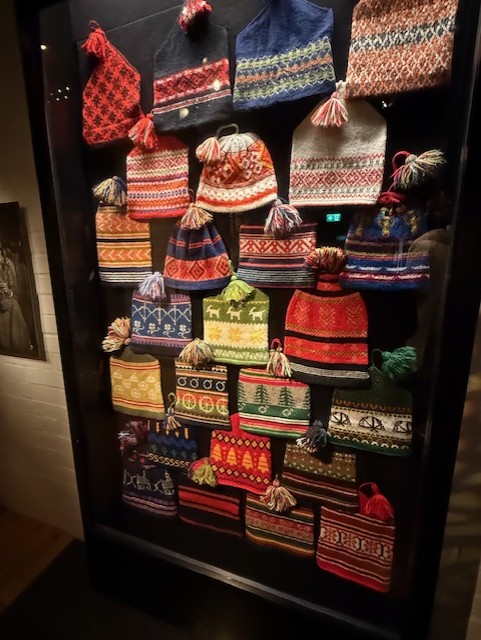
Meanwhile, Judy Larson attended the Väv2025 weaving conference in Gävle, Sweden. While there, she visited the Dalarnas Museum in Falun and took these photos of a knitting exhibit.
Photo by Judy Larson.Photo by Judy Larson.
Following the conference, Judy traveled to Vävstugan (The Weaving House ) in Tingsryd, Sweden. Here, weavers of all levels are welcome to work on one of 23 looms in a variety of traditional Swedish techniques. (See link below.)
Photo by Judy Larson.
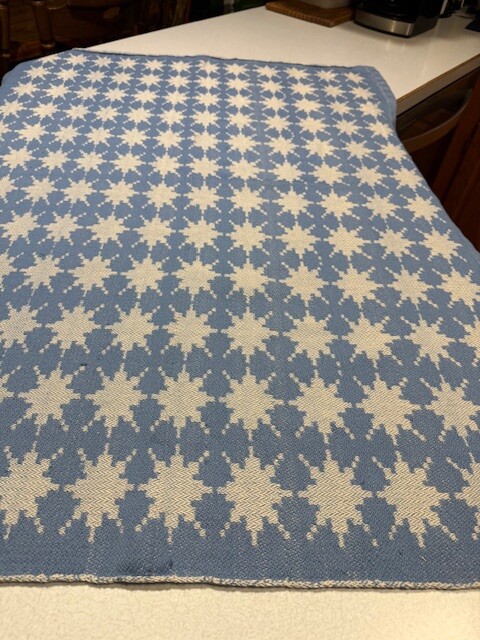
Judy wove this beautiful blue blanket in 8/2 cotton on a drawloom. She wove the piece below BACK SIDE UP, using Opphämpta technique on a drawloom. Congratulations, Judy!
Photo by Judy Larson.
Go to Part Two of this post for more weaving journeys!
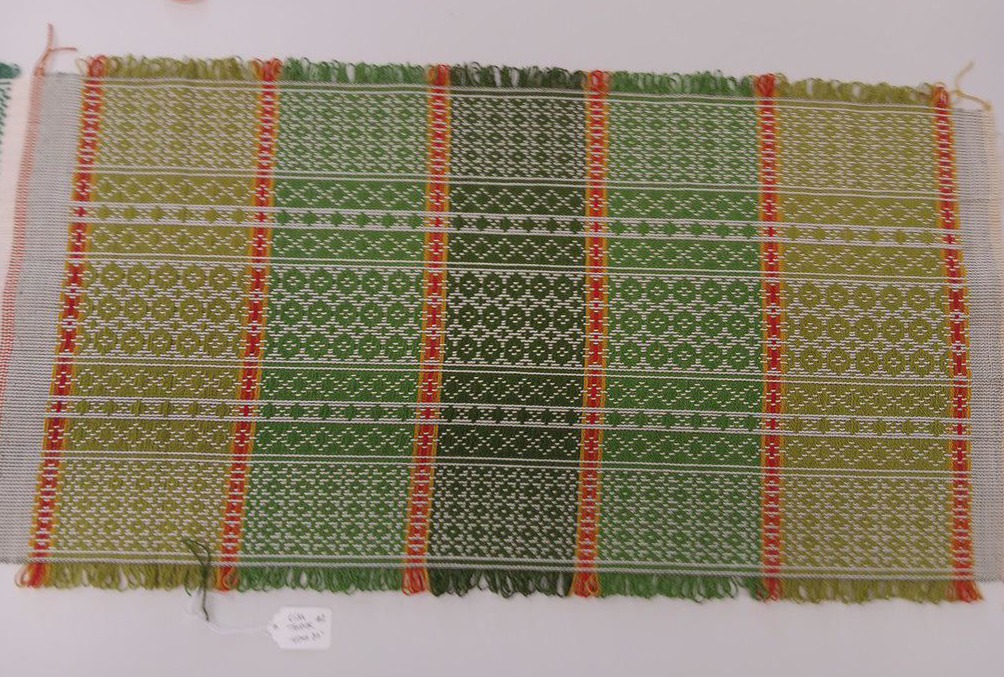
In 2025, the Scandinavian Weavers wove two long group warps in skillbragd technique. Group warps give newer members the opportunity to try techniques with support from more experienced members. It also allows weavers to use a larger floor loom they might not have at home.
We are grateful that the Weavers Guild of Minnesota has dedicated looms for interest groups. We love weaving at the Guild, as it gives us a chance to share our passion for Scandinavian weaving with visitors, shoppers, students, and fellow Guild members.
Lisa Torvik weaving skillbragd at the Weavers Guild of Minnesota.
Lisa Torvik was our mentor in skillbragd, providing guidance in dressing the loom as well as math, problem-solving, and the occasional repair of broken warp threads. (She swears by weaver’s knots!)
Skillbragd in spring shades. Photo by Lisa Torvik.
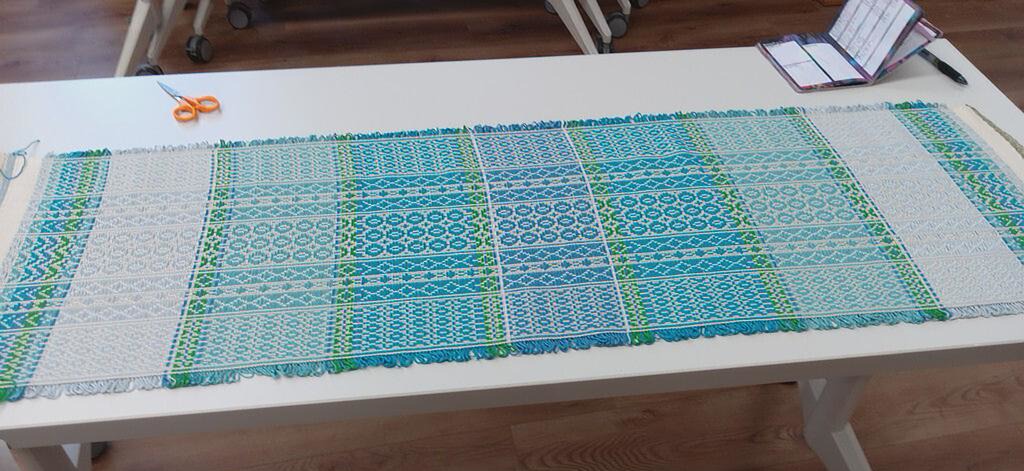
Lisa wove this runner in spring colors, using Rauma Prydvevgarn.
Photo by Lisa Torvik.
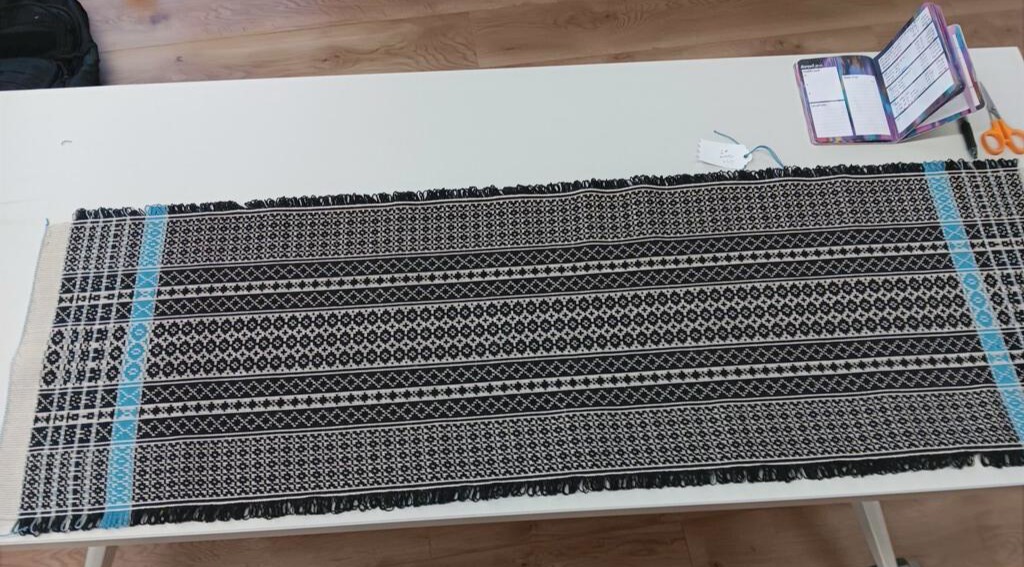
Many of Lisa’s weavings end up as gifts for family and friends in Norway. The black-and-white runner was destined for watercolor artist Gunvor Hegge. (See “Weaving Journeys” blog post for a photo of the runner in its new home.)
Weaving and photo by Lisa Torvik.
Another runner in delicate spring shades.
Weaving and photo by Lisa Torvik.
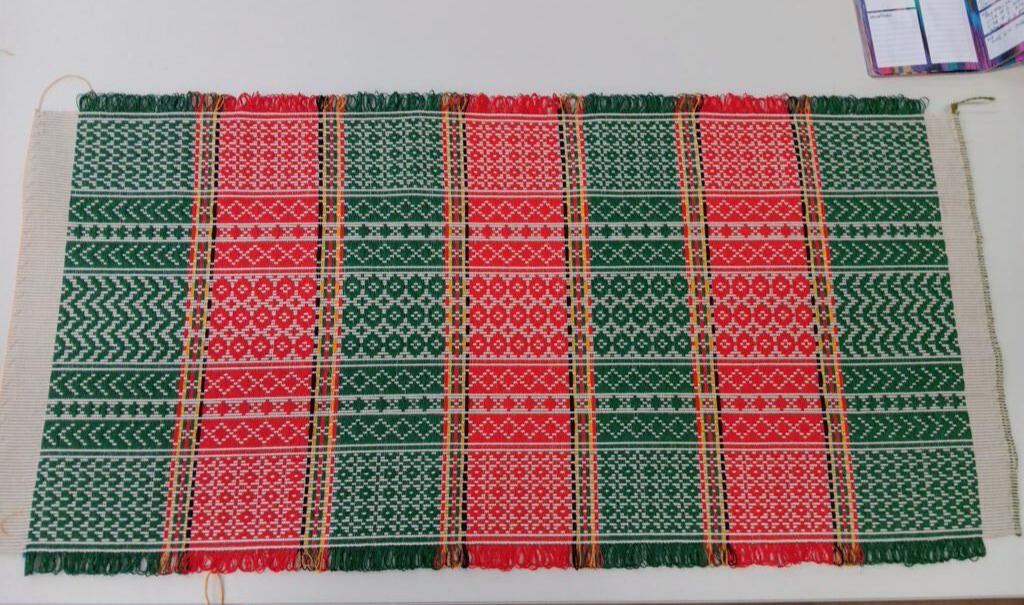
Finally, a weaving for Christmas!
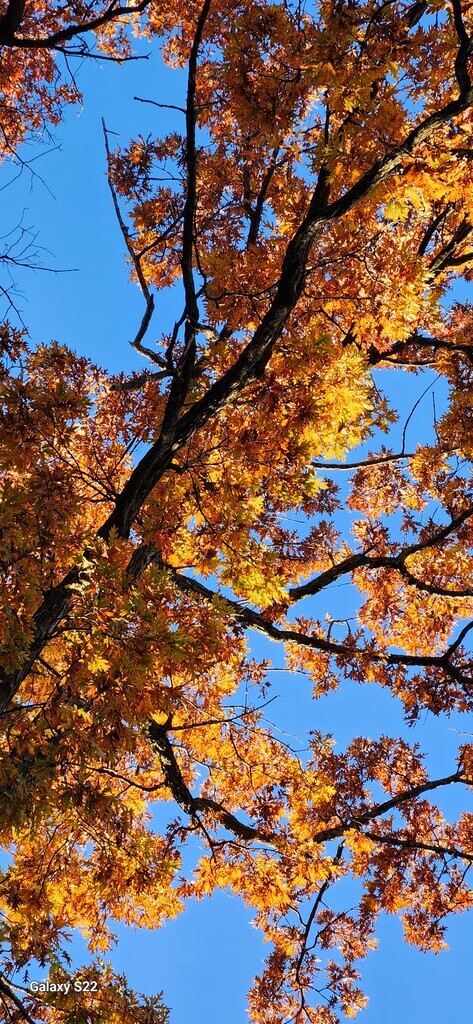
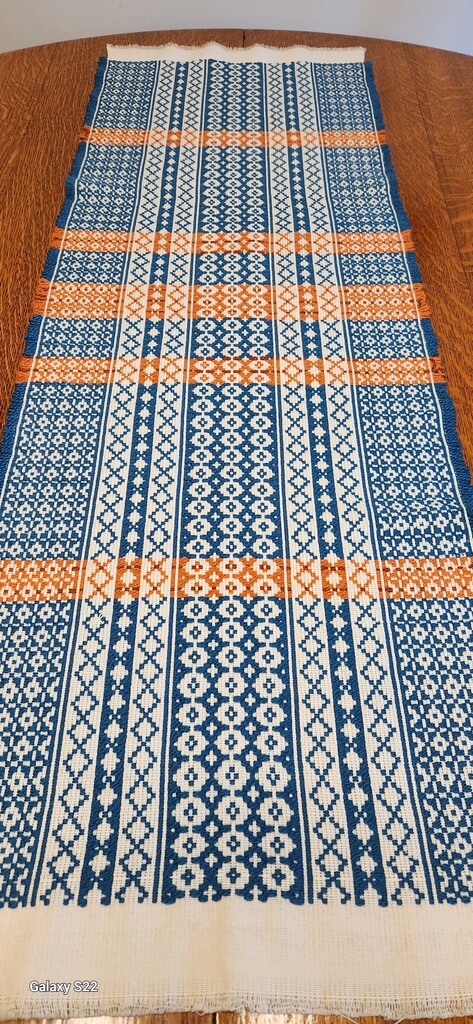
Minnesota enjoyed an unusually mild autumn this year. Lori Labs was inspired by the oak trees at her home in weaving her table runner.
Photo by Lori Labs.
Lori’s weaving in shades of orange and turquoise captured the brilliant glow of golden leaves against the autumn sky.
Weaving and photo by Lori Labs.
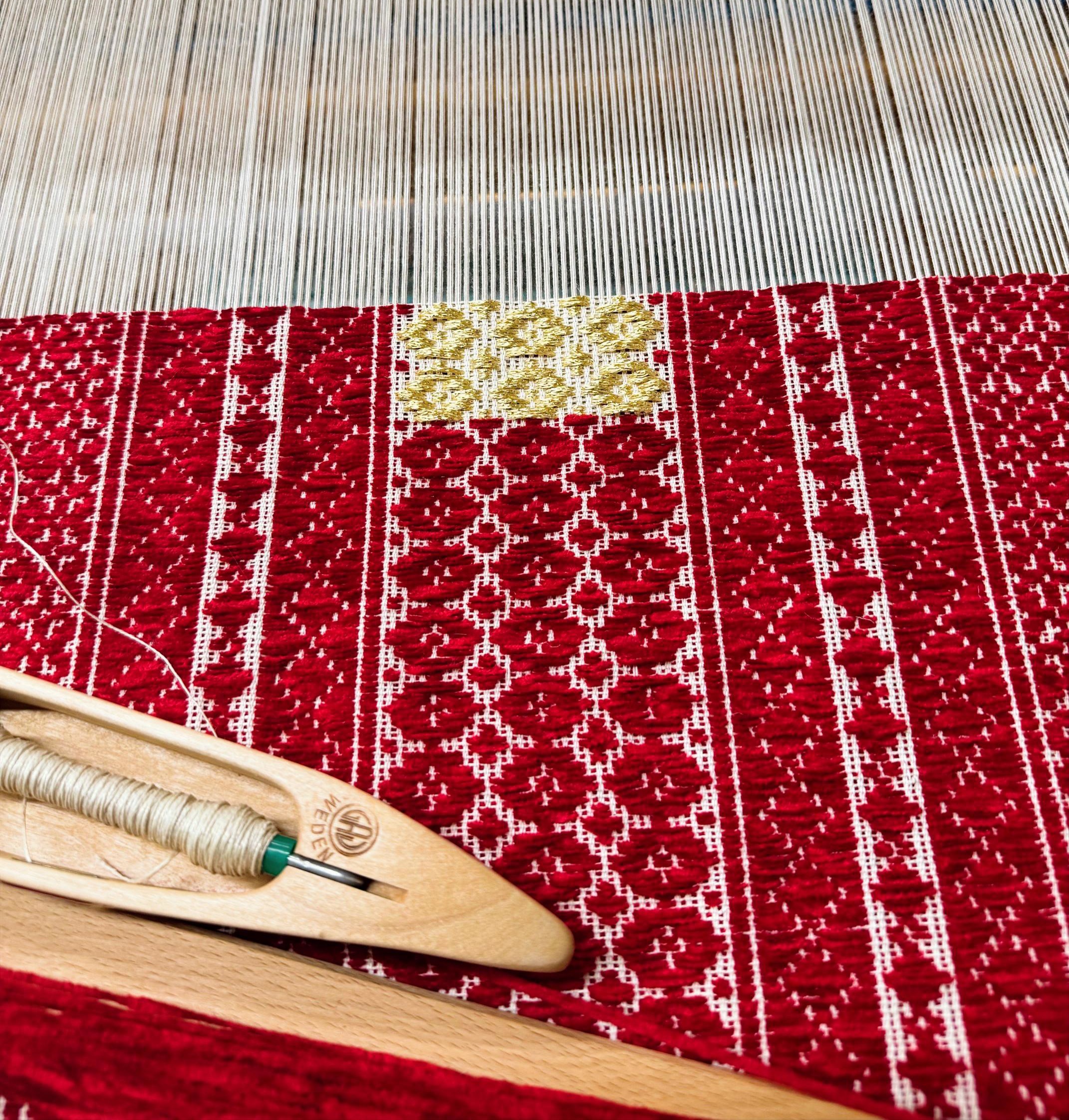
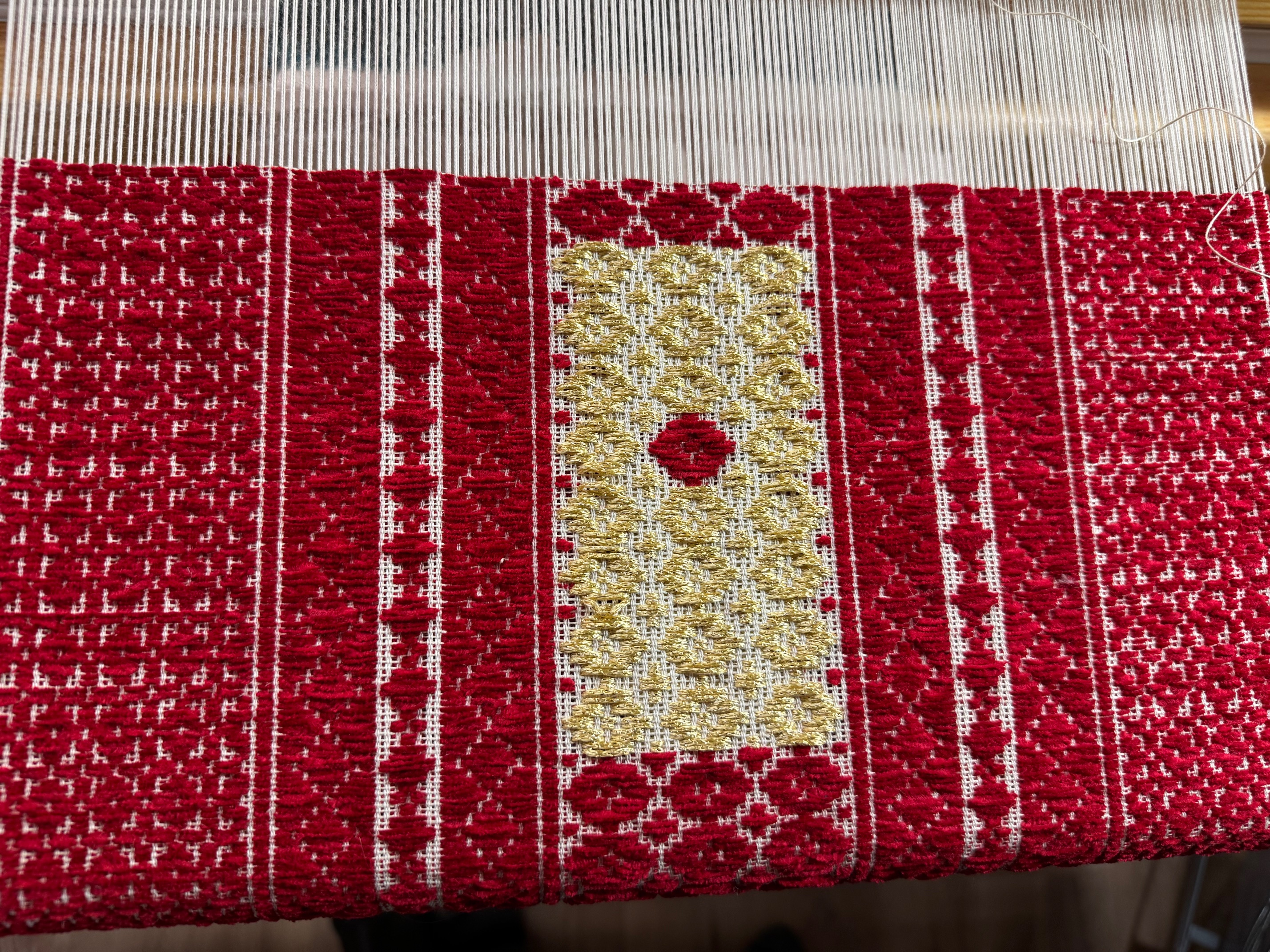
For her runner, Mary Skoy reached into her yarn stash for some luscious pattern weft.
Weaving and photo by Mary Skoy.
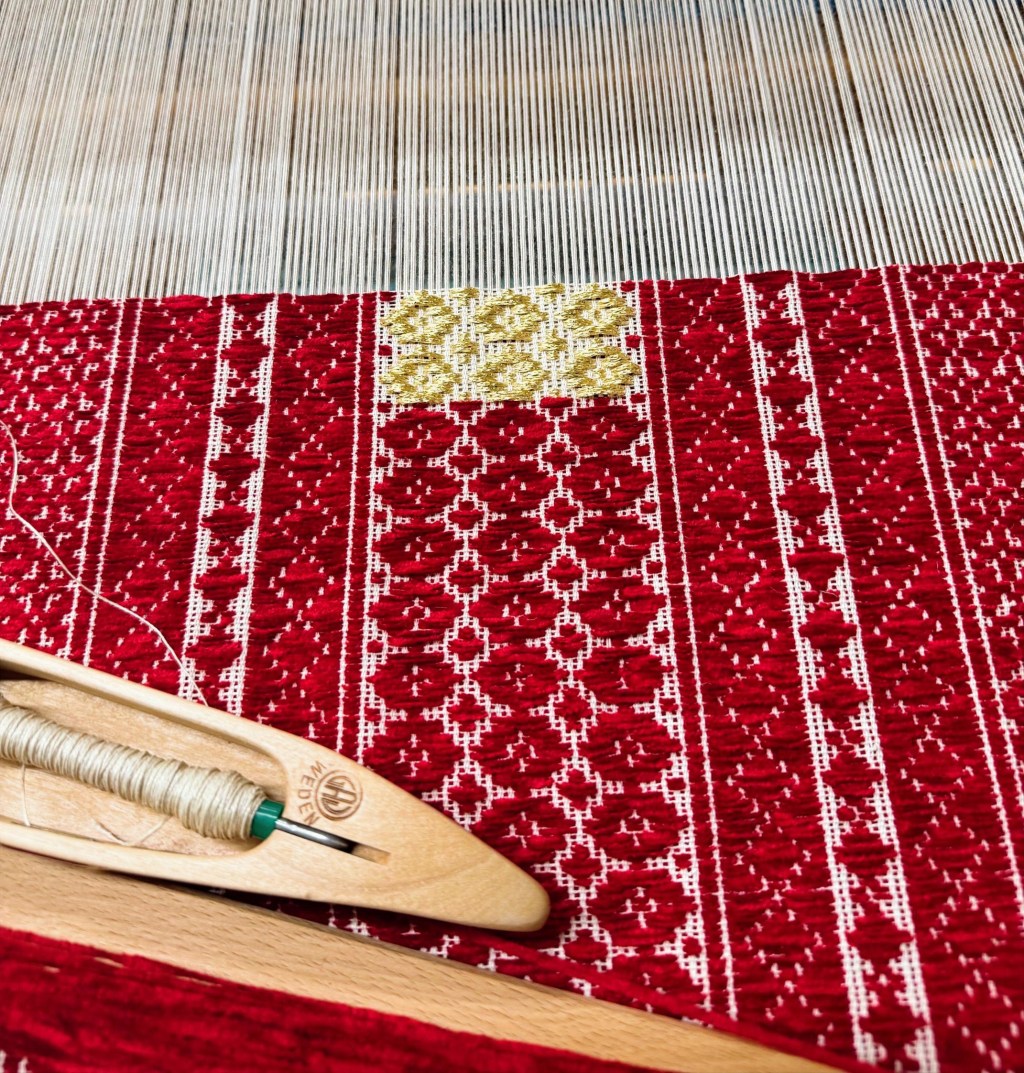
“The red [yarn] is a cotton chenille,” Mary explains. “The yellowing label inside the giant cone says “Phoenix Dye Works Cleveland, Ohio.” Google says the company was liquidated in the 90s. The gold thread was on a much smaller cone with no label, but about the same yardage. I used the McMorran Yarn Balance to estimate the yardage on these two kind of mystery yarns.”
Weaving and photo by Mary Skoy.
Mary added a special touch to her weaving. The golden pattern square is known in Sweden as a prästruta, or “priest’s square.” Traditionally, this section of a Smålandsväv table covering was reserved for a visiting priest’s catechism or prayerbook.
Like Mary, Marianne Tamminen dug into her stash for her project, including 6/1 wool and unbleached linen.
Her first runner was carefully woven to match her dishes, but her second piece is is pure play. “It is so much fun to play with colors and pattern!” she writes.
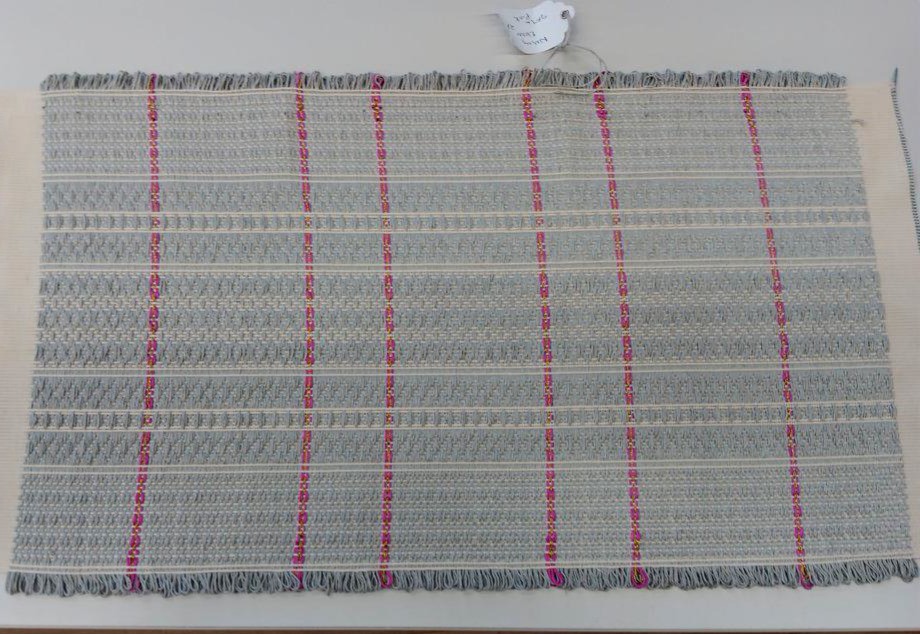
Nancy Ebner also chose delicate grey pattern weft for runner, with a dash of her signature pink.
Weaving by Nancy Ebner. Photo by Lisa Torvik.
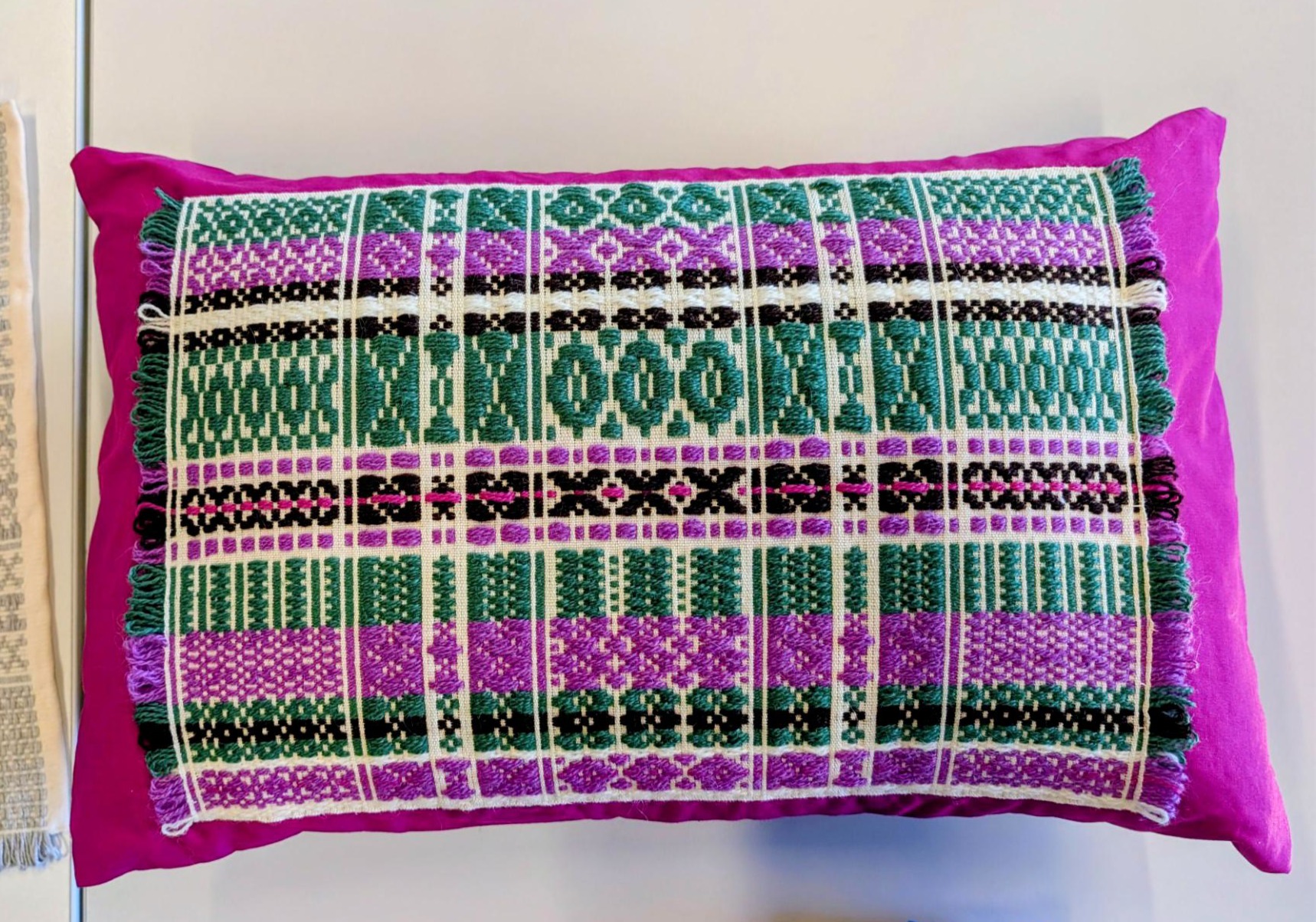
Nancy cleverly used her skillbragd sampler in vibrant green, black, and purple for a pillow. For more of Nancy’s skillbragd weavings, see the blog post “Weaving Journeys (Part One).”
Weaving by Nancy Ebner. Photo by Lisa Torvik.
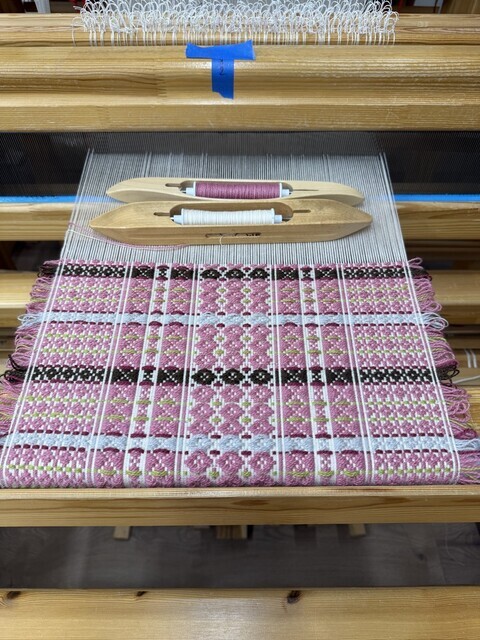
Peg Hansen also loves weaving in pink! Like many others, she used Rauma Prydvevgarn for her pattern weft.
Peg comments: “As many have said before, [skillbragd] is a slow go but gratifying to accomplish. I look forward to finishing it and getting it on my dining room table! Thank you to everyone who has made this opportunity possible. It is so fun demystifying Skillbragd. I hope I can be brave enough to warp it someday on my own loom.”
Photo by Lisa Torvik.
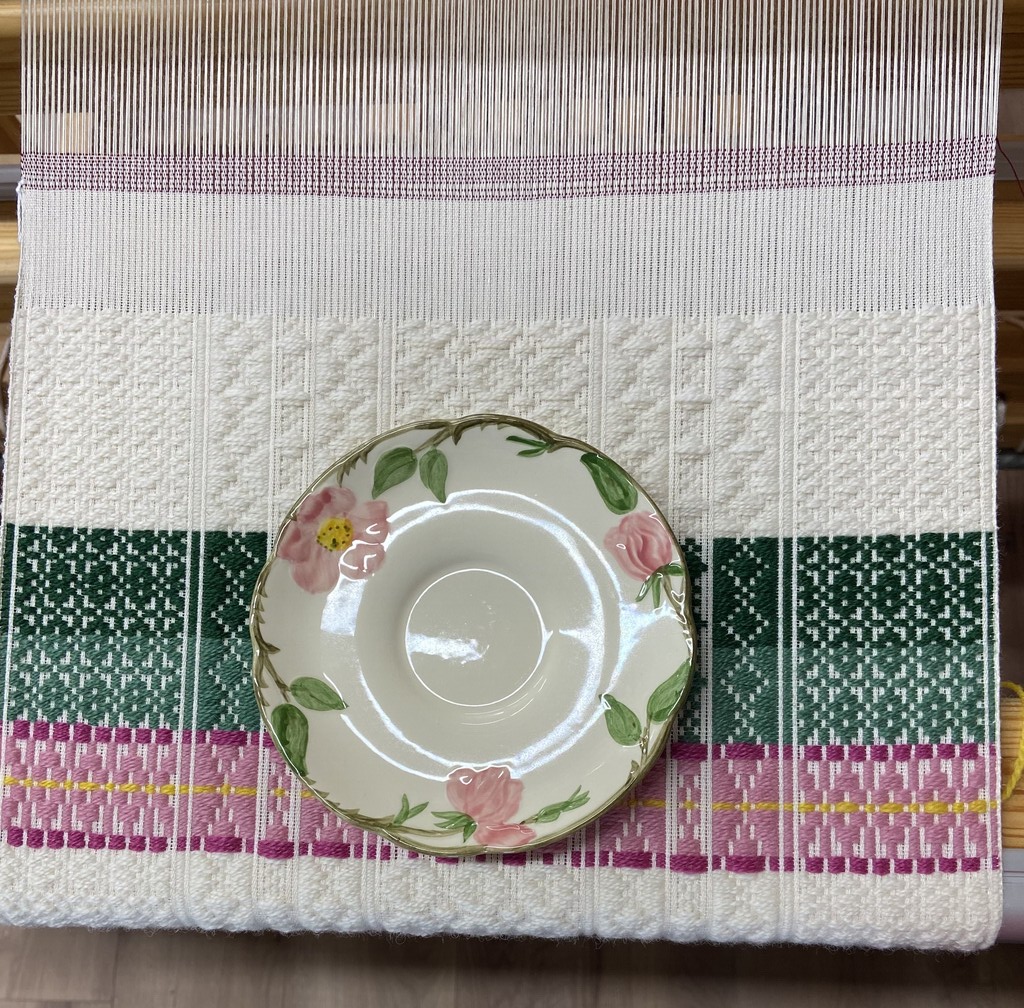
Shari Nelson wove her runner to complement beloved family tableware.
“I planned the colors around my Grandmother’s Fransicanware Desert Rose dishes that I inherited,” she explains. (See link below for more on this popular china pattern.)
“The cream, yellow and Dusty Rose wefts were Rauma Finull and the burgundy and greens were Prydvevgarn,” Shari writes. “I chose not to do the loop edges as I will be using this as a table runner.”
Robbie LaFleur chose to take a sculptural approach to skillbragd.
Photo by Robbie LaFleur.
“I have woven runners in skillbragd before,” Robbie writes, “so [this time] I experimented with the technique.”
“Å skille means to part or separate,” Robbie explains, “so that’s what I did. It was fun!”
Whatever the style, the possibilities of this technique appear to be endless.
Stay tuned for our next group warp in Norwegian Flesberg technique, also known as treskaft in Swedish.
Bonus content: Enjoy a deep dive into the history of Desert Rose dishes, courtesy of The Brooklyn Teacup!
Northern Lights over southern Minnesota. Photo by Lisa-Anne Bauch.
Here in Minnesota, we were recently treated to a spectacular display of the Northern Lights, due to a solar storm.
Close-up of skillbragd weaving by Alla Hale. Photo by Alla Hale.
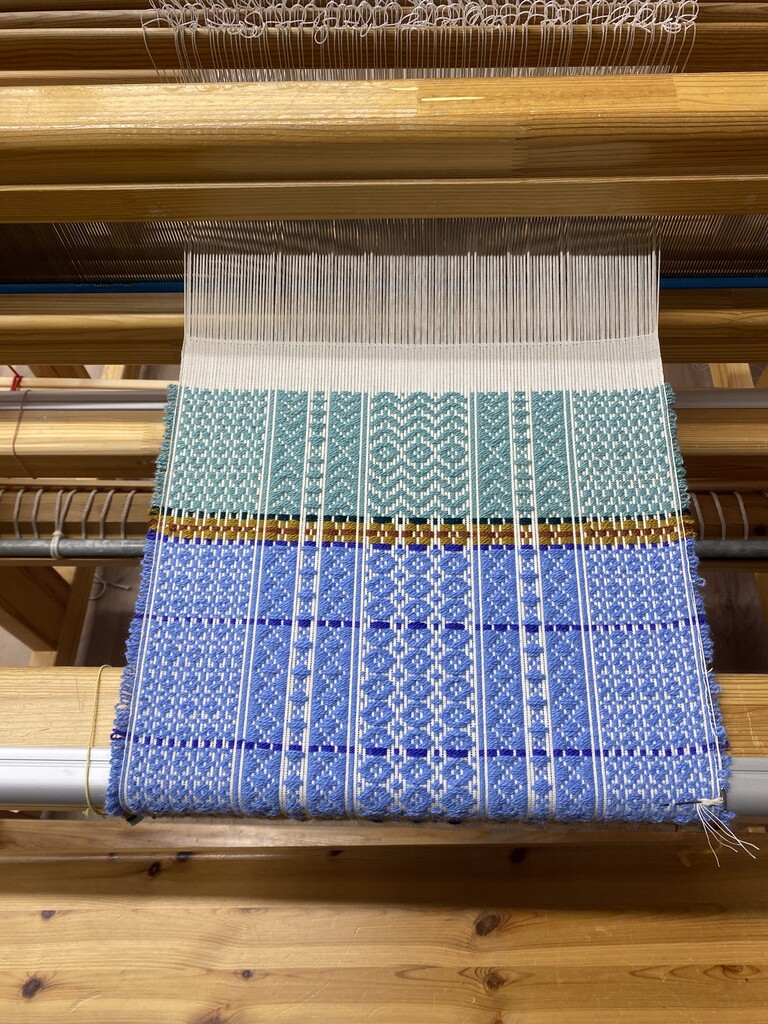
The colors are echoed in Alla Hale’s weaving on the latest group warp by the Scandinavian Weavers. For this warp, we returned to one of our favorite techniques, skillbragd.
Skillbragd is a traditional overshot technique in which a fine tabby weft is woven alternately with a heavier pattern weft. Katherine Larson, in The Woven Coverlets of Norway, writes that skillbragd was named for the skill, or opening in the threads by which the elaborate patterns were created. In Norway, skillbragd coverlets were often used as christening blankets.
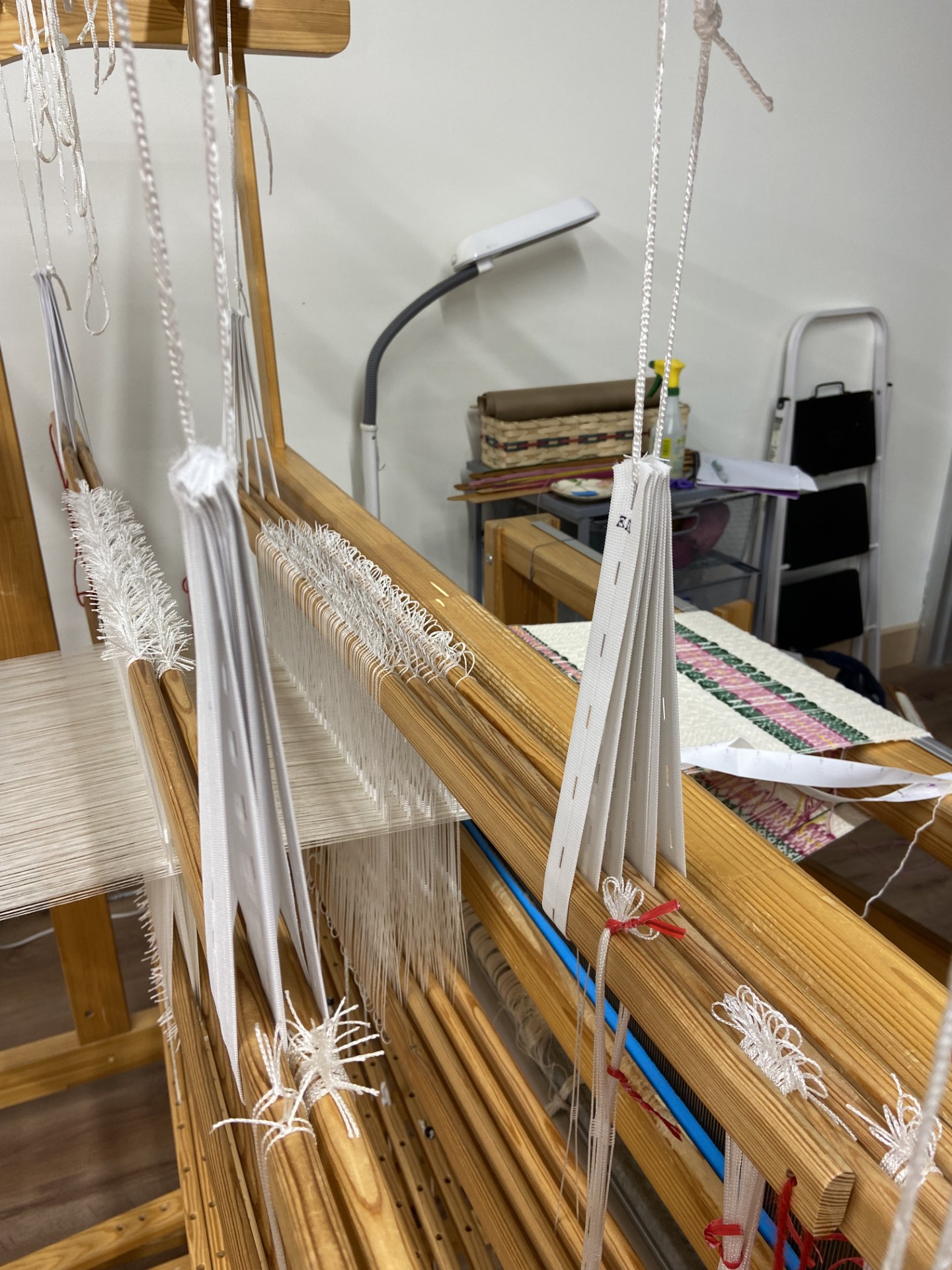
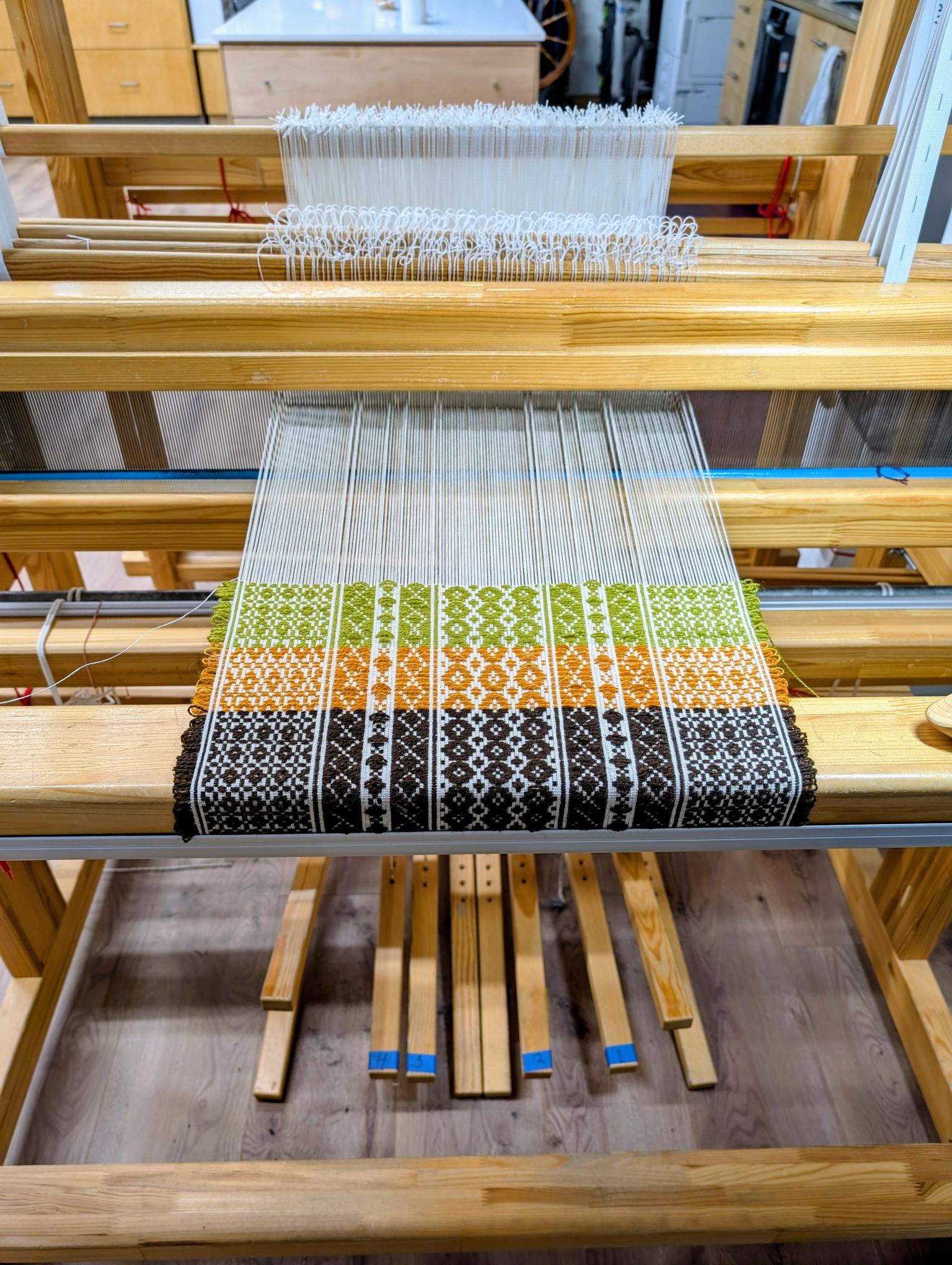
This technique requires two sets of shaft: Pattern shafts with long-eye heddles at the front of the loom and ground shafts with regular heddles at the back. This can require the use of a specially designed loom.
However, it’s also possible to weave skillbragd on an eight-harness countermarche or counterbalance loom, which is what we did, based on a draft by weaver Laura Demuth. Laura’s draft is inspired by a woven piece in the collection of Vesterheim Norwegian-American and will be featured in a forthcoming book.
Skillbragd on a countermarche Glimåkra loom at the Weavers Guild of Minnesota. Photo by Alla Hale.
Laura writes, “Because this technique requires a direct tie-up of the treadles, it is necessary to use two pairs of elastic hangers on the harnesses: one pair will be used on harnesses 1-4 and the second pair will be used on harnesses 7-8…It is also necessary to use two sizes of string heddles. Standard heddles are used for the tabby threading on harnesses 7 and 8. Special long-eyed heddles are used on the pattern harnesses, 1-4.”
Close-up of harnesses. Photo by Shari Nelson.
Per Laura’s instructions, we warped the loom with 20/2 cotton at 40 EPI and used the same thread for the tabby weft. Each weaver brought in her own pattern weft yarn in a variety of fibers, which made for wonderful variation in color and texture.
Abbey Nielsen at the loom. Photo by Lisa-Anne Bauch.
Abbey Nielsen chose soft shades of blue and yellow for her very first skillbragd weaving. A lucky family member will receive it as a Christmas gift!
Abbey’s weaving. Photo by Lisa-Anne Bauch.
Traditional skillbragd often features decorative loops along the selvedges, made simply by looping the pattern weft yarn around a finger, as in Abbey’s weaving above. The loops also serve the a practical purpose of hiding color changes in the pattern weft, rather than having to cut and work in the ends.
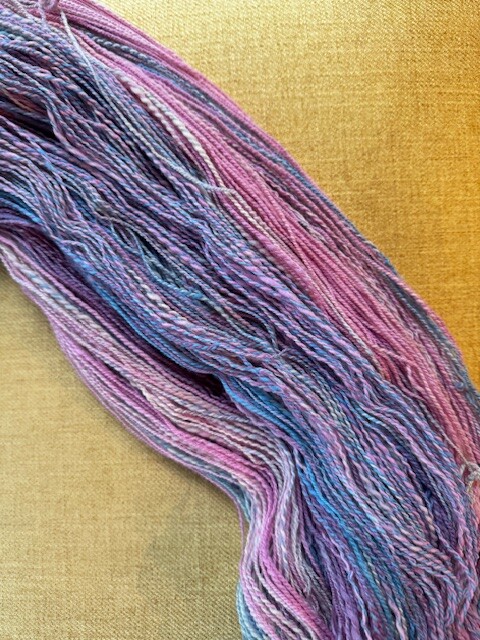
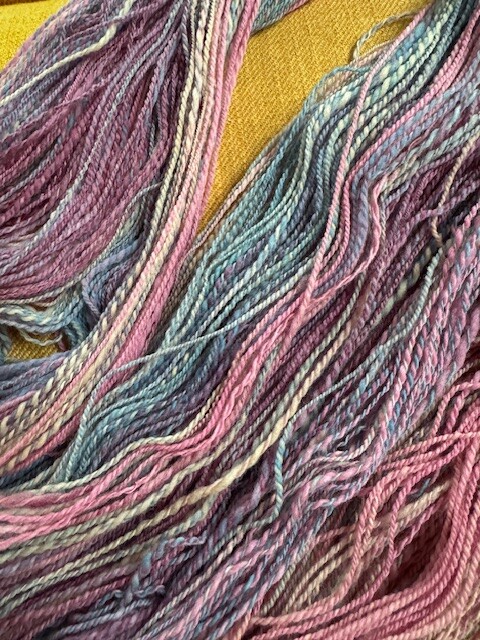
Alla’s beautiful handspun yarn. Photo by Alla Hale.
For her piece, Alla Hale used her own handspun yarn. “It’s from a pretty braid dyed by local natural dyer Petal and Hank,” she writes.
Alla spun the yarn from hand-dyed fleece. Photo by Alla Hale.
“I’m a new spinner,” Alla continues, “so [the yarn] is not very consistent, but I think that will make for nice character in the weaving.” I think we all agree!
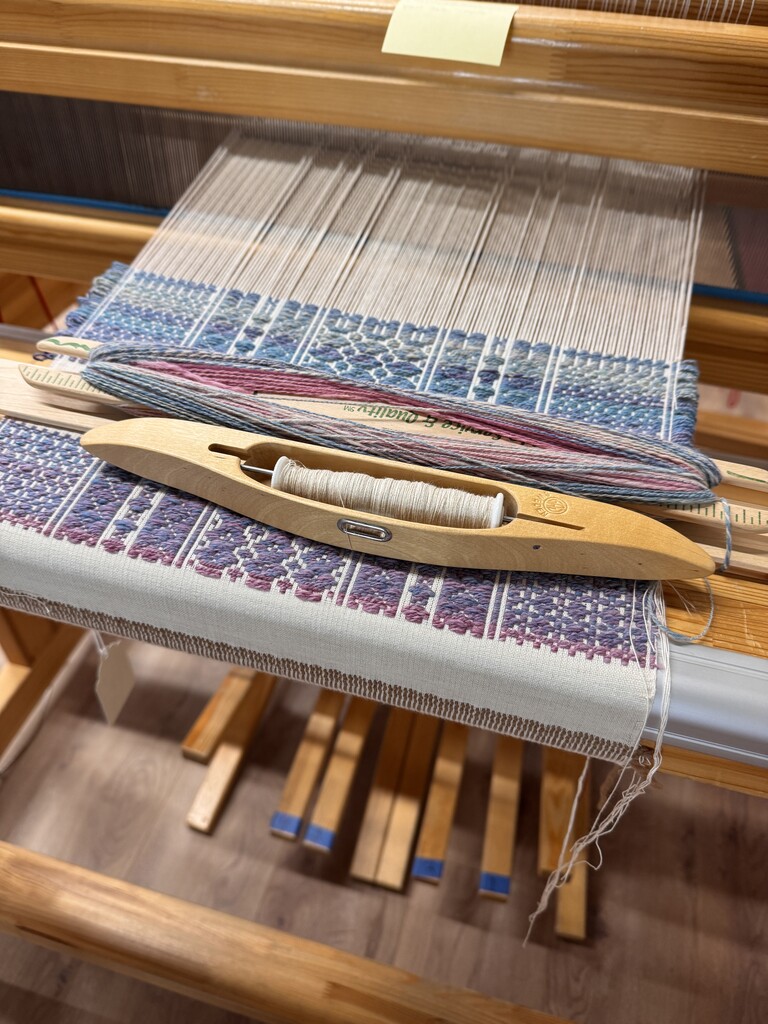
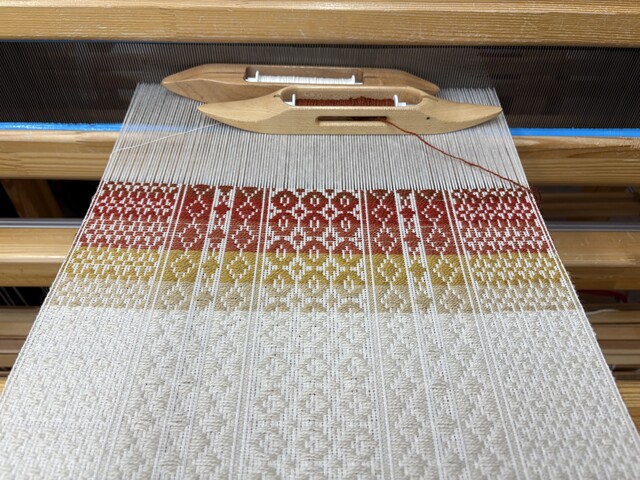
Alla’s weaving on the loom. Photo by Alla Hale.
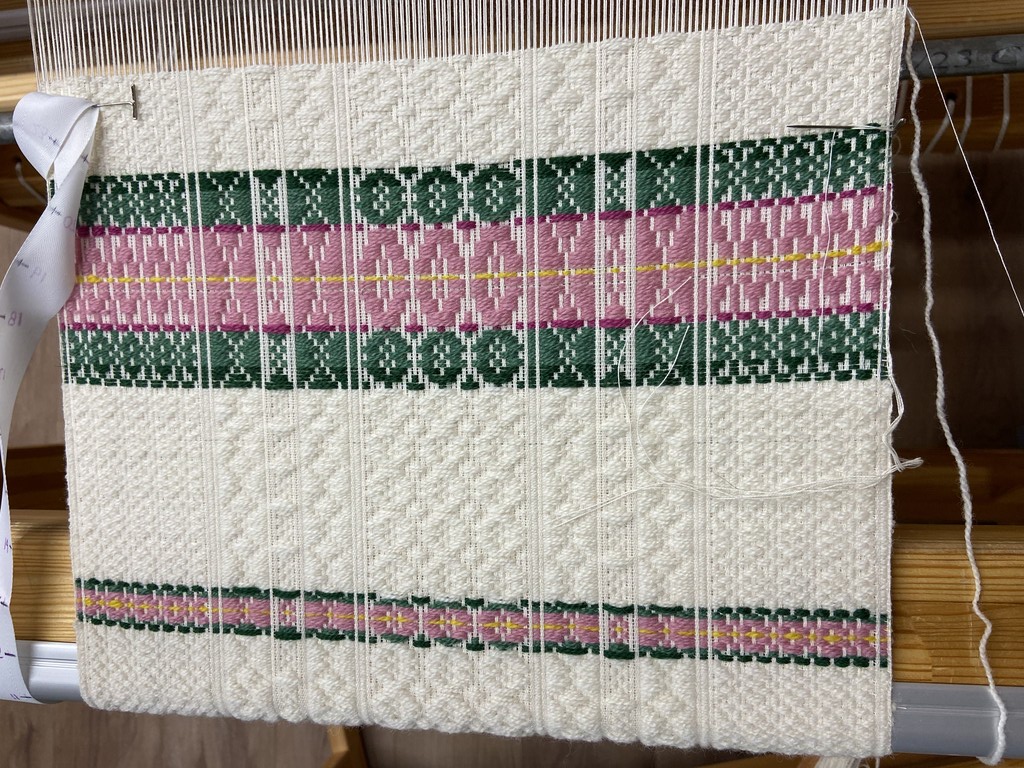
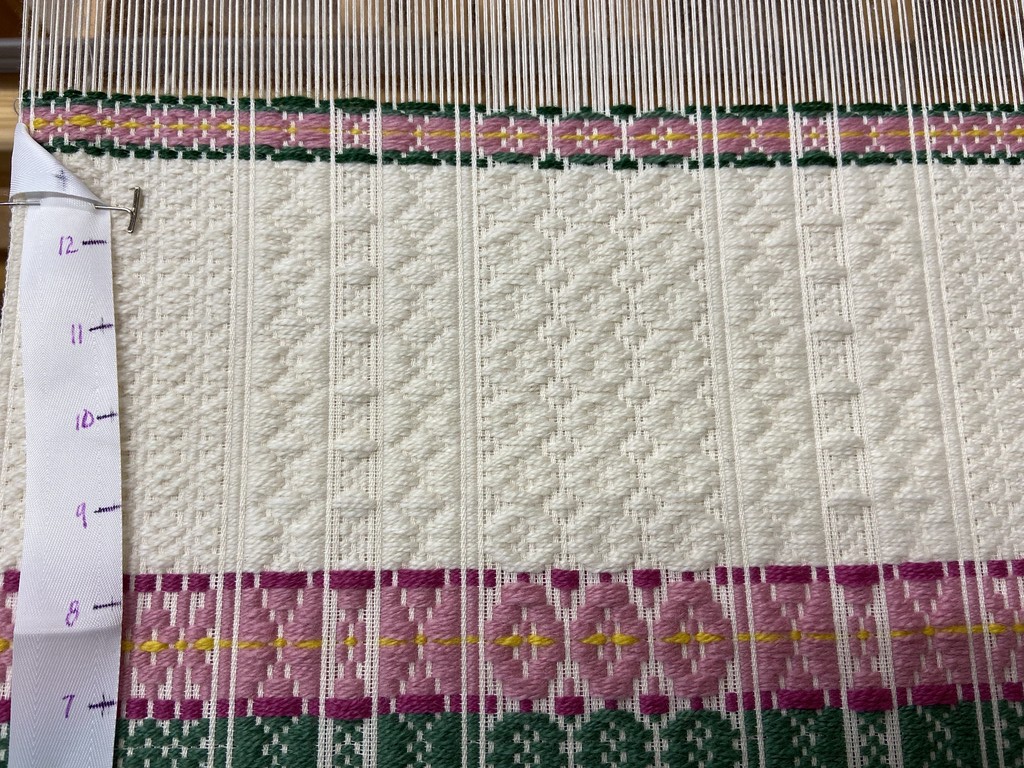
In the photo above, note how the fine tabby weft (20/2 cotton) alternates with the woolen pattern weft.
Alla’s weaving on the loom. Photo by Alla Hale.
Amy Grimm took a scientific approach to her piece, following Laura Demuth’s original draft as closely as possible.
“I figured, being such a new weaver, I would be a good test of the directions,” she explains. “Some might say I lacked imagination but my focus was on testing her directions. My background is computer science and technical writing, so this type of testing was right up my alley!”
Weavings and photo by Amy Grimm..
Amy used Laura’s suggested pattern weft of Rauma Prydvevgarn in traditional shades of blue, red, green, and yellow, providing her with samplers for future projects.
Beth Detlie warped her loom at home using Laura’s draft, but used linen for warp. She wove three runners, allowing her to explore the many pattern variations. “I had fun experimenting!” she says.
Beth Detlie’s complex weaving. Photo by Beth Detile.
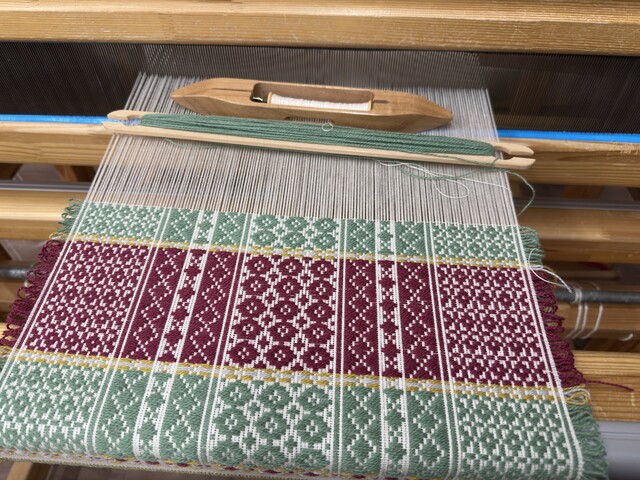
Like Amy, Brenda Gauvin-Chadwick also used Rauma Prydvevgarn for her pattern weft, in cool tones of melon and maroon.
Skillbragd on the loom. Photo by Brenda Gauvin-Chadwick.Brenda’s weaving at home. Photo by Brenda Gauvin-Chadwick
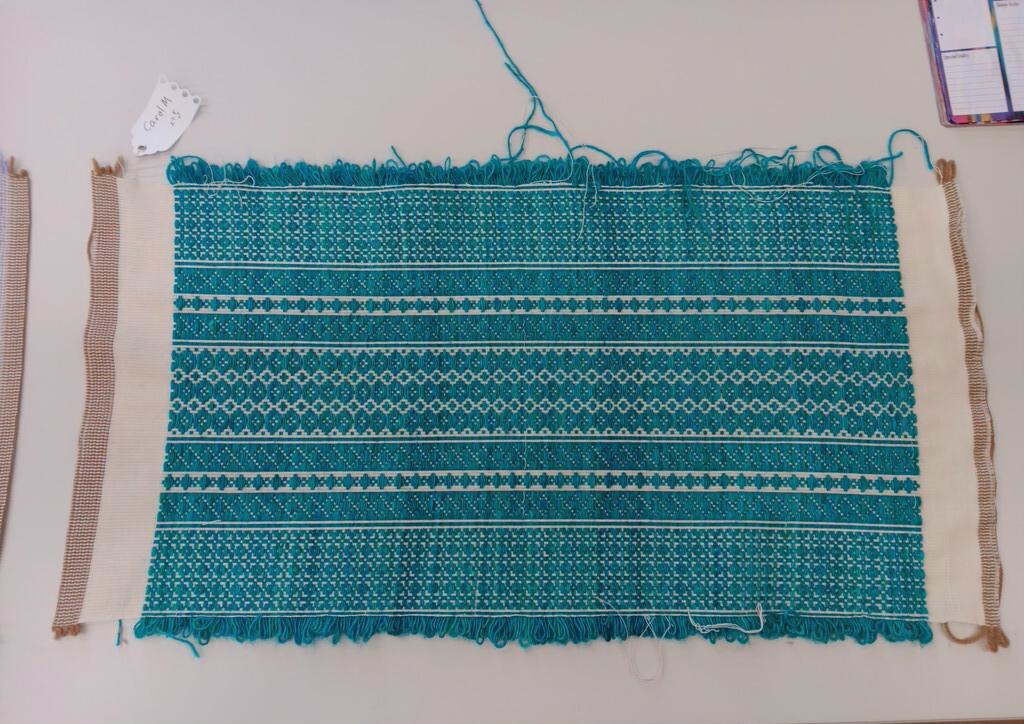
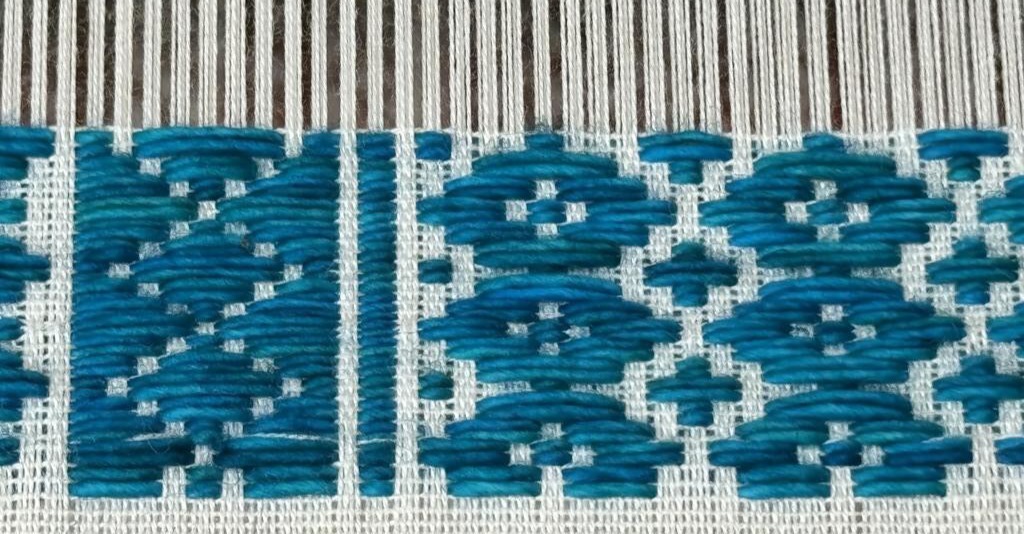
Carol Mashuga experimented with a single color of weft, in a gorgeous shade of turquoise, which allowed the patterns to dominate. “The fiber I used [for pattern weft] is Madelinetosh merino wool in Nassau Blue,” Carol writes. “It is a super wash 100% wool that is very soft and drapes beautifully.”
Carol’s weaving, off the loom but not yet wet-finished. Photo by Lisa Torvik.
“This has been a fabulous weaving experience for me,” Carol adds. “I have learned so much and could spend years weaving this pattern and trying out different color combinations, etc. It is that interesting!”
Close-up of Carol’s weaving. Note the subtle shifts of color in the pattern weft. Photo by Carol Mashuga.
Cathie Mayr agrees with Carol’s assessment: “[Skillbragd] is a slow weave, but a beautiful result.” Group members concurred that the process is meticulous but rewarding.
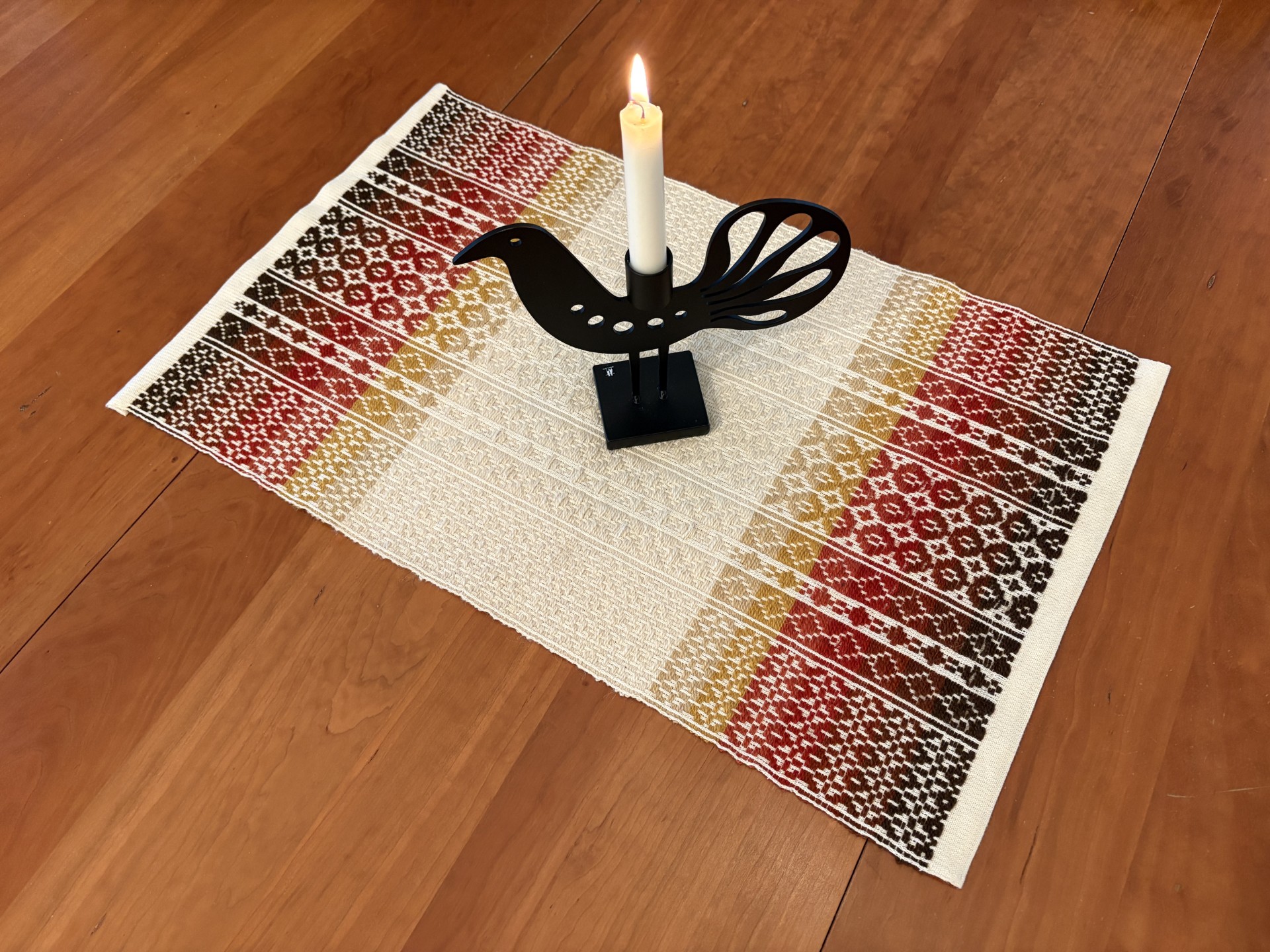
Cathie Mayr’s autumn table runner. Photo by Cathie Mayr.
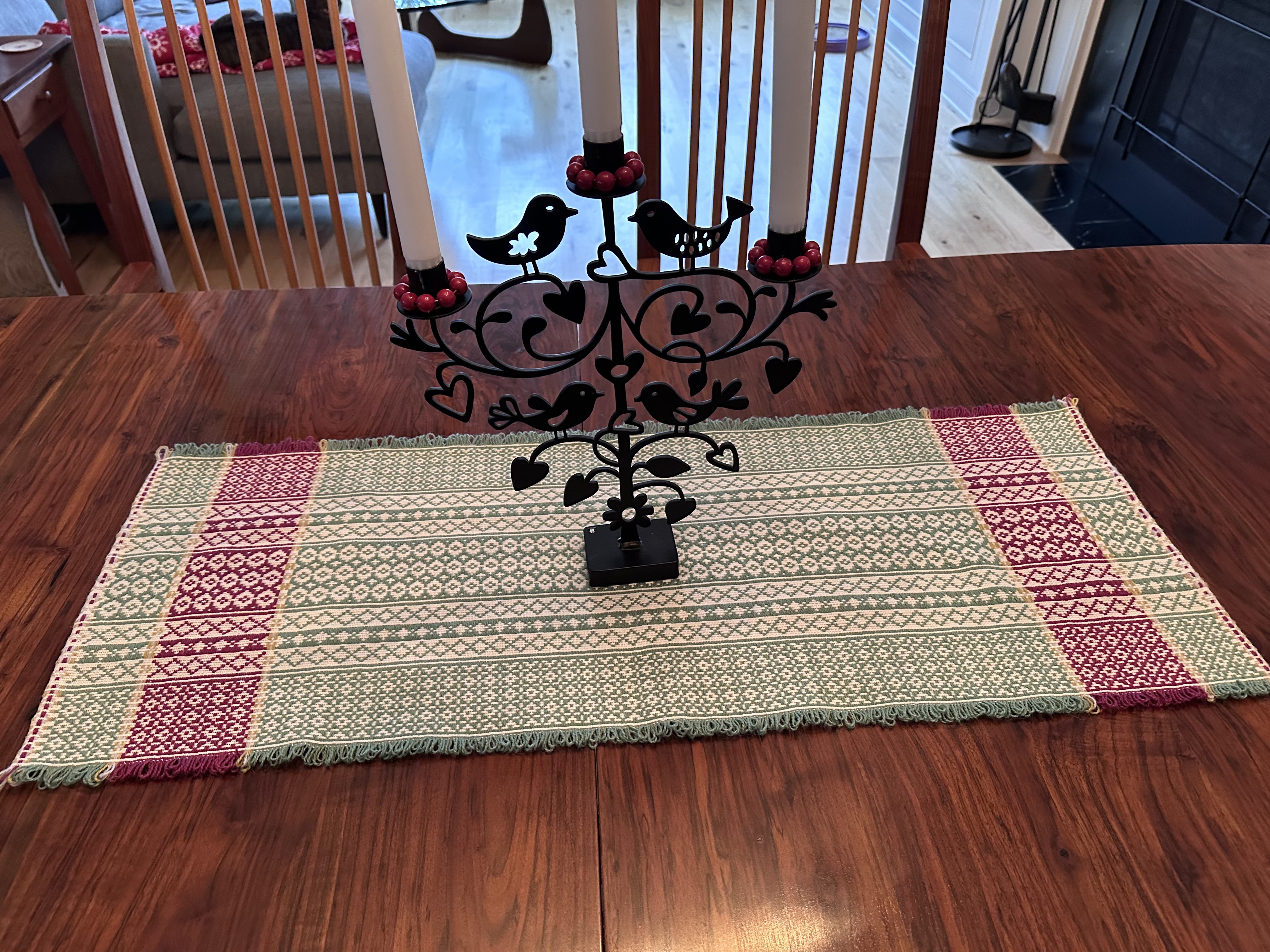
Cathie wove an autumn runner with a cream-colored center to show off a Swedish black iron candleholder. In the photo above, note how beautifully the patterns show, even with a neutral weft color.
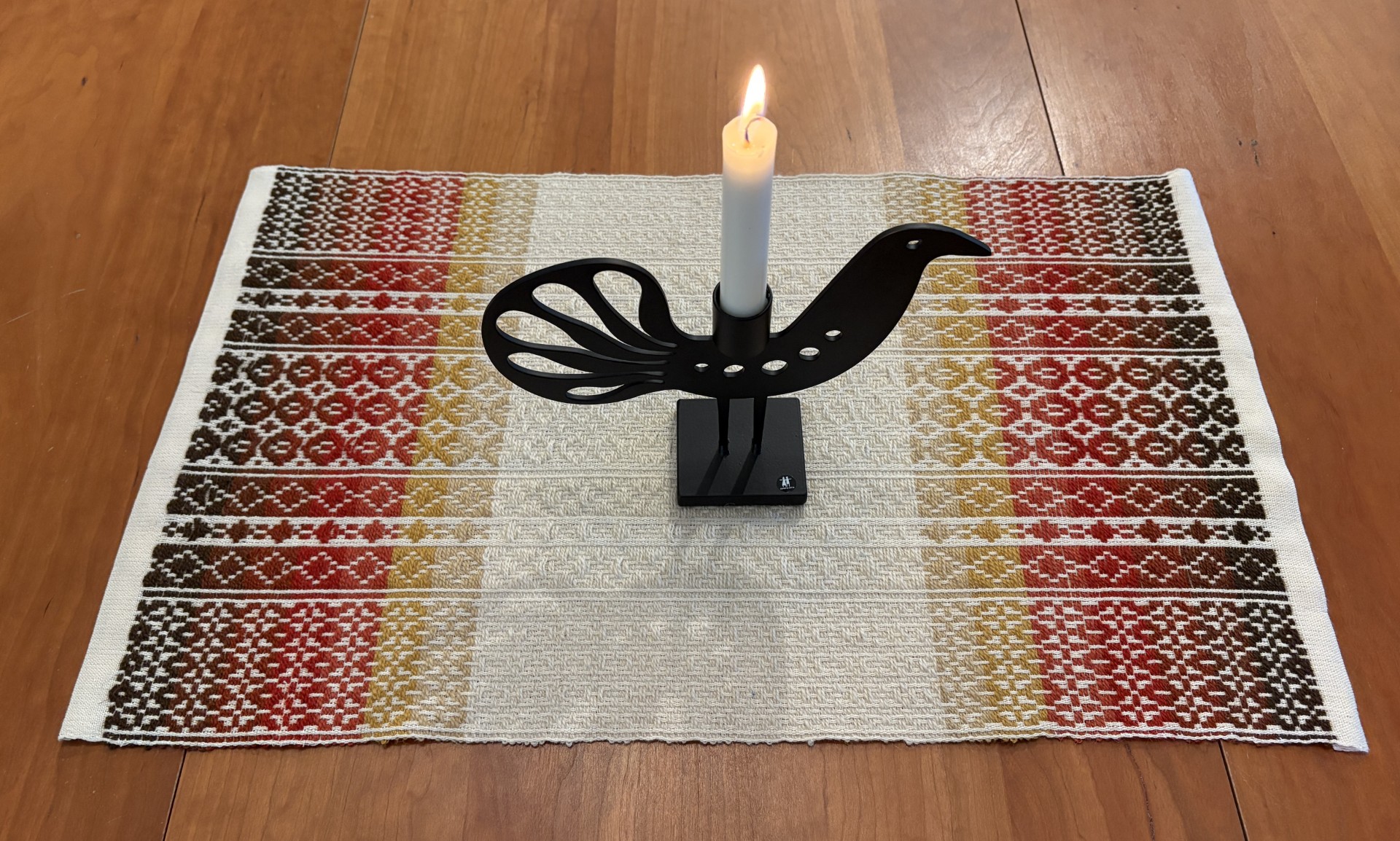
Cathie Mayr’s runner at home on her dining room table. Photo by Cathie Mayr.
“It was such a challenging and satisfying project!,” Cathie writes. “I’m so grateful to those who planned it, ran the warp, dressed the loom, and provided the pattern draft and explanations on how to weave it. This group is amazing!”
The chicken candleholder presided over Cathie’s Thanksgiving table. Photo by Cathie Mayr.
“My piece is purposely short to fit in the center of our dining room table,” Carol adds. “I elected not to include selvedge loops. When my family gathers for Thanksgiving, anything on the table is at risk for gravy and cranberry drippings!”
Holly Hildebrandt chose soothing shades of blue and green for her weaving, perhaps inspired by her recent study trip to Norway.
Holly Hildebrandt’s weaving in progress. Photo by Holly Hildebrandt.
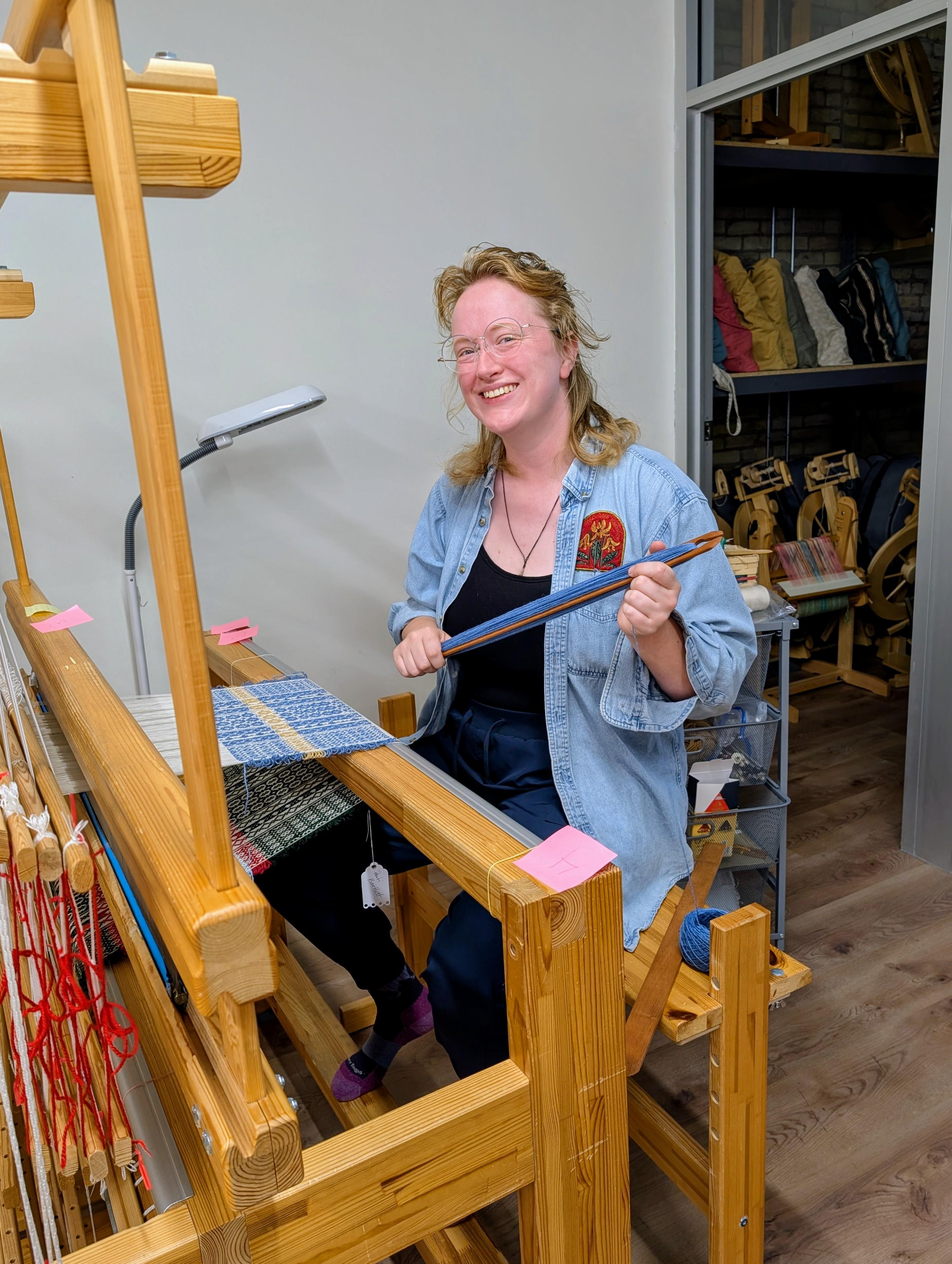
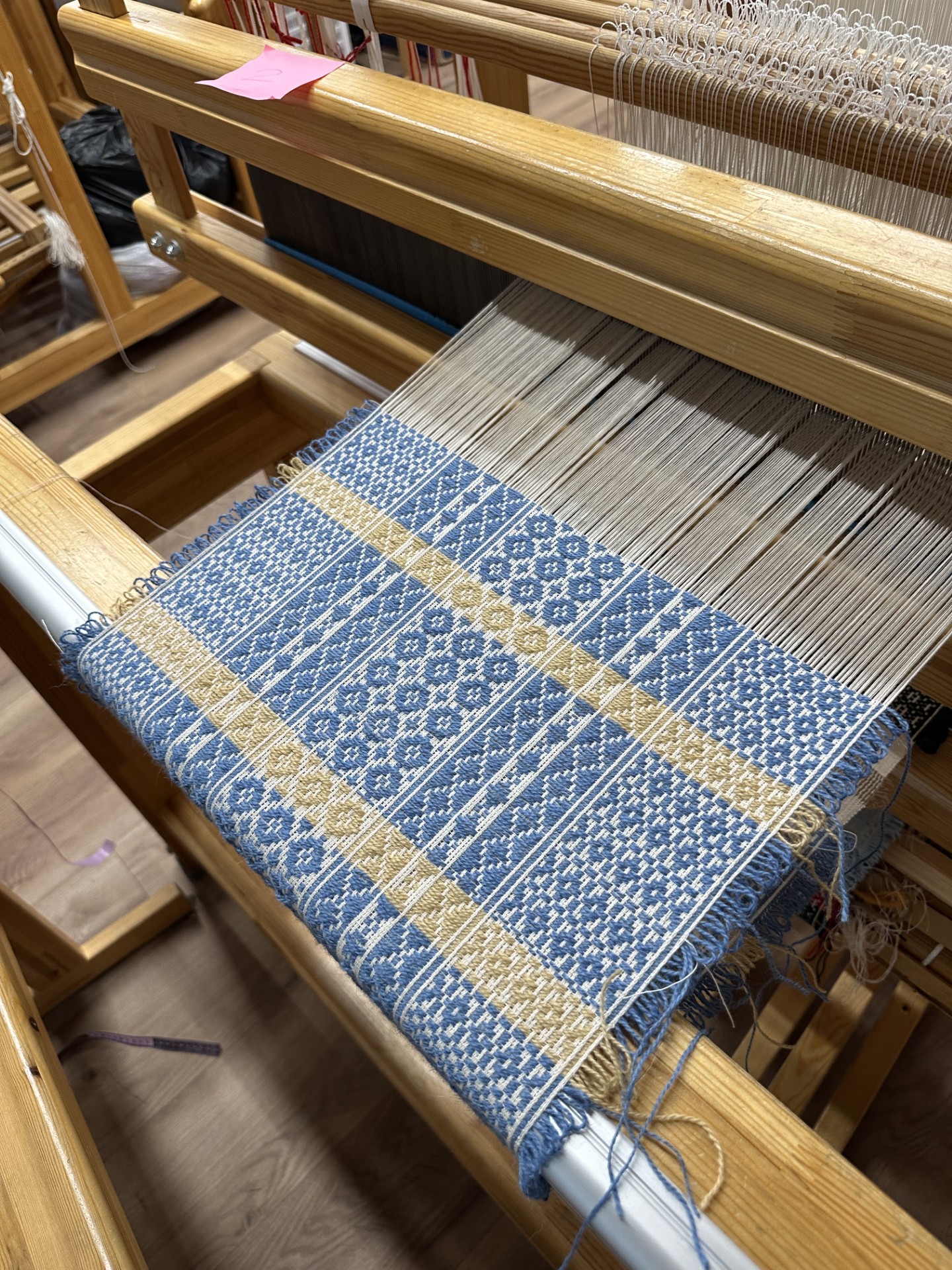
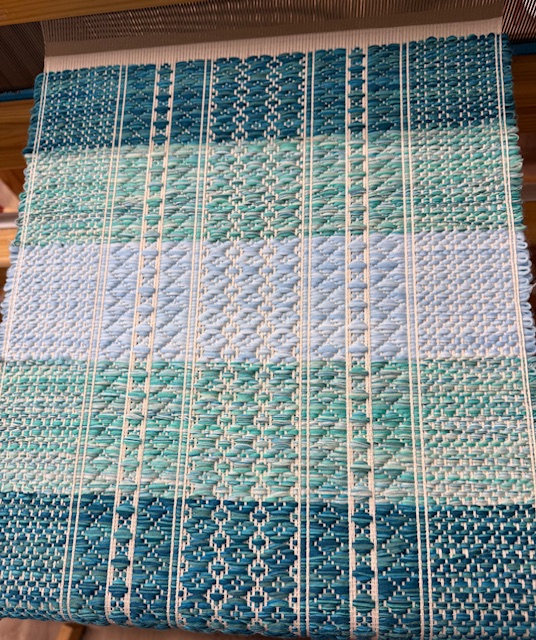
Judy Larson also choose blue and green for her weaving, using variegated string yarn from Sweden. The effect is of the far horizon over water.
Judy Larson’s weaving in soothing shades of blue. Photo by Judy Larson.
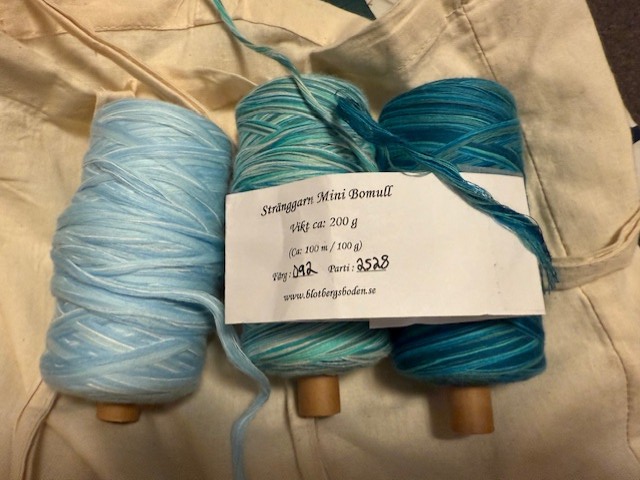
Judy purchased the yarn while attending the Väv2025 conference in Gävle, Sweden. It consists of several strands of cotton wound together.
Judy Larson’s luscious weft yarn. Photo by Judy Larson.
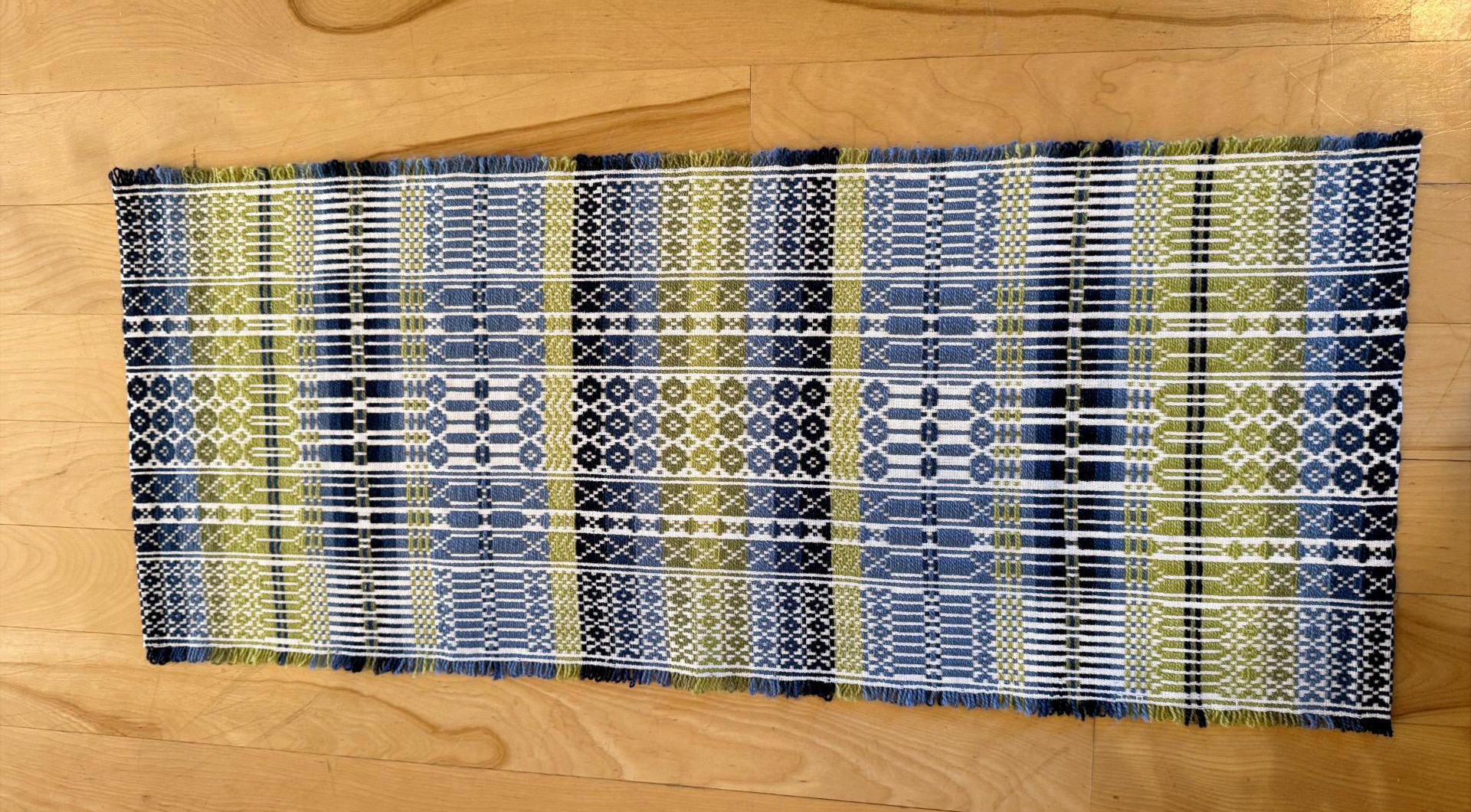
Jan Johnson shared the photos below on her Instagram. “The Scandinavian Weaver’s study group at the Weaver’s Guild of Minnesota is weaving Smålandsvëv or Swedish Opphämpta,” she wrote. “The Norwegian-dominant study group persists in calling it skillbragd, but I feel the need to stand up for my Swedish heritage, so Swedish Opphämpta it is!”
Photo by Jan Johnson.
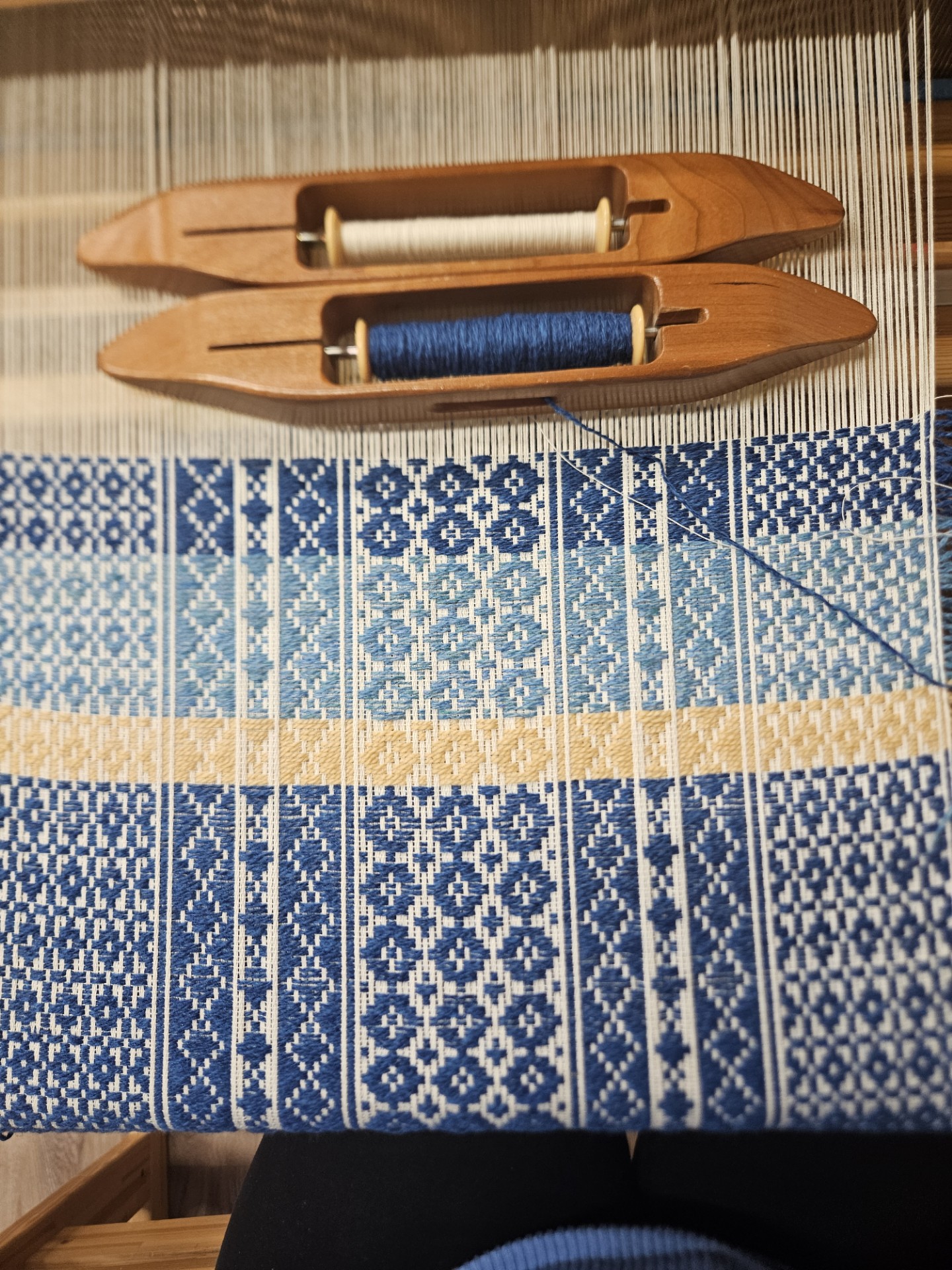
For her weft yarn, Jan appropriately chose lovely shades of blue and yellow from her stash of Harrisville Highland.
Jan’s weaving on the loom. Photo by Jan Johnson.
Fellow Swede Lisa Bauch chose weft colors reminiscent of a Scandinavian forest, including moss green.
Photo by Lisa-Anne Bauch.
Full disclosure: Lisa purchased the yarn in Norway at the Hillesvåg woolen mill near Bergen.
Admiring weavings as the first warp comes off the loom. Photo by Lisa-Anne Bauch.
Bio: Nancy started weaving in earnest at the Minnetonka Center for the Arts in 2017 by taking classes offered by Traudi Bestler. She wanted to learn to weave independently prior to her retirement and has tried her hand at a multitude of 4-shaft weave structures. She continues to explore techniques for the opportunity to learn and to connect with other makers. Nancy is drawn to bright, vibrant colors and especially to the color PINK! She enjoys both the design and the technical aspects of completing a woven piece. As a bonus, textile-related travel has taken her to New Mexico, Massachusetts, Sweden, Norway, Ireland, and most recently to the Peruvian Andes. She hopes to explore the rich textile heritage of Morocco in 2025.
Description: An online photo and the discussion of the similarity between Turkish Kilim and Scandinavian weaving patterns led me to the book Flatweaves from Fjord and Forest: Scandinavian tapestries of the 19th and 20th centuries. I ordered the book to learn more about the piece in the photo and chose to weave a smaller, modified version of the original weaving. The original design was thought to be from a carriage cushion woven around 1800 in southern Sweden. In 2019, I traveled to Sweden with a subset of our Scandinavian Weavers Group to learn various art weaves. I returned with a “sampler” that included a tiny portion of this geometric tapestry technique called rutevev (Norwegian) or rölakan (Swedish). In 2022, I received further instruction from Jan Mostrom during her class featuring square weaves at the Vesterheim Norwegian-American Museum in Decorah, Iowa. This weaving method is VERY slow going as each square in worked by hand using yarn butterflies and a single-interlock process. Some rows required up to 29 color changes per row! This particular piece has 1320 passes of the weft across the warp and finishing required 1775 ends to be woven by needle into the back of the work. (My super power is persistence!) Many of the designs in heirloom weavings have spiritual significance. This particular piece contains symbols of the sacred: a rose, birds and numerous crosses.
Bio: Sharon Moe Marquardt has been weaving since the mid-1980s. Inspired by her sister’s summer/winter cow runner, she studied rigid heddle one and two-heddle loom techniques from the Prairie Wool Companion, edited and authored by David and Alexis Xenakis. She used her notes to teach rigid heddle classes at the Weaving Works and Experimental College in Seattle. Moving to her home state of Minnesota, she taught these classes at several weaving conferences. At one conference, she discovered Syvilla Tweed Bolson’s vendor table and later signed up for her boundweave class in Decorah, Iowa. These lessons led to a life-long pursuit of learning Scandinavian techniques. She has studied at Vesterheim Norwegian-American Museum, in Norway, and at the Hemslöjden in Landskrona, Skåne, Sweden.
Description: At Vesterheim I learned the decorative West Coast weaves from Marta Kløve Juuhl, who has explored almost-forgotten weaves from Norway, Iceland and the Shetlands. She is the main curator at the husflid in Osterøy, west of Bergen. I wove the smaller colorful hanging based on her lessons. Heidi Goldberg, art professor at Concordia College, Moorhead, Minnesota, asked me to assist with the weaving section in her traditional Nordic Arts classes. I taught the West Coast weaves first on backstrap looms and then on small warp-weighted looms that my husband had made based on the loom I had purchased at the Sami Husflid (handcraft store).
Regarding the Scandinavian Weavers Group: The Scandinavian study group has been my main support for decades. I live in a small rural area where hardly anybody weaves. I’ve traveled to meetings, but with Zoom now available I can attend most of them. Mange takk to this group!
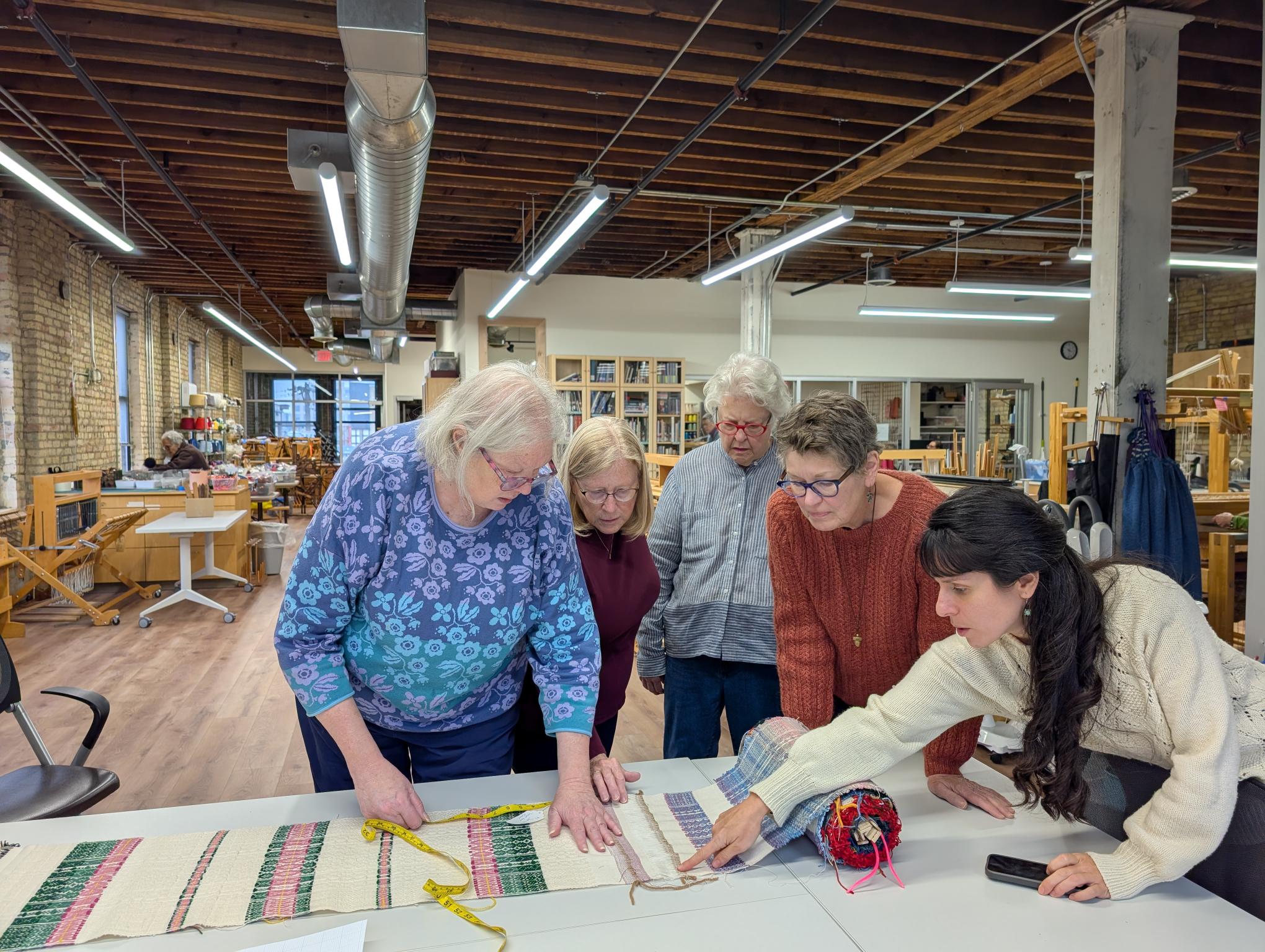
In Sweden, the days between Christmas and New Year are known as mellandagarna, or “in-between days.” With the bustle of holiday preparations over, it’s the perfect time to get together with friends. In our case, we enjoyed a cozy “UFO” gathering. (“UFO” stands for “Unfinished Object.”) Everyone brought projects that needed finishing, including weaving, knitting, embroidery, and felting, along with leftover holiday treats.
It’s much easier to put those last few stitches in when you’re chatting and laughing with friends! Here Beth works on finishing her Repp weave wall hanging while Robbie converts her tapestry into a pillow.
Photo by Nancy Ebner
“This was the second tapestry I ever wove,” explains Robbie, “at Valdres Husflidsskole in Norway. The design is two abstracted blossoms. It was never great as a wall piece, so I am now attaching hand-made wool fringe and it will become a pillow.”
Photo by Robbie LaFleur
Mary finished an adorable pair of booties for a newborn family member!
Photo by Mary Skoy
Kits to make these fuzzy booties are available from Joe’s Toes in the UK.
Photo by Mary Skoy
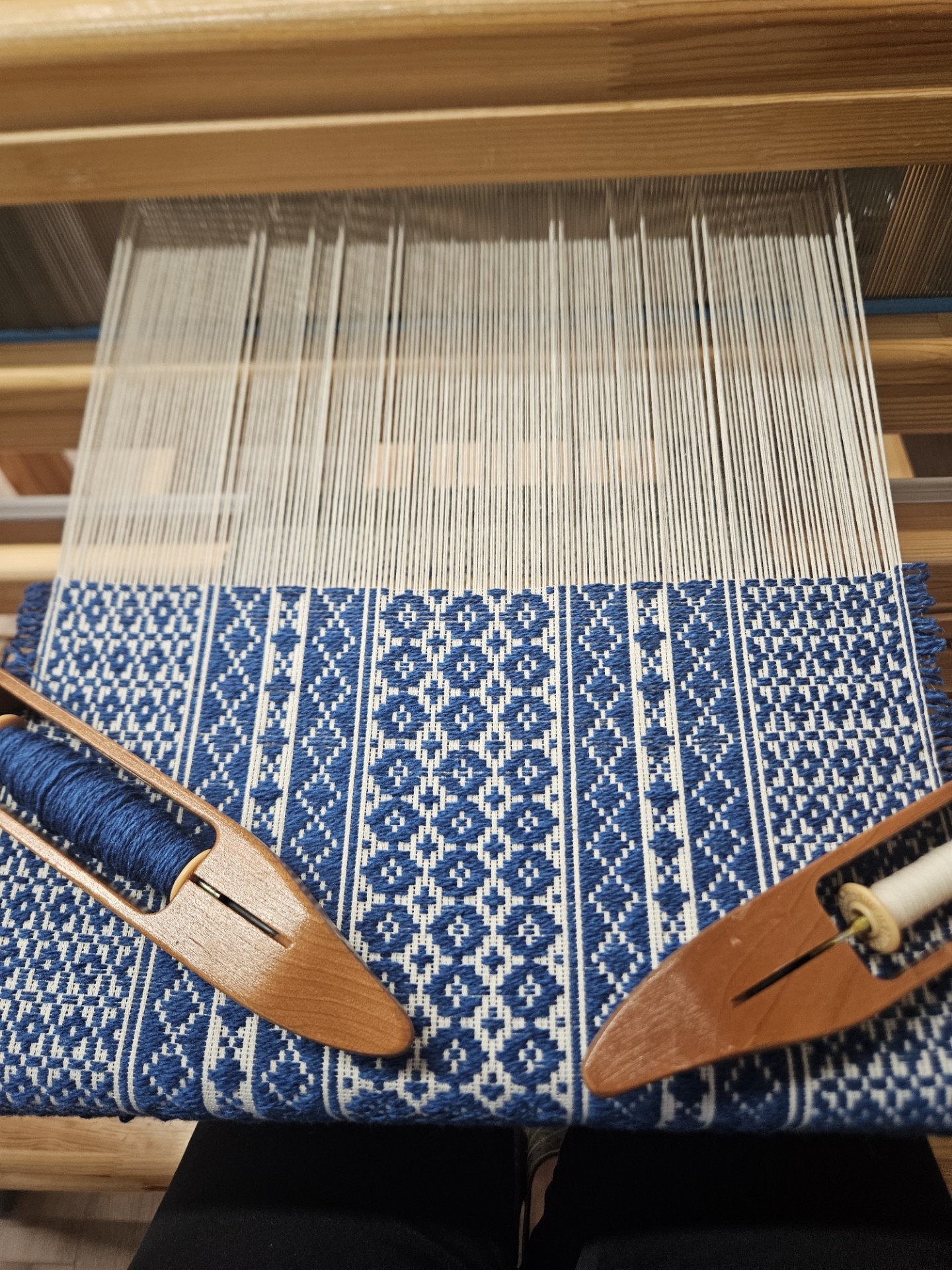
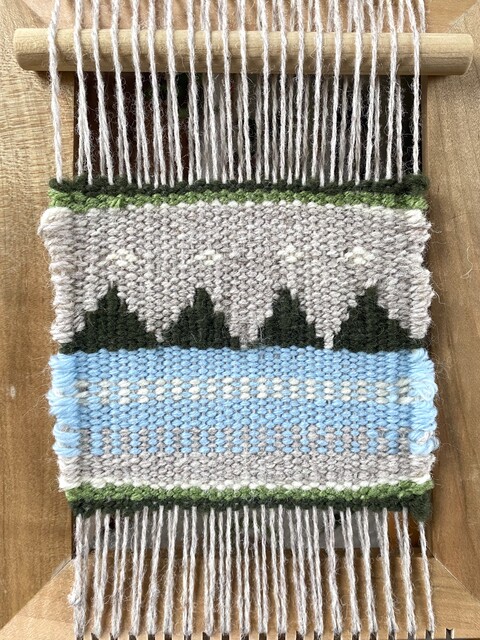
During the Scandinavian Weavers upcoming exhibit “Vibrant Tradition” at Norway House in Minneapolis, we will host Family Weaving Days with weaving activities for all ages. (Follow this blog for dates and times.) Here, Holly practices one of the activities, weaving simple coasters on a frame loom.
Photo by Nancy Ebner
The finished result! Holly says, “I think it looks like trees on the shore of a frozen lake with some snowmobile tracks running across.”
Photo by Holly Hildebrandt
The gathering was also an opportunity to share tips and techniques. New member Amy learned how to twist coordinating cordage to adorn her twill weave pillow.
Photo by Amy Grimm
Phyllis finished a knitted scarf while Kelly felted colorful designs on wool dryer balls. (Wool for felting in the foreground.)
Photo by Nancy Ebner
The Scandinavian Weavers have many exciting projects lined up for 2025, including the “Vibrant Tradition” exhibit at Norway House (January 31–April 6) and weaving demonstrations at Gammelgården (May 3). On the loom, we will tackle skillbragd as well as draw loom techniques. Stay tuned for all the details.
We extend our heartfelt thanks to all blog followers and hope you will continue to find both information and inspiration in the coming year!
Detail of a rag rug woven by Karin Larsson from “Karin Larsson: Let the Hand be Seen” at the American Swedish Institute.
Today’s blog entry is written and photographed by Scandinavian Weavers member Holly Hildebrandt.
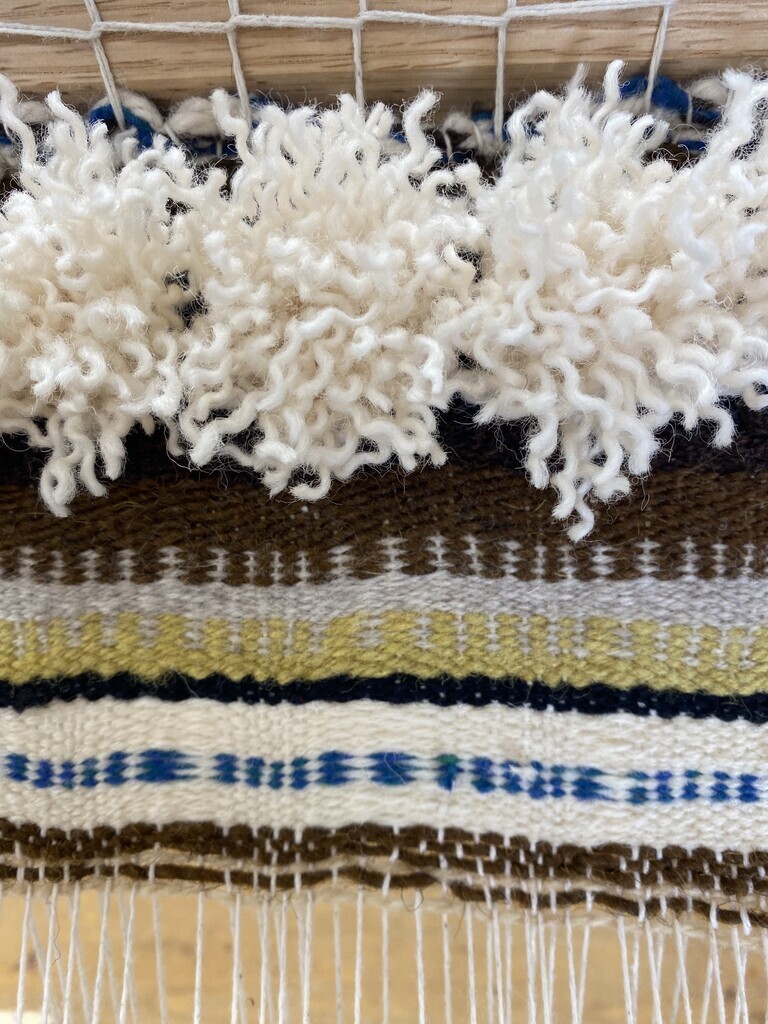
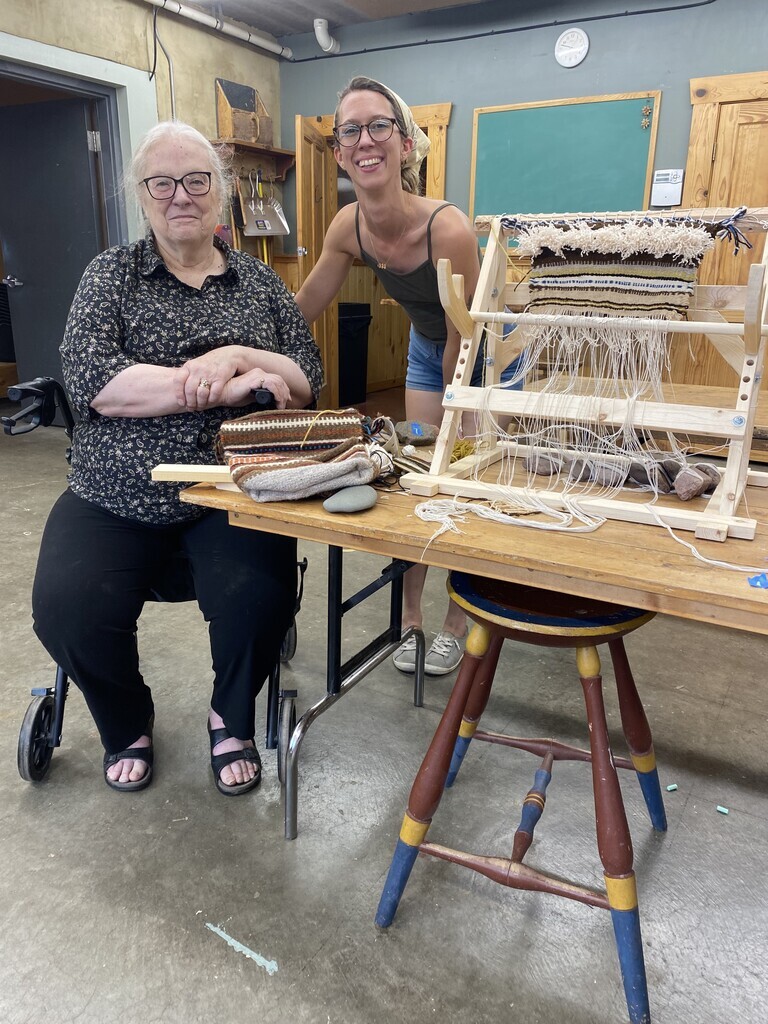
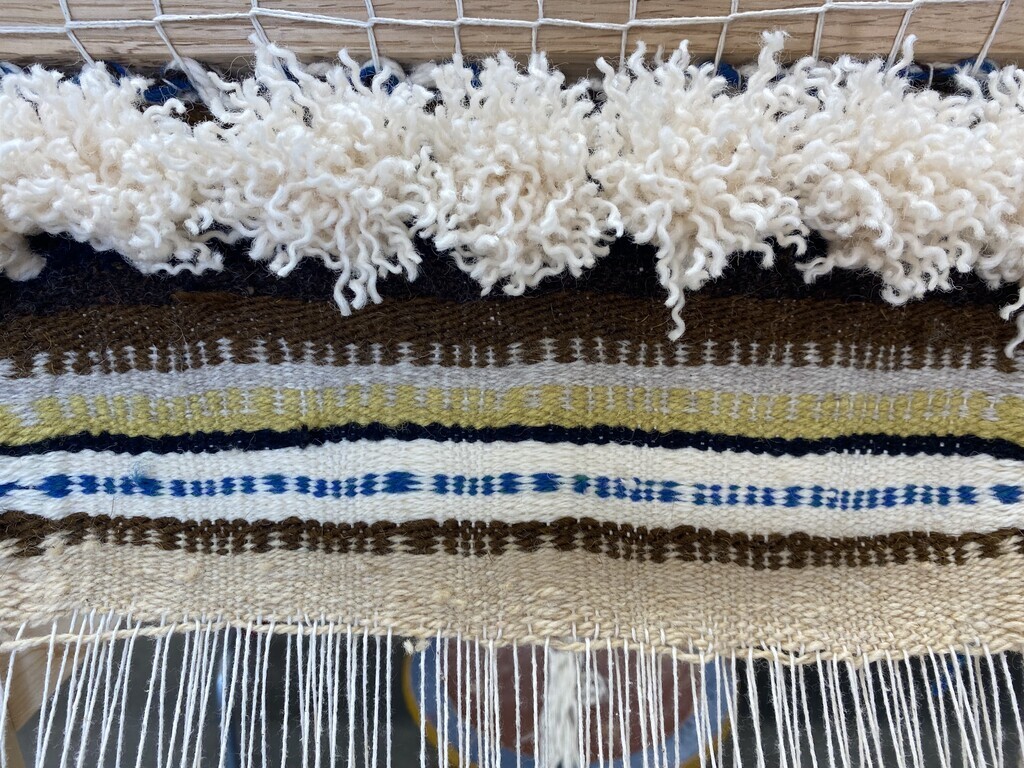
I got home late last night after the most incredible five days in Grand Marais, taking Melba Granlund’s class at North House Folk School! We built our own warp weighted loom the first two days, then wove on it the next three. It’s the most fun I’ve had in a long time and it was wonderful spending time with Melba.
Melba and Holly
David Susag was our woodworking instructor. He also has a major affinity for Scandinavian tradition and is most known for springpole woodwork.
Students with woodworking instructor David Susag
Between the lake, smoked fish, mountain of wool yarn, and smell of pine as we chiseled, it was so magical. I am sad that it’s over but so grateful for the memories we created. Big thanks to Melba for sharing her wealth of knowledge with our little group!
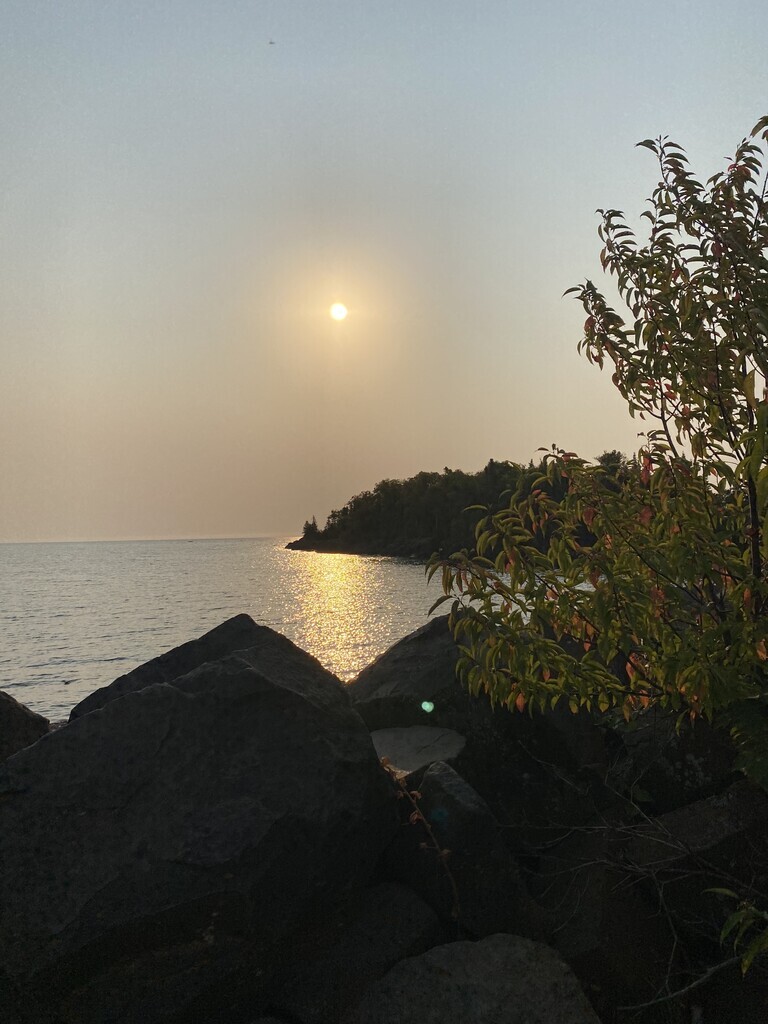
Warp strings weighted with rocksClose-up of Holly’s weavingLake Superior shore in Grand Marais, MinnesotaSunset over the Big Lake
If you know Minnesota, you know how much we love our annual State Fair. Twelve glorious days of agricultural expositions and competitions, live music, fried food, carnival rides, games for the kids, amateur talent contests, more fried food, shopping, politicking, marching bands, sunburn, heatstroke, beauty queens sculpted in butter, and even more fried food, most of it on a stick.
It really is all about the food, especially when you add garlic and butter.
For the past 50 years, volunteers from the Weavers Guild of Minnesota have demonstrated the arts of weaving and spinning in the Creative Arts building, sharing their passion and expertise with fairgoers of all ages throughout the entire run of each year’s Fair. In recognition of this achievement, the Weavers Guild of Minnesota received one of the 2024 Minnesota State Fair 50 Year Awards, presented annually to individuals who have actively participated in the Minnesota State Fair for 50 years.
Nancy Gossell and Judy Larson demonstrate weaving at the Minnesota State Fair.
Besides volunteering, many weavers and spinners compete in the creative activities competitions. This year, Scan Weavers member Nancy Ebner took the plunge, entering for the very first time. To her surprise, she won not one but three ribbons, including a blue ribbon for her square weave tapestry “Divine Order,” seen at the Scan Weavers exhibits at Becketwood and Red Wing Arts. (See previous pots on this blog for a photo.) She was also awarded a red ribbon for her telemarksteppe, seen below.
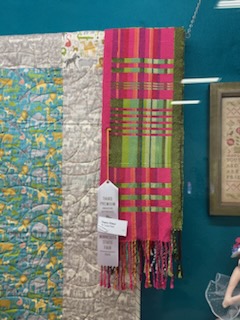
Finally, her charming pink scarf below—yes, pink is her favorite color—won a white ribbon for “Work by a Senior Citizen,” in the category of woven scarf, stole, or shawl.
Barb Yarusso is active in both the Scandinavian Weavers and the Rag Rug Weavers groups. She won a blue ribbon in the category of “International or Historically Inspired Rug” for her rug in a traditional Finnish-American pattern known as “Over the Waves.”
“I wove it using the Finnish 3-shuttle technique, which I learned in a class taught by Wynne Mattila,” Barb explains. “The weft strips are a mix of old sheets and new quilting cotton, and it was primarily a stash-busting project. I used primarily blues and greens to suggest water waves. There are sections using various combinations of weft fabrics, but it’s always a dark, a bright, and a light. When you combine the four treadle repeat sequence with the 3-shuttle technique, it gives waves with a 12 pick repeat length. I wove the hems using Lily Sugar ‘n Cream cotton yarn, doubled, in coordinating colors. The weight of the yarn gives a slightly thicker hem with less draw in than using the warp yarn as hem weft. Combining colors in the hem also makes it look intentional.”
In other award news, Scan Weavers member Mandy Pedigo was honored with a coveted slot in the Fair’s Studio HERE program, which showcases twelve artists over the twelve days of the MN State Fair. The chosen artists set up their creative space in the Fine Arts Building, providing fairgoers an opportunity to engage with the creative process. Visit Mandy’s blog to learn more about her experiences and be sure to give her a follow.
The Scan Weavers’ coordinator, Robbie LaFleur, was honored to have her latest open-warp tapestry “Nest (Golden-Winged Warblers Are Happy in Their Minnesota Habitat)” displayed in the annual Textile Center display in the Creative Arts Building.
Finally, be sure to check out this live segment from KSTP’s “Creative Corner” featuring Minnesota Weavers Guild volunteers, including Judy Larson, a Scan Weavers member and Rag Rug group coordinator.













 Scandinavian Weavers Study Group