In Sweden, the days between Christmas and New Year are known as mellandagarna, or “in-between days.” With the bustle of holiday preparations over, it’s the perfect time to get together with friends. In our case, we enjoyed a cozy “UFO” gathering. (“UFO” stands for “Unfinished Object.”) Everyone brought projects that needed finishing, including weaving, knitting, embroidery, and felting, along with leftover holiday treats.
It’s much easier to put those last few stitches in when you’re chatting and laughing with friends! Here Beth works on finishing her Repp weave wall hanging while Robbie converts her tapestry into a pillow.
Photo by Nancy Ebner
“This was the second tapestry I ever wove,” explains Robbie, “at Valdres Husflidsskole in Norway. The design is two abstracted blossoms. It was never great as a wall piece, so I am now attaching hand-made wool fringe and it will become a pillow.”
Photo by Robbie LaFleur
Mary finished an adorable pair of booties for a newborn family member!
Photo by Mary Skoy
Kits to make these fuzzy booties are available from Joe’s Toes in the UK.
Photo by Mary Skoy
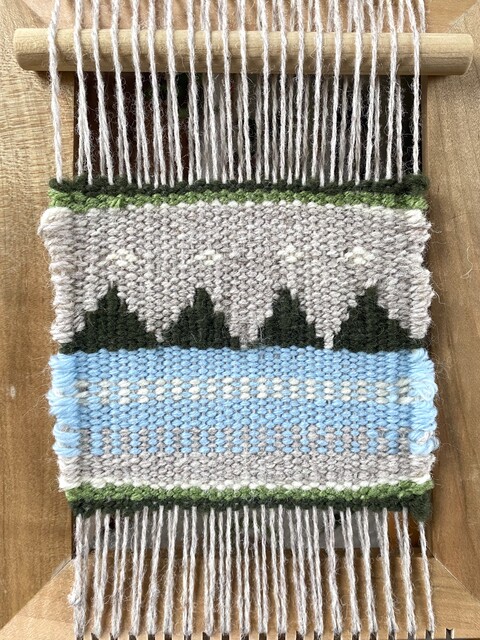
During the Scandinavian Weavers upcoming exhibit “Vibrant Tradition” at Norway House in Minneapolis, we will host Family Weaving Days with weaving activities for all ages. (Follow this blog for dates and times.) Here, Holly practices one of the activities, weaving simple coasters on a frame loom.
Photo by Nancy Ebner
The finished result! Holly says, “I think it looks like trees on the shore of a frozen lake with some snowmobile tracks running across.”
Photo by Holly Hildebrandt
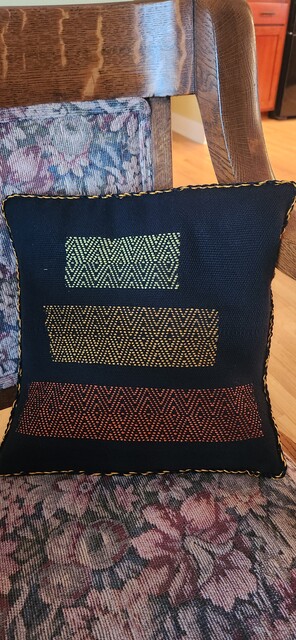
The gathering was also an opportunity to share tips and techniques. New member Amy learned how to twist coordinating cordage to adorn her twill weave pillow.
Photo by Amy Grimm
Phyllis finished a knitted scarf while Kelly felted colorful designs on wool dryer balls. (Wool for felting in the foreground.)
Photo by Nancy Ebner
The Scandinavian Weavers have many exciting projects lined up for 2025, including the “Vibrant Tradition” exhibit at Norway House (January 31–April 6) and weaving demonstrations at Gammelgården (May 3). On the loom, we will tackle skillbragd as well as draw loom techniques. Stay tuned for all the details.
We extend our heartfelt thanks to all blog followers and hope you will continue to find both information and inspiration in the coming year!
Detail of a rag rug woven by Karin Larsson from “Karin Larsson: Let the Hand be Seen” at the American Swedish Institute.
Nancy Ellison, longtime member of the Scandinavian Weavers Group, has been having a busy summer. Nancy raises Scandinavian heritage breed sheep on her farm near Zumbrota, Minnesota, and spins and weaves with their fleece. She is a recognized expert in traditional Norwegian folk arts.
Nancy Ellison demonstrating cradle loom weaving at the Scandinavian Weavers Group exhibit “Domestic to Decorative” at Red Wing Arts.
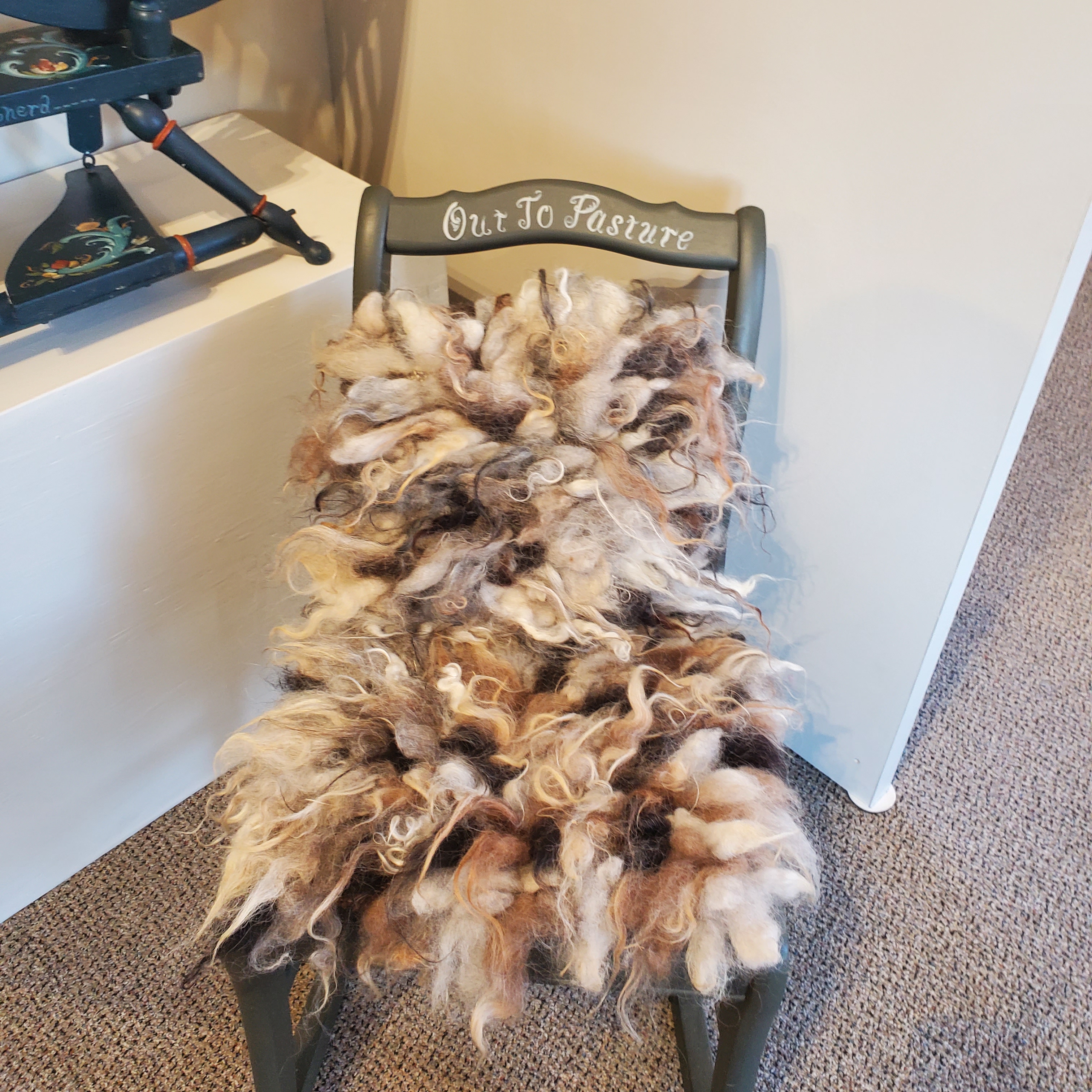
Her flock’s colorful fleeces are featured in her weaving, as in this rya. (Nancy also painted the rocking chair and spinning wheel.) Her flock features Shetland, Gotland, and Icelandic sheep.
A poster featuring Nancy was recently spotted at this year’s FinnFest in Duluth by alert Scandinavian Weavers member Barb Yarusso.
Photo by Barb Yarusso
The poster is from a traveling exhibit called “Traveling Traditions: Nordic Folk Arts in the Upper Midwest,” created by the University of Wisconsin-Madison’s Center for the Study of Upper Midwestern Cultures. The exhibit features photos and interviews with seven folk artists throughout the region. The interviews were conducted by graduate students at the University of Wisconsin–Madison, trained in folklore fieldwork, working in cooperation with the Minnesota State Arts Board and the Wisconsin Arts Board.
Nancy recalls the interview with her customary modesty: “I don’t know how they decided to ask me for an interview. I hadn’t applied for anything. I’ve been blessed by unasked for publicity that has come my way through the years. It has been fun!”
Nancy was also in the news recently when a sheep got loose in Zumbrota. (Some might say the sheep was on the lam.) The sheep evaded police but was eventually apprehended by some experienced wranglers. An enterprising reporter from the Minneapolis Star Tribune contacted Nancy for a quote. “He had an interest in sheep and said he saw lots of sheep when he was on a trip to Scotland,” Nancy explains, “and he saw the news about the Zumbrota police capturing an escaped sheep. I am always happy to help educate the public when anyone asks me about sheep, wool, spinning, weaving, etc.”
Fortunately, Nancy has never lost one of her rare heritage sheep. “One time a lonesome stray sheep got in with my flock,” she says. “I was surprised to see a sheep I didn’t recognize. [With a] pan of grain, my sheep follow me wherever I want them to go, and the stray followed them in the shed where I could corner him, put a halter on him, and put him in a separate pen. I phoned neighbors with sheep and nobody was missing any. Some people had seen a sheep in the area by itself. I phoned the sales barn, two miles from here on the other side of Zumbrota, and they had one escape a month previous and sent someone to get it from here. The sheep had enjoyed a month of freedom and hadn’t been eaten by a coyote. Sorry to see him go back behind baaaaars! “
Be sure to check out Nancy’s website at Ellison Sheep Farm. She teaches classes and gives presentations on traditional Scandinavian spinning and weaving and is a great person to consult regarding old spinning wheels and looms.
The Scandinavian Weavers exhibit “Deep Winter Needs the Colors of Scandinavia” is currently on view (through April 2, 2024) at Becketwood Senior Cooperative in Minneapolis. While Becketwood is a private residence, you can arrange to see the exhibit by calling the front desk at (612) 722- 4077 prior to your visit to make sure the galleries are open for viewing. We recently enjoyed a gallery talk with residents, who asked great questions about the traditional weaving techniques on display.
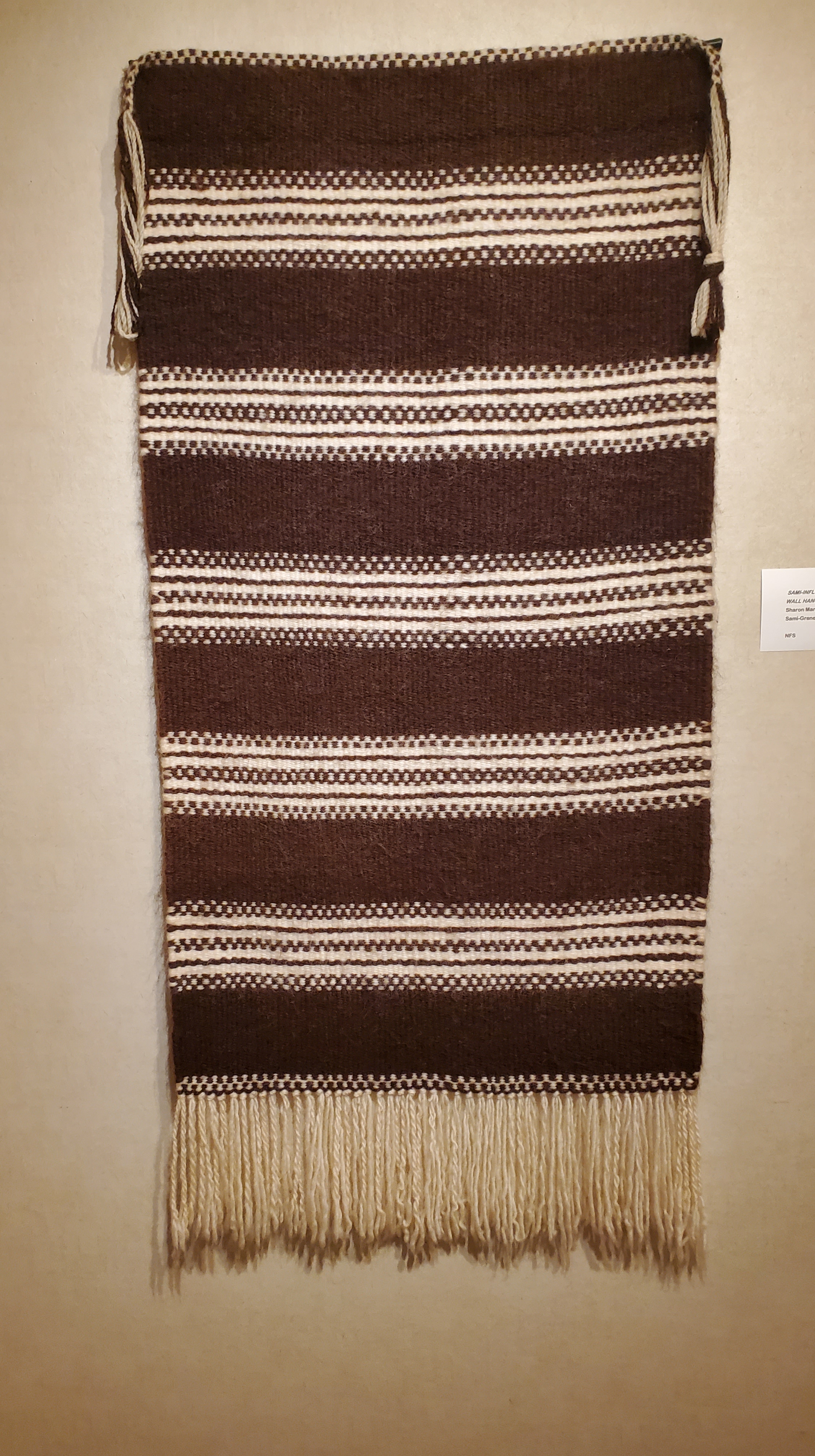
Sharon Moe Marquardt wove this Sami-style grene on a warp-weighted loom while on a study trip in Norway. She learned this traditional technique from Sonja Vangen and Olaug Isaksen at Lofoten Folkehøgskole in Kabelvåg, near Lofoten.
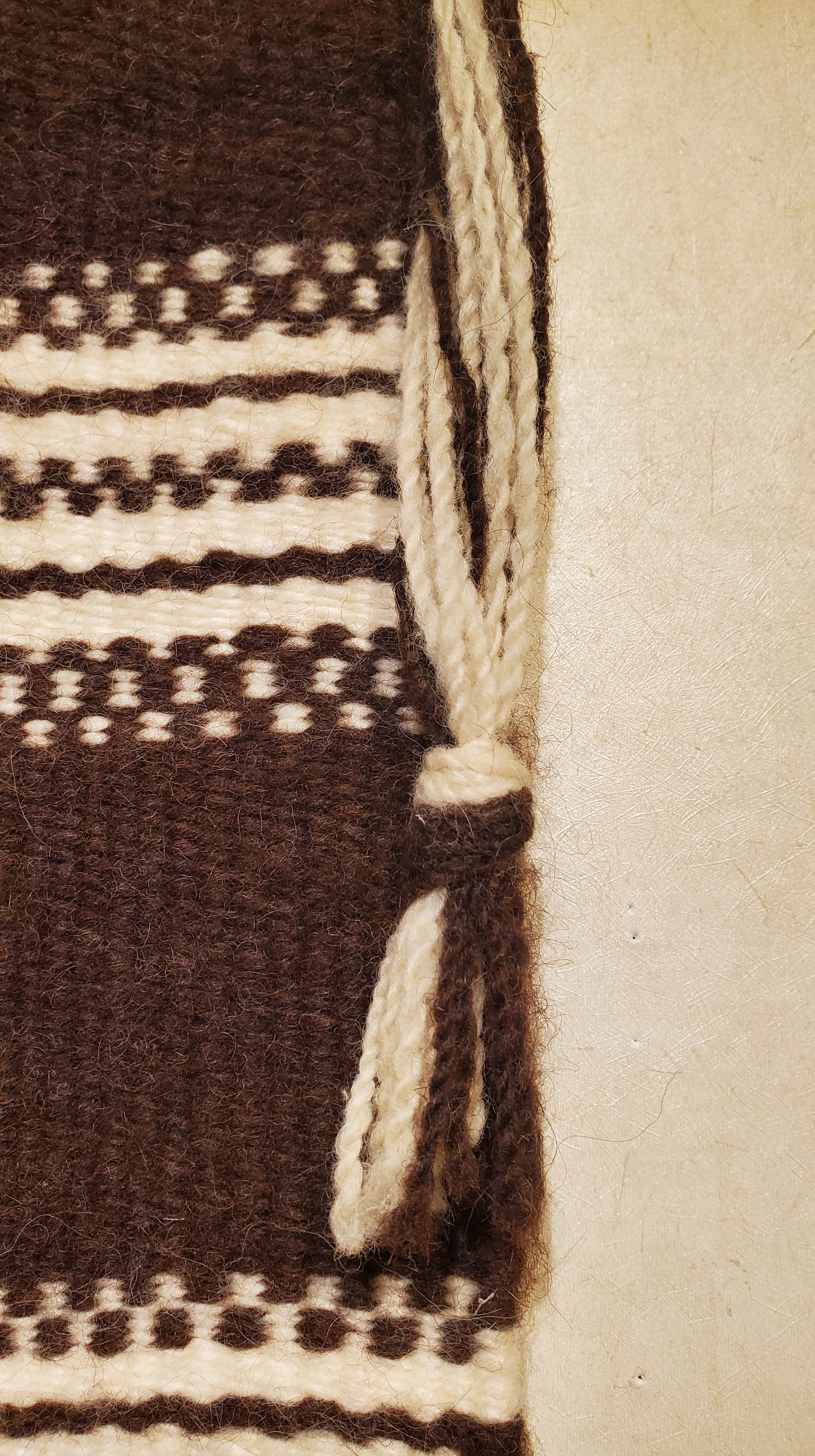
Detail of Sharon’s weaving.
Mary Skoy was also inspired by her travels in Scandinavia. She wove this traditional-style christening blanket based on one she saw in a museum in Sweden. “Red being my favorite color,” she explains, “I knew I needed to reproduce it!” Christening coverlets were traditionally woven with protective symbols to shield the infant from evil influences while being carried to church for baptism. The coverlet is woven in three-shaft bound rosepath with cotton seine warp and wool weft. The selvedges are covered with a band, woven on an inkle loom with pick-up patterns, which also includes protective symbols. (Read more: https://norwegiantextileletter.com/article/baby-basket/)
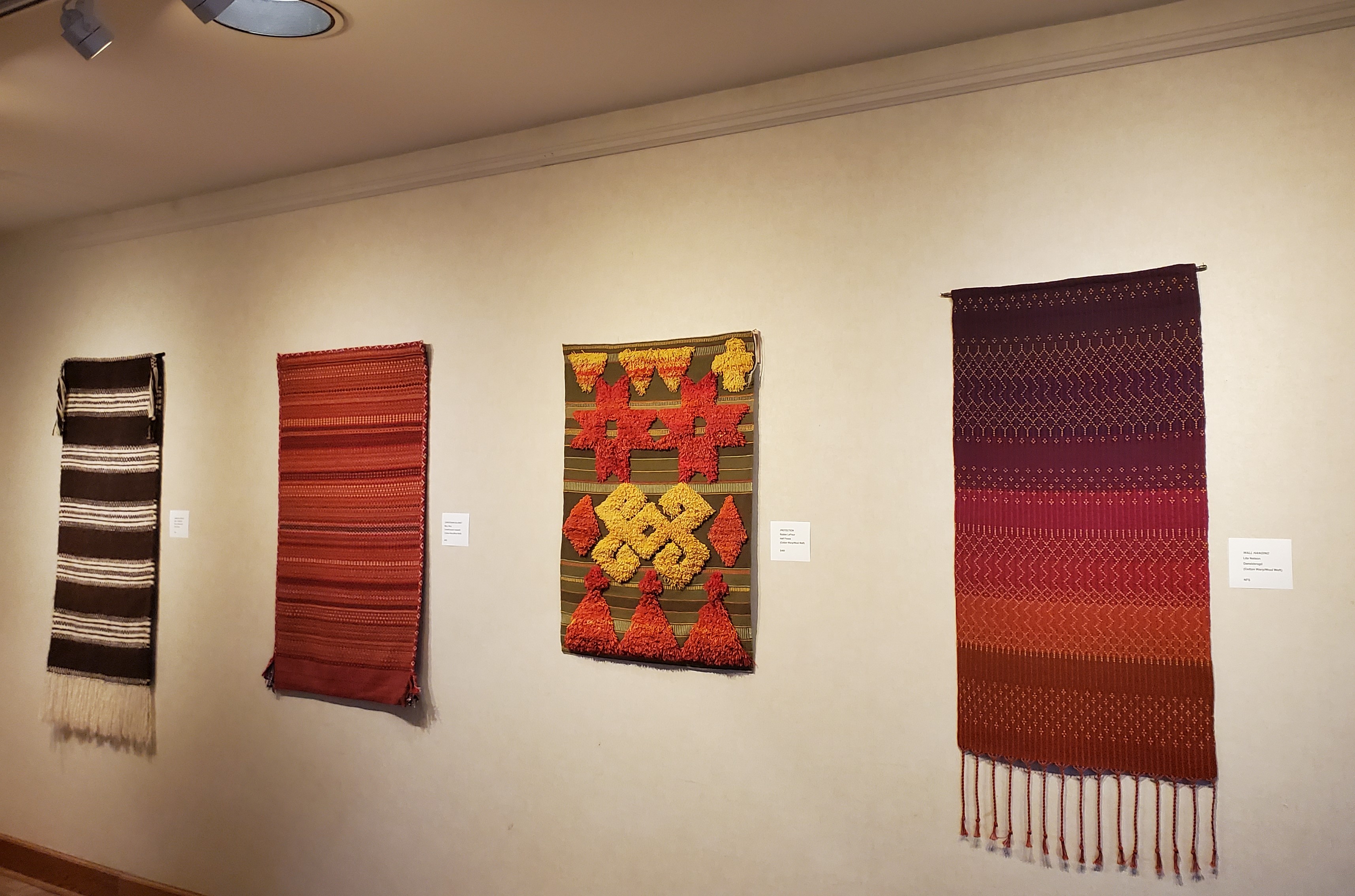
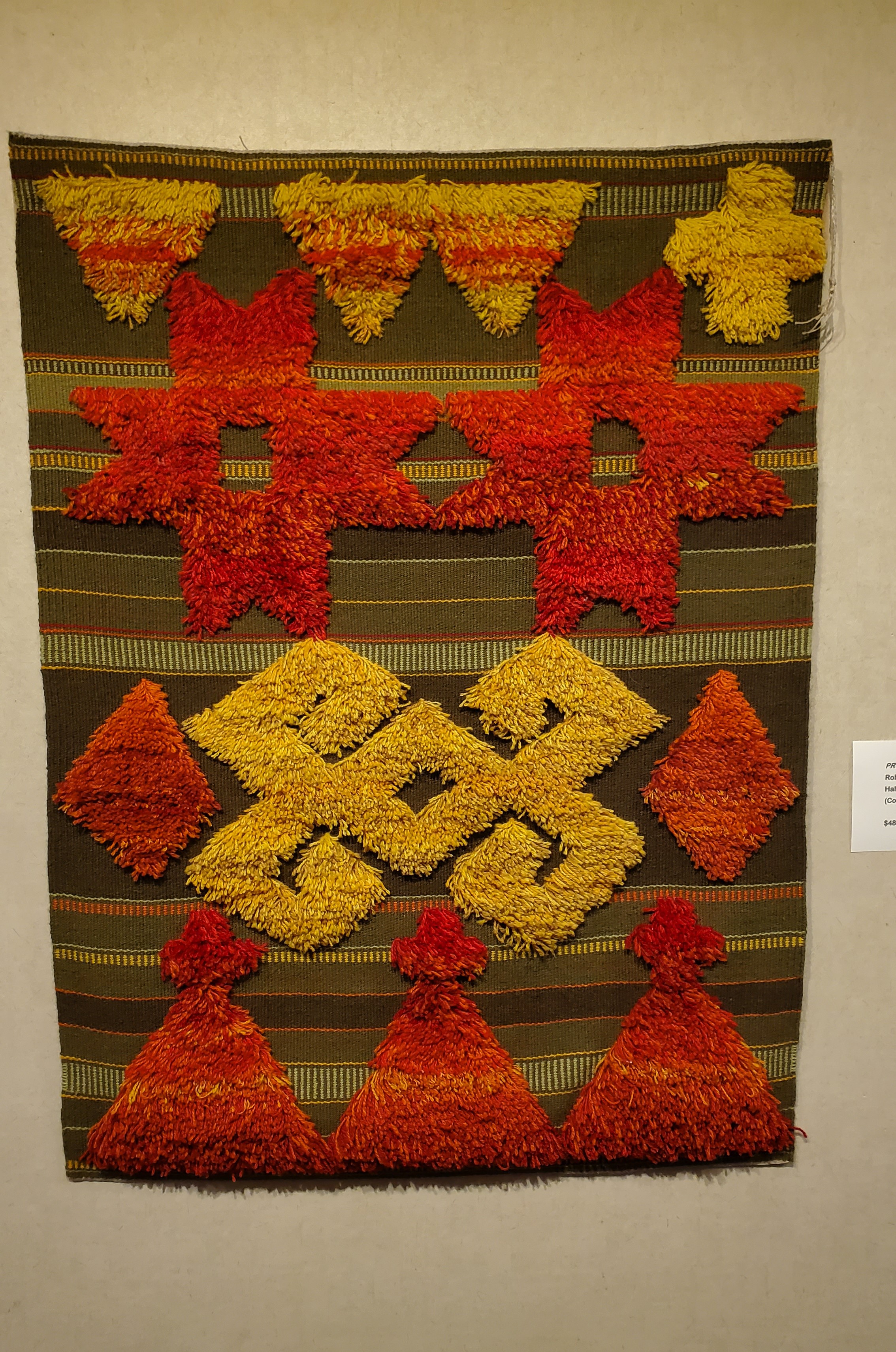
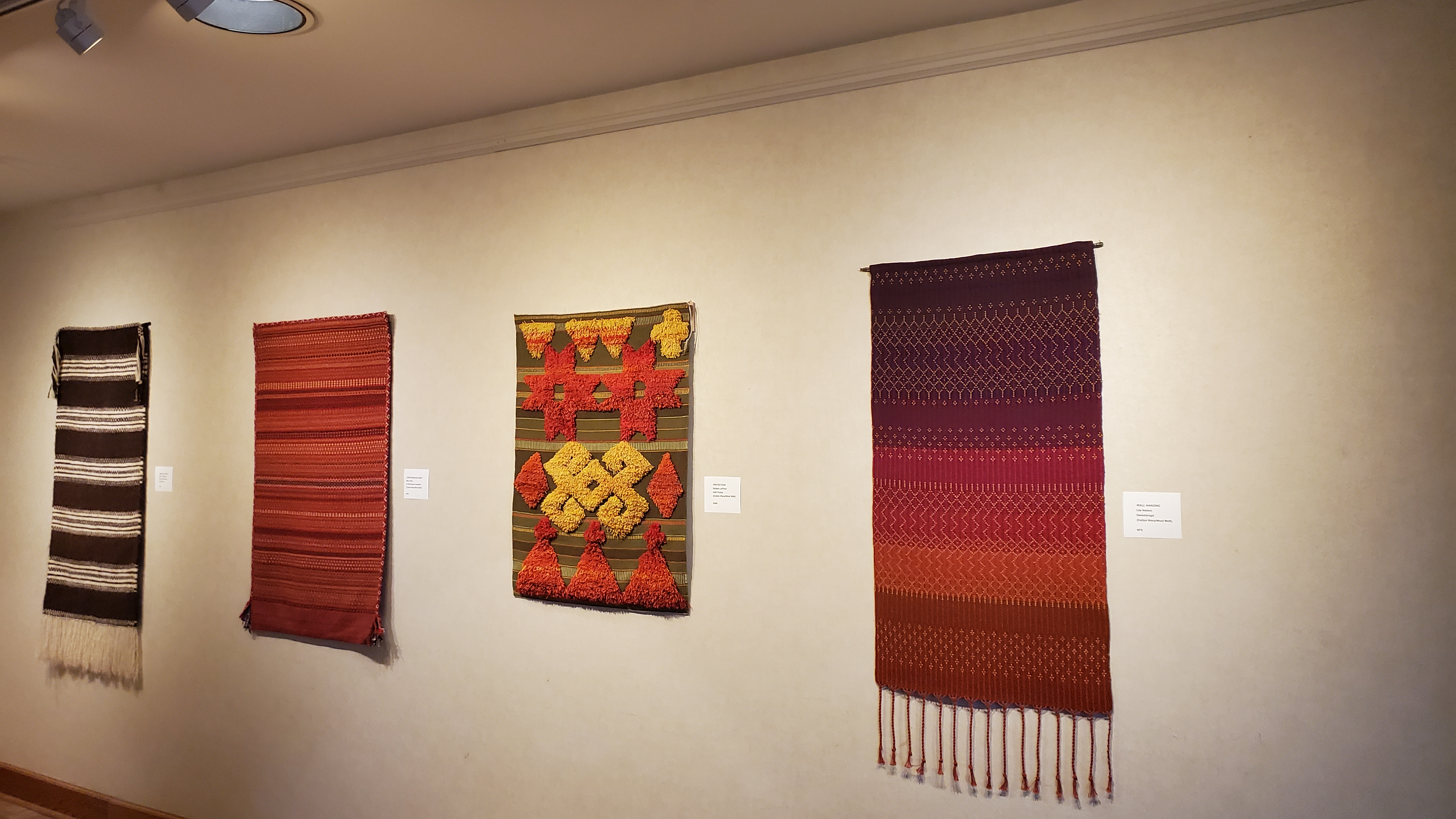
Robbie LaFleur wove this colorful half-flossa wall hanging, called “Protection,” for the Scandinavian Weavers previous exhibit “Myths, Symbols, and Fairy Tales.” Half-flossa technique includes alternating sections of plain weave and short pile.
Lila Nelson, one of the original founders of the Scandinavian Weavers group, wove this elegant danskbrogd wall hanging, which is in the permanent collection of the Weavers Guild of Minnesota. Lila did extensive research on danskbrogd and is largely responsible for bringing the technique to the United States.
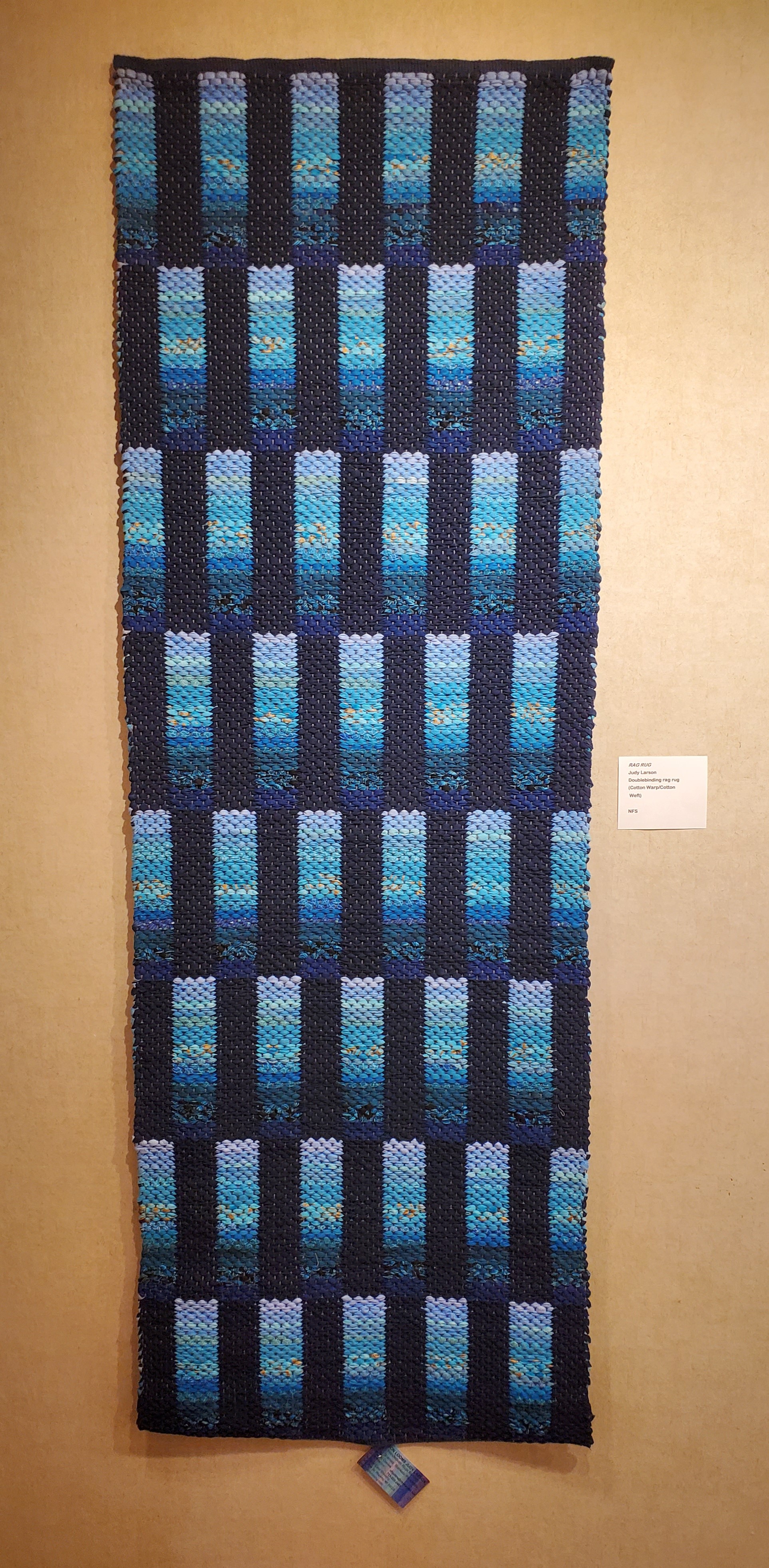
Judy Larson wove this stunning rag rug called “Rippling Water.” The rug is a double binding rug in which smaller strips of multiple blue fabrics were sewn together to contrast with the navy solids. “Rippling Water” was a labor of love. “Even with all the fabric prepped and already on the shuttles,” Judy explains, “this rug took 8 hours to weave at the loom!”
On the left is another rag rug, this one woven by Barb Yarusso. The weft comes from a rug woven by her grandmother Alma Norhala, an immigrant from Finland. The original rug was woven in the 1950s, in plain weave with log cabin threading. Barb carefully salvaged and cleaned the cotton weft material and re-wove it into a new rug as her way of honoring Alma’s work and carrying on the immigrant tradition of not letting anything go to waste. Barb’s rug exactly re-creates the original log cabin threading as well as the stripe sequence. (Read more: “In Honor of Alma: A Reconstructed Rag Rug.)
On the right is “Horda 3rd Gen,” a transparency by Lisa Torvik. Lisa studied weaving in Norway and focuses her work on traditional Norwegian techniques and geometric designs. In this case, the center panel is based on a coverlet from the Hordaland region of Norway, while the motifs along both sides are abstract improvisations on traditional motifs. In 2023, “Horda 3rd Gen” won first place in the “Weaving the North” exhibit at North Suburban Arts Center as well as a blue ribbon at Vesterheim’s National Norwegian-American Folk Art Exhibition. (Read more: “Three “Generations” of an Old Hordaland Weaving Design.”)
Raanu is a traditional Finnish weave that takes many different forms. Lisa-Anne Bauch learned to weave raanu rugs from Wynne Mattila at the Weavers Guild of Minnesota. Most raanus take their color inspiration from the natural world. “Polar Vortex” explores the colors of a cold winter’s night.
For more beautiful weavings, stay tuned for Part Three of this post, which will be up later this week!
Becketwood is a senior housing cooperative in Minneapolis, located in the Longfellow neighborhood on a beautiful bluff overlooking the Mississippi River. Becketwood has an active fine arts committee, including several weavers. The committee invited the Scandinavian Weavers to present an exhibit in their gallery space.
Scandinavian weavings at Becketwood
Our goal was to present a wide variety of traditional Scandinavian techniques. Since we were expecting our usual harsh Minnesota winter, we named the exhibit “Deep Winter Needs the Colors of Scandinavia.” Alas, it has been unseasonably warm with almost no snow. Nevertheless, the bright colors of the weavings are a welcome sight.
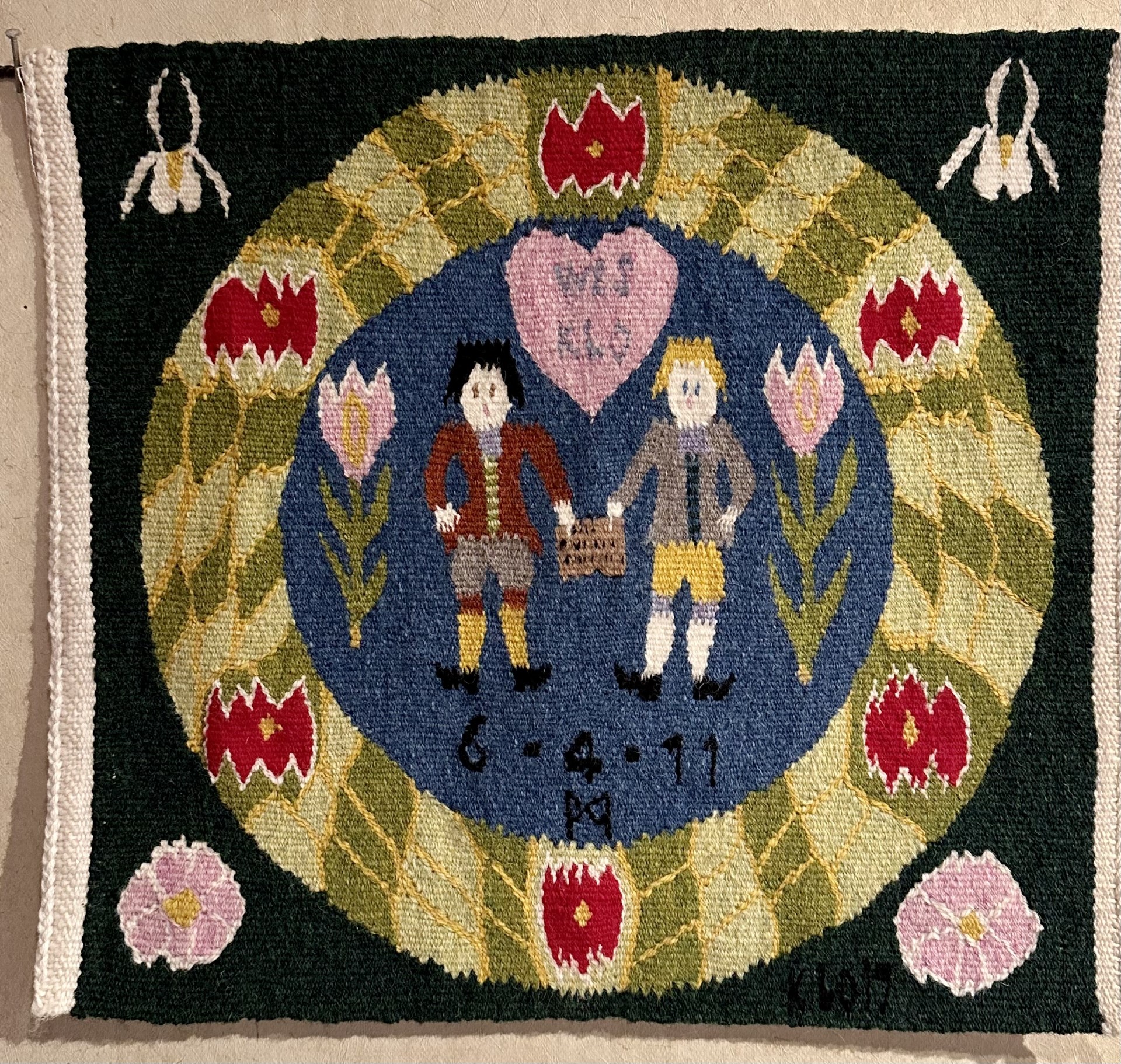
Kevin Olsen, who specializes in Scandinavian tapestry techniques, wove a wreath pattern called Betrothal, traditionally woven to celebrate an engagement. “Since my husband and I had already been married for six years when I wove the tapestry,” Kevin explains, “I called mine Anniversary instead. I included irises and peonies, which were our wedding flowers, while the tulips are a traditional motif.” The six red roses stand for the six years Kevin and his husband had been married. In the spirit of betrothal tapestries, Kevin included the date and an image of the marriage certificate.
Kevin Olsen’s Anniversary tapestry
A vitrine showcases woven bands, a common element of Scandinavian folk costumes. As seen below right, Jane Connett used card-weaving to create a wide belt for a bunad (traditional costume). In this ancient technique, warp yarns run through holes in square cards. Each single card has four holes, one in each corner, and dozens of cards may be combined to create intricate patterns. After each weft shot, the cards are turned forward or backward to create the next element of the pattern.
Below center, Judy Larson wove a smaller band using a heddle or bandgrind. In this portable technique, the weaver raises and lowers the heddle to create the open sheds through which the weft passes. To weave designs, the warp strings can be picked up individually and a curved knife is used to beat in the weft yarn.
The charming tea cozy in the background was woven by Marie Nordland (1909-2000), the aunt of current Scandinavian Weavers member Nancy Ellison. Marie was a member of De Norske Vevere (the Norwegian Weavers), a group in the Weavers Guild of Minnesota that was a forerunner of the Scandinavian Weavers Study Group. She used a variety of techniques in her tea cozy, including krokbragd, danskbrogd, and rya.
Back row, left to right: Tea Cozy by Marie Nordland, Heddle Band by Judy Larson, and Bunad Belt by Janet Connett. Foreground: Sami-Influenced Band by Sharon Moe Marquardt.
Sharon Moe Marquardt wove the Sami-style band in the foreground using a simple tube loom. She added miniature Sami boots that she purchased at the husflidlag (handcraft association) in Manndalen, a Sami community on Kåfjord, east of Trømso in Norway, where she learned the technique.
Close-up of Sharon Moe Marquardt’s Sami-style band, including miniature boots of reindeer leather.
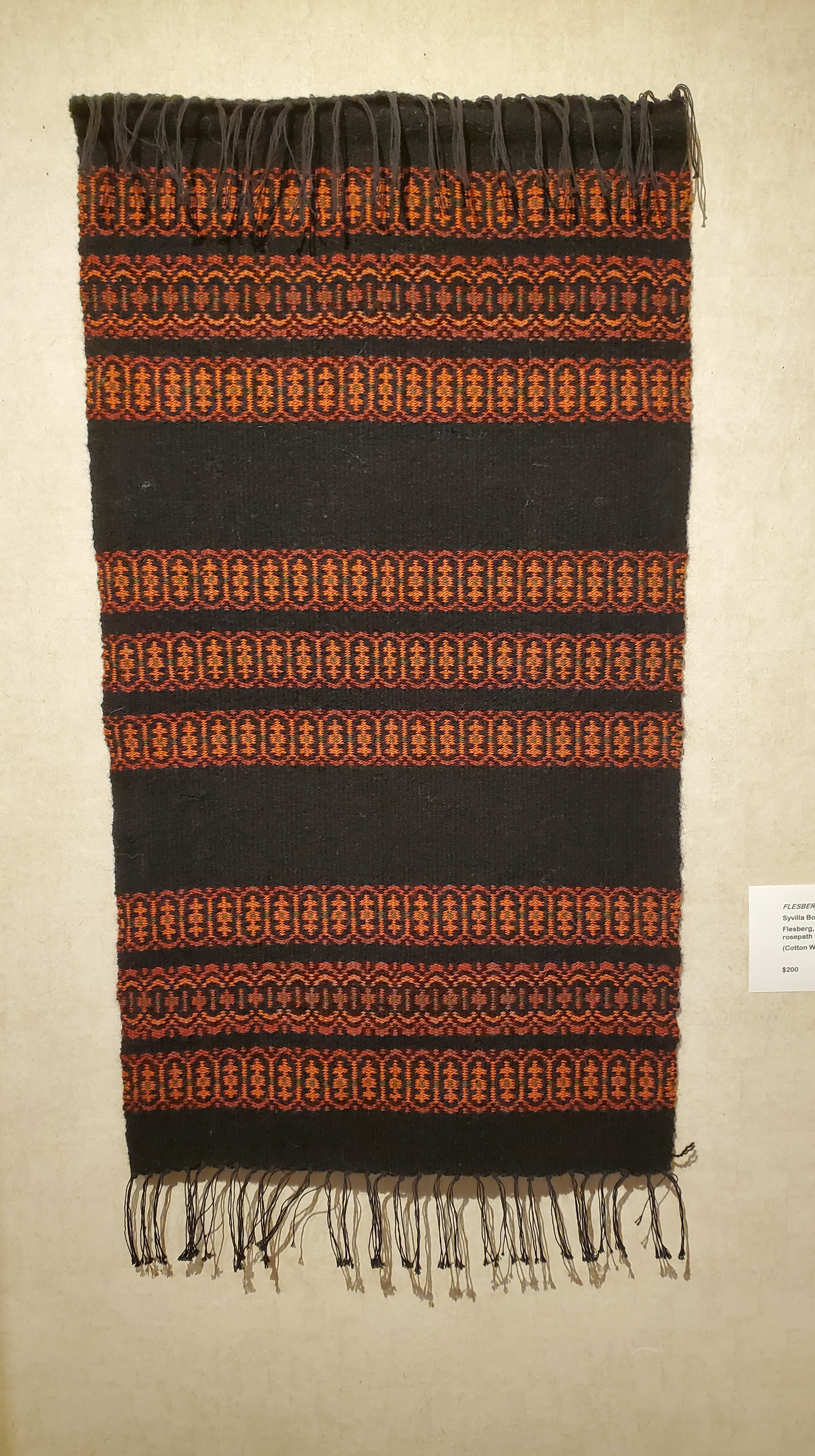
Syvilla Bolson (1928-2011) wove the wall hanging below in Flesberg technique, a style of three-shaft bound rosepath from the Flesberg region in Norway. Syvilla was a beloved member of the Scandinavian Weavers for many years. (Learn more about the flesberg technique in the November, 2020, issue of the NorwegianTextileLetter.)
Flesberg technique woven by Syvilla Bolson
Jan Mostrom wove the rutevev wall hanging below, evocatively named “Old Soul.” Rutevev, or square-weave, is a geometric weaving technique using single or double interlock joins.
Ann Haushild, a Becketwood resident and long-time study group member, wove this colorful hanging in Vestfold technique, named after the Vestfold region in Norway. It is an inlay technique, in which weft yarn is laid in to create the designs. (There is more on this technique in the February, 2020, issue of the Norwegian Textile Letter.)
Vestfold wall hanging by Ann Haushild
Last year, the Scandinavian Weavers set up a group warp to weave in telemarksteppe technique. (See previous blog posts for more photos of this technique.) Kala Exworthy wove the beautiful version below in colors inspired by the natural world.
Telemarksteppe wall hanging by Kala Exworthy
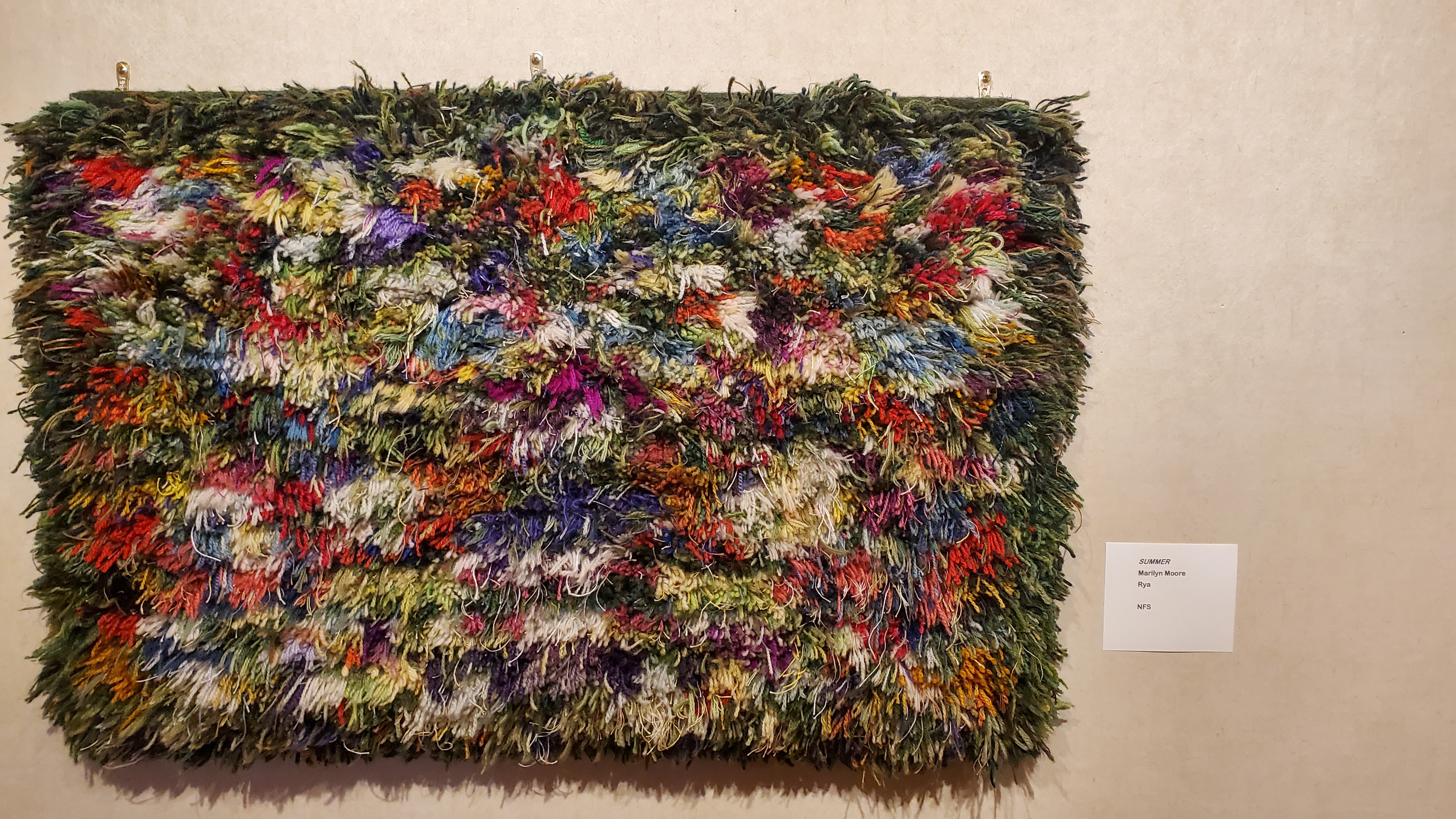
Rya is a traditional pile technique. Marilyn Moore’s lush version below was inspired by the colors in her expansive flower garden.
Rya wall hanging by Marilyn Moore
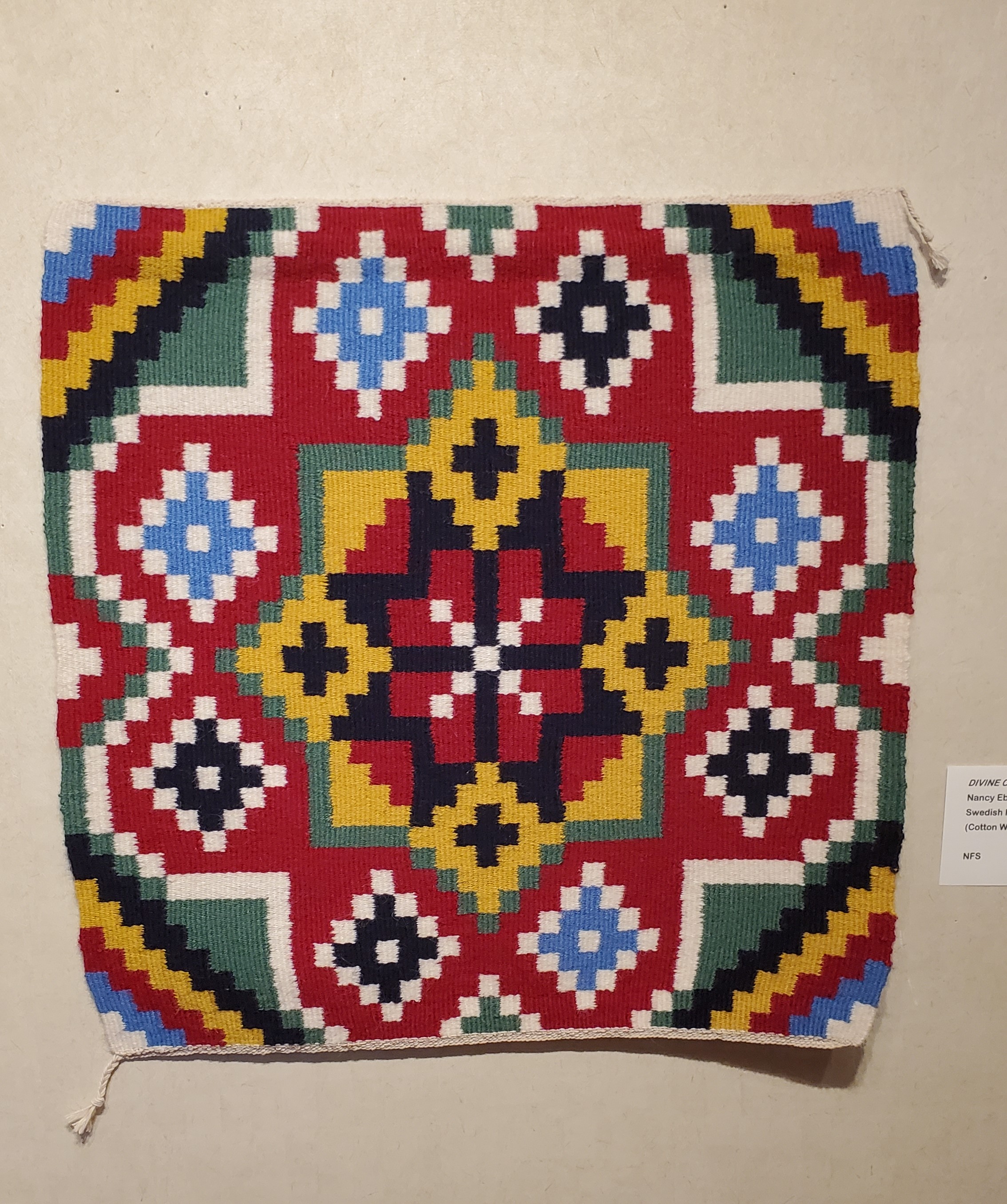
Nancy Ebner wove a rutevev wall hanging called “Divine Order.” The original pattern drawing was produced in the 1930s by Linnea Kullman (Johansson), a student at Johanna Brunsson’s Weaving School in Stockholm, Sweden. Nancy discovered the pattern in the historical collections at the Nordisk Museum (via digitalmuseum.se).
“Divine Order” by Nancy Ebner
Brenda Gauvin-Chadwick wove the pillow below, called “Joy Exploding,” in rosepath technique. “The pillow was woven with Fåro yarn that I purchased in Sweden many years ago,” she writes. “I carried it all over Scandinavia for weeks in my suitcase. I bought it after skiing the Swedish Vasaloppet. Two weeks later in Norway I skied the Birkebeiner race. The colors represent the forests, the beautiful sunshine and my heart exploding with joy as I skied along!”
Brenda Gauvin-Chadwick’s “Joy Exploding”Detail of “Joy Exploding”
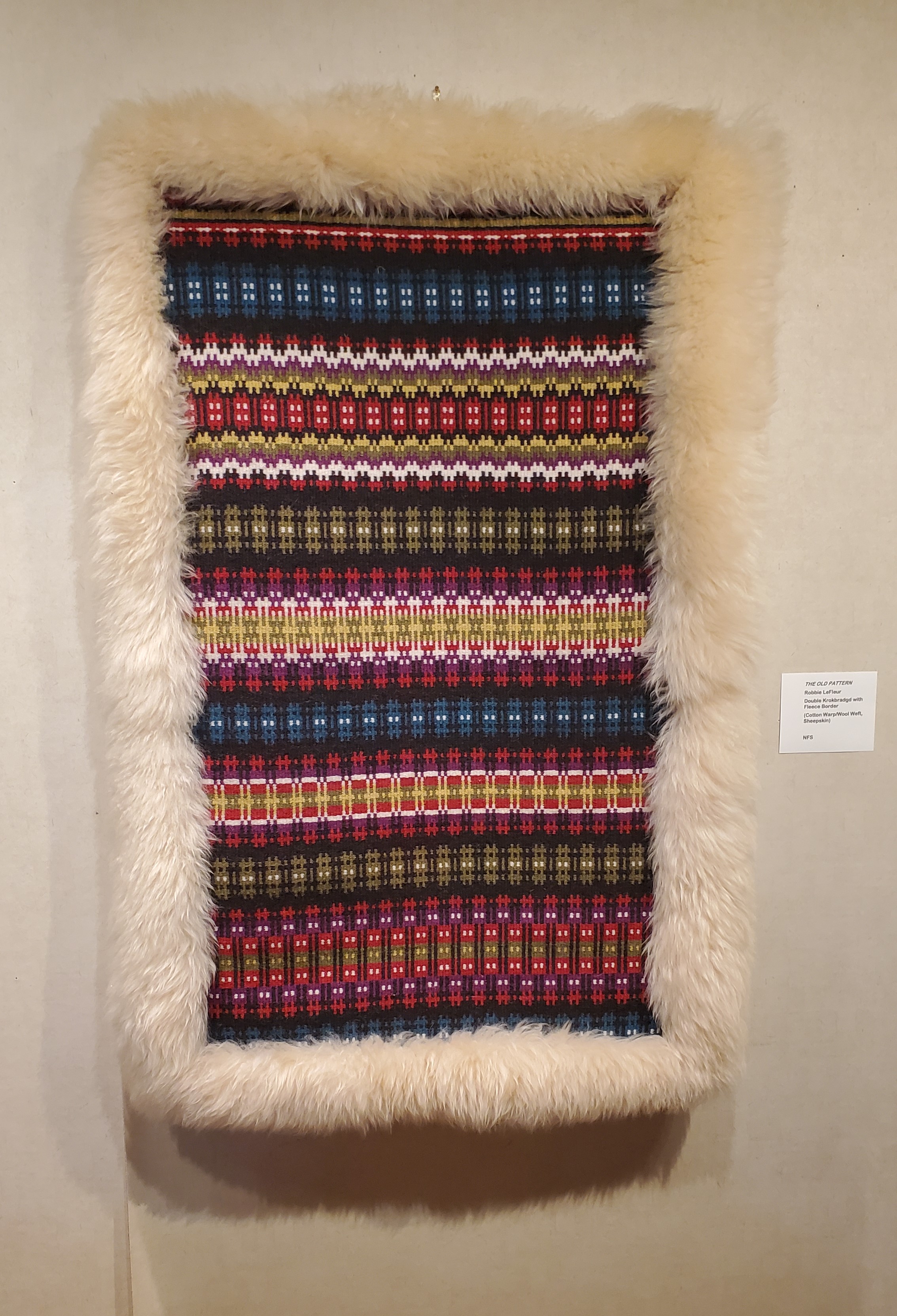
Robbie LaFleur’s weaving below is in double krokbragd technique. Called “The Old Pattern” it includes a sheepskin backing and fringe. (Read the full article from the Norwegian Textile Letter on the old pattern.)
“The Old Pattern” by Robbie LaFleurDetail of “The Old Pattern”
Stay tuned for more blog posts featuring photos from the exhibit, which will be on view through April 4.
If you would like to visit the exhibit, please call the Becketwood front desk at (612) 722- 4077 prior to your visit to make sure the galleries are open for viewing.
















 Scandinavian Weavers Study Group