By Robbie LaFleur
Our experience with the Scandinavian Weavers Study Group shared warp for Flesberg technique has been mixed, to say the least. Based on a piece I wove in 2008, we decided to warp the loom with 12/6 seine twine. I carefully unwove a tiny strand of the braided “tail” of black seine twine on my old piece and verified that it indeed had six strands. Our group members said they didn’t like black, because it can be hard to see on the loom, so I found some 12/6 white seine twine in my stash. Super volunteers wound the warp and put it on the loom at the Weavers Guild.
Here’s the problem. I thought the white seine twine was the same size as the black I had used, but it was not. It looked the same at first glance, but it turned out to be just a little heftier than the yarn I used originally, just enough thicker to make it difficult to cover the warp threads easily. Both the warp I used before and the warp we used now was 12/6. But dyeing can affect the yarn.
As I heard reports from the first weavers, I was confused. I did not remember beating hard at all. The great challenges of weaving in the flesberg technique should be choosing your pattern arrangement and colors, and following the patterns accurately. I didn’t remember struggling to weave an even edge or having to beat hard to make the weft cover the warp.
Weaver #1: Beth Detlie
Despite the difficulties, Beth Detlie wove a smashing runner for the first project. She used yarn specially spun for her by Beth Friedman, using the fur of her daughter’s dog, a Norwegian buhund. The fuzziness helped the coverage, and she was using lighter colors, so a bit of white warp was not noticeable.
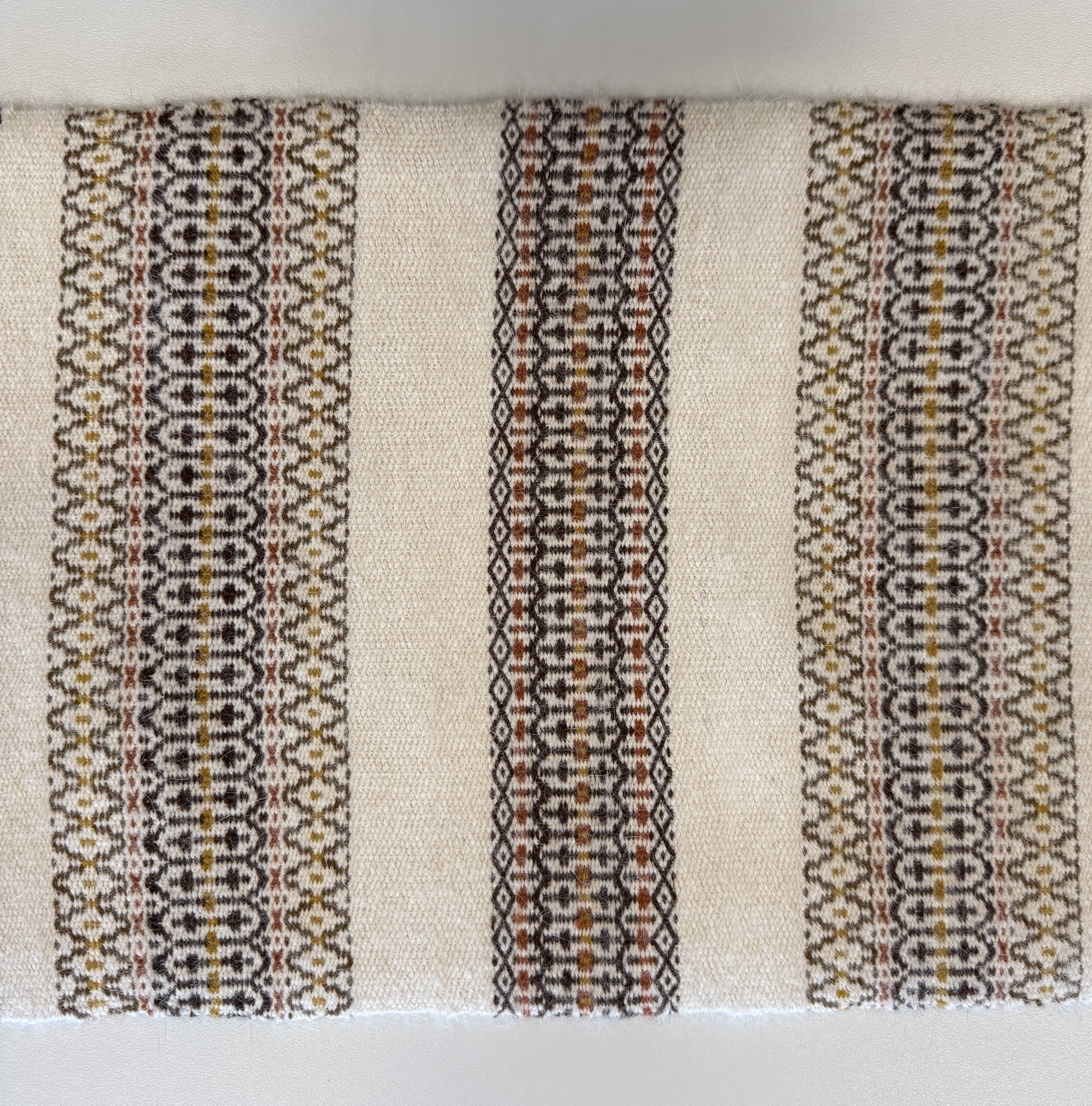
Here are Beth’s hints from her experience.
The pattern columns read from right to left so, for instance, you would start where the word bord 1 is. I liked using the magnetic board and strips to move along as I wove the pattern, not exposing more than 5-8 throws before moving to the next group. Always move the bottom magnetic strip up to meet the top one before you advance the top strip, weave and repeat.
I also think it helps visually to have some device for visual rest, like a strip of solid color or a repeat simple pattern. I think this allows the more complex patterns be better defined.
Weaver #2: Judy Larson
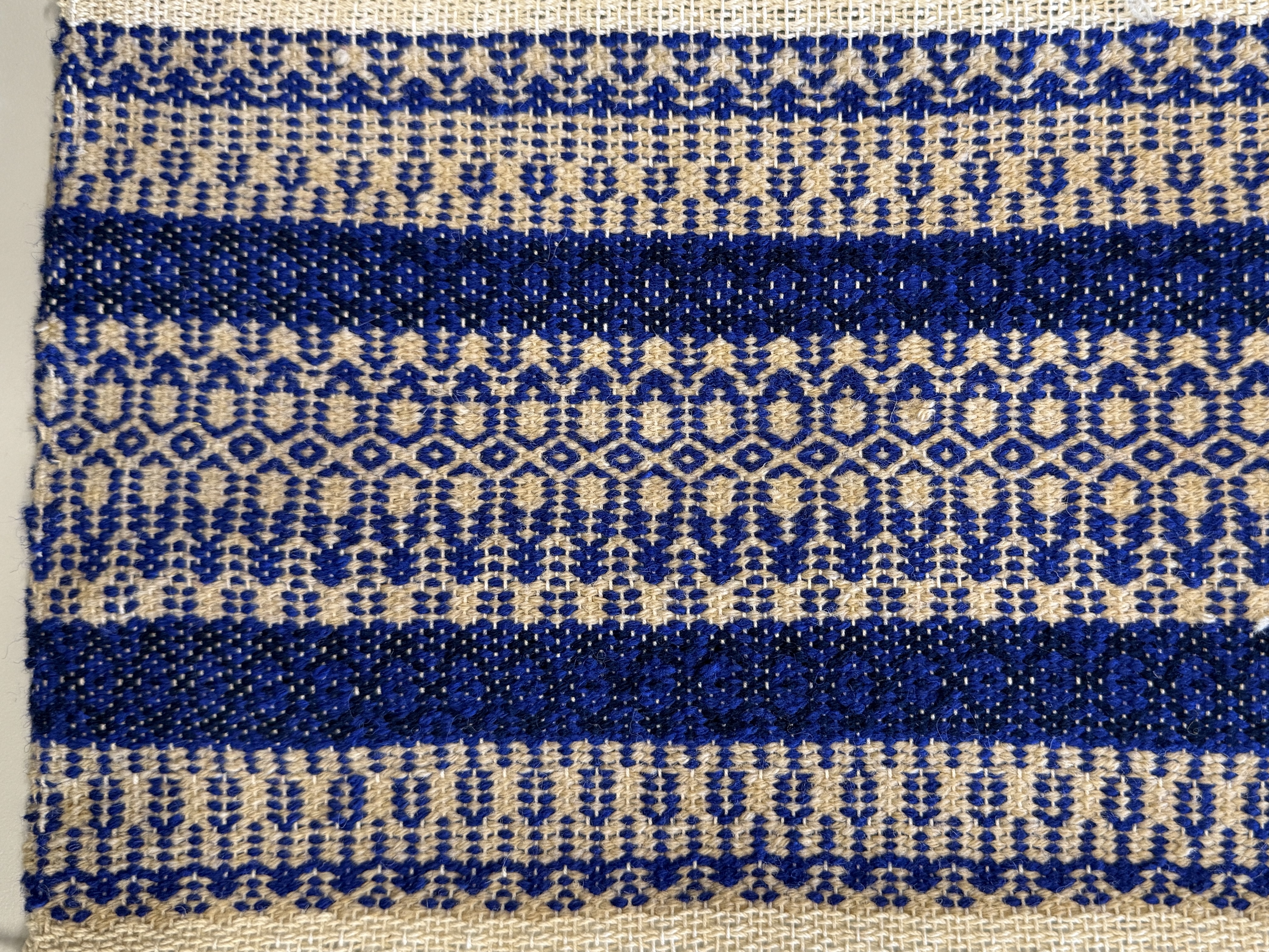
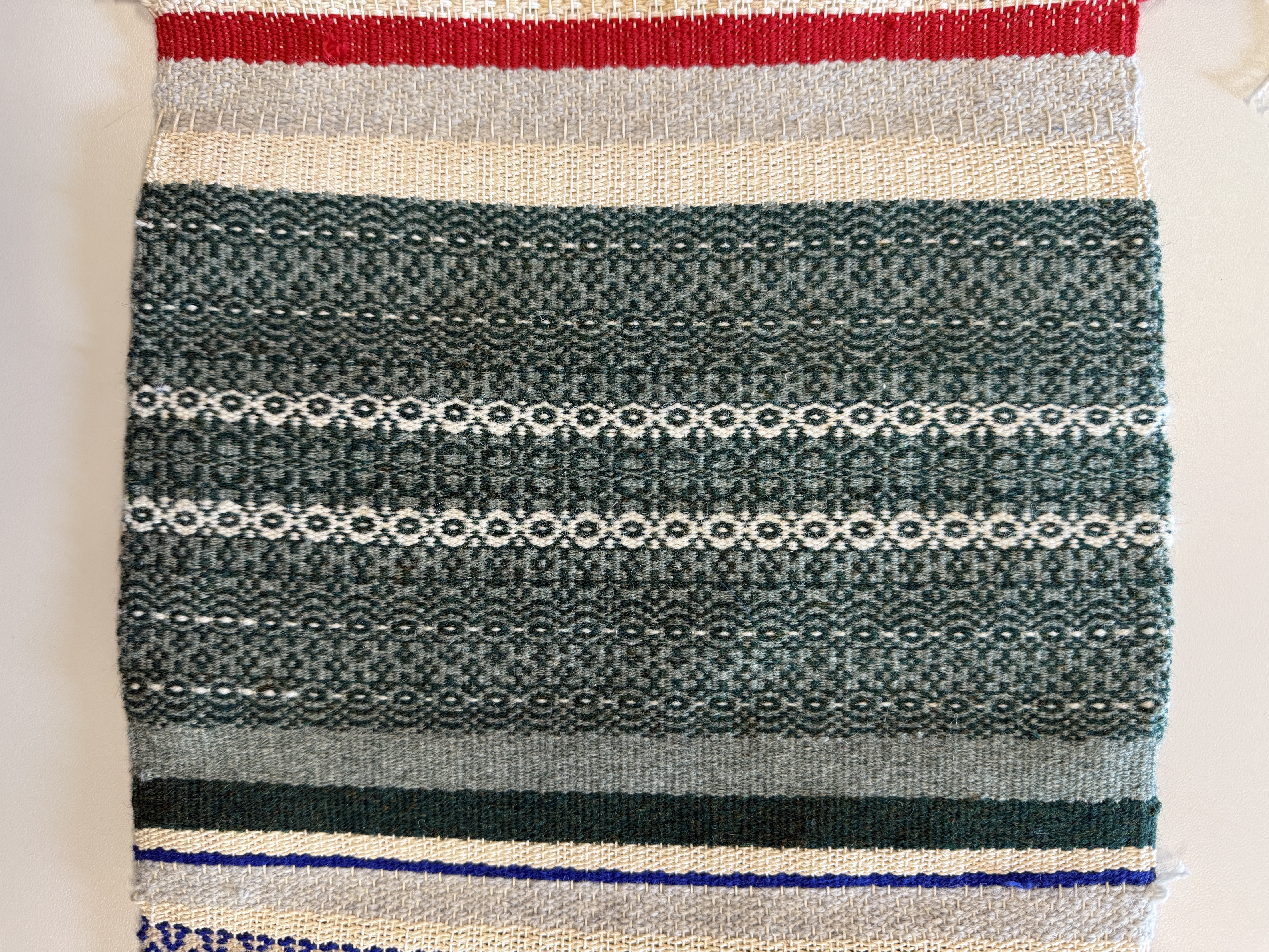
Next Judy Larson experimented. Judy is a super-skilled weaver, yet she had problems with coverage, even though she tried different yarns. She ended up with a small sample that showed the patterns well, but it seemed crazy that she would have difficulties. In the sample with the blue yarn, at ten ends per inch it was difficult for Judy to get good coverage using …. yarn. In the green sample, she switched to very thin … yarn.
Weaver #3: Lisa Torvik
I talked with Lisa Torvik about the beating and coverage issues before she took her turn at the Glimakra. Lisa’s brilliant solution was just to go with the fact that part of the warp would show. She had a beautifully even beat throughout, and as usual, impeccable color choices.
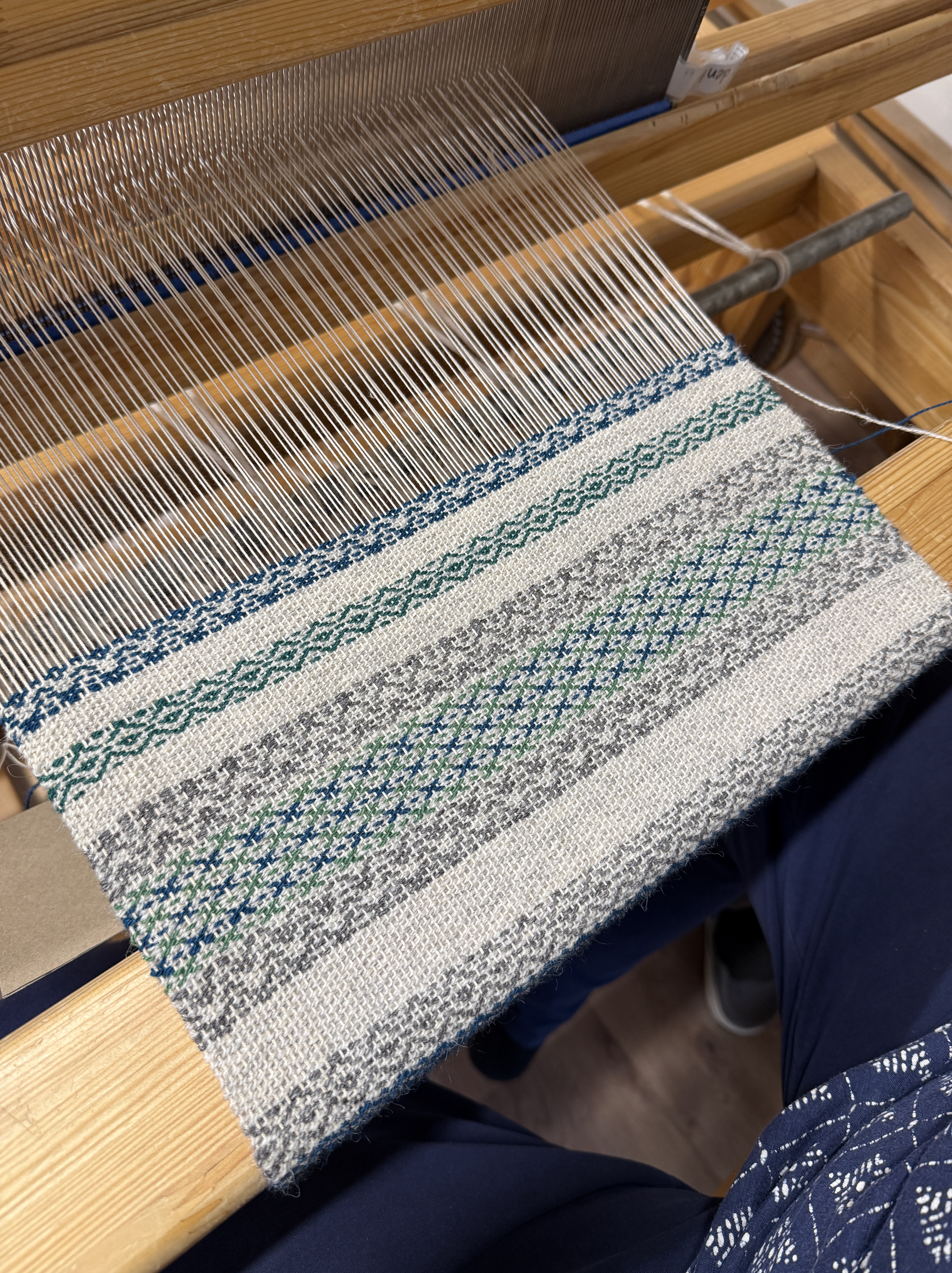
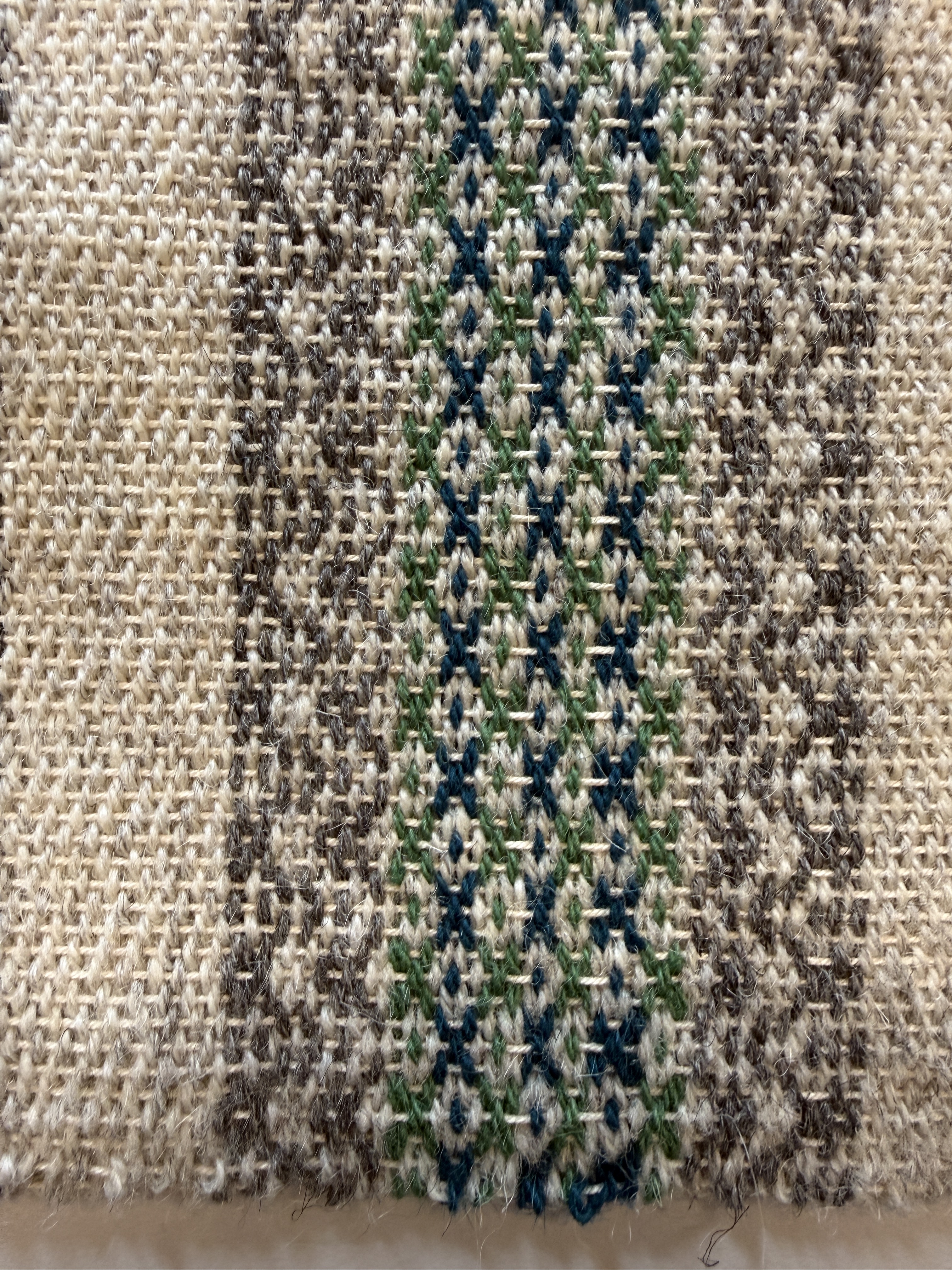
These are Lisa’s tips.
Decide on your preferred borders first from the multitude of patterns we have available.. Unless this is a familiar technique, which it was not for me, the need to counterbalance shots makes experimenting tough.
I photocopied the two sets of borders I settled upon, and pinned them to opposite sides of a thin piece of styrofoam. Cardboard might work too. I used a T-pin to mark my progress, three shots at a time.
I agree with Robbie about marking your colors. Black squares should alway be your “ground” color within each border, if not overall, and use color to help you with the other shots.
And if at first you don’t like the look, be patient with the unweaving. I had to do some too!
Weaver #4: Robbie LaFleur
Lisa Torvik agreed with me that we should cut down the warp and re-sley at 8 epi instead of 10. So that’s what I did.
At eight ends per inch, rather than ten, coverage was much easier to obtain. It was easy to maintain a nice selvedge. I used a combination of Frid and Prydvev yarn for weft.
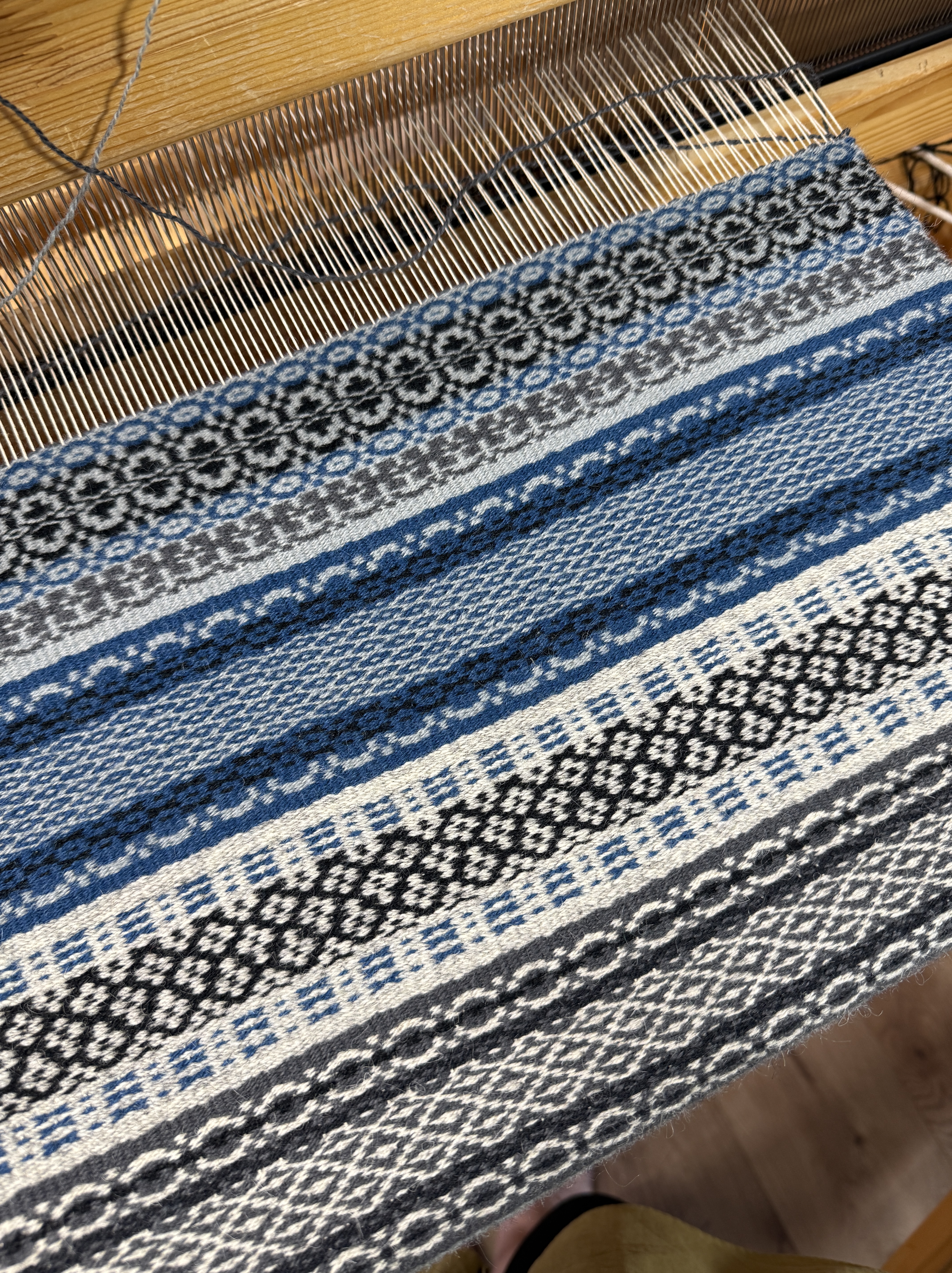
I spent so much wasted time during my weaving! I unwove a border one time because I hated the colors I chose. I unwove another because I was reading the pattern incorrectly. I wove and unwove within one border because I kept mis-reading the pattern. Finally, ON DAY THREE, I came up with a process that settled my anxiety and let me merely observe the magic of the patterns unfolding. Those of you with more clever and elastic brains certainly don’t have to do what I do, but this is what works for me.
- Choose a pattern and colors you like. Make a photocopy of the pattern page.
- Leave the background squares with the black rectangles as is, and use markers or colored pencils to fill in the squares of pattern. Who can possibly keep those little circles and slashes straight?
- Mark the first three lines with a highlighter, skip three lines, mark the next three lines with a highlighter, etc. It is easier to work three shots at a time.
- And this is what I discovered is key for me. I keep the colored pattern sheet next to me on the loom bench, and after each three shots, I make a little check mark on the pattern. When I place the third shot, I double-check where I am, like “Is this blue in treadle 2?” Yes? Great! Then I make the small check and go on to the next set of three shots. See the video.
Other weavers like to use a paper clip or magnetic strip and move it as the pattern unfolds. Nancy Ebner wrote, “I discovered “knitters tape” and have used it to keep my place in the pattern. You can move it and reuse it like a post-it.” Whatever works for you is the “right” way.
Observations about sett and yarn
In 2008, when I warped my loom with the thin black warp at 8 epi, I found the resulting piece to be too drapey for my taste. That’s why I re-sleyed it at 10 epi. The resulting piece was thick and solid.
If you want to weave at 10 epi, use thin 12/6 colored seine twine from Glimåkra and thin plied weft wool. If you want to weave at 8 epi, the warp can be a bit thicker.


Leave a Reply