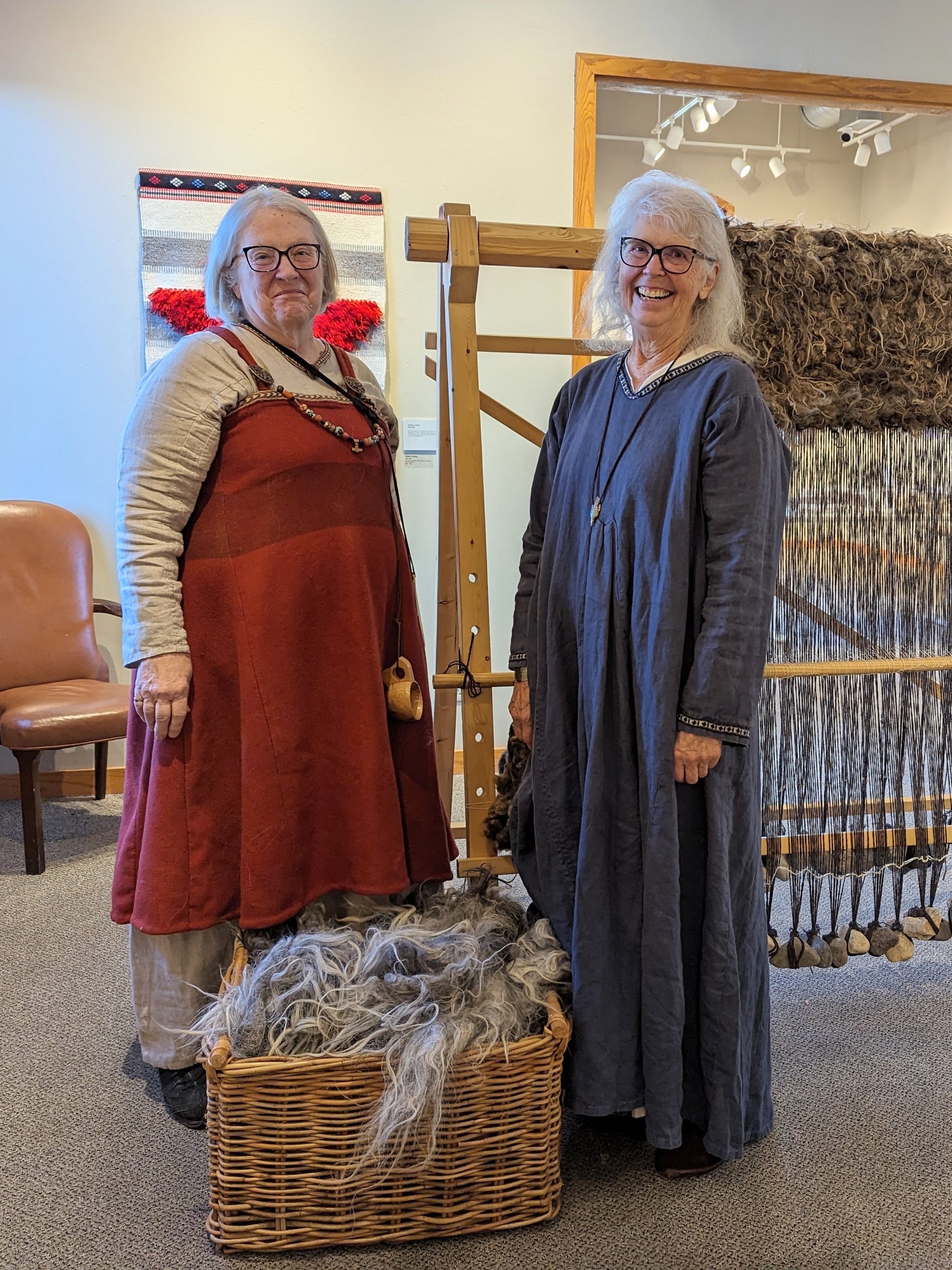
Thanks to Melba Granlund and Peg Hansen who demonstrated weaving on a traditional Scandinavian warp-weighted loom at Red Wing Arts on November 18, as part of the Scandinavian Weavers exhibit “Domestic to Decorative: The Evolution of Nordic Weaving.” Visitors were fascinated by this ancient weaving technique, and Melba and Peg looked their finest in their Viking garb!
Melba Granlund explains the history of the warp-weighted loom to visitors (dogs included). Melba teaches classes in warp-weighted weaving at the Weavers Guild of Minnesota, North House Folk School, Shepherds Harvest, and other venues.
Red Wing Arts is the perfect space for weaving on a warp-weighted loom: Plenty of room and lots of sunlight!
The big loom always draws a crowd!
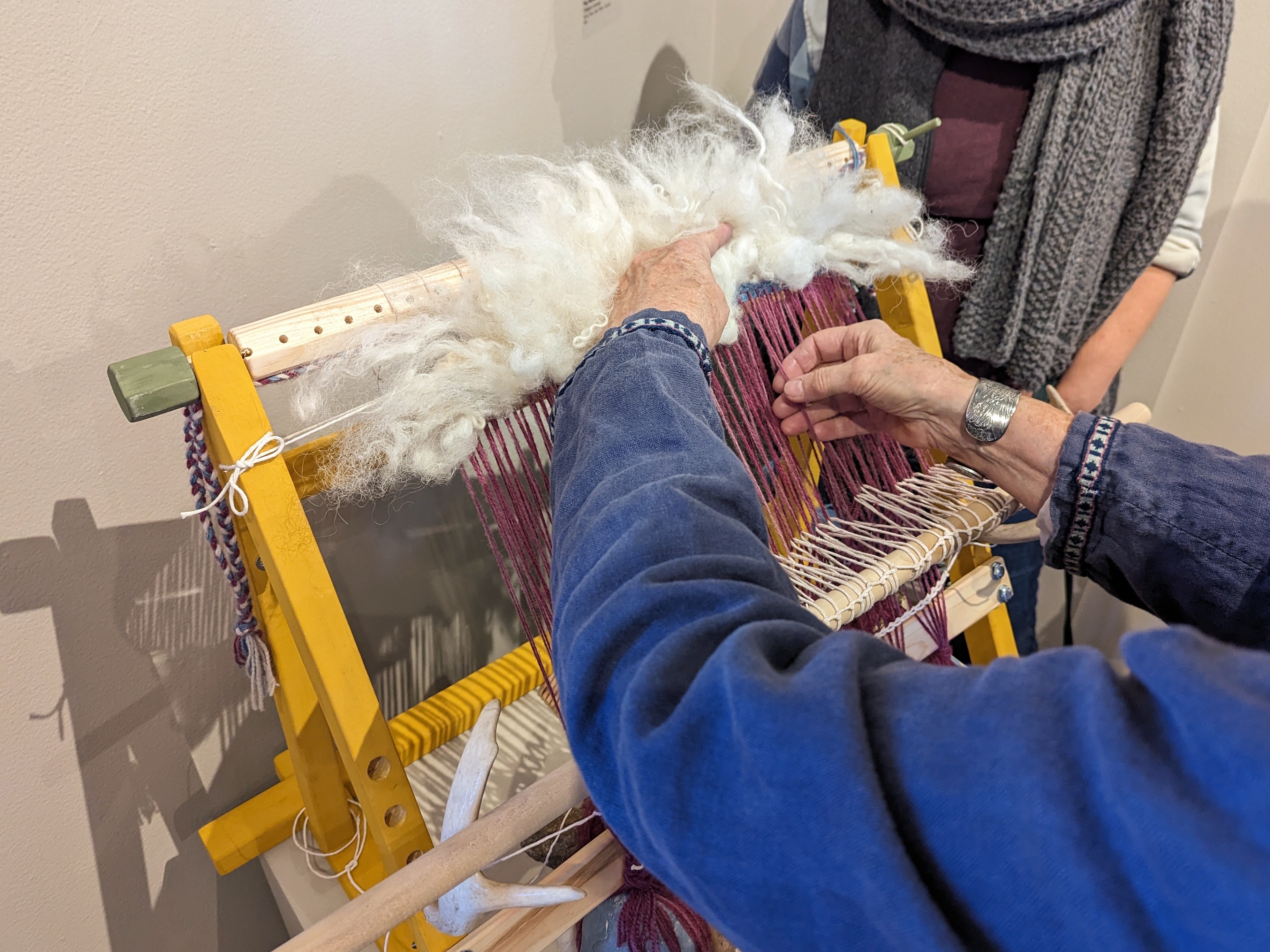
Peg Hansen demonstrates rya weaving on the small warp-weighted loom she built in Melba’s class at North House Folk School. (Notice the deer antlers.)
Any weaver who has used a warp-weighted loom will tell you the slowest part of the process is tying on the loom weights.
Yes, still tying on rocks!
Our beautiful Viking maidens!
For close-up photos of Peg’s handmade loom and the saga that inspired it, visit Robbie LaFleur’s blog post here
Thanks to everyone who joined us at the opening reception for Scandinavian Weavers’ new exhibit “Domestic to Decorative: The Evolution of Nordic Weaving.” The exhibit is on view at the Red Wing Arts gallery through December 24. (Please see the Red Wing Arts website for hours.)
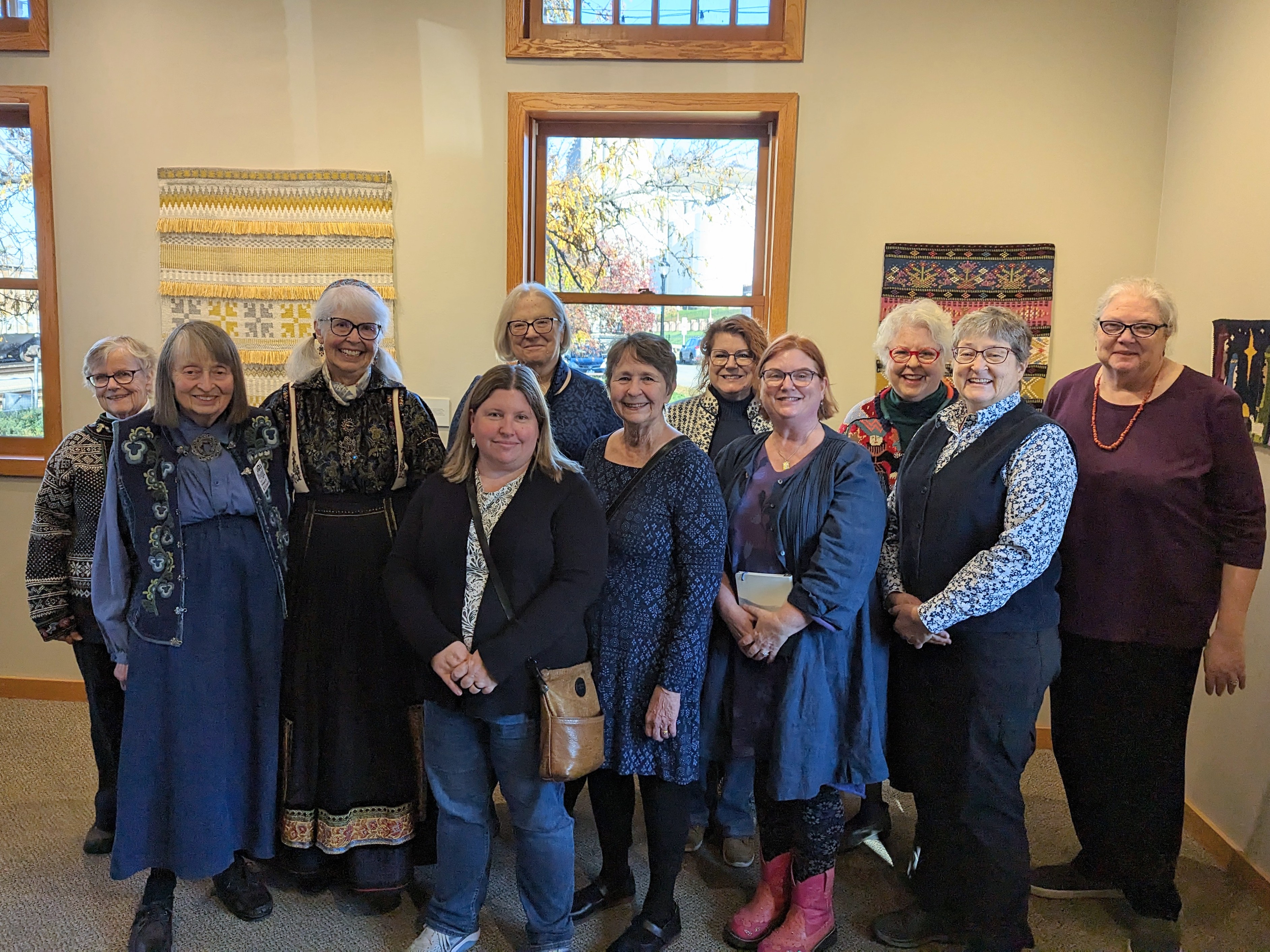
Scan Weavers present at the reception. Back row: Edi Thorstensson, Peg Hanssen, Melba Granlund, Kala Exworthy, Mary Skoy, Lisa Torvik. Front row: Nancy Ellison, Nancy Pedigo, Jan Mostrom, Lisa-Anne Bauch, Barb Yarusso.
Scan Weaver Kevin Olsen and his Norwegian tapestry Nativity.
Special thanks to Edi Thorstensson and Nancy Ellison, who demonstrated weaving techniques.
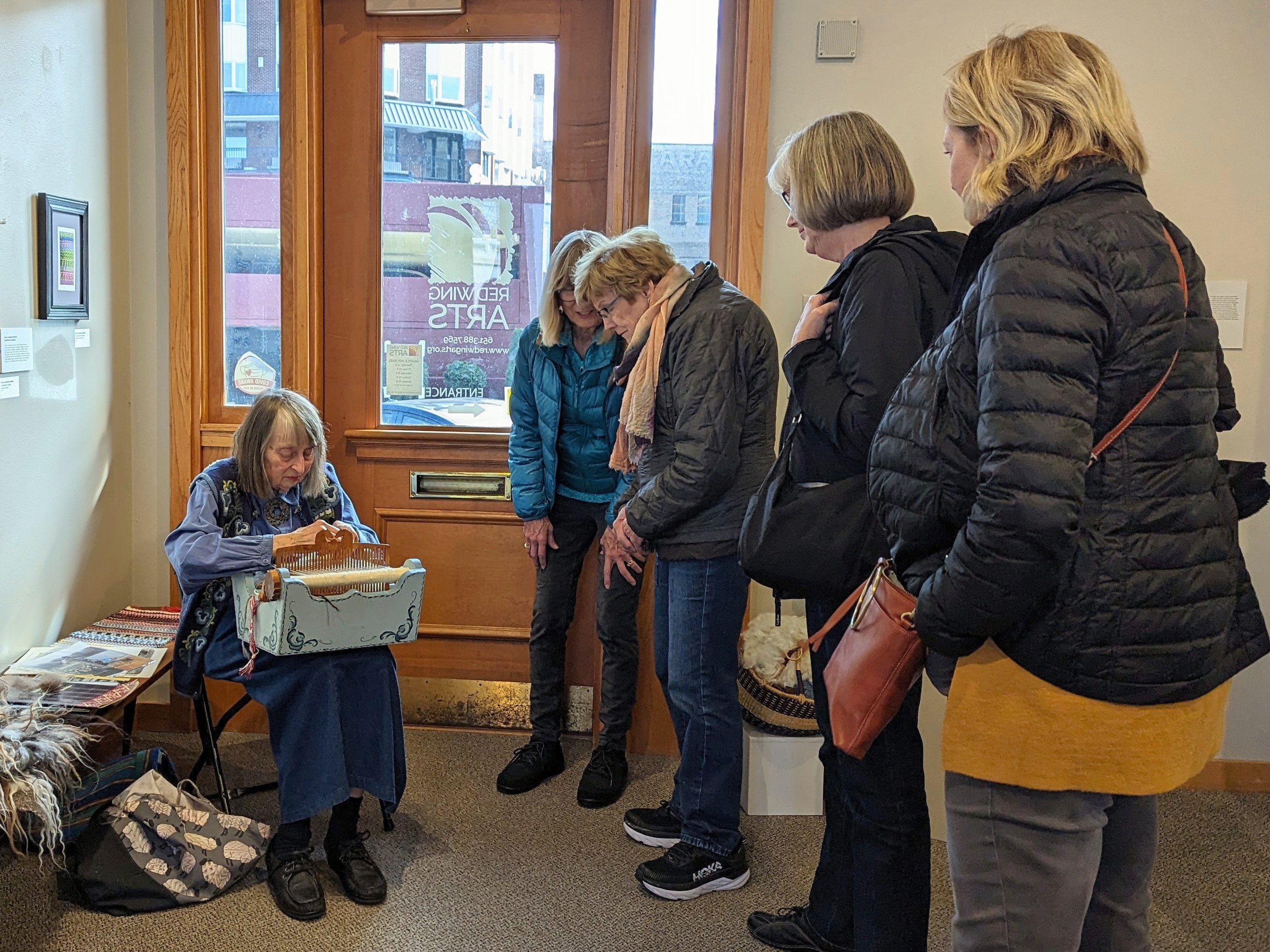
Edi and Nancy compare weaving techniques. Edi wove a band using a hand-carved heddle, while Nancy wove rya on a Norwegian cradle loom.
Tremendous thanks to Red Wing Arts Program Director Heather Lorenz and Gallery Manager Shawn Niebeling, who championed this exhibit and made the entire experience a joy.
Scan Weavers member Peg Hansen, who regularly volunteers at Red Wing Arts, provided hospitality in her Norwegian bunad.
Members of the Zumbro River fiber arts guild watch closely while Nancy demonstrates rya weaving on her hand-painted cradle loom.
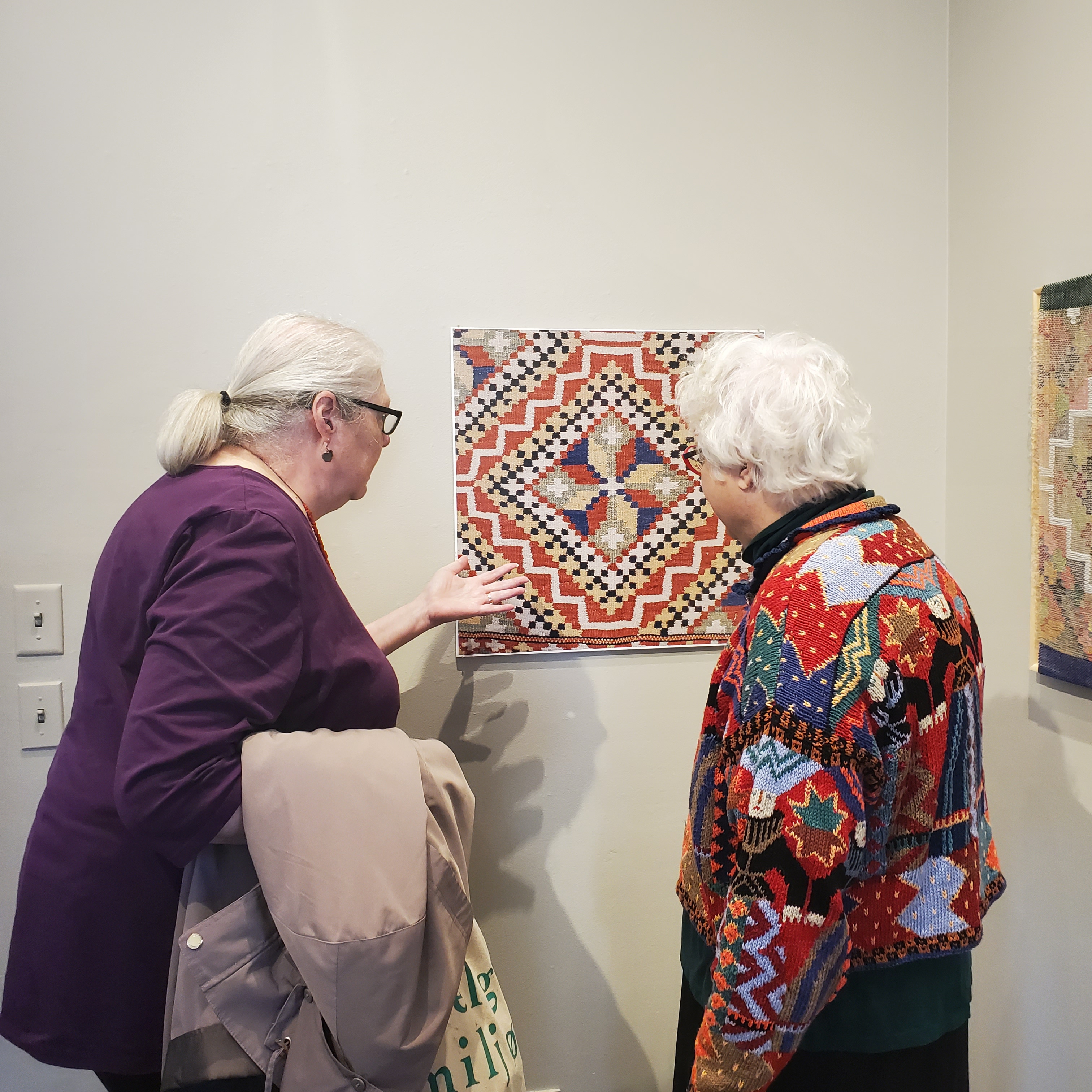
Lisa Torvik shows Mary Skoy the antique coverlet from the Sogn region that inspired her transparencies.
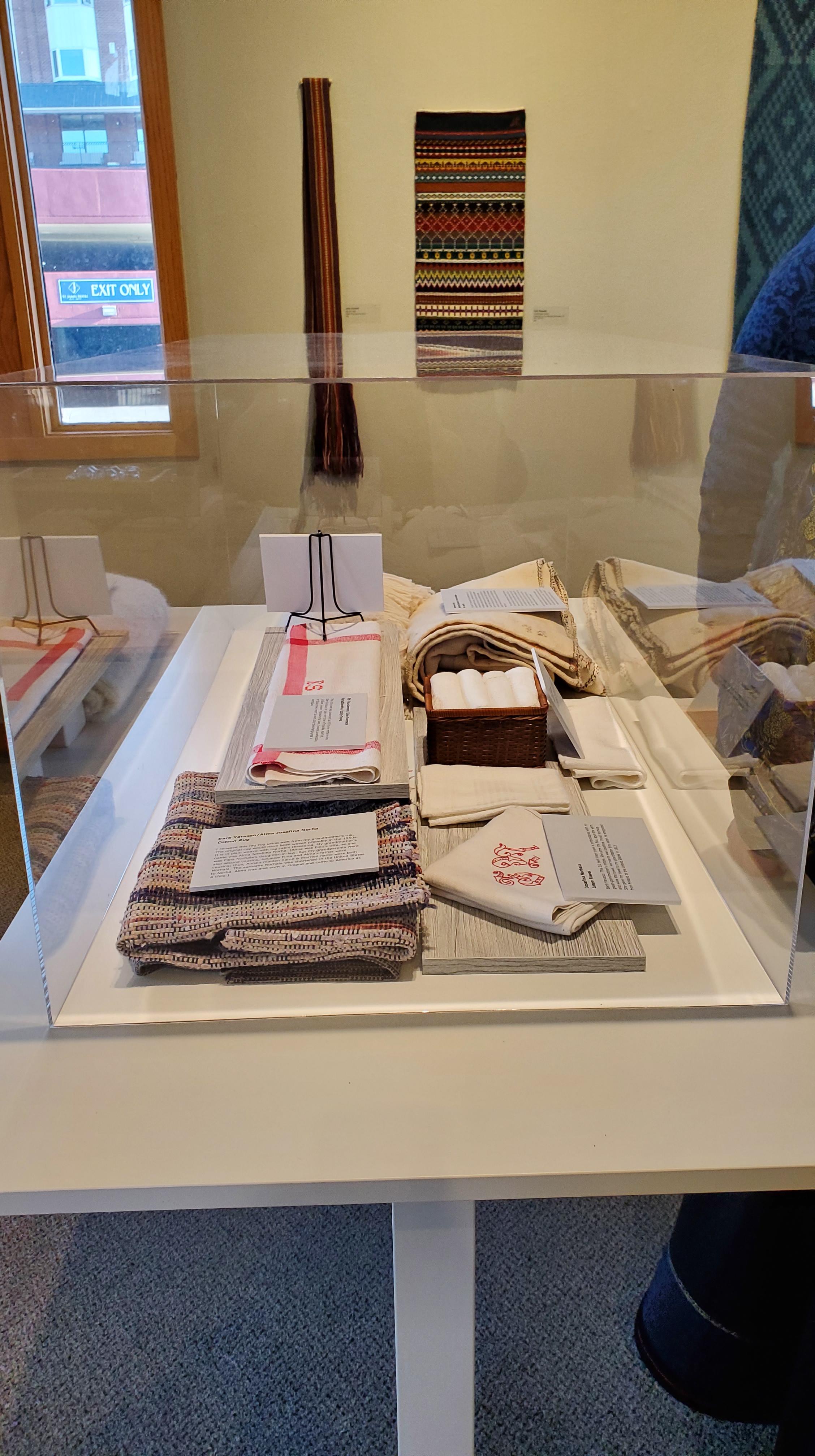
Scan Weavers Barb Yarusso, Mary Skoy, and Edi Thorstensson generously lent the heirloom textiles that inspired their weaving. Jane Connett’s colorful weavings are in the background.
Peg Hansen and her daughters Bitsy Joy and Rachel Hansen Morris collaborated on Tidligere Kvinner.
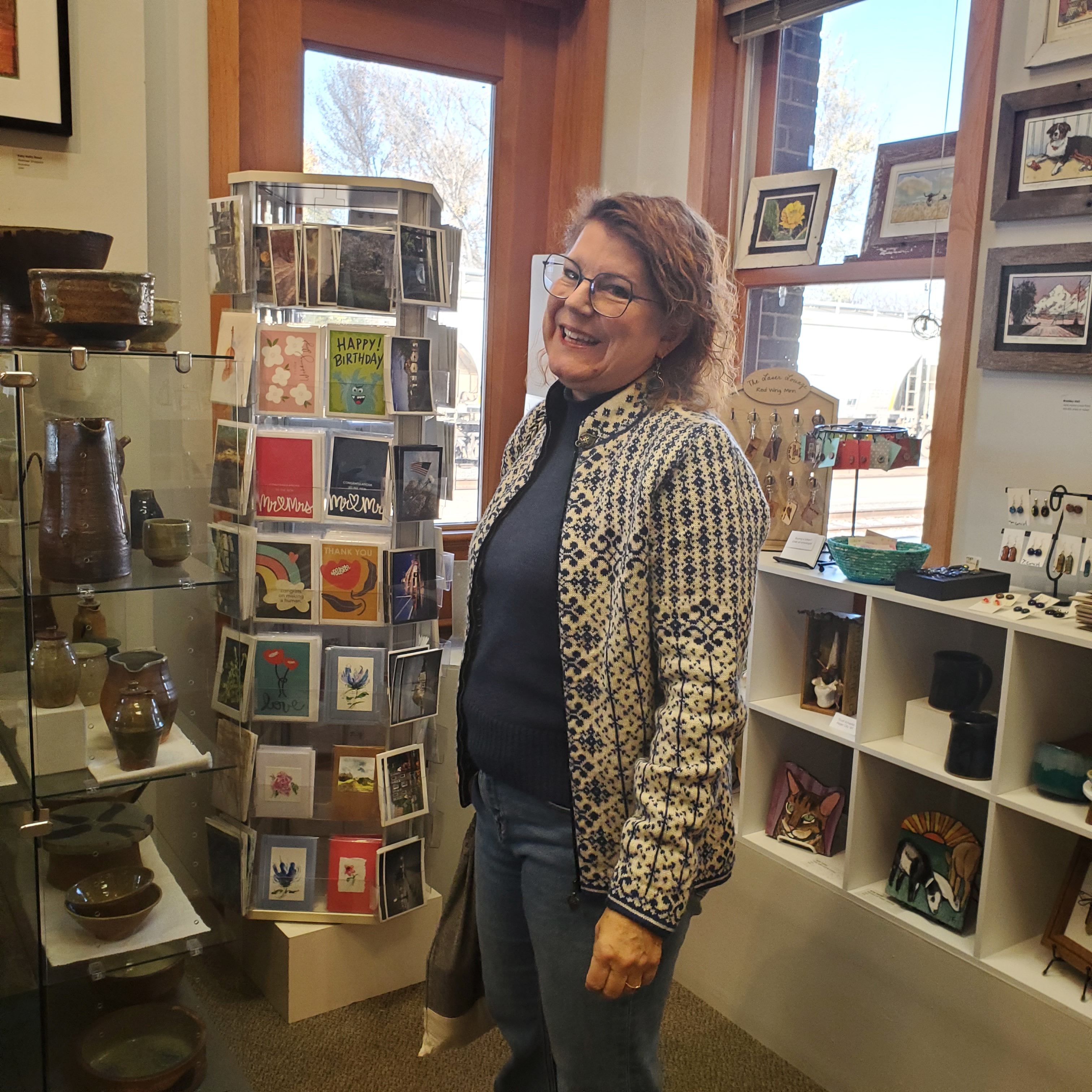
Kala Exworthy takes a moment to enjoy the Red Wing Arts shop. (Highly recommended!)
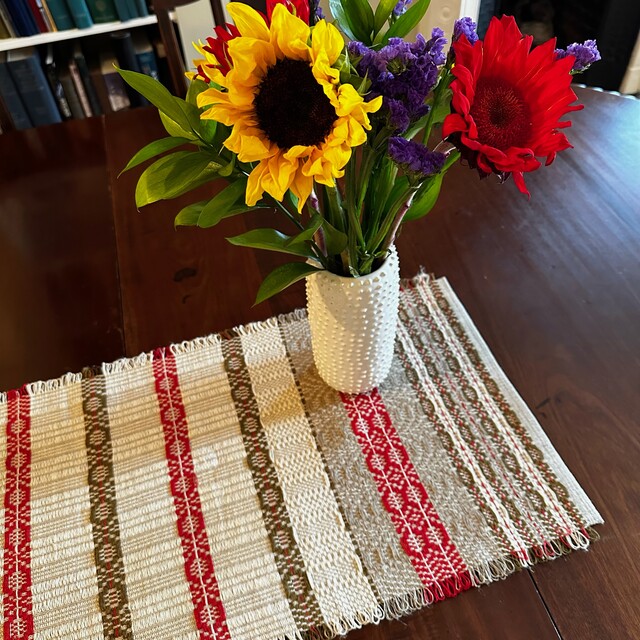
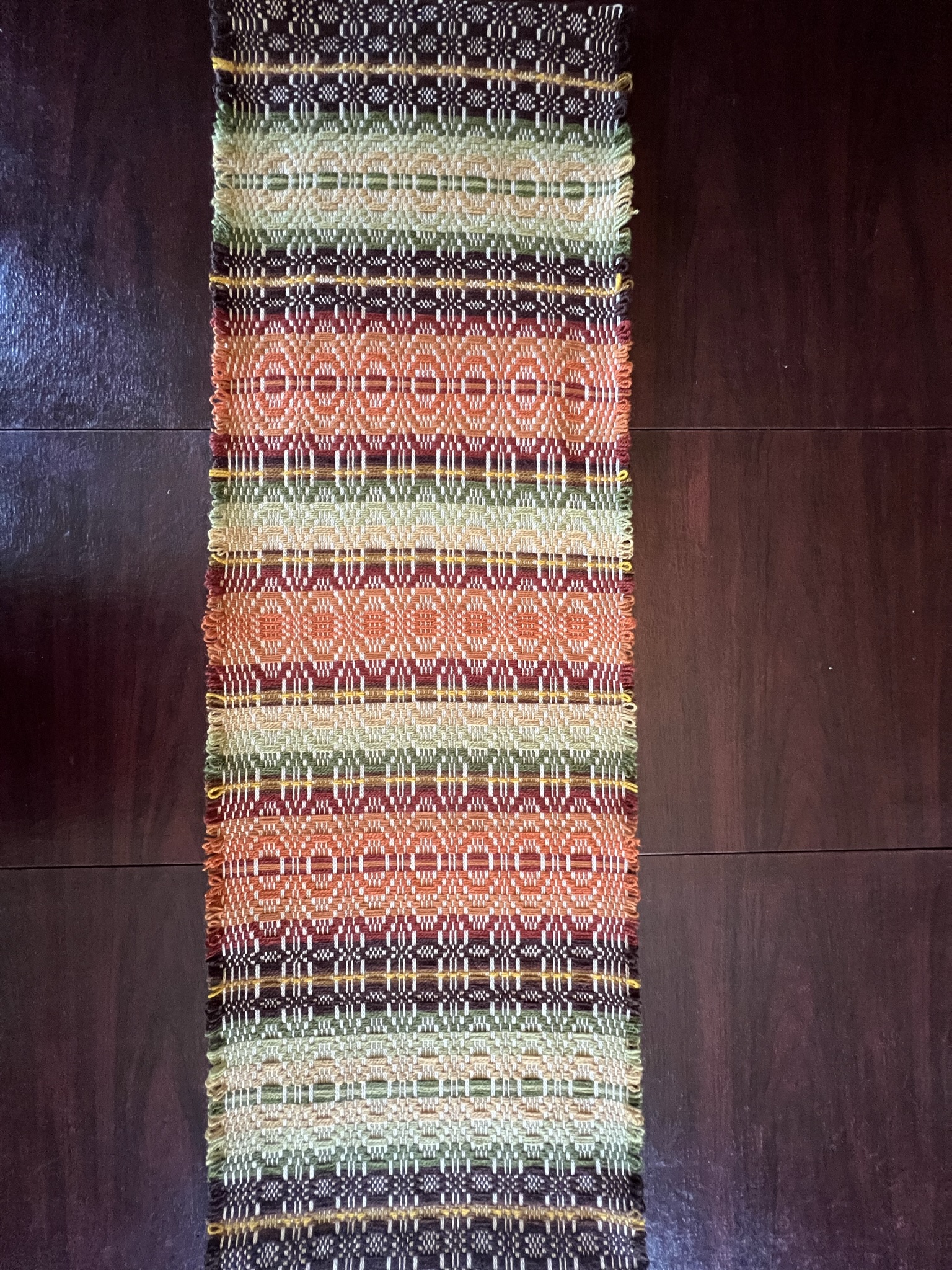
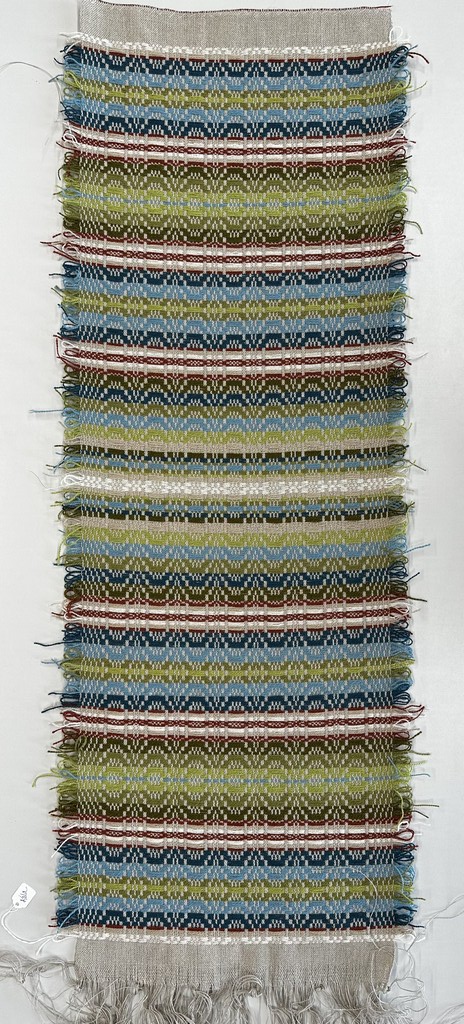
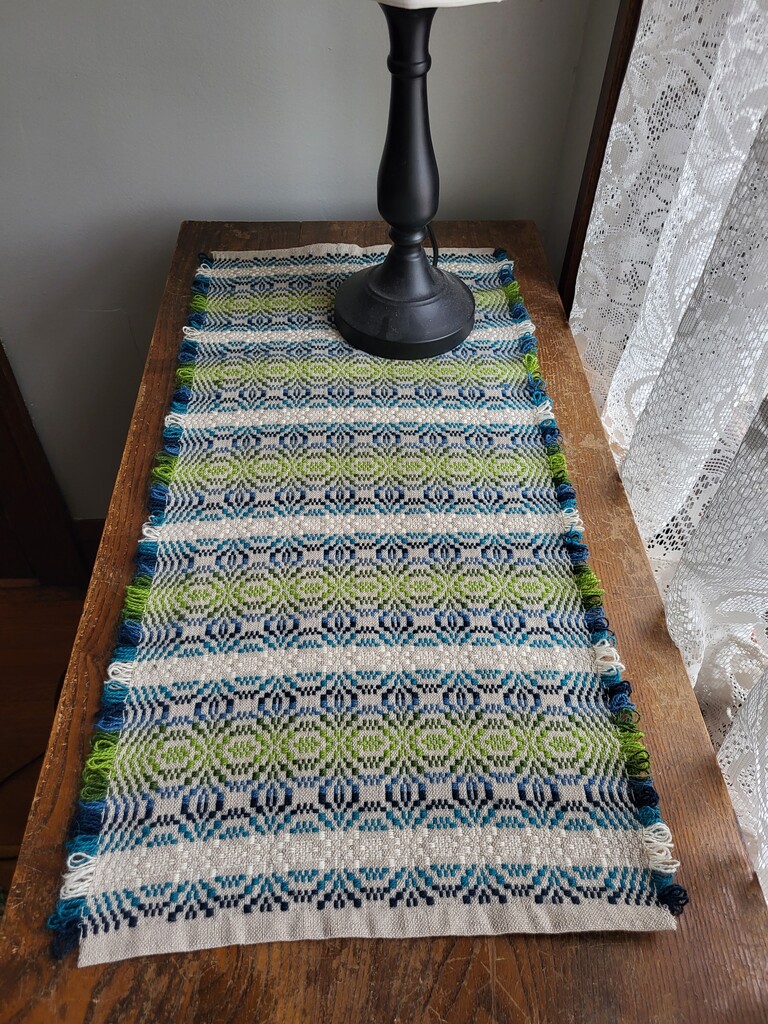
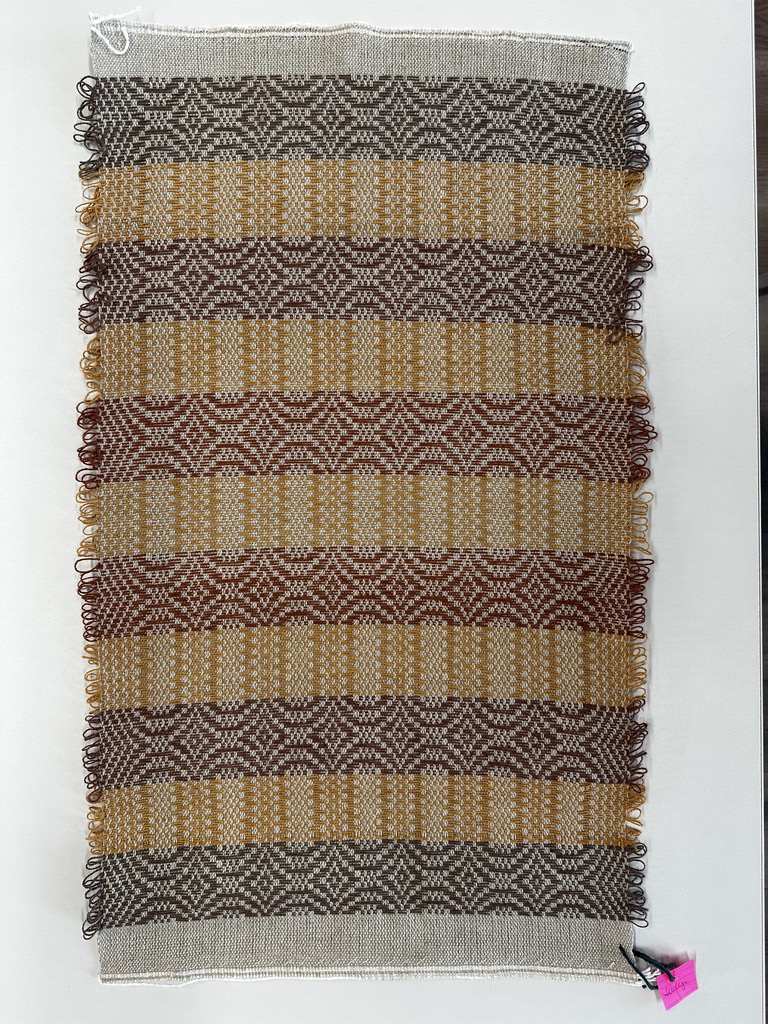
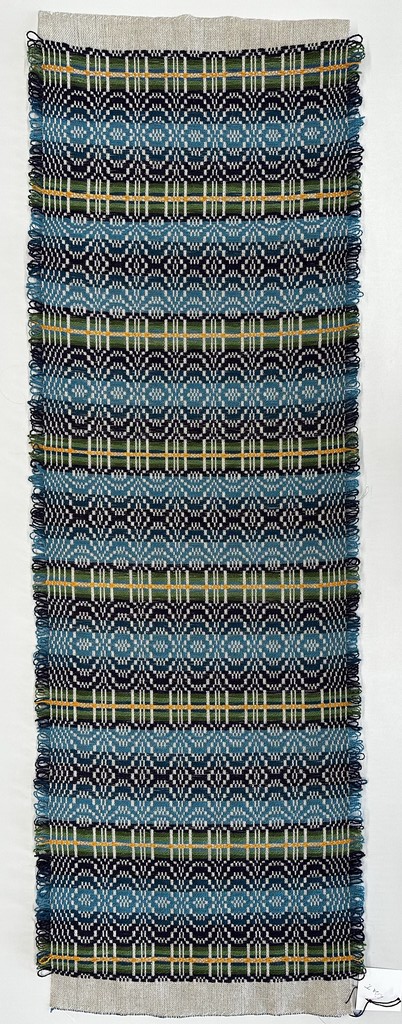
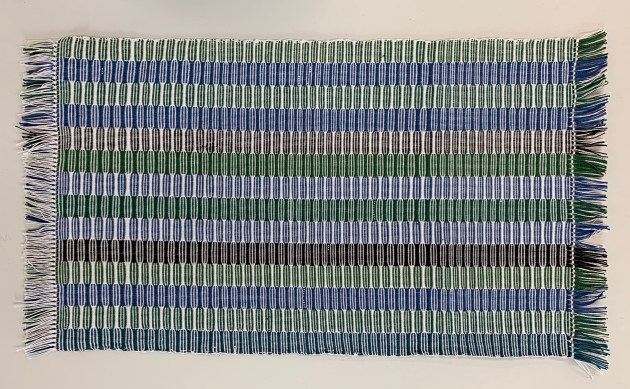
The Scandinavian Weavers’ latest group project was weaving in Telemarksteppe, organized by Lisa Torvik. Lisa was inspired by Laura Demuth’s table runner in a 2013 issue of Handwoven magazine. Laura wrote:
“Telemarksteppe is a technique that originates from Telemark, a county located along the southeastern coast of Norway. Using six shafts and five treadles, Telemarksteppe is a three-block weave woven on a tabby ground. This three-block structure allows for more design elements than the two blocks found in monk’s belt. Another aspect of Telemarksteppe that I find especially charming is the inclusion of weft loops along the selvedges. The loops also make frequent pattern-weft color changes easy. A color that is not used for several picks does not have to be cut because its end may be woven into the selvedge and reintroduced by making a loop at the selvedge that blends in with the other weft loops.”
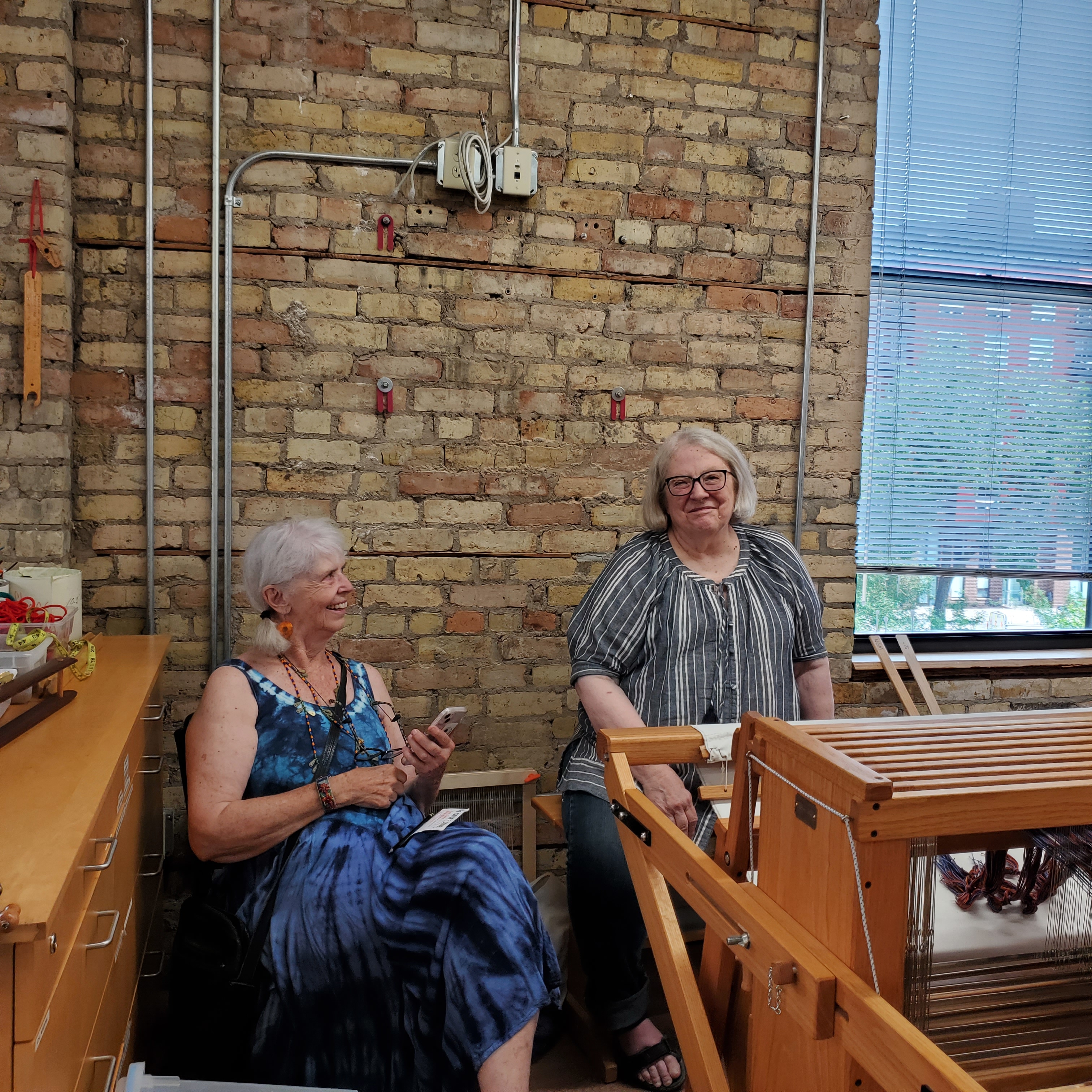
This was our first group project in the new home of the Weavers Guild of Minnesota, the Open Book building in Minneapolis. It was a joy to work in this bright space and also have the opportunity to demonstrate weaving Telemarksteppe to visiting students, guests, and Guild members.
Scan Weavers members used a variety of weft threads in wool, linen, or cotton. The first group of weavers had so much fun that we put a second warp on the loom. Stay tuned for more pictures as their projects are finished!
Telemarksteppe runners fresh off the loom!Lisa-Anne Bauch
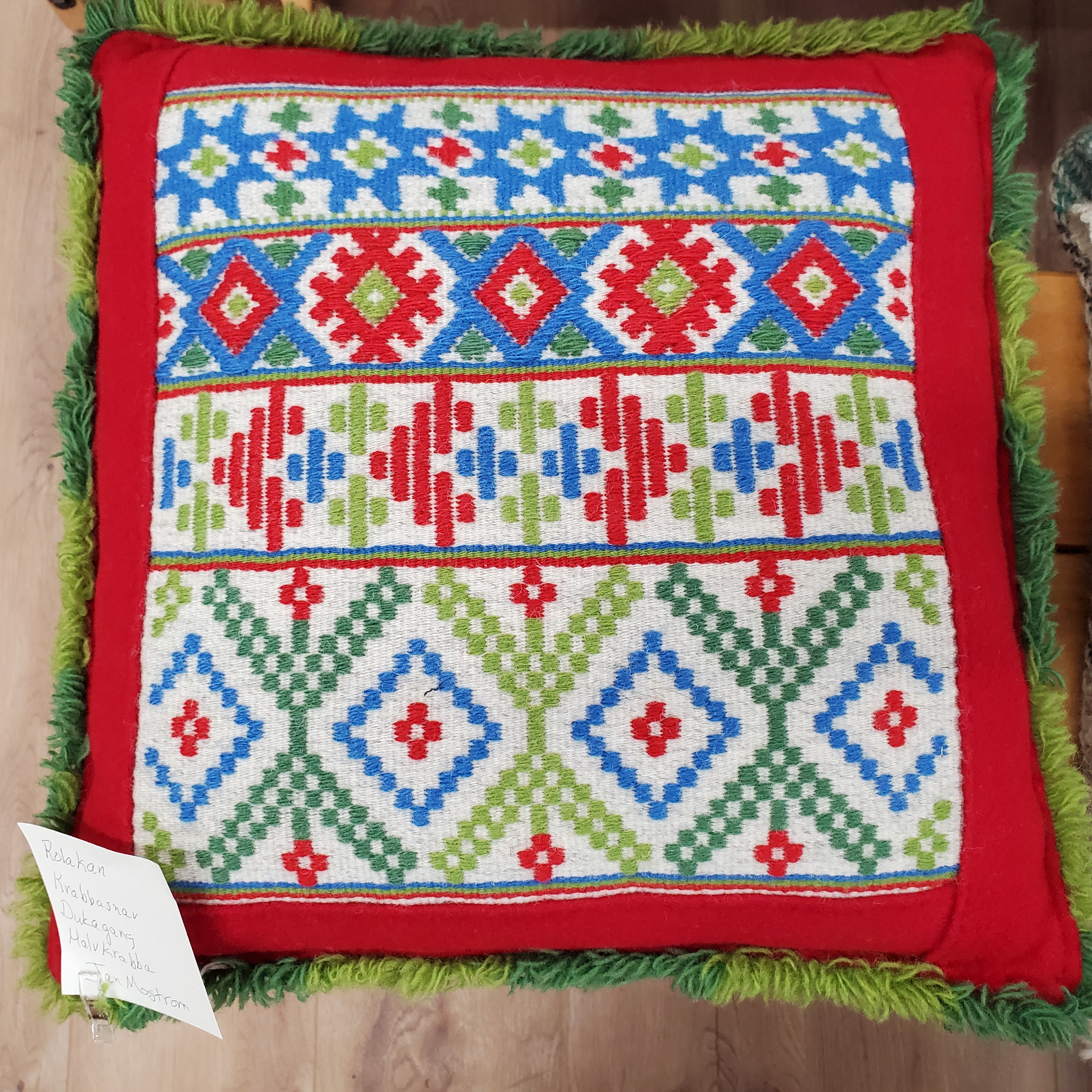
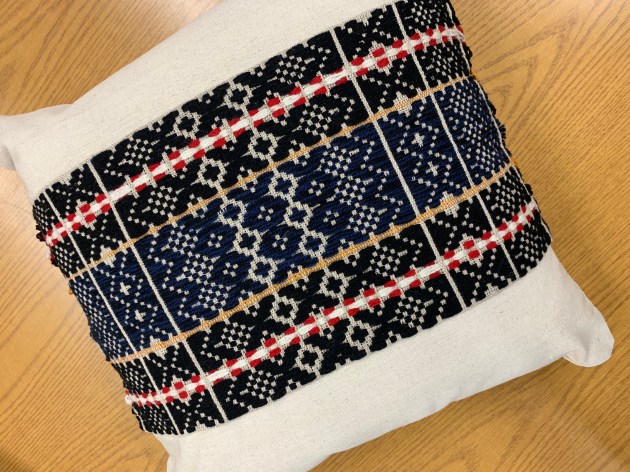
Pillow by Jan Mostrom featuring Swedish art weaves
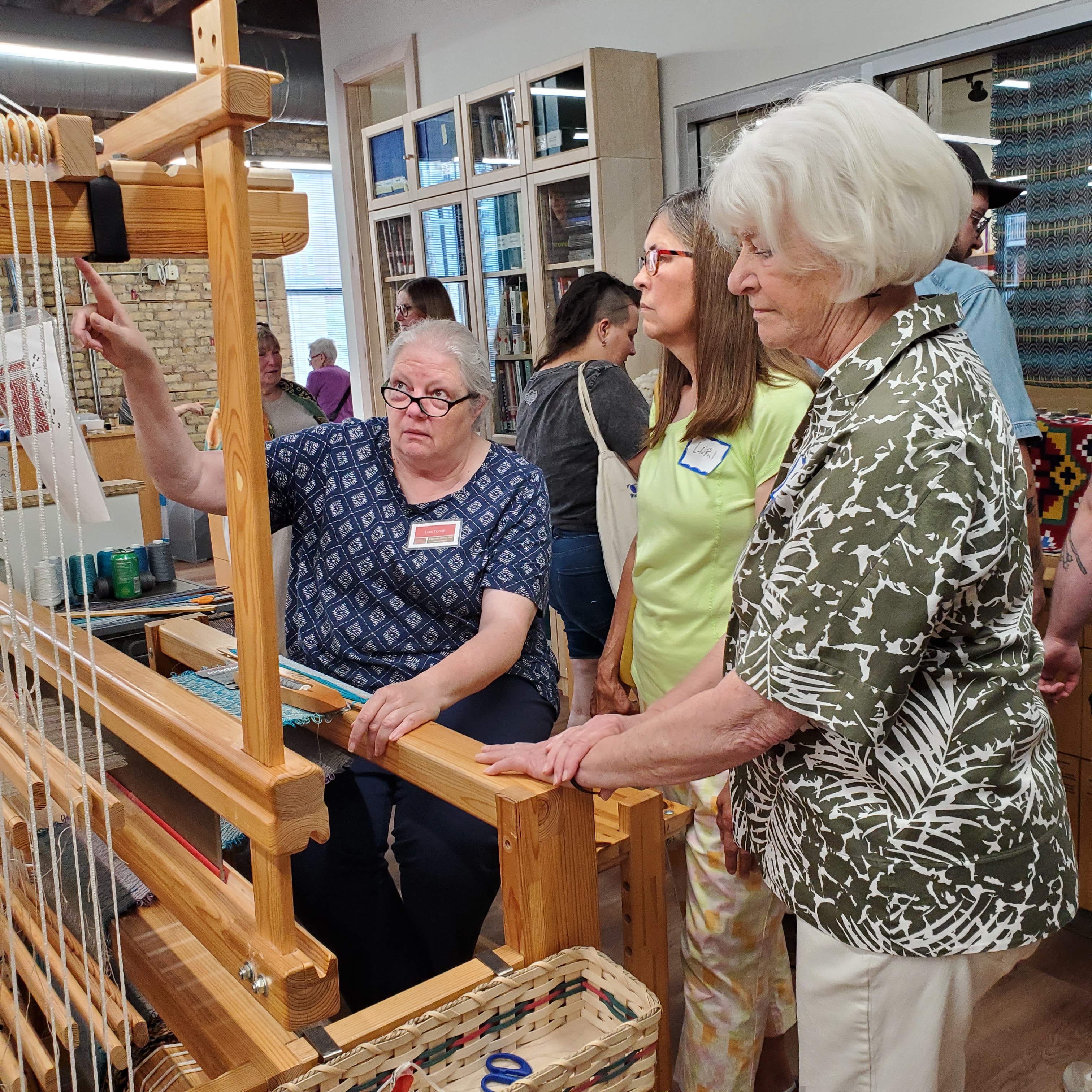
On Tuesday, June 27, the Scandinavian Weavers Interest Group hosted an open house at the Weavers Guild of Minnesota. Guests viewed samples of work by Scan Weavers, enjoyed refreshments, and watched weaving demonstrations by Lisa T as well as students in the Weaving with History workshop. (See previous post.)
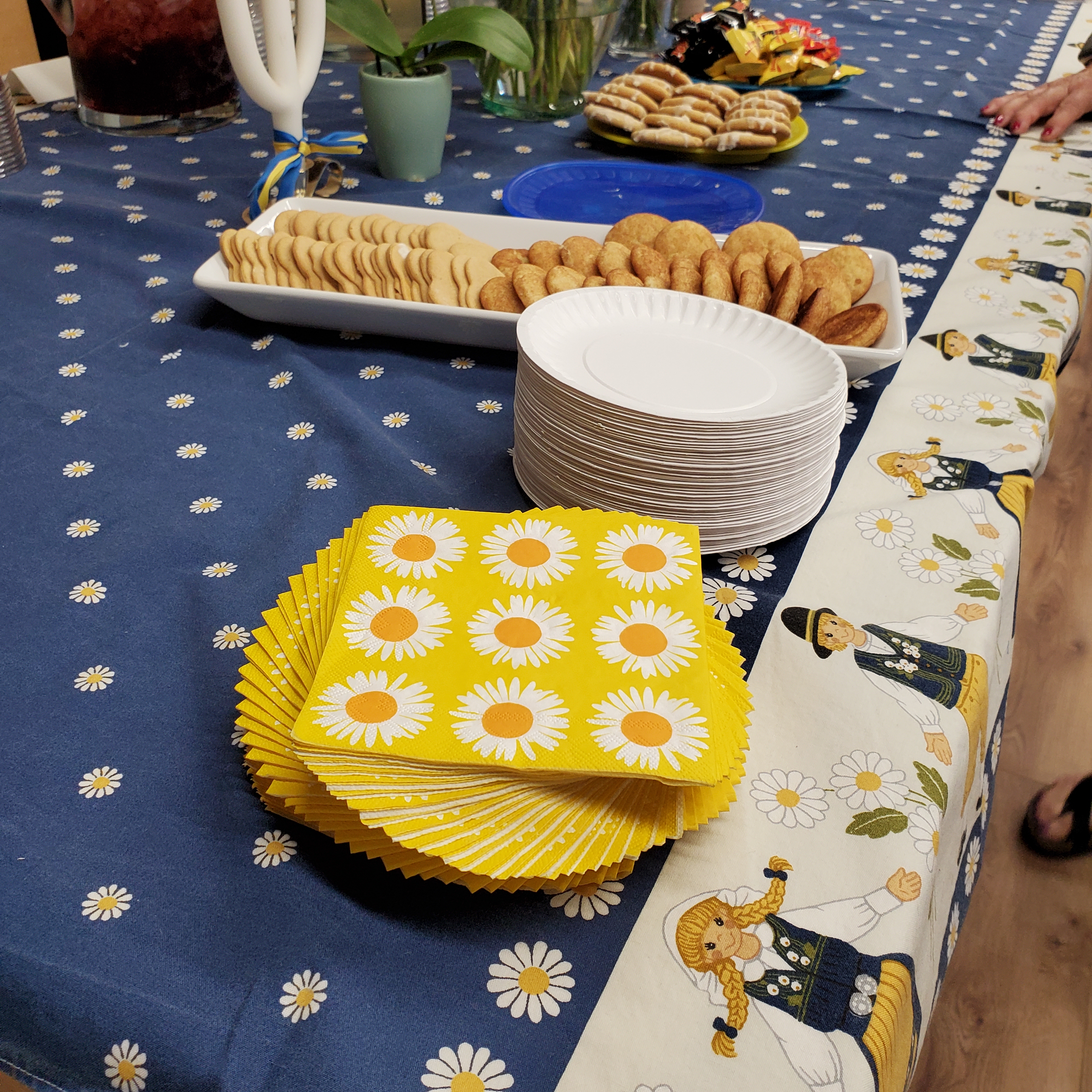
Judy setting out her pepparkakor. (Tin is for transport only – those cookies were home-baked!)
Bri helping in the Guild’s fabulous new kitchen!
No party is complete without Marimekko!
Lisa T explaining Telemarksteppe to guests.
Sharon demonstrating Munkabälte (Monksbelt).
Peg and Melba reminiscing about recent travels to Norway. Melba is warping repp weave.
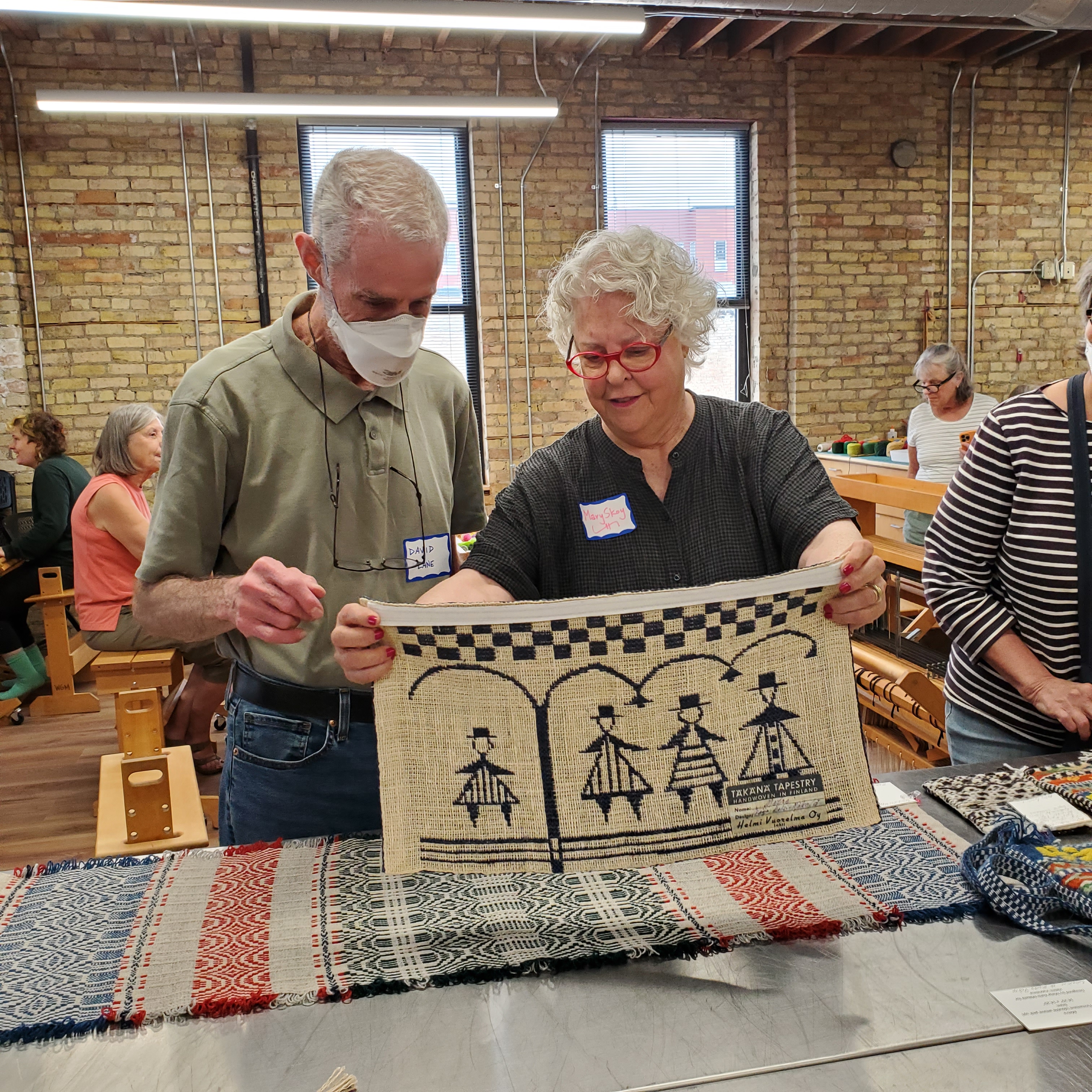
Mary admiring Finnväv (reversed) by designer Maija Kolsi-Mäkelä. Scan Weavers member Mandy Pedigo researched Kolsi-Mäkelä’ ‘s work during her MFA program and owns several of her designs, which she brought to the open house. (See Mandy’s blog at http://www.mandypedigo.com/maijakolsimakela for more info.)
Rag rugs by Judy Larson (left) and Robbie LaFleur (right). (Robbie wove her rug in a class at Sätergläntan. See her blog for details.) Above left is a krokbragd weaving by Lisa-Anne Bauch. Above right is a band weaving by Jane Connett.
Smalandsväv by Nancy Ebner. The design is by Becky Ashenden at Vävstuga.
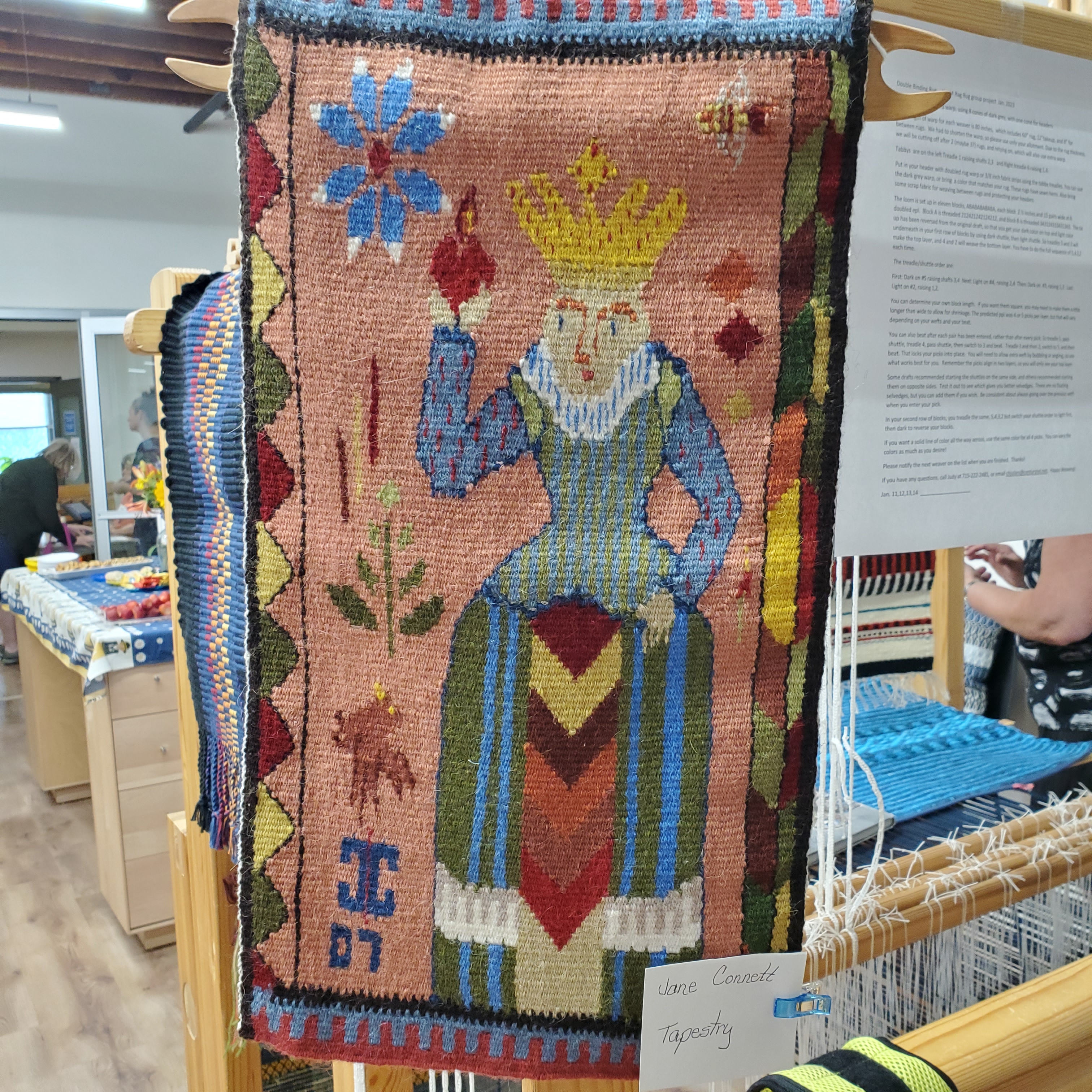
Tapestry by Jane Connett.
Swedish art weaves pillow by Jan Mostrom.
Twill blanket in wool woven by Peg Hansen in Norway.
Rosepath pillow by Sharon Marquardt.
More samples in a variety of weave structures.
Scan Weavers meetings are held monthly September through May. Contact Robbie LaFleur at lafleur1801@me.com to join the fun!
Our Scandinavian Weavers Study Group zoom meetings during the pandemic year are going pretty well. A digital meeting will never replace the fun of meeting in person, and actually seeing the work of our members, but we’ve had good attendance and it’s fun to catch up on everyone’s weaving activities. People are even becoming accustomed to sending photos to the group email list ahead of time! During the first meeting it became quickly apparent that holding up a weaving to your laptop or cell phone camera during a zoom meeting was an inadequate sharing method. Jan Josifek started off this month’s sharing, ahead of our meeting next Sunday. She made a fabulous guitar strap with woven guitars on it. Her husband made the guitar! At last month’s meeting Jan claimed that she was such a terrible sewer and she wasn’t sure how she would be able to finish off the strap. The answer? Beautifully!
Boundweave guitars
This blog was originally set up to share the activities of our group with photos, because our former email system was so clumsy. The side benefit was to share the work of our group with all people interested in Scandinavian weaving. Now that we have a better email system and it is much easier to share photos among ourselves, this blog lost its primary goal.
So thank you for your attention and interest! This blog will remain up, but inactive. If you are interested in Scandinavian weaving, be sure to sign up for notification to the Norwegian Textile Letter. When our Scandinavian Weavers Study Group has its next show, it will be covered for sure in the newsletter. I also cover Scandinavian weaving in my own blog, robbielafleur.com.
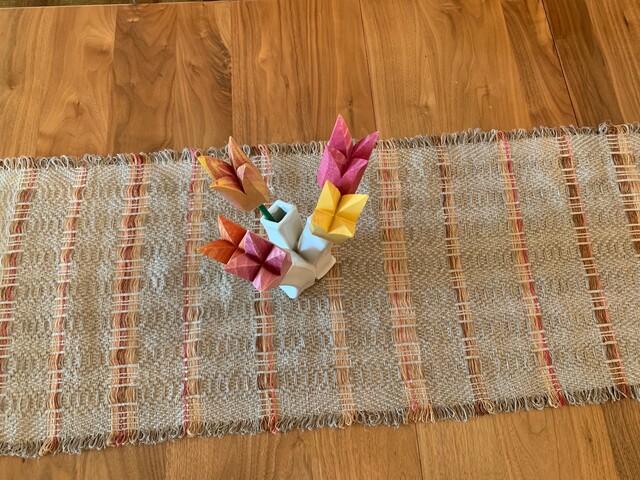
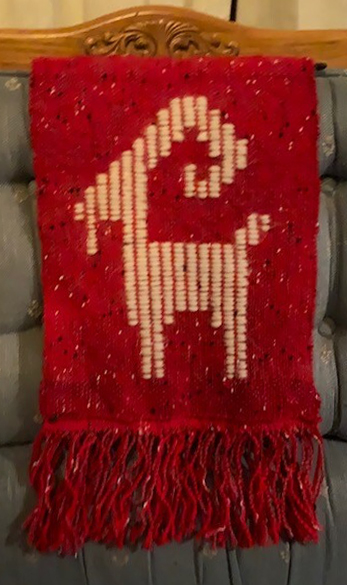
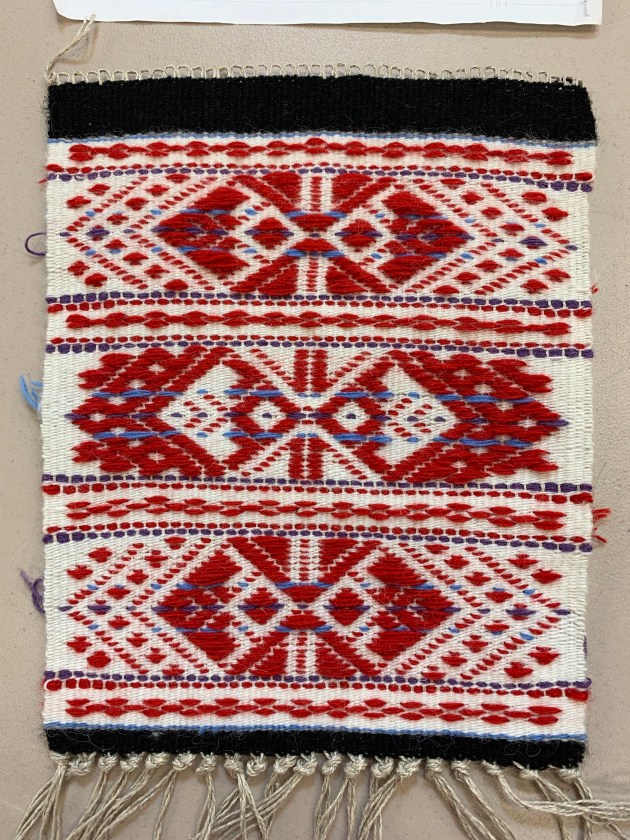
For our Scandinavian Weavers holiday card, please enjoy this sweet weaving made on a rigid heddle loom by Nancy Ellison from Zumbrota, Minnesota. The white pattern yarn is handspun from the fleece of her own sheep. A personal goal of mine is to get vaccinated and be able to visit Nancy again. I’m sure this was the first of many years I missed a trip to seen Nancy and her animals.
Happy holidays, despite this challenging year. Robbie LaFleur
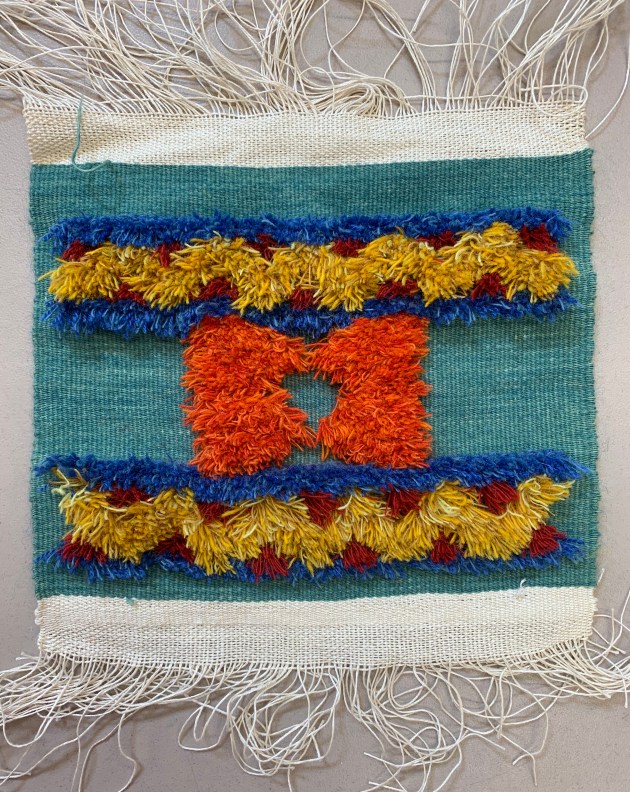
We love it when our Scandinavian Weavers Study Group members bring Show and Tell to our monthly meetings. Melba Granlund has been busy with rya. She is teaching a upcoming spring class where the students make a small warp-weighted loom and weave a rya. (She will be teaching the same class at North House next fall.) The small warp-weighted looms that the students will make measure 18 or 19 inches between the side posts. Melba just finished a second sample piece for the course, with water-inspired blue hues.
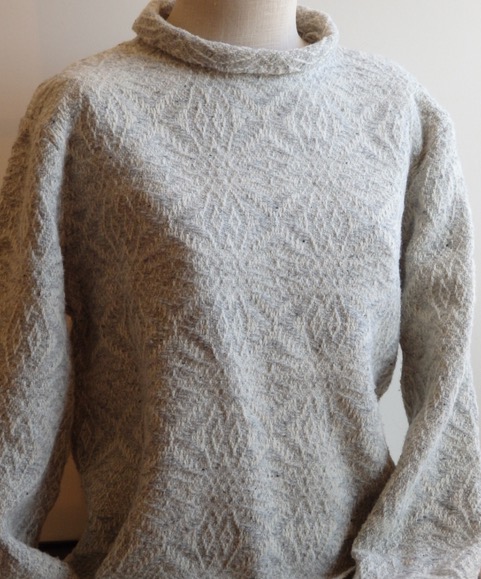
Jan Josifek wore her show and tell, a beautiful woven sweater. Jan sent this photo, and wrote of her sweater,
Mary Skoy used to teach a woven sweater class at the Guild which I couldn’t take. Working from inspiration from Mary on my own, I have tried a few all woven sweaters. For this one I used the 6-shaft American Snowflake draft in the May/June 2014 issue of Handwoven Magazine, changing the satin section between the advancing twill sections to point twill “M”, and treadled accordingly.
I was looking for a mill spun yarn that resembled handspun yarn and went with Brooklyn Tweed “Loft” for the weft and Harrisville Designs Shetland for warp. I used a commercial sweater sewing pattern cut to my size.
Linda Sorrano showed a photo of the brilliant mechanism her brother-in-law rigged up for her to take her draw loom attachment out of the way and easily retrieved–up in the air! This photo is from Linda’s lovely Instagram feed.
Much of the meeting was taken up with discussion of our just-started group warp project. We are making rosepath pillow tops, inspired by a Swedish book by Anna Östlund, Från Januariblues till Decemberröd: 18 kuddar i rosengång(From January Blues to December Reds: 18 pillows in rosepath). More on this project will appear on the blog soon.
The Scandinavian Weavers Study Group met on October 20th. Results of our online survey to choose our next area of study were unveiled–for the next couple of years, expect to see more “rosepath, including bound 3 and 4 harness rosepath, rosepath on opposites, and patterned rosepath that is not weft face.” We’ll be planning a group project soon, as well as pursuing these techniques on our own. (Sorry rya, perhaps another year.)
The show and tell segment was full. Jan Josifek brought rosepath rugs incorporating some of her own handspun yarn. The first featured delicious natural sheep colors.
In this rug, the red areas had beautiful variegation.
Sharon Marquardt recently took a class from Norma Refsdal on using Swedish pewter thread for small jewelry pieces with Sami-inspired designs.
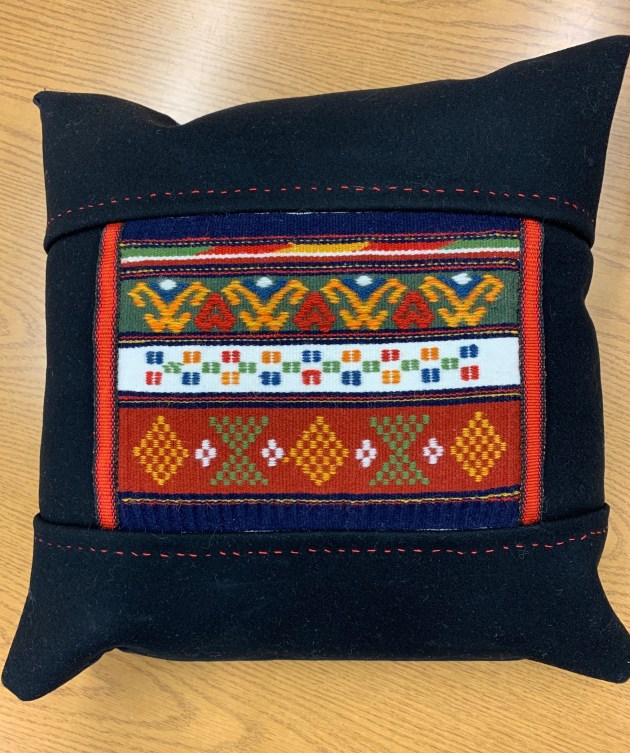
Edi Thorstensson added the piece she made as part of our skilbragd shared warp to a pillow top.
Edi attended a class on Swedish art weaves in Sweden last year, but only recently made made a pillow cover using her sampler.
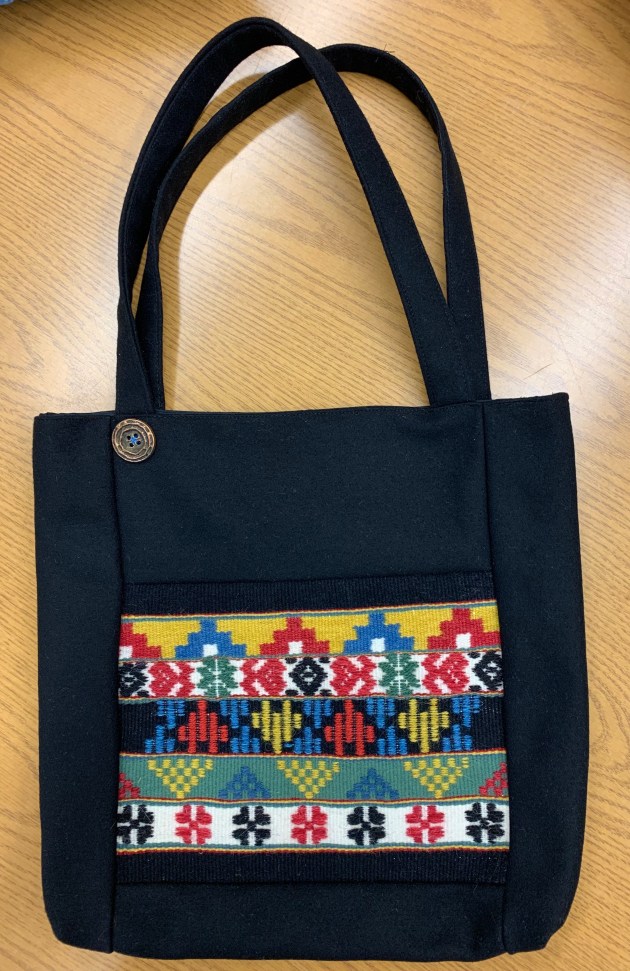
Nancy Ebner took a similar class in Sweden this summer, and her sampler became part of a bag.
Nancy also brought quite a long bound rosepath runner, which she made at the Minnetonka Center for the Arts, with Traudi Bestler as a teacher. She uses it on top of a grand piano!
Lisa Torvik said while she had no show and tell this month, she is planning to finish weaving her 18 yard linen runner warp, which has been on her loom for a very long time. We tried to apply just the right amount of pressure to be sure it shows up at next month’s meeting.
The Dobby Weavers Group at the Weavers Guild of Minnesota, masters of the many-shafted computerized Megado loom, is going Scandinavian this fall. They are joining with the Scandinavian Weavers Study Group to weave a complex version of monk’s belt, one with blocks of pattern. In this joint project between the two study groups, the Dobby Weavers will do a bit of Scandinavian weaving, and the Scandinavian Weavers will get an opportunity to try out the beautiful Megado loom. The inspiration piece was one owned by Melba Granlund.
We decided to warp the Megado with the same warp, 20/2 cottolin at 24 epi, as the recent monk’s belt group project the Scandinavian Weavers wove on the Glimakra at the Weavers Guild.
I promised to compile some ideas for designing pieces for monk’s belt, some ways to think of the color of pattern weft and background weft, materials, and variations in stripe widths. There’s a crazy amount of variation possible using the “language” of these elements. Several of the examples from this quick and dirty compilation are from pieces woven by the Scandinavian Weavers Study Group in our recent group project.
Here are a couple of photos from a coverlet book from 1977, Åkleboka: Nye Mønstre i Gamle Teknikker, by Torbjørg Gauslaa and Tove Østby, Oslo: Landbruksforlaget, 1977. This piece is on wool warp. Note the use of a monochromatic color palette, with color changes made within long stretches of the same lines.
The second piece is completely asymmetrical, with a large difference in the long and short pattern elements.
Below, Sara Okern’s minimalist design used areas without pattern warp, but with stripes of varied linen colors.
Melba Granlund used several colors in bands of varying widths.
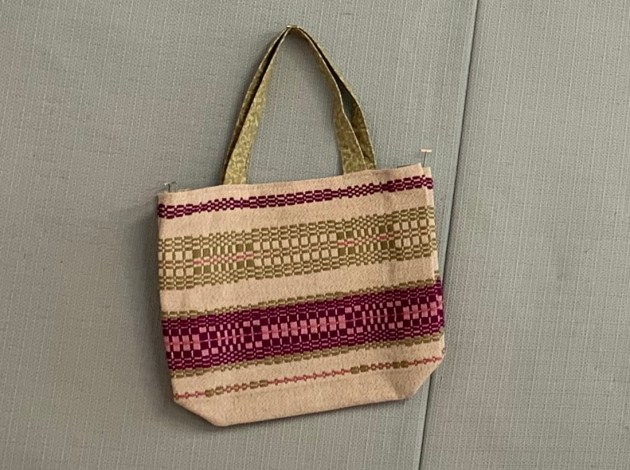
Notice two things in this bad photo of Jan Josifek’s beautiful small bag. It’s a wonderful way to use a small piece of weaving! In the top band, a single skinny band of pink makes it pop. In the bottom band, note the use of pink in the background tabby weft–subtle and beautiful.
Many traditional monk’s belt pieces were woven with fairly consistent stripe sizes, making square, overall patterns. This example is from Simple Weaves: Over 30 Classic Patterns and Fresh New Styles, by Birgitta Bengtsson Bjork and Tina Ignell. (English translation) Vermont : Trafalgar Square Books, 2012. The monk’s belt is shown as a backing for a skinnfell, a sheepskin, another traditional use of lightweight overshot coverlets.
Another monk’s belt piece on a skinnfell. A very regular pattern with beautiful use of varying colors for long and skinny parts of the pattern. From Åklær, Å Kle ei Seng, Å Veve et Åkle. Trondheim : Trøndersk Forlag, 2002.
This image is from the same book, but of a skillbragd coverlet. Still, it shows that a piece can be designed symmetrically in broad bands.
Our group doesn’t normally meet during the summer months, but because we neglected to take it off the online Weavers Guild of Minnesota calendar, and several members were around, we decided to meet. We had the best turnout of the year so far!
Melba sent me this photo of the other samples woven by students at the Hemslojd class. Melba’s piece is in the center.
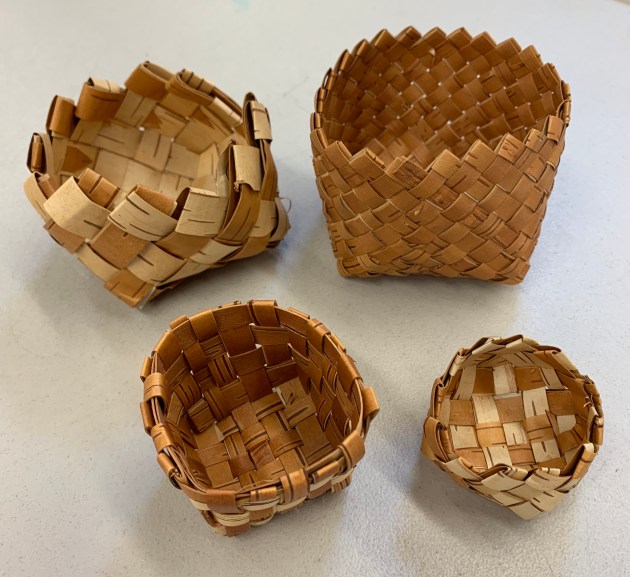
Lisa Bauch has been suffering from a bit of tennis elbow from slamming the beater on her loom, so she’s devoted some off-loom time to making small birchbark baskets from the bark of a dead birch tree they needed to take down in her yard.
Someone asked how she cut her strips and Lisa told of a novel method. A pasta machine–you know, the kind with a crank that unfurls lengths of pasta–works great. And the fettuccini setting? Perfect for the small-scale baskets.
During this meeting, several people shared by showing photos on their phones. Five or six times, phones were passed around the large table. I think this “show and tell” technology will be used more and more, with no more excuses like, “I tried to get it off the loom before the meeting.” Linda Sorranno’s technology for this purpose was best; she had an iPad, so we could admire her piece on the loom in larger scale. She is weaving a boundweave rug in neutral tones.
We admonished Mary Skoy for not bringing in the rug she recently finished, which is now in its intended spot in their house. She told the story of seeing a similar rug at the American Swedish Institute (ASI) and thinking, “I need that rug.” Here’s the ASI rug.
Woven by Ruth Skyttes, who wove the rug on loom built by her husband, for an ASI Christmas program for the Värmlands Forbundet in the early 1960s. Ruth emigrated from Värmland, Sweden to Minneapolis in 1927. 20”x 42” cotton warp, wool fabric strips weft and inlay
Mary liked the slarvtjäll technique, with short inlay tufts. She haunted thrift stores, picking up woolen tweed jackets to cut up for the weft strips. It turned out great, but she seemed sheepish when her rug looked like an exact replica of the original, not what she really intended to do.
Judy Larsen has been making runners with a pattern from a recent Handwoven magazine, “Distorted -Weft Rep Runner & Trio of Pillows.” (Her sisters have already announced how long Judy should make their runners.)
Jan Josefek has been busy weaving. She showed a small piece inspired by the patterns of Estonian bands. Jan wove a piece on her tapestry loom, pick-up on a plain weave. Bands are woven lengthwise, but this stack of three patterns was woven horizontally. People were in awe. As a follow-up, author Piia Rand write that her book is now available in English. See: https://epood.saara.ee/pood/estonian-pick-up-woven-belts
Jan also made a sample rug using rosepath stripes, in anticipation of making the “real” one with handspun yarn. She used a draft from a notebook from our Scandinavian Weavers group, making it extra appropriate to share with the group.
Ever Woodward came to her first Scandinavian Weavers meeting, and shared towels she just took off the loom. She claimed that she is most drawn to neutral colors in her life, but who can resist pink yarn?
My report was an iPhone one, too–a photo of a piece in Frida Hansen’s open warp transparency technique. The underground portion of the potato plant is complete.
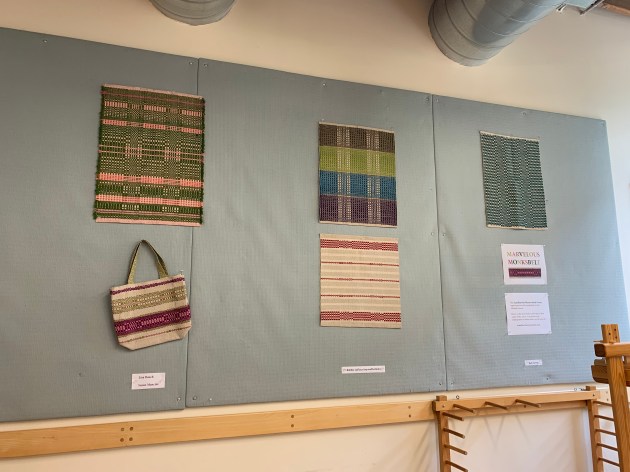
Are you stopping by the Weavers Guild of Minnesota this summer? You can see some of the monksbelt pieces woven by the Scandinavian Weavers Study Group members this spring up on the back gallery wall of the “Rug Room” (the room with the bigger looms). It’s possible to stand below them for a good look, but impossible to get a good overall shot because of the stacked-up looms right now. So here are two very bad photos, looking to the left and looking to the right, with the center pieced repeated.
Left: Lisa Torvik. Top row: Mary Skoy (it’s hard to see, but that is a tray made of clear acrylic with the weaving in the base), Lisa Bauch. Bottom row: Jan Josifek, Susan Mancini
Top row: Lisa Anne Bauch, Robbie LaFleur, Judy Larson. Bottom row: Susan Mancini, Robbie LaFleur
One fun aspect of this small show is seeing how some of the pieces were finished to use as practical items. Karin Knudsen, Operations Manager at the Weavers Guild, commented, “Cool. It’s always nice to have ideas for your toolkit for using your weaving.”
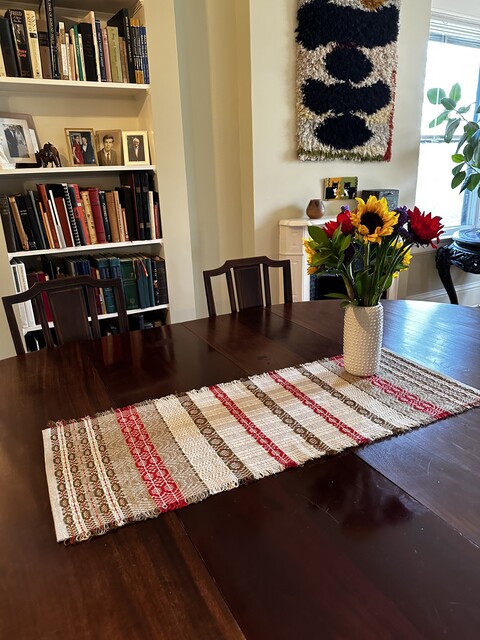
Susan Mancini made a lovely small bag. She wove her piece with that end game in mind, so the matching is meticulous. Mary Skoy put her piece in the base of an acrylic tray. Jan Josifek made a pillow–see the pink bands on the piece that looks thick, ready for puffy stuffing? The other pieces, of course, make lovely runners. The long runner made by Lisa Torvik is called “For My Mother’s Danish Dishes,” and I’m sure it looks lovely with them.





































 Scandinavian Weavers Study Group