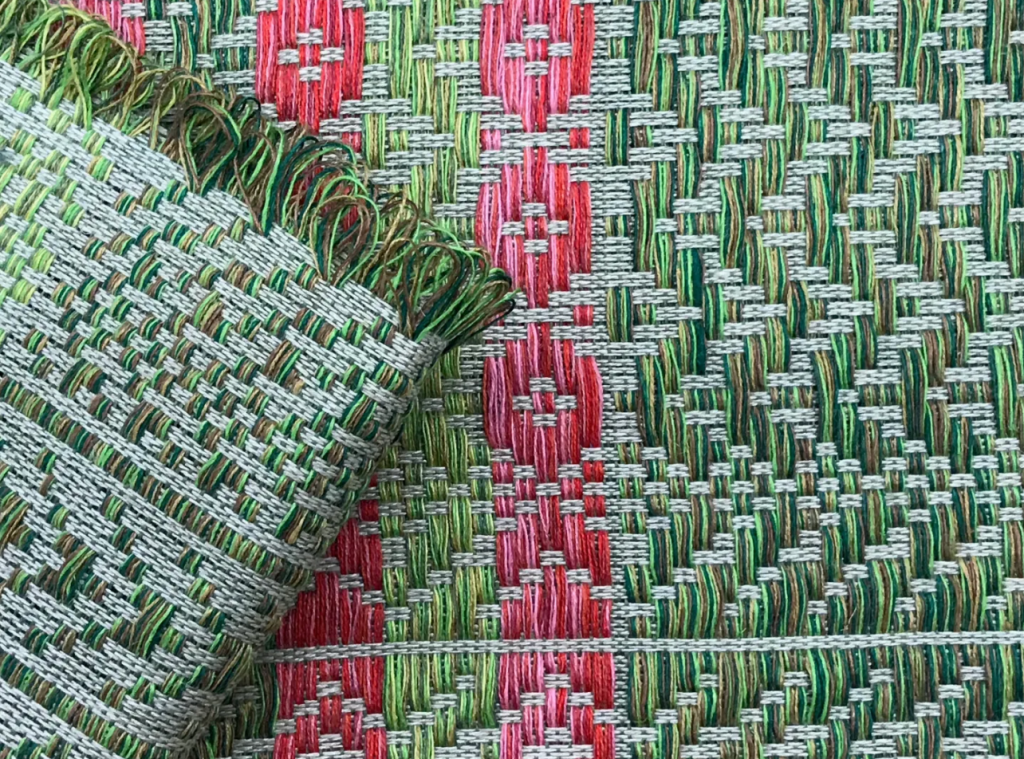
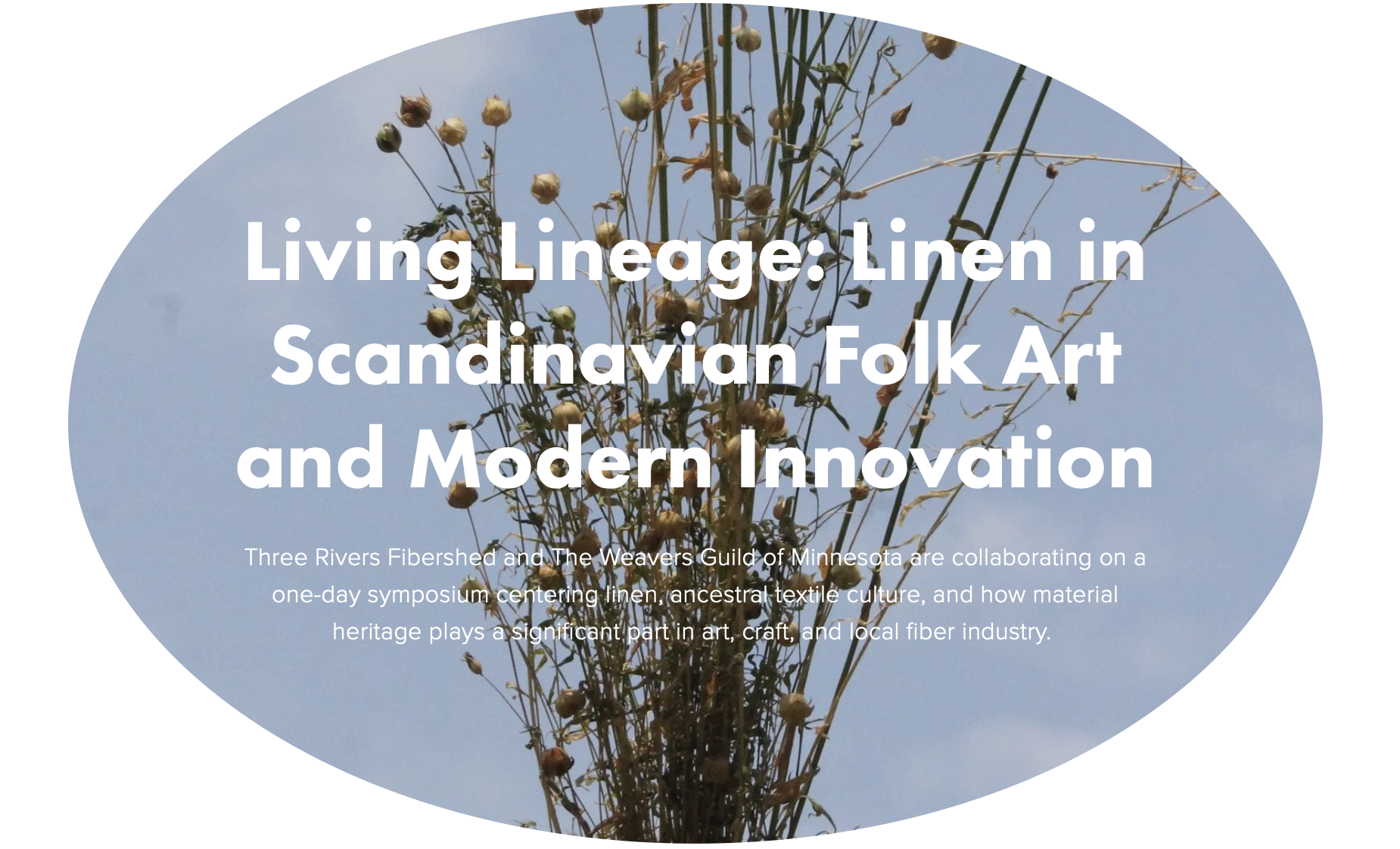
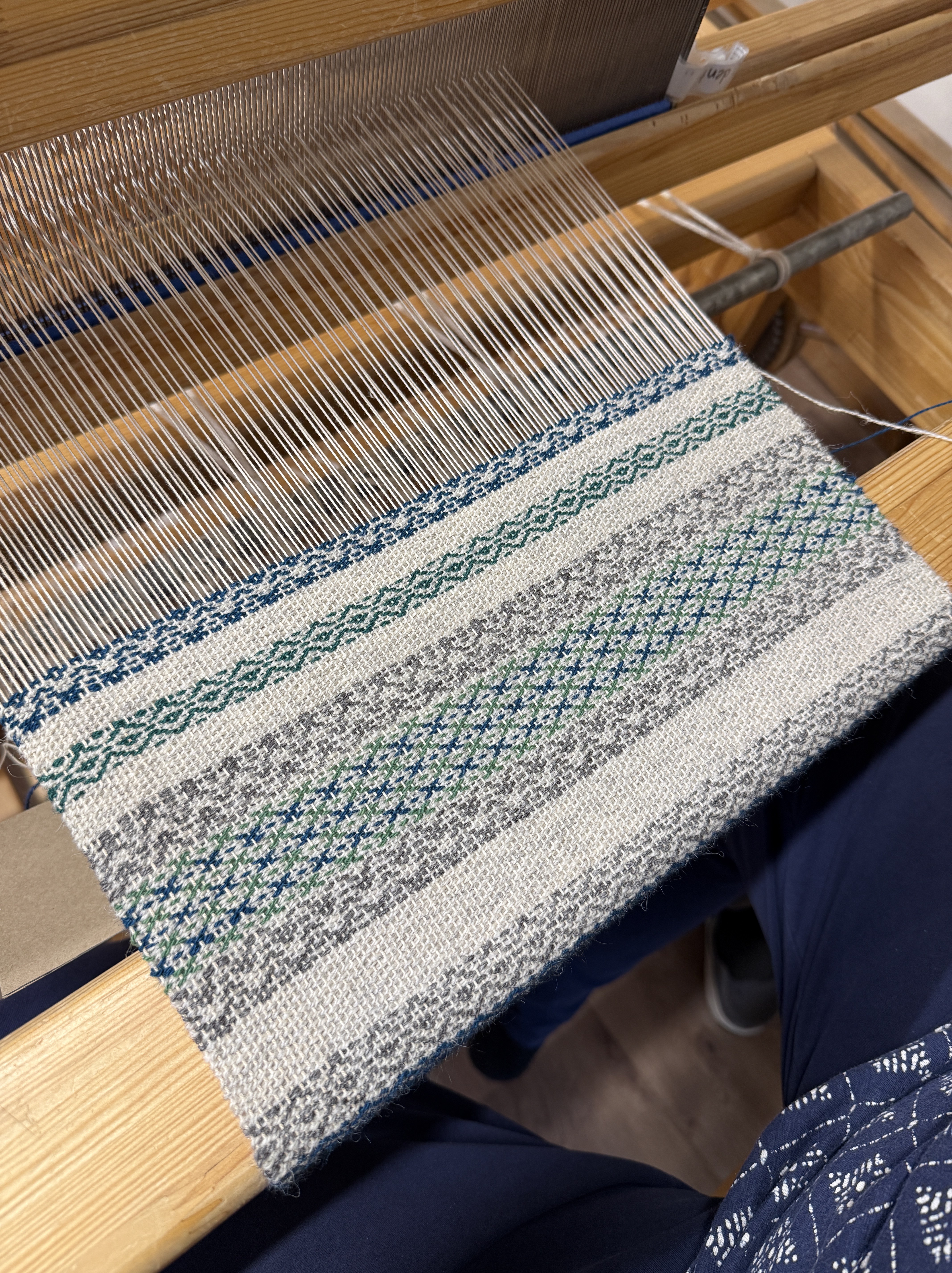
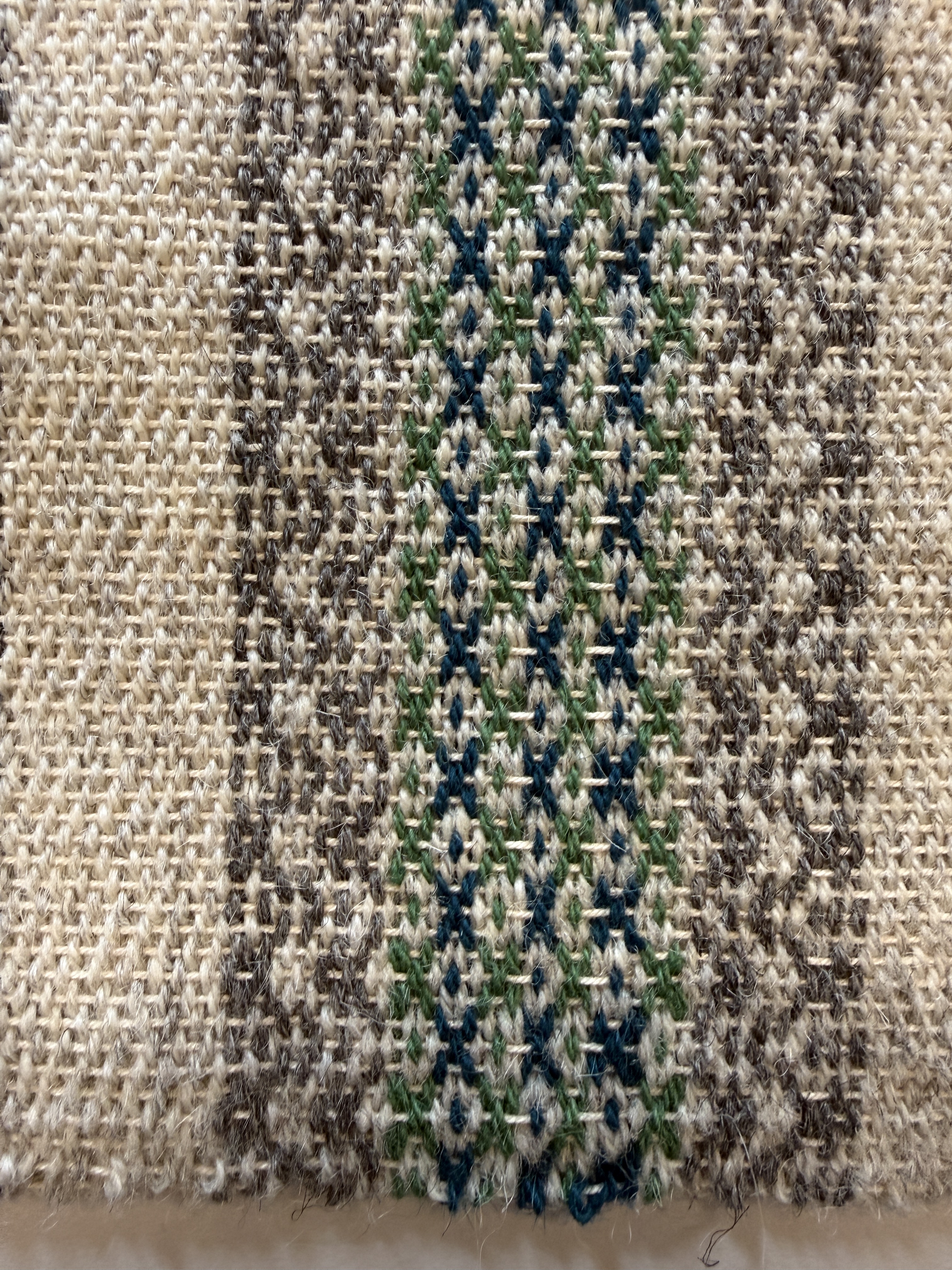
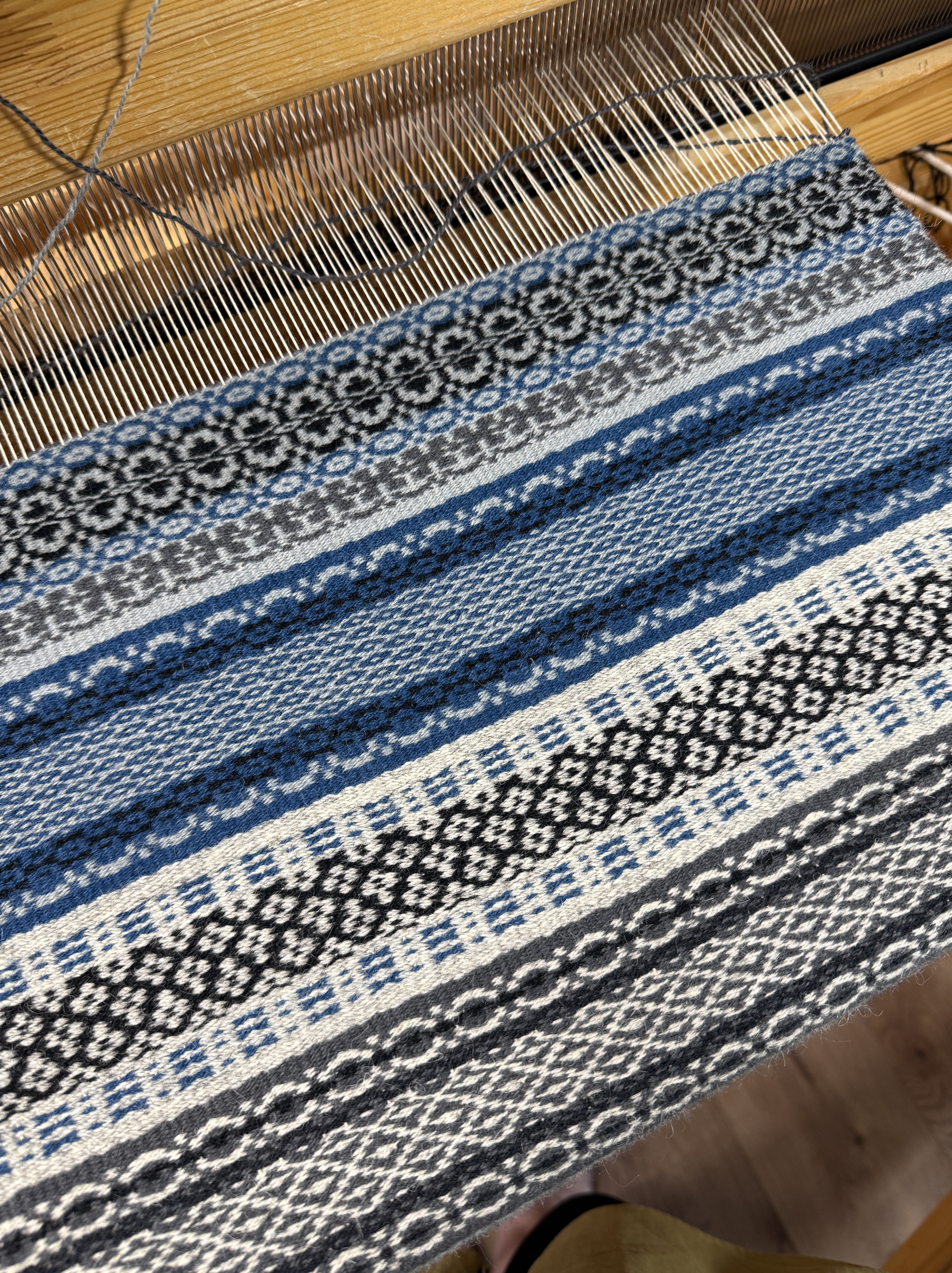
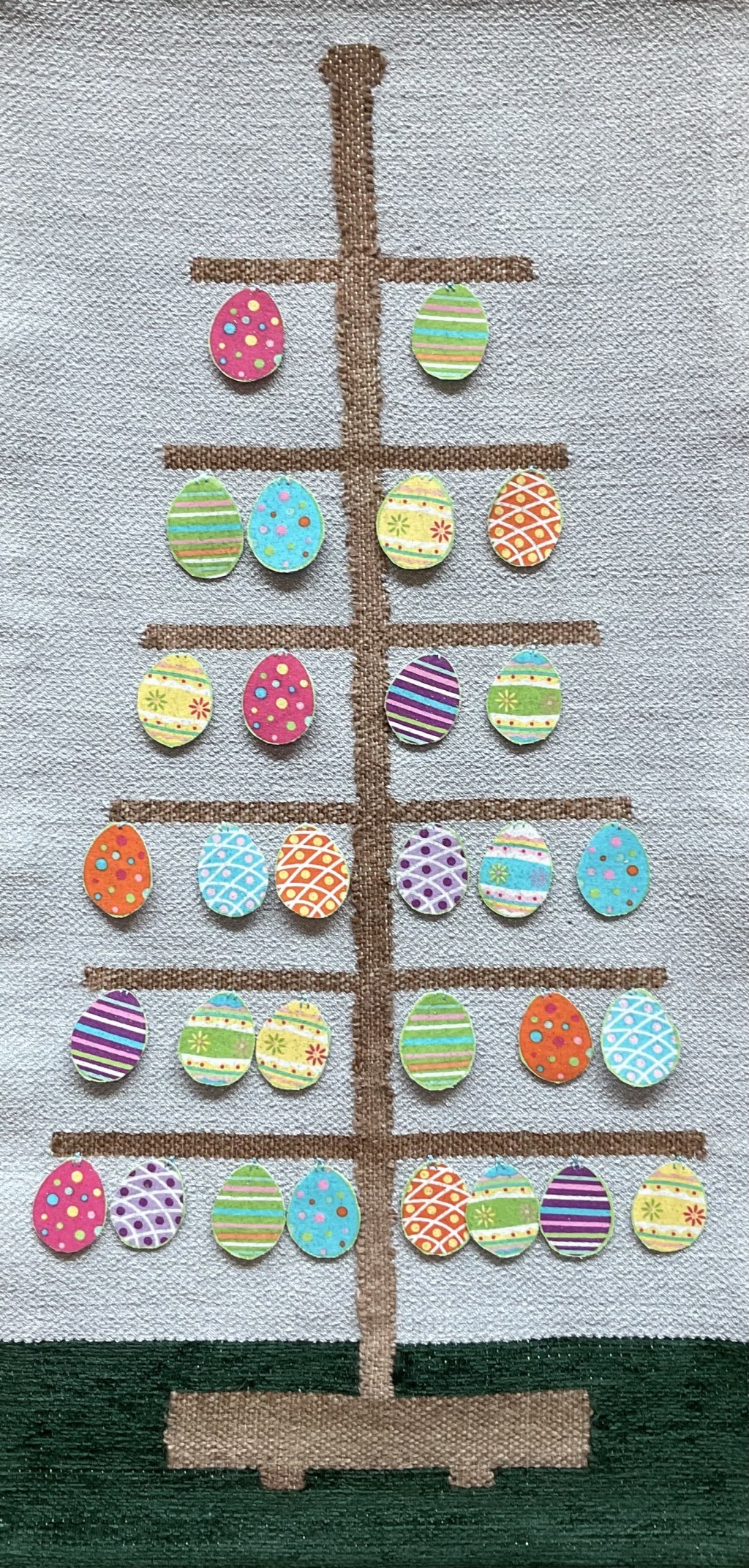
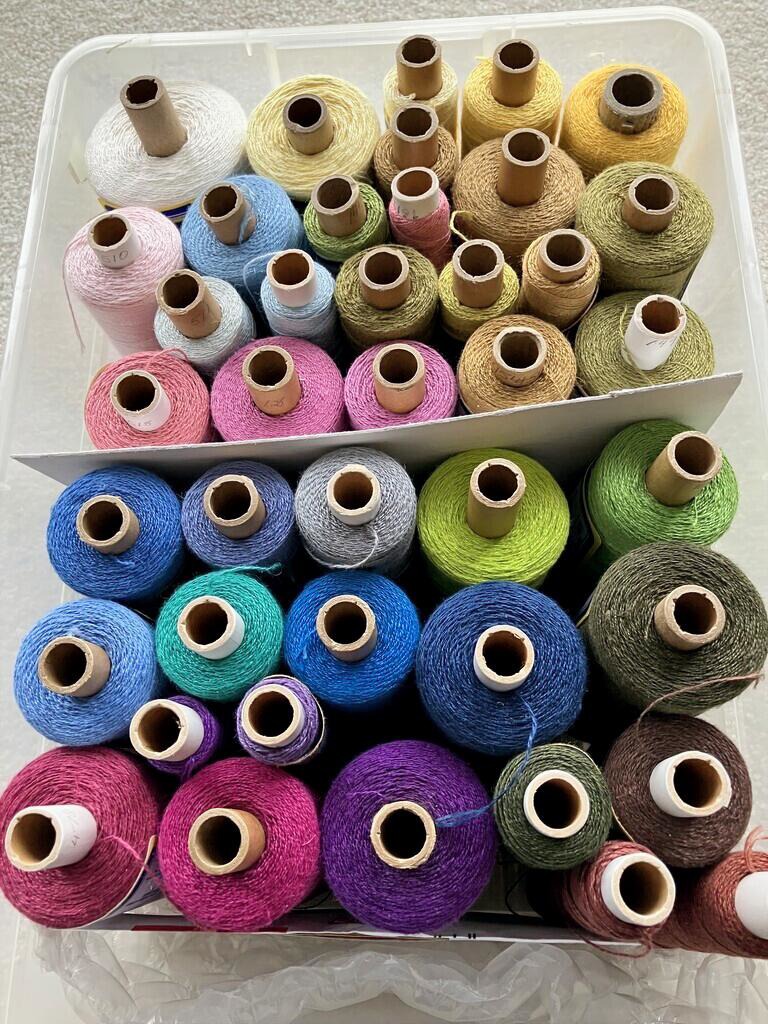
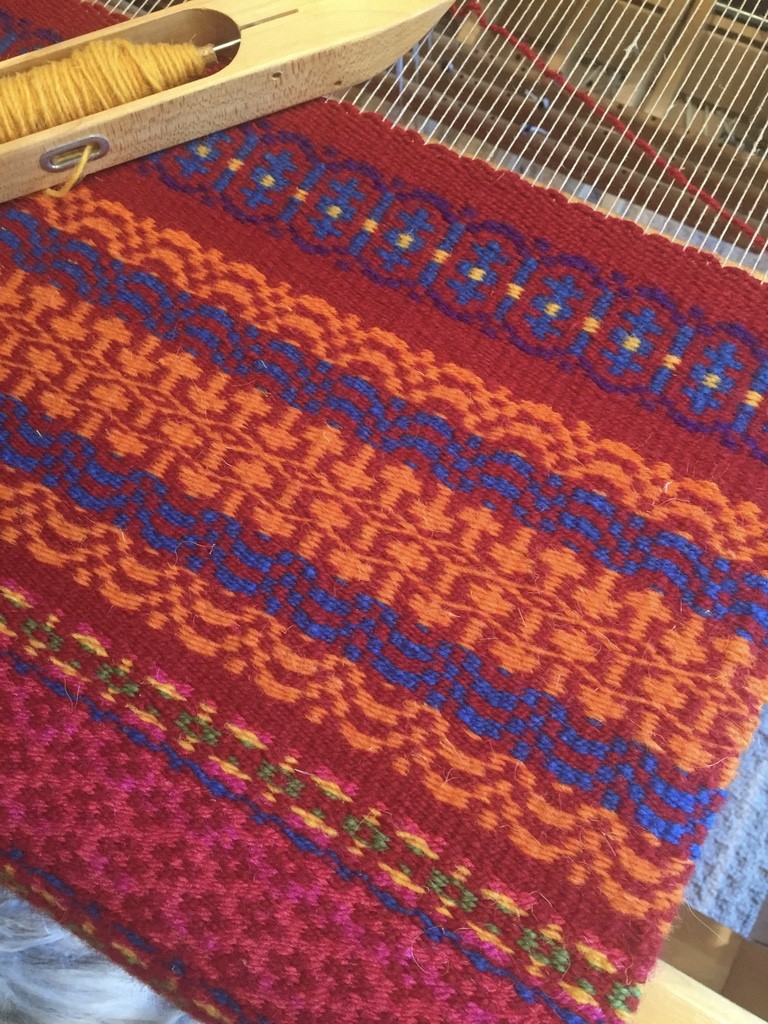
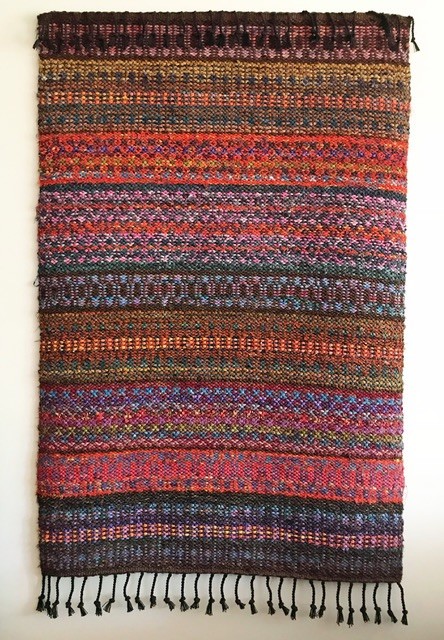
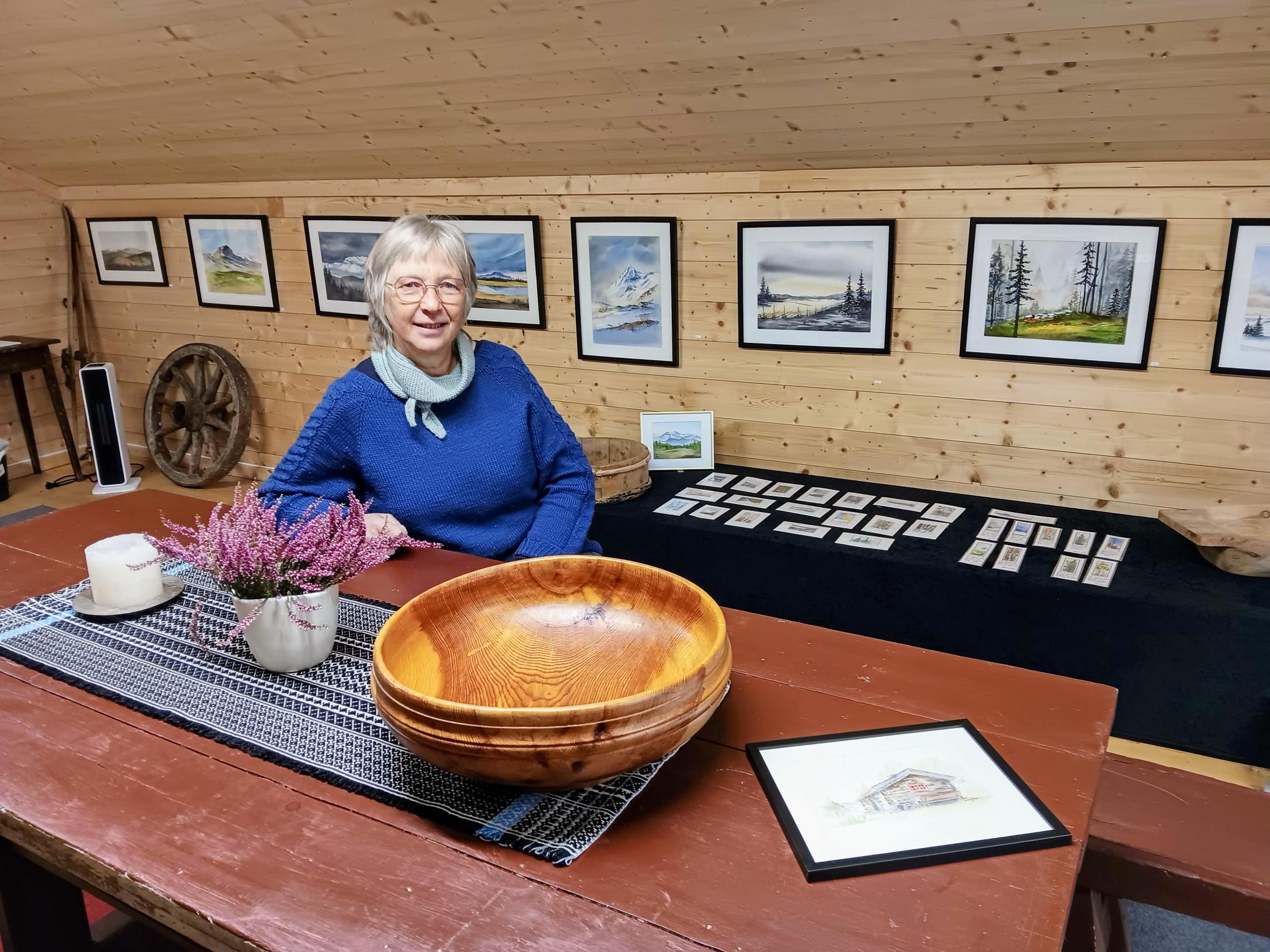
Living Lineage opens December 12 in the second-floor gallery at Open Book in Minneapolis, celebrating linen through traditional and contemporary works of art and weaving for everyday use.
Living Lineage: Linen in Scandinavian Folk Art and Modern Interpretation is the culmination of a project sponsored by Three Rivers Fibershed and the Weavers Guild of Minnesota, funded by the American Scandinavian Foundation. Six artists were chosen to create projects. They range from contemporary lampshades of handspun linen; to a linen crocheted version the of the Norns of Scandinavian mythology who weave the threads of peoples’ lives; to elegant panels woven with bundled linen, showing the natural colors of linen from different geographic regions. The exhibit traces flax’s journey from plant to cloth, explores the possibilities of reviving local flax processing, and showcases gorgeous linen weavings and objects that might inspire you to work with linen yourself. See profiles of the artists and other posts about the exhibit on the Three Rivers Fibershed Instagram feed.
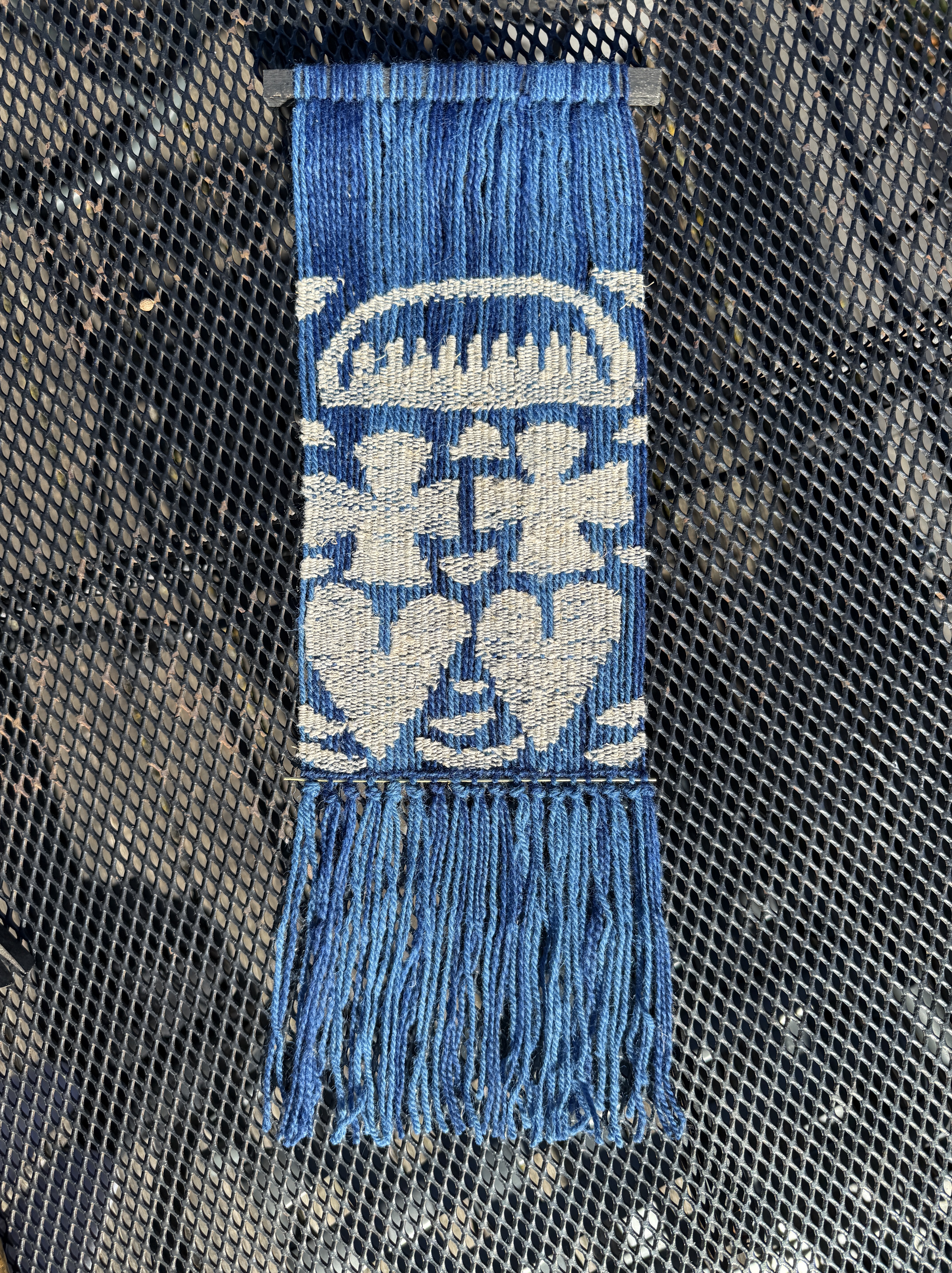
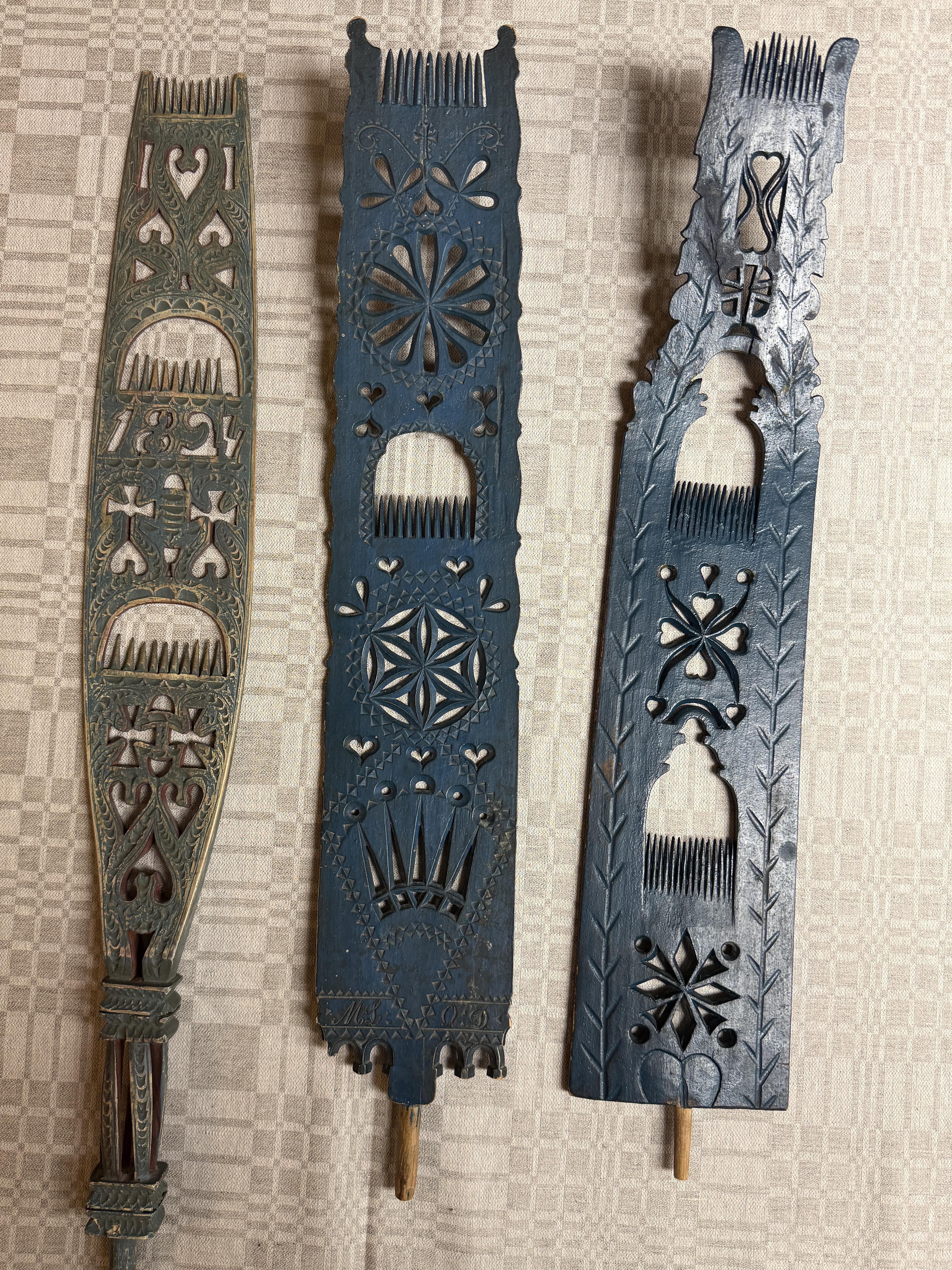
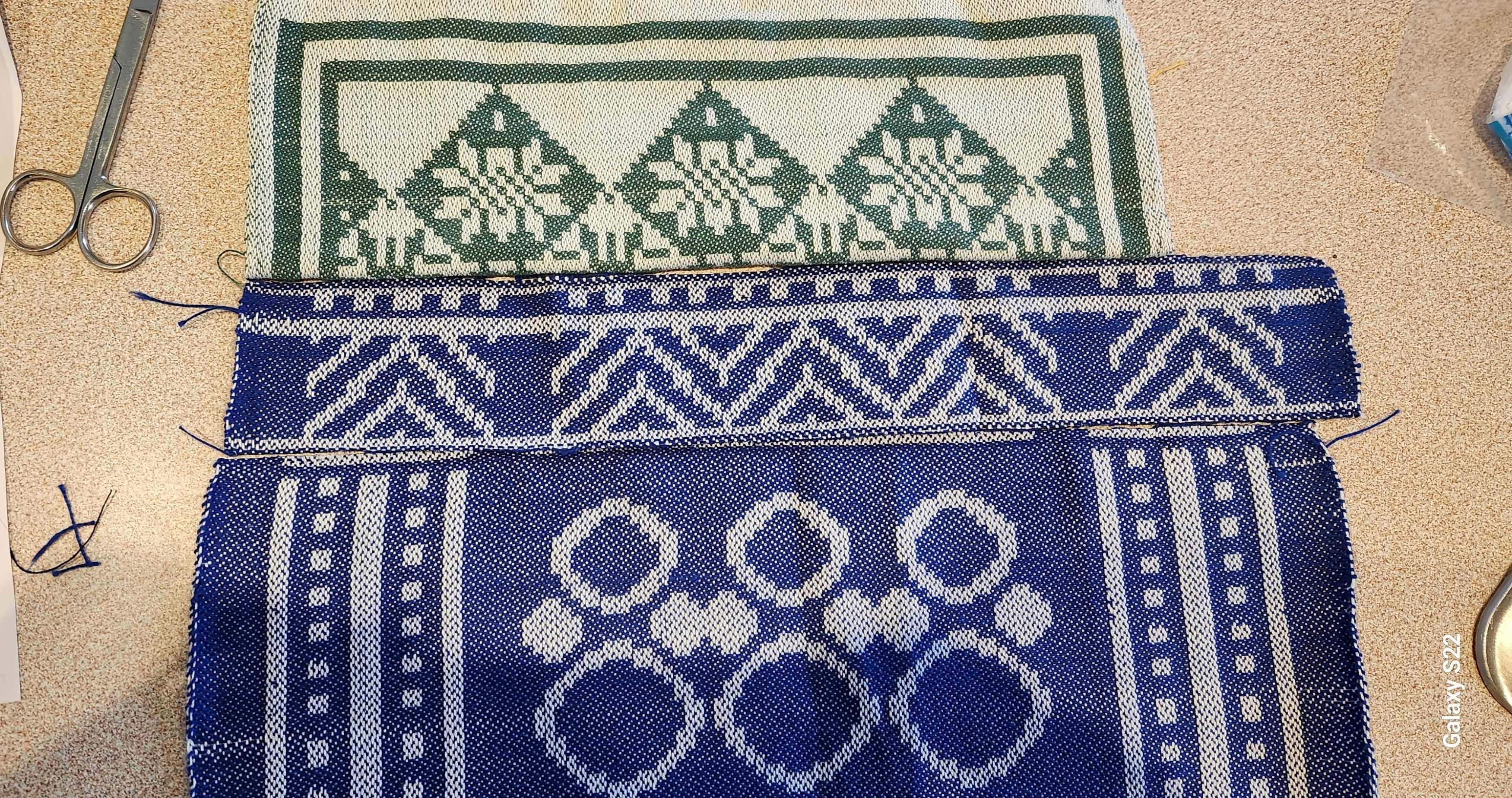
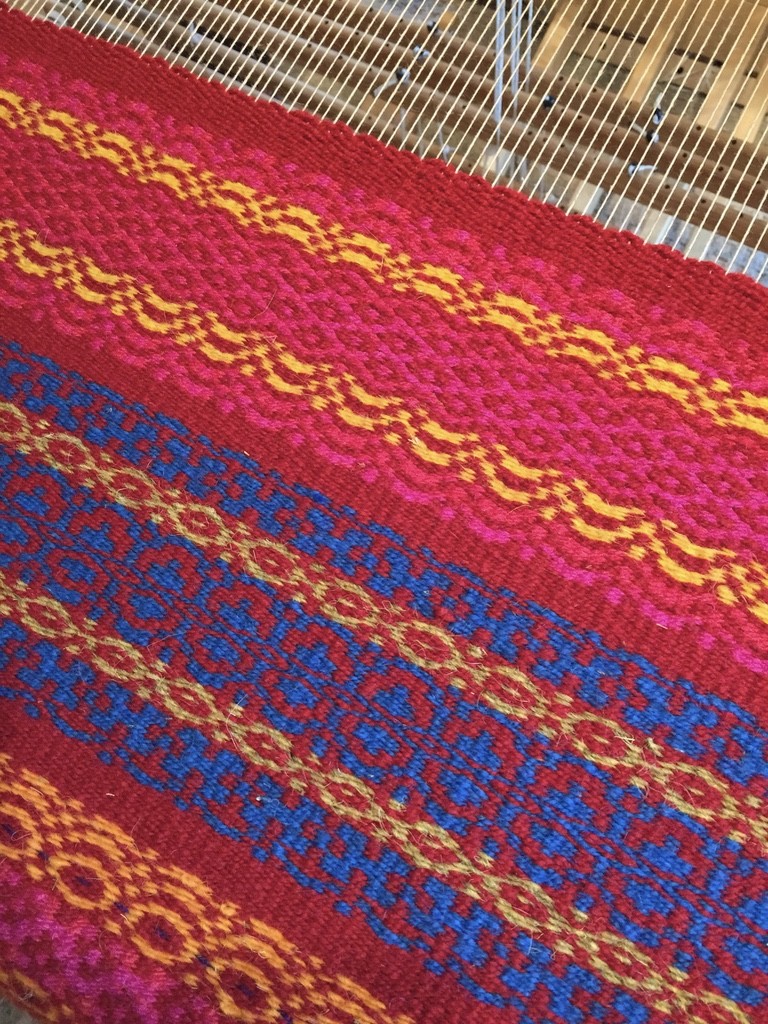
Robbie LaFleur is one of the six project artists, and her two tapestries honor the tools used in linen production and the flax plant itself. The motifs from Love and Protection are taken from a historical distaff. See if you can find the matching carving; it’s on the green distaff. (Read more about this weaving: “From Carved Wood to Woven Linen.”)
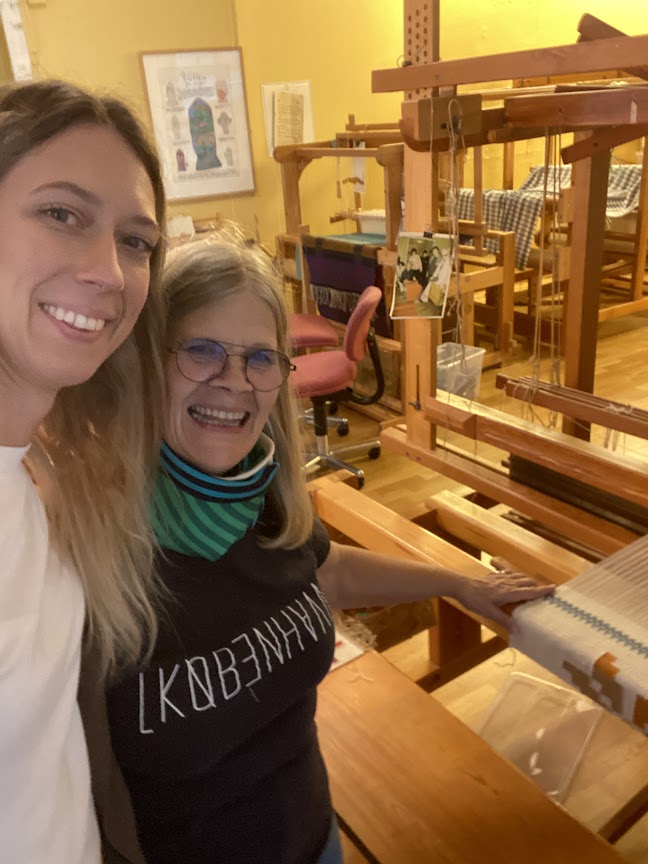
There will be a symposium on the opening day of the exhibit, December 12. Scandinavian Weavers Study Group member Lisa Torvik will be a panelist for the first session, “History in the Making: Finding Ancestral Connection Through Textiles.” See the full line-up and sign up here.
In connection with the Living Lineage exhibit, the Weavers Guild of Minnesota will display linen weavings from Guild members, including many members of our Scandinavian Weavers Study Group.
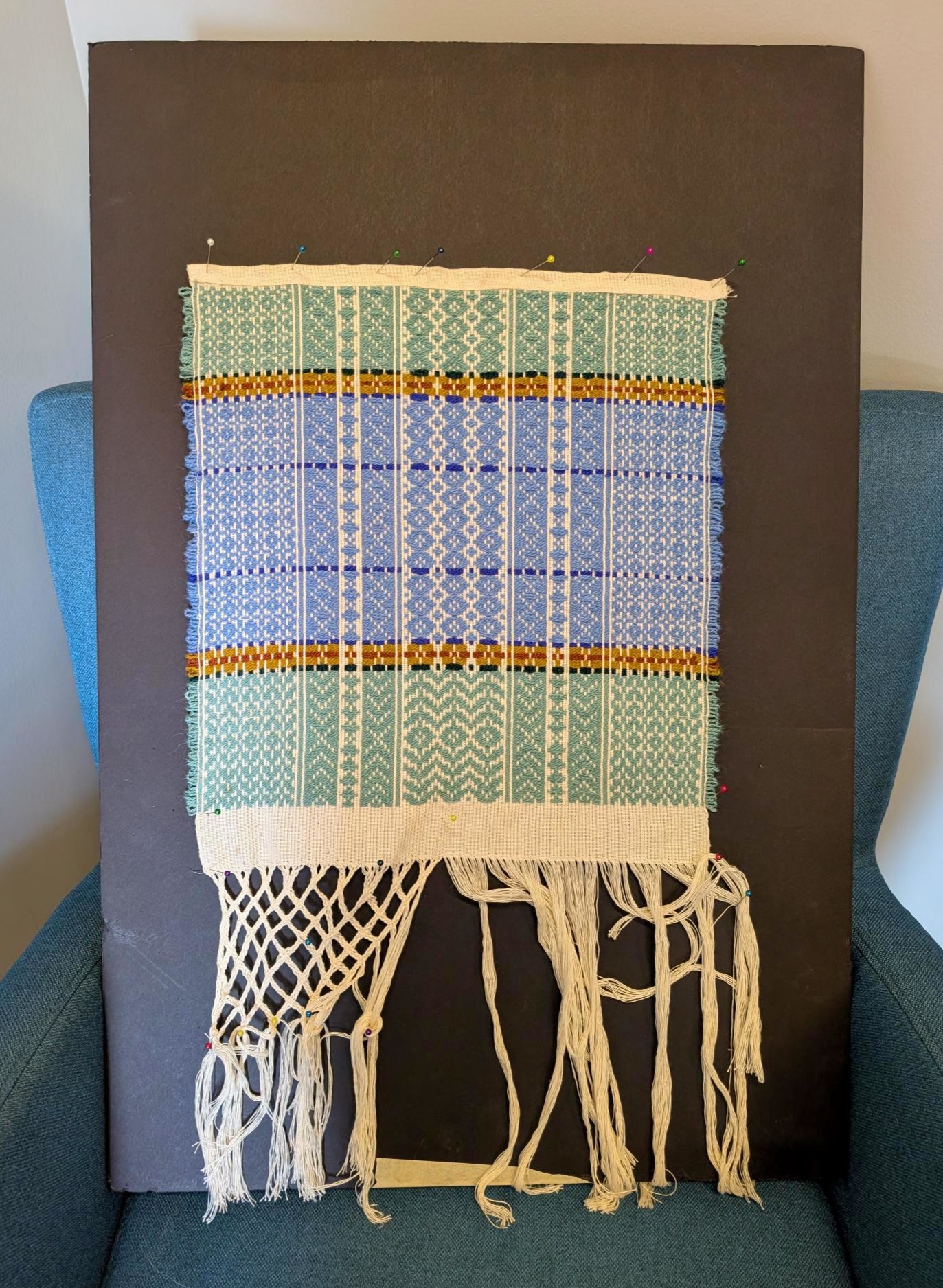
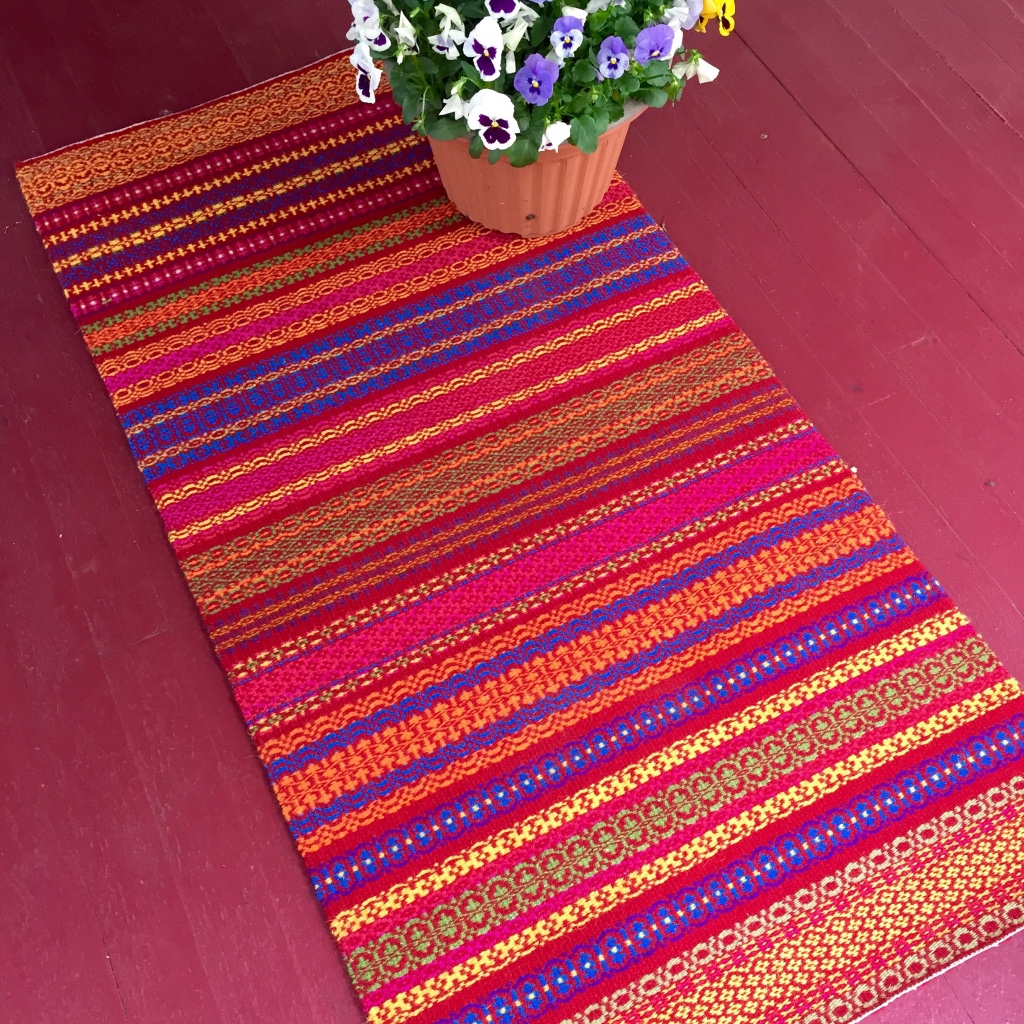
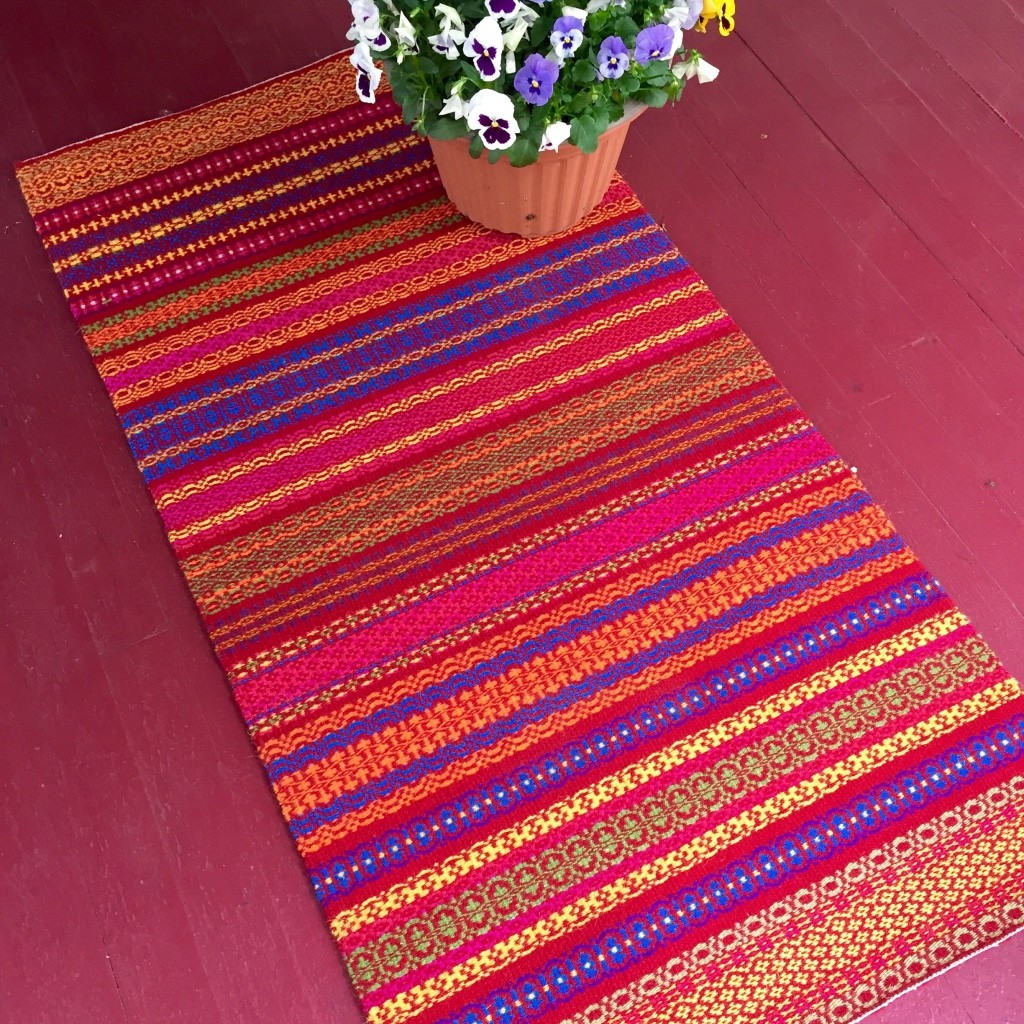
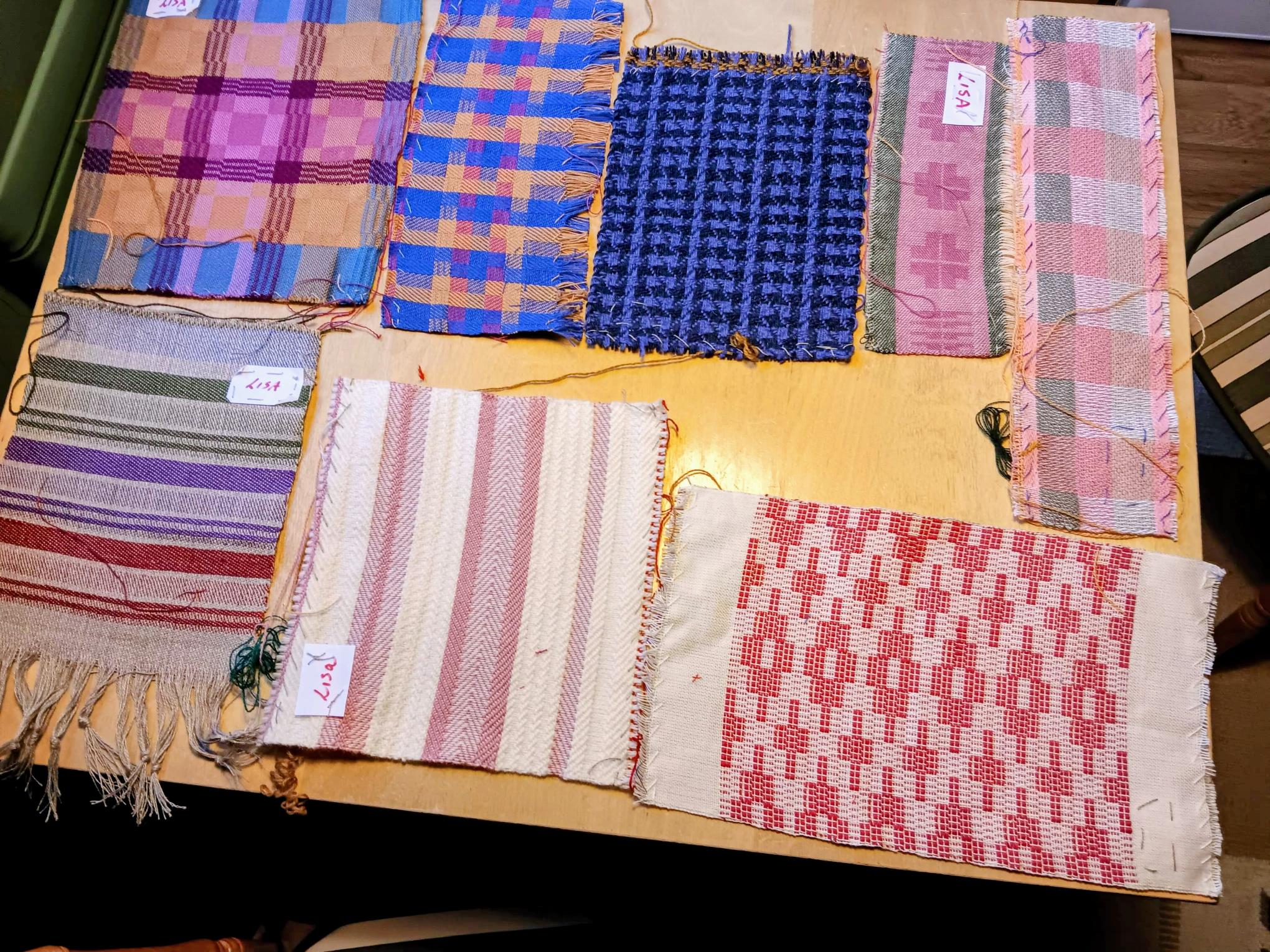
Lisa Torvik’s flower garden linen runner in skillbragd technique will be on display in the Weavers Guild of Minnesota gallery.
If you come to Open Book for Living Lineage, be sure to head upstairs to the Guild to see what members of our study group have been weaving in linen.
Our experience with the Scandinavian Weavers Study Group shared warp for Flesberg technique has been mixed, to say the least. Based on a piece I wove in 2008, we decided to warp the loom with 12/6 seine twine. I carefully unwove a tiny strand of the braided “tail” of black seine twine on my old piece and verified that it indeed had six strands. Our group members said they didn’t like black, because it can be hard to see on the loom, so I found some 12/6 white seine twine in my stash. Super volunteers wound the warp and put it on the loom at the Weavers Guild.
Here’s the problem. I thought the white seine twine was the same size as the black I had used, but it was not. It looked the same at first glance, but it turned out to be just a little heftier than the yarn I used originally, just enough thicker to make it difficult to cover the warp threads easily. Both the warp I used before and the warp we used now was 12/6. But dyeing can affect the yarn.
As I heard reports from the first weavers, I was confused. I did not remember beating hard at all. The great challenges of weaving in the flesberg technique should be choosing your pattern arrangement and colors, and following the patterns accurately. I didn’t remember struggling to weave an even edge or having to beat hard to make the weft cover the warp.
Weaver #1: Beth Detlie
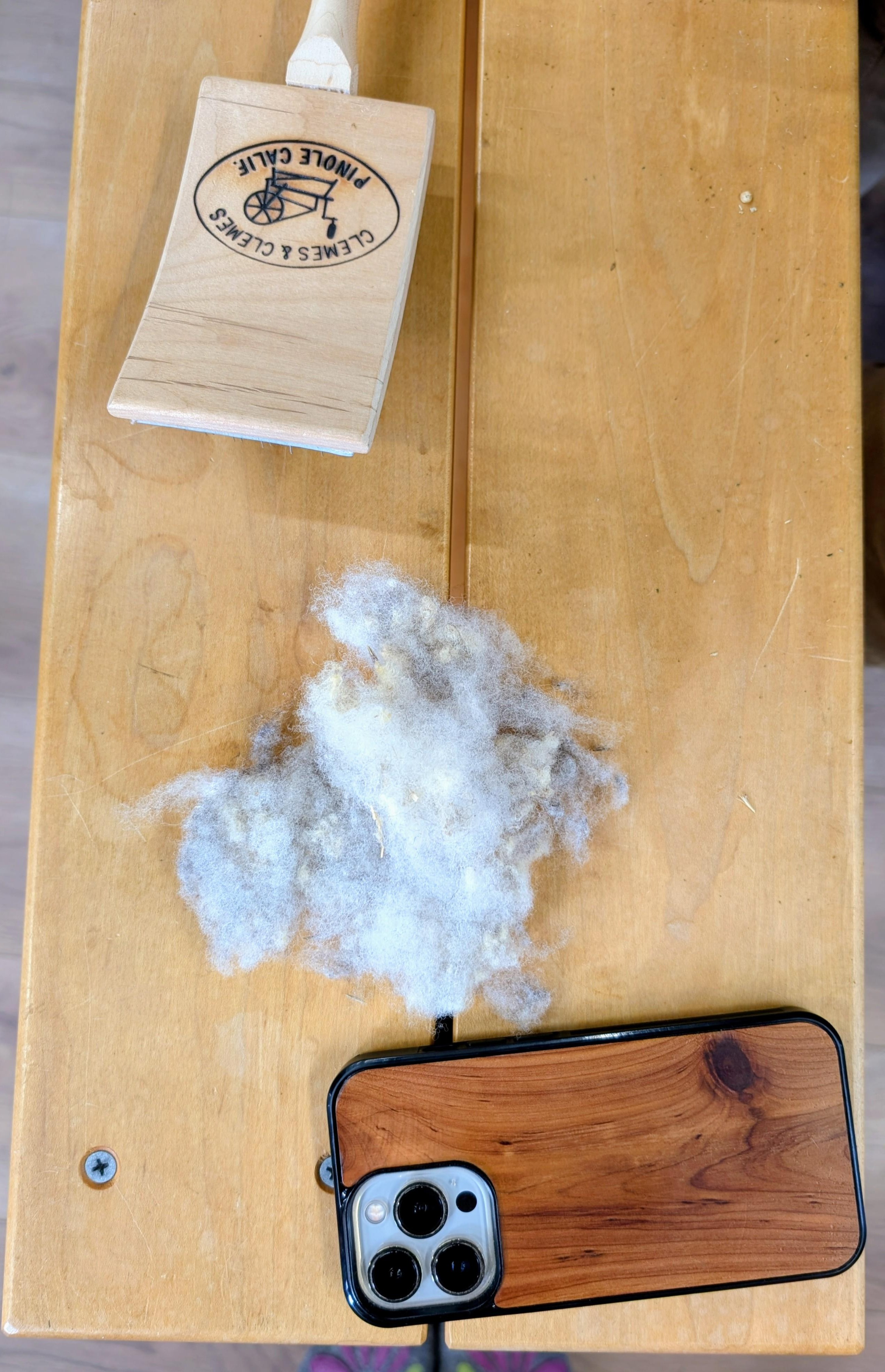
Despite the difficulties, Beth Detlie wove a smashing runner for the first project. She used yarn specially spun for her by Beth Friedman, using the fur of her daughter’s dog, a Norwegian buhund. The fuzziness helped the coverage, and she was using lighter colors, so a bit of white warp was not noticeable.
Beth Detlie
Here are Beth’s hints from her experience.
The pattern columns read from right to left so, for instance, you would start where the word bord 1 is. I liked using the magnetic board and strips to move along as I wove the pattern, not exposing more than 5-8 throws before moving to the next group. Always move the bottom magnetic strip up to meet the top one before you advance the top strip, weave and repeat.
I also think it helps visually to have some device for visual rest, like a strip of solid color or a repeat simple pattern. I think this allows the more complex patterns be better defined.
Weaver #2: Judy Larson
Next Judy Larson experimented. Judy is a super-skilled weaver, yet she had problems with coverage, even though she tried different yarns. She ended up with a small sample that showed the patterns well, but it seemed crazy that she would have difficulties. In the sample with the blue yarn, at ten ends per inch it was difficult for Judy to get good coverage using …. yarn. In the green sample, she switched to very thin … yarn.
Weaver #3: Lisa Torvik
I talked with Lisa Torvik about the beating and coverage issues before she took her turn at the Glimakra. Lisa’s brilliant solution was just to go with the fact that part of the warp would show. She had a beautifully even beat throughout, and as usual, impeccable color choices.
These are Lisa’s tips.
Decide on your preferred borders first from the multitude of patterns we have available.. Unless this is a familiar technique, which it was not for me, the need to counterbalance shots makes experimenting tough.
I photocopied the two sets of borders I settled upon, and pinned them to opposite sides of a thin piece of styrofoam. Cardboard might work too. I used a T-pin to mark my progress, three shots at a time.
I agree with Robbie about marking your colors. Black squares should alway be your “ground” color within each border, if not overall, and use color to help you with the other shots.
And if at first you don’t like the look, be patient with the unweaving. I had to do some too!
Weaver #4: Robbie LaFleur
Lisa Torvik agreed with me that we should cut down the warp and re-sley at 8 epi instead of 10. So that’s what I did.
At eight ends per inch, rather than ten, coverage was much easier to obtain. It was easy to maintain a nice selvedge. I used a combination of Frid and Prydvev yarn for weft.
I spent so much wasted time during my weaving! I unwove a border one time because I hated the colors I chose. I unwove another because I was reading the pattern incorrectly. I wove and unwove within one border because I kept mis-reading the pattern. Finally, ON DAY THREE, I came up with a process that settled my anxiety and let me merely observe the magic of the patterns unfolding. Those of you with more clever and elastic brains certainly don’t have to do what I do, but this is what works for me.
Choose a pattern and colors you like. Make a photocopy of the pattern page.
Leave the background squares with the black rectangles as is, and use markers or colored pencils to fill in the squares of pattern. Who can possibly keep those little circles and slashes straight?
Mark the first three lines with a highlighter, skip three lines, mark the next three lines with a highlighter, etc. It is easier to work three shots at a time.
And this is what I discovered is key for me. I keep the colored pattern sheet next to me on the loom bench, and after each three shots, I make a little check mark on the pattern. When I place the third shot, I double-check where I am, like “Is this blue in treadle 2?” Yes? Great! Then I make the small check and go on to the next set of three shots. See the video.
Other weavers like to use a paper clip or magnetic strip and move it as the pattern unfolds. Nancy Ebner wrote, “I discovered “knitters tape” and have used it to keep my place in the pattern. You can move it and reuse it like a post-it.” Whatever works for you is the “right” way.
Observations about sett and yarn
In 2008, when I warped my loom with the thin black warp at 8 epi, I found the resulting piece to be too drapey for my taste. That’s why I re-sleyed it at 10 epi. The resulting piece was thick and solid.
If you want to weave at 10 epi, use thin 12/6 colored seine twine from Glimåkra and thin plied weft wool. If you want to weave at 8 epi, the warp can be a bit thicker.
Spring has finally arrived in Minnesota, and the Scandinavian Weavers are busy as bees!
Weaving and photo by Jean Neilson
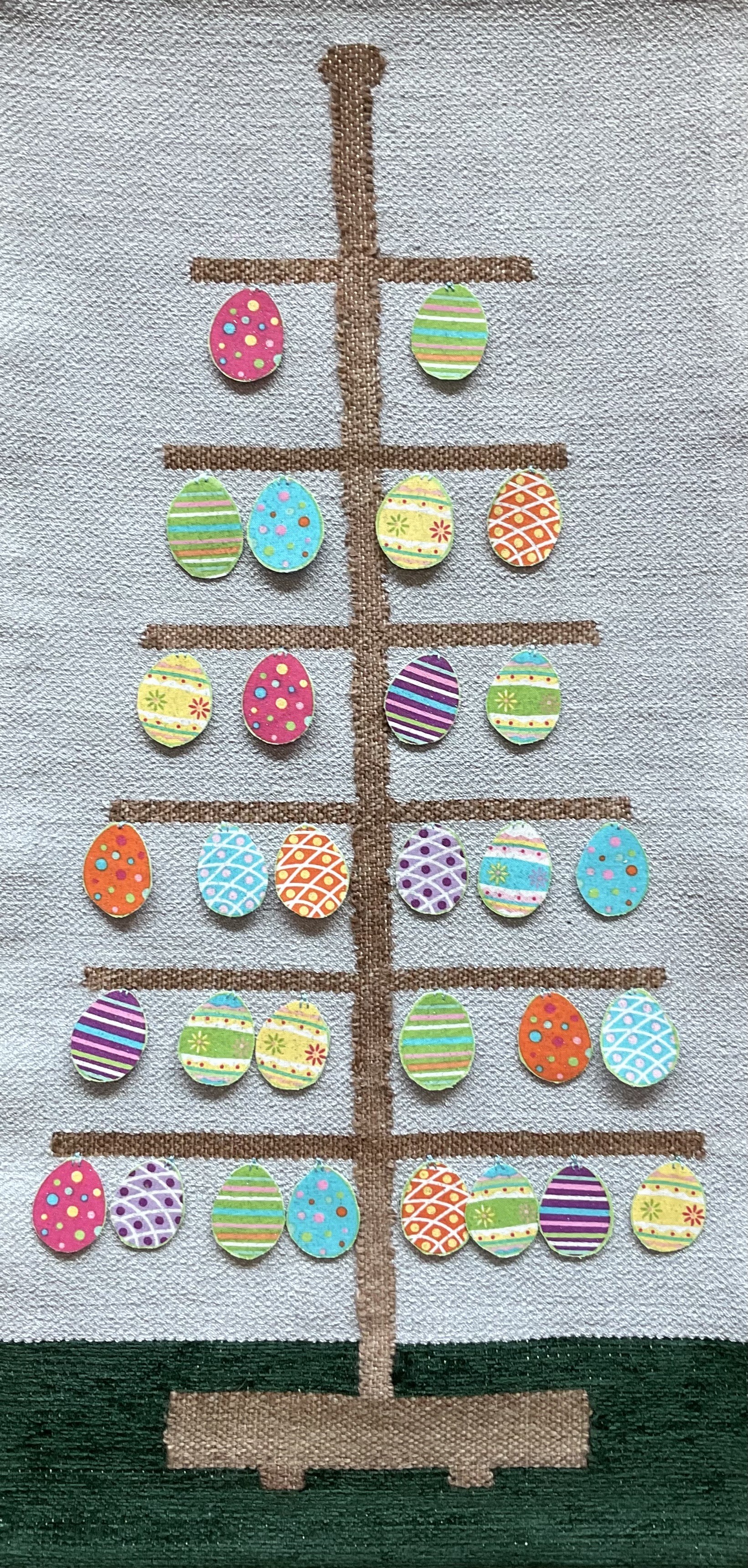
Jean Neilson wove the tree above in Theo Moorman technique. She cleverly kept the tree bare so that she can place new decorations as the seasons change.
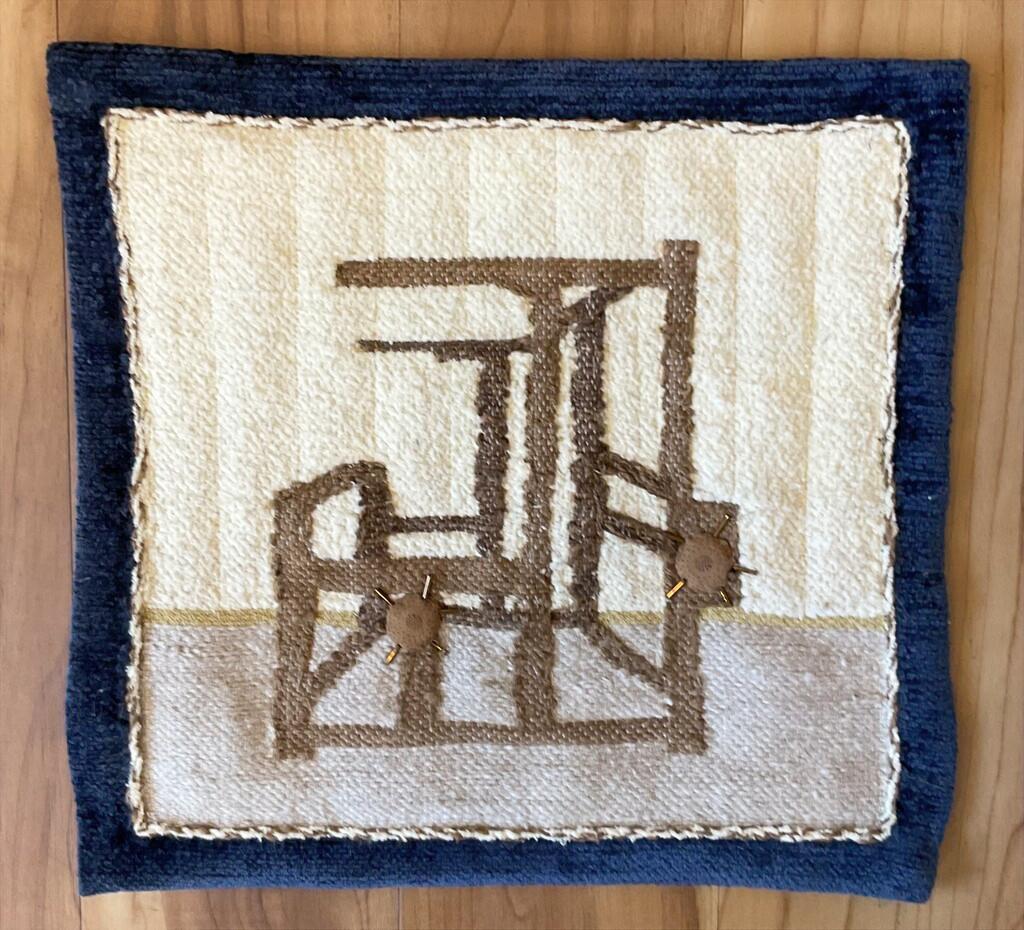
Jean also wove the charming loom above in Moorman technique. She quilted around the loom shape and background to resemble wallpaper.
Weaving and photo by Judy Larson
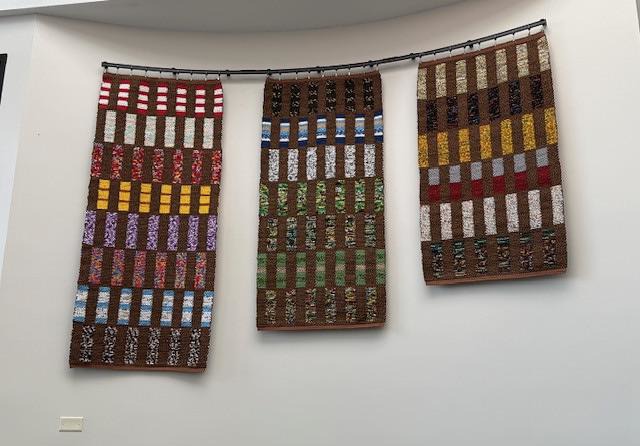
Judy Larson was commissioned to weave wall hangings for the public library in Ellsworth, Wisconsin. She designed the wall hangings above to look like books on the shelves, inspired by picture books, chapter books, and adult books. (See if you can find the covers for childhood favorites Goodnight Moon, The Very Hungry Caterpillar, and Harold and His Purple Crayon.) They are woven in double binding technique with 1 1/2” strips on a seine twine warp at 7 1/2 EPI. The rugs are hung in a curved stairway and spread across a nine-foot span.
Photo by Lisa-Anne Bauch
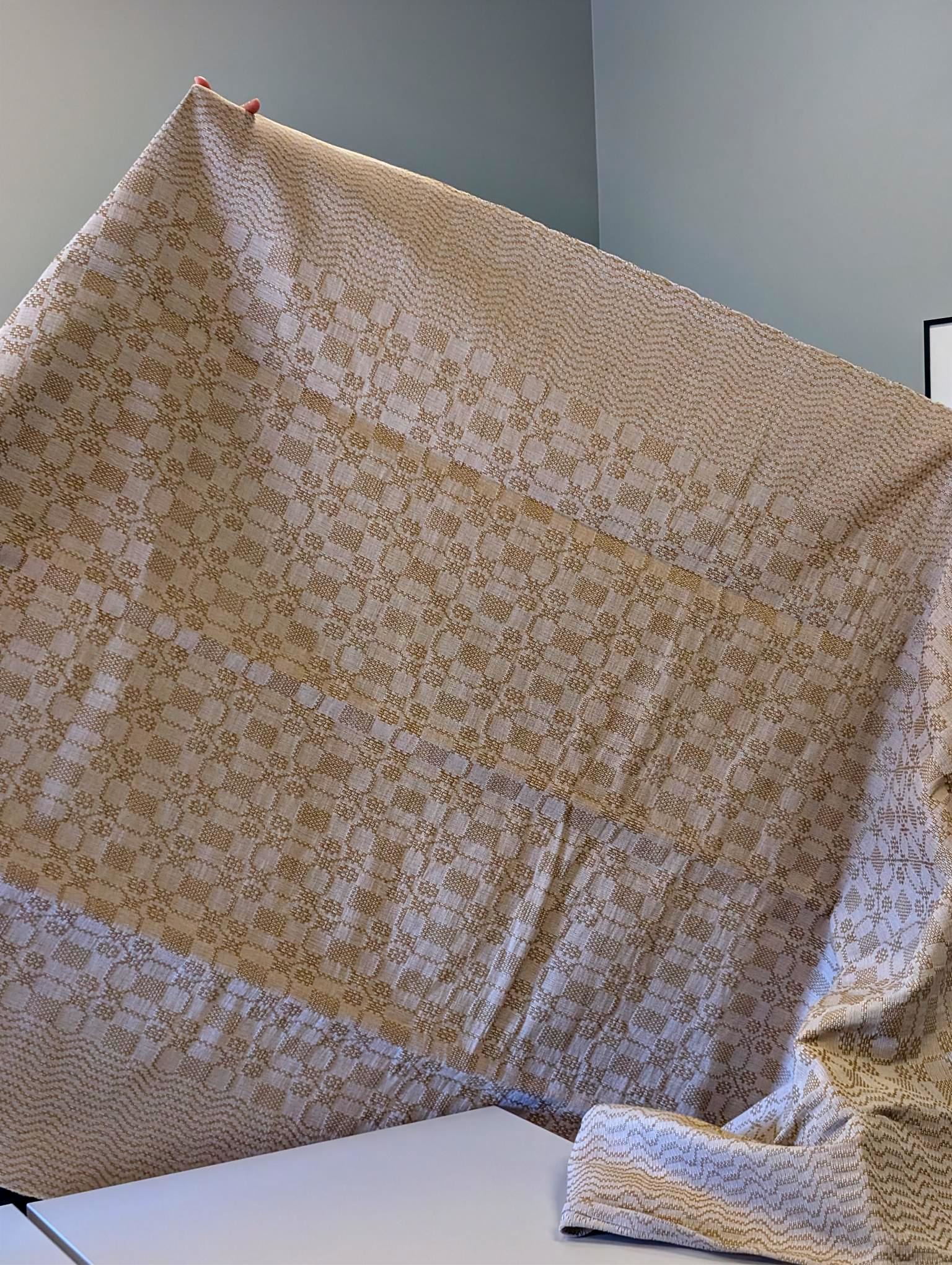
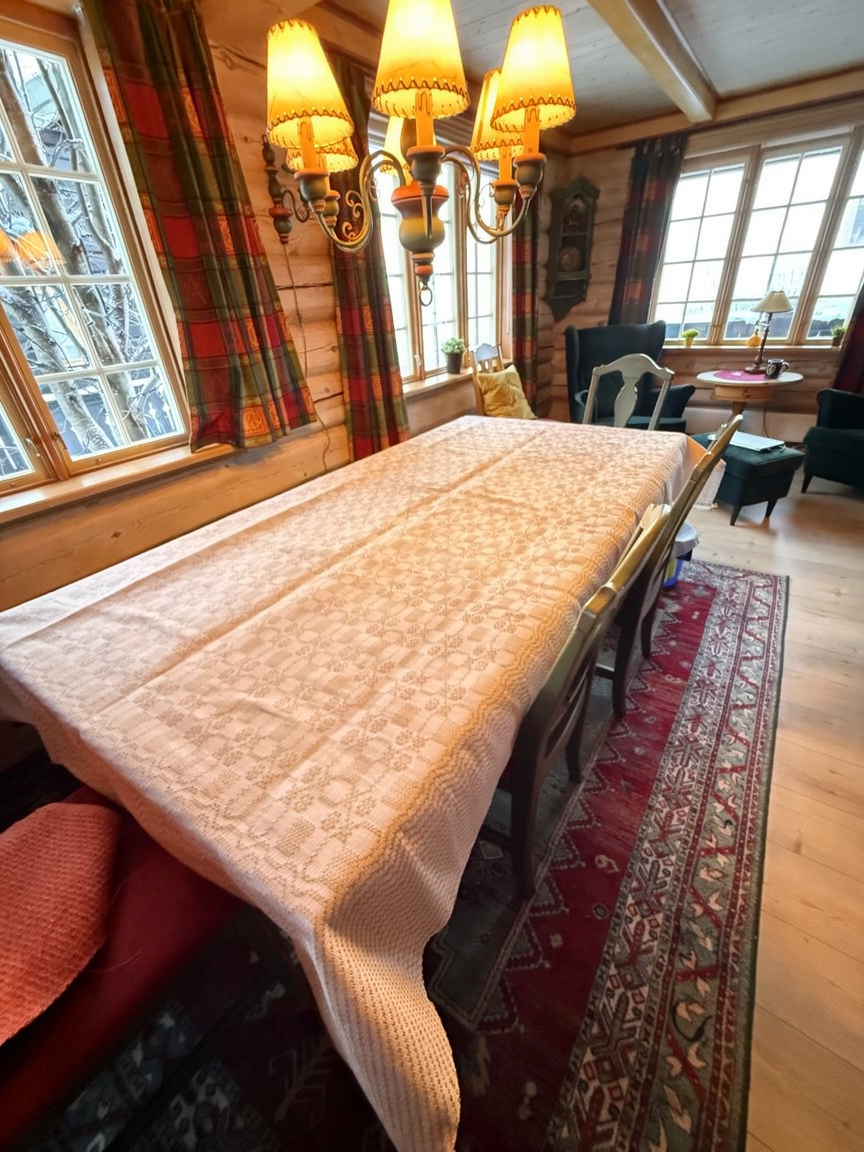
Beth Detlie wove the beautiful halvdrall tablecloth above at a weaving collective in Norway.
Photo by Beth Detlie
She shared this photo of the cloth on her dining table. Notice how she designed the central motif to fit the size of the table.
Weaving and photo by Cathie Mayr
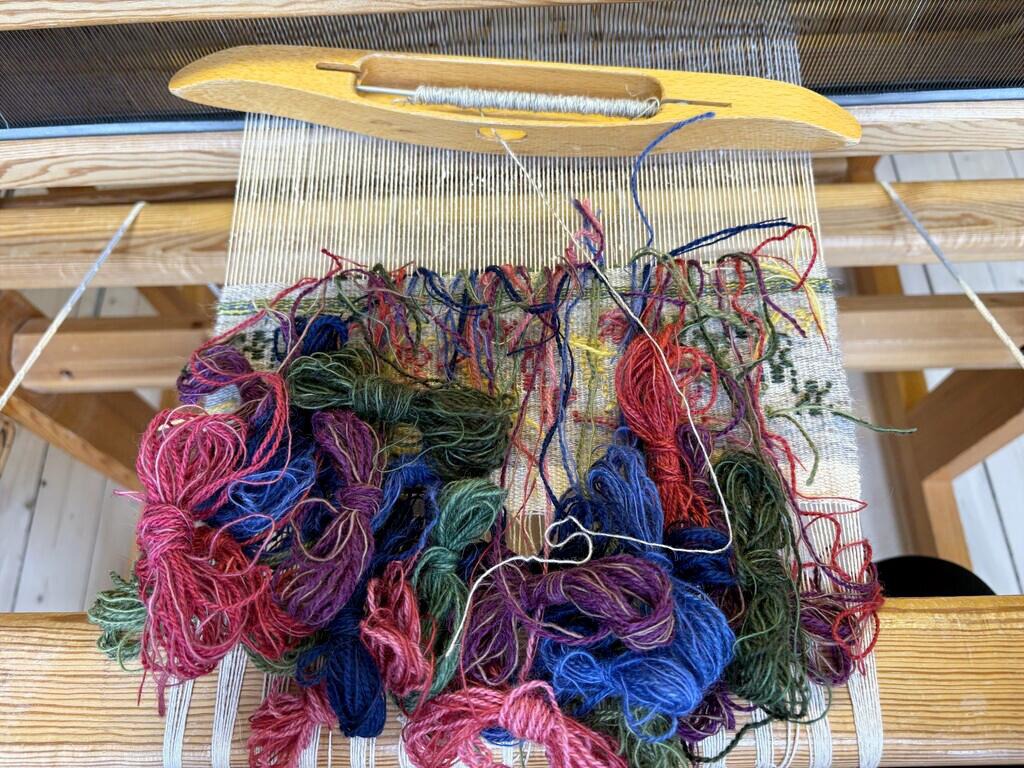
Cathie Mayr took a workshop in Swedish Art Weaves from legendary weaver and instructor Gunvor Johansson, author of Heirlooms of Skåne. Cathie wove the beautiful sampler above over five days. “The warp is linen and held at a VERY high tension on Glimakra looms,” Cathie writes. “The ground weft is single-ply Rauma (Norwegian) wool, 3 picks between each pattern weft, done with a shuttle. The pattern weft is three strands of singles yarn held together in individual butterflies for each pick.”
Weaving and photo by Cathie Mayr
“To add just a little more complexity,” Cathie adds, “all weaving is done from the back side.” Above, Cathie’s sampler on the loom.
Weaving and photo by Lori Labs
Lori Labs took a workshop from another well-known instructor, Joanne Hall, at Eugene Textile Center. She wove the sampler above on a drawloom.
Lisa Torvik recently taught us the art of firefletting, decorative braiding used on Norwegian textiles. (Stay tuned for a blog post with more photos.) Holly Hildebrandt is patiently practicing on her skillbragd weaving above.
Weaving and photo by Elizabeth Hunter
Liz Hunter is an abstract painter as well as a weaver in rya. With an upcoming workshop on luminosity, she writes, “I’ve been thinking about light, a new experience. I happened to look out the window one morning and saw the dark vertical trees suddenly hit by a band of blazing horizontal first light. Ahh, a challenge: Can i do light in rya?” It turns out she can! Liz wove the 3′ x 2′ rya above.
Abbey Nielsen also took inspiration from nature, weaving the krokbragd above on her rigid heddle loom. When she wasn’t weaving krokbragd, Abbey wove rutevev on a frame loom, a band for a friend’s wedding, took a rosemaling class, and built her own inkle loom!
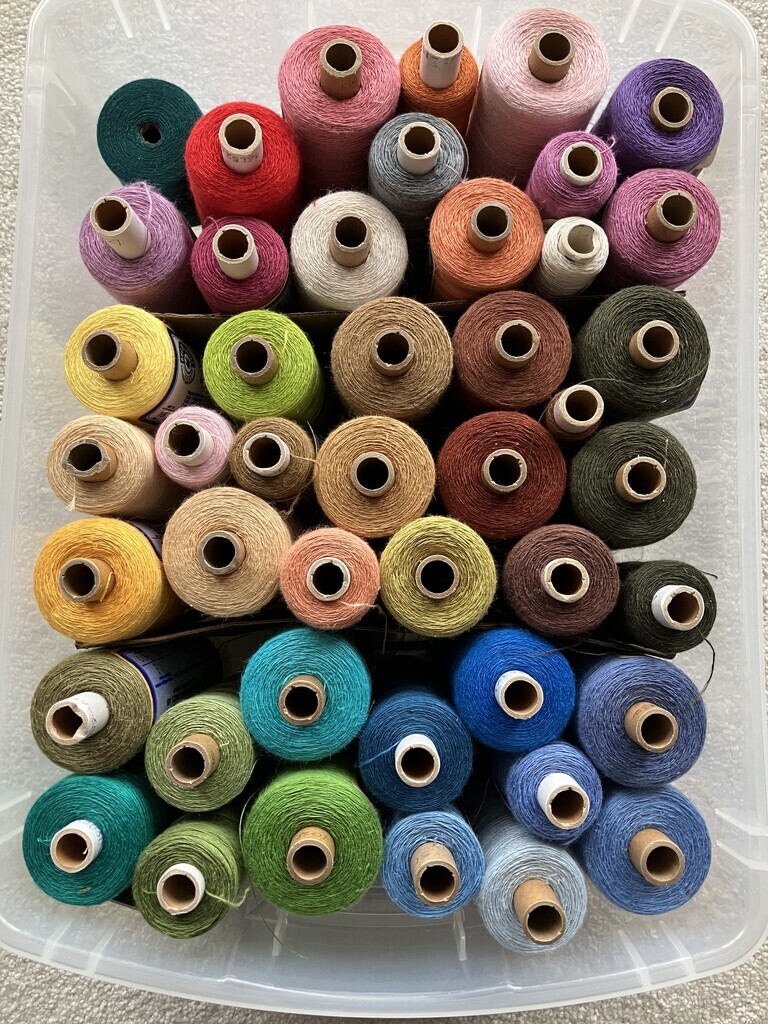
Speaking of spring colors, a generous friend donated two boxes of Swedish linen to the Scandinavian Weavers for a future project.
What will they become? Stay tuned to the blog and find out!
At the Weavers Guild of Minnesota the Scandinavian Weavers Study Group often sets up a group project to learn a new weaving technique. For newer weavers, it’s a chance to try a technique in a supportive setting. For those members who already know the technique, it’s an opportunity to experiment and share the joy of seeing a wide variety of color and patterns develop on the same warp. Sometimes members of our group warp their own looms at home and weave along. The next group warp for the Scandinavian Weavers will be set up for Flesberg technique, and we are inviting you to weave along with us! Our Weavers Guild members will be weaving on a Glimåkra loom in Minneapolis, but we’d like to hear from others, no matter where you are.
Robbie LaFleur, Flesberg rug.
Flesberg is a style of three-shaft boundweave, named for the Flesberg area of Norway where it is popular. The style allows the weaver to create a multitude of curved motifs.
We will be warping our Glimakra loom with 12/6 seine twine at a sett of 10 EPI. Our weaving width will be 14″, suitable for a runner or pillow top. Weavers will experiment with a variety of wool weft yarns.
How can you participate? Use the basic threading and tie-up, written by Kay Larson, linked below. (Please note that Kay’s draft calls for black seine twine yarn. Our project will use a neutral shade instead, as black warp threads can be visually tricky if you haven’t woven this style before.) There are also links to pattern PDFs created by Anna Bakken.
The November, 2020, issue of the Norwegian Textile Letter included several articles about Flesberg. It’s filled with information and inspiring photos of historical and contemporary pieces.
If you choose to try out the technique, we’d love to see what you weave. Here is a short form to report the details about your weaving. Please respond by September 30, 2026. At the end of the year we’ll publish galleries of submitted photos from our Fun with Flesberg project on the Scandinavian Weavers Study Group blog.
For inspiration, here are more Flesberg weavings done by members of the Scandinavian Weavers Study Group.
Flesberg weaving by Nancy Ebner
Nancy Ebner wove the Flesberg wall hanging above, using the instructions from the Norwegian Textile Letter. (See link above.) . She reports that Flesberg is one of the most fun weaving styles she has done.
Robbie LaFleur, Flesberg rug woven with fabric strips
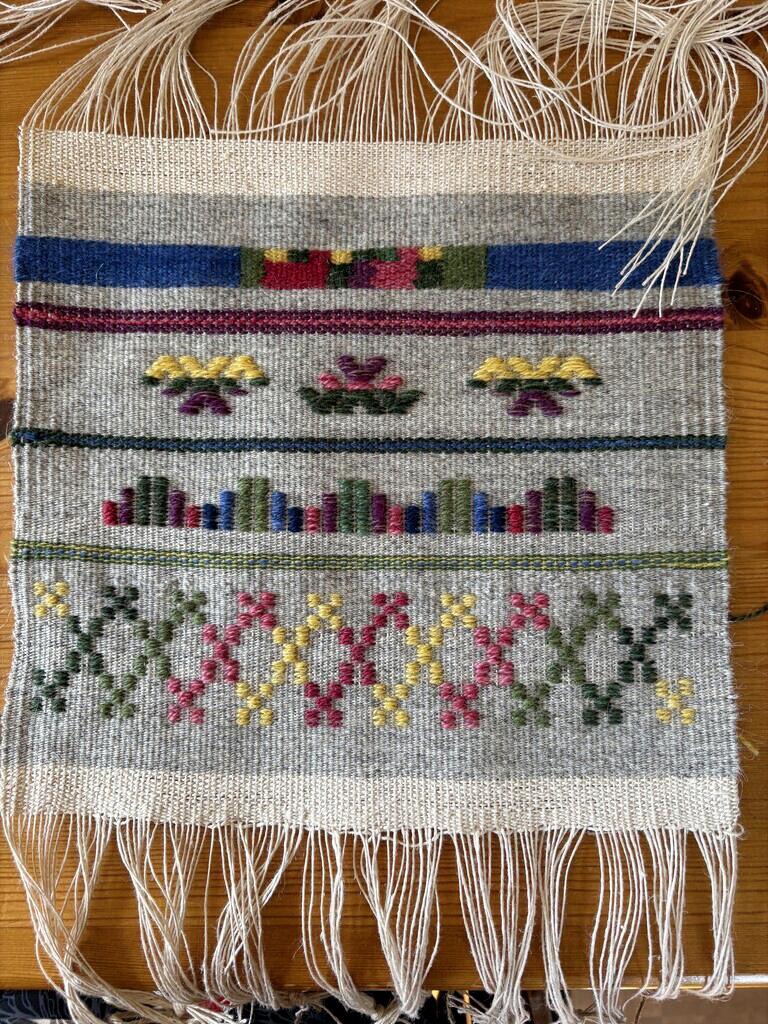
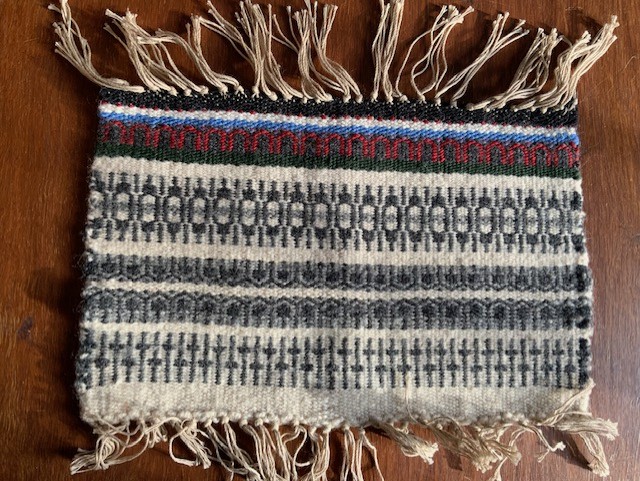
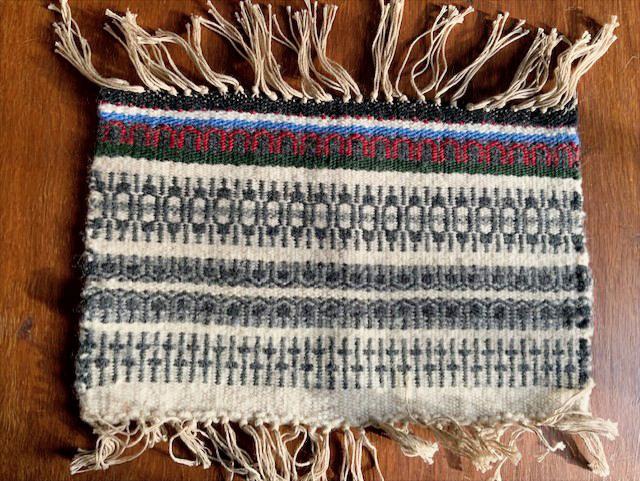
Nancy wove the above sampler in a class she took from Katharine Dickerson at Vesterheim Norwegian-American Museum. “After weaving with the black, gray, and white yarn and drafts supplied in the class we were encouraged to try something on our own, so I wove a row of red covered bridges with blue sky and green grass as the covered bridge at Zumbrota, Minnesota is a local tourist attraction here.”
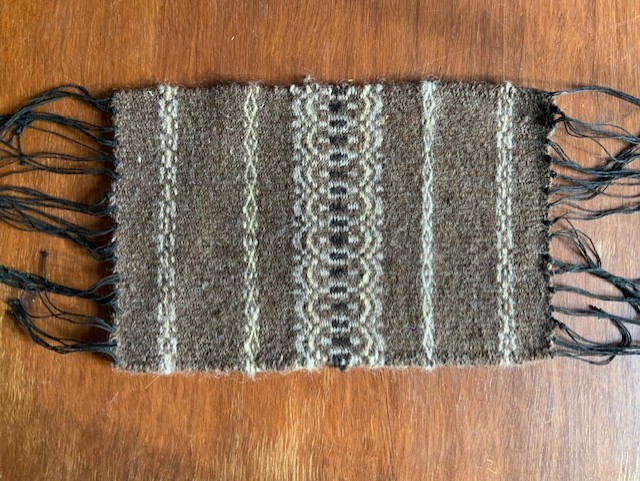
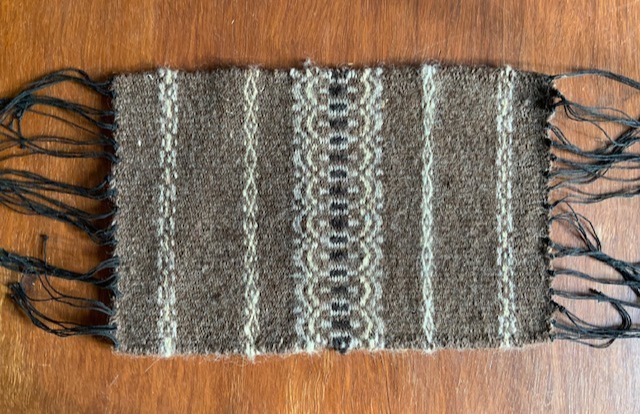
Nancy Ellison created the weaving above for an exhibit of the Flesberg Study Group in Decorah in October 2005. Nancy writes, “[This weaving] was in natural colors of brown, gray, and black yarn from Shetland and Icelandic sheep in my flock at the time.” She spun the white yarn from wool she purchased during a textile tour of Norway.
If you try your hand at the technique, tell us your story by September 30.
Emelie Röndahl ‘s self portrait. Photo by Robbie LaFleur
Members of the Scandinavian Weavers were honored to volunteer for a major exhibit by Swedish artist Emelie Röndahl at the American Swedish Institute (ASI) in Minneapolis. “Handwoven: Between Chaos and Order” is on view through June 7 in the historic Turnblad mansion.
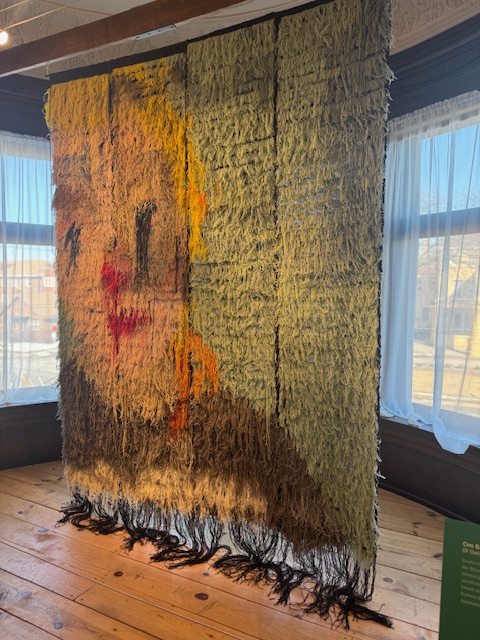
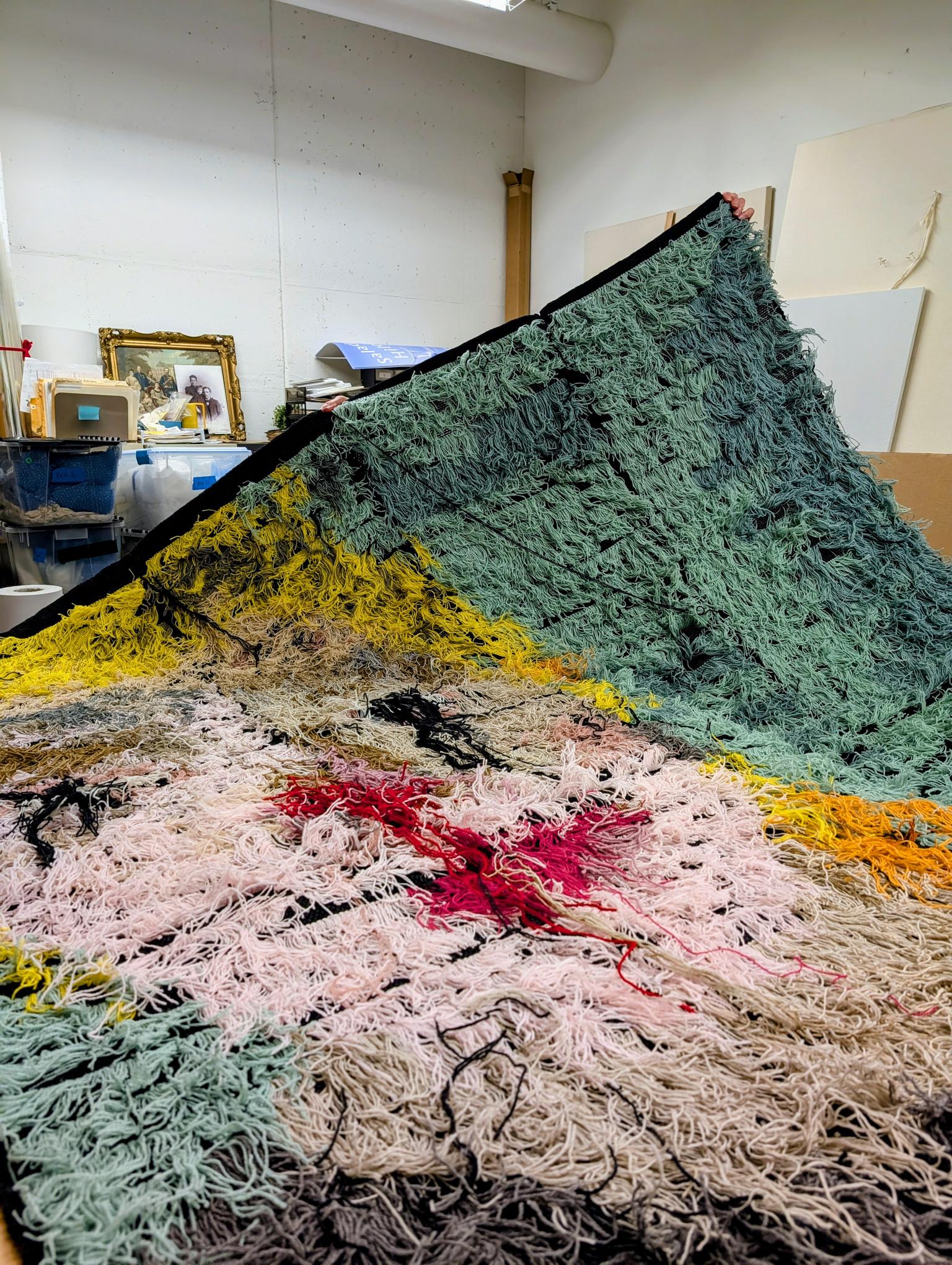
Emelie works in rya, a traditional pile weave once used for warmth. In Emelie’s vision, the humble rya become works of contemporary art, monumental in scale yet intimate in imagery.
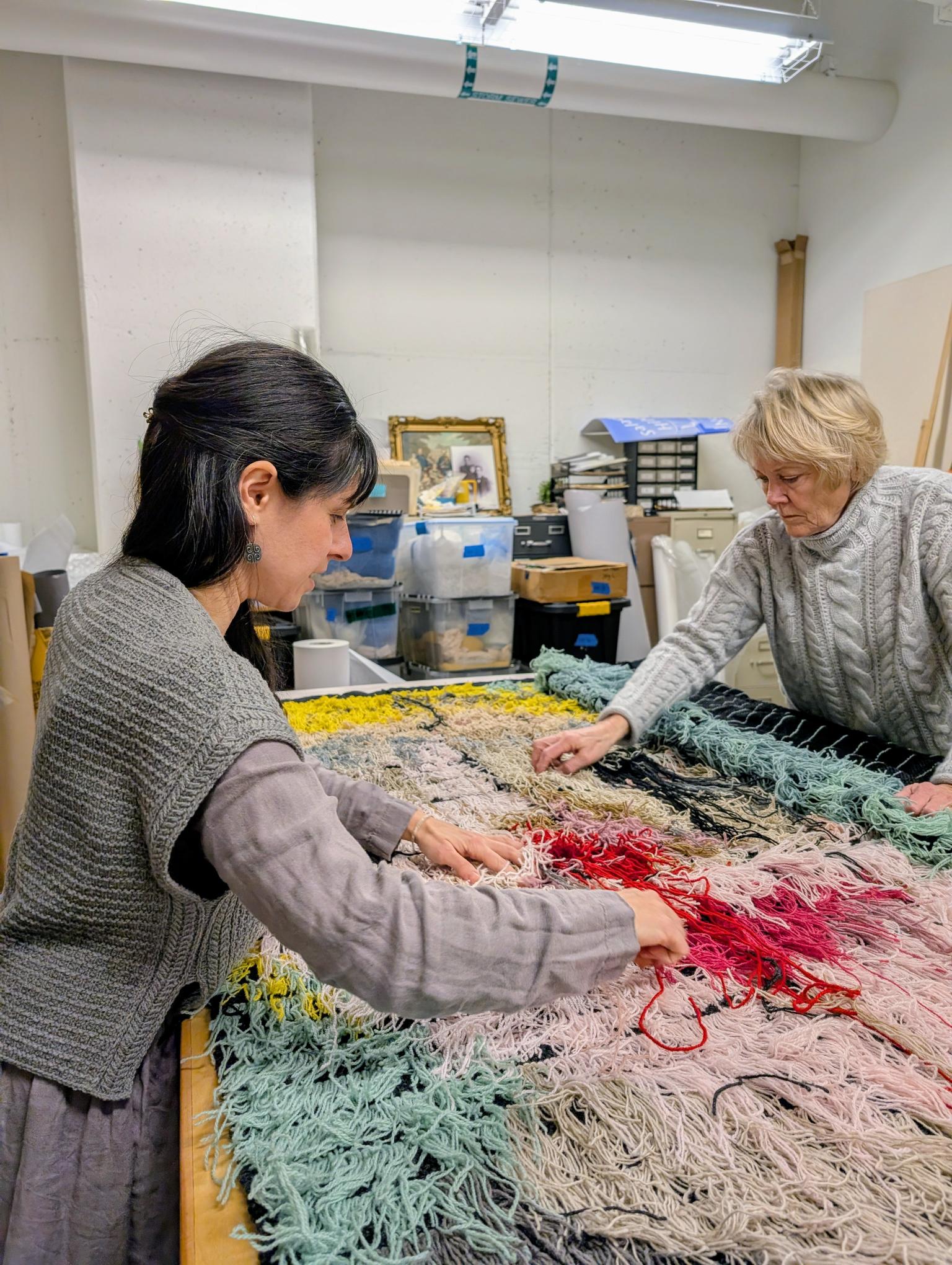
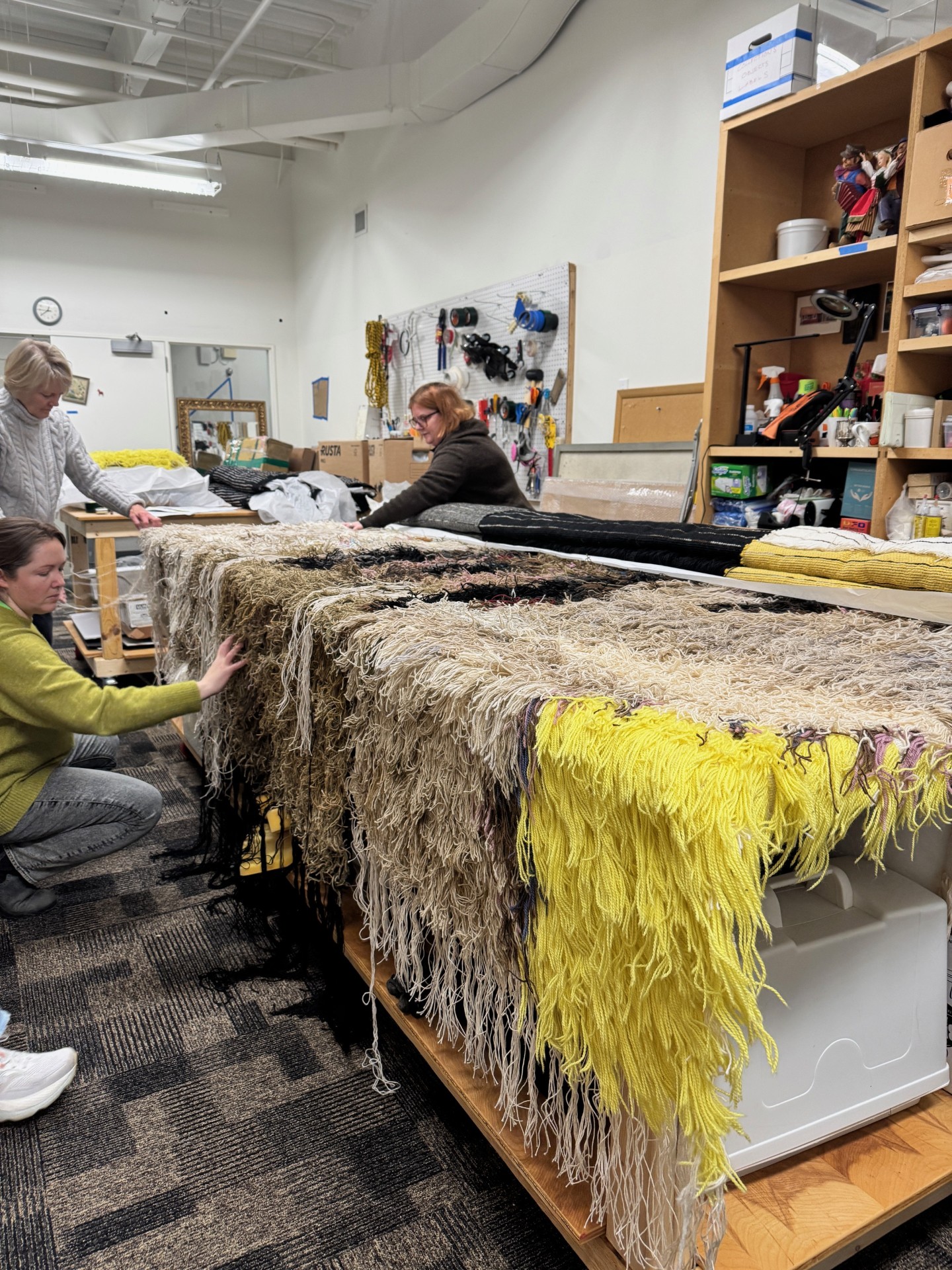
Several Scandinavian weavers were on hand to help un-box the massive textiles, which were shipped from Emelie’s studio in Sweden.
Photo by Lisa-Anne Bauch
The rya were carefully finger-combed to lift the pile. It was such a treat to sink our fingers into the luscious fibers!
Alla Hale and Patti Bartlett comb a rya. Photo by Lisa-Anne Bauch
While in lockdown during Covid, Emelie began weaving portraits of family members, including her beloved dog Maxim. Combing the fibers, we felt like we were petting his soft fur. Such a good boy!
ASI staff and volunteers. Photo by Alla Hale
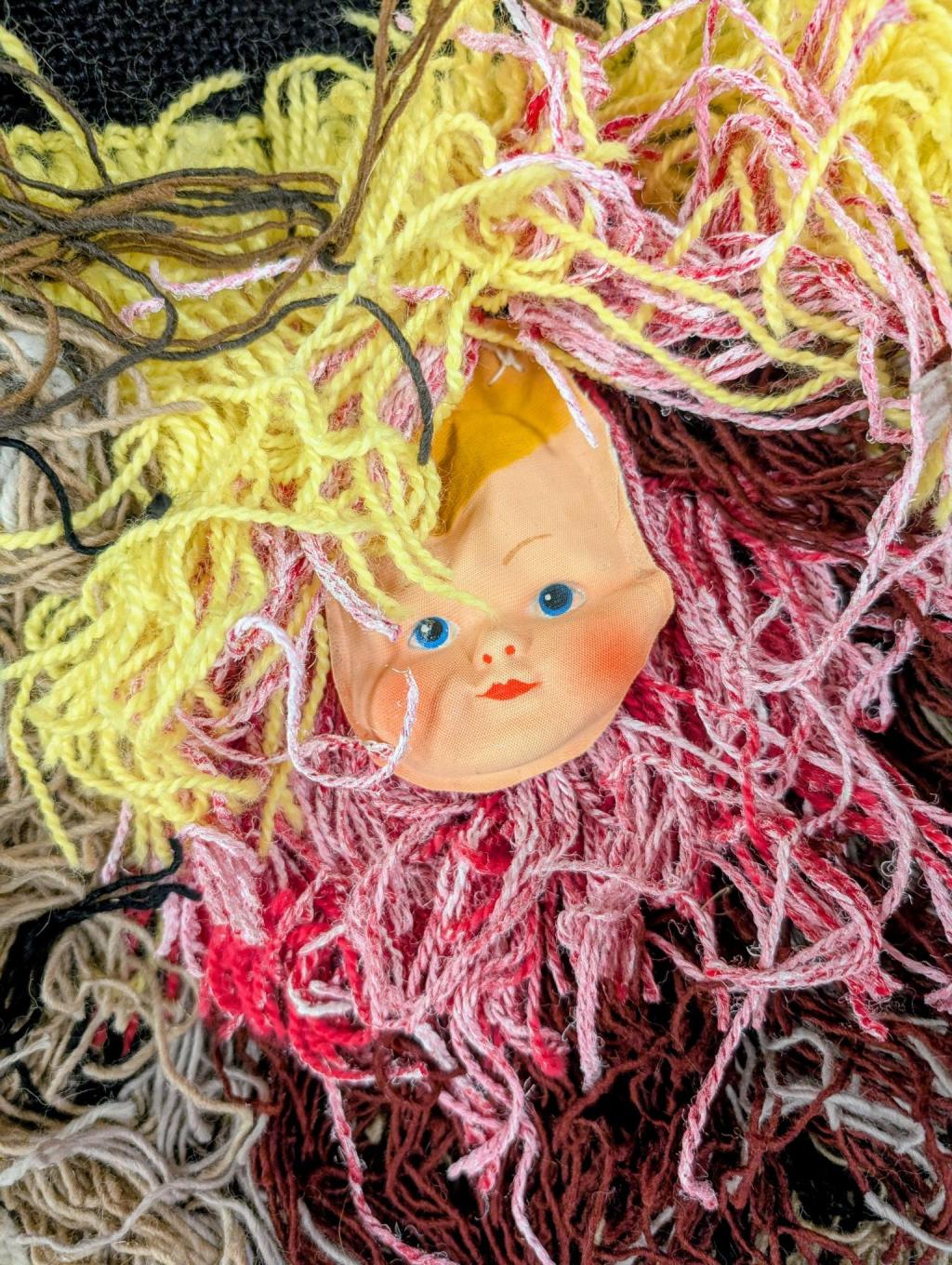
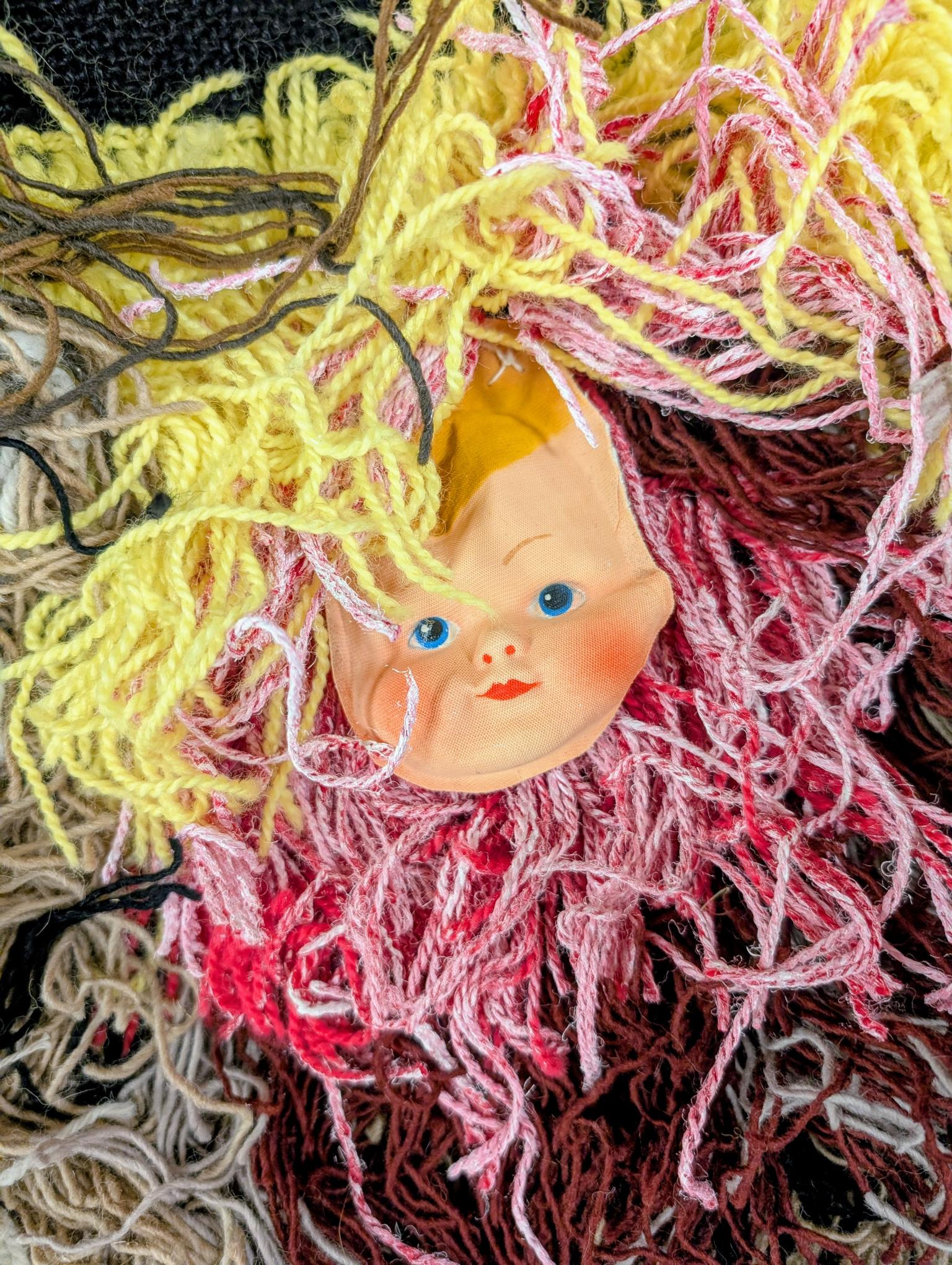
Emelie uses yarn of all fibers and sizes in her work. Up close, the viewer will find delightful details, including hidden braids, strands of tinsel, and other surprises.
Photo by Lisa-Anne Bauch
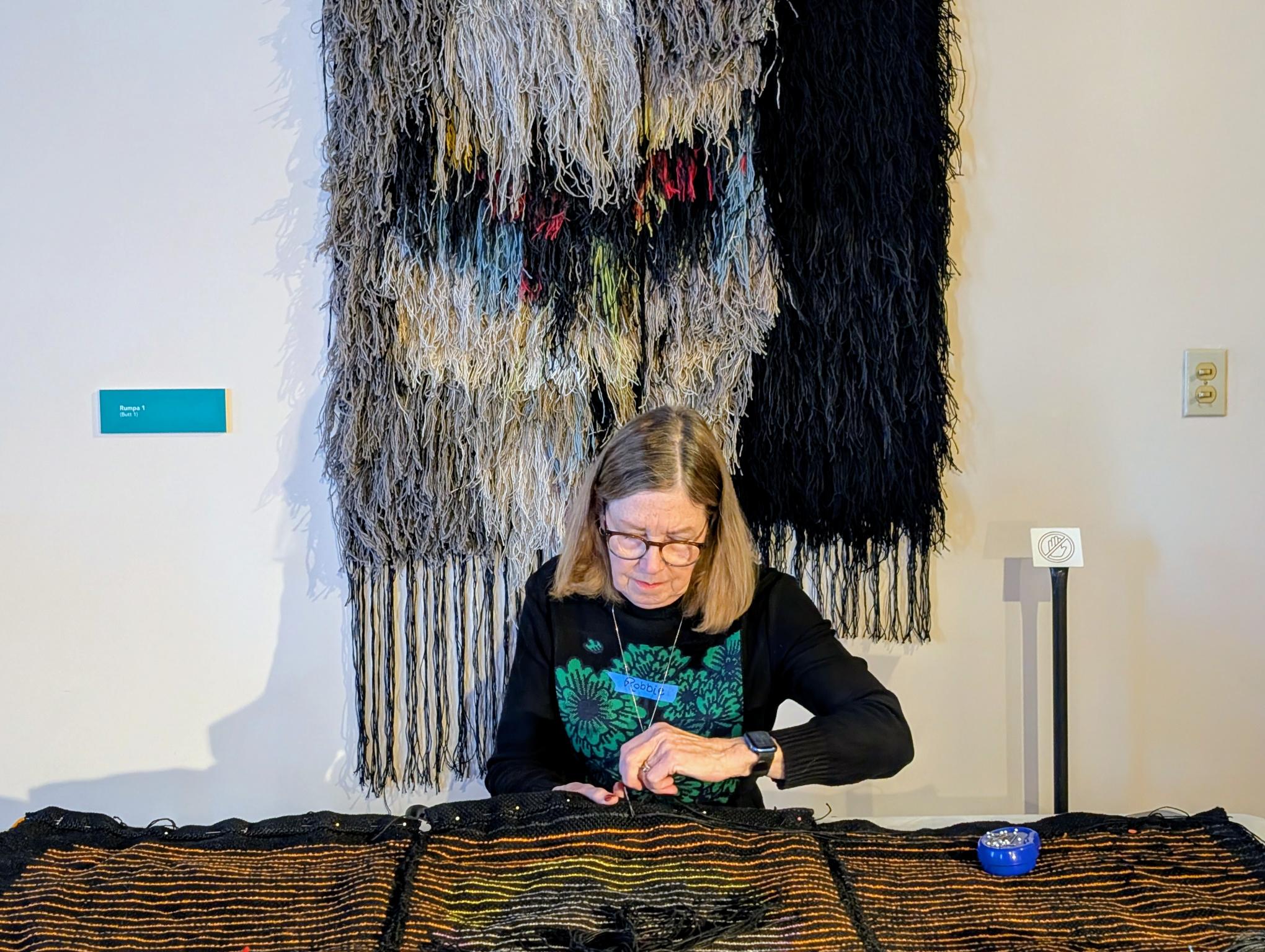
Emelie weaves her largest works in panels, which are then sewn together. Here, Robbie LaFleur lends a hand.
Photo by Lisa-Anne Bauch
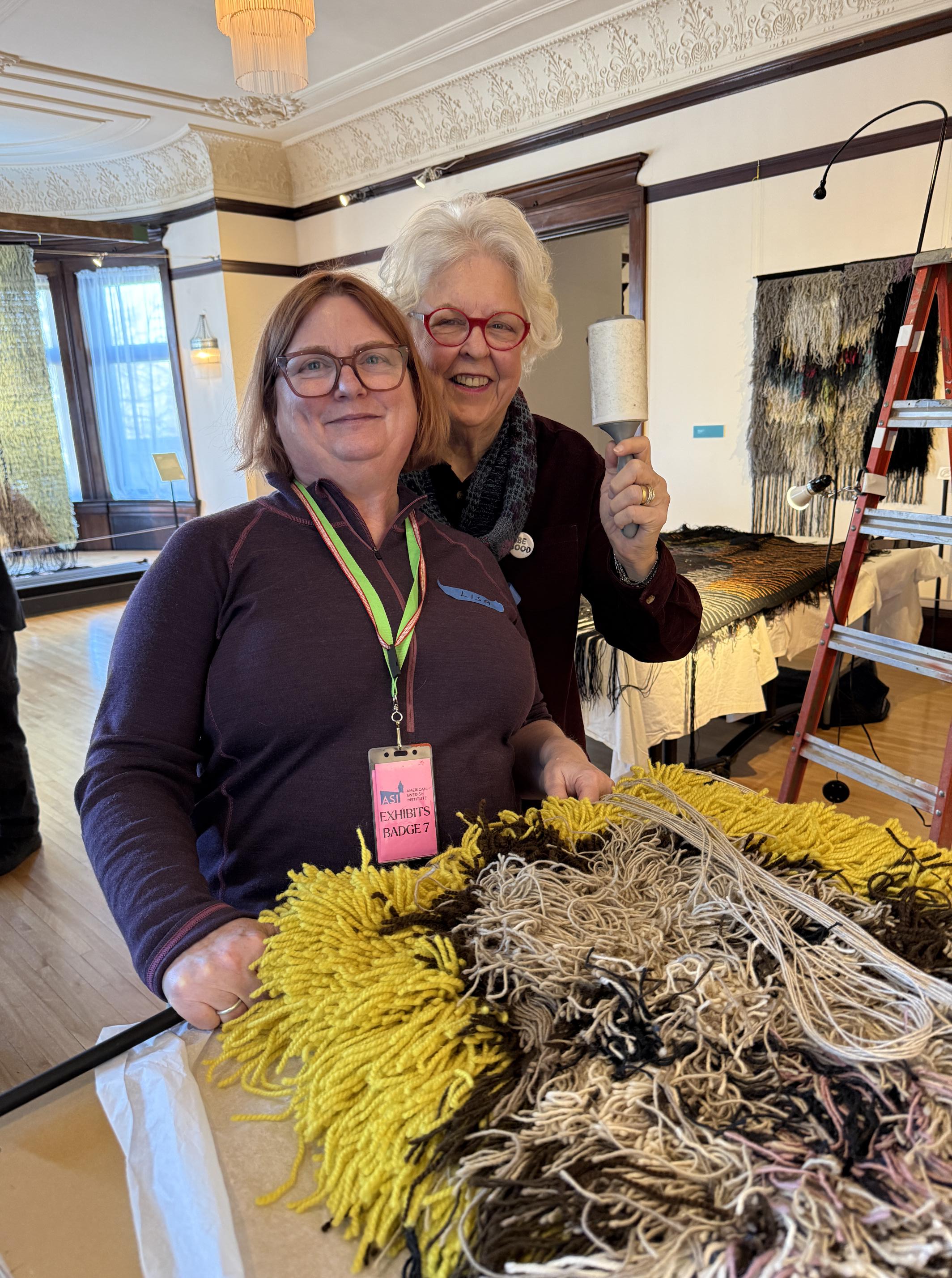
Because Emelie’s home is pet-friendly, a lint roller is used on the reverse side of the weaving to remove any stray hairs. Fortunately, Mary Skoy was on hand to tackle the job!
Photo by Robbie LaFleur
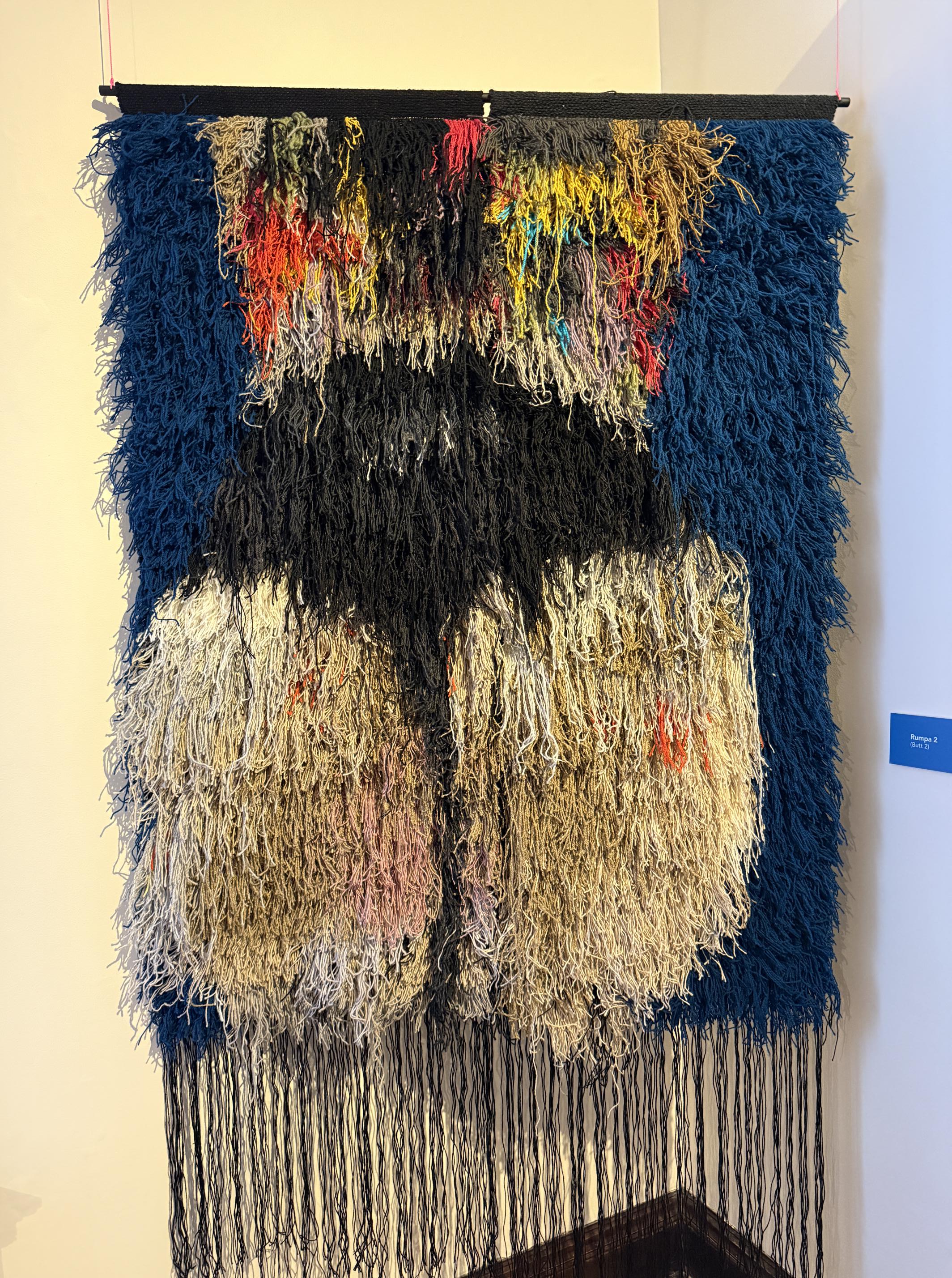
This weaving, called “Rumpa,” was one of our favorites.
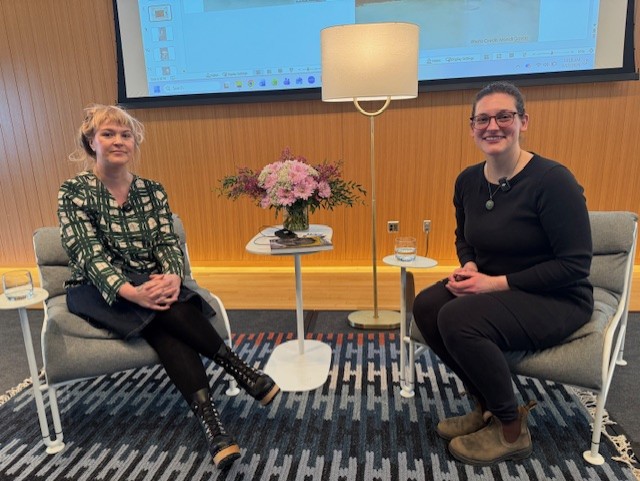
We were also honored to attend an artist’s talk with Emelie, in conversation with Betsy Konop, Executive Director of the Weavers Guild of Minnesota.
While weaving, Emelie works from a printed cartoon, usually a photo. But when it comes to choosing the individual strands of yarn, Emelie’s weaving process is intuitive. Once a piece is removed from the loom, she does not trim the pile or otherwise alter the weaving. She intentionally lets the longer strings hang, so they appear to be “crying,” expressing the emotion of the image.
Emelie Röndahl and Betsy Konop. Photo by Mary Skoy
Rather than relegating rya and other traditional weavings to the past, Emelie feels they still speak to us today. Her exhibit stands as testament to the contemporary possibilities of this ancient technique.
And where would Emelie like to visit while in Minneapolis? The Prince museum at Paisley Park, of course!
The next group warp for the Scandinavian Weavers will be Flesberg technique.
Flesberg is a style of three-shaft boundweave, named for the Flesberg area of Norway where it is popular. (See link below for more information.) In Sweden it might be referred to as treskaft or bound Rosepath. The technique allows the weaver to create curved motifs.
Several members of our group have woven Flesberg, including Nancy Ellison.
Weaving and photo by Nancy Ellison
“This was my weaving that I did for the Exhibit of the Flesberg Study Group in Decorah in October 2005,” she writes. “It was in natural colors of brown, gray, and black yarn from Shetland and Icelandic sheep in my flock a the time.” Nancy spun the white yarn from wool she purchased during a textile tour of Norway.
Weaving and photo by Nancy Ellison
Nancy also wove the above sampler in a class she took from Katharine Dickerson at Vesterheim Norwegian-American Museum. “After weaving with the black, gray, and white yarn and drafts supplied in the class we were encouraged to try something on our own, so I wove a row of red covered bridges with blue sky and green grass as the covered bridge at Zumbrota, Minnesota is a local tourist attraction here.”
Weaving and photo by Robbie LaFleur
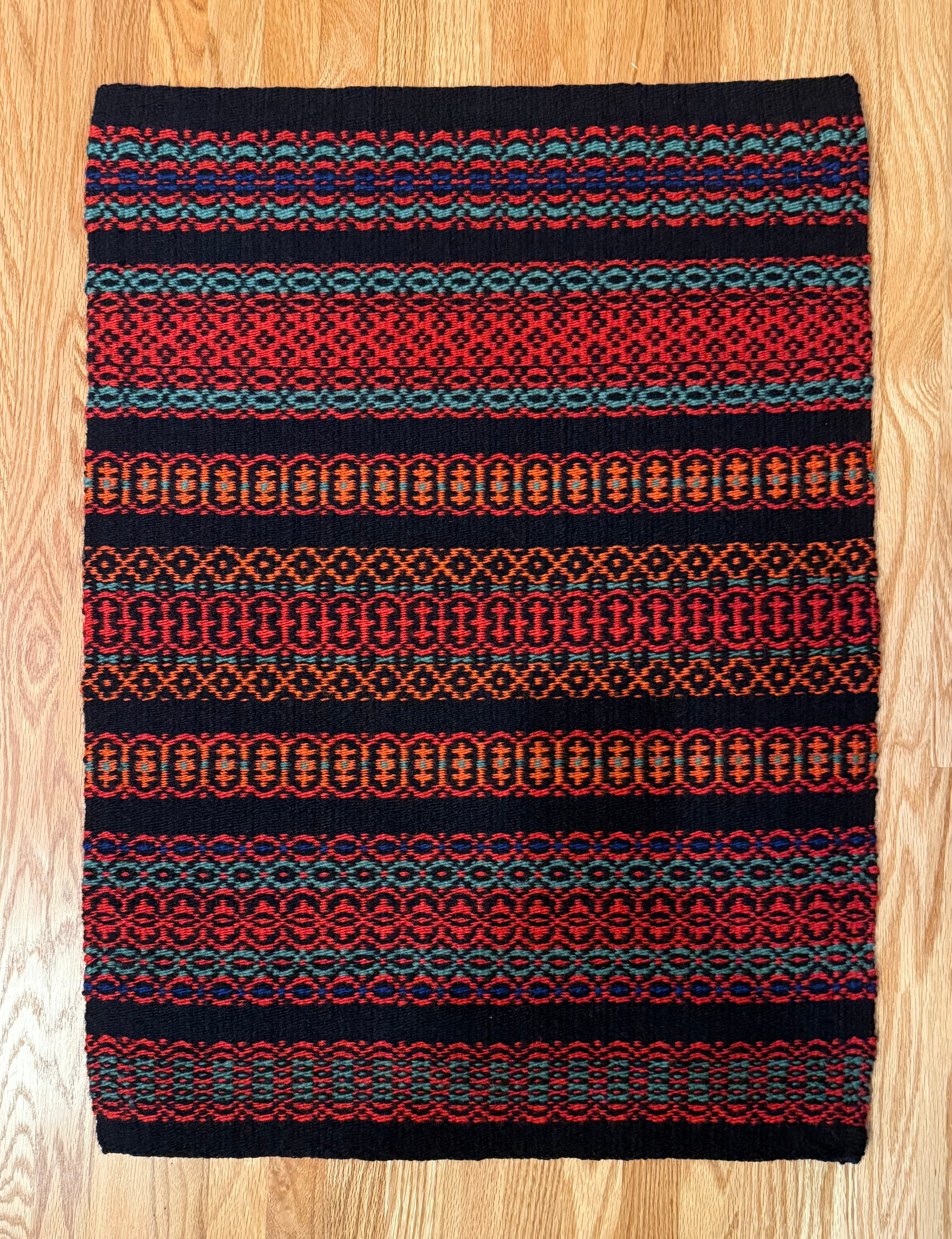
Robbie LaFleur has woven Flesberg rugs, such as the one above, using seine twine as warp and Prydvev yarn as weft, both single- and double-ply.
A close-up of curved motifs. Weaving and photo by Robbie LaFleur
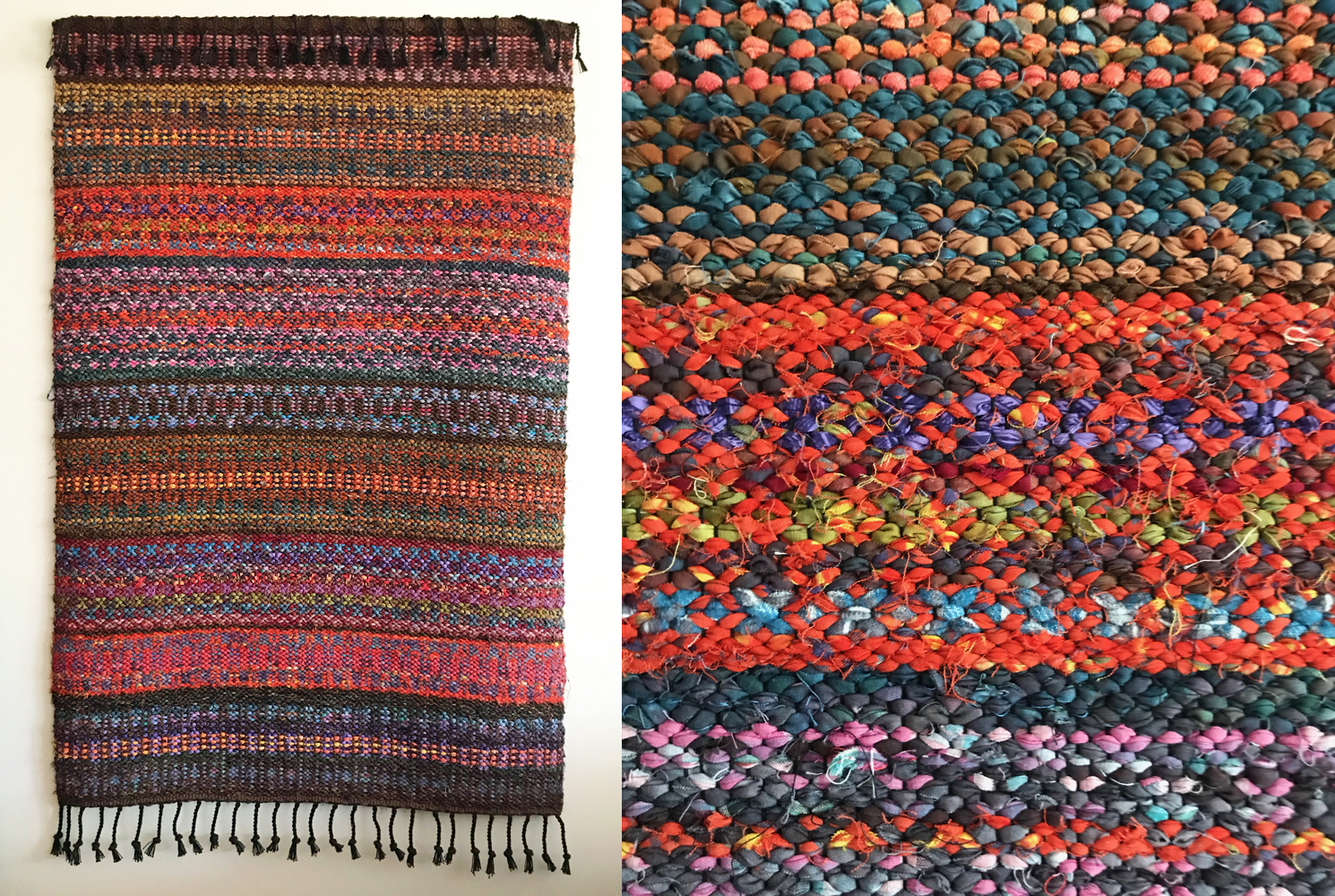
Robbie has also woven Flesberg using strips of fabric as weft, as in the wall hanging below. It is her favorite piece in the technique.
Weaving and photo by Robbie LaFleur
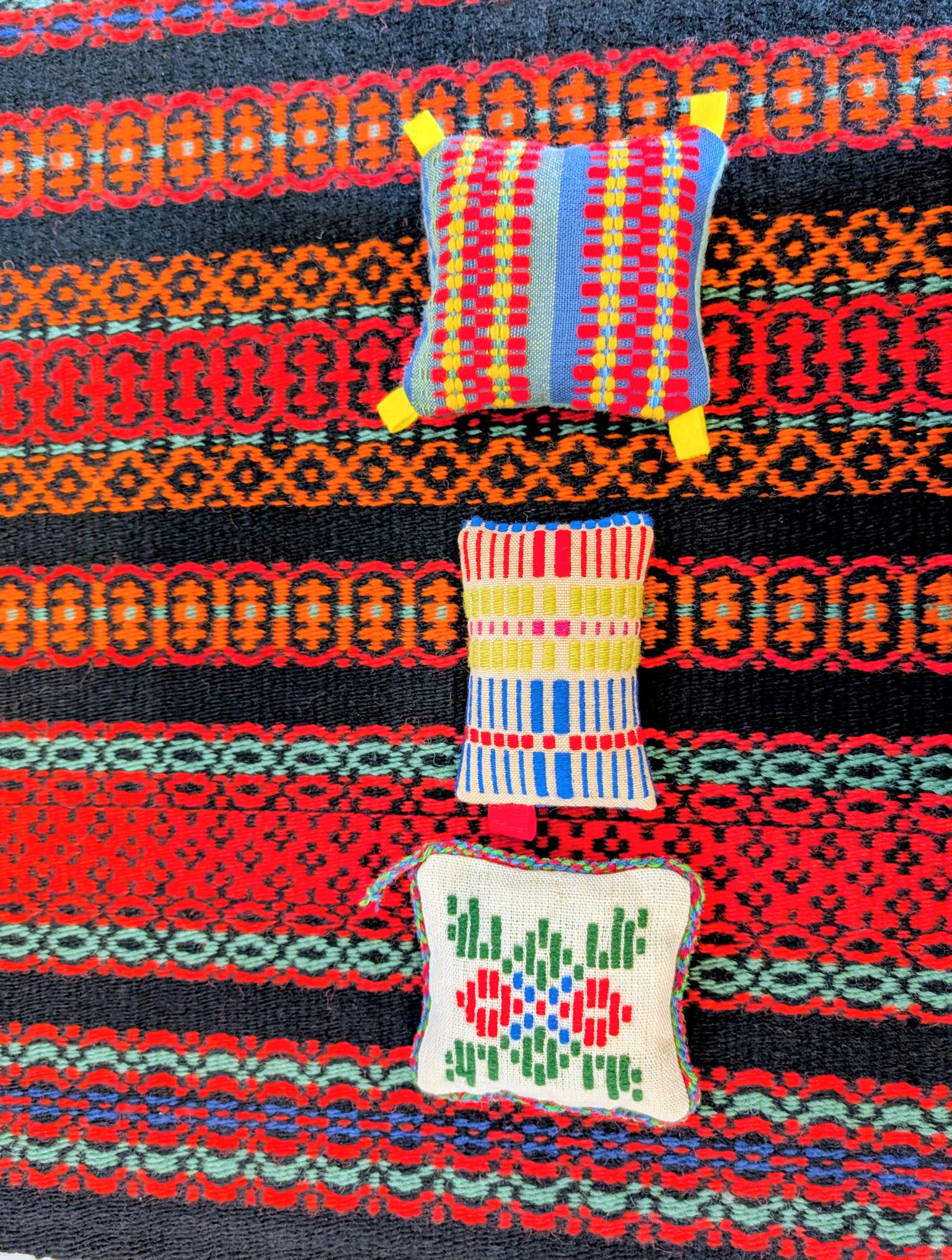
Nancy Ebner wove the Flesberg wall hanging below, using instructions from the Norwegian Textile Letter, which devoted an issue to the technique in November, 2020. Nancy’s weaving is shown with her samplers of Swedish art weaves, which she cleverly made into pin cushions.
Weaving by Nancy Ebner
Those who have woven Flesberg say it is fun to weave but note that it is a slow technique, requiring patience and concentration. An inch of weaving per hour is a reasonable rate!
Given that information, we expect our Flesberg project to be on the loom at the Weavers Guild of Minnesota throughout 2026. In the coming weeks we will share project notes if you would like to weave along at home!
Fortunately, creativity is flourishing among the Scandinavian Weavers!
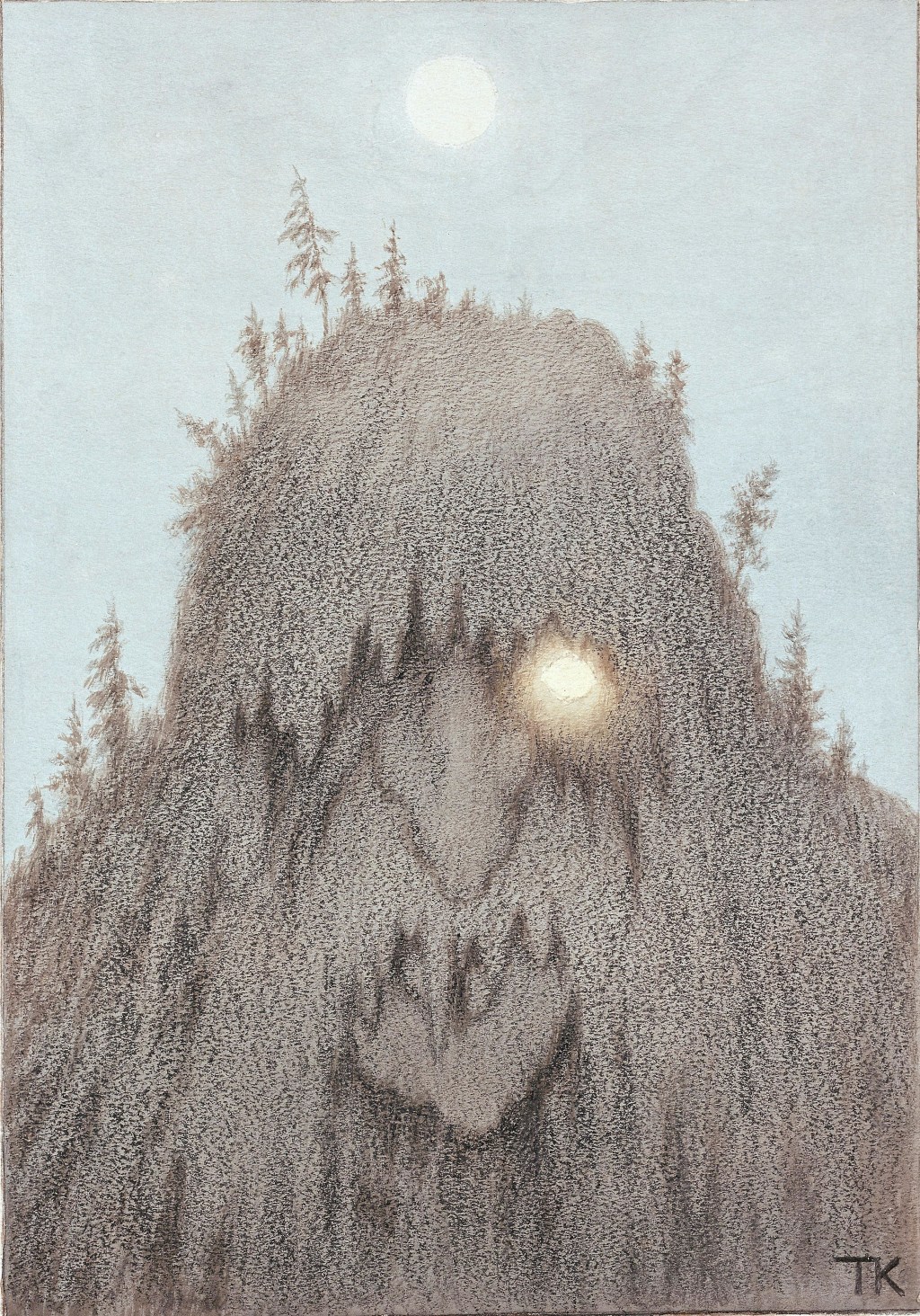
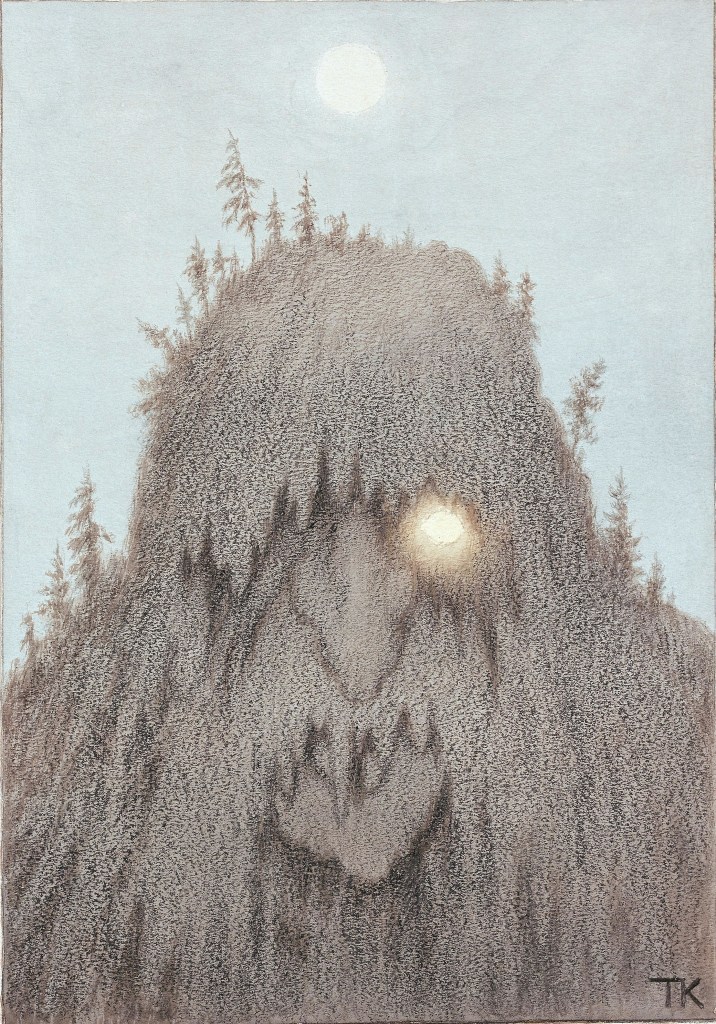
Alla Hale was inspired by Theodor Kittelsen’s image of the “Skog Troll” or Forest Troll. Kittelssen (1857–1914) is one of Norway’s most famous artists, known for his paintings of nature as well his illustrations of Norwegian folklore. We are grateful to Norway’s Nasjonalmuseet for the free use of the above image. (See link below.)
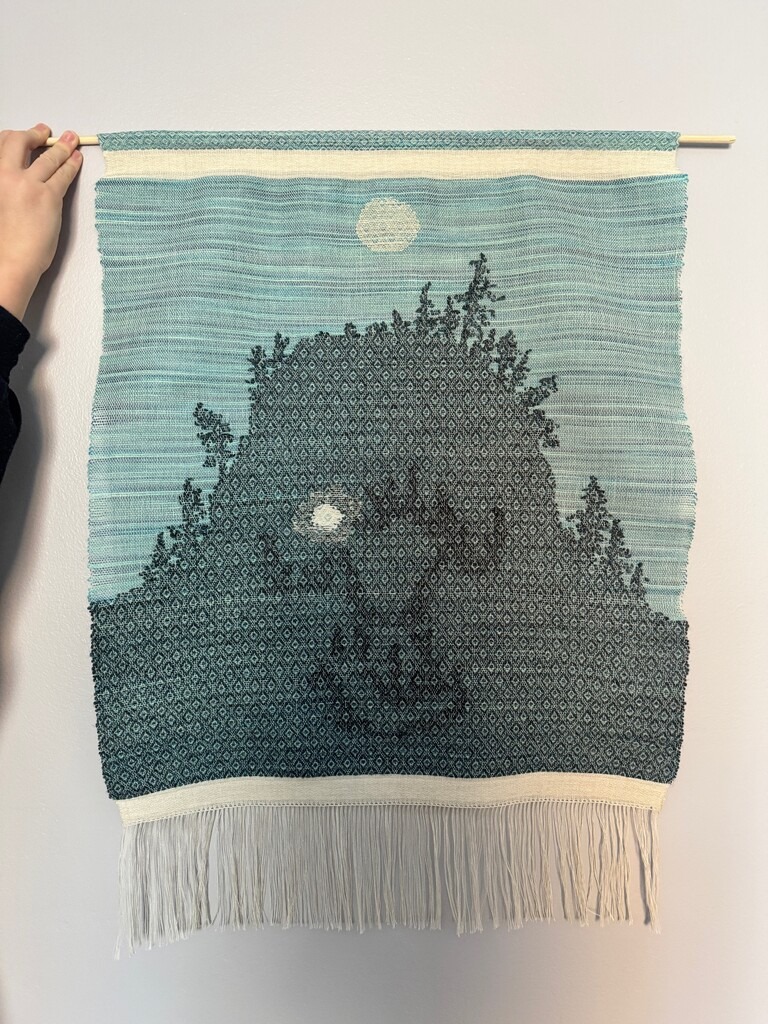
Weaving and photo by Alla Hale
Alla wove this piece as part of a series of eight, starting with six silhouettes of family members. Her warp is a very fine cotton threaded at 24 EPI. (She notes that the photo above is of the unfinished weaving fresh off the loom, rather than a “glamour shot.”)
Alla writes, “You’ll notice [my weaving] is a mirror image- I pin the reference cartoon to the work, but printed on an inkjet printer, and it was rubbing off on the work, so all my pieces became mirror images.”
“Background weft is a laceweight hand dyed merino wool. The troll is a Briggs & Little sport weight Canadian wool. The moon, eye, and shading is accomplished with an inlay of various remnant wool and alpaca, mostly fingering and lace weight.”
Weaving and photo by Alla Hale
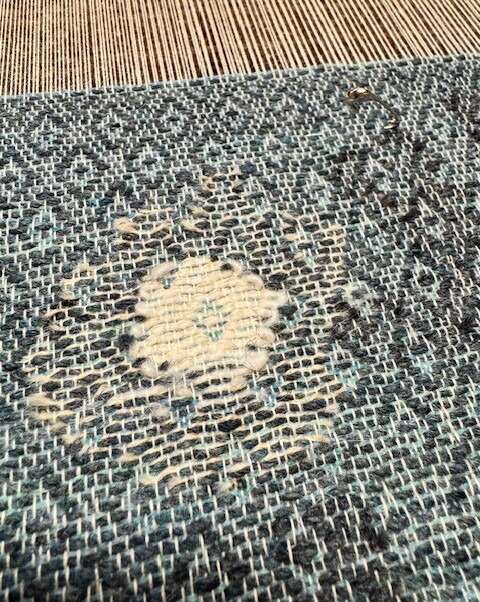
“I will share that I felt very unsure about weaving this,” Alla writes, “worried that I wasn’t doing the painting justice, until I got to his eye and saw how the overshot pattern lined up just so in the eyeball. This made me cackle with delight.” (Somewhere, the Trolls are cackling, too.)
Weaving and photo by Alla Hale
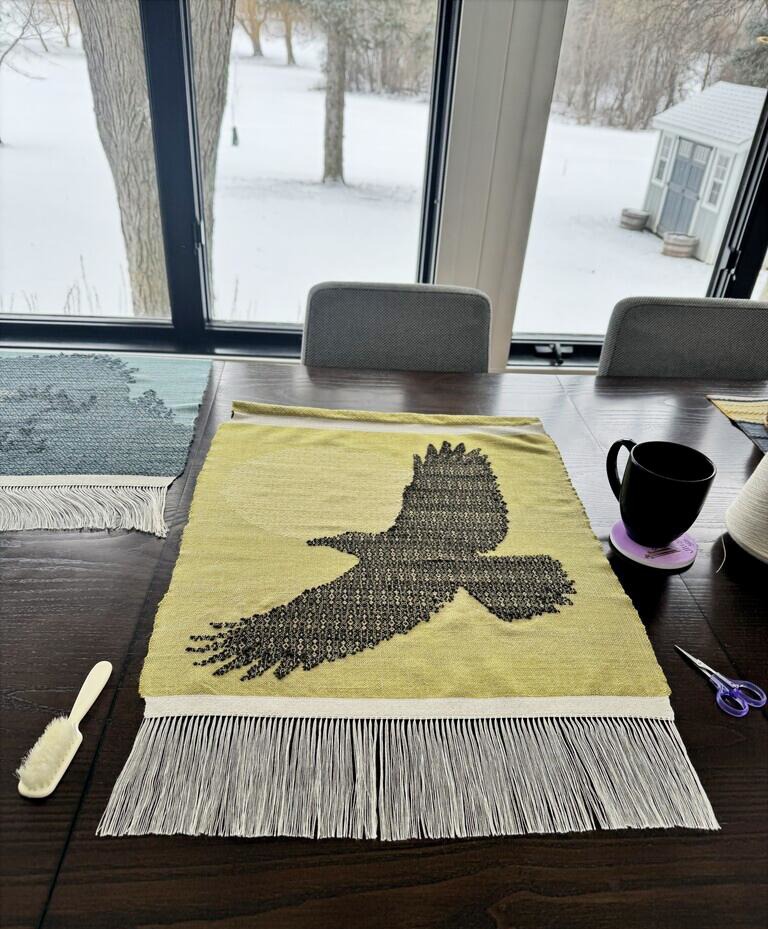
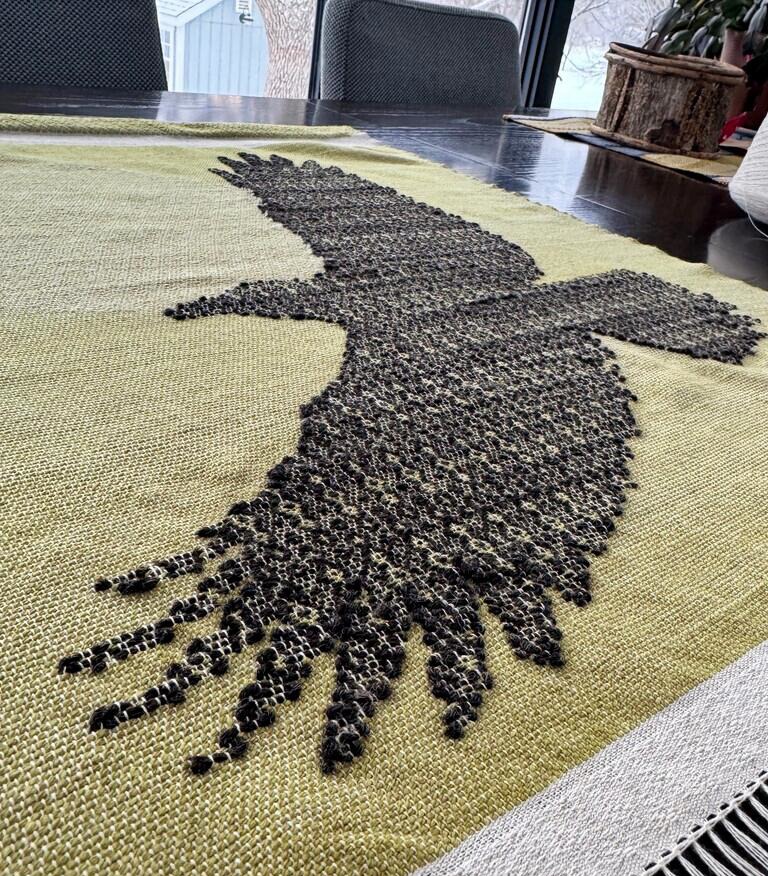
Alla’s eighth weaving in her series was a raven. “The raven was a request by a friend building a cabin up in Northern California,” she writes. “The raven is a cheviot spun at Badgerface Fiber, Minnesota’s first solar powered yarn mill.” (See link below)
Weaving and photo by Alla Hale.
“The moon is woven in a laceweight alpaca. The background is woven with a fingering weight merino wool that I dyed with red onion skins. Weaving this one was very challenging since I had to keep track of the moon [and] raven treadlings separately. What a brain workout for this baby weaver.”
Needless to say, all the weavers in our group were impressed!
Weaving and photo by Lori Labs
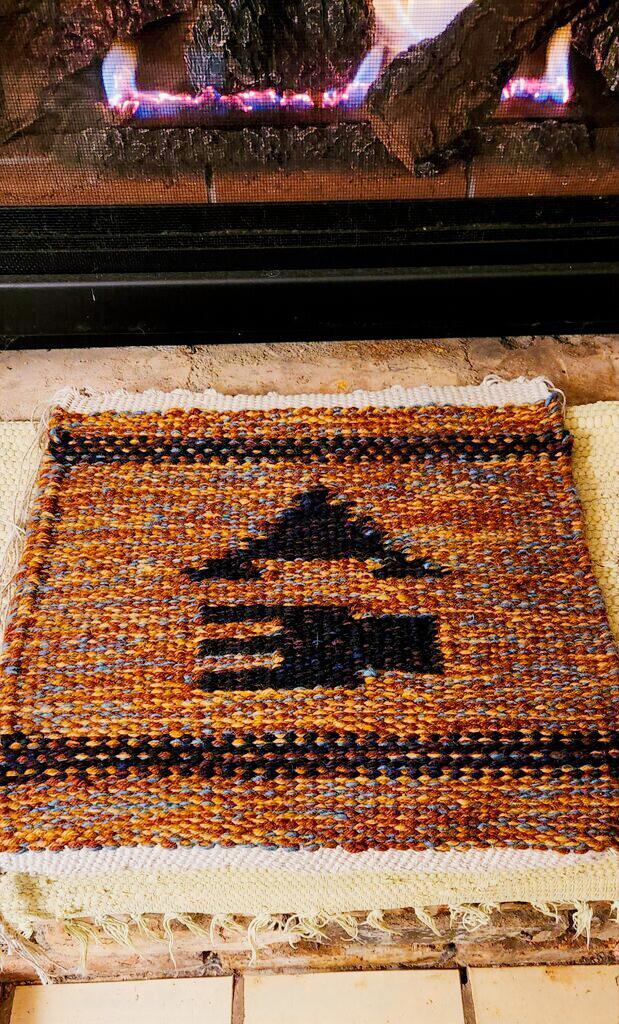
Above is Lori Lab’s Rölakan weaving, which she is in the process of finishing. Lori wove the piece in a class by Christine Novotny at North House Folk School. The weft yarn is Swedish Mattgarn. Five strands per pick allows for for color blending. The woven motifs were inspired by Lori’s travels in Morocco. With the colors echoing the flames above, Lori’s weaving seems to have found an appropriately cozy home by the fireplace.
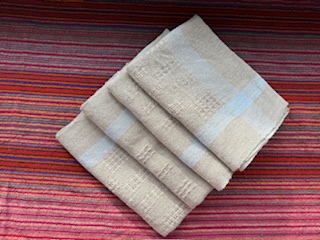
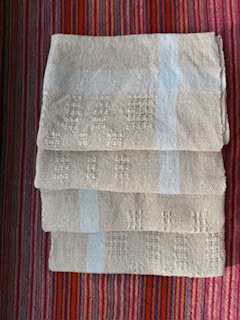
Equally cozy are Nancy Ebner’s lovely hand towels, woven in 16/2 linen that echoes the colors of the winter landscape. Nancy chose her favorite treadlings in a Bronson lace pattern from Halcyon Yarn in Maine, a state that is enduring an equally icy winter.
Look for more winter weavings in Part Two, including Norwegian pick-up bandweaving, the very last of the skillbragd warp, and the beginning our next group warp in Flesberg technique. Plus, a surprise gift lends hints of spring in Swedish linen!
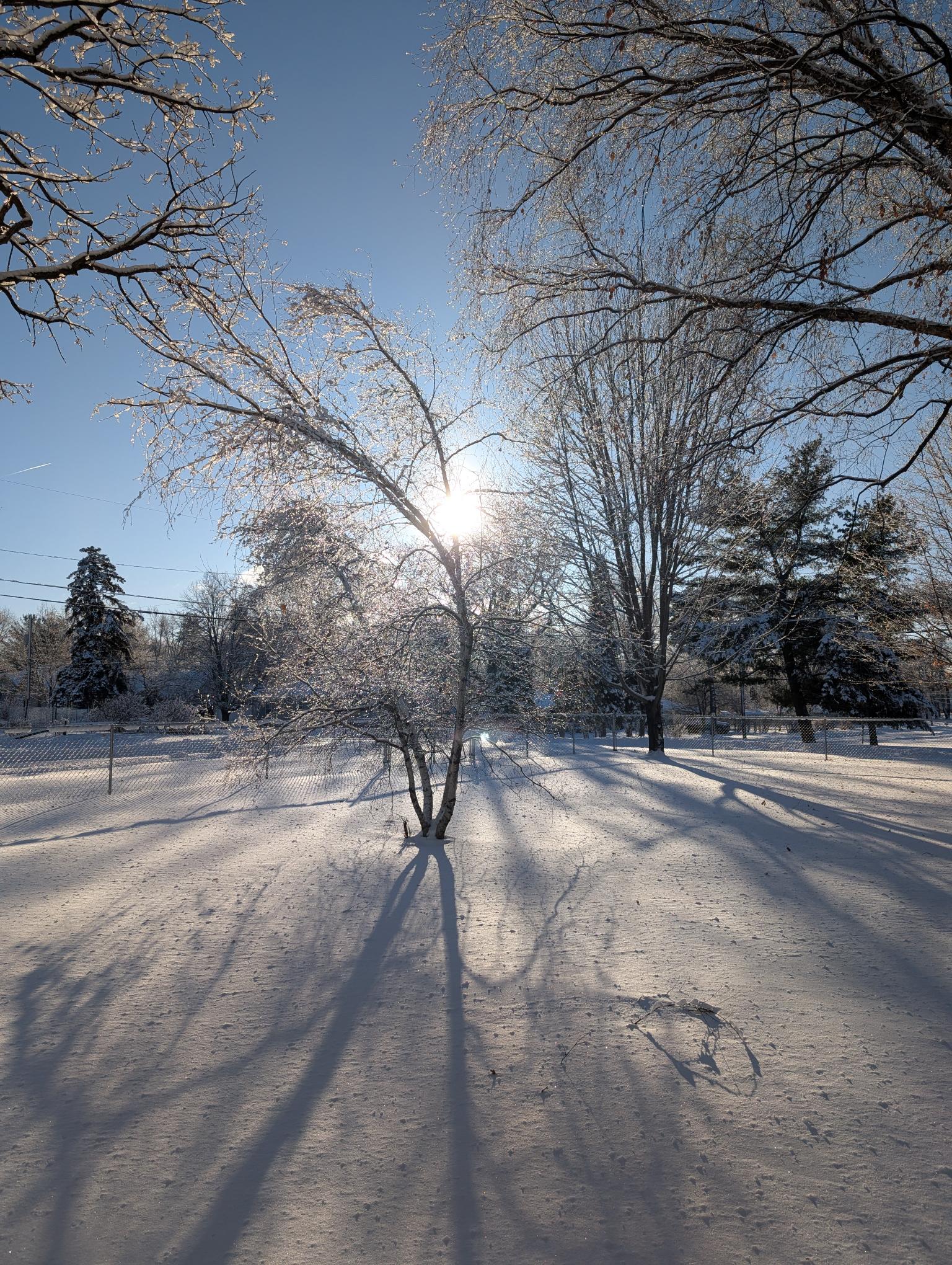
There is an icy wind blowing here in Minnesota, and we wonder if spring will ever come. But our hearts are warm as our community remains strong.
A beautiful loom bench at the Weavers Guild.
On a snowy morning, members of our Guild gathered as usual for spinning, dyeing, and weaving. Coffee and conversation flowed freely.
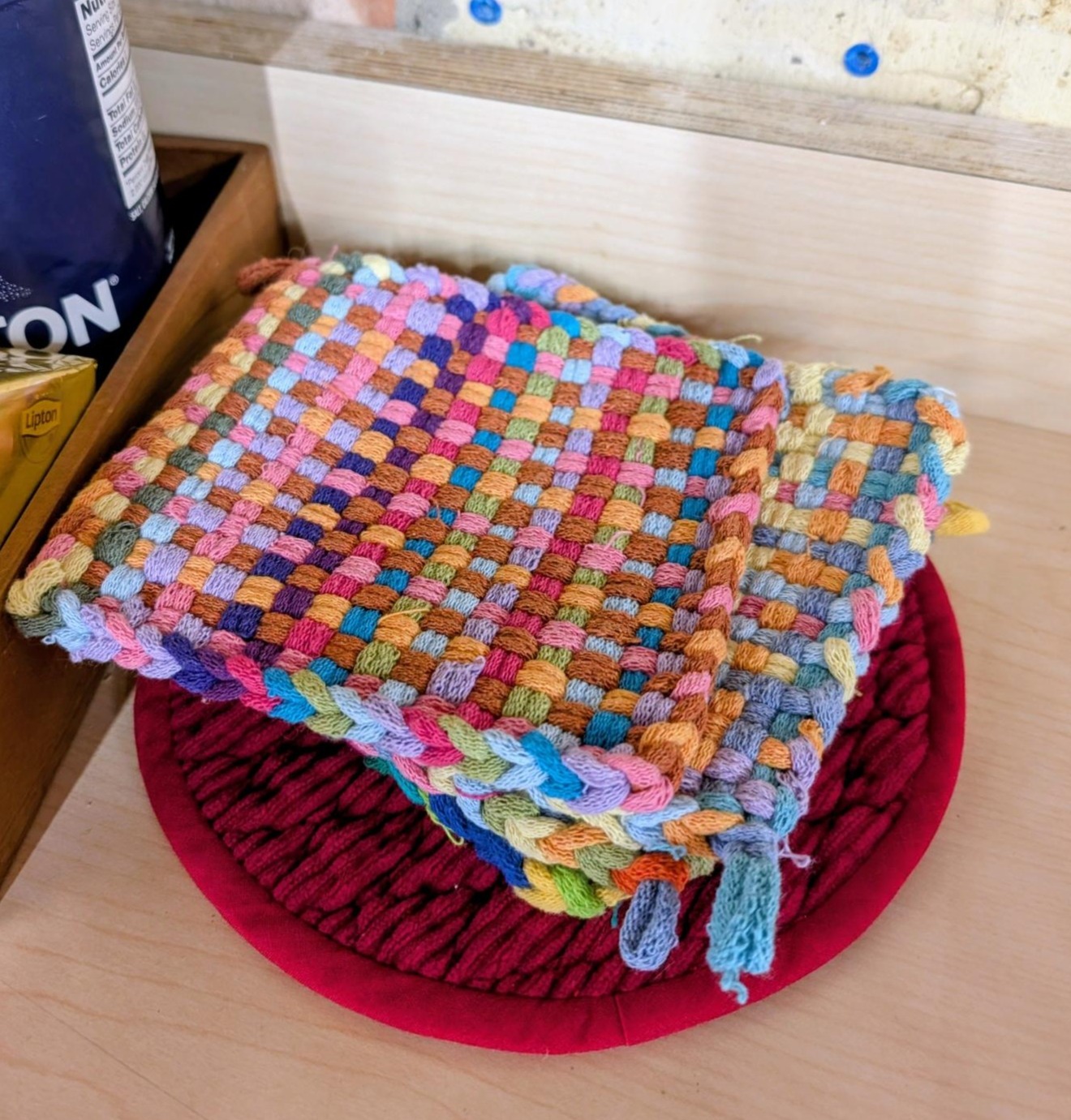
Many of us did our first weaving as children making pot holders. They hold pride of place in our communal kitchen.Every towel in our kitchen is handwoven, showing the beauty of everyday objects.
For as long as humans have been around, we have practiced the ancient arts of spinning, dyeing, weaving, and sewing, creating objects of beauty and usefulness with our hands.
The weaving continues in a rainbow of colors.
Older generations mentor younger ones, who bring their own genius to bear on age-old challenges. The work goes on and will continue long after we’re gone.
Old and new technologies work together.
Sharing our joys and struggles together creates community, and community sustains us. Our differences are not a weakness to be overcome but a strength to be shared, in good times and in bad.
For in the end, we know that spring always follows winter. In the end, the ice will melt, but we will remain.
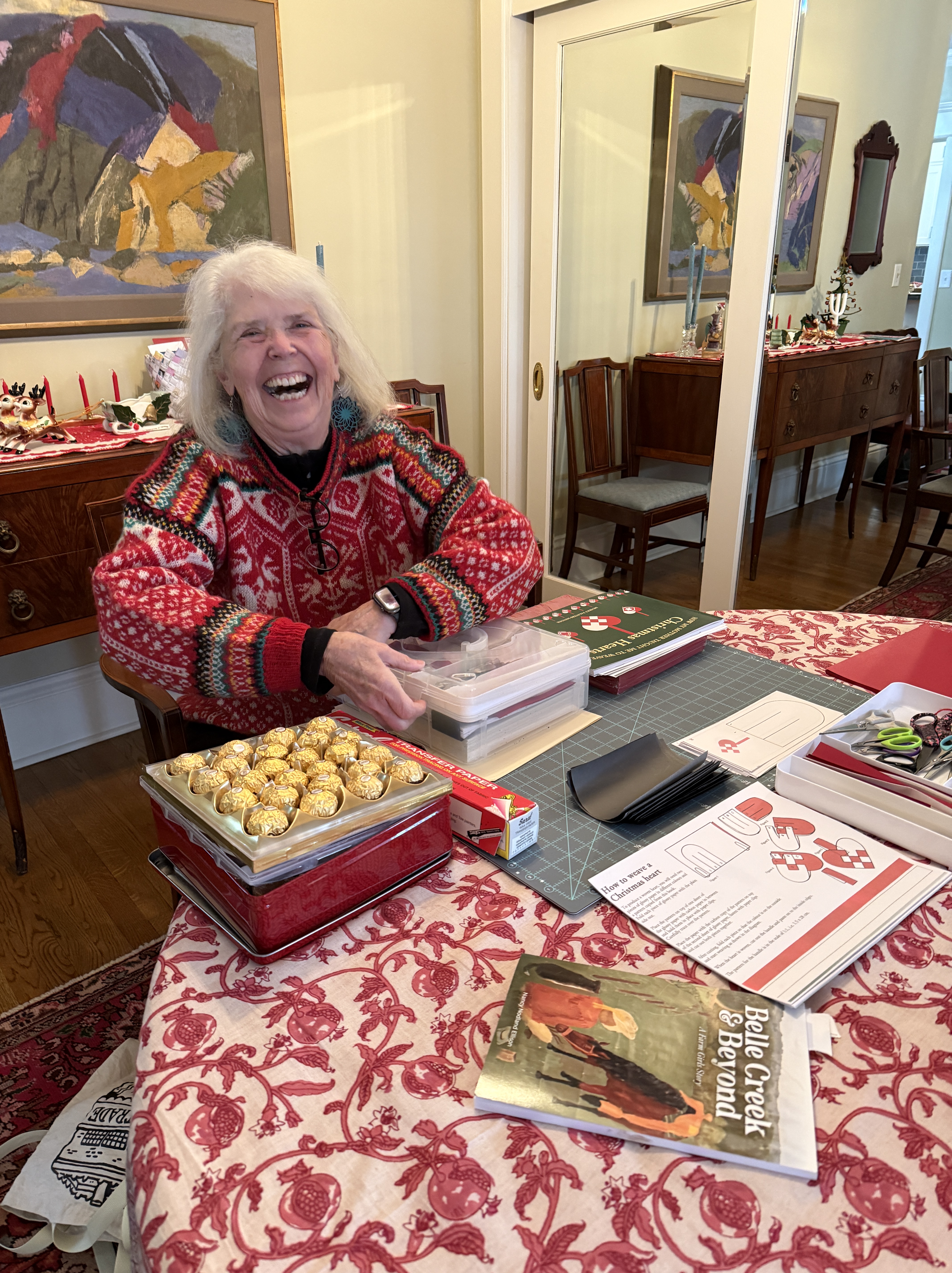
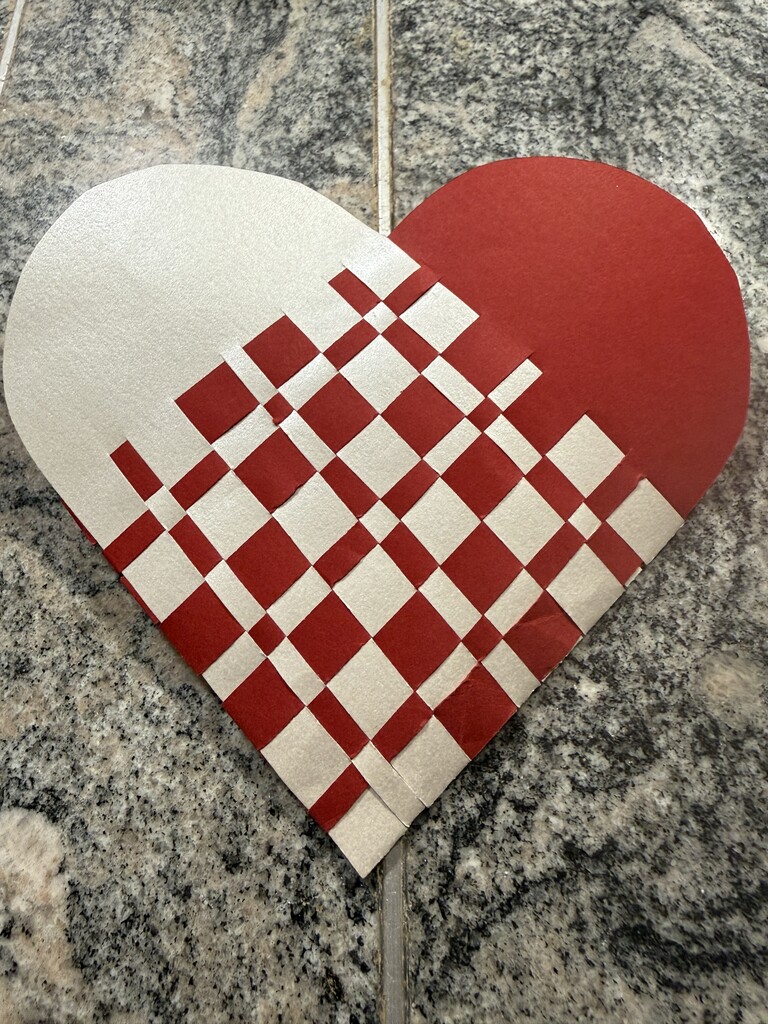
Peg Hansen, Scandinavian Weavers Study Group member and a former art teacher, guided our party activity. She supplied strong, beautiful paper, detailed instructions, and enormous enthusiasm.
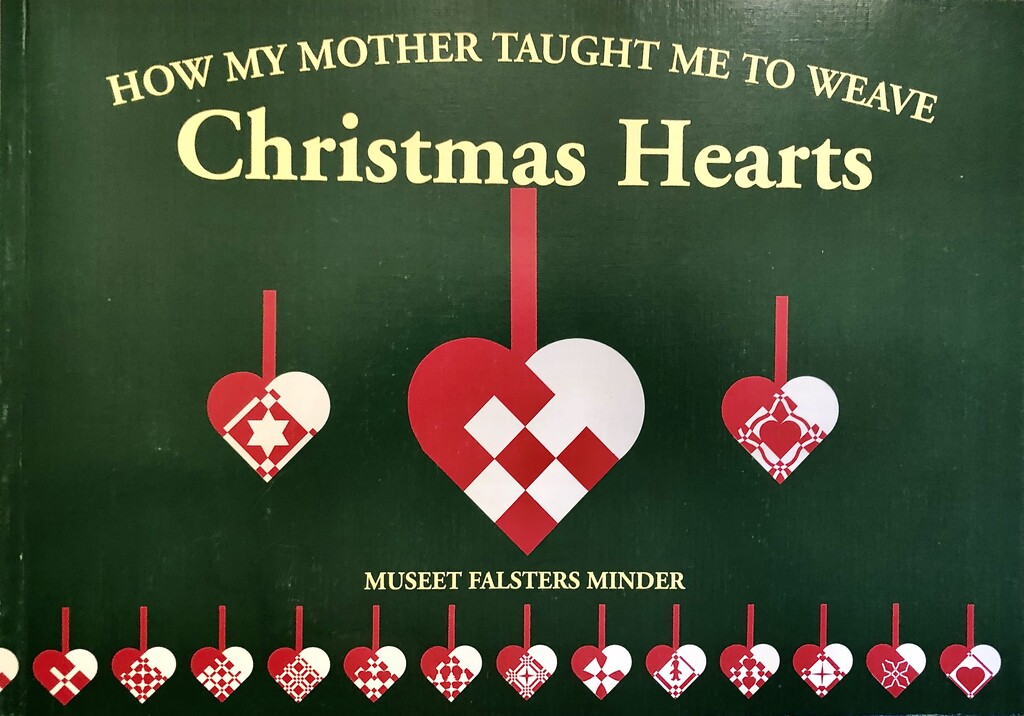
Peg also ordered a book with many advanced designs, How My Mother Taught Me to Weave Christmas Hearts, with patterns by Knud Vaegter.
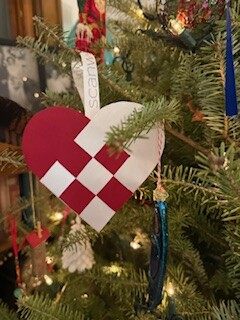
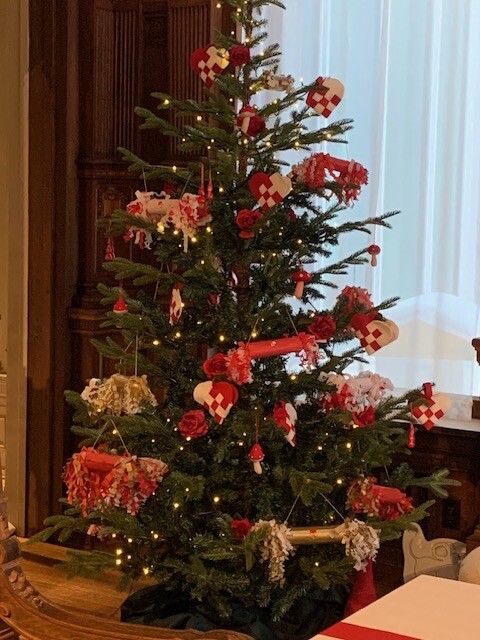
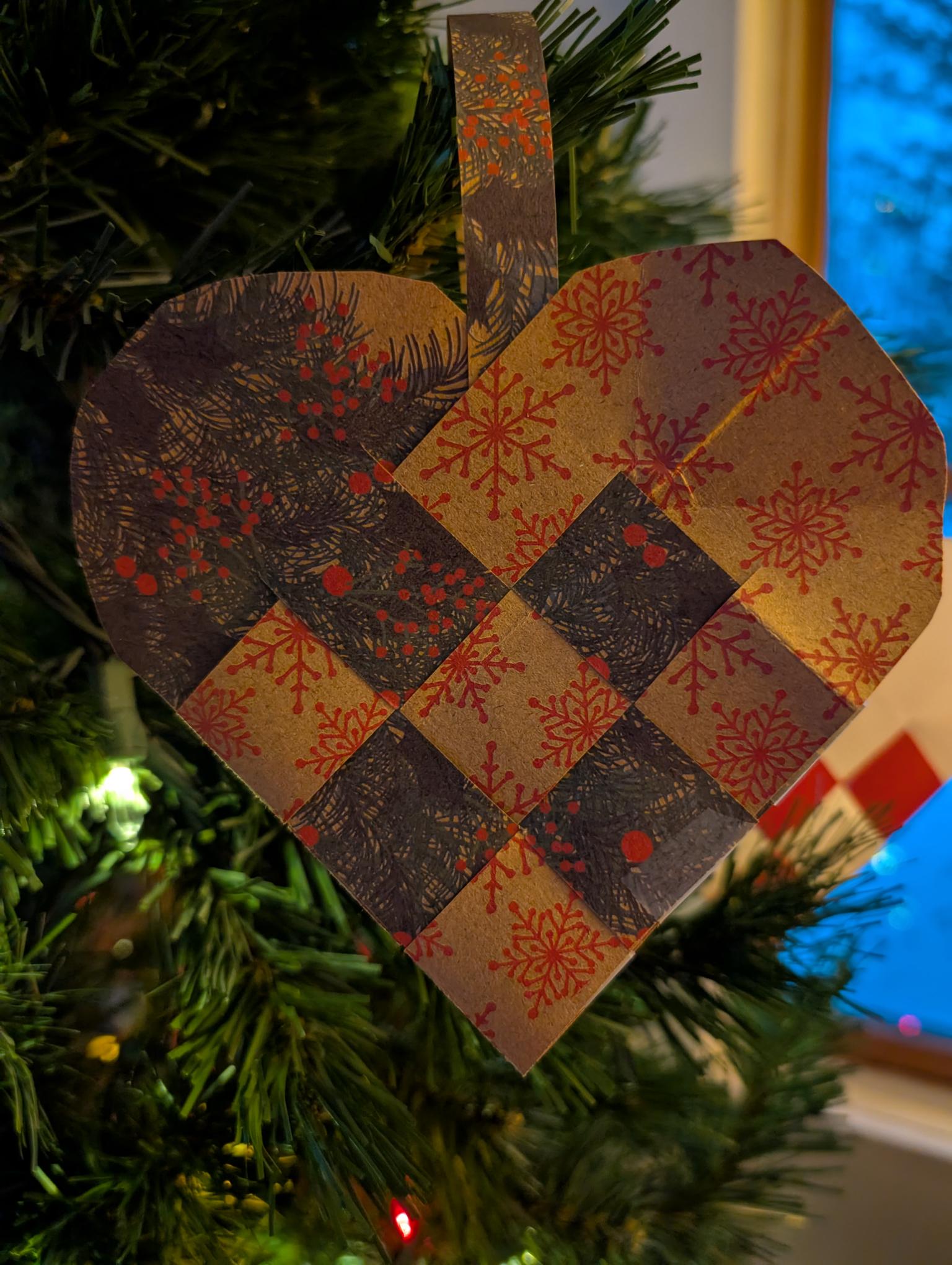
The paper hearts are traditionally filled with candy and hung as festive ornaments on the Christmas tree, as in the photo below from the American Swedish Institute in Minneapolis.
Photo by Jan Mostrom.
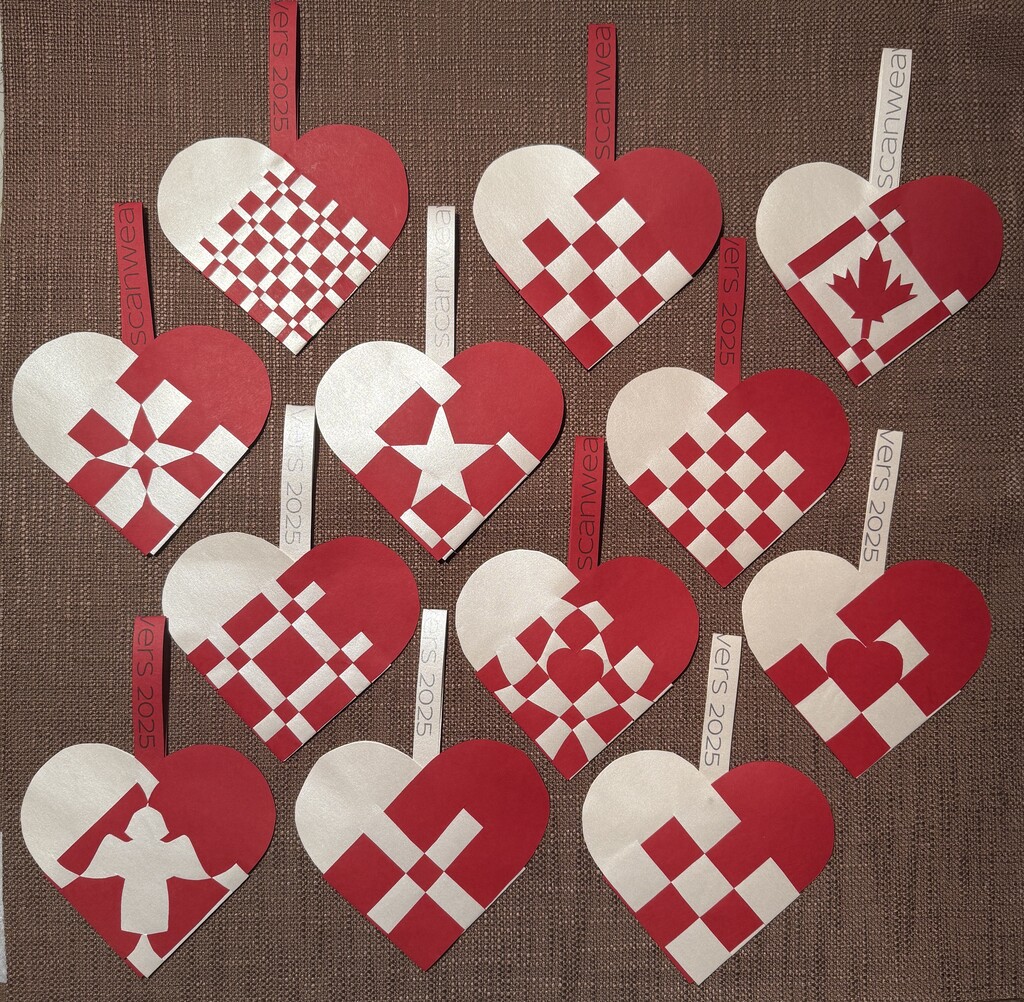
Peg Hansen wove many of the hearts in the book. She then taught us the basic pattern, shown in the middle of the top row in the photo below.
Weaving and photo by Peg Hansen.
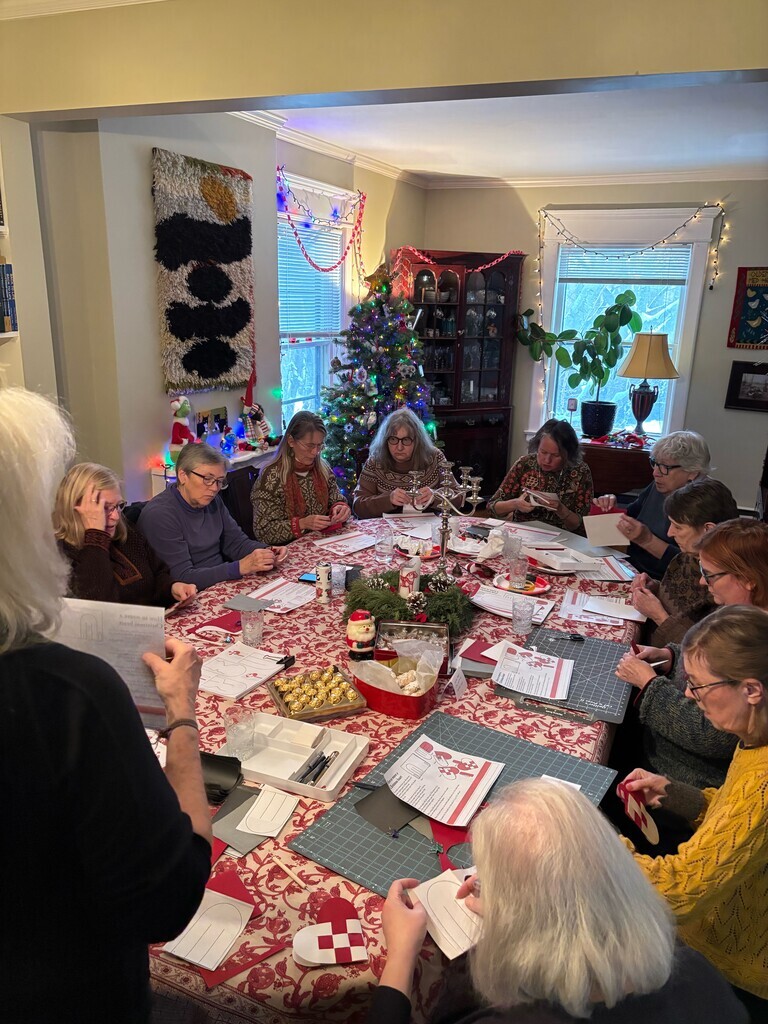
The paper weaving technique is a bit tricky until you get the hang of it. As you can see from the photo below, we all had to concentrate very hard!
Photo by Barb Yarusso.
Peg recommends a high-quality paper that won’t tear during the weaving process. Bone folders come in handy to make clean folds, and a good sharp pair of scissors are a must! Peg wove the lovely and meticulous heart below.
Weaving and photo by Peg Hansen.
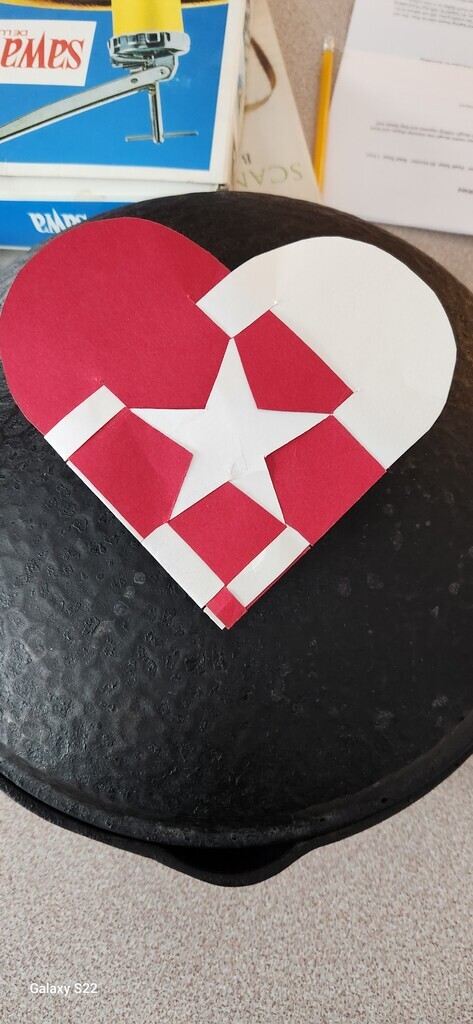
Lori Labs wove the star below, an extra-tricky pattern due to the sharp points, which are susceptible to tearing.
Weaving and photo by Lori Labs.
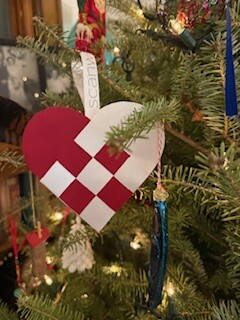
Nancy Ebner’s simple heart found a home on her Christmas tree.
Weaving and photo by Nancy Ebner.
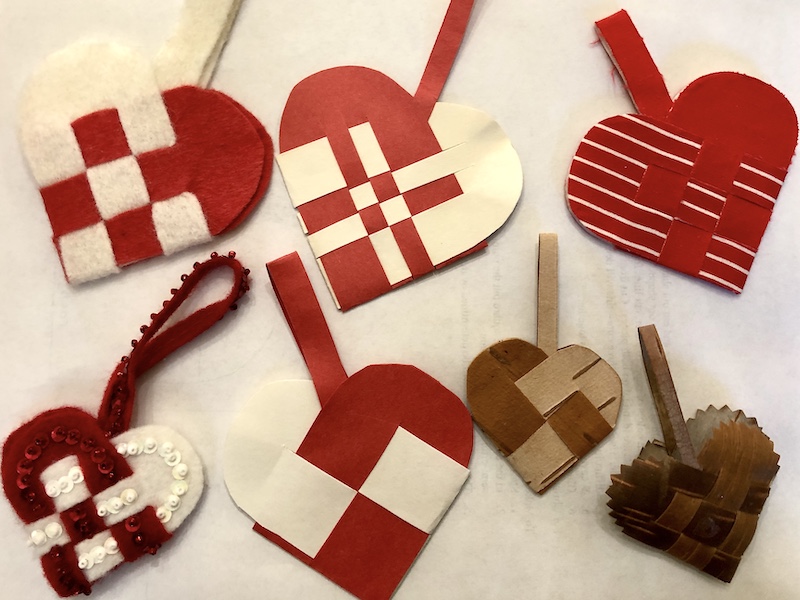
Mary Erickson wove a variety of hearts using paper, felt, and even birch bark.
Weaving and photo by Mary Erickson.
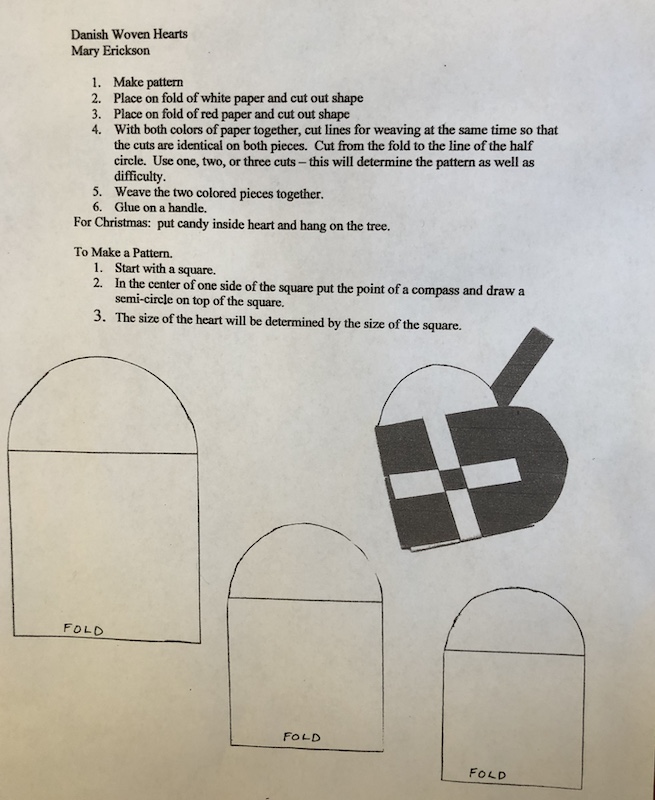
Mary shared her pattern for making Danish hearts. Feel free to give it a try and send us photos!
Wishing all our readers PEACE and JOY in the New Year! Thanks so much for subscribing to our blog!
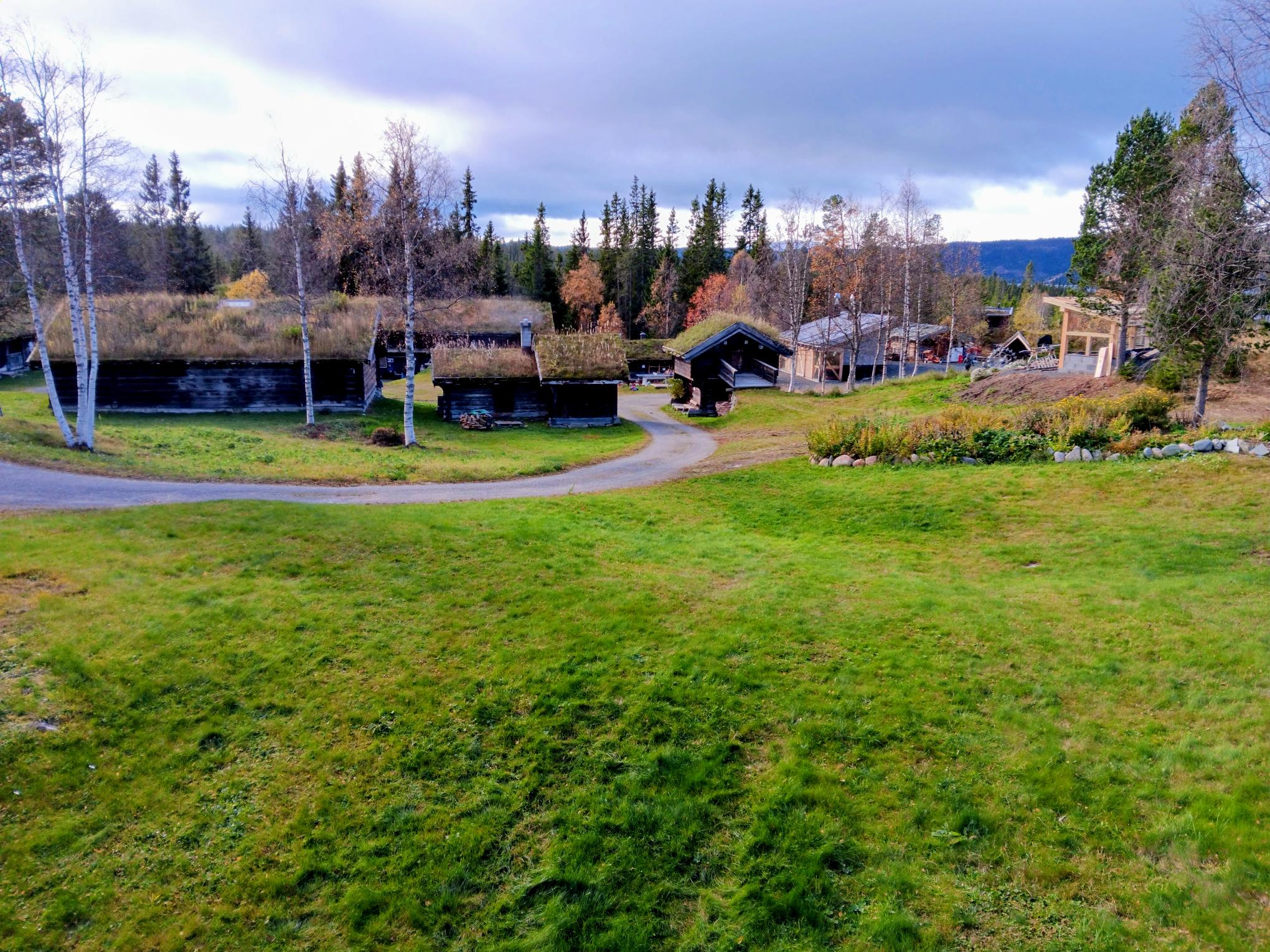
Members of the Scandinavian Weavers group traveled far and wide in 2025. Lisa Torvik ventured to Rauland in Telemark, Norway, eleven hours north of Oslo. There, she studied weaving at Raulandsakademiet, which offers classes in traditional craft. (See link below.)
View from Raulandsakademiet in beautiful Telemark. Photo by Lisa Torvik.
Note from Lisa: “This is the view out the back windows of the fireplace lounge (peisestogo) and the upper floor cafeteria and large meeting room [at Raulandsakademiet]. The building is the “Telemark Tun”, a small museum of traditional farm buildings that house a shop of handmade items in the hay barn and a bakery specializing in traditional breads. In Norwegian, a “tun” is what we call a farmstead and since farmsteads were often built close together, with maybe two manor houses or more, it might be the origin of the English word town. ”
The weaving course was taught in Norwegian. Fortunately, Lisa is fluent in both language and traditional weaving, having studied at at Valdres Husflidskule (handcraft school) in Fagernes in 1974. She is currently a member of the Øystre Slidre Husflidslag (handcraft guild).
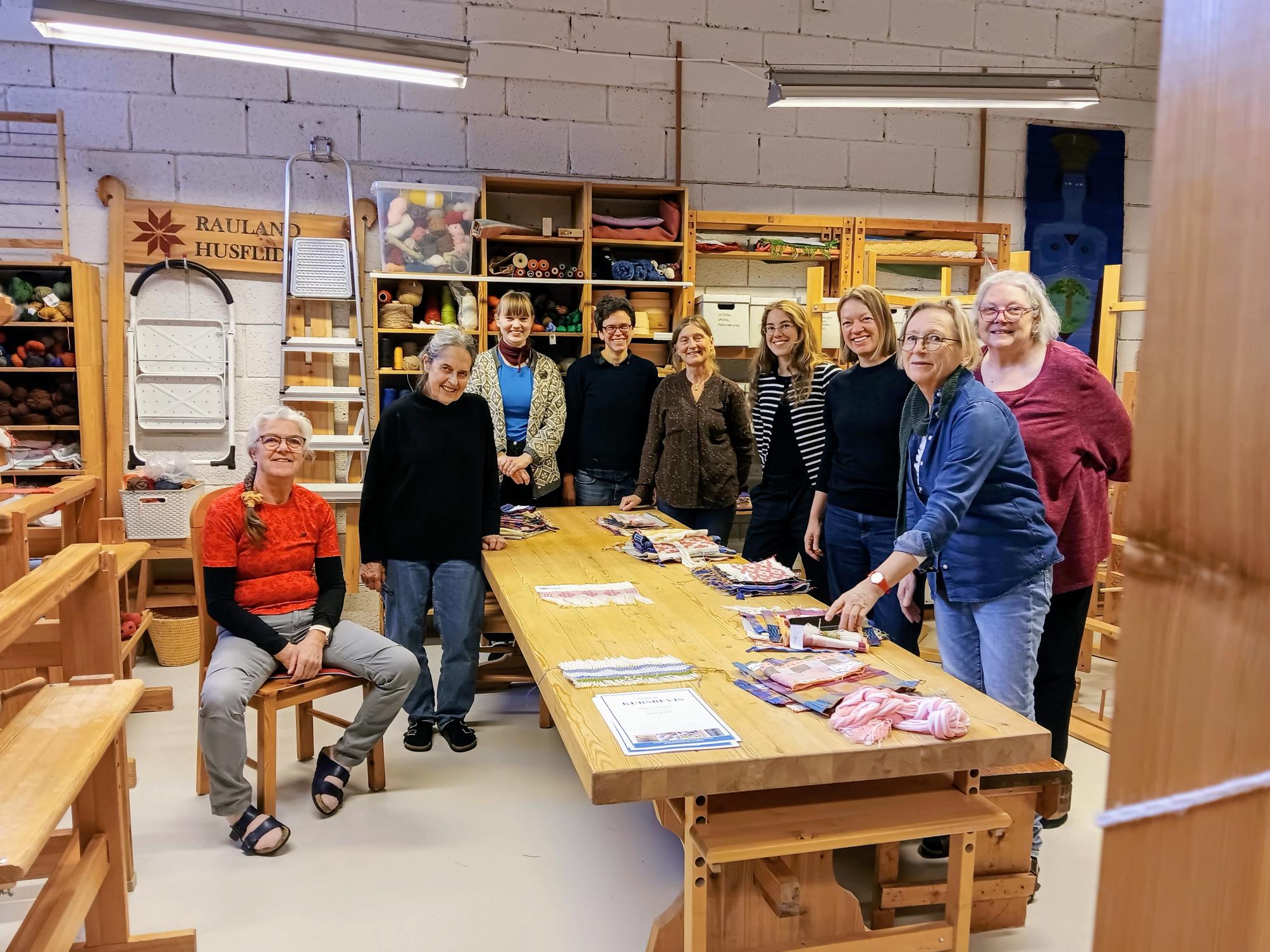
Lisa (in the red shirt) with her classmates in Rauland.
“The course I attended this fall in Rauland was called “Dreiel og sateng”, and focused on “drill” patterns of both satin and broken twill (korskypert) weaves,” Lisa explains. The course instructor was Rita Vistad
Lisa’s weaving samples. She wove all this in two and a half days! Photo by Lisa Torvik.
While in Norway, Lisa visited many friends and family members, bringing gifts of her woven items. Here is Lisa’s friend Gunvor Hegge in her artist’s studio. Lisa wove the black-and-white skillbragd table runner on the table.
Photo by Lisa Torvik.
Holly Hildebrandt made her very first trip to Norway, where she studied with Ingebjørg Monsen in Bergen. Ingebjørg is president of Bjørgvin Husflidslag (handcraft guild), where she teaches classes in weaving and sewing, and specializes in constructing men’s bunader (national costumes).
Holly and Ingebjørg at the loom. Photo by Holly Hildebrandt.A clever weaving hack to keep treadles spaced properly. Photo by Holly Hildebrandt.
Holly spent the week learning to weave krokbragd and rutevev techniques in beautiful Norwegian wool.
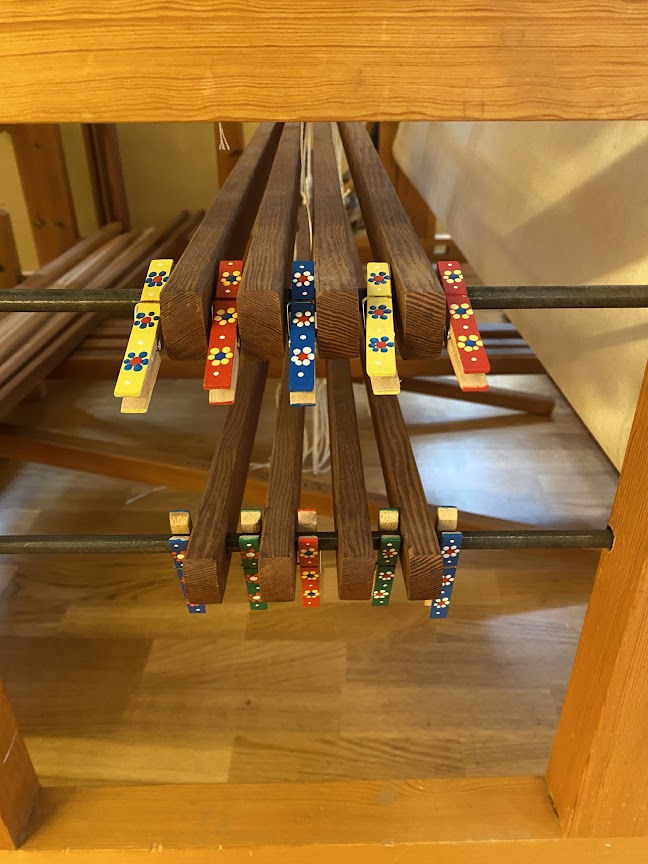
Krokbragd designs on the loom. Photo by Holly Hildebrandt.Yarn spin from Norwegian spelsau sheet. Notice the sheen! Photo by Holly Hildebrandt.
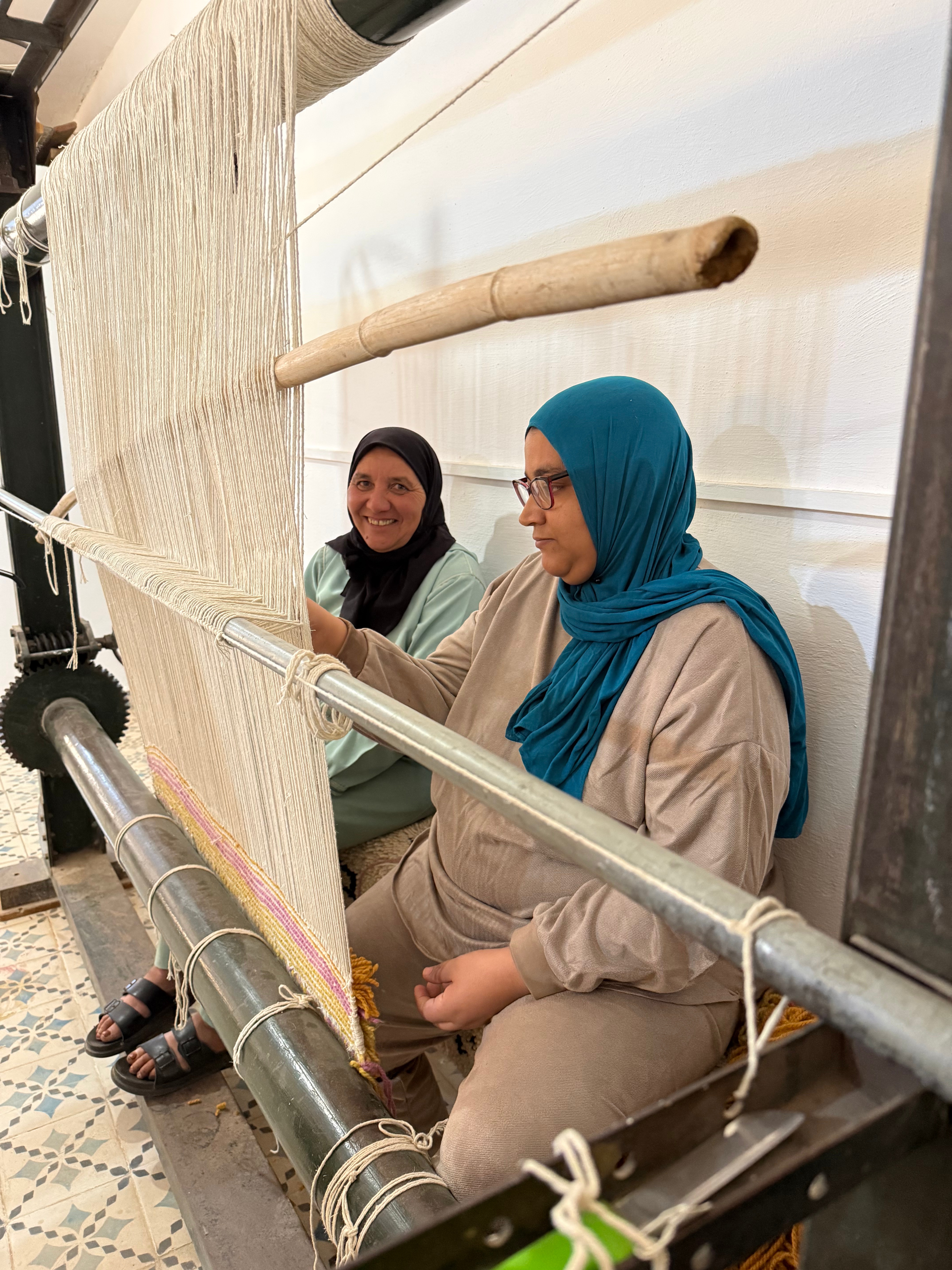
Nancy Ebner finished her 2025 travels with a trip to Morocco through Loom Dancer Odysseys. Nancy and other tour members participated in four textile workshops, and Nancy took more than 1000 photos! Below, women weave rugs in a pile technique similar to Scandinavian rya.
Photo by Nancy Ebner, taken at the Cherry Buttons Women’s Cooperative.