Category: Uncategorized

  • Beloved Textiles and Family Stories in “Domestic to Decorative”

    Beloved Textiles and Family Stories in “Domestic to Decorative”

    The Scandinavian Weavers’ “Domestic to Decorative” exhibit included several heirloom textiles, which came with wonderful family stories. The heirlooms inspired members of our group to weave new versions of the same technique—in one case, to combine old and new in a single weaving—or to use their imaginations to create something new inspired by the past.
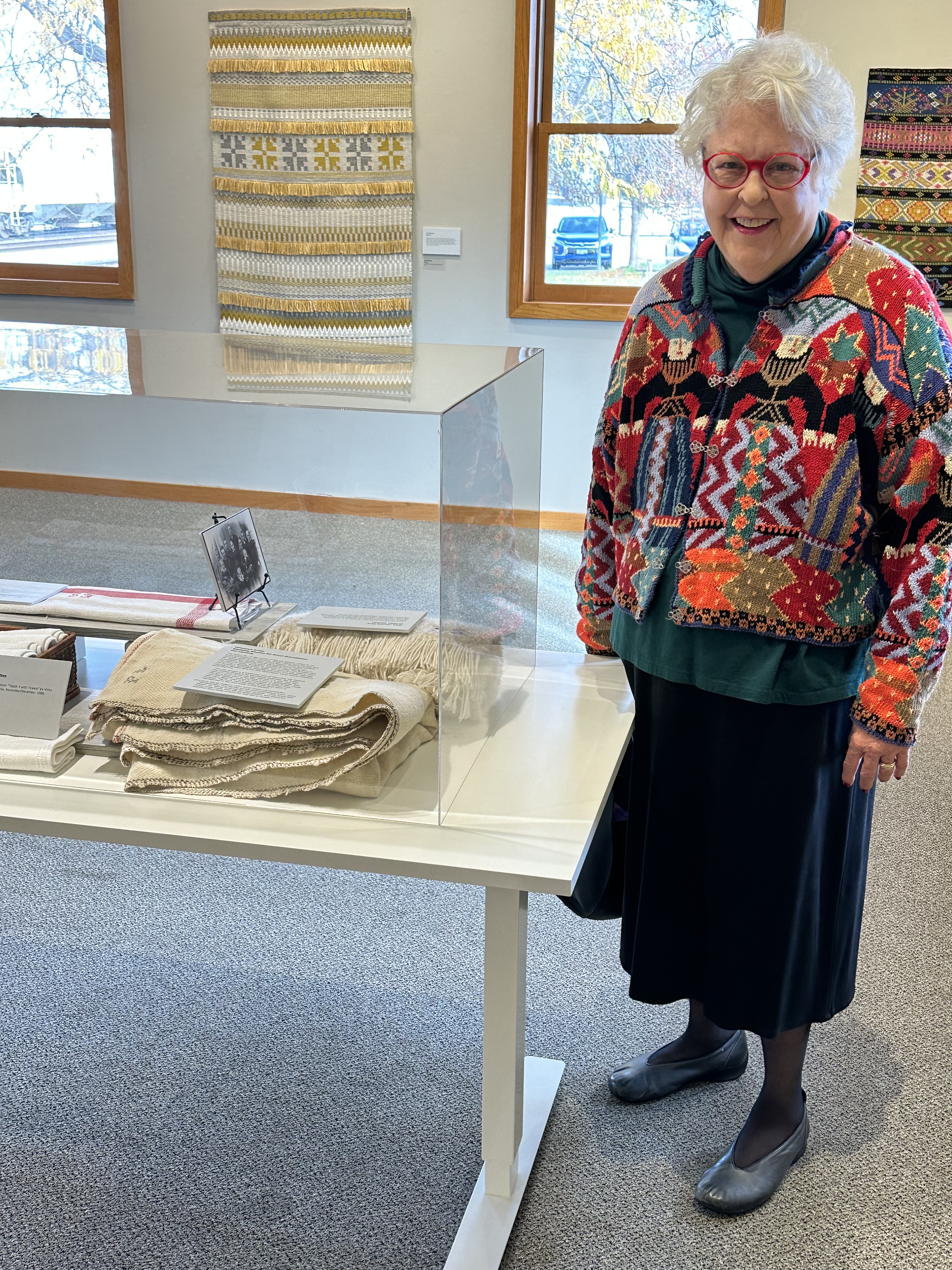
    Weaver Mary Skoy next to the woolen blanket given at her great-grandparents’ wedding.

    One of Mary Skoy’s most treasured family heirlooms is a simple woolen blanket. The blanket was a gift to Mary’s great-grandfather Per Mikkjelson Lønning and great-grandmother Synneva Fransdatter Kanelønning, who were married at the Lønning farm on the island of Stord, Hordaland, Norway in 1880. “The blanket was a gift from a wedding guest,” Mary explains. “The faded PL in the corner of the old blanket refers to Per Lønning. Sadly, the name of the weaver was not recorded.” Note: Mary always encourages those of us in the Scandinavian Weavers group to include our initials on everything we weave!

    Per Lønning and Family

    Mary researched the history of blankets from this era, consulting Norwegian weaving instructor and textile historian Ingebjørg Monsen. Ingebjørg sent the following information about similar blankets from that era: “The red thread is a traditional way of hemming the blanket. The colored thread is for decoration purposes, but it also makes a cover up for the hem stitches in a very nice way. The hand spun yarn in the piece is from a dropspindel. This very fine blanket I expect to have been in used in bed. Could also have been used as a tjeld (curtain) to protect from draught. The more common width of the farm loom is represented in the half width of the blanket.”

    Inspired by the heirloom blanket, Mary wove a new blanket for the birthday of her great-niece. “The elements from the old blanket I incorporated are the color, two narrow lengths hand-stitched together, and most importantly the initials embroidered into one corner,” Mary says. The new blanket is also much softer, incorporating alpaca, mohair, silk, and wool—luxury fibers that would not have been available to her ancestors in 1880.
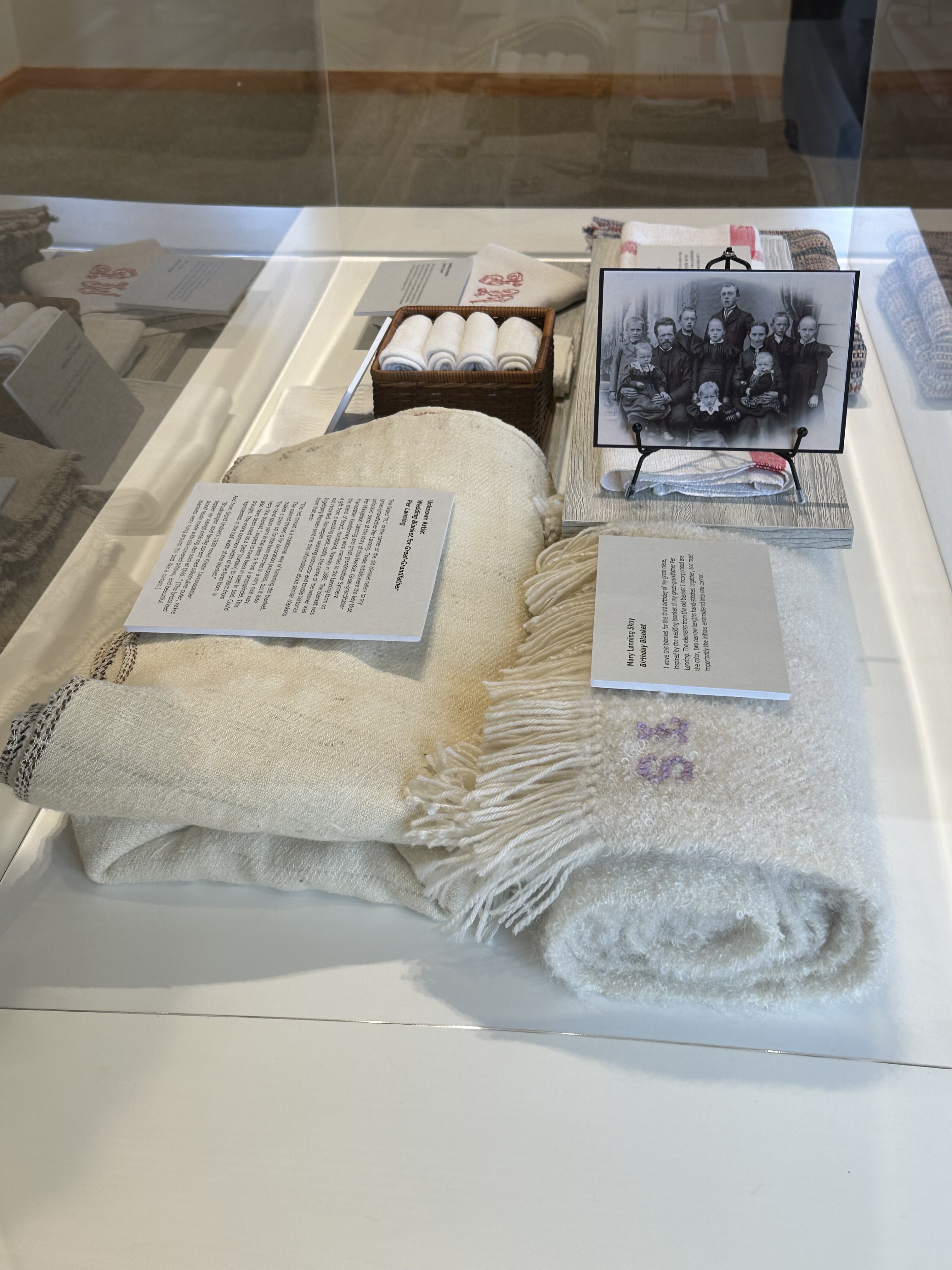
    Original blanket on the left; Mary’s blanket on the right.
    Close-up showing the embroidered initials. Note the difference between the simple wool fibers in the original and the fluffier fibers on the new blanket.

    Beth Detlie was also inspired by Norwegian textiles: “Vegteppe was a wedding gift from my husband’s aunt to us in 1978. She told us that the weaving was done by a distant relative of mine. (My mother’s ancestors immigrated to the United States from the Telemark region in Norway during the 1850s.)” Beth’s Telemark Reflection is an echo of this beloved weaving.

    Original vegteppe on the far wall with Beth’s smaller version on the right. In the foreground is the special case holding other heirloom textiles.

    Edi Thortensson donated a simple but treasured handtowel. “The towel was handwoven around 1950 by my mother-in-law, Ellen Svensson, for use in her home in Tröjemåla, near Ryd, Småland, Sweden,” Edi writes. Inspired by Ellen’s towel, Edi wove a paradhandduk, or display towel, meant to cover utility towels hanging near a washstand.

    Edi Thorstensson and her parahandduk.

    Barb Yarusso shared two Finnish heirloom textiles for the exhibit, including a 2/2 twill linen towel embroidered with her great-grandmother’s initials. Her great-grandmother’s name was Josefiina (Fiina) Norhala. “Josefiina grew the flax, spun the yarn, and wove the towel,” Barb writes. “She gave the towel to my grandfather Eino when he emigrated from Finland to the United States in 1913.”
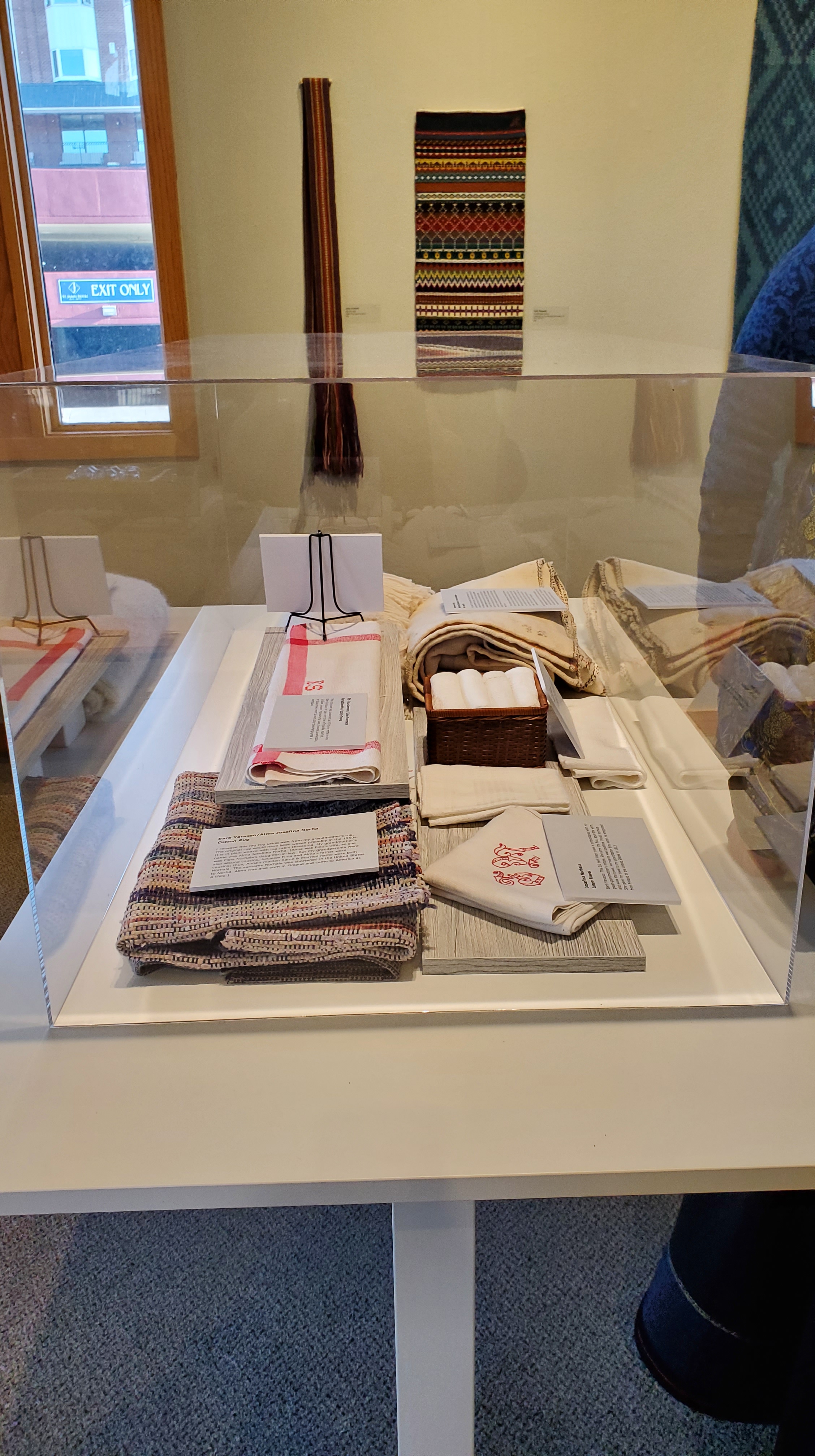
    On the far left is the red and white towel woven by Edi’s mother-in-law Ellen Swenson and embroidered with the initials ES. On the right is the white towel with initials embroidered in red by Barb’s great-grandmother Josefiina Norhala.

    Barb also has a rug woven by Alma Norhala, Eino’s wife. Alma was also born in Finland and came to America as a child. The original rug was woven in the 1950s, in plain weave with log cabin threading. Barb carefully salvaged the cotton weft material and re-wove it into a new rug as her way of honoring Alma’s work.

    Barb Yarusso proudly holds the rug she rewove using weft material from her grandmother Alma Norhala.

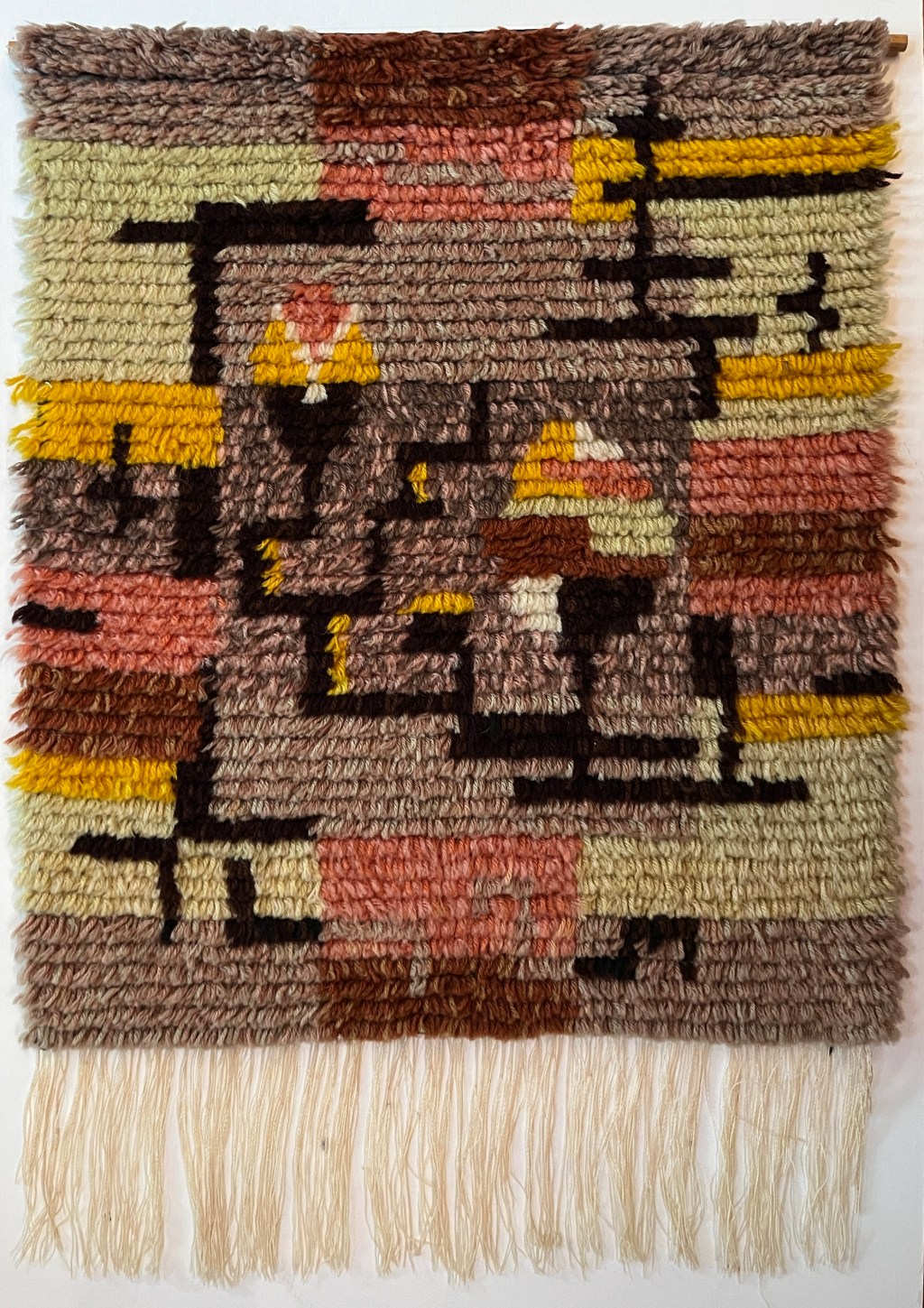
    Peg Hansen was also inspired by Finnish weaving. Löytyi Karannut Lemmikki (A Runaway Pet Was Found) is a vintage (over 100 years old) Finnish Rya/Ryu wall hanging from the collection of Peg’s friend Susan Sutherlund. It belonged to Susan’s grandmother Lydia Ivonen. Unfortunately, the weaver is not known.
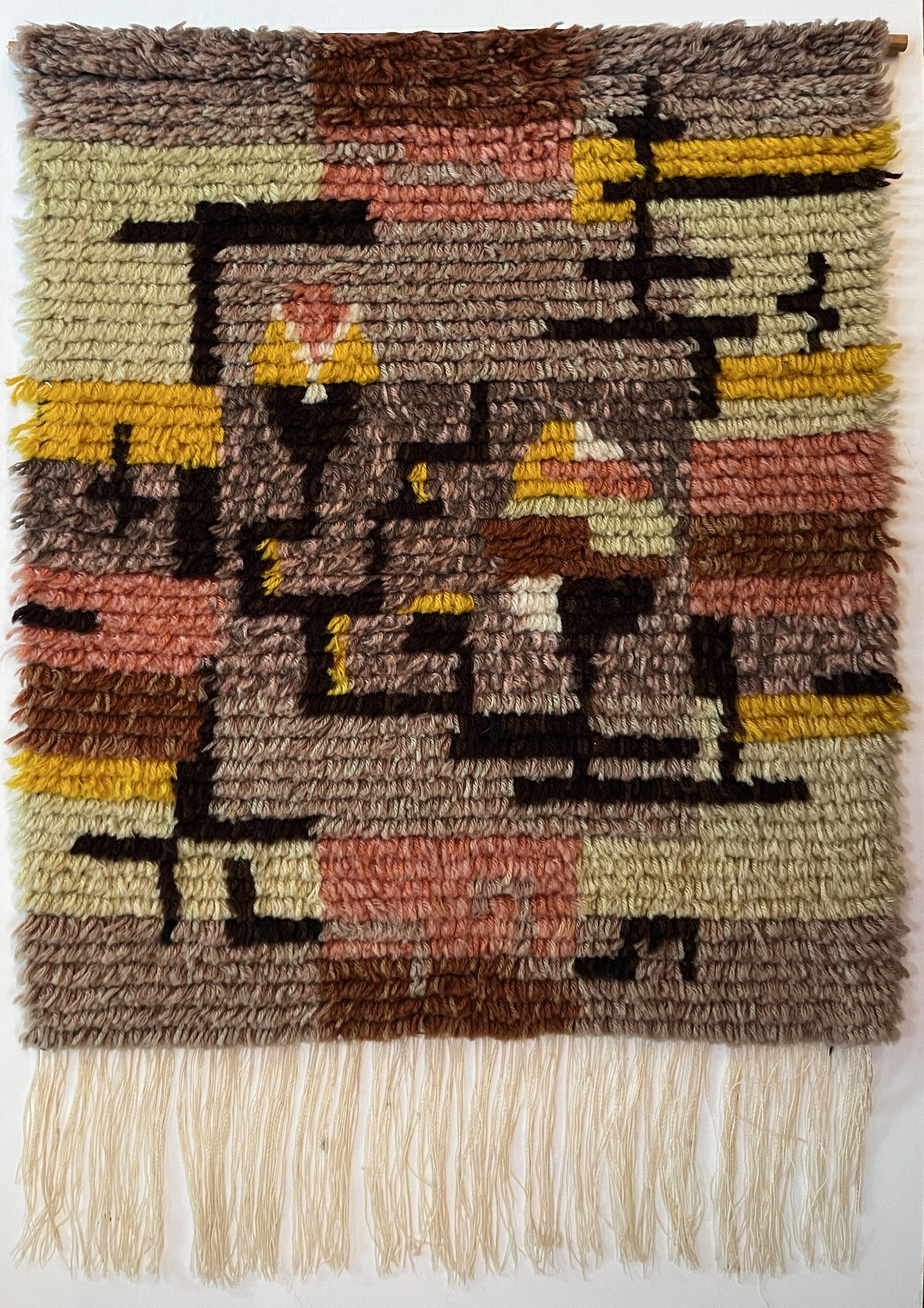
    Löytyi Karannut Lemmikki (A Runaway Pet Was Found)

    This piece served as Peg’s inspiration to learn more about the Rya/Ryu weaving technique used in Scandinavia.
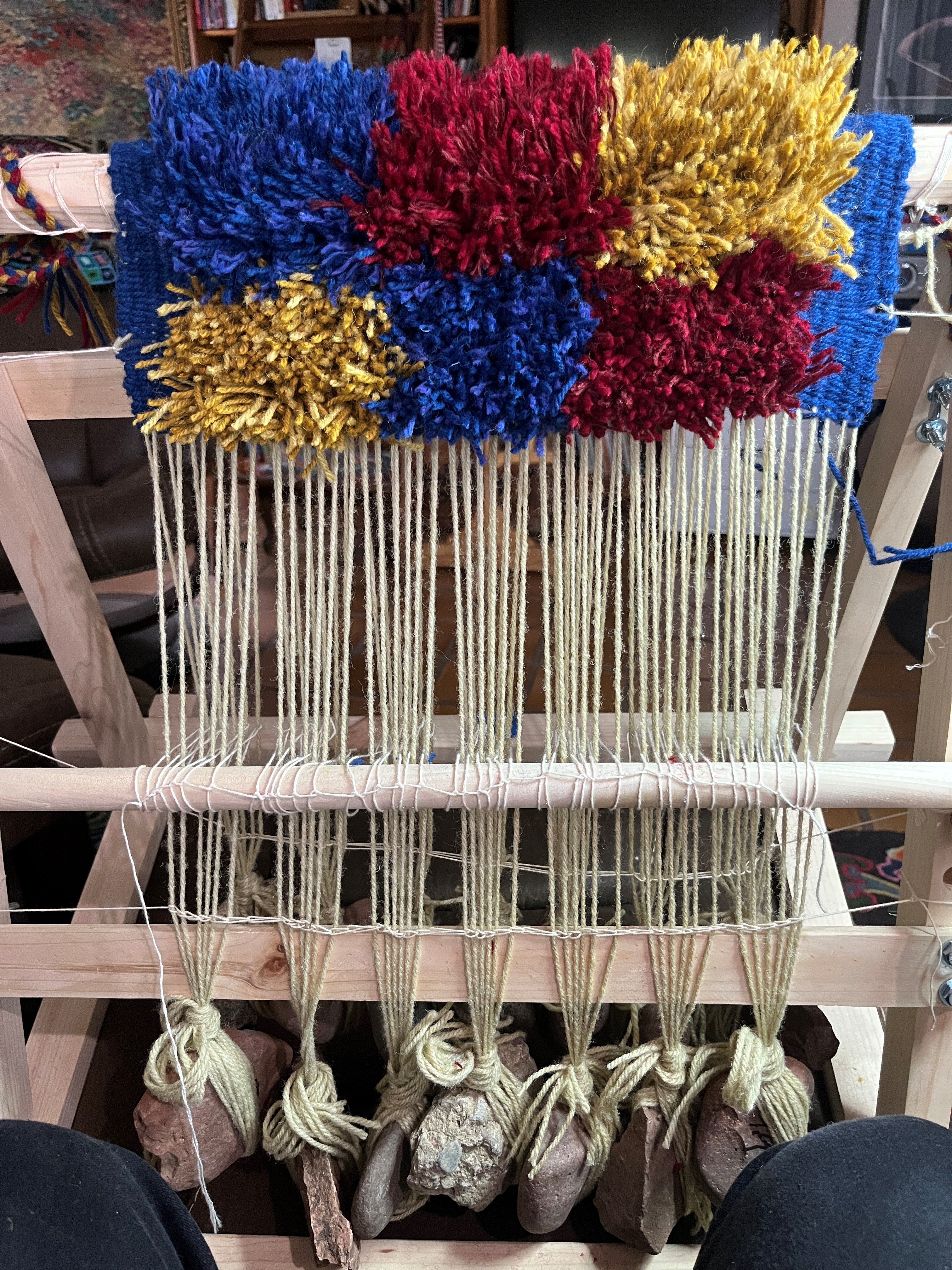
    Peg’s rya weaving on her hand-built warp-weighted loom.

    Kala Exworthy’s source of inspiration was a beloved quilt. “My maternal Grandmother loved making things,” she writes. “From her I learned to knit, rosmal and paint those cute plaster gnomes, which we painted red hats on and called “Nisse.” The photo below is of a quilt given to Kala by her grandmother. “I was the oldest granddaughter and was given first choice of the pile of quilts,” Kala explains. “The fabrics are from worn garments and I have always been a fan of bright colors. As a practical quilt, it has been used from day one. It’s worn and faded now but no less precious.”
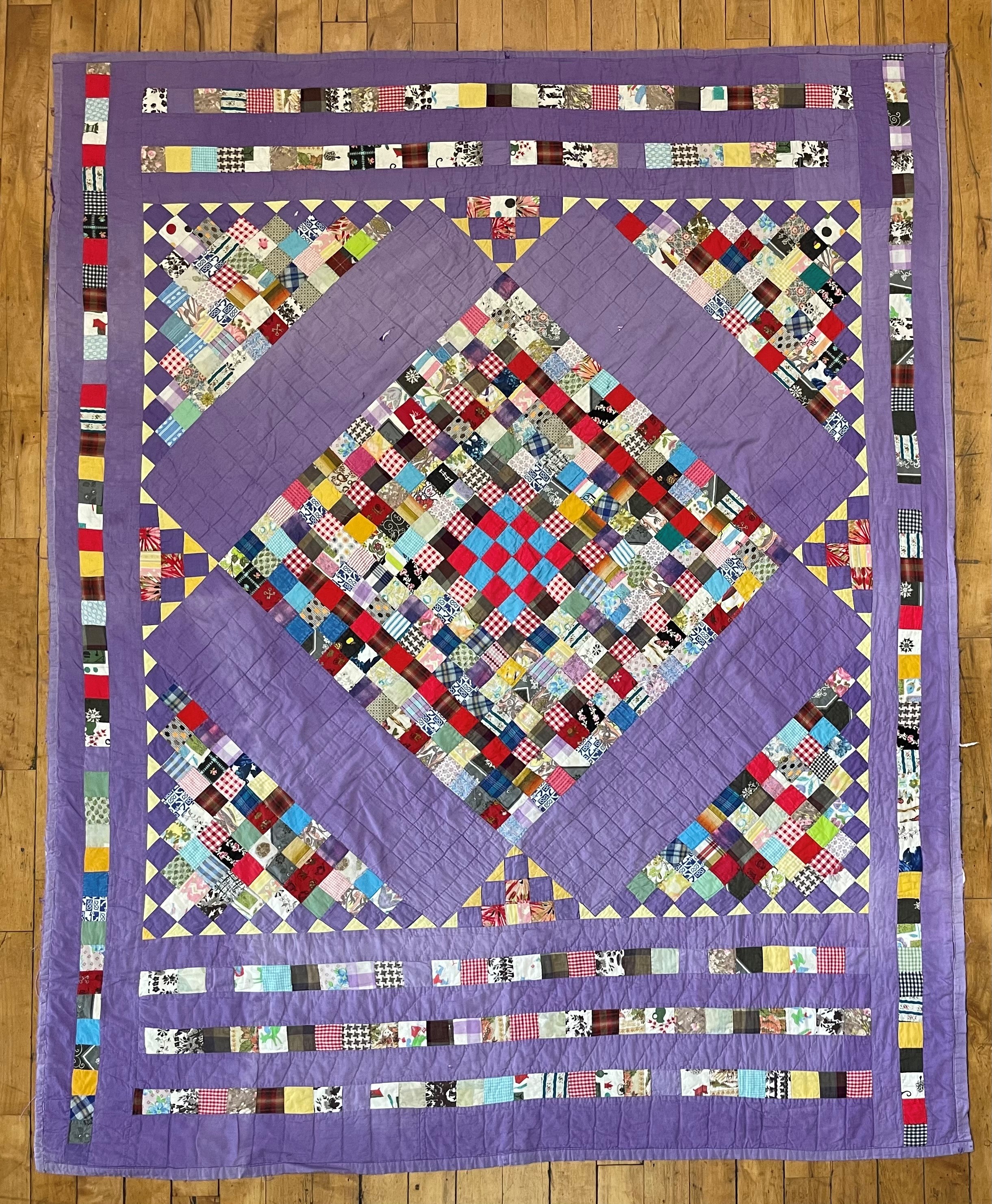
    The quilt given to Kala by her grandmother.

     Inspired by the quilt, Kala wove a wall hanging she calls Memory Fragments. “The wall hanging represents not only the colors in the quilt but also the random memories that I have when I look at the quilt,” she writes. “Pictures in my head of Gram at different times in our lives, red paint on the paintbrush for the Nisse hats, the smell of turpentine and linseed oil used to clean our brushes, yarn and needles and of course, lefse with mashed potatoes, chicken and crispy sugar cookies. I loved going to Gramma Egstad’s house because there was always time to make something.”

    Kala’s Memory Fragments inspired by her grandmother’s quilt.

    For Nancy Ellison, her heirlooms come in the form of sheep. Nancy raises Icelandic sheep and other heritage breeds on her farm near Zumbrota, Minnesota. “Historically in Iceland shepherds wore a mantel or cloak woven with locks of wool to protect the wearer from the weather,” Nancy explains. “The shaggy surface is like the wool growing on a sheep.” Nancy wove a pillow and chair cushion in this technique, using gray, black, brown, and white wool from her flock.

    Nancy shaggy sheep contributed to her weaving!

    Some weavers were inspired by vintage objects, even though they didn’t have a family connection. Sharon Marquart’s From Garment to Garnish was inspired by an antique embroidered bodice, possibly Scandinavian, and an antique beaded belt, which may have been part of a Norwegian bunad (ceremonial dress).
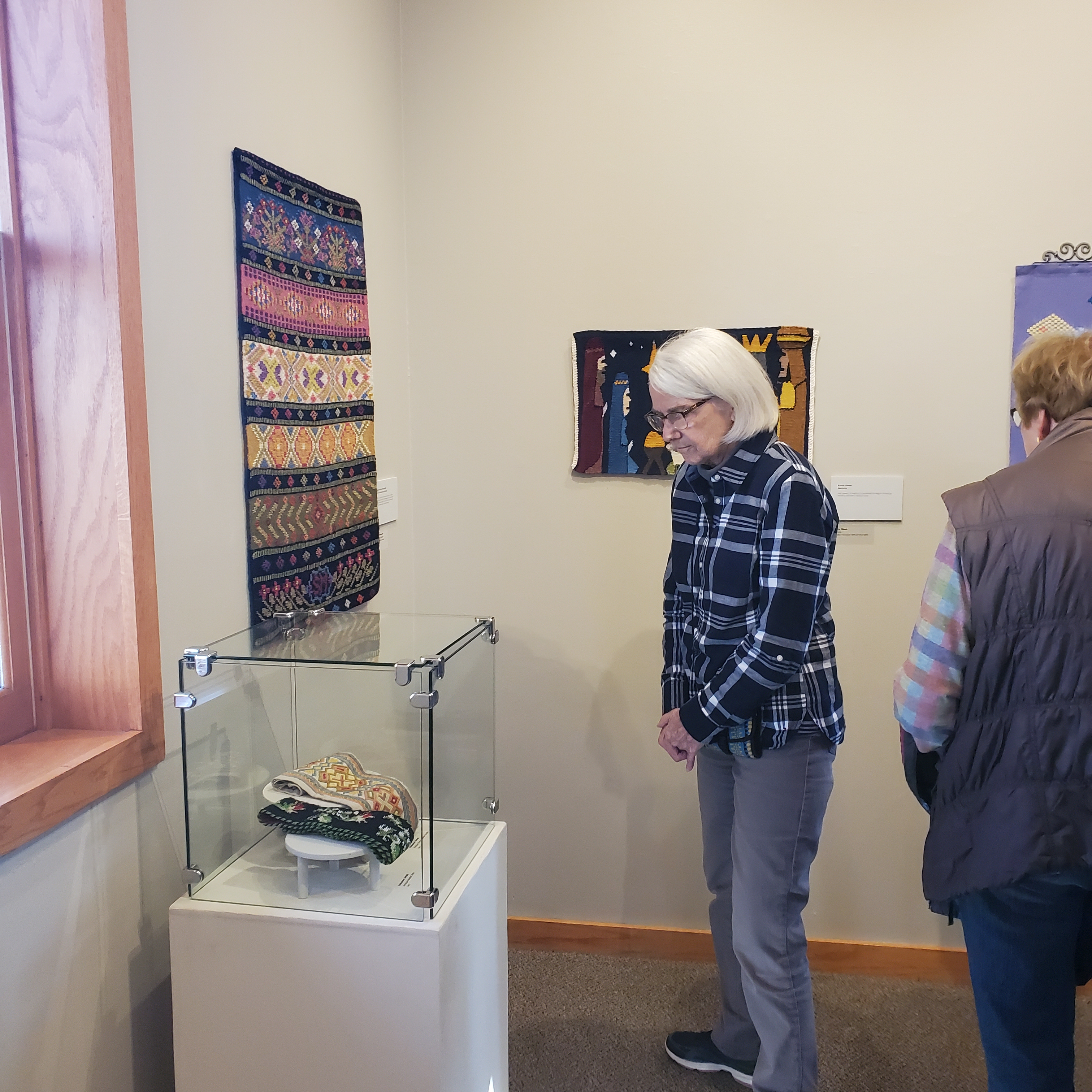
    A visitor examines the vintage clothing items that inspired the woven motifs in Sharon’s From Garment to Garnish, seen on the wall.

    Melba Granlund wove a telemarksteppe she called Reflections. “My color inspiration for Reflections came from a stained-glass window salvaged from an old farmhouse,” she states. “It was purchased at a farm auction in central Minnesota and currently hangs in the dining room window of our “new” farmhouse a few miles away. “

    Melba’s Reflections and a photo of the stained glass that inspired the color palette.

    Although humble, these beloved textiles are still treasures, even a hundred years later. As shown in this exhibit, even the simplest textile can inspire later generations to weave on. We are all part of the fabric of history, and our own small threads can have a positive impact far beyond our lifetimes. Just remember to put your initials on everything you weave!

  • New Year, New Project!

    A cold January is the perfect time to start a new weaving project! The Scandinavian Weavers’ latest group warp is a pattern called Kukkoladräll.

    The Kukkoladräll pattern was composed by Elsa Kerttu in 1926 when she was a student at Jämtslöjds Kvinnliga Slöjdskola (Women’s Craft School) in Östersund as an assignment to create a pattern in Jämtlandsdräll. It was named after Elsa’s hometown of Kukkola, a small fishing village in northern Sweden, just across the border from Finland. A lovely version of this pattern was woven by Ulrika Bos Kerttu, Elsa’s niece, in a palette she named Cloudberry. The draft for the pattern is copyrighted by Sveriges Länshemslöjdskonsulenter and provided bytextilhemslojd.se

    Image of cloudberries from Pinterest.

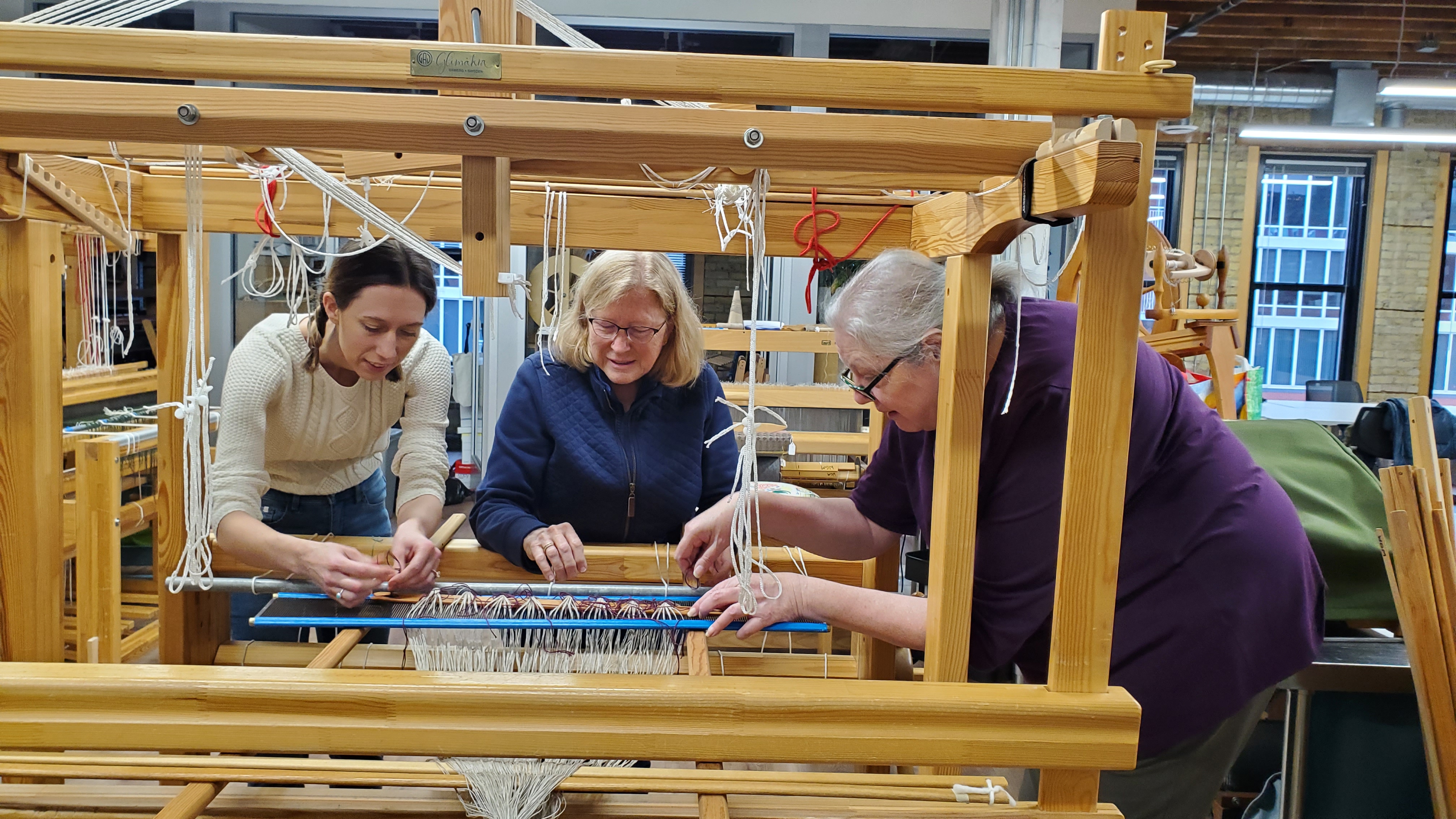
    The Weavers Guild of Minnesota is equipped with two Glimakra looms for classes and group projects. The Scan Weavers generously dug into their stashes for the linen warp. At least 14 of us will weave on this warp, so it is quite long.

    There’s nothing more beautiful than a plain linen warp. Note the slightly different colors that result from blending.

    Warping is always more fun with a group! (Especially with coffee breaks.) Below, Lisa Torvik explains the benefits of pre-sleying the reed to newer weavers Holly and Beth.

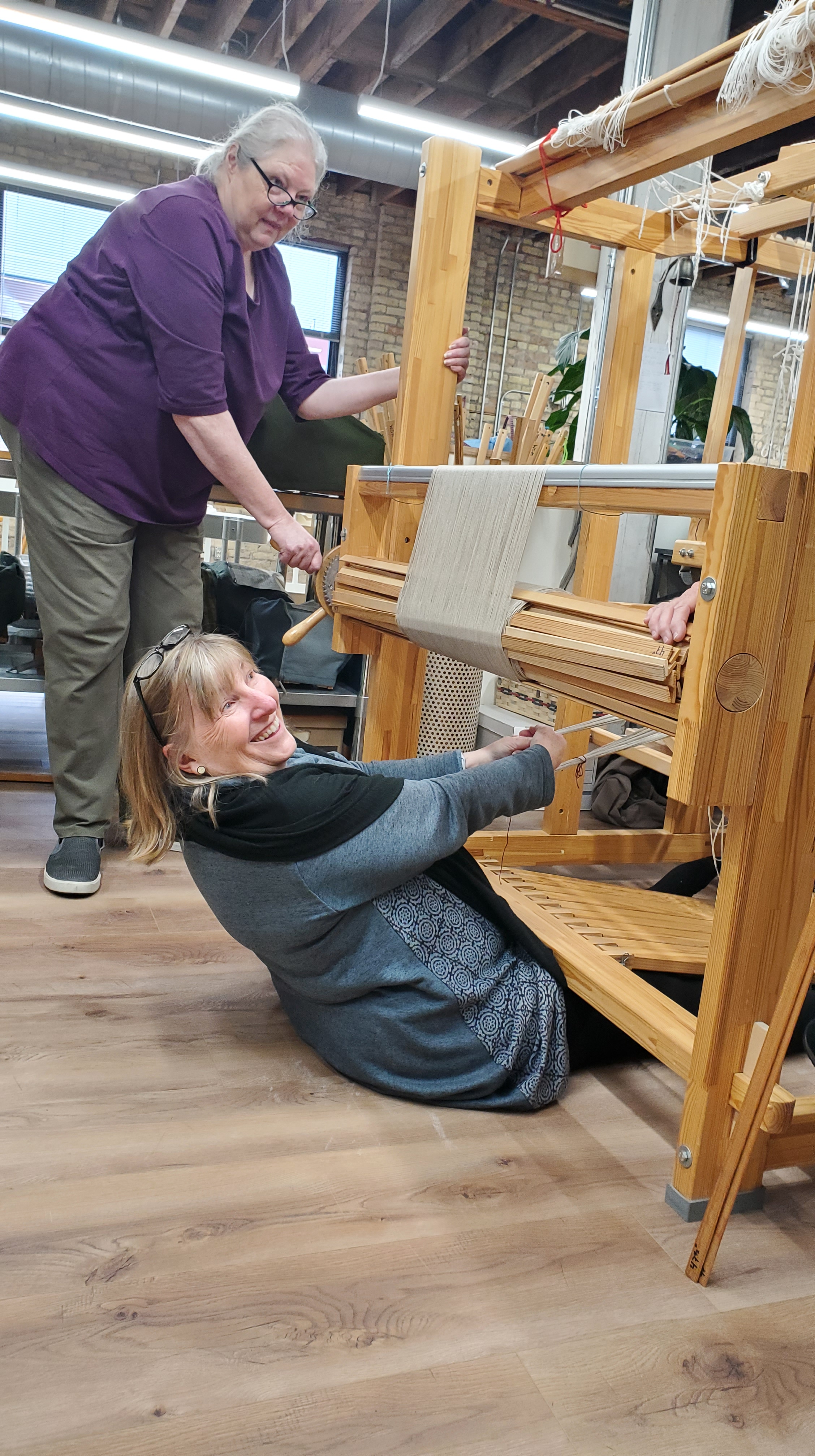
    Patty Johnson demonstrates how she used to warp her Glimakra all by herself – controlling the warp tension while winding on the back beam. Fortunately, Lisa is there to help.

    Lisa reminds everyone to spritz the linen warp with water to prevent breakage. (Lisa does this every time she advances the warp, which she does every three to four inches.)

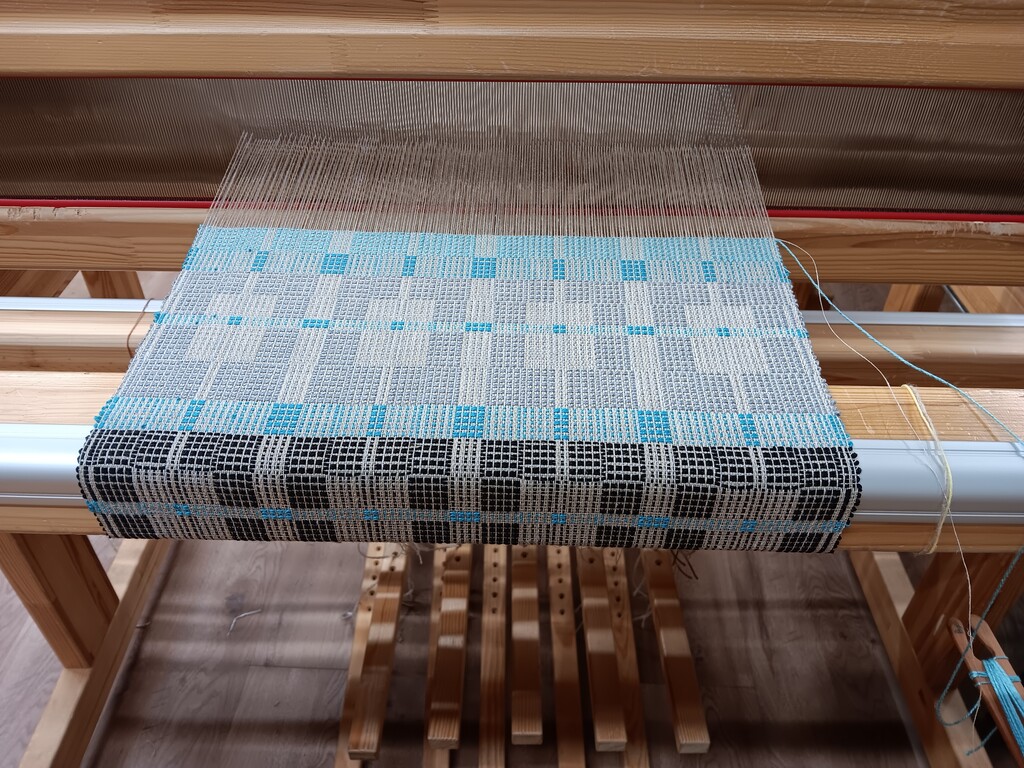
    Lisa adapted the draft for towels and included four motifs across the width instead of three.

    Lisa wove two towels in different colorways. For the first, she used 16/1 linen doubled on stick shuttles for the pattern weft and 12/1 linen for the ground shots.

    For the second towel, Lisa chose to work with perle cotton for the pattern weft.

    Stay tuned for more updates on this project. I like to think that Elsa Kerttu’s original design of multiple squares was inspired by the many small fishing huts in Kukkola.

    Image of Kukkola from Pinterest
    Stock image

    If you now want to visit Kukkola as much as I do, search online for the Kukkola Tourist and Conference Board. They say the area provides natural beauty, peace, and creative inspiration. What could be better for weavers?

  • Now Open: “Domestic to Decorative”

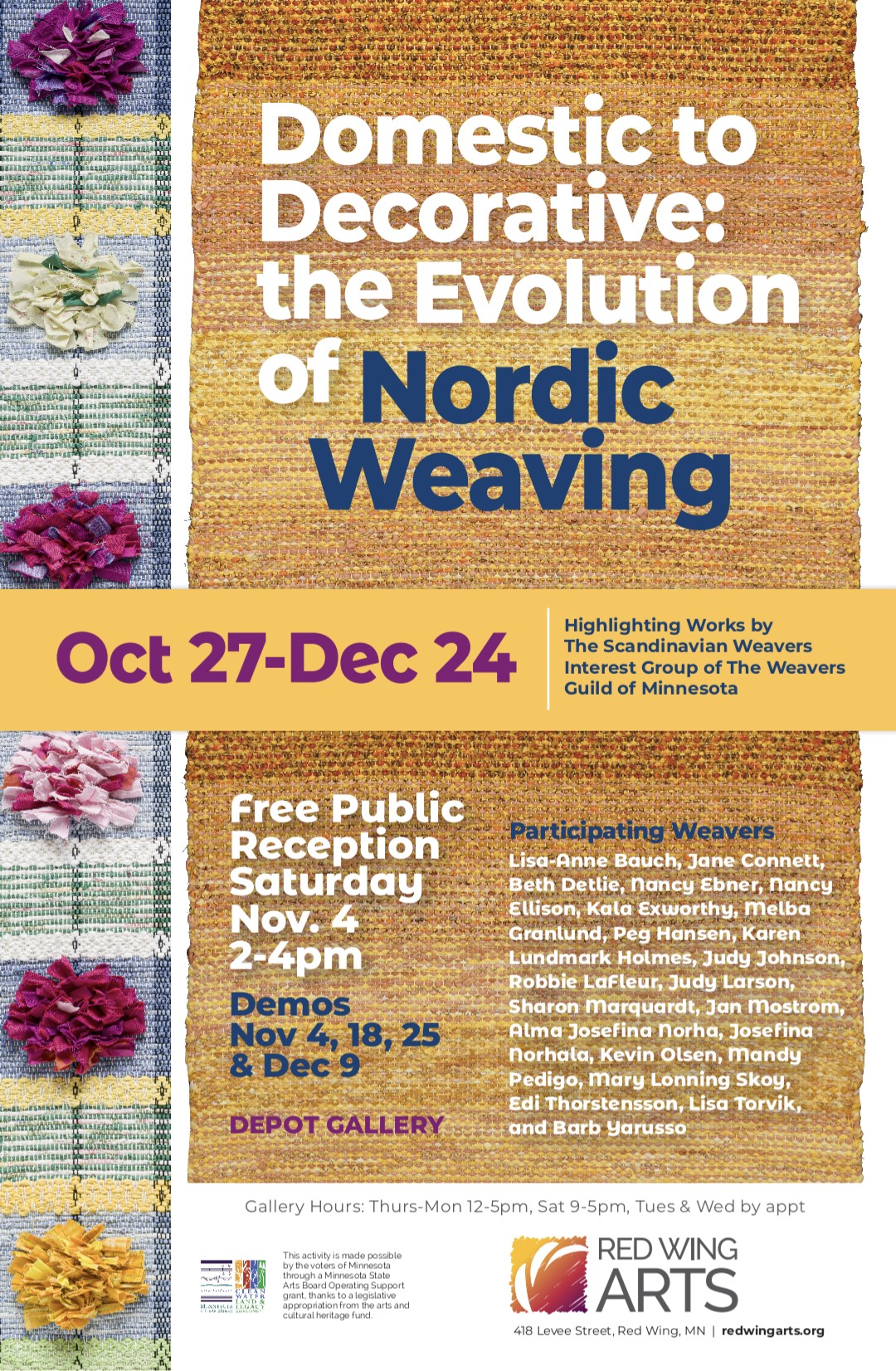
    The Scandinavian Weavers’ new exhibit “Domestic to Decorative: The Evolution of Nordic Weaving” is now open at Red Wing Arts in Red Wing, Minnesota. The exhibit is free and open to the public during regular hours at Red Wing Arts. (Thursday through Monday 12:00 to 5:00 PM / Saturday 9:00 AM to 5:00 PM/ Tuesday and Wednesday by appointment)

    Please join us for a free Opening Reception on Saturday, November 4 from 2:00 to 4:00 PM. In keeping with tradition, Scan Weavers are baking seven different kinds of cookies for the event.

    Also on November 4, Edi Thorstensson will demonstrate band-weaving on a hand-carved Swedish heddle from 10:00 to 11:30 AM. Nancy Ellison will demonstrate rigid heddle weaving from 1:00 to 3:00 PM. Additional demonstrations will be held November 18 (warp-weighted loom), November 25 (krokbragd on a rigid heddle), and December 9 (transparency weaving). Watch this space for further details.

    Special thanks to Shawn Niebling at Red Wing Arts for shepherding this exhibit from concept to installation!

    Visit Red Wing Arts in the historic train depot at 418 Levee Street in Red Wing, near the riverfront. (Yes, you can travel by Amtrak train to the depot.)

    During the installation process, Peg Hansen carefully combs the fringe on Jan Mostrom’s beautiful weaving.
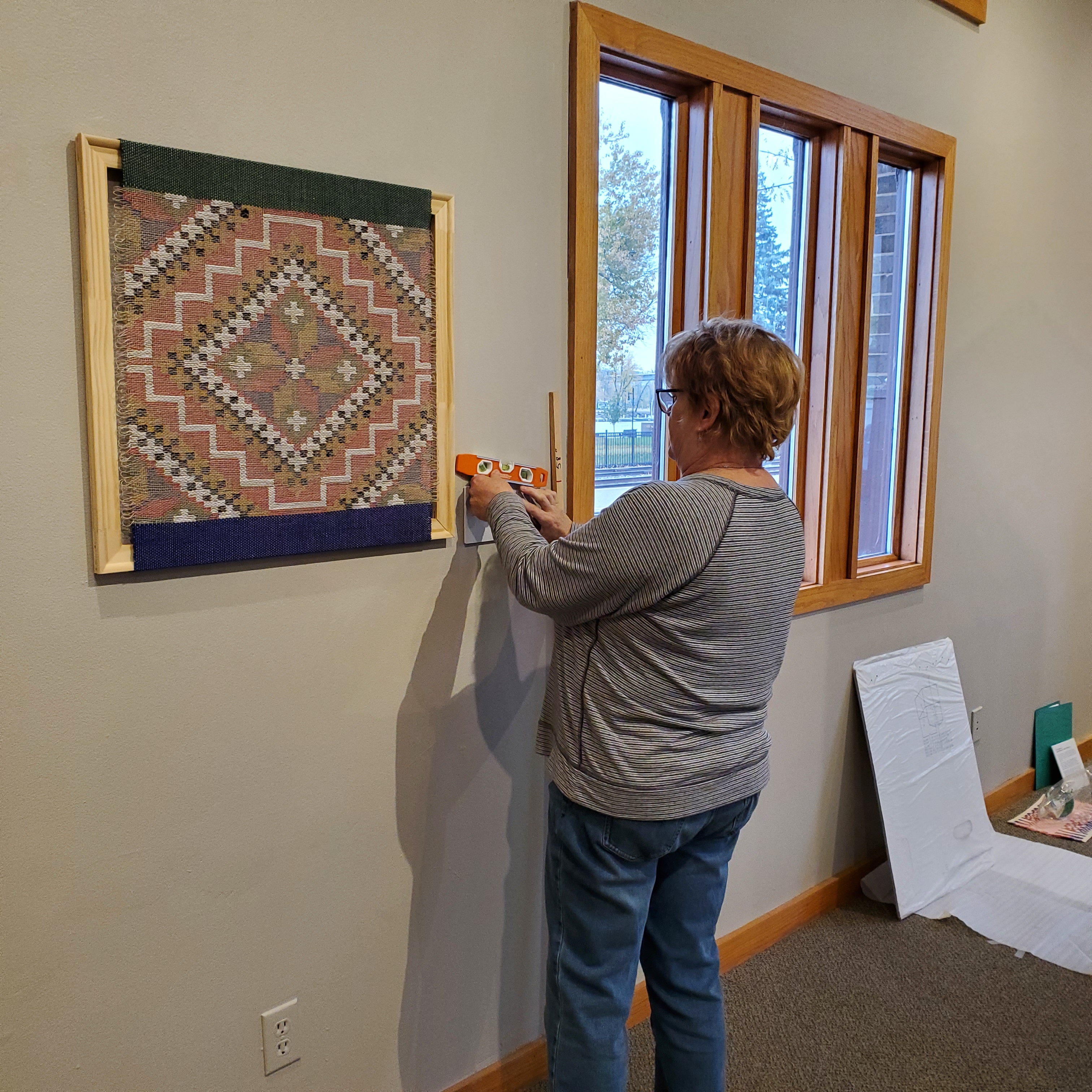
    Shawn Niebling expertly checking levels on Lisa Torvik’s transparency.
    Nancy Ellison’s rya weavings feature fleece from her flock of Icelandic sheep. (Photo by Peg Hansen)
  • Save the Date!

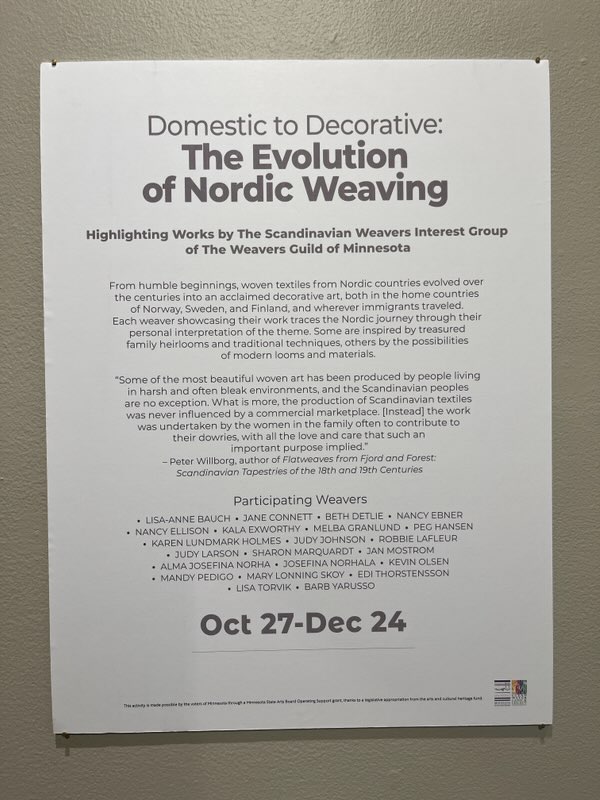
    Scandinavian Weavers NEW exhibit “Domestic to Decorative: The Evolution of Nordic Weaving” opens October 27 in the historic Depot Gallery in beautiful Red Wing, Minnesota! Many thanks to the wonderful staff at Red Wing Arts!

  • December 2020 Show and Tell: A Final Blog Post

    Our Scandinavian Weavers Study Group zoom meetings during the pandemic year are going pretty well. A digital meeting will never replace the fun of meeting in person, and actually seeing the work of our members, but we’ve had good attendance and it’s fun to catch up on everyone’s weaving activities. People are even becoming accustomed to sending photos to the group email list ahead of time! During the first meeting it became quickly apparent that holding up a weaving to your laptop or cell phone camera during a zoom meeting was an inadequate sharing method. Jan Josifek started off this month’s sharing, ahead of our meeting next Sunday. She made a fabulous guitar strap with woven guitars on it. Her husband made the guitar! At last month’s meeting Jan claimed that she was such a terrible sewer and she wasn’t sure how she would be able to finish off the strap. The answer? Beautifully!

    Boundweave guitars

    This blog was originally set up to share the activities of our group with photos, because our former email system was so clumsy. The side benefit was to share the work of our group with all people interested in Scandinavian weaving. Now that we have a better email system and it is much easier to share photos among ourselves, this blog lost its primary goal.

    So thank you for your attention and interest! This blog will remain up, but inactive. If you are interested in Scandinavian weaving, be sure to sign up for notification to the Norwegian Textile Letter. When our Scandinavian Weavers Study Group has its next show, it will be covered for sure in the newsletter. I also cover Scandinavian weaving in my own blog, robbielafleur.com.

    For our Scandinavian Weavers holiday card, please enjoy this sweet weaving made on a rigid heddle loom by Nancy Ellison from Zumbrota, Minnesota. The white pattern yarn is handspun from the fleece of her own sheep. A personal goal of mine is to get vaccinated and be able to visit Nancy again. I’m sure this was the first of many years I missed a trip to seen Nancy and her animals.

    Happy holidays, despite this challenging year. Robbie LaFleur

  • The Scandinavian Weavers Study Group Meets Via Zoom

    Our Scandinavian Weavers Study Group meeting in March was cancelled due to the sudden coronavirus “Shelter at Home” order. April was a first–we met via Zoom. It worked well as a platform to share how we have been faring. It isn’t as fun as our regular meetings, with the ability to see real woven items, of course, but it worked so well that Jan Mostrom suggested it might be our fallback plan in times of bad weather in the future.

    What have the Scandinavian Weavers been working on during this isolation interlude?

    Mary Skoy finished up thirsty waffle weave towels. Like many house-bound people, she’s been cleaning and organizing. “I know where every pin and needle in my studio are,” she commented. She also said she filled a large bag for the Textile Center Garage Sale. Can you imagine how big the next Textile Center Garage Sale could be?

    Judy Larson is a fast and prolific weaver. When she mentioned that she wove five rugs in the past month, Patty Johnson piped up, “Of course you did!” Lisa Anne Bauch later wrote, “I love the blue and green one – it reminds me of summer by the lake!”

    Linda Sorrano, who convened our meeting, has been busy at her big loom, but also on a small tapestry loom, where she is playing with a series of abstract pieces.

    Here’s a tartan car lap robe that Linda made. Do you see her Instagram handle? You should follow her!

    Lisa Anne Bauch has been putting together her brand new Toika loom, as she said, “fresh off the boat from Finland.”

    And now she will be able to weave her set of rugs for the upcoming Norway House exhibit, The Baldishol: A Medieval Norwegian Tapestry Inspires Contemporary Textiles. Here is her hand-dyed weft of wool and cotton, inspired by the colors of the medieval tapestry.

    Jan Mostrom is a bit farther along on her Baldishol exhibit piece, with only the finishing work remaining. Do you remember the spots on the horse in the Baldishol Tapestry? They become a beautiful abstract pattern on Jan’s rug.

    My work this month has also been on my piece for the Baldishol exhibit. You can see the progression of the “Baldishol Duck” in this collage: bottom border, water, duck, and now the almost-finished top border. You can read about the duck and it meaning at robbielafleur.com.

    The Baldishol exhibit will be mounted at Norway House as planned, opening June 26. Read about the updated plans here: “The Baldishol Tapestry and the Coronavirus.”

    Melba Grandlund had the most dramatic month. She traveled to Norway to participate in Viking-era textile activities. Halfway into her month, she spent days arranging a flight back to the U.S., due to the closing airports. Now she is home with lots of Norwegian yarn to make a wide banded coverlet on her warp-weighted loom.

    She also learned about a modern replica of the Bayeaux Tapestry (really an embroidery). She was inspired to embroider some of the motifs herself.

    Connie LaTendresse wove samples for an upcoming rigid heddle class, including a houndstooth scarf and a v-necked shawl (pictured below).

    Connie wove an inkle band for straps to coordinate with a bag of handwoven fabric for her daughter.

    Connie is very productive. In addition to much weaving, including playing with krokbragd, she said she has read more books this year than in all of last year.

    Patty Johnson has been productive–or distracted? She wrote that she was surprised at all the projects she has underway, once she tallied them up. “Oh my, when I looked at the pictures I realized how many items I have pulled out.  Just have a couple more weaving on the back of the chair to hem, sewing masks in the dining room, hooking strips on coffee table, design and start up of hooked rug.  Yardage on one loom, start of krokbrag on second loom and a small tapestry loom warped.  Maybe I need to get a focus? Or not?”

    Karen Hovermale wove a rosepath pillow top–the same project as we have on the Glimakra loom at the Guild, but she warped her own loom at home.

    After weaving the first pillow top with wool, she dipped into stash to work on a second, using linen and a 2-ply mohair/silk.

    Kevin Olsen took a rag rug class at North House Folk School this winter, and now has a rug on his large Regina tapestry loom.

    Kevin also enjoyed a tapestry workshop with Elizabeth Buckley in Albuquerque in February. Below are the samplers from the tapestry workshop, on hachure, and the rag rug workshop. He’ll have lots to explore during his isolation time–when he is not picking out everything needed for his new house being built.

    Nancy Ebner completed several projects, including a stash-busting set of colorful towels (not shown), and a set of towels designed by Marian Dahlberg that feature a hanging tab woven on a supplemental warp.

    Right before everything shut down, Nancy had just started on a three-shaft rosepath hanging on a loom at the Minnetonka Center for the Arts, based on one she saw in Sweden last year.

    Marilyn Moore was stash-busting, weaving runners in beautiful soft colors with Poppano yarn bought at Patty Johnson’s shop,  Color Crossing, a while back. Next, she has two rugs ready to go on her Glimakra.

    Brenda Gauvin-Chadwick reported that she has been doing a ton of knitting in the past month. She has a set of towels on her loom, from a Handwoven pattern. “I even used the same colors,” she said.

    That’s a lot of work underway. And I didn’t even post ALL the photos I received. Happy weaving!

  • Scandinavian Weavers Share their Weaving Projects

    We love it when our Scandinavian Weavers Study Group members bring Show and Tell to our monthly meetings. Melba Granlund has been busy with rya. She is teaching a upcoming spring class where the students make a small warp-weighted loom and weave a rya. (She will be teaching the same class at North House next fall.) The small warp-weighted looms that the students will make measure 18 or 19 inches between the side posts. Melba just finished a second sample piece for the course, with water-inspired blue hues.

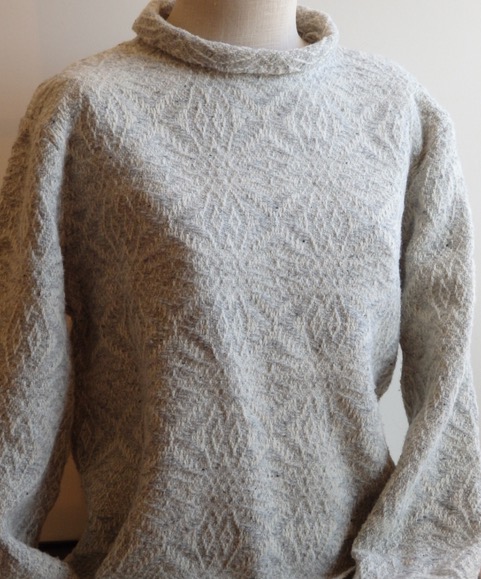
    Jan Josifek wore her show and tell, a beautiful woven sweater. Jan sent this photo, and wrote of her sweater,

    Mary Skoy used to teach a woven sweater class at the Guild which I couldn’t take. Working from inspiration from Mary on my own, I have tried a few all woven sweaters. For this one I used the 6-shaft American Snowflake draft in the May/June 2014 issue of Handwoven Magazine, changing the satin section between the advancing twill sections to point twill “M”, and treadled accordingly.
    I was looking for a mill spun yarn that resembled handspun yarn and went with Brooklyn Tweed “Loft” for the weft and Harrisville Designs Shetland for warp. I used a commercial sweater sewing pattern cut to my size.

    Linda Sorrano showed a photo of the brilliant mechanism her brother-in-law rigged up for her to take her draw loom attachment out of the way and easily retrieved–up in the air! This photo is from Linda’s lovely Instagram feed.


    Much of the meeting was taken up with discussion of our just-started group warp project. We are making rosepath pillow tops, inspired by a Swedish book by Anna Östlund, Från Januariblues till Decemberröd: 18 kuddar i rosengång (From January Blues to December Reds: 18 pillows in rosepath). More on this project will appear on the blog soon.


  • Happy holidays from the Scandinavian Weavers Study Group

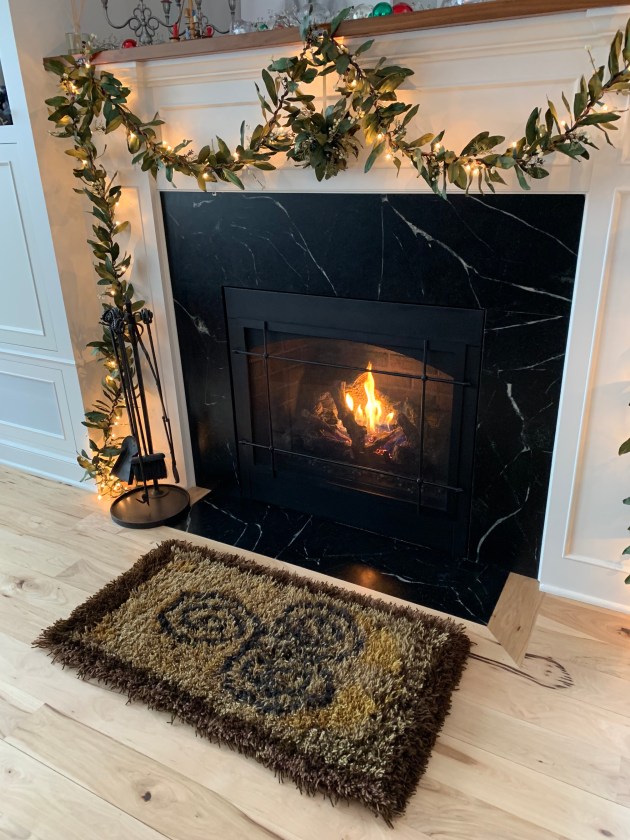
    Our group enjoyed a holiday party at the home of Brenda Gavin-Chadwick. Her home is open and light-filled, with clean Scandinavian lines. Only one person brought a show-and-tell item, but somehow Marilyn Moore must have sensed that Brenda’s hearth would be the perfect spot for staging her rya. The three-spiral design echos the three stages in the life of a woman–maiden, mother, and crone.

    Marilyn’s rya started as a way to use up a mass of brown yarn she had–but of course she ended up having to buy more and desperately trying to match colors. The resulting color blending across the whole piece adds richness.

    Happy holidays and happy weaving in 2020!

  • Lisa’s Linen

    At the last Scandinavian Weavers meeting, Lisa Torvik brought a enormously long roll of just-off-the-loom linen runners. This project deserved a real celebration–she said the warp had been on the loom for for perhaps two decades in all. This was the moment of cutting it off at home.

    Lisa suggested it could be a holiday decoration?

    Here are two of the lovely runners.  It was sort of a shame to cut them apart, Lisa wrote, but then they are like puppies–you can’t keep them all! Perhaps several of her relatives are getting wonderful Christmas gifts?

    On the top is one of Lisa’s favorites, with pink stripes. The bottom one was inspired by colors seen on an autumn trip to New Hampshire.


  • The Monk’s Belt Megado Project…Getting Underway

    The Dobby Weavers Group at the Weavers Guild of Minnesota, masters of the many-shafted computerized Megado loom, is going Scandinavian this fall. They are joining with the Scandinavian Weavers Study Group to weave a complex version of monk’s belt, one with blocks of pattern. In this joint project between the two study groups, the Dobby Weavers will do a bit of Scandinavian weaving, and the Scandinavian Weavers will get an opportunity to try out the beautiful Megado loom. The inspiration piece was one owned by Melba Granlund.

    We decided to warp the Megado with the same warp, 20/2 cottolin at 24 epi, as the recent monk’s belt group project the Scandinavian Weavers wove on the Glimakra at the Weavers Guild.

    I promised to compile some ideas for designing pieces for monk’s belt, some ways to think of the color of pattern weft and background weft, materials, and variations in stripe widths. There’s a crazy amount of variation possible using the “language” of these elements. Several of the examples from this quick and dirty compilation are from pieces woven by the Scandinavian Weavers Study Group in our recent group project.

    Here are a couple of photos from a coverlet book from  1977, Åkleboka: Nye Mønstre i Gamle Teknikker, by Torbjørg Gauslaa and Tove Østby, Oslo: Landbruksforlaget, 1977. This piece is on wool warp. Note the use of a monochromatic color palette, with color changes made within long stretches of the same lines.

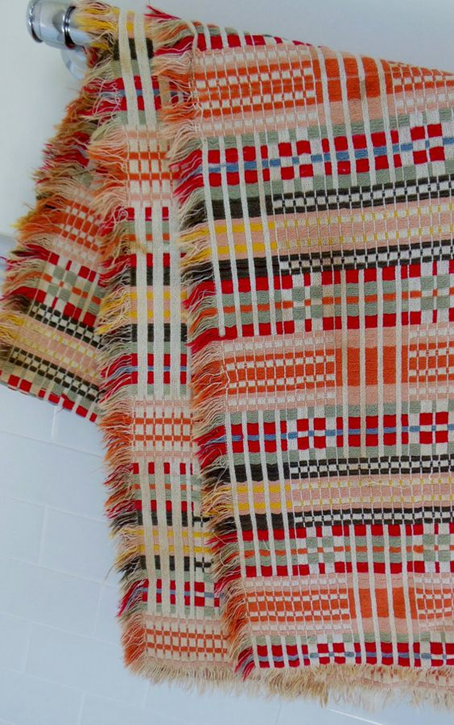
    The second piece is completely asymmetrical, with a large difference in the long and short pattern elements.

    Below, Sara Okern’s minimalist design used areas without pattern warp, but with stripes of varied linen colors.

    Melba Granlund used several colors in bands of varying widths.


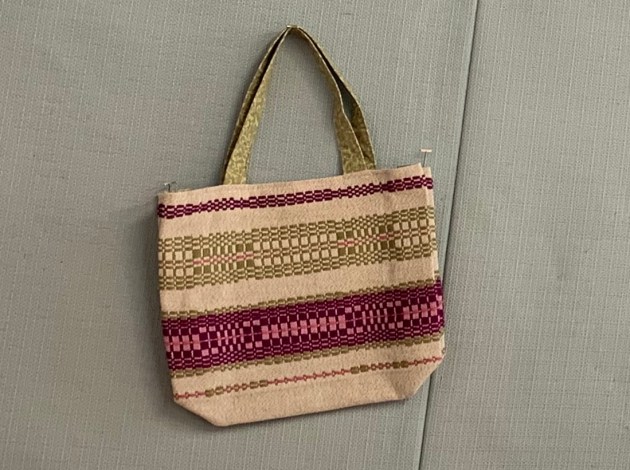
    Notice two things in this bad photo of Jan Josifek’s beautiful small bag. It’s a wonderful way to use a small piece of weaving!  In the top band, a single skinny band of pink makes it pop. In the bottom band, note the use of pink in the background tabby weft–subtle and beautiful.

    Many traditional monk’s belt pieces were woven with fairly consistent stripe sizes, making square, overall patterns.  This example is from Simple Weaves: Over 30 Classic Patterns and Fresh New Styles, by Birgitta Bengtsson Bjork and Tina Ignell. (English translation) Vermont : Trafalgar Square Books, 2012. The monk’s belt is shown as a backing for a skinnfell, a sheepskin, another traditional use of lightweight overshot coverlets.

    Another monk’s belt piece on a skinnfell.  A very regular pattern with beautiful use of varying colors for long and skinny parts of the pattern. From Åklær, Å Kle ei Seng, Å Veve et Åkle. Trondheim : Trøndersk Forlag, 2002.

    This image is from the same book, but of a skillbragd coverlet.  Still, it shows that a piece can be designed symmetrically in broad bands.

    to be continued…..  Robbie LaFleur