The last weekend of the Weavers Guild of Minnesota and Norway House exhibition, “Traditional Norwegian Textiles: American Reboot,” includes special programming. Afternoon with an Expert, on Saturday, September 9, from 1-3:30 pm, features Laurann Gilbertson, Curator at the Vesterheim Norwegian-American Museum. Her lecture, “Warmth and Color: Traditional Norwegian Coverlets,” will begin at 1 pm. Following the lecture, Gilbertson will conduct an Antique ID clinic. Members of the public are encouraged to bring Nordic textiles to learn more about their age, origin, and function (but no appraisals). Perhaps you have inherited a coverlet or hanging, but know little about it? Maybe you bought a beautiful textile at an antique store or thrift shop and you wonder about its origins?
All those attending the lecture and visiting the exhibit are welcome to stay for the Antique ID portion, a special opportunity to see even more Scandinavian textiles.
Afternoon with an Expert: Laurann Gilbertson at Norway House
Saturday, September 9, 2017
12-3 pm: Visit the exhibition, “Traditional Norwegian Textiles: American Reboot”
1 pm: “Warmth and Color: Traditional Norwegian Coverlets
2 pm: Antique ID clinic
Location: Norway House, 913 E. Franklin Avenue, Minneapolis, MN 55404
Cost: $5; Free for members of Norway House and the Weavers Guild of Minnesota
When? 12-3 on Wednesday, August 30 and Sunday, September 3, 2017 Where? At Norway House, 913 E. Franklin Avenue, Minneapolis, MN 55404
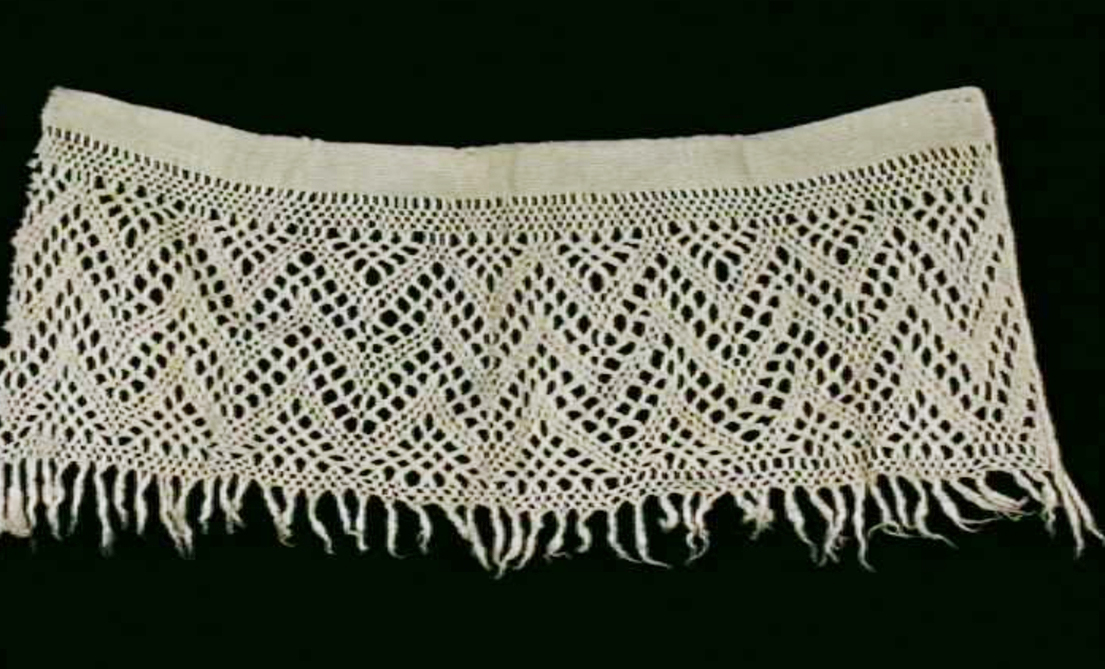
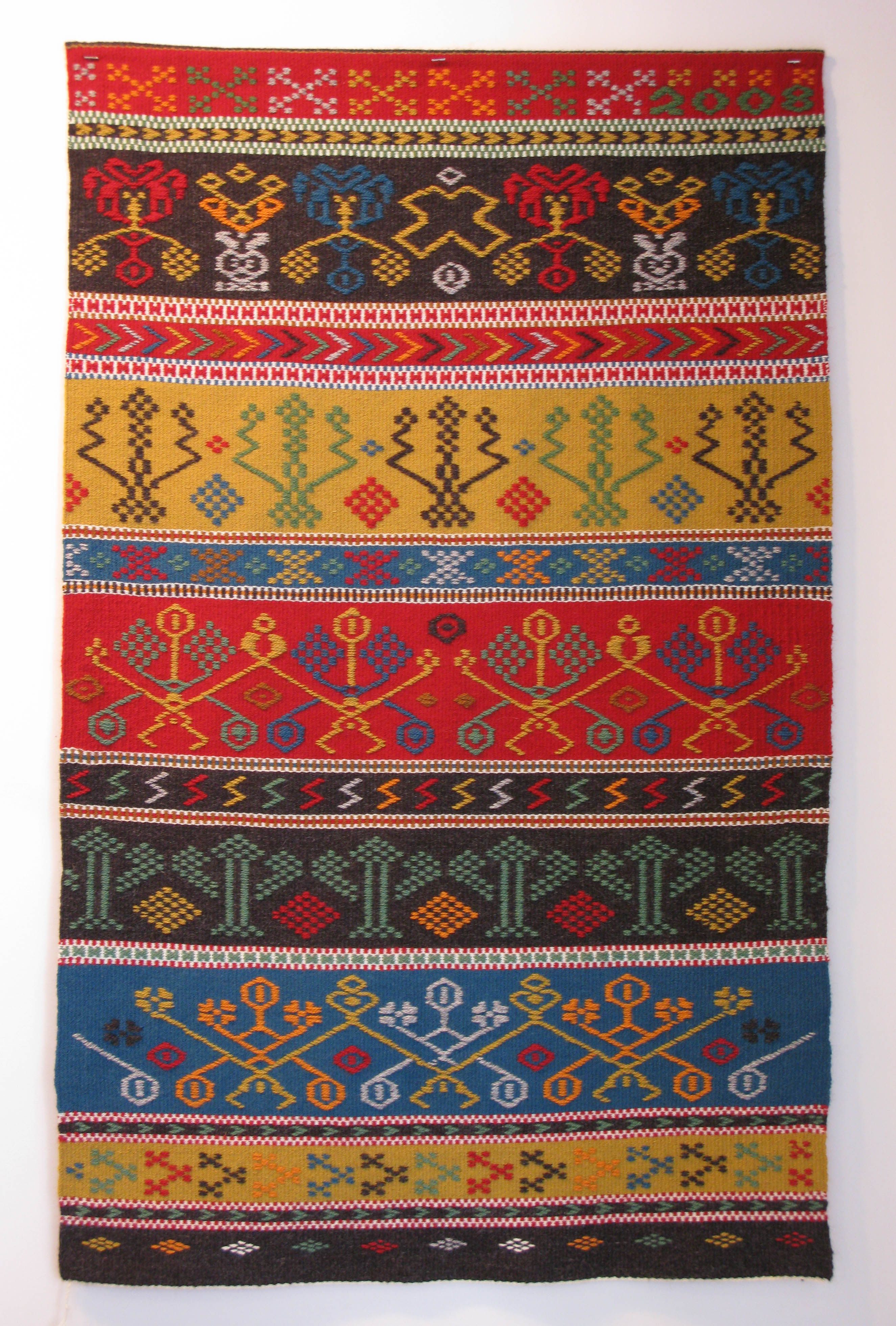
As part of the exhibition, “Traditional Norwegian Weaving: American Reboot,” Lisa Torvik will demonstrate the Norwegian handcraft of firfletting, a four-strand braiding technique traditionally used to make ethereal linen hangings for windows or to hang in front of fine weavings. The braided technique was also typically used for the borders of Christmas towels.
The piece shown below is from the Valdres Folkemuseum (details here). It is appropriate to show a piece from Valdres because that is where demonstrator Lisa Torvik attended husflidsskole (handcraft school) and learned the technique.
Firfletting has been designated a handcraft in danger of disappearing on the Norwegian Husflid (Handcraft Association) Rødliste (the Red List), and a lovely short film about the technique was produced in Bø i Telemark. Moderator Torhild Aavik describes the tradition and demonstrates the technique, which goes back to Viking times. She shows a traditional way firfletting is used in Bø i Telemark, as two panels hung on each side of a window. In the film, she is reproducing a pattern from the area by looking at a photograph of an old piece. Although firfletting was largely practiced by women, that piece was made in the 1800s by Anders Spjote, a man from the area.
To finish, Torhild says, “We will be much poorer of we turn our backs on this handwork and others like it. They can bring a bit of the past into the present.” The film is in Norwegian, but instructive even if you can’t understand the dialogue. The film is here.
Here is another photo of firfletting, a piece from the Norsk Folkemuseum. (Details here)
Don’t miss Lisa’s time at Norway House, which will be in addition to the regularly-scheduled rutevev demonstration on the loom in the exhibition.
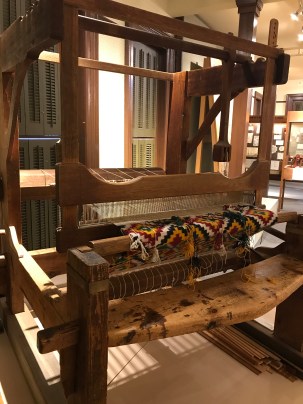
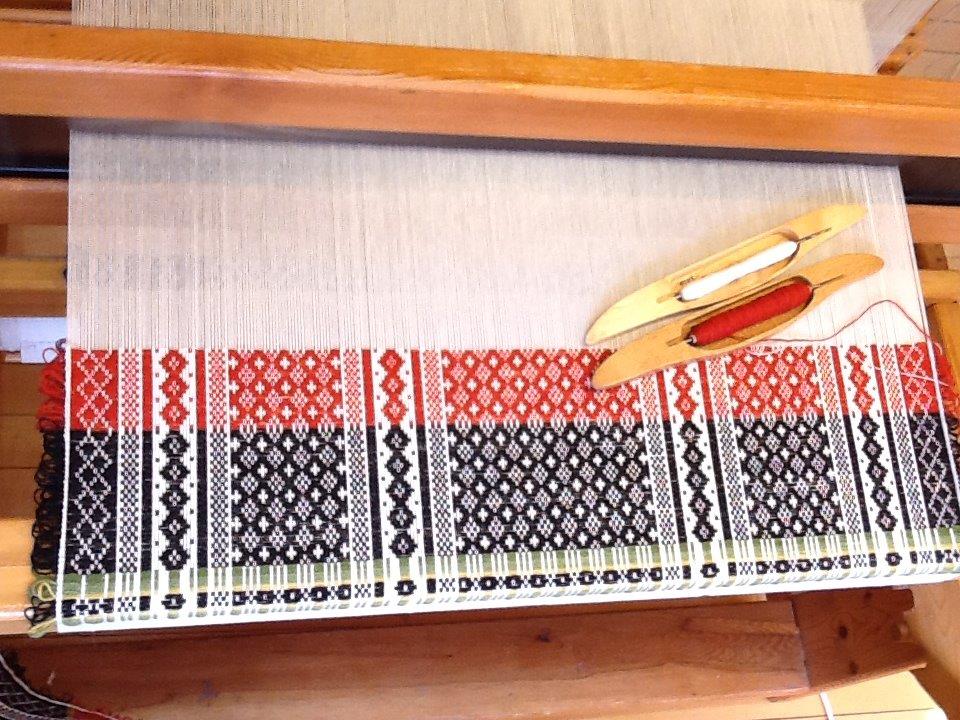
Each Wednesday and Sunday until September 10 (12-3 pm), volunteers from the Weavers Guild of Minnesota Scandinavian Weavers Study Group are demonstrating weaving in the Galleri at Norway House, part of the exhibit “Traditional Norwegian Weaving: American Reboot.” Slowly, the narrow runner in rutevev (square weave) is taking shape. It’s hard to know how long it takes to weave the runner, however, because part of the weaving time is devoted to talking to visitors. We explain the weaving being done or discuss other pieces in the show. That’s the purpose of being there–so please come and distract the weaver!
This Sunday, August 13, Judy Larson will demonstrate weaving and Robbie LaFleur will give a gallery talk at 2 pm. Please join us.
The runner is a variant of a large rutevev in the exhibit, one that was also woven by people demonstrating weaving. In that case, it was the Oneota Weavers Guild in Iowa who wove on a large loom at the Vesterheim Norwegian-American Museum. In the past couple of decades, the guild members have woven four large rutevev coverlets.
Again, it would be hard to calculate how long it took to weave the piece.
Jan Mostrom wove a large rutevev. It’s not in the exhibit; this photo is from her home. The size is roughly 36″ by 55″. Big.
Jan said that it took her about one hour to complete one row of squares. But, keep in mind that she is experienced and fast. We counted the rows and estimated time for weaving the top and bottom bands and came up with an estimate of 120 hours for the whole piece. Of course that doesn’t include the time to warp the loom, get the materials, graph out the pattern, or finish the edges after it came off the loom. It couldn’t have been less that 150 hours.
The weaving time for many of the complex weavings in the American Reboot exhibit was considerable. Come and enjoy the beautiful results.
Four of Robbie’s pieces at Norway House have similarities; they all include bands of color and design and are woven in fairly large scale in Scandinavian wool.
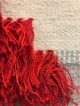
Traditional Norwegian symbols often appear in Robbie’s weaving, sometimes in an unexpected scale or materials. “Scandinavian Star” highlights a single Norwegian star, dense in shade of red rya pile. Read more about the piece in “An Eight-Pointed Star in Rya.” ($900)
Bright bands of red, orange, and pink compose a wall hanging (or rug) made in Flesberg technique. “Flesberg” is a three-shaft bound weave technique found in that area of Norway. Read more in “A Red Rug for the Vesterheim Exhibit.” ($800)
Recently, Robbie has been experimenting with Danskbrogd, a boundweave technique found in the area of Vest Agder, near Kristiansand in Norway. Here is a detail from a piece seen in Norway earlier this summer.
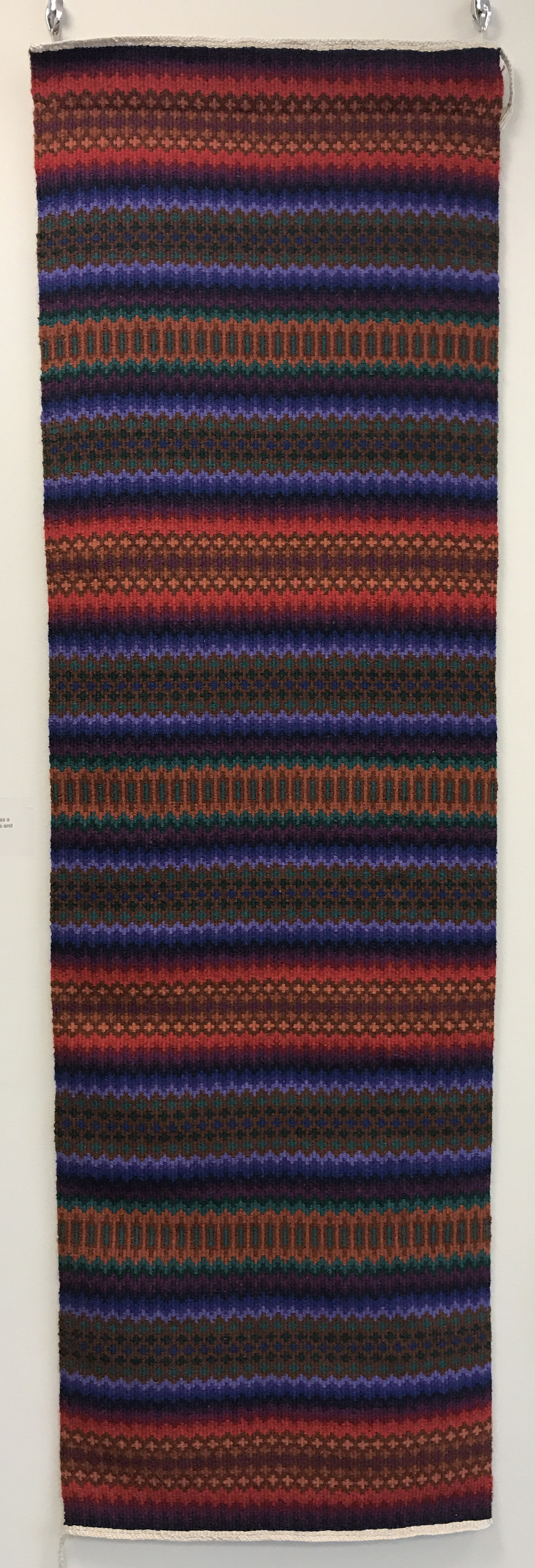
Robbie was steeped in gray during a gray winter month, so the next step was to move to color. The X design became bigger and bolder, on stripes of purple. Read more in “A New Weaving, and Red Bits for the Birds.” ($900)
Biography:
Robbie LaFleur, from Minneapolis, Minnesota, has been following a thread of Scandinavian textiles since she studied weaving at Valdres Husflidsskole in Fagernes, Norway in 1977. She has continued her study with Scandinavian instructors at workshops in Norway and the U.S. Recent projects include interpreting Edvard Munch’s “Scream” painting into a variety of textile techniques and weaving tapestry portraits of her relatives. She was awarded the Gold Medal in Weaving from the Vesterheim Norwegian-American Museum in 2006. Robbie coordinates the Weavers Guild of Minnesota Scandinavian Weavers Study Group and publishes the quarterly online newsletter, The Norwegian Textile Letter.
Artist Statement:
I am a handweaver of contemporary textiles inspired by Scandinavian folk textiles. The language of my looms is based on centuries-old techniques, learned in weaving school in Norway. The core graphic impact of old folk textiles drives each new weaving, in a search for balance, color and boldness. Even when the planning process is computer-assisted, or a technique is done at a new scale or in unusual materials, I honor the fine craftsmanship of the past.
The exhibit will be up at Norway House in Minneapolis through September 10.
There are fabulous weavings in the Norway House Galleri during the run of the “Traditional Norwegian Weaving: American Reboot” exhibit, but there are more in Norway House atrium area, too–a pop-up exhibit of weaving by the co-curators, Jan Mostrom and Robbie LaFleur. This post features Jan’s weavings, and begins with her background.
I started weaving in a January term at Luther College in Decorah, Iowa when I was twenty years old. I was fortunate to have Lila Nelson as my first teacher and to have her continue as a mentor through the Scandinavian Weavers Study Group. I have been an active participant in Scanweavers since its beginning over thirty years ago. Lila provided the thread to connect me to Vesterheim where I took many weaving classes from Norwegian instructors in their Folk Art program. I also have taken six textile tours with Vesterheim led by Laurann Gilbertson.
When I took my first weaving class at Vesterheim, I met Syvilla Bolson who became a lifelong friend and mentor. She encouraged me to teach weaving at Vesterheim where I have taught classes including rutevev, rya, krokbragd, danskbrogd, Vestfold technique and Norwegian west coast coverlet techniques. I have also taught at the Weavers Guild of Minnesota, a Michigan weaving conference and at the first Norwegian Textile Conference in Decorah. I organized the first study group through the Norwegian Textile Letter (NTL) for the exploration of danskbrogd and have participated in two more NTL study groups. I have been a frequent author of articles in the NTL on weaving technique. I have a great passion and love for researching and teaching weaving.
“Folk Dance” by Jan Mostrom (NFS) hangs behind the desk where Galleri guests are greeted. Jan wrote, “I was inspired by a coverlet from Vesterheim that had both single point krokbragd and double point krokbragd. My weaving has single krokbragd borders with a double krokbragd center. The joyful colors reminded me of the spinning colors of Norwegian folk dancers. ”
Nearby is Jan’s “Northland” (NFS), a weaving in wool with rows of surprising rya knots — in reindeer skin. “I purchased a dyed red reindeer skin in north Norway on a Textile Tour to learn about the Sami culture of northern Scandinavia and Russia. This danskbrogd weaving of tree forms against a snowy white background has red leather rya knots. The colors, spare trees and reindeer leather remind me of Norway above the Arctic Circle.”
Jan’s long krokbragd weaving (NFS) was undertaken as a color study of brighter colors and values. The red sections have a glowing fire aspect.
Jan Mostrom explains her weaving “Garden Path.” ($1000, 50″ x 27″) “I wanted to create a non-traditional rutevev design that was colorful and whimsical. Garden Path was the result. It is heavy enough to use as a rug and also works on the wall either vertically or horizontally. The tapestry was woven with butterflies made up of a heavy two ply rya yarn and a thinner single ply yarn. The diffference in texture adds texture and the surfaces of the two yarns reflect light differently to create a little twinkle.”
Finally, Jan’s “Forest Echos” (photo coming, NFS) features beautiful browns of nature. Her explanation is perfect for those weaver-viewers who might want to know, “How did she do that?” Jan wrote,
This boundweave piece had an irregular twill threading. I used danskbrogd, a pick up technique, to replace some areas of the pattern with the background color. For instance, if it was woven as threaded, there would be narrow columns of color between the arrow shapes at the top and bottom of the weaving. By using danskbrogd, I could remove those colored bars and cover that area with the background brown and allow the arrow points to dominate that area of the weaving. The irregular threading created a repeated pattern that reminded me of echos, while the colors spoke of the forest to me.
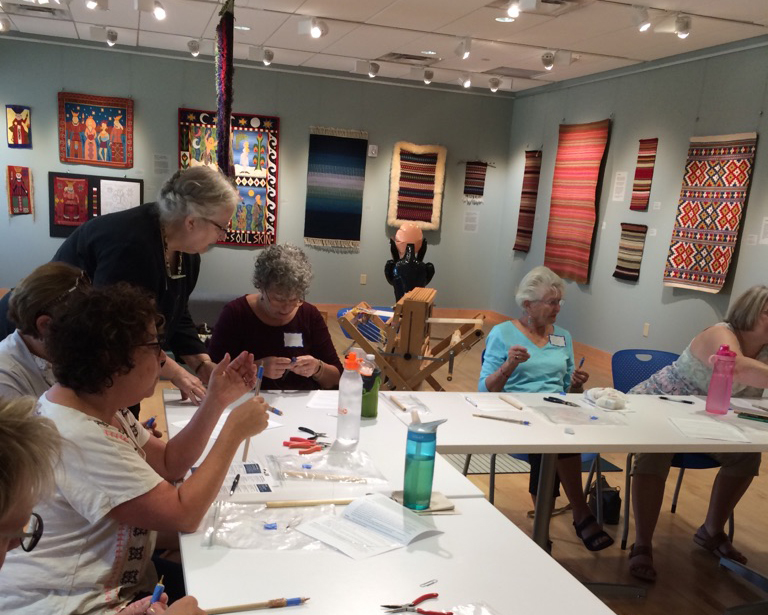
There is still time to register for the second “class in the Galleri” event connected with the Norway House exhibit, “Traditional Norwegian Weaving American Reboot.” Last week, students enjoyed Melba Granlund’s “Viking Knit Bracelet” class in the light and textile filled Norway House Galleri.
On August 14 and 21 the Galleri will be filled with band weavers. Students will learn to weave intricately patterned and colorful bands found throughout Scandinavia and the Baltic regions, and used by the Sami people as embellishments on their folk costumes.
It’s a rare opportunity to learn while surrounded by beautiful traditional and contemporary weavings. Trade the sun and humidity for inspiration and weaving for a while this month. Sign up with a friend or family member!
Sami-Style Band Weaving, Mondays, August 14 & 21: 12:00pm – 4:00pm. $72 WGM member / $96 Non-Member. Additional details and sign-up here.
And don’t miss instructor Keith Pierce’s collection of beautiful bands on display in the show.
If you want to see weavings made in the Norwegian tradition, the Midwest has been perennially good location. The upcoming exhibit at Norway House, “Traditional Norwegian Weaving: American Reboot,” is the latest, and the largest in Minneapolis.
Each summer the Vesterheim Norwegian-American Museum holds a rich exhibit of many types of folk art, including weaving, rosemaling, knife-making, and wood carving. The objects in the National Exhibit of Folk Art in the Norwegian Tradition complement each other in a joint display. This exhibit is an opportunity to see many types of folk art done in a traditional style along with pieces created in more contemporary styles, but with clear Norwegian folk art influences. The current exhibit is up through July 29, 2017.
Two pieces in the American Reboot exhibit at Norway House from previous exhibits illustrate a traditional versus contemporary influence. Vestfold is a weaving technique named after the county in Norway in which several examples were found. The technique features embroidery-like patterns woven into a two-shaft ground weave, similar to Swedish krabbasnår. The coverlets were built up of bands of characteristic patterns that varied in color and pattern. Robbie LaFleur’s banded piece would fit in well with the 18th and 19th century Vestfold weaving found in that area; it uses many of the motifs found in the older coverlets.
In contrast, Rosemary Roehl used the same technique for a more recognizable image–birds march along bands of color divided by borders of flowers. Rosemary liked the pattern so much that she wove it both with a black background and another with a white background.
Rosemary Roehl
In her photo, Rosemary is wearing a bunad from the Nordfjord region, which she sewed herself. Her comment on this was, “Lucky for me they were weavers.” She wove the apron, which has flowers done with the vest fold technique, and the many yards of bands on the hem, waist and front and back of the bodice.
Since The Norwegian Textile Letter became digital, photos of all of the weavings in the Vesterheim National Exhibit of Folk Art in the Norwegian Tradition have been published each summer.
A beautiful blue runner in Telemarks teppe technique (a variant of skilbragd) is included in the “Traditional Norwegian Weaving: American Reboot” exhibit at Norway House (July 20 – September 10, 2017). It was woven by Syvilla Tweed Bolson, (1924-2011), who lived in Decorah and taught weaving in her home.
The blue runner is modest in size, which is not commensurate with her influence on the Scandinavian weaving community.
Several of the weavers who have pieces in the exhibit studied with her. Jeanine Swenson Ehnert traveled from central Minnesota down to Decorah to learn from Syvilla. And Corwyn Knutson wrote in his bio:
I was introduced to Syvilla Tweed Bolson, artist and weaver from Decorah, Iowa. Syvilla, a renowned weaver, graciously guided me in the Norwegian textile art. Syvilla taught me the basics of rya weaving and inspired me to be creative in design and motivated me to produce many beautiful pieces.
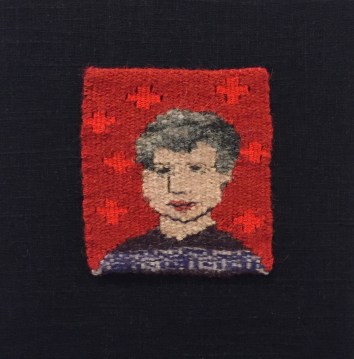
Jan Mostrom considered Syvilla a lifetime friend and mentor, and wove a sweet small tapestry portrait in homage to her.
In addition to teaching in her home, Syvilla was a dealer, feeding the expensive habit of area Scandinavian weavers–buying Norwegian yarn. She was so considerate and helpful. If you ran out of yarn and needed a skein, you could send an email and it nearly instantly showed up on your doorstep. One time I ran out of a gold color near the end of and she took some off a project on her own loom and sent it to me, just to make sure I could finish my weaving before more yarn arrived from Norway. (Read that story here.)
The members of the Scandinavian Weavers Study Group considered it a privilege to have Syvilla’s advice and support and friendship.
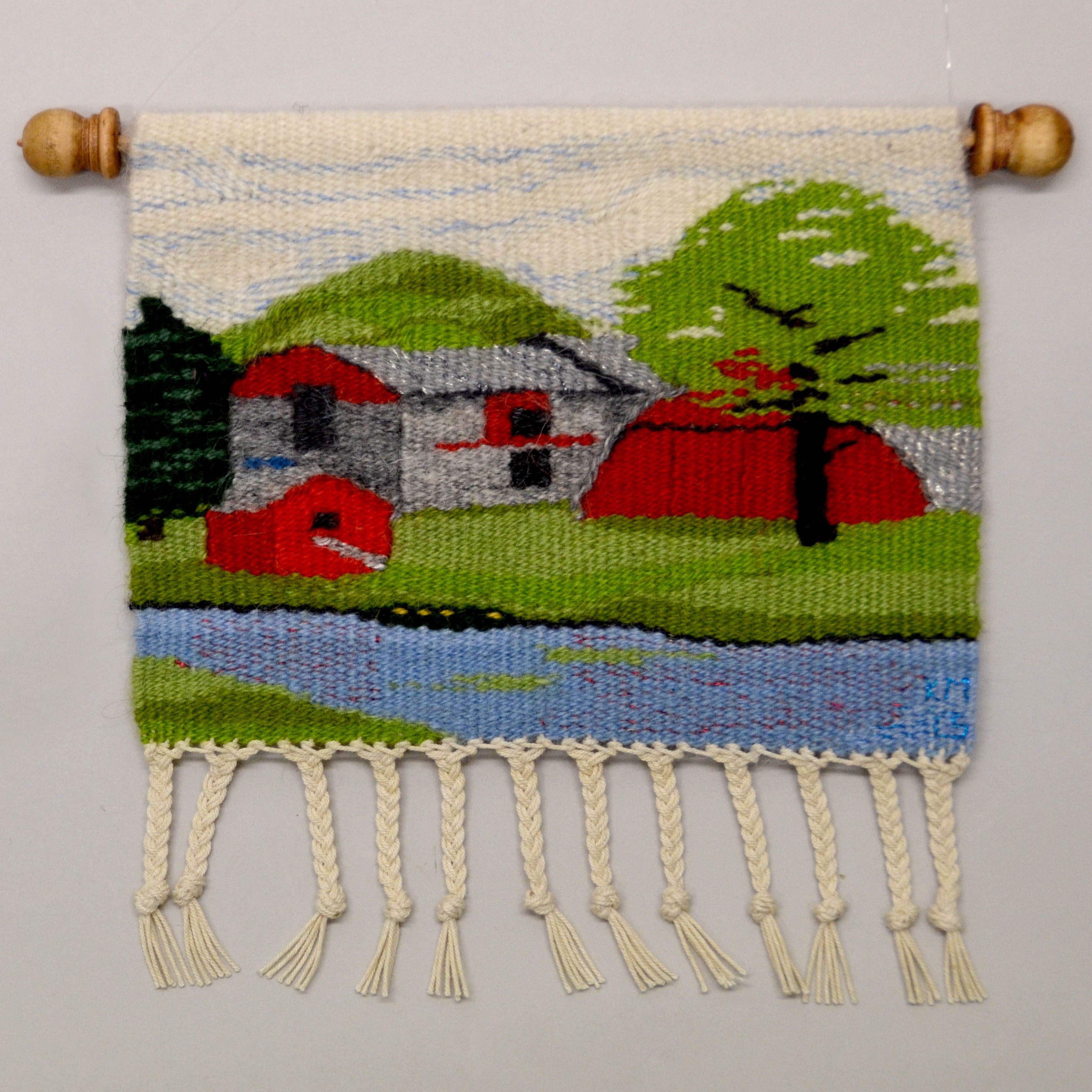
History. Color. Amazing workmanship. Funny images. Text and depth in fiber. You will find these things in pieces in the exhibit at Norway House, “Traditional Norwegian Weaving: American Reboot,” up from July 20-September 10. You will also find stories. In two small tapestries at Norway House you can find a three-generation weaving story that stretches from Norway to Minnesota.
Hans Berg painted his wife Inga at the loom.
Inga Berg, born in 1897 in Lier, Norway, married artist Hans Berg in 1921. They studied art on a months-long honeymoon throughout Europe. In 1929 Inga studied weaving theory at Sister Bengston’s weaving school in Oslo, Norway. She was prolific in spinning, dyeing, knitting, weaving and sewing. Often Hans would create a pattern for his adoring wife to weave.
Inga’s daughter Ellen was born in Oslo, Norway, in 1924. While in Norway, she became a registered nurse and a medical technologist. During WWII she helped hide her soon to be brother-in-law Gunnar Lislerud in the attic of their home. After WWII, in the 1950s, Ellen, along with her parents, moved to Minneapolis.
Ellen married Don Anderson in 1958 and they had two children, Kent and Karin. She was an excellent strawberry farmer, beekeeper, weaver, painter, cook and caregiver. She took care of both of her parents; Inga lived to the age of 106.
Ellen had a love for weaving and her homeland, so she joined the Weavers Guild of Minnesota and the Scandinavian Weavers group. Inspired by her mother’s work, she took a tapestry class at the Weavers Guild and the Vesterheim Norwegian-American Museum. Ellen liked to use tapestry patterns from Norway that were sold for studying tapestry weaving, like this image of the girl and the cow. There is no doubt this same weaving is found on the walls of many Norwegian homes, too.
In this particular weaving Ellen was interested in perfecting her tapestry techniques, and learning the various types of joining techniques that are characteristic of billedvev, Norwegian tapestry. This was Ellen’s last weaving before she died suddenly in 2003. She left an unfinished dream: to weave a picture of her beloved strawberry farm.
That brings us to the present, and the continuing weaving story of Karin Maahs, Ellen’s daughter, a member of the Scandinavian Weavers Study Group and a relatively new weaver. Karen relates the story of her tapestry in the American Reboot show.
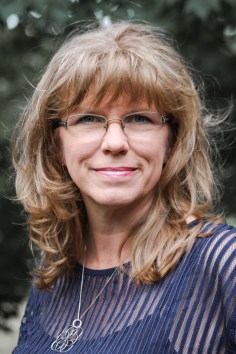
Karin Maahs
My inspiration was from the love of my mother. For years my mom wanted me to draw a weaving for her of our strawberry farm. After my mother’s death, I inherited all of my her and my grandmother’s wool, looms, spinning wheels, books and weaving journals. I initially joined the Scandinavian Weavers Study Group in 2003-2005. I took some beginning floor loom classes to learn how to use my mom’s loom. I was home schooling my children at the time so I stopped weaving and focused on them. After both my kids started college I could not stop the burning desire to work with the loom again. The big question was, “What should I start with?”
I knew there was some very special yarn in my stash, Kunstvevgarn Spelsau yarn in every color of the rainbow, shipped from my aunt in Norway to my mother. In an attempt to honor my mom, grandmother and aunt I decided to weave the tapestry my mom always wanted to do, a picture of “The Farm.” At first it was intimidating because I knew nothing about how to start. After some great encouragement from my mom’s Scandinavian weaving friends, and a plethora of books I inherited, I dove in. My thought was—I know I can paint this, so why not treat the yarn like it was paint? It didn’t take long to absolutely fall in love with working in wool. Especially this wool… my mom’s wool.
Karin has two grown children. Perhaps it is time to stretch the weaving tradition to a fourth generation? The Weavers Guild of Minnesota is a perfect place to learn.
Mark your calendars for a trip to Norway House between July 20 and September 10. Come to the opening! Thursday, July 20, 5-8 pm.
How did the contemporary weavers in the “Traditional Norwegian Weaving: American Reboot” exhibit learn to weave in traditional techniques? Sometimes it was a class, other times by studying an old textile. But books are key.
If you could create a state-by-state map showing ownership of weaving books in Norwegian, Minnesota would win, hands-down. Many weavers around the state have collections of books bought on trips to Norway or many times, from the Vesterheim Norwegian-American Museum. It doesn’t even matter if the owners don’t read Norwegian, weavers find inspiration from the photos and can read the drafts for the loom.
Jeanine Swanson Ehnert‘s beautiful and traditional weaving in skilbragd technique was inspired by the draft for a “Skilbragd from Fosnes” found in a book published in 2001 by the Nord-Trøndelag Husflidslag, Om Fellen Kunne Fortelle: Åkletradisjon til Inspirasjon by Randi Breistet (loosely translated as If the Blanket Could Talk: Coverlet Traditions for Inspiration). She used a draft similar to this one from the book.
Jeanine weaves in Frazee, Minnesota, with a concentration on traditional Norwegian weaving techniques. She also conducts weaving workshops and classes at the Vevstuen Nordic Weaving Studio, located in her home, which includes two floor looms and several table looms. Some workshops are for beginning weavers, and others focus more on Scandinavian design aspects.
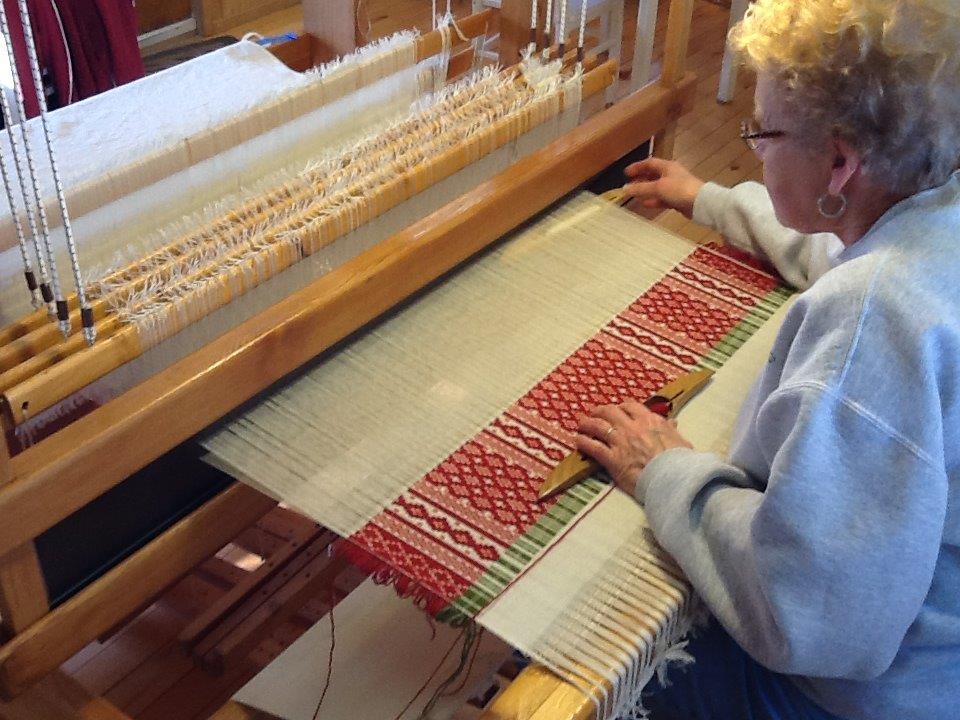
Here is Jeanine weaving the first section of her “Skilbragd fra Fosnes.”
The piece progresses.
Come to the wide-ranging exhibit at Norway House, July 20-September 10, “Traditional Norwegian Weaving: American Reboot” to see the full piece. Don’t miss it! During the run of the show, there will be classes, demonstration days, gallery talks, and a lecture. Full details here.

 The last weekend of the Weavers Guild of Minnesota and Norway House exhibition, “Traditional Norwegian Textiles: American Reboot,” includes special programming. Afternoon with an Expert, on Saturday, September 9, from 1-3:30 pm, features Laurann Gilbertson, Curator at the Vesterheim Norwegian-American Museum. Her lecture, “Warmth and Color: Traditional Norwegian Coverlets,” will begin at 1 pm. Following the lecture, Gilbertson will conduct an Antique ID clinic. Members of the public are encouraged to bring Nordic textiles to learn more about their age, origin, and function (but no appraisals). Perhaps you have inherited a coverlet or hanging, but know little about it? Maybe you bought a beautiful textile at an antique store or thrift shop and you wonder about its origins?
 When? 12-3 on Wednesday, August 30 and Sunday, September 3, 2017


 Each Wednesday and Sunday until September 10 (12-3 pm), volunteers from the Weavers Guild of Minnesota Scandinavian Weavers Study Group are demonstrating weaving in the Galleri at
  The runner is a variant of a large rutevev in the exhibit, one that was also woven by people demonstrating weaving. In that case, it was the Oneota Weavers Guild in Iowa who wove on a large loom at the Vesterheim Norwegian-American Museum. In the past couple of decades, the guild members have woven four large rutevev coverlets.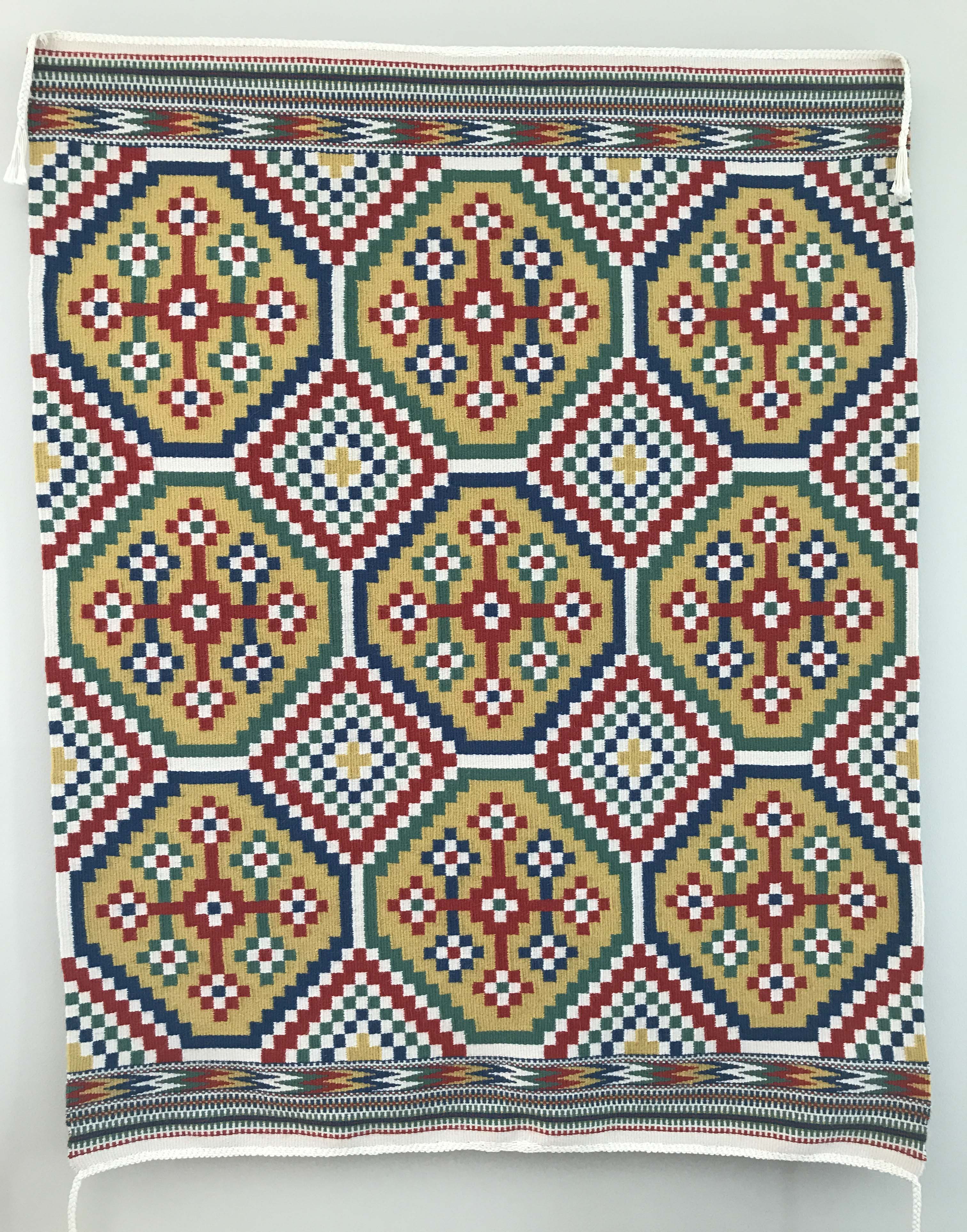

 Traditional Norwegian symbols often appear in Robbie’s weaving, sometimes in an unexpected scale or materials. “Scandinavian Star” highlights a single Norwegian star, dense in shade of red rya pile. Read more about the piece in “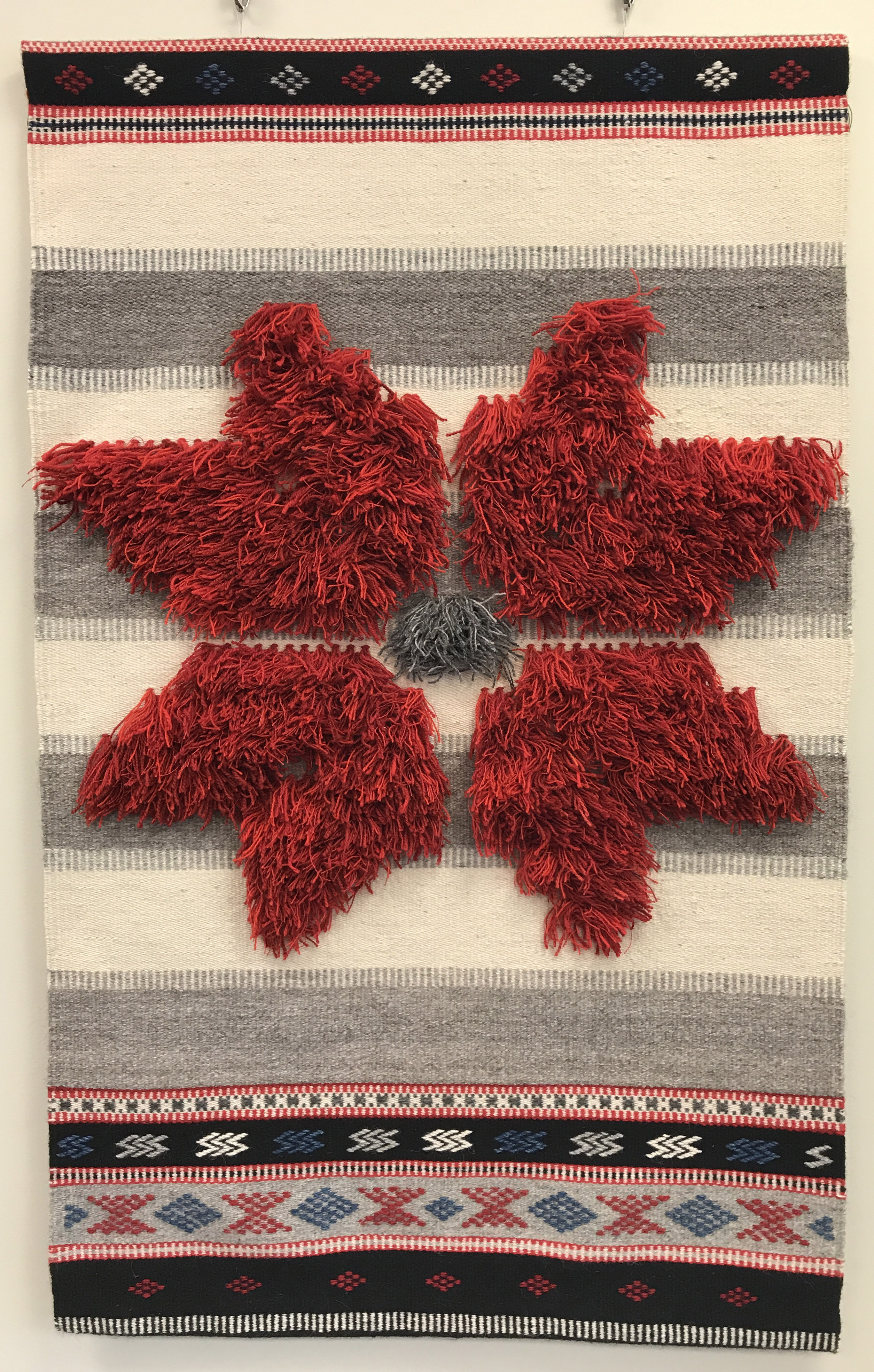
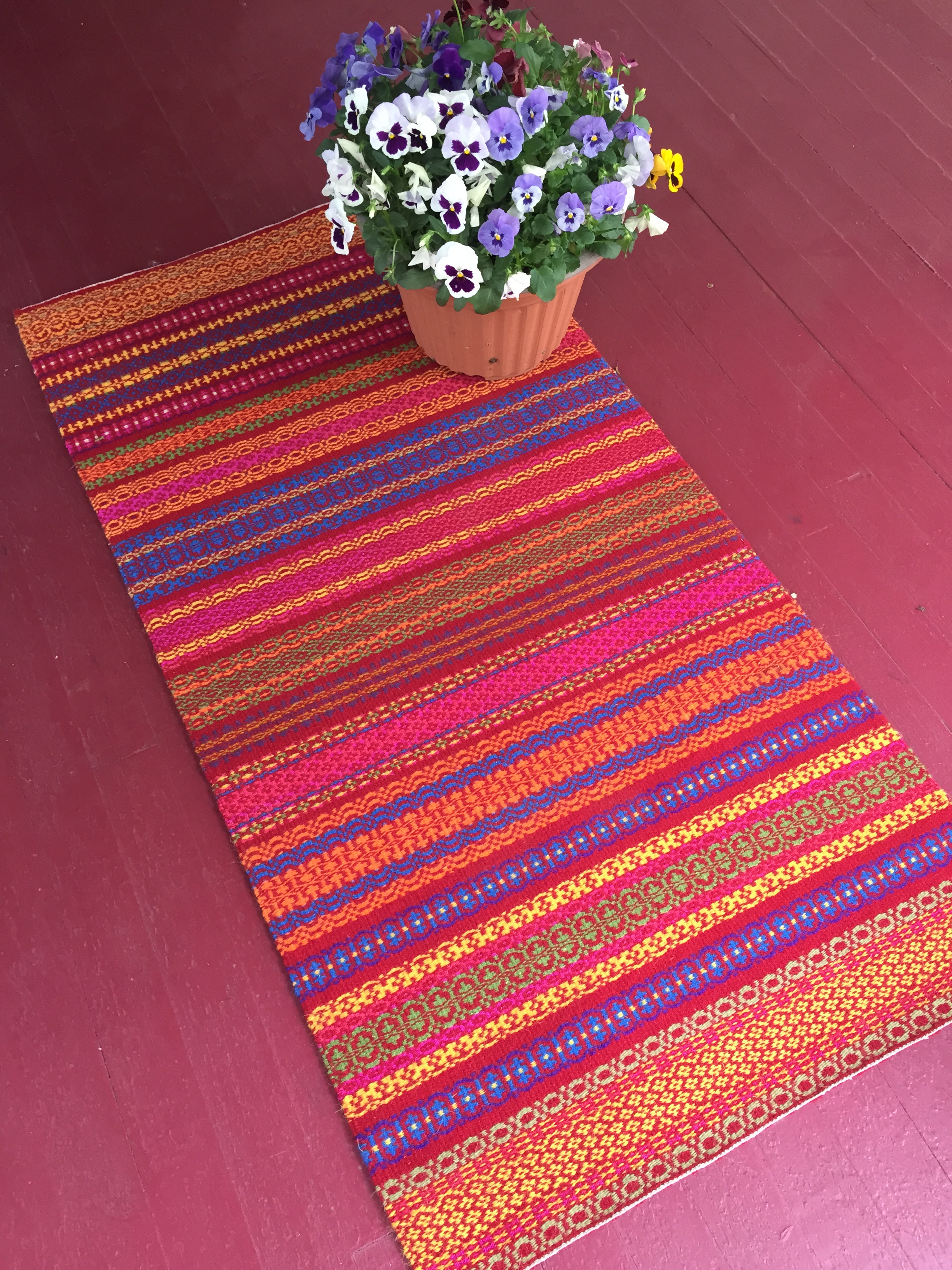
 Recently, Robbie has been experimenting with Danskbrogd, a boundweave technique found in the area of Vest Agder, near Kristiansand in Norway. Here is a detail from a piece seen in Norway earlier this summer.
 Robbie was steeped in gray during a gray winter month, so the next step was to move to color. The X design became bigger and bolder, on stripes of purple. Read more in “

 “Folk Dance” by Jan Mostrom (NFS) hangs behind the desk where Galleri guests are greeted. Jan wrote, “I was inspired by a coverlet from Vesterheim that had both single point krokbragd and double point krokbragd. My weaving has single krokbragd borders with a double krokbragd center. The joyful colors reminded me of the spinning colors of Norwegian folk dancers. ”
 Nearby is Jan’s “Northland” (NFS), a weaving in wool with rows of surprising rya knots — in reindeer skin. “I purchased a dyed red reindeer skin in north Norway on a Textile Tour to learn about the Sami culture of northern Scandinavia and Russia. This danskbrogd weaving of tree forms against a snowy white background has red leather rya knots. The colors, spare trees and reindeer leather remind me of Norway above the Arctic Circle.”




 Sami-Style Band Weaving, Mondays, August 14 & 21: 12:00pm – 4:00pm. $72 WGM member / $96 Non-Member. Additional details and sign-up



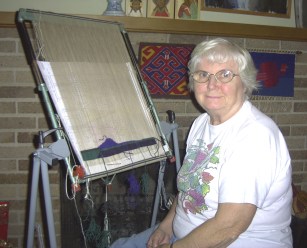
 Jan Mostrom considered Syvilla a lifetime friend and mentor, and wove a sweet small tapestry portrait in homage to her.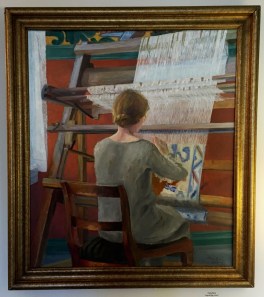
 Ellen married Don Anderson in 1958 and they had two children, Kent and Karin. She was an excellent strawberry farmer, beekeeper, weaver, painter, cook and caregiver. She took care of both of her parents; Inga lived to the age of 106.

 How did the contemporary weavers in the “
 Scandinavian Weavers Study Group