Emelie Röndahl ‘s self portrait. Photo by Robbie LaFleur
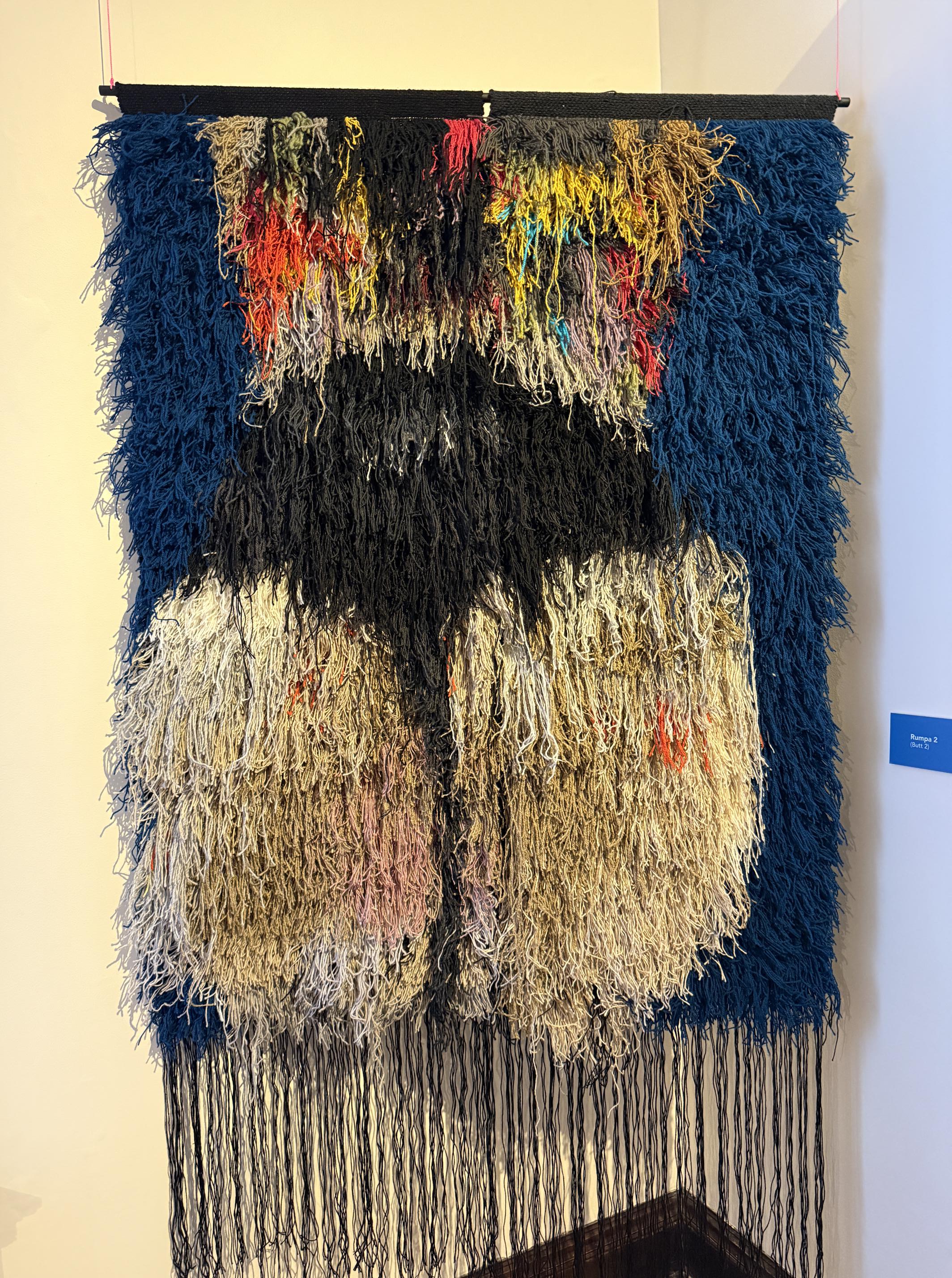
Members of the Scandinavian Weavers were honored to volunteer for a major exhibit by Swedish artist Emelie Röndahl at the American Swedish Institute (ASI) in Minneapolis. “Handwoven: Between Chaos and Order” is on view through June 7 in the historic Turnblad mansion.
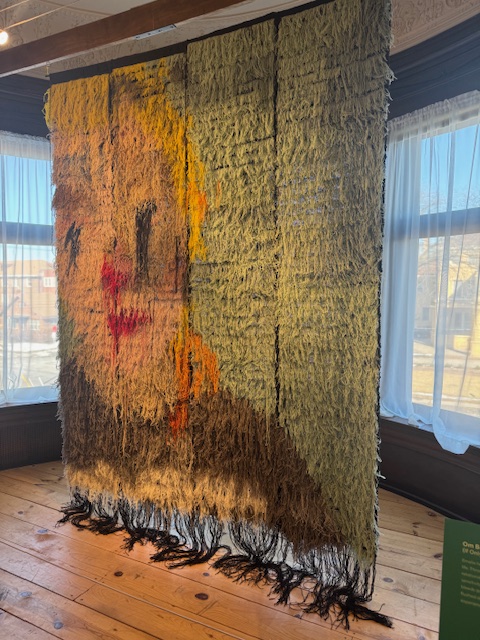
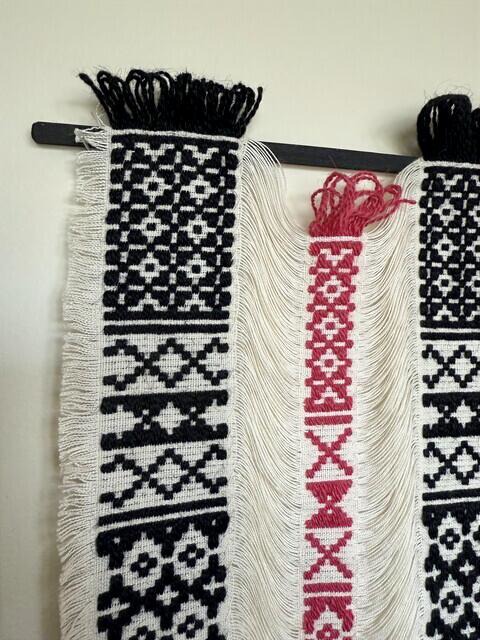
Emelie works in rya, a traditional pile weave once used for warmth. In Emelie’s vision, the humble rya become works of contemporary art, monumental in scale yet intimate in imagery.
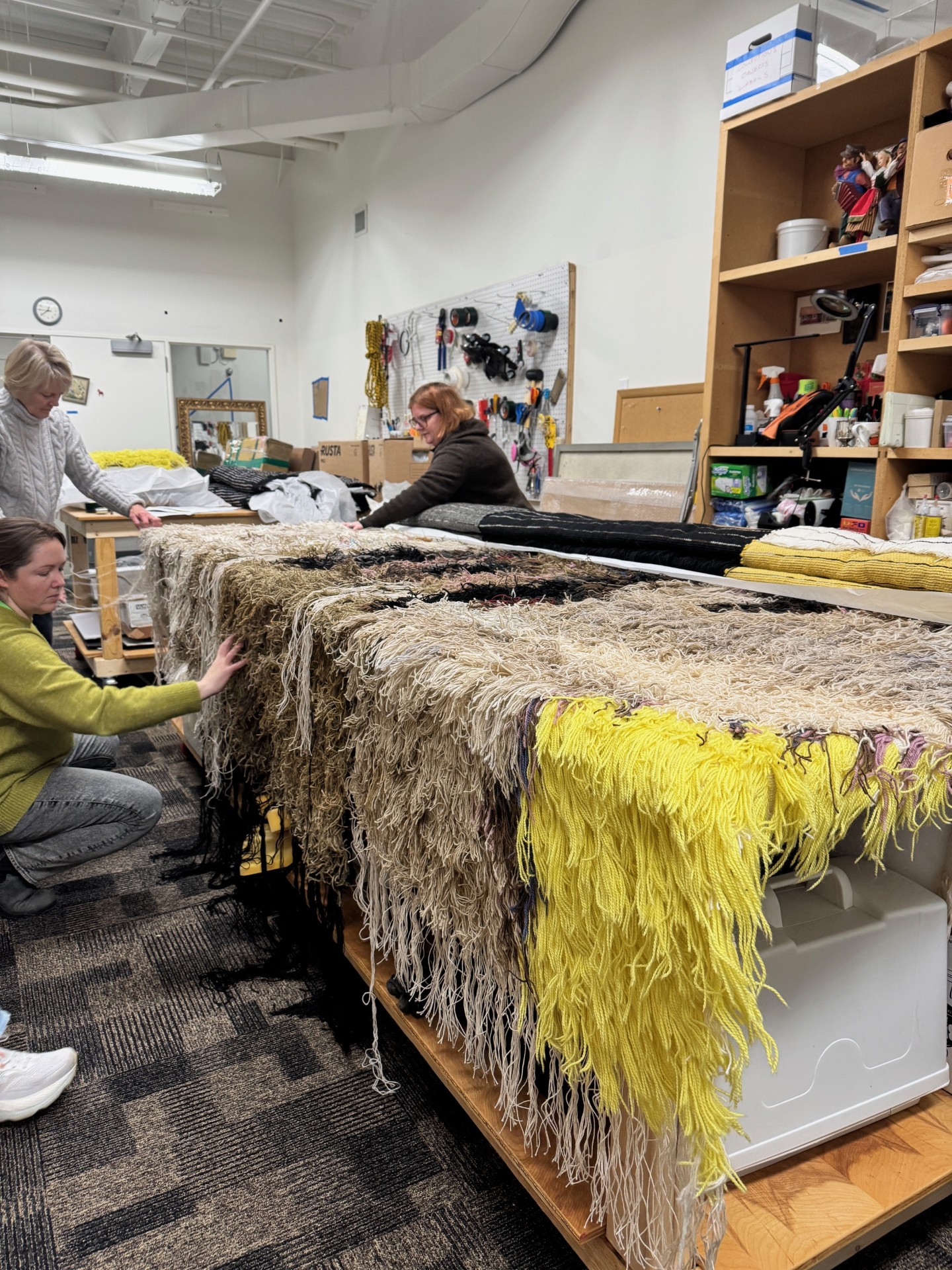
Several Scandinavian weavers were on hand to help un-box the massive textiles, which were shipped from Emelie’s studio in Sweden.
Photo by Lisa-Anne Bauch
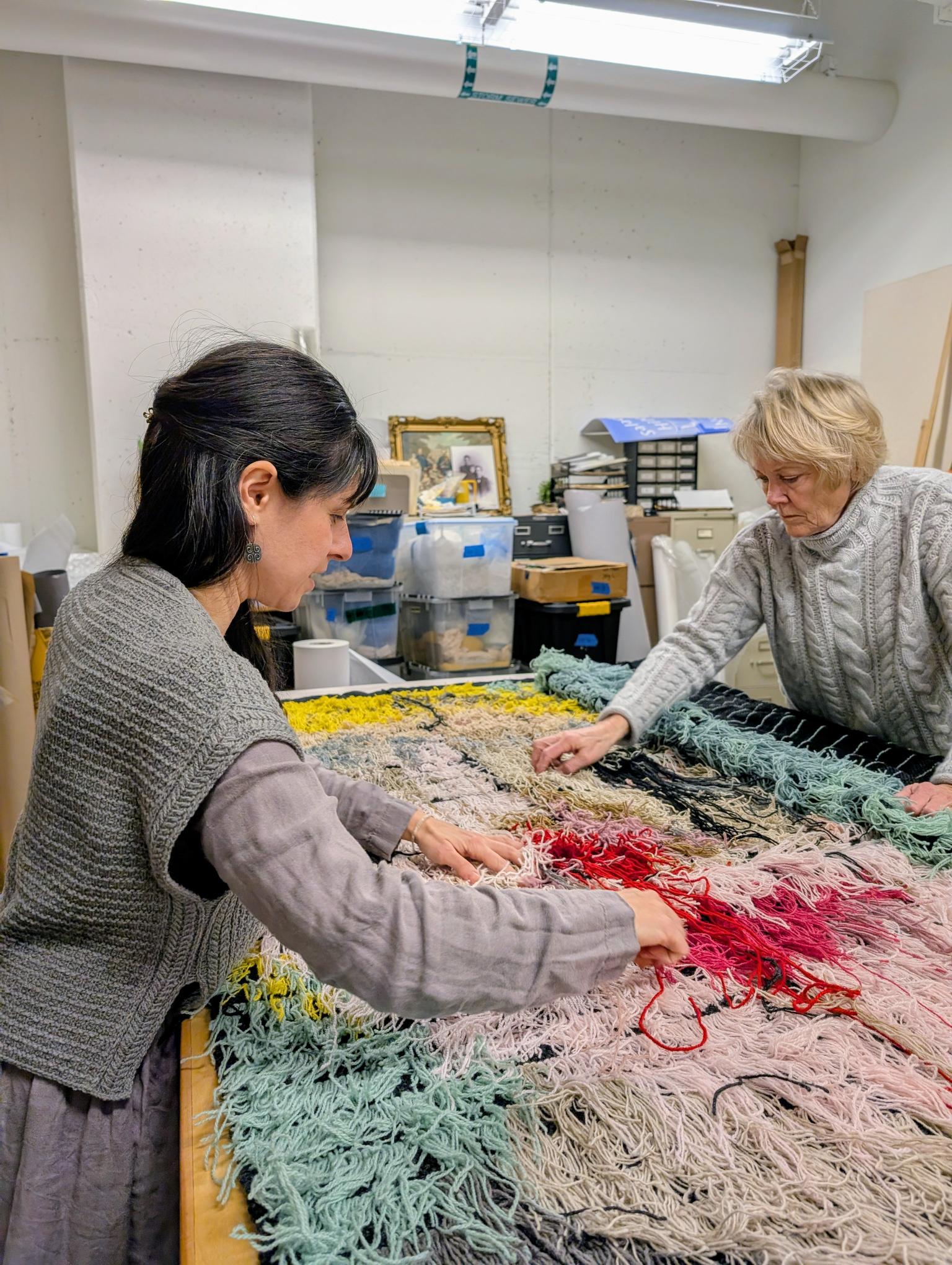
The rya were carefully finger-combed to lift the pile. It was such a treat to sink our fingers into the luscious fibers!
Alla Hale and Patti Bartlett comb a rya. Photo by Lisa-Anne Bauch
While in lockdown during Covid, Emelie began weaving portraits of family members, including her beloved dog Maxim. Combing the fibers, we felt like we were petting his soft fur. Such a good boy!
ASI staff and volunteers. Photo by Alla Hale
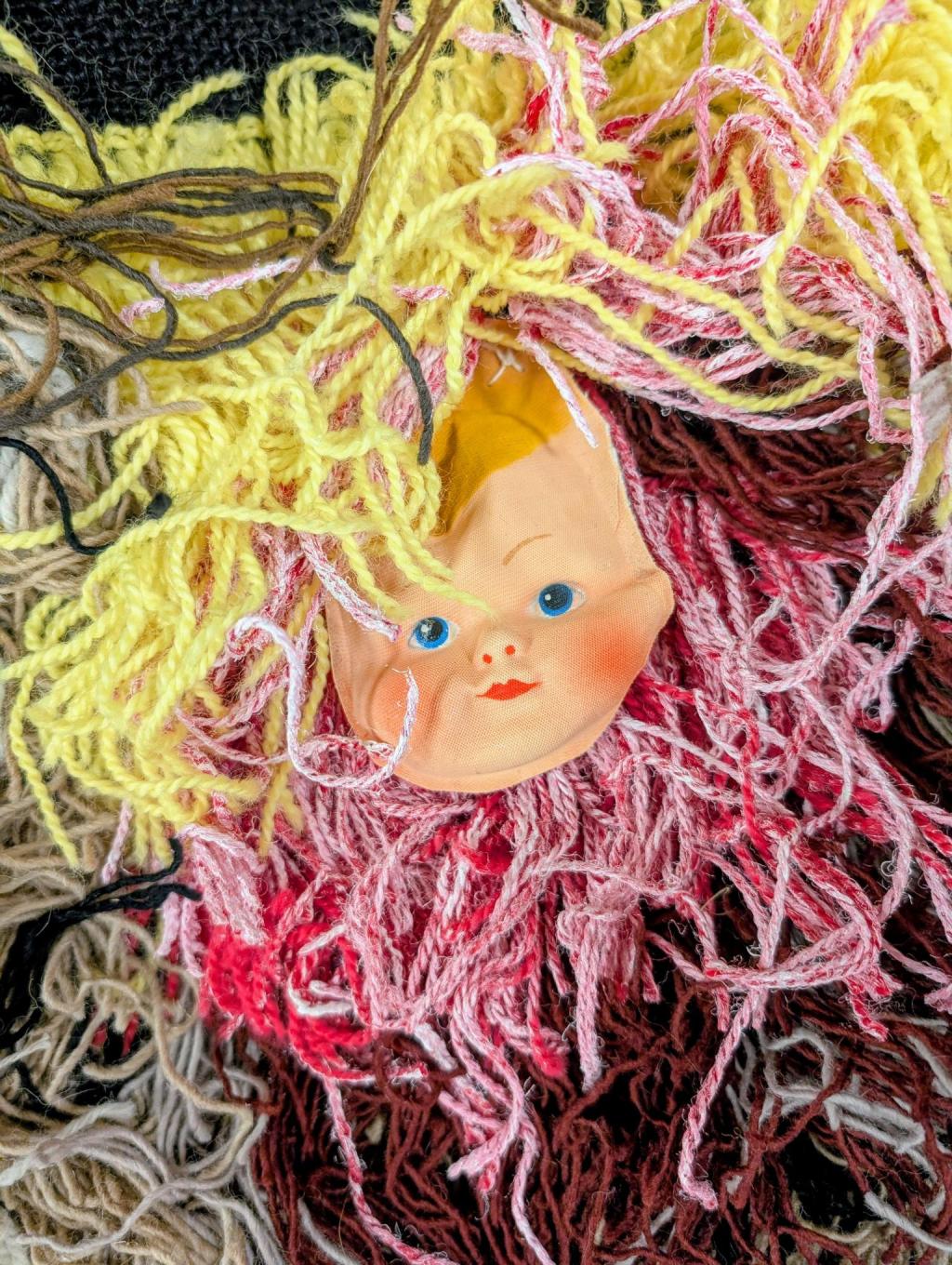
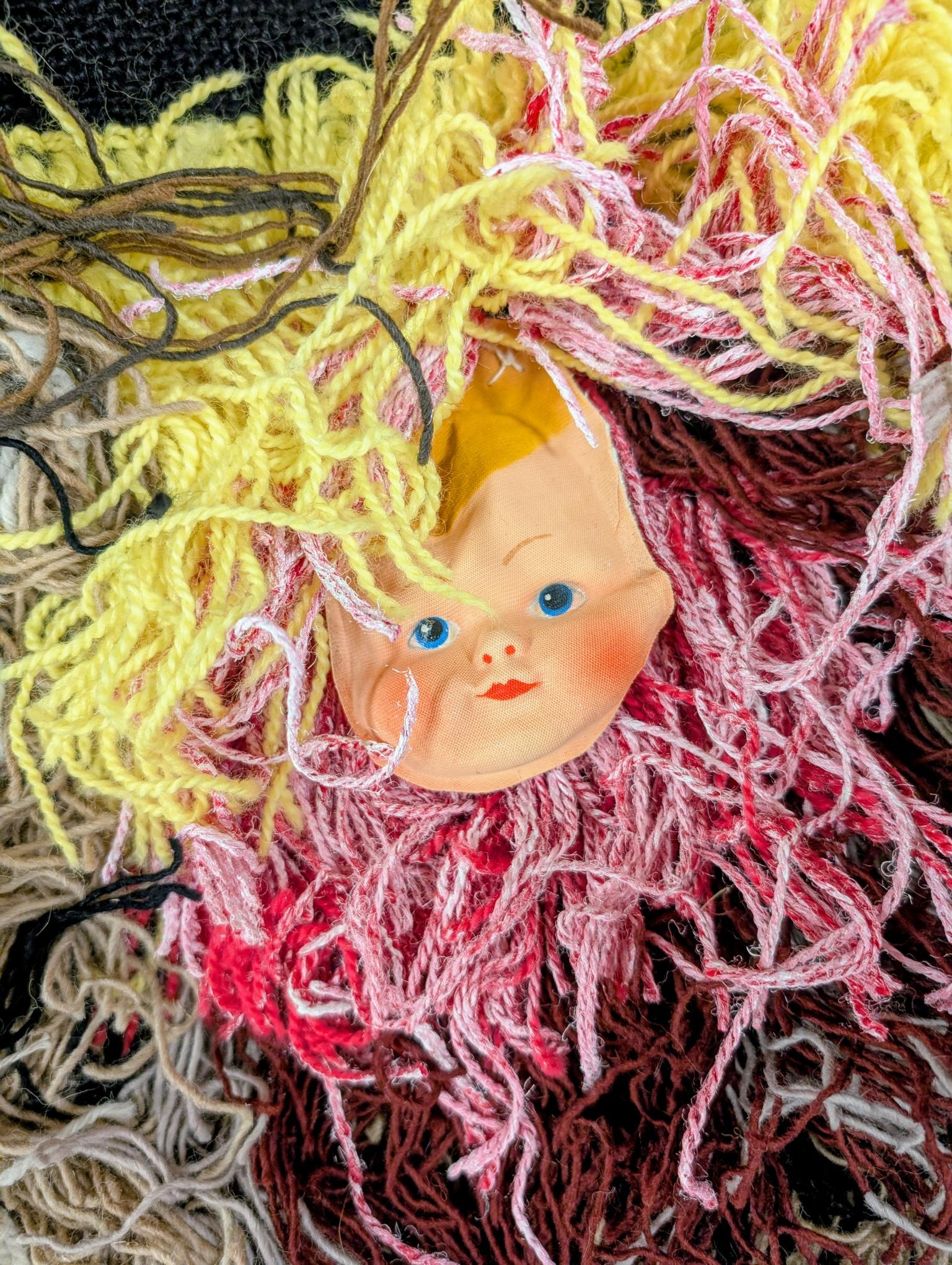
Emelie uses yarn of all fibers and sizes in her work. Up close, the viewer will find delightful details, including hidden braids, strands of tinsel, and other surprises.
Photo by Lisa-Anne Bauch
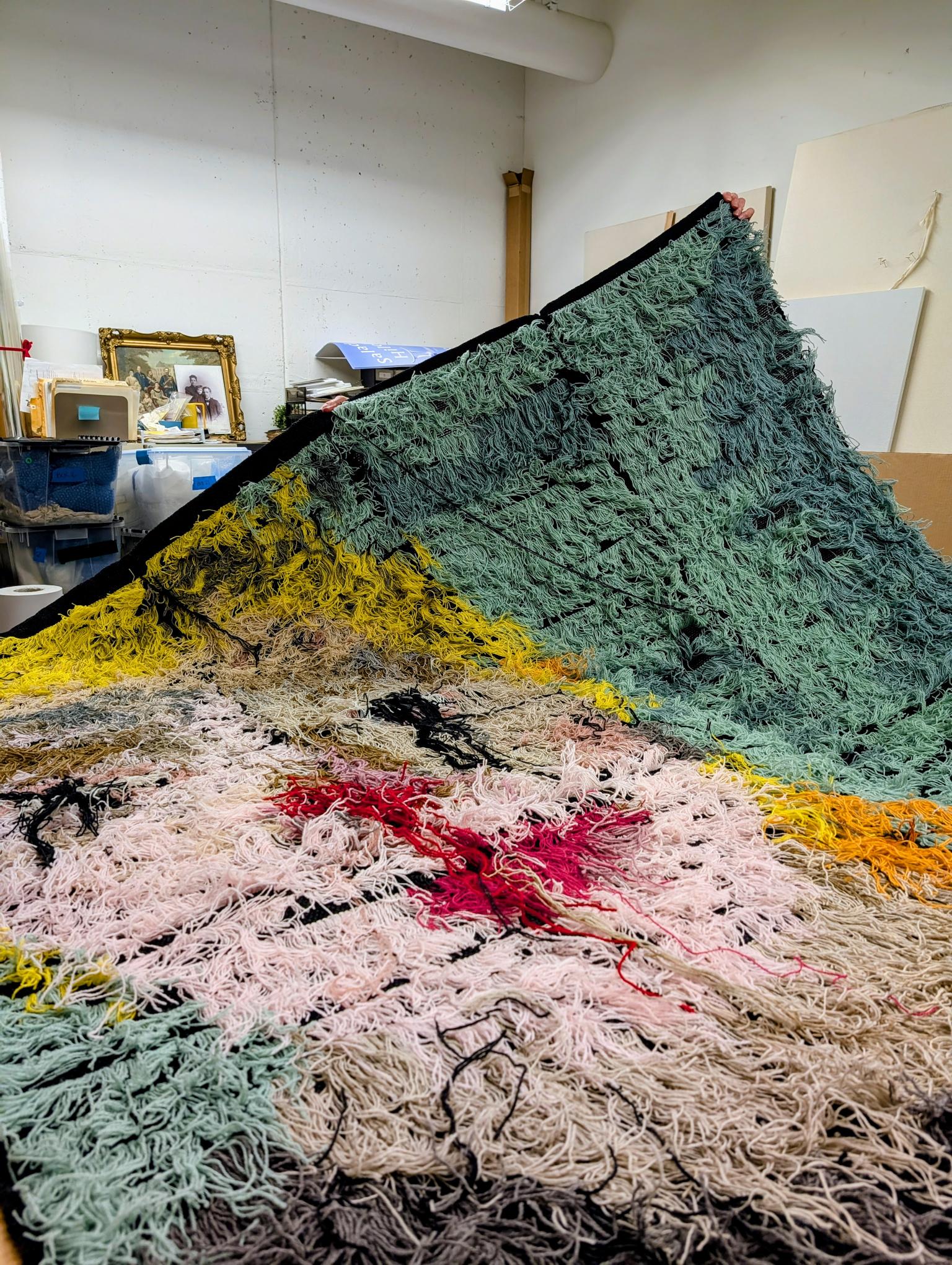
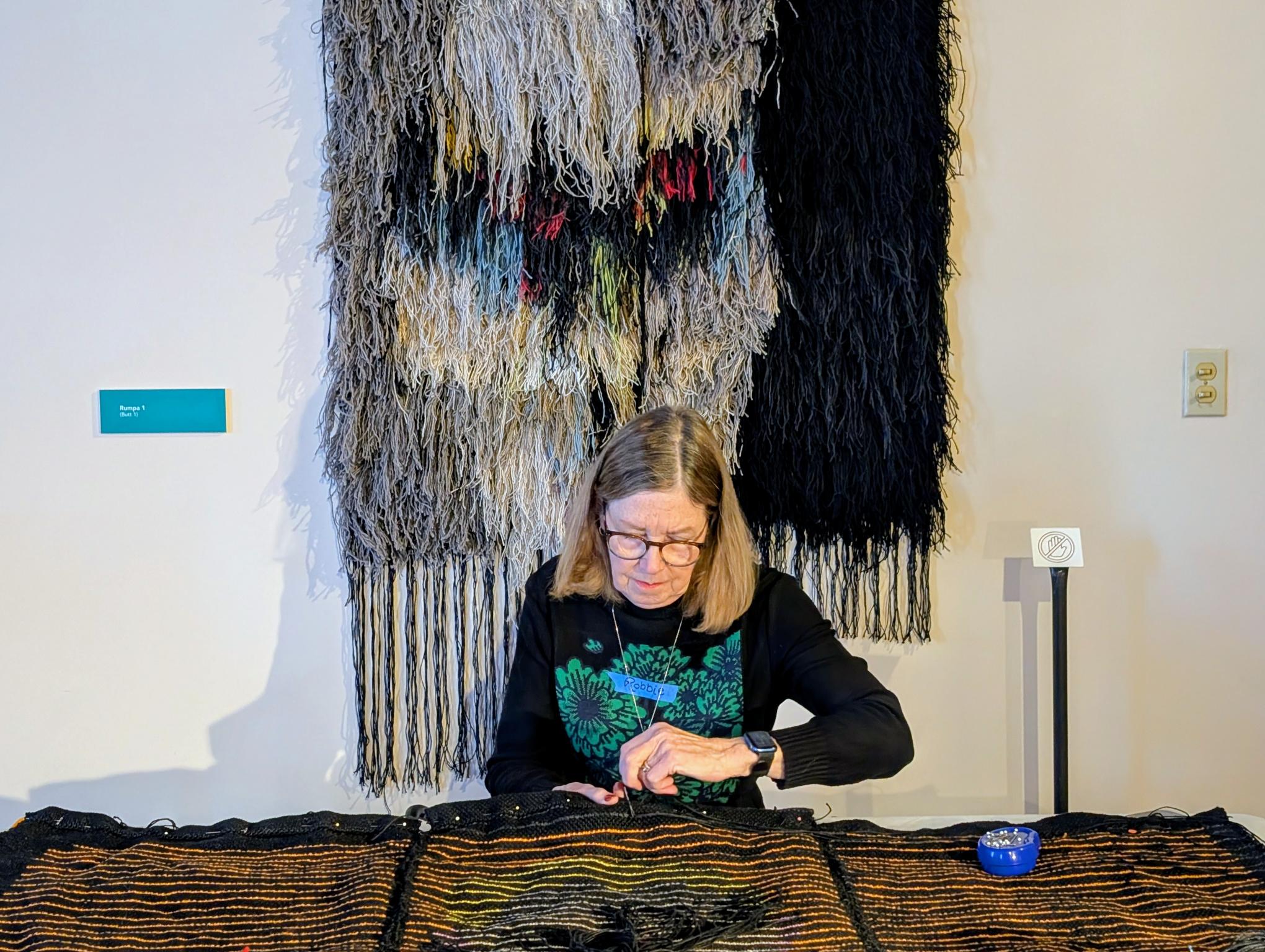
Emelie weaves her largest works in panels, which are then sewn together. Here, Robbie LaFleur lends a hand.
Photo by Lisa-Anne Bauch
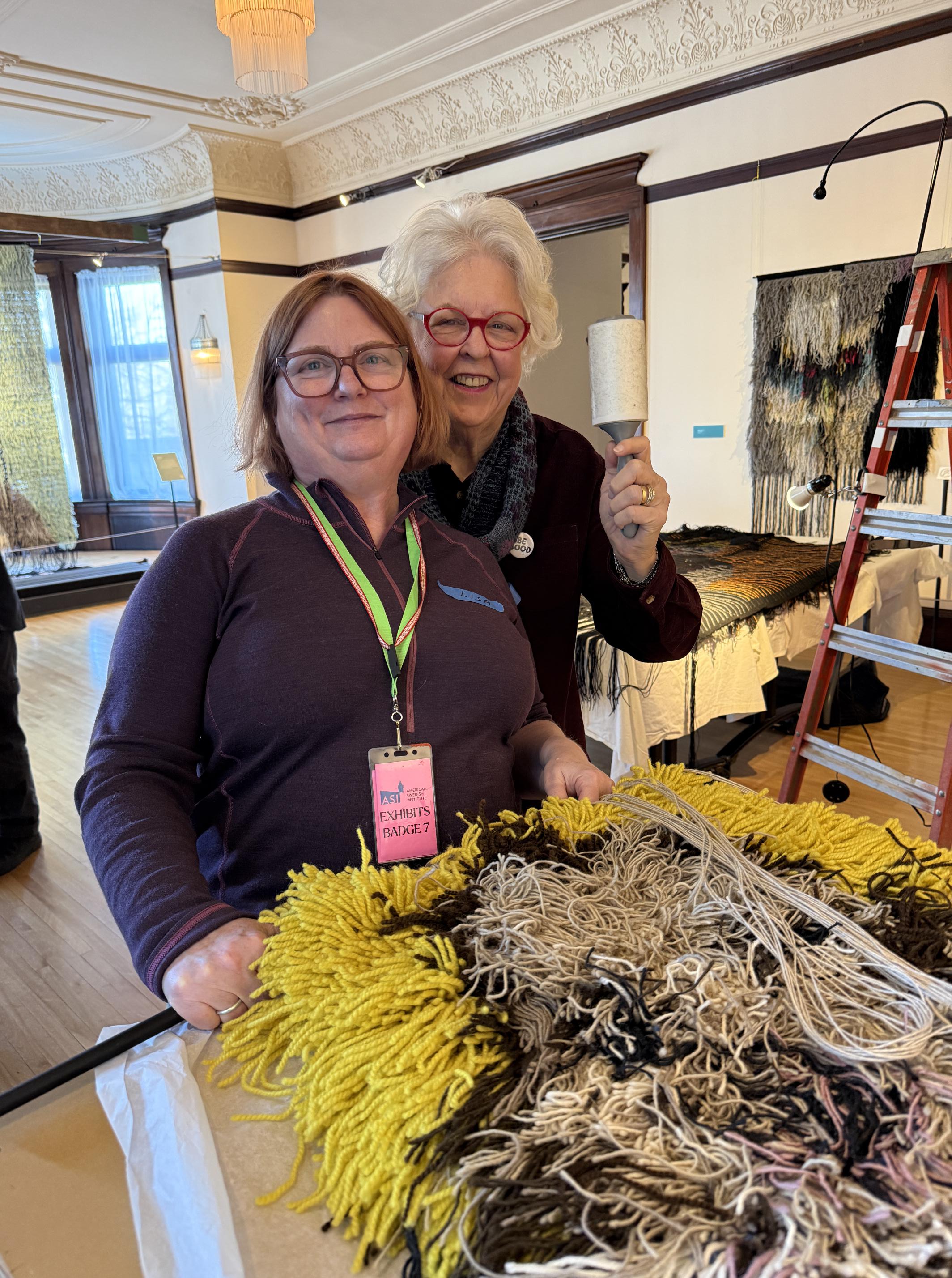
Because Emelie’s home is pet-friendly, a lint roller is used on the reverse side of the weaving to remove any stray hairs. Fortunately, Mary Skoy was on hand to tackle the job!
Photo by Robbie LaFleur
This weaving, called “Rumpa,” was one of our favorites.
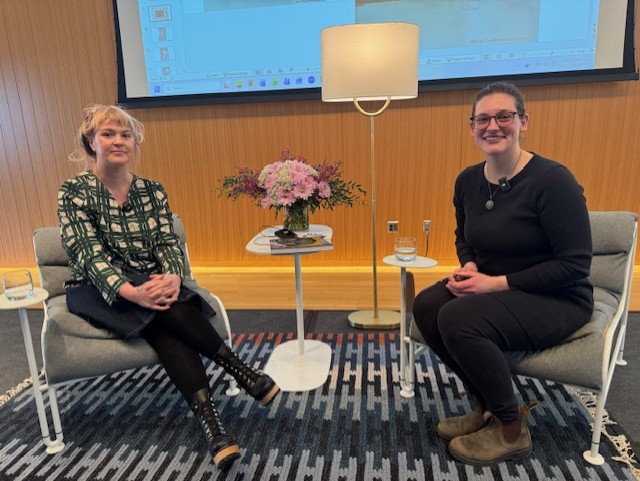
We were also honored to attend an artist’s talk with Emelie, in conversation with Betsy Konop, Executive Director of the Weavers Guild of Minnesota.
While weaving, Emelie works from a printed cartoon, usually a photo. But when it comes to choosing the individual strands of yarn, Emelie’s weaving process is intuitive. Once a piece is removed from the loom, she does not trim the pile or otherwise alter the weaving. She intentionally lets the longer strings hang, so they appear to be “crying,” expressing the emotion of the image.
Emelie Röndahl and Betsy Konop. Photo by Mary Skoy
Rather than relegating rya and other traditional weavings to the past, Emelie feels they still speak to us today. Her exhibit stands as testament to the contemporary possibilities of this ancient technique.
And where would Emelie like to visit while in Minneapolis? The Prince museum at Paisley Park, of course!
The next group warp for the Scandinavian Weavers will be Flesberg technique.
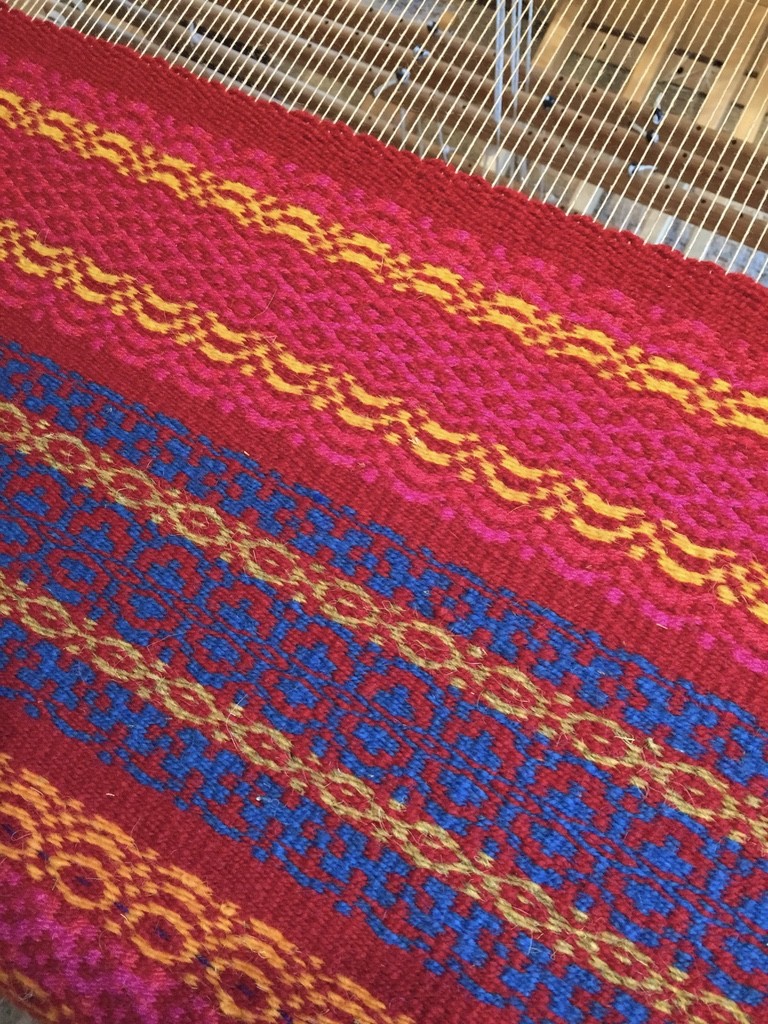
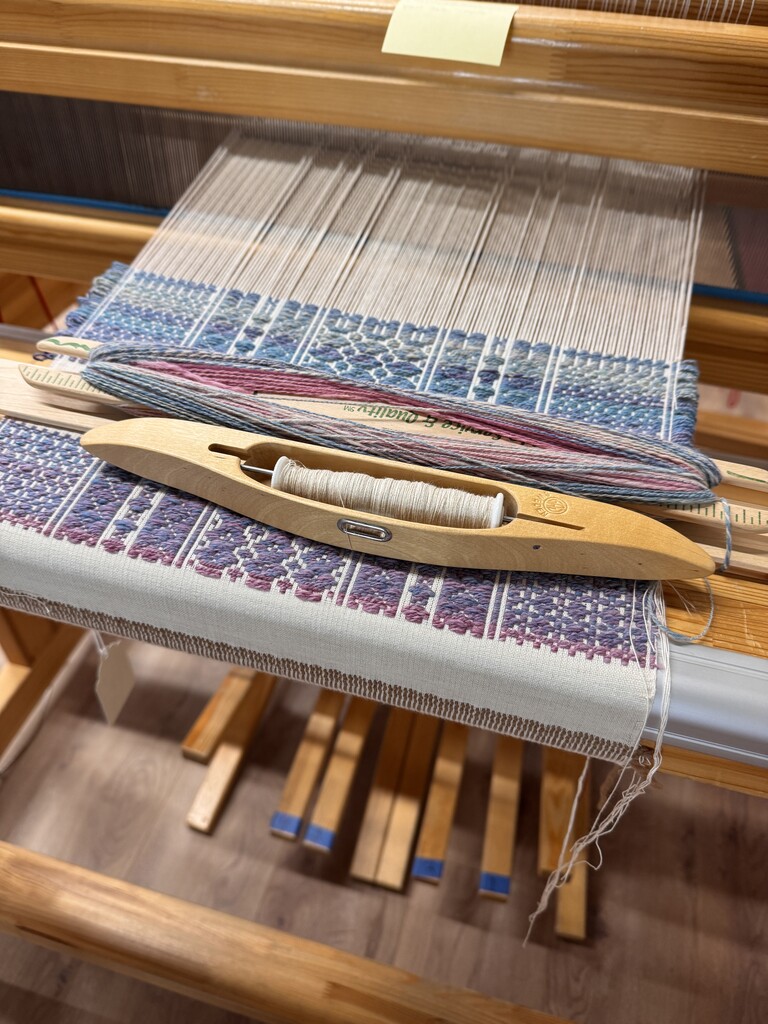
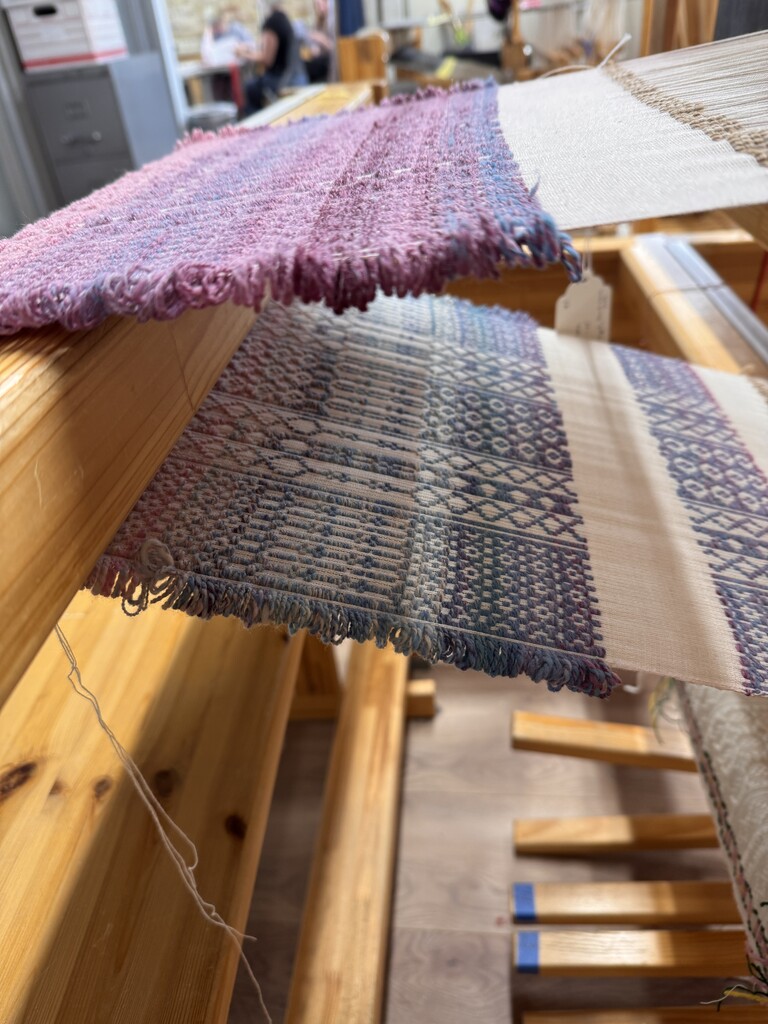
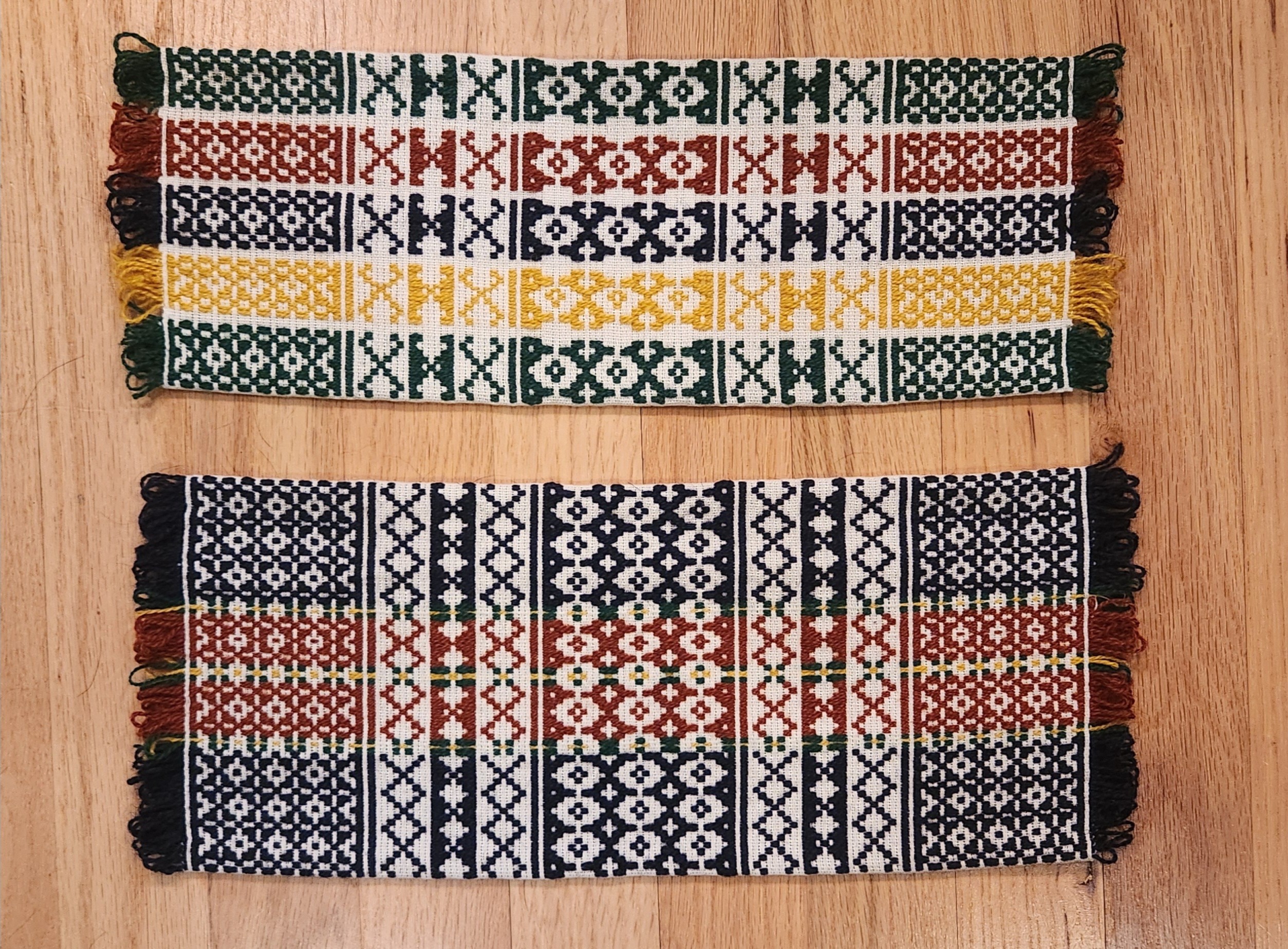
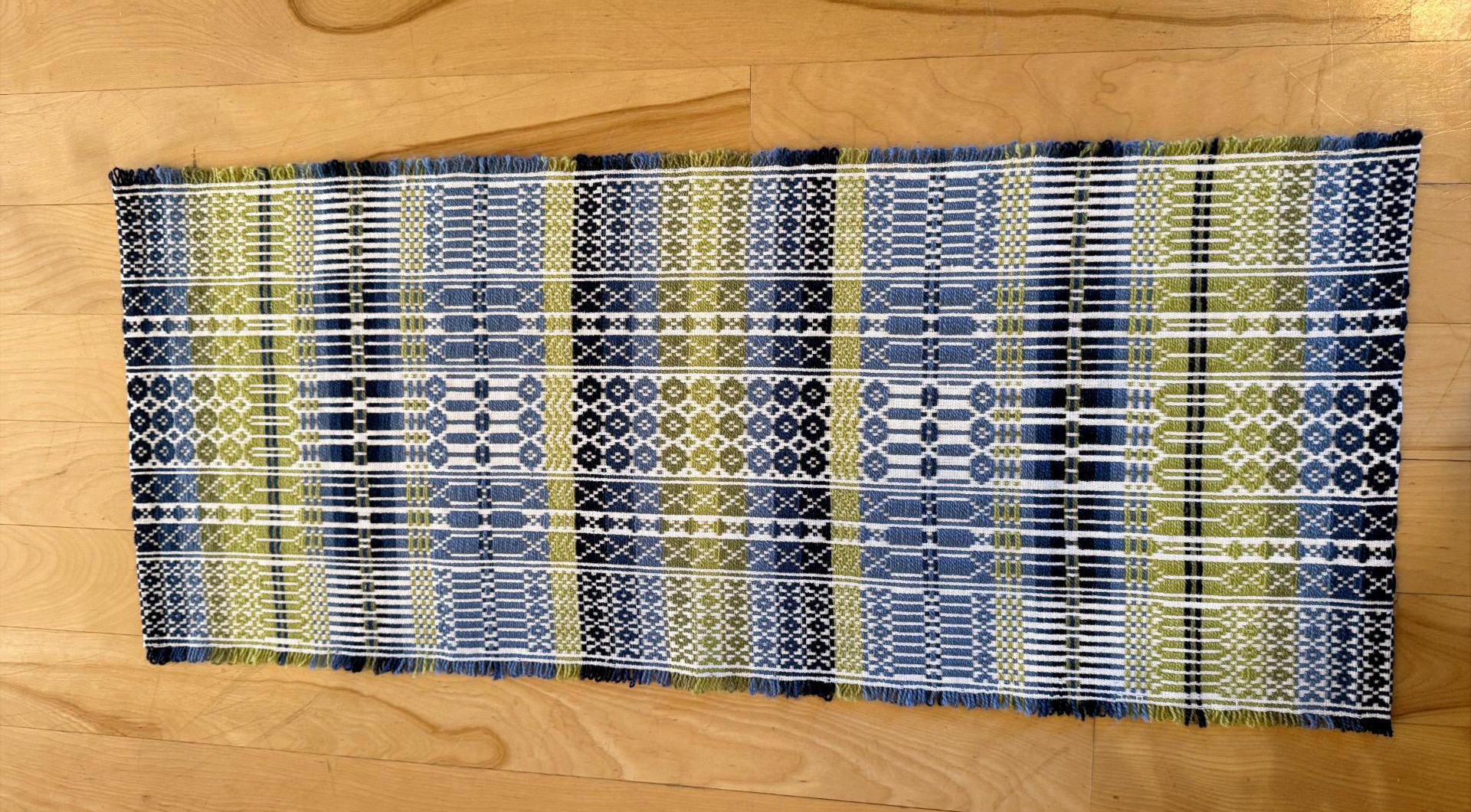
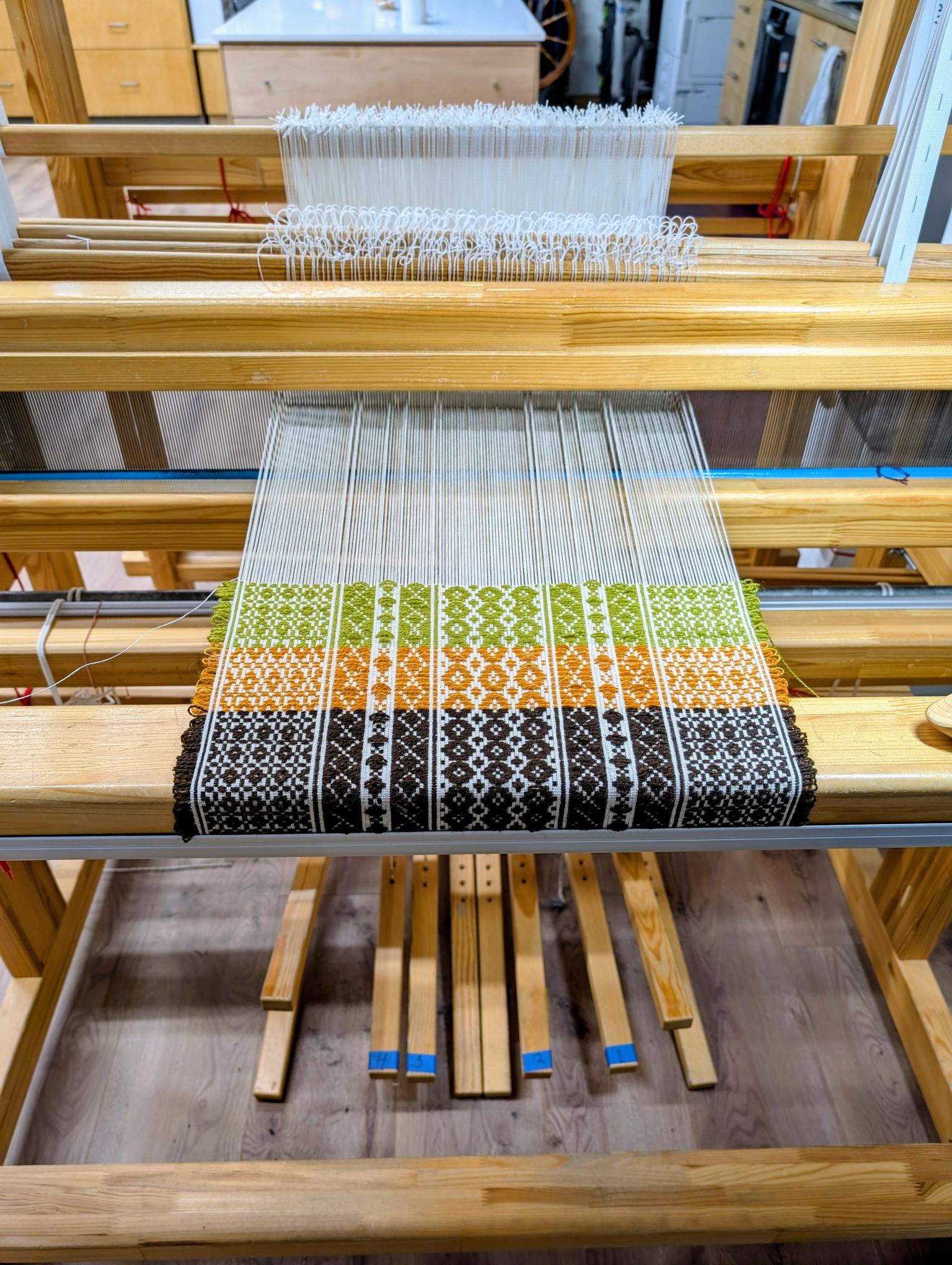
Flesberg is a style of three-shaft boundweave, named for the Flesberg area of Norway where it is popular. (See link below for more information.) In Sweden it might be referred to as treskaft or bound Rosepath. The technique allows the weaver to create curved motifs.
Several members of our group have woven Flesberg, including Nancy Ellison.
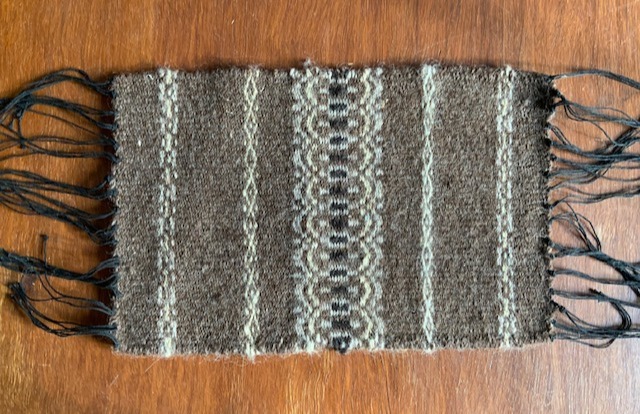
Weaving and photo by Nancy Ellison
“This was my weaving that I did for the Exhibit of the Flesberg Study Group in Decorah in October 2005,” she writes. “It was in natural colors of brown, gray, and black yarn from Shetland and Icelandic sheep in my flock a the time.” Nancy spun the white yarn from wool she purchased during a textile tour of Norway.
Weaving and photo by Nancy Ellison
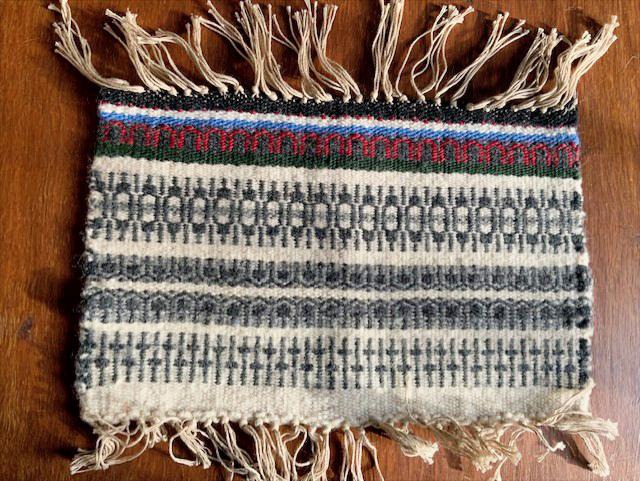
Nancy also wove the above sampler in a class she took from Katharine Dickerson at Vesterheim Norwegian-American Museum. “After weaving with the black, gray, and white yarn and drafts supplied in the class we were encouraged to try something on our own, so I wove a row of red covered bridges with blue sky and green grass as the covered bridge at Zumbrota, Minnesota is a local tourist attraction here.”
Weaving and photo by Robbie LaFleur
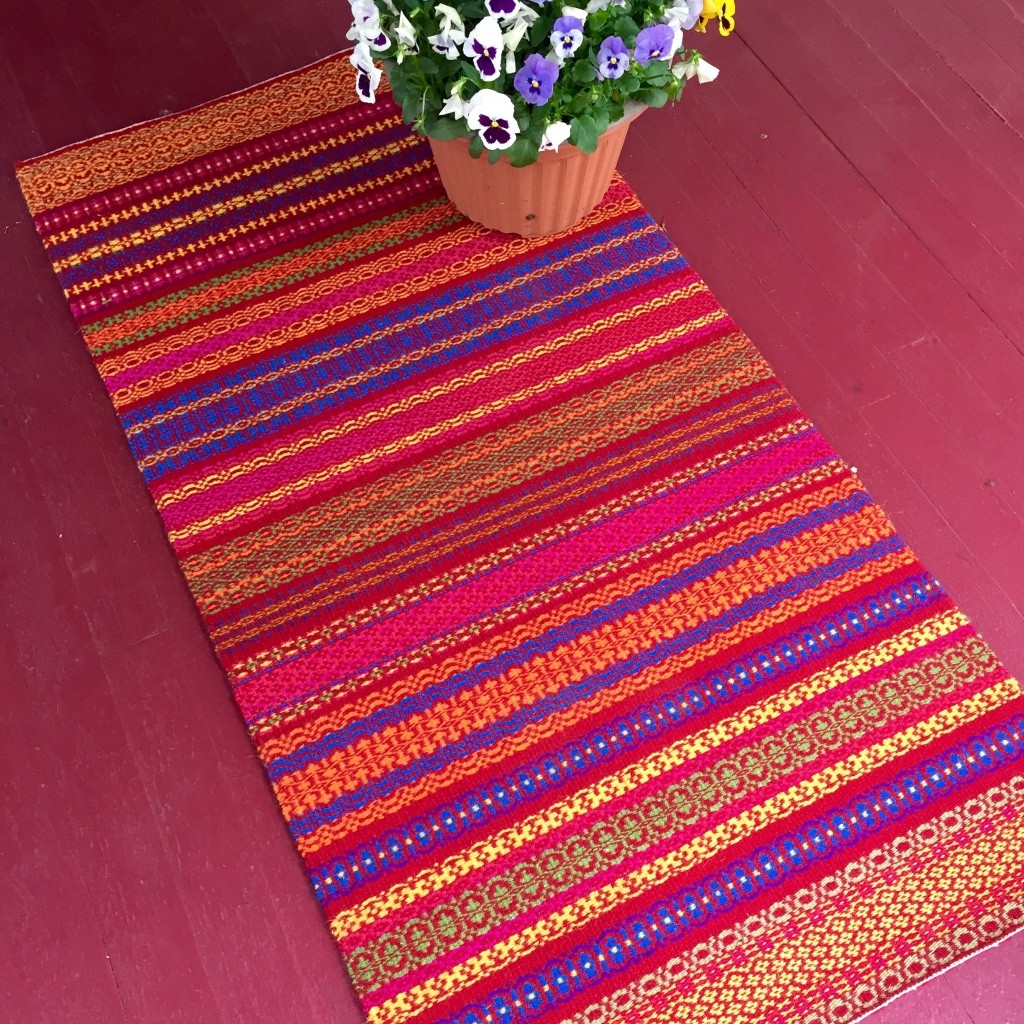
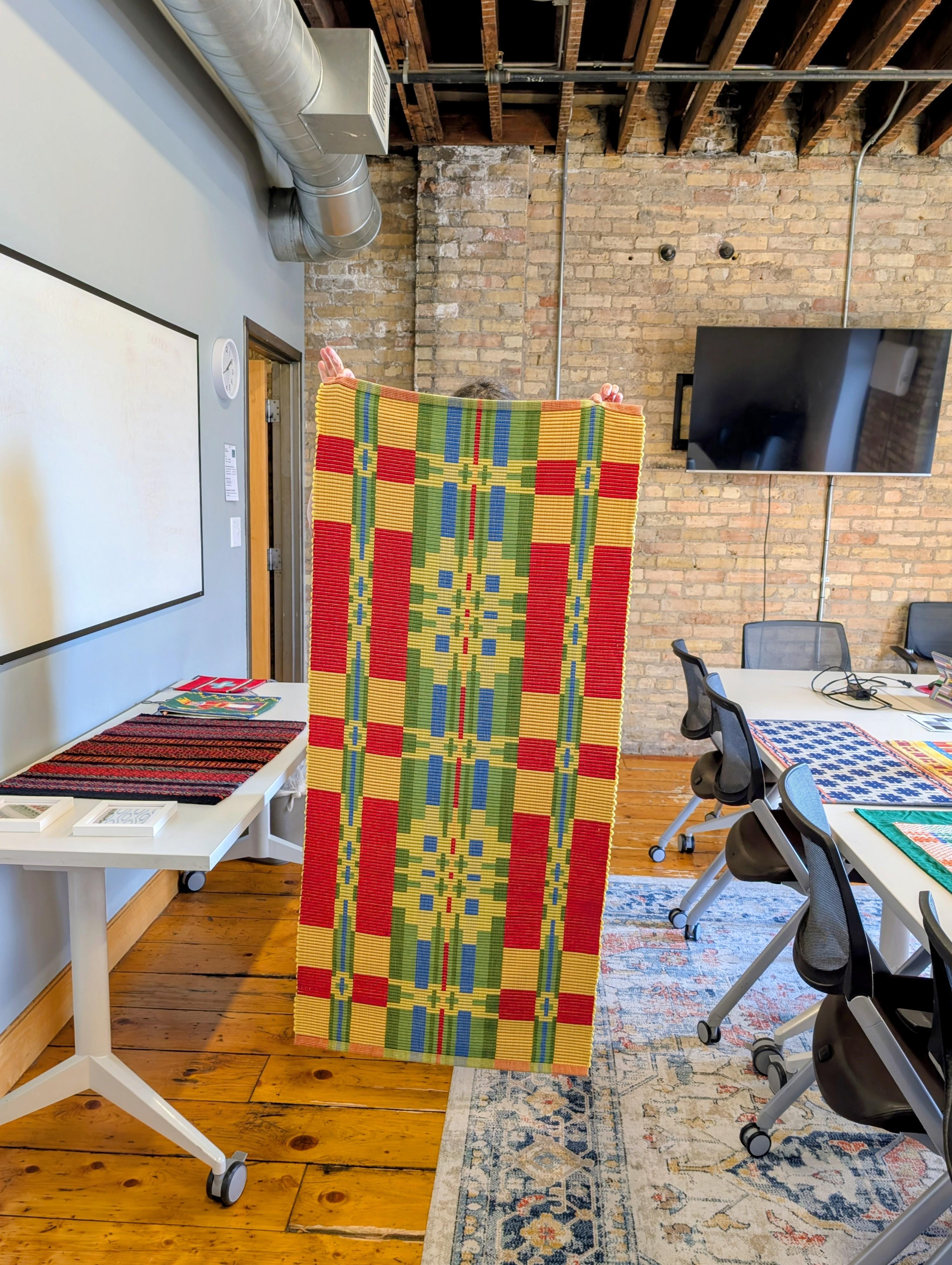
Robbie LaFleur has woven Flesberg rugs, such as the one above, using seine twine as warp and Prydvev yarn as weft, both single- and double-ply.
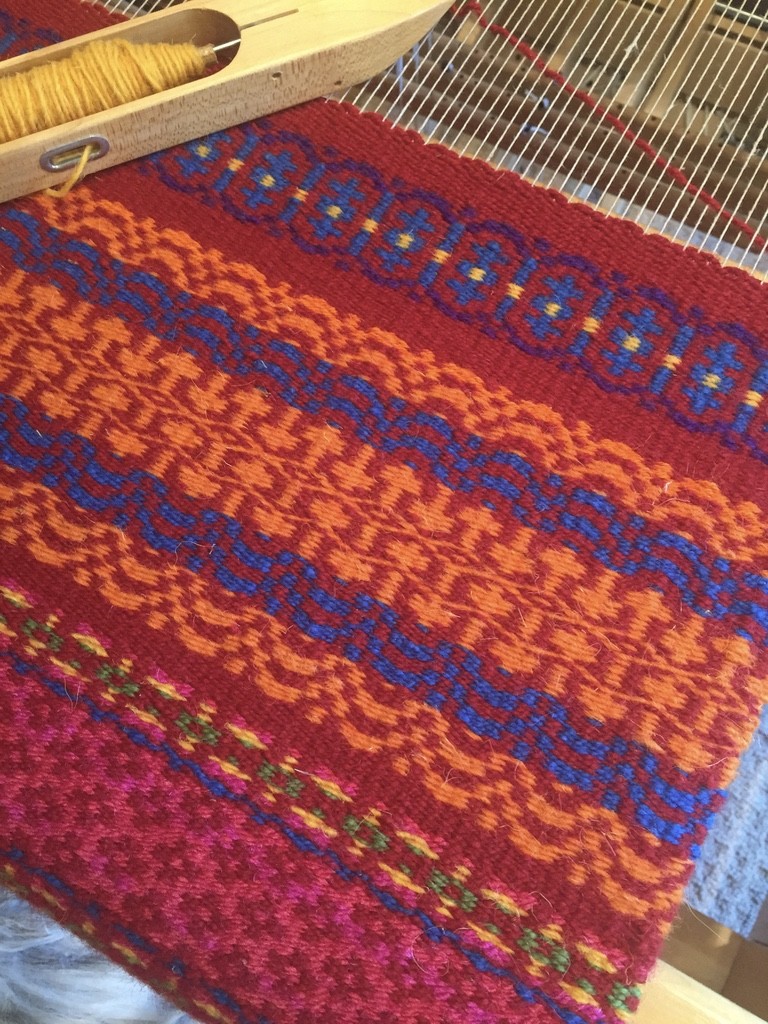
A close-up of curved motifs. Weaving and photo by Robbie LaFleur
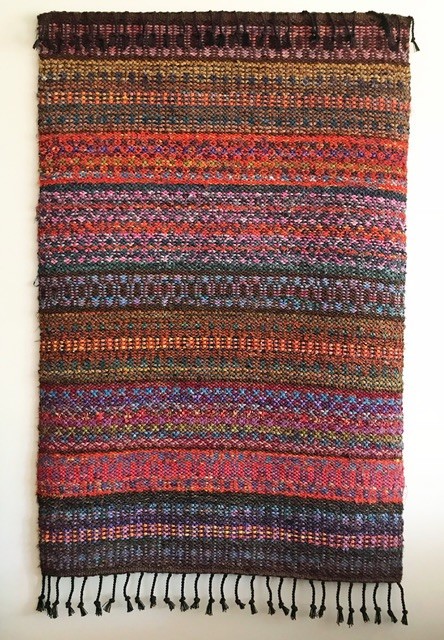
Robbie has also woven Flesberg using strips of fabric as weft, as in the wall hanging below. It is her favorite piece in the technique.
Weaving and photo by Robbie LaFleur
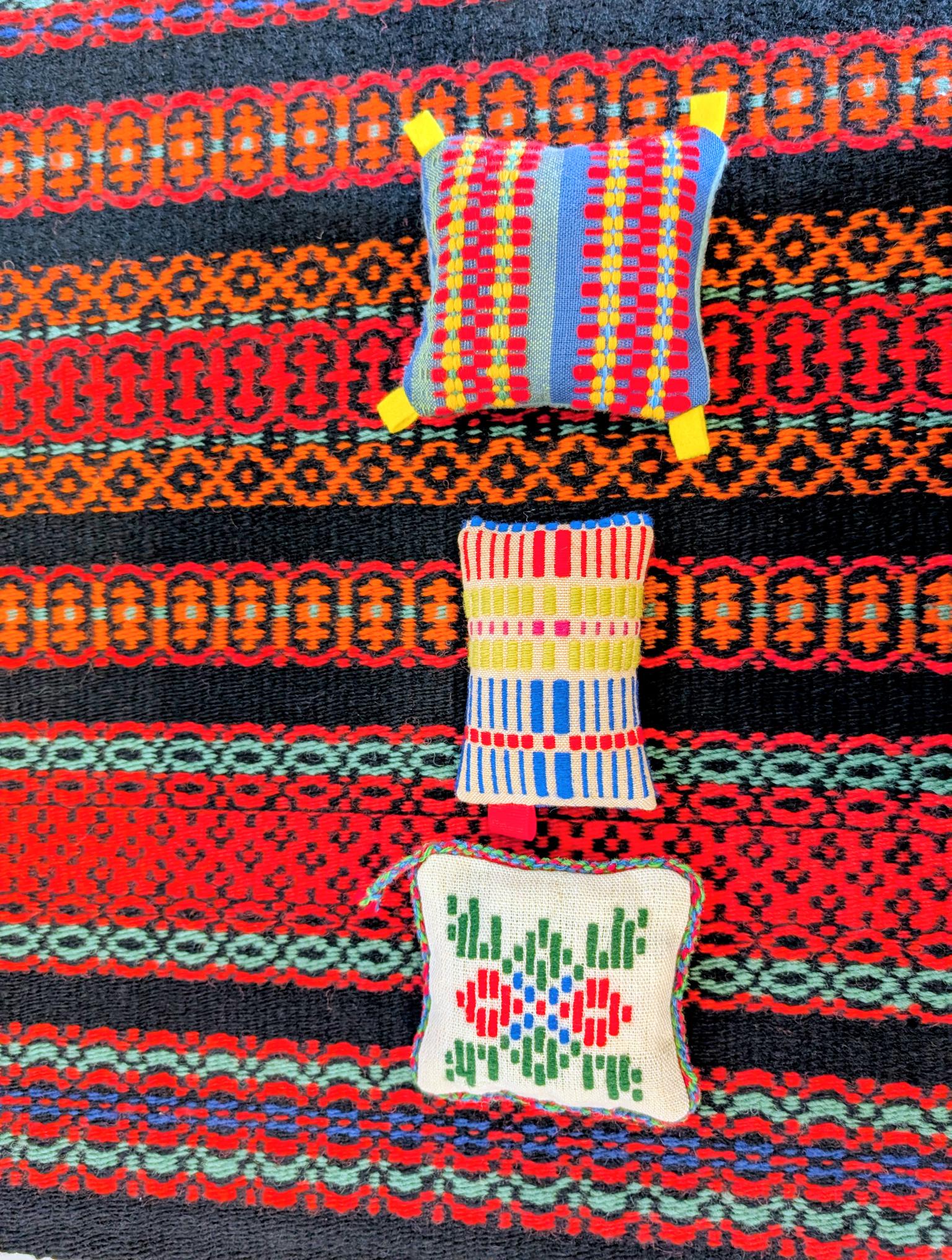
Nancy Ebner wove the Flesberg wall hanging below, using instructions from the Norwegian Textile Letter, which devoted an issue to the technique in November, 2020. Nancy’s weaving is shown with her samplers of Swedish art weaves, which she cleverly made into pin cushions.
Weaving by Nancy Ebner
Those who have woven Flesberg say it is fun to weave but note that it is a slow technique, requiring patience and concentration. An inch of weaving per hour is a reasonable rate!
Given that information, we expect our Flesberg project to be on the loom at the Weavers Guild of Minnesota throughout 2026. In the coming weeks we will share project notes if you would like to weave along at home!
Fortunately, creativity is flourishing among the Scandinavian Weavers!
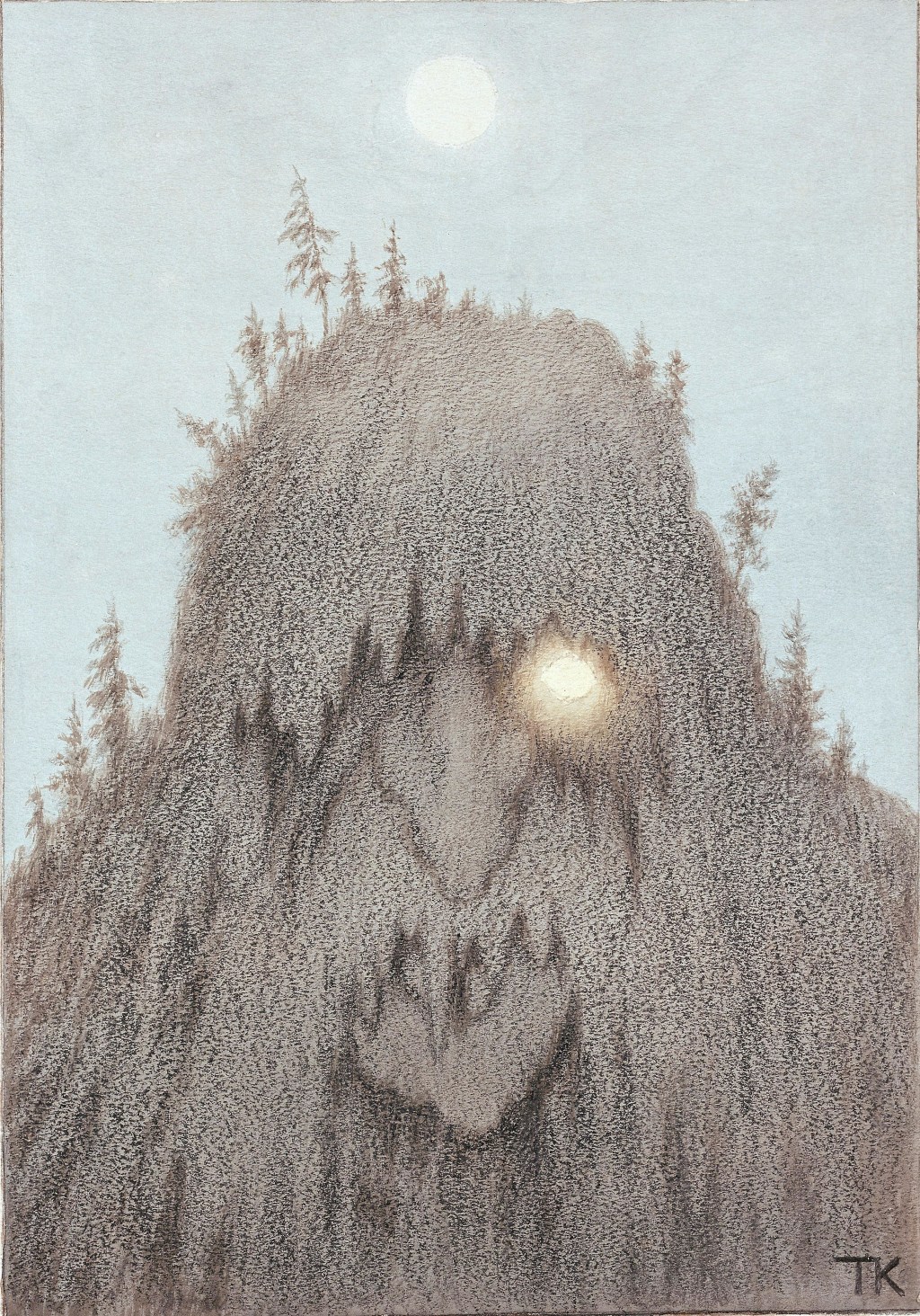
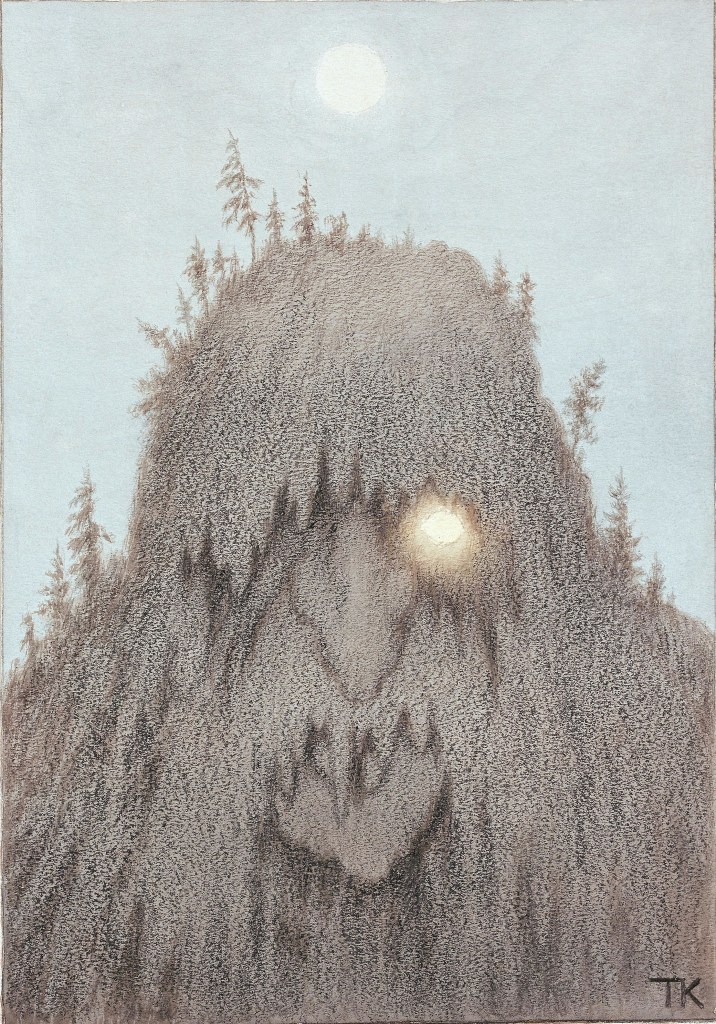
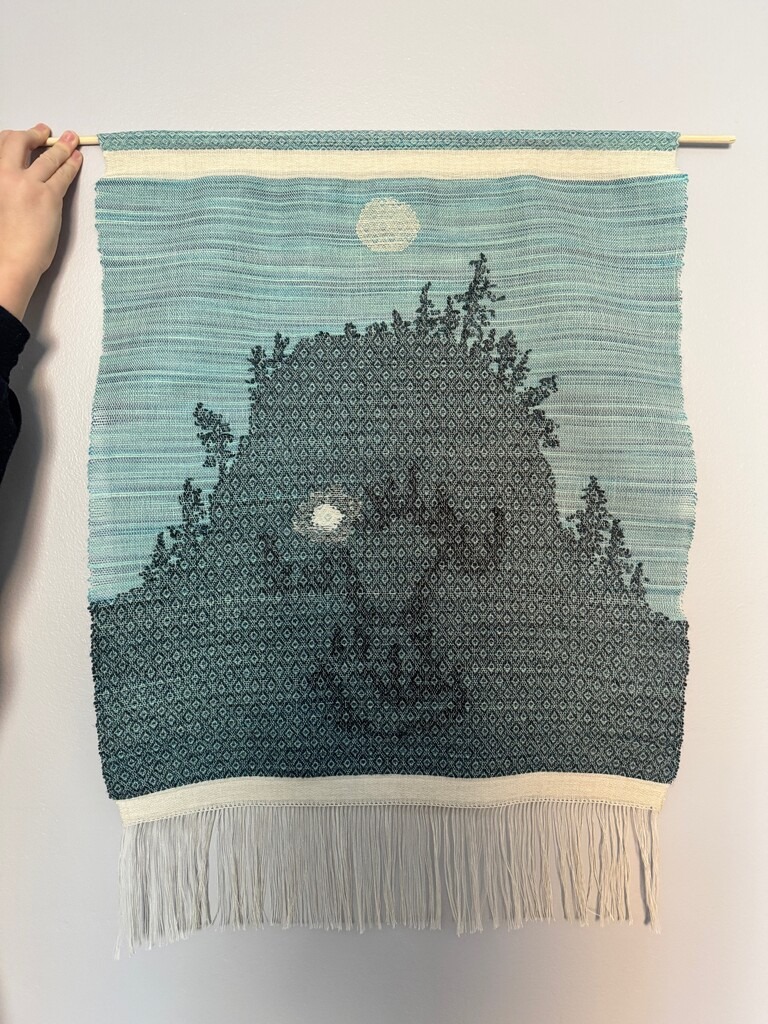
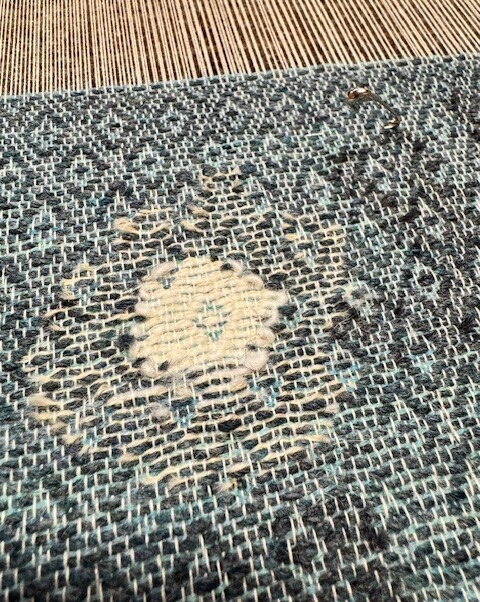
Alla Hale was inspired by Theodor Kittelsen’s image of the “Skog Troll” or Forest Troll. Kittelssen (1857–1914) is one of Norway’s most famous artists, known for his paintings of nature as well his illustrations of Norwegian folklore. We are grateful to Norway’s Nasjonalmuseet for the free use of the above image. (See link below.)
Weaving and photo by Alla Hale
Alla wove this piece as part of a series of eight, starting with six silhouettes of family members. Her warp is a very fine cotton threaded at 24 EPI. (She notes that the photo above is of the unfinished weaving fresh off the loom, rather than a “glamour shot.”)
Alla writes, “You’ll notice [my weaving] is a mirror image- I pin the reference cartoon to the work, but printed on an inkjet printer, and it was rubbing off on the work, so all my pieces became mirror images.”
“Background weft is a laceweight hand dyed merino wool. The troll is a Briggs & Little sport weight Canadian wool. The moon, eye, and shading is accomplished with an inlay of various remnant wool and alpaca, mostly fingering and lace weight.”
Weaving and photo by Alla Hale
“I will share that I felt very unsure about weaving this,” Alla writes, “worried that I wasn’t doing the painting justice, until I got to his eye and saw how the overshot pattern lined up just so in the eyeball. This made me cackle with delight.” (Somewhere, the Trolls are cackling, too.)
Weaving and photo by Alla Hale
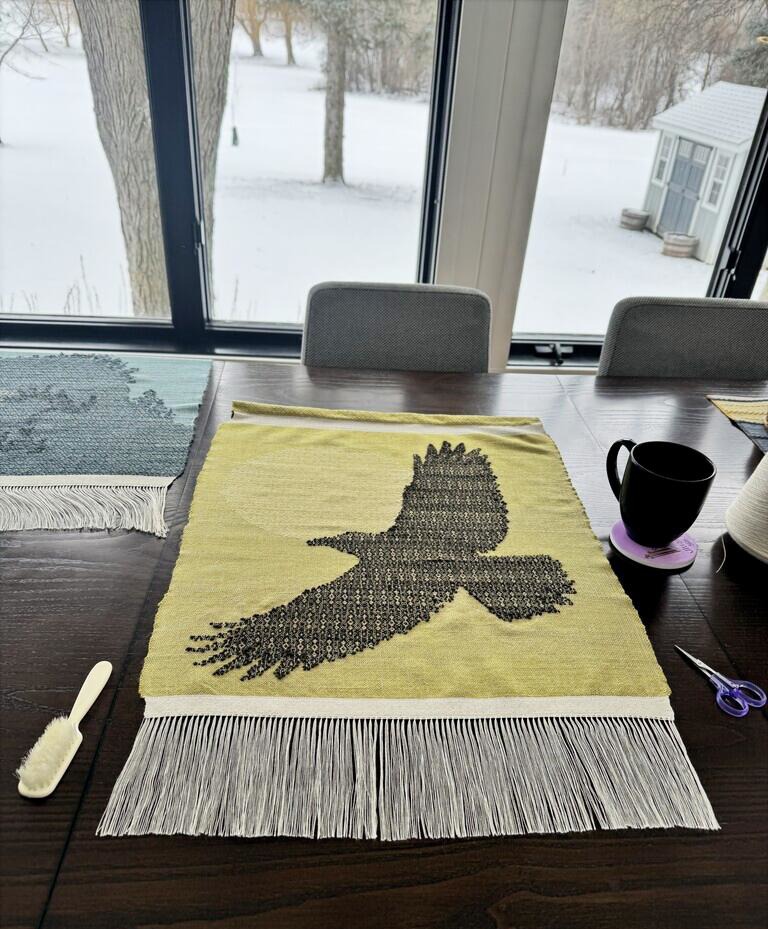
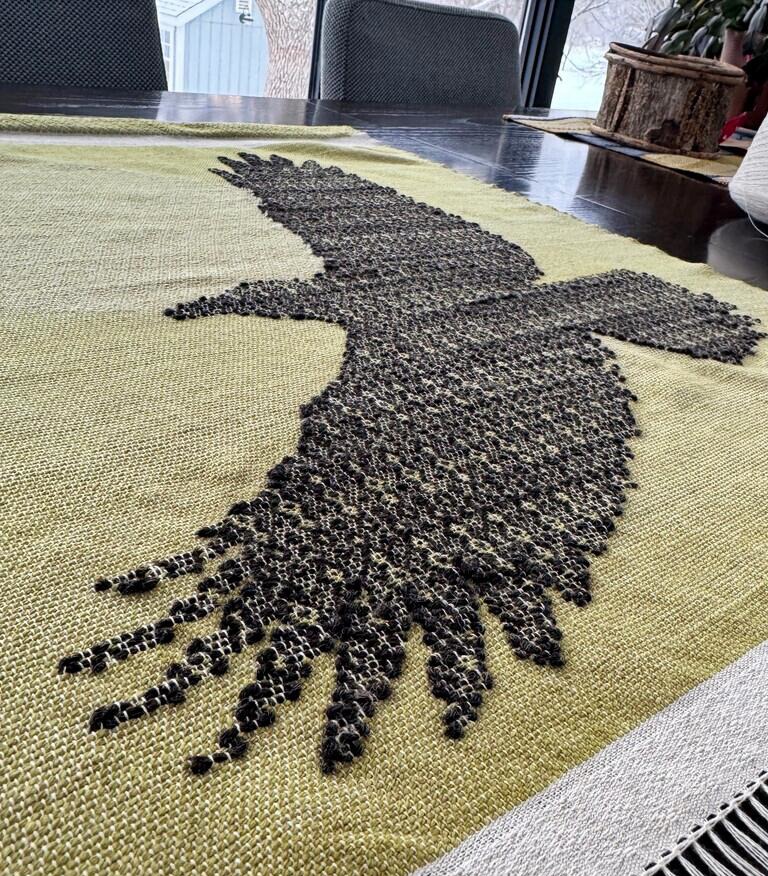
Alla’s eighth weaving in her series was a raven. “The raven was a request by a friend building a cabin up in Northern California,” she writes. “The raven is a cheviot spun at Badgerface Fiber, Minnesota’s first solar powered yarn mill.” (See link below)
Weaving and photo by Alla Hale.
“The moon is woven in a laceweight alpaca. The background is woven with a fingering weight merino wool that I dyed with red onion skins. Weaving this one was very challenging since I had to keep track of the moon [and] raven treadlings separately. What a brain workout for this baby weaver.”
Needless to say, all the weavers in our group were impressed!
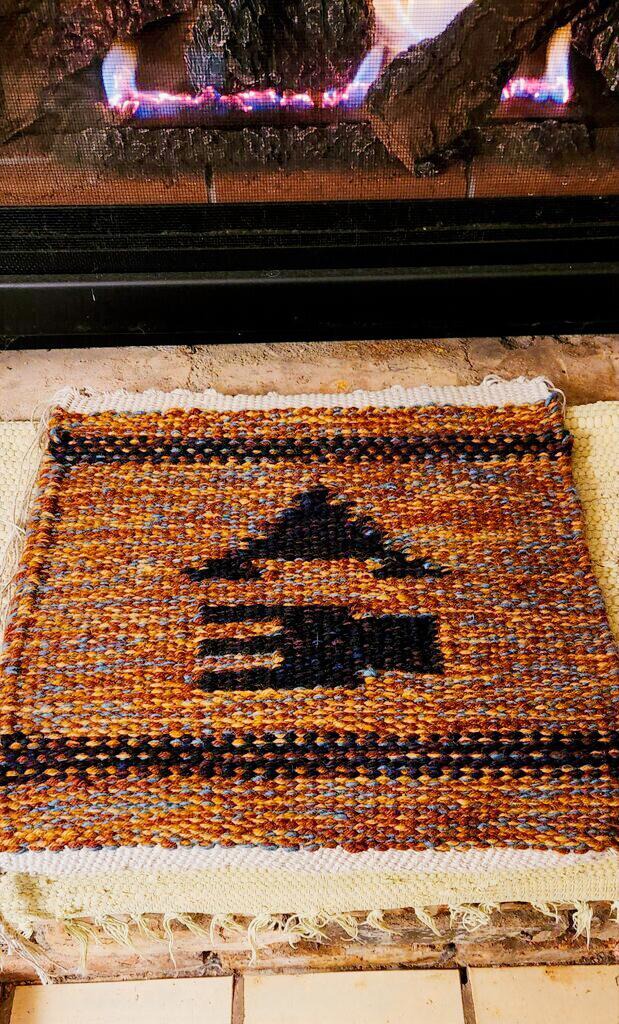
Weaving and photo by Lori Labs
Above is Lori Lab’s Rölakan weaving, which she is in the process of finishing. Lori wove the piece in a class by Christine Novotny at North House Folk School. The weft yarn is Swedish Mattgarn. Five strands per pick allows for for color blending. The woven motifs were inspired by Lori’s travels in Morocco. With the colors echoing the flames above, Lori’s weaving seems to have found an appropriately cozy home by the fireplace.
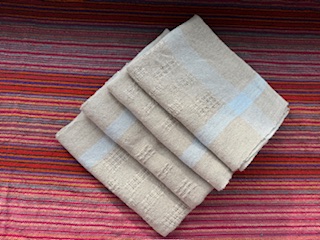
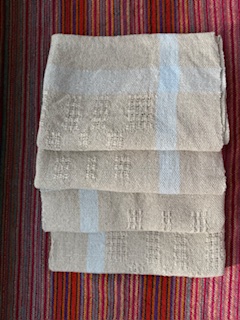
Equally cozy are Nancy Ebner’s lovely hand towels, woven in 16/2 linen that echoes the colors of the winter landscape. Nancy chose her favorite treadlings in a Bronson lace pattern from Halcyon Yarn in Maine, a state that is enduring an equally icy winter.
Look for more winter weavings in Part Two, including Norwegian pick-up bandweaving, the very last of the skillbragd warp, and the beginning our next group warp in Flesberg technique. Plus, a surprise gift lends hints of spring in Swedish linen!
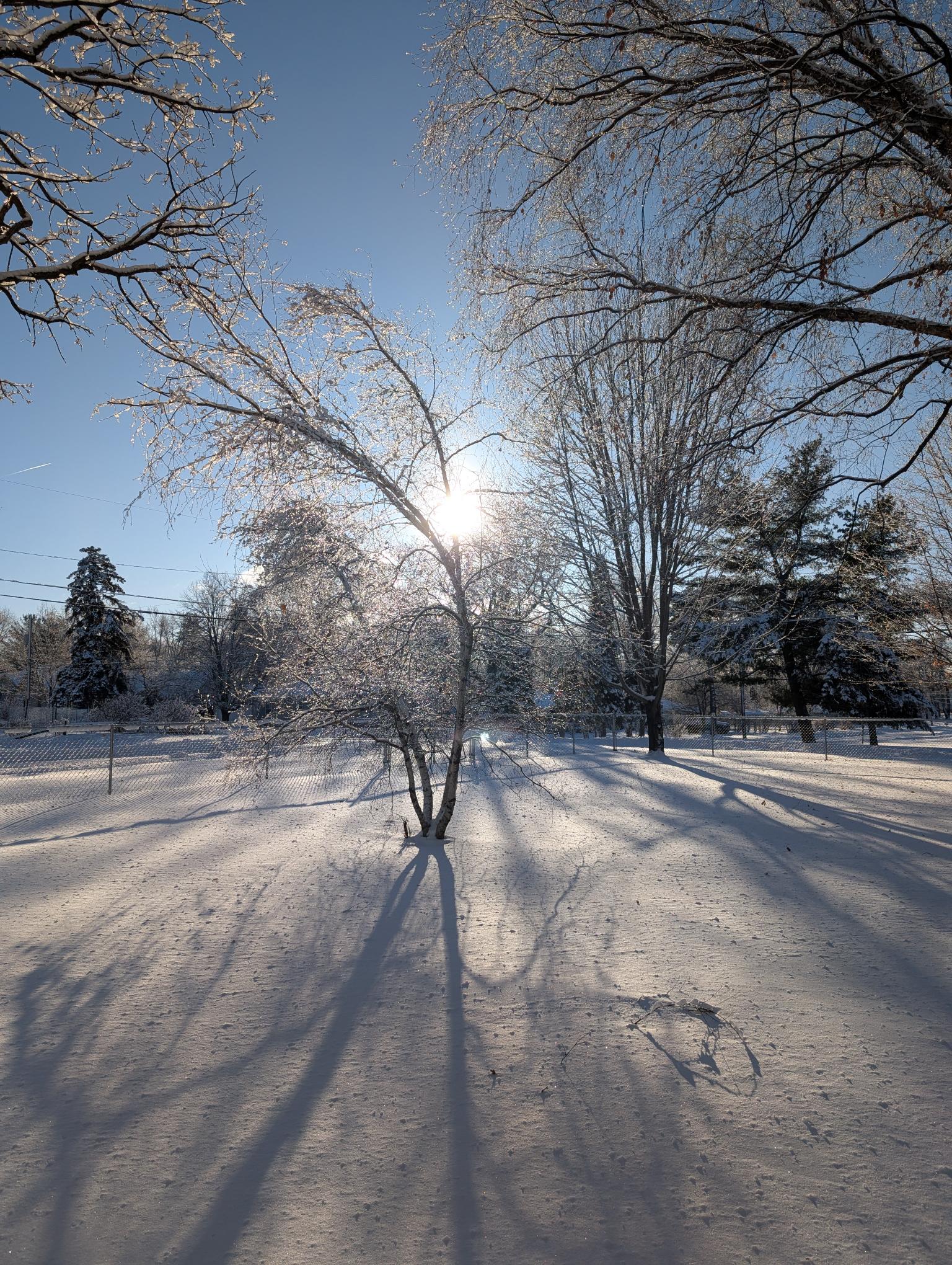
There is an icy wind blowing here in Minnesota, and we wonder if spring will ever come. But our hearts are warm as our community remains strong.
A beautiful loom bench at the Weavers Guild.
On a snowy morning, members of our Guild gathered as usual for spinning, dyeing, and weaving. Coffee and conversation flowed freely.
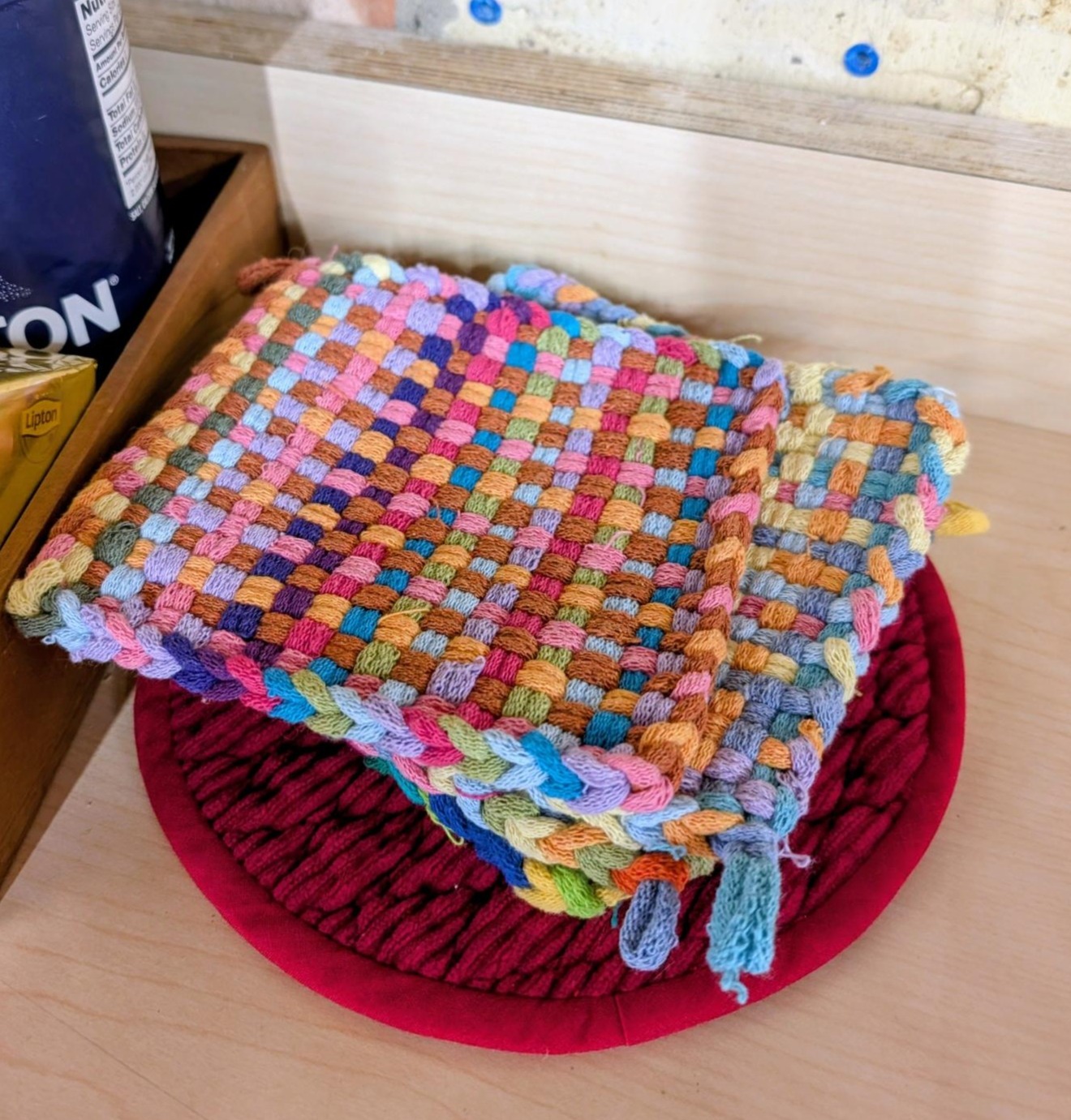
Many of us did our first weaving as children making pot holders. They hold pride of place in our communal kitchen.Every towel in our kitchen is handwoven, showing the beauty of everyday objects.
For as long as humans have been around, we have practiced the ancient arts of spinning, dyeing, weaving, and sewing, creating objects of beauty and usefulness with our hands.
The weaving continues in a rainbow of colors.
Older generations mentor younger ones, who bring their own genius to bear on age-old challenges. The work goes on and will continue long after we’re gone.
Old and new technologies work together.
Sharing our joys and struggles together creates community, and community sustains us. Our differences are not a weakness to be overcome but a strength to be shared, in good times and in bad.
For in the end, we know that spring always follows winter. In the end, the ice will melt, but we will remain.
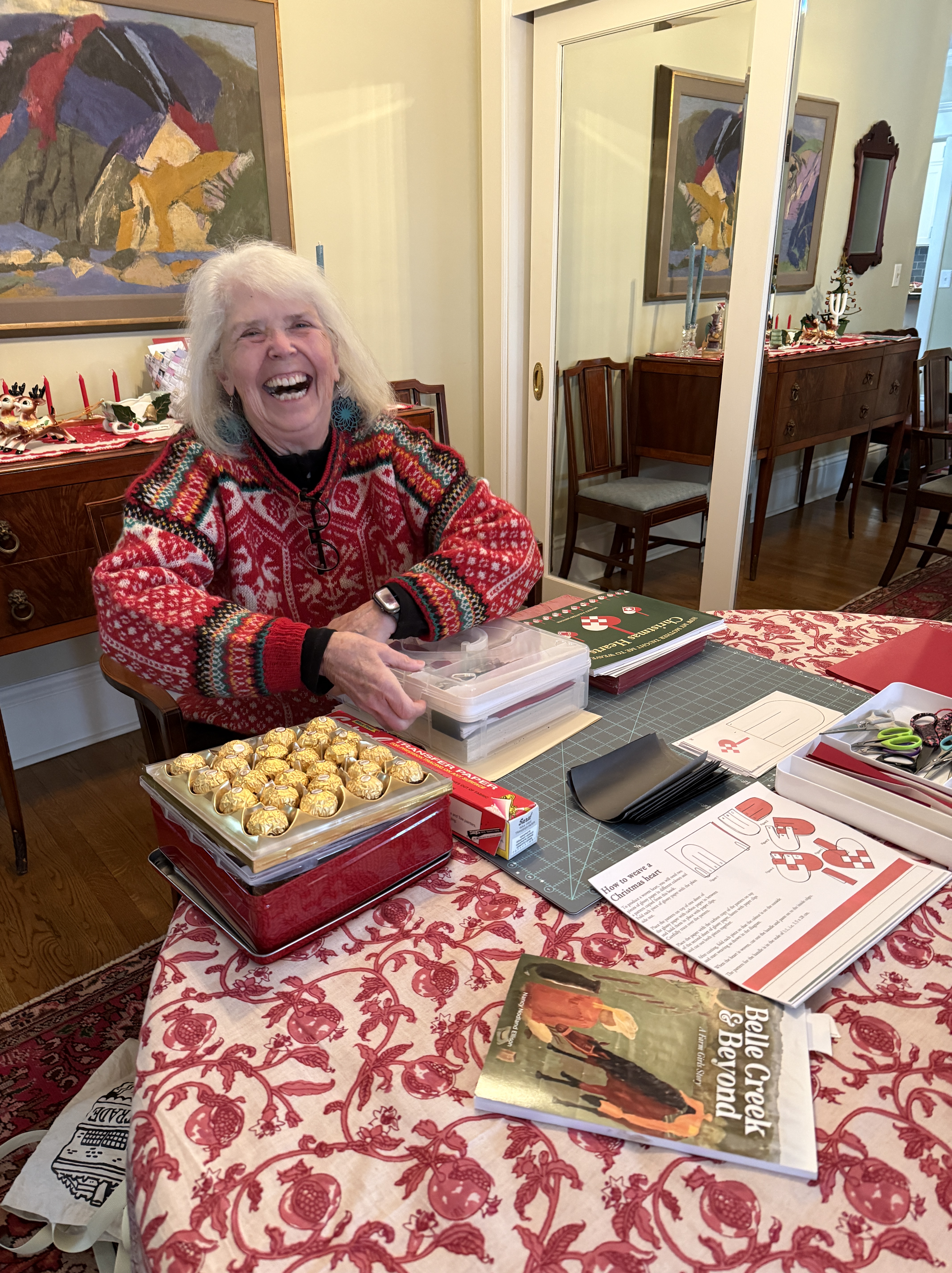
Peg Hansen, Scandinavian Weavers Study Group member and a former art teacher, guided our party activity. She supplied strong, beautiful paper, detailed instructions, and enormous enthusiasm.
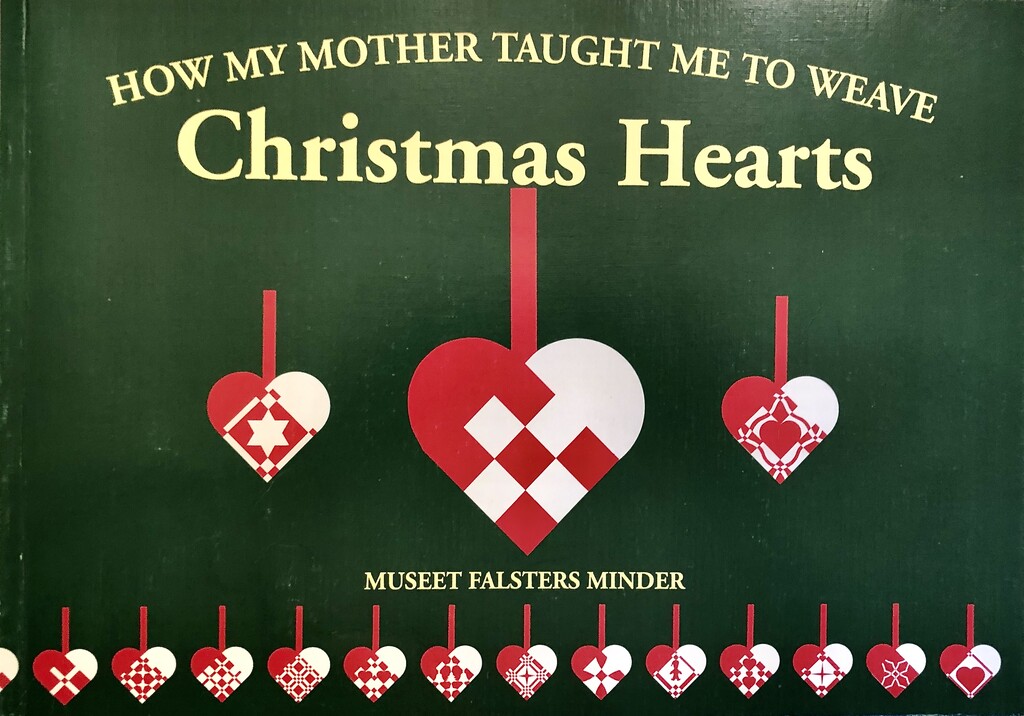
Peg also ordered a book with many advanced designs, How My Mother Taught Me to Weave Christmas Hearts, with patterns by Knud Vaegter.
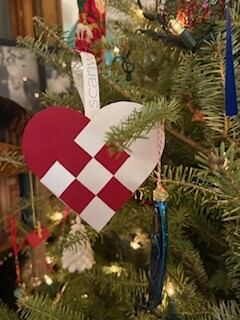
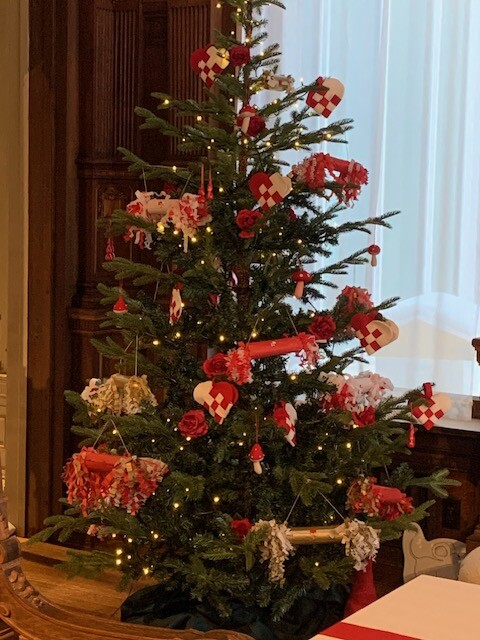
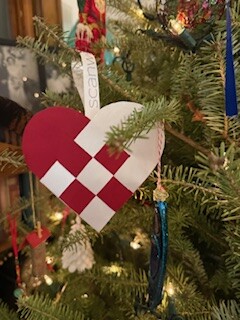
The paper hearts are traditionally filled with candy and hung as festive ornaments on the Christmas tree, as in the photo below from the American Swedish Institute in Minneapolis.
Photo by Jan Mostrom.
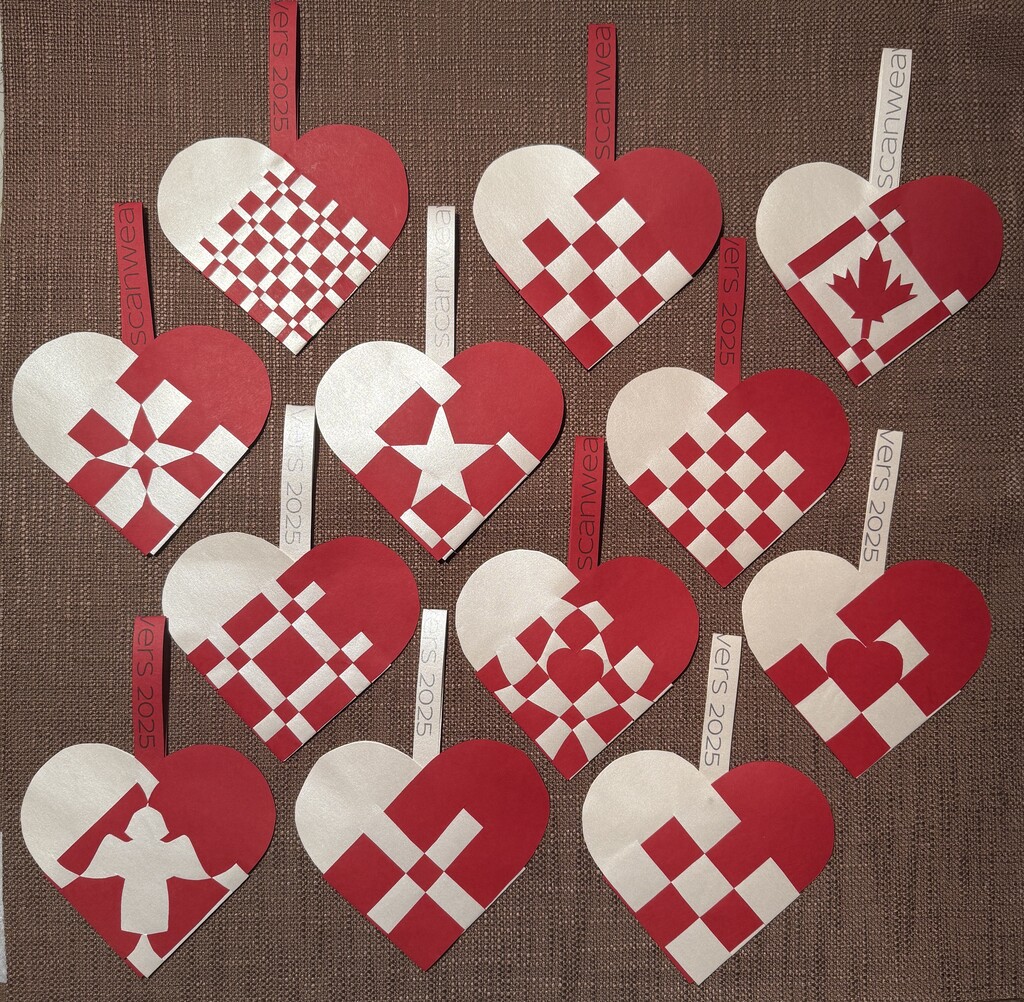
Peg Hansen wove many of the hearts in the book. She then taught us the basic pattern, shown in the middle of the top row in the photo below.
Weaving and photo by Peg Hansen.
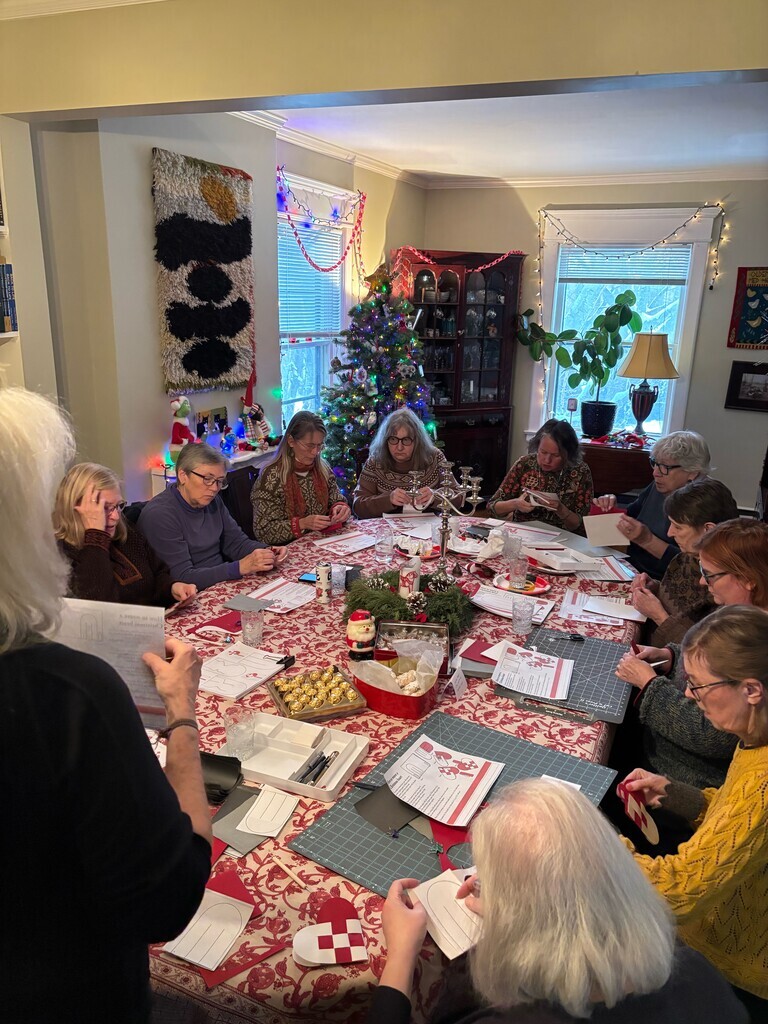
The paper weaving technique is a bit tricky until you get the hang of it. As you can see from the photo below, we all had to concentrate very hard!
Photo by Barb Yarusso.
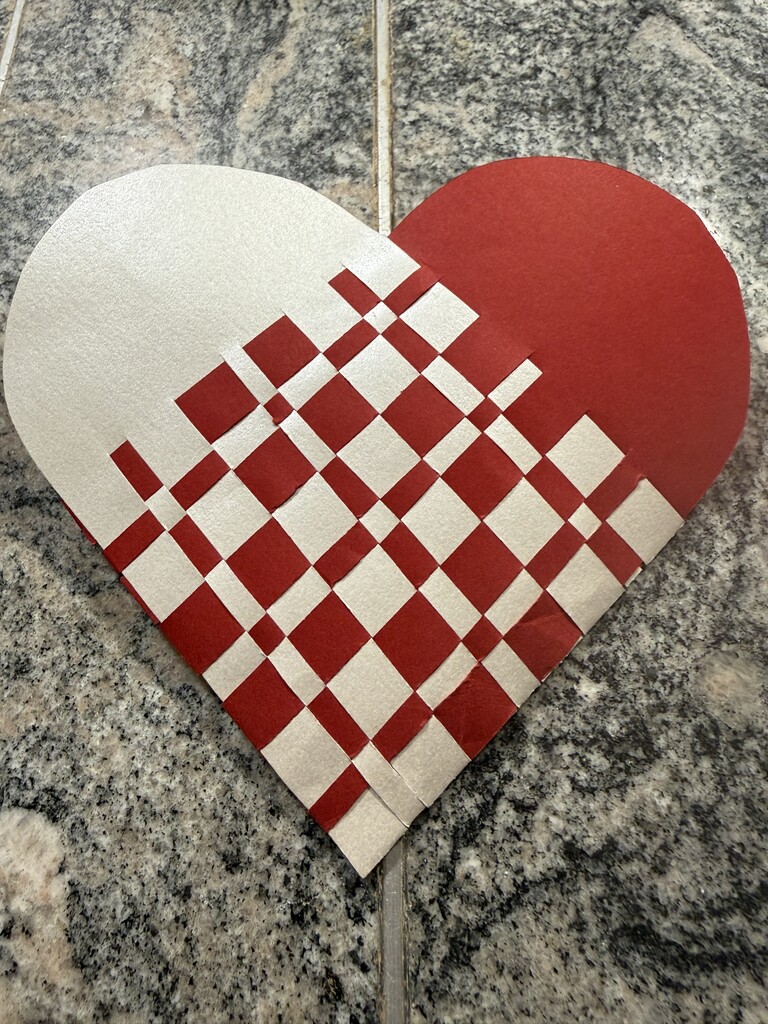
Peg recommends a high-quality paper that won’t tear during the weaving process. Bone folders come in handy to make clean folds, and a good sharp pair of scissors are a must! Peg wove the lovely and meticulous heart below.
Weaving and photo by Peg Hansen.
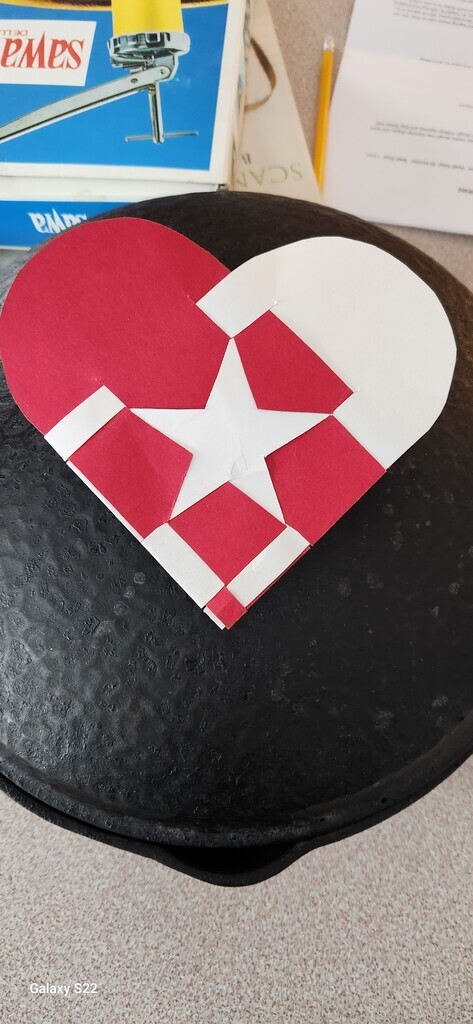
Lori Labs wove the star below, an extra-tricky pattern due to the sharp points, which are susceptible to tearing.
Weaving and photo by Lori Labs.
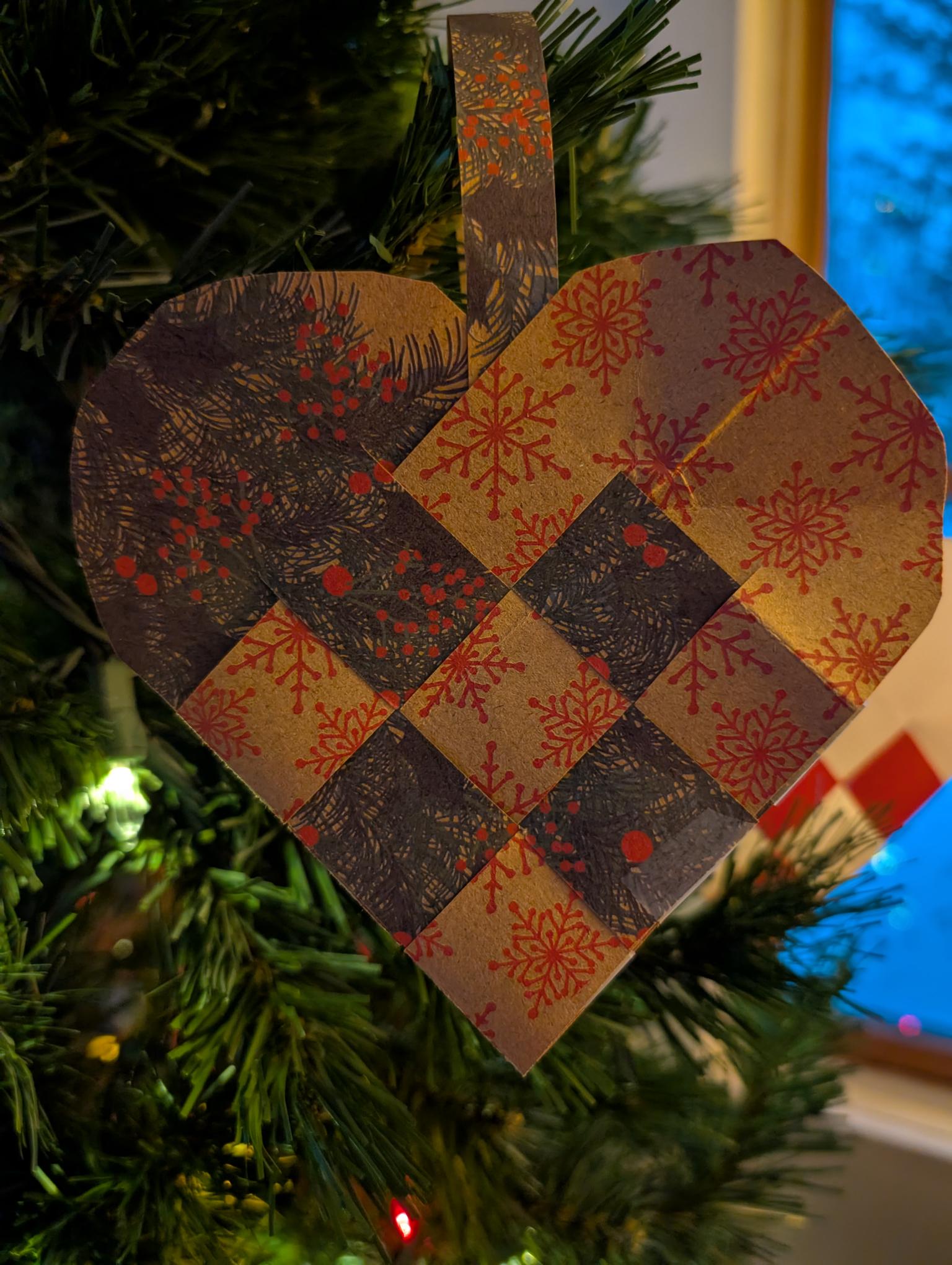
Nancy Ebner’s simple heart found a home on her Christmas tree.
Weaving and photo by Nancy Ebner.
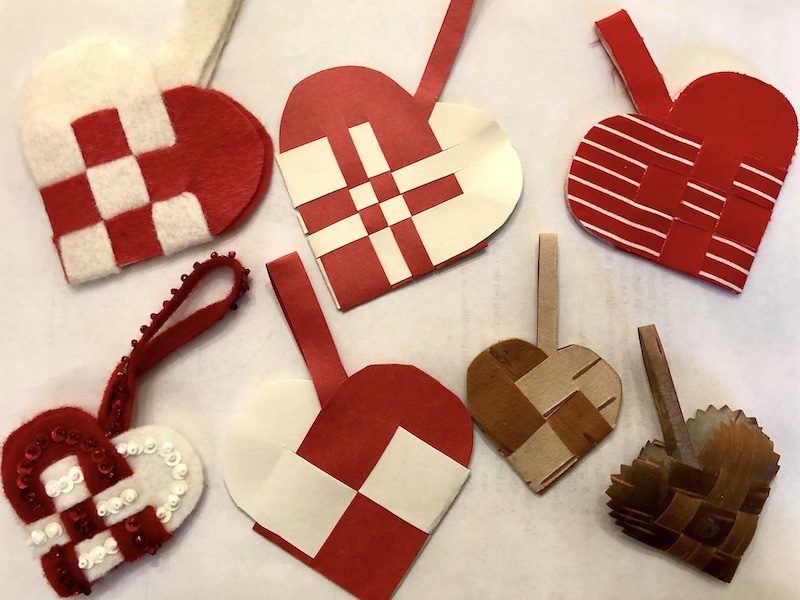
Mary Erickson wove a variety of hearts using paper, felt, and even birch bark.
Weaving and photo by Mary Erickson.
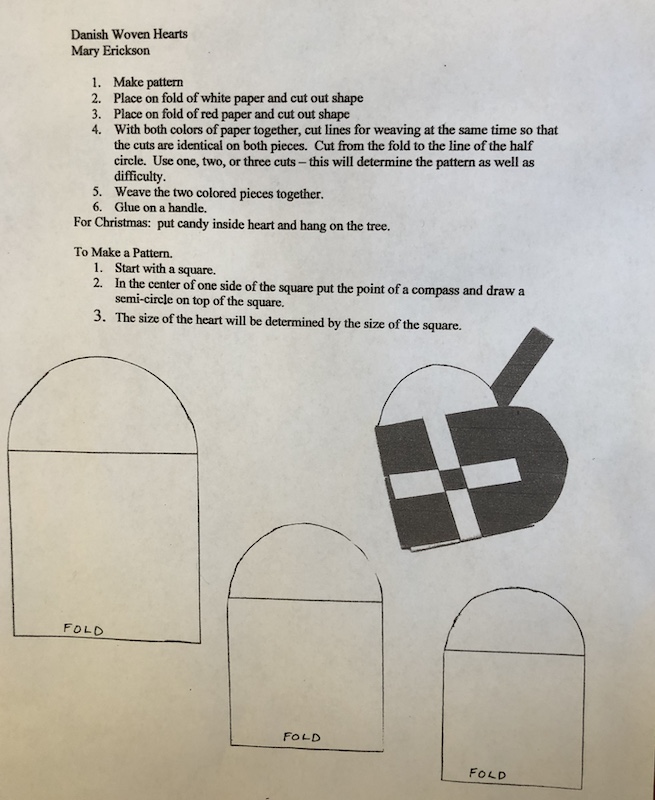
Mary shared her pattern for making Danish hearts. Feel free to give it a try and send us photos!
Wishing all our readers PEACE and JOY in the New Year! Thanks so much for subscribing to our blog!
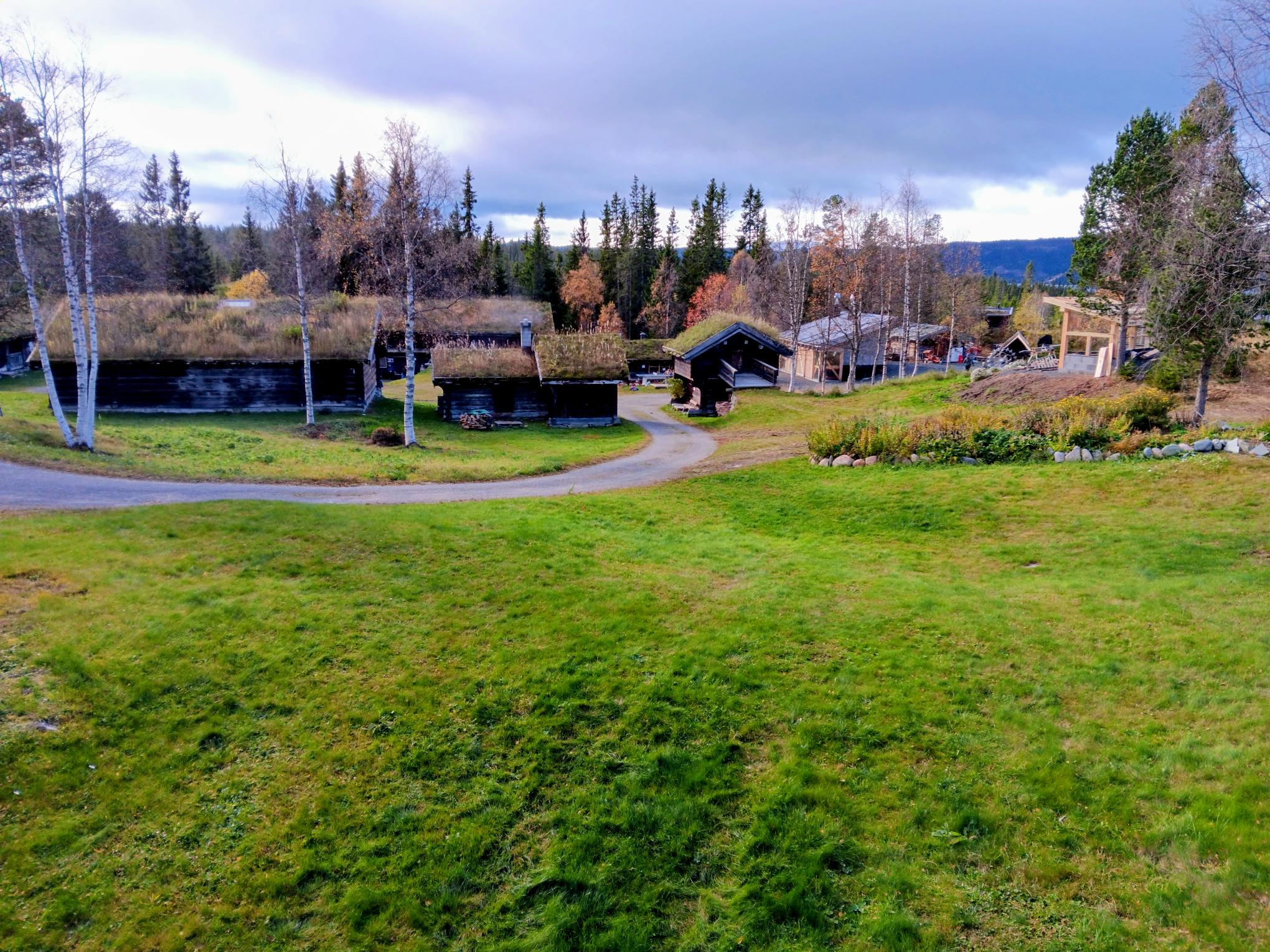
Members of the Scandinavian Weavers group traveled far and wide in 2025. Lisa Torvik ventured to Rauland in Telemark, Norway, eleven hours north of Oslo. There, she studied weaving at Raulandsakademiet, which offers classes in traditional craft. (See link below.)
View from Raulandsakademiet in beautiful Telemark. Photo by Lisa Torvik.
Note from Lisa: “This is the view out the back windows of the fireplace lounge (peisestogo) and the upper floor cafeteria and large meeting room [at Raulandsakademiet]. The building is the “Telemark Tun”, a small museum of traditional farm buildings that house a shop of handmade items in the hay barn and a bakery specializing in traditional breads. In Norwegian, a “tun” is what we call a farmstead and since farmsteads were often built close together, with maybe two manor houses or more, it might be the origin of the English word town. ”
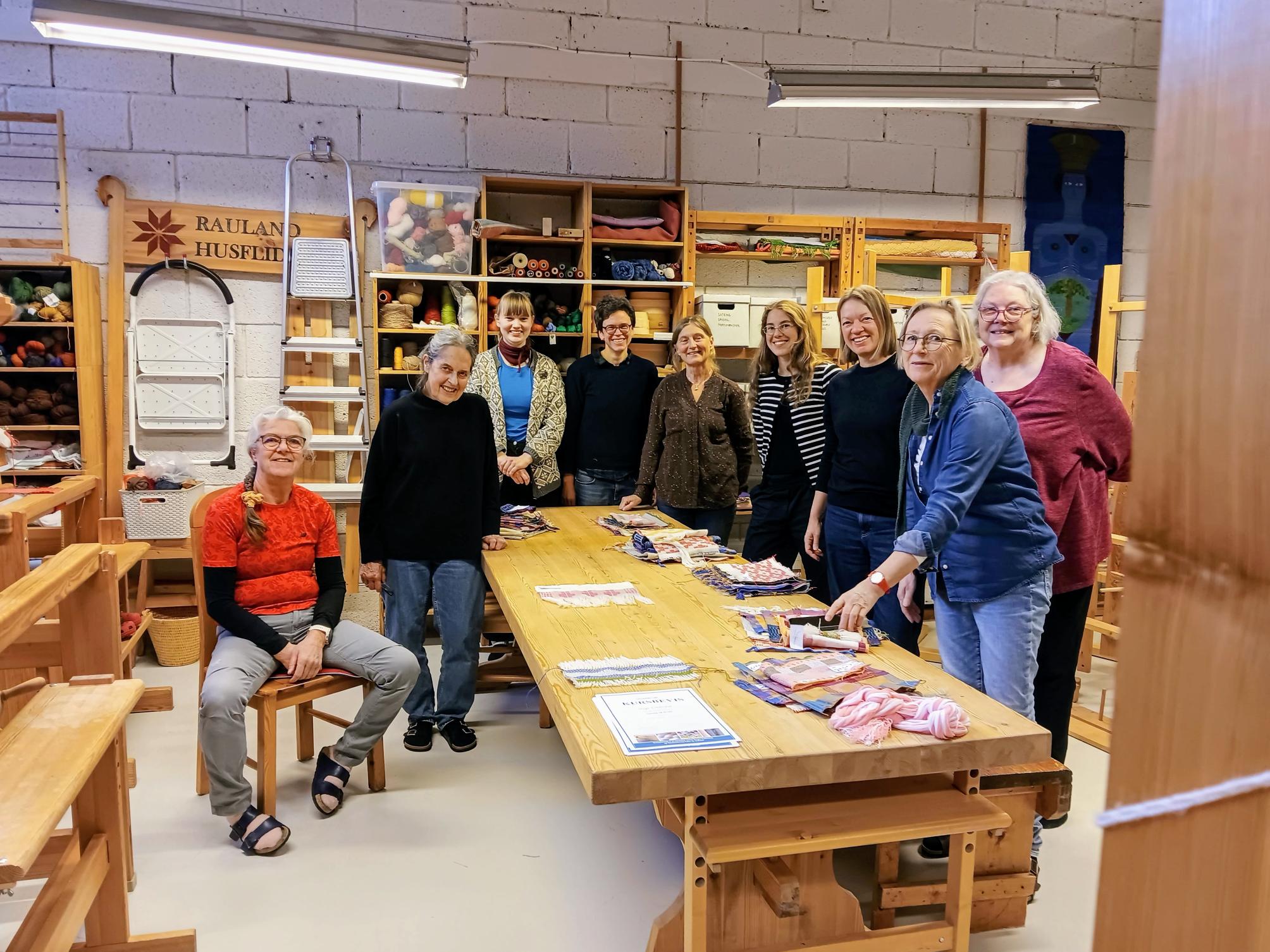
The weaving course was taught in Norwegian. Fortunately, Lisa is fluent in both language and traditional weaving, having studied at at Valdres Husflidskule (handcraft school) in Fagernes in 1974. She is currently a member of the Øystre Slidre Husflidslag (handcraft guild).
Lisa (in the red shirt) with her classmates in Rauland.
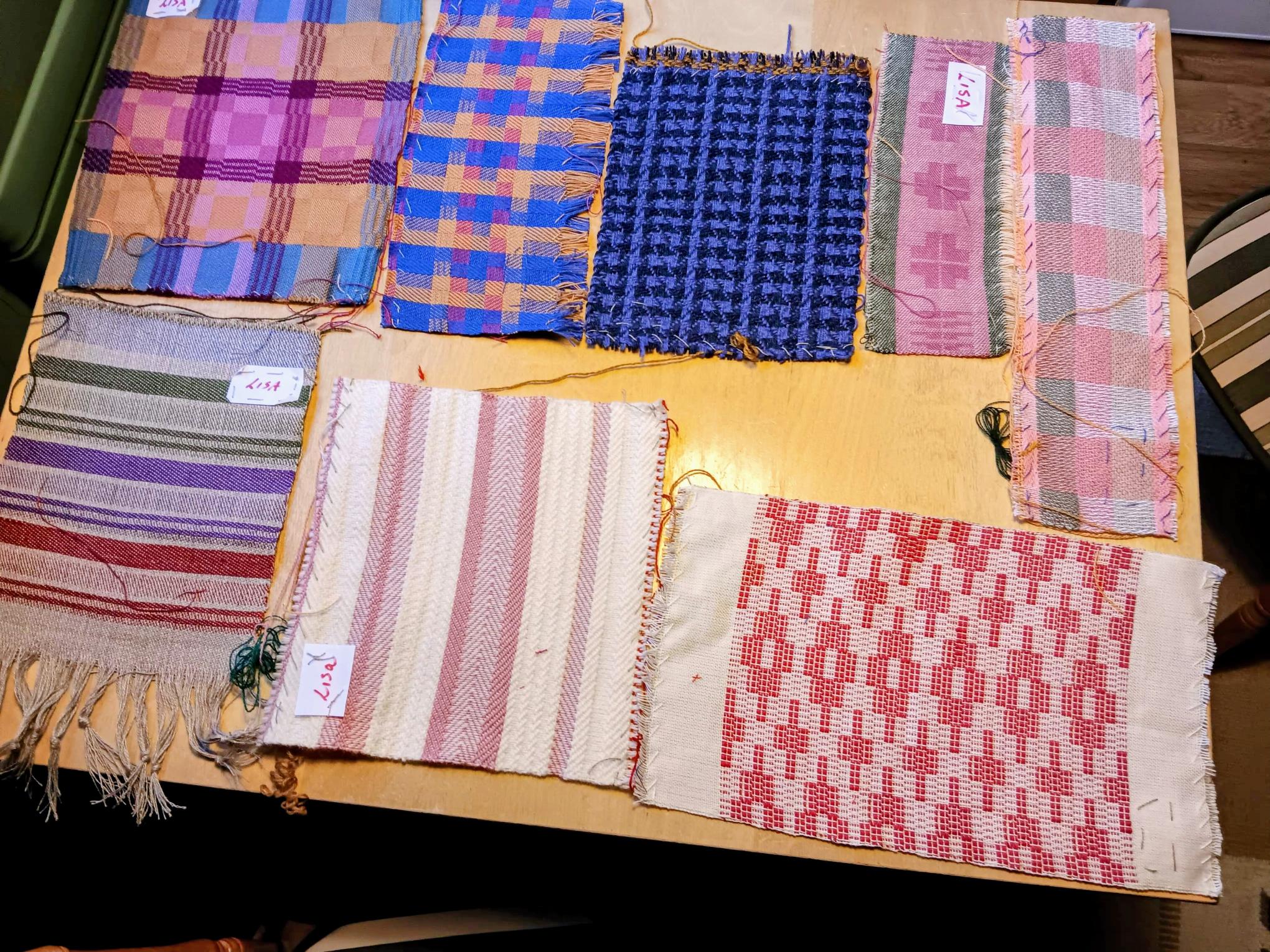
“The course I attended this fall in Rauland was called “Dreiel og sateng”, and focused on “drill” patterns of both satin and broken twill (korskypert) weaves,” Lisa explains. The course instructor was Rita Vistad
Lisa’s weaving samples. She wove all this in two and a half days! Photo by Lisa Torvik.
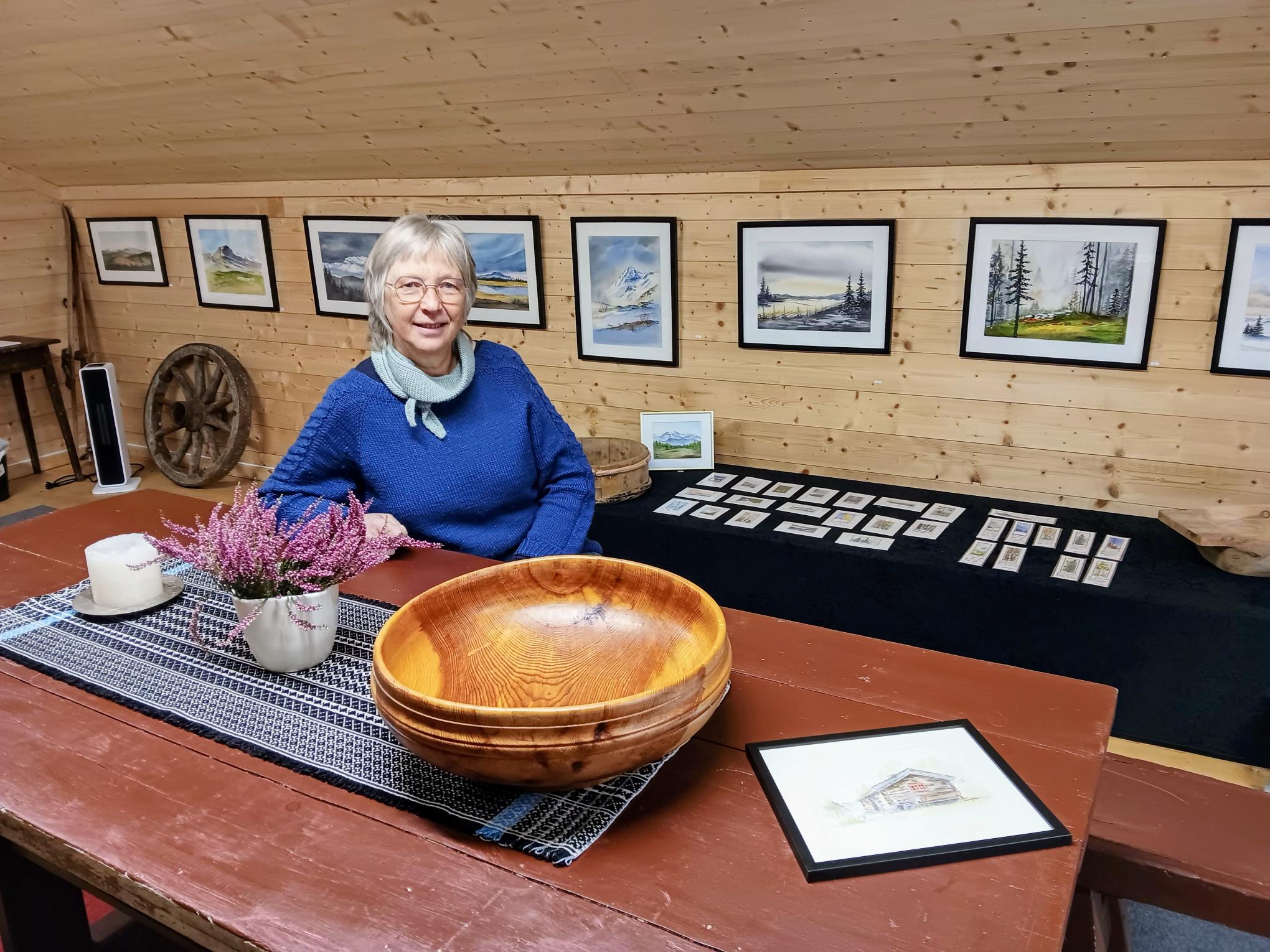
While in Norway, Lisa visited many friends and family members, bringing gifts of her woven items. Here is Lisa’s friend Gunvor Hegge in her artist’s studio. Lisa wove the black-and-white skillbragd table runner on the table.
Photo by Lisa Torvik.
Holly Hildebrandt made her very first trip to Norway, where she studied with Ingebjørg Monsen in Bergen. Ingebjørg is president of Bjørgvin Husflidslag (handcraft guild), where she teaches classes in weaving and sewing, and specializes in constructing men’s bunader (national costumes).
Holly and Ingebjørg at the loom. Photo by Holly Hildebrandt.A clever weaving hack to keep treadles spaced properly. Photo by Holly Hildebrandt.
Holly spent the week learning to weave krokbragd and rutevev techniques in beautiful Norwegian wool.
Krokbragd designs on the loom. Photo by Holly Hildebrandt.Yarn spin from Norwegian spelsau sheet. Notice the sheen! Photo by Holly Hildebrandt.
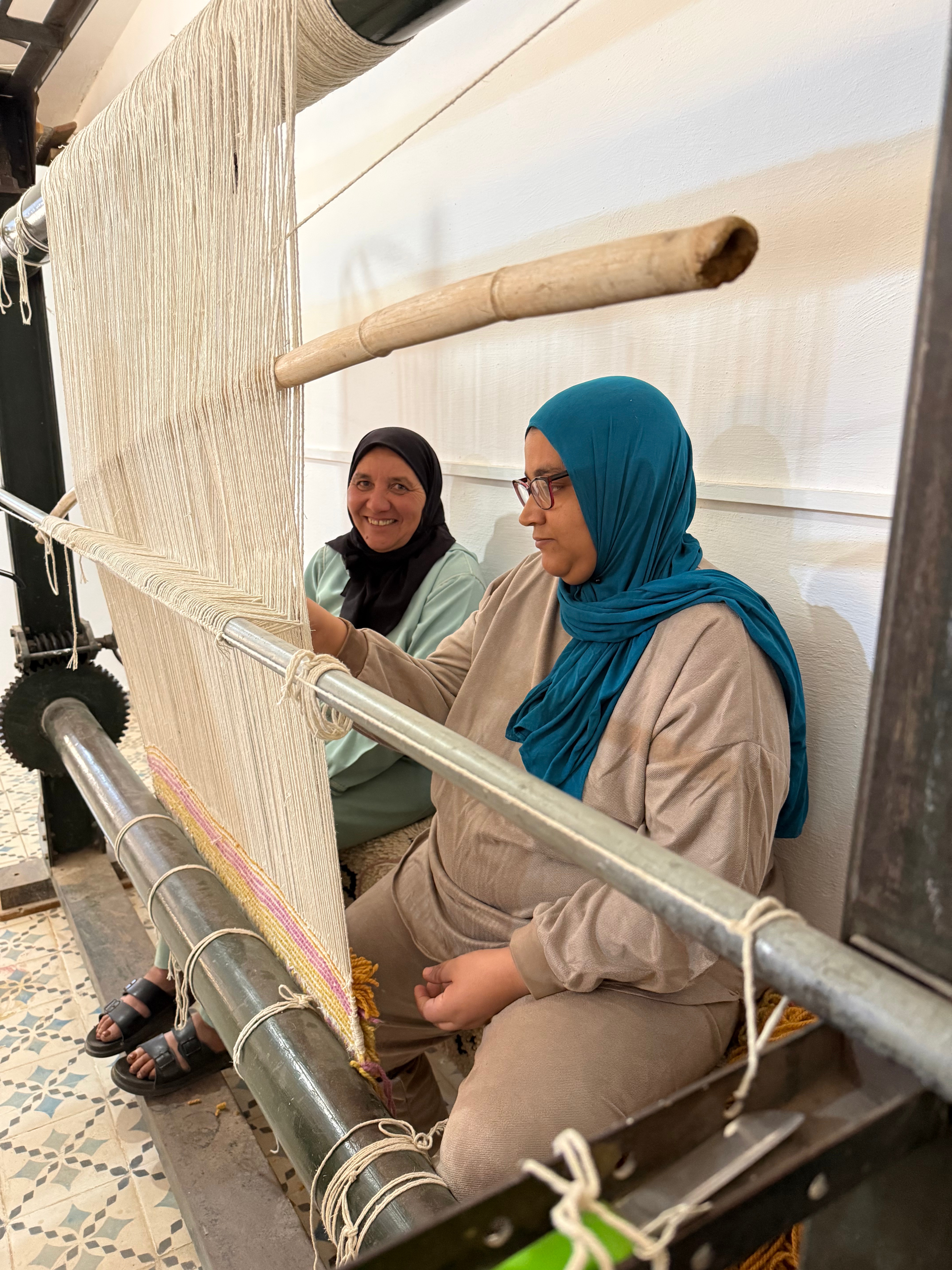
Nancy Ebner finished her 2025 travels with a trip to Morocco through Loom Dancer Odysseys. Nancy and other tour members participated in four textile workshops, and Nancy took more than 1000 photos! Below, women weave rugs in a pile technique similar to Scandinavian rya.
Photo by Nancy Ebner, taken at the Cherry Buttons Women’s Cooperative.
Weaving is a universal language with a thousand different dialects. Many of the Scandinavian Weavers group are ardent travelers, roaming far and wide to learn more about global textile traditions. These are some of their stories.
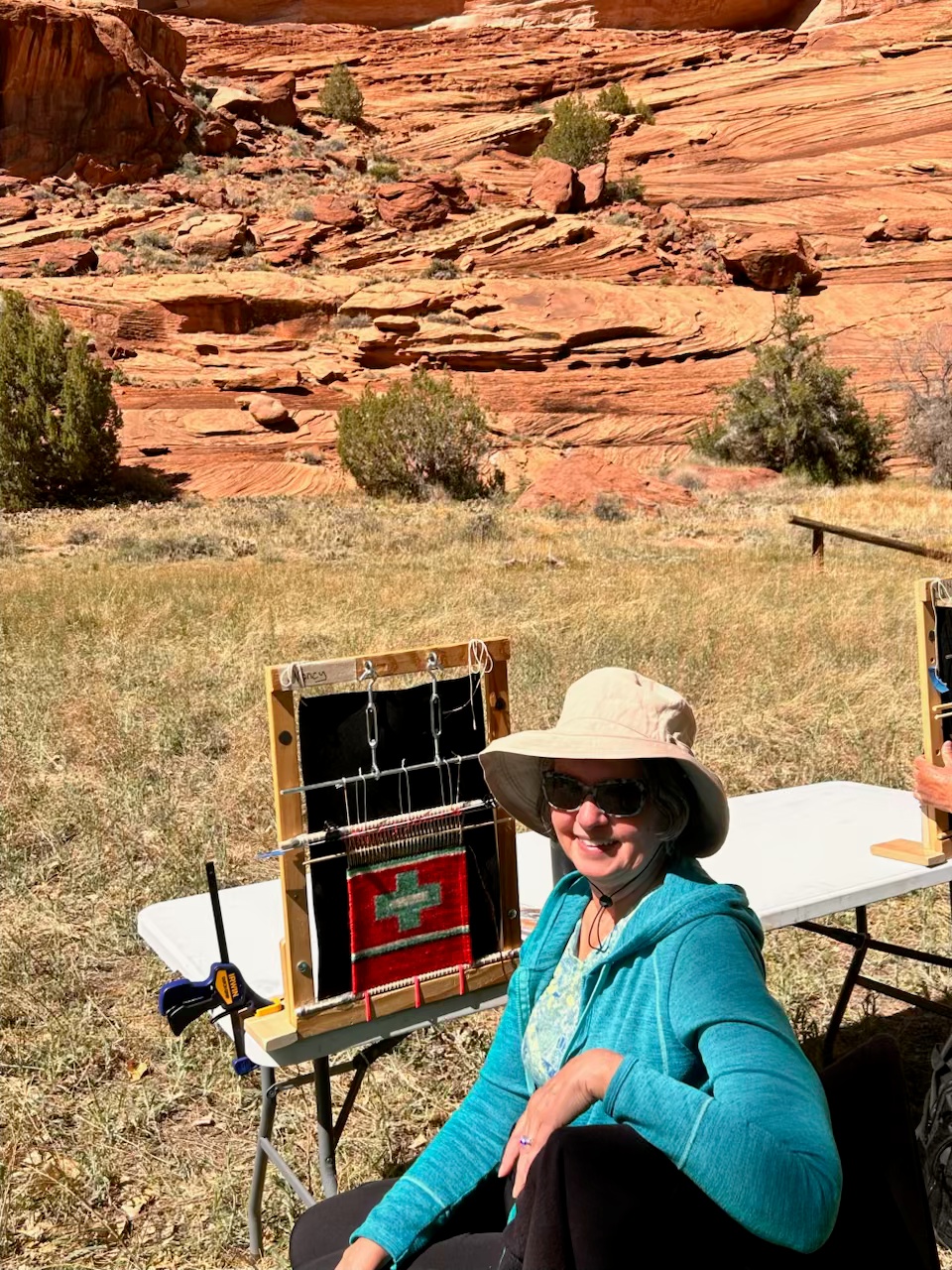
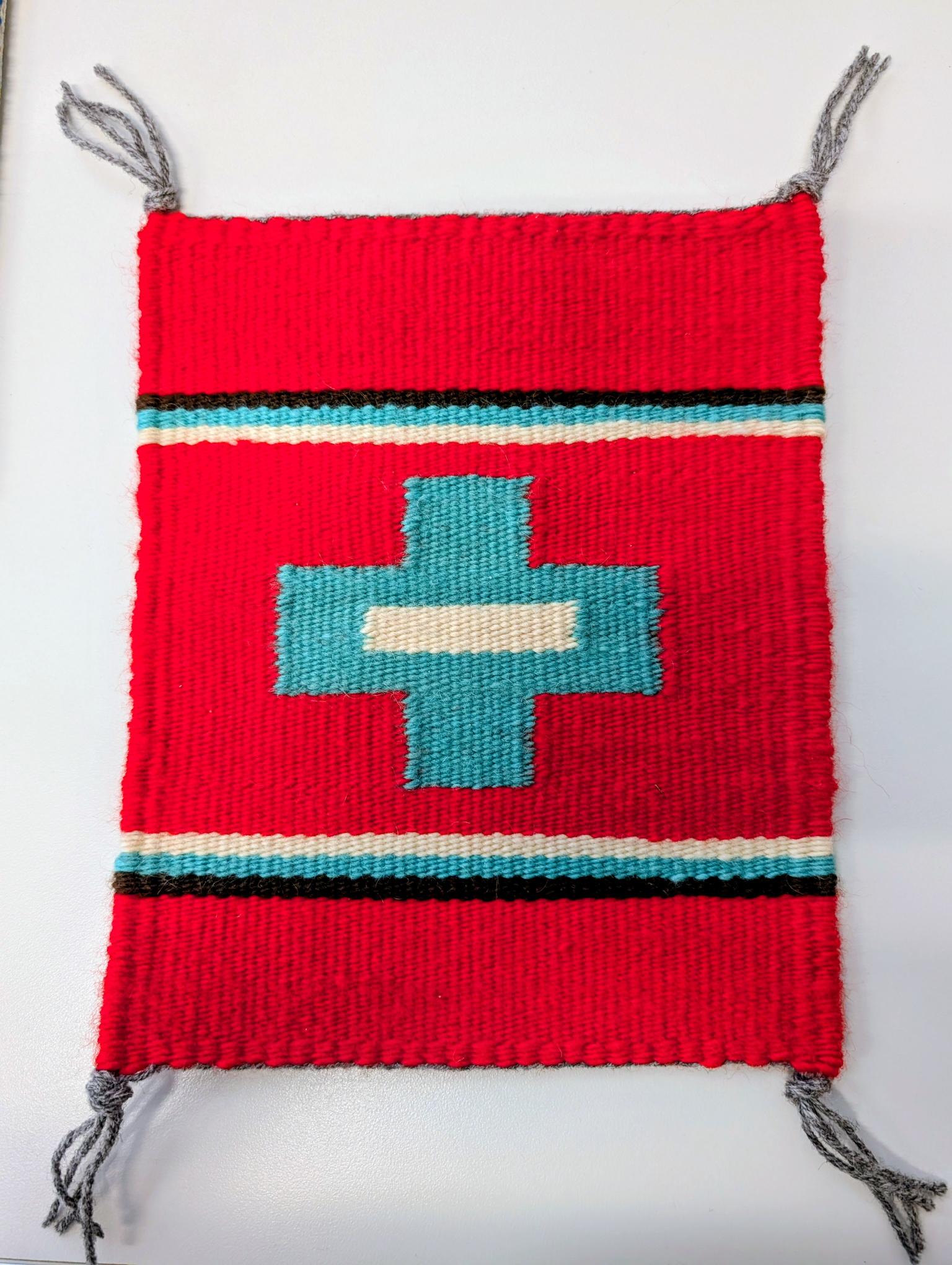
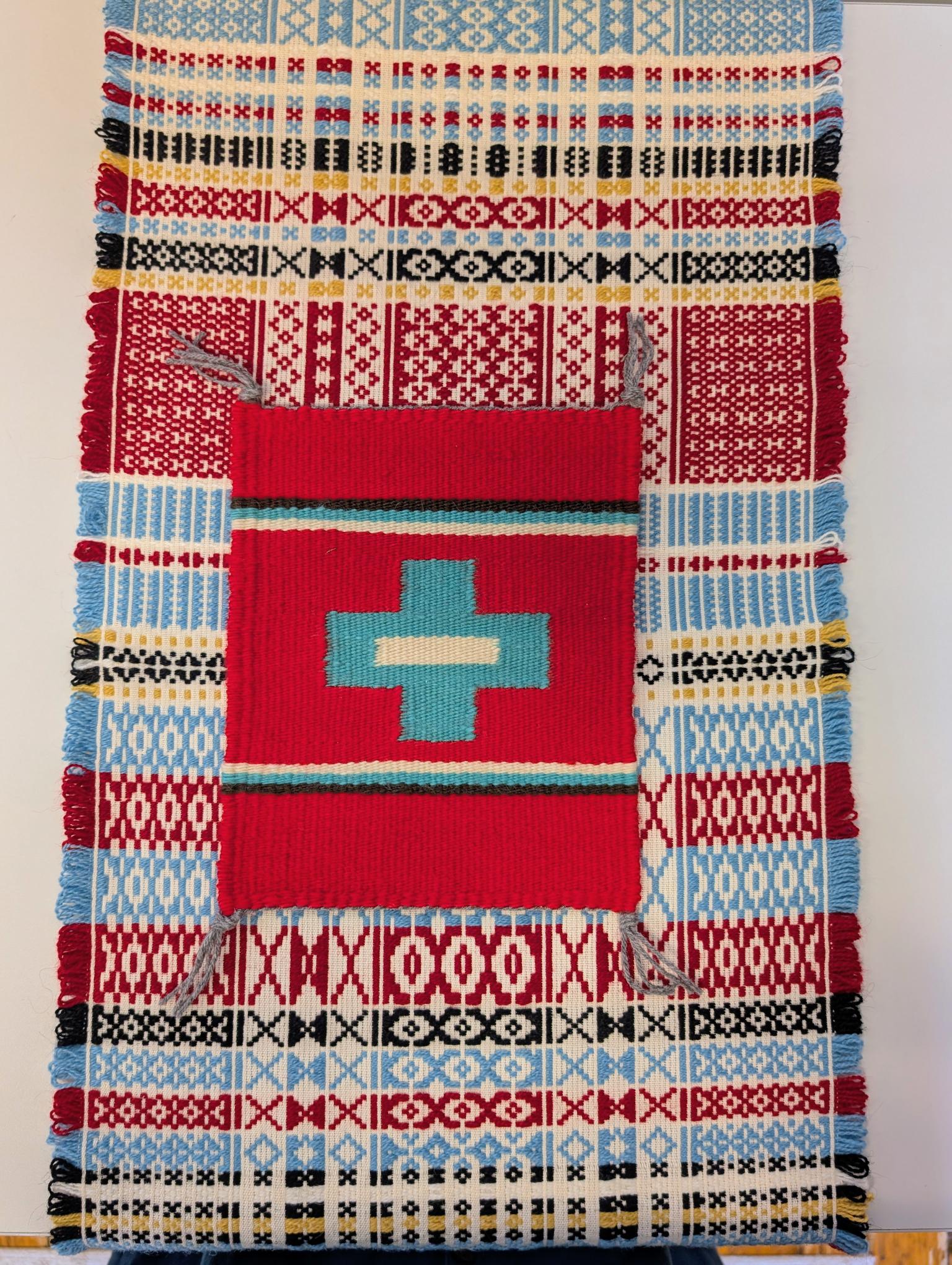
Nancy Ebner is a true globe-trotter—and wherever she travels, she always takes time to take classes in local weaving traditions. Here, she learns Diné-inspired tapestry on a portable loom in Canyon de Chelly, Arizona.
Nancy’s finished tapestry. Photo by Nancy Ebner.
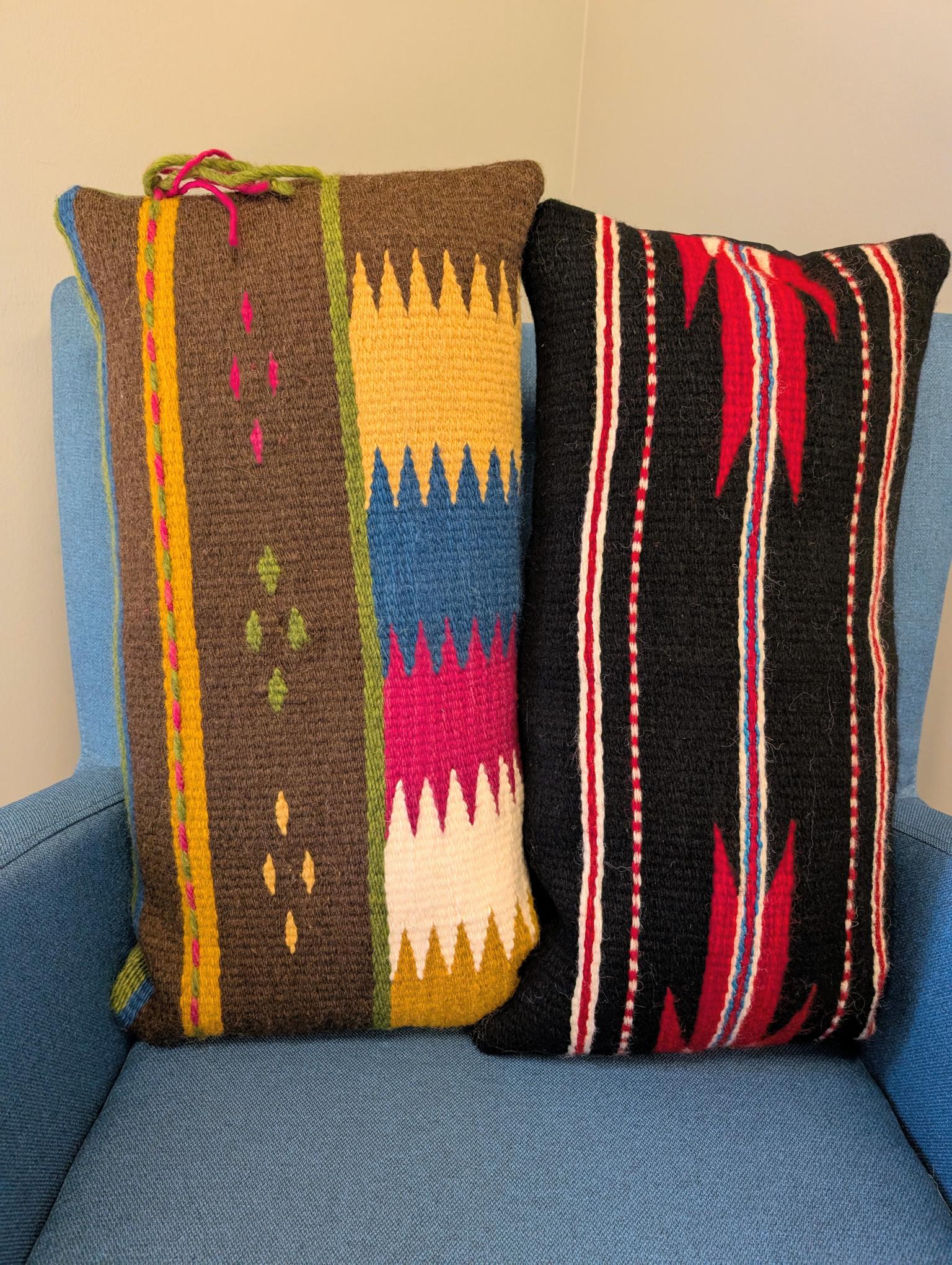
In a previous trip to Santa Fe, New Mexico, Nancy wove on a 2-harness, Rio Grande loom. “Rio Grande looms are also called “Walking Looms” because you stand at the loom, instead of sitting at the loom and step on the treadles to work the harnesses,” Nancy explained in a blog post. “They are counterbalance in nature, so they generate an excellent weaving shed.”
Nancy turned her Rio Grande weavings into pillows. Photo by Lisa-Anne Bauch.
These were just a few of the SIXTEEN pieces Nancy wove and/or finished between April and August of this year. (We’re pretty sure this is a group record!) She shared them at a fall Scandinavian Weavers meeting.
Nancy surrounded by her sixteen weavings! Photo by Lisa Bauch.
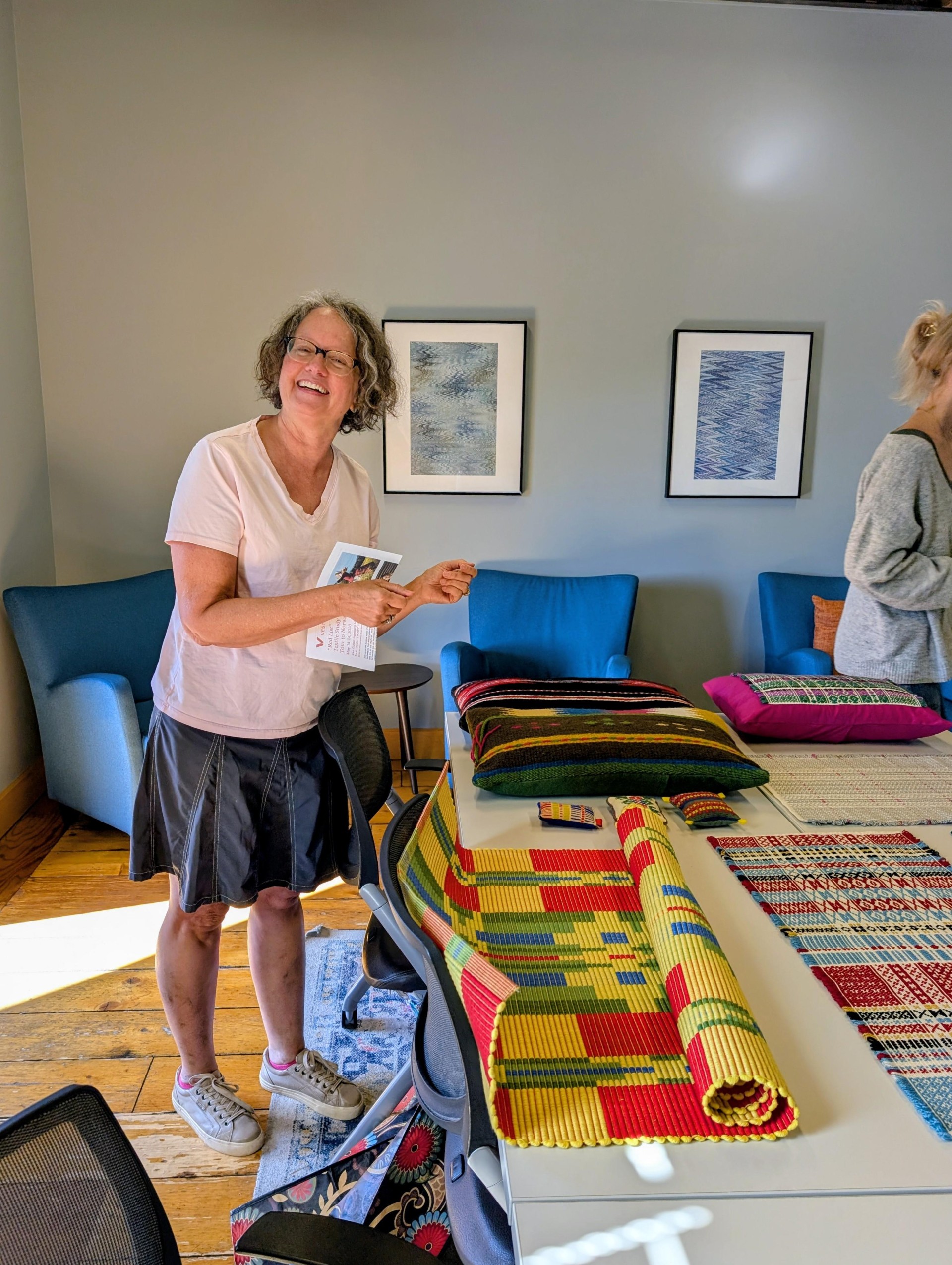
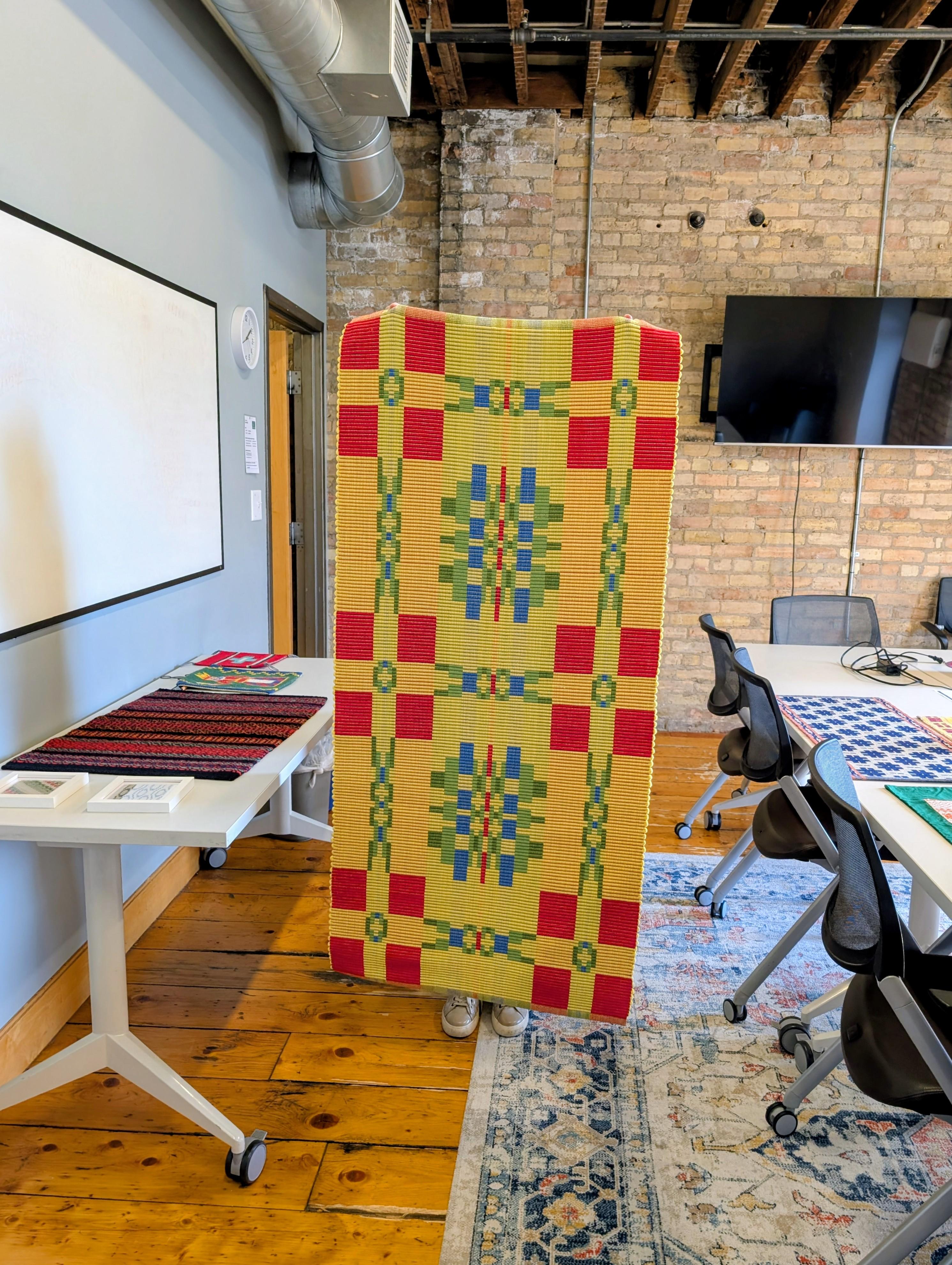
Nancy’s recent travels include a class in rep weave at Vävstuga Weaving School in Massachusetts, where she wove the rug below. (See link below) Which side do you prefer?
Photo by Lisa BauchPhoto by Lisa Bauch
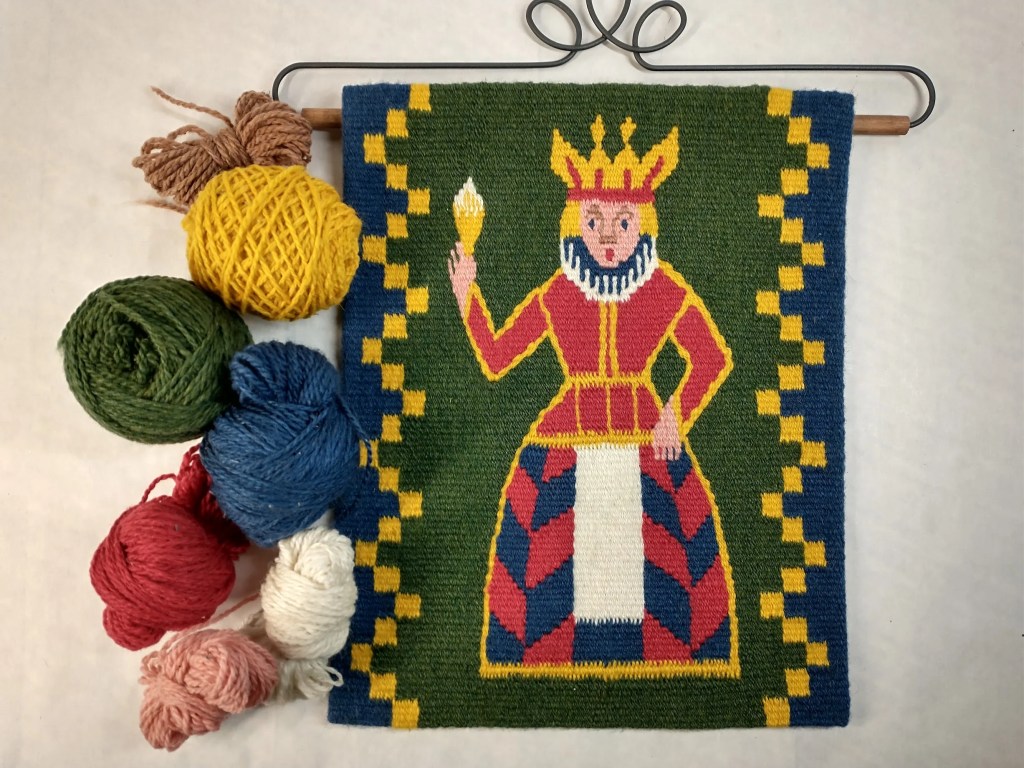
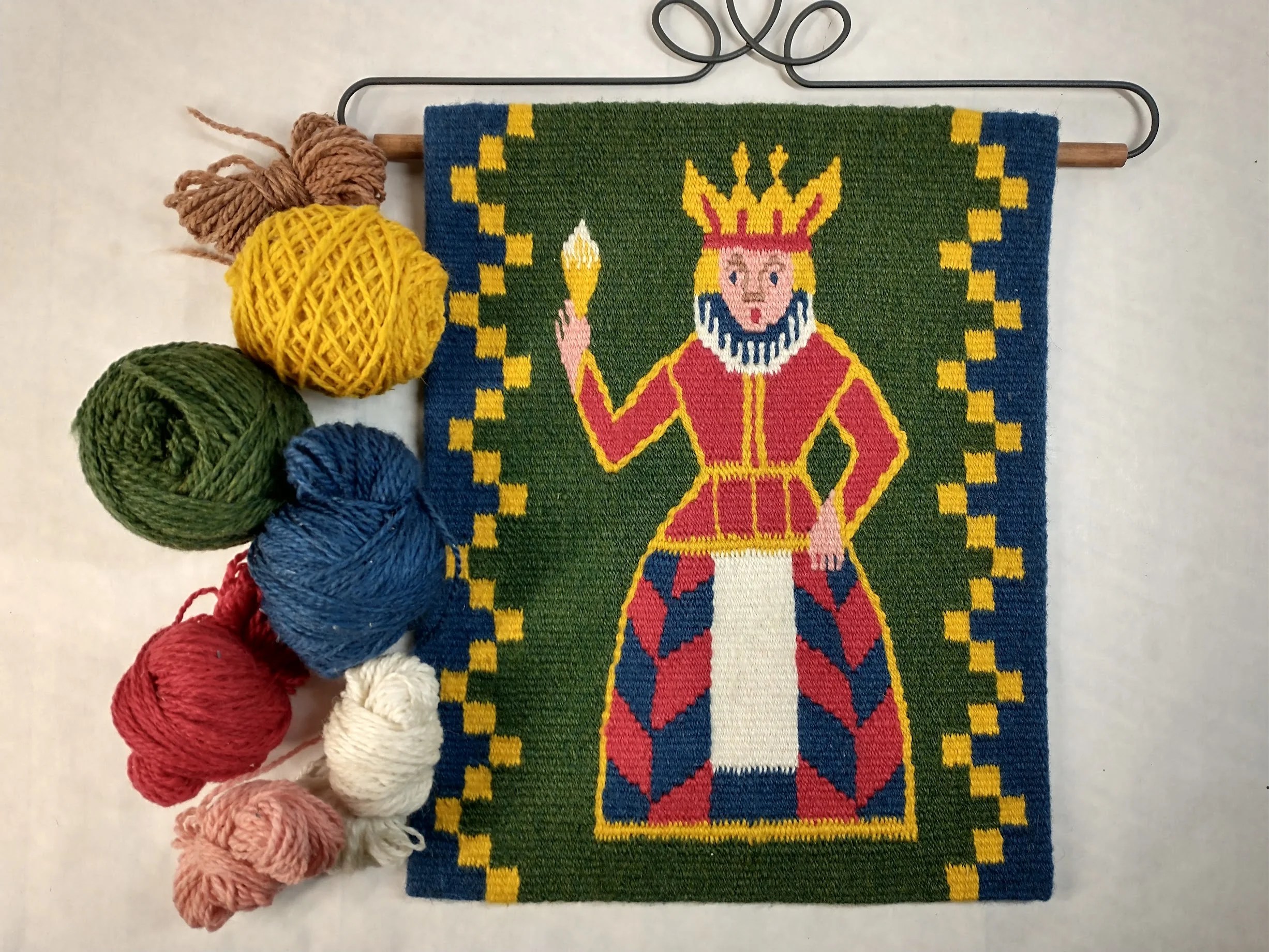
Nancy also studied Norwegian billedvev (tapestry) with Laura Berlage. Below is her rendition of the traditional Wise Virgin motif.
Photo by Nancy Ebner
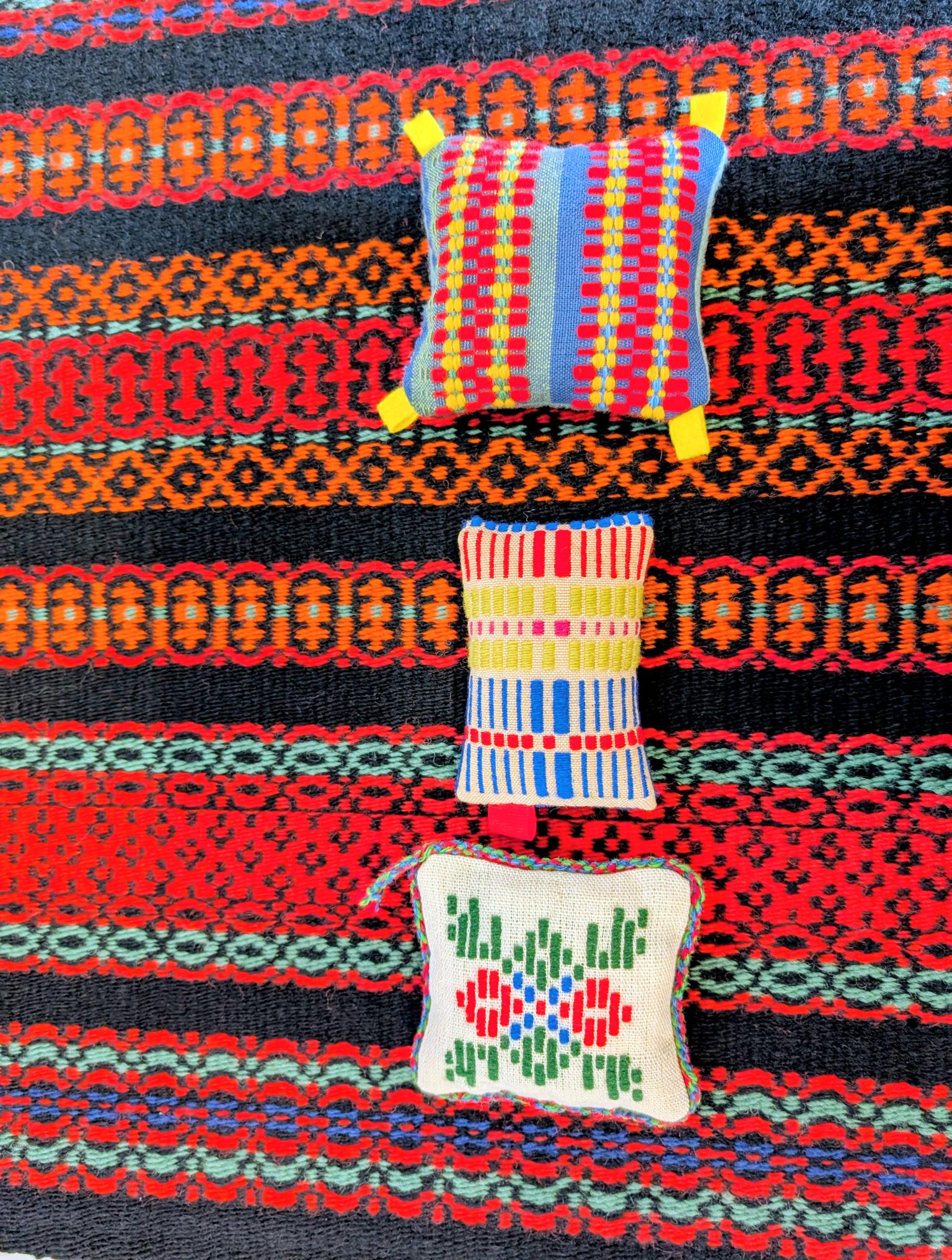
Nancy cleverly used her samples from a Swedish weaving workshop to make pin cushions. They are displayed here on a weaving she did in Norwegian flesberg technique.
Photo by Nancy Ebner.
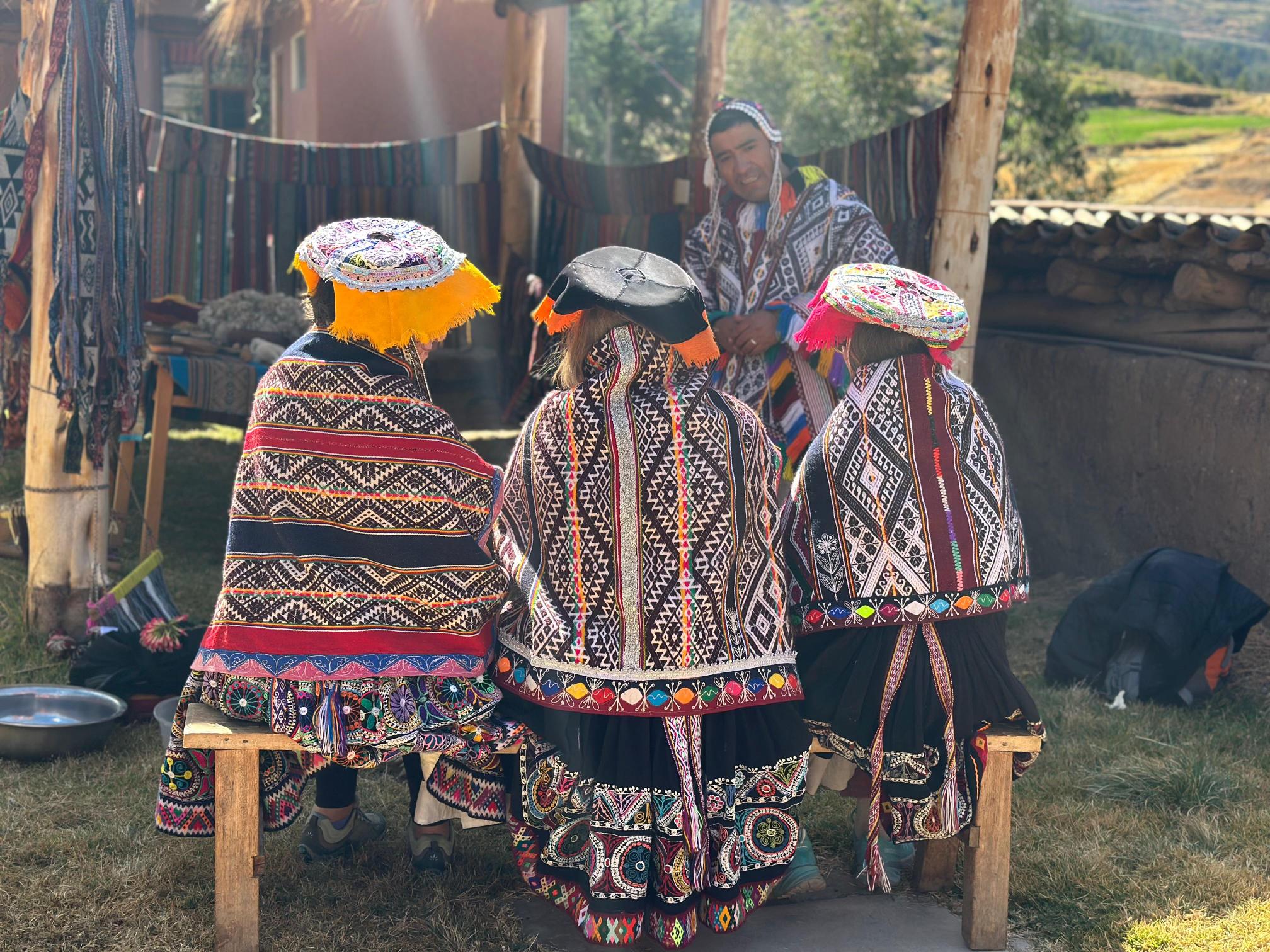
Finally, a photo from a trip Nancy led to Peru, through The Andean Alliance for Sustainable Development.
Quechua weavers. Photo by Nancy Ebner.
“I enjoy the weaving itself,” Nancy says of her travels, “and the connection it creates to people of other countries, backgrounds and cultures.”
Below, a cultural exchange. Nancy’s tapestry atop a Norwegian skillbragd she wove during a Scandinavian Weavers group warp. (See Skillbragd post.)
Photo by Lisa-Anne Bauch.
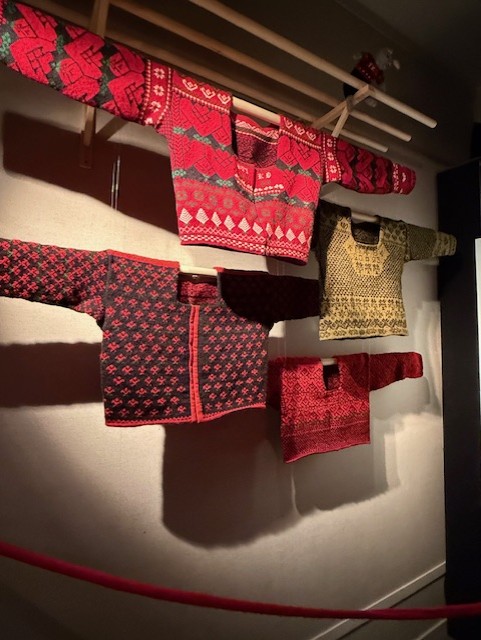
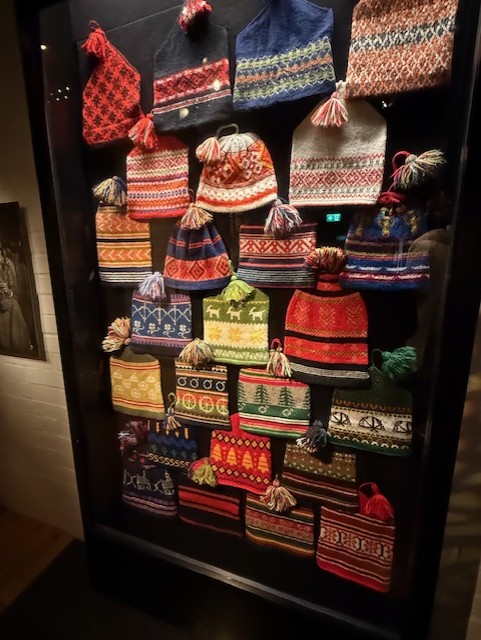
Meanwhile, Judy Larson attended the Väv2025 weaving conference in Gävle, Sweden. While there, she visited the Dalarnas Museum in Falun and took these photos of a knitting exhibit.
Photo by Judy Larson.Photo by Judy Larson.
Following the conference, Judy traveled to Vävstugan (The Weaving House ) in Tingsryd, Sweden. Here, weavers of all levels are welcome to work on one of 23 looms in a variety of traditional Swedish techniques. (See link below.)
Photo by Judy Larson.
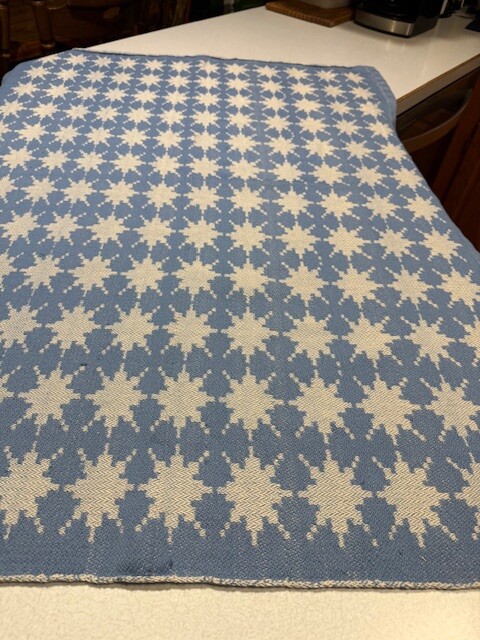
Judy wove this beautiful blue blanket in 8/2 cotton on a drawloom. She wove the piece below BACK SIDE UP, using Opphämpta technique on a drawloom. Congratulations, Judy!
Photo by Judy Larson.
Go to Part Two of this post for more weaving journeys!
In 2025, the Scandinavian Weavers wove two long group warps in skillbragd technique. Group warps give newer members the opportunity to try techniques with support from more experienced members. It also allows weavers to use a larger floor loom they might not have at home.
We are grateful that the Weavers Guild of Minnesota has dedicated looms for interest groups. We love weaving at the Guild, as it gives us a chance to share our passion for Scandinavian weaving with visitors, shoppers, students, and fellow Guild members.
Lisa Torvik weaving skillbragd at the Weavers Guild of Minnesota.
Lisa Torvik was our mentor in skillbragd, providing guidance in dressing the loom as well as math, problem-solving, and the occasional repair of broken warp threads. (She swears by weaver’s knots!)
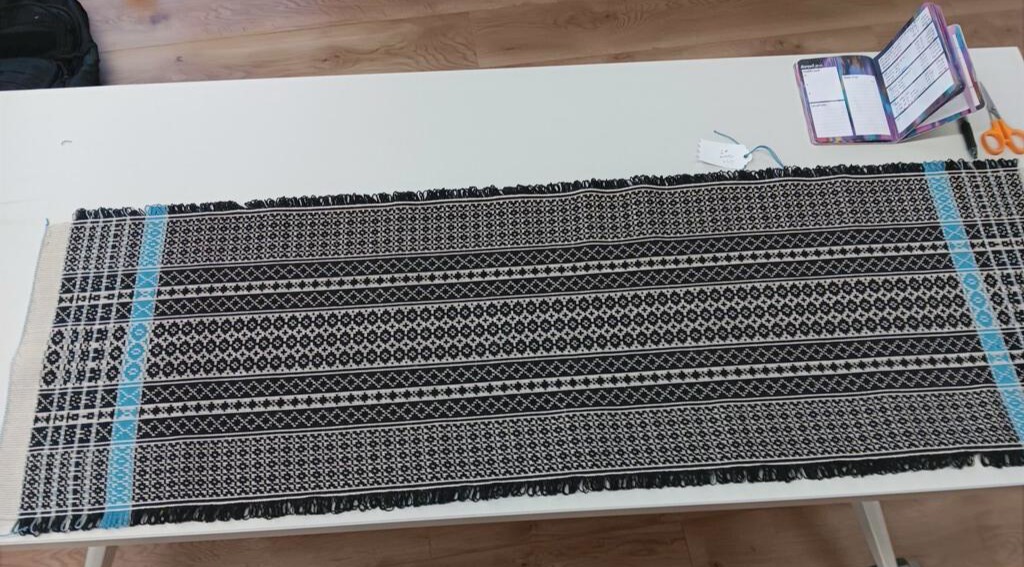
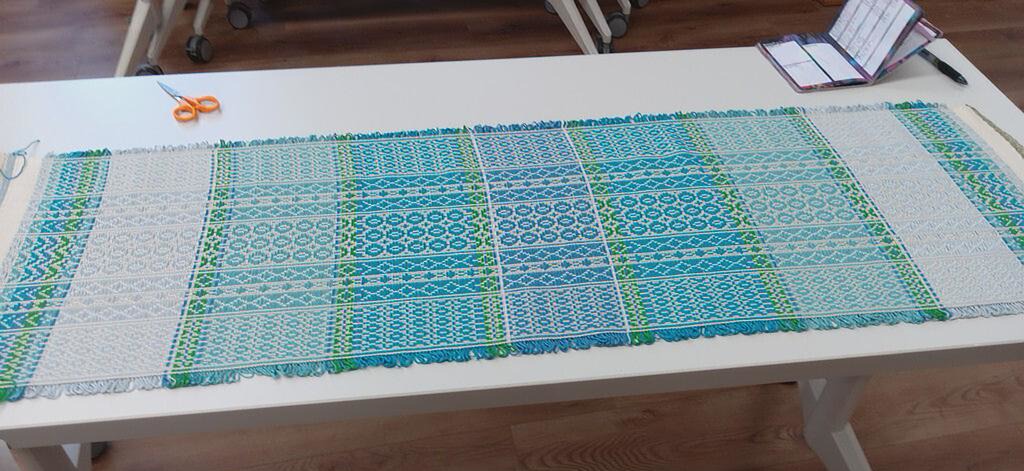
Skillbragd in spring shades. Photo by Lisa Torvik.
Lisa wove this runner in spring colors, using Rauma Prydvevgarn.
Photo by Lisa Torvik.
Many of Lisa’s weavings end up as gifts for family and friends in Norway. The black-and-white runner was destined for watercolor artist Gunvor Hegge. (See “Weaving Journeys” blog post for a photo of the runner in its new home.)
Weaving and photo by Lisa Torvik.
Another runner in delicate spring shades.
Weaving and photo by Lisa Torvik.
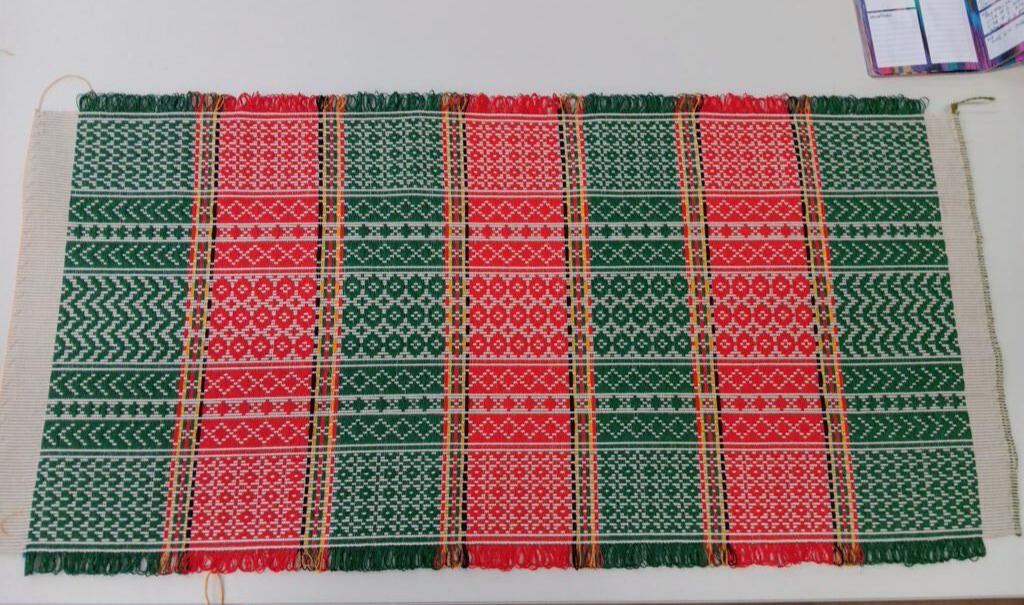
Finally, a weaving for Christmas!
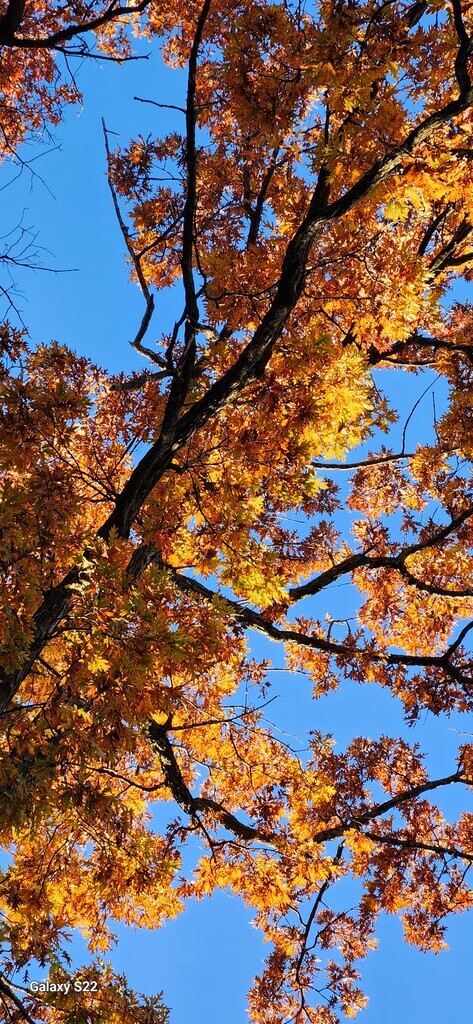
Minnesota enjoyed an unusually mild autumn this year. Lori Labs was inspired by the oak trees at her home in weaving her table runner.
Photo by Lori Labs.
Lori’s weaving in shades of orange and turquoise captured the brilliant glow of golden leaves against the autumn sky.
Weaving and photo by Lori Labs.
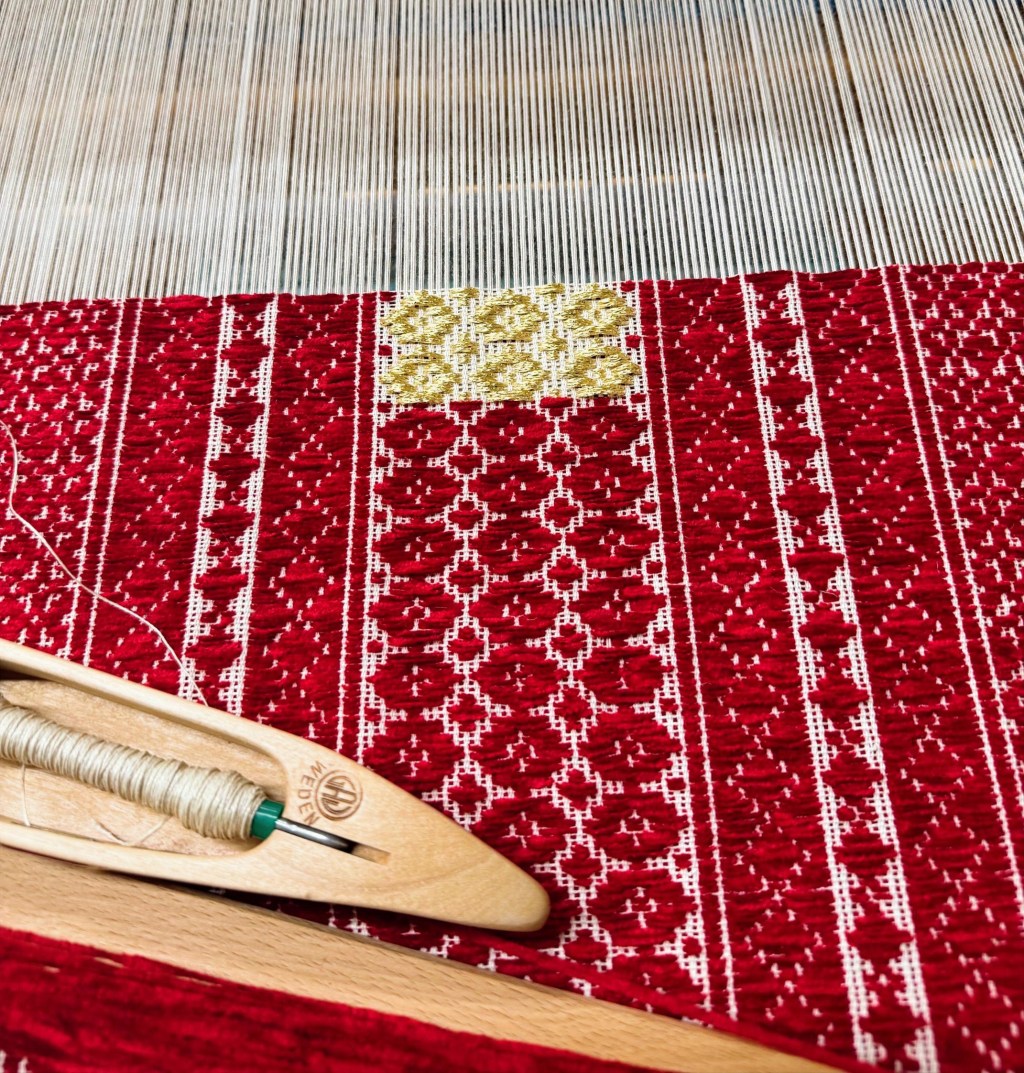
For her runner, Mary Skoy reached into her yarn stash for some luscious pattern weft.
Weaving and photo by Mary Skoy.
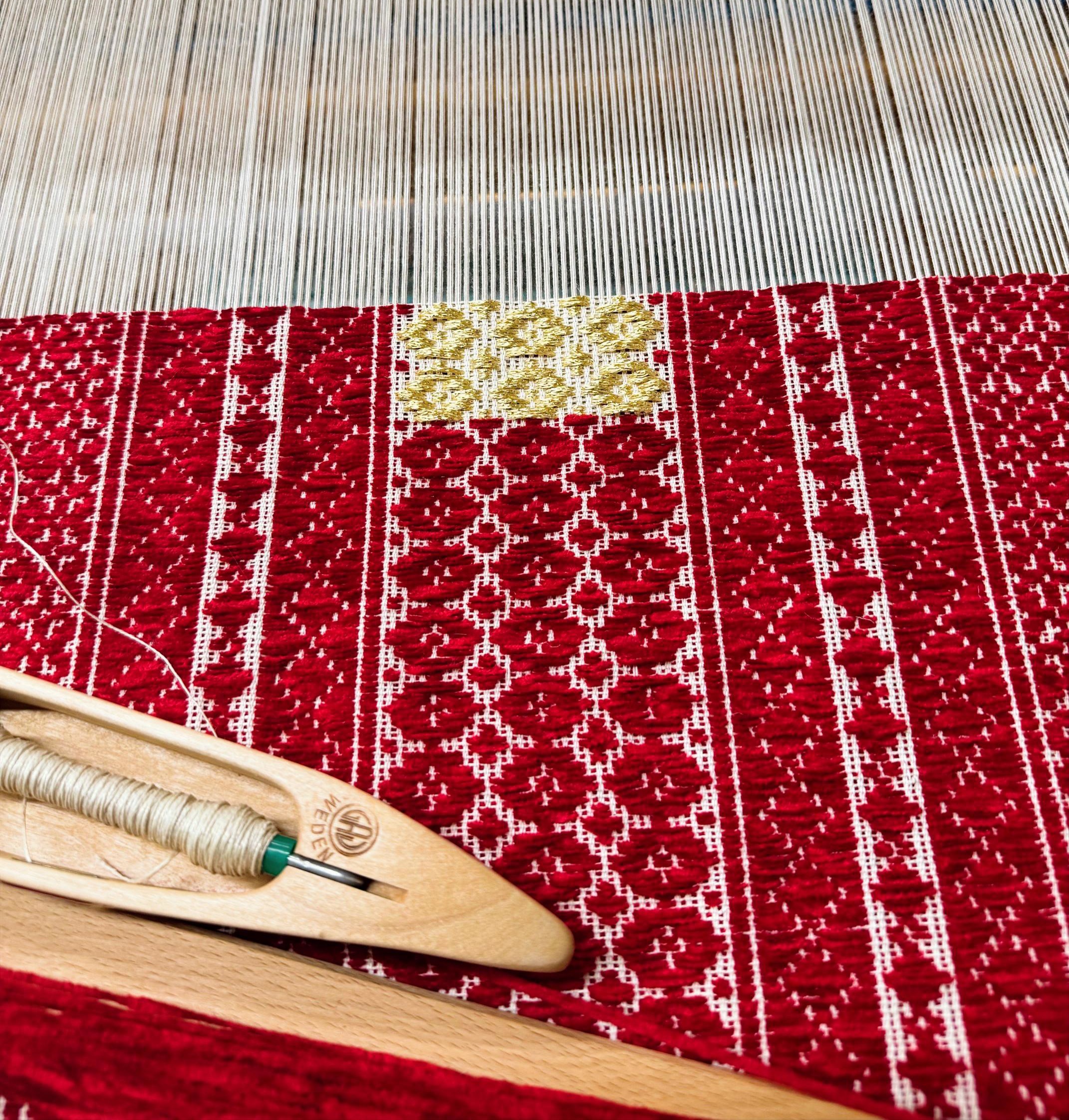
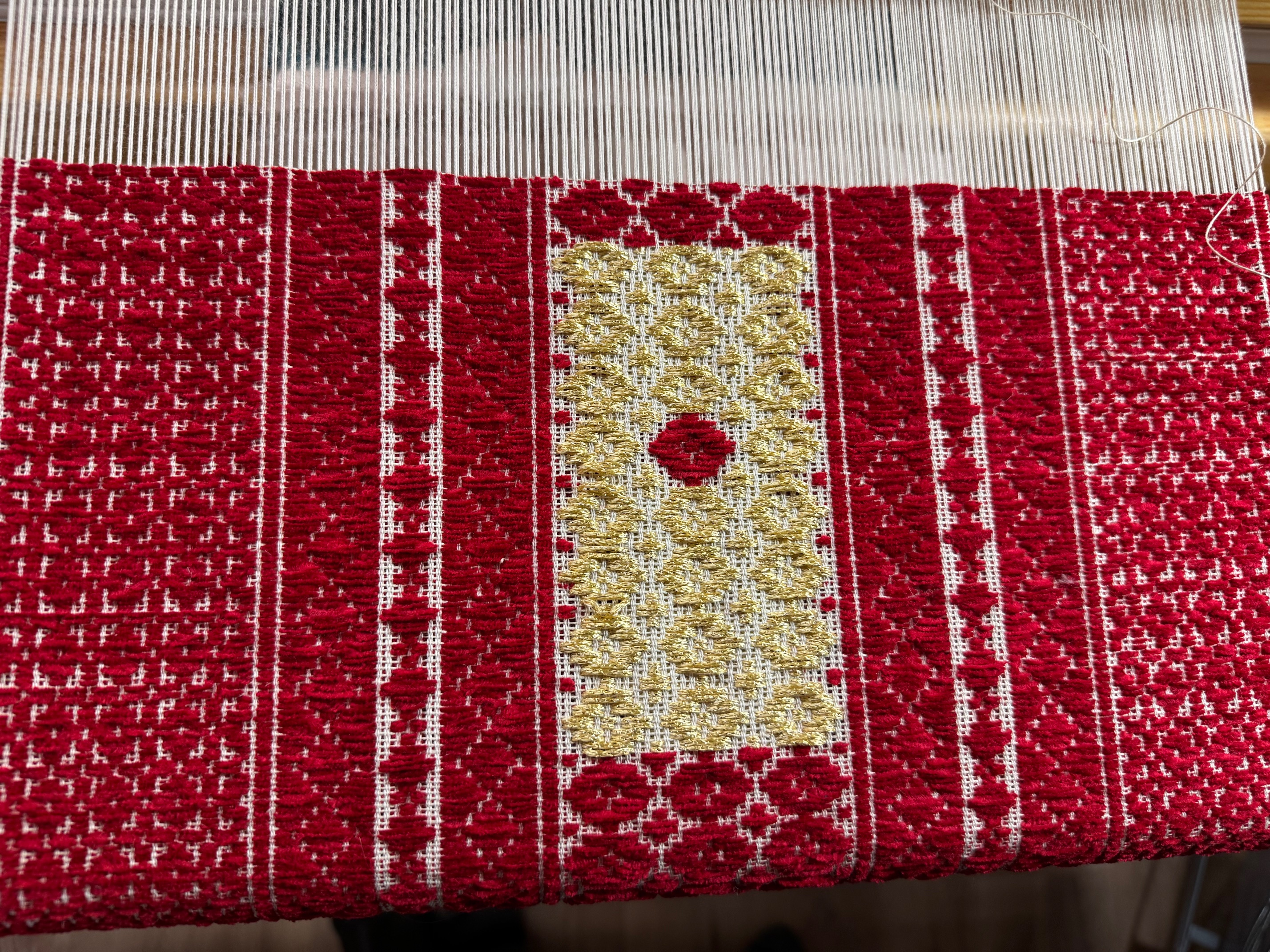
“The red [yarn] is a cotton chenille,” Mary explains. “The yellowing label inside the giant cone says “Phoenix Dye Works Cleveland, Ohio.” Google says the company was liquidated in the 90s. The gold thread was on a much smaller cone with no label, but about the same yardage. I used the McMorran Yarn Balance to estimate the yardage on these two kind of mystery yarns.”
Weaving and photo by Mary Skoy.
Mary added a special touch to her weaving. The golden pattern square is known in Sweden as a prästruta, or “priest’s square.” Traditionally, this section of a Smålandsväv table covering was reserved for a visiting priest’s catechism or prayerbook.
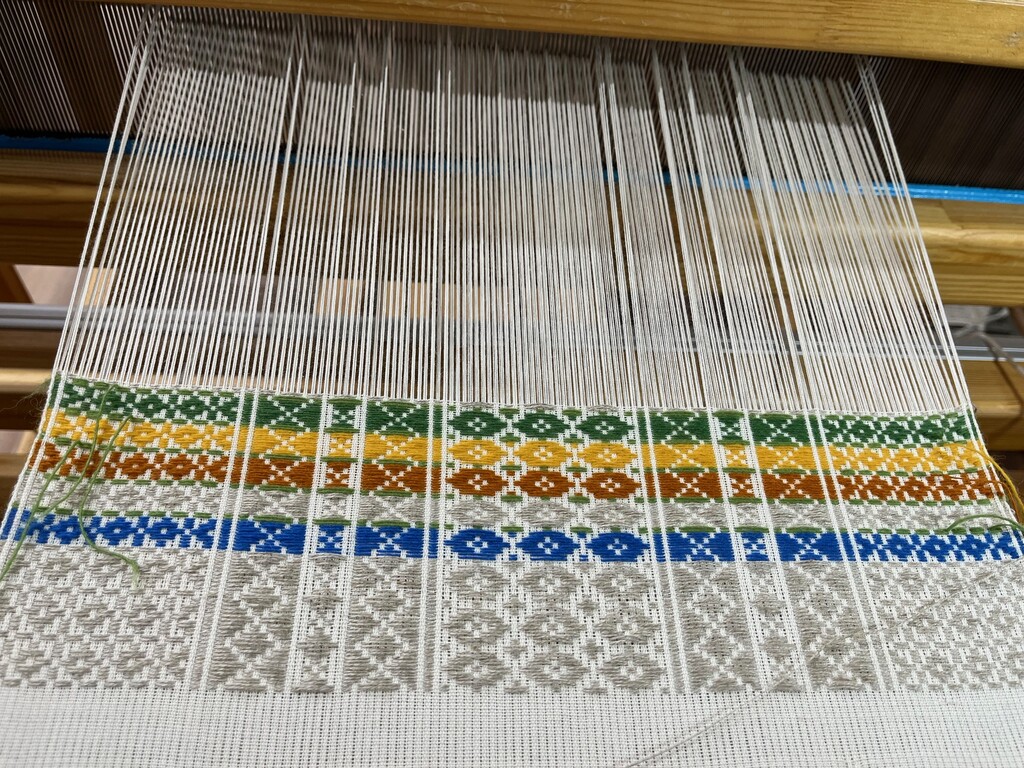
Like Mary, Marianne Tamminen dug into her stash for her project, including 6/1 wool and unbleached linen.
Her first runner was carefully woven to match her dishes, but her second piece is is pure play. “It is so much fun to play with colors and pattern!” she writes.
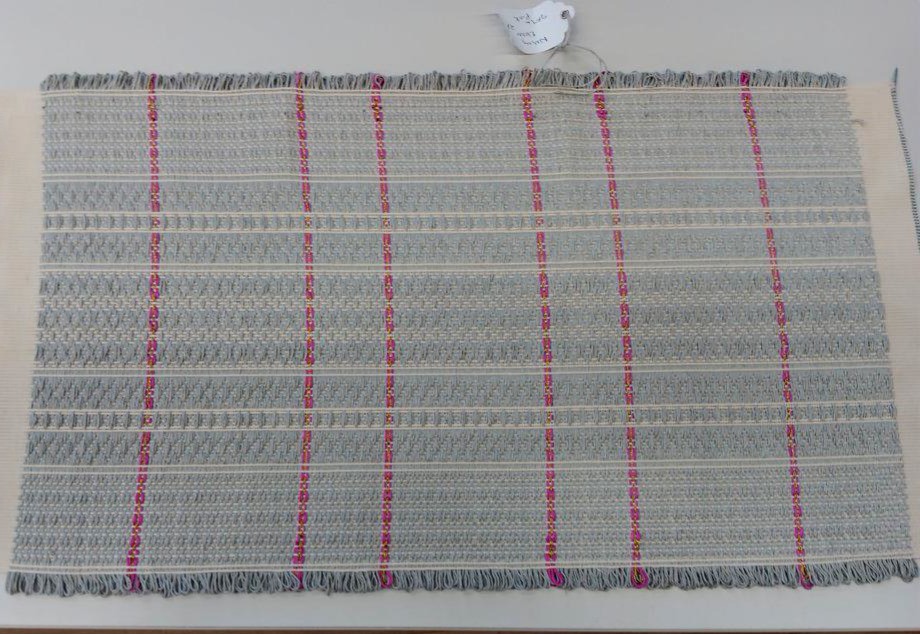
Nancy Ebner also chose delicate grey pattern weft for runner, with a dash of her signature pink.
Weaving by Nancy Ebner. Photo by Lisa Torvik.
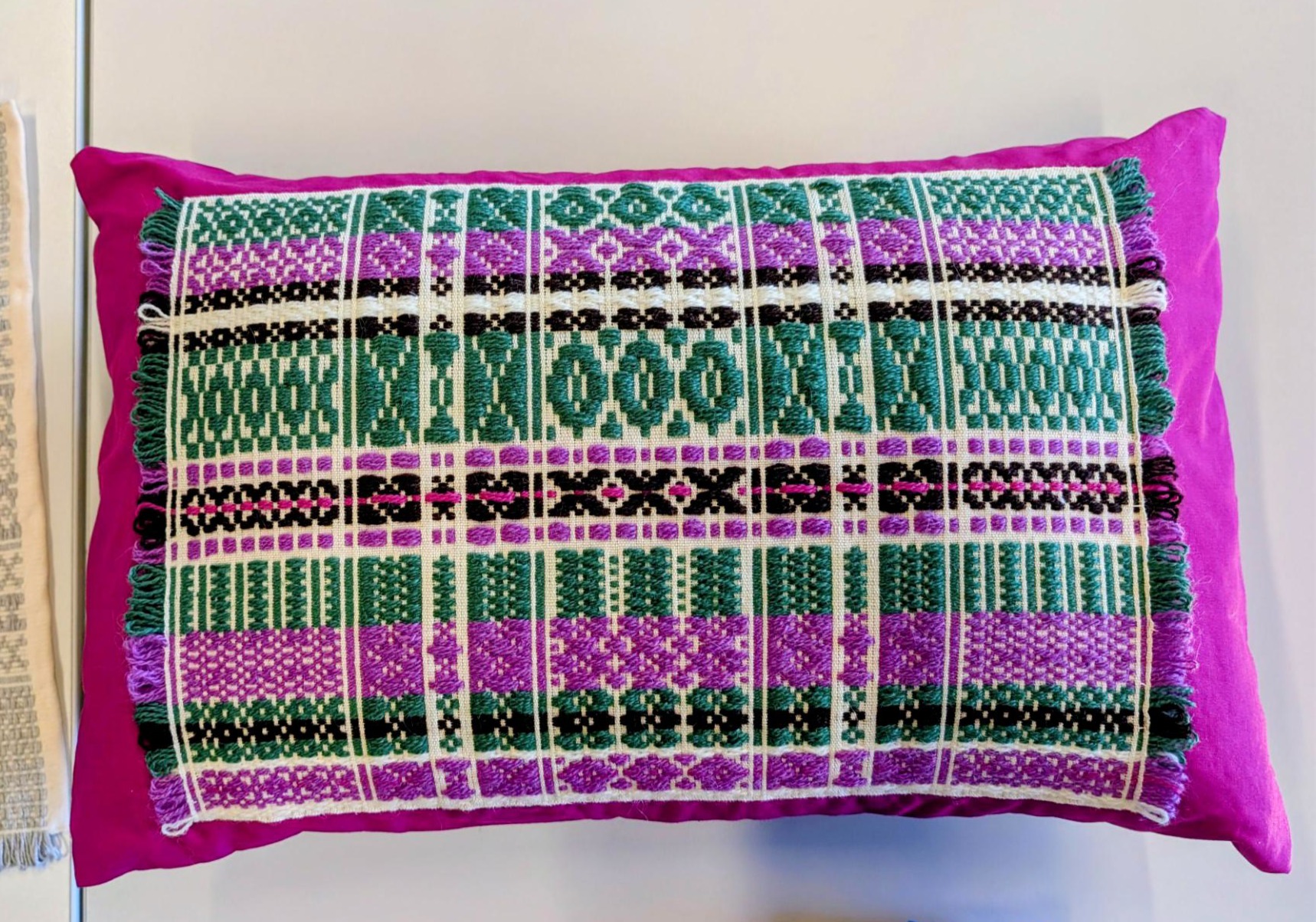
Nancy cleverly used her skillbragd sampler in vibrant green, black, and purple for a pillow. For more of Nancy’s skillbragd weavings, see the blog post “Weaving Journeys (Part One).”
Weaving by Nancy Ebner. Photo by Lisa Torvik.
Peg Hansen also loves weaving in pink! Like many others, she used Rauma Prydvevgarn for her pattern weft.
Peg comments: “As many have said before, [skillbragd] is a slow go but gratifying to accomplish. I look forward to finishing it and getting it on my dining room table! Thank you to everyone who has made this opportunity possible. It is so fun demystifying Skillbragd. I hope I can be brave enough to warp it someday on my own loom.”
Photo by Lisa Torvik.
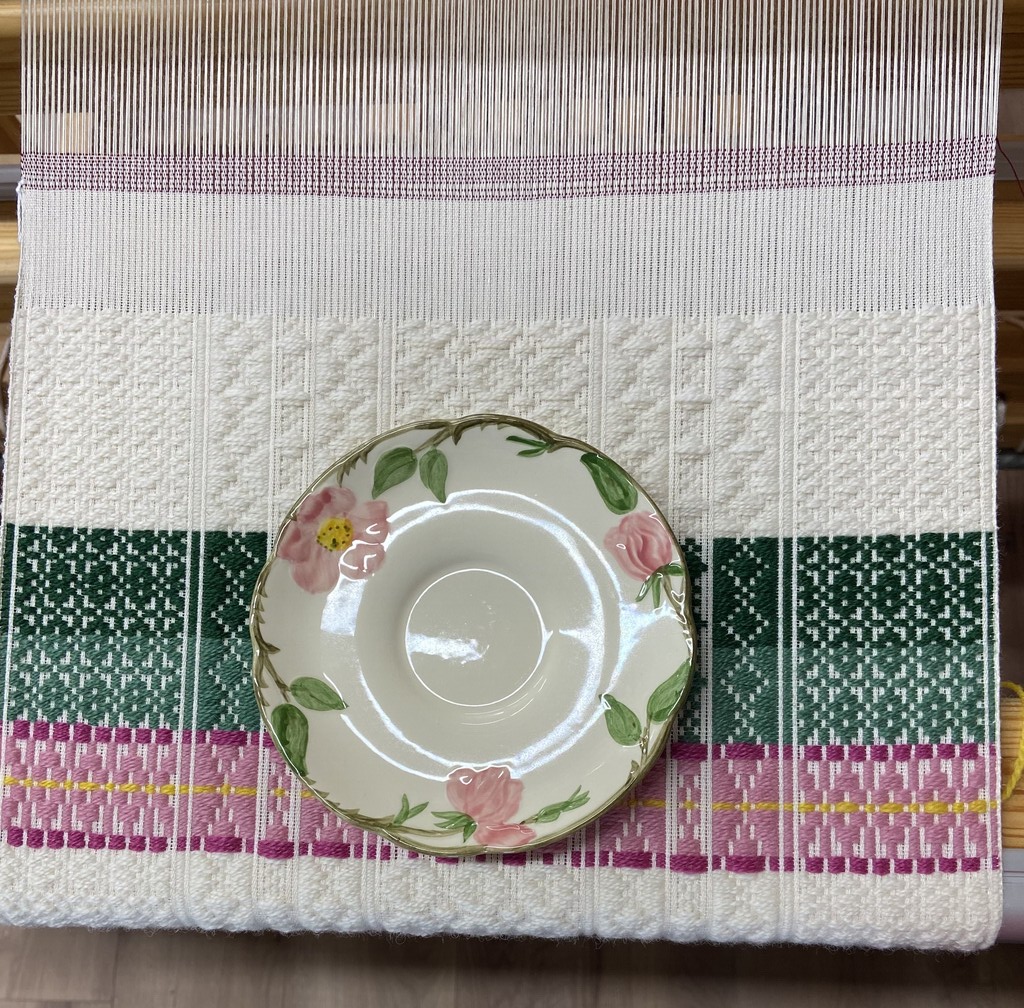
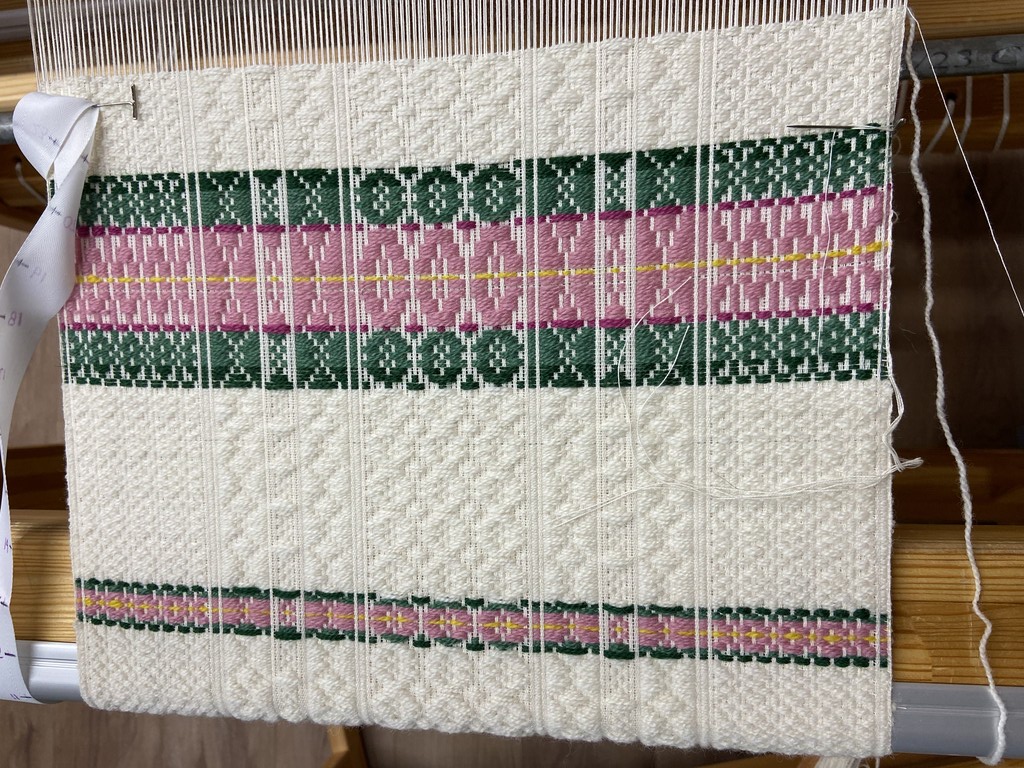
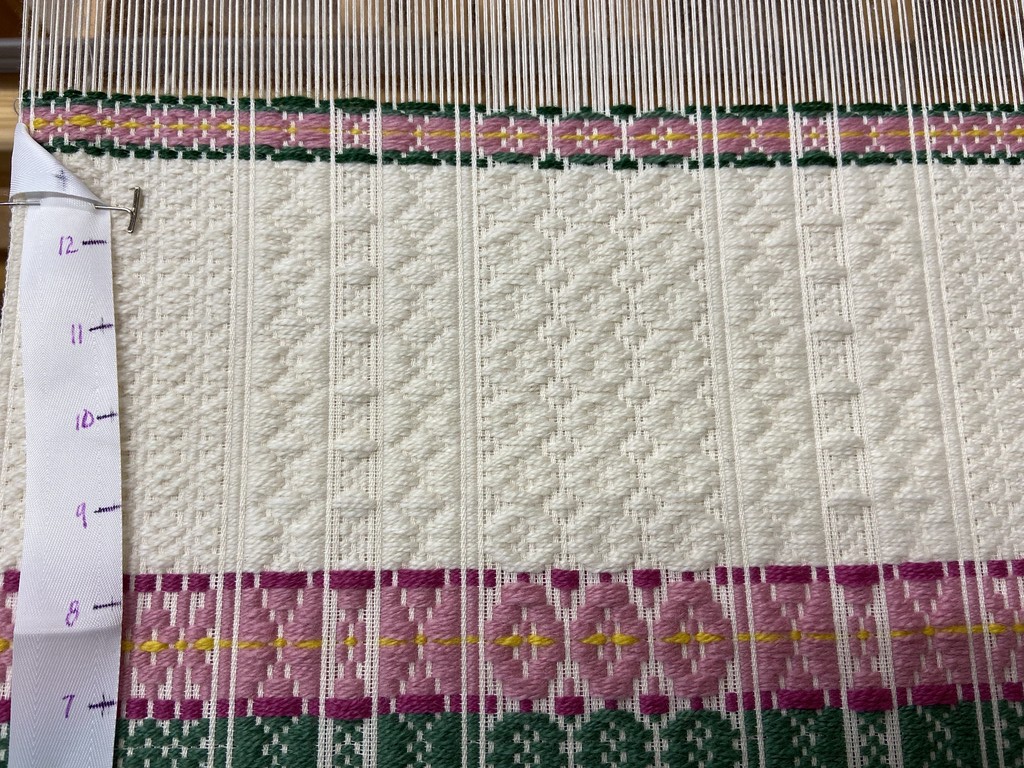
Shari Nelson wove her runner to complement beloved family tableware.
“I planned the colors around my Grandmother’s Fransicanware Desert Rose dishes that I inherited,” she explains. (See link below for more on this popular china pattern.)
“The cream, yellow and Dusty Rose wefts were Rauma Finull and the burgundy and greens were Prydvevgarn,” Shari writes. “I chose not to do the loop edges as I will be using this as a table runner.”
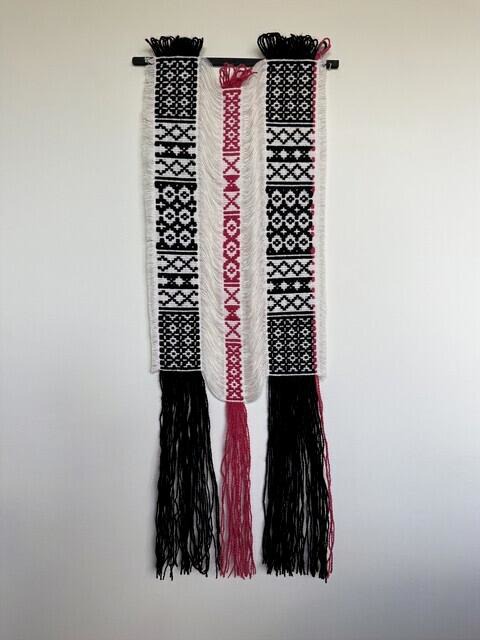
Robbie LaFleur chose to take a sculptural approach to skillbragd.
Photo by Robbie LaFleur.
“I have woven runners in skillbragd before,” Robbie writes, “so [this time] I experimented with the technique.”
“Å skille means to part or separate,” Robbie explains, “so that’s what I did. It was fun!”
Whatever the style, the possibilities of this technique appear to be endless.
Stay tuned for our next group warp in Norwegian Flesberg technique, also known as treskaft in Swedish.
Bonus content: Enjoy a deep dive into the history of Desert Rose dishes, courtesy of The Brooklyn Teacup!
Northern Lights over southern Minnesota. Photo by Lisa-Anne Bauch.
Here in Minnesota, we were recently treated to a spectacular display of the Northern Lights, due to a solar storm.
Close-up of skillbragd weaving by Alla Hale. Photo by Alla Hale.
The colors are echoed in Alla Hale’s weaving on the latest group warp by the Scandinavian Weavers. For this warp, we returned to one of our favorite techniques, skillbragd.
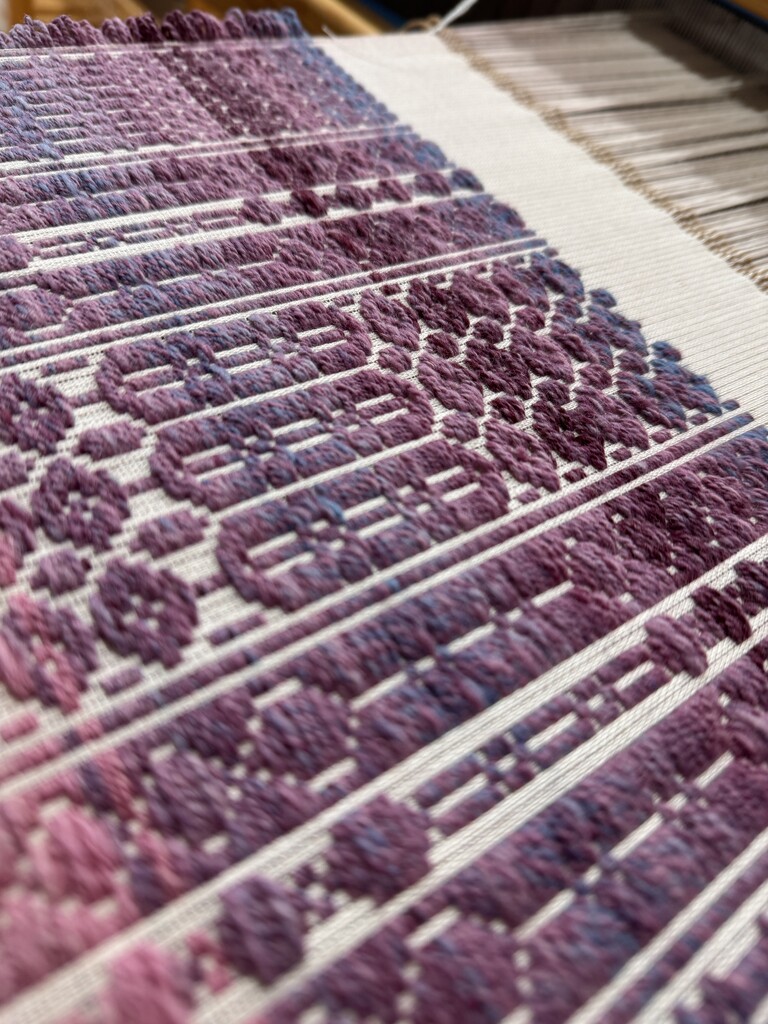
Skillbragd is a traditional overshot technique in which a fine tabby weft is woven alternately with a heavier pattern weft. Katherine Larson, in The Woven Coverlets of Norway, writes that skillbragd was named for the skill, or opening in the threads by which the elaborate patterns were created. In Norway, skillbragd coverlets were often used as christening blankets.
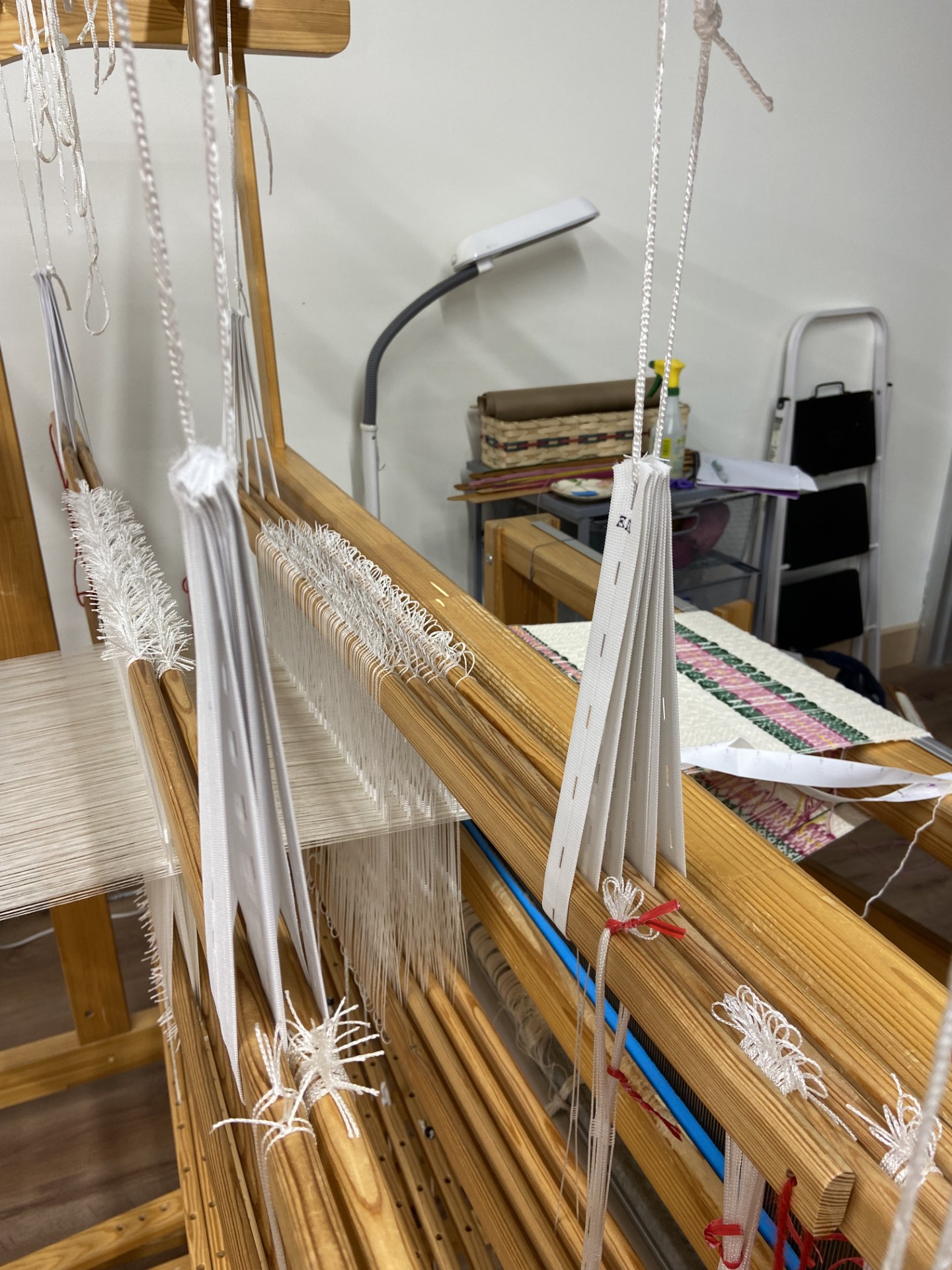
This technique requires two sets of shaft: Pattern shafts with long-eye heddles at the front of the loom and ground shafts with regular heddles at the back. This can require the use of a specially designed loom.
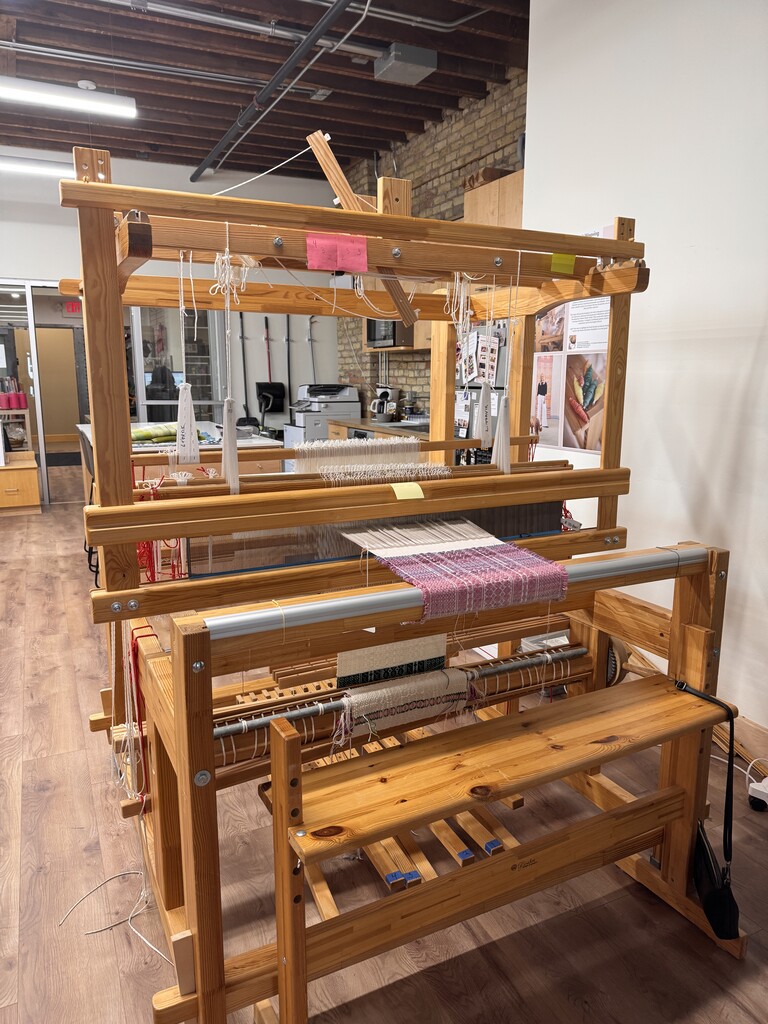
However, it’s also possible to weave skillbragd on an eight-harness countermarche or counterbalance loom, which is what we did, based on a draft by weaver Laura Demuth. Laura’s draft is inspired by a woven piece in the collection of Vesterheim Norwegian-American and will be featured in a forthcoming book.
Skillbragd on a countermarche Glimåkra loom at the Weavers Guild of Minnesota. Photo by Alla Hale.
Laura writes, “Because this technique requires a direct tie-up of the treadles, it is necessary to use two pairs of elastic hangers on the harnesses: one pair will be used on harnesses 1-4 and the second pair will be used on harnesses 7-8…It is also necessary to use two sizes of string heddles. Standard heddles are used for the tabby threading on harnesses 7 and 8. Special long-eyed heddles are used on the pattern harnesses, 1-4.”
Close-up of harnesses. Photo by Shari Nelson.
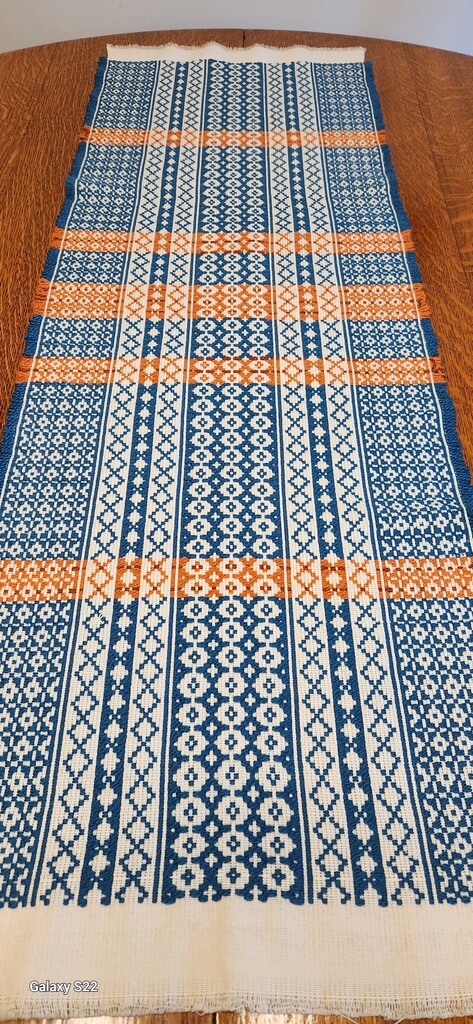
Per Laura’s instructions, we warped the loom with 20/2 cotton at 40 EPI and used the same thread for the tabby weft. Each weaver brought in her own pattern weft yarn in a variety of fibers, which made for wonderful variation in color and texture.
Abbey Nielsen at the loom. Photo by Lisa-Anne Bauch.
Abbey Nielsen chose soft shades of blue and yellow for her very first skillbragd weaving. A lucky family member will receive it as a Christmas gift!
Abbey’s weaving. Photo by Lisa-Anne Bauch.
Traditional skillbragd often features decorative loops along the selvedges, made simply by looping the pattern weft yarn around a finger, as in Abbey’s weaving above. The loops also serve the a practical purpose of hiding color changes in the pattern weft, rather than having to cut and work in the ends.
Alla’s beautiful handspun yarn. Photo by Alla Hale.
For her piece, Alla Hale used her own handspun yarn. “It’s from a pretty braid dyed by local natural dyer Petal and Hank,” she writes.
Alla spun the yarn from hand-dyed fleece. Photo by Alla Hale.
“I’m a new spinner,” Alla continues, “so [the yarn] is not very consistent, but I think that will make for nice character in the weaving.” I think we all agree!
Alla’s weaving on the loom. Photo by Alla Hale.
In the photo above, note how the fine tabby weft (20/2 cotton) alternates with the woolen pattern weft.
Alla’s weaving on the loom. Photo by Alla Hale.
Amy Grimm took a scientific approach to her piece, following Laura Demuth’s original draft as closely as possible.
“I figured, being such a new weaver, I would be a good test of the directions,” she explains. “Some might say I lacked imagination but my focus was on testing her directions. My background is computer science and technical writing, so this type of testing was right up my alley!”
Weavings and photo by Amy Grimm..
Amy used Laura’s suggested pattern weft of Rauma Prydvevgarn in traditional shades of blue, red, green, and yellow, providing her with samplers for future projects.
Beth Detlie warped her loom at home using Laura’s draft, but used linen for warp. She wove three runners, allowing her to explore the many pattern variations. “I had fun experimenting!” she says.
Beth Detlie’s complex weaving. Photo by Beth Detile.
Like Amy, Brenda Gauvin-Chadwick also used Rauma Prydvevgarn for her pattern weft, in cool tones of melon and maroon.
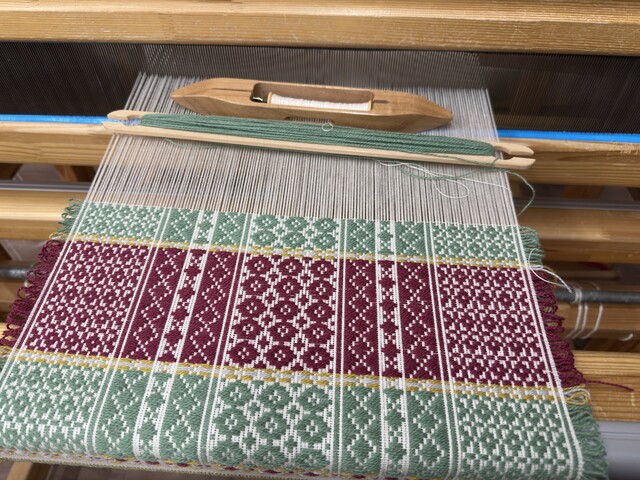
Skillbragd on the loom. Photo by Brenda Gauvin-Chadwick.Brenda’s weaving at home. Photo by Brenda Gauvin-Chadwick
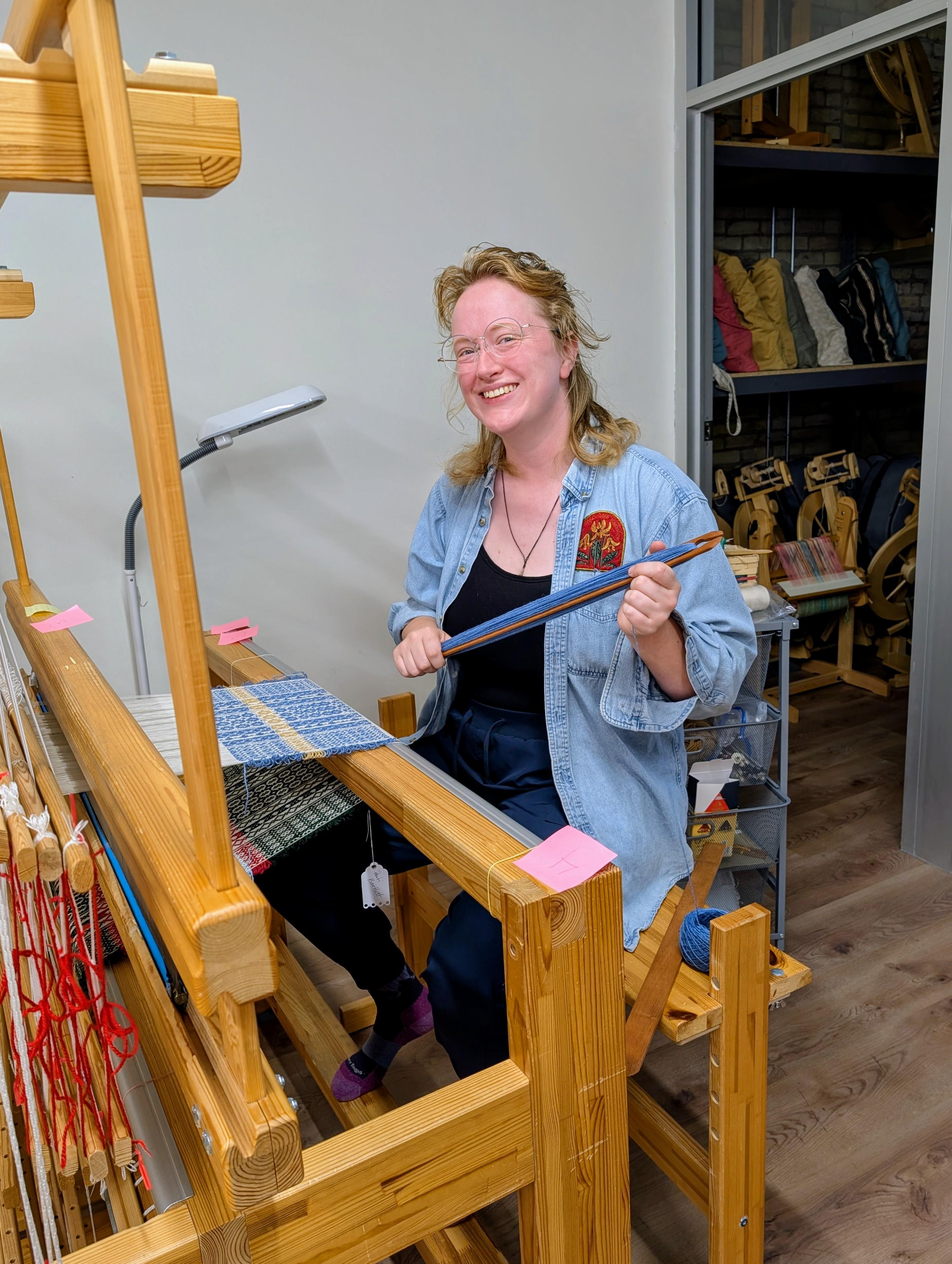
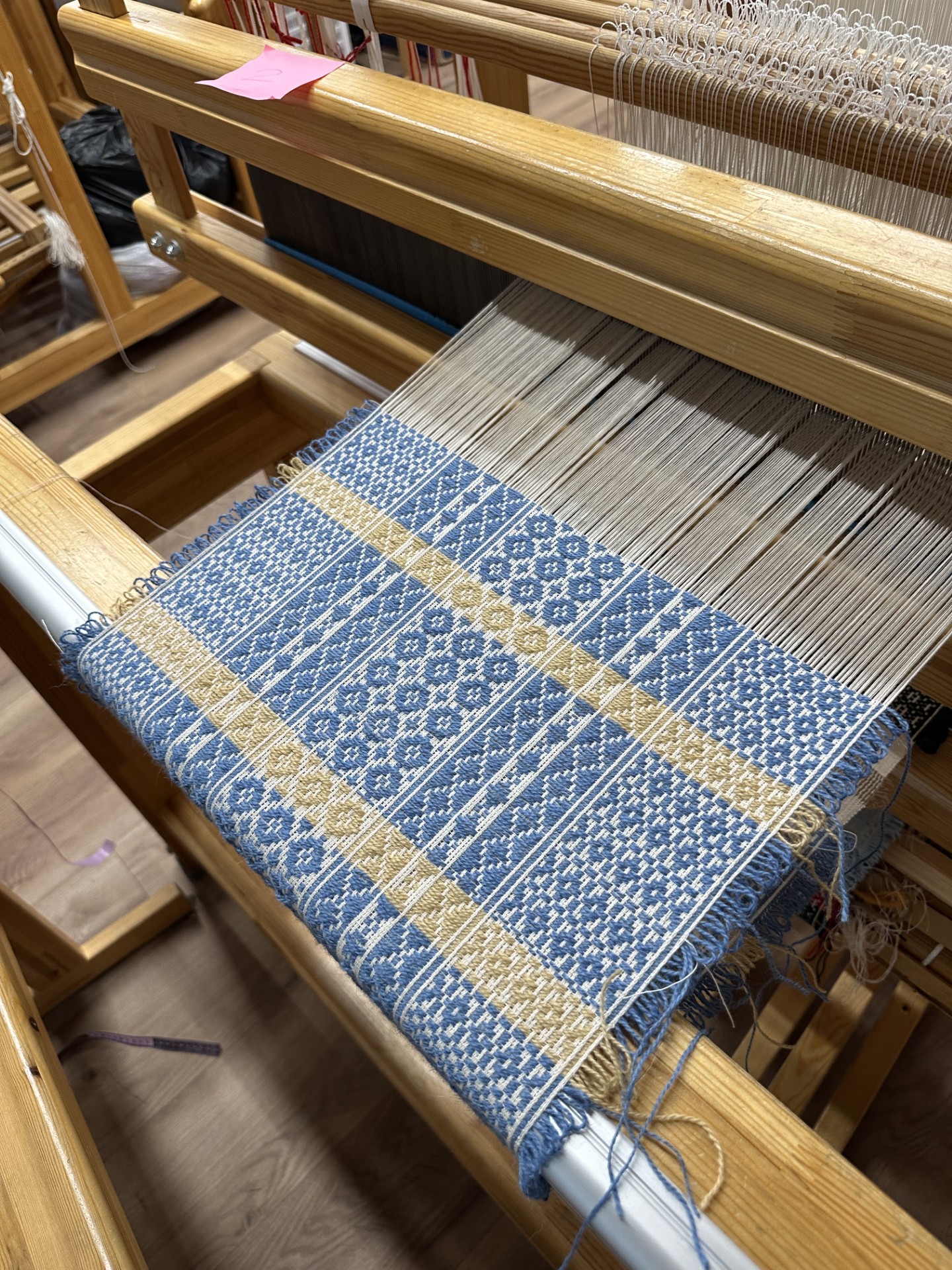
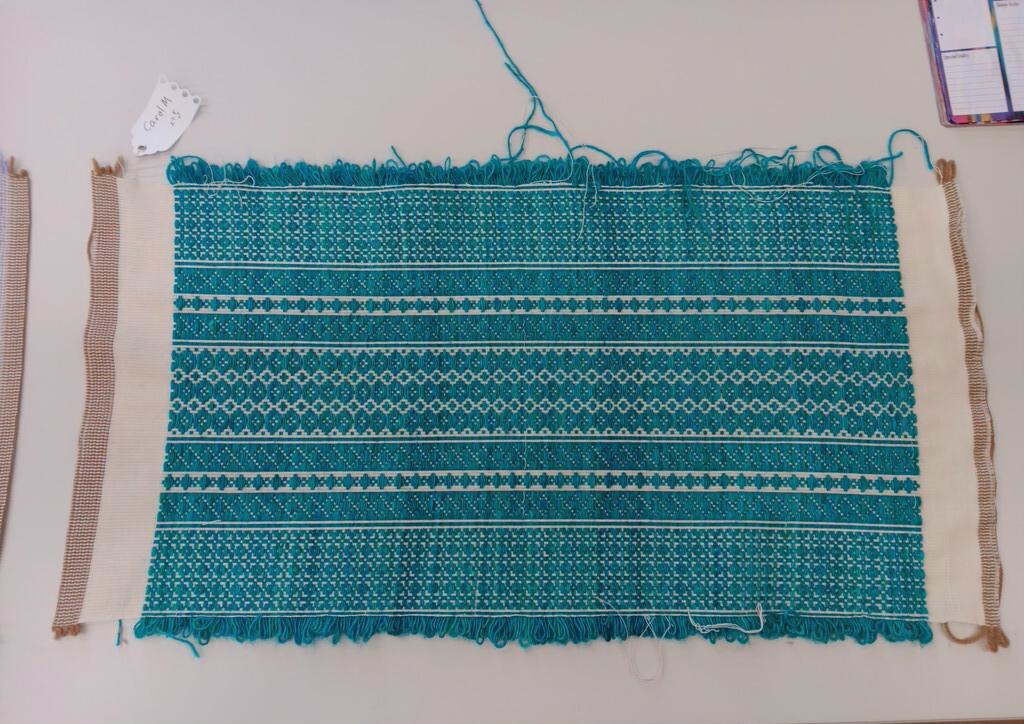
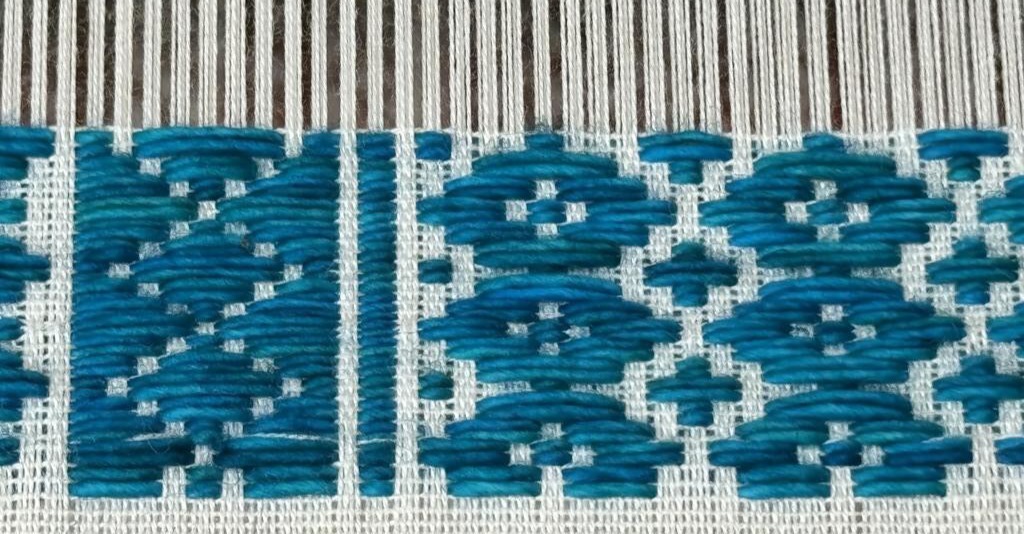
Carol Mashuga experimented with a single color of weft, in a gorgeous shade of turquoise, which allowed the patterns to dominate. “The fiber I used [for pattern weft] is Madelinetosh merino wool in Nassau Blue,” Carol writes. “It is a super wash 100% wool that is very soft and drapes beautifully.”
Carol’s weaving, off the loom but not yet wet-finished. Photo by Lisa Torvik.
“This has been a fabulous weaving experience for me,” Carol adds. “I have learned so much and could spend years weaving this pattern and trying out different color combinations, etc. It is that interesting!”
Close-up of Carol’s weaving. Note the subtle shifts of color in the pattern weft. Photo by Carol Mashuga.
Cathie Mayr agrees with Carol’s assessment: “[Skillbragd] is a slow weave, but a beautiful result.” Group members concurred that the process is meticulous but rewarding.
Cathie Mayr’s autumn table runner. Photo by Cathie Mayr.
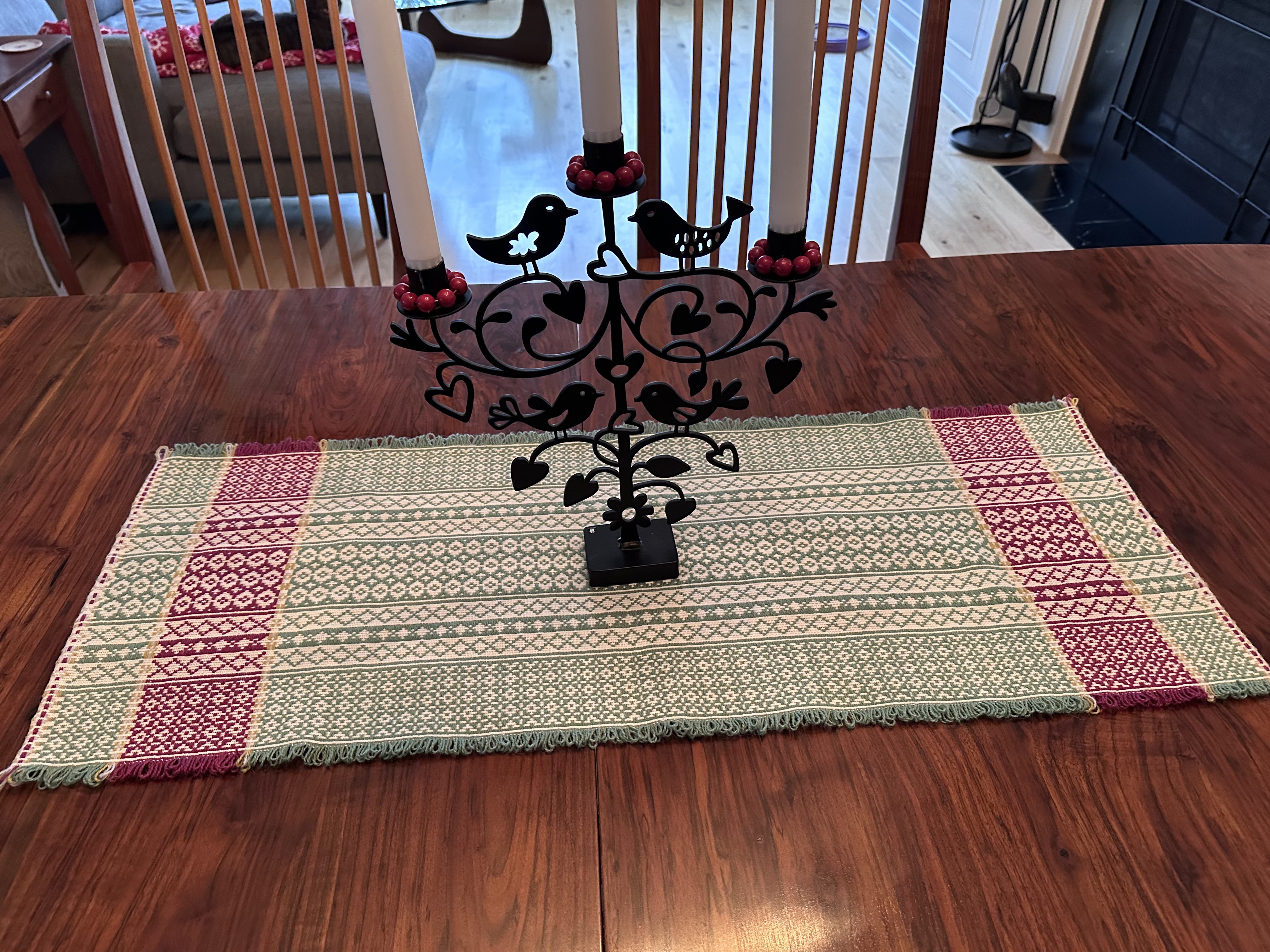
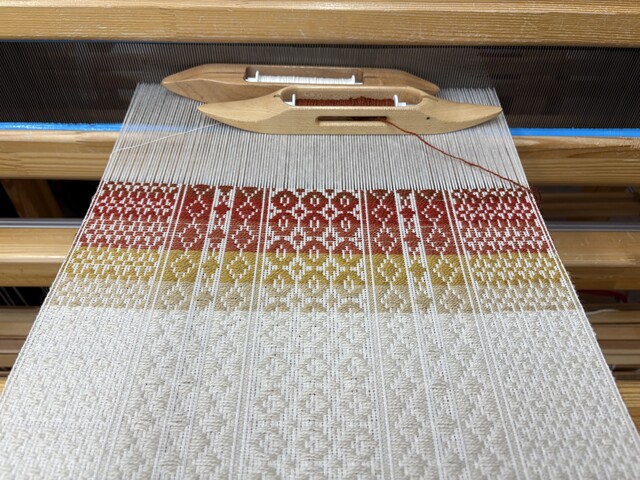
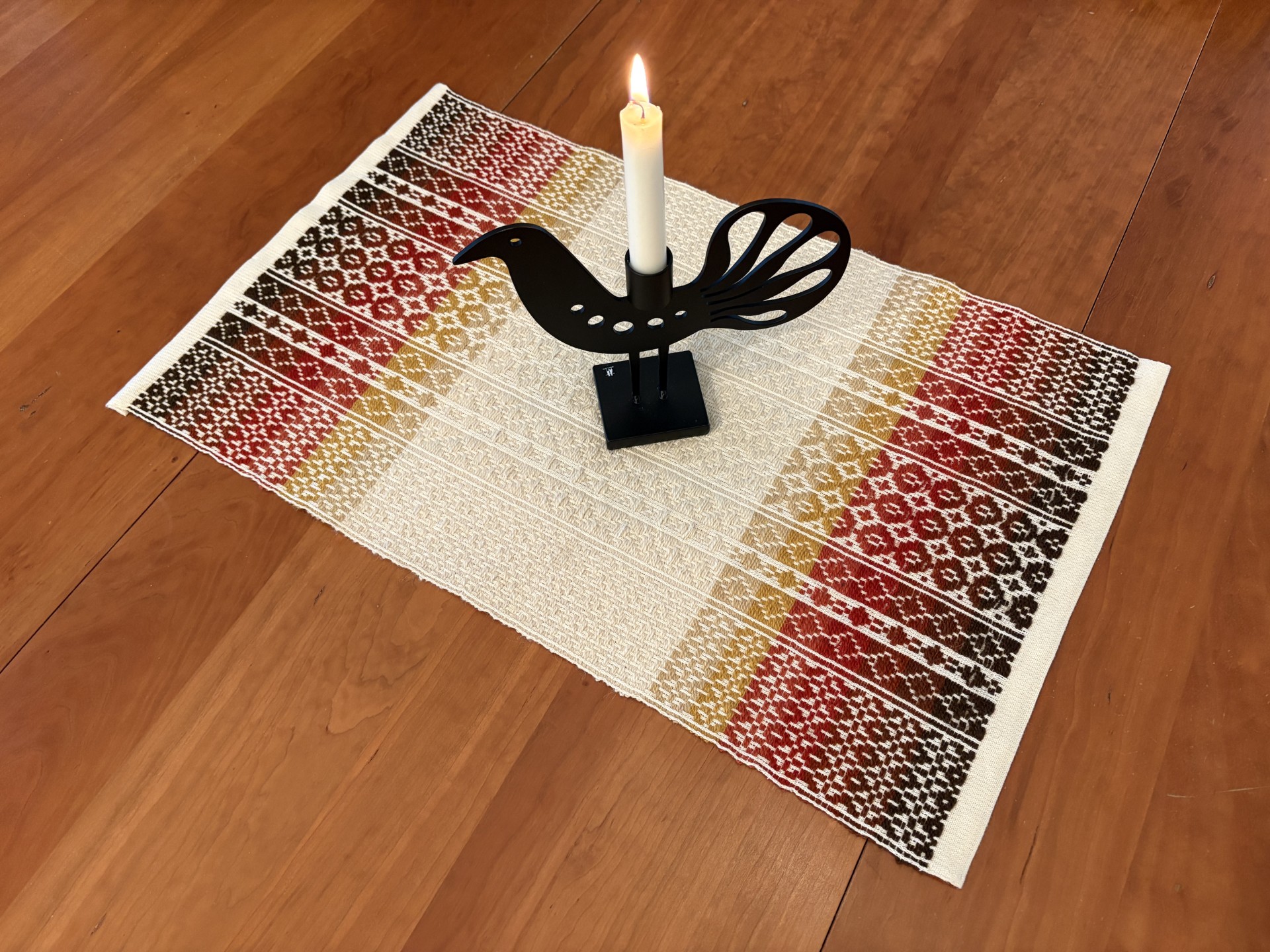
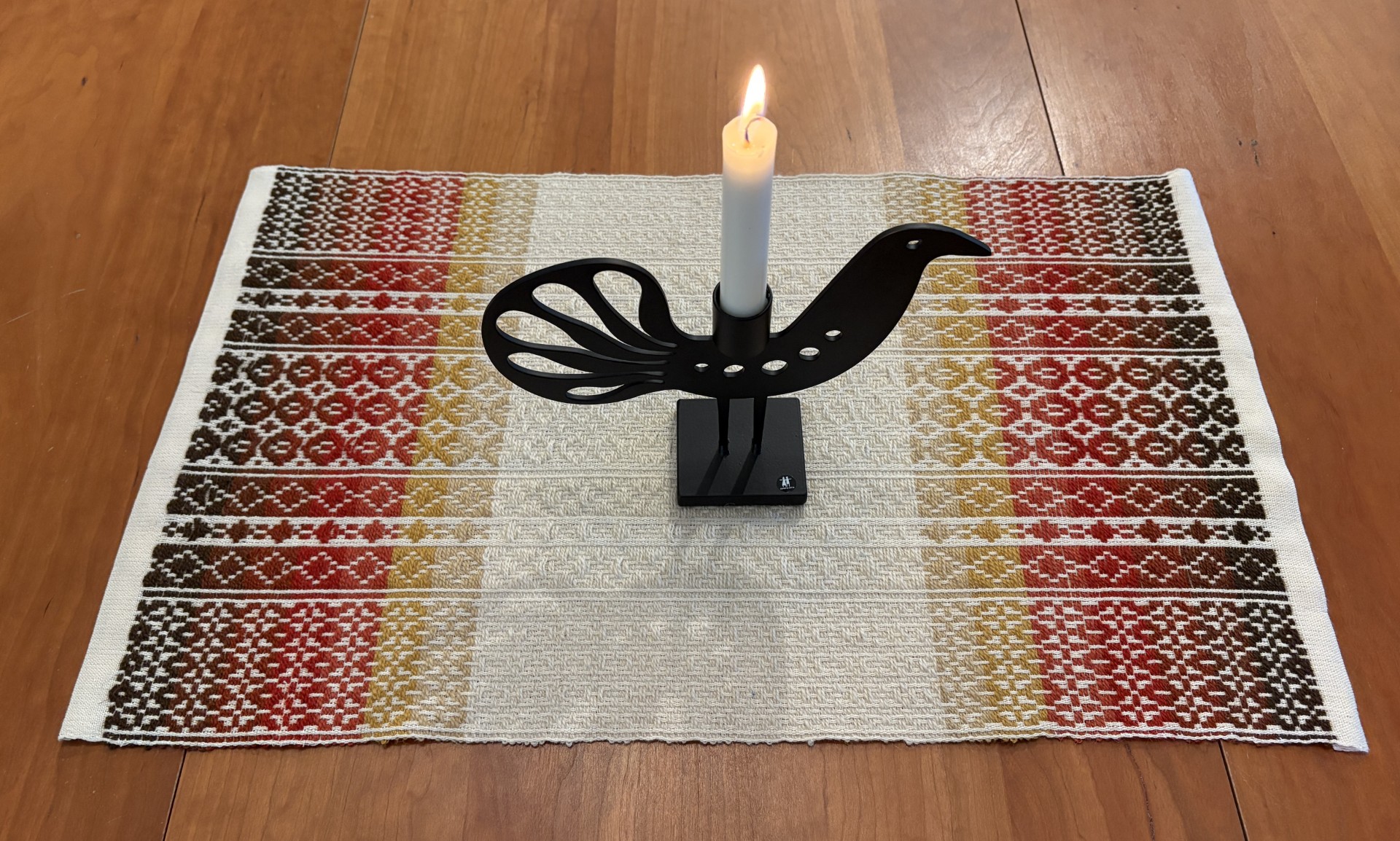
Cathie wove an autumn runner with a cream-colored center to show off a Swedish black iron candleholder. In the photo above, note how beautifully the patterns show, even with a neutral weft color.
Cathie Mayr’s runner at home on her dining room table. Photo by Cathie Mayr.
“It was such a challenging and satisfying project!,” Cathie writes. “I’m so grateful to those who planned it, ran the warp, dressed the loom, and provided the pattern draft and explanations on how to weave it. This group is amazing!”
The chicken candleholder presided over Cathie’s Thanksgiving table. Photo by Cathie Mayr.
“My piece is purposely short to fit in the center of our dining room table,” Carol adds. “I elected not to include selvedge loops. When my family gathers for Thanksgiving, anything on the table is at risk for gravy and cranberry drippings!”
Holly Hildebrandt chose soothing shades of blue and green for her weaving, perhaps inspired by her recent study trip to Norway.
Holly Hildebrandt’s weaving in progress. Photo by Holly Hildebrandt.
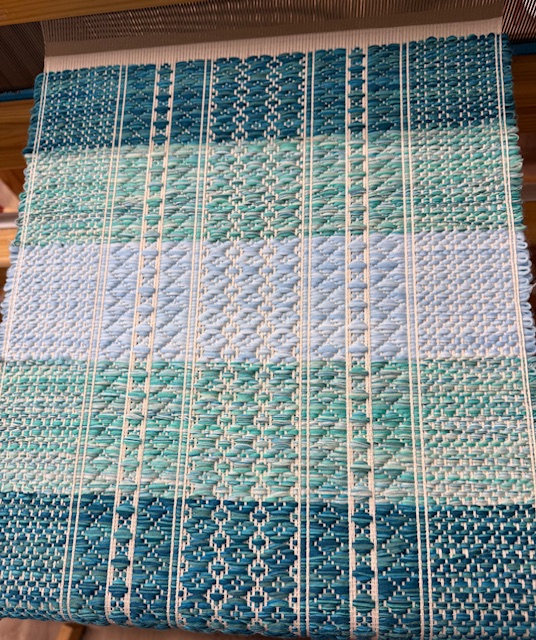
Judy Larson also choose blue and green for her weaving, using variegated string yarn from Sweden. The effect is of the far horizon over water.
Judy Larson’s weaving in soothing shades of blue. Photo by Judy Larson.
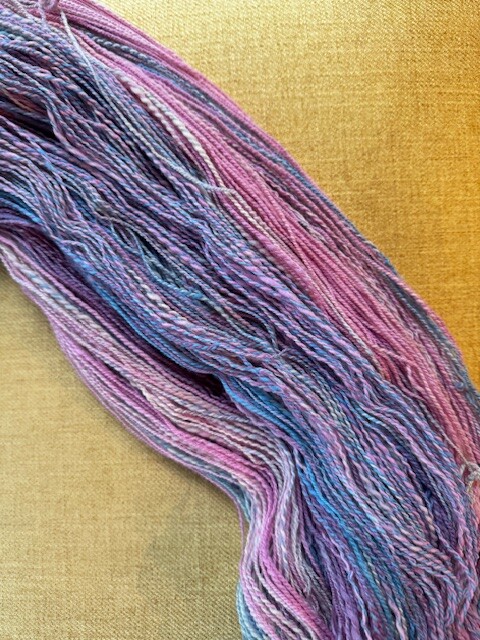
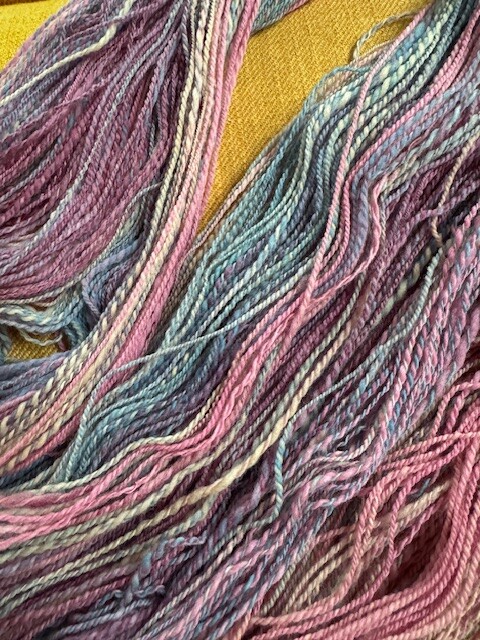
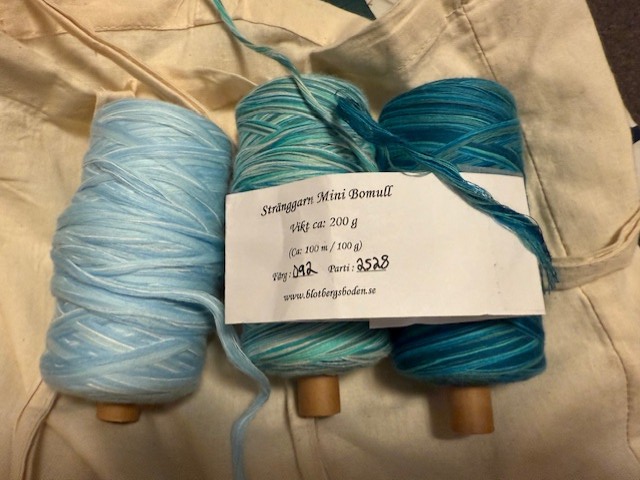
Judy purchased the yarn while attending the Väv2025 conference in Gävle, Sweden. It consists of several strands of cotton wound together.
Judy Larson’s luscious weft yarn. Photo by Judy Larson.
Jan Johnson shared the photos below on her Instagram. “The Scandinavian Weaver’s study group at the Weaver’s Guild of Minnesota is weaving Smålandsvëv or Swedish Opphämpta,” she wrote. “The Norwegian-dominant study group persists in calling it skillbragd, but I feel the need to stand up for my Swedish heritage, so Swedish Opphämpta it is!”
Photo by Jan Johnson.
For her weft yarn, Jan appropriately chose lovely shades of blue and yellow from her stash of Harrisville Highland.
Jan’s weaving on the loom. Photo by Jan Johnson.
Fellow Swede Lisa Bauch chose weft colors reminiscent of a Scandinavian forest, including moss green.
Photo by Lisa-Anne Bauch.
Full disclosure: Lisa purchased the yarn in Norway at the Hillesvåg woolen mill near Bergen.
Admiring weavings as the first warp comes off the loom. Photo by Lisa-Anne Bauch.
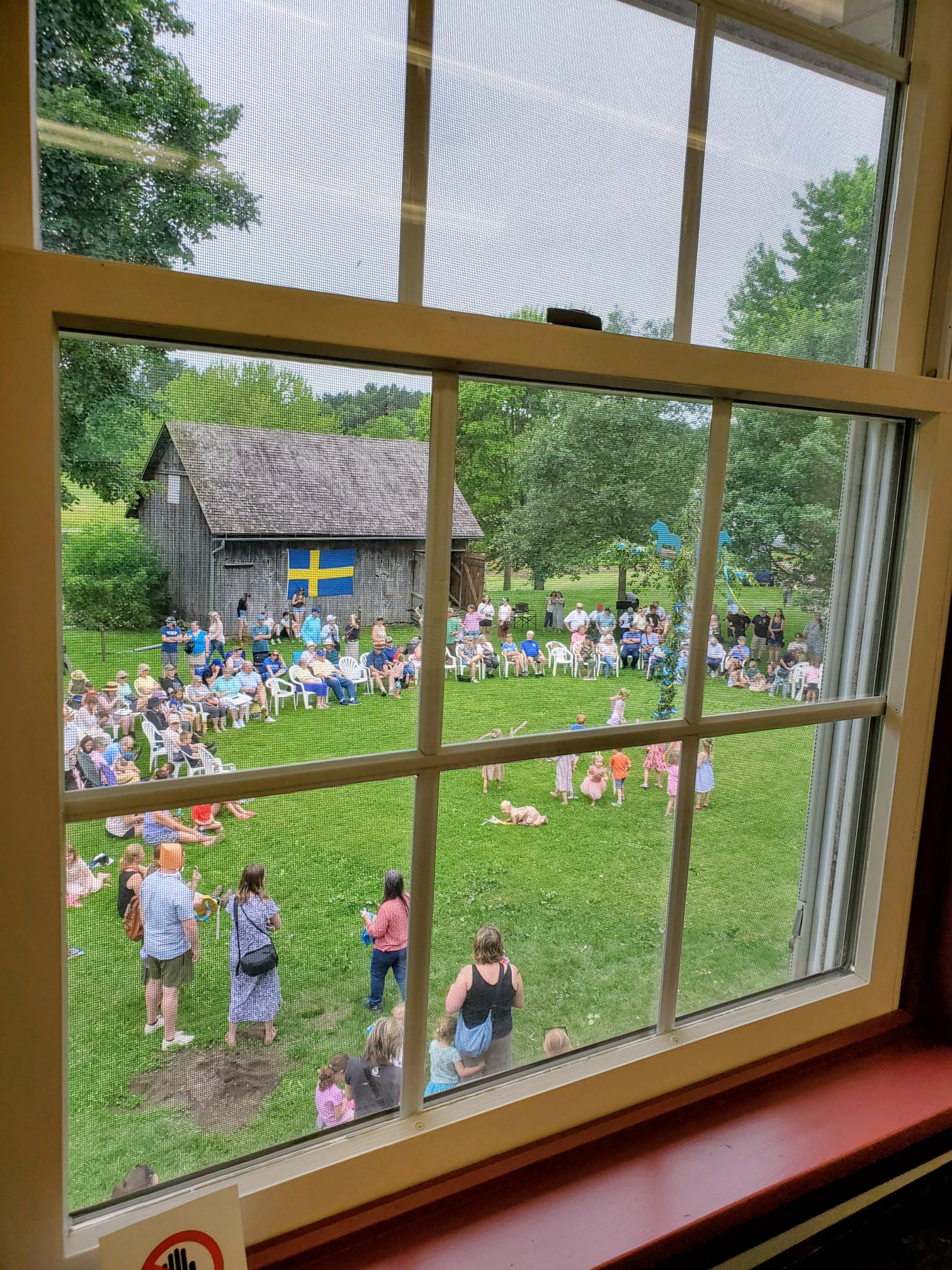
As always, the Scandinavian Weavers spent the summer volunteering, demonstrating the art of weaving at community events.
Midsommar at Gammelgården
These included the Opening Day, Midsommar, and Spelmansstämman celebrations at Gammelgården in Scandia, Minnesota.
Focusing on history, art, culture, and agriculture, Gammelgården is the only open-air museum devoted to preserving, presenting, and promoting Swedish immigrant heritage in the United States.
Housed in six buildings on the historic gammelgården, or old farm, where the community of Scandia was first established, Gammelgården invites visitors to step back in time, experience the stories of Swedish immigrants, and relate them to their own family immigration stories.
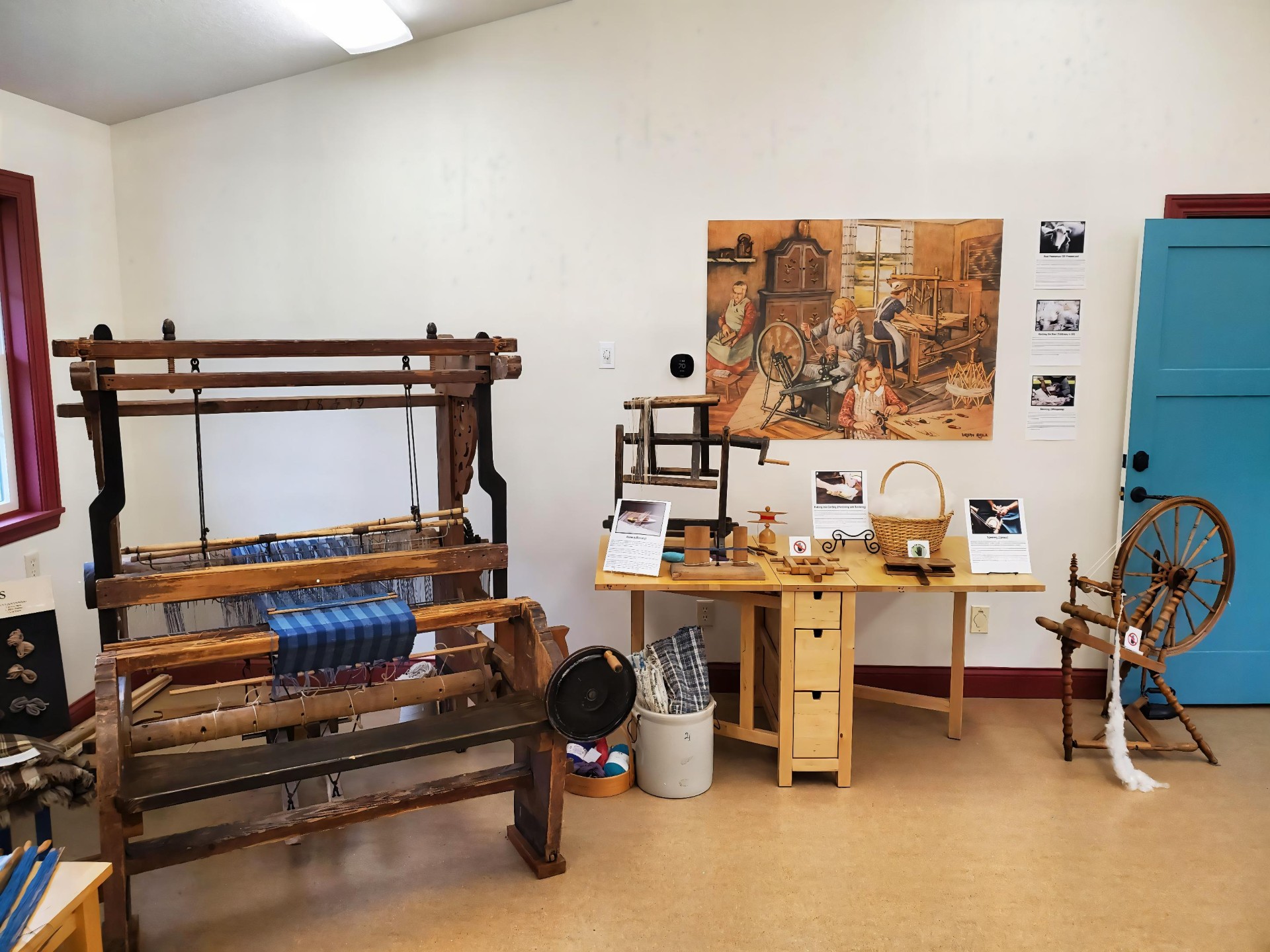
Weaving exhibit at Gammelgården
Among the treasures at Gammelgården is a loom crafted in Sweden in 1879. The loom was built by a father whose daughter was getting married and immigrating to the United States. It was his parting gift to her. Judy Larson warped the loom in beautiful blue stripes, and it still weaves beautifully.
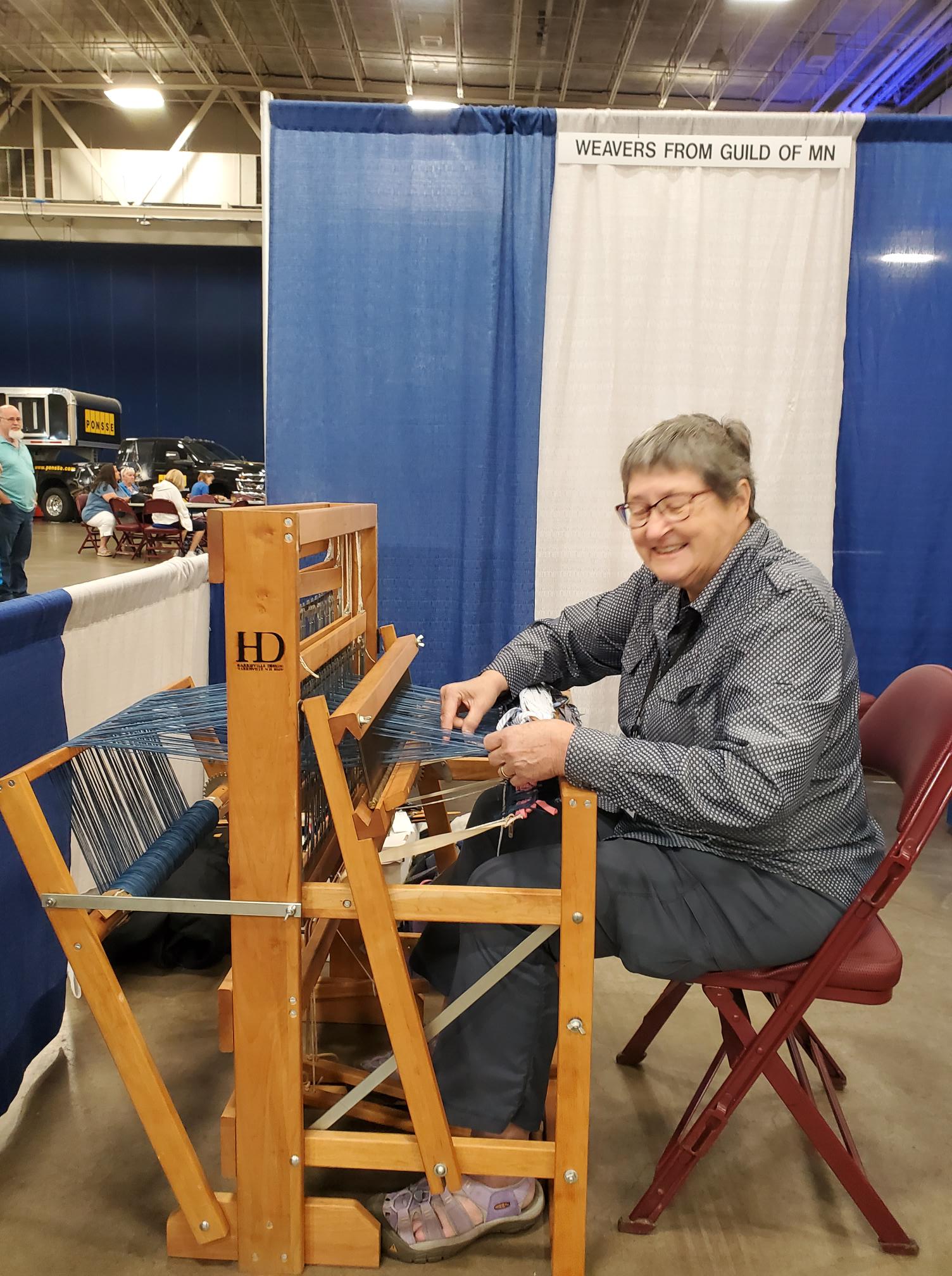
Barb Yarusso at the loom
Another fun event was FinnFest, held in Duluth, Minnesota in August. Barb Yarusso demonstrated weaving and also gave a presentation on reconstructing her grandmother Alma’s rag rug. Lisa Bauch gave a talk called “Rugs, Raanu, and Rya: The Living Legacy of Finnish-American Weaving.”
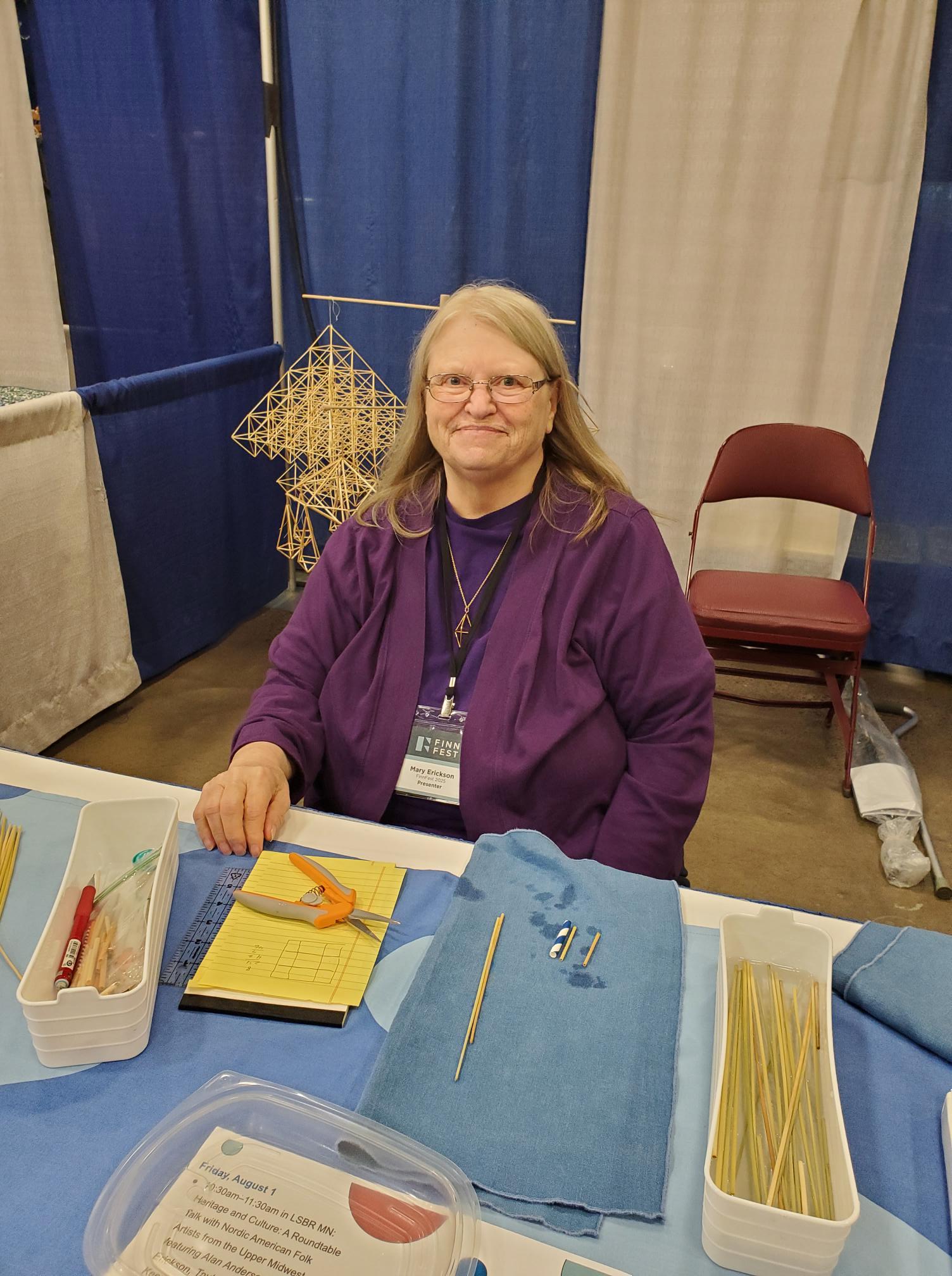
Mary in her popular booth at FinnFest.
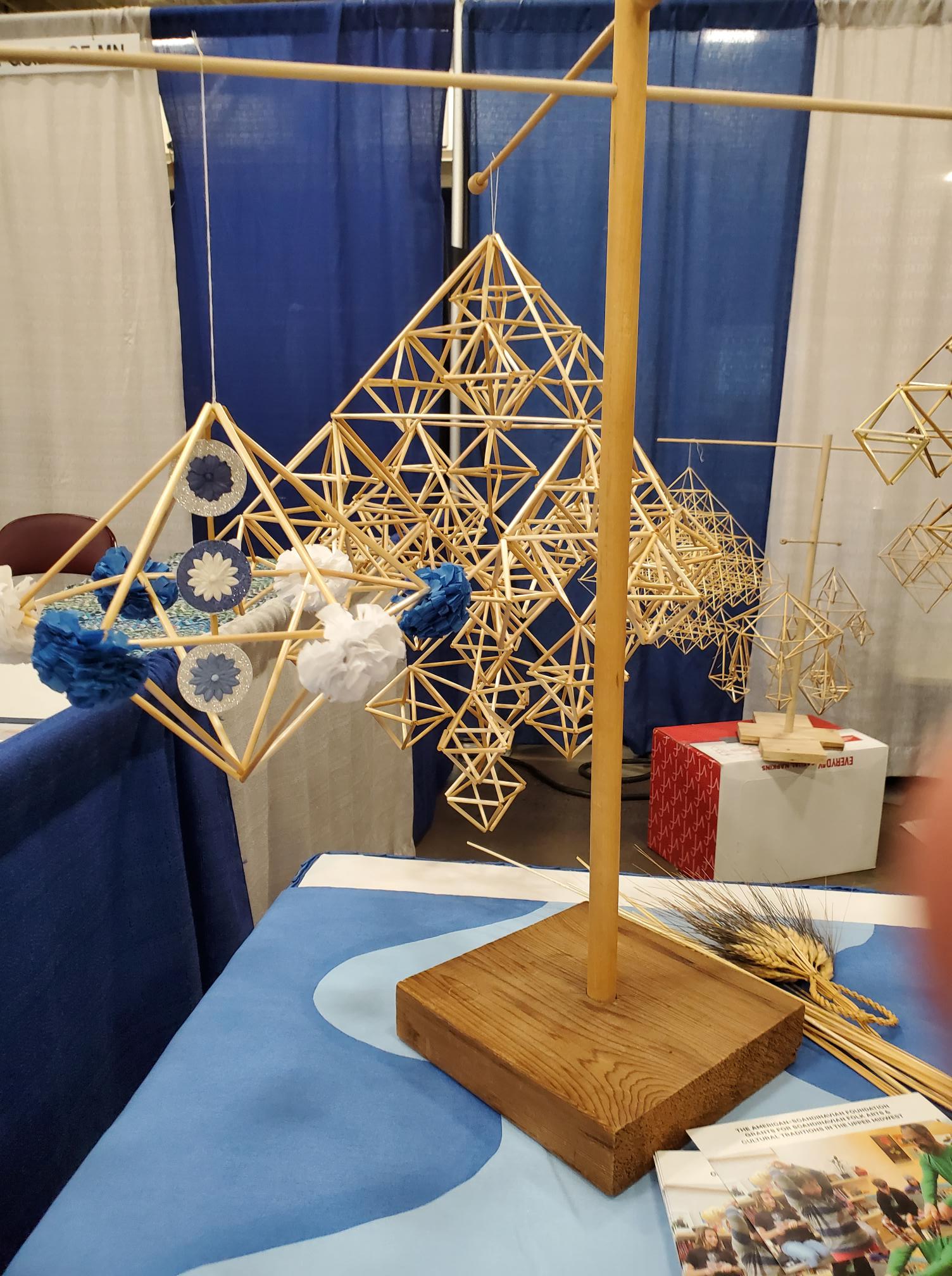
Mary Erickson demonstrated the art of himmeli and also participated in a panel discussion with fellow Nordic American folk craft artists. Himmeli, geometric figures made from straw, were originally created in Finland, Norway, Sweden, and Estonia, and functioned as good luck charms that were hung from the ceiling in homes to ensure good crops and the fertility of fields.
The art was brought to northern Minnesota by Finnish immigrants. Mary first studied himmeli making with Elna Hietala in Minnesota and later with Eija Koski in Finland. It is her hope that by teaching and sharing what she has learned that this tradition will continue. Her beginning course “The Geometry, Magic, and Beauty of Himmeli” will be held at North House Folk School in October.
Himmeli was traditionally made of rye straw, intricately braided.
Books by Mary’s teacher in Finland, Eija Koski.
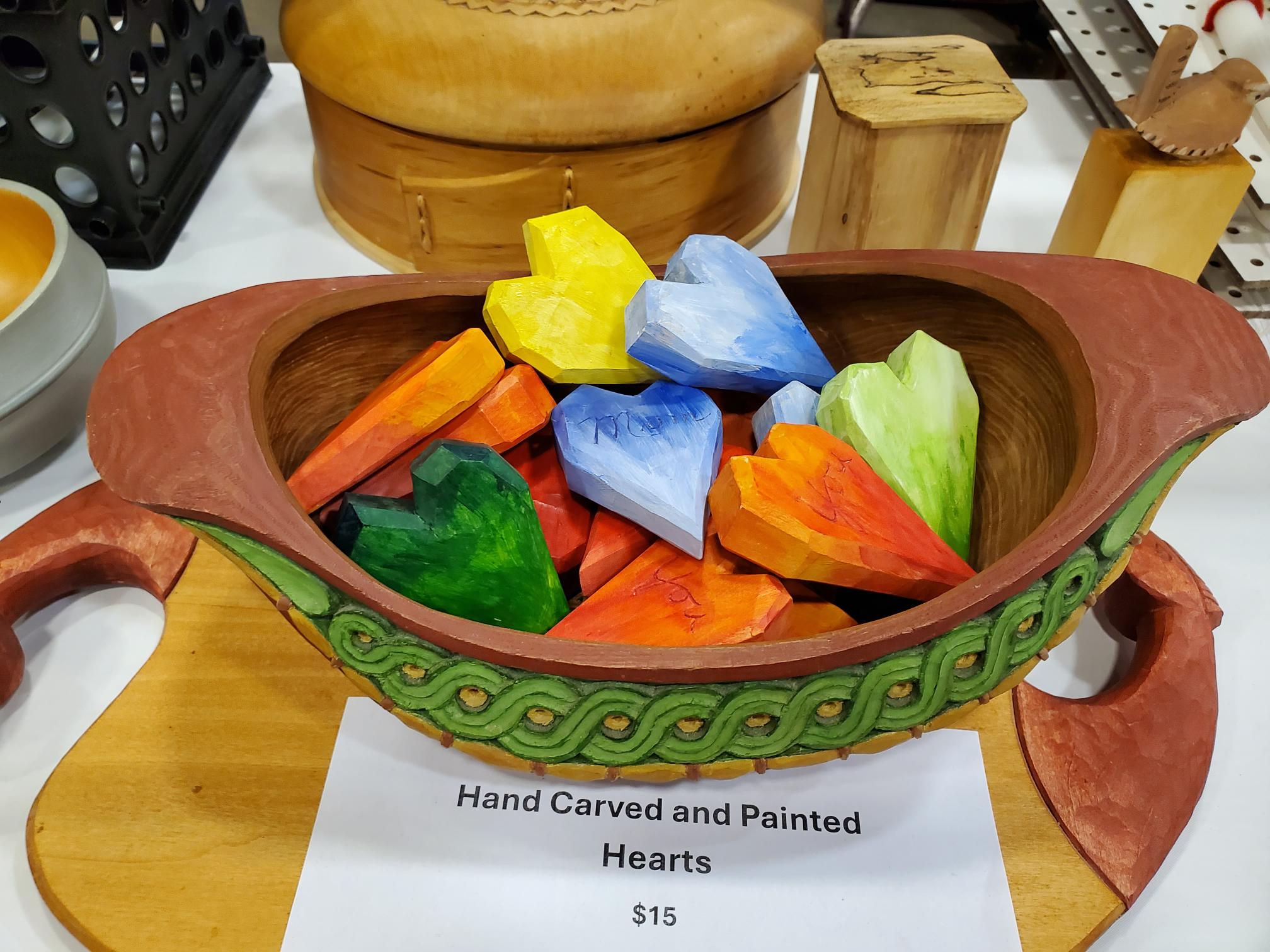
Among the other displays at FinnFest were traditional hand carvings by Alan Anderson.
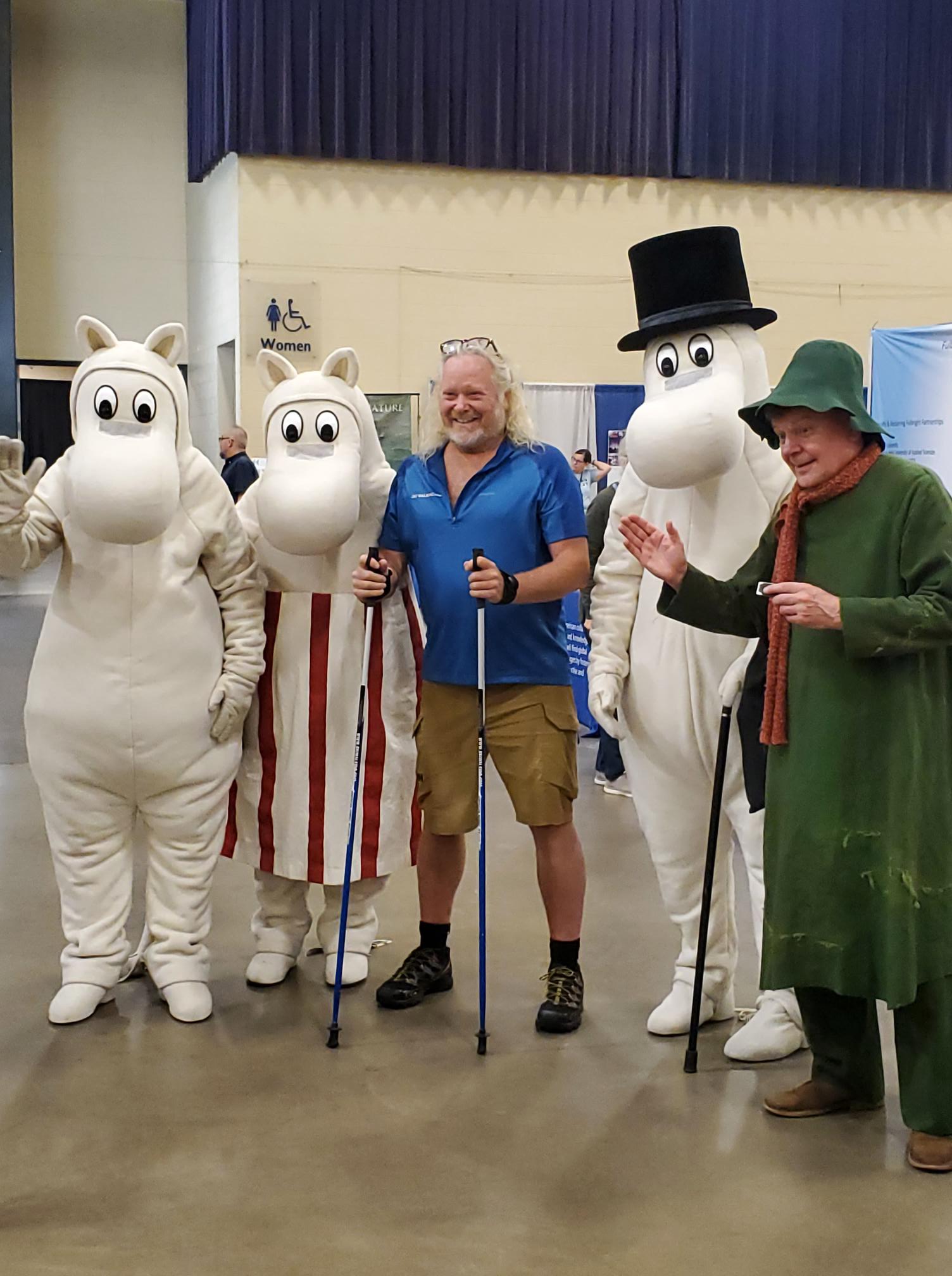
FinnFest, where Moomins are treated like rock stars!
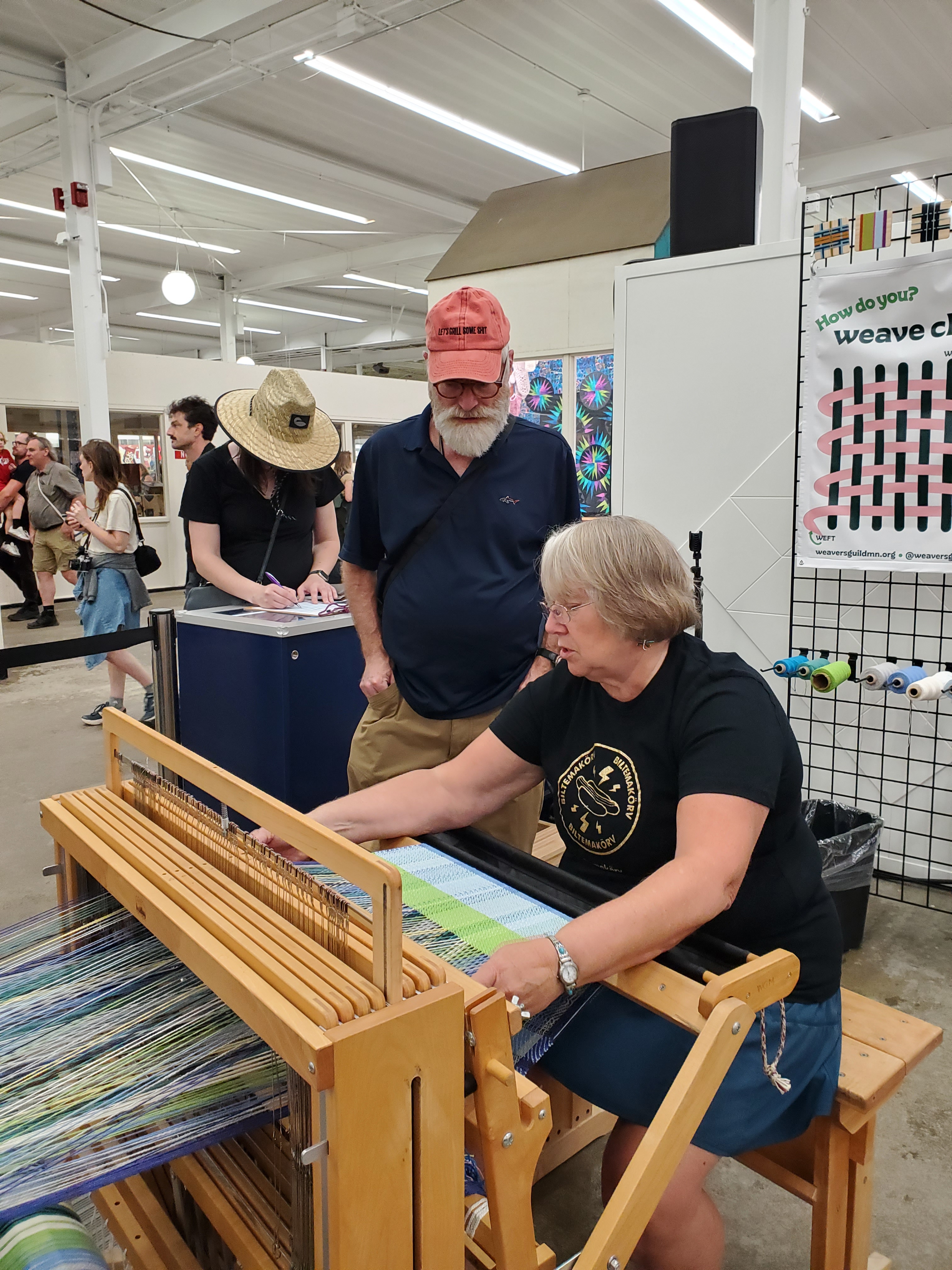
Judy Larson demonstrates weaving to a curious fairgoer.
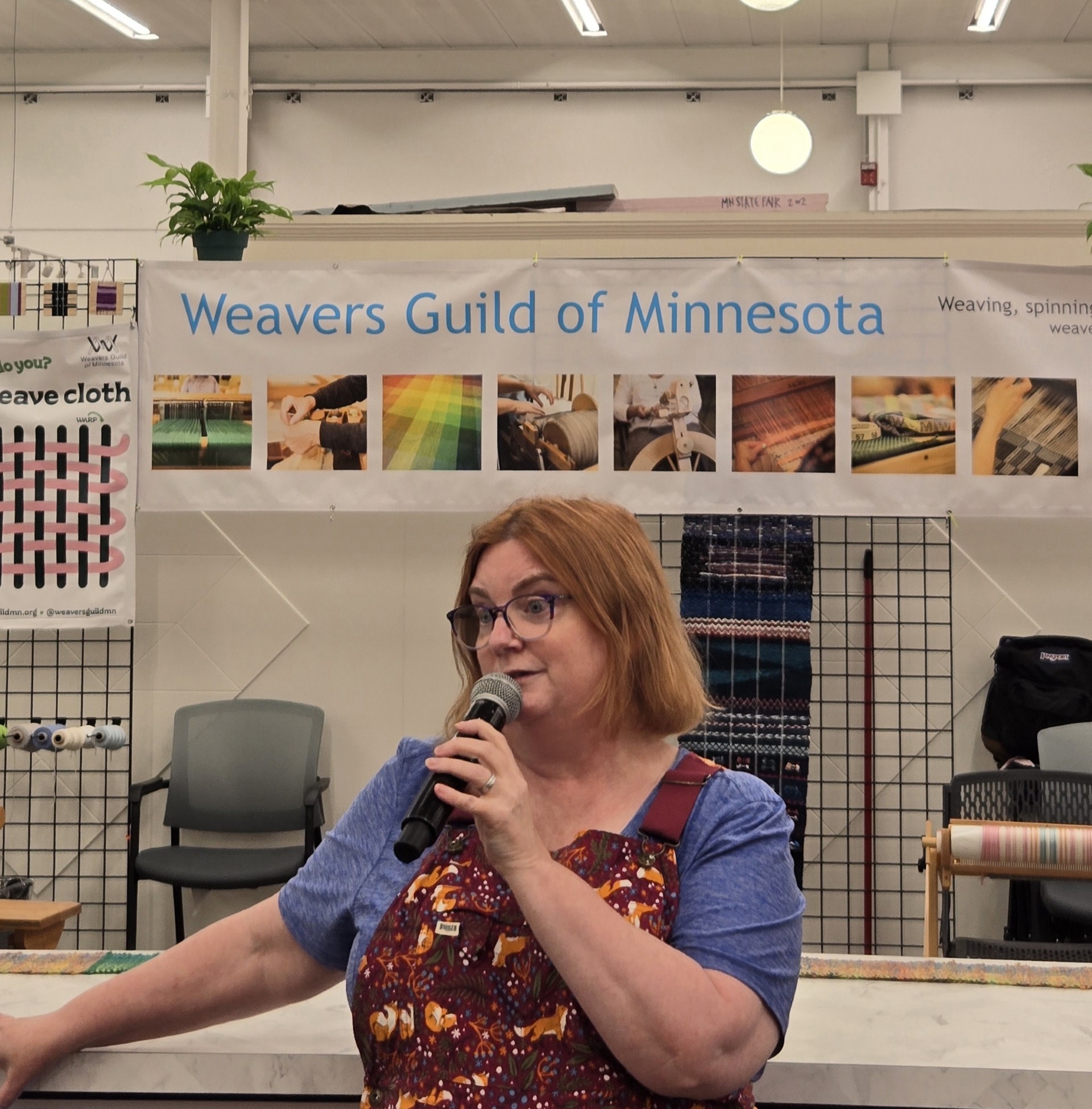
Of course, no Minnesota summer is complete without a trip to the Minnesota State Fair! As always, volunteers from the Weavers Guild of Minnesota were present for the entire Fair, from opening day to closing night. Demonstrations and talks took place in our new booth, centrally located in the Creative Arts Building.
Lori Labs at the loom.Photo by Linnea Anderson.
Yours truly gave a talk on Nordic Weaving in Minnesota, with an emphasis on rag rug weaving. The Rag Rug Group brought in rugs in a variety of techniques to illustrate.
Rag rugs on display
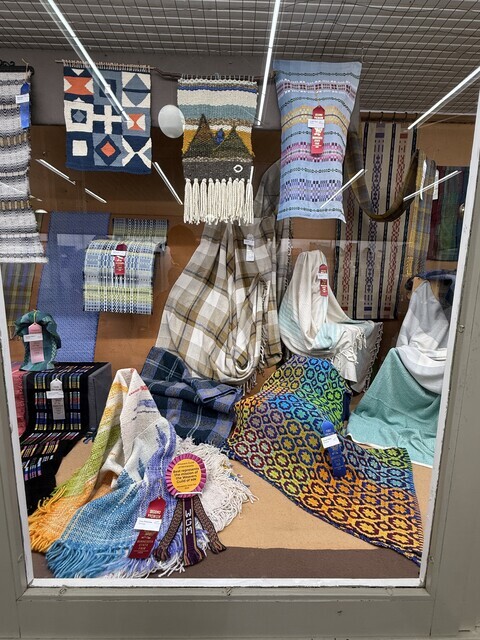
Finally, huge congratulations to the following members of the Scandinavian Weavers Group, who won ribbons in this year’s State Fair competition!
Beth Detlie
Lori Labs
Robbie LaFleur
Cathie Mayr
Lisa Torvik
Barb Yarusso
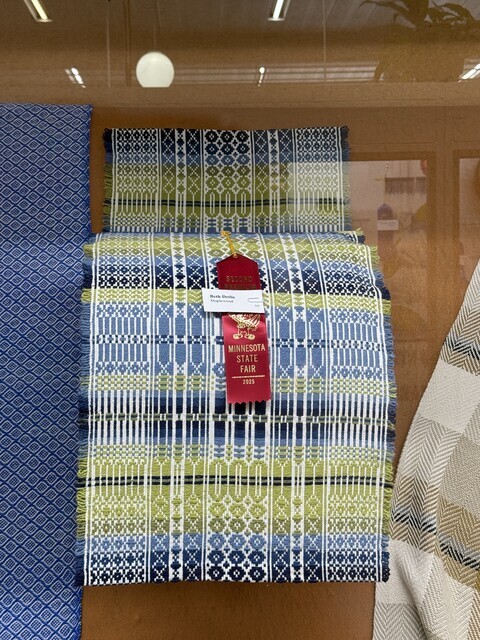
Special congratulations to Beth Detlie, who won the coveted Doris Tufte Award for weaving in the Scandinavian tradition.
Lisa Torvik’s weaving on displayBeth Detlie’s table runnerBeth Detlie’s Doris Tufte ribbonLori’s blanket in neutrals is front and center. Cathie’s weaving in floral colors is to the upper right, with the red ribbon.More weaving at the Fair.











 Scandinavian Weavers Study Group