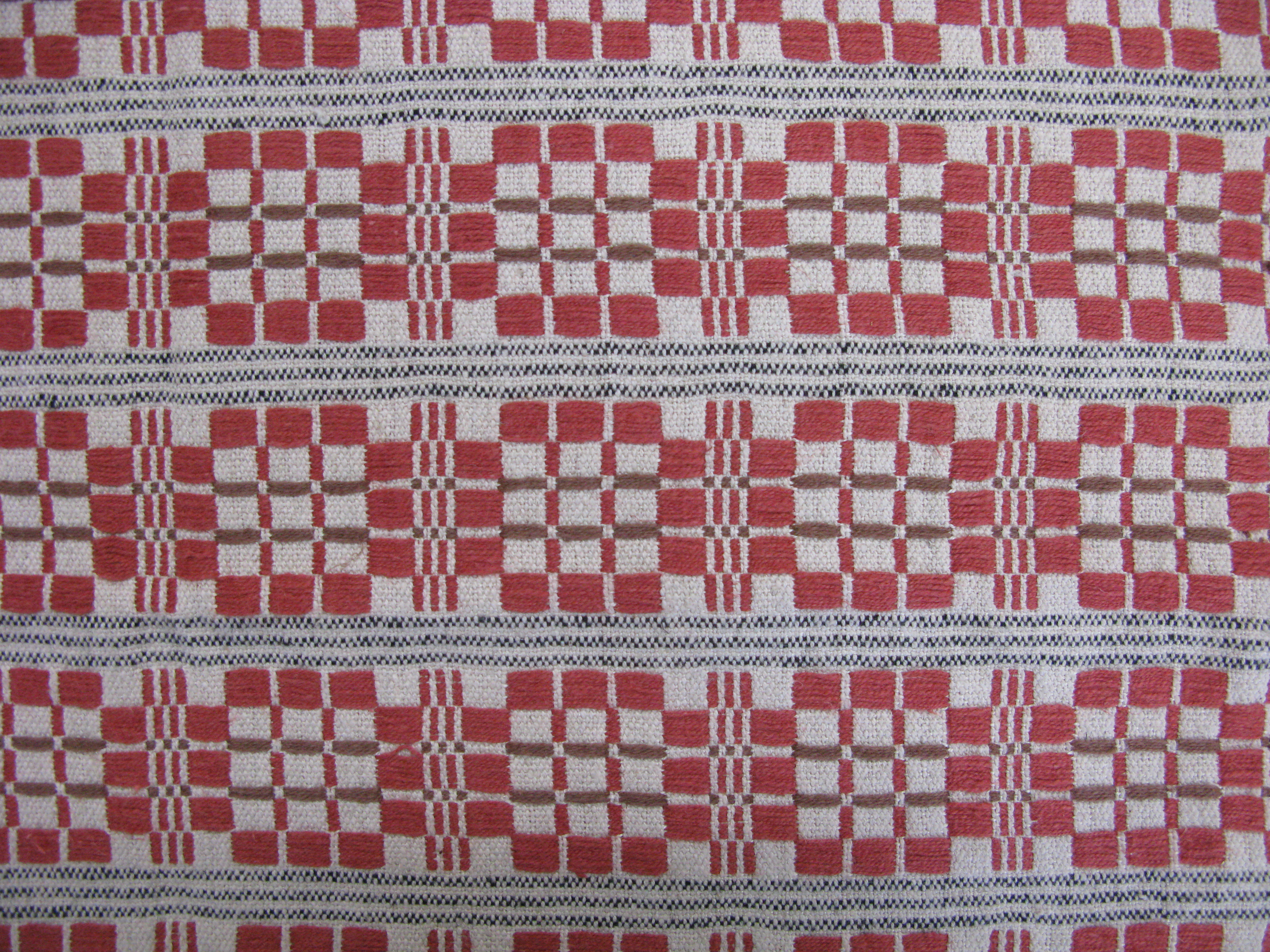
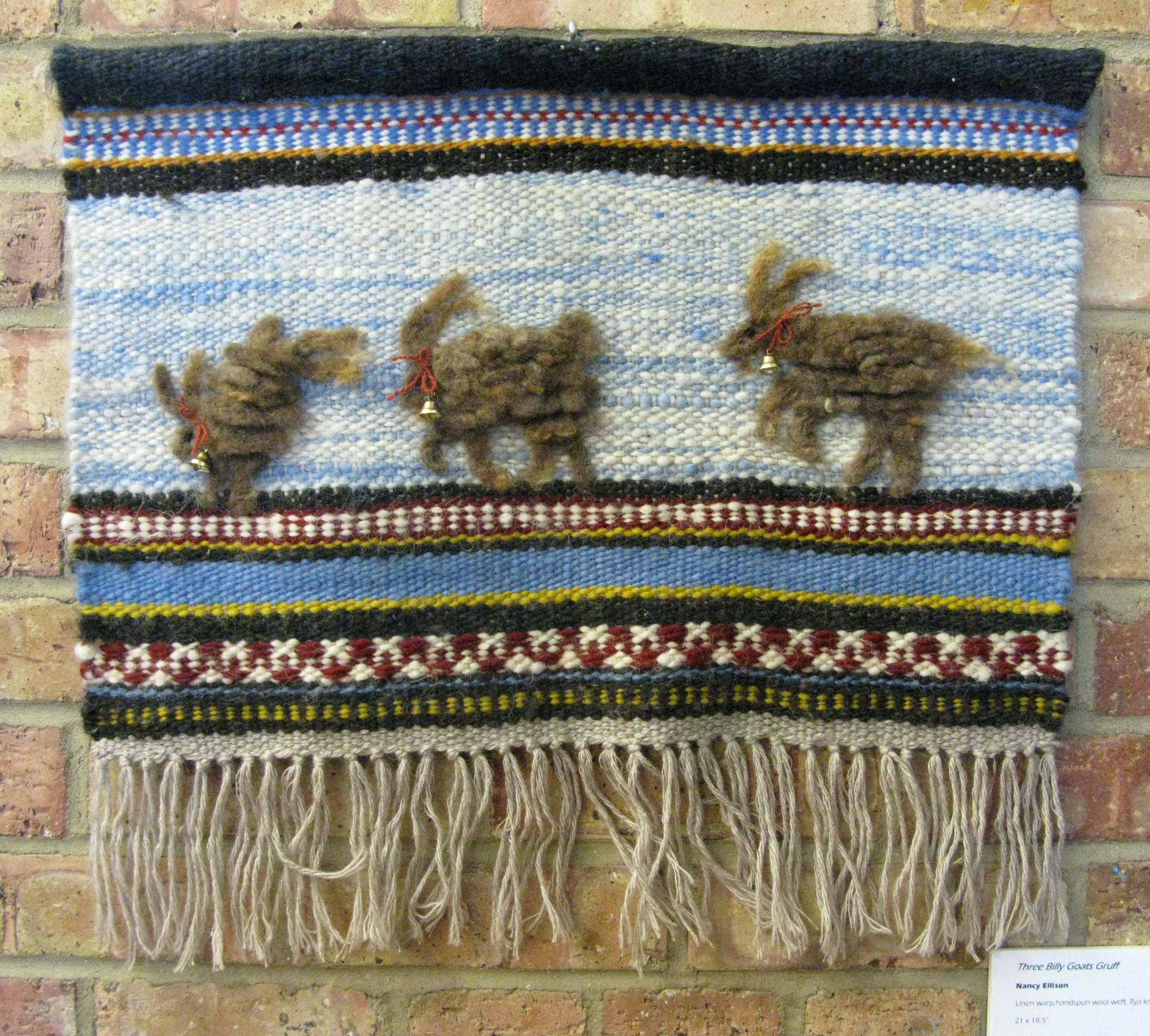
 The Timeless Tradition show up at the Unitarian Society looks great. The textiles look wonderful against the brick walls. I stopped in to take photos on the first Sunday after the show was hung; several people were around following the morning service. They were so appreciative! A man said to me, “I suppose you’re going to try to do that now!” – a friendly comment meant to convey how it would be amazing that anyone could create such pieces. “Oh, I have,” I replied, “A couple of my pieces are here.” Other people came up to me and thanked me. Most pieces line two brick walls of the narthex area. Nancy Ellingson’s “Three Billy Goats Gruff” is at the far end, hanging over the guest book on a podium. Much of the wool in the piece is from Nancy’s own sheep, including the unspun wool of the charming sheep’s bodies. (More photos of Nancy’s farm and sheep can be found here.)
Blog
-
Timeless Tradition
-
A Great Place to See Scandinavian Woven Pieces
 If you can’t get to Norway to view or purchase beautiful woven textiles, you have an equal opportunity this month in Minneapolis. The Scandinavian Weavers Study Group, part of the Weavers Guild of Minnesota, is displaying a selection of woven textiles through Christmas in the gallery of the Unitarian Society of Minneapolis.
The Scandinavian Weavers Study Group has been meeting for more than twenty years, providing a consistent forum for the study of traditional Scandinavian weaving techniques. The members weave traditional patterns and also use the weaving techniques and pattern elements for modern expression. The group studies a particular technique each year, most recently concentrating on boundweave techniques, in which the warp threads are covered, or bound, by the weft. Many of the pieces in this show are woven in krokbragd, a three-shaft technique that yields pieces with an immense range of points, squares, and linear elements.
Most pieces in the current show are woven with wool, primarily Norwegian yarns. They hold the connotations of traditional textiles – warmth, the multi-generational appeal of folk patterns, and ethnic identity. On the other hand, the weavers’ personal design and color choices, and high craftsmanship, result in abstract art pieces.
Maybe you can’t get away to a “hytte,” a Norwegian cabin, this Christmas. But you can admire many weavings that would be perfectly at home in that setting, as well as in our contemporary Minnesota homes.
Timeless Tradition: Selected Weavings
November 28-December 26, 2010 First Unitarian Society of Minneapolis
900 Mount Curve Ave
Minneapolis, MN 55403Hours: 9am – 3pm, M-F
(The office entrance is to the right of
the main entrance doors.)
Sunday: 9 am – 1:30 pm
For other times, call: 612-377-6608Download a flyer for the exhibit.
-
Gradation in Color in the Stripe
 Jan Mostrom brought in a piece that had lovely color gradations in long stripes. From a distance, the color shifts look like a painterly progression. Close up, you can see the alternating yarn colors.
 -
Cottolin Makes a Satisfying Background for Monksbelt
 This is a monksbelt piece woven by Jan Mostrom woven entirely in cottolin – warp, background weft, and pattern weft. The sett is 24 epi. Jan suggested that for someone completely new to the technique, using cottolin can be satisfying. “It’s more fogiving than linen,” she noted. With the cottolin warp and weft you could also use prydvev yarn (a thinnish Norwegian wool yarn) for the pattern.
 -
Monksbelt examples – The Good and the Bad


Syvilla Bolson brought along some monksbelt samples; it’s so instructional to see swatches. The first was an example of what had NOT worked well when she was sampling. The pink and white linen floats in the pattern weave of the first piece were a bit too long, proportionately. The look a bit draggy and limp. On the other hand, the very precise, short floats on the all-wool blue piece were perfect in proportion. The fine wool was lovely; Syvilla thought it might have been Maypole yarn. The unexpected color combination is also lovely, a deep rose tone with a slight heathery cast on blue.