Blog

  • Keith Pierce

    Many of the members of our Scandinavian Weavers Study Group have lifelong  experience with weaving; others are on the beginning path of weaving study.  Keith Pierce fills both categories.  His initial experience with weaving dates back to a unit in ninth grade shop class, when he wove a runner in overshot technique on a table loom that was only about 15″ wide.  Years later, after marriage but before kids, he picked up “Byways in Hand-weaving” by Mary Meigs Atwater. He learned tablet and inkle weaving and a few other off-loom techniques. Over the next four decades he wove on his Beka inkle loom, punctuated with large gaps as more pressing matters intervened, like job, family, and adding bedrooms to his house.
    About a year and a half ago Keith revived his weaving hobby and started working through Peter Collingwood’s book, “Techniques of Tablet Weaving”.  He wanted to try weaving a belt using double-face 3/1 broken twill, his first attempt with that technique, and settled on the double-helix pattern that he found on a Danish web site.  It was inspired by iron-age bands with helix motifs found at sites in northern Europe, for example at Mammen, Denmark and Elisehof, Germany.
    keith-closeup-3
    Peter Collingwood describes 3/1 broken twill as “the most challenging of the double-faced weaves.”  While the technique was challenging, the choice of materials was easy.  Keith said, “I used some green, black, and red 5/2 perle cotton from the stash that I dragged around the country for 40 years.”  His materials at hand worked well for the band.  “I enjoy working with Perle cotton. It’s strength, smoothness, and durability make for painless weaving. And it produces a pretty, lustrous fabric.”  He explored further, to great success.  His second band in 3/1 broken twill won a Sweepstakes ribbon at the Minnesota State Fair in 2012.
    The photo below shows the front and the back side of Keith’s double-helix band in the show.
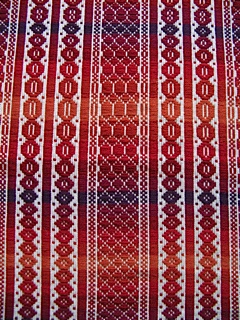
    Keith-band-front-backKeith has two Sami bands woven in perle cotton in the current exhibit.  The background in the narrower  card-woven band used 10/2 and pattern used 3/2.

    keith-closeup-2
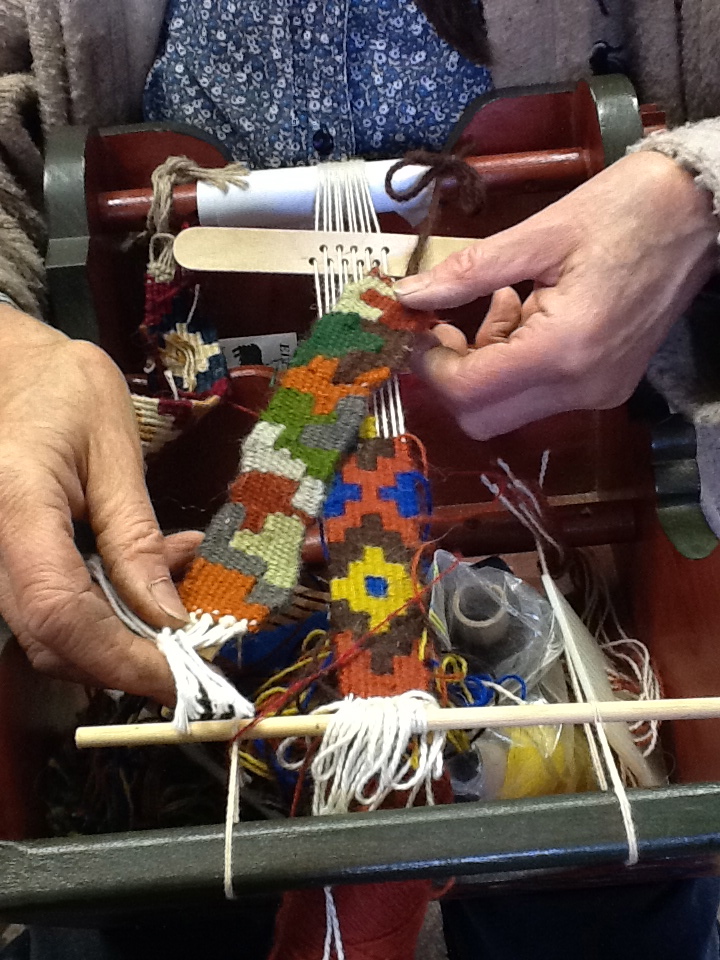
    The wider band used 3/2 for both, but doubled the pattern threads. The patterns are taken from the book “Sami band weaving” by Susan J. Foulkes (self-published and available at blurb.com).  It was woven using a traditional hand-held heddle.
    keith-closeup-1

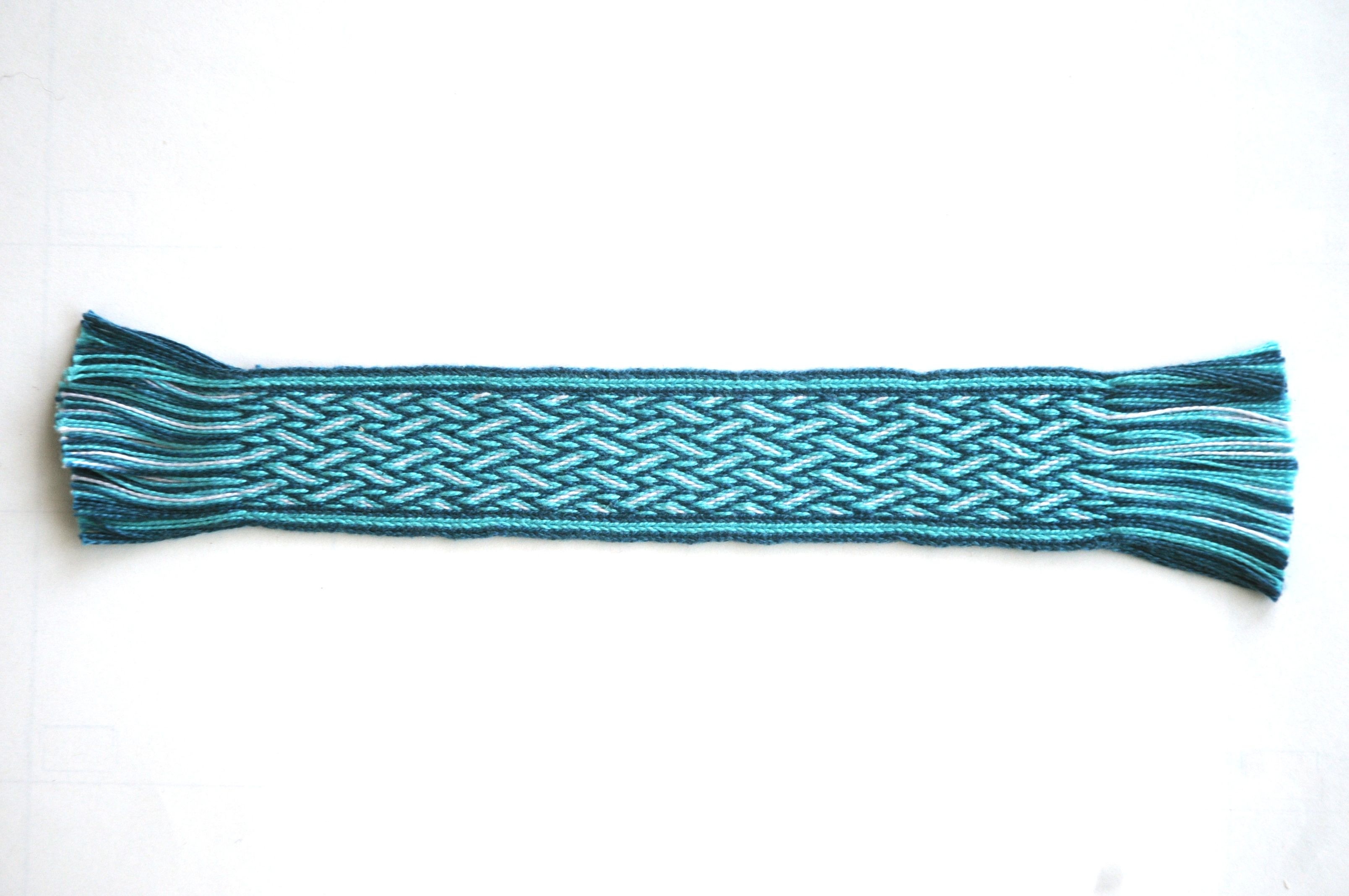
    Also in the exhibit is a blue bookmark woven with 10/2 Perle cotton. Its pattern has Scandinavian origins as described in “Viking-Style Tablet Weaving: Birka Strapwork Motif” by Carolyn Priest-Dorman.  She writes, “The motif for this tablet-weaving “recipe” is based on a Viking Age brocaded tablet-weaving pattern found on Bands 22 and 23 at Birka, Sweden. Based on both the number of finds of brocaded tablet-weaving finds and the total weight of metal brocading weft found at Birka, this was the trim pattern most commonly represented in Birka’s Viking Age burials; its popularity spanned the ninth and tenth centuries.”  Keith notes that this pattern has been used by many band weavers – just google the term “birka strapwork” as evidence.
    keith-blue-band

    keith-closeup-4
    Keith and Jane Connett are members of the Banditos Interest Group at the Weavers Guild of Minnesota.  For that group, Keith reported on another band experiment, in which he used card-weaving for a band in krokbragd technique.  How did it go?  Keith advised his fellow band weavers to stick to shafted looms, and let cards to what they do best
    (not Krokbragd). Read Keith’s detailed notes here.
    keith
    Keith’s new path of weaving study is prompted by inheriting a 1960’s vintage Scandinavian four-shaft table loom.  It’s still waiting to be used.  Keith recently joined the Scandinavian Weavers Study Group and is looking forward to working on krokbragd – but on his loom with shafts, not with cards. We look forward to many more of Keith’s beautifully executed “experiments.”
  • The Weavers Guild Annual Benefit

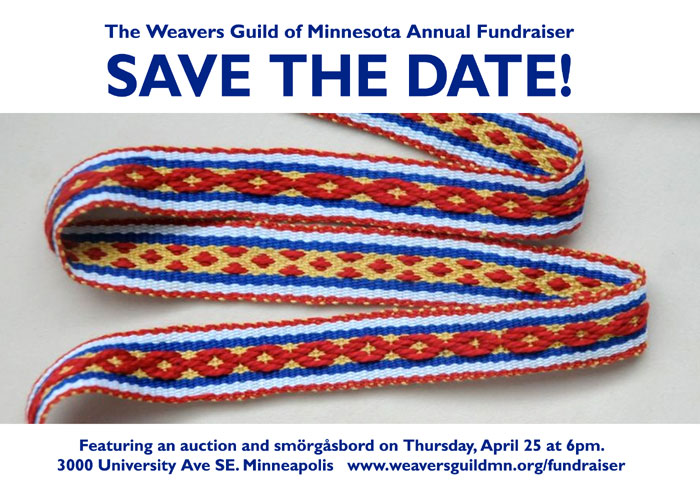
    One of Keith Pierce’s bands in the Scandinavian Weavers Study Group exhibit enjoys special status as the postcard image for the upcoming Weavers Guild of Minnesota benefit.  Here’s more information on the event on April 25 event, which features a live and silent auction and a smörgåsbord.

    postcard

  • Judy Larson

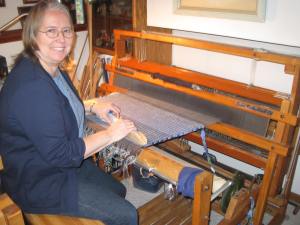
    Judy Larson has been weaving for ten years, and with the addition of an 8-shaft Glimakra in October, has managed to fill her living room with looms.  Patty Johnson said she dreamt Judy’s husband was sitting on a folding chair in the center of room, couches replaced with more looms.  “Not true – not yet!” Judy responded.  Still, Judy does manage to weave on several looms.  Overall, her favorite part of the weaving process is the discovery of color interactions when various weft yarns are used on the same warp.  “Even when I think I have planned it all out and have a prediction, I’m pleasantly surprised by the resulting combinations, so I like to put on a longer warp and do multiple projects in a variety of colors.”

    Judy’s new Glimakra 8-harness loom is used for finer warps; she’s used it for several Monk’s Belt pieces.  Now it is set up for rep weave placemats. “The ease of weaving on it allows me to easily create intricate patterns.”  The ergonomics of warping the Glimakra convinced her to purchase the loom.

    judy-with-loom

    A sturdy Fairloom rug loom from Sears shares her living room space.  She bought the used loom three years ago because it has a stronger “box” construction to weave rag rugs. With a huge stash of fabric, Judy will work on rugs for years, and enjoy surprising color interactions when weaving with a variety of fabrics.  She enjoys having two looms easily at hand.  “It is nice to have the options to choose each night if I want to do delicate patterns, or weave away some frustrations from the day with some good hard beats!”

    judy-at-loom-2

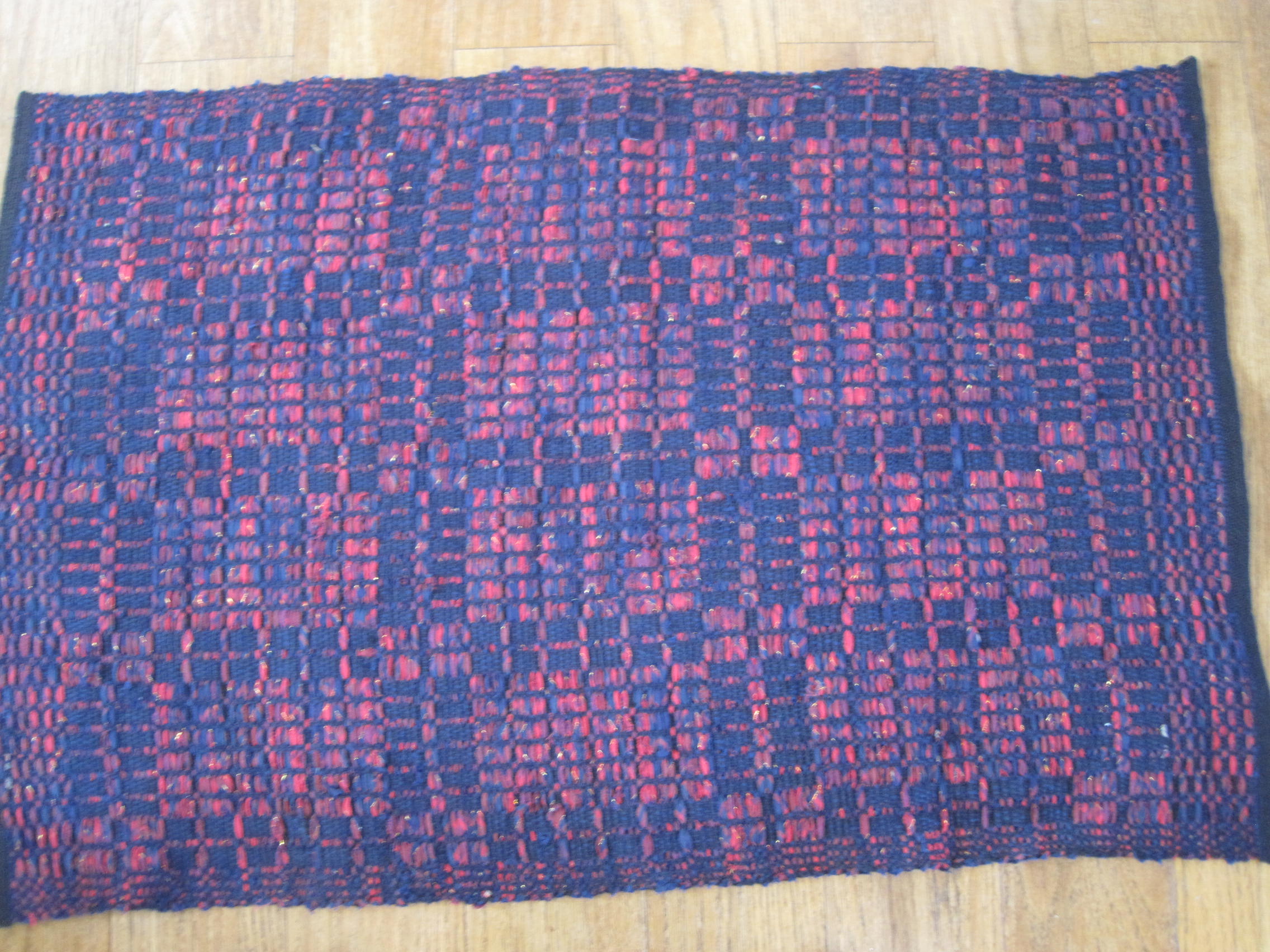
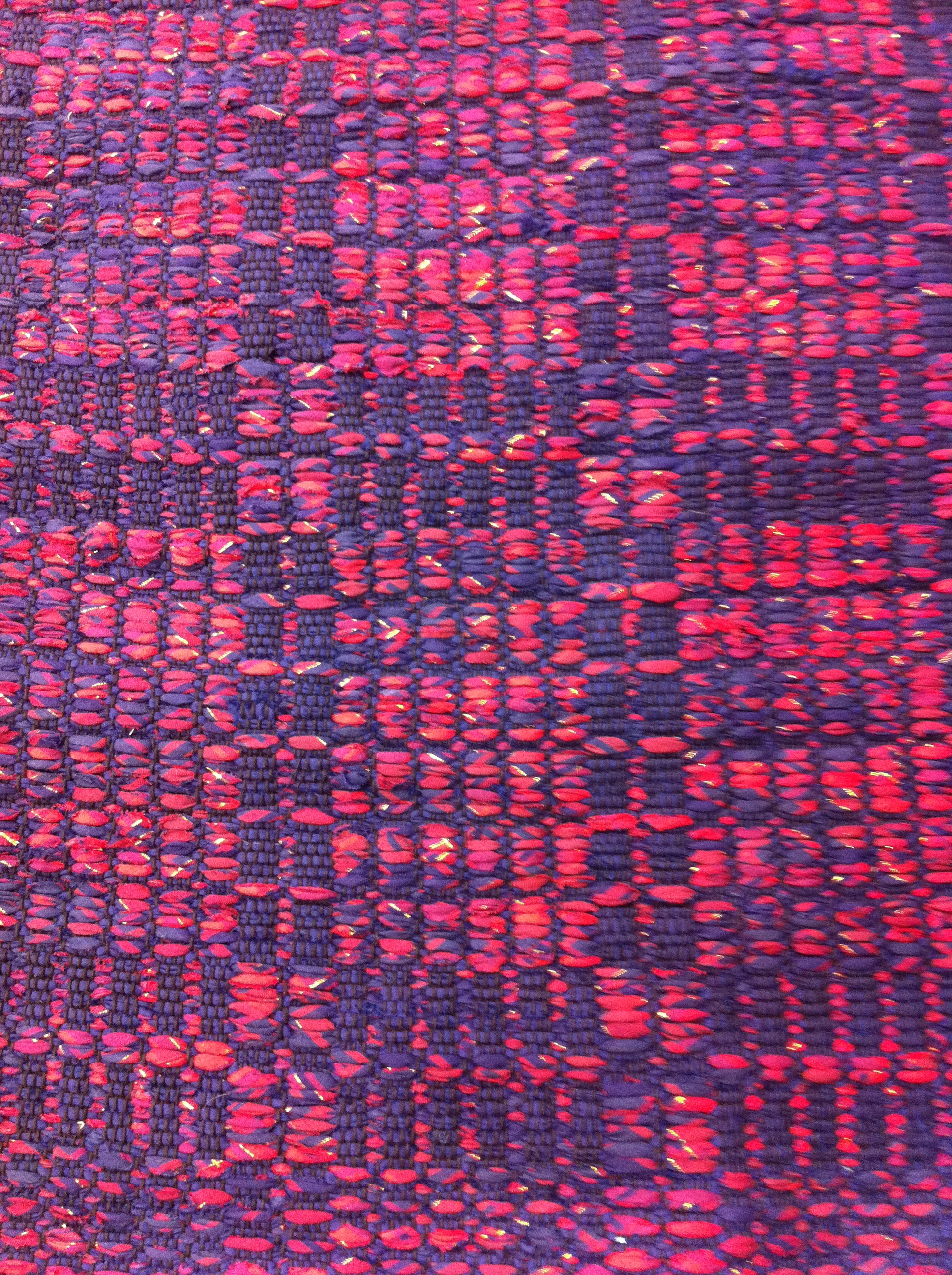
    Judy’s Monk’s Belt rug in the exhibit was woven on the Fairloom.  She was curious to see how fabric would work instead of the usual yarns, so she wove four rugs.  The navy plaid, with a sparkle of gold, was her favorite because it had the most subtle overall effect.

    judy-monksbelt-rug

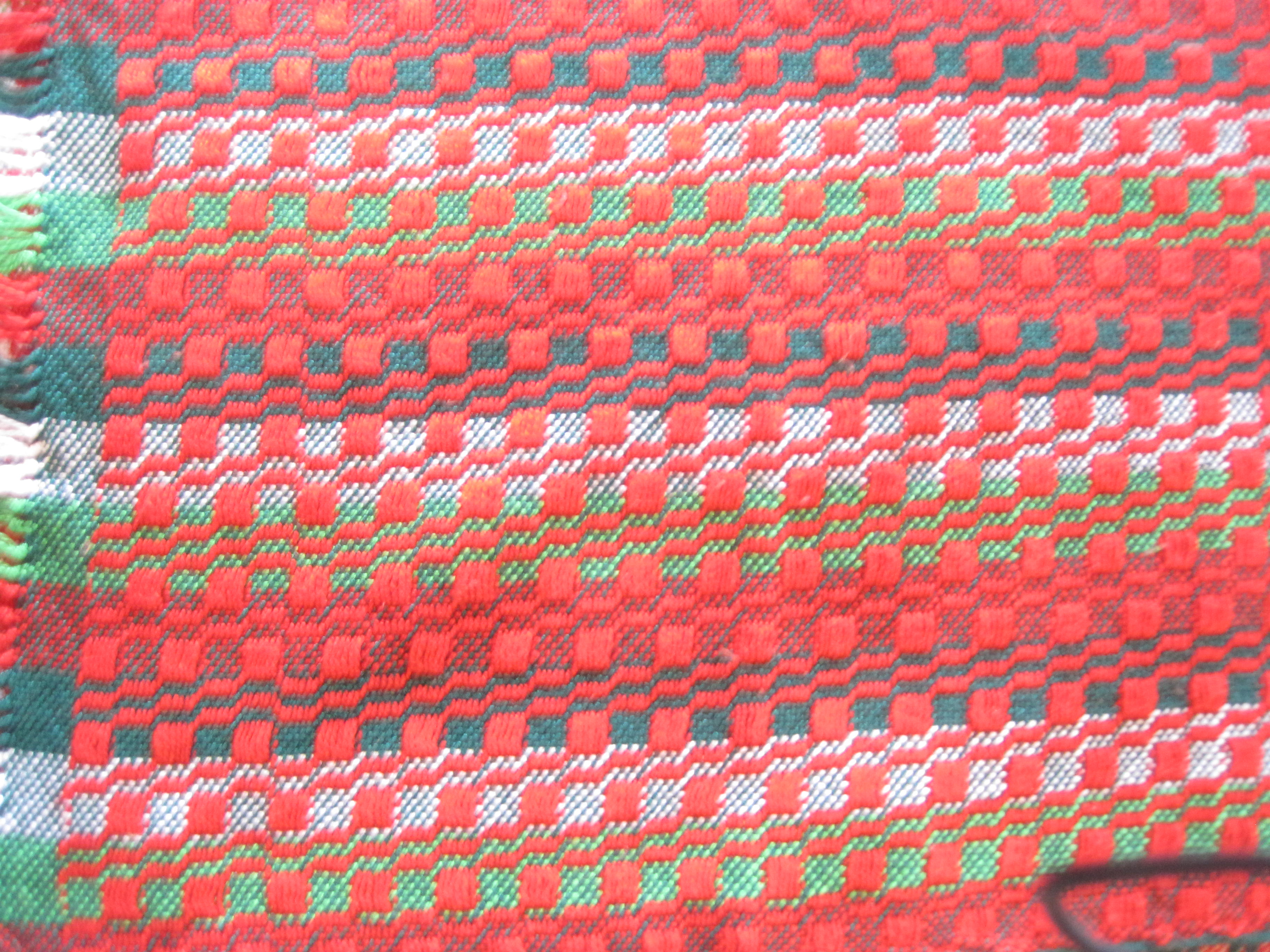
    Her Monk’s Belt runner is the opposite of subtle – a bright and festive Christmas runner.  It was made on the Glimakra with 3/2 pearl cotton.

    judy-monksbelt-3

    Judy can often be found at Patty Johnson’s shop, Color Crossing, where she uses more looms.  She warps an eight-foot Cranbrook loom for room-sized rugs. Her next rug will use a linen warp and wool weft in a shaft switching technique. It will grace her newest grandson’s room.  She also uses a 60-inch twelve-shaft Finnish Toika in the studio at the shop.

    Wait!  There’s more! Judy also still has her first loom, a four shaft LeClerc.  Are there enough hours in the day?

  • Jan Mostrom

    Jan Mostrom describes her ties to Scandinavian weaving techniques and to the Scandinavian Weavers Study Group:

    “I have been weaving since a January term class taught by Lila Nelson while I was attending Luther College.  Lila and Syvilla Bolson have been long time mentors for me and their knowledge and love for Norwegian techniques influenced my own excitement about Scandinavian textiles. I have loved being part of the Scandinavian Weaving Study Group because we inspire, share and support each other while working with different weaving themes.  It helps me to have a deadline and to want to push a technique in a new direction even though I love working within the traditional weaves.  I have also enjoyed teaching some of the weaving techniques at Vesterheim Norwegian American Museum and at the Minnesota Weavers Guild.”

    IMG_5254

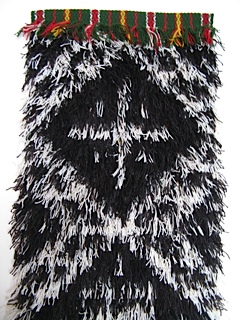
    Jan has three pieces in the current exhibit.  In “Protection Rya,” the twill backing design was reproduced from a rya at Vesterheim.  The knot design was inspired by the protective symbols painted on the walls of a home in the Hardanger Museum.  She used Norwegian Rauma Aklea yarn in the warp, weft and knots.

    IMG_1468

    “Sunset Skillbragd” is done in the traditional Norwegian skillbragd technique, which requires two sets of shafts to weave.  One set is for weaving the plain weave ground and the other set of shafts is to weave the pattern.  Warps go through both sets of shafts.  This piece is woven with a fine cotton warp and Rauma prydvev for the pattern.

    IMG_5261

    IMG_5262

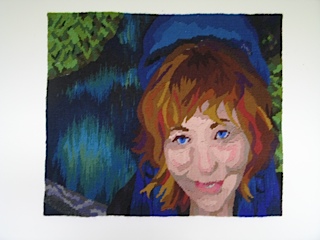
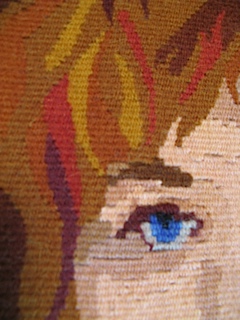
    “Backpacker Tapestry,” adapted from a photo of her daughter, was woven with a seine twine warp and mostly Rauma prydvev yarn for the weft.  Jan dyed the skin tones for the face with acid dyes.

    IMG_2409

    IMG_2399

    IMG_2289

  • Jane Connett

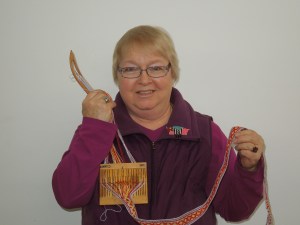
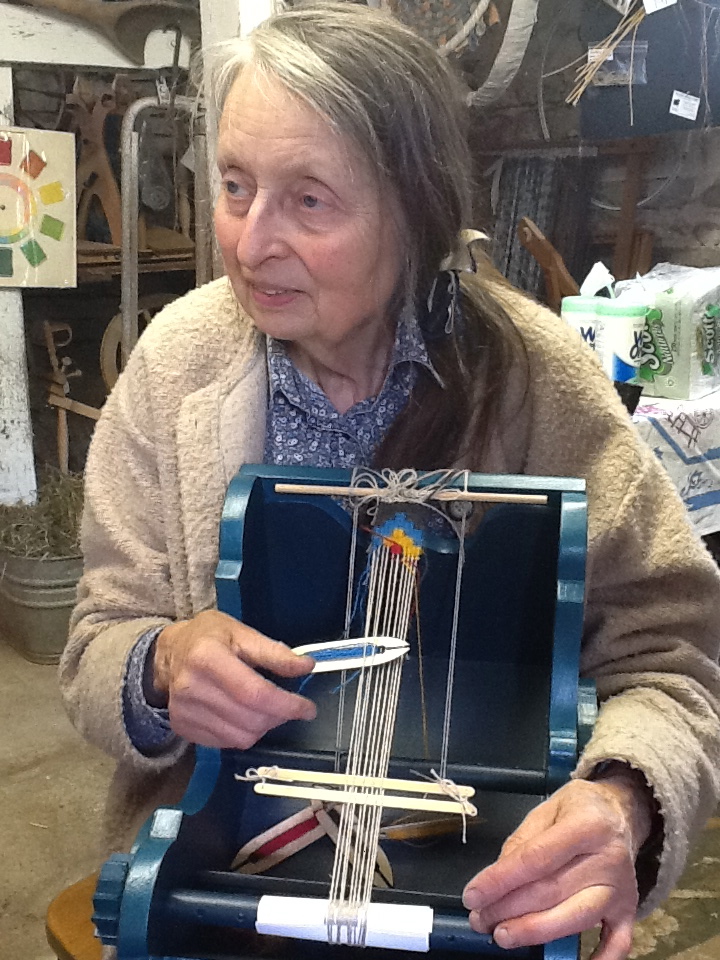
    Jane Connett’s Sami bands fit well into the exploration of Scandinavian weaving techniques, but were actually woven in the context of another Weaver’s Guild interest group, the Banditos. About three months ago, Jane suggested weaving Sami bands. Jane noted that her bands on exhibit are the successful ones, after abandoning other experiments with the wrong colors, wrong wool, or the sloppy work of experimentation.  She added, “Tying the warp up to different types of small looms has been a learning experience, as it mostly does not work to do the bands this way.  I have reluctantly admitted that I have to do them back strap to get the best results.”

    Of the Scandinavian Weavers Study Group, Jany wrote, “Scan Weavers keeps me going.  Everyone is creative, sharing and inspirational.  I know that I will never be in the position I would like for weaving… lots of room, light, time and equipment.  But I can dream, and on occasion can manage some small thing that gives me much joy.”

    jane-with-band-1

    In her weaving, Jane focuses on rigid heddle, tapestry, inkle and card weaving, and has multiple looms for all those techniques.  “I used to say you could never have too many looms… but I think I may have finally reached my limit.”

    Jane loves the hands-on pleasure of working with color and pattern, on and off the loom.  “I love Krokbragd.  I like designing small and larger intricate looking patterns and graphing them out and coloring them in. Then I see what changes I can make to the design, and then what happens when I change the colors, moving the darks and lights to another area.”  She hopes to get back to tapestry weaving. “Working that close to a design and having the wool in my hands brings me a supreme sense of joy.”

    Jane came to her love of weaving serendipitously.

    “I had a Girl Scout troop for 11 years and they wanted to do a ‘weaving badge’ in the spring of 1994.  Not knowing anything about weaving, I took my first class that summer at the old Guild building, on card weaving with Karen Searle.   After teaching this to the girls they wanted more, so I took beginning rigid heddle, and tapestry with Joanna Foslien.   Eventually, the girls in my troop learned about seven different techniques and sponsored a Weaving Weekend at a summer camp for around 400 young girls.   They demonstrated the different kinds of looms and weaving, and we provided prewarped cardboard looms for all of the attendees and their leaders.  It was a lot of work but a great success!!   I was hooked, but always short on time with a LOT of volunteering at that time in my life.”

    These days Jane’s weaving time is limited by her growing family; three granddaughters, including newly-born twins.  As soon as they are old enough to manage a warp, Jane will be the perfect weaving instructor!

  • It’s Up!

    Thanks to the hard work of Jan Mostrom, Keith Pierce, and Robyn Meadows, “Everything Under the (Midnight) Sun: Scandinavian Weavings” is up!  It happened just as in previous shows.  All the pieces were assembled in one spot this morning and the giant puzzle of placing them appropriately on the walls began.  Whoa!  The orange of one piece makes a second one look terrible.  Shuffling happens.  Then, magically, three pieces look marvelous together, with a harmony of color of pattern that enhances them all.  Maybe we have too many pieces.  But wait!  Jan’s tapestry looks perfect on the far orange wall.  Keith and Robyn carefully measured the walls and the pieces, and used the level on everything.  A few hours later, the pieces are nailed and tacked and shifted to the perfect positions, and once again the Scandinavian Weavers have a great show in place.

    Several bands are in the show, and they look smashing on black felt. One of Jane’s bands is still on the heddle, giving the viewers a sense of how it is made. Nancy Ellison’s “Band of Sheep” is below.

    IMG_3684

    Two pieces by Melba Granlund flank a tapestry by Sharon Marquardt.  What you don’t see is that they are above a blue sofa in a seating area, and the grouping looks as if it was custom woven for the space.

    IMG_3673

    The holiday red of Judy Larsen’s Monk’s Belt runner seemed too strong to hang near pieces with more neutral tones, but POPS with the black-and-white of Jan Mostrom’s rya and Keith’s Viking band.

    IMG_3671

    To be continued….

  • “The Sheep Farm” by Nancy Ellison

    nancy-krokbragd-sheepNancy Ellison’s  weaving has a soft surface and the natural brown, black, and gray shades of the xxx sheep on her southern Minnesota farm.  “The Sheep Farm” was woven on three harnesses with a krokbragd threading.  It was woven with handspun yarn on a Louet David loom with a sinking shed which Nancy prefers for weaving krokbragd. The wooly sheep emerge with unspun fleece tied with traditional rya knots.  The piece received honorable mention at the Vesterheim National Folk Art exhibit in 2012.

    nancy-floor-loom

    “Side by Side,” a band with sheep images, was woven with Ashford Tepako wool yarn.  For a band of this type, Nancy sometimes uses a Schacht inkle loom and other times a Glimakra band loom. She wove it as a krokbragd turned draft by adding a set of string heddles to get a third shed.

    nancy-spinning
    It’s a wonder that Nancy has time to weave and spin, with the responsibility of her farm and animals – sheep, ducks, chickens, goats, and a remarkable goose who looks like he is wearing a cap.

    She teaches spinning and weaving classes in an old barn on the farm.  The studio area has heavy timber walls, a magical space for a spinner or weaver, as you examine the new and antique looms and wheels lining the perimeter.  (And surprise! There are two long-haired rabbits tucked in a cage, too.)  The whitewashed round silo has been transformed into a gallery. Nancy is a dealer for a variety of spinning wheels and looms. You can – and should – visit “The Ellison Sheep Farm” open by appointment.

    Nancy is a former home economics teacher, and studied weaving during the summer of 1968. She has been a member of the Scandinavian Weavers Study group for many years.

    (More on a visit to Nancy’s farm here.)

  • Everything Under the (Midnight) Sun: Scandinavian Weavings

    Nils-Aslak_Valkeapää_Beaivi,_Áhcázan_The_Sun,_My_FatherThe Scandinavian Weaving Study Group of the Minnesota Weavers Guild is mounting a new exhibition, Everything Under the (Midnight) Sun: Scandinavian Weavings, to be displayed in the Community Gallery of the Textile Center of Minnesota, from March 15 – May 4.  Information about the pieces and the weavers will be posted in the coming weeks.

    Typically, the Study Group concentrates on a particular Scandinavian weaving technique for one or two years, culminating in an exhibit. Other times the group chose a theme on which to base a show, as in “Symbols, Myths, and Fairy Tales.” The 2013 display breaks from tradition. It gathers recent work by the weavers in a panorama of Scandinavian weaving techniques.

    The  weavers represented have varying degrees of experience; some are new to the craft, others have woven for decades.  The looms used range from simple heddles with a backstrap to complex floor looms. The common theme is enthusiasm for traditional Scandinavian weaving techniques as a way to create contemporary textiles.

    The show includes two tapestry pieces. One is based on a medieval Norwegian theme; the other uses similar techniques to depict a modern girl with a backpack, woven in hand-dyed yarns. Those familiar with Norwegian weaving will find pieces in familiar techniques; krokbragd, rutevev, skillbragd, and monk’s belt. Pieces are woven in cotton, fine linen, and wool, including hand-spun wool.  Sometimes traditional weave structures are used with unconventional materials, like fabric strips or pineapple bast.

    All visitors will find inspiring weavings with “Everything Under the Midnight Sun” represented in the latest Scandinavian Weavers exhibit.

    Contributors include Jane Connett, Keith Pierce, Patty Johnson, Judy Larson, Sharon Marquardt, Melba Granlund, Jan Mostrom, Nancy Ellison, Veronna Capone, Robyn Meadows, and Robbie LaFleur.

  • Scandinavian Weavers Meeting, May 2012 (Part one)

    Field trip!  We had a great trip to Nancy Ellison’s farm near Zumbrota – DESPITE the cold and drizzly day, an anomaly following several perfect spring weeks in Minnesota.  All of Nancy’s beautiful long-haired sheep were shorn on Good Friday, leaving them a bit patchy-looking.  Normally they would have been in a distant pasture eating fresh greens, so we appreciated the fact Nancy kept them in the barn for viewing.

    ImageFrom an earlier trip, here’s how they look in full long-fibered glory.

    We met in a room at the edge of the barn with thick, white-painted timbers and spinning wheels and looms flanking the walls (plus long-haired rabbits in cages!). The wind was howling outside, yet it was quiet inside.
    Nancy will be teaching a cradle loom class this summer.  She showed us cradle looms with a completed slit tapestry and one in progress.  Inspired by observing her warping method and by her completed pieces, Jan Mostrom, Mary Skoy and I are all meeting to warp our cradle looms later this month.  We all have lovely rosemaled cradle looms which we have NEVER USED.  For Pete’s sake, we only have to warp 10 threads!  How long could it take?  We’ll report later on our progress.
    A remark about Decorah and the Norwegian-American Museum sparked  a great story from Lila Nelson about manners and creative problem-solving.  Years ago, King Olav gave money to Vesterheim that was used to install a state-of-the-art textile washing station.  Old textiles could be submerged flat and gently into the large shallow basin.  During a Royal Visit to Vesterheim, the new equipment was on display in demonstration mode.  Lila and others needed to show how it was done, complete with wearing heavy rubber gloves to protect their hands and the textile.  But how would that work with the king’s well-known desire to shake hands with the people he met?  In the end they decided to sort of fake the actual washing step.  They pulled their right-hand gloves almost completely off their hands, so that when the King came close – whoosh, off came the glove.  Awkward  rubber glove pulling, struggling and snapping would put a dent in trying to appear poised, wouldn’t it?
  • Scandinavian Weavers Meeting, March 2012

    Veronna started off a really interesting discussion of hems and edges of textiles when she described a recent project, monksbelt runners in pearl cotton.  “Oh,” she noted when she took them off the loom, “It looks like I was drunk at one point and here at another.”  Hardly.  There’s more on that discussion on my “Bound to Weave” blog, “Showing Your Good Side.” She shared two interesting lessons from that piece.  She made color windings of the yarns, around a card, to test out combinations.  Then she made both a black-and-white photocopy and a color photocopy of the combinations.  The black-and-white helped show relative contrast of dark and light.  Also, when you weave monksbelt with the same color for the base and pattern weft, it is really two colors, because of the reflective properties of the yarn.

    Veronna suggested we look at the swatch photos for patterns in Mary E. Black’s New Key to Weaving found in a new digital collection sponsored by the government of Novia Scotia.

    Judy brought rouched scarves made with lace-weight yarn, silk  120 inches long, 72 inches, and Jaeger zephyr wool silk.

    She made a rug in monksbelt pattern using fabric strips. She sleyed poly-cotton carpet warp at 12 epi.

    Patty Kuebker Johnson talked about the color and weave study group sponsored at Color Crossing.  It’s especially useful for those who don’t do a lot of fine thread weaving.  “Unless you have a weft-faced or warp faced weave, you are always dealing with the interaction of the thread colors,” she explained.   Once it’s on the loom the study group members sign up for time slots to weave off samples.

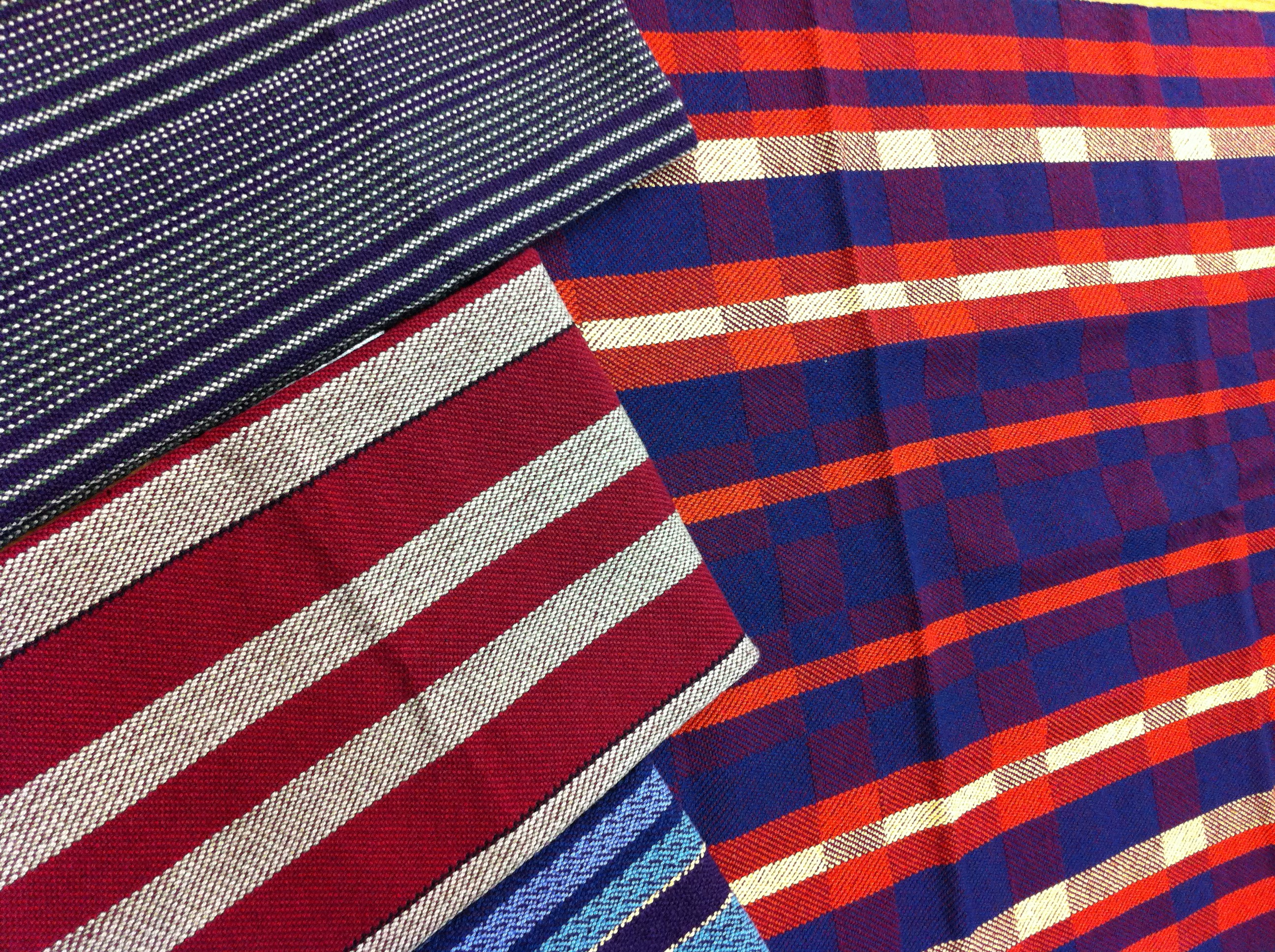
    Robin Meadow noted that a new session of the color exploration class, Stripes and Structures to Create Tantalizing Towels, was starting soon.  She’s taken it twice, and as a new weaver, found it enormously helpful each time. You work in different structures, different color palettes,  and it requires diligent production weaving.  Why take it twice? You deal with different color ways, different loom personalities, and even different weave structures from one class to the next. Patty said that she uses the towels she makes as runners until they become dishtowels.  Below is a jumble of the towels Robin wove in her last class, a bad photo of lovely items.

    Melba Granlund spent a fantastic week taking the basic Swedish weaving course at Becky’s Vavstuga. “You weave like you’re crazy,” Melba said.  There were eight people in the class, two of whom had never woven before.  Her completed pieces were beautiful.

    A perennial weaving problem is time, never enough time for weaving. At one point the issue was raised about weaving just a bit each day on a project. Isn’t  there a problem with a difference  in beating? Are some portions more tightly woven than others?  Patty noted that she encounters this more with with knitting than weaving.  She advised, “Warping is the hard part!  Reward yourself for each step of the way.  Today I wind the warp – that’s the assignment.  The next day, put it on the back beam.  Break it into segments and reward yourself for the completion of each.”  Meeting with our group is good for encouragement – the encouragement of example, and the encouragement of tips.