Blog

  • “Weaving with History” Workshop

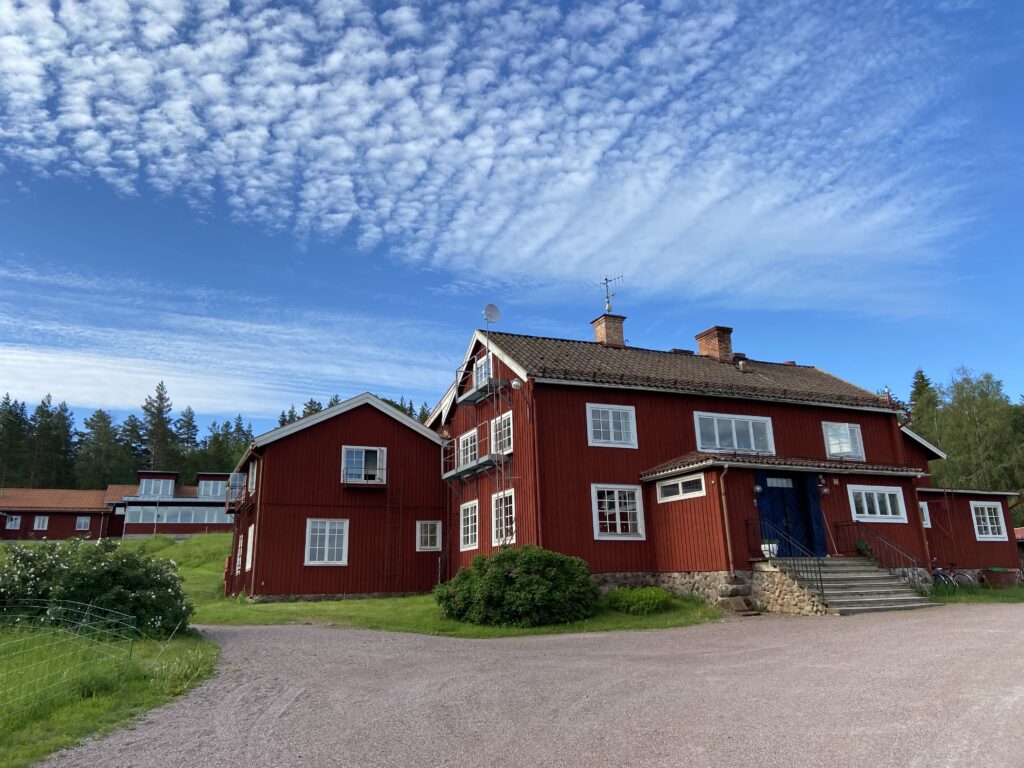
    Beautiful Sätergläntan in Sweden

    Editor’s Note: Today’s blog entry was written by Judy Larson.

    “Nordic Handcraft Workshop: Weaving with History – Using Historical Textiles” was a class co-hosted by American Swedish Institute (ASI) and Weavers Guild of Minnesota (WGM) and planned to be taught by Susanna Ayton of Sätergläntan Institute for Craft and Handwork in Insjön, Dalarna, Sweden. Enrollment filled quickly, and five members of the Scandinavian Weavers Interest Group offered to wind warps and prepare the twelve looms. Betsy Konop, the WGM Education Coordinator, ordered the materials and assigned the warps for winding. 

    On Tuesday, June 20, the warps were delivered, and five of the looms got the warps wound on. Each loom had to be carefully warped using 6/1 linen, 6/3 linen, 6/1 wool, and 16/2 cottons. The next day, more warps were wound on, sleying started, and the process continued. That night, we were informed that the instructor had been called back to Sweden for a family emergency, and we could choose to continue with the class as a group study or get a full refund. Betsy said she was sure we could “make lemonade out of these lemons!” Besides, the looms were almost ready!
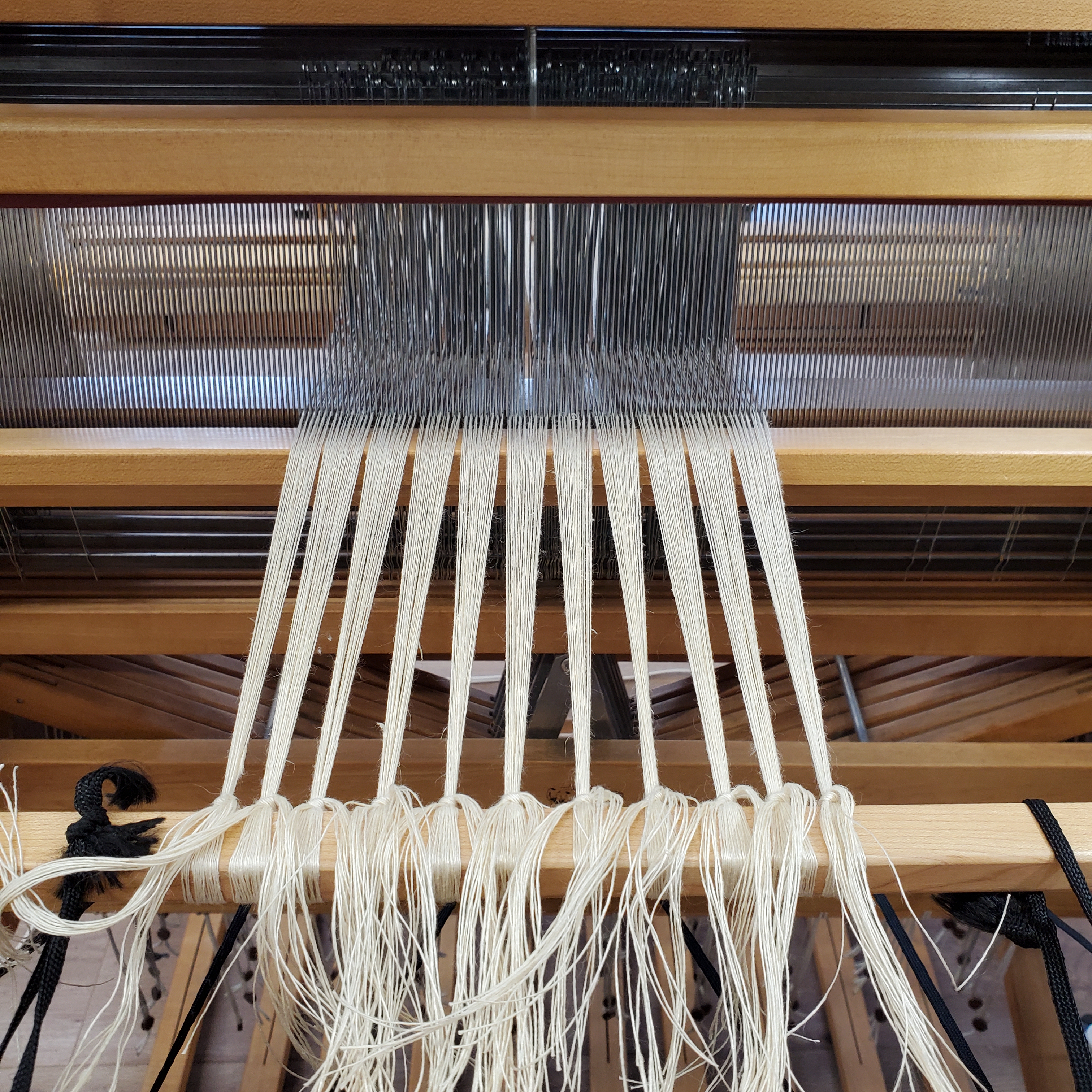
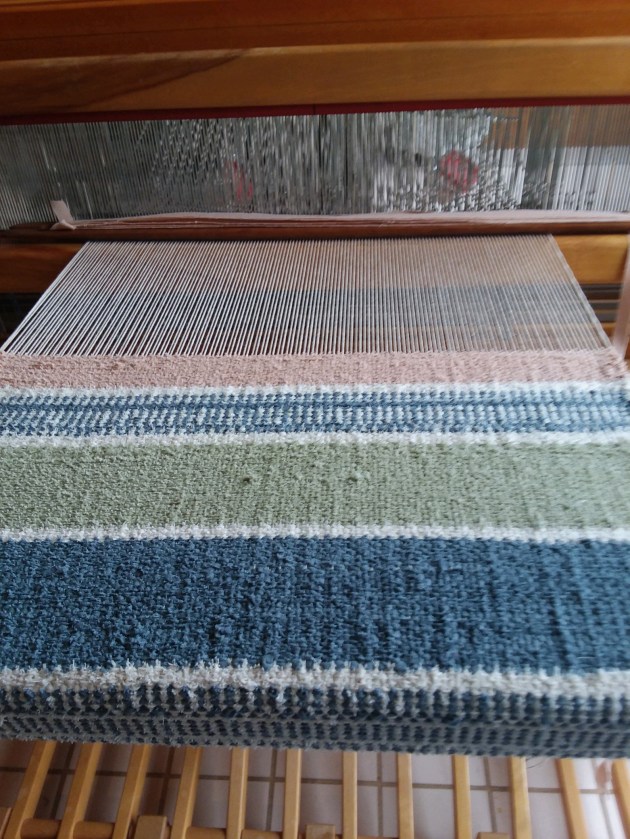
    Loom warped in beautiful Swedish linen

    Ten of the twelve students chose to still do the class as a group study, and so the warping continued. It looked like everything was ready! Just before leaving on Thursday night, I noticed that one of the 6/1 linen warps had “churros” between the reed and the back beam, so it had to be completely wound to the the front beam, all the way to the end, and the twists removed. Betsy’s dog, Hopsy, was patiently waiting to go home, and he sat toward the end of the warp as the twist was slowly worked back. The decision was made to make it to Hopsy’s ears, and then cut the warp! It was then tied to the back beam and re-beamed the next day.

    Hops hard at work! (Note his magnificent ears)

    Friday morning, the group met at ASI and had a quick introduction to Sätergläntan’s programs in weaving, woodworking, blacksmithing, and hand sewing. 

    American Swedish Institute in Minneapolis

    Then Phyllis Waggoner shared information and showed textiles from ASI’s collection in each of the weave structures we’d be sampling. Phyllis has been working with the ASI textiles for many years and is our local expert!

    Phyllis explaining Blådrättar, a style of Dukagång

    We first saw the Dukagång and Blådrättar.  Blådrättar means “blue dish” in Swedish and refers to the fact that this type of Dukagång was traditionally done in blue and white/cream, similar to the colors on porcelain dishes. In Dukagång, the wool pattern weft is laid in fine rows separated by thin lines of tabby wefts.

    Close-up of Blådrättar from ASI collection

    Rölakan and munkabälte (Monksbelt) pieces were shown next, along with Daldräll (Overshot) and Rosengång (Rosepath).

    Close-up of Rölakan showing distinctive interlock technique

    Close-up of mythical creature on Rölakan weaving

    Another Rölakan from ASI’s textile collection
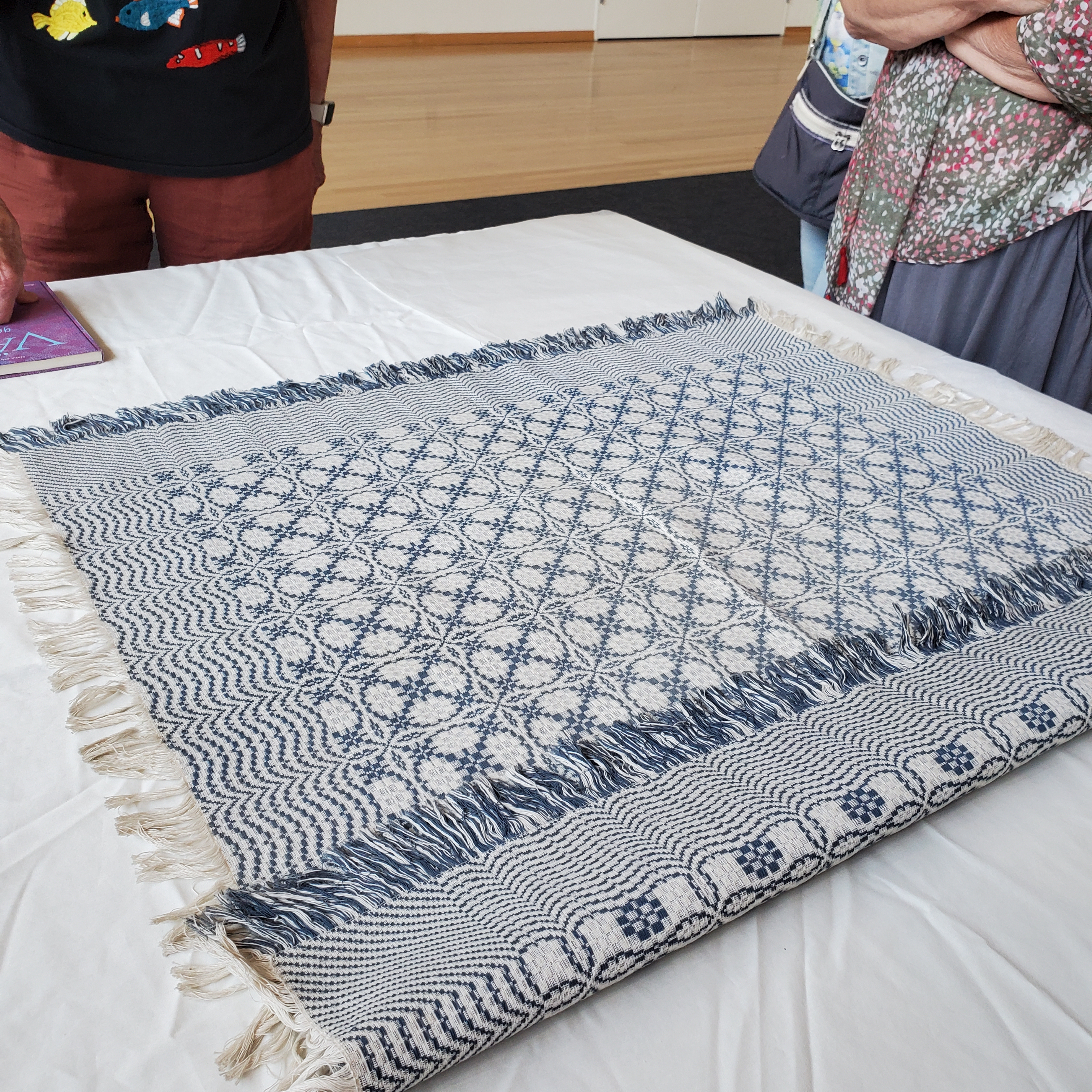
    Daldräll from ASI’s textile collection

    Munkabälte (Monksbelt) from ASI collection

    After lunch, the group went to the Guild and started our group study.  Those with any experience in any of the structures gave their mini-demonstration, and then the weavers began making their samples.

    Swedish wool yarn with WGM looms in the background
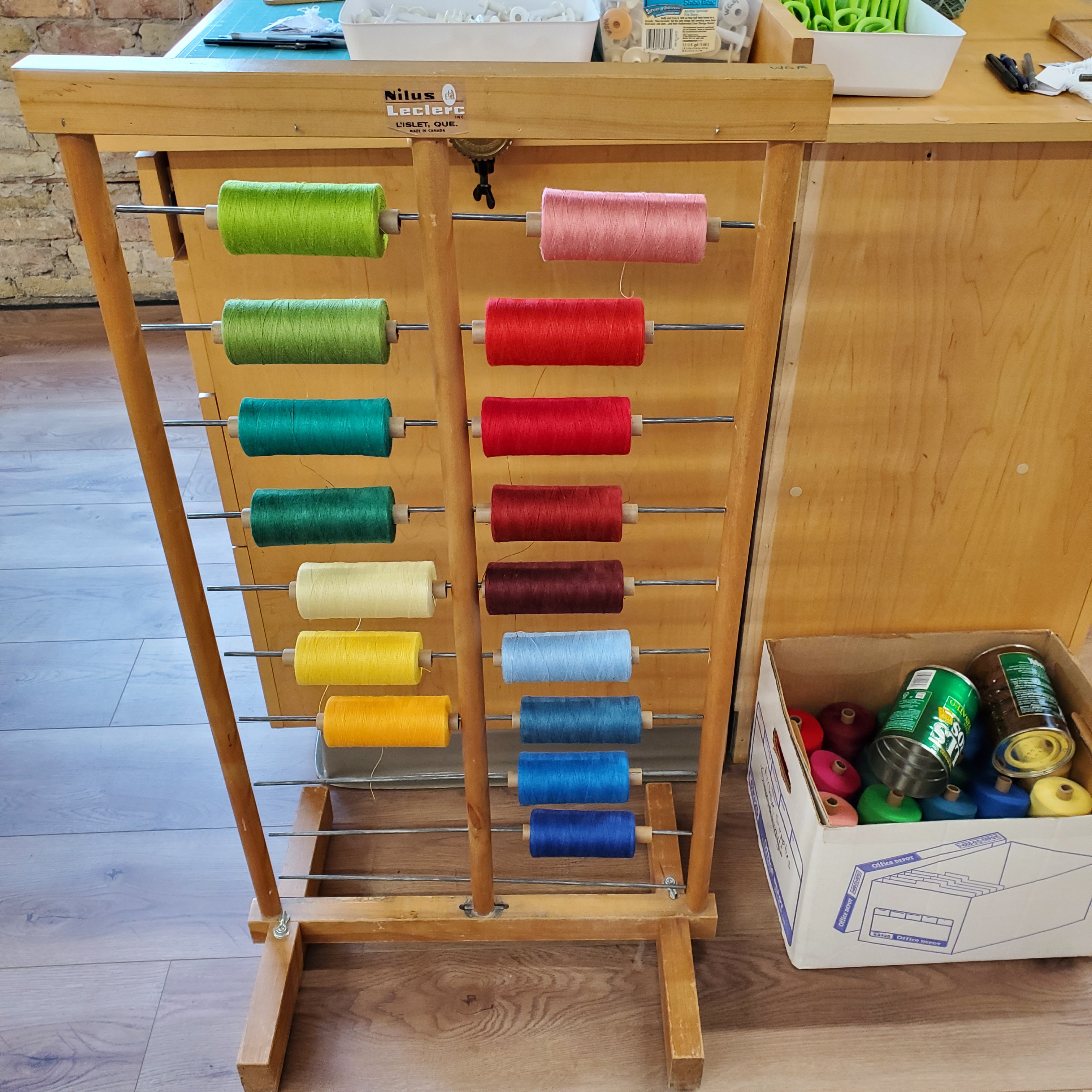
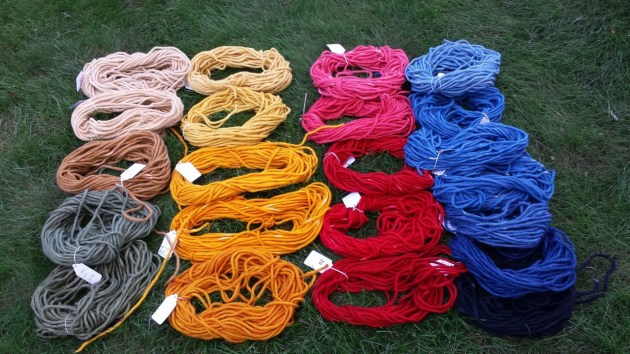
    Lovely Swedish linen in a rainbow of colors!

    Munkabälte and Daldräll were both pattern/tabby weaves and were more familiar. The Rosengång on opposites was a little trickier to do, but remembering the treadle partners of 1/4 with 2/3 and 1/2 with 3/4 helped.  The Rölakan differences with single or double interlocks, plus the dovetail and over two without interlocked were discussed.  The most challenging weave was the Dukagång.

    Marianne weaving Rosengång (Rosepath)

    Ever working on Rölakan interlocks

    The weavers wove 6-inch samples of three different Munkabälte patterns, two Rosengångs (one with twills 4321234, and one with 123414321 threadings), two Daldräll patterns, two Rölakan, and three Dukagångs. As the weaving started, the patterns were coming out underneath. The tie-ups were all for counterbalance looms, so the tie ups needed to be reversed! More learning was happening!

    Daldräll by Judy
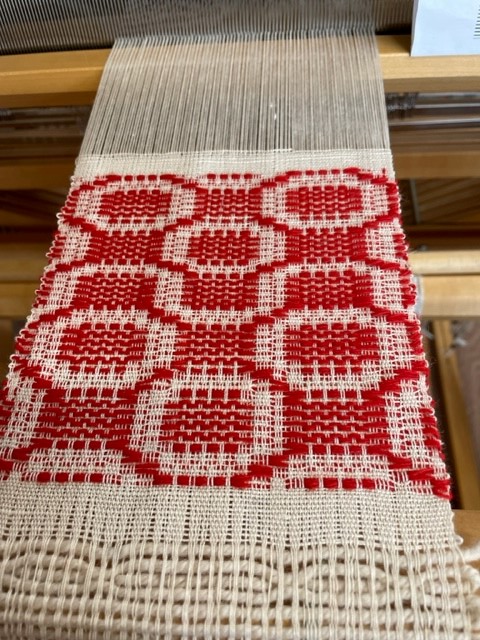
    Second Daldräll threading

    Two of the Dukagångs were on 6/1 Farö wool warps, which kept breaking.  Finally, the decision was made to re-warp one of them with 6/1 linen, which worked much better. 
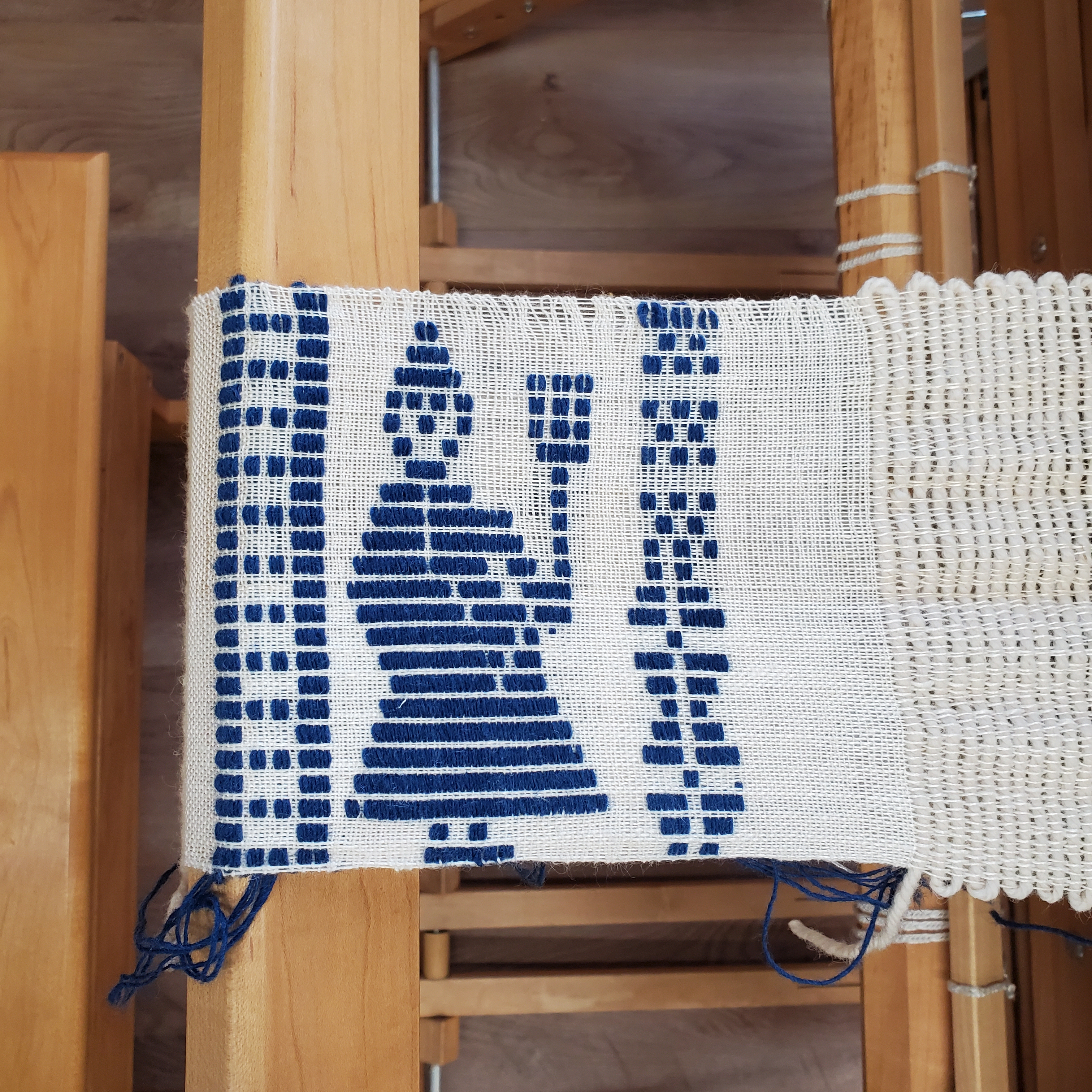
    Sharon’s beautiful Blådrättar!

    Sharon experimented with color blending in munkabälte

    Close-up of Sharon’s munkabälte

    More munkabälte

    Munkabälte

    Analyzing weave structure’s in Nancy’s show-and-tell

    After weaving on Saturday and Sunday, there was a reception at ASI for all the participants in any of the four areas for Sätergläntan classes.  The blacksmithing teacher commented that it was impressive that the weaving class went forward, even without a teacher.  But it just shows that when weavers get a chance, they make the best of it!  We truly did make “lemonade out of the lemons!”

    After the warps are taken off the looms, Betsy will take pictures of each sample, and send them out to their respective weavers.  The weekend was a great opportunity to meet more weavers, learn more about Swedish structures, and support the Guild/ASI partnership with Sätergläntan.  Thank you to everyone who made this possible!  

    Editor’s Note: Special thanks to Betsy and Judy (and Hopsy!) as well as Erin Swenson-Klatt at ASI, who all went above and beyond to make sure this week was a wonderful experience for all!

    Websites:

    Sätergläntan: saterglantan.se

    American Swedish Institute (ASI): asimn.org

    Weavers Guild of Minnesota: weaversguildmn.org
  • “Weaving the North” Panel Discussion

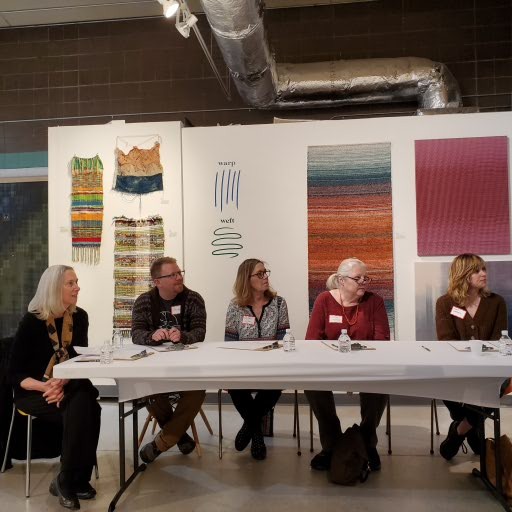
    As part of “Weaving the North,” North Suburban Center for the Arts hosted a panel discussion moderated by Minnesota tapestry artist Susan Gangsei.

    From left: Susan Gangsei, Jacob Moore, Robbie LaFleur, Lisa Torvik, Amy Shebeck

    Please visit the North Suburban blog to learn more:

    https://www.northsuburbanarts.org/blog/weaving-panel

  • “Weaving the North” Exhibit (Part Two)

    As promised, here are photos of items in “Weaving the North” woven by members of the Scandinavian Weavers group. I will also add a third blog post that reports on the “Weaving the North” panel discussion.

    Lisa-Anne Bauch, Northern Lights

    Yours truly wove this Rosepath piece during a Scandinavian Weavers group project. The abstract design suggests a snowy pine forest and a night sky with the Northern Lights overhead.

    Judy Larson, Diamond Heritage (blue rug on left)

    Judy Larson learned to weave on her great-grandmother’s loom and is known in the Scan Weavers group as an amazing and prolific rug weaver. She has mastered shaft-switching techniques that allowed her to create the complex designs in Diamond Heritage. “This is a very slow weave,” Judy explains, “about two inches in an hour! So this [rug] took about 50 hours.” Judy was inspired by a pattern in an old Swedish weaving book.

    Nancy Ebner, Lucky U (red and gold wall hanging in center)

    Nancy Ebner was inspired by a visit to the Hemslöjden (Center for Handicrafts) in Landskrona, Sweden, where she saw a traditional weaving, pointed to it, and said, “I want to do THAT.” Nancy found a suitable design in the book Heirlooms of Skåne by Gunvor Johansson, who teaches in Landskrona, and the result was Lucky U. The wall hanging was woven on a four-shaft loom using three shafts, with linen warp and weft of fine Swedish wool.

    Cathie Mayr, Night in a Swedish Mining Town (blue shawl on right)

    Cathie Mayr comes from a long line of weavers on both sides of her family in England, Sweden, and Norway and currently teaches weaving in the Brainerd Lakes area. Her artistic process starts with color. “When I find a yarn that inspires me,” she explains, “I often keep it out in my studio until I have a sense of what it wants to become. Then I’ll think about what weave structure would best show off the yarn and its colors.” In this case, Cathie purchased the yarn in a village shop near Trondheim, Norway, where the shop owner custom dyes her yarn: “I fell in love with this variegated yarn and she told me her inspiration was a visit to a Swedish mining town at night!”

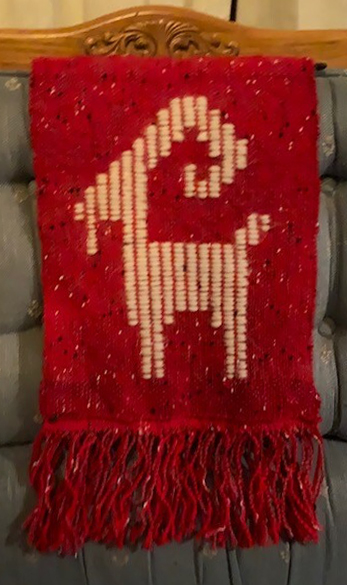
    Karen Holmes, Little Swedish Goat

    This charming tapestry was woven on a simple frame loom. Karen Holmes chose seine twine for warp, wool for weft, and used the leftover warp to make the decorative top-knot and beaded fringe. The piece is woven in traditional Scandinavian colors to celebrate her Swedish and Finnish heritage.

    Jan Mostrom, Northland

    Jan Mostrom wove Northland in a five-shaft point twill boundweave, using wool from spelsau sheep, a Norwegian heritage breed, and rya knots made from reindeer leather dyed red. “I was inspired by the landscape of Northern Norway as well as winter in the northern Midwest,” Jan writes. “I used the idea of winter tree silhouettes to create my design. Adding red to the white and gray brought warmth and joy to the piece.”

    Riley Kleve (right) admires Marilyn Moore’s Summer. Riley’s Community Cloth is the wall hanging with fringe the right.

    Marilyn Moore, Summer

    Marilyn Moore comes from a long line of Swedish weavers and focuses her work on Swedish techniques. She is inspired by color, so it is fitting that Summer is based on the many bright colors in her flower garden. For this weaving, Marilyn used wool but also linen, which gives an added shimmer to the rya knots. Visitors at “Weaving the North” commented on how much they wanted to sink their fingers in the luscious fibers!

    Riley Kleve, Community Cloth

    Community Cloth was created for Northern Spark, a late-night community arts festival that asked artists to create work in response to the prompt “What the world needs now.” Guests at Northern Spark chose a color of yarn that reminded them of something good and shared the association with others as they worked together. Community Cloth was woven by 116 weavers in just five hours!

    Riley Kleve, Priscilla II (not pictured)

    Riley writes, “As a non-binary artist working in traditionally feminine techniques, I pay respect to the forms and techniques of our foremothers while also seeking to create beyond the confines of aesthetics or utility that restrained their work. The piece gets its name from the vintage book of Hardanger embroidery that I used to learn the technique.”

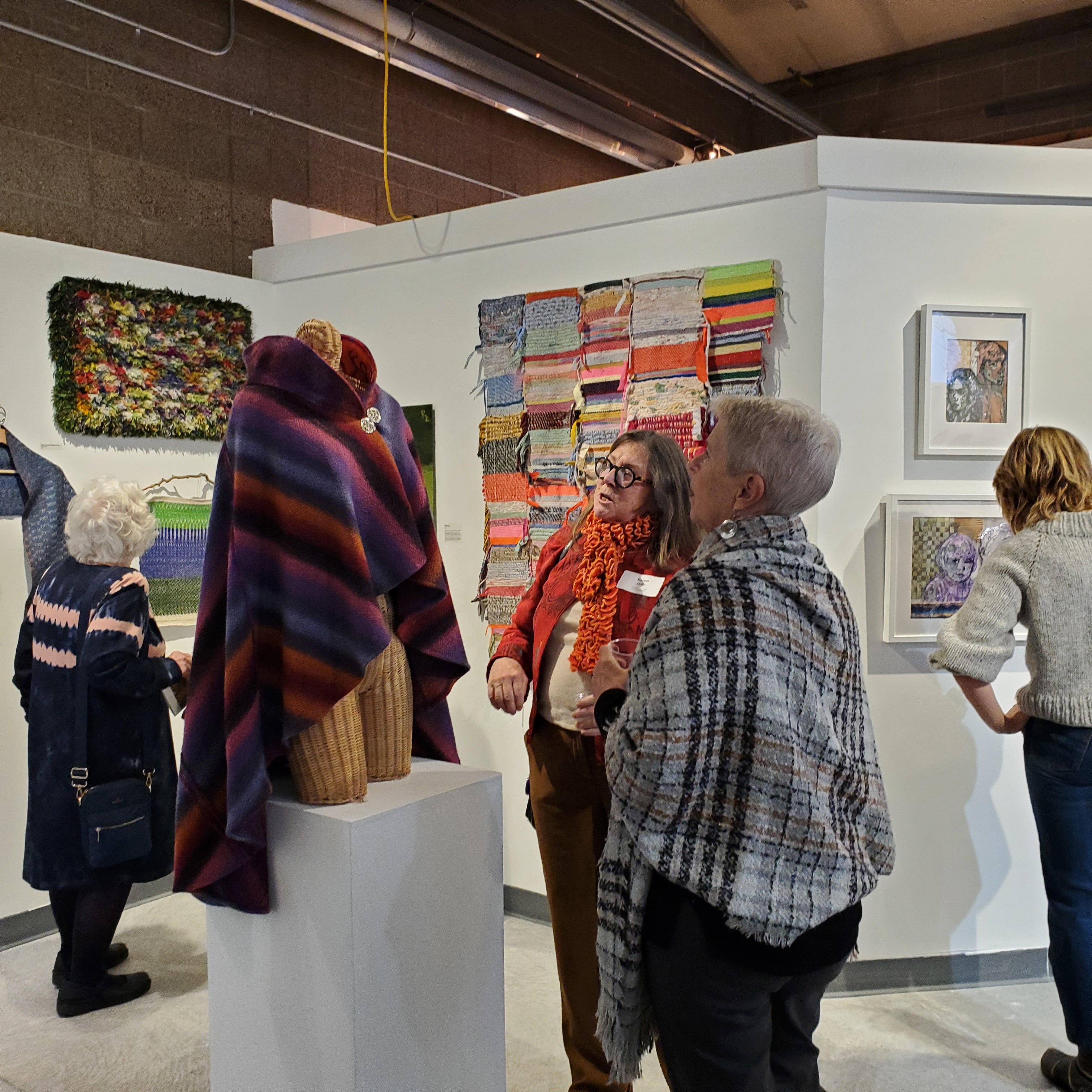
    Kala Exworthy, Northern Cape (on mannequin)

    Kala Exworthy wove the colorful cape in a point twill in diamonds. The warp is Zephyr, spaced to show off the weft, which is a soft knitting yarn. “I wove it as fabric not knowing what it would be,” Kala writes. “Then it became a nice, warm dress up cape. Perfect for the cooler evenings of a lovely spring or fall day in our northern clime.” Northern Cape was the subject of a lively bidding war during the opening night reception for “Weaving the North.” The lucky winner got to wear the cape home at the end of the exhibit! (Riley’ Kleve’s Community Cloth is in the background.)

    Robbie LaFleur, Burn 2020

    Robbie LaFleur is an expert in billedvev, traditional Norwegian tapestry weaving. The tapestry was woven in wool, with silk thread added to lend luster to the areas of the hottest white and yellow flames. Robbie designed the tapestry after a photo of a bonfire at a family gathering. She writes, “The bonfire is a reminder of family and warmth, yet also represents the isolation, loss, and unrest of the pandemic year—burn away, 2020.” Robbie won Honorable Mention in “Weaving the North” for her piece. For more on this tapestry, visit Robbie’s blog at the link below:

    My Bonfire Tapestry is in ENGLAND – Robbie LaFleur

    Lisa Torvik, Horda 3rd Gen

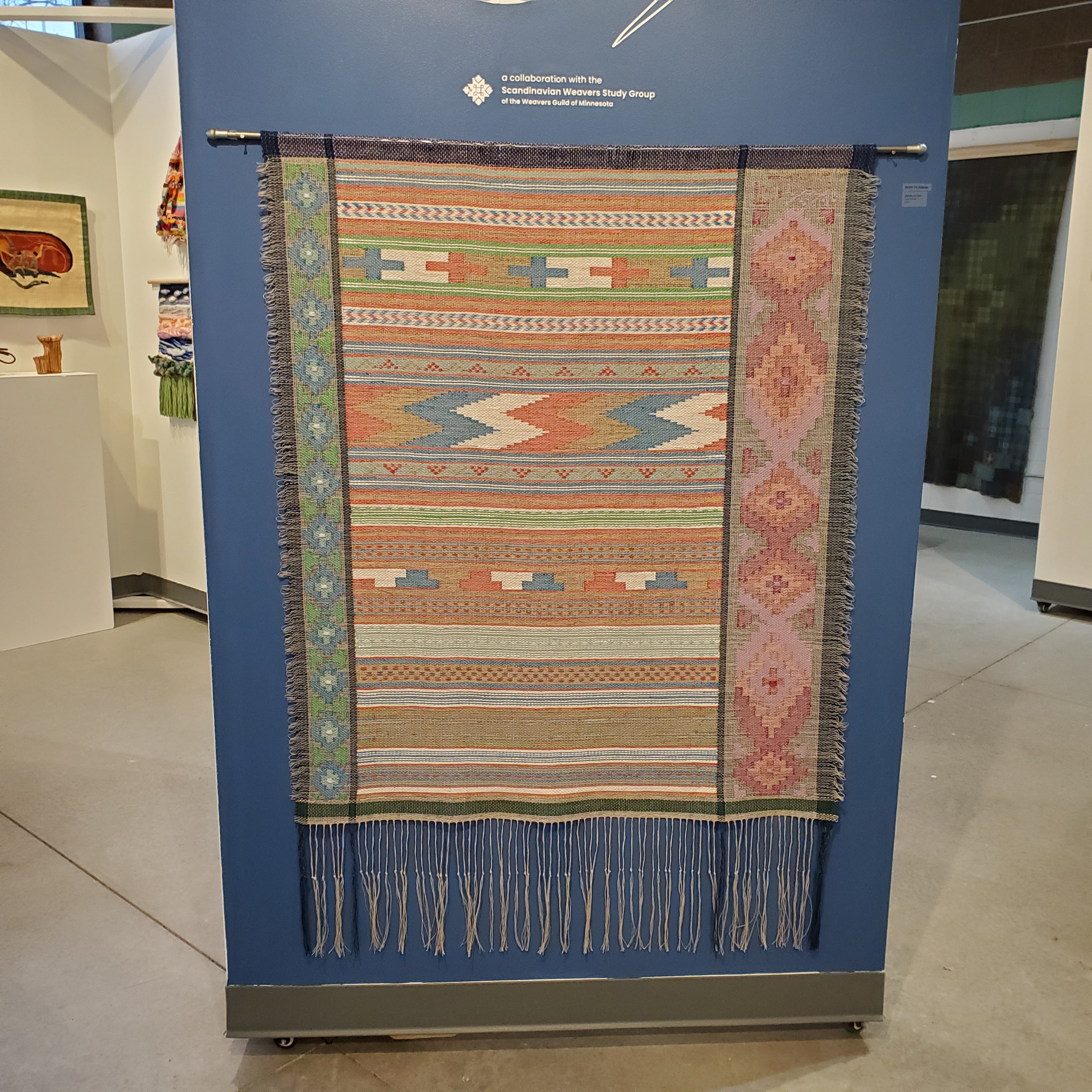
    Lisa Torvik started weaving at age 12 and went on to study at a husflid in Norway. She focuses her work on traditional Norwegian techniques and geometric designs and has recently been exploring using those designs in new ways—in particular, with transparency techniques. In this case, the center panel is based on a coverlet from the Hordaland region of Norway, while the motifs along both sides are abstract improvisations on traditional motifs. Lisa won First Place in “Weaving the North” for this stunning piece.

  • “Weaving the North” Exhibit (Part One)

    The Scandinavian Weavers group has a long history of public exhibits. Some are collaborations between the Scan Weavers and community arts organizations and are open to all weavers, not just members of our group.

    Our goal in community exhibits is to increase awareness of traditional and contemporary Scandinavian weaving and to offer opportunities for artists to exhibit their weaving, which is often under-represented in traditional art galleries and museums.

    In this case, “Weaving the North” was juried, curated, and installed by the staff at North Suburban Center for the Arts (NSCA). North Suburban is located in a decommissioned fire station in Fridley, Minnesota. The organization has creatively transformed this industrial building into a charming gallery, shop, library, and classroom space where they hold community arts events year-round. The exhibit was open to the public free of charge. In addition to the exhibit, North Suburban hosted a panel discussion with several of the artists as well as weaving demonstrations and classes.

    We were delighted when North Suburban approached us about collaborating on a weaving exhibit. Together, we chose the theme “Weaving the North” and invited weavers to imaginatively consider the idea of ‘North.’ We encouraged artists to draw inspiration from the northern landscape, seasons, plants, and weather; highlight weaving traditions of northern peoples; explore the emotions and images evoked by our specific region; and tell stories of the north and the people who make it their home.

    The result was an amazing variety of weaving, detailed in the blog post below from North Suburban. In addition, I will post a second blog with photos and details of weavings by Scan Weavers.

    Please consider supporting small, local arts organizations like North Suburban who do so much creative work in our communities. (Hint: Their fundraiser is this weekend.) We loved working with North Suburban and hope this is the first of many future collaborations!

    Following a Thread: Weaving Exhibition Explores ‘the North’ — North Suburban Center for the Arts (northsuburbanarts.org)

  • Welcome Back to the Blog!

    The Scandinavian Weavers Interest Group is alive and well! We are busy weaving, meeting, exhibiting, taking/teaching classes, traveling, and keeping each other inspired.

    I will be editing this blog, which will allow Robbie LaFleur to concentrate on leading our group and editing the Norwegian Textile Letter. In addition, we will be doing some re-organizing of the blog. The main categories for blog posts will include Meetings, Group Projects, Exhibits, Classes, Travel, Weaving Techniques, and Links. I will add tags to help with searches. If there are other topics you would like to see covered, please let me know. I am very excited to take on the blog but new to WordPress, so I appreciate your patience.

    If you would like to subscribe to this blog, please do so with your email address. If you would like to become a member of the Scandinavian Weavers Interest Group, please visit the link below and scroll down to our group information. Please note: Our group meets both via Zoom and in-person.

    https://www.weaversguildmn.org/resources/member-interest-groups

  • December 2020 Show and Tell: A Final Blog Post

    Our Scandinavian Weavers Study Group zoom meetings during the pandemic year are going pretty well. A digital meeting will never replace the fun of meeting in person, and actually seeing the work of our members, but we’ve had good attendance and it’s fun to catch up on everyone’s weaving activities. People are even becoming accustomed to sending photos to the group email list ahead of time! During the first meeting it became quickly apparent that holding up a weaving to your laptop or cell phone camera during a zoom meeting was an inadequate sharing method. Jan Josifek started off this month’s sharing, ahead of our meeting next Sunday. She made a fabulous guitar strap with woven guitars on it. Her husband made the guitar! At last month’s meeting Jan claimed that she was such a terrible sewer and she wasn’t sure how she would be able to finish off the strap. The answer? Beautifully!

    Boundweave guitars

    This blog was originally set up to share the activities of our group with photos, because our former email system was so clumsy. The side benefit was to share the work of our group with all people interested in Scandinavian weaving. Now that we have a better email system and it is much easier to share photos among ourselves, this blog lost its primary goal.

    So thank you for your attention and interest! This blog will remain up, but inactive. If you are interested in Scandinavian weaving, be sure to sign up for notification to the Norwegian Textile Letter. When our Scandinavian Weavers Study Group has its next show, it will be covered for sure in the newsletter. I also cover Scandinavian weaving in my own blog, robbielafleur.com.

    For our Scandinavian Weavers holiday card, please enjoy this sweet weaving made on a rigid heddle loom by Nancy Ellison from Zumbrota, Minnesota. The white pattern yarn is handspun from the fleece of her own sheep. A personal goal of mine is to get vaccinated and be able to visit Nancy again. I’m sure this was the first of many years I missed a trip to seen Nancy and her animals.

    Happy holidays, despite this challenging year. Robbie LaFleur

  • The Scandinavian Weavers Study Group Meets Via Zoom

    Our Scandinavian Weavers Study Group meeting in March was cancelled due to the sudden coronavirus “Shelter at Home” order. April was a first–we met via Zoom. It worked well as a platform to share how we have been faring. It isn’t as fun as our regular meetings, with the ability to see real woven items, of course, but it worked so well that Jan Mostrom suggested it might be our fallback plan in times of bad weather in the future.

    What have the Scandinavian Weavers been working on during this isolation interlude?

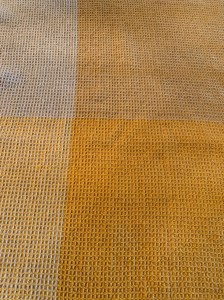
    Mary Skoy finished up thirsty waffle weave towels. Like many house-bound people, she’s been cleaning and organizing. “I know where every pin and needle in my studio are,” she commented. She also said she filled a large bag for the Textile Center Garage Sale. Can you imagine how big the next Textile Center Garage Sale could be?

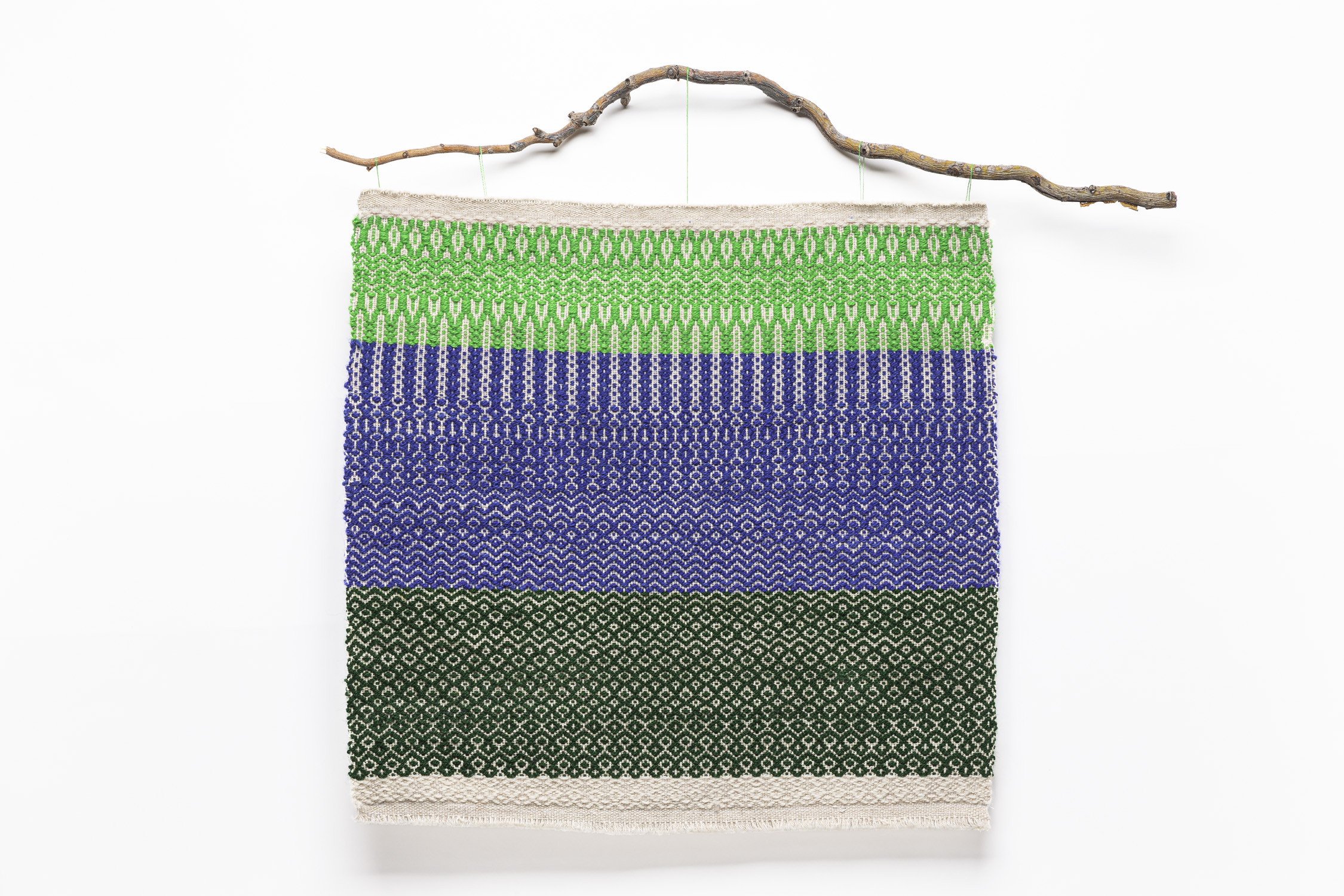
    Judy Larson is a fast and prolific weaver. When she mentioned that she wove five rugs in the past month, Patty Johnson piped up, “Of course you did!” Lisa Anne Bauch later wrote, “I love the blue and green one – it reminds me of summer by the lake!”

    Linda Sorrano, who convened our meeting, has been busy at her big loom, but also on a small tapestry loom, where she is playing with a series of abstract pieces.

    Here’s a tartan car lap robe that Linda made. Do you see her Instagram handle? You should follow her!

    Lisa Anne Bauch has been putting together her brand new Toika loom, as she said, “fresh off the boat from Finland.”

    And now she will be able to weave her set of rugs for the upcoming Norway House exhibit, The Baldishol: A Medieval Norwegian Tapestry Inspires Contemporary Textiles. Here is her hand-dyed weft of wool and cotton, inspired by the colors of the medieval tapestry.

    Jan Mostrom is a bit farther along on her Baldishol exhibit piece, with only the finishing work remaining. Do you remember the spots on the horse in the Baldishol Tapestry? They become a beautiful abstract pattern on Jan’s rug.

    My work this month has also been on my piece for the Baldishol exhibit. You can see the progression of the “Baldishol Duck” in this collage: bottom border, water, duck, and now the almost-finished top border. You can read about the duck and it meaning at robbielafleur.com.

    The Baldishol exhibit will be mounted at Norway House as planned, opening June 26. Read about the updated plans here: “The Baldishol Tapestry and the Coronavirus.”

    Melba Grandlund had the most dramatic month. She traveled to Norway to participate in Viking-era textile activities. Halfway into her month, she spent days arranging a flight back to the U.S., due to the closing airports. Now she is home with lots of Norwegian yarn to make a wide banded coverlet on her warp-weighted loom.

    She also learned about a modern replica of the Bayeaux Tapestry (really an embroidery). She was inspired to embroider some of the motifs herself.

    Connie LaTendresse wove samples for an upcoming rigid heddle class, including a houndstooth scarf and a v-necked shawl (pictured below).

    Connie wove an inkle band for straps to coordinate with a bag of handwoven fabric for her daughter.

    Connie is very productive. In addition to much weaving, including playing with krokbragd, she said she has read more books this year than in all of last year.

    Patty Johnson has been productive–or distracted? She wrote that she was surprised at all the projects she has underway, once she tallied them up. “Oh my, when I looked at the pictures I realized how many items I have pulled out.  Just have a couple more weaving on the back of the chair to hem, sewing masks in the dining room, hooking strips on coffee table, design and start up of hooked rug.  Yardage on one loom, start of krokbrag on second loom and a small tapestry loom warped.  Maybe I need to get a focus? Or not?”

    Karen Hovermale wove a rosepath pillow top–the same project as we have on the Glimakra loom at the Guild, but she warped her own loom at home.

    After weaving the first pillow top with wool, she dipped into stash to work on a second, using linen and a 2-ply mohair/silk.

    Kevin Olsen took a rag rug class at North House Folk School this winter, and now has a rug on his large Regina tapestry loom.

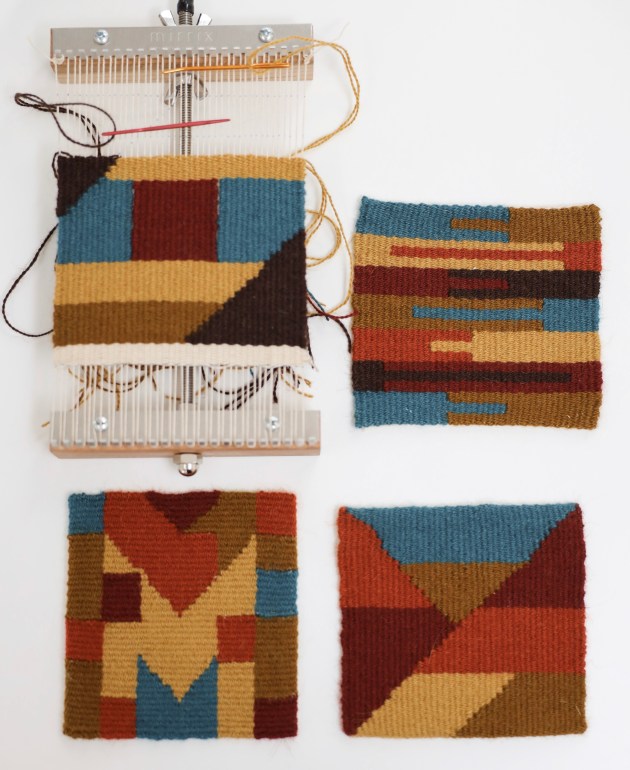
    Kevin also enjoyed a tapestry workshop with Elizabeth Buckley in Albuquerque in February. Below are the samplers from the tapestry workshop, on hachure, and the rag rug workshop. He’ll have lots to explore during his isolation time–when he is not picking out everything needed for his new house being built.

    Nancy Ebner completed several projects, including a stash-busting set of colorful towels (not shown), and a set of towels designed by Marian Dahlberg that feature a hanging tab woven on a supplemental warp.
    Right before everything shut down, Nancy had just started on a three-shaft rosepath hanging on a loom at the Minnetonka Center for the Arts, based on one she saw in Sweden last year.

    Marilyn Moore was stash-busting, weaving runners in beautiful soft colors with Poppano yarn bought at Patty Johnson’s shop,  Color Crossing, a while back. Next, she has two rugs ready to go on her Glimakra.

    Brenda Gauvin-Chadwick reported that she has been doing a ton of knitting in the past month. She has a set of towels on her loom, from a Handwoven pattern. “I even used the same colors,” she said.

    That’s a lot of work underway. And I didn’t even post ALL the photos I received. Happy weaving!

  • Scandinavian Weavers Share their Weaving Projects

    We love it when our Scandinavian Weavers Study Group members bring Show and Tell to our monthly meetings. Melba Granlund has been busy with rya. She is teaching a upcoming spring class where the students make a small warp-weighted loom and weave a rya. (She will be teaching the same class at North House next fall.) The small warp-weighted looms that the students will make measure 18 or 19 inches between the side posts. Melba just finished a second sample piece for the course, with water-inspired blue hues.

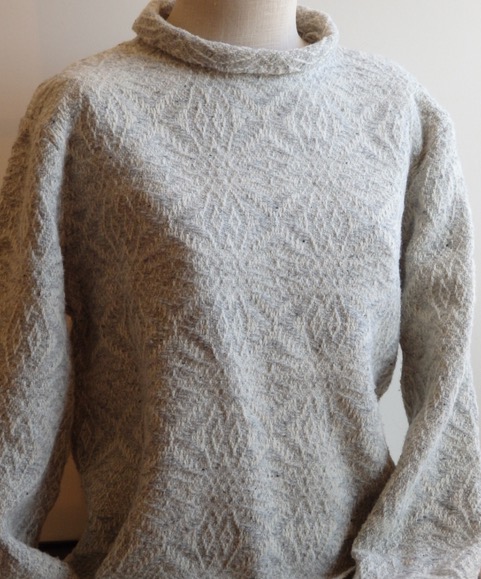
    Jan Josifek wore her show and tell, a beautiful woven sweater. Jan sent this photo, and wrote of her sweater,

    Mary Skoy used to teach a woven sweater class at the Guild which I couldn’t take. Working from inspiration from Mary on my own, I have tried a few all woven sweaters. For this one I used the 6-shaft American Snowflake draft in the May/June 2014 issue of Handwoven Magazine, changing the satin section between the advancing twill sections to point twill “M”, and treadled accordingly.
    I was looking for a mill spun yarn that resembled handspun yarn and went with Brooklyn Tweed “Loft” for the weft and Harrisville Designs Shetland for warp. I used a commercial sweater sewing pattern cut to my size.

    Linda Sorrano showed a photo of the brilliant mechanism her brother-in-law rigged up for her to take her draw loom attachment out of the way and easily retrieved–up in the air! This photo is from Linda’s lovely Instagram feed.


    Much of the meeting was taken up with discussion of our just-started group warp project. We are making rosepath pillow tops, inspired by a Swedish book by Anna Östlund, Från Januariblues till Decemberröd: 18 kuddar i rosengång (From January Blues to December Reds: 18 pillows in rosepath). More on this project will appear on the blog soon.


  • Happy holidays from the Scandinavian Weavers Study Group

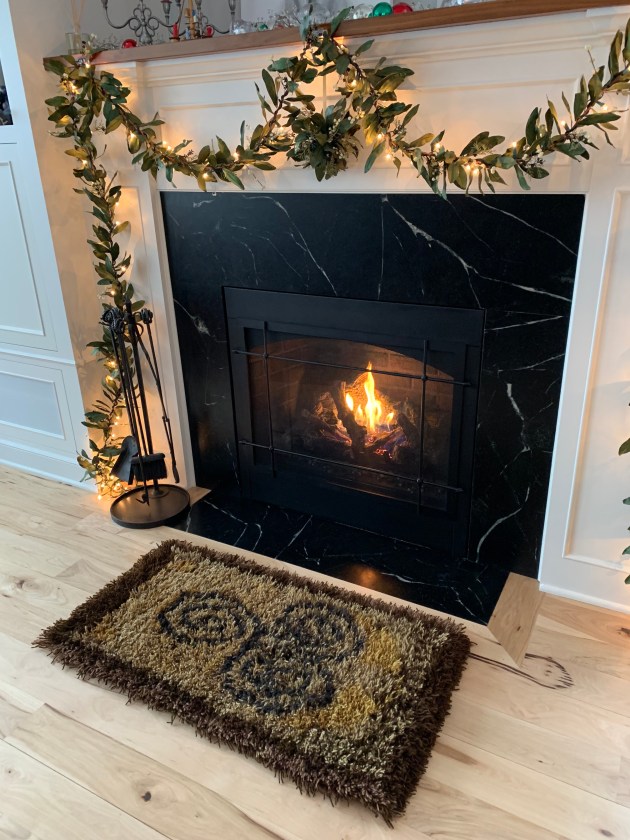
    Our group enjoyed a holiday party at the home of Brenda Gavin-Chadwick. Her home is open and light-filled, with clean Scandinavian lines. Only one person brought a show-and-tell item, but somehow Marilyn Moore must have sensed that Brenda’s hearth would be the perfect spot for staging her rya. The three-spiral design echos the three stages in the life of a woman–maiden, mother, and crone.

    Marilyn’s rya started as a way to use up a mass of brown yarn she had–but of course she ended up having to buy more and desperately trying to match colors. The resulting color blending across the whole piece adds richness.

    Happy holidays and happy weaving in 2020!

  • Lisa’s Linen

    At the last Scandinavian Weavers meeting, Lisa Torvik brought a enormously long roll of just-off-the-loom linen runners. This project deserved a real celebration–she said the warp had been on the loom for for perhaps two decades in all. This was the moment of cutting it off at home.

    Lisa suggested it could be a holiday decoration?

    Here are two of the lovely runners.  It was sort of a shame to cut them apart, Lisa wrote, but then they are like puppies–you can’t keep them all! Perhaps several of her relatives are getting wonderful Christmas gifts?

    On the top is one of Lisa’s favorites, with pink stripes. The bottom one was inspired by colors seen on an autumn trip to New Hampshire.