Today’s blog entry is written and photographed by Scandinavian Weavers member Holly Hildebrandt.
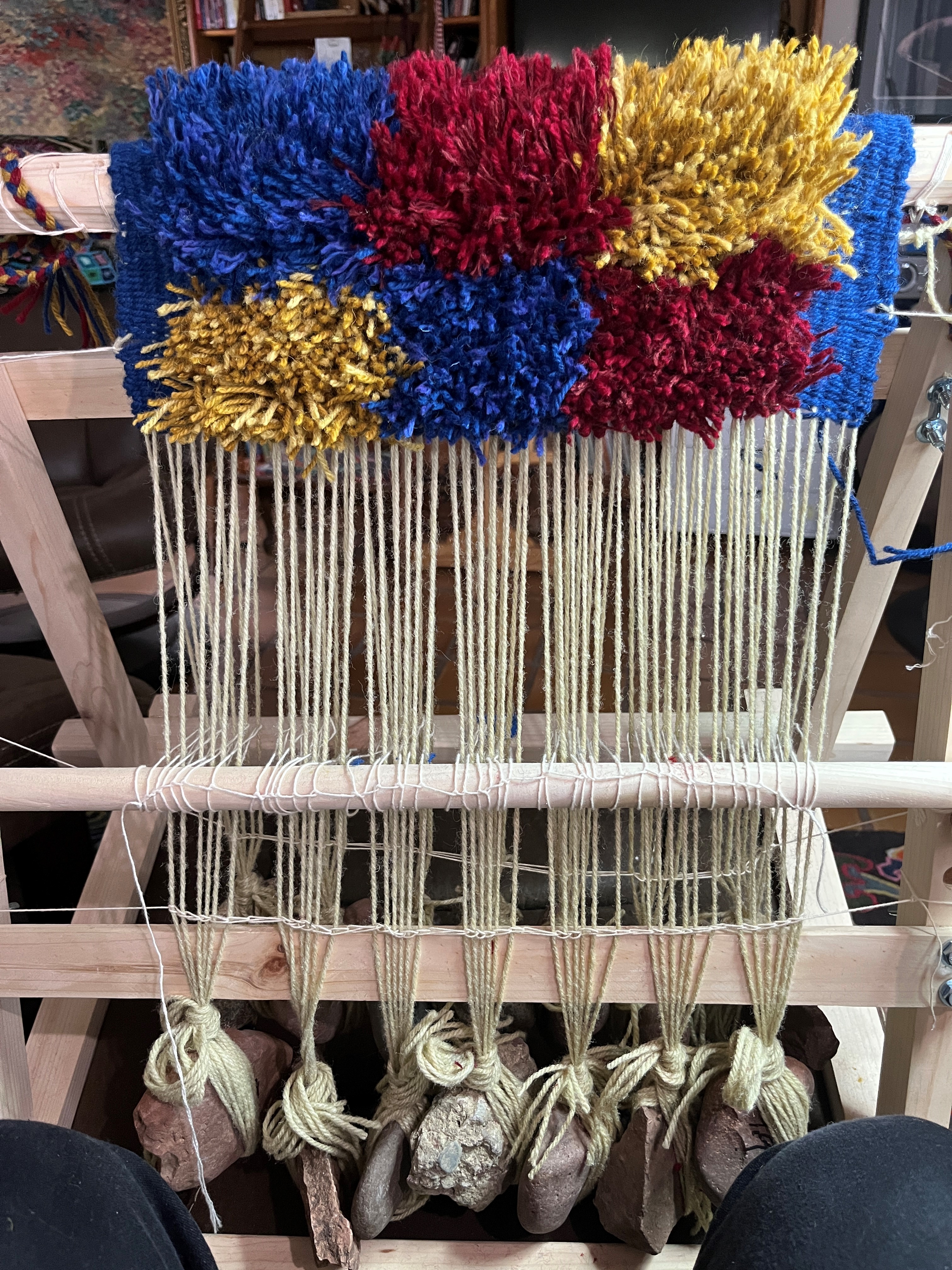
I got home late last night after the most incredible five days in Grand Marais, taking Melba Granlund’s class at North House Folk School! We built our own warp weighted loom the first two days, then wove on it the next three. It’s the most fun I’ve had in a long time and it was wonderful spending time with Melba.
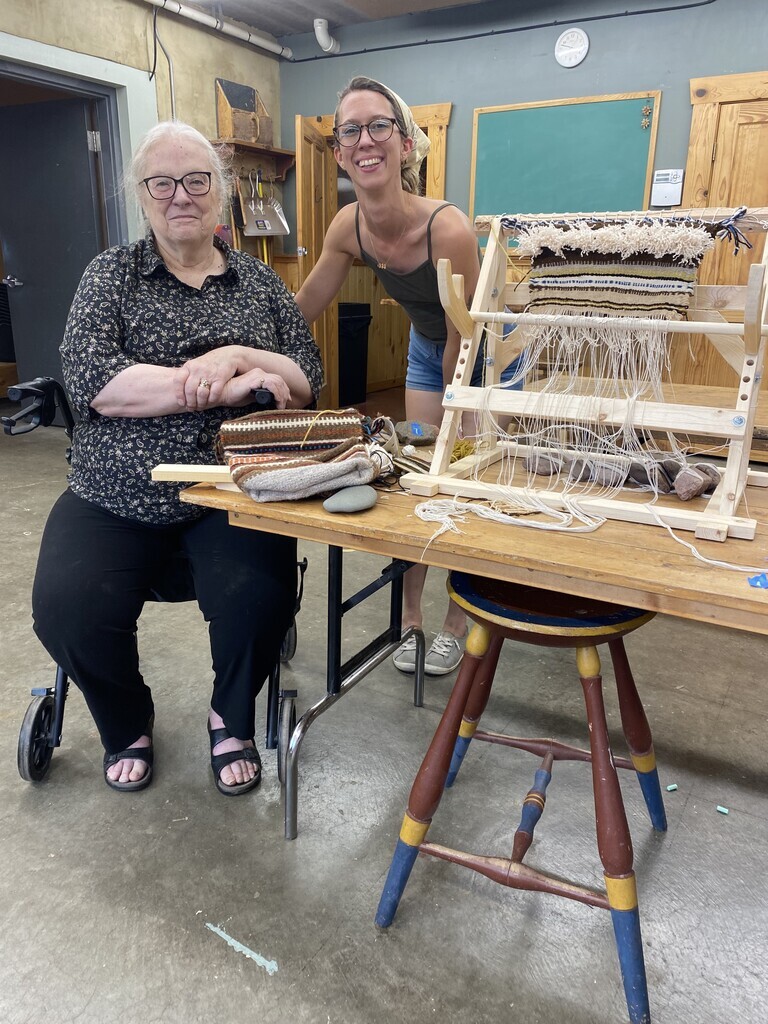
Melba and Holly
David Susag was our woodworking instructor. He also has a major affinity for Scandinavian tradition and is most known for springpole woodwork.
Students with woodworking instructor David Susag
Between the lake, smoked fish, mountain of wool yarn, and smell of pine as we chiseled, it was so magical. I am sad that it’s over but so grateful for the memories we created. Big thanks to Melba for sharing her wealth of knowledge with our little group!
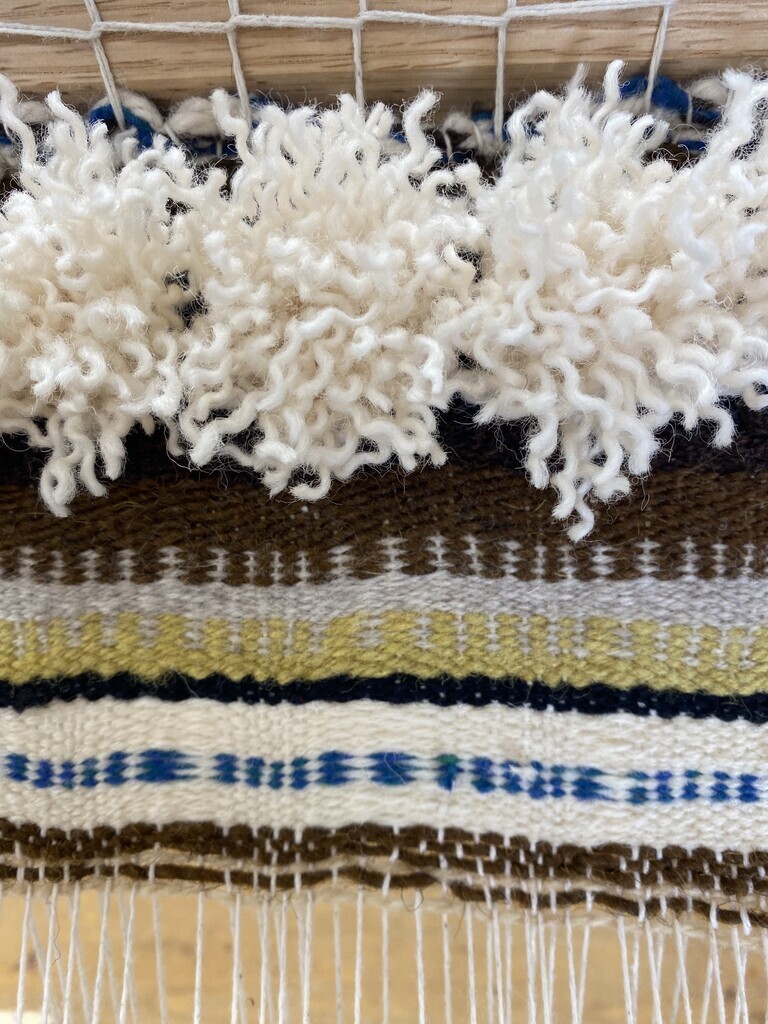
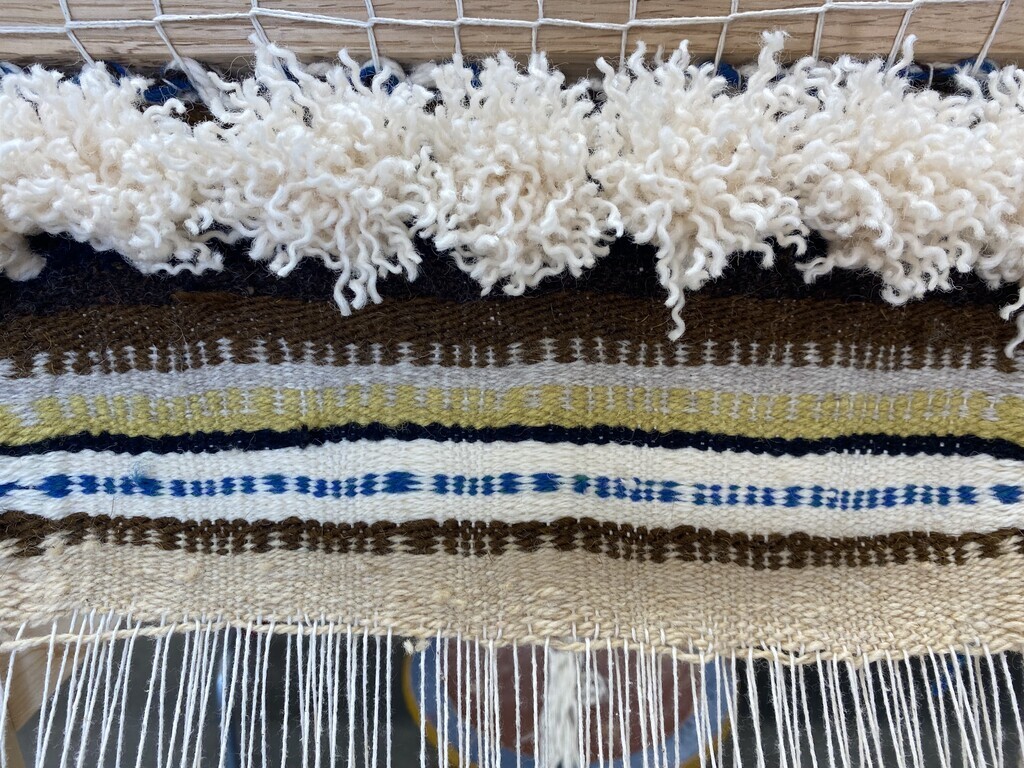
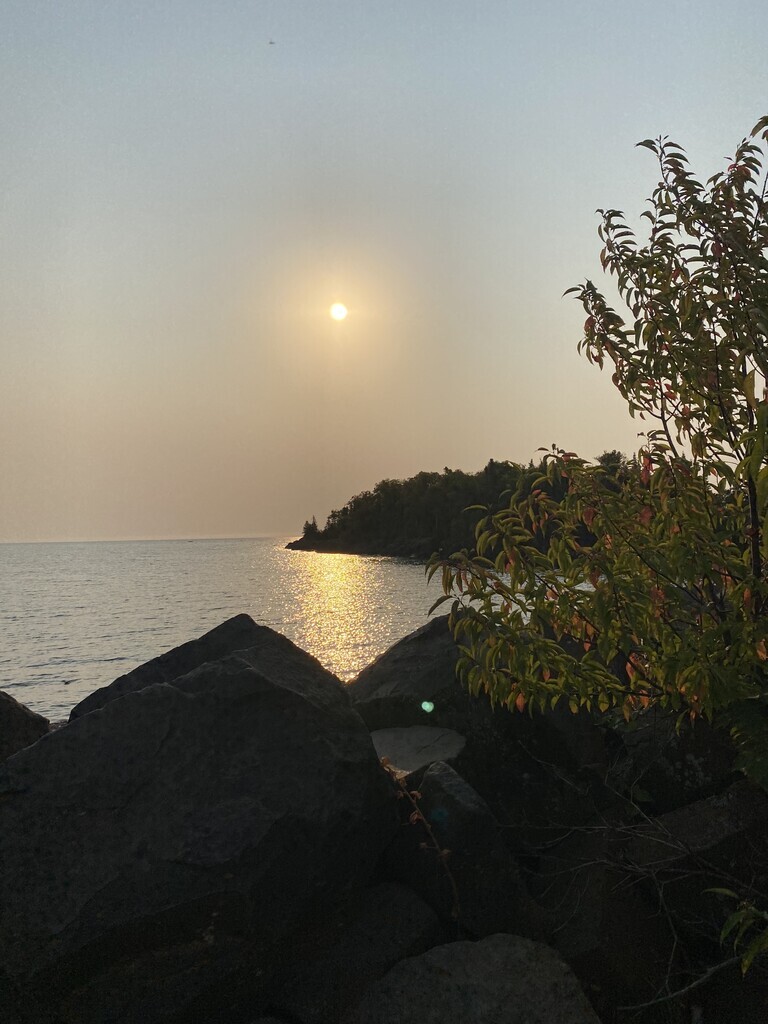
Warp strings weighted with rocksClose-up of Holly’s weavingLake Superior shore in Grand Marais, MinnesotaSunset over the Big Lake
Both Scandinavian Weavers and Rag Rug Weavers have been busy this summer volunteering at the American Swedish Institute during the run of “Karin Larsson: Let the Hand Be Seen.” (See previous blog posts for details.) It’s been an amazing opportunity to demonstrate weaving to museum guests, who have been an enthusiastic and curious audience.
Many older guests have shared fond memories of cutting up old clothing and textiles into strips, then sorting them into piles by color, winding them into balls, and delivering them to the local “Rug Lady,” who wove the strips into rugs. Some guests are lucky enough to own rag rugs passed down from family members. so sturdy and well-woven they are still in use today.
Nancy Gossell weaves on the Glimakra loom as ASI guests look on.
This past Monday, Nancy Gossell, Judy Larson, and yours truly arrived at the ASI mansion in the wee hours of the morning to appear on a local news channel’s live broadcast. We were helping promote ASI’s “Cocktails in the Castle,” a night of celebration and craft (both the weaving and cocktail kind). Our interview appears about halfway through the video clip.
The exhibit will be on view at ASI through October 27. Scan Weavers will be on hand to weave on the following Thursday evenings: September 26, October 10, and October 24. Admission is free on Thursdays after 3:00 PM, so stop by if you can.
For a lovely recap of the Karin Larsson exhibit, check out this article on the Modern Daily Knitting blog:
If you’re not able to make it to Minneapolis to see this marvelous exhibit, you’ll have another opportunity in 2025 when it moves to the Swedish American in the historic Andersonville neighborhood in Chicago.
“Karin Larsson: Let the Hand be Seen,” American Swedish Institute, June 8 through October 27, 2024
The highly-anticipated exhibit “Karin Larsson: Let the Hand be Seen” opened yesterday with great festivity at the American Swedish Institute (ASI), where it will be on display through October. Members of the Scandinavian Weavers and Rag Rug Weavers of the Weavers Guild of Minnesota were on hand to demonstrate the art of Swedish-style rag rug weaving and will continue on key dates through the run of the exhibit.
Swedish loom in the ballroom at the American Swedish Institute
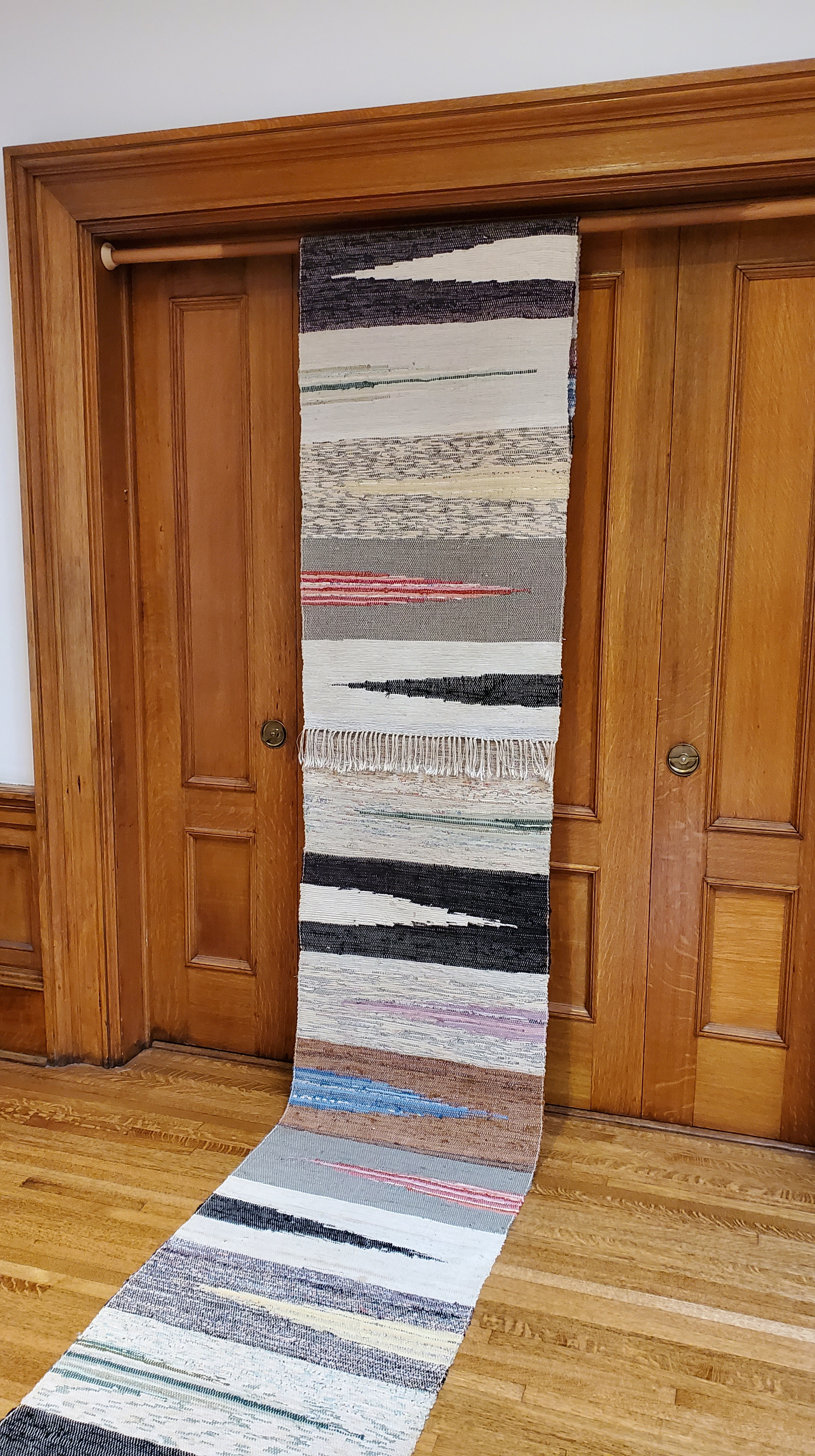
In addition to Karin Larsson, we took inspiration from a 14-meter rag rug in ASI’s permanent collection. It was woven by Maria Jonsson in the province of Värmland, Sweden and donated to ASI in the 1950s.
Maria Jonsson’s masterful rug
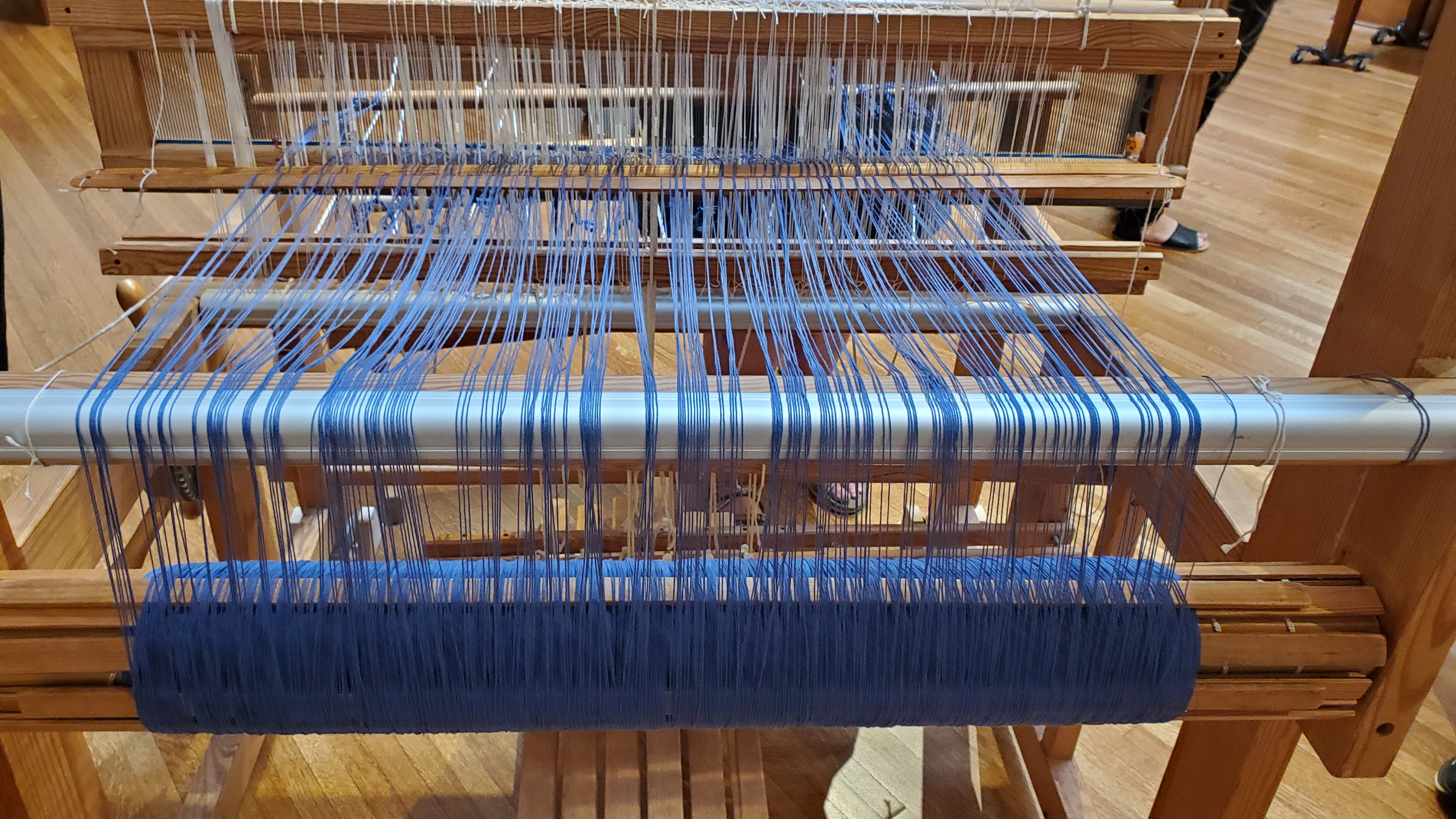
Judy Larson, coordinator of the Rag Rug Group, warped a vintage Glimakra loom in “Swedish blue” and designed our first rug to feature a wedge pattern like the ones in Jonsson’s rug. (Thanks to Patty Johnson of Color Crossing for lending her loom.)
Loom warped in cotton seine twineWedge weave in blue fabric strips
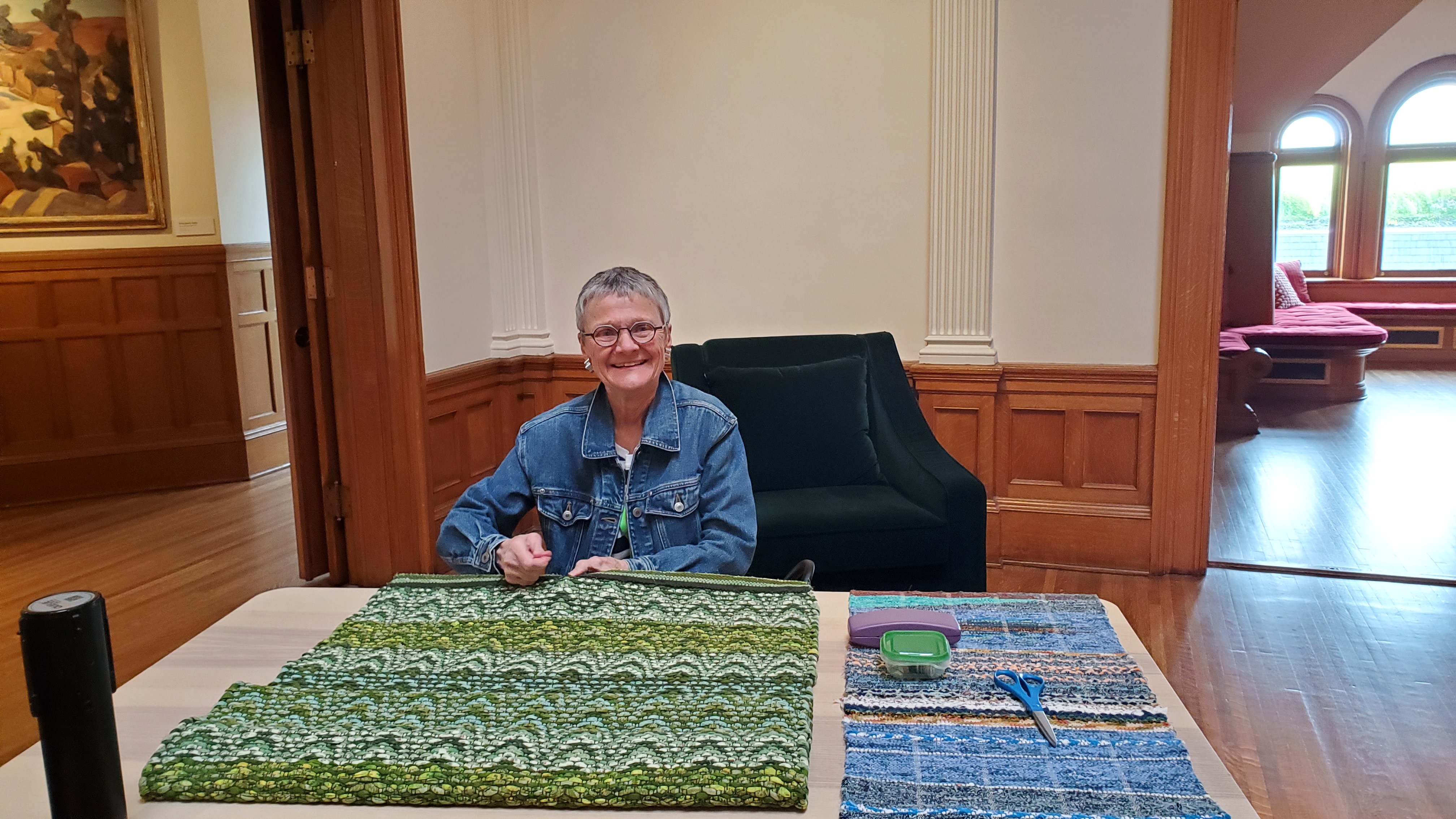
Besides weaving at the loom, volunteers demonstrated the entire process of rag-rug weaving, from preparing fabric to finishing techniques. Finished rugs are also on display.
Cotton fabric strips prepped for weavingNancy hand-finishing one of her beautiful rugs
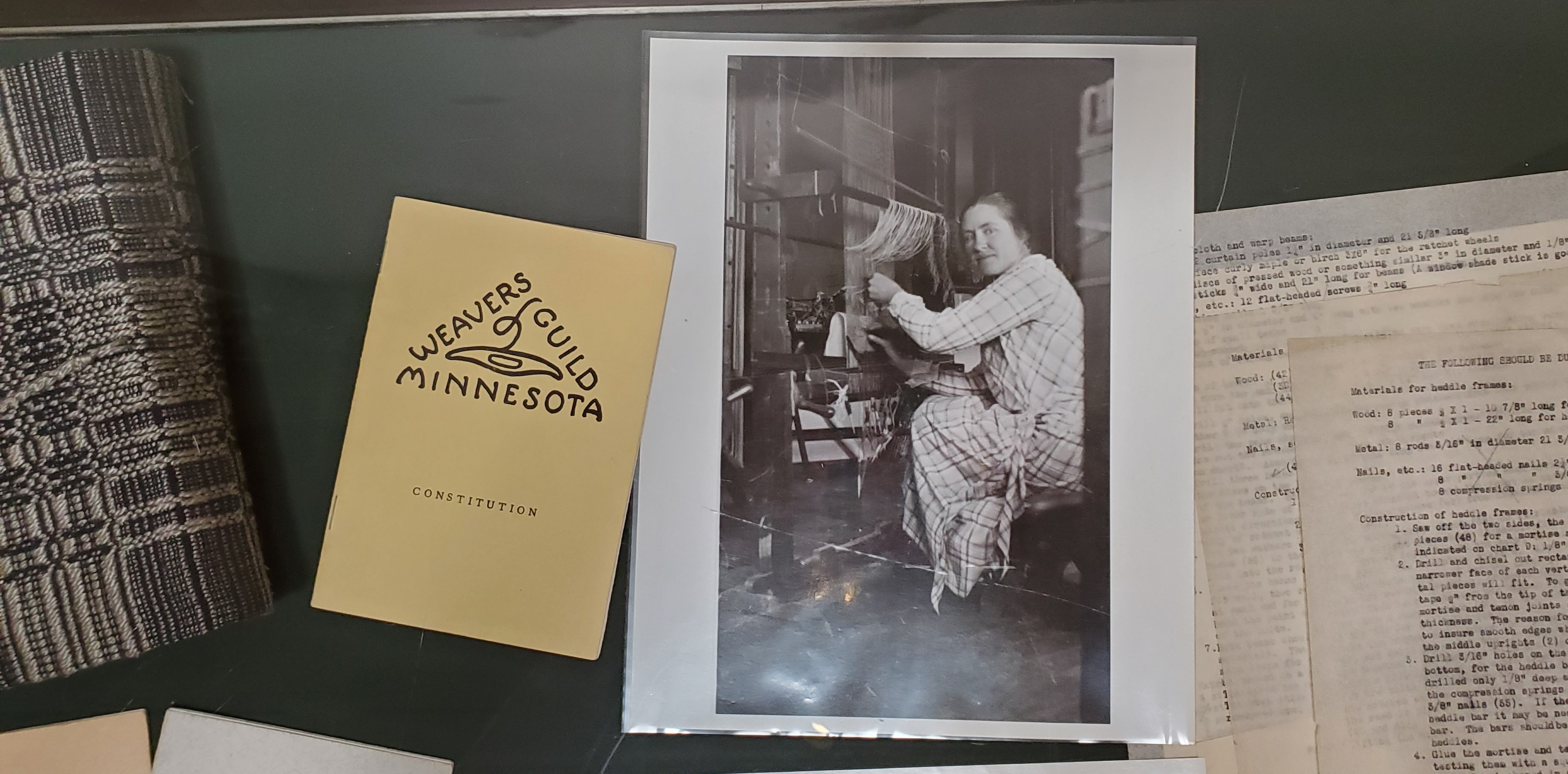
The collections staff at ASI has also put together a display about Hilma Berglund, one of the founders of the Weavers Guild of Minnesota.
Display features photos, examples of Hilma’s weaving, and documents, including the constitution of the Weavers Guild
Weaving demonstrations will be held on the following Thursday evenings from 5:00 to 8:00 PM: June 13, and 27, July 11 and 25, August 8 and 22, September 5 and 26, October 10 and 24. Note: Admission to the museum will be free after 3:00 PM.
In addition, demonstrations will be held at ASI’s Midsommar Celebration, Saturday, June 15 from 10:00 AM to 4:00 PM and Cocktails at the Castle, Saturday, September 14, from 6:00 PM to 9:00 PM. Note: These are ticketed events, so admission is required.
A special thank-you to the staff of the Weavers Guild of Minnesota and the American Swedish Institute for coordinating this volunteer program. Stay tuned to the blog for more articles on this ground-breaking exhibit!
For more information, please visit the ASI website:
The Scandinavian Weavers are honored and excited to be part of the upcoming major exhibit at the American Swedish Institute, “Karin Larsson: Let the Hand be Seen,” June 8 through October 27, 2024.
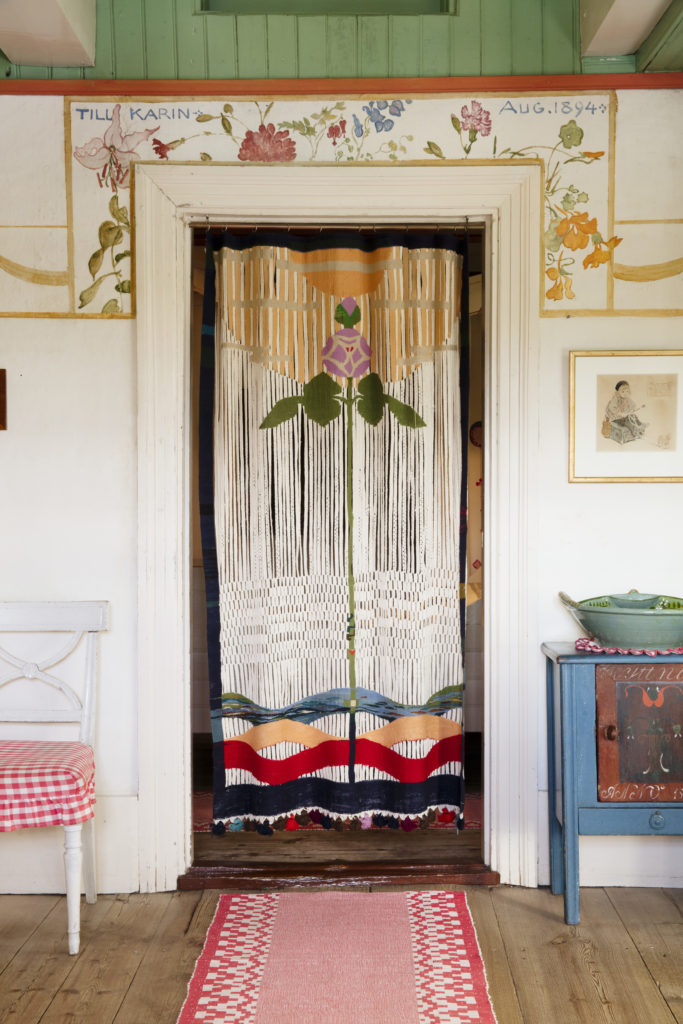
Portier woven by Karin Larsson at Lilla Hyttnäs in Sundborn, Sweden. Photo courtesy of Carl Larsson-gården.
Karin Bergöö Larsson (1859–1928) was a groundbreaking artist whose approach to textiles and design ushered in a new era of interior design and established the iconic Swedish style that continues to inspire artists worldwide. The floral motifs, vivid colors, and charming simplicity of her style remain heavily influential nearly a century after her death, thanks to the images captured by her painter husband Carl Larsson.
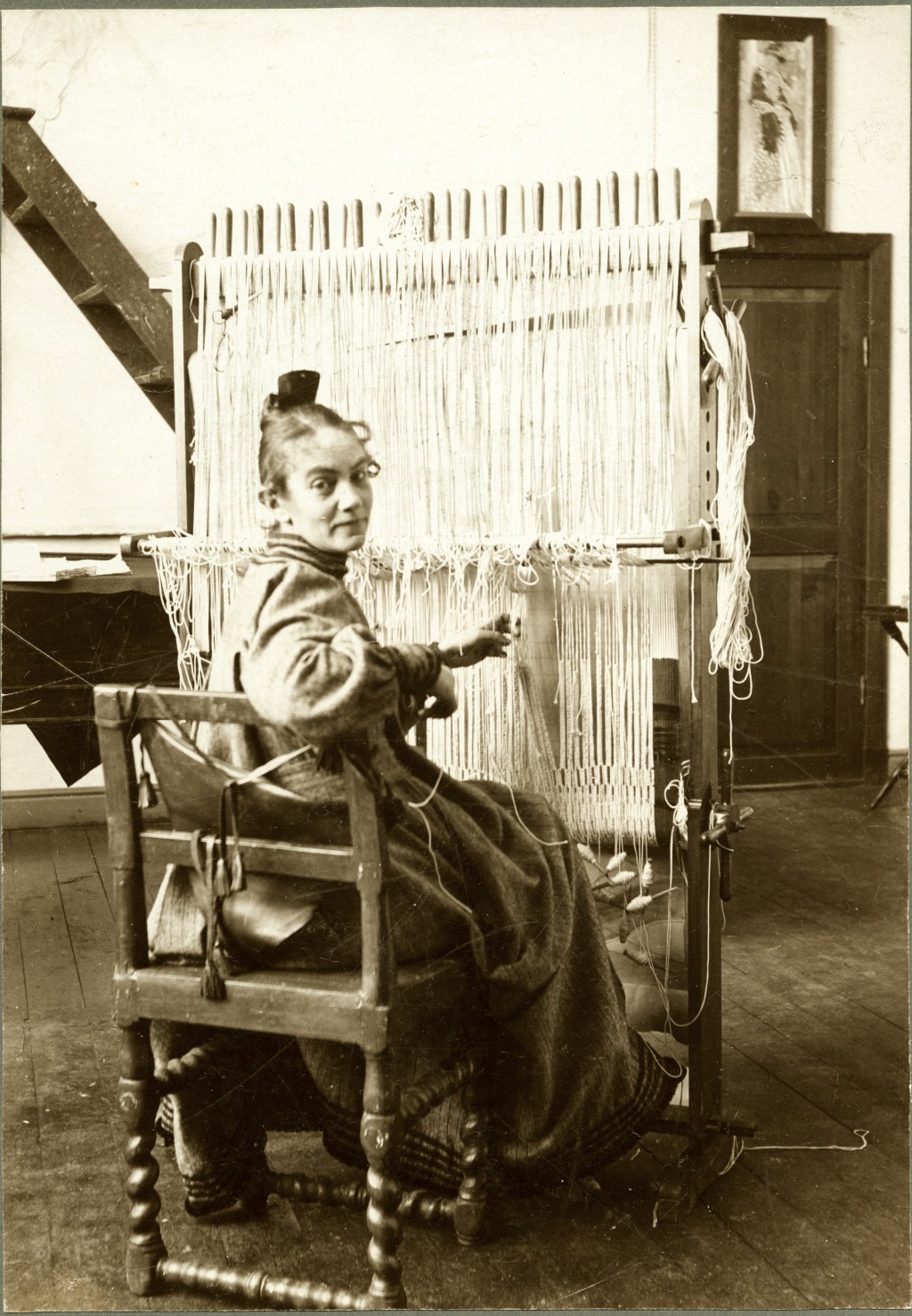
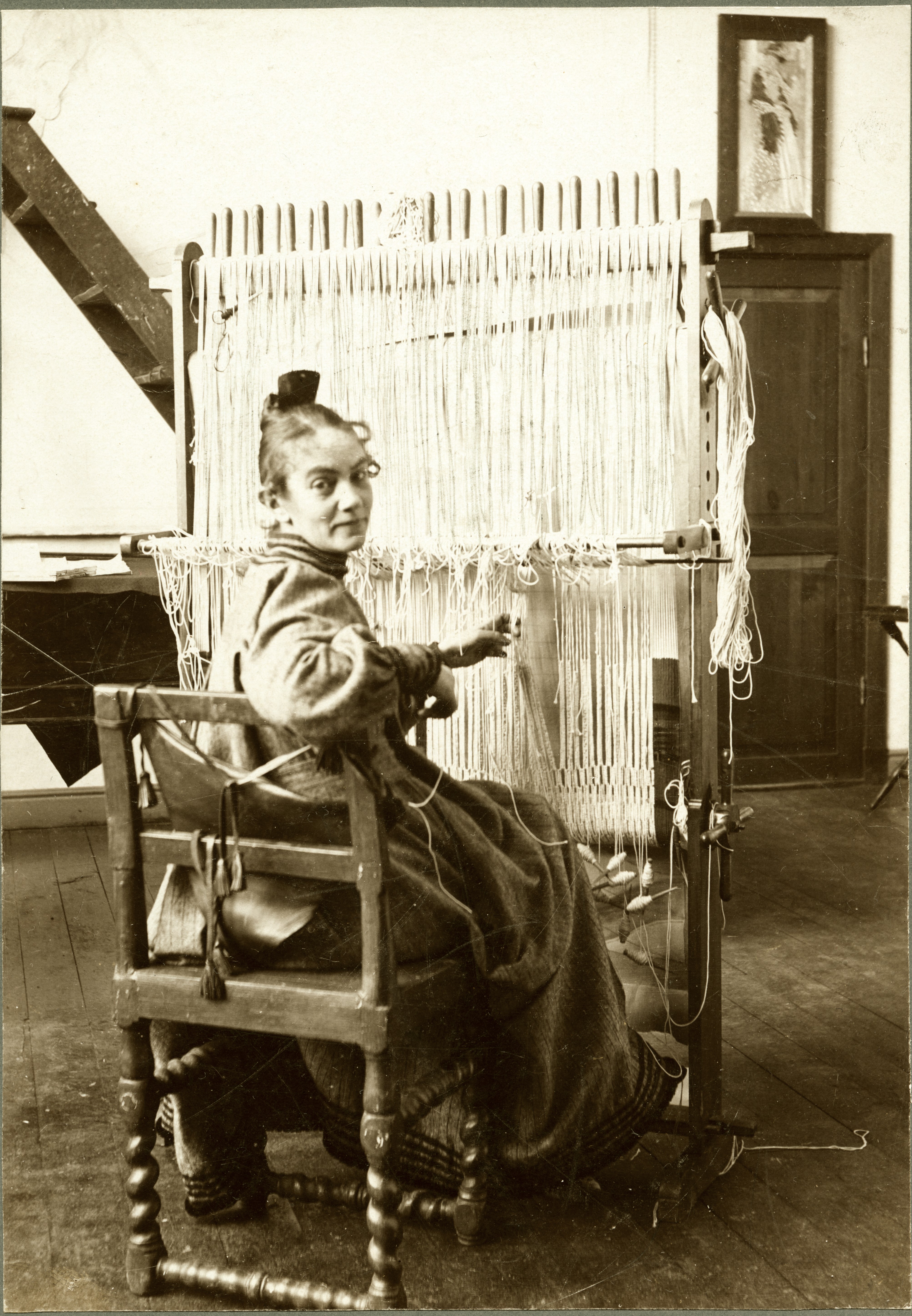
Karin Larsson at her upright loom. Photo courtesy of Carl Larsson-gården.
It was Karin who designed and created Lilla Hyttnäs, the Larsson’s home just outside of Falun in Sundborn, Sweden, which was so often the subject of Carl’s paintings. From the bold interiors to the modern textiles and rustic furniture, Karin’s hand can be seen across many of Carl’s works, which have become some of Sweden’s most famous paintings. The home continues to inspire and is open to the public as Carl Larsson-gården, which created this traveling exhibition.
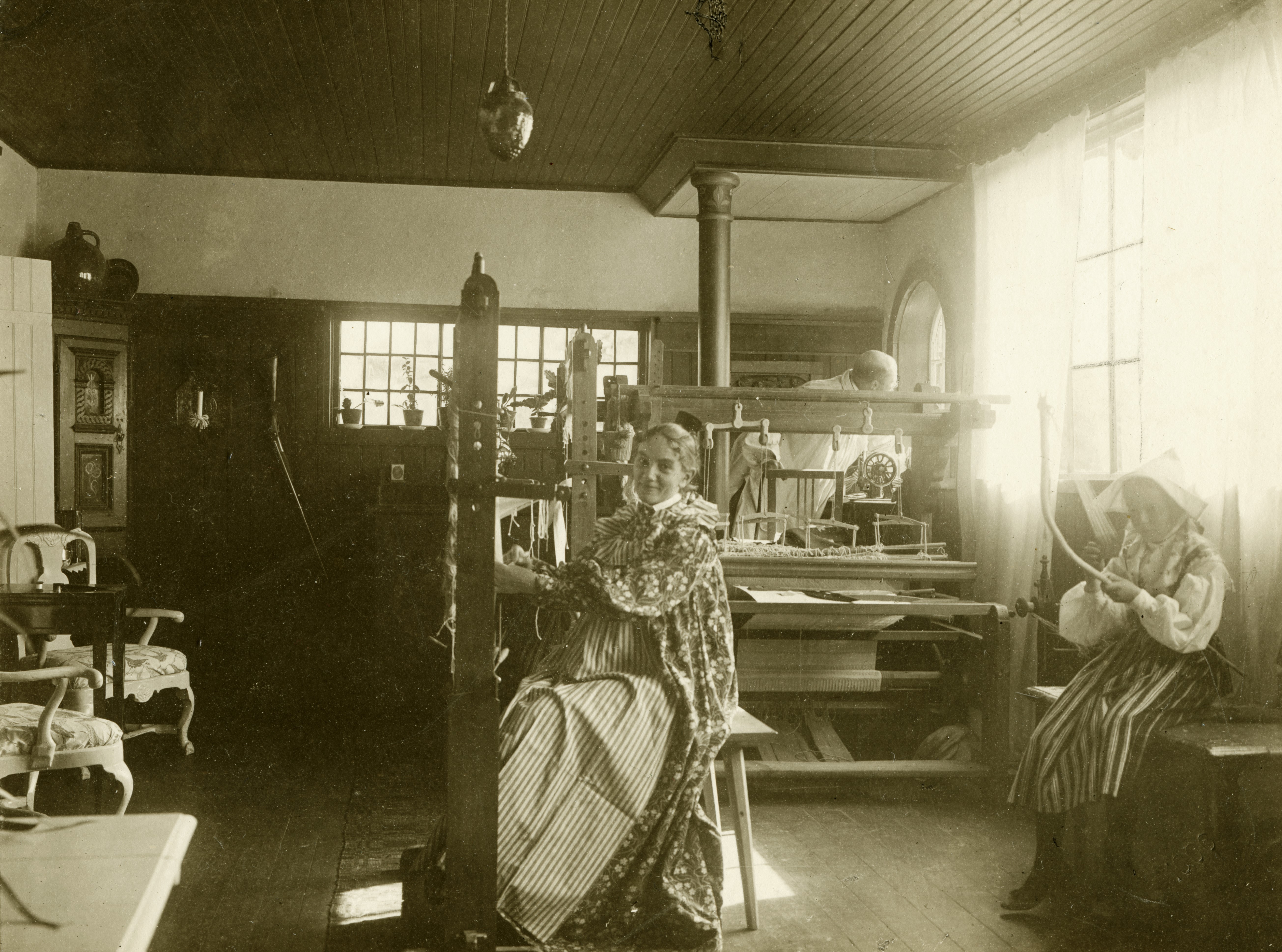
Karin at her upright loom with her floor loom in the background.Photo courtesy of Carl Larsson-gården
Along with members of the Rag Rug Weavers group from the Weavers Guild of Minnesota, the Scandinavian Weavers will demonstrate traditional Swedish rag rug weaving during the run of the exhibit. We will be working in the ballroom at the top floor of the historic Turnblad Mansion—AKA “The Castle”—in Minneapolis. Thanks to renovation efforts, the Turnblad Mansion is fully handicapped accessible, including an elevator, which will come in handy when transporting a large Swedish floor loom!
Turnblad Mansion. Photo courtesy of the American Swedish Institute.
Stay tuned to this blog for further details! In the meantime, for more information, visit the American Swedish Institute website:
The Scandinavian Weavers exhibit “Deep Winter Needs the Colors of Scandinavia” is in its final week at Becketwood Senior Cooperative in Minneapolis. The last day to view the exhibit is April 2. Because Becketwood is a private residence, please arrange to see the exhibit by calling the front desk at (612) 722- 4077 prior to your visit to make sure the galleries are open for viewing.
Peg Hansen created Tidigare Kvinner in collaboration with her three daughters. Their inspiration was the bloodthirsty Norse/Celtic battle saga Darradarljod, in which the Valkyries weave on a warp-weighted loom built of bones and entrails, with heads of defeated warriors as loom weights. Peg writes, “In 2023, I took a loom construction class by Jess Hirsch followed by rya weaving under the instruction of Melba Granlund. One thing led to another: I built the loom. My daughter Sarah/Hannah dyed the blood-red warp using lac with additional exhaust from madder, marigold, and cochineal. The blue weft is indigo dyed, and the white wool locks are scoured Wensleydale Fleece.” The ceramic heads of contemporary power brokers, sculpted by Peg and daughter Bitsy, substitute for the traditional rocks in the spirit of the Darradarljod. The inspirational passage from the saga hangs nearby in the gallery, type-set and hand-printed by daughter Rachel.
Nancy Ellison’s “Pasture by the Cemetery” is a perennial favorite, showing the figurative possibilities of krokbragd technique. Between bands of traditional geometric designs are farmers and farmwives with their flocks of sheep along with black-suited pastors presiding over a row of gravestones.
Detail of “Pasture by the Cemetery.”
Jan Mostrom’s “Sun Dogs” is a rya woven on a backing threaded in a goose eye twill, visible at the top of the piece. Jan explains that traditional rya coverlets would be placed on a bed with the pile side toward the sleeper and the patterned side for public view. The pile trapped warmth and kept the sleeper cozy. This traditional technique is found throughout the Scandinavian region.
Mary Erickson wove the complex patterns of “Think About It” in bound rosepath in a class taught by the Norwegian weaver Åse Frøysadal at Vesterheim. Mary explains, “Åse stressed designing at the loom instead of using pattern drafts. I still remember her saying “think about it” as we wove. She opened up new ideas of how to weave!”
Lisa Torvik wove this wall hanging in skillbragd technique at weaving school in Valdres, Norway in 1974. She completed the piece in four days—four long days—as her time on the loom was very limited. “The hardware was an exceptional opportunity I could not pass up,” she recalls. “The husband of a teacher at the school was a metal worker. In his spare time, he did decorative wrought iron and made beautiful hangers for weavings. Carrying it home on the airplane was another story!”
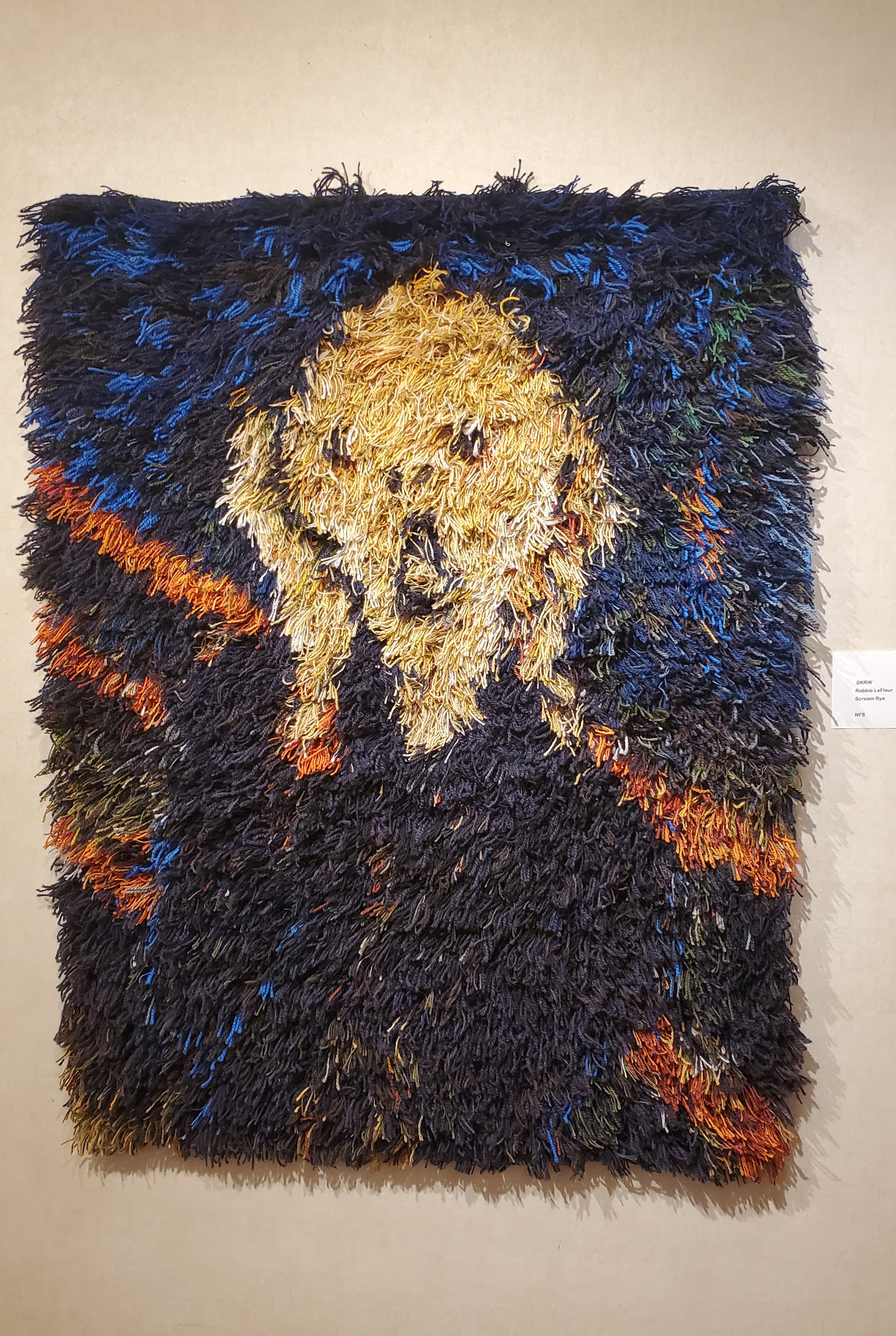
Robbie LaFleur is a fan of Edvard Munch’s famous painting “The Scream” (Skrik in Norwegian) and has woven it in many different techniques. Here it is in rya technique. A visitor to the gallery commented that it was the scariest version they had ever seen! For more of Robbie’s explorations, see https://robbielafleur.com/2015/07/27/edvard-munch-in-stitches/
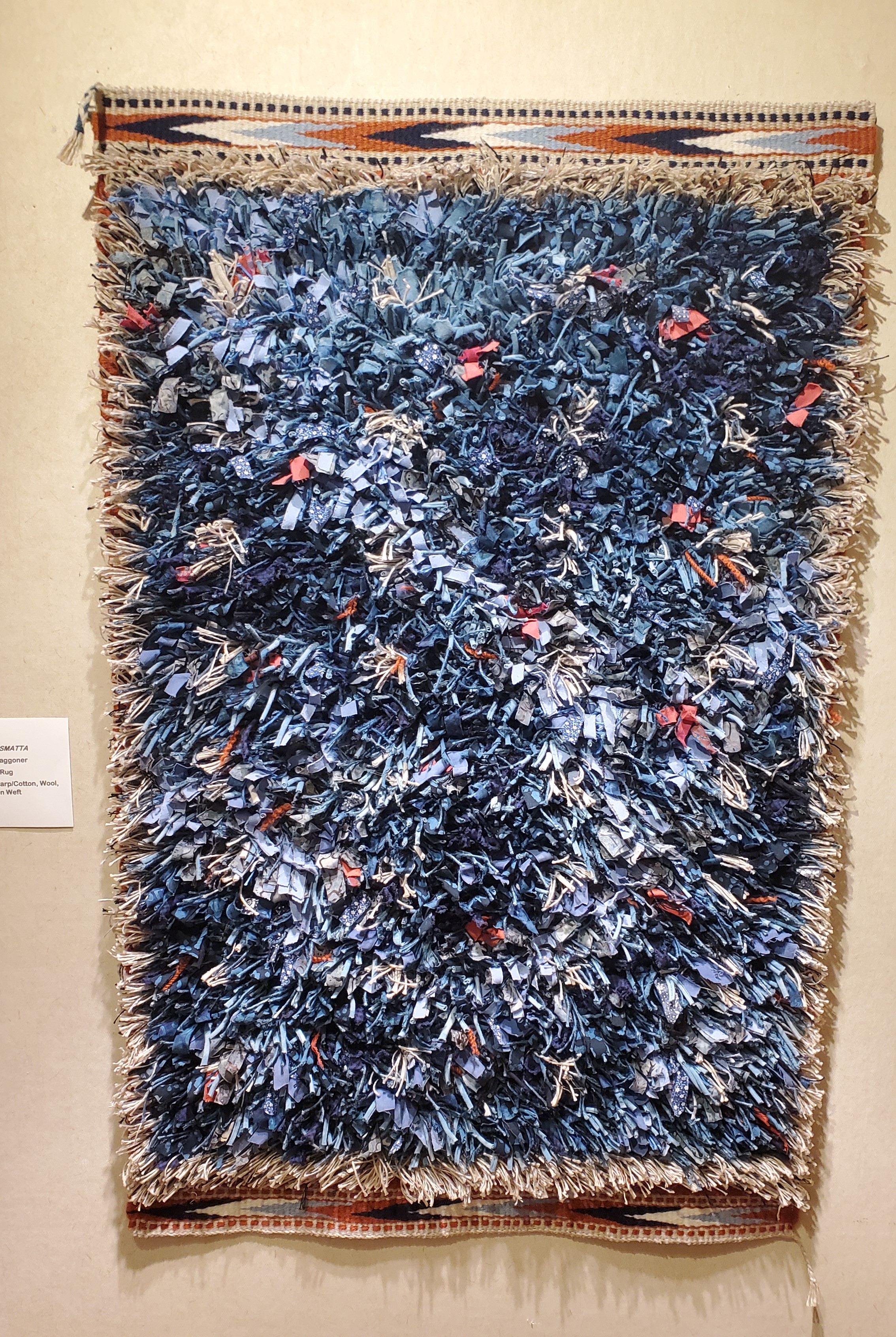
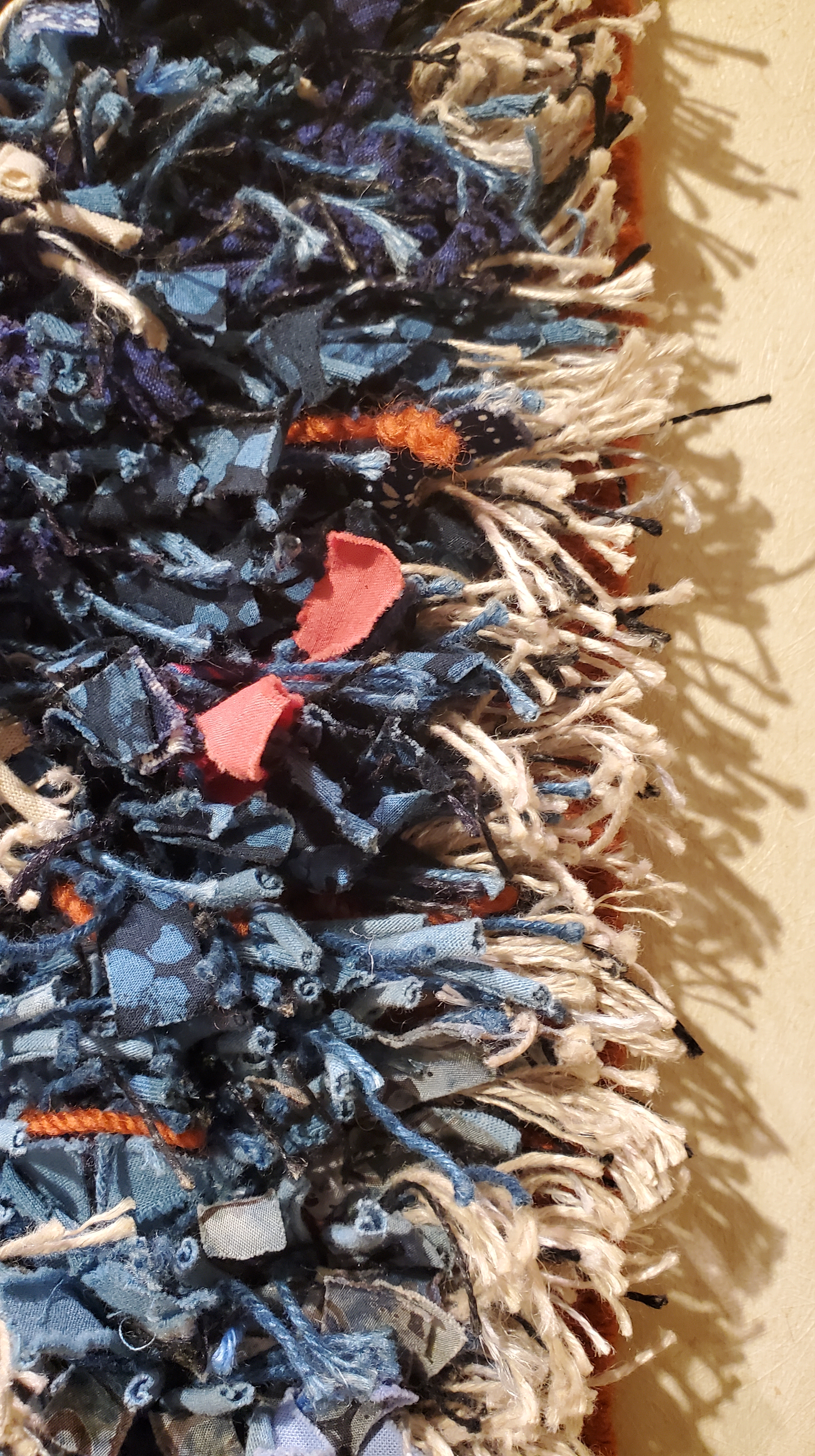
Phyllis Waggoner’s inspiration for her “Rya Trasmatta” was “Blå trasryan”, 1934, by Swedish designer/weaver Märta Måås-Fjätterström. Phyllis’ version was woven linen warp thrums—unwoven warp ends remaining on the loom after the last rug is cut off. They were combined with strips torn from old and new fabrics, and overdyed in indigo.
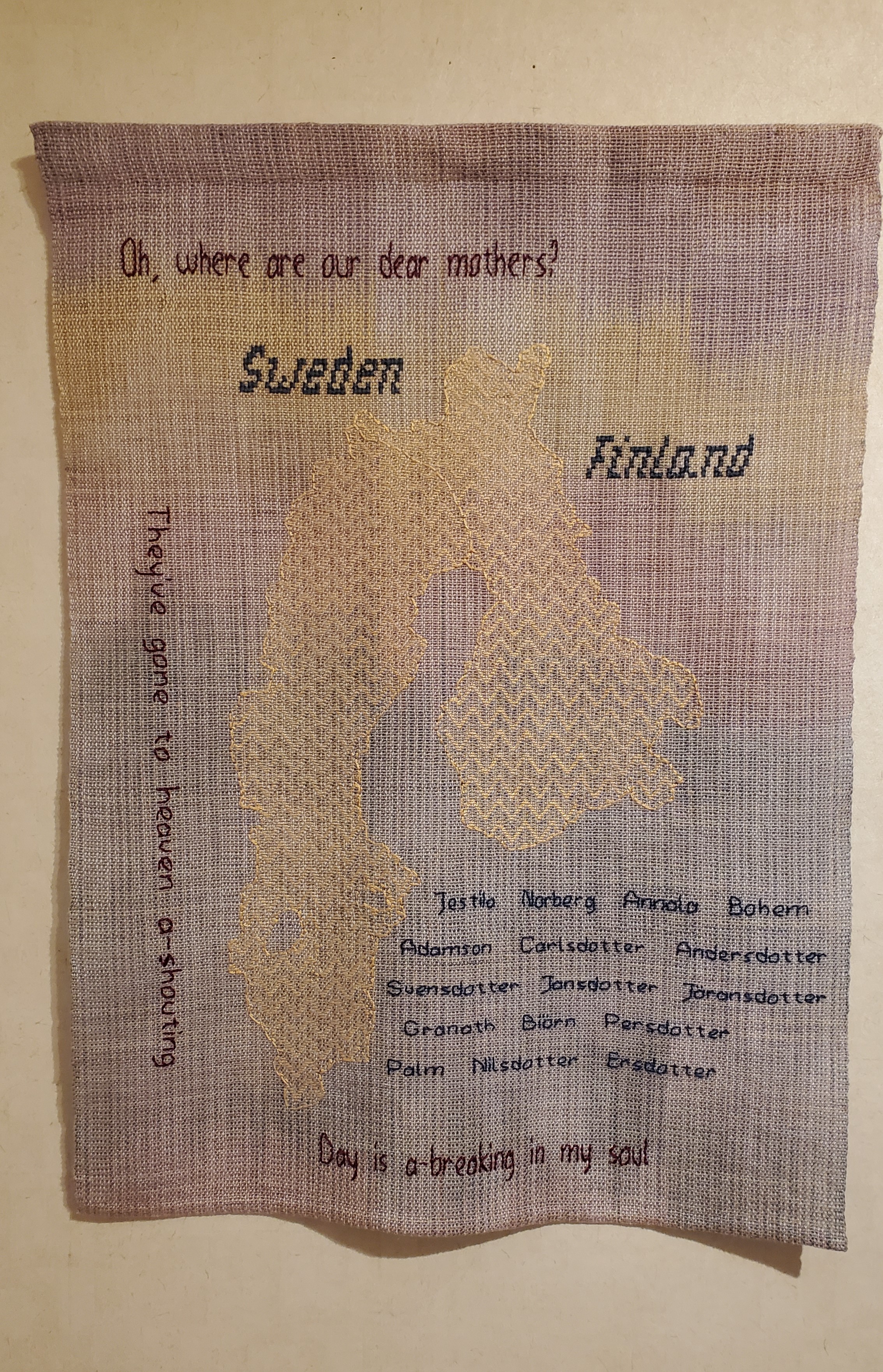
On the left is Mandy Pedigo’s “Where Are Our Mothers?” On the right is “Linnea Flowers,” a Monksbelt piece by Lisa-Anne Bauch woven as part of a Scandinavian Weavers group warp.
Mandy writes, “‘Where Are Our Mothers’ is woven inlay piece that features a map of Sweden and Finland. It is inspired by samplers and captures some of my early genealogy work to reclaim the lost names of the women in my line.” The piece includes hand-painted warp with woven inlay and embroidery. For more on Mandy’s work, visit her website at https://www.mandypedigo.com/
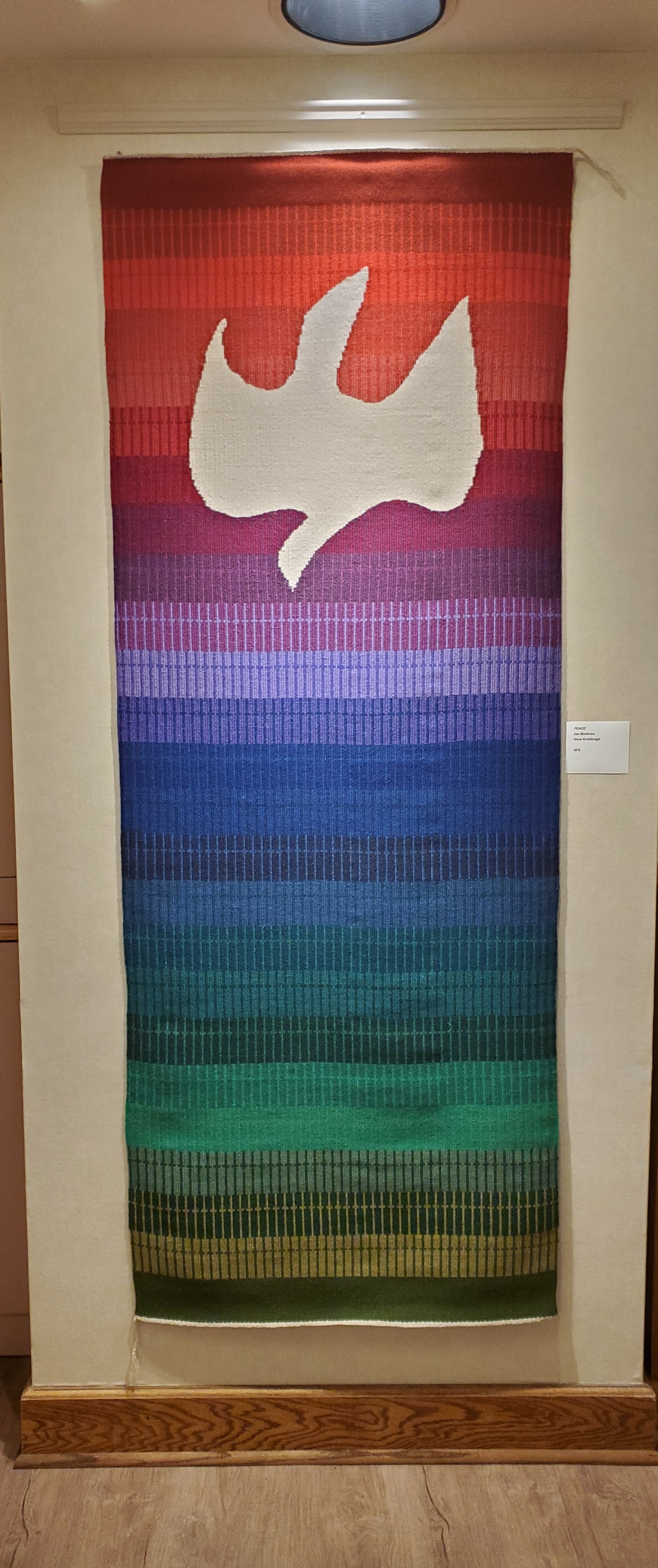
Jan Mostrom’s stunning krokbragd weaving “Peace” was woven for her church, Peace Lutheran of Plymouth. “I used liturgical colors,” Jan notes. “The dove symbol is represented in a large stained-glass window at the church. ‘Peace’ was woven tapestry-style but all in the krokbragd treadling or technique. I used multiple shuttles or butterflies to weave across each row with background and dove colors as needed.”
Mary Skoy’s tapestry also has a religious theme. The Biblical parable of “The Wise and Foolish Virgins” was the most popular tapestry subject in medieval Norway. The parable, from the Gospel of Matthew, warns Christians to be prepared for Christ’s return. Since they do not know the day or hour of his coming, they must be like those waiting late at night for the arrival of a bridegroom, an important and honored guest. The wise virgins bring extra oil in case their lamps run dry. The foolish do not. When their lamps inevitably wink out, they must go and buy more oil because the wise virgins refuse to share. Thus, the foolish miss the arrival of the bridegroom and when they return, find the doors to the wedding celebration locked. In the traditional tapestries, as in Mary’s, they weep dramatically into their handkerchiefs. “I have called this tapestry ‘I Thought We Were Friends,’” Mary notes, “because I think the five who were saving their oil and didn’t offer to share with the five who had used up their oil were mean and selfish!”
Mary thoughtfully displayed her tapestry along with the relevant Bible verses, the cartoon used to weave it, and a sample card of all the colors in the wool yarn. She also included her initials and the date of the weaving, because far too many of our weaving ancestors did not, and their names and stories were lost to time. She encourages other weavers to do the same!
The Scandinavian Weavers would like to express our sincere thanks to the Becketwood community for their kind invitation to exhibit in their gallery, as well as their hospitality. And although it is now spring, deep winter seems to have returned in the form of a snowstorm—a fitting backdrop to the bright and warm colors of Scandinavian weaving.
Becketwood is a senior housing cooperative in Minneapolis, located in the Longfellow neighborhood on a beautiful bluff overlooking the Mississippi River. Becketwood has an active fine arts committee, including several weavers. The committee invited the Scandinavian Weavers to present an exhibit in their gallery space.
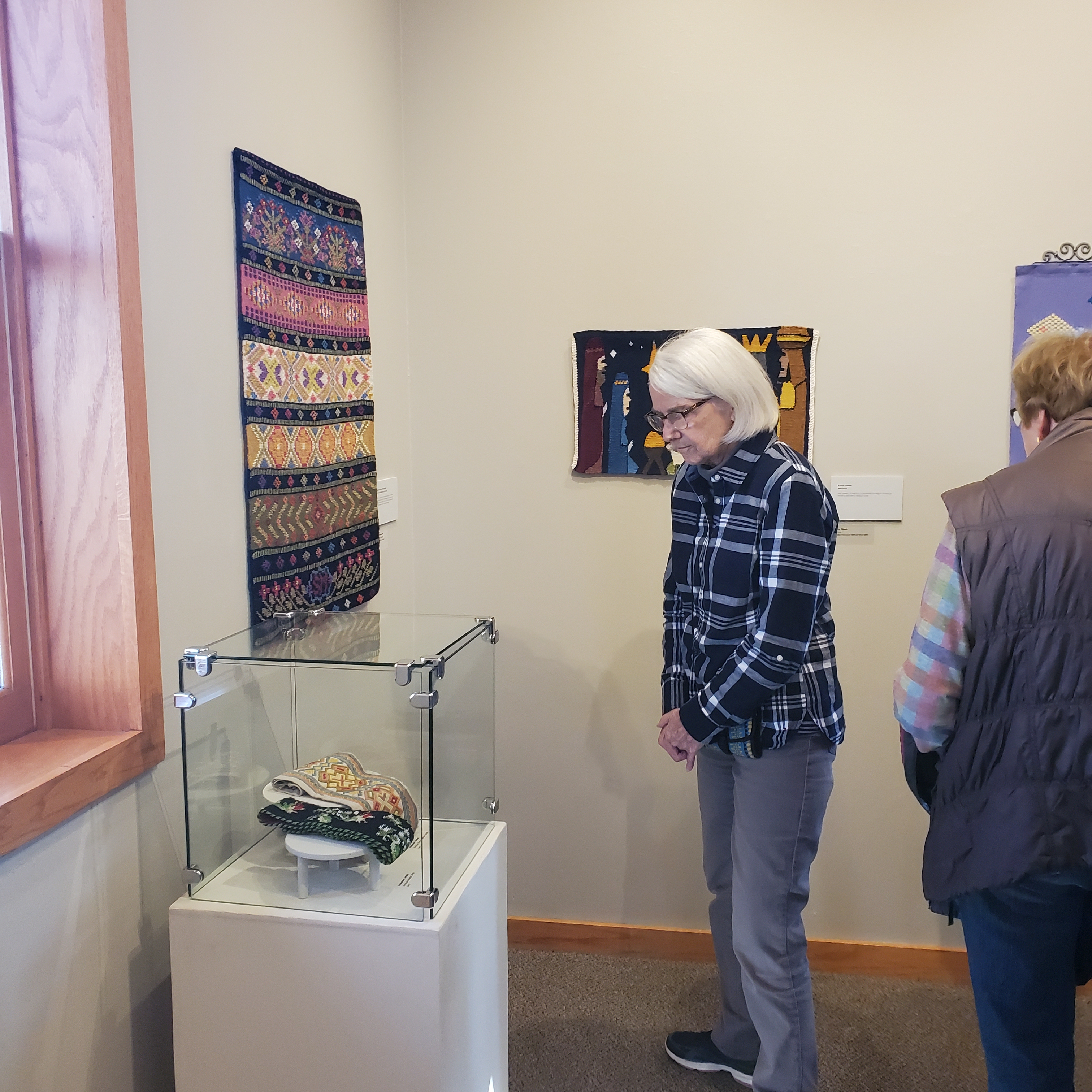
Scandinavian weavings at Becketwood
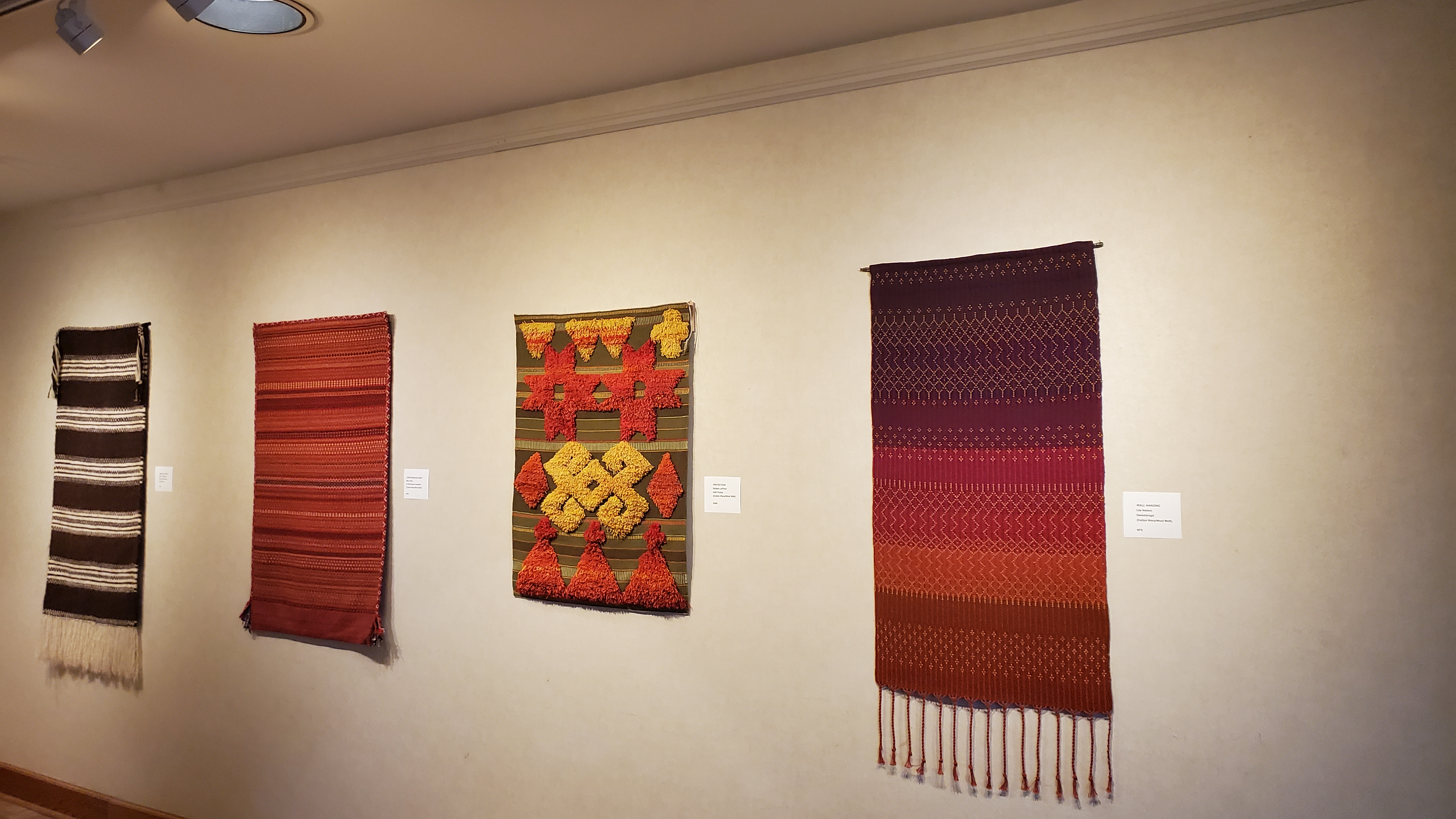
Our goal was to present a wide variety of traditional Scandinavian techniques. Since we were expecting our usual harsh Minnesota winter, we named the exhibit “Deep Winter Needs the Colors of Scandinavia.” Alas, it has been unseasonably warm with almost no snow. Nevertheless, the bright colors of the weavings are a welcome sight.
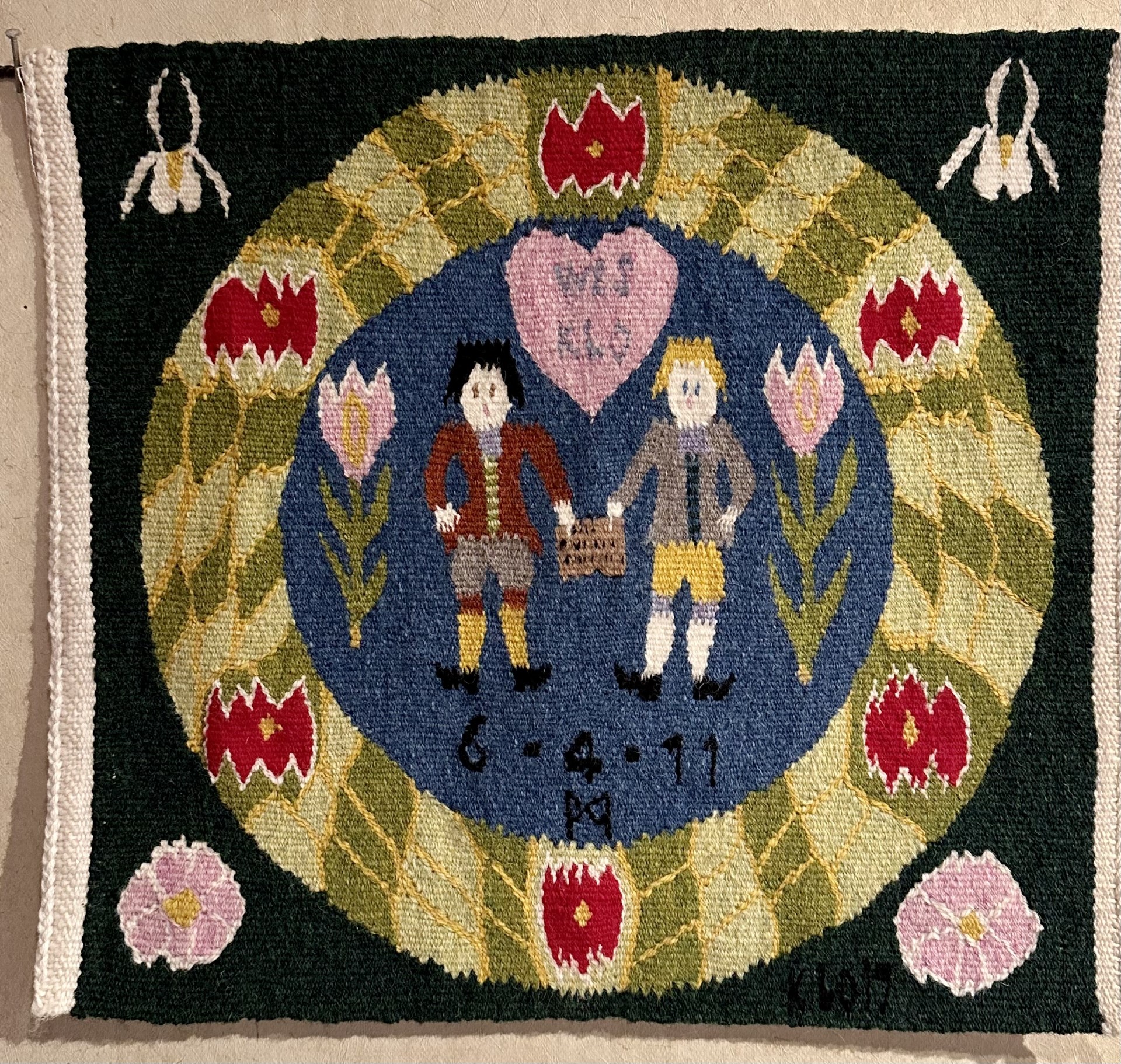
Kevin Olsen, who specializes in Scandinavian tapestry techniques, wove a wreath pattern called Betrothal, traditionally woven to celebrate an engagement. “Since my husband and I had already been married for six years when I wove the tapestry,” Kevin explains, “I called mine Anniversary instead. I included irises and peonies, which were our wedding flowers, while the tulips are a traditional motif.” The six red roses stand for the six years Kevin and his husband had been married. In the spirit of betrothal tapestries, Kevin included the date and an image of the marriage certificate.
Kevin Olsen’s Anniversary tapestry
A vitrine showcases woven bands, a common element of Scandinavian folk costumes. As seen below right, Jane Connett used card-weaving to create a wide belt for a bunad (traditional costume). In this ancient technique, warp yarns run through holes in square cards. Each single card has four holes, one in each corner, and dozens of cards may be combined to create intricate patterns. After each weft shot, the cards are turned forward or backward to create the next element of the pattern.
Below center, Judy Larson wove a smaller band using a heddle or bandgrind. In this portable technique, the weaver raises and lowers the heddle to create the open sheds through which the weft passes. To weave designs, the warp strings can be picked up individually and a curved knife is used to beat in the weft yarn.
The charming tea cozy in the background was woven by Marie Nordland (1909-2000), the aunt of current Scandinavian Weavers member Nancy Ellison. Marie was a member of De Norske Vevere (the Norwegian Weavers), a group in the Weavers Guild of Minnesota that was a forerunner of the Scandinavian Weavers Study Group. She used a variety of techniques in her tea cozy, including krokbragd, danskbrogd, and rya.
Back row, left to right: Tea Cozy by Marie Nordland, Heddle Band by Judy Larson, and Bunad Belt by Janet Connett. Foreground: Sami-Influenced Band by Sharon Moe Marquardt.
Sharon Moe Marquardt wove the Sami-style band in the foreground using a simple tube loom. She added miniature Sami boots that she purchased at the husflidlag (handcraft association) in Manndalen, a Sami community on Kåfjord, east of Trømso in Norway, where she learned the technique.
Close-up of Sharon Moe Marquardt’s Sami-style band, including miniature boots of reindeer leather.
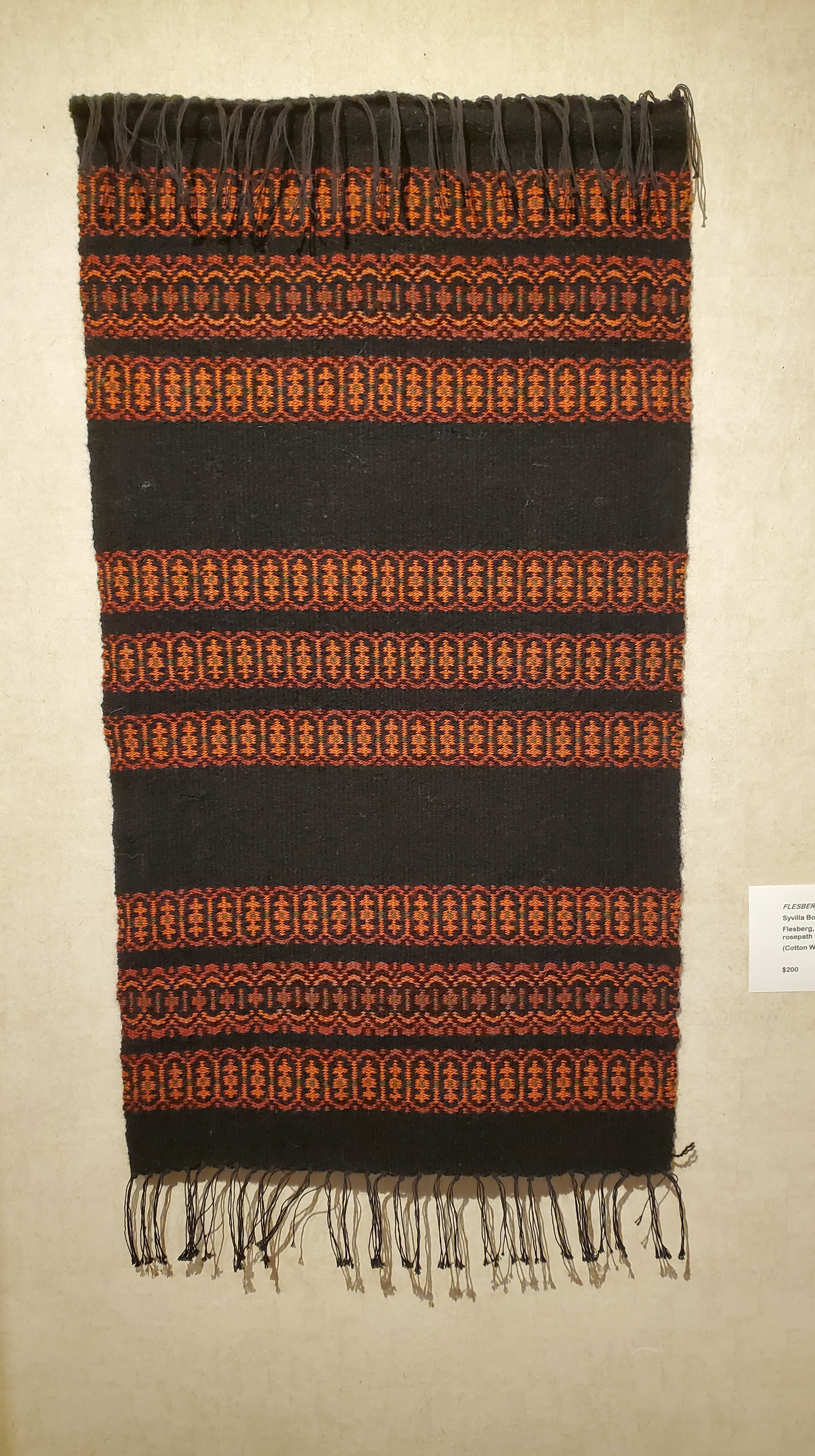
Syvilla Bolson (1928-2011) wove the wall hanging below in Flesberg technique, a style of three-shaft bound rosepath from the Flesberg region in Norway. Syvilla was a beloved member of the Scandinavian Weavers for many years. (Learn more about the flesberg technique in the November, 2020, issue of the NorwegianTextileLetter.)
Flesberg technique woven by Syvilla Bolson
Jan Mostrom wove the rutevev wall hanging below, evocatively named “Old Soul.” Rutevev, or square-weave, is a geometric weaving technique using single or double interlock joins.
Ann Haushild, a Becketwood resident and long-time study group member, wove this colorful hanging in Vestfold technique, named after the Vestfold region in Norway. It is an inlay technique, in which weft yarn is laid in to create the designs. (There is more on this technique in the February, 2020, issue of the Norwegian Textile Letter.)
Vestfold wall hanging by Ann Haushild
Last year, the Scandinavian Weavers set up a group warp to weave in telemarksteppe technique. (See previous blog posts for more photos of this technique.) Kala Exworthy wove the beautiful version below in colors inspired by the natural world.
Telemarksteppe wall hanging by Kala Exworthy
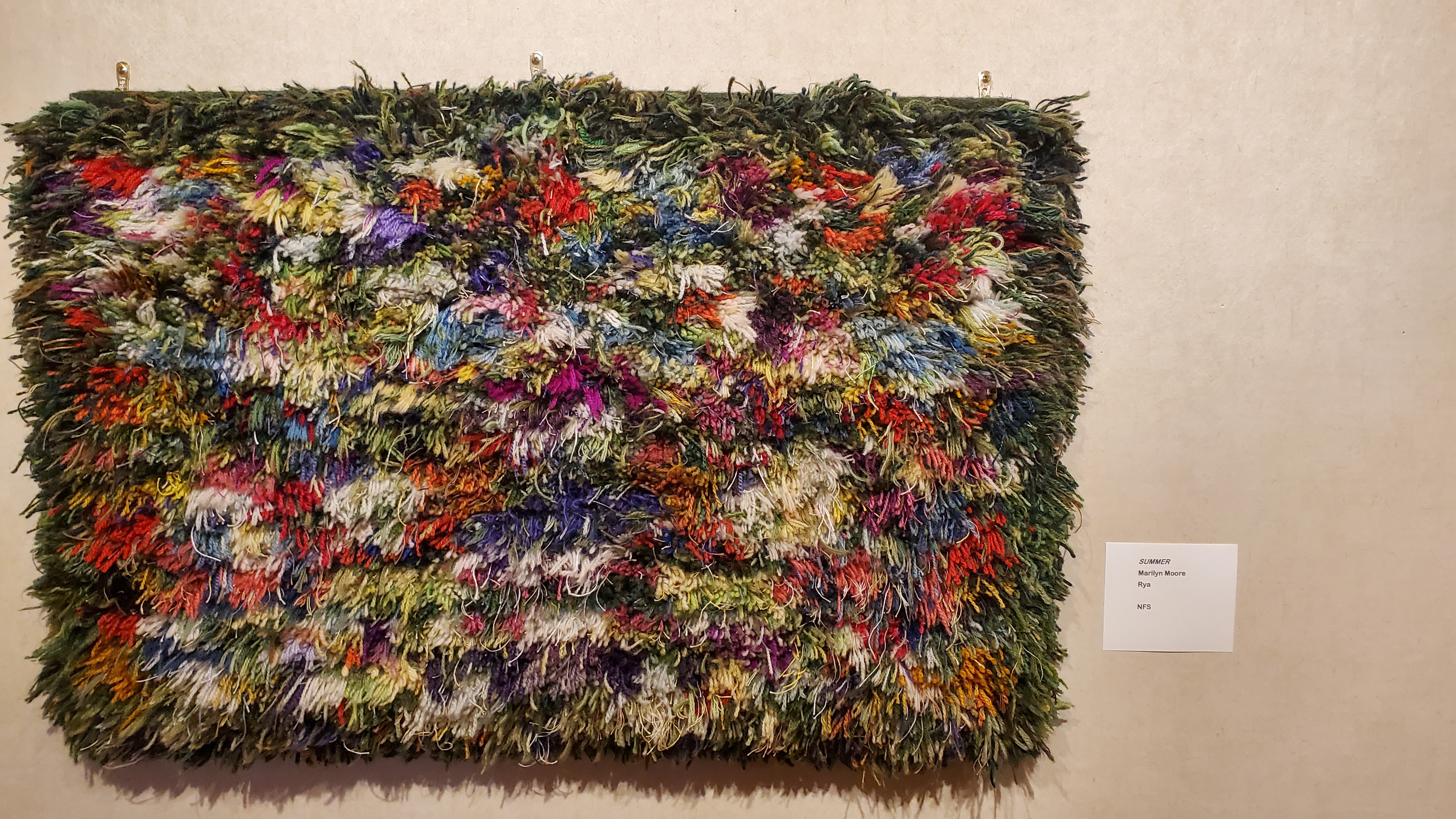
Rya is a traditional pile technique. Marilyn Moore’s lush version below was inspired by the colors in her expansive flower garden.
Rya wall hanging by Marilyn Moore
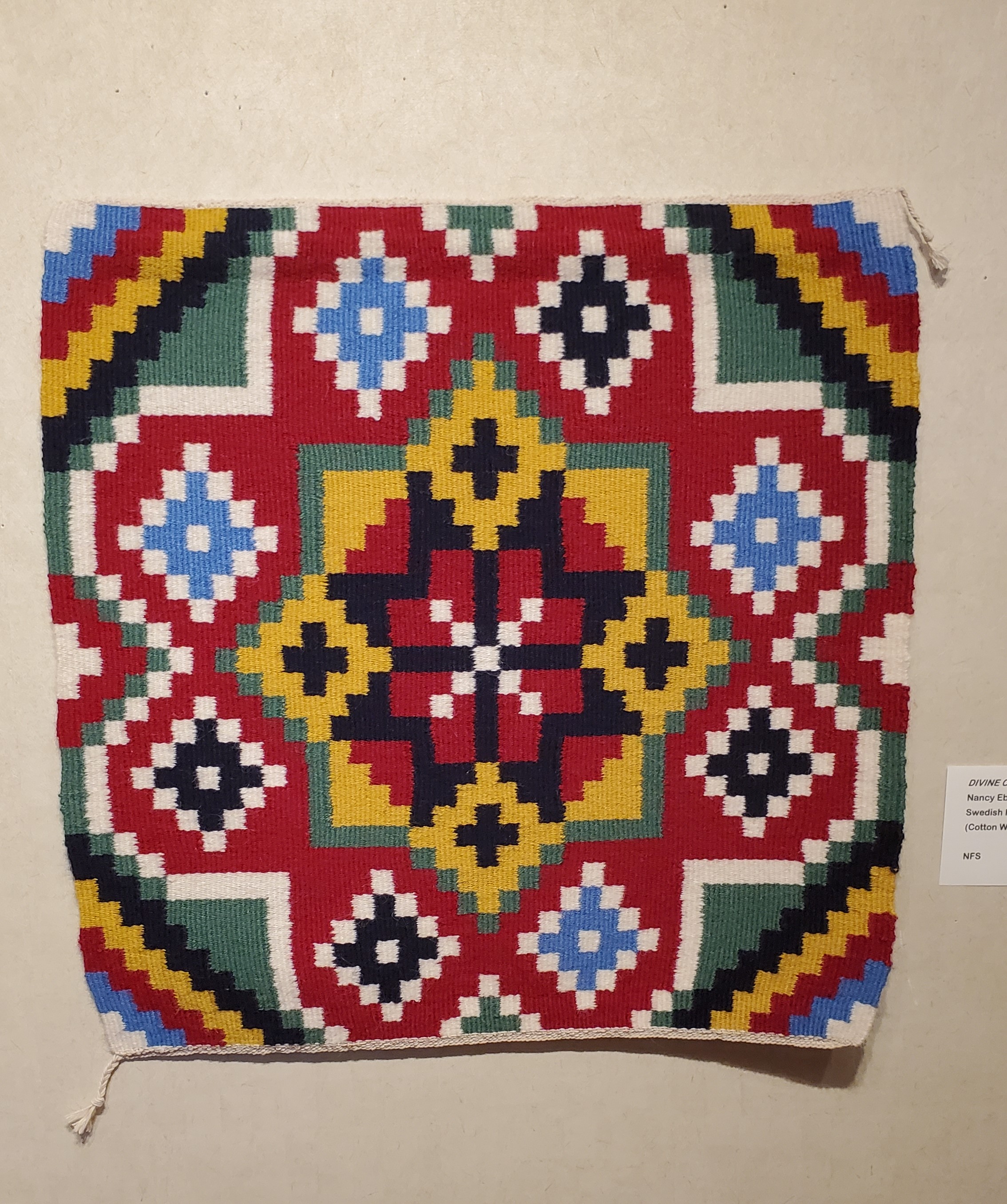
Nancy Ebner wove a rutevev wall hanging called “Divine Order.” The original pattern drawing was produced in the 1930s by Linnea Kullman (Johansson), a student at Johanna Brunsson’s Weaving School in Stockholm, Sweden. Nancy discovered the pattern in the historical collections at the Nordisk Museum (via digitalmuseum.se).
“Divine Order” by Nancy Ebner
Brenda Gauvin-Chadwick wove the pillow below, called “Joy Exploding,” in rosepath technique. “The pillow was woven with Fåro yarn that I purchased in Sweden many years ago,” she writes. “I carried it all over Scandinavia for weeks in my suitcase. I bought it after skiing the Swedish Vasaloppet. Two weeks later in Norway I skied the Birkebeiner race. The colors represent the forests, the beautiful sunshine and my heart exploding with joy as I skied along!”
Brenda Gauvin-Chadwick’s “Joy Exploding”Detail of “Joy Exploding”
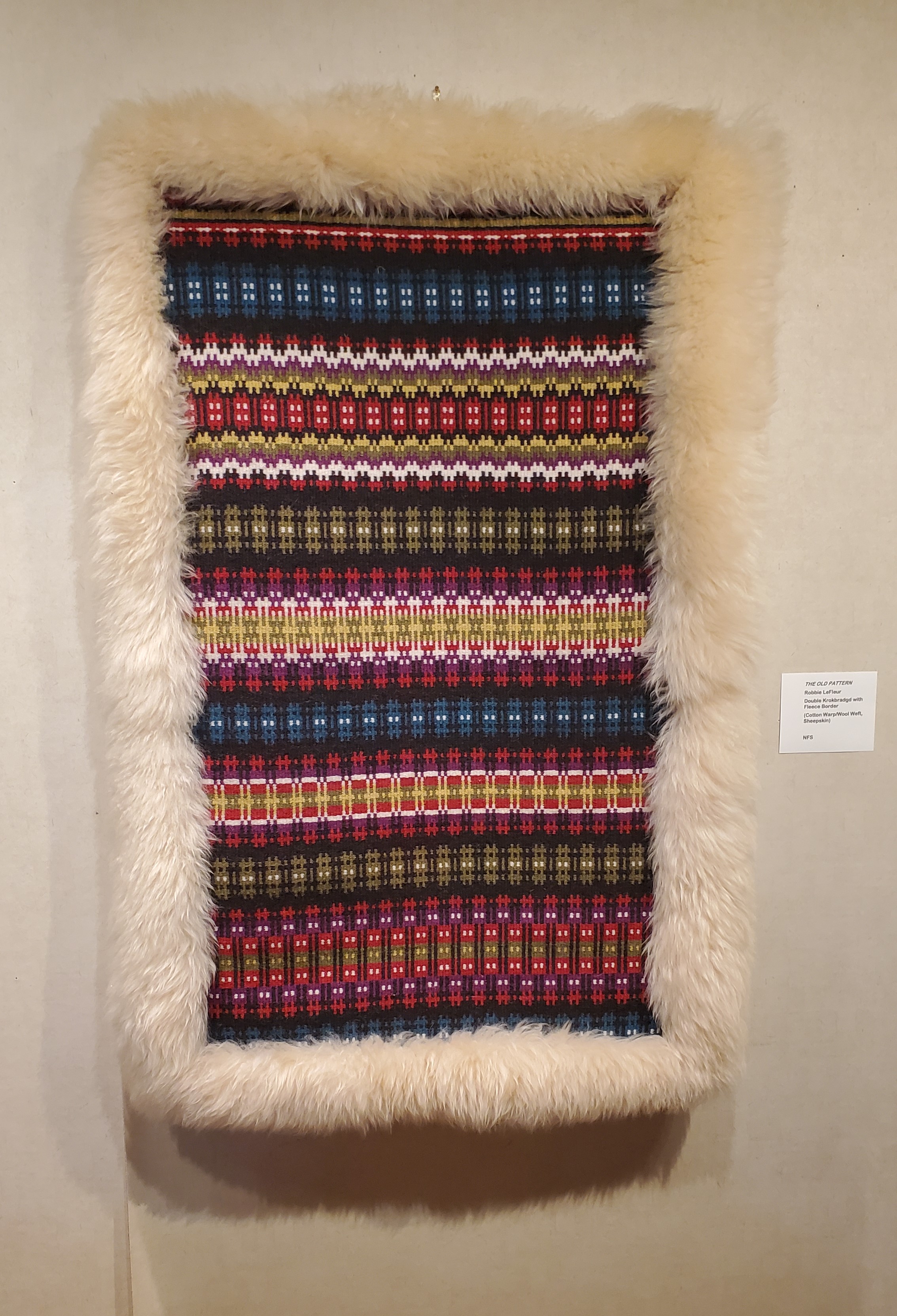
Robbie LaFleur’s weaving below is in double krokbragd technique. Called “The Old Pattern” it includes a sheepskin backing and fringe. (Read the full article from the Norwegian Textile Letter on the old pattern.)
“The Old Pattern” by Robbie LaFleurDetail of “The Old Pattern”
Stay tuned for more blog posts featuring photos from the exhibit, which will be on view through April 4.
If you would like to visit the exhibit, please call the Becketwood front desk at (612) 722- 4077 prior to your visit to make sure the galleries are open for viewing.
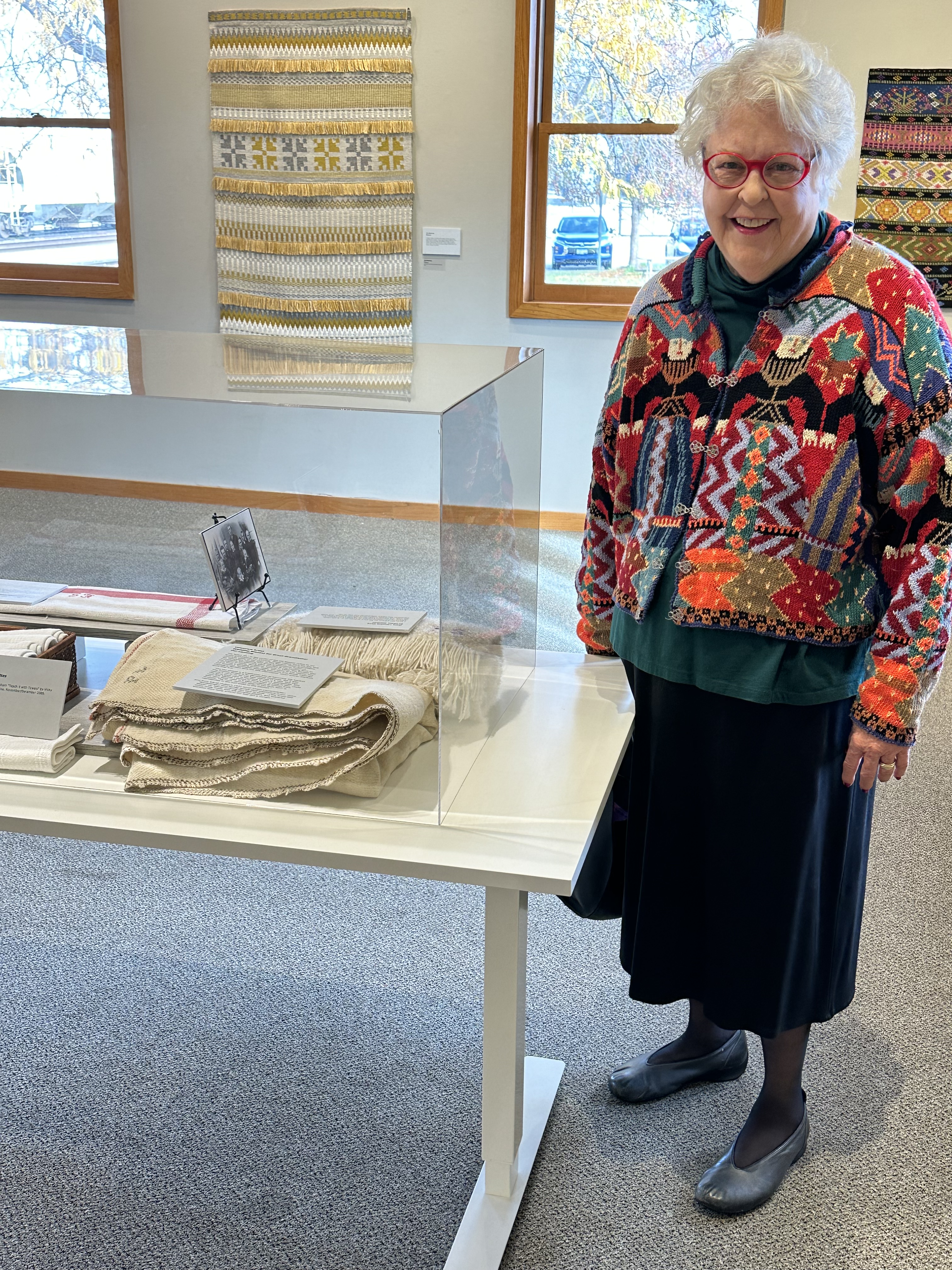
The Scandinavian Weavers’ “Domestic to Decorative” exhibit included several heirloom textiles, which came with wonderful family stories. The heirlooms inspired members of our group to weave new versions of the same technique—in one case, to combine old and new in a single weaving—or to use their imaginations to create something new inspired by the past.
Weaver Mary Skoy next to the woolen blanket given at her great-grandparents’ wedding.
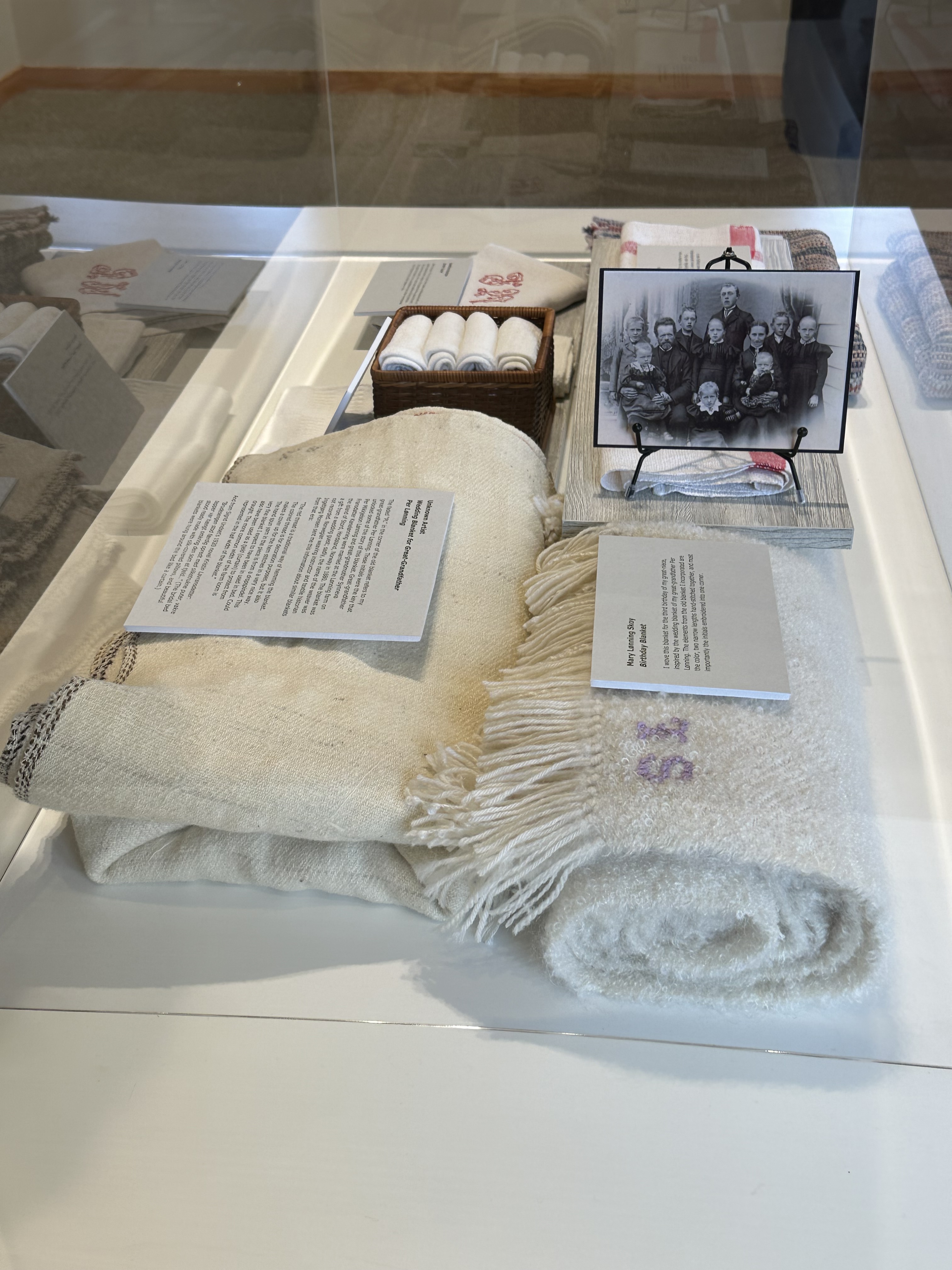
One of Mary Skoy’s most treasured family heirlooms is a simple woolen blanket. The blanket was a gift to Mary’s great-grandfather Per Mikkjelson Lønning and great-grandmother Synneva Fransdatter Kanelønning, who were married at the Lønning farm on the island of Stord, Hordaland, Norway in 1880. “The blanket was a gift from a wedding guest,” Mary explains. “The faded PL in the corner of the old blanket refers to Per Lønning. Sadly, the name of the weaver was not recorded.” Note: Mary always encourages those of us in the Scandinavian Weavers group to include our initials on everything we weave!
Per Lønning and Family
Mary researched the history of blankets from this era, consulting Norwegian weaving instructor and textile historian Ingebjørg Monsen. Ingebjørg sent the following information about similar blankets from that era: “The red thread is a traditional way of hemming the blanket. The colored thread is for decoration purposes, but it also makes a cover up for the hem stitches in a very nice way. The hand spun yarn in the piece is from a dropspindel. This very fine blanket I expect to have been in used in bed. Could also have been used as a tjeld (curtain) to protect from draught. The more common width of the farm loom is represented in the half width of the blanket.”
Inspired by the heirloom blanket, Mary wove a new blanket for the birthday of her great-niece. “The elements from the old blanket I incorporated are the color, two narrow lengths hand-stitched together, and most importantly the initials embroidered into one corner,” Mary says. The new blanket is also much softer, incorporating alpaca, mohair, silk, and wool—luxury fibers that would not have been available to her ancestors in 1880.
Original blanket on the left; Mary’s blanket on the right.Close-up showing theembroidered initials.Note the difference between the simple wool fibers in the original and the fluffier fibers on the new blanket.
Beth Detlie was also inspired by Norwegian textiles: “Vegteppe was a wedding gift from my husband’s aunt to us in 1978. She told us that the weaving was done by a distant relative of mine. (My mother’s ancestors immigrated to the United States from the Telemark region in Norway during the 1850s.)” Beth’s Telemark Reflection is an echo of this beloved weaving.
Original vegteppe on the far wall with Beth’s smaller version on the right. In the foreground is the special case holding other heirloom textiles.
Edi Thortensson donated a simple but treasured handtowel. “The towel was handwoven around 1950 by my mother-in-law, Ellen Svensson, for use in her home in Tröjemåla, near Ryd, Småland, Sweden,” Edi writes. Inspired by Ellen’s towel, Edi wove a paradhandduk, or display towel, meant to cover utility towels hanging near a washstand.
Edi Thorstensson and her parahandduk.
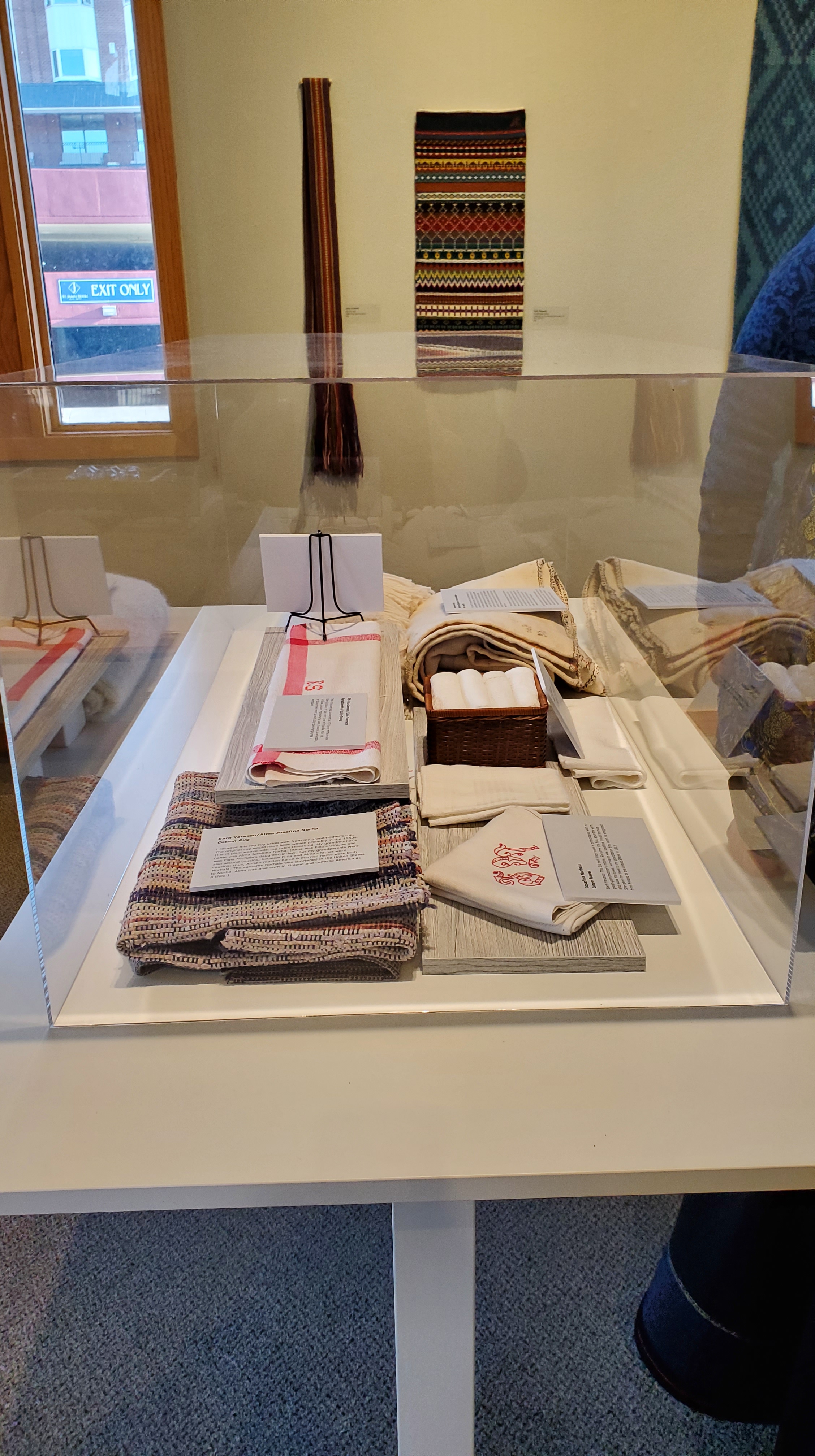
Barb Yarusso shared two Finnish heirloom textiles for the exhibit, including a 2/2 twill linen towel embroidered with her great-grandmother’s initials. Her great-grandmother’s name was Josefiina (Fiina) Norhala. “Josefiina grew the flax, spun the yarn, and wove the towel,” Barb writes. “She gave the towel to my grandfather Eino when he emigrated from Finland to the United States in 1913.”
On the far left is the red and white towel woven by Edi’s mother-in-law Ellen Swenson and embroidered with the initials ES. On the right is the white towel with initials embroidered in red by Barb’s great-grandmother Josefiina Norhala.
Barb also has a rug woven by Alma Norhala, Eino’s wife. Alma was also born in Finland and came to America as a child. The original rug was woven in the 1950s, in plain weave with log cabin threading. Barb carefully salvaged the cotton weft material and re-wove it into a new rug as her way of honoring Alma’s work.
Barb Yarusso proudly holds the rug she rewove using weft material from her grandmother Alma Norhala.
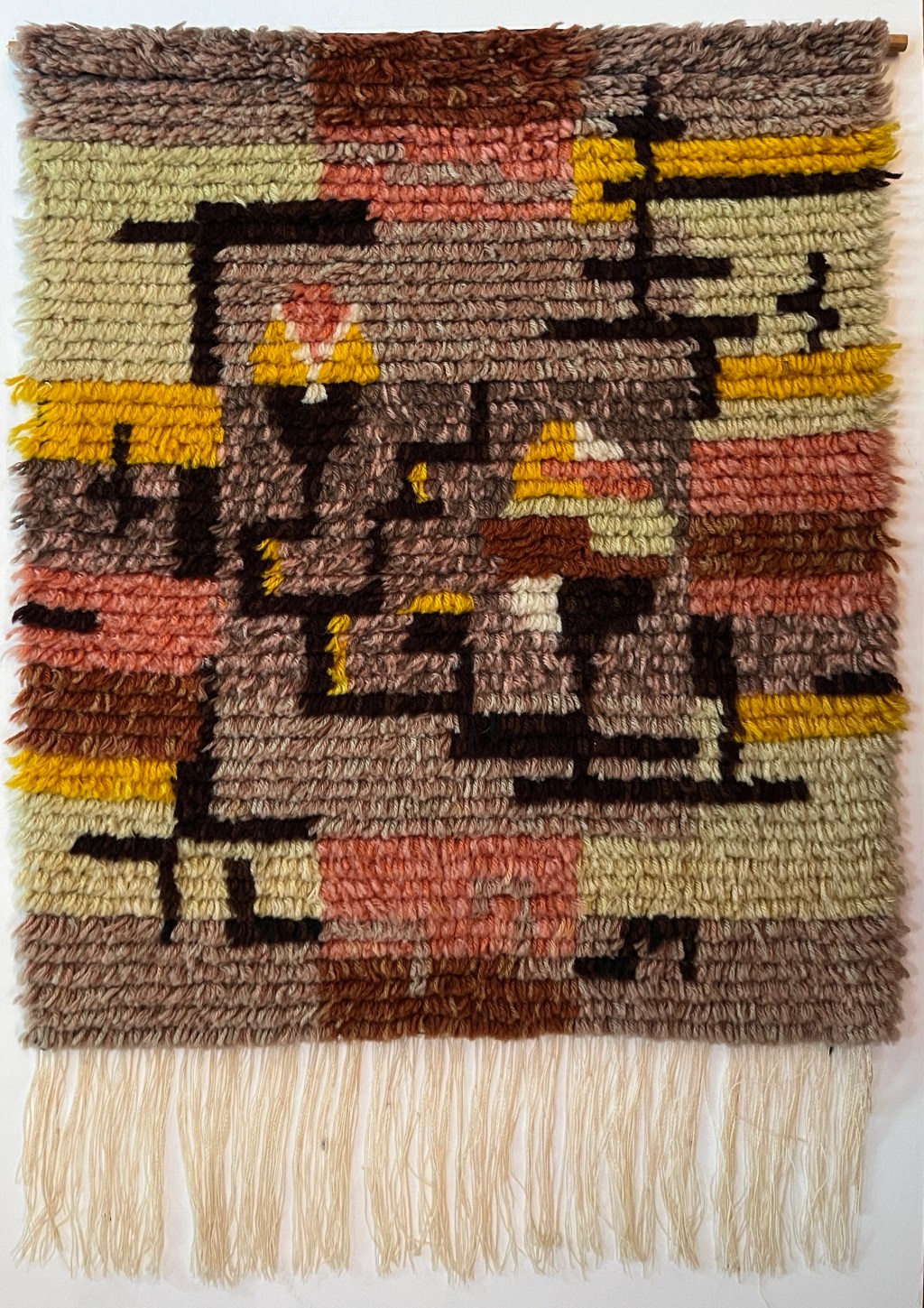
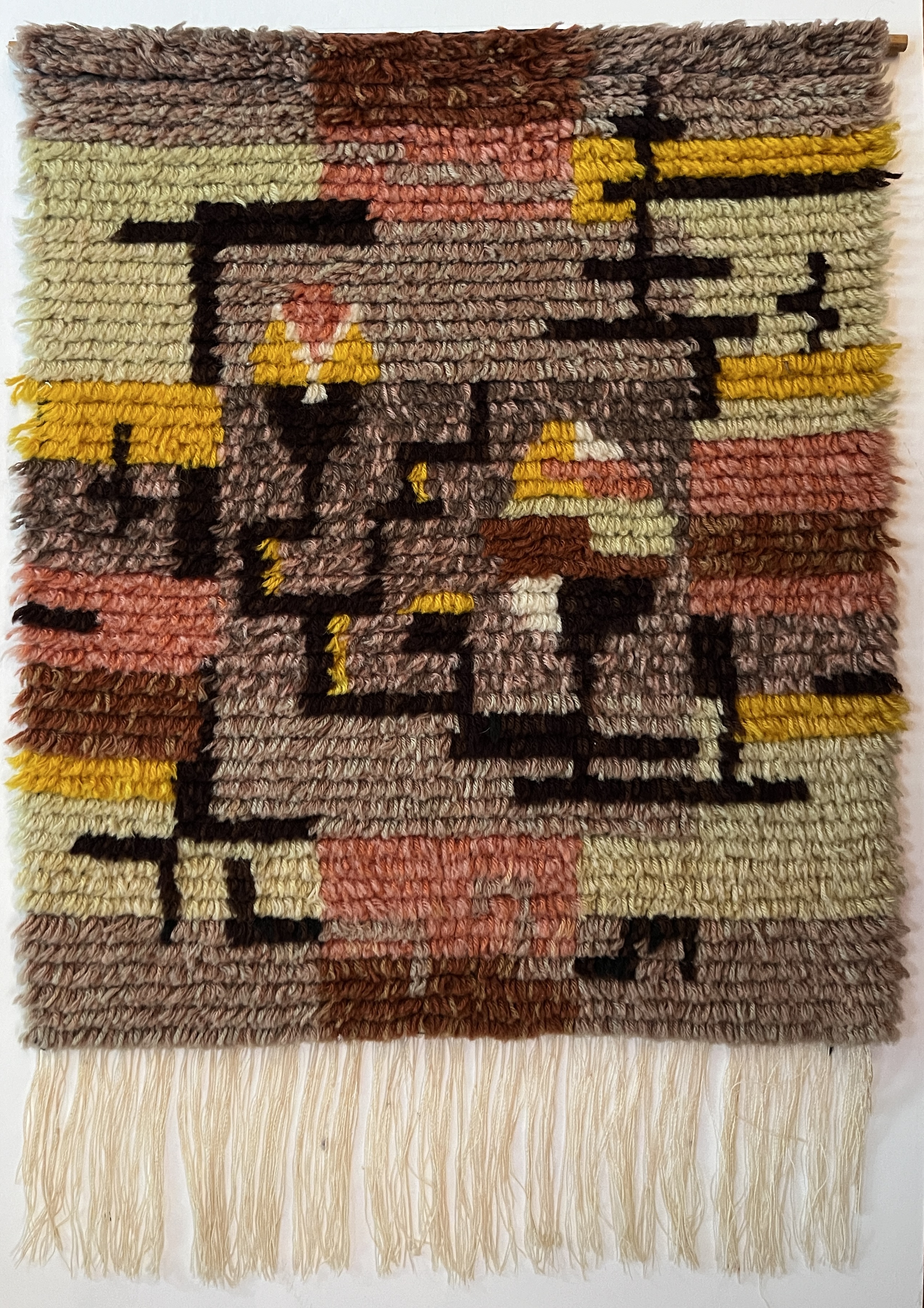
Peg Hansen was also inspired by Finnish weaving. Löytyi Karannut Lemmikki (A Runaway Pet Was Found) is a vintage (over 100 years old) Finnish Rya/Ryu wall hanging from the collection of Peg’s friend Susan Sutherlund. It belonged to Susan’s grandmother Lydia Ivonen. Unfortunately, the weaver is not known.
Löytyi Karannut Lemmikki (A Runaway Pet Was Found)
This piece served as Peg’s inspiration to learn more about the Rya/Ryu weaving technique used in Scandinavia.
Peg’s rya weaving on her hand-builtwarp-weighted loom.
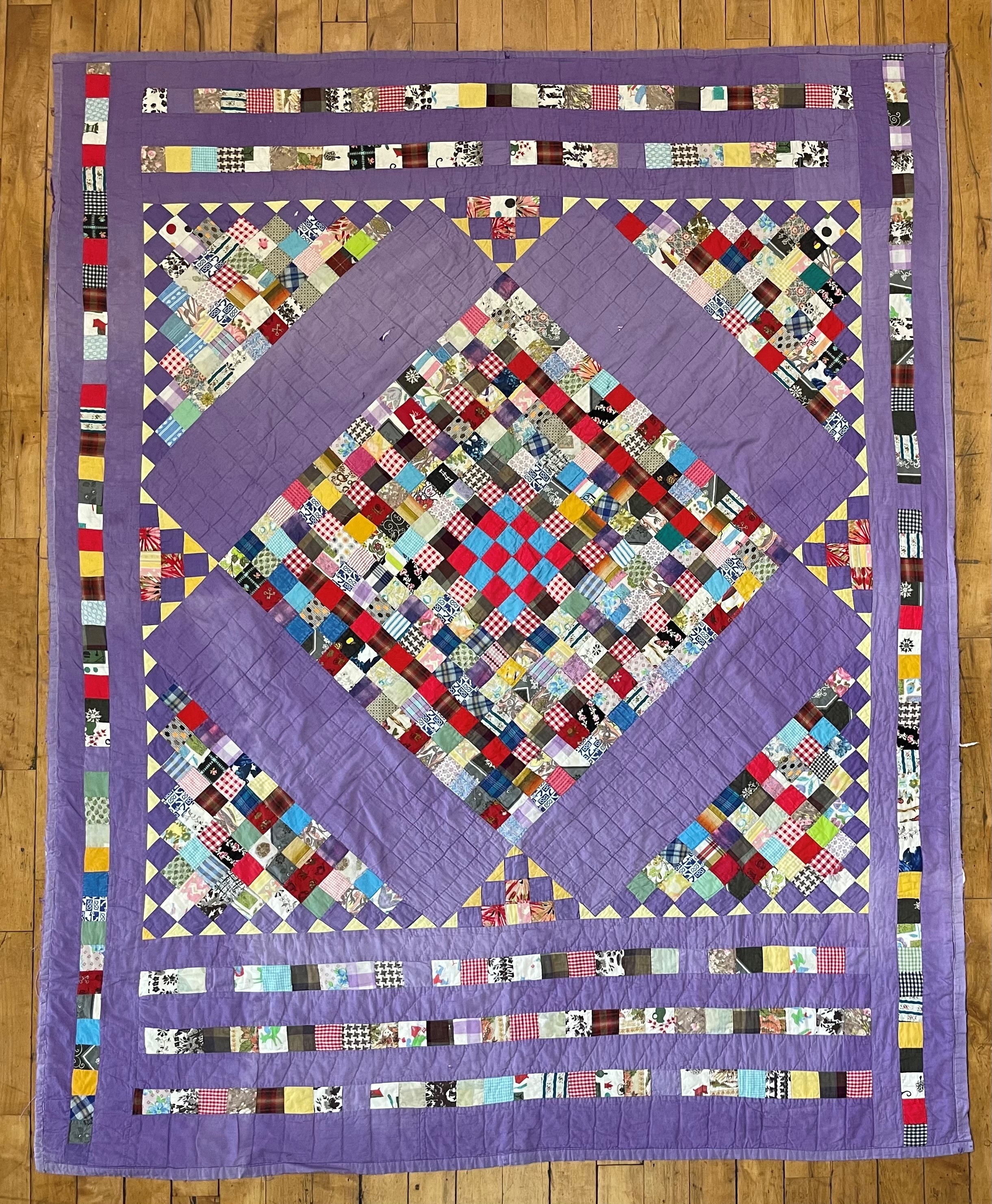
Kala Exworthy’s source of inspiration was a beloved quilt. “My maternal Grandmother loved making things,” she writes. “From her I learned to knit, rosmal and paint those cute plaster gnomes, which we painted red hats on and called “Nisse.” The photo below is of a quilt given to Kala by her grandmother. “I was the oldest granddaughter and was given first choice of the pile of quilts,” Kala explains. “The fabrics are from worn garments and I have always been a fan of bright colors. As a practical quilt, it has been used from day one. It’s worn and faded now but no less precious.”
The quilt given to Kala by her grandmother.
Inspired by the quilt, Kala wove a wall hanging she calls Memory Fragments. “The wall hanging represents not only the colors in the quilt but also the random memories that I have when I look at the quilt,” she writes. “Pictures in my head of Gram at different times in our lives, red paint on the paintbrush for the Nisse hats, the smell of turpentine and linseed oil used to clean our brushes, yarn and needles and of course, lefse with mashed potatoes, chicken and crispy sugar cookies. I loved going to Gramma Egstad’s house because there was always time to make something.”
Kala’sMemory Fragments inspired by her grandmother’s quilt.
For Nancy Ellison, her heirlooms come in the form of sheep. Nancy raises Icelandic sheep and other heritage breeds on her farm near Zumbrota, Minnesota. “Historically in Iceland shepherds wore a mantel or cloak woven with locks of wool to protect the wearer from the weather,” Nancy explains. “The shaggy surface is like the wool growing on a sheep.” Nancy wove a pillow and chair cushion in this technique, using gray, black, brown, and white wool from her flock.
Nancy shaggy sheep contributed to her weaving!
Some weavers were inspired by vintage objects, even though they didn’t have a family connection. Sharon Marquart’s From Garment to Garnish was inspired by an antique embroidered bodice, possibly Scandinavian, and an antique beaded belt, which may have been part of a Norwegian bunad (ceremonial dress).
A visitor examines the vintage clothing items that inspired the woven motifs inSharon’s From Garment to Garnish, seen on the wall.
Melba Granlund wove a telemarksteppe she called Reflections. “My color inspiration for Reflections came from a stained-glass window salvaged from an old farmhouse,” she states. “It was purchased at a farm auction in central Minnesota and currently hangs in the dining room window of our “new” farmhouse a few miles away. “
Melba’s Reflections and a photo of the stained glass that inspired the color palette.
Although humble, these beloved textiles are still treasures, even a hundred years later. As shown in this exhibit, even the simplest textile can inspire later generations to weave on. We are all part of the fabric of history, and our own small threads can have a positive impact far beyond our lifetimes. Just remember to put your initials on everything you weave!
A cold January is the perfect time to start a new weaving project! The Scandinavian Weavers’ latest group warp is a pattern called Kukkoladräll.
The Kukkoladräll pattern was composed by Elsa Kerttu in 1926 when she was a student at Jämtslöjds Kvinnliga Slöjdskola (Women’s Craft School) in Östersund as an assignment to create a pattern in Jämtlandsdräll. It was named after Elsa’s hometown of Kukkola, a small fishing village in northern Sweden, just across the border from Finland. A lovely version of this pattern was woven by Ulrika Bos Kerttu, Elsa’s niece, in a palette she named Cloudberry. The draft for the pattern is copyrighted by Sveriges Länshemslöjdskonsulenter and provided bytextilhemslojd.se
Image of cloudberries from Pinterest.
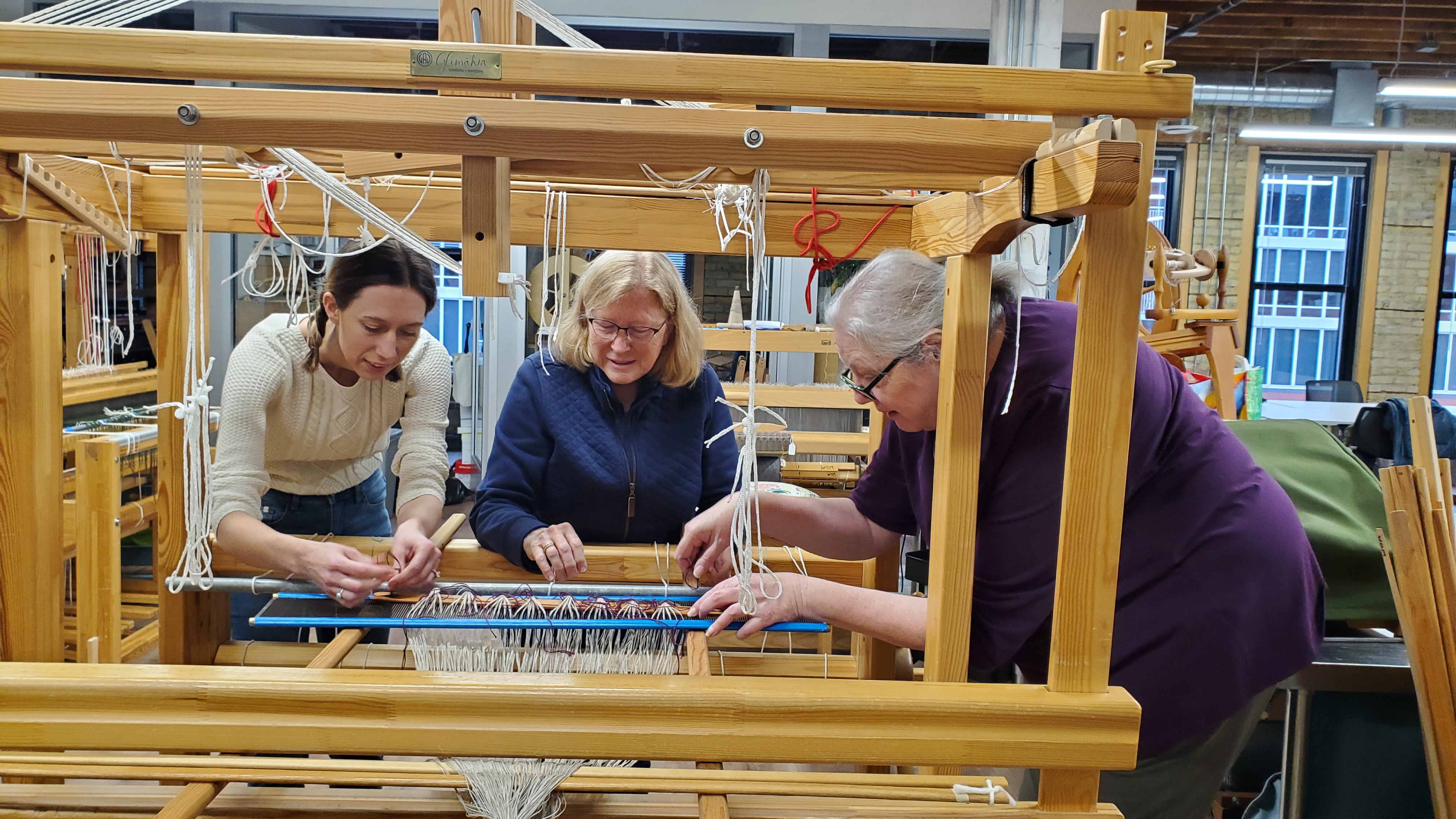
The Weavers Guild of Minnesota is equipped with two Glimakra looms for classes and group projects. The Scan Weavers generously dug into their stashes for the linen warp. At least 14 of us will weave on this warp, so it is quite long.
There’s nothing more beautiful than a plain linen warp. Note the slightly different colors that result from blending.
Warping is always more fun with a group! (Especially with coffee breaks.) Below, Lisa Torvik explains the benefits of pre-sleying the reed to newer weavers Holly and Beth.
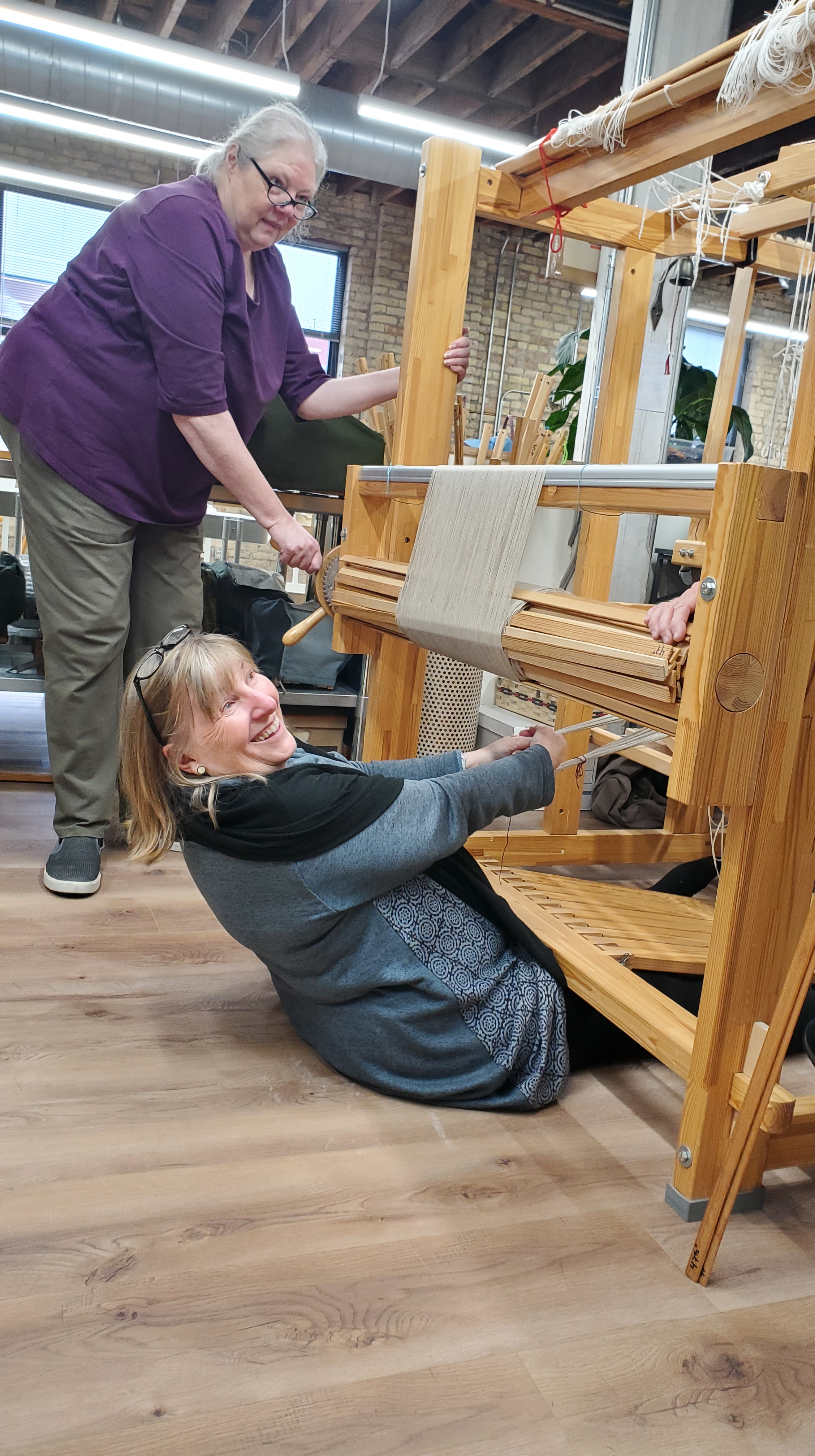
Patty Johnson demonstrates how she used to warp her Glimakra all by herself – controlling the warp tension while winding on the back beam. Fortunately, Lisa is there to help.
Lisa reminds everyone to spritz the linen warp with water to prevent breakage. (Lisa does this every time she advances the warp, which she does every three to four inches.)
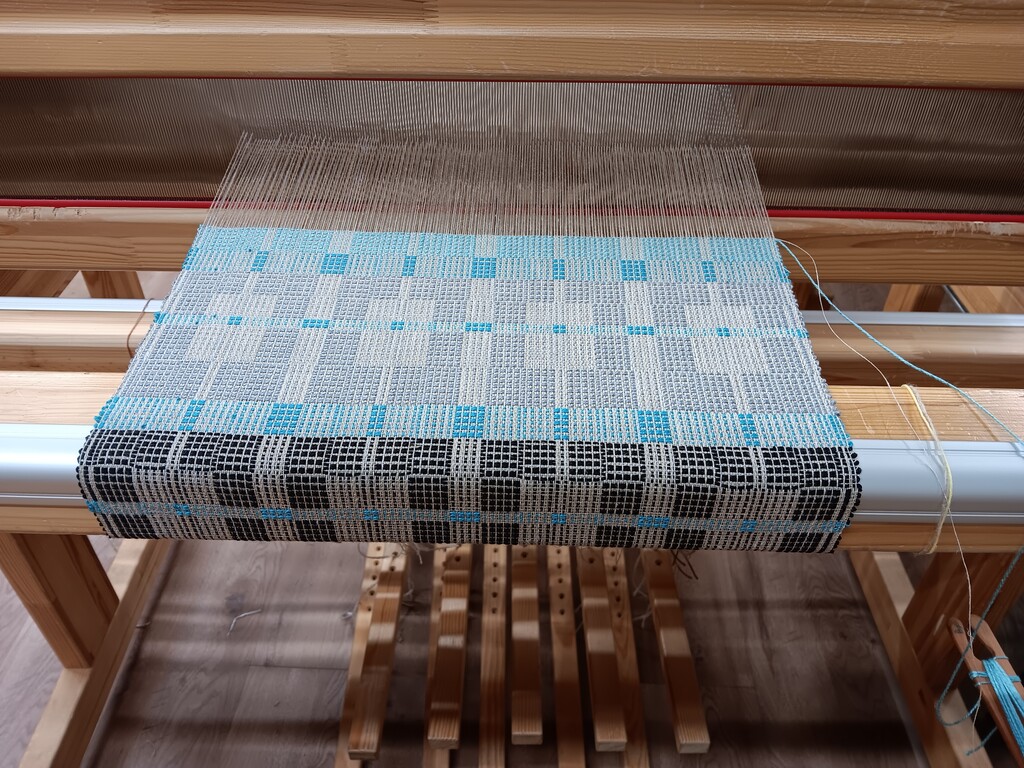
Lisa adapted the draft for towels and included four motifs across the width instead of three.
Lisa wove two towels in different colorways. For the first, she used 16/1 linen doubled on stick shuttles for the pattern weft and 12/1 linen for the ground shots.
For the second towel, Lisa chose to work with perle cotton for the pattern weft.
Stay tuned for more updates on this project. I like to think that Elsa Kerttu’s original design of multiple squares was inspired by the many small fishing huts in Kukkola.
Image of Kukkola from PinterestStock image
If you now want to visit Kukkola as much as I do, search online for the Kukkola Tourist and Conference Board. They say the area provides natural beauty, peace, and creative inspiration. What could be better for weavers?
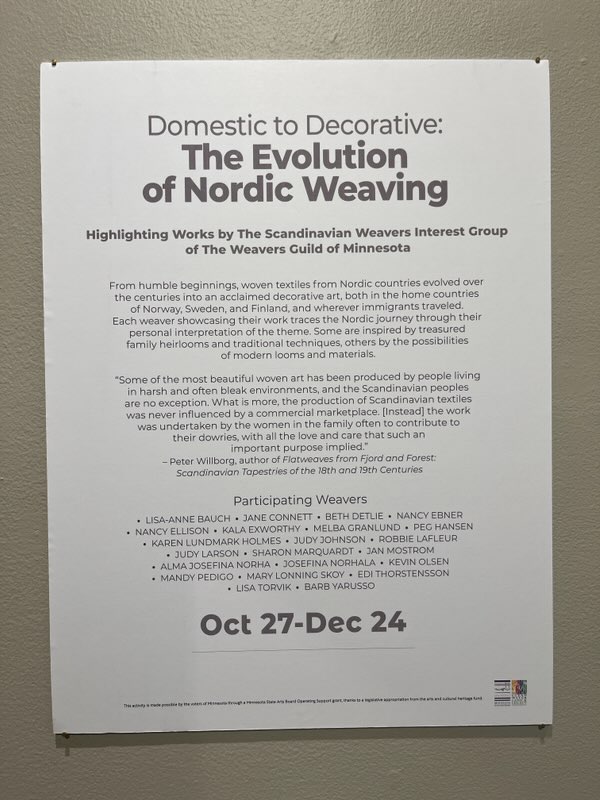
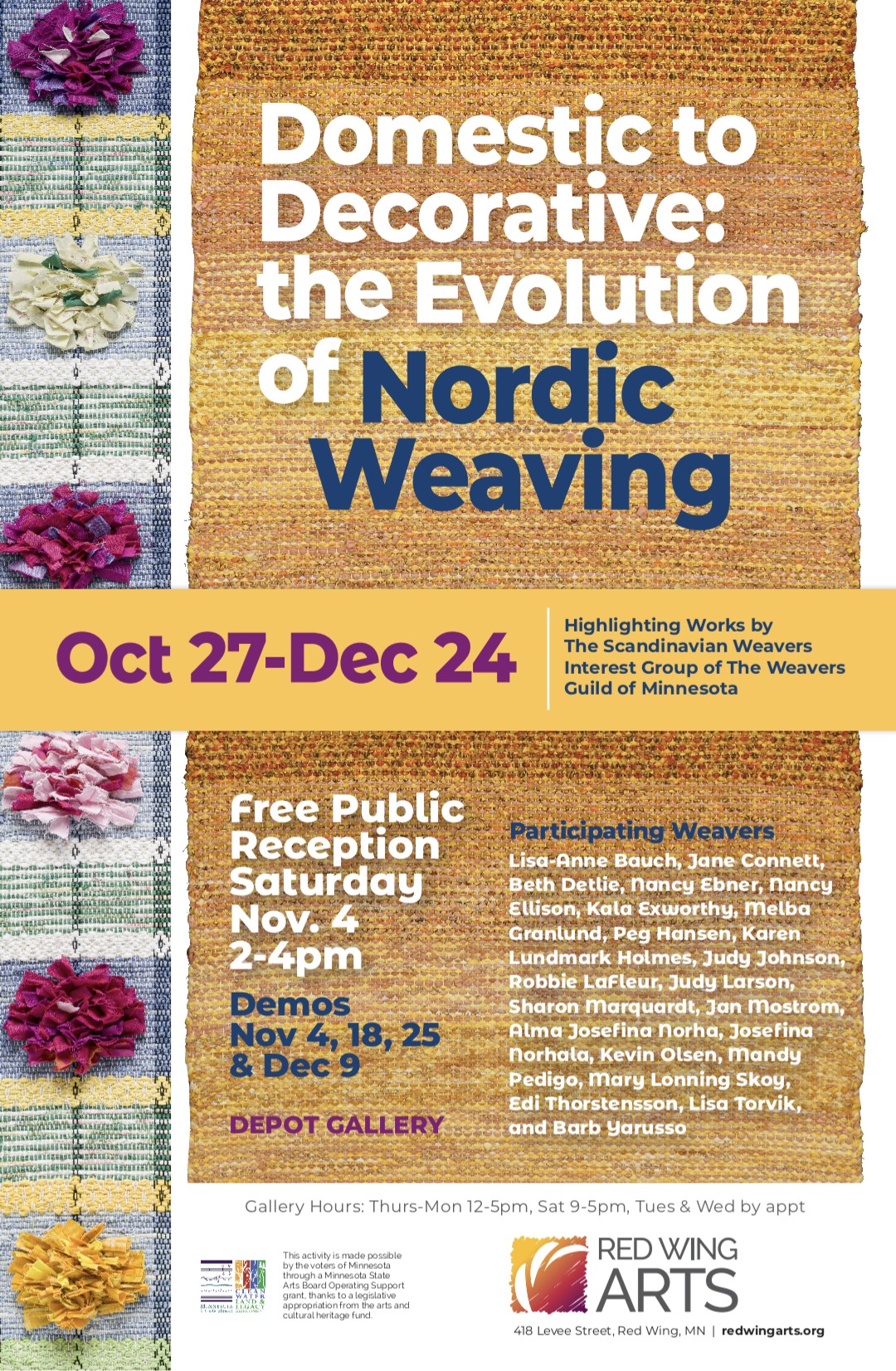
The Scandinavian Weavers’ new exhibit “Domestic to Decorative: The Evolution of Nordic Weaving” is now open at Red Wing Arts in Red Wing, Minnesota. The exhibit is free and open to the public during regular hours at Red Wing Arts. (Thursday through Monday 12:00 to 5:00 PM / Saturday 9:00 AM to 5:00 PM/ Tuesday and Wednesday by appointment)
Please join usfor a free Opening Reception on Saturday, November 4 from 2:00 to 4:00 PM. In keeping with tradition, Scan Weavers are baking seven different kinds of cookies for the event.
Also on November 4, Edi Thorstensson will demonstrate band-weaving on a hand-carved Swedish heddle from 10:00 to 11:30 AM. Nancy Ellison will demonstrate rigid heddle weaving from 1:00 to 3:00 PM. Additional demonstrations will be held November 18 (warp-weighted loom), November 25 (krokbragd on a rigid heddle), and December 9 (transparency weaving). Watch this space for further details.
Special thanks to Shawn Niebling at Red Wing Arts for shepherding this exhibit from concept to installation!
Visit Red Wing Arts in the historic train depot at 418 Levee Street in Red Wing, near the riverfront. (Yes, you can travel by Amtrak train to the depot.)
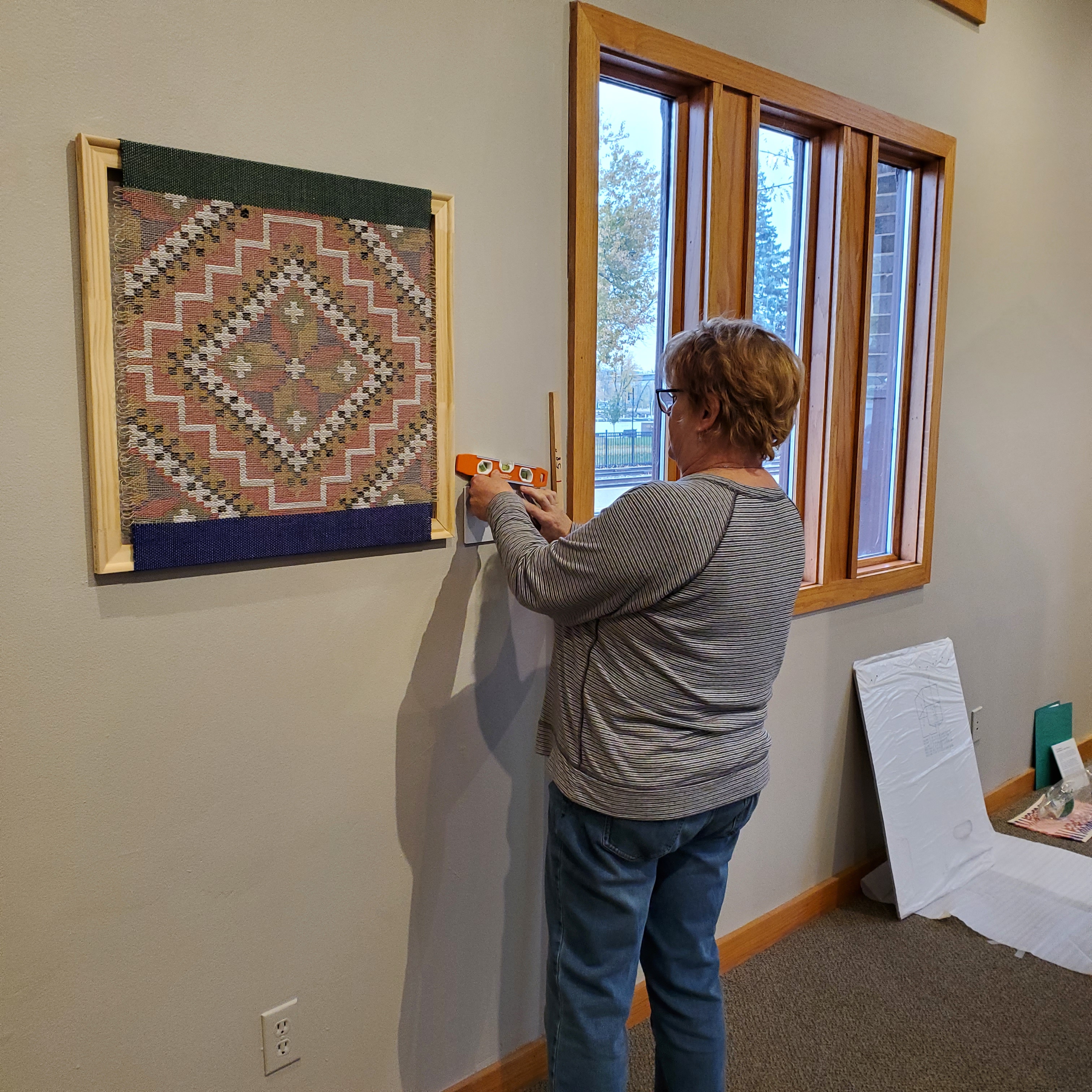
During the installation process, Peg Hansen carefully combs the fringe on Jan Mostrom’s beautiful weaving.Shawn Niebling expertly checking levels on Lisa Torvik’s transparency.Nancy Ellison’s rya weavings feature fleece from her flock of Icelandic sheep. (Photo by Peg Hansen)
Scandinavian Weavers NEW exhibit “Domestic to Decorative: The Evolution of Nordic Weaving” opens October 27 in the historic Depot Gallery in beautiful Red Wing, Minnesota! Many thanks to the wonderful staff at Red Wing Arts!



































 Scandinavian Weavers Study Group