Blog

  • Phyllis Waggoner’s Liturgical Textiles at Hennepin Methodist Church

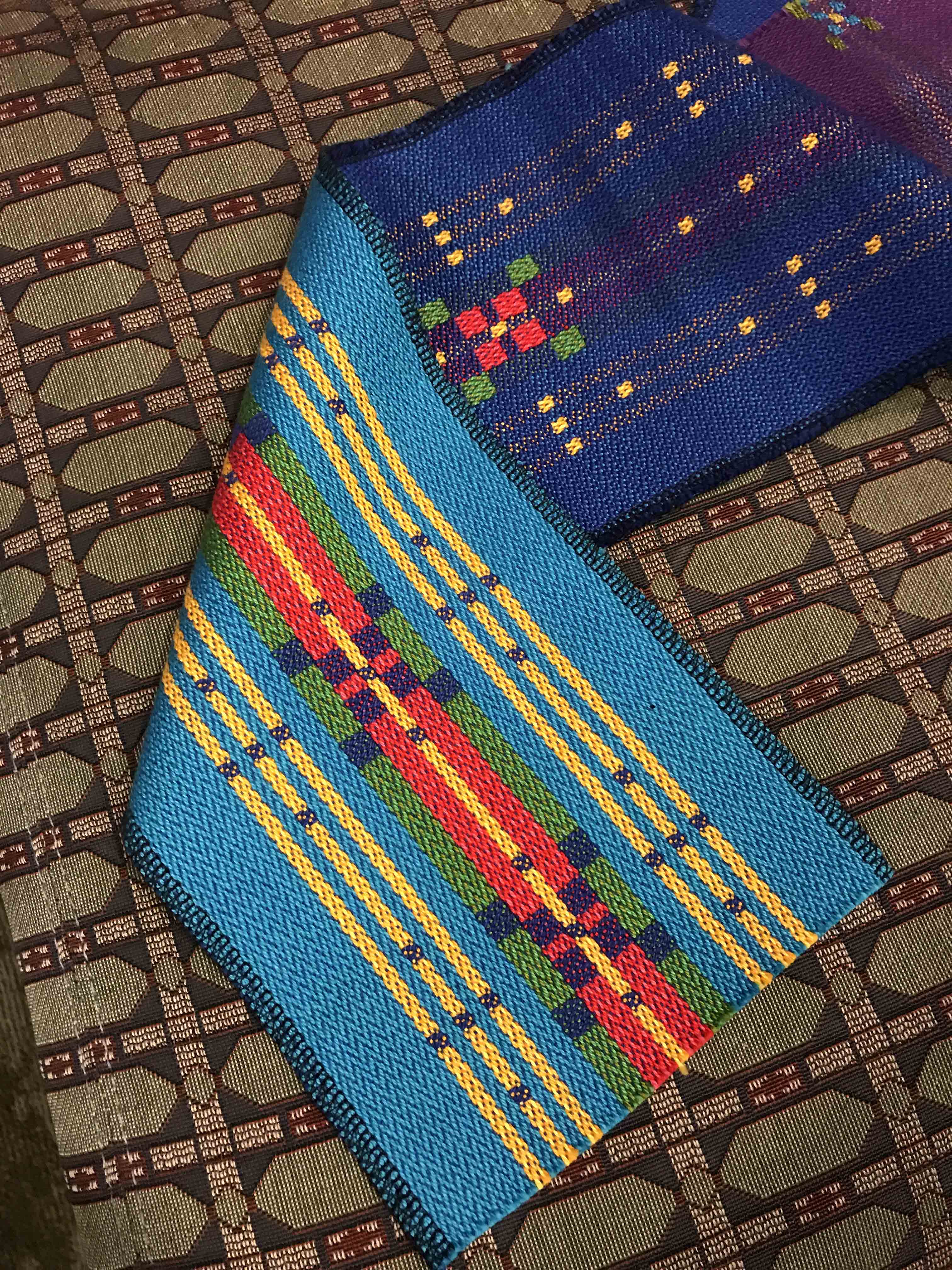
    Several members of the Scandinavian Weavers Study Group were lucky to get a private tour of an exhibit of Phyllis Waggoner’s liturgical textiles, on view at the Hennepin Avenue United Methodist Church through June 6, 2017. The display includes six sets of liturgical textiles she wove in cotton damask for the church 25 years ago, one for each of the liturgical seasons. They were woven in 10/2 mercerized cotton, at 30 ends per inch, on a 20 shaft drawloom, with the ground shafts tied for a 6 shaft false damask. This example shows the difference between the front and the back in the type of weave structure she used.
    contrast

    The labels in the exhibit give detailed information on the seasons and symbolism, but it was especially fun to hear Phyllis recount stories of their creation—inside stories that her group of weaving friends would understand.

    The first set we examined was green, the color of the long season between Lent and Advent, sometimes referred to as the “Sundays after Pentecost” or “Ordinary Time.” Phyllis wove many symbols, including grapes for wine and wheat for the wafers of communion. “I had to start all over on the wheat,” she admitted, as her first attempt looked like little trees.  Along the edges is a border of small squares that mimics the borders on the beautiful stained glass windows in the church.  Phyllis was in the choir, and each each Sunday she examined the windows during two church services,  imagining textile patterns.

    wheat

    The red set is for Pentecost, and they should be displayed only on that day. But people love red, Phyllis noted, so often they are up for more Sundays. Note the bright pops of color in the sections of squares; Phyllis said she was inspired by a Pentecost choral anthem sung by the choir with an electronic accompaniment. It was modern, with intermittent, distinct sounds meant to portray wind, flames and many languages all spoken at once.

    red-pops

    Planning, weaving and sewing all the sets of paraments took two years in all. It was for her own church and she said, “I was motivated. I strongly wanted to do it.”

    Though she was paid, it was hardly a living wage for the long project. But Keith Pierce pointed out, “If you worried about money, you would have been a lawyer.”

    In the pattern for the blue Advent textiles, the red rose is for the Virgin Mary.

    advent

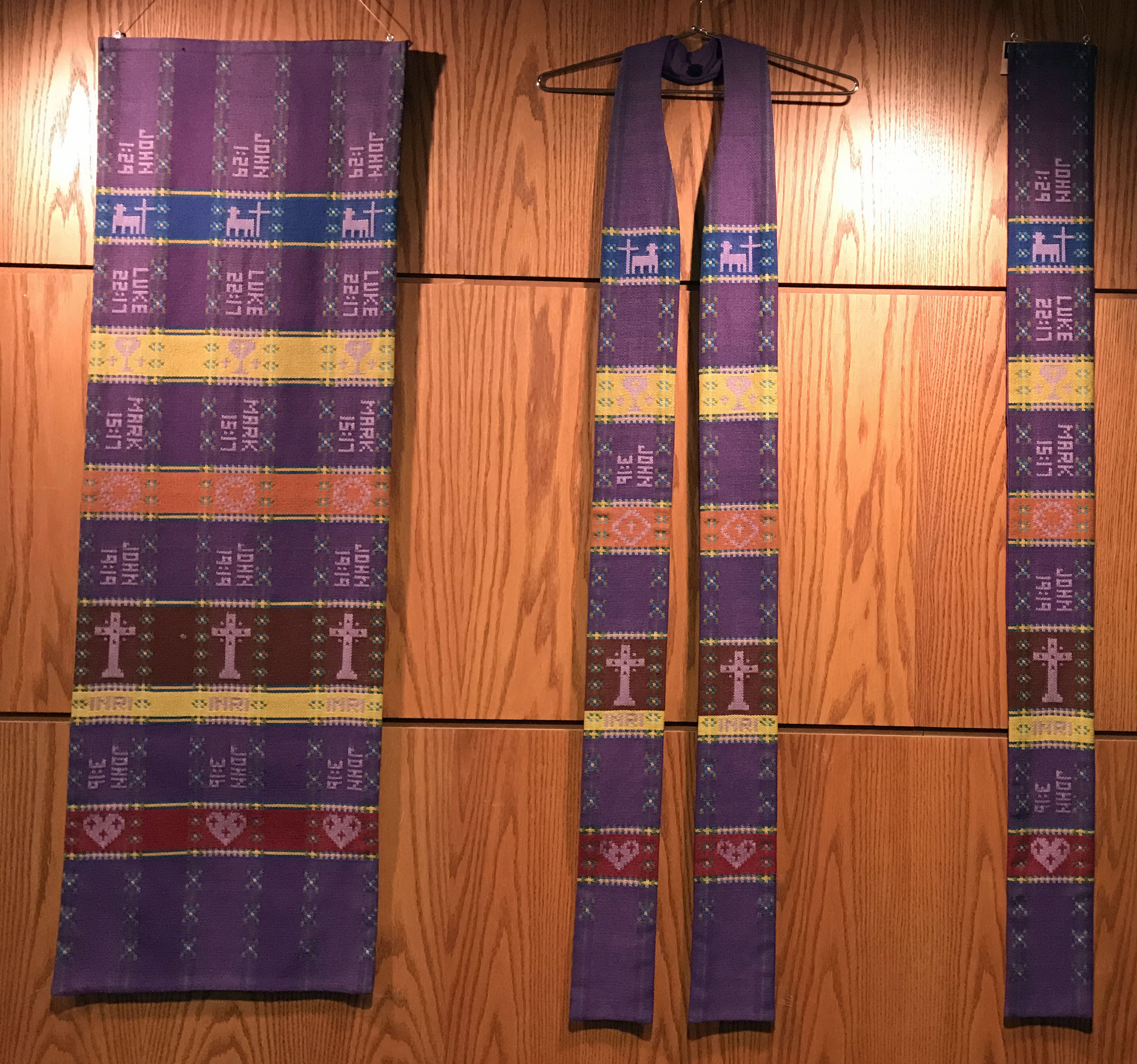
    When we looked at the purple Lent textiles, Phyllis felt compelled to point out a problem. “I messed up the lamb legs. Karen,” to which Karen replied that no, they all have four legs!
    purple

    The weaving looks difficult, but Phyllis minimized the complexity and emphasized the joy of draw loom weaving.  Examining one piece, she pointed out, “I just pull up when I want pink to show. It’s just pulling a cord. It’s fun! More important is the sett and beat so that the squares are equal.”

    The group was amazed at this large project.  “Did you run your designs past anyone?” someone asked.  No! Phyllis assured us.  Clearly, she was trusted.

    Through her weaving career, Phyllis made liturgical textiles for a number of churches in the Twin Cities and elsewhere, with her first paraments for Augsburg College. For  Concordia College in Moorhead, she was commissioned to weave challenging doublewoven sets in white and green, red and blue.  Each side was dominated by one color, so the same textiles could be turned over as the seasons changed.

    For a Lutheran church she wove a stole with a space-dyed warp. Unfortunately the pastor rejected it, saying it looked too much like tie-dye. Here, Phyllis holds a sample showing a space-dyed warp.

    space

    Whenever Phyllis undertook a commission, she took many photos of the pulpit and the area surrounding it, to get an idea of the architectural elements in place.  She aimed for textiles that wouldn’t stand out, but used designs to enhance the surroundings, rather than create too much visual contrast.

    For a Norwegian Church in South Dakota, she made a pulpit fall.  “In the old days,” a friend of Phyllis’s once explained, “the Bibles were so valuable that they were wrapped.”  That meant when the Bible was read during the service, it was unwrapped, and the “fall” draped over the front of the pulpit.

    This fall was on the pulpit when we visited.  “Look Mary,” Phyllis pointed out to Mary Skoy, “Do you see the Swedish knitting pattern in it?”

    swedish

    This work was inspiring; you might see a rash of drawloom weaving interest pop up at the Weavers Guild of Minnesota soon!
  • Traditional Norwegian Weaving: American Reboot

    Traditional Norwegian Weaving: American Reboot


    Traditional Norwegian Weaving: American Reboot

    An Exhibit at Norway House: July 20-September 10, 2017
    Sponsored by Norway House and the Weavers Guild of Minnesota


    Vesterheim-krokbragd
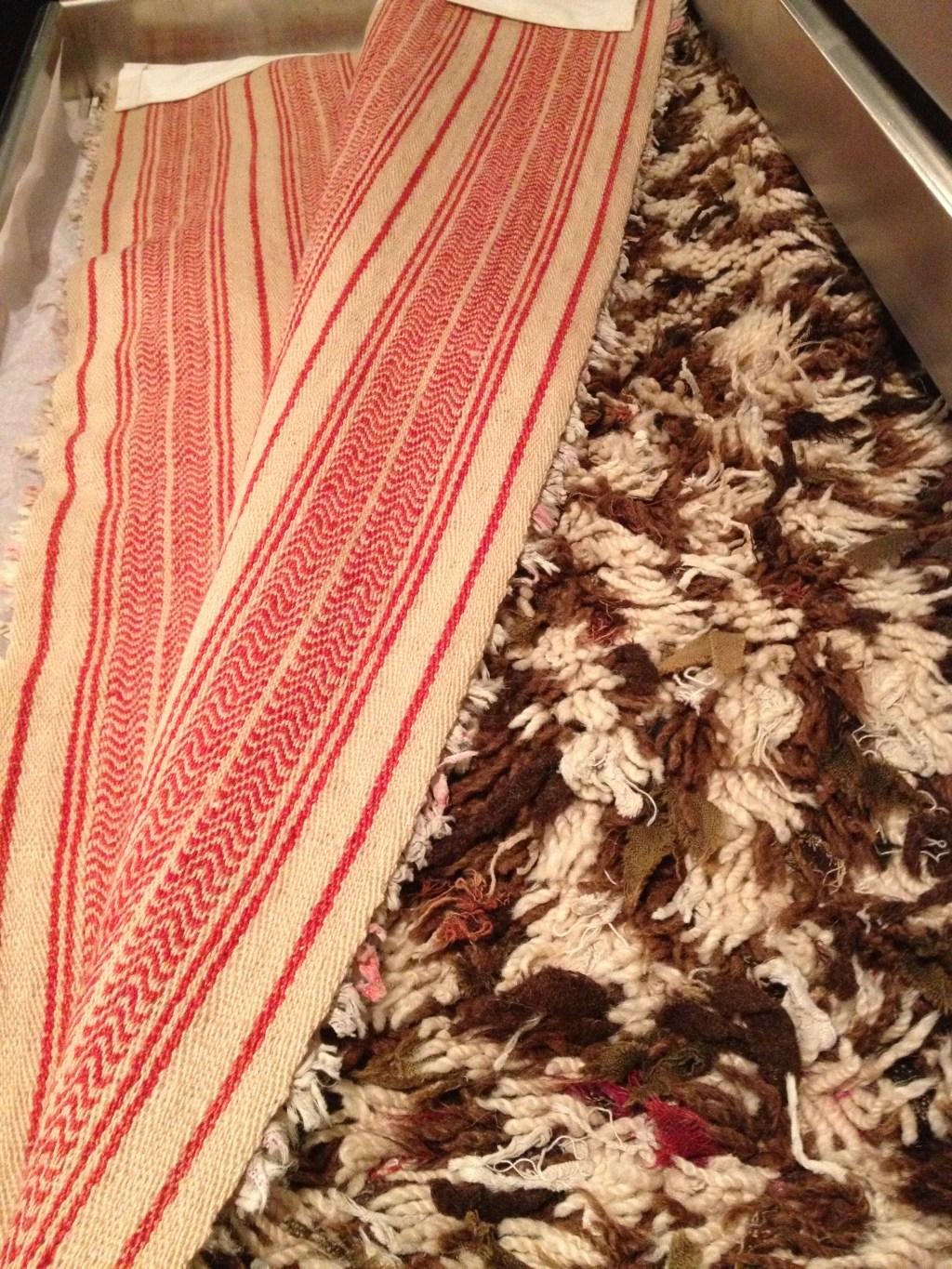
    A traditional krokbragd coverlet from the collection of the Vesterheim Norwegian American Museum

    Make Minneapolis your destination thus summer for an exhibit joining Norwegian weaving past and present. Inspired by historical textiles, American weavers have used Norwegian weaving techniques to create a new body of work, contemporary in design or materials. Enjoy traditional pieces from the collection of the Vesterheim Norwegian American Museum and outstanding weavings from recent decades that honor the past and break through with modern expression.  

    The exhibit of invited pieces (40 in all) is based around several techniques, including rya; tapestry; krokbragd and other boundweave variants; band weaving; and overshot weaves such as monks belt and skilbragd.  Other pieces are chosen to illustrate where American weavers learned their skills in Norwegian techniques, and where weaving in the Norwegian tradition has been exhibited over the years.

    Related events include lectures and classes and weaving demonstrations.  A loom will be set up in the gallery where members of the Scandinavian Weavers Study Group will weave a rutevev (square weave) runner.

    • Opening celebration: Thursday, July 20, 2017, 5-8 pm.
    • Gallery talks: Sundays, July 23 and August 13, 2 pm.
    • Weaving demonstrations: Wednesdays and Sundays from July 23-September 10, 12 pm-3 pm
    • Afternoon with an Expert, featuring Laurann Gilbertson, Curator, Vesterheim Norwegian-American Museum: Saturday, September 9, 1-3:30 pm.  Following the lecture, “Warmth and Color: Traditional Norwegian Coverlets,” Gilbertson will conduct an Antique ID clinic.  Members of the public are encouraged to bring Nordic textiles to learn more about their age, origin, and function (but no appraisals).   
    • Classes: Sami-style Band Weaving, Mondays, August 14 and 21, 12-4 pm; Make a Viking Knit Bracelet, Monday, July 24, 10 am-2 pm; Cardboard Loom Weaving for Kids, Monday, August 7, 10 am – noon.

    IMG_5189Information on the exhibit is also found on the Norway House website. Be sure to sign up for Sami-style Band Weaving with Keith Pierce, or Make a Viking Knit Bracelet with Melba Granlund. Maybe you know a kid to sign up for the fun introduction to weaving. This is a special opportunity to see the weaving exhibit in depth, as these Weavers Guild classes will be held at Norway House, right in the main gallery.

    Also, follow the Scandinavian Weavers Study Group blog in the coming weeks to read about many of the individual pieces.

    This 19th century “boat rya,” a treasure of the Vesterheim Norwegian-American Museum, will hang next to several contemporary rya weavings.


  • The Dukagång Experiment–Cut off the Loom

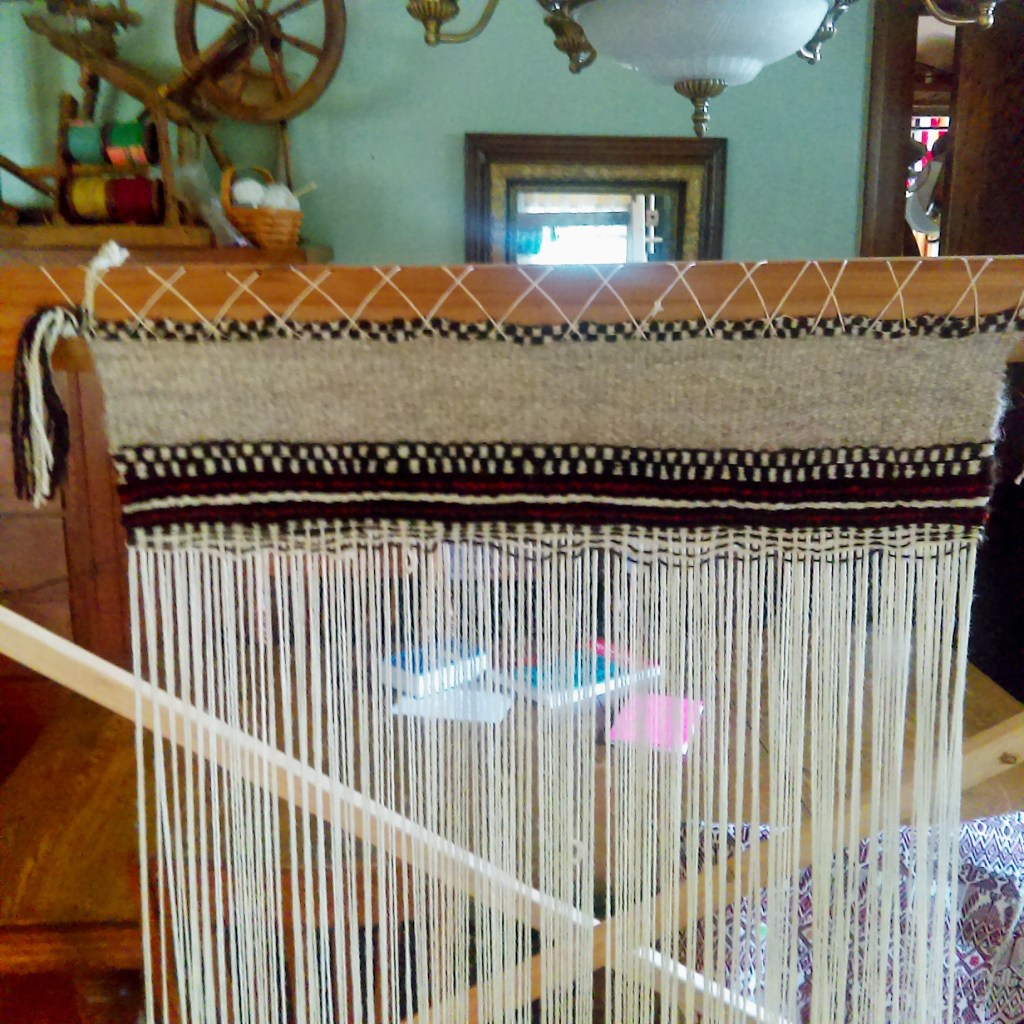
    Several curious Scandinavian Weavers Group members gathered to cut the dukagång group warp off the Glimakra last night.  It was so fun to see the completed pieces, right side up, and not just peeking from the back of the loom as they rolled around the beam.  Jan Mostrom, who should be duly thanked for her work setting up the project and getting the yarn, clipped it off. (There was a section of unwoven warp at the very end, which Lisa Torvik is going to use for firfletting.)

    IMG_3316

    Mary Skoy brought her sewing machine and sewed fine, straight seams between the pieces so they could be cut apart without raveling.

    IMG_3317

    Melba Granlund was the designated snipper.

    IMG_3319

    Oh, you wanted to see the individual pieces?  Coming soon.  They will be displayed on a wall of the Weavers Guild, and published here, on Friday.

  • Grene Demonstration on a Warp-Weighted Loom

    Grene Demonstration on a Warp-Weighted Loom

    Melba Granlund set up a warp-weighted loom (courtesy of the Vesterheim Norwegian-American Museum) at the 2017 Shepherd’s Harvest Festival, as part of the Weavers Guild of Minnesota booth.  She started work on a traditional Sami-style grene, a banded coverlet technique woven with thick, lofty wool.  It was a smashing success!  Though she planned to give a formal presentation at one point, that never happened.  Instead, she was inundated with questions from curious visitors from beginning to end.  And all that didn’t leave time for much actual weaving progress, only about 4-1/2 inches.

    melba-grene

    With the festival over, and the loom moved back to her home, Melba is continuing the project.  Watch the blog for updates on the grene, and a description of the wonderful yarn she is using.
    melba-grene-2

    Did you miss this cool loom at the Shepherd’s Harvest Festival this year?  There’s always 2018.  Melba said that there was so much interest that a warp-weighted loom demo would be great for next year, too.

  • Favorite Pattern Motif so Far? Stars.

    Favorite Pattern Motif so Far? Stars.

    On our Scandinavian Weavers group warp, three people have chosen to weave stars.  Recently, Lisa Torvik’s star peeps out as Sara Okern weaves a blue star.

    IMG_2579
    Lisa Torvik’s bright and festive star pattern
    IMG_2576
    Sara Okern said this was the first time she has woven anything but a rag rug.  Success! 
    IMG_2578
    Sara wove a blue star.
  • Norwegian Yarn in the Swedish Dukagång

    Norwegian Yarn in the Swedish Dukagång

    Karin Maahs finished her piece, and her pattern weft was sentimental. She used thin Norwegian yarn her grandmother used to embroider bunads (Norwegian costumes).

    One day her pattern was sitting on the loom. “Oh nice, that’s what was just finished,” I thought as I snapped this photo.  Clearly I had not looked carefully, as that was the just completed piece, and Karin’s pattern ready to start.  Weaving from the back makes this process hard to document!

    karin2

    Here’s Karin’s piece, underway.  It will be nice to photograph all the pieces once they are off the loom.  For now, it still looks great at this weird angle.

    karin


  • A Dukagång among Friends

    A Dukagång among Friends

    Patty Johnson, Jane Connett and Judy Larson whipped out their dukagång in record time.

    17426249_10208969849945003_5122056684819950562_n
    Judy and Jane figure out the pattern.
    17553457_10208973372313060_4273208060765423849_n
    Patty helping out under the loom
    17554511_10208969917626695_3559845606546420303_n
    Their pattern revealed from below
  • Skinny Woman, Fatter Man?

    Skinny Woman, Fatter Man?

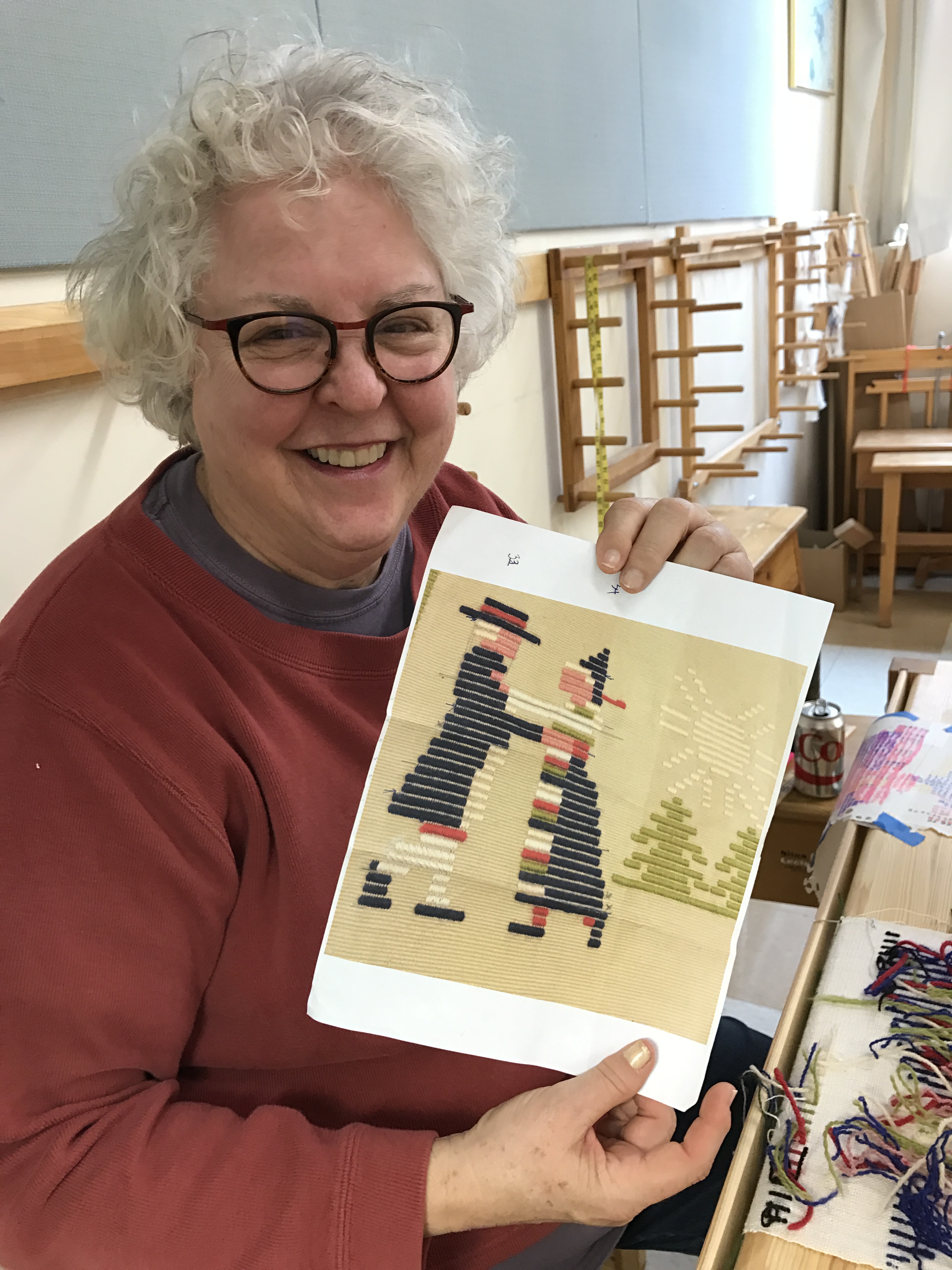
    Mary Skoy is working on her dukagang piece this weekend, weaving a dancing couple from a piece at the American Swedish Institute.

    IMG_2296

    She was using four shots of pattern yarn to make a square, with only one shot of background weft between each pattern shot.  This resulted in a skinny woman! For the man, she is switching to five pattern shots per square; it will be interesting to see how that changes the pattern.

    IMG_2300

    She’s using a variety of wools from her stash for the pattern; sometimes two strands of Harrisville Highland (blue) or a single strand of a fatter knitting yarn (red and white).

    IMG_2302

    Mary placed a white piece of fabric on the piece below the loom, when she discovered that the lint from the linen was falling on the piece below.

    IMG_2298

    Mary’s weaving experience was great, although once she congratulated herself for weaving with no broken threads– snap went a selvedge thread.

  • Dukagång Group Project Underway

    Dukagång Group Project Underway

    By Robbie LaFleur

    Last year and this year our Scandinavian Weavers study Group is focusing on Swedish weaving, with a particular interest in linen.  We’ve begun a group project on one of the two Glimakra looms at the Weavers Guild of Minnesota.  We put on a 12″ wide warp of 20/2 half-bleached linen, set at 24 epi, to experiment with dukagång. Jan Mostrom deserves special thanks for ordering the yarn and winding the warp.

    jan-wind-warp

    Jan and Phyllis Waggoner warped; Melba Granlund helped, too.

    jan-phyllis-warping

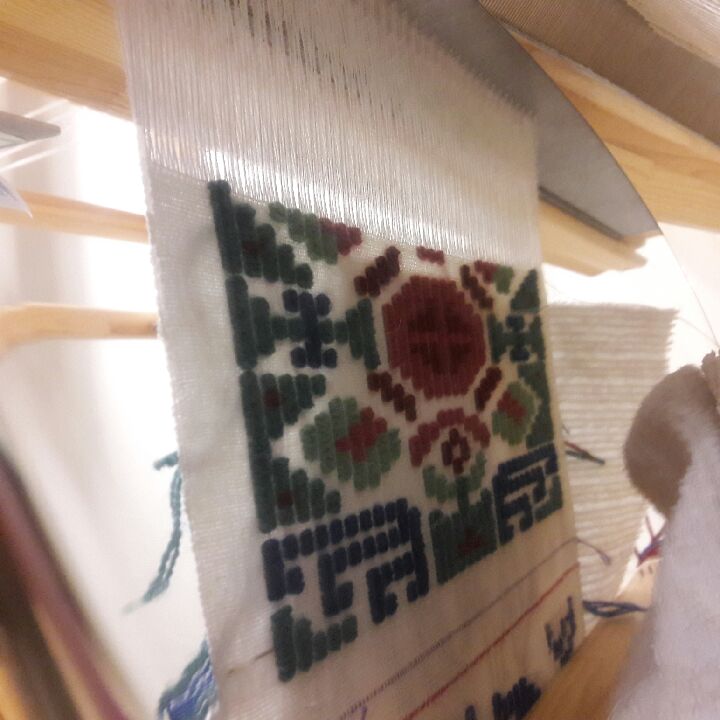
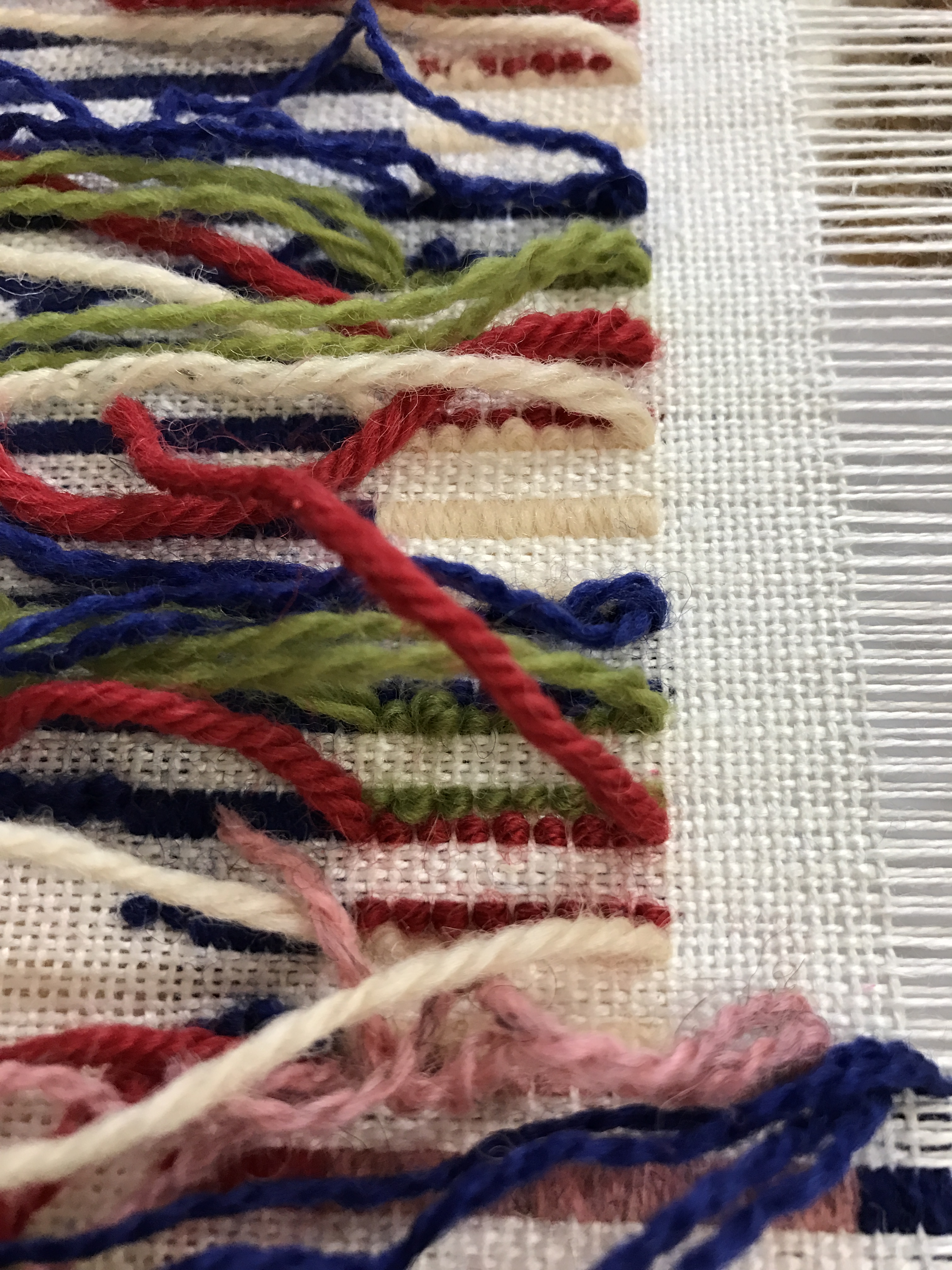
    Their efforts resulted in a even-tensioned warp with a beautifully wide shed. Each of 12 weavers will weave 12-18″. I was the first to test the warp, and I chose an image I frequently weave — can you tell from the back? Dukagång is woven from the back.

    scream-back

    Jan Mostrom was the second one to weave, and the right side of my piece peeked at her as it wound through the loom. Now you’ll get it.

    scream-under

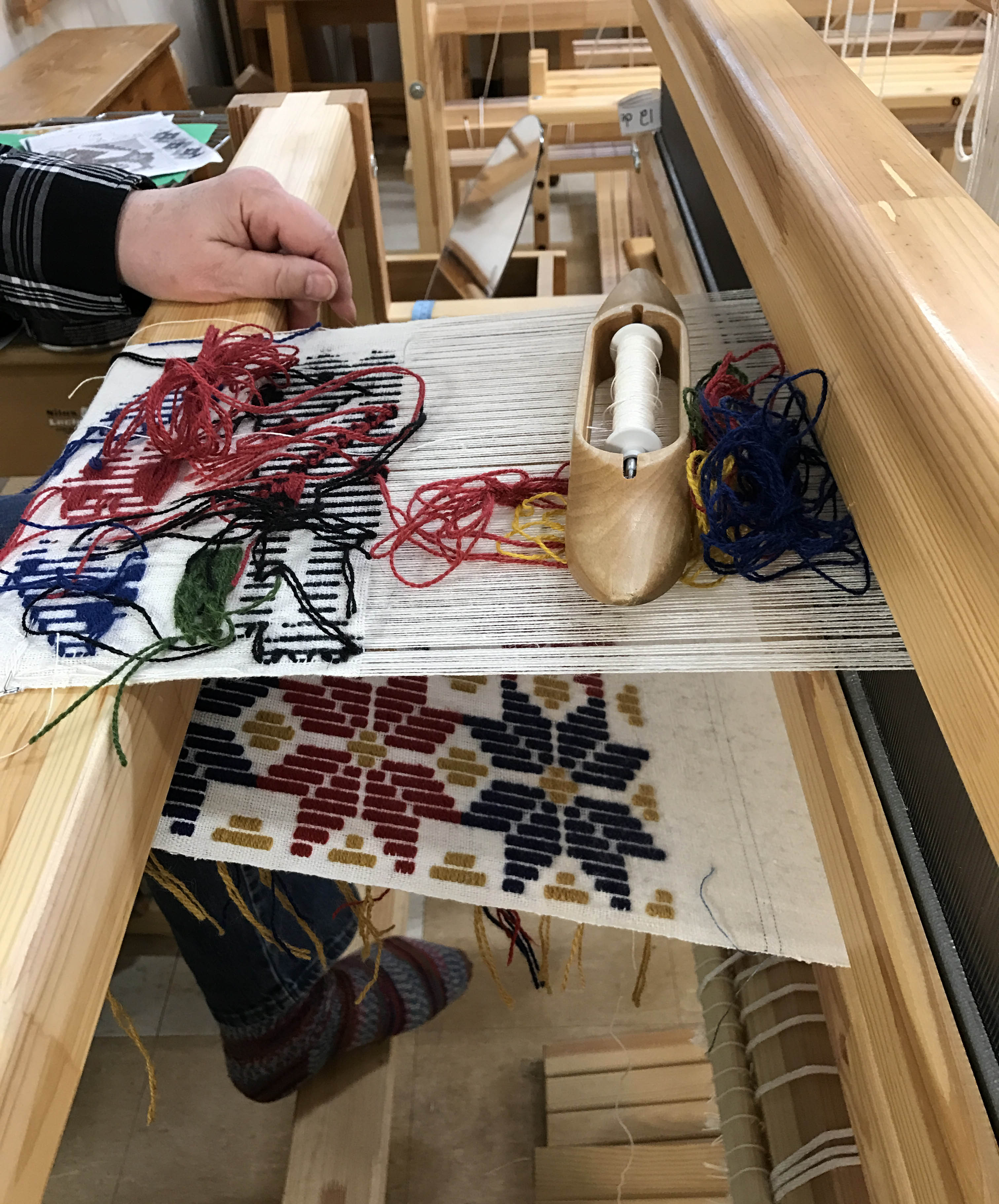
    Jan Mostrom was next on the loom; look at her beautiful stars–or as much as you can see, at this point. Melba Granlund was the third person to weave; you can see the back of her piece here.  A little hard to decipher…

    jans-stars

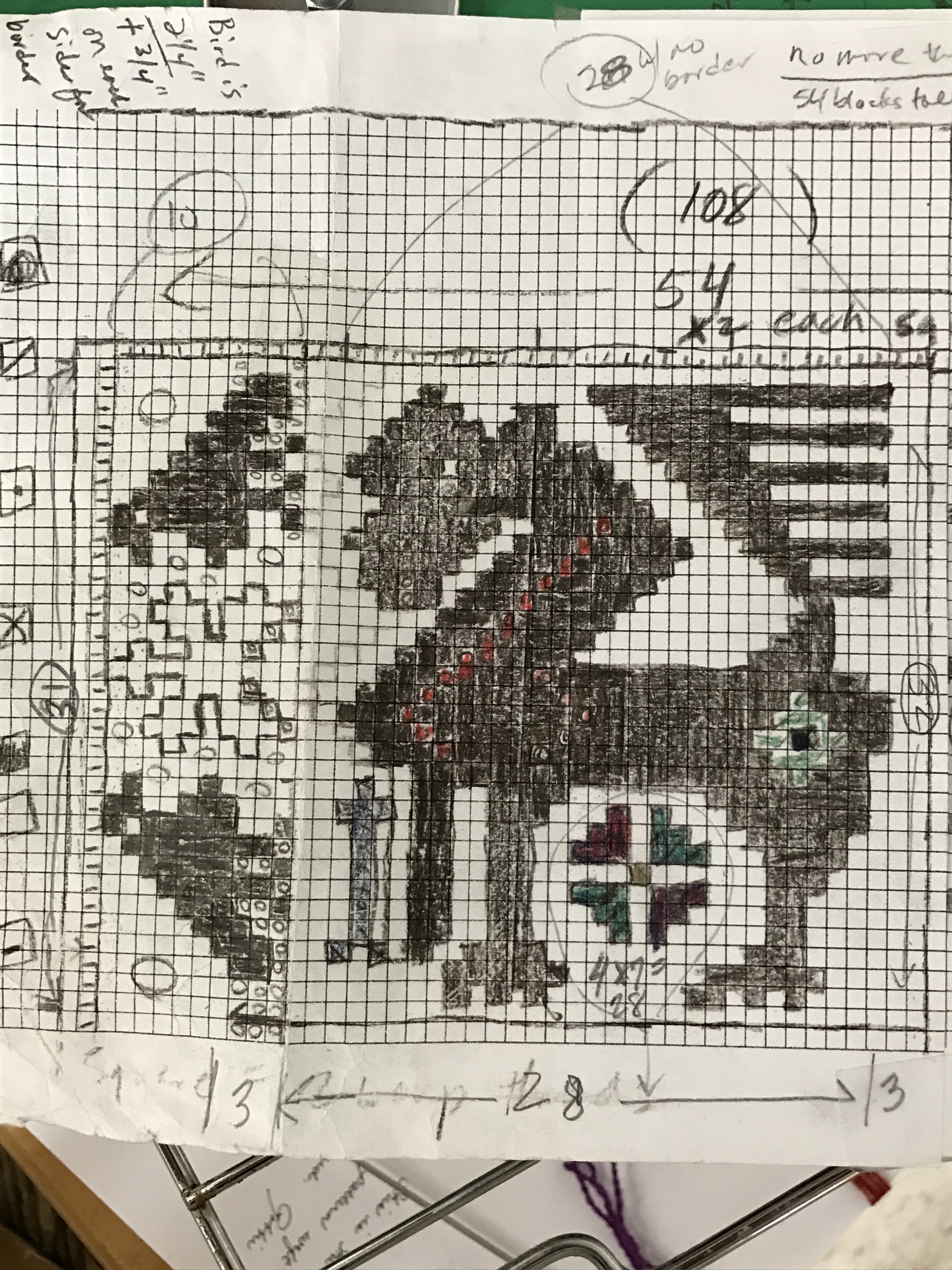
    Here’s Melba’s pattern: birds, a fabulous griffin, and a stylized floral border.

    IMG_2245

    A problem with weaving grid-based patterns is remembering where you left off.  I solved it by highlighting each new row before I wove it.

    scream-grid

    Melba’s system was more ingenious.  She asked her husband, “Don’t you have a magnetized clipboard?”  Shortly after, he came from the basement with a tool, a discarded metal refrigerator rack with a strong magnet. Melba moved the pattern as she finished each row.

    IMG_2246

    I’ll share more photos as this magical warp progresses, and the cut-off day will be super fun.


  • Show and Tell

    Show and Tell

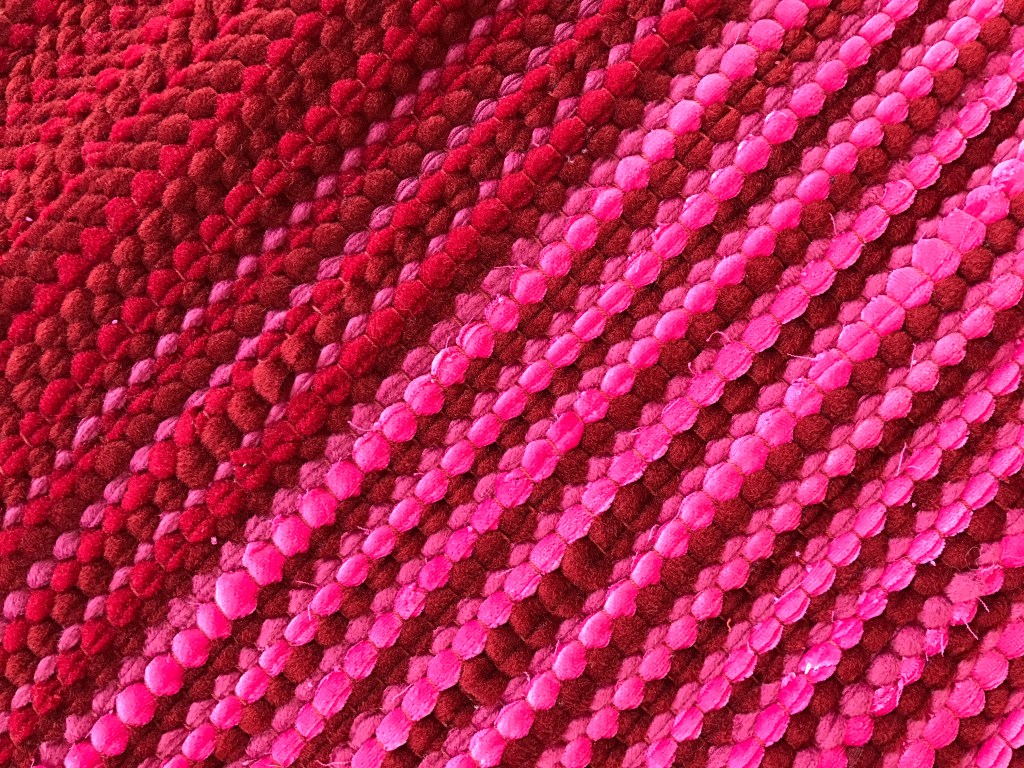
    At the Scandinavian Weavers meeting yesterday we enjoyed Judy Larson’s latest red rugs. Judy often weaves LARGE rugs, but these were small ones, using wildly different wefts, on the same warp.  She wove one with chunky weft of knit ties, part of an 8000-tie stash from a man who worked at the Library of Congress, and never wore the same tie twice. The second one has sharp pink with red, and is made with silky-soft velour strips—her granddaughter’s favorite.  The third uses the most conventional rag rug weft, printed cottons.  Fun!

    judys-rugs