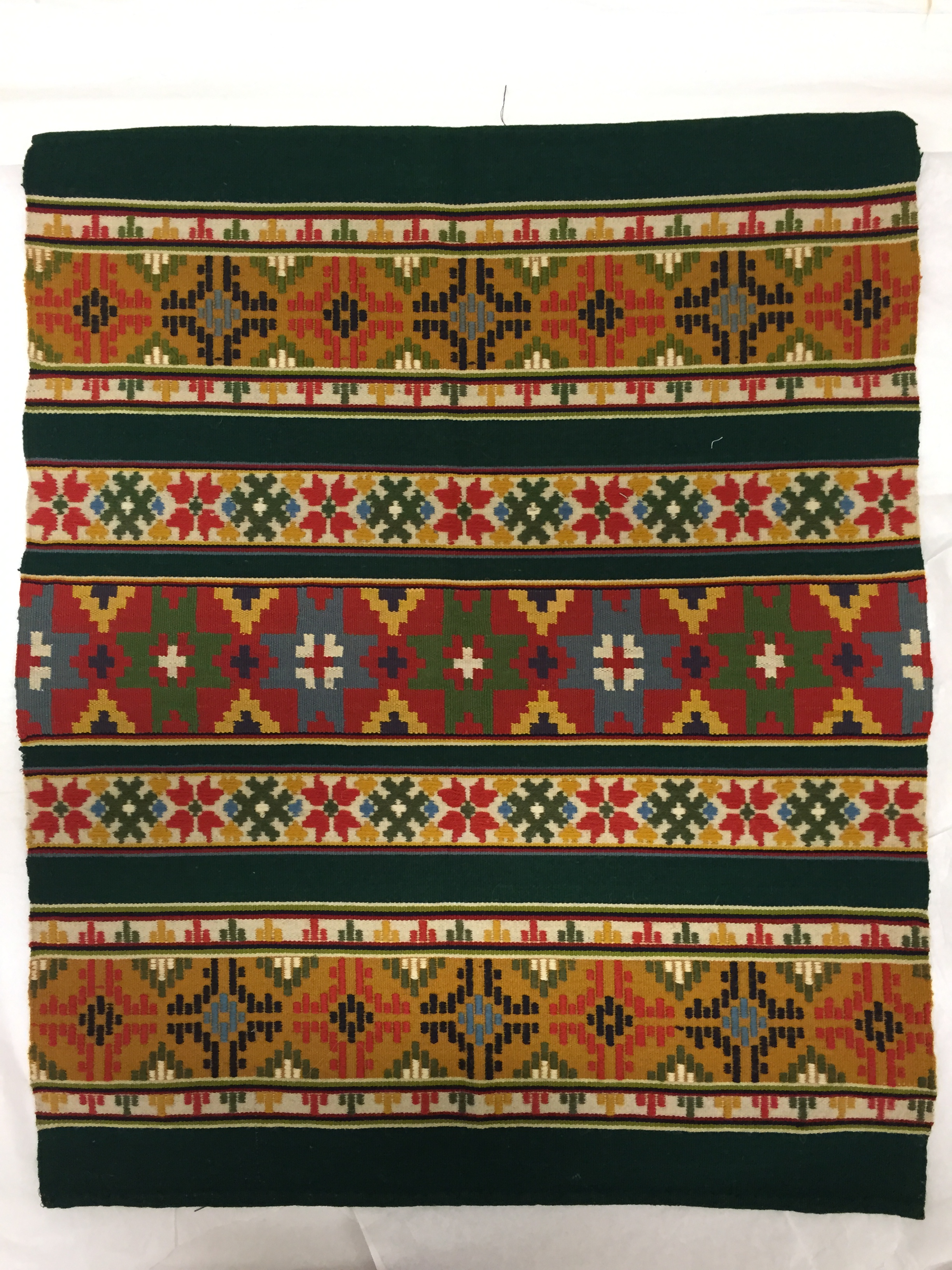
This week Phyllis Waggoner, Jan Mostrom, and I looked at many Swedish Art Weave pieces owned by the American Swedish Institute, to prepare for our upcoming Scandinavian Weavers Study Group meeting and choose which ones to take out for display. As you might guess, we chose almost all the pieces we looked at, except in one category. The ASI owns many 20th century pieces that are similar in pattern. They were sold through Hemslöjd in Sweden in the 20th century. Though beautifully executed, if you see a couple, you get the idea. In contrast, the older, more one-of-a-kind weavings in the collection seemed to merit more individual study and comments.
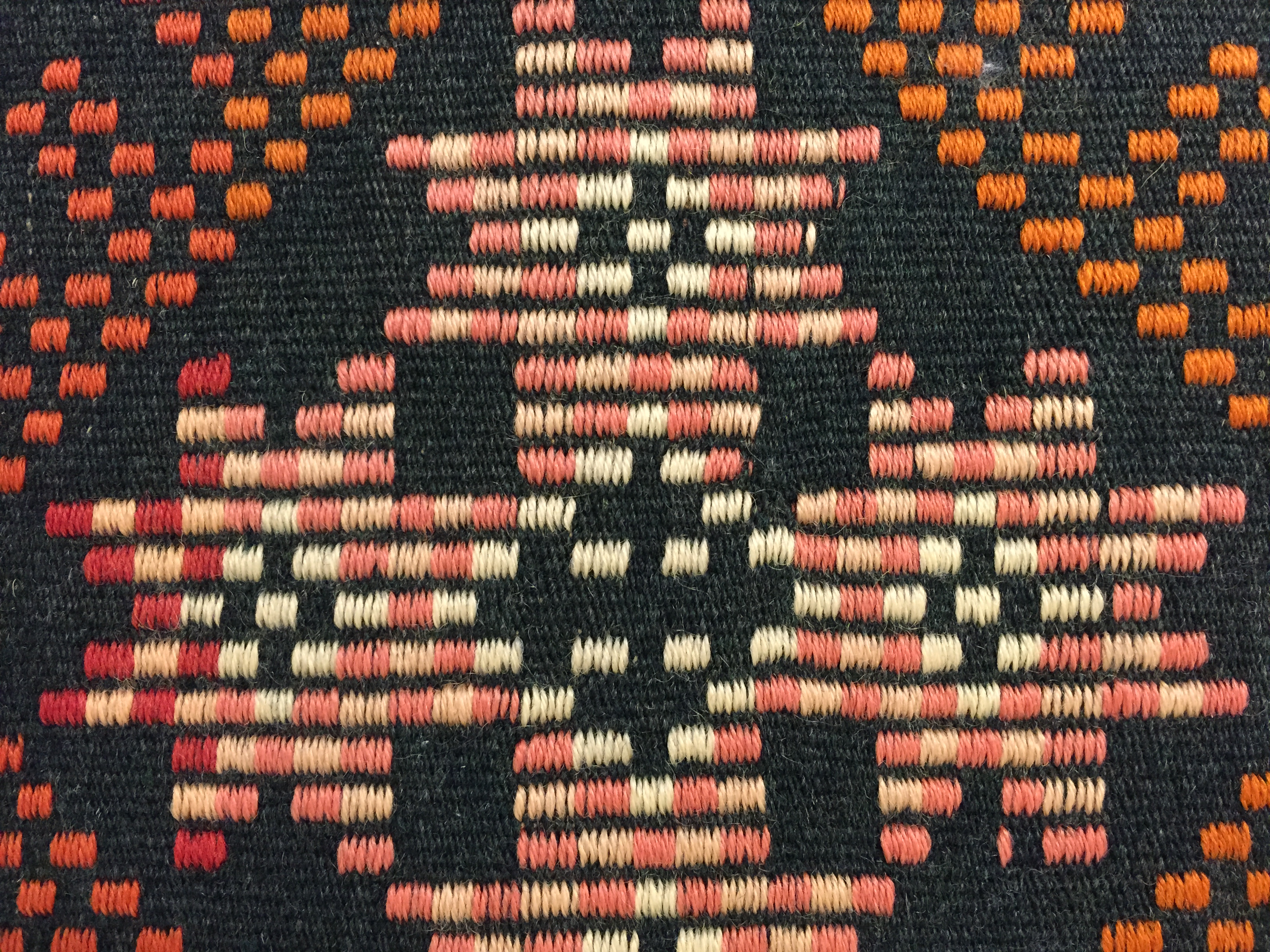
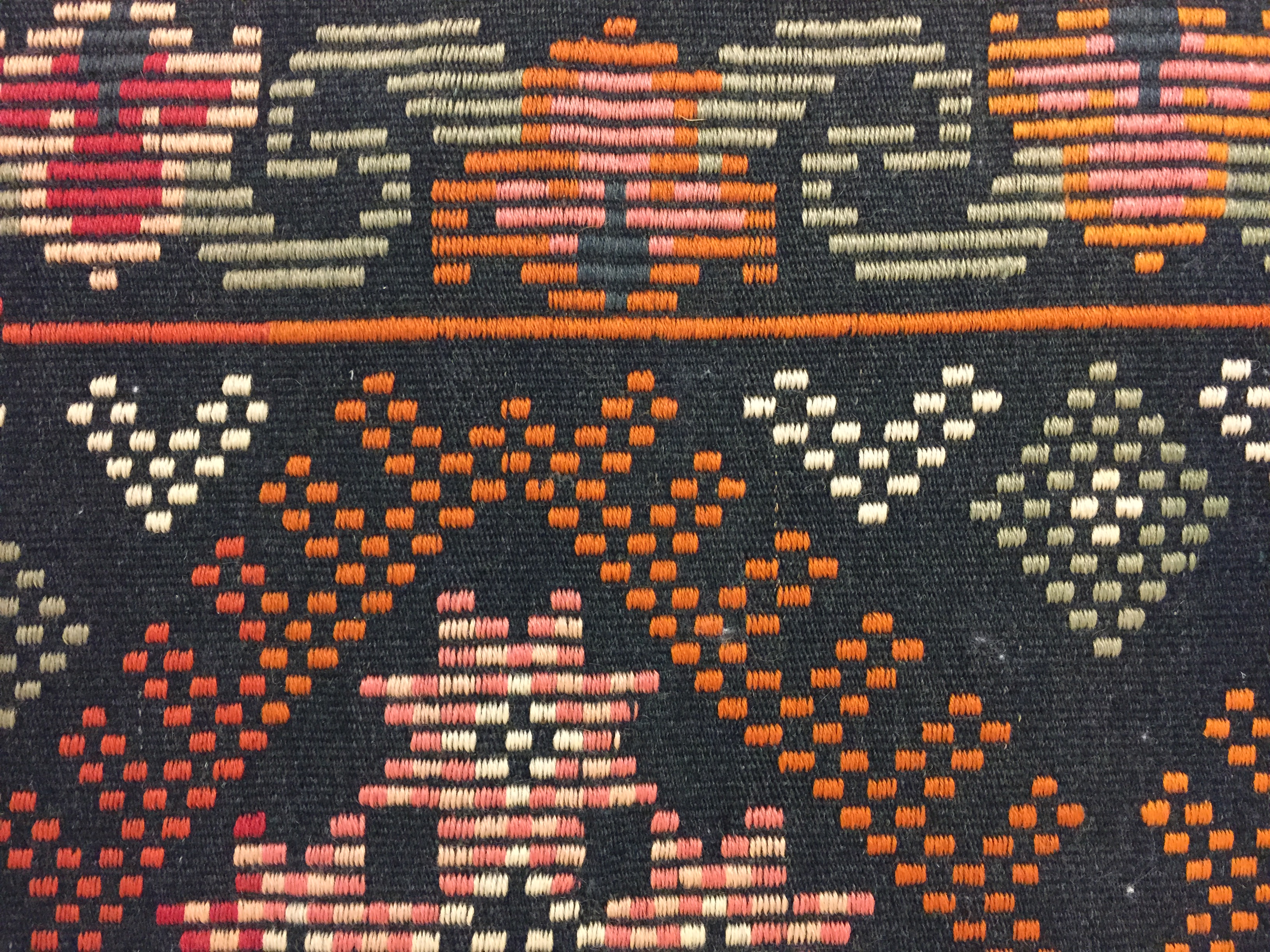
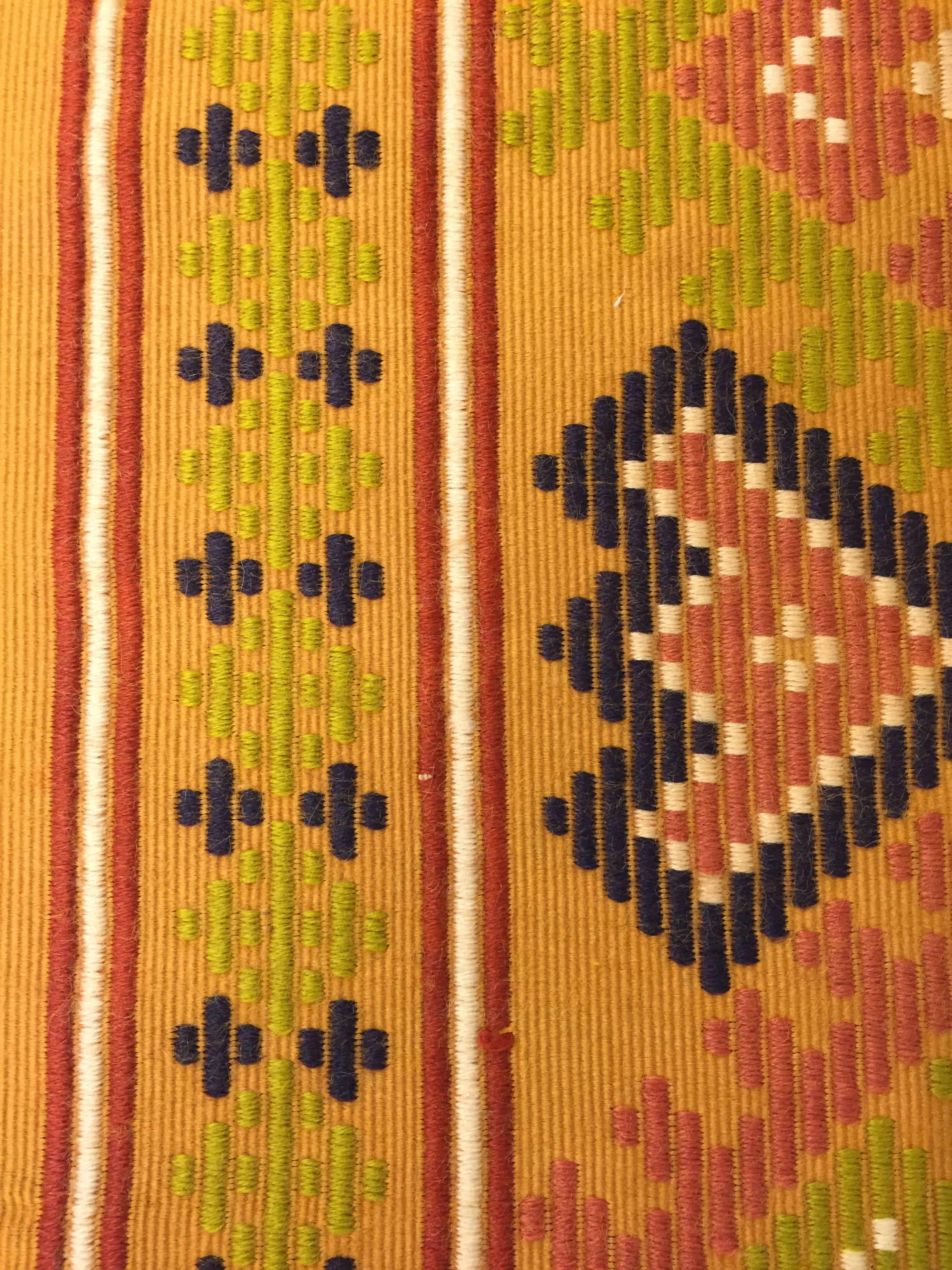
This post includes a few detail shots of the pieces and some comments. Later, we will post better, full-piece shots. This is just to whet you appetite!
We came up with a few general observations. The sett for the tabby background on the Swedish brocaded pieces was uniformly fine, not less than ten ends per inch, and in one case, about 19 ends per inch. The wool used was a single ply, thin wool, which in some cases may have been used double-spooled in the background. The brocaded patterns were woven with multiple strands, from 2-5.
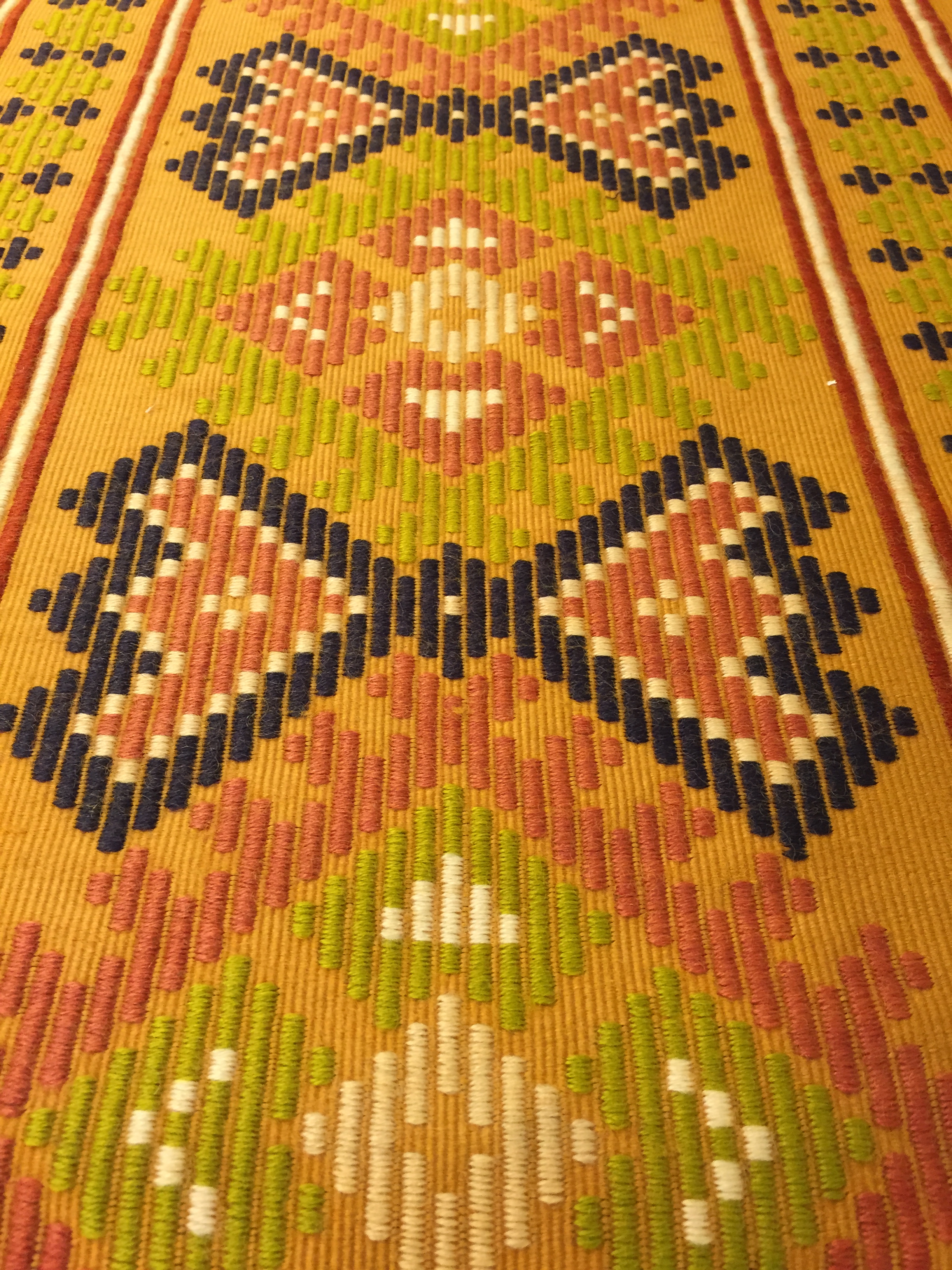
The first piece we looked at had a bright modern flair. The abstract patterns included many colors, and some of them, like a light turquoise, seemed unexpected. This piece is in dukagång. It’s easy to recognize patterns woven in dukagång by their columnar appearance created by the tie-down thread. In the pieces we looked at, most dukagång patterns floated over three threads and under one, but we saw one with over two, under one, and one with over four, under one.
Most likely, all the pieces were woven with the back side up. Uniformly, the workmanship was lovely. Here’s the back side.
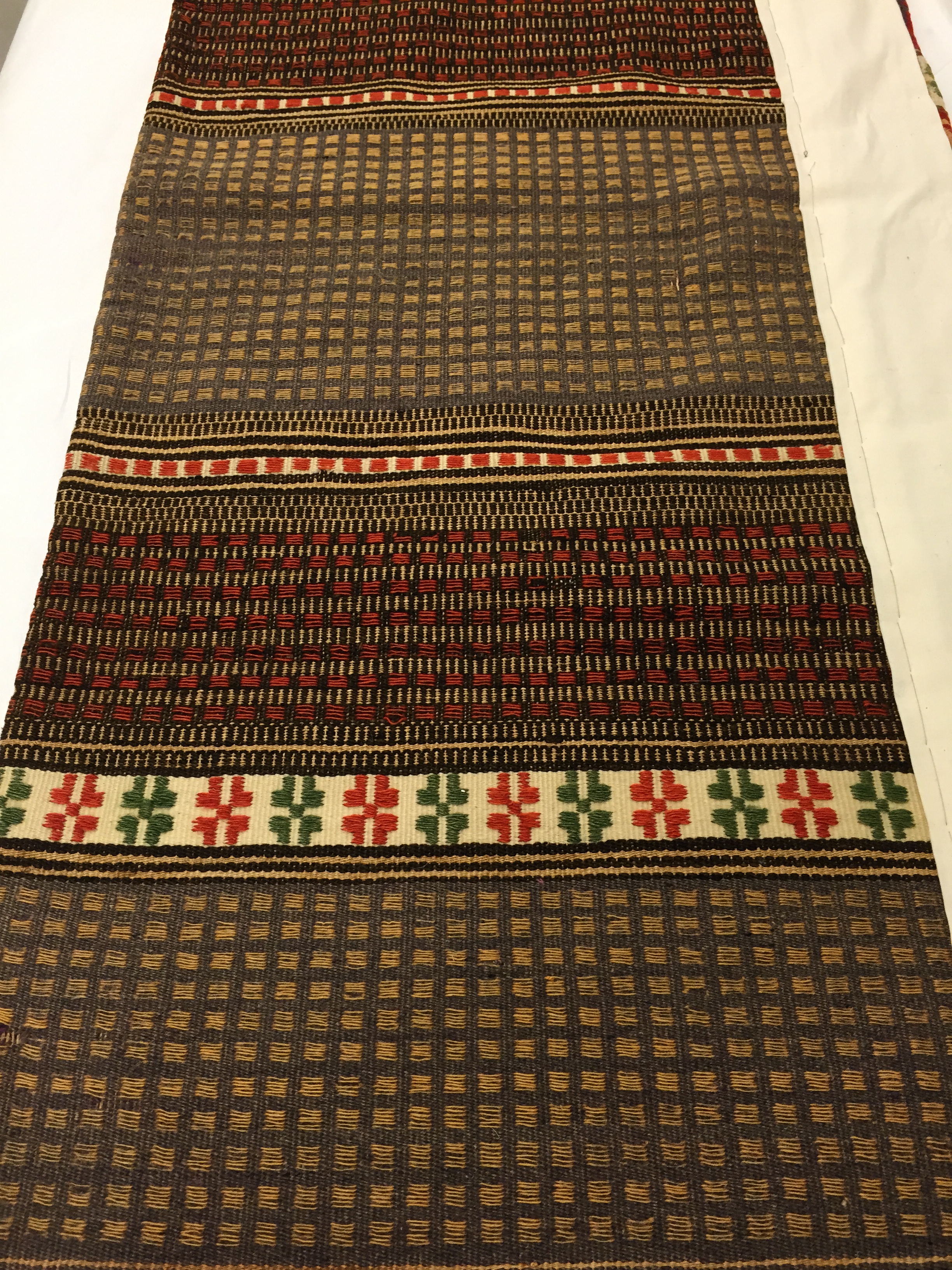
Phyllis imagined that a brown piece with a simple art noveau pattern may have elegantly draped over a piano. In this piece we guessed that the rich brown-black sections were woven double-spooled, with a brown and black thread mixed.
We looked at wool draperies woven for the Turnblad mansion, with brocaded borders. (No photo at this time.)
Some pieces had sections of rolokan, like the Norwegian rutevev, or square-weave technique.
On this piece we puzzled over a change in color near the beginning of the piece. Was the weaver just testing before settling on the desired color combination? Also, it was a long piece, unhemmed on either end. Perhaps it was woven to upholster something?
This piece also demonstrates how dukagång is used to weave a less rectilinear pattern with curves; it’s along the edge.
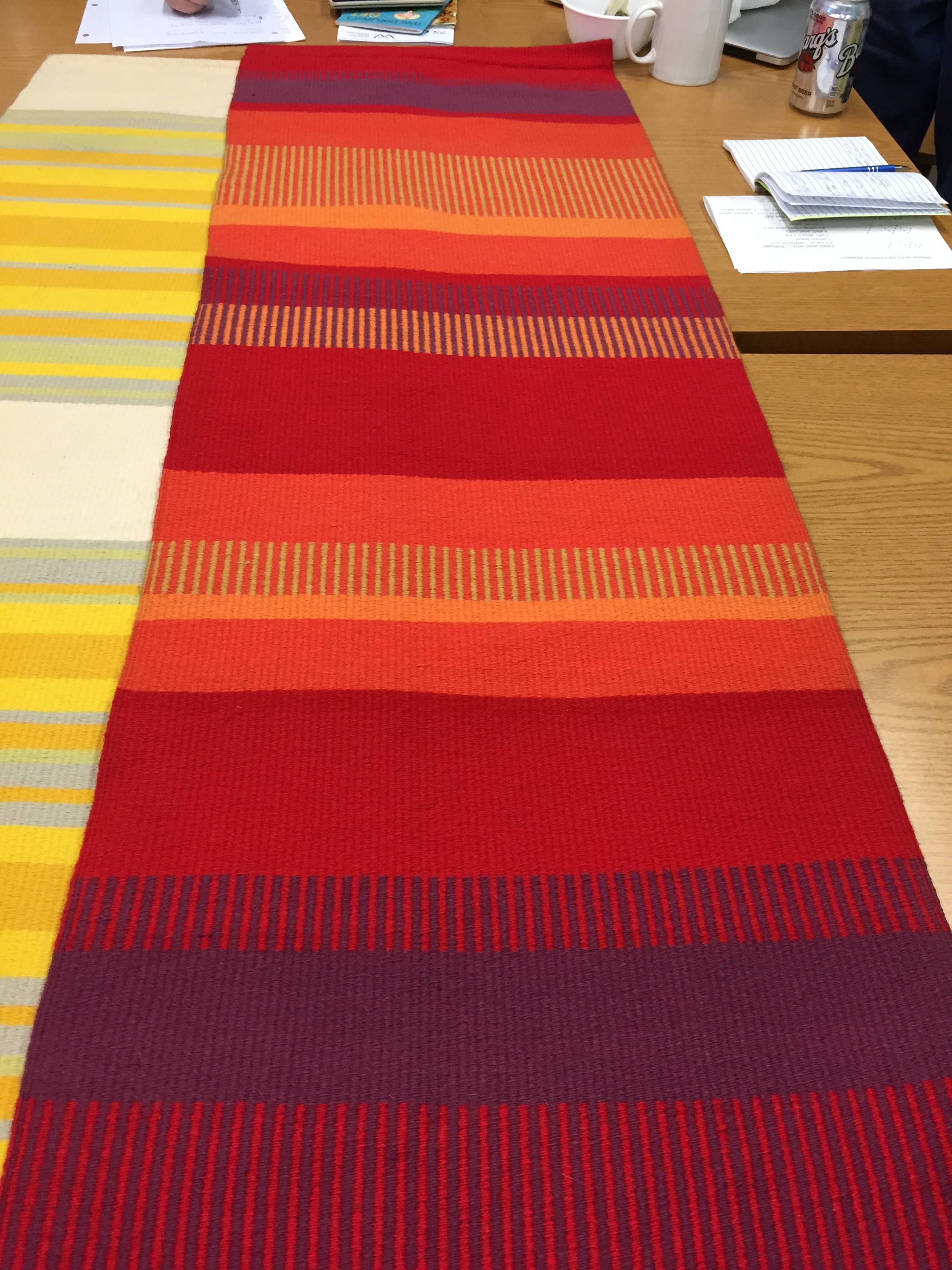
Another beautiful dukagång piece had heart images and a beautiful palette of acid green, gold, orange, purple, and cream. It was a length of fabric, with unfinished edges.
These Swedish brocading techniques were often used on bench covers. One beautiful example in the ASI collection is completely covered with krabbasnår. It’s also interesting to see the back of the bench cover; they were generally woven in a less time-consuming weave structure. this one was still quite beautiful and would have been even more striking if the brilliant purple we could see on the inside was not faded to gray.
The halv-krabba and krabbasnår brocading techniques of the Swedish pieces are exactly the same technique used in Norwegian Vestfold pieces, and many of the designs I’ve seen on Swedish pieces are exactly the same as on old Norwegian Vestfold pieces. However, the fine tabby background differed from what I know of the corresponding Norwegian Vestfold technique. The Vestfold pieces I have seen (and made) use heavier yarn for the background.
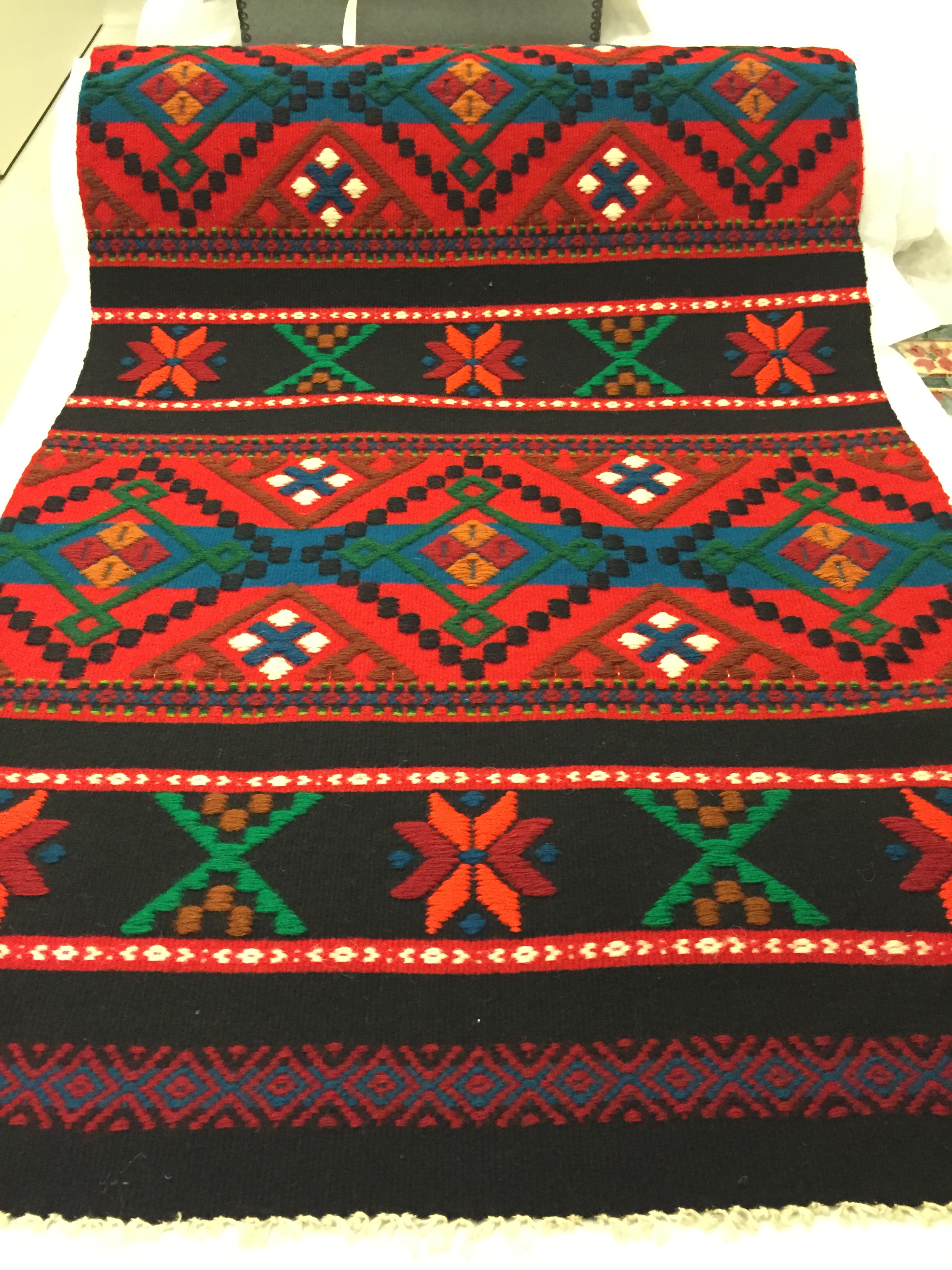
The Swedish Institute owns several pieces that were woven and sold by Hemslöjd stores in the twentieth century. Those pieces were characterized by larger-scale and more sparse, less all-over, designs. They include rosepath patterning in the bands. They were also characterized by a broad stripe in the background, behind the patterning. Most were not hemmed nicely, but just cut and knotted. Considering the design in the weavings as a group, they seemed more commercial and less interesting than some of the earlier pieces. Still, they are bold and beautiful.
Finally, we noticed on a couple of pieces that the warp threads were of alternating colors. Perhaps that was to make the counting easier when picking up patterns? It’s a good idea!
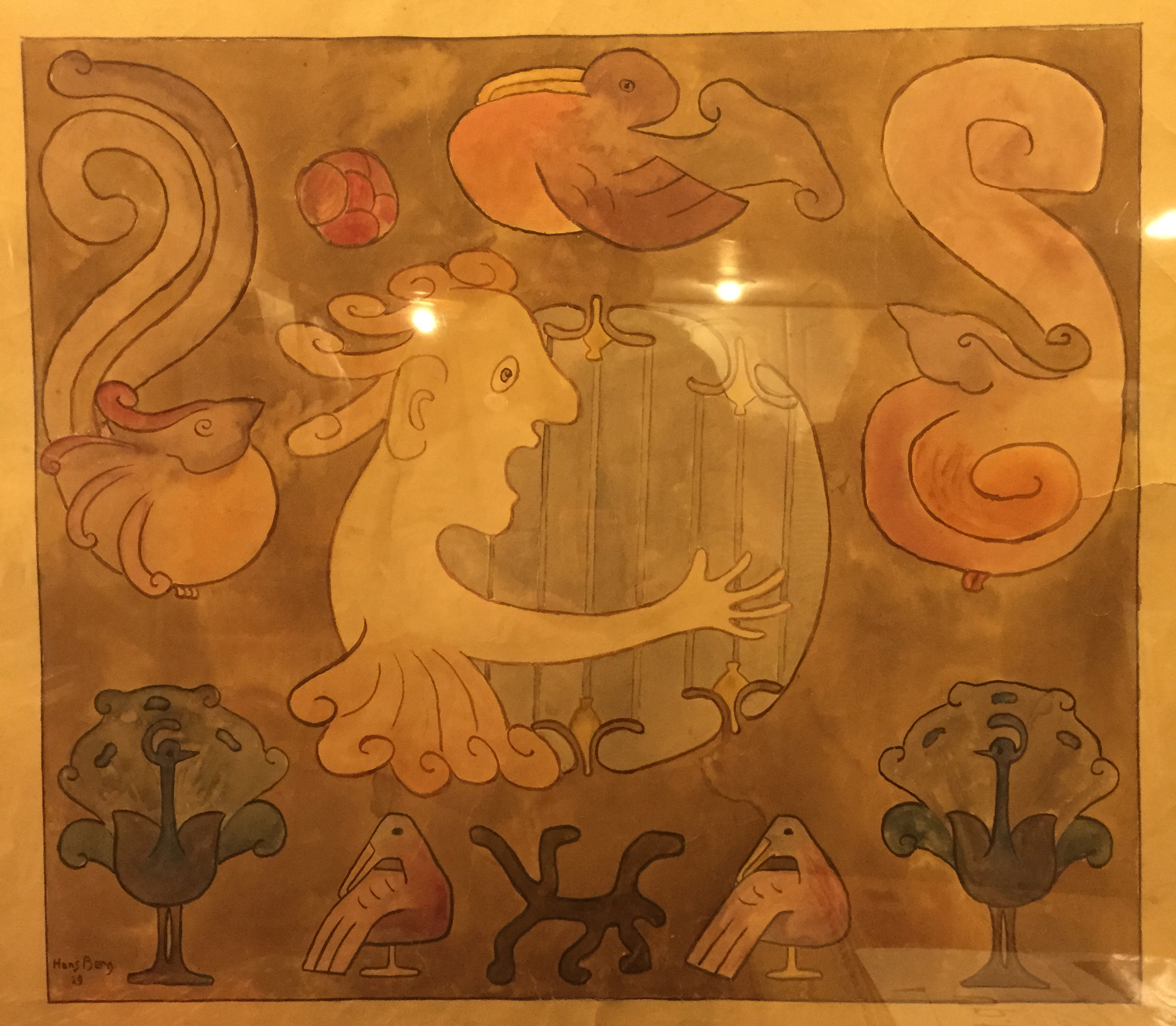
In October a small group of Scandinavian Weavers Study Group members drove to Karin Maah’s home in the northern suburbs. Karin’s home became a pop-up museum in our honor. The walls and halls were covered in paintings by her grandfather, noted Norwegian-American painter Hans Berg. He also was a rosemaler, and his work was exuberant and personal, like this piece.
The guests arrived to this beautiful array of food. “Wait,” Karin exclaimed,”the cake isn’t out,” as if somehow the existing spread was inadequate!
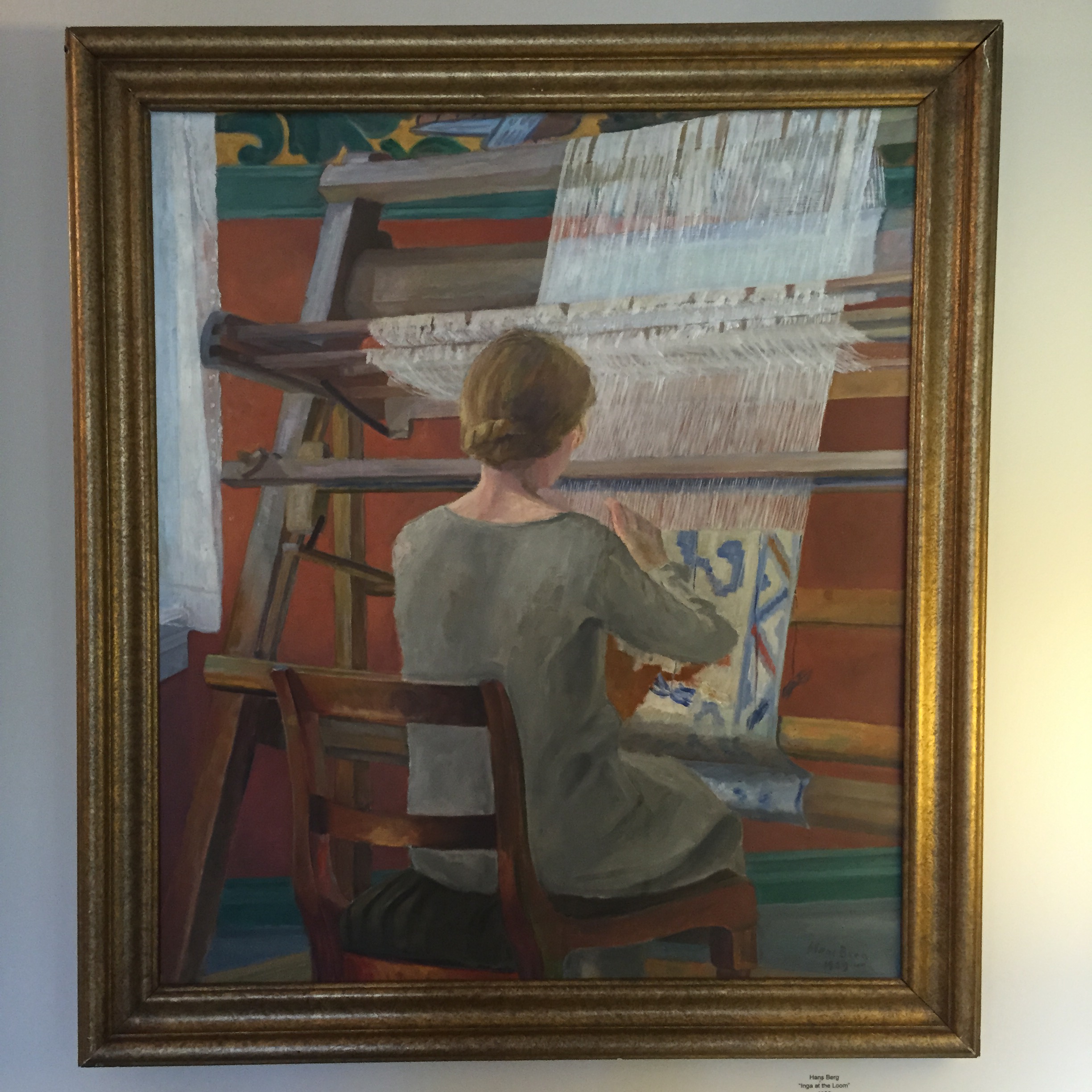
It is always a wonderful experience to see the homes of fellow study group members, to see what looms and stashed of yarn they have, and to see their personal art and weaving collections. Karin has amazing family treasures. I thought this was the most amazing set. She has a beautiful billedvev (tapestry) woven by her grandmother.
She also has the cartoon for the piece, painted by her grandfather.
Some people might also have lovely pieces along with the original cartoons, but the most amazing part of Karin’s collection is that she also has a painting of her grandmother weaving the piece!
My favorite piece was a tapestry done by her grandmother, based on a cartoon done by her grandfather. This photo can’t capture the subtle color gradations in the tapestry introduced by beautiful handspun yarns with slight, but painterly, variagations.
All of this documentation was amazing. Here, in another one of Hans Berg’s paintings, the shawl depicted is still around, and shown hanging on one edge.
An enthusiastic group of weavers (and one non-weaver) met four times over the past year to talk about rya in its many forms. Impetus for the group’s formation included the excellent exhibit at the American Swedish Institute, The Living Tradition of Ryijy – Finnish Rugs and their Makers, and two great classes on rya weaving by Jan Mostrom at the Weavers Guild.
Our Rya Exploration Group discussed traditional ryas of the Nordic countries, some with the pile woven in, and others with pile added to a ground cloth. The year began with an exhibit of ryas on the walls of the Weavers Guild, and the year was capped with a second exhibit, which is now up for the months of November and December at the Weavers Guild of Minnesota. Please visit!
Fred M.B. Amram
Lest We Forget: 1933-1945 23” x 28” Hardware cloth, wool, barbed wire, old barn wood, rusty screws.
Fred wrote about his inspiration for the piece.
As a Jude (Jew) who witnessed the beginnings of the Nazi catastrophe, I continue to purge my anger. I’m dedicated to remembering past genocides so that our future will allow all to feel free and equal.
I’m relatively new to rya and eager to test how far the art can be stretched. The rya technique was originally used to make warm bedspreads, rugs and wall hangings. I’ve tried three-dimensional boxes and now I want to re-examine the use of space in a multi-media sculpture.
Lisa Ann Bauch
Rya Inspired by Edvard Munch’s ‘Moonlight.’ Wool warp and weft; wool and linen pile.
I was fascinated by the way Munch captured the glint of moonlight on water in his painting from 1895. I replicated the effect by adding linen, which catches the light, to the wool knots. I also used a pale yellow yarn in the moonlit sections to draw the viewer’s eye.
Houndstooth Rya Bench Cover
The ground cloth is a houndstooth pattern, while the rya section was made using the ‘hidden knots’ technique (the knots don’t show on the reverse side). It was inspired by a photo of an Icelandic sweater in blue, brown, and white.
Anita Jain
Universe.
This ryijy (Anita is Finnish, so we will use this spelling) is a very different take on a traditional ryijy; it is knotted on a metal netting, using strips of fabric. Anita wrote:
“It is inspired by the Universe, the way I think of it, limitless in size and power, that gives me energy and creativity. The piece is dark, but not at all in the negative sense. The darkness contains the mystery and the power and the light, and the creative energy, the freedom and the direction; just observe. listen and trust in its limitlessness.
“In the energy burst in the middle, I have used mostly wool yarn in different colors–that I see as life force color for this particular piece. The energy burst in the middle is fluid,like life itself, ever moving and reshaping and changing. So each time the piece is hung it is hand shaped, thus looking a little different each time, as well.”
Corwyn Knutson
Rya Pillow. 14” x 14” wool
Exuberant gray pile explodes from a base of gray goose-eye twill. In a switch from most exhibits, the weaver granted explicit permission to TOUCH.
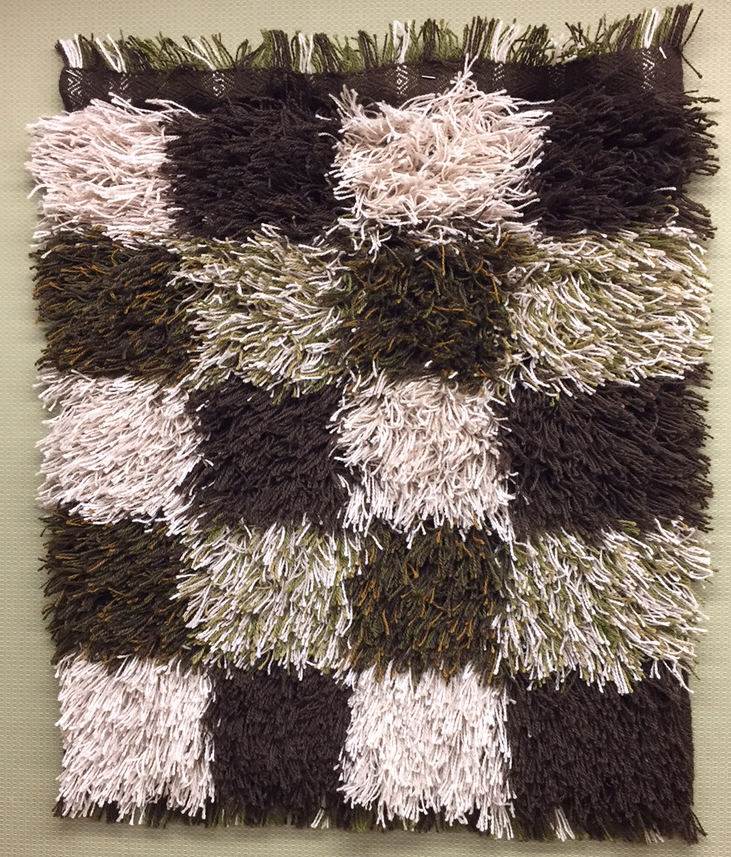
Checkerboard. 34” x 27” Wool.
Woven on a diamond twill background, the squares of pile acquire beautiful shading by mixing colors in the knots.
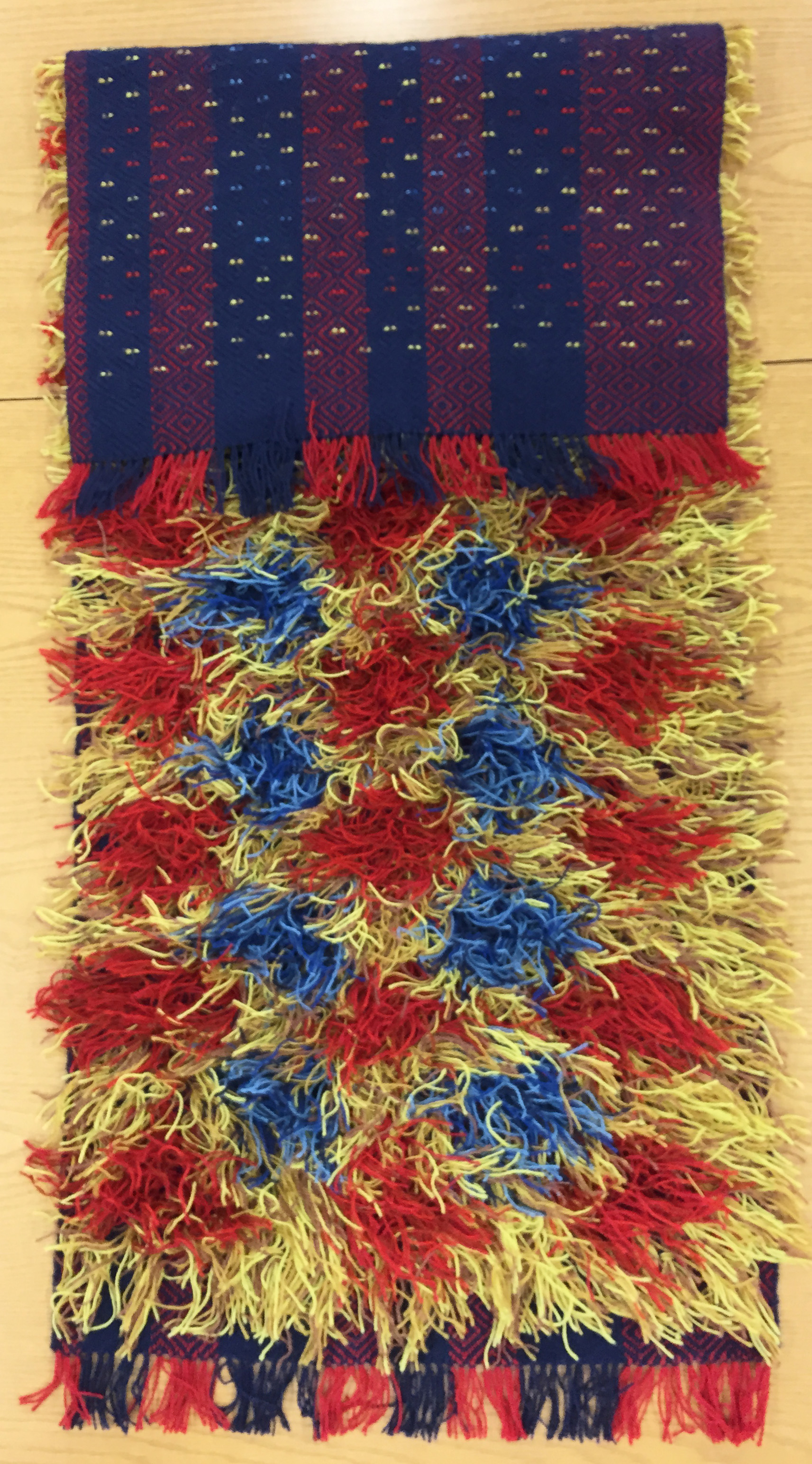
Diamonds. 42” x 20.5”
In this rya technique, the flat, decorative knots on the reverse side echo the pile diamonds on the front. The piece is hung to advantage with the top folded over, showing both sides. When ryas were woven as bed coverings, the pile side would face down, and the decorative, flat pattern would face up on the bed.
Robbie LaFleur
Purple Power Field. 30” x 30” Chicken wire, cotton fabric
The chicken wire rya started as an afternoon test for a possible collaborative art project, and ended up being a time-consuming abstract art piece. Read more about its development at: https://boundweave.wordpress.com/2015/11/17/chicken-wire-ryas/
Jan Mostrom
Rya on Pick and Pick Backing. 14″ x16” Cotton warp, wool weft, wool and linen pile
The blue and gray rya was inspired by ryas from the area of Narvik, Sweden, which use pick and pick-patterned weft face backing.
Goose-eye Rya. 15″ x 22” wool
Red, orange and gray pile. This piece was inspired by ryas at the Vesterheim Norwegian-American Museum woven with goose-eye twill on the reverse sides.
Rya. 19″ x 27” Cotton warp, wool weft, wool and linen pile
Jan wove this piece on a loom on a demonstration loom at the American Swedish Institute. The teal, green, blue, and yellow pile rya was inspired by a ceramic fireplace in the room where she wove this piece. It was woven on a weft-faced solid black backing.
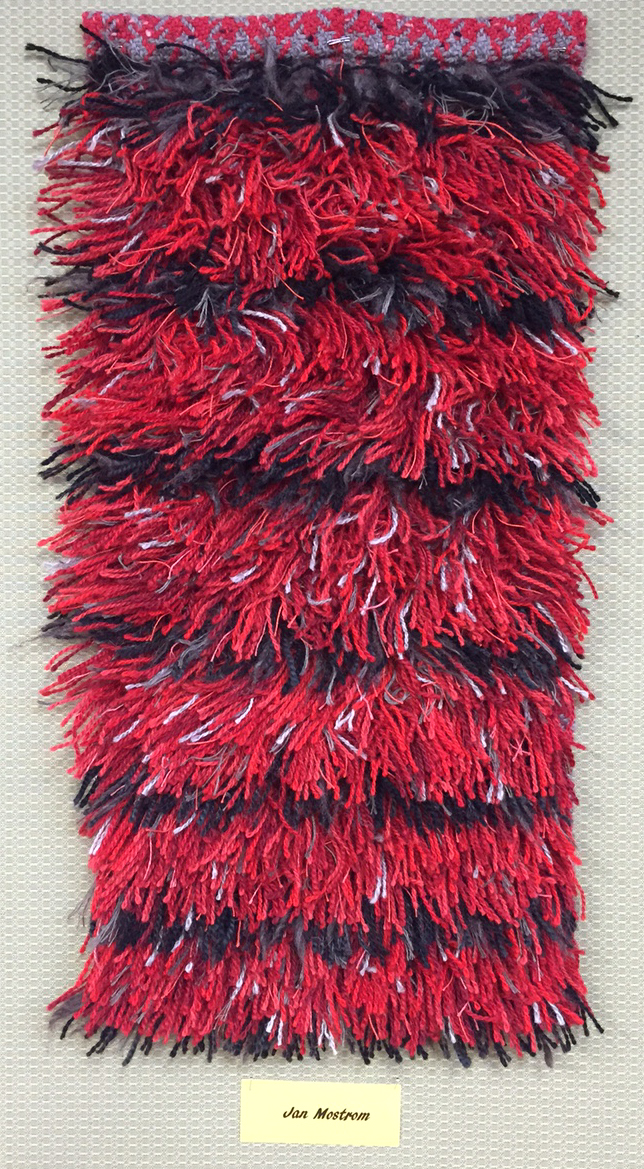
Houndstooth Rya. 11″ x 22″ Wool warp and weft, wool and linen pile
The red, black, and gray rya was inspired by the houndstooth backing on an old rya owned by the Vesterheim Norwegian-American Museum in Decorah, Iowa.
The Scandinavian Weavers Study Group will meet on the following Sundays at 2pm in the fall of 2015 through Spring 2016: October 18 (field trip to the home of Karin Maahs), November 15 (Rya Exploration at 12:30 and Scandinavian Weavers at 2), December 13 (holiday gathering at the home of Karen Weiberg), January 17, February 21, March 20, April 17, May 15.
There will be an exhibit of Lila Nelson’s tapestries at the Textile Center, in the Studio Gallery, in November and December of this year. It will be a great kick-off and tie-in to a larger retrospective of Lila’s works at Vesterheim. The Vesterheim exhibit will include more than just tapestry, and will be in the large gallery space near the entrance to the museum. It will be up from December 2, 2015 and probably through November of 2016. Francie Iverson, Claire Selkurt, and I are meeting to choose the tapestries to be displayed, and Laurann will facilitate sending them to the Textile Center.
The Scandinavian Weavers next exhibit, featuring our work with RED, will be in the Textile Center Community Gallery, from May 13-June 25, 2016. We will make plans for an opening celebration at our meeting on March 20. We will make postcards, to be distributed by each weaver. If you would like to have your weaving considered for the postcard image, a high-quality digital image should be submitted by March 20.
Keith brought two family pieces. His mother’s side of the family is Finnish, and his mother’s cousin, who ran a Finnish design shop for several years, sent Keith two Finnish pieces. Keith said he has asked several people how he should clean the pieces, and the consensus is – snow! (There was an article in the Norwegian Textile Letter on cleaning weavings/rugs with snow, here: http://norwegiantextileletter.com/?s=snow+washing)
Karin Maah’s tapestry got a State Fair blue ribbon and honorable mention at Vesterheim.
She also brought a beautiful quilt top, her first, made with a rainbow of batik squares.
Marilyn Moore’s beautiful rag rug with rosepath designs got a red ribbon at Vesterheim, and a white ribbon and “Best First Weaving” at the State Fair.
Lisa Bauch learned a Finnish raanu technique in Wynne Mattila’s class, and she made a new piece, based on the colors of early spring leaves.
Corky Knutson received a red ribbon for a pillow. Robbie LaFleur submitted two pieces to the State Fair. (See information on the ribbons here.)
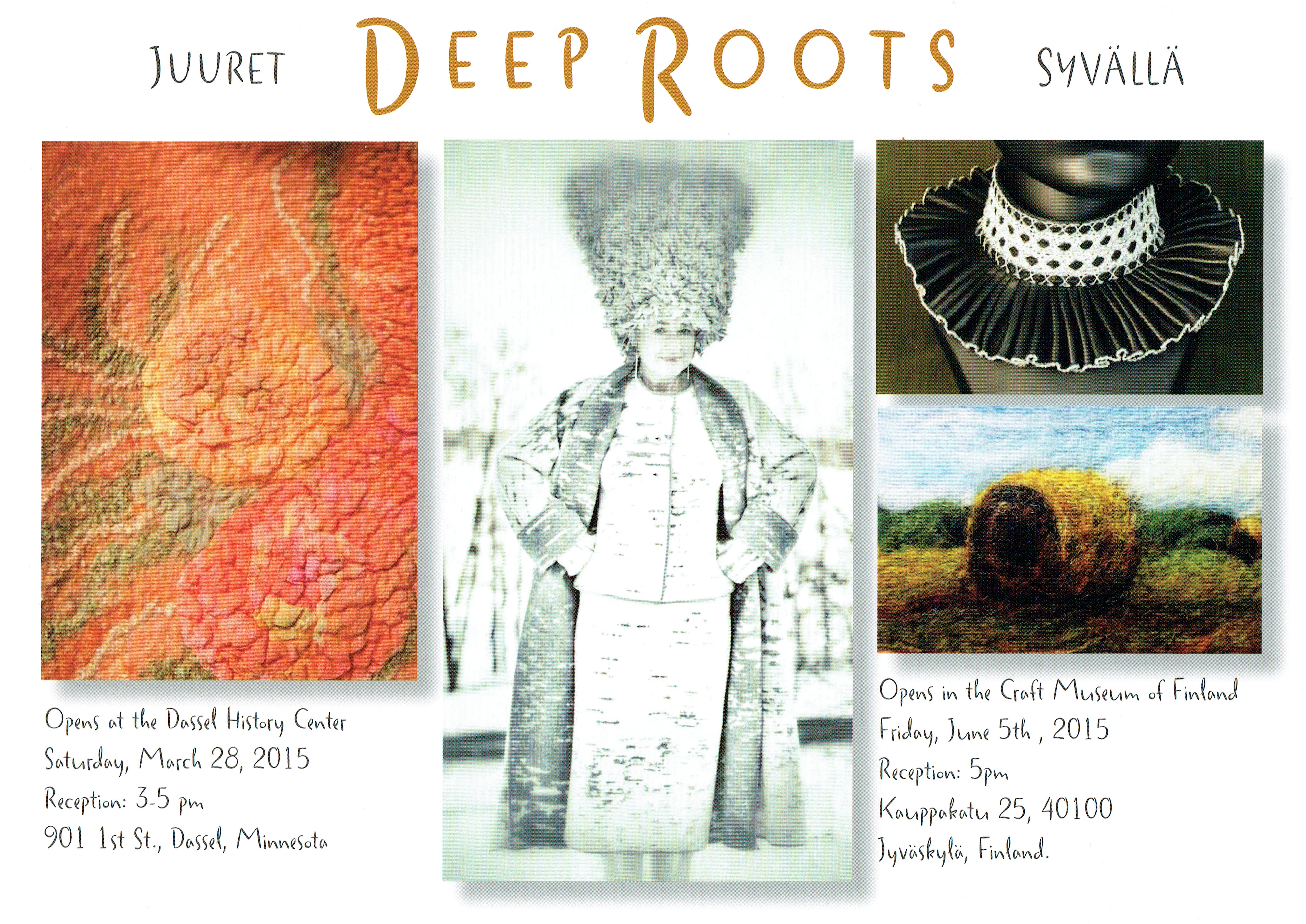
Last fall Anita Jain, founder of Common Strands, a Minnesota nonprofit, sent out a call for textile artists who were interested in submitting pieces for a show celebrating Nordic heritage. The “Deep Roots” exhibit was held at the Dassel History Center from March 28-April 25, 2015. If you are traveling to Finland soon, you can catch the exhibit at its second venue, the National Craft Museum of Finland in Jyväskylä, until August 23. The Minneapolis opening in Dassel was well-attended, and the opening in Finland attracted over 100 visitors, many from Helsinki, over four hours away. Several of the U.S. artists attended the Finnish opening, although none of five Scandinavian Weavers Study Group members who were part of the show.
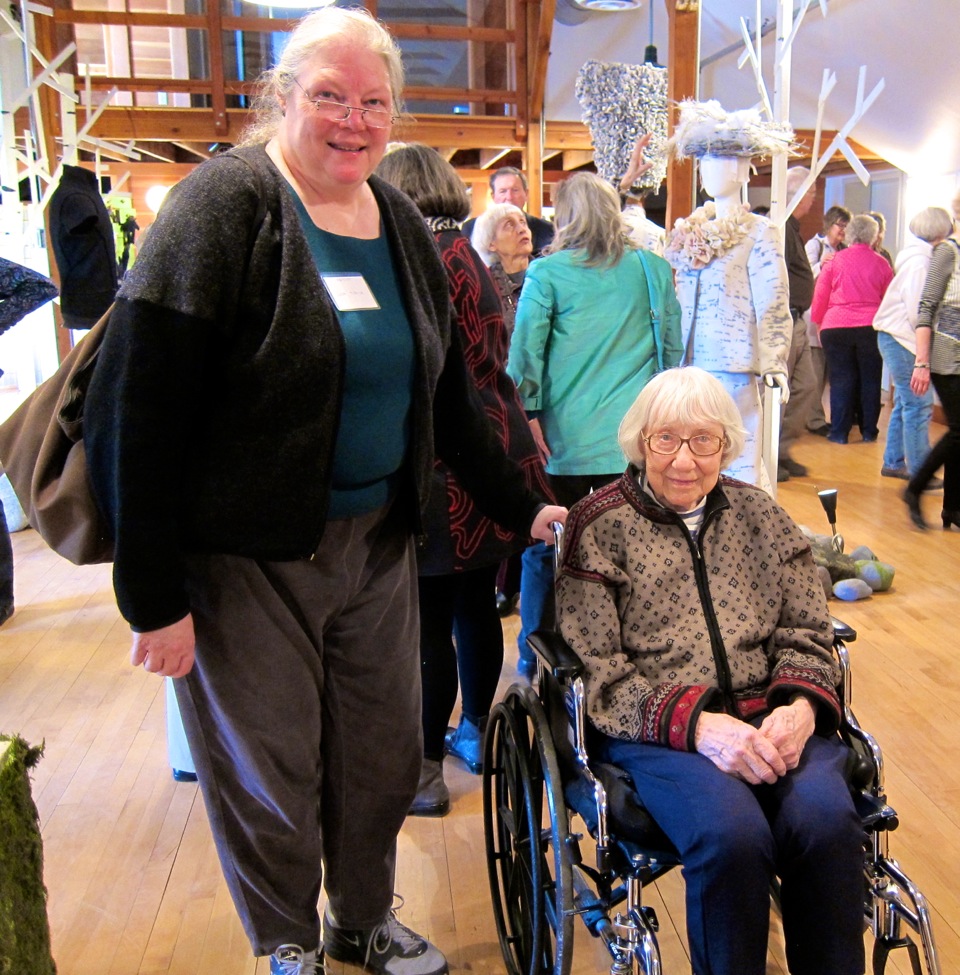
Exhibitor Lisa Torvik brought a special guest, Lila Nelson, to the opening at the Dassel History Center.
Included in the show is a notebook with information about the artists and the inspiration for their pieces. Here are the submissions from five members of our Scandinavian Weavers group.
Mary Lonning Skoy
Bio: I have been involved in the fiber community in Minnesota since the early 70s as a weaver, spinner, knitter, and frame loom weaving teacher. I wrote a booklet, Weaving on a Frame Loom: A First Project, to help weavers learn to weave with a rigid heddle loom. I organized an after school knitting club teaching dozens of teens to knit. Walking down the halls of Minnetonka High School seeing kids sitting at their lockers knitting is one of my cherished memories of 32 years there as an English teacher. I have written articles which have appeared in Handwoven Design Collection #4, Handwoven and SpinOff magazines, Weavers Journal, and A Thread through Time, the Weavers Guild of Minnesota’s 75th Anniversary book.
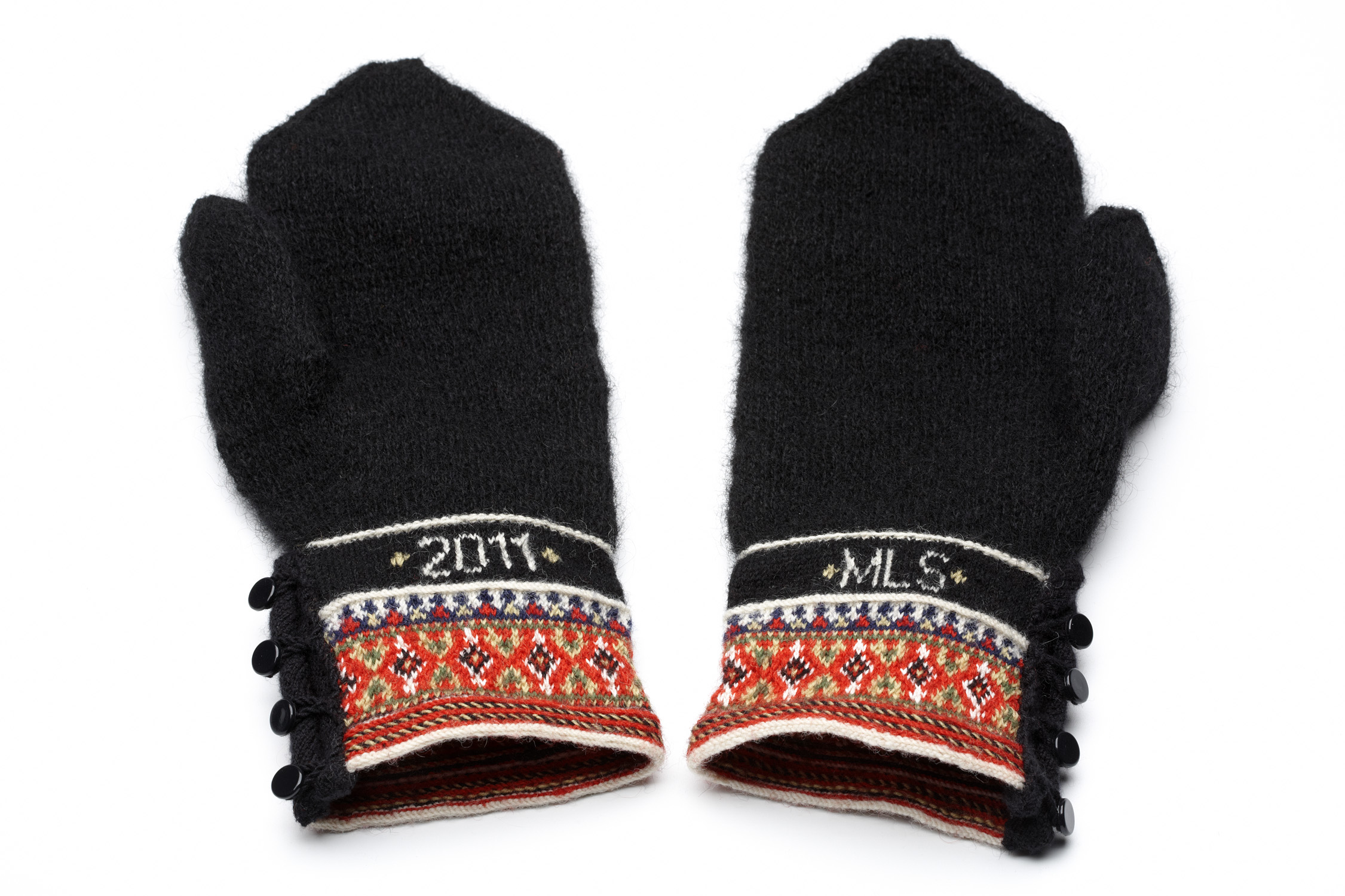
Inspiration: I trace my fiber roots to my Norwegian/Irish mother who taught me to knit and further back to my Norwegian great aunt Sunniva Lønning, a fiber artist, teacher, and activist in mid twentieth century Norway working to preserve ancient sheep breeds in Norway, particularly the spelsau sheep. The family textiles I saw when I visited my father’s cousins on the island of Stord off the western coast of Norway are the “deep roots” of the textile arts I pursue today. I learned the twined knitting (tvebandstrikk) technique from Hege Therese Nilsen in Bergen, Norway. The inspiration for these twined mittens was a pair of folk socks (sjonaleister) typical of the Hordaland region of Norway from the early 19th century.
The multi colored cuff of the traditional festive socks became the cuff for my mittens, very wearable “art” for Minnesota winters.
Marilyn Moore was born in upstate New York, but has been a Minnesotan since 1974, when she and her husband moved here.
Bio and inspiration:My Swedish heritage started in America in 1912 when my Grandfather Olaf Anderson arrived at Ellis Island from Lund, Sweden. The home where he was born in 1887, and the school he attended, still exist. Growing up, he rang the bells on Sunday at the Lund Cathedral, as his father and grandfather had done before him. I have traced his family back to 1789. His first home here was in Bayridge, New York, where many of the Scandinavian immigrants first lived. He was a mason and worked on many of the buildings and bridges built at that time in New York City.
Olaf met my Grandmother Svea Magnusson on the streets of New York. She was born in Hyppeln in Bohuslan, Sweden, an island off Gotenborg, in1890. Her father was a fisherman and some of the family are still fishing today. Svea also came to this country in 1912. Her family goes back to 1790. Svea and Olaf married and raised a family in Hook Creek on Long Island. She did not work outside the home.
My grandfather died a young man in his 60s. Svea lived into her 80s. She spent many summers at our home when I was growing up. She would sing a few songs in Swedish and the one I remember the most was Hälsa dem därhemma. I never knew the English translation until1980 when I joined the American Swedish Institute, thinking I would learn more about my Swedish heritage. At a Lucia performance the choir sang this song in Swedish and English. As I listened, I could hear my grandmother sing this song and I understood what she was singing. This is the chorus translated to English:
On the deck I stand at night, Greet my dear old mother,
when the stars above were bright, greet my father too,
far away from friends and home, and my little brother
lonely here I roam. when he welcomes you.
Swallows on their wings so high, If I had wings to follow,
now in spring they homeward fly, happy I would be
to the land where sunlight beams Dearest little swallow.
is my childhood dreams. greet them all for me.
My Grandmother never saw her mother or her father again, though she did go home once and saw her extended family and walked the island of Hyppeln where she was born. I joined a club at ASI called Svea (my grandmother’s name) and am still a member of it today. I took my mother, Inga, to Sweden where we met all her first cousins and walked the same island. There I left part of myself, as that is where my roots began.
Now as I look back at pictures, I see beautiful weavings that I never connected with at the time. I have been weaving for a little over five years. I lean toward the many beautiful Scandinavian techniques, still have much to learn.
“Summer,” a ryijy by Marilyn Moore
Lisa Torvik
Bio: My mom was a knitter and got me started when I was about 4 or 5, though I did not really start my own projects, for my Barbie on 00 needles, until I was about 8. Grammy T was a great needlewoman who taught me to sew when I was 9 or 10 on her treadle machine, since mom’s Singer scared me. The first loom I saw was the one mom brought home from a farm sale and set up, when I was about 12. I wove my first piece on that loom. (Her teacher at the University of Minnesota was Hilma Berglund, back in the early 1950s.) A couple years later, I got to know Lila and Marion Nelson when they came to work at the museum in my hometown, Decorah, Iowa, and I took my first backstrap class from Lila when I was 15. When I was 17, Grammy T. wanted me to join the first youth exchange group that went from Decorah to Valdres in Norway, and in the family I lived with for 6 weeks were twin sisters who had just finished a year at Valdres Husflidsskule (Home Craft School.) I was fascinated with all the things they had made and saw many old and precious textiles in the homes of that extended family. When I was 19, an uncle in that family got me a job at Valdres Folkemuseum, where I spent six months as the head guide, translated a visitor booklet to English and became more acquainted with the textile collection and history of women’s arts in Valdres. About 14 months later I applied to Valdres Husflidsskule and was admitted to the half year weaving program. I worked at the museum again that summer, setting up a loom (1701 was carved in the beater) with a plaid pattern that had been gleaned from old log chinking. I was allowed to stay another half year as an “extra” student at the husflidsskule during which I copied advanced patterns from our principal’s own workbook, wove a number of projects and attended a month-long course in plant dyeing and spinning at the Buskerud husflidsskule in Gol. My work was included with school exhibits in Norway, I have demonstrated tapestry weaving at Vesterheim in Decorah, and shown and sold some pieces at a yarn shop where I worked in the 1970s. Since then I have given away most of my woven and knit projects.
Lisa wrote about her inspiration for making a “rull” for her wedding in 2009:
“There are many, widely varying types of wedding headdress in the Norwegian tradition. Some are truly crowns, of silver or gold belonging to the wealthiest of families, or beaded and decorated with ribbon, quartz and glass in others. The tradition of a Valdres “rull” was documented in the early 1800s by watercolor sketches of visiting artists and its most significant distinction from other regions is that while worn back on the head, it is open and shows the bride’s hair, curled in a braid. As an unmarried girl, her hair braid would be wrapped in a woven braid and outlined by a beaded piece called a “lad” and wrapped in a silk scarf. The wedding “rull” is a structured piece, sometimes built up on a wood frame. It was decorated with gold medallions and wrapped with a silk scarf. A married woman wore her “rull” in the same way but the back is closed with a lace-like covering done in “sprang” technique. Widows would wear a much simpler “rull” sometimes even just a dark color, if they remarried. As an “older bride” I wanted to combine the beading technique of the girl’s “lad” with the shape and style of the “rull” and I copied the basic pattern of the beaded belt I wear on my jacket, a belt that I made several years ago with the instruction of my “host mom” and which was finished with a silver buckle that was a gift from my “host sister.” I embellished my “rull” a little more with a border of white pearl-like beads and fresh water pearls.”
Lisa wrote about her Norwegian inspiration for a weaving in transparency technique:
“My favorite weaver in history is Frida Hansen, a Norwegian woman who was an artist, hands-on weaver and an entrepreneur at the turn of the 19th to 20th century. From virtually self-taught beginnings in her hometown Stavanger, her work eventually reached the public, the nobility and museums of continental Europe and the USA, as well as Norway. Her tapestries were shown at the Chicago Exhibition of 1893 and the Paris Exhibition of 1900, among many others. In 1897, she was granted a patent on a new technique, which she called “open ornamentation,” which consisted of tapestry-like weaving in which the weft floated on open warp threads, allowing light to pass through or “transparency.” This “transparent” technique is my favorite of hers and for this transparency study I have used two weights of linen, woven on a tapestry loom for stable and tight tension. The pattern is taken from the “overall background pattern” of a sweater I knit some years ago.”
Lisa-Anne Bauch
Bio and inspiration: Most of my ancestors were Swedish—all my grandparents but one were born of first-generation immigrants—I’ve always felt a close connection to my heritage. The Swedes who came to America in the late nineteenth and early twentieth centuries worked very hard to succeed in a new land while also retaining their native language and culture. They built churches, cultural centers, and universities, initially conducting activities in Swedish.
Many members of my family attended one such university: Augustana College in Rock Island, Illinois. My father also taught history at Augustana for many years.
In the art department at Augustana was a huge, mysterious wooden contraption—a Swedish-style loom. When I was a little girl, it seemed as big as a house! I was fascinated by it and promised myself that one day I would learn to weave.
That day came many years later, after I had moved north to Minnesota and became a member of the Weavers Guild of Minnesota. I was immediately drawn to learning the Nordic styles of weaving I remembered from my childhood, especially wool and cotton rugs.
In 2014 the American Swedish Institute, located in Minneapolis, sponsored an exhibit called The Living Tradition of Ryijy—Finnish Rugs and their Makers. The exhibit included dozens of ryijy weavings from the famed collection of Dr. Tuomas Sopanen. For the first time, I was able to see these remarkable weavings up close. I was enthralled by the bold colors, complex textures, and tremendous skill of the weavers. Visiting artist Siiri Korhonen gave a lecture on the important place these weavings hold in the history and culture of the Finnish people.
In conjunction with the exhibit, the Weavers Guild of Minnesota offered a class in ryijy, taught by master weaver Jan Mostrom. The piece I am submitting to Deep Roots is the one I wove in Jan’s class.
Inspired by the exhibit, I decided to take a bold approach to design. My rjijy was inspired by “Moonlight,” a painting by Edvard Munch from 1895. I was fascinated by the way Munch captured the glint of moonlight on water. I replicated the effect by adding linen, which catches the light, to the wool knots. I also used a pale yellow yarn in the moonlit sections to draw the viewer’s eye—as Munch does in the painting that I admire so much.
My rjijy is a definite nod to my Nordic ancestry. The rich legacy that my immigrant forebears bequeathed to our family included a deep love of the natural world—and a certain melancholy temperament. I feel that Munch captured both in his painting and hope I conveyed the same in my ryijy.”
Lisa-Anne Bauch, Wall hanging in rya technique, inspired by Edvard Munch’s painting, “Moonlight.”
Robbie LaFleur
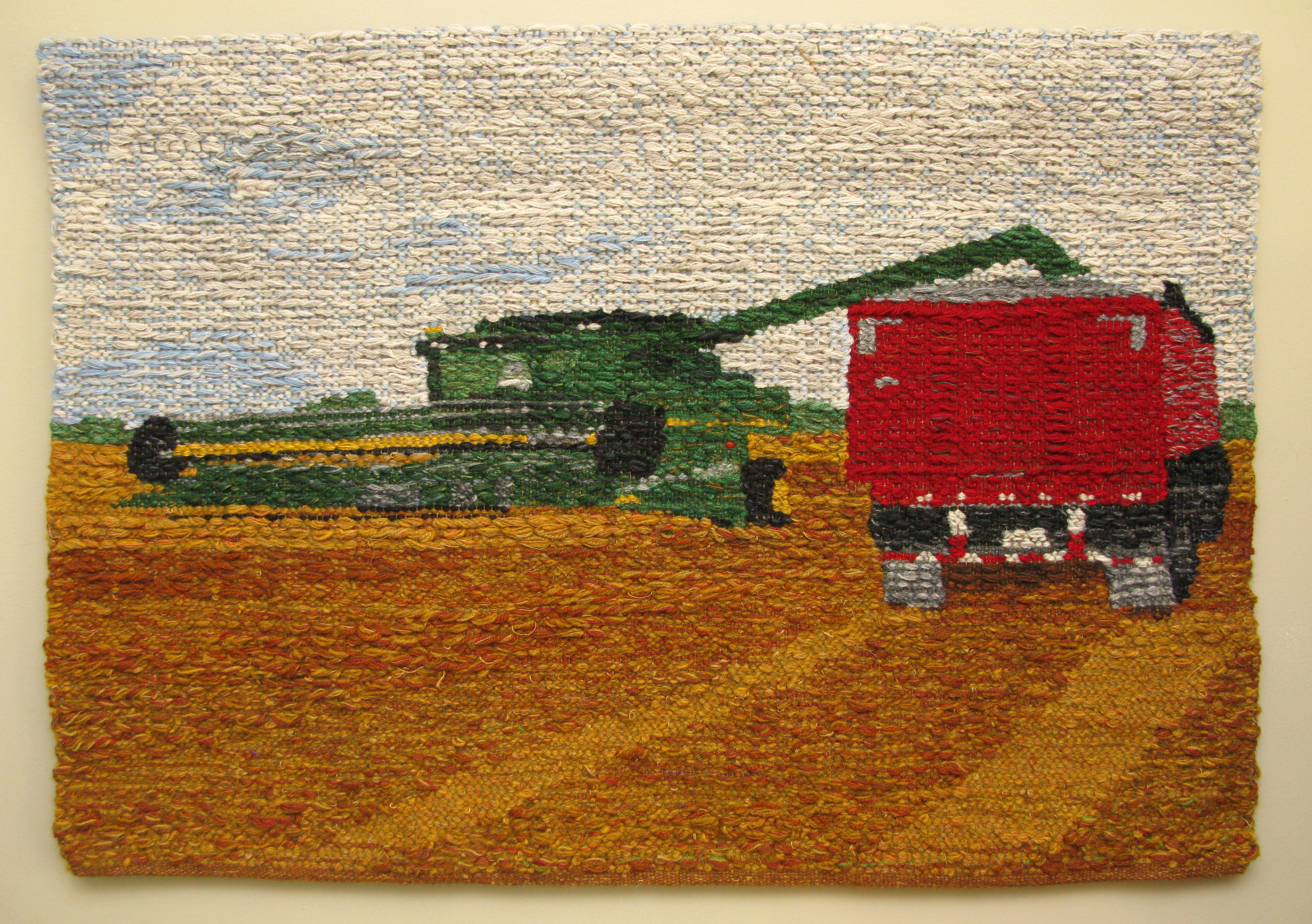
Inspiration: The deep roots of the wheat being harvested in this field lead back to Norway and my great-grandfather who homesteaded in Bygland Township in northwestern Minnesota. My childhood included countless trips with my father and grandfather to check on the crops, and as a teenager I drove the truck during harvest. My brother Jon Wurden continues to farm. The weaving is based on a photo taken during my father’s dying days, two years ago, which coincided with the harvest of this section of land. Early that summer, on the last day my father was able to drive, he drove his pickup to check the newly-planted wheat in this field.
I moved to the city as an adult but my life will never be complete without visiting the farm each summer. I have to check the fields.
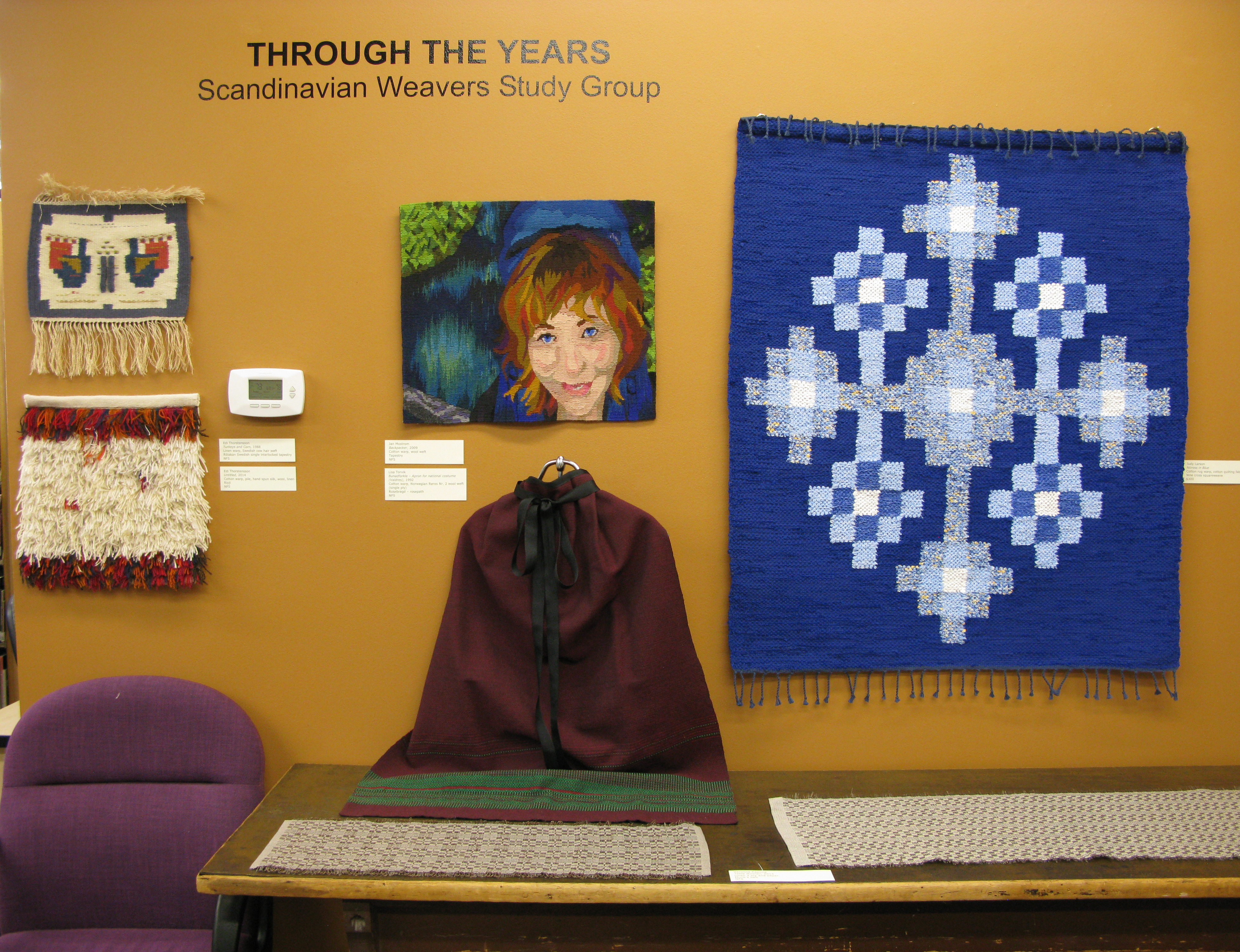
Members of the Scandinavian Weavers Interest Group have had pieces on exhibit in several venues recently. You can see works from the just-ended exhibit, “Through the Years: Scandinavian Weavers Study Group,” on their blog, Scandinavian Weavers Study Group.
As an adjunct to this summer’s Midwest Weavers Conference, the work of several interest groups from the Weavers Guild of Minnesota are on view in the gallery of the O’Shaunessy auditorium on the University of St. Thomas campus until early August. The keystone of the exhibit is the recent Rag Rug Interest group display, “Urban Graffiti.” Other groups are represented in covered cases. In the Scandinavian Weavers Interest group case you can see works by Jan Mostrom, Lila Nelson, Lisa Torvik, Keith Pierce, Mary Skoy, and Melba Grandlund.
And finally, an exhibit of my textile interpretations of Edvard Munch’s “Scream” painting are at the American Swedish Institute, “Scream (In Stitches).”
Lisa Torvik grew up with lots of yarn and skilled teachers surrounding her. She characterizes herself as a perennial knitter and lapsed weaver, trying to get back to her loom and all those boxes of potential projects.
Bunad forklede (an apron for her bunad from Røbøle Farm, Øystre Slidre, Valdres)
Ringvend (rosepath)
Cotton warp, wool weft
Åkle (A half-width copy of a copy by Kari Sand Nikolaisen of a threadbare Nordhordalands åkle in Kunstindustrimuseum, Oslo) Åklesmett (squareweave tapestry)
Linen warp, Norwegian spelsau wool weft
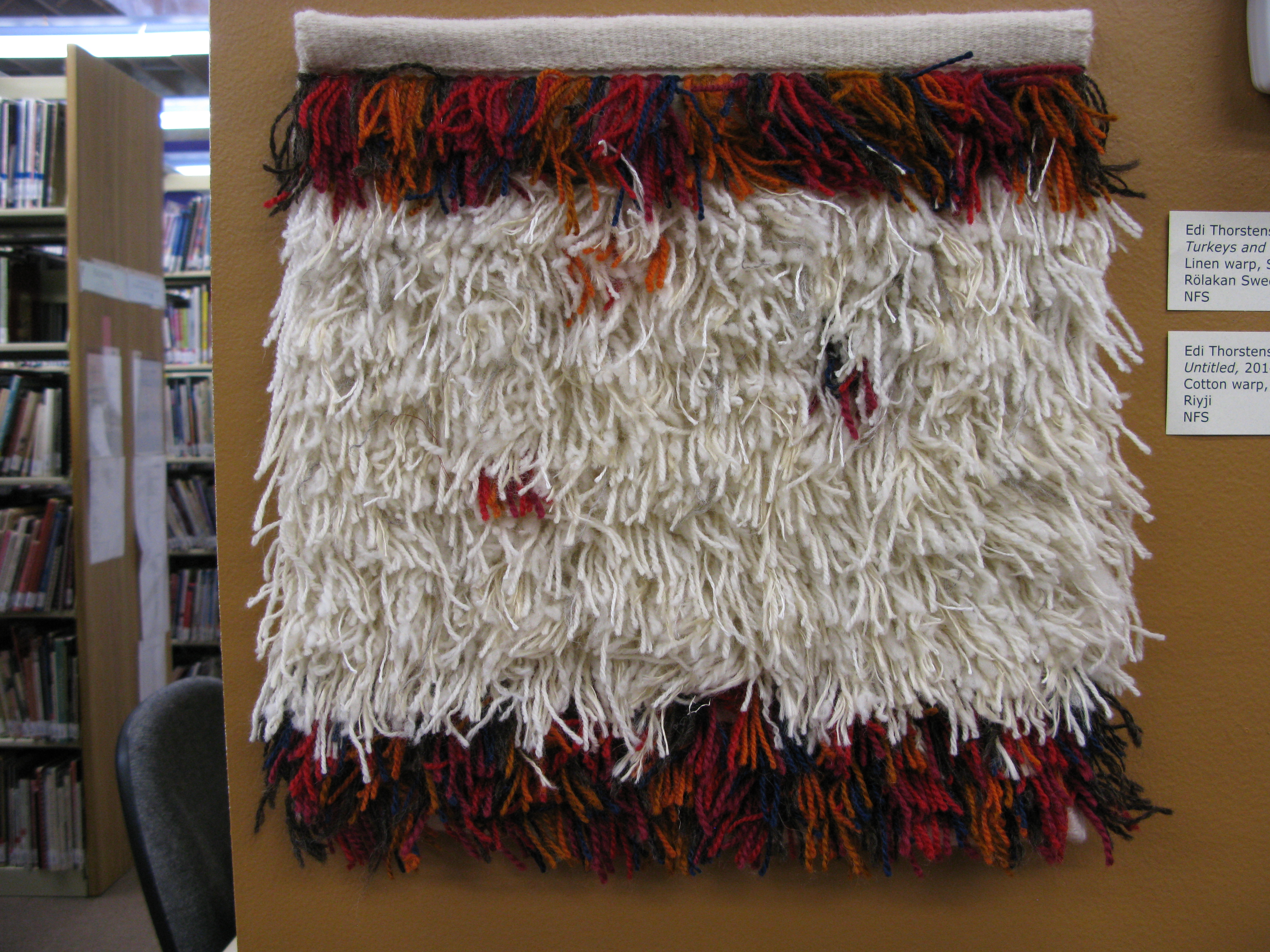
Edi Thorstensson has been weaving since 1966. She has studied at the Chicago Art Institute, Mora Folkhögskola in Sweden, Sievers School of Fiber Arts, the Weavers Guild of Minnesota, and in Norway. She lives in St. Peter, Minnesota.
Turkeys and Corn. ca 1988
Technique: Rölakan Swedish single interlocked tapestry
Materials: Linen warp, Swedish cow hair weft, 16″ x 13 1/4″
Paradhandduk (Display towel) ca. 1988
Technique: Plain and pick-up weave, lace
Materials: Cotton and linen, 36″ x 17 3/4″
Untitled 2014
Technique: Riyji
Materials: Cotton warp; wool weft; handspun silk and wool, and linen pile, 15 1/2″ x 14 1/2″
Keith Pierce has woven bands off and on for 40 years, but has practiced it seriously only since 2011, after joining the Weavers Guild and Banditos interest group. Now retired, he formerly taught mathematics and computer science, most recently at the University of Minnesota-Duluth, and practiced software engineering at several Twin Cities businesses.
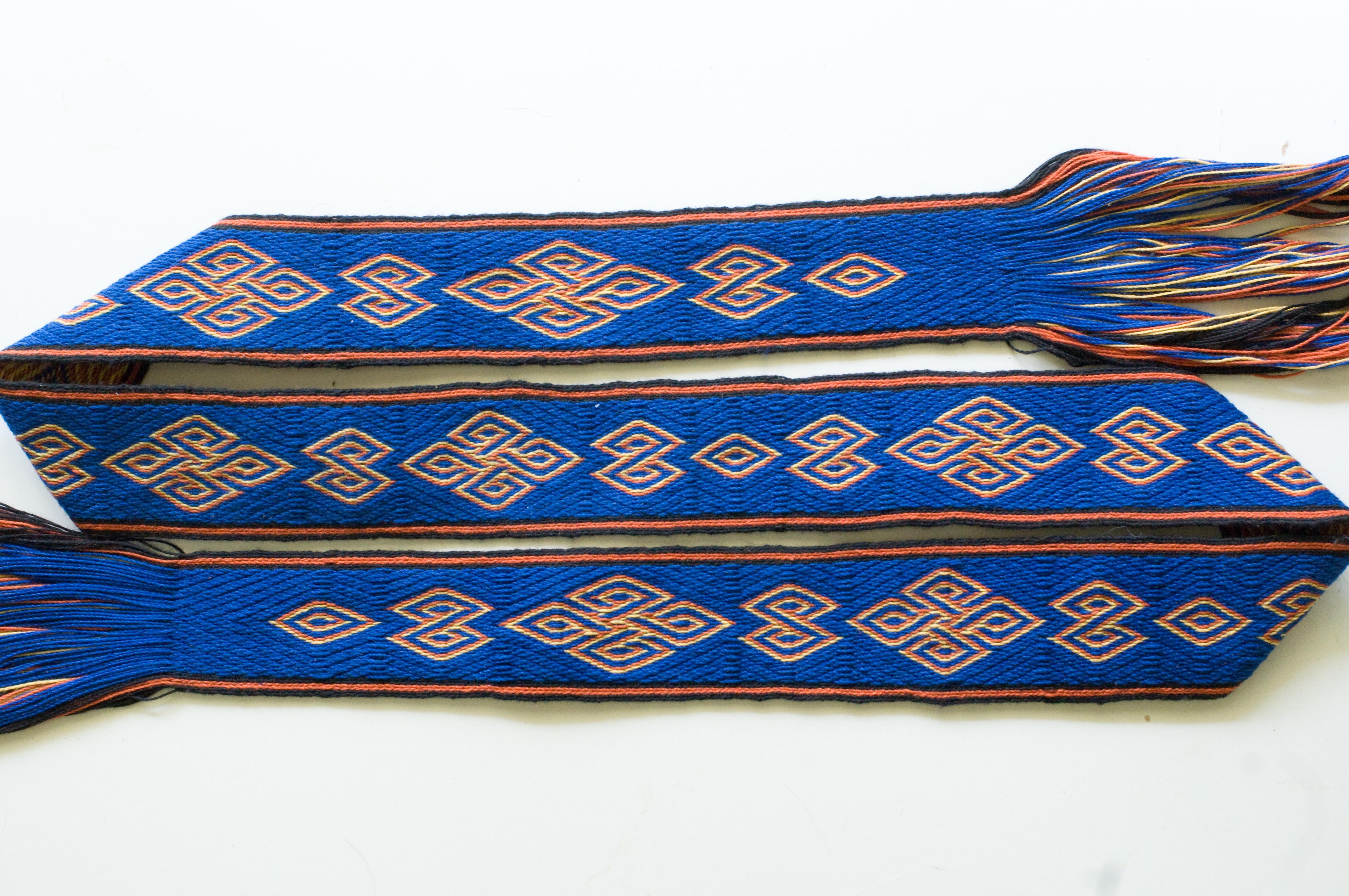
Celtic Knots 2012
Tablet woven, 3/1 broken twill. I used 10/2 perle cotton that I dragged around the country for 40 years before resuming my tablet-weaving hobby. The band won the sweepstakes award in the category “Weaving, knotting, felting and caning” at the 2012 Minnesota State Fair.
Inspired by Jörmungandr 2014
Tablet woven, 3/1 broken twill. 8/2 Tencel. I was inspired not only by the classic tale in Norse mythology but also by symbols of the ouroboros, depicting a serpent eating its own tail, or occasionally two serpents devouring each other. It won first place in the band weaving category at the 2014 Minnesota State Fair.
Estonian costume sash 2014
This belt with supplementary-warp pattern was woven on an inkle loom using warp pick-up. It is representative of belts on women’s costumes from Estonia. The pick-up technique and similar patterns can be found throughout Scandinavia as well as the Baltic states.
Judy Larson: I love discovering the surprises as colors interact. Weaving changes planning and logic into enjoyable art! There are always new surprises and techniques to discover.
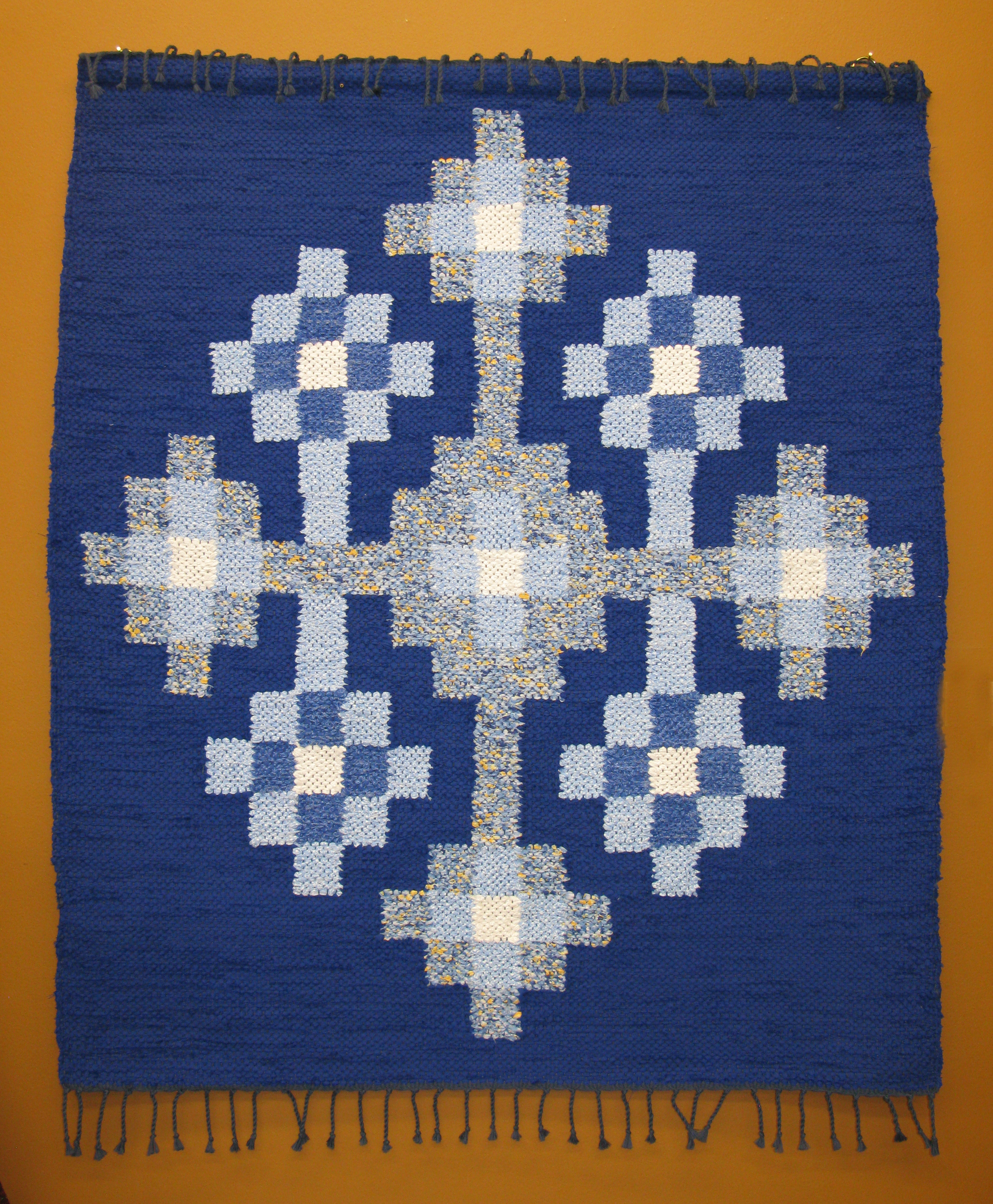
Blue Nicross 2014
Rutevev (Square weave)
Cotton warp, Cotton fabric strip weft, 42″ x 42″ This is inspired by a traditional coverlet in the Vesterheim collection, and interpreted with fabric strips. Using small print fabrics added more interest to the design.
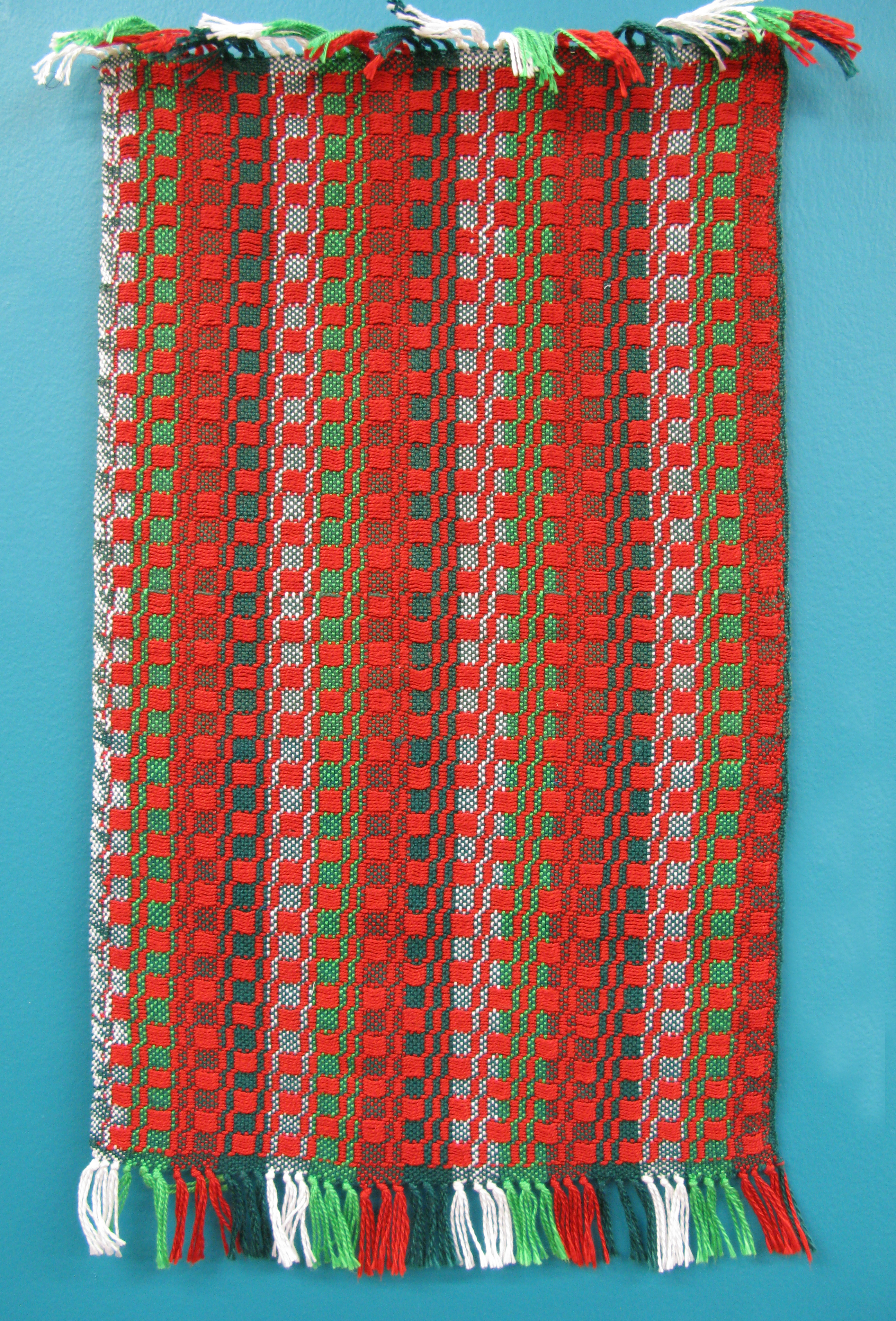
Holiday Monksbelt
Monksbelt (also known as tavlebragd in Norwegian)
Perle cotton, 15 x 25″ Using 3/2 Perle cotton in holiday colors in the warp gives a 3-D effect to the monksbelt pattern.
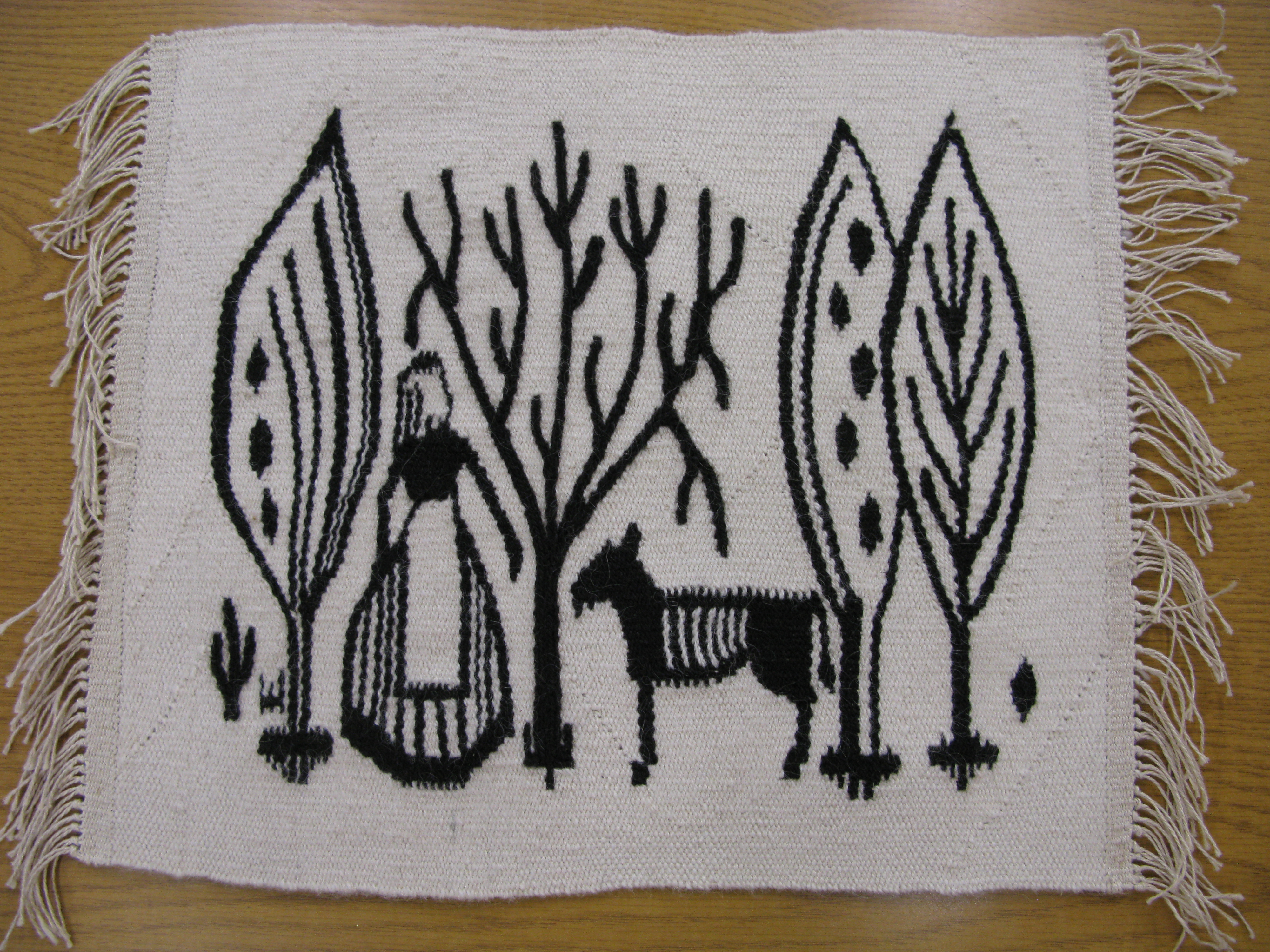
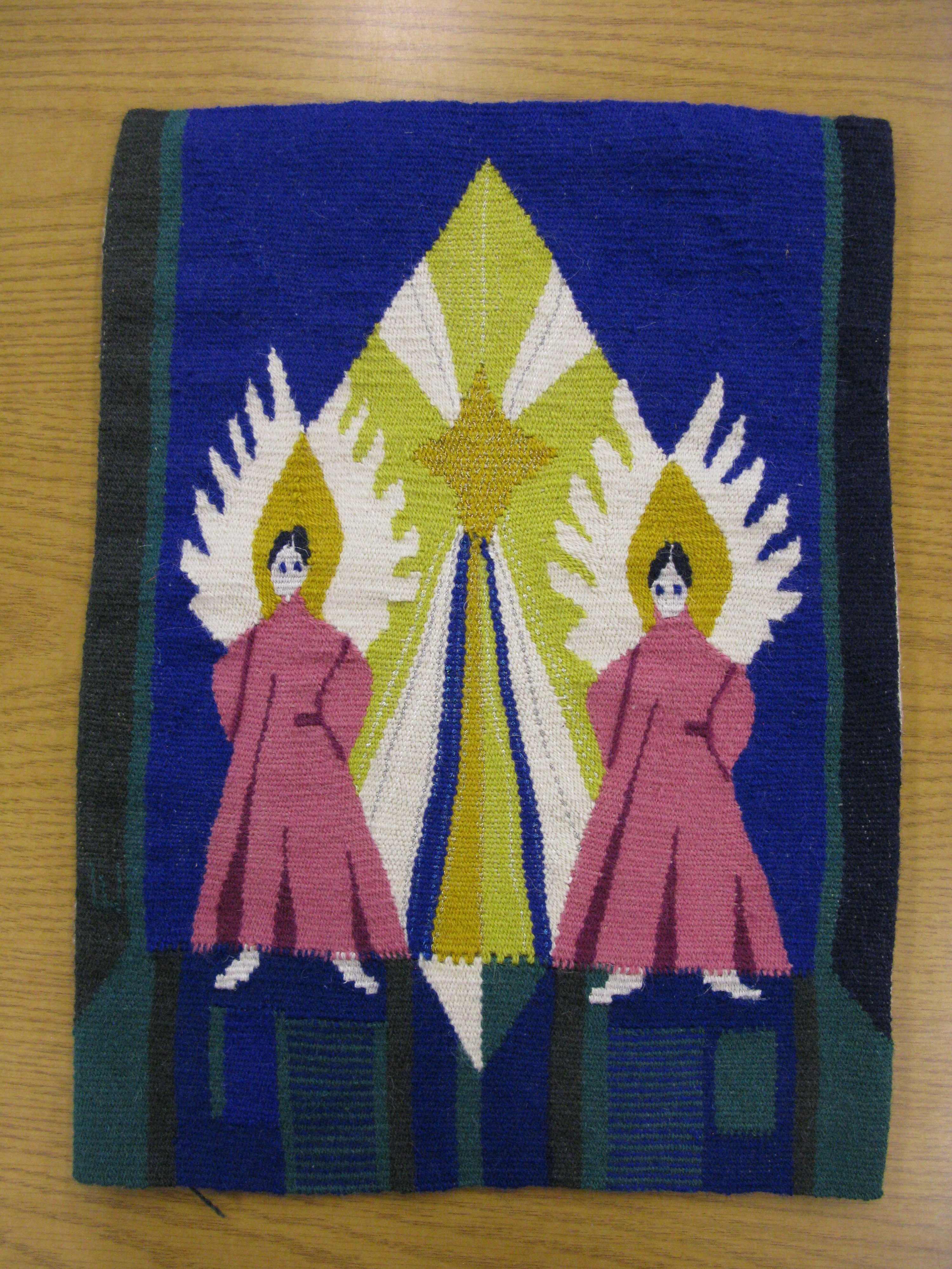
Ellen Anderson, a member of the Scandinavian Weavers Study Group for several years, passed away several years ago. It’s only fitting that two of her pieces are represented in the retrospective. One tapestry is noteworthy because is is a beautifully-executed pattern that was sold by Husflid in Norway. For decades, many weavers in Norway wove the image when learning the unique joins and technique of Norwegian billedvev. These tapestries were provided by Ellen’s daughter Karin Maah’s, who is following in her mother’s footsteps as an enthusiastic weaver and member of the Scandinavian Weavers Interest Group.
“Julestjernen og englene” (Christmas Star and Angels). Karin thought that her mother purchased the pattern or took it from a book. It was woven with Norsk Kunstvevgarn Spelsauul and DMC thread






 The guests arrived to this beautiful array of food. “Wait,” Karin exclaimed,”the cake isn’t out,” as if somehow the existing spread was inadequate!














 Scandinavian Weavers Study Group