Blog

  • Robbie LaFleur: Nest

    Robbie LaFleur

    Nest (Golden-Winged Warblers are Happy in their Minnesota Habitat)

    24″ x 52″
    Wool warp and weft

    NFS

    robbielafleur.com
    Insta: robbie_lafleur

    Bio: Robbie LaFleur, from Minneapolis, Minnesota, has been following a thread of Scandinavian textiles since she studied weaving at Valdres Husflidsskole in Fagernes, Norway in 1977. She has continued her study with Scandinavian instructors at workshops in Norway and the U.S. Recent projects include interpreting Edvard Munch’s “Scream” painting into a variety of textile techniques and weaving tapestry portraits of her relatives. She was awarded the Gold Medal in Weaving from the Vesterheim Norwegian-American Museum in 2006. Robbie coordinates the Weavers Guild of Minnesota Scandinavian Weavers Group and is the editor and publisher of the digital Norwegian Textile Letter.

    In 2019 LaFleur was a fellow with the American Scandinavian Foundation and traveled to Stavanger, Norway, to study the wool open-warp transparent tapestry technique of Frida Hansen (1855-1931). (full resume here)

    Description: The weaving was inspired by an article in the Star Tribune, “Minnesota’s forests a haven where rare bird still sings,” (10/28/2022) by Greg Stanley, part of an excellent series, “Our Vanishing North.” While news of environmental issues can generate feelings of hopelessness and loss, these articles also focused on dedicated people trying to address the habitats and polices needed to help species survive.

    Golden-winged warblers winter in Central America, traveling 3500 miles each summer to northern Minnesota. Half of all golden warblers in existence breed in the forests of our state. I admire the on-the-ground attempts of conservationists to combat the increasing monoculture of forest areas to provide a more traditional mixed habitat needed for many plants and animals.

     Nest is woven in wool open-warp transparent tapestry technique, first developed by Frida Hansen. She was a ground-breaking Norwegian artist on several levels. She reinvigorated historical tapestry weaving and the use of natural dyes during the National Romantic period in Norway, ran a school for tapestry weaving, directed one of the largest tapestry studios in Europe at the turn of the 20th century, and gained international fame for her large tapestries in Art Nouveau style. She also developed a patented technique for weaving “transparent” tapestries with wool warp and weft. Portions of the weavings, usually hung as portieres or curtains, were left unwoven, giving a see-through effect and an emphasis on positive and negative spaces in the images. Hansen’s transparent tapestries drew rave reviews at the Paris Exposition in 1900, and were purchased throughout Europe. Once her patent was released in 1906, many of her studio weavers and students also designed and wove transparencies. 

    I am writing a book on Frida Hansen and her unique transparency technique, to be published in 2026.

    lafleur1801@me.com
  • Robbie LaFleur: Margaret, the Medieval Queen

    Robbie LaFleur

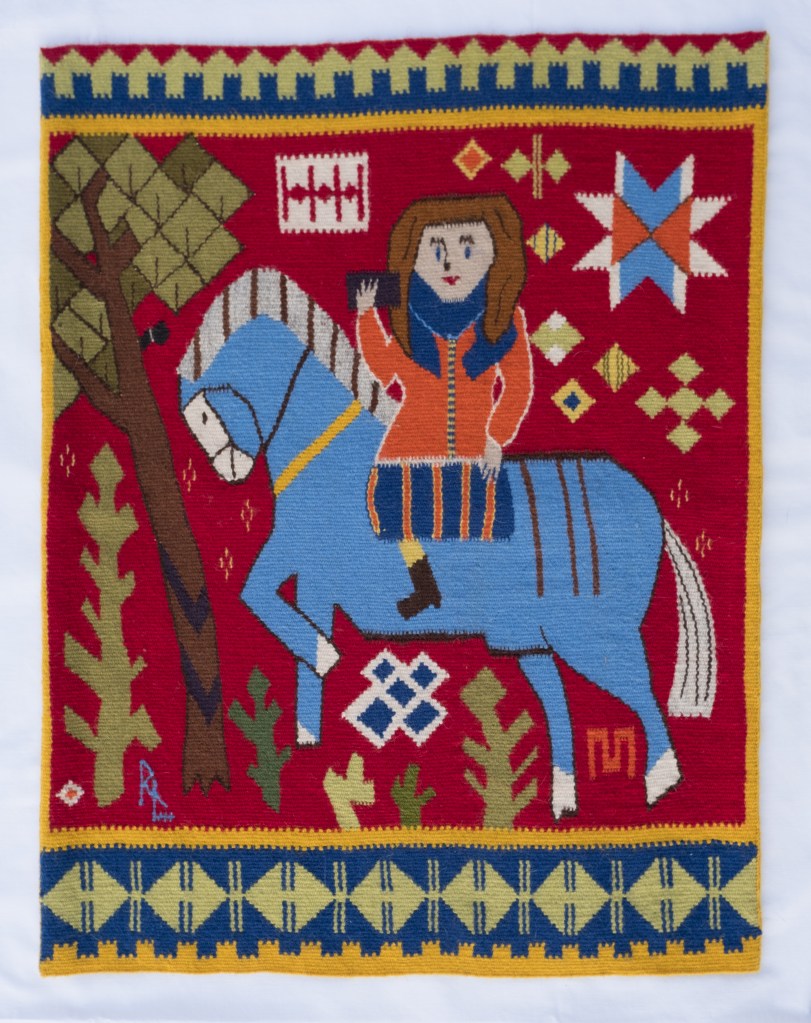
    Margaret, the Medieval Queen

    21″ x 28″
    Cotton warp, wool weft
    NFS
    http://www.robbielafleur.com
    Insta: robbie_lafleur

    Bio: Robbie LaFleur, from Minneapolis, Minnesota, has been following a thread of Scandinavian textiles since she studied weaving at Valdres Husflidsskole in Fagernes, Norway in 1977. She has continued her study with Scandinavian instructors at workshops in Norway and the U.S. Recent projects include interpreting Edvard Munch’s “Scream” painting into a variety of textile techniques and weaving tapestry portraits of her relatives. She was awarded the Gold Medal in Weaving from the Vesterheim Norwegian-American Museum in 2006. Robbie coordinates the Weavers Guild of Minnesota Scandinavian Weavers Group and is the editor and publisher of the digital Norwegian Textile Letter.

    In 2019 LaFleur was a fellow with the American Scandinavian Foundation and traveled to Stavanger, Norway, to study the wool open-warp transparent tapestry technique of Frida Hansen (1855-1931). (full resume here)

    Description: I’ve always loved the blue and green and red horses depicted in Renaissance-era Norwegian tapestry, of billedvev. My blue horse is not ridden by a king, but by my daughter. Rather than a ruff around her neck, Margaret wears a signature scarf. In her hand is a cell phone. Many of the motifs surrounding the horse are taken directly from historical tapestries — but not the camera in the tree to the left. That represents the topic of all the podcasts I was listening to while weaving, our modern-day surveillance society. This post reads to several blog entries about elements of the tapestry, “Medieval Mash-up with Margaret, Finished.”

    lafleur1801@me.com

  • Lisa Torvik: Hordaland Teppe/Coverlet

    Lisa Torvik

    Hordaland Teppe/Coverlet

    60″ x 23″ x 1/4″
    Linen warp, wool weft
    NFS

    Bio: Lisa Torvik credits early influences of her mother, grandmothers, aunts and friends in the US and in Norway for her knitting, sewing, embroidery and weaving interests. She spent a year in her youth studying weaving at Valdres Husflidsskule in Fagernes, Norway and now focuses on projects in traditional Norwegian techniques and more contemporary applications.

    Description: My Hordaland teppe is a half-width copy of my weaving school teacher’s full-sized coverlet, which again she had copied from an old threadbare coverlet. A classmate and I lay on our teacher’s living room floor for a couple days and drew the weaving order, shot for shot, on graph paper with colored pencils. We taped the sheets together into a long scroll. I continued as an “extra” student for another semester, able to pursue independent projects, and I wove it up from this scroll on a Monica loom that was free. It gave me nice clean lines.

    Regarding the Scandinavian Weavers Group: I am happy to be a part of a group to which I can contribute what I have learned and I can in turn try my hand at techniques I am unlikely to set up on my own or have little experience with. Weaving is both a social and solitary occupation, and the Scandinavian Weavers Study Group encourages both learning and community.

    content1627@gmail.com

  • Phyllis Waggoner: Rya Rag Rug

    Phyllis Waggoner

    Rya Rag Rug

    36″ x 24″
    Linen, wool, cotton fabric
    NFS

    Bio: Phyllis Waggoner has a BA in Art Education and a Masters degree in Design, from the University of Minnesota. She traveled to the Southwest with faculty and students of the University of Wisconsin, River Falls, studying the culture and weaving of the Hopi and Navajo people. Additional weaving classes include: The Marshfield School of Weaving in Vermont, taught by master weaver, Norman Kennedy, The Gotland Hemslöjd, in Visby, Sweden and The Weavers School, with weaver and author Madelyn van der Hoogt. Phyllis was awarded the American Swedish Institute Lily Lorenzen scholarship for study in Sweden and in March, 1999, she attended the weaving course offered at the Comvux school for adult education in Upplands Väsby, where she focused on drawloom weaving with weaver, teacher and author Kerstin Lovallius. Phyllis has taught classes in Color and Design and Weaving for the Extension Division of the University of Minnesota; The Art Center of Minnesota; The Norwegian-American Museum in Decorah, Iowa; The American Swedish Institute (ASI); and The Weavers Guild of Minnesota. She has volunteered for over 30 years at the American Swedish Institute, working with their textile collection. She was a guest curator for three exhibitions: Dreams of Home, Swedish Woven Coverlets; Hilma Berglund, Swedish Immigrants’ Daughter; and The Fabric of Life, Textiles from the ASI Collection. Articles featuring her work have appeared in The Weavers Journal, Handwoven and New Sweden Minnesota. She is a longtime member of the Weavers Guild of Minnesota.

    Description: My inspiration was “Blå transryan”, 1934, created by Swedish designer Märta Måås-Fjätterström. She recycled bits of leftover linen warp yarn and cotton rags which were dyed and then used for the rya knot bundles. Technique: rya. The tapestry warp is linen. The weft is wool for the ground and borders; with linen and cotton over-dyed in indigo for the rya knots.

    rpwaggoner2@gmail.com

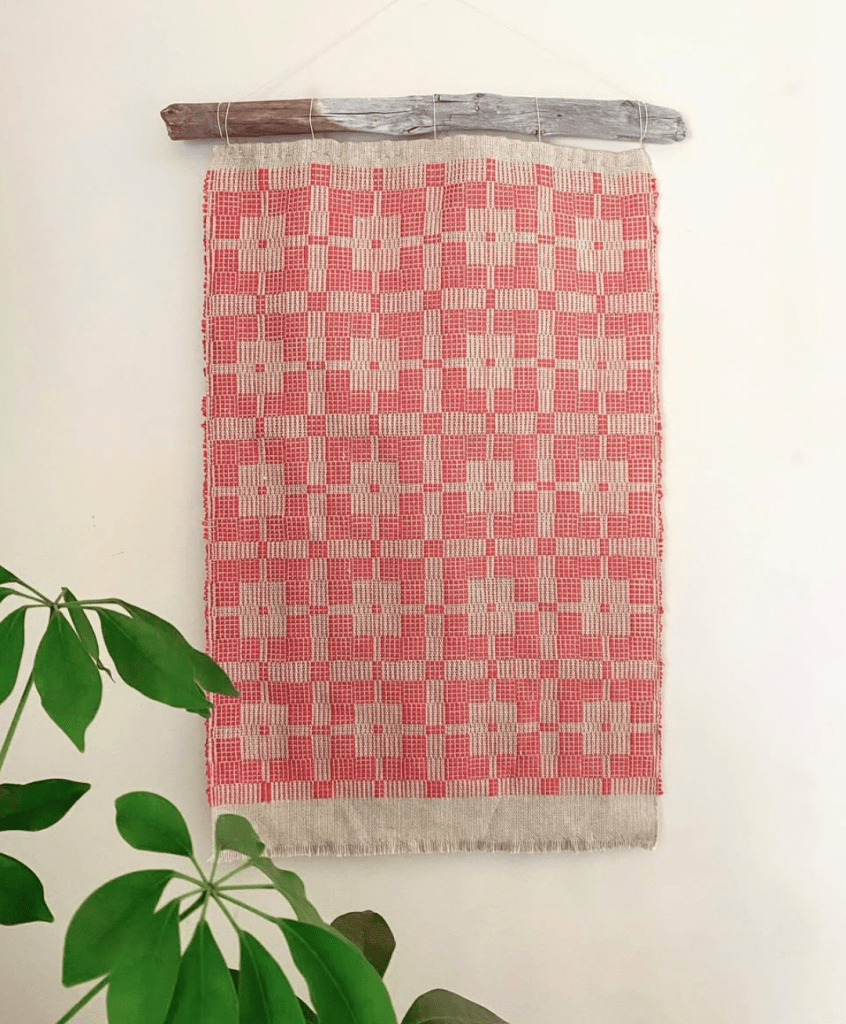
  • Holly Hildebrandt: Cloudberries

    Holly Hildebrandt

    Cloudberries

    24″ x 15″
    Linen
    NFS


    @hollyhilda_mn

    Bio: Holly Hildebrandt lives in the Minnesota St. Croix River Valley. She is a commercial interior designer by day and has a fascination with weaving and the fiber arts. She taught herself how to weave on a frame loom in 2018, and was gifted a floor loom in 2019. This led to many classes, lectures, joining the Scandinavian Weavers Study Group, participating in makers’ markets, and an inevitable lifelong passion for weaving. Holly is inspired by natural surroundings, uncovering family heritage, and studying global design history. With her craft, she hopes to excite an appreciation for functional art, connection to the past, and an intentional way of living in the world today.

    Description: I learned to weave this technique along with other members of the Scandinavian Weavers Study Group in early 2024 on a group warp. The lovely geometric pattern took on so many different identities with different weavers’ color selections. Mine took a bold and organic turn with its bright poppy red and creamy natural linen colors. I love the way this traditional technique took on such a modern flair by introducing the softness of the linen to the geometry of the little squares and highly contrasted scarlet weft. A technique I plan to explore more in the future, definitely.

    hollyrhildebrandt@gmail.com

  • Sharon Moe Marquardt: Traditional Sami Grene

    Sharon Moe Marquardt

    Traditional Sami Grene

    5′ x 3′
    Handspun wool and Norwegian regionally produced wool

    NFS

    Bio: Sharon Moe Marquardt has been weaving since the mid-1980s. Inspired by her sister’s summer/winter cow runner, she studied rigid heddle one- and two-heddle loom techniques from the Prairie Wool Companion, edited and authored by David and Alexis Xenakis. She used her notes to teach rigid-heddle classes at the Weaving Works and Experimental College in Seattle. Moving to her home state of Minnesota, she taught these classes at several weaving conferences. At one conference, she discovered Syvilla Tweed Bolson’s vendor table and later signed up for her boundweave class in Decorah, Iowa. These lessons led to a life-long pursuit of learning Scandinavian techniques. She has studied at Vesterheim Norwegian-American Museum, in Norway, and at the Hemslöjden in Landskrona, Skane, Sweden.

    Description: On a Vesterheim-sponsored tour which included the folk school in Kabelvåg in the Lofoten Islands I learned to weave a traditional black and white Sami coverlet called a grene from teachers Sonja Vangen and Olaug Isaksen. They work and teach at the Sami Husflid [a handcraft organization] in Manndalen, a Sami community on Kafjord east of Tromso. I was one of the first to sign up for this class because my grandmother is from the Vesterålen Islands north of the Lofotens and west of Tromso, where I have relatives. The grene is a much-desired coverlet and wall hanging. Sonja weaves them for customers on her warp-weighted loom. For wider grene, the looms are propped up against walls and woven outside. Later on the tour, we visited their husflid where I purchased a miniature warp-weighted loom which allowed me to teach classes.

    Regarding the Scandinavian Weavers Study Group: The Scandinavian study group has been my main support for decades. I live in a small rural area where hardly anybody weaves. I’ve traveled to meetings, but with Zoom now available I can attend most of them. Mange takk to this group.

    shmarquardt@gmail.com

  • Mary Erickson: Poppies

    Mary Erickson

    Poppies

     24” x 12”

    Wool warp and weft

    NFS

    Bio: Mary Erickson is a fiber artist living on the Mesabi Iron Range with an interest in how landscape and culture influence our lives.  Scandinavian weaving has long been an interest and she has traveled to several Nordic countries to study traditional methods of weaving.  

    Her weavings are on public display at the Essentia Health Virginia Building, the Minnesota North College at the Mesabi Range Virginia Campus and also at the Eveleth Campus.  Solo exhibits of her work have been held at the First Stage Gallery, Lyric Center for the Arts in Virginia, MN and her work has been included in many group exhibits.

    Mary holds a Bachelor of Science Degree in Art Education from Bemidji State University and a Master of Art Degree from the University of Wisconsin, Superior.

    Description: The first time I saw Frida Hansen’s weavings was at the Kunstindustrimuseet in Oslo. I was struck by their beauty!  When I asked for more information about her, the book Frida Hansen Europeeren i norsk vevkunst was suggested.  Over the years I have treasured the book with the wonderful images of her weavings, but had no idea how they were woven.

    I was happy when I learned that Robbie LaFleur studied Frida’s work and was teaching classes on how to weave this open warp transparency technique.   I feel very fortunate to learn from her.

    Why Poppies? Several years ago I photographed and drew sketches of poppies growing in my garden which I intended to one day use for a weaving.  Now was the time.  I wove these poppies based on the beauty in nature.  But like so many things we create, our ideas can go deeper and give more meaning.  When I see poppies I always remember my mother saying that she loved poppies every time she saw them. 

    About the Scandinavian Weavers Study Group: Living in Northern Minnesota, the Zoom link to the Scandinavian Weavers Study Group enables me to connect with a wonderful organization of weavers who are always looking forward to new learning, projects and goals. I feel very lucky to be a part of this group of talented weavers and also for the opportunity to display my work in this exhibit.

    vember@mchsi.com

  • Veronna Capone: Monk’s Belt Runner

    Veronna Capone

    Monk’s Belt Runner

    40″ x 70″
    Linen warp and ground weft, wool pattern weft
    NFS

    Bio: Veronna began to learn how to weave while taking adult education classes in Whittier, CA and found ways to learn the techniques, vocabulary, materials, looms, history, and applications while moving from one part of the US to another. While both of her grandmothers wove, one for making money, one out of necessity, the knowledge skipped a generation and she learned from others by taking classes, workshops, and travel.

    Description: After the upheaval of moving once again I had an urge to fill the loom, use a steady repeat of a pattern I liked, favorite colors of Harrisville singles stash for quiet movement, natural linen for ground and background, a thumb measure to fringe the sides and hide bad selvedges—and this small coverlet was born.  A friend once described it by saying, “ I immediately thought of Finland when I saw it.”  I’m flattered by that as it must have touched an old memory.  Monk’s belt, in one of the simplest ways to weave it, is a clear repetition of the square.  The repetition of few colors and similar sized bands are another simple way to weave.

    Regarding the Scandinavian Weavers Group: The study group is both intimidating and inspirational: People with great skill, talent, and energy to learn, share their wealth of knowledge, and keep the treasure of weaving activity lively and full of opportunity.

    venopac@swiftel.net

  • Kala Exworthy: Towels in the Colors of Norwegian Rosemaling

    Kala Exworthy

    Towels in the Colors of Norwegian Rosemaling

    34 “x 24″ x 3”

    Cotton warp and weft

    loomsong.com

    Bio: Kala learned to weave in Sandefjord, Norway in 1980. It took a few years, but she finished her BFA in Fiber Art at Northern Michigan University. Now, any available time is spent living her dream; enjoying her studio space and teaching at the Weaver’s Guild of Minnesota in Minneapolis as well as folk schools and non-profits. “Weaving, with its endless possibilities, fascinates me. It’s like creating a tangible story with a purpose. The texture of the thread, the color it’s next to, the direction it’s laying, the light it’s exposed to, all influence what we see. My favorite ingredient is the color, I can play endlessly with color combinations and textures.”

    Description: These towels were inspired by artifacts at Vesterheim Norwegian-American Museum in Decorah, Iowa. The photos show the artifacts which were painted at different times in history. I like weaving memories that are developed by looking at the colors and then making something that can be used everyday.

    Regarding the Scandinavian Weavers Study Group: The Scandinavian Weavers group is a wonderful community. The sharing and encouragement among members is exactly what a study group should be there for. It’s exciting to try new techniques as a group and brainstorm with people who understand the vision.

    kala.exworthy@gmail.com

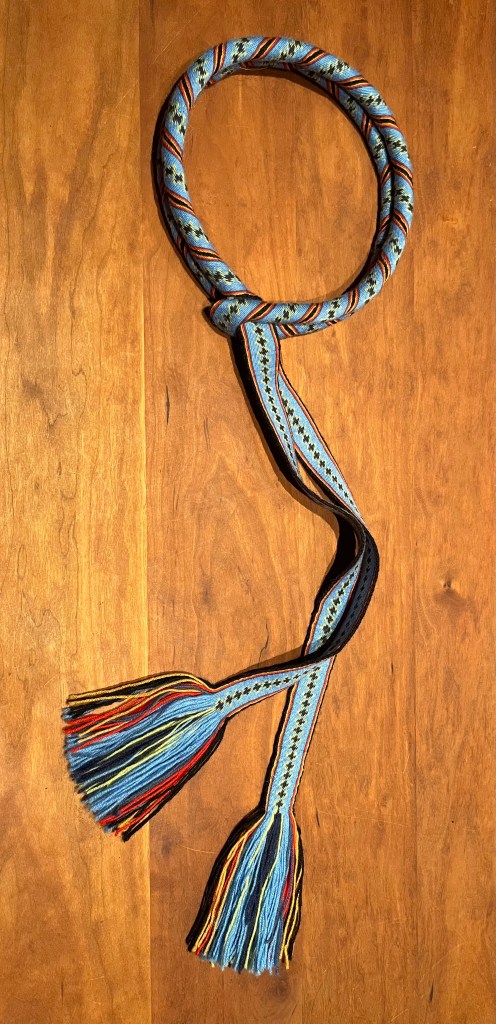
  • Peg Hansen: Beltestakk Hårbånd

    Peg Hansen

    Beltestakk Hårbånd

    8″ diameter crown with 18″ ribbon tails
    Wool Beltegarn, Almankås Telemarksbunader
    NFS

    Bio: Peg Hansen attended the University of Wisconsin River Falls in the late 1980s for the purpose of learning to weave fabric for sewing garments. As it turned out, she instead pursued a career in teaching Visual Art to Red Wing High School students for 20 years. After that she got back to her fiber roots and started weaving in earnest. Being in the Scandinavian Weavers has provided the opportunity to learn about many weaving techniques from group warps and the sharing of knowledge by amazing group members. Weaving trips to Norway and most recently, Peru have proven to be highly educational and motivating. In addition to the classes at the Weavers Guild of Minnesota, Peg has taken classes at North House Folk School in Grand Marais, MN and Vesterheim in Decorah, Iowa. Peg is also a member of the Zumbro River Fiber Arts Guild

    Description: I learned card weaving long ago as a weaving student at the University of Wisconsin River Falls. Little did I know that one day I would find myself immersed in all fiber things Norwegian. I started making a Beltestakk Bunad for myself in 2018 when I went on a tour to Norway with my bunad instructor, Sue Sutherland of Ely, MN. I spotted one version with silk embroidery on wool fabric and I was hooked. Woven accesories are important for a complete costume. Card weaving goes back centuries in Norwegian textile traditions. It is the chosen technique for hårbånds and the wide belt of this particular Telemark bunad. The colors I chose are from the town of Bø, Telemark in Norway.

    Regarding the Scandinavian Weavers Group: Learning about the technique used for the hårbånd was what drew me to The Weavers Guild of Minnesota. I first joined the Banditos Band Weaving group since their focus is weaving bands from cultures around the world. Through them I learned about the Scan Weavers. Even though I live 60 miles away, I am able to attend meetings more often since Covid allowed for the development of online meetings alongside the in-person meetups. The study groups have provided the opportunity to get to know weavers more personally. In fact, it was though this group that I was able to actually tour and weave my blanket (shown elsewhere in this exhibit) in Norway. I love the community warps that give me the opportunity to learn and practice the craft.

    pegandrayhansen@gmail.com