56″ x 39 1/2″ x 1/16″ Linen warp, linen and cotton weft NFS
Bio: Lisa Torvik credits early influences of her mother, grandmothers, aunts and friends in the US and in Norway for her knitting, sewing, embroidery and weaving interests. She spent a year in her youth studying weaving at Valdres Husflidsskule in Fagernes, Norway and now focuses on projects in traditional Norwegian techniques and more contemporary applications.
Description: After I finished my “Kalendar” piece for our Baldishol exhibition at Norway House in 2020, I had about 2-3 yards of warp left on the loom. A combination of upcoming shows and our “stash busting” challenge inspired me to get that warp off the loom, but what to weave? I looked at my Hordaland teppe hanging on the wall and just started weaving it up as a transparency, from the bottom up until I ran out of warp. I improvised designs to fill the border areas, and I used primarily what I had on hand, including different weights of linen and perle cotton.
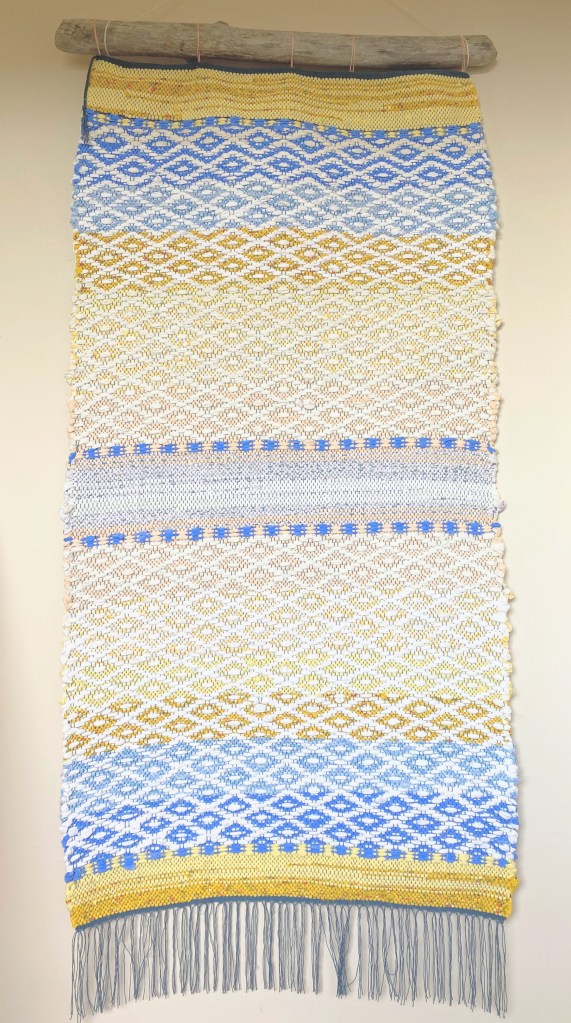
42 x 42” Seine Twine warp with quilting cottons as weft NFS
Bio: Judy Larson began weaving when her mother got her great-grandmother’s loom out of the grainery 22 years ago. She was given a used loom, and began her learning journey, always ready to take on a challenge. Primarily a rug weaver, she enjoys using fabrics in creative ways and exploring Scandinavian weaving traditions. Retired from teaching elementary school, she now teaches weaving and enjoys sharing her passion with weavers of all ages. Judy Larson now has a weaving studio at Color Crossing in Roberts, Wisconsin where she weaves on an 8-foot Cranbrook loom and a 10-foot Glimakra loom. She incorporates several different techniques such as shaft switching, taquete, and rosepath into her weavings. She is the leader of the Rag Rug group at the Weavers Guild of Minnesota and is also active in the Scan Weavers and New and Occasional Weavers study groups. Weaving encourages her to play with color, texture, design, pattern, and materials. There is enough challenge and new learning to keep her busy for years, creating pieces that are uniquely hers, while still being functional. Combining design, color, and durability always leads to wonderful surprises, even when carefully planned out, which keeps weaving both amazing and satisfying.
Description: This piece was inspired by a Nicross (9 cross) design on wallpaper at Vesterheim in Decorah, Iowa. Taking that design and recreating it as a square weave wall hanging was a lesson in patience, persistence, and careful counting! The initial block pattern was off, so it was unwoven and rewoven with the correct block placement. Using blue and yellow fabrics instead of yarns gives the weaving a unique texture, while still honoring the initial design. This wall hanging has been shown at Vesterheim.
Regarding the Scandinavian Weavers Group: The Scandinavian Weavers Group are skilled weavers who are inspiring others, encouraging others, and genuinely passionate about preserving traditional techniques and sharing their legacy. Being a part of this group has enhanced my own weaving skills and expanded my circle of friends. Taking on a cooperative weaving project with American Swedish Institute as part of the Karin Larsson: Let the Hand Be Seen exhibit, the members had the opportunity to demonstrate weaving for many visitors. It was so popular that visitors began asking, “Are the weavers here today?”
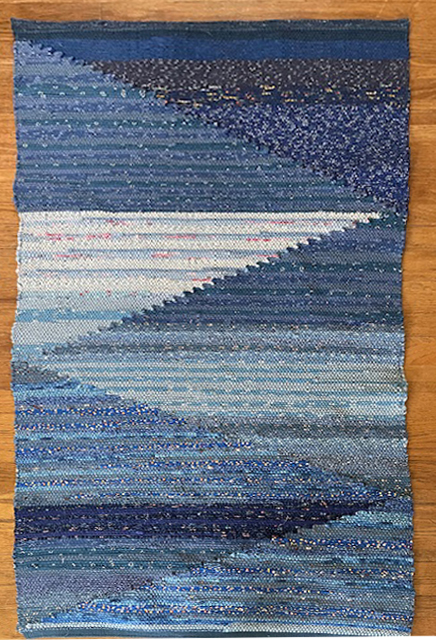
49″ x 26″ Seine Twine warp with Quilting cottons wefts NFS
Bio: Judy Larson began weaving when her mother got her great-grandmother’s loom out of the grainery 22 years ago. She was given a used loom, and began her learning journey, always ready to take on a challenge. Primarily a rug weaver, she enjoys using fabrics in creative ways and exploring Scandinavian weaving traditions. Retired from teaching elementary school, she now teaches weaving and enjoys sharing her passion with weavers of all ages. Judy Larson now has a weaving studio at Color Crossing in Roberts, Wisconsin where she weaves on an 8-foot Cranbrook loom and a 10-foot Glimakra loom. She incorporates several different techniques such as shaft switching, taquete, and rosepath into her weavings. She is the leader of the Rag Rug group at the Weavers Guild of Minnesota, and is active in the Scanweavers and New and Occasional Weavers study groups. Weaving encourages her to play with color, texture, design, pattern, and materials. There is enough challenge and new learning to keep her busy for years, creating pieces that are uniquely hers, while still being functional. Combining design, color, and durability always leads to wonderful surprises, even when carefully planned out, which keeps weaving both amazing and satisfying.
Description: Experimenting with Rölakan techniques, I connected many small pieces of leftover quilting fabrics into dark, medium, and light wefts. The wedge design enhanced the color interactions, and made the design very intriguing as the weaving progressed.
About the Scandinavian Weavers Study Group: If you have a question about weaving, the Scanweavers group has someone who knows the answer, or someone who knows where to research that answer. The collective knowledge of these weavers is a treasure trove!
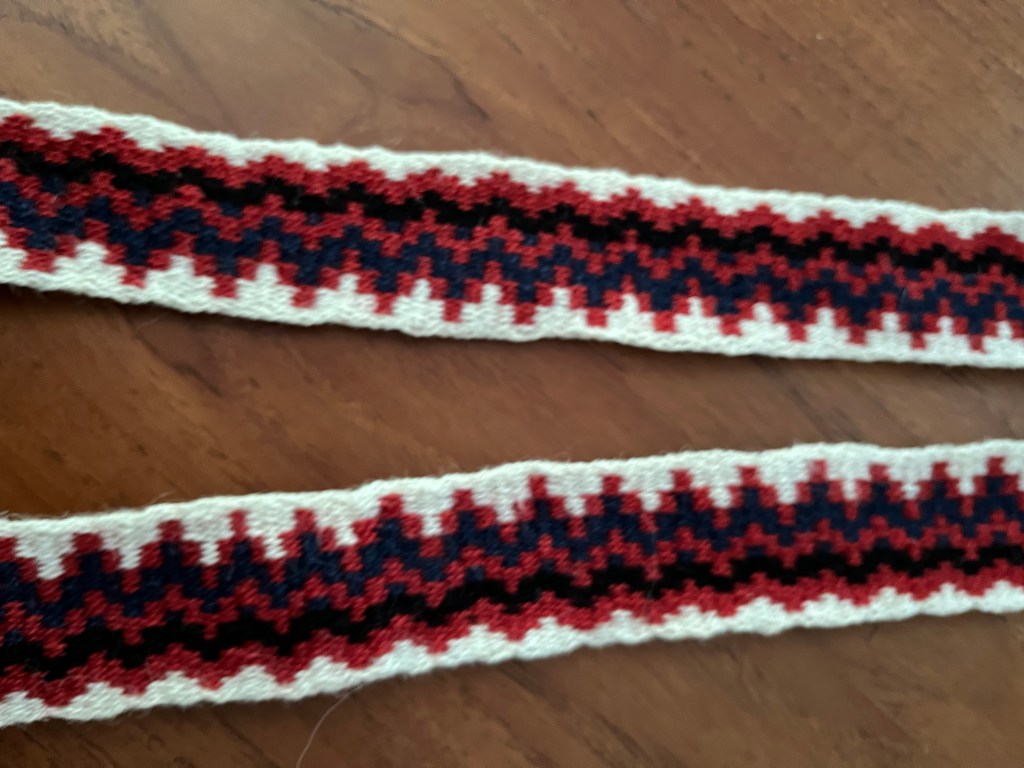
63”x 1 3/8” 5/2 Perle cotton, woven on an inkle loom NFS
Bio: Jane has been weaving since 1994. She has done several inkle loom techniques, including Baltic pick-up and South American pebble weaving. She plans to return to weaving more on the inkle loom.
Description: This belt has single, double, and multiple krokbragd patterns. I wanted to try weaving a krokbragd belt with the bright gold and blue colors.
Regarding the Scandinavian Weavers Group: I really enjoy seeing the work of all the other weavers in the group, especially the floor loom weavings.
Bio: Holly grew up on the North Shore of MN and now lives in the St. Croix River Valley where she continues to be inspired by forests and great bodies of water. She taught herself how to weave on a frame loom in 2018, and was then gifted a floor loom in 2019. This led to many classes, lectures, joining the Scandinavian Weavers Study Group, participating in makers’ markets, and an inevitable lifelong passion for weaving. Holly is inspired by natural surroundings, uncovering family heritage, and as an Interior Designer, enjoys studying global design history. With her craft, she hopes to excite an appreciation for functional art, connection to the past, and an intentional way of living in the world today.
Description: My first rag rug. It was woven in conjunction with the Karin Larsson “Let the Hand Be Seen” exhibit at the American Swedish Institute in 2024. The color scheme is comprised of cloth my mother had leftover from when I was a little girl: the curtains from my bedroom, a blanket from my sister’s bed, extra fabric from a doll pillow. I supplemented the color scheme with some purchased cloth and some kindly shared with me. The rosepath pattern in white I feel creates somewhat of a gate that you can look through to the gradient from peach to periwinkle, much like the Belt of Venus that is so visible at sunrise and sunset. The organic striations at the center are very much to me a lake that reflects a gradient sky onto the water. This year I have done a lot of visiting the North Shore, where I am from, and have been totally captured by the Belt of Venus over Lake Superior. Serene, restful, cheerful.
14.5”x 9 1/4” Linen warp, linen and black wool weft NFS
Bio: Jane has been weaving since 1994. She specializes in small loom weavings and loves to do intricate patterns. Crows are her favorite bird, so weaving this transparency was a labor of love.
Description: This piece is inspired by my fascination with crows. Crows are so smart, and call out to me. They are one of the most intelligent animals, often outperforming dogs and cats!
Bio: Edi Thorstensson has been weaving since 1963, when she enrolled in a summer class in beginning weaving at the Chicago Art Institute. The class was taught by Lurene Stone and occasionally visited by Elsa Regensteiner, who was head of the Weaving Department at the Art Institute and a noted author and textile designer. Being a student in the Art Institute School at the time placed Thorstensson in a social context very different from the Chicago suburb, La Grange, in which she had grown up and the college, St.Olaf, where she had just completed her first year. Her classmates were public school art teachers, aspiring textile designers, artist activists, students of all ages, with diverse economic backgrounds, racial identities, and life experiences and goals. The Civil Rights movement was gaining momentum, and it influenced students’ relationships to each other both inside and outside the classroom. For Thorstensson, the summer weeks of 1963 at the Chicago Art Institute, was an introduction to weaving much more than cloth. Thorstensson has continued her textile studies at Mora Folkhögskola and Skånska Hemslöjd in Sweden, in Tromsø and other settings in Norway, and, in the US, Sievers School of Fiber Arts, the Weavers Guild of Minnesota, North House Folk School, and Vesterheim Norwegian American Museum. She has taught weaving classes at Gustavus Adolphus College and the Arts Center of St. Peter. She is a retired librarian and college archivist who lives in St. Peter, Minnesota.
Description: I brought this inkle loom krokbragd as a show-and-tell to the Scandinavian Weavers exhibit in Red Wing Arts in Red Wing, Minnesota. It was a fun chance to try something new. I now see this as a wonderful way to weave very substantial bands that can stand up to wear and tear. I love this technique when used with the right warp and weft.
Regarding the Scandinavian Weavers Group: The study group has been a wonderful enhancement and continuation of the Norwegian Textile focus group and publications. It is always good to connect!
Bio: Edi Thorstensson has been weaving since 1963, when she enrolled in a summer class in beginning weaving at the Chicago Art Institute. The class was taught by Lurene Stone and occasionally visited by Elsa Regensteiner, who was head of the Weaving Department at the Art Institute and a noted author and textile designer. Being a student in the Art Institute School at the time placed Thorstensson in a social context very different from the Chicago suburb, La Grange, in which she had grown up and the college, St.Olaf, where she had just completed her first year. Her classmates were public school art teachers, aspiring textile designers, artist activists, students of all ages, with diverse economic backgrounds, racial identities, and life experiences and goals. The Civil Rights movement was gaining momentum, and it influenced students’ relationships to each other both inside and outside the classroom. For Thorstensson, the summer weeks of 1963 at the Chicago Art Institute, was an introduction to weaving much more than cloth. Thorstensson has continued her textile studies at Mora Folkhögskola and Skånska Hemslöjd in Sweden, in Tromsø and other settings in Norway, and, in the US, Sievers School of Fiber Arts, the Weavers Guild of Minnesota, North House Folk School, and Vesterheim Norwegian American Museum. She has taught weaving classes at Gustavus Adolphus College and the Arts Center of St. Peter. She is a retired librarian and college archivist who lives in St. Peter, Minnesota.
Description: Following a Vesterheim Textile Study Tour to Denmark and Norway in the summer of 2017, a number of tour participants and I traveled from Copenhagen to Landskrona, Sweden, to study Swedish art weaves with Gunvor Johansson at Skånska Hemslöjd’s headquarters. This was made possible by Scandinavian Weaver Melba Granlund, who arranged for a class for our group that would be taught in English. My piece is entirely inspired by Gunvor’s examples and her encouragement. It was woven on a pre-warped loom with a 50/10 reed, dressed with 20/3 linen warp. Weft was Swedish wool yarns, including Klippans Fårö, and Norwegian Rauma prydvevgarn one- and two-ply. I chose to mount my piece on commercial black wool fabric and embellish it with a cotton inkle-woven band and minimal hand stitching. I used a manufactured pillow case and filler to complete the piece.
Regarding the Scandinavian Weavers Group: The study group has been a wonderful enhancement and continuation of the Norwegian Textile focus group and publications. It is always good to connect!
Bio: Beth started to weave in 2020 after retiring. She has taken classes through the Weavers Guild of Minnesota and currently weaves on a Rigid Heddle loom and a floor loom at home. Her interest is in exploring Norwegian weaving. This has led to taking a course at Vävstuga in Massachusetts and weaving at a studio in Norway.
Description: I wove this skillbragd piece in the Fall of 2024 while participating in a Husflid weaving group in Oppdal, Norway. It was my first skillbragd weaving. The pattern is woven with 4 pattern shafts and 2 background shafts that are located several inches behind the pattern shafts. The technique is unique as the warp is threaded through multiple heddles, creating the more intricate pattern. Currently, I am focusing on traditional Norwegian weaving and exploring contemporary interpretation of these patterns.
Bio: Beth started to weave in 2020 after retiring. She has taken classes through the Weavers Guild of Minnesota and currently weaves on a Rigid Heddle loom and a floor loom at home. Her interest is in exploring Norwegian weaving. This has led to taking a course at Vävstuga in Massachusetts and weaving at a studio in Norway.
Description: I wove this piece as part of the Scandinavian Weavers’ Telemarksteppe group warp at the Weavers Guild of Minnesota. The design inspiration came from a veggteppe my husband and I received as a wedding gift from a relative in Norway in 1978. The wool was purchased in Norway and is similar to the material used in the original weaving.








 Scandinavian Weavers Study Group