Tag: Weavers Guild of Minnesota

  • Hello from the Great Minnesota Get-Together!

    Hello from the Great Minnesota Get-Together!

    The Giant Sing Along is fun for all ages!

    If you know Minnesota, you know how much we love our annual State Fair. Twelve glorious days of agricultural expositions and competitions, live music, fried food, carnival rides, games for the kids, amateur talent contests, more fried food, shopping, politicking, marching bands, sunburn, heatstroke, beauty queens sculpted in butter, and even more fried food, most of it on a stick.

    It really is all about the food, especially when you add garlic and butter.

    For the past 50 years, volunteers from the Weavers Guild of Minnesota have demonstrated the arts of weaving and spinning in the Creative Arts building, sharing their passion and expertise with fairgoers of all ages throughout the entire run of each year’s Fair. In recognition of this achievement, the Weavers Guild of Minnesota received one of the 2024 Minnesota State Fair 50 Year Awards, presented annually to individuals who have actively participated in the Minnesota State Fair for 50 years.

    Nancy Gossell and Judy Larson demonstrate weaving at the Minnesota State Fair.

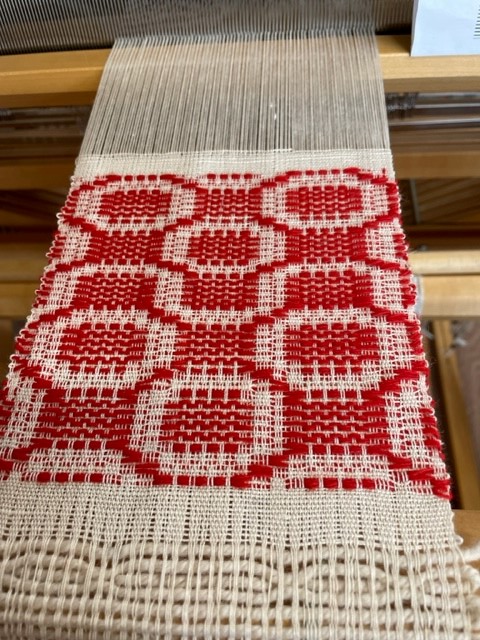
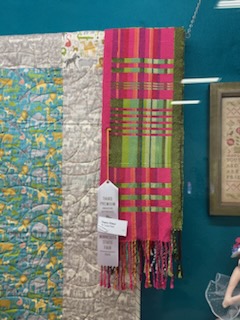
    Besides volunteering, many weavers and spinners compete in the creative activities competitions. This year, Scan Weavers member Nancy Ebner took the plunge, entering for the very first time. To her surprise, she won not one but three ribbons, including a blue ribbon for her square weave tapestry “Divine Order,” seen at the Scan Weavers exhibits at Becketwood and Red Wing Arts. (See previous pots on this blog for a photo.) She was also awarded a red ribbon for her telemarksteppe, seen below.

    Finally, her charming pink scarf below—yes, pink is her favorite color—won a white ribbon for “Work by a Senior Citizen,” in the category of woven scarf, stole, or shawl.
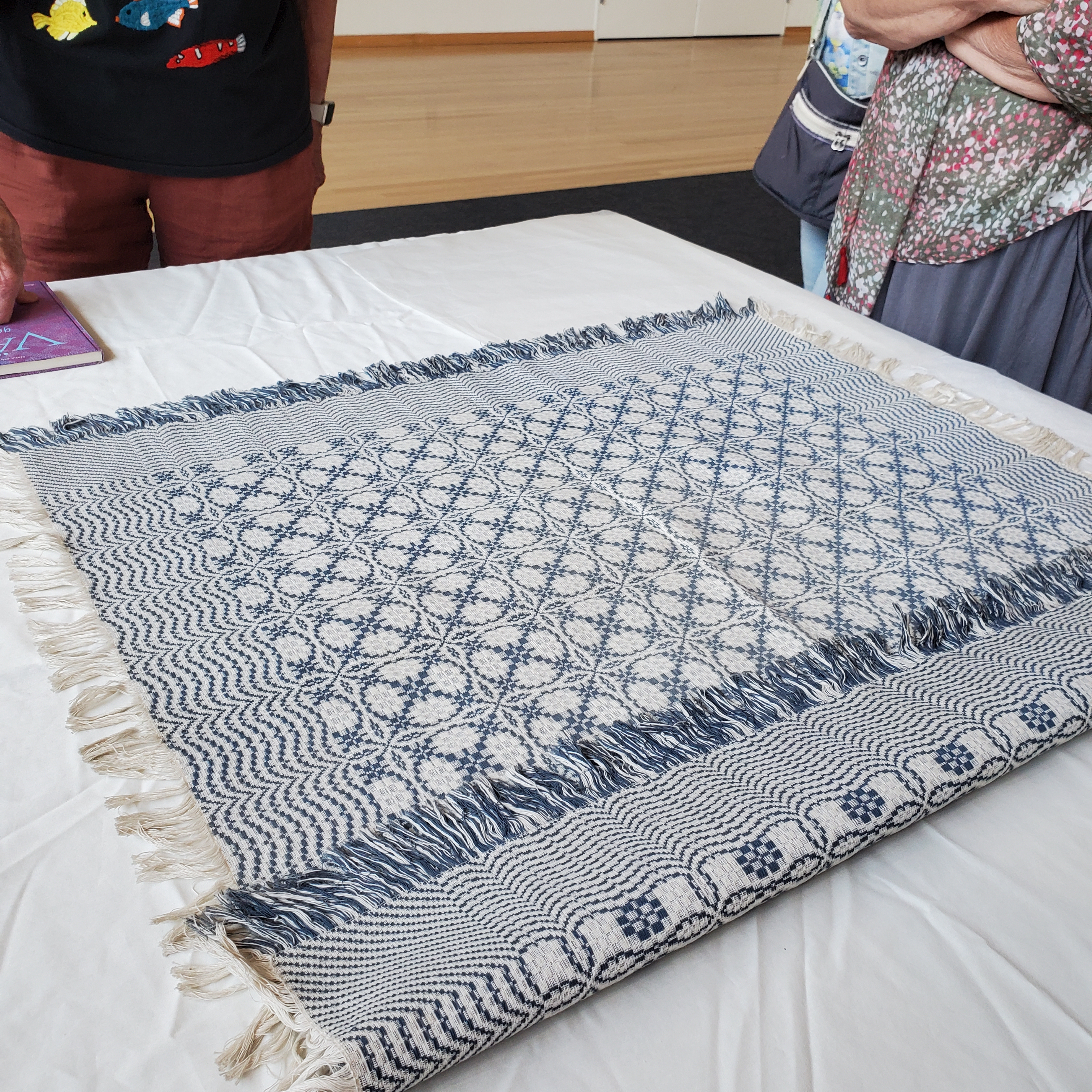
    Barb Yarusso is active in both the Scandinavian Weavers and the Rag Rug Weavers groups. She won a blue ribbon in the category of “International or Historically Inspired Rug” for her rug in a traditional Finnish-American pattern known as “Over the Waves.”

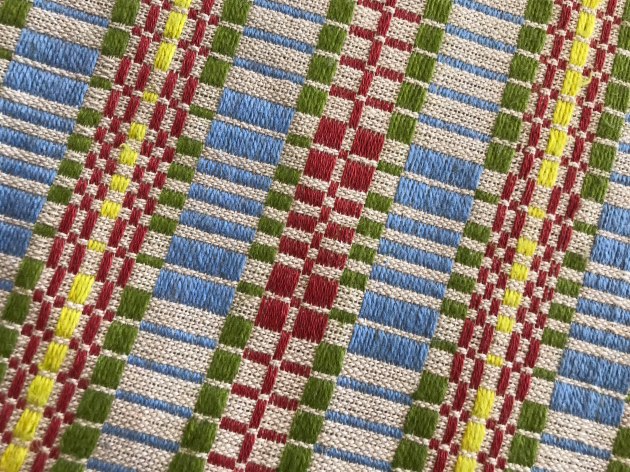
    “I wove it using the Finnish 3-shuttle technique, which I learned in a class taught by Wynne Mattila,” Barb explains. “The weft strips are a mix of old sheets and new quilting cotton, and it was primarily a stash-busting project. I used primarily blues and greens to suggest water waves. There are sections using various combinations of weft fabrics, but it’s always a dark, a bright, and a light. When you combine the four treadle repeat sequence with the 3-shuttle technique, it gives waves with a 12 pick repeat length. I wove the hems using Lily Sugar ‘n Cream cotton yarn, doubled, in coordinating colors. The weight of the yarn gives a slightly thicker hem with less draw in than using the warp yarn as hem weft. Combining colors in the hem also makes it look intentional.”

    In other award news, Scan Weavers member Mandy Pedigo was honored with a coveted slot in the Fair’s Studio HERE program, which showcases twelve artists over the twelve days of the MN State Fair. The chosen artists set up their creative space in the Fine Arts Building, providing fairgoers an opportunity to engage with the creative process. Visit Mandy’s blog to learn more about her experiences and be sure to give her a follow.

    https://www.mandypedigo.com/blog/a-day-at-the-fair-weaving-memories-and-weathering-the-storm

    The Scan Weavers’ coordinator, Robbie LaFleur, was honored to have her latest open-warp tapestry “Nest (Golden-Winged Warblers Are Happy in Their Minnesota Habitat)” displayed in the annual Textile Center display in the Creative Arts Building.

    Read more in Robbie’s blog post here.

    Finally, be sure to check out this live segment from KSTP’s “Creative Corner” featuring Minnesota Weavers Guild volunteers, including Judy Larson, a Scan Weavers member and Rag Rug group coordinator.

    Not a live button above — see the segment here.

    Next up: Scan Weavers enjoy “Cocktails at the Castle”! Stay tuned!

  • Latest News from Scandinavian Weavers!

    Latest News from Scandinavian Weavers!

    Follow the Scan Weavers Blog! (And see more beautiful blue rugs by Judy Larson!)

    It’s been a busy summer for our Scandinavian Weavers Group and promises to be a busy fall, as well. Stay tuned for a summer wrap-up and fall preview, including the following:

    Scan Weavers win ribbons the Minnesota State Fair!

    Scan Weavers in the news!

    Recent and Upcoming travels to Scandinavia!

    Group Projects: Rosepath Rugs and Viking Twill!

    Major Exhibit Coming in 2025!

    And more! (Including waffles.)

  • Beloved Textiles and Family Stories in “Domestic to Decorative”

    Beloved Textiles and Family Stories in “Domestic to Decorative”

    The Scandinavian Weavers’ “Domestic to Decorative” exhibit included several heirloom textiles, which came with wonderful family stories. The heirlooms inspired members of our group to weave new versions of the same technique—in one case, to combine old and new in a single weaving—or to use their imaginations to create something new inspired by the past.

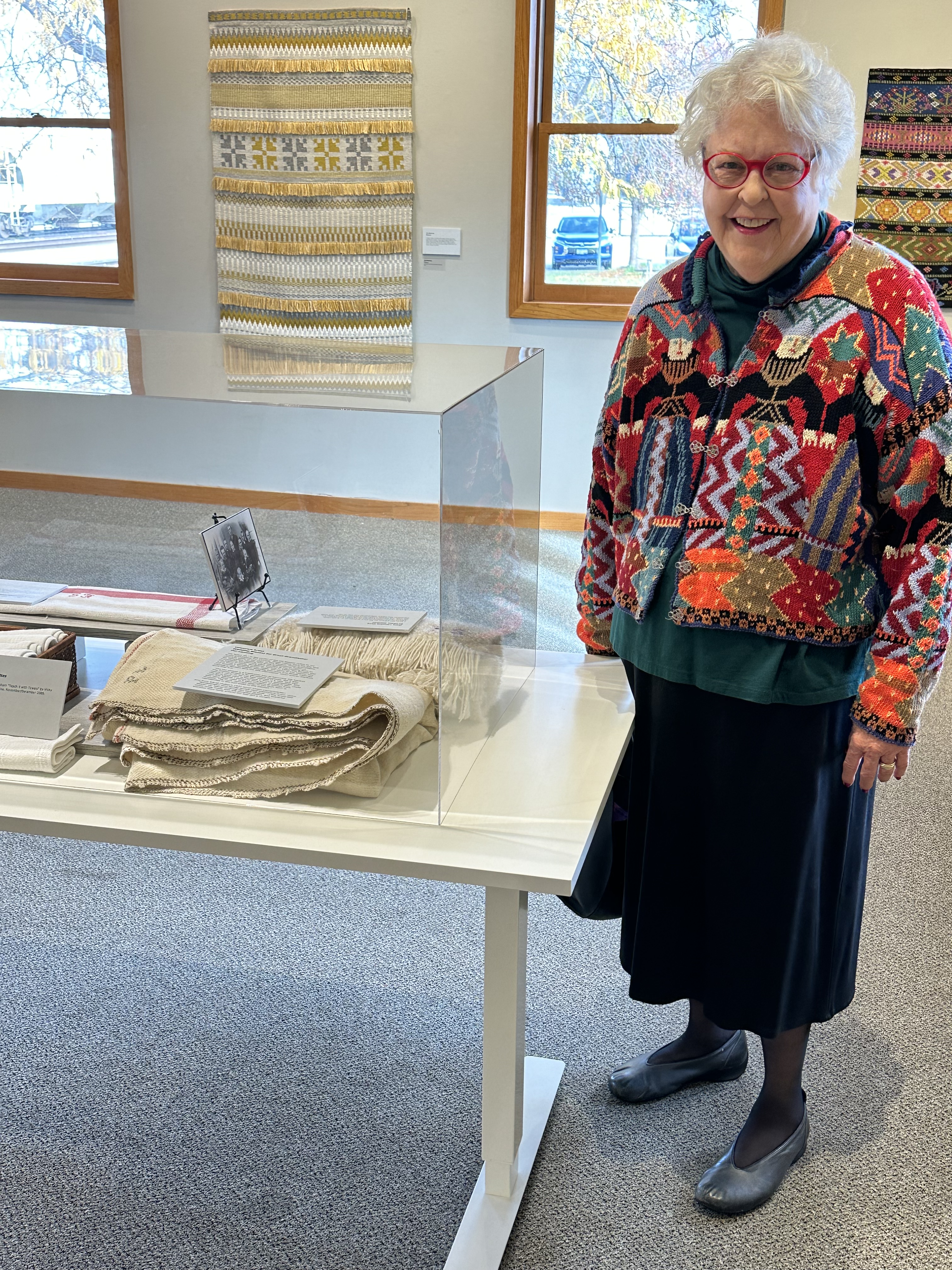
    Weaver Mary Skoy next to the woolen blanket given at her great-grandparents’ wedding.

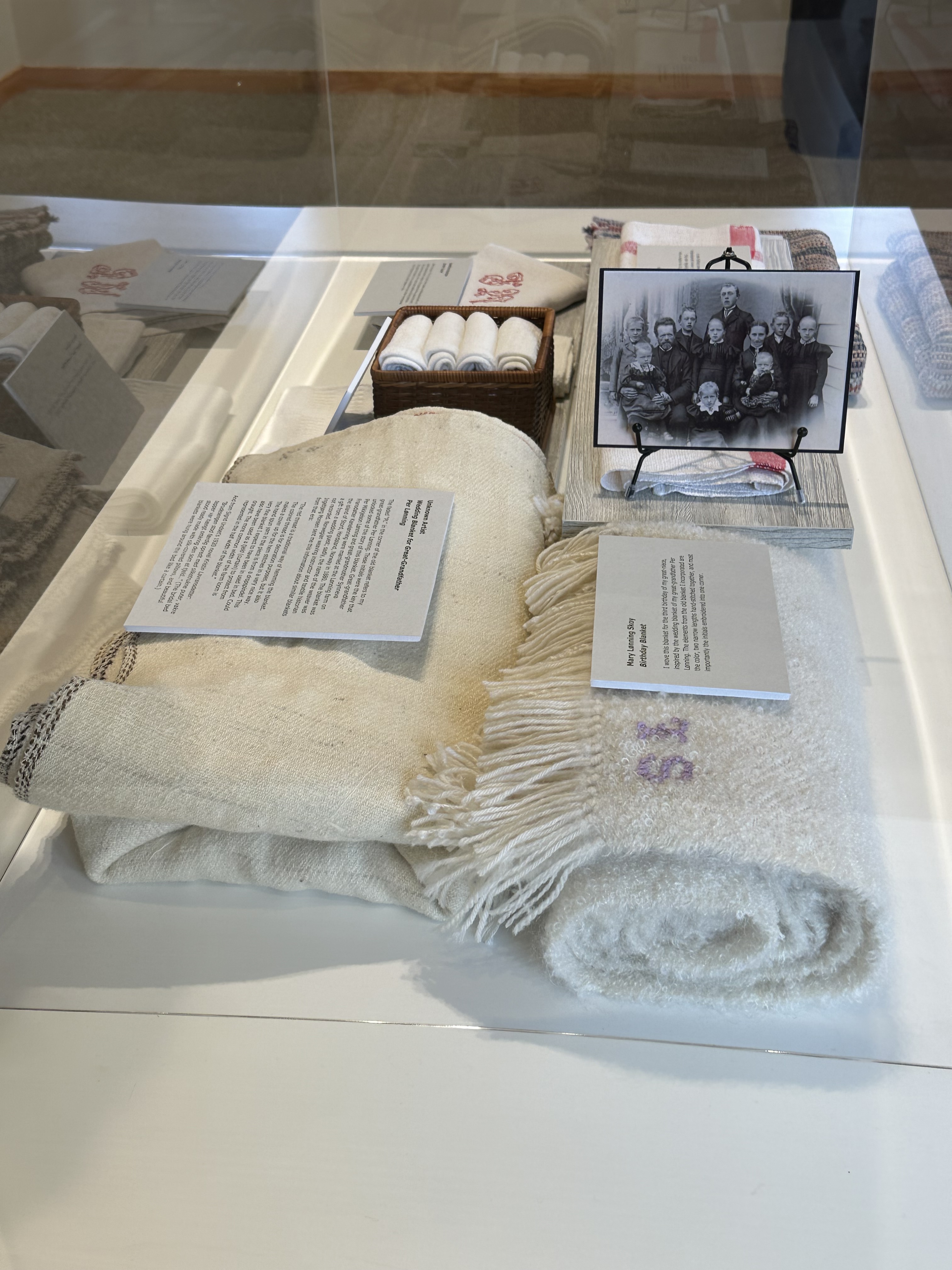
    One of Mary Skoy’s most treasured family heirlooms is a simple woolen blanket. The blanket was a gift to Mary’s great-grandfather Per Mikkjelson Lønning and great-grandmother Synneva Fransdatter Kanelønning, who were married at the Lønning farm on the island of Stord, Hordaland, Norway in 1880. “The blanket was a gift from a wedding guest,” Mary explains. “The faded PL in the corner of the old blanket refers to Per Lønning. Sadly, the name of the weaver was not recorded.” Note: Mary always encourages those of us in the Scandinavian Weavers group to include our initials on everything we weave!

    Per Lønning and Family

    Mary researched the history of blankets from this era, consulting Norwegian weaving instructor and textile historian Ingebjørg Monsen. Ingebjørg sent the following information about similar blankets from that era: “The red thread is a traditional way of hemming the blanket. The colored thread is for decoration purposes, but it also makes a cover up for the hem stitches in a very nice way. The hand spun yarn in the piece is from a dropspindel. This very fine blanket I expect to have been in used in bed. Could also have been used as a tjeld (curtain) to protect from draught. The more common width of the farm loom is represented in the half width of the blanket.”

    Inspired by the heirloom blanket, Mary wove a new blanket for the birthday of her great-niece. “The elements from the old blanket I incorporated are the color, two narrow lengths hand-stitched together, and most importantly the initials embroidered into one corner,” Mary says. The new blanket is also much softer, incorporating alpaca, mohair, silk, and wool—luxury fibers that would not have been available to her ancestors in 1880.

    Original blanket on the left; Mary’s blanket on the right.
    Close-up showing theembroidered initials.Note the difference between the simple wool fibers in the original and the fluffier fibers on the new blanket.

    Beth Detlie was also inspired by Norwegian textiles: “Vegteppe was a wedding gift from my husband’s aunt to us in 1978. She told us that the weaving was done by a distant relative of mine. (My mother’s ancestors immigrated to the United States from the Telemark region in Norway during the 1850s.)” Beth’s Telemark Reflection is an echo of this beloved weaving.

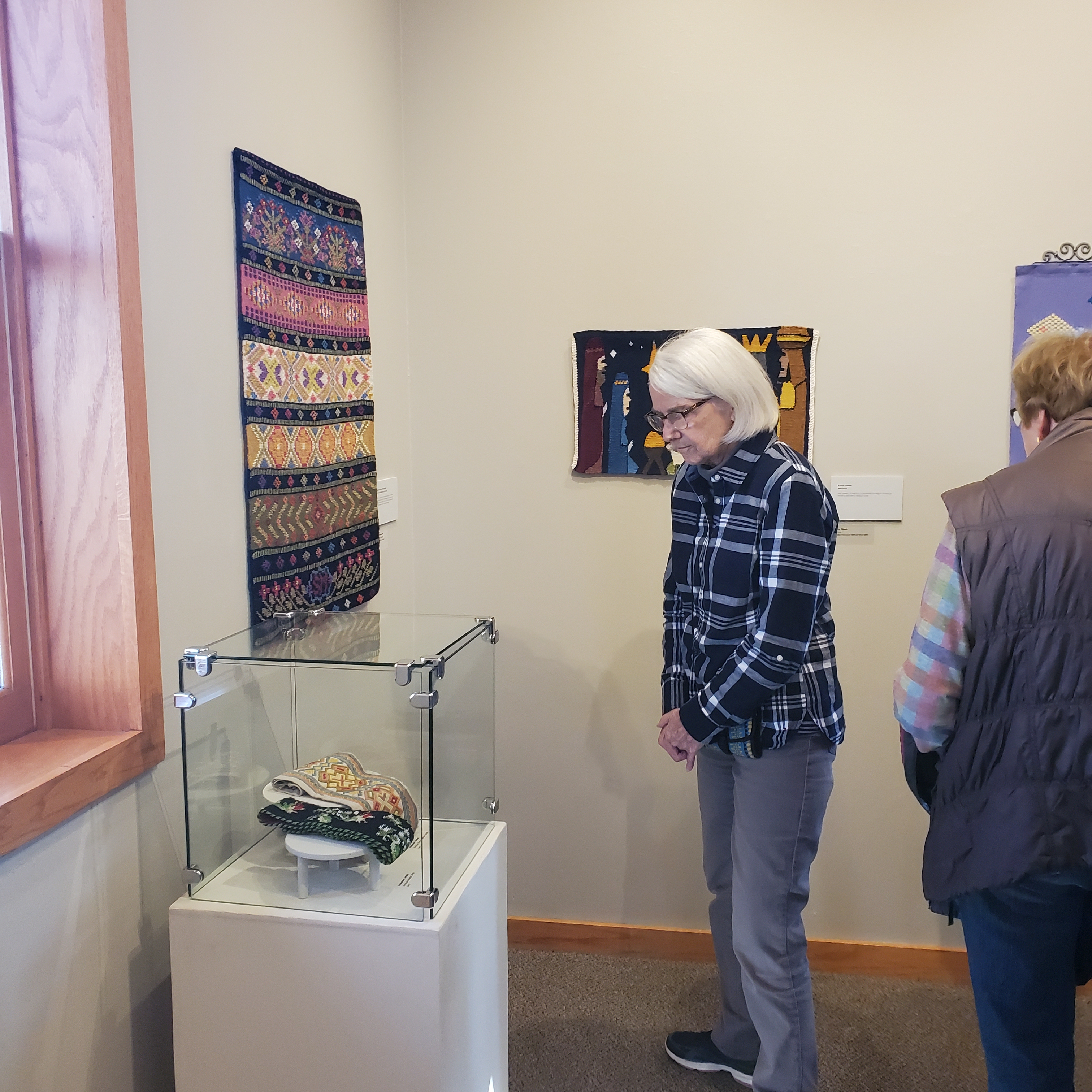
    Original vegteppe on the far wall with Beth’s smaller version on the right. In the foreground is the special case holding other heirloom textiles.

    Edi Thortensson donated a simple but treasured handtowel. “The towel was handwoven around 1950 by my mother-in-law, Ellen Svensson, for use in her home in Tröjemåla, near Ryd, Småland, Sweden,” Edi writes. Inspired by Ellen’s towel, Edi wove a paradhandduk, or display towel, meant to cover utility towels hanging near a washstand.

    Edi Thorstensson and her parahandduk.

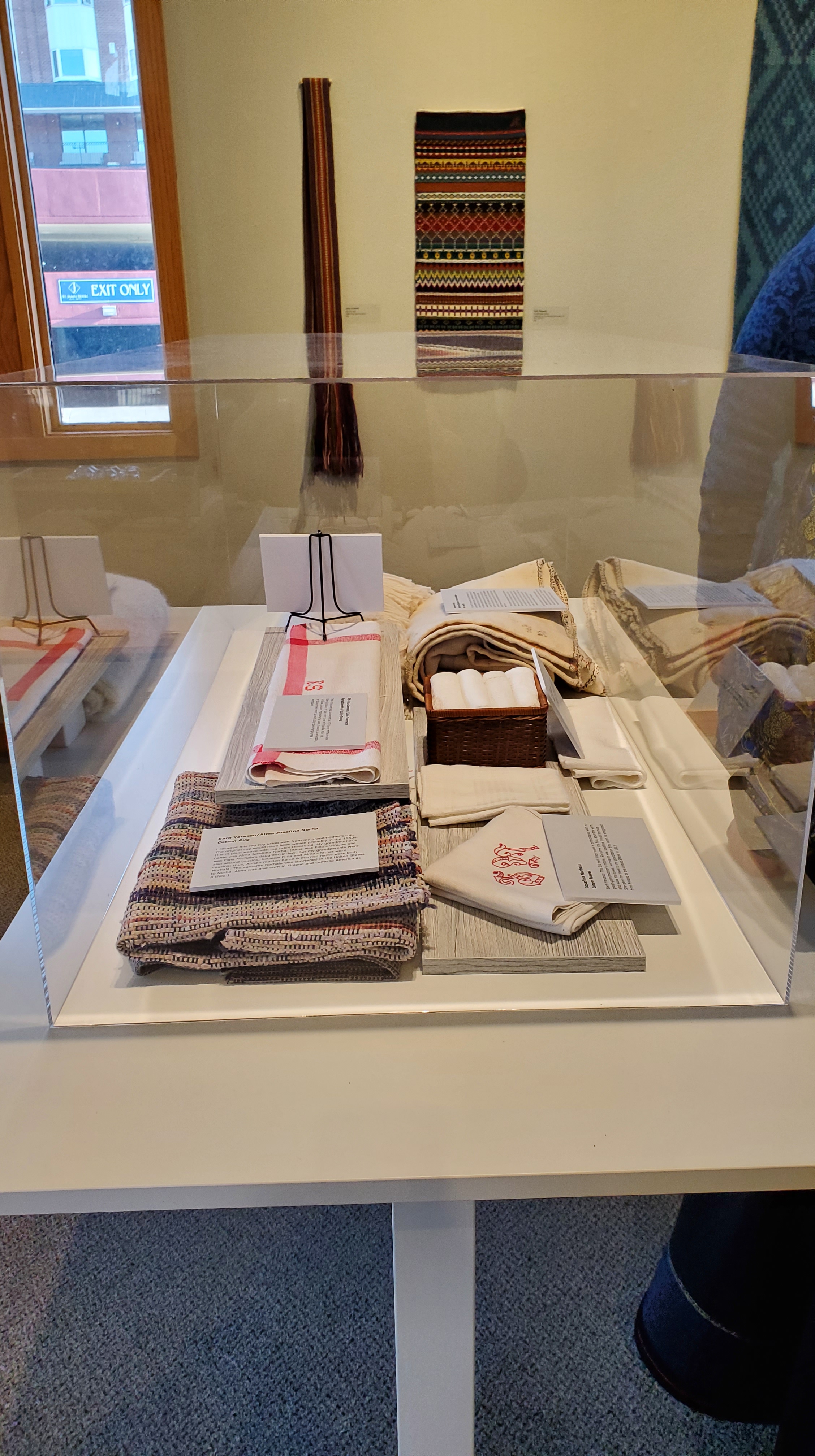
    Barb Yarusso shared two Finnish heirloom textiles for the exhibit, including a 2/2 twill linen towel embroidered with her great-grandmother’s initials. Her great-grandmother’s name was Josefiina (Fiina) Norhala. “Josefiina grew the flax, spun the yarn, and wove the towel,” Barb writes. “She gave the towel to my grandfather Eino when he emigrated from Finland to the United States in 1913.”

    On the far left is the red and white towel woven by Edi’s mother-in-law Ellen Swenson and embroidered with the initials ES. On the right is the white towel with initials embroidered in red by Barb’s great-grandmother Josefiina Norhala.

    Barb also has a rug woven by Alma Norhala, Eino’s wife. Alma was also born in Finland and came to America as a child. The original rug was woven in the 1950s, in plain weave with log cabin threading. Barb carefully salvaged the cotton weft material and re-wove it into a new rug as her way of honoring Alma’s work.

    Barb Yarusso proudly holds the rug she rewove using weft material from her grandmother Alma Norhala.

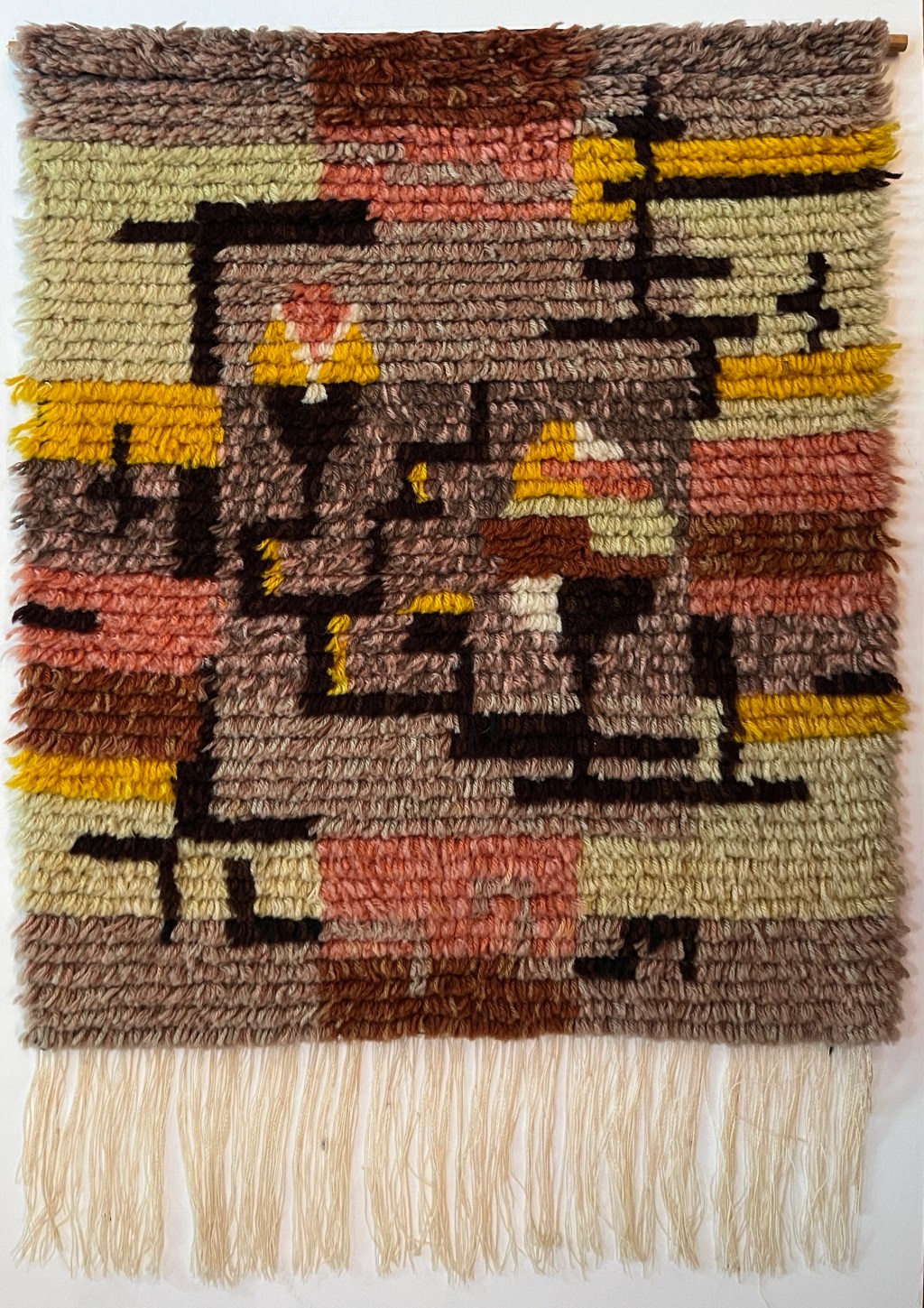
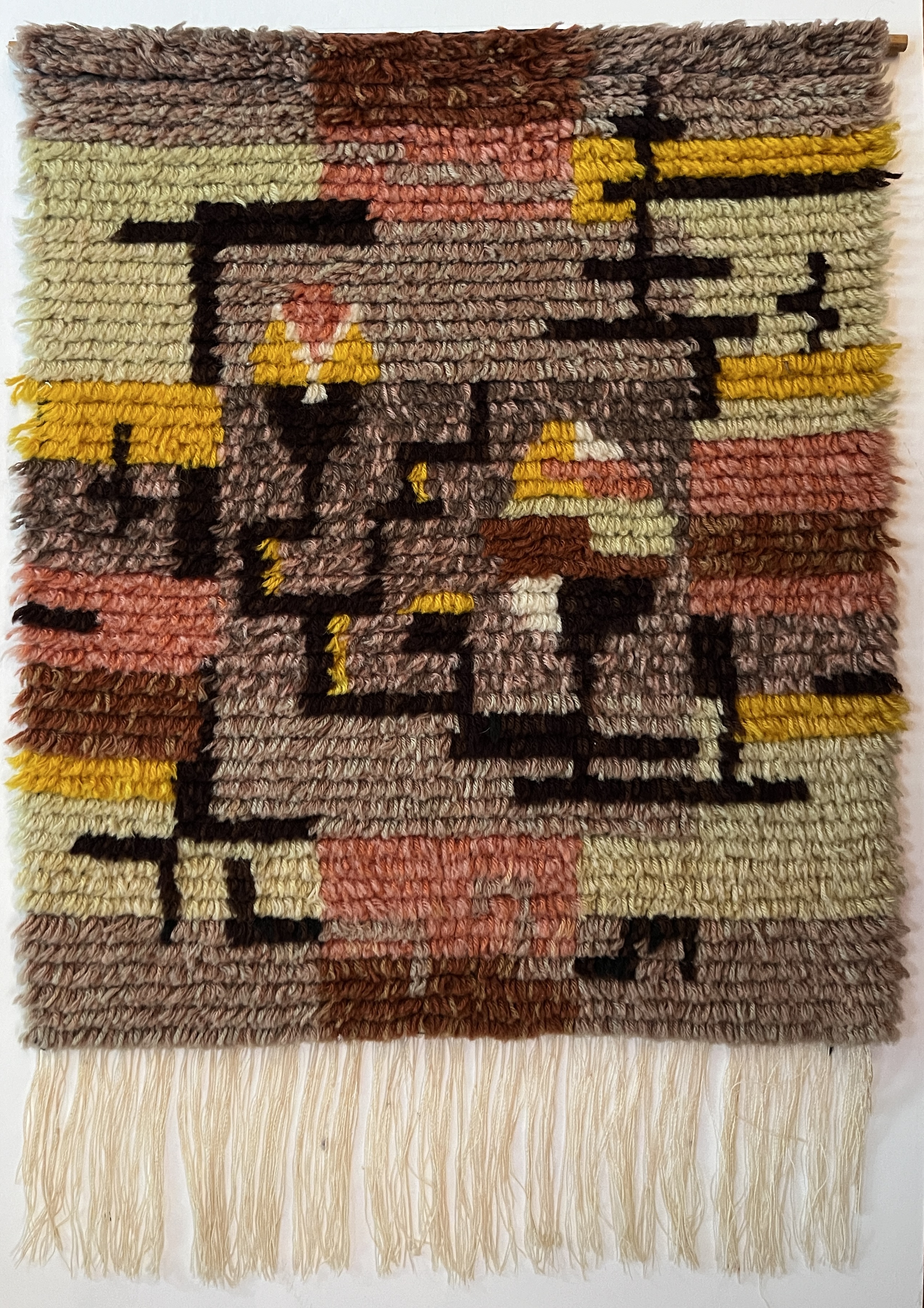
    Peg Hansen was also inspired by Finnish weaving. Löytyi Karannut Lemmikki (A Runaway Pet Was Found) is a vintage (over 100 years old) Finnish Rya/Ryu wall hanging from the collection of Peg’s friend Susan Sutherlund. It belonged to Susan’s grandmother Lydia Ivonen. Unfortunately, the weaver is not known.

    Löytyi Karannut Lemmikki (A Runaway Pet Was Found)

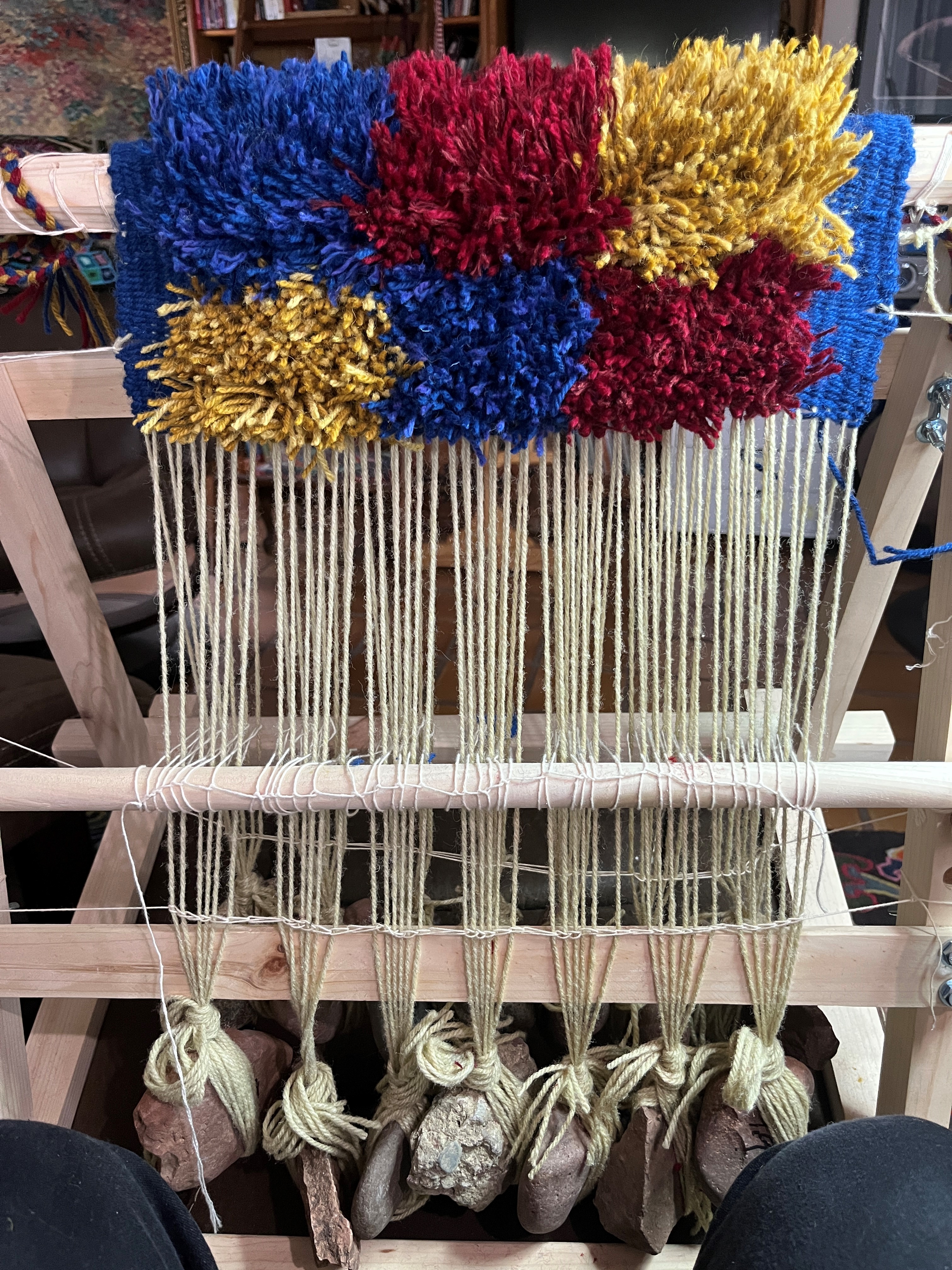
    This piece served as Peg’s inspiration to learn more about the Rya/Ryu weaving technique used in Scandinavia.

    Peg’s rya weaving on her hand-built warp-weighted loom.

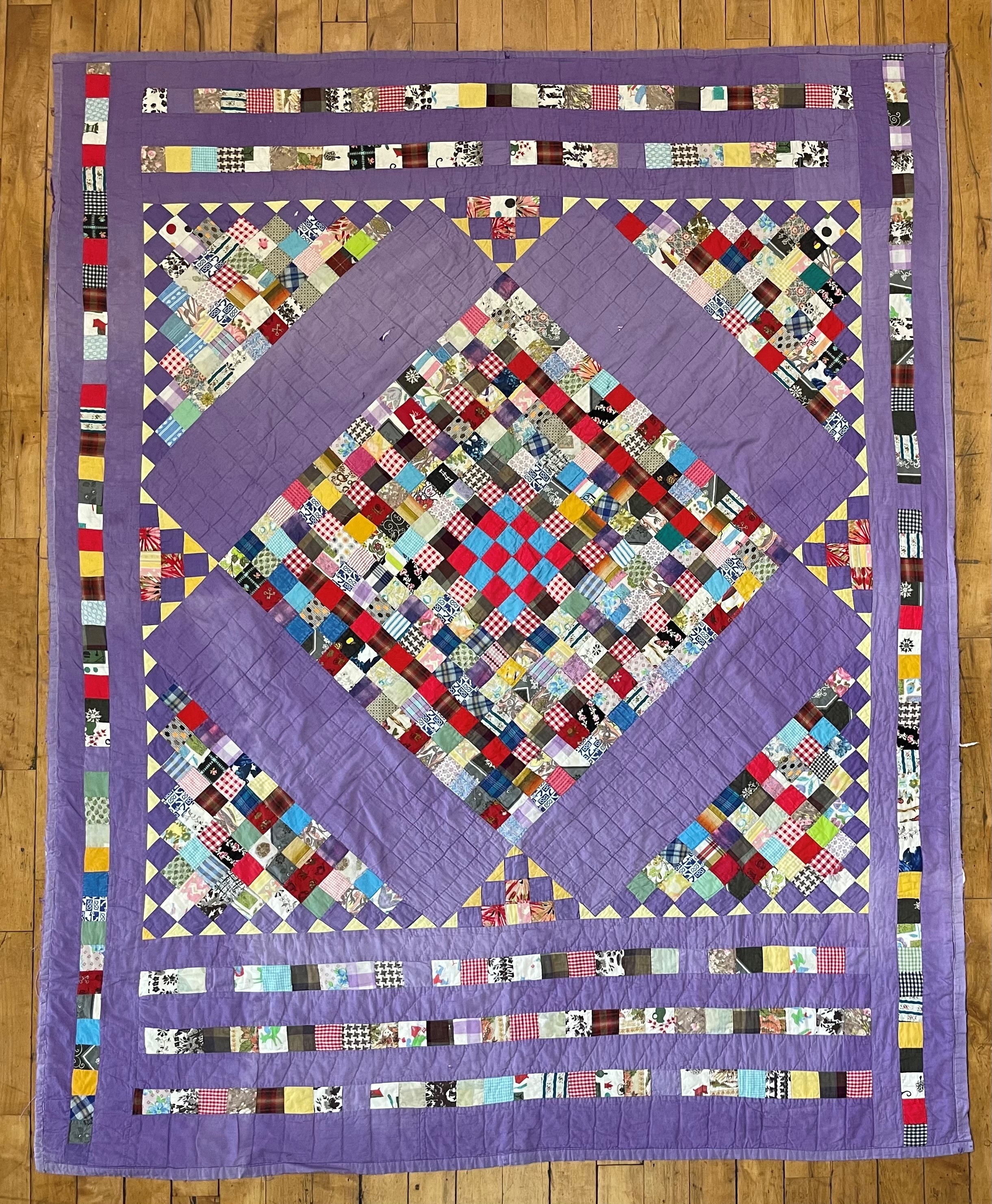
    Kala Exworthy’s source of inspiration was a beloved quilt. “My maternal Grandmother loved making things,” she writes. “From her I learned to knit, rosmal and paint those cute plaster gnomes, which we painted red hats on and called “Nisse.” The photo below is of a quilt given to Kala by her grandmother. “I was the oldest granddaughter and was given first choice of the pile of quilts,” Kala explains. “The fabrics are from worn garments and I have always been a fan of bright colors. As a practical quilt, it has been used from day one. It’s worn and faded now but no less precious.”

    The quilt given to Kala by her grandmother.

     Inspired by the quilt, Kala wove a wall hanging she calls Memory Fragments. “The wall hanging represents not only the colors in the quilt but also the random memories that I have when I look at the quilt,” she writes. “Pictures in my head of Gram at different times in our lives, red paint on the paintbrush for the Nisse hats, the smell of turpentine and linseed oil used to clean our brushes, yarn and needles and of course, lefse with mashed potatoes, chicken and crispy sugar cookies. I loved going to Gramma Egstad’s house because there was always time to make something.”

    Kala’s Memory Fragments inspired by her grandmother’s quilt.

    For Nancy Ellison, her heirlooms come in the form of sheep. Nancy raises Icelandic sheep and other heritage breeds on her farm near Zumbrota, Minnesota. “Historically in Iceland shepherds wore a mantel or cloak woven with locks of wool to protect the wearer from the weather,” Nancy explains. “The shaggy surface is like the wool growing on a sheep.” Nancy wove a pillow and chair cushion in this technique, using gray, black, brown, and white wool from her flock.

    Nancy shaggy sheep contributed to her weaving!

    Some weavers were inspired by vintage objects, even though they didn’t have a family connection. Sharon Marquart’s From Garment to Garnish was inspired by an antique embroidered bodice, possibly Scandinavian, and an antique beaded belt, which may have been part of a Norwegian bunad (ceremonial dress).

    A visitor examines the vintage clothing items that inspired the woven motifs in Sharon’s From Garment to Garnish, seen on the wall.

    Melba Granlund wove a telemarksteppe she called Reflections. “My color inspiration for Reflections came from a stained-glass window salvaged from an old farmhouse,” she states. “It was purchased at a farm auction in central Minnesota and currently hangs in the dining room window of our “new” farmhouse a few miles away. “

    Melba’s Reflections and a photo of the stained glass that inspired the color palette.

    Although humble, these beloved textiles are still treasures, even a hundred years later. As shown in this exhibit, even the simplest textile can inspire later generations to weave on. We are all part of the fabric of history, and our own small threads can have a positive impact far beyond our lifetimes. Just remember to put your initials on everything you weave!

  • New Year, New Project!

    A cold January is the perfect time to start a new weaving project! The Scandinavian Weavers’ latest group warp is a pattern called Kukkoladräll.

    The Kukkoladräll pattern was composed by Elsa Kerttu in 1926 when she was a student at Jämtslöjds Kvinnliga Slöjdskola (Women’s Craft School) in Östersund as an assignment to create a pattern in Jämtlandsdräll. It was named after Elsa’s hometown of Kukkola, a small fishing village in northern Sweden, just across the border from Finland. A lovely version of this pattern was woven by Ulrika Bos Kerttu, Elsa’s niece, in a palette she named Cloudberry. The draft for the pattern is copyrighted by Sveriges Länshemslöjdskonsulenter and provided bytextilhemslojd.se

    Image of cloudberries from Pinterest.

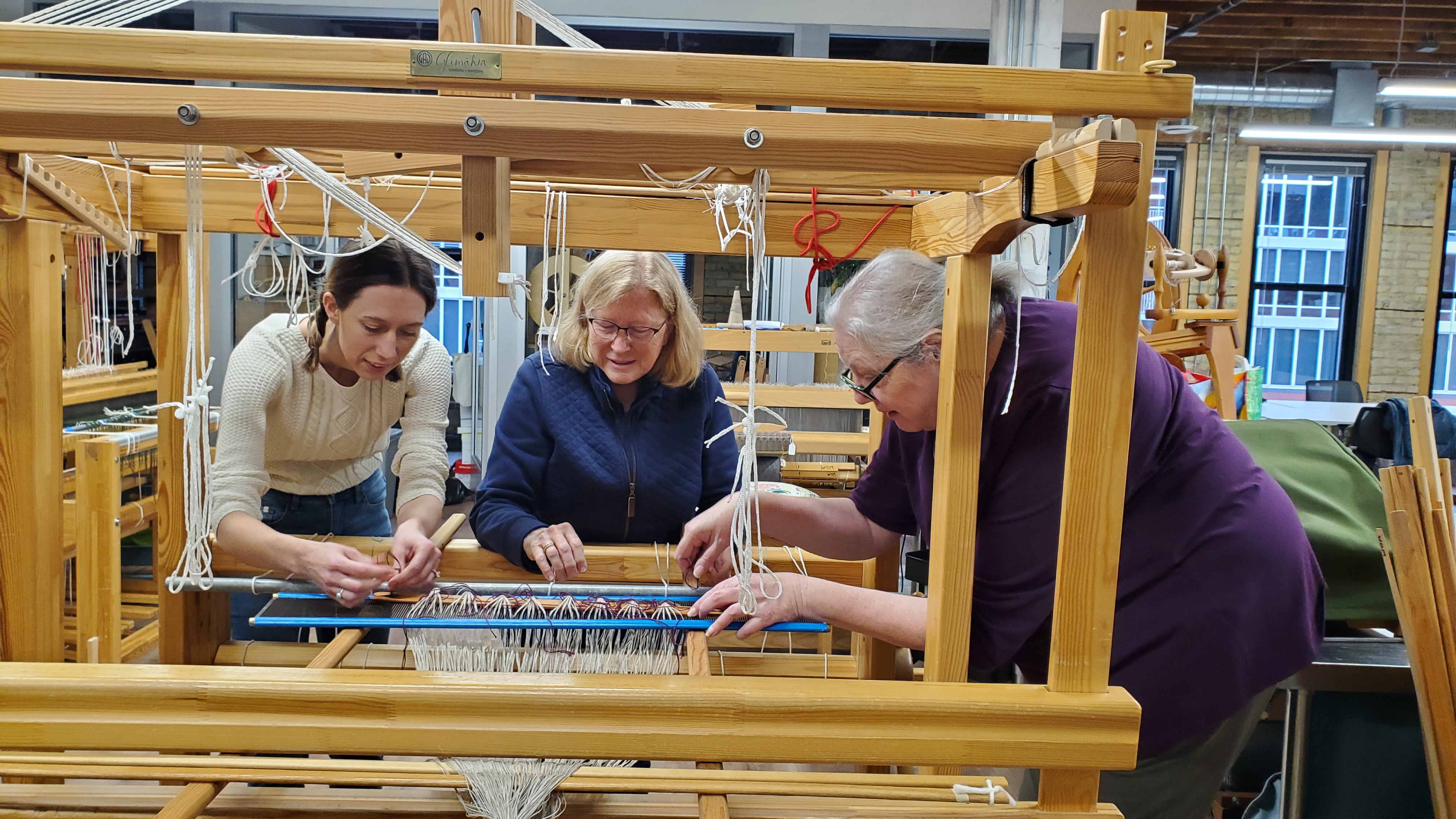
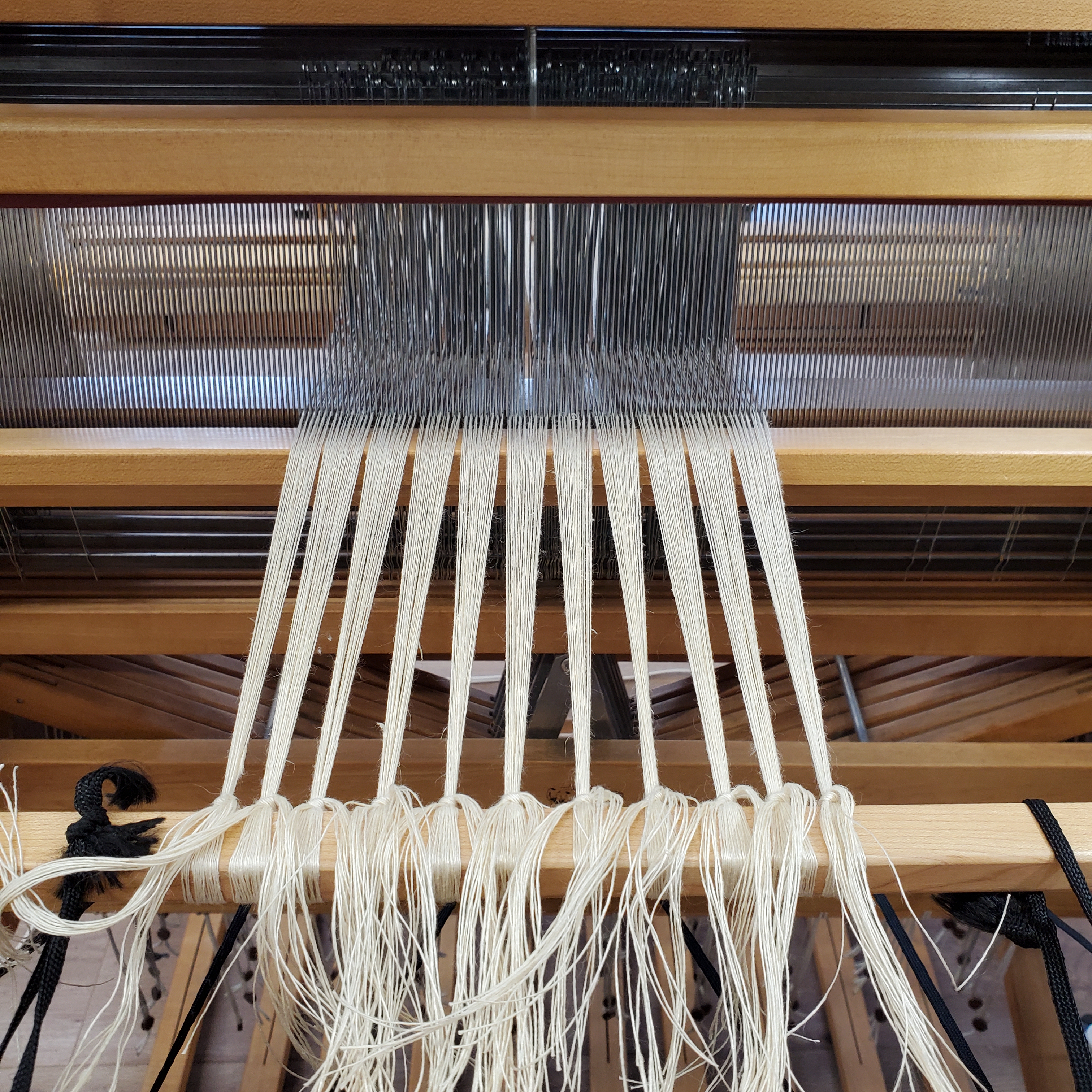
    The Weavers Guild of Minnesota is equipped with two Glimakra looms for classes and group projects. The Scan Weavers generously dug into their stashes for the linen warp. At least 14 of us will weave on this warp, so it is quite long.

    There’s nothing more beautiful than a plain linen warp. Note the slightly different colors that result from blending.

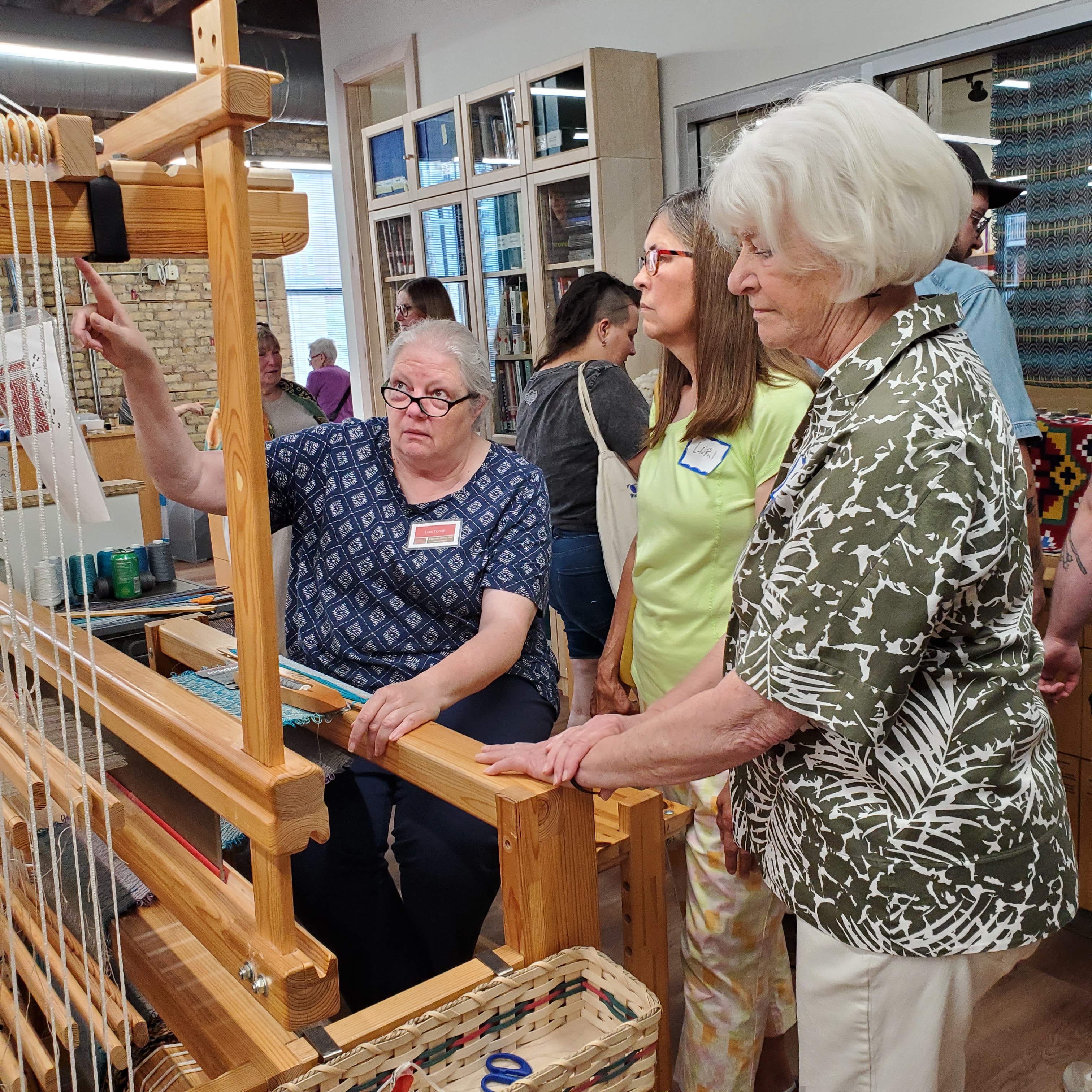
    Warping is always more fun with a group! (Especially with coffee breaks.) Below, Lisa Torvik explains the benefits of pre-sleying the reed to newer weavers Holly and Beth.

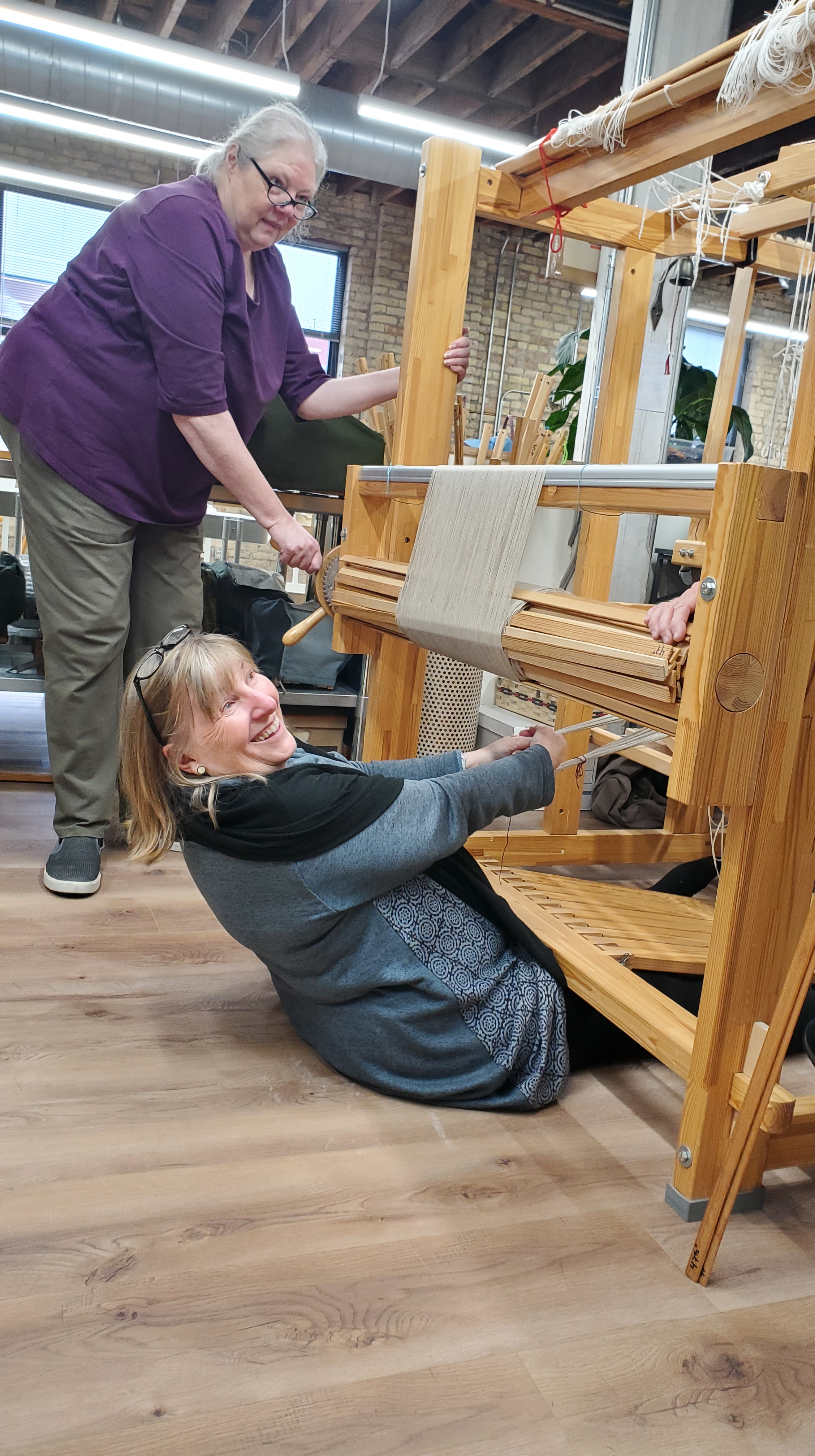
    Patty Johnson demonstrates how she used to warp her Glimakra all by herself – controlling the warp tension while winding on the back beam. Fortunately, Lisa is there to help.

    Lisa reminds everyone to spritz the linen warp with water to prevent breakage. (Lisa does this every time she advances the warp, which she does every three to four inches.)

    Lisa adapted the draft for towels and included four motifs across the width instead of three.

    Lisa wove two towels in different colorways. For the first, she used 16/1 linen doubled on stick shuttles for the pattern weft and 12/1 linen for the ground shots.

    For the second towel, Lisa chose to work with perle cotton for the pattern weft.

    Stay tuned for more updates on this project. I like to think that Elsa Kerttu’s original design of multiple squares was inspired by the many small fishing huts in Kukkola.

    Image of Kukkola from Pinterest
    Stock image

    If you now want to visit Kukkola as much as I do, search online for the Kukkola Tourist and Conference Board. They say the area provides natural beauty, peace, and creative inspiration. What could be better for weavers?

  • “Scandinavian Showcase” at Weavers Guild of Minnesota

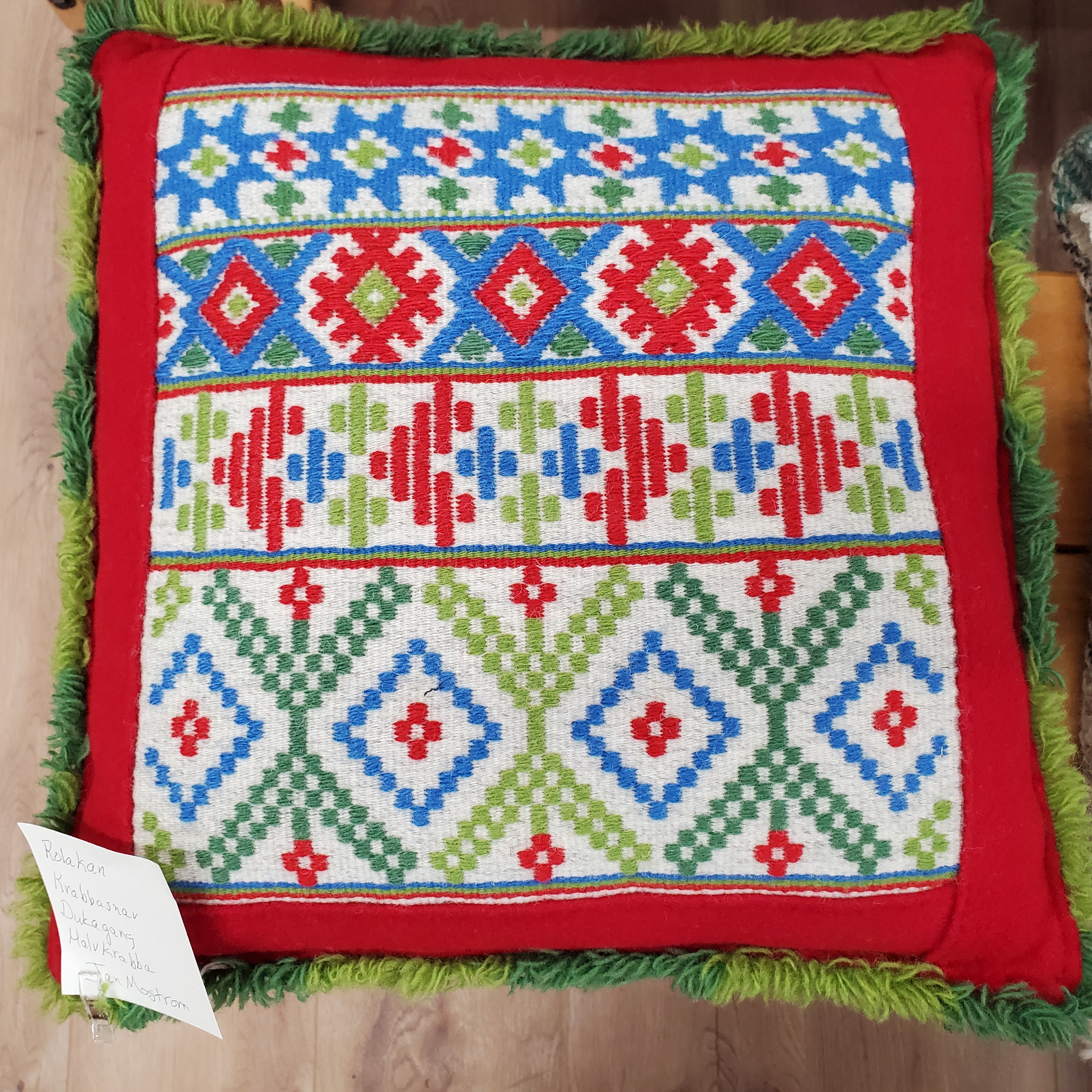
    Pillow by Jan Mostrom featuring Swedish art weaves

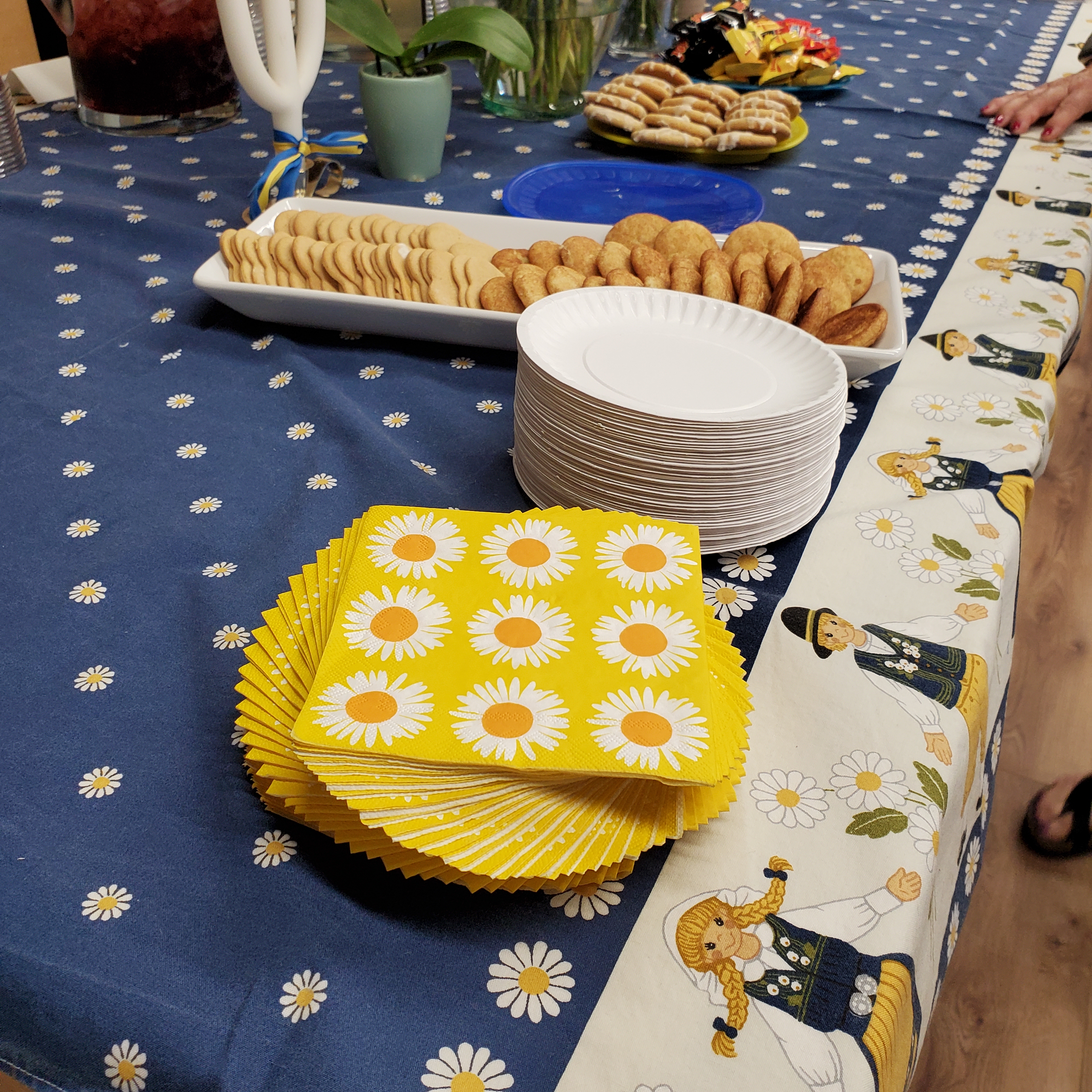
    On Tuesday, June 27, the Scandinavian Weavers Interest Group hosted an open house at the Weavers Guild of Minnesota. Guests viewed samples of work by Scan Weavers, enjoyed refreshments, and watched weaving demonstrations by Lisa T as well as students in the Weaving with History workshop. (See previous post.)

    Judy setting out her pepparkakor. (Tin is for transport only – those cookies were home-baked!)

    Bri helping in the Guild’s fabulous new kitchen!

    No party is complete without Marimekko!

    Lisa T explaining Telemarksteppe to guests.

    Sharon demonstrating Munkabälte (Monksbelt).

    Peg and Melba reminiscing about recent travels to Norway. Melba is warping repp weave.

    Mary admiring Finnväv (reversed) by designer Maija Kolsi-Mäkelä. Scan Weavers member Mandy Pedigo researched Kolsi-Mäkelä’ ‘s work during her MFA program and owns several of her designs, which she brought to the open house. (See Mandy’s blog at http://www.mandypedigo.com/maijakolsimakela for more info.)

    Rag rugs by Judy Larson (left) and Robbie LaFleur (right). (Robbie wove her rug in a class at Sätergläntan. See her blog for details.) Above left is a krokbragd weaving by Lisa-Anne Bauch. Above right is a band weaving by Jane Connett.

    Smalandsväv by Nancy Ebner. The design is by Becky Ashenden at Vävstuga.

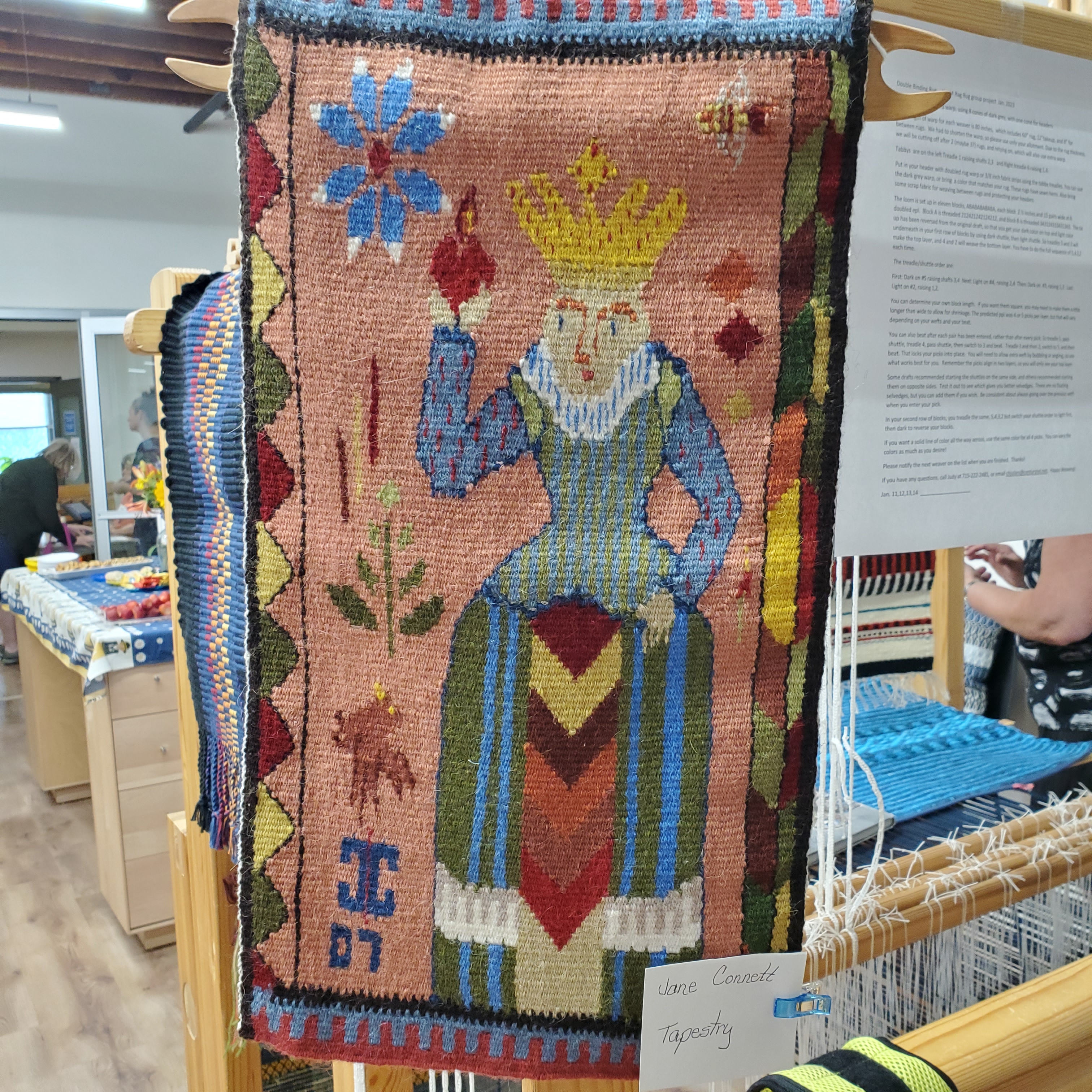
    Tapestry by Jane Connett.

    Swedish art weaves pillow by Jan Mostrom.

    Twill blanket in wool woven by Peg Hansen in Norway.

    Rosepath pillow by Sharon Marquardt.

    More samples in a variety of weave structures.

    Scan Weavers meetings are held monthly September through May. Contact Robbie LaFleur at lafleur1801@me.com to join the fun!

  • “Weaving with History” Workshop

    Beautiful Sätergläntan in Sweden

    Editor’s Note: Today’s blog entry was written by Judy Larson.

    “Nordic Handcraft Workshop: Weaving with History – Using Historical Textiles” was a class co-hosted by American Swedish Institute (ASI) and Weavers Guild of Minnesota (WGM) and planned to be taught by Susanna Ayton of Sätergläntan Institute for Craft and Handwork in Insjön, Dalarna, Sweden. Enrollment filled quickly, and five members of the Scandinavian Weavers Interest Group offered to wind warps and prepare the twelve looms. Betsy Konop, the WGM Education Coordinator, ordered the materials and assigned the warps for winding. 

    On Tuesday, June 20, the warps were delivered, and five of the looms got the warps wound on. Each loom had to be carefully warped using 6/1 linen, 6/3 linen, 6/1 wool, and 16/2 cottons. The next day, more warps were wound on, sleying started, and the process continued. That night, we were informed that the instructor had been called back to Sweden for a family emergency, and we could choose to continue with the class as a group study or get a full refund. Betsy said she was sure we could “make lemonade out of these lemons!” Besides, the looms were almost ready!

    Loom warped in beautiful Swedish linen

    Ten of the twelve students chose to still do the class as a group study, and so the warping continued. It looked like everything was ready! Just before leaving on Thursday night, I noticed that one of the 6/1 linen warps had “churros” between the reed and the back beam, so it had to be completely wound to the the front beam, all the way to the end, and the twists removed. Betsy’s dog, Hopsy, was patiently waiting to go home, and he sat toward the end of the warp as the twist was slowly worked back. The decision was made to make it to Hopsy’s ears, and then cut the warp! It was then tied to the back beam and re-beamed the next day.

    Hops hard at work! (Note his magnificent ears)

    Friday morning, the group met at ASI and had a quick introduction to Sätergläntan’s programs in weaving, woodworking, blacksmithing, and hand sewing. 

    American Swedish Institute in Minneapolis

    Then Phyllis Waggoner shared information and showed textiles from ASI’s collection in each of the weave structures we’d be sampling. Phyllis has been working with the ASI textiles for many years and is our local expert!

    Phyllis explaining Blådrättar, a style of Dukagång

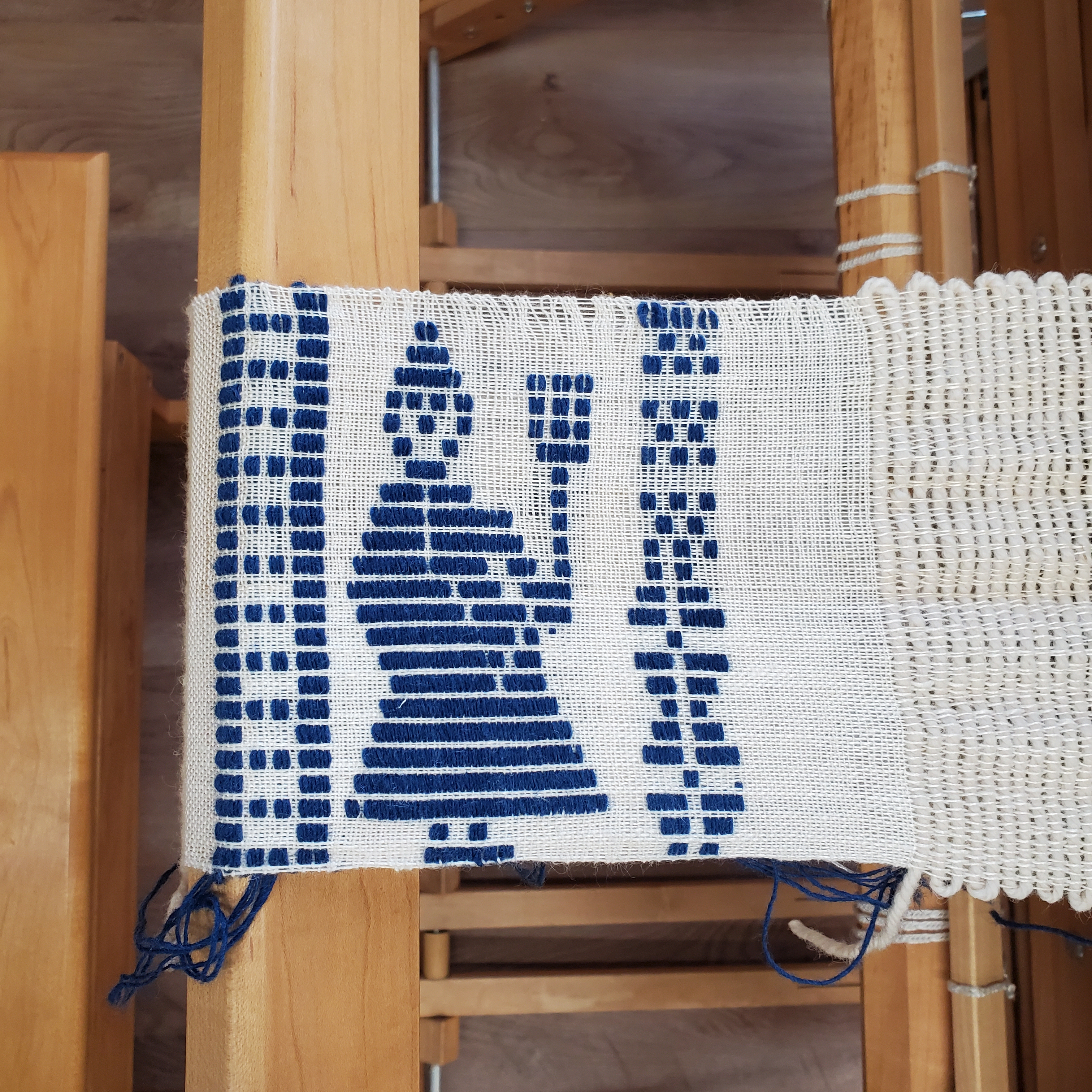
    We first saw the Dukagång and Blådrättar.  Blådrättar means “blue dish” in Swedish and refers to the fact that this type of Dukagång was traditionally done in blue and white/cream, similar to the colors on porcelain dishes. In Dukagång, the wool pattern weft is laid in fine rows separated by thin lines of tabby wefts.

    Close-up of Blådrättar from ASI collection

    Rölakan and munkabälte (Monksbelt) pieces were shown next, along with Daldräll (Overshot) and Rosengång (Rosepath).

    Close-up of Rölakan showing distinctive interlock technique

    Close-up of mythical creature on Rölakan weaving

    Another Rölakan from ASI’s textile collection

    Daldräll from ASI’s textile collection

    Munkabälte (Monksbelt) from ASI collection

    After lunch, the group went to the Guild and started our group study.  Those with any experience in any of the structures gave their mini-demonstration, and then the weavers began making their samples.

    Swedish wool yarn with WGM looms in the background

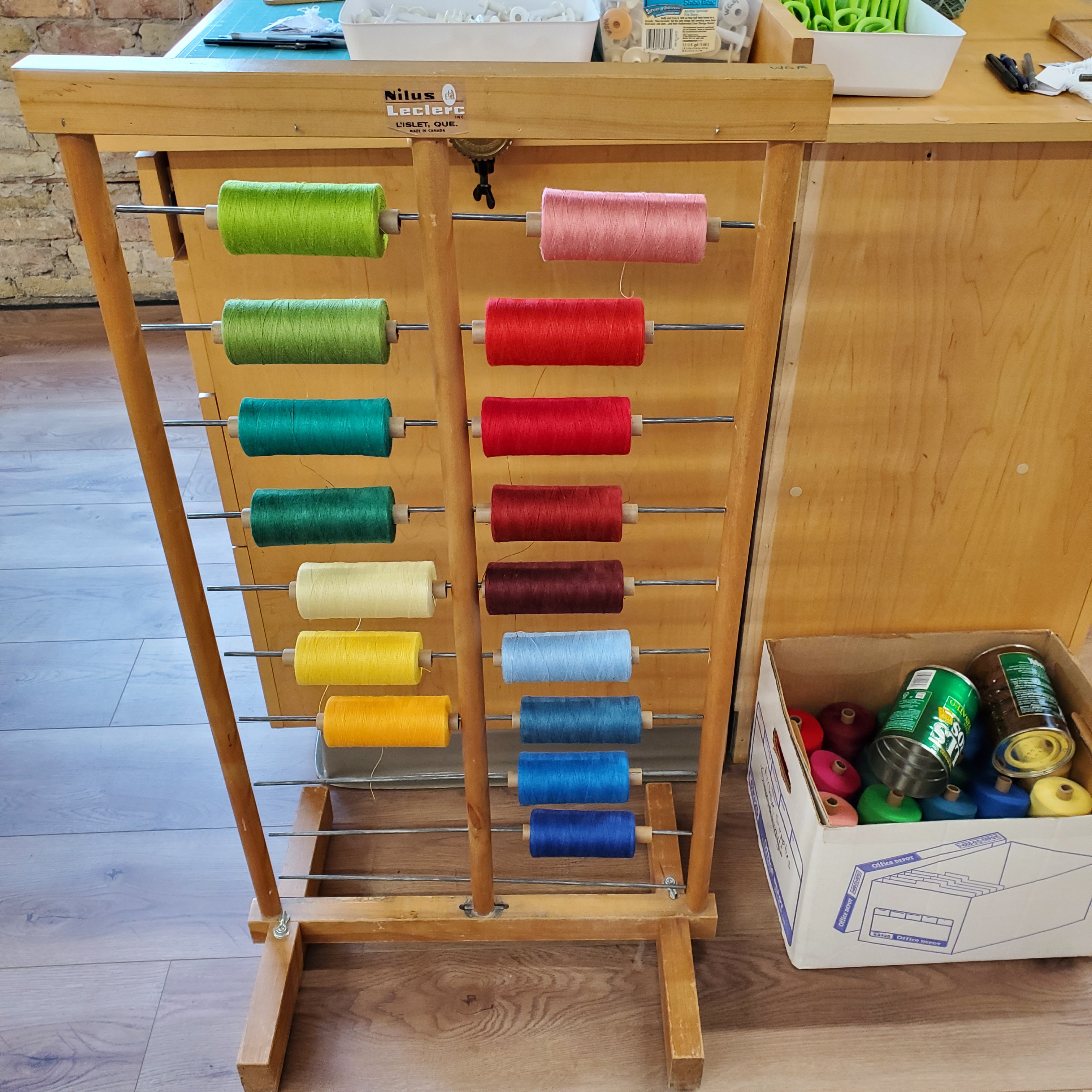
    Lovely Swedish linen in a rainbow of colors!

    Munkabälte and Daldräll were both pattern/tabby weaves and were more familiar. The Rosengång on opposites was a little trickier to do, but remembering the treadle partners of 1/4 with 2/3 and 1/2 with 3/4 helped.  The Rölakan differences with single or double interlocks, plus the dovetail and over two without interlocked were discussed.  The most challenging weave was the Dukagång.

    Marianne weaving Rosengång (Rosepath)

    Ever working on Rölakan interlocks

    The weavers wove 6-inch samples of three different Munkabälte patterns, two Rosengångs (one with twills 4321234, and one with 123414321 threadings), two Daldräll patterns, two Rölakan, and three Dukagångs. As the weaving started, the patterns were coming out underneath. The tie-ups were all for counterbalance looms, so the tie ups needed to be reversed! More learning was happening!
    Daldräll by Judy

    Second Daldräll threading

    Two of the Dukagångs were on 6/1 Farö wool warps, which kept breaking.  Finally, the decision was made to re-warp one of them with 6/1 linen, which worked much better. 

    Sharon’s beautiful Blådrättar!

    Sharon experimented with color blending in munkabälte

    Close-up of Sharon’s munkabälte

    More munkabälte

    Munkabälte

    Analyzing weave structure’s in Nancy’s show-and-tell

    After weaving on Saturday and Sunday, there was a reception at ASI for all the participants in any of the four areas for Sätergläntan classes.  The blacksmithing teacher commented that it was impressive that the weaving class went forward, even without a teacher.  But it just shows that when weavers get a chance, they make the best of it!  We truly did make “lemonade out of the lemons!”

    After the warps are taken off the looms, Betsy will take pictures of each sample, and send them out to their respective weavers.  The weekend was a great opportunity to meet more weavers, learn more about Swedish structures, and support the Guild/ASI partnership with Sätergläntan.  Thank you to everyone who made this possible!  

    Editor’s Note: Special thanks to Betsy and Judy (and Hopsy!) as well as Erin Swenson-Klatt at ASI, who all went above and beyond to make sure this week was a wonderful experience for all!

    Websites:

    Sätergläntan: saterglantan.se

    American Swedish Institute (ASI): asimn.org

    Weavers Guild of Minnesota: weaversguildmn.org

  • Monksbelt Unveiling and a Fun Discussion

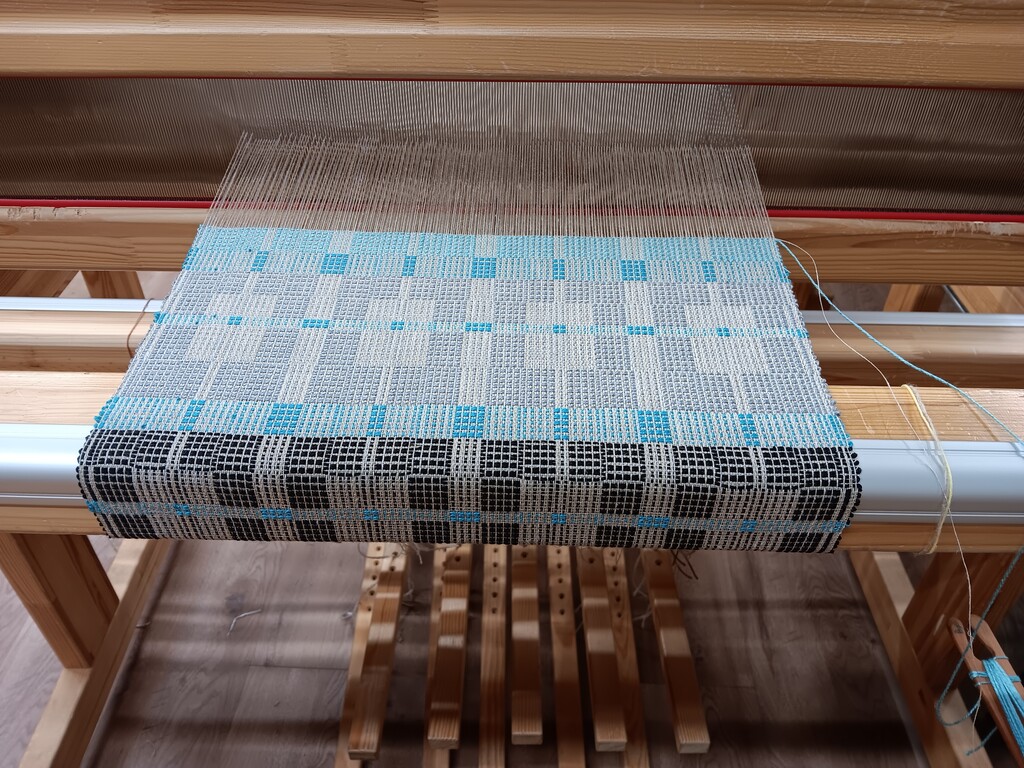
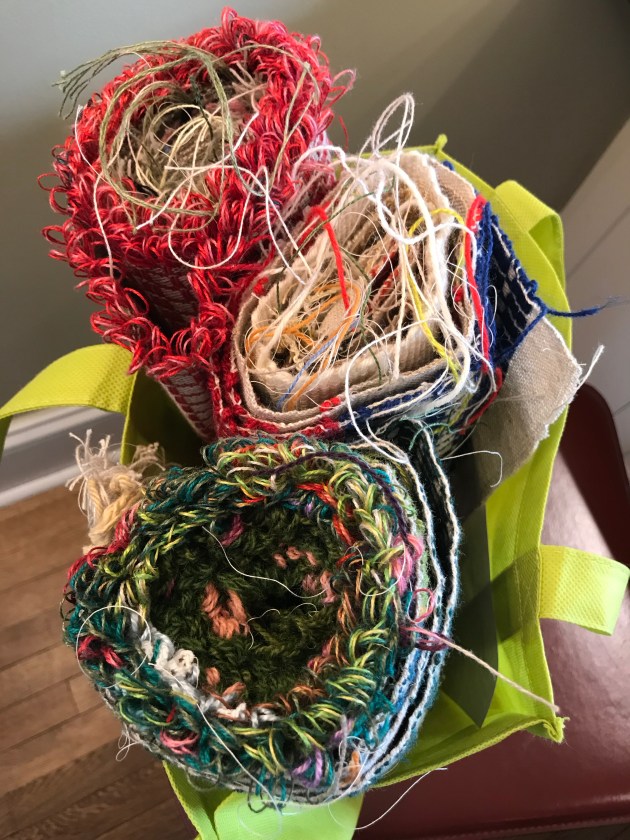
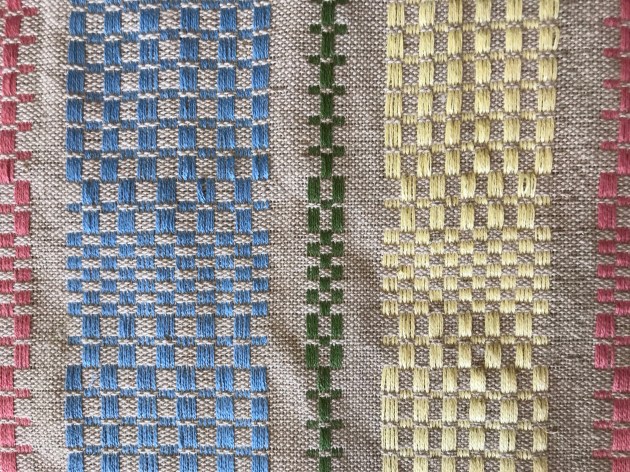
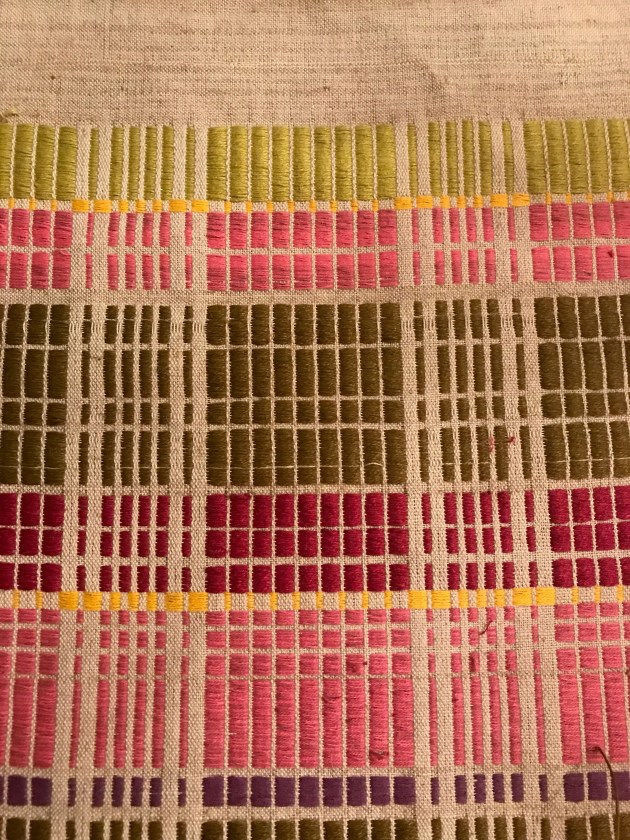
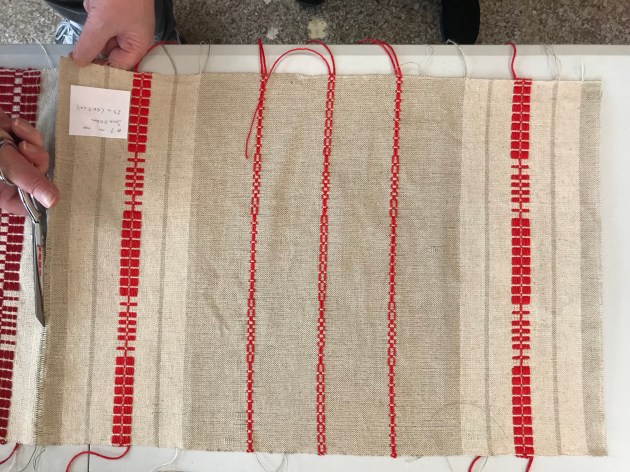
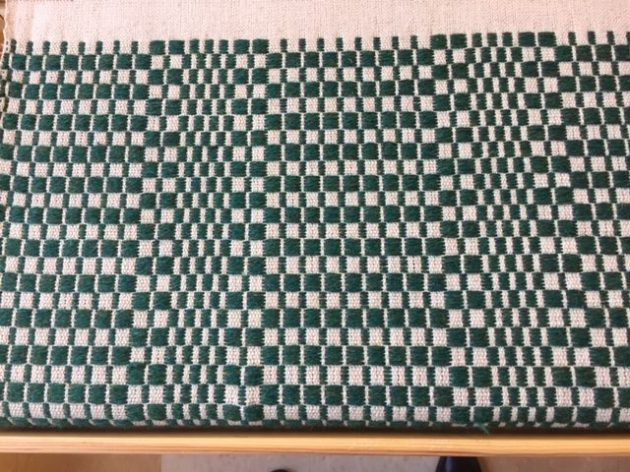
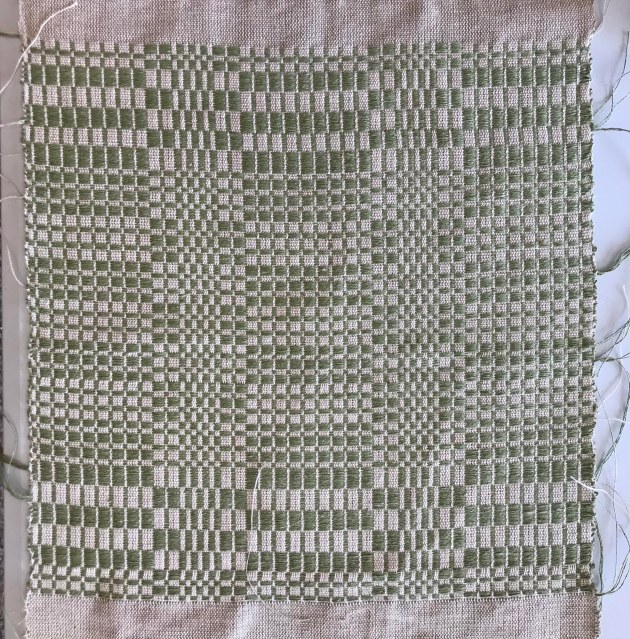
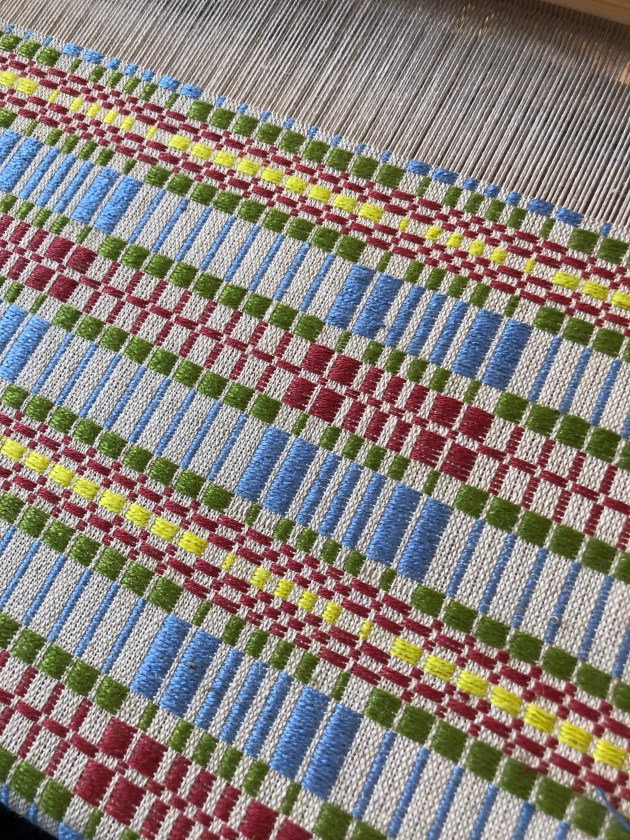
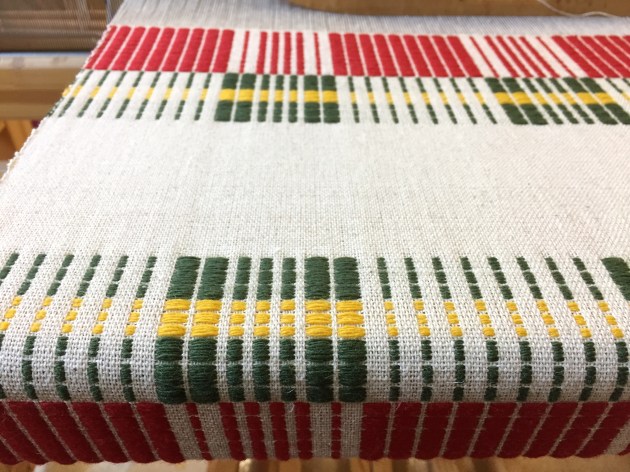
    The monksbelt pieces from our Scandinavian Weavers group warp project came off the loom, and Mary Skoy was nice enough to sew seams on her machine in order to cut them apart without fraying. She brought the roll of pieces to my home.  A bag of treasures! You can see that some were woven with looped edges, some with plain selvedges.

    A few members were able to make it to an afternoon celebration of cutting them apart and talking about our experiences. This marks the culmination of another successful collaboration on a Weavers Guild loom. Hopefully, everyone is happy with the learning experience.  Perfection was not the goal, but it’s hard to set that aside, isn’t it? It’s marvelous to see the work of the other weavers, but sometimes a bit frustrating. I know I looked at the beautiful pastels of several pieces and wished I had gone for a brighter palette. We were short a few threads and had to adjust the selvedge size during threading, so it was quite difficult to get a neat and clean selvedge.  Darn, I wish I had chosen loops, was my feeling after weaving.

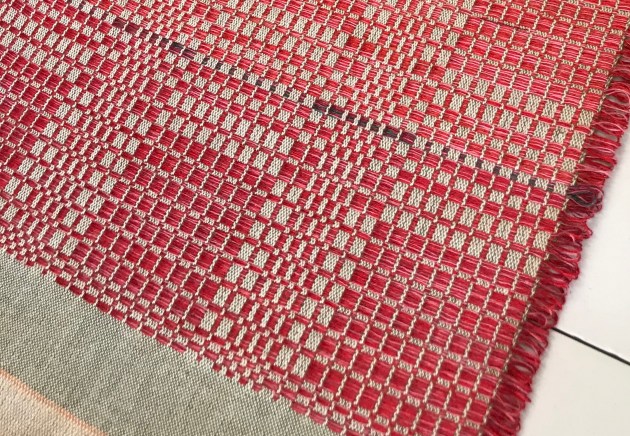
    Note to viewers! These photos show pieces in process or just off the loom, with all of the stray threads, lumpiness, and imperfections that will be transformed as we bring them to their finished states.

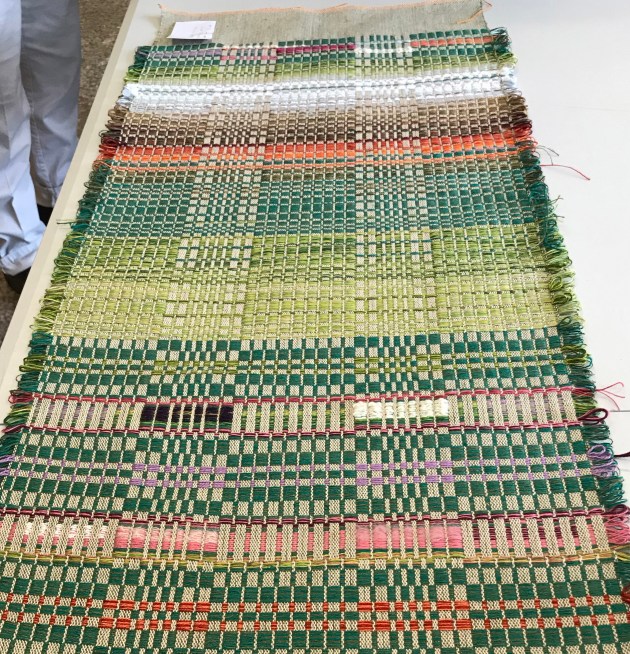
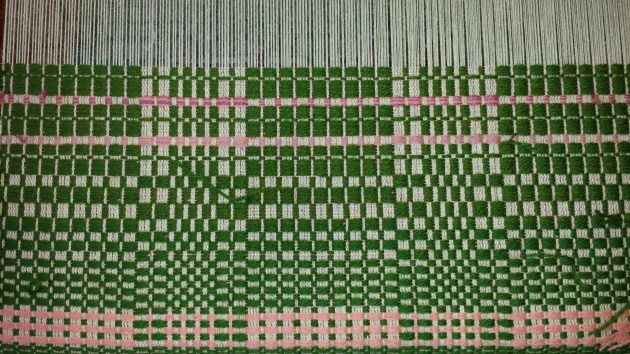
    It was interesting to see the variation in wefts used for the background.  Lisa Bauch used pink, which shows up more in the photo than it does in person. She also used two shades of green–one more olive in cast–but that hardly shows up in the finished piece.

    Lisa Bauch

    Lisa Torvik used green linen background weft. “I have so much of it,” she explained. We all agreed that the greenish cast was particularly effective with her piece made with shades of pink linen in the pattern weft.

    Lisa Torvik

    The pink piece was Lisa’s second piece, woven when one of the weavers was not able to use her time/warp. Lisa’s first piece was complex, a depiction of her flower garden, with a nod to tulips, prairie smoke, bee balm, and star gazer lilies.

    Some weavers included a looped fringe at each edge, and others wove a clean selvedge.  In a discussion about adding loops, someone mentioned adding another warp yarn at each edge, a little ways out, to get nice even loops.  Lisa uses her fingers to estimate each turn, noting, “I have two index fingers and the last time I checked, they’re roughly the same size.”

    Lisa Torvik

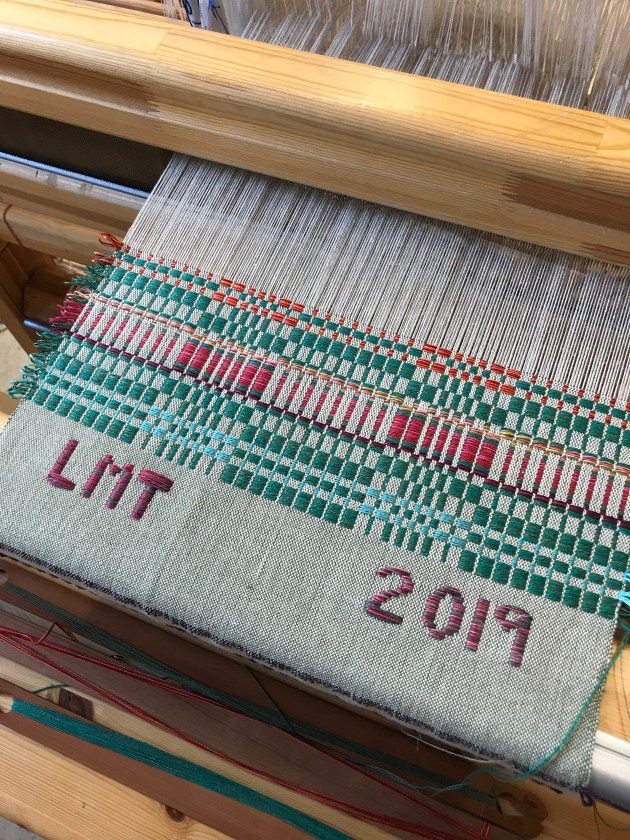
    Lisa Torvik should get a special documentation prize for this one, too, since she added the year and her initials on her header.

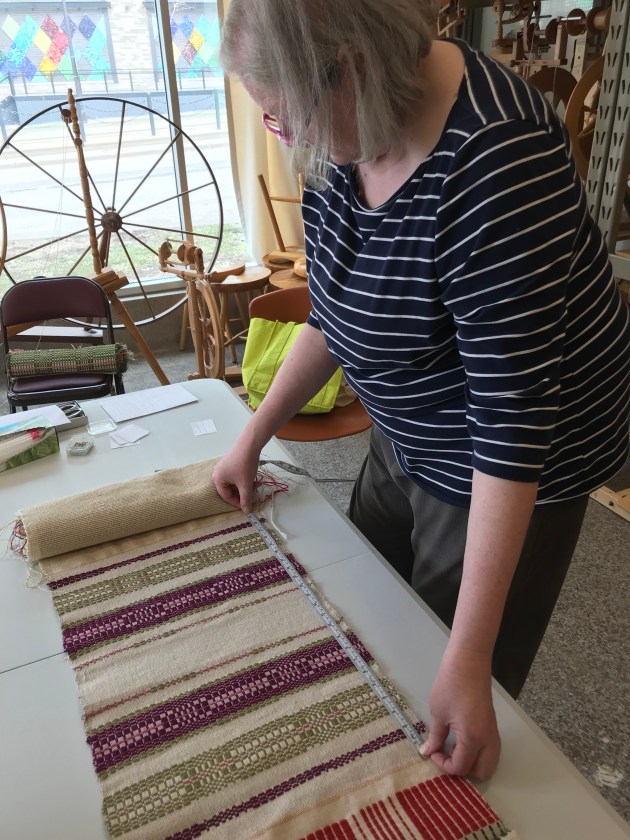
    Susan Mancini switched in a deep pink background weft in a few bands of her piece, sure that it would be very dramatic.  Barely noticeable!  Susan plans to make a bag with the piece so she wove the two halves to match. Here, Lisa Torvik is measuring Susan’s piece on cut-off day.

    Susan Mancini

    Melba Granlund did a wonderful job of incorporating thick and thin lines with color variation.

    Melba Granlund

    Marilyn Moore used beautiful spring-like colors in her linen pattern weft. I know that flowers are on her mind these days, but if she wanted to weave her flower garden, she would have to weave yards of fabric.

    Marilyn Moore

    Mary Skoy plans to use her piece to make a pouch or bag.  It should work great, with her modern graphic design.  Also, the crisp hand of the fabric will work well in a pouch.

    Mary Skoy

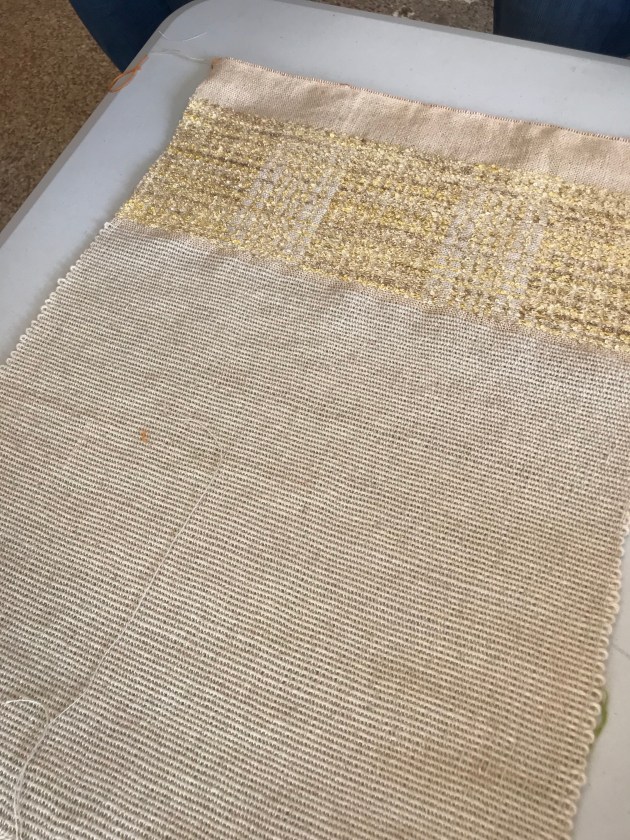
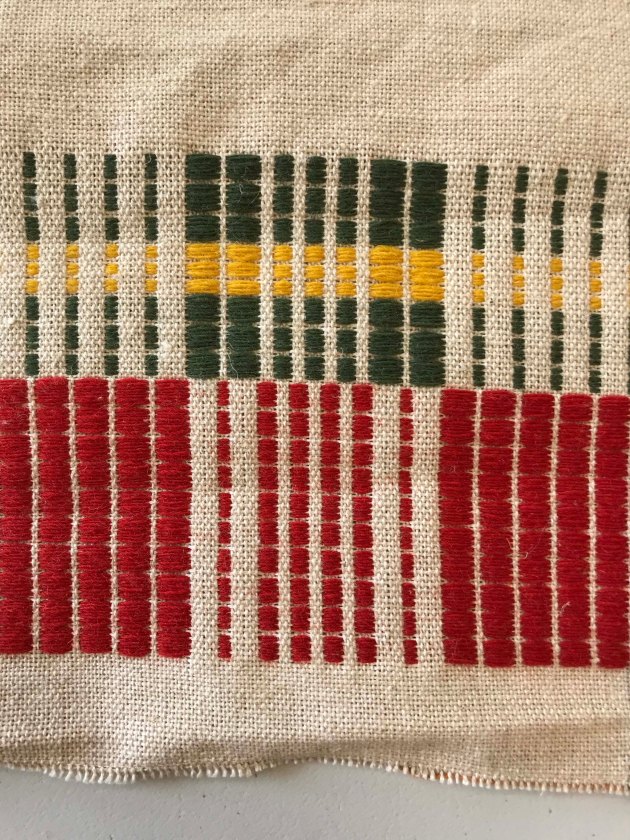
    Of any of these monks belt experiments, Claire Most’s piece will undergo the biggest transformation during the finishing process.  Claire wove the pattern in a silk boucle yarn, but just for a short distance.  The rest of the piece is woven in a waste yarn that will be taken out; the warp will become part of a deep fringe treatment.  Claire said she wasn’t quite sure how it will end up–but we all can’t wait to see!

    Claire Most

    One of the benefits of weaving on a group project is trying out techniques and weave structures that are new to you.  Sarah Okern weaves beautiful rag rugs for her business, Andasmer, so she rarely ventures to finer thread weave structures. Her incorporation of larger areas of plain weave was partly to save time; she said she could only take one day to devote to the project. Interestingly, her spare design relates to the graphic rugs that are her trademark.

    Sarah Okern

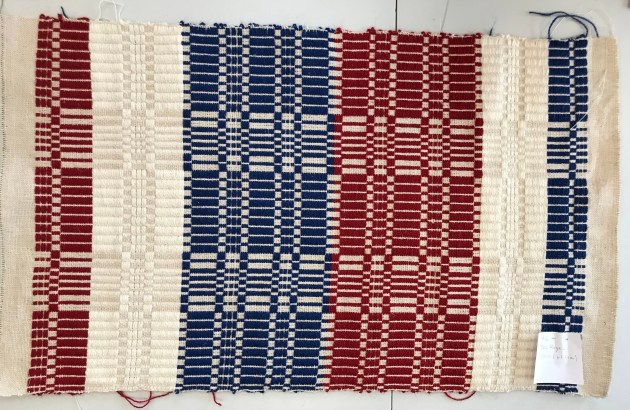
    Deb Reagan gets a prize for driving the farthest to participate, all the way from Grand Forks. She used red, too, and with her addition of blue, wouldn’t this make the perfect runner to put on the table for Syttende Mai?

    Deb Reagan

    Brenda Gauvin-Chadwick used red, also.  She said she wasn’t so happy with the colors–too Christmas-y.  I ‘m not sure that’s true, but maybe seems so compared to the pastels she saw in some other pieces.

    Brenda Gauvin-Chadwick

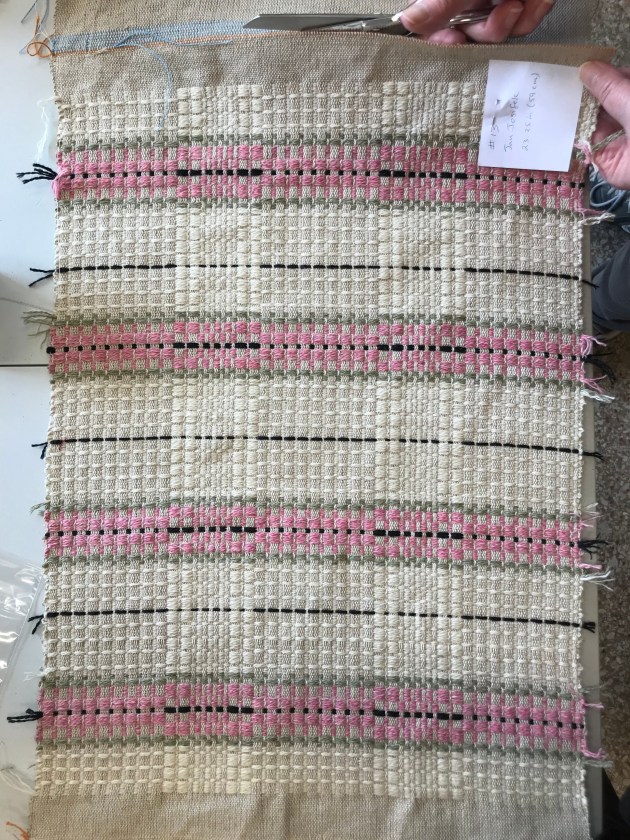
    Jan Josifek’s pink, neutral, and black color palette is striking.  Someone noted that the bands resemble those you often find in much larger rag rugs.

    Jan Josifek

    I learned a great deal from my piece (Robbie LaFleur).  I’m eager to put on a long warp of my own and continue playing with color and pattern, and I know how I will change my threading.  I’ll vow to count better, too; I’m a bit annoyed with the first and last bands, which should be the same size.

    Robbie LaFleur

    Our group projects only get done due to the wonderful collaboration of our members.  It takes time to wind the warp, get it on the loom, and test it out.  On this project Judy Larson was the first to weave, and  in that role she wanted to make sure that everything was in order–the threading, the reed sleying, the sett, the tension, etc.  Was it in shape for the next weavers?  Yes!

    Judy Larson

    When the pieces were cut off this week, the first one was Judy’s, with pattern weft on one color, a deep green wool, and the last piece was Karen Weiberg’s, in a lighter linen green.  It was almost like the change of seasons that happened during the time the warp was up. Winter dragged out in Minnesota with a snowstorm disrupting our schedule, but spring may finally be here now.

    Karen Weiberg

    Thanks to all of the weavers and helpers who helped to make our group project rewarding.


  • And MORE Weavers on the Monksbelt Warp….

    April 2019: The Scandinavnian Weavers Study Group members continue their monksbelt exploration.

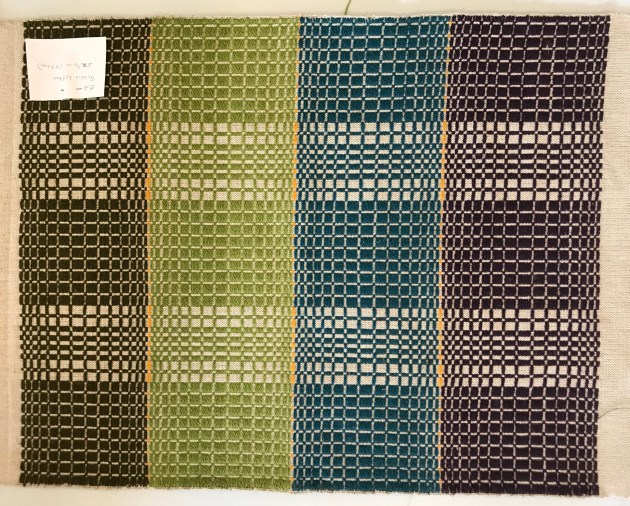
    Melba Granlund focused on spring in her linen pattern palette. Her comment when she sent her photo, “This is so fun!”

    Claire added fun and untraditional pattern weft. Shiny!

    Susan Mancini had fun playing at the loom, too. She wrote, “Here is my piece, about 2/3rds in. I wove 12 inches and then reversed the pattern for the 2nd 12”. My plan is to sew a small tote bag with this sample. I changed the tabby color in the large magenta block to a dark pink thinking it would be dramatic. But not so!! It hardly shows up at all. Interesting lesson.
    This was fun!” (Note: her e-mailed photo is not large enough to show it to advantage…)


    Brenda Gauvin-Chadwick said she wasn’t fond of her piece, as it turned out too Christmas-y, even when she added plain weave between bands.  But she noted that the experiment achieved one important purpose: “Great learning experience!”

    We’re in the home stretch, just a few more weavers to go on our cottolin warp.

  • More Weavers on the Monksbelt Warp

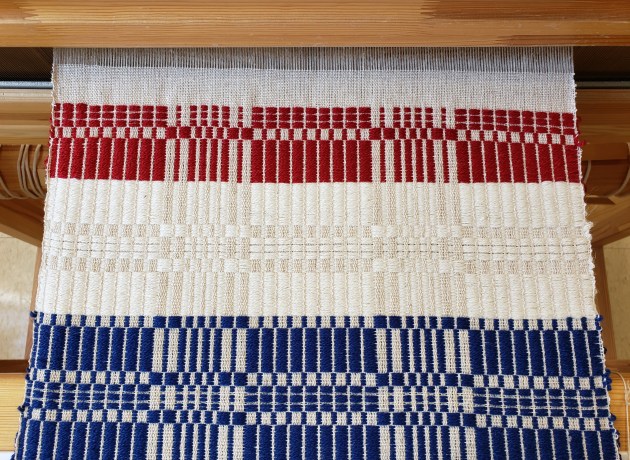
    Deb Reagen traveled all the way from Grand Forks to take her turn at the loom.  She reported that she kept it easy by weaving a repeating design. The colors in this portion have a patriotic flavor–either American or Norwegian.

    Sara Okern (andasmer.com) only wanted to take one day for her weaving, so she incorporated areas of plain weave to contrast with the monksbelt pattern.  The two shades of linen look particularly elegant.

    We are making steady progress!

  • Monksbelt–Lisa Bauch

    Lisa Bauch spent two days composing a birthday runner for her sister, with colors based on Linnea flowers that grow in Sweden.

    Note some small tails on the beautiful surface.  Lisa likes to leave tails formed when changing color or a bobbin on the front, rather than the back, before she snips them off.

    Judy Larson and I, on the first two pieces, wove a clean linen edge.  Lisa Torvik and Lisa Bauch added looped fringe. That hadn’t even occurred to me when I sat down to weave, but it is beautiful. It has a special charm on Lisa Torvik’s piece because she used so many colors.  You’ll have to wait to the end to see those loops, however; Lisa Torvik didn’t take a photo when she finished, and it is now hiding under the beam at the front of the loom.