Bio: Brenda Gauvin-Chadwick has loved textiles since she was a young child, sewing her own clothes, knitting, embroidering, and of course making pot holders on a pot holder loom. She learned to weave in her late 20s from a very talented Swedish weaver in upstate New York, and with the exception of taking a hiatus when her children were young has continued to weave. She belongs to the Minnesota Weavers Guild and studies Scandinavian techniques with Scandinavian Weavers Group.
Description: This piece in bound rosepath technique was woven as part of a group project by the Scandinavian Weavers. I was inspired by the beauty of Scandinavia in the winter. The pillow was woven with Fåro yarn that I purchased in Sweden many years ago. I carried it all over Scandinavia for weeks in my suitcase. I bought it after skiing the Swedish Vasaloppet. Two weeks later in Norway I skied the Birkebeiner race. The colors represent the forests, the beautiful sunshine and my heart exploding with joy as I skied along! The colors represent the forests, the beautiful sunshine and my heart exploding with joy as I skied along the breathtaking terrain.
Bio: Marilyn met a girl years ago who was a weaver , and thought that would be something she would like to do. She retired and met a weaver in a knitting shop who had a loom for sale—a four-harness Kessenich—so she bought it. Two books came with the loom: The Rag Rug Handbook, written by Janet Meany and Paula Pfaff, and A Handweaver’s Pattern Book, by Marguerite P. Davidson, printed in 1947. So she began! She also met Winnie Johnson, a weaver who helped her set up the loom and get started. By winter that year she joined the Weavers Guild of Minnesota and took a class. Marilyn is a self-taught weaver in many ways and always trying something new.
Description: I learned this technique in a class at the Weavers Guild of Minnesota. It is called rya.
About the Scandinavian Weavers Group: I love to see all the work that is shared each month and learn so much from that!
Bio: Jan Mostrom grew up on a dairy farm in Wisconsin. Before Jan started school, her grandmother taught her how to embroider. While she may have harassed her grandmother to teach her and preschool stitches are unique, this was the beginning of a lifelong love of textiles. While attending Luther College in Decorah Iowa, Jan took a January term class in weaving from Lila Nelson. After graduation, Jan used her savings to buy a used car and a loom. She has been weaving on that loom ever since. The car is long gone. Graduation was also followed by a wedding to her high school and college sweetheart Mike, and their two children and two grandchildren remain the center of her life and heart. Jan has taught Scandinavian weaving classes at Vesterheim Norwegian-American Museum for over 20 years and also has taught at the Weavers Guild of Minnesota, Minnetonka Center for the Arts and others including the first Norwegian Textile Conference. She has contributed articles to the Norwegian Textile Letter and organized an international weaving study group. She received her gold medal in weaving from Vesterheim Folk Art School in 1999. She has traveled to Scandinavia many times with Vesterheim textile tours and independently and has studied with Scandinavian weaving instructors in the United States, Norway and Sweden. Jan, along with weaving friend Janis Aune, has taught a small group of impoverished women in Tanzania how to weave rag rugs allowing them to support themselves and their children to attend school.
Description: Indigo Nights was woven as part of an earlier exhibition of textiles inspired by the Baldishol tapestry, one of the oldest surviving tapestry from Norway, dating from about 1100. I have always been attracted to the graphic style of the Baldishol with its interesting background designs and vibrant colors. The Baldishol represents April and May of what must have been a much larger tapestry. Taking my inspiration from the spotted sky of the May section, I wove a bold wool rug with wide stripes in various shades of indigo and circles of red, gold and white. The black and white triangle borders are another element found in the Baldishol. I dyed the wool with natural dyes that may have been used in the original weaving; indigo for blue, madder root for red and birch leaves for gold. The white and black wools are natural sheep colors.
Warp: 16/2 line linen, unbleached; tabby weft: 16/1 line linen, unbleached; Pattern Weft – Rauma Pridvevgarn, 2-ply wool
NFS
Bio: Shari Nelson learned to weave in the early 2000s but has done most of her weaving after retirement in 2020. She learned on a 4 shaft Norwood workshop loom during a class taught by Cathie Mayr at Nordic Living in Nisswa, MN. Shari has tried other techniques such as rigid heddle, tablet, card and tapestry weaving but her passion is for the more complicated floor loom projects. She continues to learn and develop drafts/color plans including those inspired by Scandinavian weaves past and present. Her looms are also used to produce utilitarian items and small wearables. Recently, she acquired a Glimakra 10 shaft countermarch loom that will open up a world of possibilities.
Description: I learned to weave this Telemarksteppe draft as part of the Scandinavian Weavers Group joint project on a pre-warped loom in April of 2023. As a relatively new weaver, this was the perfect opportunity for me to experiment with a countermarch loom and linen warp and ground weft with wool pattern yarn. The color inspiration is from a rug in my Scandinavian-decorated home in Baxter, MN. To use authentic Scandinavian materials, I chose Rauma Prydvevgarn yarn for the pattern yarn. Three colors of blue were used along with red, olive and gold as accents. I learned how to plan the color sequences and treadling by using a weaving software for the first time. The first couple of days were used understanding how the draft transferred to the woven cloth and adjustments were made as I wove. The “finger loop” edge trim was fun to do and easier than I imagined. It hangs in my dining room and is a constant reminder to me that anything can be accomplished if you have the desire to learn. Why name this piece Journey? This piece is a culmination of several exploration journeys to Norway, weaving software exploration to devise color, draft and treadling plans, collaboration with weaving friends and the desire to step out and just try it.
Regarding the Scandinavian Weavers Group: This Telemarksteppe project would not have happened for me if it wasn’t for the help and advice from members of the Scandinavian Weavers Group of the Weavers Guild of Minnesota. The linen being pre-warped and threaded was of utmost importance. Members answered so many questions for me about the draft and materials needed so I could be prepared. Lisa Torvik voluntarily came down on my first assigned weaving day to show me how to operate the Glimakra Loom since I had never used one before. Every night I went away tired but more confident. I live in Baxter, MN so it required me to stay at my son’s house to be able to do this project over four days. The staff was patient and encouraging and the space was a joy to weave in with ample space and light.
Bio: Jan Mostrom grew up on a dairy farm in Wisconsin. Before Jan started school, her grandmother taught her how to embroider. While she may have harassed her grandmother to teach her and her preschool stitches are unique, this was the beginning of a lifelong love of textiles. While attending Luther College in Decorah Iowa, Jan took a January term class in weaving from Lila Nelson. After graduation, Jan used her savings to buy a used car and a loom. She has been weaving on that loom ever since. The car is long gone. Graduation was also followed by a wedding to her high school and college sweetheart Mike, and their two children and two grandchildren remain the center of her life and heart. Jan has taught Scandinavian weaving classes at Vesterheim Norwegian-American Museum for over 20 years and also has taught at the Weavers Guild of Minnesota, Minnetonka Center for the Arts and others including the first Norwegian Textile Conference. She has contributed articles to the Norwegian Textile Letter and organized an international weaving study group. She received her gold medal in weaving from Vesterheim Folk Art School in 1999. She has traveled to Scandinavia many times with Vesterheim textile tours and independently and has studied with Scandinavian weaving instructors in the United States, Norway and Sweden. Jan, along with weaving friend Janis Aune, has taught a small group of impoverished women in Tanzania how to weave rag rugs allowing them to support themselves and their children to attend school.
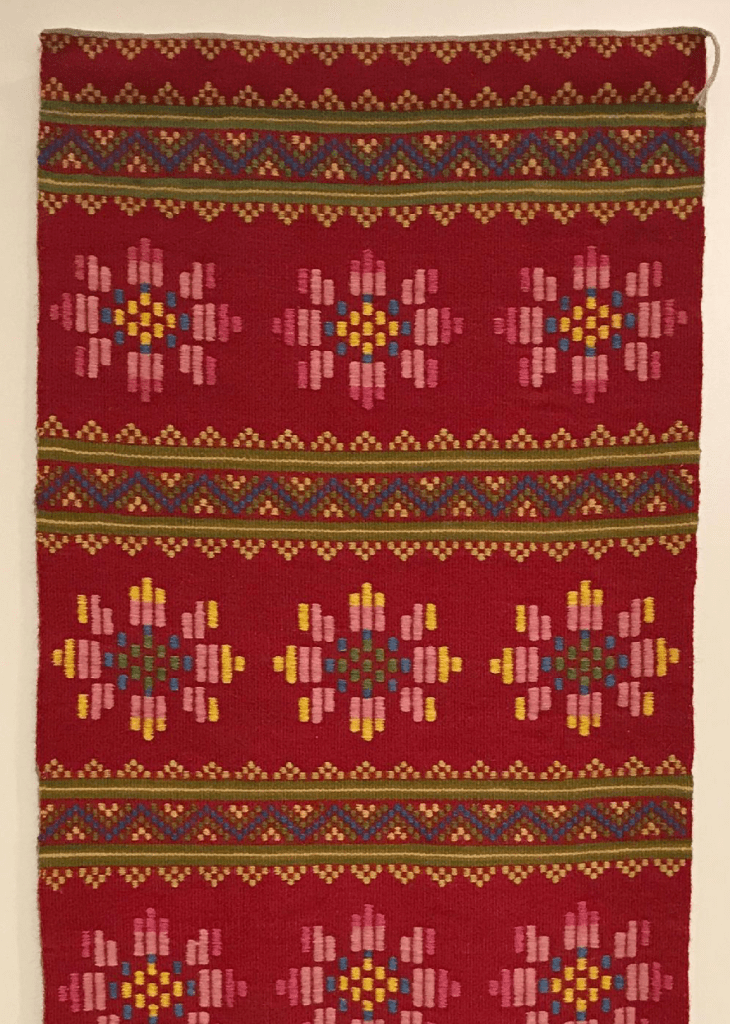
Description: Summer is inspired by the bright dance of light in summer gardens and by the basket of natural dyed yarns I had amassed over the years. I love the science and seeming magic of natural dyes. The red background was dyed with madder root and the rest of the yarns came from the basket of previous dyed yarns from flowers, leaves, cochineal, goldenrod and indigo. I wove the flowers in dukagång technique which creates columns and the rest of the patterns are woven in inlay technique similar to Vestfoldsmett creating a checked effect.
Regarding the Scandinavian Weavers Group: I have been a part of Scan Weavers for about 25 years. It has provided a wealth of inspiration, support and friendship. It is a safe place to ask questions and share. The depth of interest, research, knowledge is amazing as is the support and generousness of its members.
Bio: Kevin Olsen dabbled in weaving for many years but started in earnest about 15 years ago. He has taken a wide variety of classes from Peruvian scaffold weaving to Finnish raanu rugs, but his main interest is tapestry, especially the Scandinavian tradition. Kevin took his first billedvev class half-way through weaving The Wedding Anniversary. He is drawn to the graphic nature billedvev with its blocs of color often outlined in intricate joins. Tapestry appeals to him because one must think about each yarn as it is laid in and the excitement of seeing the picture appear as the weaving goes on.
Description: This piece is based on a traditional Scandinavian tapestry motif called The Betrothal. Since my husband and I were already married, I adapted the motif to celebrate our sixth wedding anniversary. It is woven in the traditional Norwegian billedvev technique. The wreath, hearts and tulips are traditional elements while the irises and peonies in the corners were flowers from our wedding. The six roses represent the six years we had been married. The symbol below the date is a Scandinavian rune which my husband gave me at our engagement. It symbolizes man, and according to some sources, means male friendship. The rectangle between us represents our wedding certificate. We were legally married in Iowa (Minnesota did not recognize same sex marriage at that time) a month before our church wedding on June 4, 2011 at Christ Church Lutheran in Minneapolis, MN.
Bio: Mandy Pedigo is a Minneapolis-based artist whose creative journey intertwines with the rich tradition of textiles, delving deep into themes of time, identity, history, memory, and our intrinsic connections to land and nature. She layers the familiarity and warmth of traditional crafts into her contemporary art. Her pieces serve as reflections on the essence of home and the comfort found within these time-honored practices. At the heart of her artistic exploration are intimate abstracted aerial maps and miniature landscapes, exploring both familiar and uncharted places.
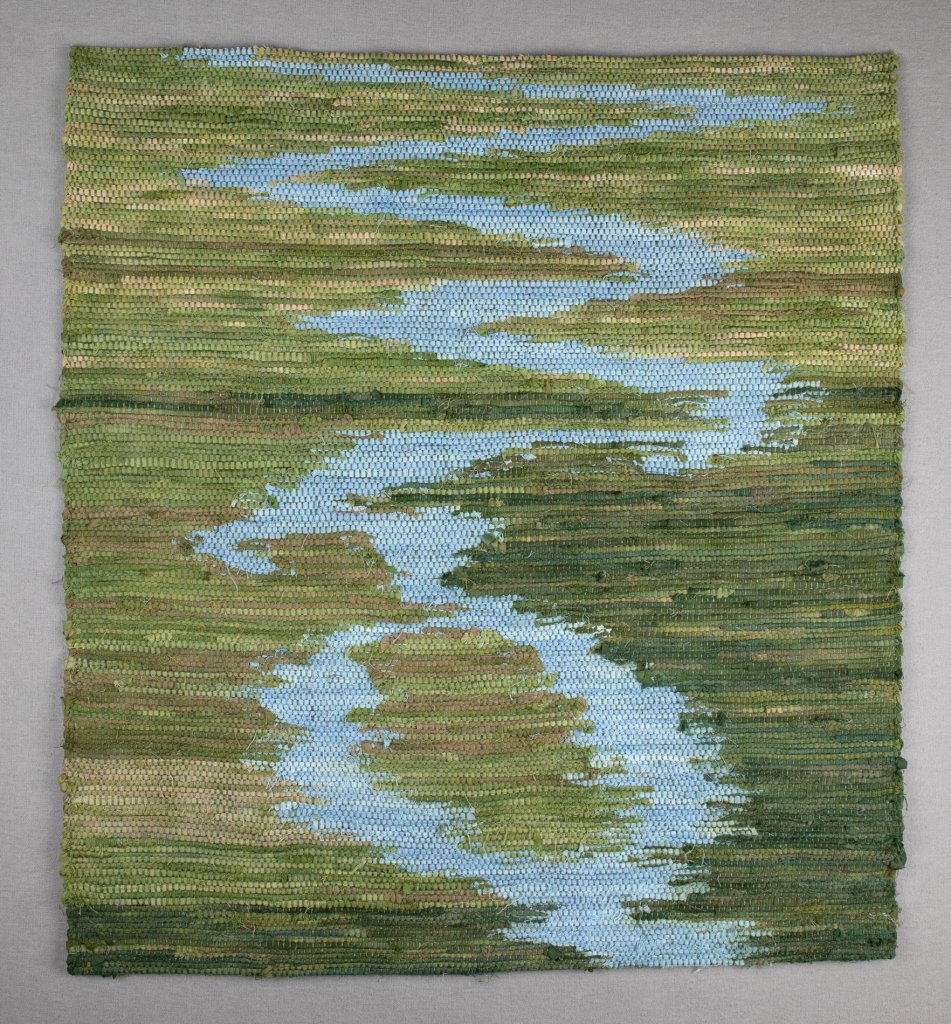
Description: In 2022, I migrated to the water-rich lands of Minnesota, a place that immediately felt like home. My great-grandparents’ immigration from Finland and Sweden, both countries abundant with lakes, echoes in my journey. Though much of their culture and language have faded, a lasting connection to nature remains as the sole cultural link passed down through generations. My family surname, which translates from Finnish as “the land endures,” guides my artistic exploration, bridging my family’s historic relationship with the land and the new connections I’ve formed in Minnesota. A significant influence on my latest work is the rag rug, a symbol deeply rooted in Nordic heritage and carried into the United States as a living tradition. Rag rugs are emblematic of resilience and resourcefulness, crafted from repurposed materials to create something both functional and beautiful. They evoke themes of domesticity and comfort, reflecting the warmth of home and the personal stories woven into everyday life. Traditionally made from worn clothing and household cloth, these rugs also symbolize memory and identity. The phrase “sweeping something under the rug” resonates with me, as it reflects how unresolved family traumas have obscured my family’s cultural identity—an identity I now seek to reclaim.
Regarding the Scandinavian Weavers Group: The study group has been an invaluable resource for connection, information, and historical knowledge. Whenever I hit a roadblock—whether it’s not knowing how to execute a technique, where to source materials, or even how to research a particular tradition—I know I can turn to the group. There’s always someone who either knows the answer or can point me in the right direction.
Nest (Golden-Winged Warblers are Happy in their Minnesota Habitat)
24″ x 52″ Wool warp and weft
NFS
robbielafleur.com Insta: robbie_lafleur
Bio: Robbie LaFleur, from Minneapolis, Minnesota, has been following a thread of Scandinavian textiles since she studied weaving at Valdres Husflidsskole in Fagernes, Norway in 1977. She has continued her study with Scandinavian instructors at workshops in Norway and the U.S. Recent projects include interpreting Edvard Munch’s “Scream” painting into a variety of textile techniques and weaving tapestry portraits of her relatives. She was awarded the Gold Medal in Weaving from the Vesterheim Norwegian-American Museum in 2006. Robbie coordinates the Weavers Guild of Minnesota Scandinavian Weavers Group and is the editor and publisher of the digital Norwegian Textile Letter.
In 2019 LaFleur was a fellow with the American Scandinavian Foundation and traveled to Stavanger, Norway, to study the wool open-warp transparent tapestry technique of Frida Hansen (1855-1931). (full resume here)
Description: The weaving was inspired by an article in the Star Tribune, “Minnesota’s forests a haven where rare bird still sings,” (10/28/2022) by Greg Stanley, part of an excellent series, “Our Vanishing North.” While news of environmental issues can generate feelings of hopelessness and loss, these articles also focused on dedicated people trying to address the habitats and polices needed to help species survive.
Golden-winged warblers winter in Central America, traveling 3500 miles each summer to northern Minnesota. Half of all golden warblers in existence breed in the forests of our state. I admire the on-the-ground attempts of conservationists to combat the increasing monoculture of forest areas to provide a more traditional mixed habitat needed for many plants and animals.
Nest is woven in wool open-warp transparent tapestry technique, first developed by Frida Hansen. She was a ground-breaking Norwegian artist on several levels. She reinvigorated historical tapestry weaving and the use of natural dyes during the National Romantic period in Norway, ran a school for tapestry weaving, directed one of the largest tapestry studios in Europe at the turn of the 20th century, and gained international fame for her large tapestries in Art Nouveau style. She also developed a patented technique for weaving “transparent” tapestries with wool warp and weft. Portions of the weavings, usually hung as portieres or curtains, were left unwoven, giving a see-through effect and an emphasis on positive and negative spaces in the images. Hansen’s transparent tapestries drew rave reviews at the Paris Exposition in 1900, and were purchased throughout Europe. Once her patent was released in 1906, many of her studio weavers and students also designed and wove transparencies.
I am writing a book on Frida Hansen and her unique transparency technique, to be published in 2026.
Bio: Robbie LaFleur, from Minneapolis, Minnesota, has been following a thread of Scandinavian textiles since she studied weaving at Valdres Husflidsskole in Fagernes, Norway in 1977. She has continued her study with Scandinavian instructors at workshops in Norway and the U.S. Recent projects include interpreting Edvard Munch’s “Scream” painting into a variety of textile techniques and weaving tapestry portraits of her relatives. She was awarded the Gold Medal in Weaving from the Vesterheim Norwegian-American Museum in 2006. Robbie coordinates the Weavers Guild of Minnesota Scandinavian Weavers Group and is the editor and publisher of the digital Norwegian Textile Letter.
In 2019 LaFleur was a fellow with the American Scandinavian Foundation and traveled to Stavanger, Norway, to study the wool open-warp transparent tapestry technique of Frida Hansen (1855-1931). (full resume here)
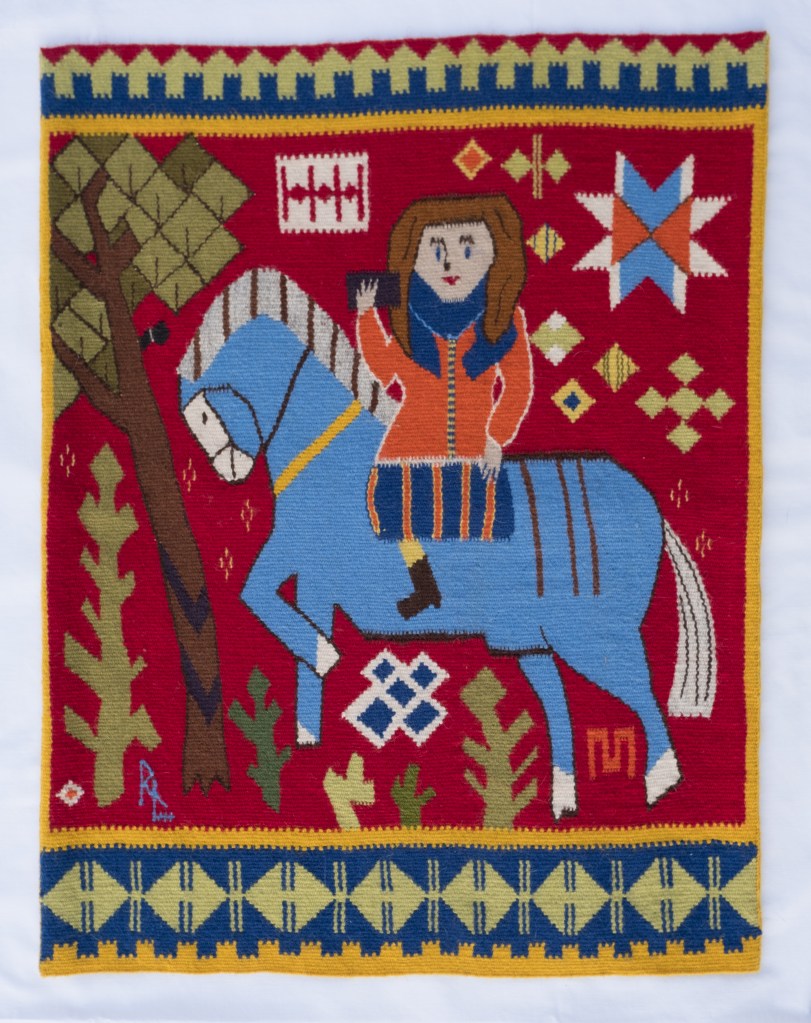
Description: I’ve always loved the blue and green and red horses depicted in Renaissance-era Norwegian tapestry, of billedvev. My blue horse is not ridden by a king, but by my daughter. Rather than a ruff around her neck, Margaret wears a signature scarf. In her hand is a cell phone. Many of the motifs surrounding the horse are taken directly from historical tapestries — but not the camera in the tree to the left. That represents the topic of all the podcasts I was listening to while weaving, our modern-day surveillance society. This post reads to several blog entries about elements of the tapestry, “Medieval Mash-up with Margaret, Finished.”
Bio: Lisa Torvik credits early influences of her mother, grandmothers, aunts and friends in the US and in Norway for her knitting, sewing, embroidery and weaving interests. She spent a year in her youth studying weaving at Valdres Husflidsskule in Fagernes, Norway and now focuses on projects in traditional Norwegian techniques and more contemporary applications.
Description: My Hordaland teppe is a half-width copy of my weaving school teacher’s full-sized coverlet, which again she had copied from an old threadbare coverlet. A classmate and I lay on our teacher’s living room floor for a couple days and drew the weaving order, shot for shot, on graph paper with colored pencils. We taped the sheets together into a long scroll. I continued as an “extra” student for another semester, able to pursue independent projects, and I wove it up from this scroll on a Monica loom that was free. It gave me nice clean lines.
Regarding the Scandinavian Weavers Group: I am happy to be a part of a group to which I can contribute what I have learned and I can in turn try my hand at techniques I am unlikely to set up on my own or have little experience with. Weaving is both a social and solitary occupation, and the Scandinavian Weavers Study Group encourages both learning and community.





 Scandinavian Weavers Study Group