Category: Uncategorized

  • The Weavers Guild Annual Benefit

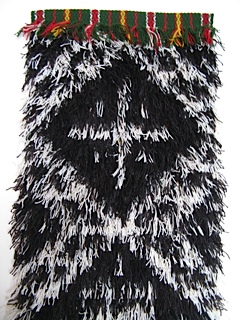
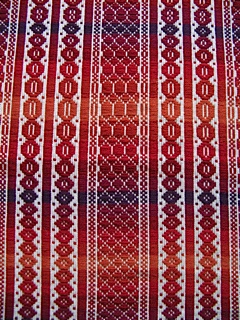
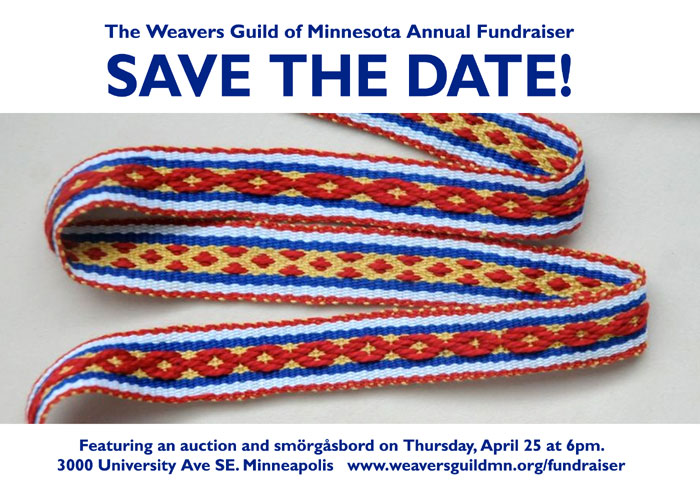
    One of Keith Pierce’s bands in the Scandinavian Weavers Study Group exhibit enjoys special status as the postcard image for the upcoming Weavers Guild of Minnesota benefit.  Here’s more information on the event on April 25 event, which features a live and silent auction and a smörgåsbord.

    postcard

  • Judy Larson

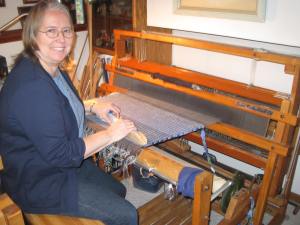
    Judy Larson has been weaving for ten years, and with the addition of an 8-shaft Glimakra in October, has managed to fill her living room with looms.  Patty Johnson said she dreamt Judy’s husband was sitting on a folding chair in the center of room, couches replaced with more looms.  “Not true – not yet!” Judy responded.  Still, Judy does manage to weave on several looms.  Overall, her favorite part of the weaving process is the discovery of color interactions when various weft yarns are used on the same warp.  “Even when I think I have planned it all out and have a prediction, I’m pleasantly surprised by the resulting combinations, so I like to put on a longer warp and do multiple projects in a variety of colors.”

    Judy’s new Glimakra 8-harness loom is used for finer warps; she’s used it for several Monk’s Belt pieces.  Now it is set up for rep weave placemats. “The ease of weaving on it allows me to easily create intricate patterns.”  The ergonomics of warping the Glimakra convinced her to purchase the loom.

    judy-with-loom

    A sturdy Fairloom rug loom from Sears shares her living room space.  She bought the used loom three years ago because it has a stronger “box” construction to weave rag rugs. With a huge stash of fabric, Judy will work on rugs for years, and enjoy surprising color interactions when weaving with a variety of fabrics.  She enjoys having two looms easily at hand.  “It is nice to have the options to choose each night if I want to do delicate patterns, or weave away some frustrations from the day with some good hard beats!”

    judy-at-loom-2

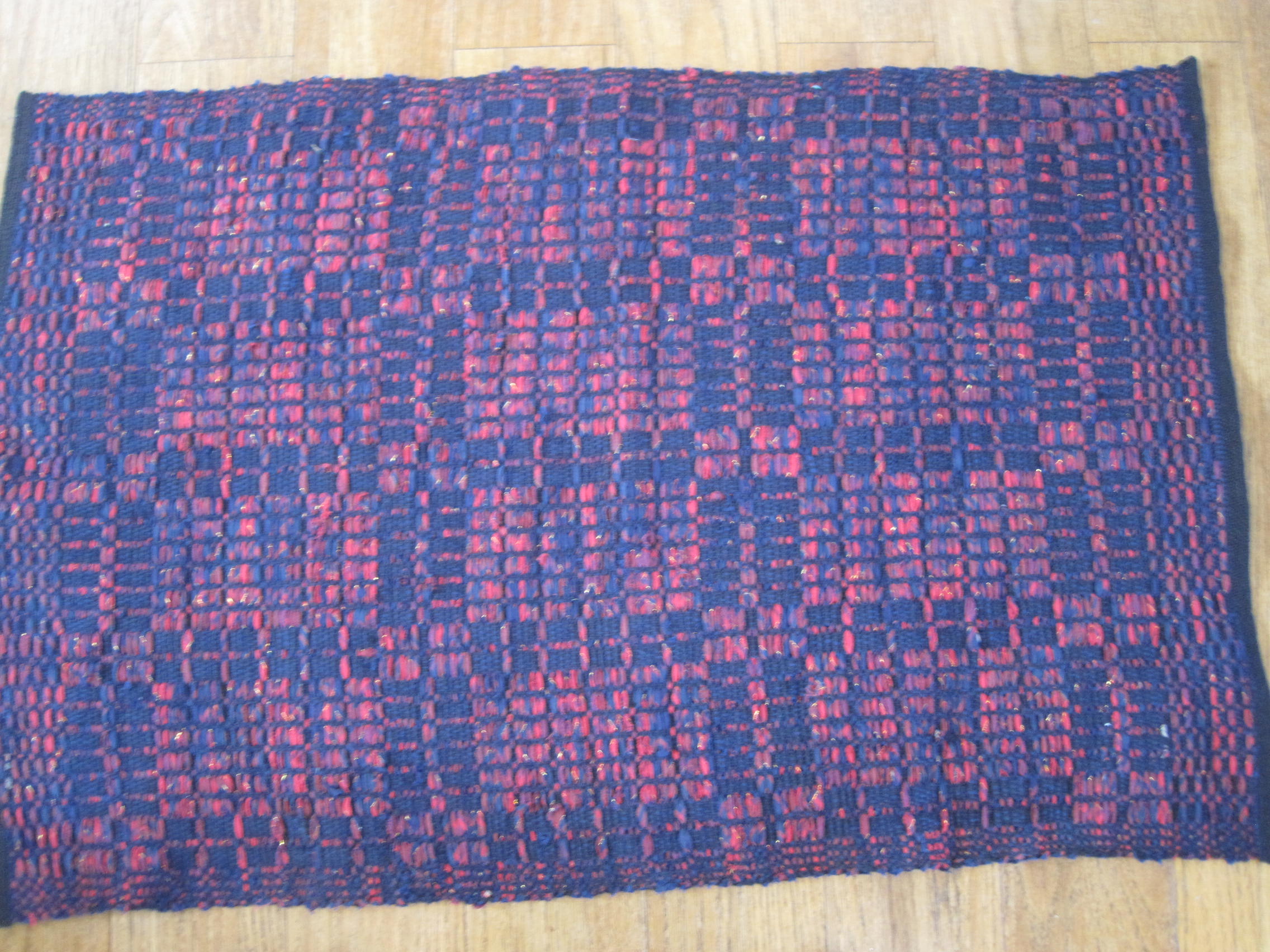
    Judy’s Monk’s Belt rug in the exhibit was woven on the Fairloom.  She was curious to see how fabric would work instead of the usual yarns, so she wove four rugs.  The navy plaid, with a sparkle of gold, was her favorite because it had the most subtle overall effect.

    judy-monksbelt-rug

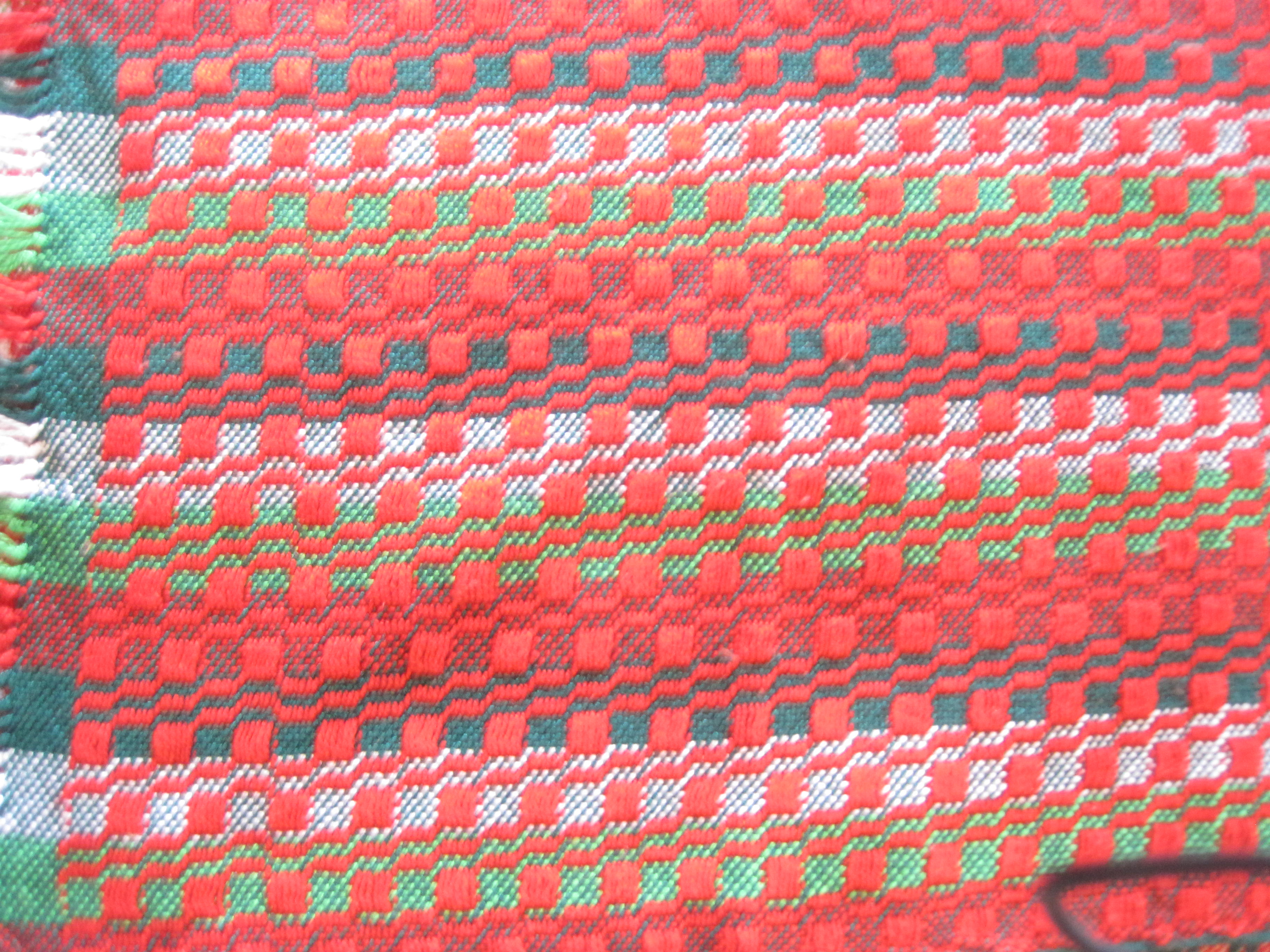
    Her Monk’s Belt runner is the opposite of subtle – a bright and festive Christmas runner.  It was made on the Glimakra with 3/2 pearl cotton.

    judy-monksbelt-3

    Judy can often be found at Patty Johnson’s shop, Color Crossing, where she uses more looms.  She warps an eight-foot Cranbrook loom for room-sized rugs. Her next rug will use a linen warp and wool weft in a shaft switching technique. It will grace her newest grandson’s room.  She also uses a 60-inch twelve-shaft Finnish Toika in the studio at the shop.

    Wait!  There’s more! Judy also still has her first loom, a four shaft LeClerc.  Are there enough hours in the day?

  • Jan Mostrom

    Jan Mostrom describes her ties to Scandinavian weaving techniques and to the Scandinavian Weavers Study Group:

    “I have been weaving since a January term class taught by Lila Nelson while I was attending Luther College.  Lila and Syvilla Bolson have been long time mentors for me and their knowledge and love for Norwegian techniques influenced my own excitement about Scandinavian textiles. I have loved being part of the Scandinavian Weaving Study Group because we inspire, share and support each other while working with different weaving themes.  It helps me to have a deadline and to want to push a technique in a new direction even though I love working within the traditional weaves.  I have also enjoyed teaching some of the weaving techniques at Vesterheim Norwegian American Museum and at the Minnesota Weavers Guild.”

    IMG_5254

    Jan has three pieces in the current exhibit.  In “Protection Rya,” the twill backing design was reproduced from a rya at Vesterheim.  The knot design was inspired by the protective symbols painted on the walls of a home in the Hardanger Museum.  She used Norwegian Rauma Aklea yarn in the warp, weft and knots.

    IMG_1468

    “Sunset Skillbragd” is done in the traditional Norwegian skillbragd technique, which requires two sets of shafts to weave.  One set is for weaving the plain weave ground and the other set of shafts is to weave the pattern.  Warps go through both sets of shafts.  This piece is woven with a fine cotton warp and Rauma prydvev for the pattern.

    IMG_5261

    IMG_5262

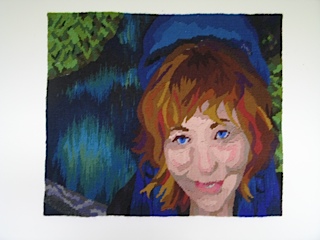
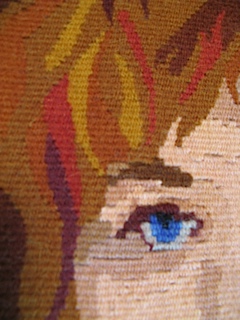
    “Backpacker Tapestry,” adapted from a photo of her daughter, was woven with a seine twine warp and mostly Rauma prydvev yarn for the weft.  Jan dyed the skin tones for the face with acid dyes.

    IMG_2409

    IMG_2399

    IMG_2289

  • Jane Connett

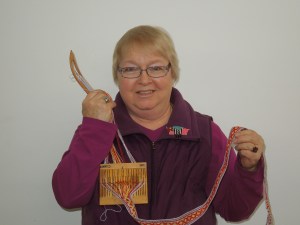
    Jane Connett’s Sami bands fit well into the exploration of Scandinavian weaving techniques, but were actually woven in the context of another Weaver’s Guild interest group, the Banditos. About three months ago, Jane suggested weaving Sami bands. Jane noted that her bands on exhibit are the successful ones, after abandoning other experiments with the wrong colors, wrong wool, or the sloppy work of experimentation.  She added, “Tying the warp up to different types of small looms has been a learning experience, as it mostly does not work to do the bands this way.  I have reluctantly admitted that I have to do them back strap to get the best results.”

    Of the Scandinavian Weavers Study Group, Jany wrote, “Scan Weavers keeps me going.  Everyone is creative, sharing and inspirational.  I know that I will never be in the position I would like for weaving… lots of room, light, time and equipment.  But I can dream, and on occasion can manage some small thing that gives me much joy.”
    jane-with-band-1

    In her weaving, Jane focuses on rigid heddle, tapestry, inkle and card weaving, and has multiple looms for all those techniques.  “I used to say you could never have too many looms… but I think I may have finally reached my limit.”

    Jane loves the hands-on pleasure of working with color and pattern, on and off the loom.  “I love Krokbragd.  I like designing small and larger intricate looking patterns and graphing them out and coloring them in. Then I see what changes I can make to the design, and then what happens when I change the colors, moving the darks and lights to another area.”  She hopes to get back to tapestry weaving. “Working that close to a design and having the wool in my hands brings me a supreme sense of joy.”

    Jane came to her love of weaving serendipitously.

    “I had a Girl Scout troop for 11 years and they wanted to do a ‘weaving badge’ in the spring of 1994.  Not knowing anything about weaving, I took my first class that summer at the old Guild building, on card weaving with Karen Searle.   After teaching this to the girls they wanted more, so I took beginning rigid heddle, and tapestry with Joanna Foslien.   Eventually, the girls in my troop learned about seven different techniques and sponsored a Weaving Weekend at a summer camp for around 400 young girls.   They demonstrated the different kinds of looms and weaving, and we provided prewarped cardboard looms for all of the attendees and their leaders.  It was a lot of work but a great success!!   I was hooked, but always short on time with a LOT of volunteering at that time in my life.”

    These days Jane’s weaving time is limited by her growing family; three granddaughters, including newly-born twins.  As soon as they are old enough to manage a warp, Jane will be the perfect weaving instructor!
  • It’s Up!

    Thanks to the hard work of Jan Mostrom, Keith Pierce, and Robyn Meadows, “Everything Under the (Midnight) Sun: Scandinavian Weavings” is up!  It happened just as in previous shows.  All the pieces were assembled in one spot this morning and the giant puzzle of placing them appropriately on the walls began.  Whoa!  The orange of one piece makes a second one look terrible.  Shuffling happens.  Then, magically, three pieces look marvelous together, with a harmony of color of pattern that enhances them all.  Maybe we have too many pieces.  But wait!  Jan’s tapestry looks perfect on the far orange wall.  Keith and Robyn carefully measured the walls and the pieces, and used the level on everything.  A few hours later, the pieces are nailed and tacked and shifted to the perfect positions, and once again the Scandinavian Weavers have a great show in place.

    Several bands are in the show, and they look smashing on black felt. One of Jane’s bands is still on the heddle, giving the viewers a sense of how it is made. Nancy Ellison’s “Band of Sheep” is below.

    IMG_3684

    Two pieces by Melba Granlund flank a tapestry by Sharon Marquardt.  What you don’t see is that they are above a blue sofa in a seating area, and the grouping looks as if it was custom woven for the space.

    IMG_3673

    The holiday red of Judy Larsen’s Monk’s Belt runner seemed too strong to hang near pieces with more neutral tones, but POPS with the black-and-white of Jan Mostrom’s rya and Keith’s Viking band.

    IMG_3671

    To be continued….

  • “The Sheep Farm” by Nancy Ellison

    nancy-krokbragd-sheepNancy Ellison’s  weaving has a soft surface and the natural brown, black, and gray shades of the xxx sheep on her southern Minnesota farm.  “The Sheep Farm” was woven on three harnesses with a krokbragd threading.  It was woven with handspun yarn on a Louet David loom with a sinking shed which Nancy prefers for weaving krokbragd. The wooly sheep emerge with unspun fleece tied with traditional rya knots.  The piece received honorable mention at the Vesterheim National Folk Art exhibit in 2012.

    nancy-floor-loom

    “Side by Side,” a band with sheep images, was woven with Ashford Tepako wool yarn.  For a band of this type, Nancy sometimes uses a Schacht inkle loom and other times a Glimakra band loom. She wove it as a krokbragd turned draft by adding a set of string heddles to get a third shed.

    nancy-spinning
    It’s a wonder that Nancy has time to weave and spin, with the responsibility of her farm and animals – sheep, ducks, chickens, goats, and a remarkable goose who looks like he is wearing a cap.

    She teaches spinning and weaving classes in an old barn on the farm.  The studio area has heavy timber walls, a magical space for a spinner or weaver, as you examine the new and antique looms and wheels lining the perimeter.  (And surprise! There are two long-haired rabbits tucked in a cage, too.)  The whitewashed round silo has been transformed into a gallery. Nancy is a dealer for a variety of spinning wheels and looms. You can – and should – visit “The Ellison Sheep Farm” open by appointment.

    Nancy is a former home economics teacher, and studied weaving during the summer of 1968. She has been a member of the Scandinavian Weavers Study group for many years.

    (More on a visit to Nancy’s farm here.)

  • Everything Under the (Midnight) Sun: Scandinavian Weavings

    Nils-Aslak_Valkeapää_Beaivi,_Áhcázan_The_Sun,_My_FatherThe Scandinavian Weaving Study Group of the Minnesota Weavers Guild is mounting a new exhibition, Everything Under the (Midnight) Sun: Scandinavian Weavings, to be displayed in the Community Gallery of the Textile Center of Minnesota, from March 15 – May 4.  Information about the pieces and the weavers will be posted in the coming weeks.

    Typically, the Study Group concentrates on a particular Scandinavian weaving technique for one or two years, culminating in an exhibit. Other times the group chose a theme on which to base a show, as in “Symbols, Myths, and Fairy Tales.” The 2013 display breaks from tradition. It gathers recent work by the weavers in a panorama of Scandinavian weaving techniques.

    The  weavers represented have varying degrees of experience; some are new to the craft, others have woven for decades.  The looms used range from simple heddles with a backstrap to complex floor looms. The common theme is enthusiasm for traditional Scandinavian weaving techniques as a way to create contemporary textiles.

    The show includes two tapestry pieces. One is based on a medieval Norwegian theme; the other uses similar techniques to depict a modern girl with a backpack, woven in hand-dyed yarns. Those familiar with Norwegian weaving will find pieces in familiar techniques; krokbragd, rutevev, skillbragd, and monk’s belt. Pieces are woven in cotton, fine linen, and wool, including hand-spun wool.  Sometimes traditional weave structures are used with unconventional materials, like fabric strips or pineapple bast.

    All visitors will find inspiring weavings with “Everything Under the Midnight Sun” represented in the latest Scandinavian Weavers exhibit.

    Contributors include Jane Connett, Keith Pierce, Patty Johnson, Judy Larson, Sharon Marquardt, Melba Granlund, Jan Mostrom, Nancy Ellison, Veronna Capone, Robyn Meadows, and Robbie LaFleur.

  • Lila Nelson Wrote About the Group in 2000

    Lila Nelson wrote about the Scandinavian Weavers Study Group in the November, 2001 issue, “Norwegian Textile Folk Arts Today.”

  • Sarah Williams’ Rosepath Rug

    The worship area of the Unitarian Society has huge windows opening onto a snowy city landscape.  Sarah Williams beautiful rosepath rag rug is the first piece you see when you walk through the rear doors into the narthex area.   The impressive scale and warm autumn colors of the rug create a wonderful first impression of the show.

  • Timeless Tradition

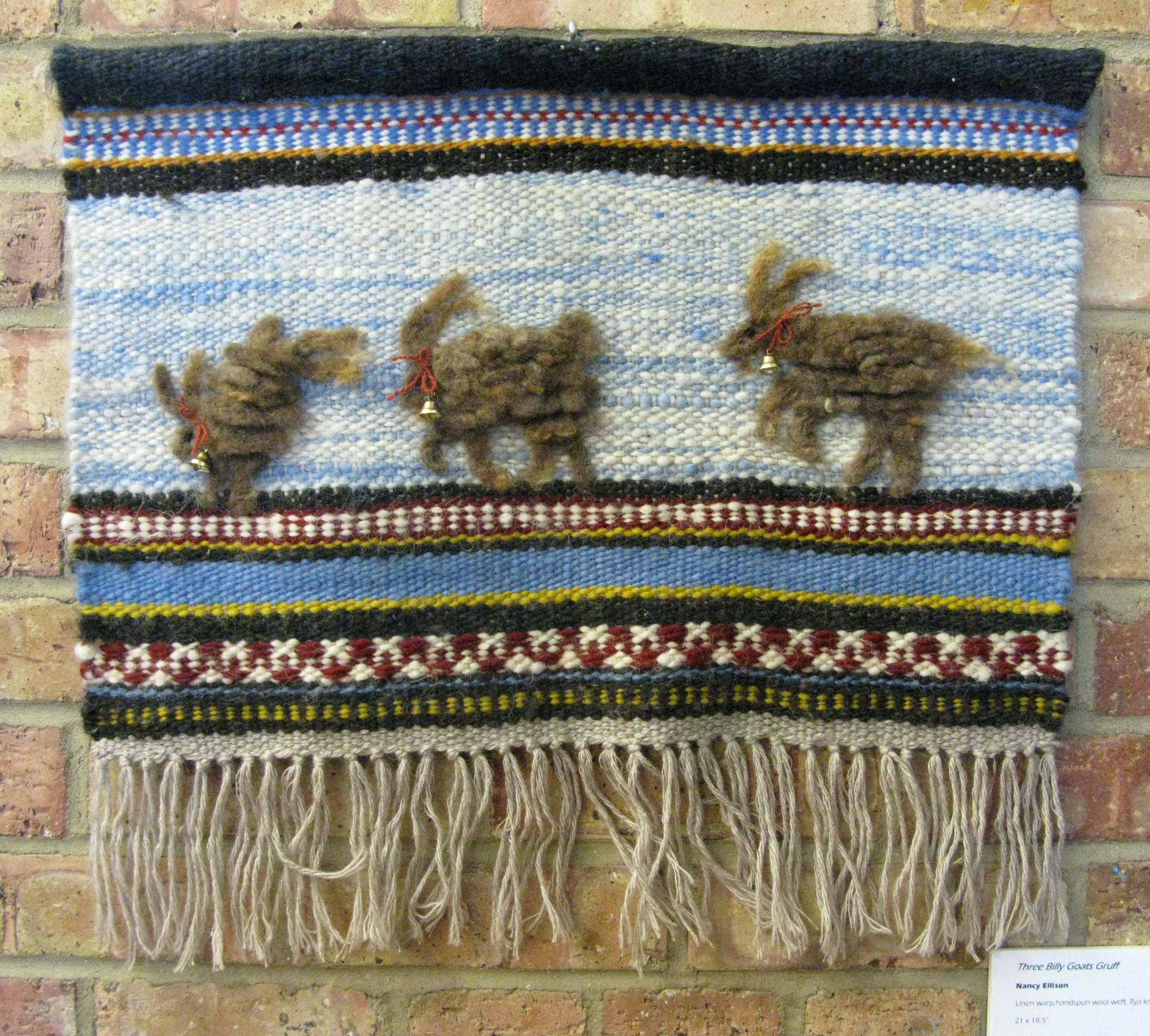
    The Timeless Tradition show up at the Unitarian Society looks great.  The textiles look wonderful against the brick walls.  I stopped in to take photos on the first Sunday after the show was hung; several people were around following the morning service.  They were so appreciative!  A man said to me, “I suppose you’re going to try to do that now!” – a friendly comment meant to convey how it would be amazing  that anyone could create such pieces.  “Oh, I have,”  I replied, “A couple of my pieces are here.”  Other people came up to me and thanked me.  Most pieces line two brick walls of the narthex area.  Nancy Ellingson’s “Three Billy Goats Gruff” is at the far end, hanging over the guest book on a podium.  Much of the wool in the piece is from Nancy’s own sheep, including the unspun wool of the charming sheep’s bodies.  (More photos of Nancy’s farm and sheep can be found here.)